Research Dossier
Primary Research:
Questionnaire:
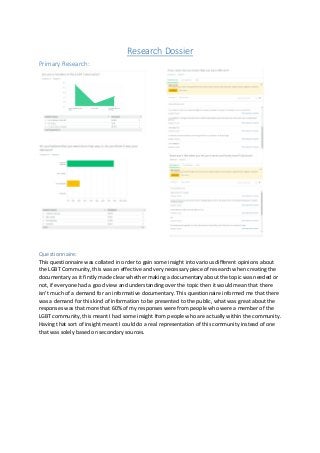
Thisquestionnaire was collated in order to gain some insight into various different opinions about
the LGBT Community, this was an effective and very necessary piece of research when creating the
documentary as it firstly made clear whether making a documentary about the topic was needed or
not, if everyone had a good view and understanding over the topic then it would mean that there
isn’t much of a demand for an informative documentary. This questionnaire informed me that there
was a demand for this kind of information to be presented to the public, what was great about the
responses was that more that 60% of my responses were from people who were a member of the
LGBT community, this meant I had some insight from people who are actually within the community.
Having that sort of insight meant I could do a real representation of this community instead of one
that was solely based on secondary sources.
2.
Interviews during Documentary:
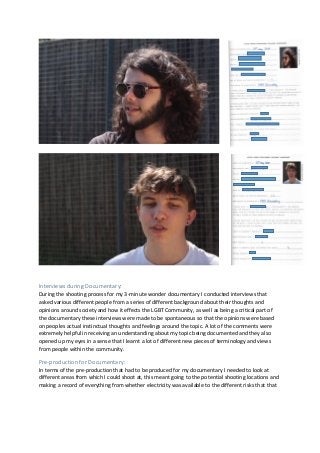
Duringthe shooting process for my 3-minute wonder documentary I conducted interviews that
asked various different people from a series of different background about their thoughts and
opinions around society and how it effects the LGBT Community, as well as being a critical part of
the documentary these interviews were made to be spontaneous so that the opinions were based
on peoples actual instinctual thoughts and feelings around the topic. A lot of the comments were
extremely helpful in receiving an understanding about my topic being documented and they also
opened up my eyes in a sense that I learnt a lot of different new pieces of terminology and views
from people within the community.
Pre-production for Documentary:
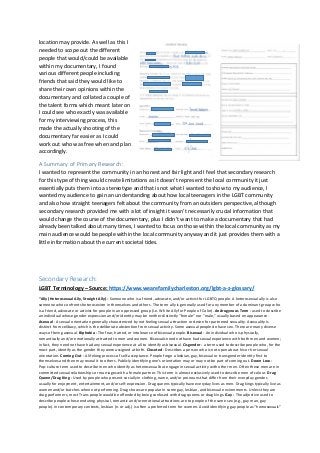
In terms of the pre-production that had to be produced for my documentary I needed to look at
different areas from which I could shoot at, this meant going to the potential shooting locations and
making a record of everything from whether electricity was available to the different risks that that
3.
location may provide.As well as this I
needed to scope out the different
people that would/could be available
within my documentary, I found
various different people including
friends that said they would like to
share their own opinions within the
documentary and collated a couple of
the talent forms which meant later on
I could see who exactly was available
for my interviewing process, this
made the actually shooting of the
documentary far easier as I could
work out who was free when and plan
accordingly.
A Summary of Primary Research:
I wanted to represent the community in an honest and fair light and I feel that secondary research
for this type of thing would create limitations as it doesn’t represent the local community it just
essentially puts them into a stereotype and that is not what I wanted to show to my audience, I
wanted my audience to gain an understanding about how local teenagers in the LGBT community
and also how straight teenagers felt about the community from an outsiders perspective, although
secondary research provided me with a lot of insight it wasn’t necessarily crucial information that
would change the course of the documentary, plus I didn’t want to make a documentary that had
already been talked about many times, I wanted to focus on those within the local community as my
main audience would be people within the local community anyway and it just provides them with a
little information about the current societal tides.
Secondary Research:
LGBT Terminology – Source: https://www.wearefamilycharleston.org/lgbt-a-z-glossary/
“Ally (Heterosexual Ally, Straight Ally) - Someone who is a friend, advocate, and/or activist for LGBTQ people. A heterosexual ally is also
someone who confronts heterosexism in themselves and others. The term ally is generally used for any member of a dominant group who
is a friend, advocate or activist for people in an oppressed group (i.e. White Ally for People of Color). Androgynous Term - used to describe
an individual whose gender expression and/or identity may be neither distinctly “female” nor “male,” usually based on appearance.
Asexual - A sexual orientation generally characterized by not feeling sexual attraction or desire for partnered sexuality. Asexuality is
distinct from celibacy, which is the deliberate abstention from sexual activity. Some asexual people do have sex. There are many diverse
ways of being asexual. Biphobia - The fear, hatred, or intolerance of bisexual people. Bisexual - An individual who is physically,
romantically and/or emotionally attracted to men and women. Bisexuals need not have had sexual experience with both men and women;
in fact, they need not have had any sexual experience at all to identify as bisexual. Cisgender - a term used to describe people who, for the
most part, identify as the gender they were assigned at birth. Closeted - Describes a person who is not open about his or her sexual
orientation. Coming Out - A lifelong process of self-acceptance. People forge a lesbian, gay, bisexual or transgender identity first to
themselves and then may reveal it to others. Publicly identifying one’s orientation may or may not be part of coming out. Down Low -
Pop-culture term used to describe men who identify as heterosexual but engage in sexual activity with other men. Often these men are in
committed sexual relationships or marriages with a female partner. This term is almost exclusively used to describe men of colour. Drag
Queen/Drag King - Used by people who present socially in clothing, name, and/or pronouns that differ from their everyday gender,
usually for enjoyment, entertainment, and/or self-expression. Drag queens typically have everyday lives as men. Drag kings typically live as
women and/or butches when not performing. Drag shows are popular in some gay, lesbian, and bisexual environments. Unless they are
drag performers, most Trans people would be offended by being confused with drag queens or drag kings. Gay - The adjective used to
describe people whose enduring physical, romantic and/or emotional attractions are to people of the same sex (e.g., gay man, gay
people). In contemporary contexts, lesbian (n. or adj.) is often a preferred term for women. Avoid identifying gay people as “homosexuals”
4.
an outdated termconsidered derogatory and offensive to many lesbian and gay people. Gender Expression - Refers to how an individual
expresses their socially constructed gender. This may refer to how an individual dresses, their general appearance, the way they speak,
and/or the way they carry themselves. Gender expression is not always correlated to an individuals’ gender identity or gender role.
Gender Identity - Since gender is a social construct, an individual may have a self-perception of their gender that is different or the same
as their biological sex. Gender identity is an internalized realization of one’s gender and may not be manifested in their outward
appearance (gender expression) or their place in society (gender role). It is important to note that an individual’s gender identity is
completely separate from their sexual orientation or sexual preference. Gender Neutral - This term is used to describe facilities that any
individual can use regardless of their gender (e.g. gender neutral bathrooms). This term can also be used to describe an individual who
does not subscribe to any socially constructed gender (sometimes referred to as “Gender Queer”).Gender Non-Conforming - A person
who is, or is perceived to have gender characteristics that do not conform to traditional or societal expectations. Gender/Sexual
Reassignment Surgery – Refers to a surgical procedure to transition an individual from one biological sex to another. This is often paired
with hormone treatment and psychological assistance. A “Transsexual” individual must go through several years of hormones and
psychological evaluation and live as the “opposite” or “desired” gender prior to receiving the surgery (see intersex). Gender Role - A
societal expectation of how an individual should act, think, and/or feel based upon an assigned gender in relation to society’s binary
biological sex system. Heterosexual - An adjective used to describe people whose enduring physical, romantic and/or emotional attraction
is to people of the opposite sex. Also straight. Homosexual - Outdated clinical term considered derogatory and offensive by many gay and
lesbian people. The Associated Press, New York Times and Washington Post restrict usage of the term. Gay and/or lesbian accurately
describe those who are attracted to people of the same sex. Homophobia - Fear of lesbians and gay men. Prejudice is usually a more
accurate description of hatred or antipathy toward LGBT people. Intersex - People who naturally (that is, without any medical
interventions) develop primary and/or secondary sex characteristics that do not fit neatly into society’s definitions of male or female.
Many visibly intersex babies/children are surgically altered by doctors to make their sex characteristics conform to societal binary norm
expectations. Intersex people are relatively common, although society’s denial of their existence has allowed very little room for intersex
issues to be discussed publicly. Has replaced “hermaphrodite,” which is inaccurate, outdated, problematic, and generally offensive, since it
means “having both sexes” and this is not necessarily true, as there are at least 16 different ways to be intersex. In the Life - Often used by
communities of color to denote inclusion in the LGBTQ communities. Kinsey Scale - Alfred Kinsey, a renowned sociologist, described a
spectrum on a scale of 0 6 to describe the type of sexual desire within an individual. 0 Completely Heterosexual – 6: Completely
Homosexual. In his 1948 work Sexual Behavior in the Human Male. The Kinsey Scale is often used to dissect the bisexual community and
describe the differences between sexual orientation and sexual preference. Lesbian - A woman who’s enduring physical, romantic and/or
emotional attraction is to other women. Some lesbians may prefer to identify as gay (adj.) or as gay women. LGBTQQIA - An acronym used
to refer to all sexual minorities: “Lesbian, Gay/Gender Neutral/Gender Queer, Bisexual/Bigender, Transgender/Transvestite/Transsexual,
Questioning/Queer, Intersex, and Allies/Androgynous/Asexual.” Lifestyle - Inaccurate term used by anti-gay extremists to denigrate
lesbian, gay, bisexual and transgender lives. As there is no one straight lifestyle, there is no one lesbian, gay, bisexual or transgender
lifestyle. Men Loving Men (MLM) - Commonly used by communities of colour to denote the attraction of men to men. Men Who Have Sex
with Men - men, including those who do not identify themselves as homosexual or bisexual, who engage in sexual activity with other men
(used in public health contexts to avoid excluding men who identify as heterosexual). Openly Gay - Describes people who self-identify as
lesbian or gay in their personal, public and/or professional lives. Also openly lesbian, openly bisexual, openly transgender. Outing - The act
of publicly declaring (sometimes based on rumor and/or speculation) or revealing another person’s sexual orientation or gender identity
without that person’s consent. Considered inappropriate by a large portion of the LGBT community. Pansexual - not limited in sexual
choice with regard to biological sex, gender, or gender identity. Queer - Traditionally a pejorative term, queer has been appropriated by
some LGBT people to describe themselves. However, it is not universally accepted even within the LGBT community and should be
avoided unless someone self-identifies that way. Questioning - The process of considering or exploring one’s sexual orientation and/or
gender identity. Sexual Orientation - The scientifically accurate term for an individual’s enduring physical, romantic and/or emotional
attraction to members of the same and/or opposite sex, including lesbian, gay, bisexual and heterosexual (straight) orientations. Avoid the
offensive term “sexual preference,” which is used to suggest that being gay or lesbian is voluntary and therefore “curable.” Sexual
Behavior - Refers to an individual’s sexual activities or actions (what a person does sexually). Though often an individual’s sexual
orientation is in line with their sexual behavior, it is not always the case. Sexual Minority - An all-inclusive, politically oriented term
referring to individuals who identify with a minority sexual orientation, sex identity, or gender expression/gender identity. Sexual
Preference - This term refers to an individual’s choice in regards to attraction. Sexual preference can be based on gender/sex, physical
appearance (height, weight, race, ethnicity), or emotional connection. It is important to note that sexual preference denotes a “choice”
and has a negative connotation when used to describe the LGBTQ population. Straight - Pop culture term used to refer to individuals who
identify as a heterosexual, meaning having a sexual, emotional, physical and relational attraction to individuals of the “opposite”
gender/sex. The term “straight” often has a negative connotation within the LGBTQ population, because it suggested that non
heterosexual individuals are “crooked” or “unnatural”. Transvestite - An umbrella term, which refers to people who wear the clothing of
the “opposite” gender. These individuals can be transgender, transsexual, cross dressers, Drag performers, or individuals who express
their gender in a unique way. This term is often thought to be outdated, problematic, and generally offensive, since it was historically used
to diagnose medical/mental health disorders. Women Loving Women (WLW) - Commonly used by communities of color to denote the
attraction of women to women. Zie & Hir -The most common spelling for gender neutral pronouns. Zie is subjective (replaces he or she)
and Hir is possessive and objective (replaces his or her).”
Questions that shouldn’t be asked: (Source: https://www.indy100.com/article/never-ask-gay-or-bi-
person-these-things-bad-questions-for-lgbt-community-riyadh-k-melanie-murphy-78303810)
• Who’s the man or woman in the relationship?
• Are you bi because you’re greedy?
5.
• Does yourpartner not worry about you cheating, because you’re bi?
• When did you realise you were gay or bi?
• Why do gay guys always have to be so feminine?
• Can you please stop rubbing your sexuality in our faces?
• Will you be my gay best friend?
History of the LGBT Community: (Source: https://en.wikipedia.org/wiki/LGBT_history)
It’s not always set in stone when the LGBT Community was begun but the term LGBT started being
used around 1988 when activists started fighting for equality. In 1990 the LGBT Community’s
categories Lesbian, Gay, Bisexual and Transgender were all seen to be equal within themselves.
Roberta Cowell was the first transgender person to undergo gender reassignment surgery during
1951. In 1967 sex between two men over the age of 21 was decriminalised in the USA as long as the
activities were in private. Pride, a well-known festival celebrating decriminalisation of certain laws
that limited what people in the LGBT Community had its first march on the 1st
July 1972. In 1992 the
World Health Organisation declassified homosexuality as a mental illness. In 2000 the LGBT
Community became widely popularised in western countries because of acceptance. On the 13th
of
March 2014 gay marriage within the UK was legalised.
LGBT Documentary Secondary Research:
For my documentary I needed to collate a couple of different sources of information that may help
to make my documentary as factual as possible, as my documentary was on a fairly opinion based
topic secondary research was quite difficult as no source of information was exceptionally factual
and was simply based on a particular viewpoint. I felt that a full list of terminology would be
extremely helpful as it meant I could use that terminology within the production of my
documentary, although when asking people on-shoot they said that they didn’t know the certain
terminologies themselves. It was informative to them but also showed that these pieces of
terminology weren’t common knowledge.
This is the same with the ‘Questions you shouldn’t ask’ research as it’s not necessarily an expert
opinion but it is what is considered social acceptable. Because of the LGBT movement being a quickly
changing societal shift there isn’t much that can be said factually about the topic so for this task I
had to rely on what is considered common knowledge.
With my short summary of the ‘History of the LGBT’ I felt this was a not so reliable but effective
source of information as it gave me a good insight into where the LGBT movement started,
Wikipedia isn’t the most reliable source of information as it is a public domain that can be edited by
almost everyone, although the information is monitored which ensures it isn’t being filled with
wholly false information. It meant that I had an insight into how far the community had come so I
knew what types of information would be appropriate for the audience but also the interviewees.
6.
Secondary Research forCorporate Video:
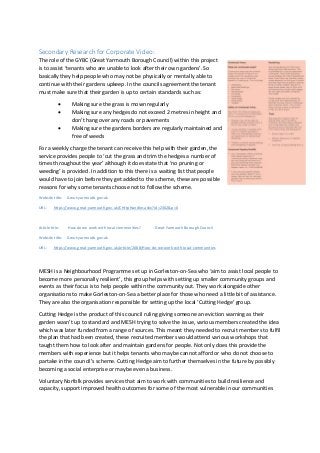
The role of the GYBC (Great Yarmouth Borough Council) within this project
is to assist ‘tenants who are unable to look after their own gardens’. So
basically they help people who may not be physically or mentally able to
continue with their gardens upkeep. In the councils agreement the tenant
must make sure that their garden is up to certain standards such as:
• Making sure the grass is mown regularly
• Making sure any hedges do not exceed 2 metres in height and
don’t hang over any roads or pavements
• Making sure the gardens borders are regularly maintained and
free of weeds
For a weekly charge the tenant can receive this help with their garden, the
service provides people to ‘cut the grass and trim the hedges a number of
times throughout the year’ although it does state that ‘no pruning or
weeding’ is provided. In addition to this there is a waiting list that people
would have to join before they get added to the scheme, these are possible
reasons for why some tenants choose not to follow the scheme.
Website title: Great-yarmouth.gov.uk
URL: https://www.great-yarmouth.gov.uk/CHttpHandler.ashx?id=2302&p=0
Article title: How do we work with local communities? - Great Yarmouth Borough Council
Website title: Great-yarmouth.gov.uk
URL: https://www.great-yarmouth.gov.uk/article/2088/How-do-we-work-with-local-communities
MESH is a Neighbourhood Programme set up in Gorleston-on-Sea who ‘aim to assist local people to
become more personally resilient’, this group helps with setting up smaller community groups and
events as their focus is to help people within the community out. They work alongside other
organisations to make Gorleston-on-Sea a better place for those who need a little bit of assistance.
They are also the organisation responsible for setting up the local ‘Cutting Hedge’ group.
Cutting Hedge is the product of this council ruling giving someone an eviction warning as their
garden wasn’t up to standard and MESH trying to solve the issue, various members created the idea
which was later funded from a range of sources. This meant they needed to recruit members to fulfil
the plan that had been created, these recruited members would attend various workshops that
taught them how to look after and maintain gardens for people. Not only does this provide the
members with experience but it helps tenants who maybe cannot afford or who do not choose to
partake in the council’s scheme. Cutting Hedge aim to further themselves in the future by possibly
becoming a social enterprise or maybe even a business.
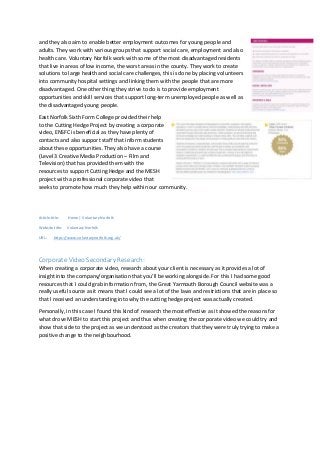
Voluntary Norfolk provides services that aim to work with communities to build resilience and
capacity, support improved health outcomes for some of the most vulnerable in our communities
7.
and they alsoaim to enable better employment outcomes for young people and
adults. They work with various groups that support social care, employment and also
health care. Voluntary Norfolk work with some of the most disadvantaged residents
that live in areas of low income, the worst areas in the county. They work to create
solutions to large health and social care challenges, this is done by placing volunteers
into community hospital settings and linking them with the people that are more
disadvantaged. One other thing they strive to do is to provide employment
opportunities and skill services that support long-term unemployed people as well as
the disadvantaged young people.
East Norfolk Sixth Form College provided their help
to the Cutting Hedge Project by creating a corporate
video, ENSFC is beneficial as they have plenty of
contacts and also support staff that inform students
about these opportunities. They also have a course
(Level 3 Creative Media Production – Film and
Television) that has provided them with the
resources to support Cutting Hedge and the MESH
project with a professional corporate video that
seeks to promote how much they help within our community.
Article title: Home | Voluntary Norfolk
Website title: Voluntary Norfolk
URL: https://www.voluntarynorfolk.org.uk/
Corporate Video Secondary Research:
When creating a corporate video, research about your client is necessary as it provides a lot of
insight into the company/organisation that you’ll be working alongside. For this I had some good
resources that I could grab information from, the Great Yarmouth Borough Council website was a
really useful source as it means that I could see a lot of the laws and restrictions that are in place so
that I received an understanding into why the cutting hedge project was actually created.
Personally, in this case I found this kind of research the most effective as it showed the reasons for
what drove MESH to start this project and thus when creating the corporate video we could try and
show that side to the project as we understood as the creators that they were truly trying to make a
positive change to the neighbourhood.