

A POLICY AUDIT ON
FERTILITYAnalysis of 9 EU Countries
March 2017
Supported by:
Sponsored by Merck KGaA,
Darmstadt, Germany,
as contribution to public policy debate.
Although the greatest care has been taken in the preparation and compilation of the Policy Audit on Fertility, no liability or responsibility of any kind
(to the extent permitted by law), including responsibility for negligence is accepted by partners namely, the European Society for Human Reproduction
and Embryology, Fertility Europe, Merck KGaA, Darmstadt, Germany, their servants or agents.
A POLICY AUDIT ON FERTILITY
ANALYSIS OF 9 EU COUNTRIES
3
TABLE OF CONTENTS
FOREWORD........................................................................................................................... 5
INTRODUCTION................................................................................................................ 7
KEY FINDINGS OF THE REPORT........................................................................... 8
ABOUT THE PARTNERS ........................................................................................... 12
METHODOLOGY............................................................................................................ 13
COUNTRY CHAPTERS................................................................................................ 15
The Czech Republic...................................................................................................... 16
France..................................................................................................................................... 20
Germany.............................................................................................................................. 24
Italy............................................................................................................................................28
Poland.....................................................................................................................................32
Romania................................................................................................................................ 36
Spain........................................................................................................................................ 40
Sweden.................................................................................................................................. 44
United Kingdom............................................................................................................. 48
ANNEXES..............................................................................................................................53
Annex I: Organisations and respective experts consulted........... 54
Annex II: Glossary......................................................................................................... 55
Annex III: Fertility Europe's Positions on Ethics,
Access to Treatment and Fertility Protection......................................... 56
Annex IV: References................................................................................................. 59
A POLICY AUDIT ON FERTILITY
ANALYSIS OF 9 EU COUNTRIES
A POLICY AUDIT ON FERTILITY
ANALYSIS OF 9 EU COUNTRIES
5
FOREWORD
It was without a moment’s hesitation that I made the decision to
support the Policy Audit on Fertility. I urge my fellow members of
the European Parliament to join me in advocating for the freedom
of citizens; freedom that cannot exist when education and access
to treatment remain unequitable. The right to family is protected
under Article 12 of the European Convention on Human Rights1
. It is
our duty to evolve our understanding of this right in light of today’s
realities. I invite you to read the main findings of this policy audit
so as to better understand infertility in the 21st
century, recognising
that infertility, while more prevalent, comes with solutions.
More than 25 million EU citizens are affected by infertility. One in
six couples worldwide experience some form of infertility. A full range of Medically Assisted
Reproduction (MAR) techniques have been developed to help infertile couples. However, due
to combining factors, including a lack of awareness, access and availability of treatments and
social stigma, many Europeans continue to face insurmountable barriers.
The consequences of not addressing the problem today are not only of a personal nature
(potential depressions, emotional and societal effects) but also impact society as a whole
by contributing to demographic decline in the EU. It is time to spread information and
raise awareness about fertility preservation and protection and that infertility is a medical
condition, not a choice. The public has the right to be educated on infertility and its treatment
options, in addition to being supported and empowered on their journey to have a child. The
time has come for us to recognise the right to have a child as part of an individual’s universal
human rights. To this end, adequate policy responses to infertility are part of a larger and
much needed solution to address the ageing population and demographic decline. 
We cannot remain silent in the face of problems when we are privileged to have solutions.
In the spirit of the foundations that we find ourselves here, participating in progressive
collaboration, we have an obligation to ensure equity in access to infertility services across
member states. While many actions will need to be taken in respective countries, much can
be done at EU level, including data collection, awareness raising, exchange of best practices
and formalised, constructive debates on this topic.
Norica Nicolai
ALDE, Romania
Member of the European Parliament
A POLICY AUDIT ON FERTILITY
ANALYSIS OF 9 EU COUNTRIES
Sponsored by Merck KGaA,
Darmstadt, Germany, as
contribution to public policy
debate and conducted on behalf
of Fertility Europe (FE) and the
European Society of Human
Reproduction and Embryology
(ESHRE) between March 2016
and January 2017. The findings
of the audit are the result of
targeted desk research, one-
to-one interviews, written
questionnaire responses and
written input from ESHRE and FE
national member associations
and respective experts.
Apart from local experts who
provided country-specific
information and perspectives
(see Annex I), special
acknowledgments go to Monika
Bulmańska-Wingett, Isabelle
Chandler, Elín Einarsdóttir and
Satu Rautakallio-Hokkanen from
Fertility Europe as well as Dr Roy
Farquharson, Helen Kendrew,
Dr Tatjana Motrenko and Bruno
Van den Eede from ESHRE, who
provided extensive review and
coordination to this project.
A POLICY AUDIT ON FERTILITY
ANALYSIS OF 9 EU COUNTRIES
7
INTRODUCTION
This report provides an overview of the situation and policies in place to
tackle infertility across a sample of nine EU member states, namely: the
Czech Republic, France, Germany, Italy, Poland, Romania, Spain, Sweden
and the United Kingdom.
I
nfertility is defined and recognised
by the World Health Organisation as
a medical condition characterised
by the failure to achieve pregnancy
after 12 months2
and without
investigations or treatment, it prevents
people from becoming parents3
. It is
estimated that one out of six people
worldwide experience some form of
infertility during their reproductive
lifespan. In the EU alone, infertility
affects approximately 25 million
citizens4
. While Medically Assisted
Reproduction (MAR) offers a full range
of techniques to assist infertile couples
or individuals, vast differences in
accessibility exist between the nine
countries examined in the report.
Treatments range in complexity from:
Intrauterine Insemination (IUI) and In
Vitro Fertilisation to Preimplantation
Genetics Diagnosis and Screening,
to gamete and embryo donation and
surrogacy.
From a demographic perspective,
the EU as a whole is in a phase
of population decline, further
underscoring the need for supporting
policies that address growth and
support families. To this aim, figures
on the Total Fertility Rate (TFR)5
have
been provided throughout Table 1.
EU9 Overview on Fertility, Age, Access,
Treatments and Funding, Table 2. EU28
Key Facts and Figures and in each
country chapter to support the reader’s
understanding. The TFR of the nine EU
member states included in this report
score between 1.32 (Spain and Poland)
and 2.01 (France) TFR, as compared to
the EU average of 1.58.
It is through this lens that the audit
brings together key facts about
important public health issues ranging
from: infertility policies, screening and
diagnosis, treatment availability and
awareness raising activities specific to
each country examined. Accordingly,
each country chapters includes a brief
overview of the situation followed
by detailed examination in six areas
of interest: 1) Key Facts and Figures;
2) Infertility Policies; 3) Screening
and Diagnosis; 4) Treatment and
Reimbursement / State Funding; 5)
Awareness Raising Activities and 6)
Future Outlook.
The report is intended to contribute to
a constructive discussion and support
a much needed exchange between
stakeholders and policy makers
with the aim to facilitate meaningful
progress for EU citizens.
A POLICY AUDIT ON FERTILITY
ANALYSIS OF 9 EU COUNTRIES
INFERTILITY
BY THE NUMBERS
„„ One in six couples worldwide experience some form of
infertility. Estimates suggest, more than 25 million EU
citizens are affected by infertility6
.
„„ There is a lack of updated comparative data on infertility
rates in the EU 28 and/or examined nine EU countries.
The calculation of data identified and reflected upon
in specific country chapters is based on different
methodologies and therefore does not allow for 	
proper comparison.
„„ Fertility rates differ significantly across the nine EU
countries examined, from Spain and Poland with a
rate of 1.32 to the UK (1.81), Sweden (1.88) and France
(2.01). Across the nine EU countries, the highest
fertility rate remains below the stabilising rate (2.1
live births per woman) necessary for maintaining
population size, according to Eurostat7
. Please see
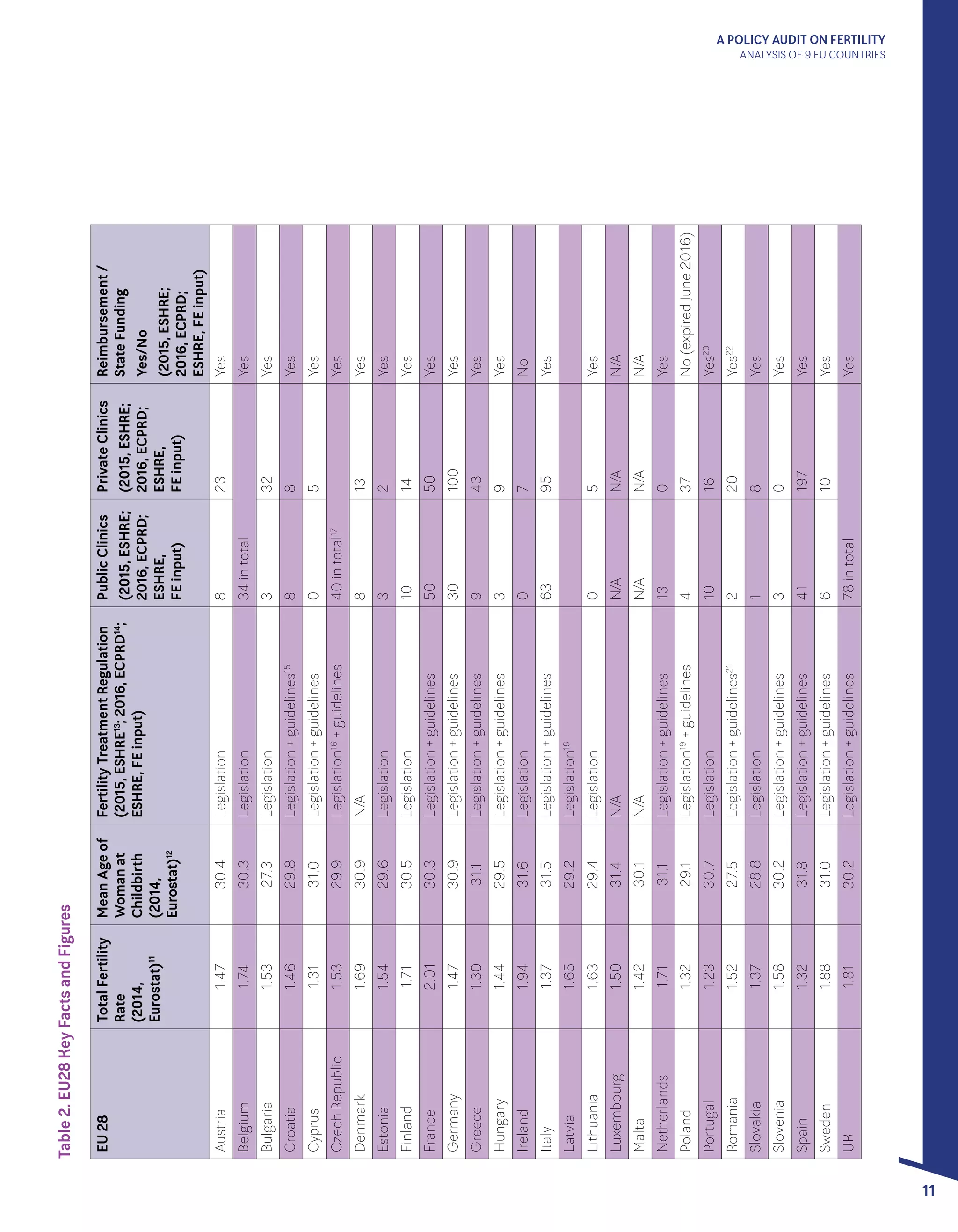
Table 2. EU28 Key Facts and Figures for an overview of
all EU member states.
HEALTH LITERACY,
STIGMA AND TABOOS
„„ Limited information and education on infertility
are common to all countries examined in this
study. Infertility and fertility protection remain
underestimated and misunderstood. Awareness raising
campaigns are mainly driven by patient groups and
healthcare professional organisations, with some
government involvement, as seen in Germany, France,
Italy and Sweden.
„„ Infertility stigma and taboos remains a considerable
issue to be addressed. Many experience difficulty
discussing infertility with their partner and/or
healthcare provider for cultural reasons or due to
prevailing perceptions that it is a social, rather than
medical, condition. Male infertility stigma was identified
in a recent Swedish report8
and a focal point in
awareness campaigns in the Czech Republic, Poland,
Spain and the UK.
KEY FINDINGS OF
THE REPORT
HIGH PREVALENCE OF
INFERTILITY
HIGH REGULATORY VARIATION
WITH RESPECT TO TREATMENT
AVAILABILITY
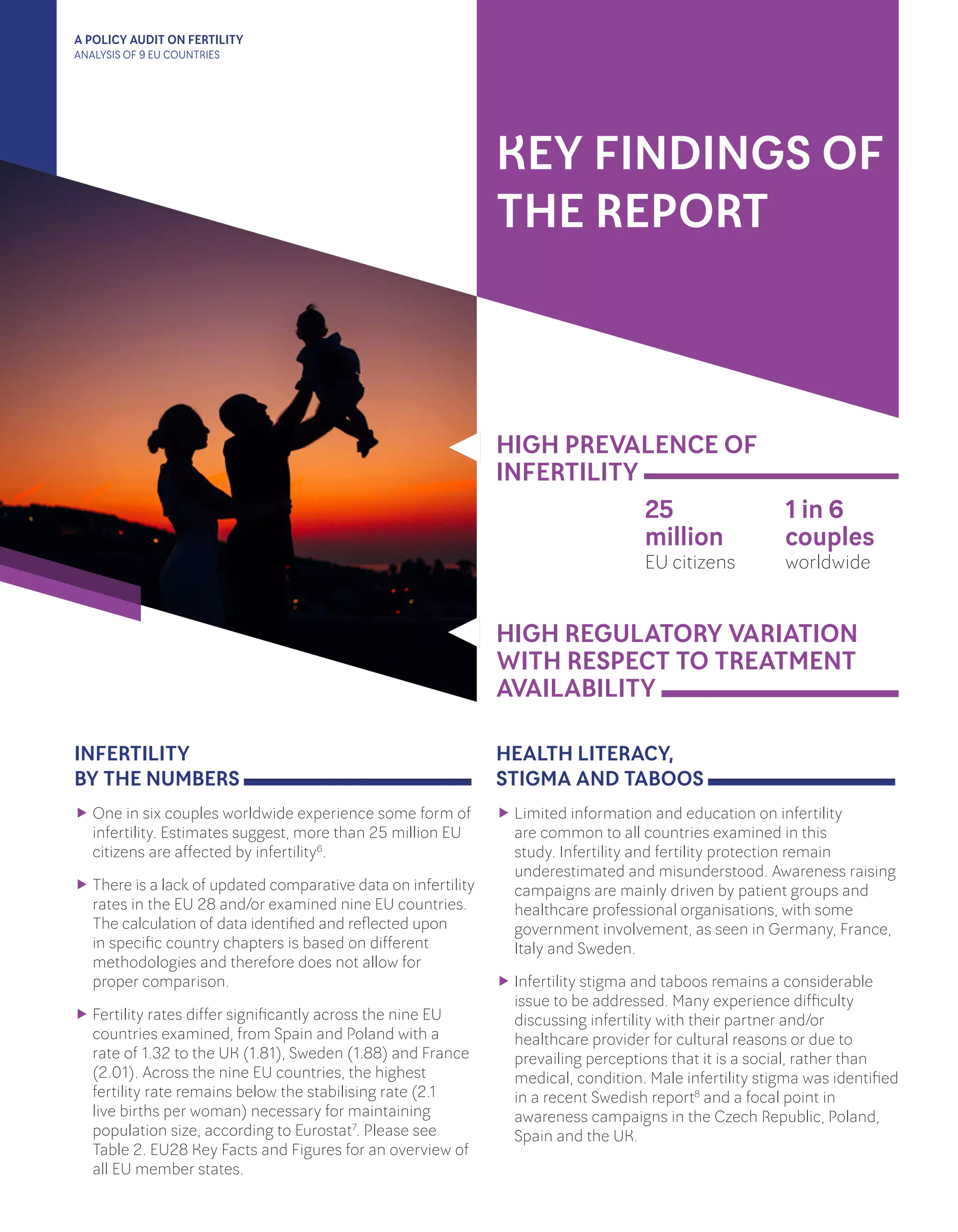
1 in 6
couples
worldwide
25
million
EU citizens
A POLICY AUDIT ON FERTILITY
ANALYSIS OF 9 EU COUNTRIES
9
INFERTILITY
LEGISLATION
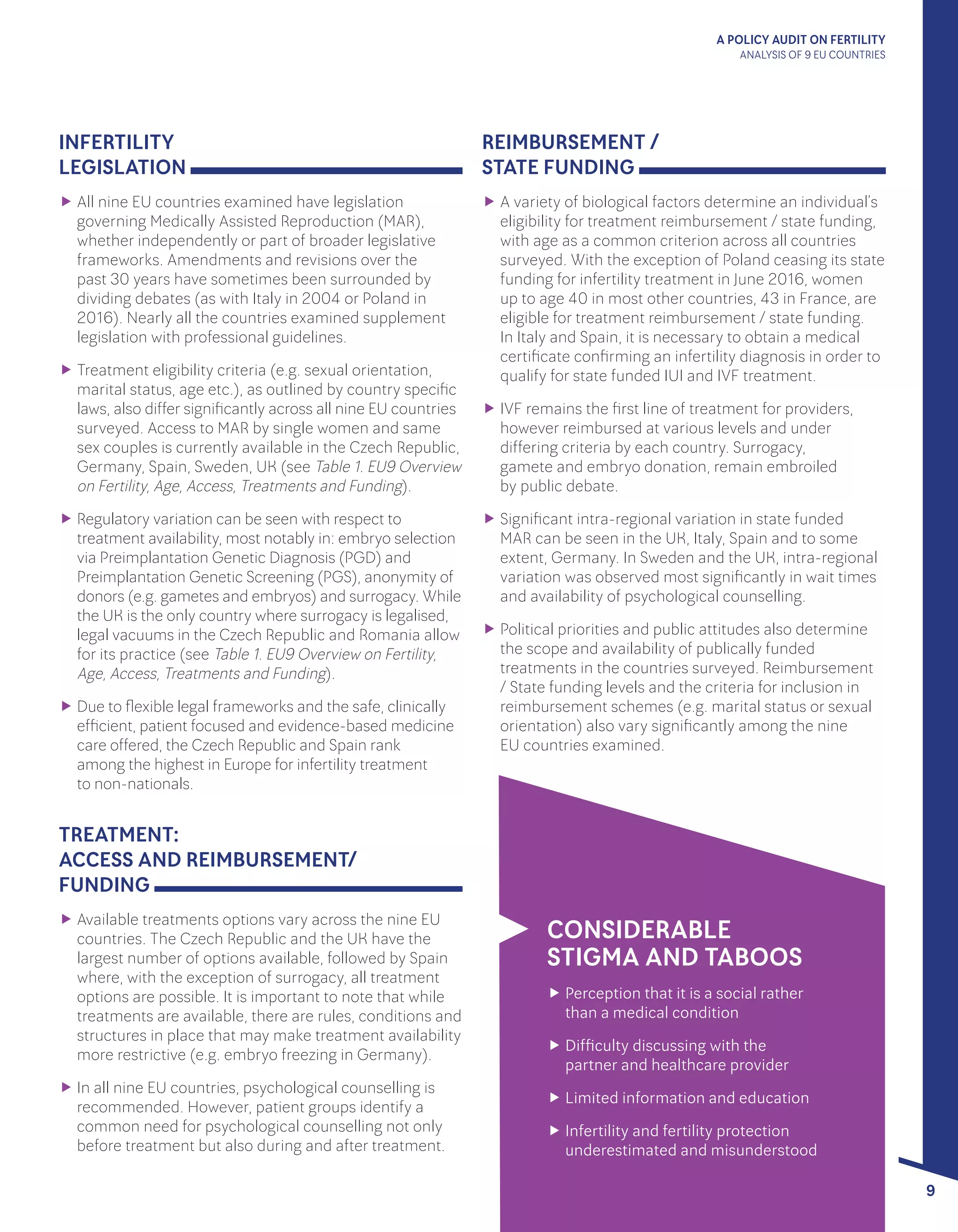
„„ All nine EU countries examined have legislation
governing Medically Assisted Reproduction (MAR),
whether independently or part of broader legislative
frameworks. Amendments and revisions over the
past 30 years have sometimes been surrounded by
dividing debates (as with Italy in 2004 or Poland in
2016). Nearly all the countries examined supplement
legislation with professional guidelines.
„„ Treatment eligibility criteria (e.g. sexual orientation,
marital status, age etc.), as outlined by country specific
laws, also differ significantly across all nine EU countries
surveyed. Access to MAR by single women and same
sex couples is currently available in the Czech Republic,
Germany, Spain, Sweden, UK (see Table 1. EU9 Overview
on Fertility, Age, Access, Treatments and Funding).
„„ Regulatory variation can be seen with respect to
treatment availability, most notably in: embryo selection
via Preimplantation Genetic Diagnosis (PGD) and
Preimplantation Genetic Screening (PGS), anonymity of
donors (e.g. gametes and embryos) and surrogacy. While
the UK is the only country where surrogacy is legalised,
legal vacuums in the Czech Republic and Romania allow
for its practice (see Table 1. EU9 Overview on Fertility,
Age, Access, Treatments and Funding).
„„ Due to flexible legal frameworks and the safe, clinically
efficient, patient focused and evidence-based medicine
care offered, the Czech Republic and Spain rank 		
among the highest in Europe for infertility treatment 	
to non-nationals.
TREATMENT:
ACCESS AND REIMBURSEMENT/
FUNDING
„„ Available treatments options vary across the nine EU
countries. The Czech Republic and the UK have the
largest number of options available, followed by Spain
where, with the exception of surrogacy, all treatment
options are possible. It is important to note that while
treatments are available, there are rules, conditions and
structures in place that may make treatment availability
more restrictive (e.g. embryo freezing in Germany).
„„ In all nine EU countries, psychological counselling is
recommended. However, patient groups identify a
common need for psychological counselling not only
before treatment but also during and after treatment. 	
	
REIMBURSEMENT /
STATE FUNDING
„„ A variety of biological factors determine an individual’s
eligibility for treatment reimbursement / state funding,
with age as a common criterion across all countries
surveyed. With the exception of Poland ceasing its state
funding for infertility treatment in June 2016, women
up to age 40 in most other countries, 43 in France, are
eligible for treatment reimbursement / state funding.
In Italy and Spain, it is necessary to obtain a medical
certificate confirming an infertility diagnosis in order to
qualify for state funded IUI and IVF treatment.
„„ IVF remains the first line of treatment for providers,
however reimbursed at various levels and under
differing criteria by each country. Surrogacy, 		
gamete and embryo donation, remain embroiled 	
by public debate.
„„ Significant intra-regional variation in state funded
MAR can be seen in the UK, Italy, Spain and to some
extent, Germany. In Sweden and the UK, intra-regional
variation was observed most significantly in wait times
and availability of psychological counselling.
„„ Political priorities and public attitudes also determine
the scope and availability of publically funded
treatments in the countries surveyed. Reimbursement
/ State funding levels and the criteria for inclusion in
reimbursement schemes (e.g. marital status or sexual
orientation) also vary significantly among the nine 	
EU countries examined.
CONSIDERABLE
STIGMA AND TABOOS
„„ Perception that it is a social rather
than a medical condition
„„ Difficulty discussing with the
partner and healthcare provider
„„ Limited information and education
„„ Infertility and fertility protection
underestimated and misunderstood
A POLICY AUDIT ON FERTILITY
ANALYSIS OF 9 EU COUNTRIES
Table1.EU9OverviewonFertility,Age,Access,TreatmentsandFunding
CountryTotalFertility
Rate
(2014,Eurostat)9
MeanAgeof
Womenat
Childbirth
(2014,Eurostat)10
LegalrighttoMAR
for:
TreatmentOptionsAvailable:
	
Reimbursement/
Statefunding
HSSSM&
NM
SW
CZ1.5329.9lllllllllllll
DE1.4730.9llllllllllU**Ul
FR2.0130.3lUlUlllllUl**Ul
IT1.3731.5lUlUlllllll**Ul
PL1.3229.1l*U*l*U*lllllll**UU
RO1.5227.5l*l*l*l*lllllll**Ul
SE1.8831.0lllllllllUU**Ul
SP1.3231.8lllllllllll**Ul
UK1.8130.2lllllllllll**ll
Legend:
lYes
UNo
MAR–MedicallyAssistedReproduction;HS:Heterosexual,SS:Samesex,M&NM:MarriedandNon-marriedcouples;SW:Singlewomen
CZ–TheCzechRepublic;DE–Germany;FR–France;IT–Italy;PL–Poland;RO-Romania;SE–Sweden;SP-Spain;UK–UnitedKingdom
Anexecutivesummaryoutliningthekeyfindingshasbeenincludedineachcountrychapter.
*PL-RightofSamesexcouplesandSinglewomenunderlegalvacuum.The“NationalProcreationProgramme”specificallyrefersto
marriedcouplesorcouplescohabitinginpartnership.;RO-Thisisdueinparttoabsenceoflegislation.
**DE-Eggdonationisnotpossible;Spermdonationisnon-anonymous;Embryofreezingisavailableonlyinemergency;FR-Donation
isanonymous;IT-Donationisanonymous;PL-Donationisanonymous;Thereisalegalvacuumconcerningsurrogacy;SP-Donationis
anonymous;SE-Embryodonationisnotpossible;Gametedonationisnon-anonymous;UK-Donationisnon-anonymous
Intrauterine
Insem
ination
(IUI),
In
Vitro
Fertilisation
(IVF),
Intracytoplasm
ic
Sperm
Injection
(ICSI),
Em
bryo
Freezing,Frozen
Em
bryo
Transfer(FET)
Preim
plantation
G
enetic
Diagnosis(PG
D),
Preim
plantation
G
enetic
Screening
(PG
S),
G
am
ete
Donation
Surrogacy
complexitylessmore
A POLICY AUDIT ON FERTILITY
ANALYSIS OF 9 EU COUNTRIES
11
Table2.EU28KeyFactsandFigures
EU28TotalFertility
Rate
(2014,
Eurostat)11
MeanAgeof
Womanat
Childbirth
(2014,
Eurostat)12
FertilityTreatmentRegulation
(2015,ESHRE13
;2016,ECPRD14
;
ESHRE,FEinput)
PublicClinics
(2015,ESHRE;
2016,ECPRD;
ESHRE,
FEinput)
PrivateClinics
(2015,ESHRE;
2016,ECPRD;
ESHRE,
FEinput)
Reimbursement/
StateFunding
Yes/No
(2015,ESHRE;
2016,ECPRD;
ESHRE,FEinput)
Austria1.4730.4Legislation823Yes
Belgium1.7430.3Legislation34intotalYes
Bulgaria1.5327.3Legislation332Yes
Croatia1.4629.8Legislation+guidelines15
88Yes
Cyprus1.3131.0Legislation+guidelines05Yes
CzechRepublic1.5329.9Legislation16
+guidelines40intotal17
Yes
Denmark1.6930.9N/A813Yes
Estonia1.5429.6Legislation32Yes
Finland1.7130.5Legislation1014Yes
France2.0130.3Legislation+guidelines5050Yes
Germany1.4730.9Legislation+guidelines30100Yes
Greece1.3031.1Legislation+guidelines943Yes
Hungary1.4429.5Legislation+guidelines39Yes
Ireland1.9431.6Legislation07No
Italy1.3731.5Legislation+guidelines6395Yes
Latvia1.6529.2Legislation18
Lithuania1.6329.4Legislation05Yes
Luxembourg1.5031.4N/AN/AN/AN/A
Malta1.4230.1N/AN/AN/AN/A
Netherlands1.7131.1Legislation+guidelines130Yes
Poland1.3229.1Legislation19
+guidelines437No(expiredJune2016)
Portugal1.2330.7Legislation1016Yes20
Romania1.5227.5Legislation+guidelines21
220Yes22
Slovakia1.3728.8Legislation18Yes
Slovenia1.5830.2Legislation+guidelines30Yes
Spain1.3231.8Legislation+guidelines41197Yes
Sweden1.8831.0Legislation+guidelines610Yes
UK1.8130.2Legislation+guidelines78intotalYes
A POLICY AUDIT ON FERTILITY
ANALYSIS OF 9 EU COUNTRIES
ABOUT THE PARTNERS
With member representation from
over 20 European countries, Fertility
Europe (abbreviated “FE”) is the Pan-
European organisation representing
infertility focused associations. FE
national organisations work tirelessly
to assist those with difficulties
conceiving. Their goal is to improve
the rights of individuals affected by
infertility by building stronger cross
border networks amongst European
patients. These synergies foster
the sharing of best practices, social
change in perception of infertility and
increase education in the protection
of reproductive health. FE’s work aims
to promote: patient empowerment,
the fight against health inequalities
and discrimination, the support
of quality care, patient safety and
patient centred treatments, as well as
the development of ethical guidelines
and regulations within each European
country.
For more information about FE, 		
visit: http://www.fertilityeurope.eu/.
The European Society of Human
Reproduction and Embryology
(abbreviated “ESHRE”) is a scientific
society incorporated as an
international non-profit organisation.
ESHRE’s main aim is to promote
interest in, and understanding of,
reproductive biology and medicine. It
does this through facilitating research
and the subsequent dissemination
of research findings in human
reproduction and embryology to the
general public, scientists, clinicians
and patient associations. It also
collaborates with politicians and
policy makers throughout Europe. It
promotes improvements in clinical
practice through organising teaching
and training activities, developing
and maintaining data registries and
providing guidance to improve safety
and quality assurance in clinical and
laboratory procedures.
For more information about ESHRE,
visit: https://www.eshre.eu/.
Merck KGaA, Darmstadt, Germany
is a leading science and technology
company in healthcare, life science
and performance materials. As
the world market leader in fertility
treatments it offers a complete
and clinically proven portfolio of
fertility treatments at every stage
of the reproductive cycle, and
combines this drug portfolio with its
continuously expanding offering of
innovative technologies. Merck KGaA,
Darmstadt, Germany has an enduring
commitment to improve treatment
outcomes for patients, in partnership
with their providers’, in accessing
treatment.
For more information about Merck
KGaA, Darmstadt, Germany visit:
http://biopharma.merckgroup.com/
en/index.html.
This project was funded by Merck KGaA, Darmstadt, Germany as contribution to public policy debate. To
ensure editorial integrity, in a Memorandum of Understanding with Fertility Europe (FE) and the European
Society of Human Reproduction and Embryology (ESHRE), Merck KGaA, Darmstadt, Germany signed
complete editorial control over the report to FE and ESHRE.
A POLICY AUDIT ON FERTILITY
ANALYSIS OF 9 EU COUNTRIES
13
METHODOLOGY
The Policy Audit on Fertility includes an examination of nine EU member
states: the Czech Republic, France, Germany, Italy, Poland, Romania,
Spain, Sweden and the United Kingdom. The country selection meant
to ensure a meaningful and balanced geographical scope of analysis.
The methodology of the report was to carry out research in a structured
approach that included: a pre-defined questionnaire, desk research,
interviews/written input and upwards of three revision cycles with the
lead partners, FE and ESHRE, their respective members and experts.
A
pre-defined questionnaire
was developed in collaboration
with the partners to guide
desk research and interviews.
Partners agreed to the following
headings, as representative of the
main areas of interest: Key Facts
and Figures; Infertility Policies;
Screening and Diagnosis; Treatment
and Reimbursement / State Funding;
Awareness Raising Activities; and
Future Outlook. For each heading,
a number of specific questions
were developed to facilitate the
harmonised collection of comparable
information, thus providing a
comprehensive assessment of the
situation in each country.
Desk research was carried out using
a range of internet sites including
national ministries, academic
institutes, professional and patient
associations, media articles and
approved reference documents.
Information was gathered from each
of the nine EU countries based on 	
the pre-defined questionnaire.
Interviews/written input were used
to build on desk research. Information
gathered from one-to-one interviews
and rounds of written input were
carried out with patient groups and
fertility specialists, representing
each of the nine countries surveyed.
FE member organisations from
the Czech Republic, France, Italy,
Poland, Romania, Sweden and the UK
participated in the interviews. Due
to lack of a local FE representative in
Spain and Germany, feedback into
their respective country chapters
were provided by the Wunschkind
association in Germany and Dr Diana
Guerra, Spanish Infertility Association
- Genera (dissolved in 2016). ESHRE
members from each of the nine EU
countries provided feedback via
written input or interviews. Interviews
were conducted according to the pre-
defined questionnaire and written
input on specific information was
coordinated by members in each
country. This process was used to
discuss and fact-check information
garnered through desk research,
as well as to asses and gather
opinions on the implementation of
a framework that optimally presents
the situation of the countries in focus.
Revision by the parties involved –
information collected through desk
research, complementary one-to-one
interviews and written input were
analysed and reviewed to create a
comprehensive overview, followed by
a 4-5 page in-depth assessment of
the situation in each of the nine EU
countries. The report then underwent
upwards of three review cycles by
members of FE and ESHRE, with
feedback incorporated into the report
you read today.
This report was produced by Burson-
Marsteller Brussels, a public affairs
and communication agency, on
behalf of the audit partners.
Disclaimer
The views and opinions expressed
in this audit report are exclusively
those of Fertility Europe (FE) and
the European Society of Human
Reproduction and Embryology
(ESHRE) and do not necessarily
reflect the official policies or positions
of stakeholders involved. This is in
keeping with the terms of agreement
for full editorial rights and control
by FE and ESHRE, as outlined in the
memorandum of understanding
between FE, ESHRE and its sponsor,
Merck KGaA, Darmstadt, Germany.
Content presented in this report is
not reflective of consultations with
government entities. Assertions
and statements provided by FE and
ESHRE are, as per the methodology,
the product of consultations with
their respective networks and
therefore should not be extended
beyond the intent for which this
report was originally conceived, a
current state assessment of infertility
in the nine EU countries surveyed.
A POLICY AUDIT ON FERTILITY
ANALYSIS OF 9 EU COUNTRIES
A POLICY AUDIT ON FERTILITY
ANALYSIS OF 9 EU COUNTRIES
15
COUNTRY
CHAPTERS
A POLICY AUDIT ON FERTILITY
ANALYSIS OF 9 EU COUNTRIES
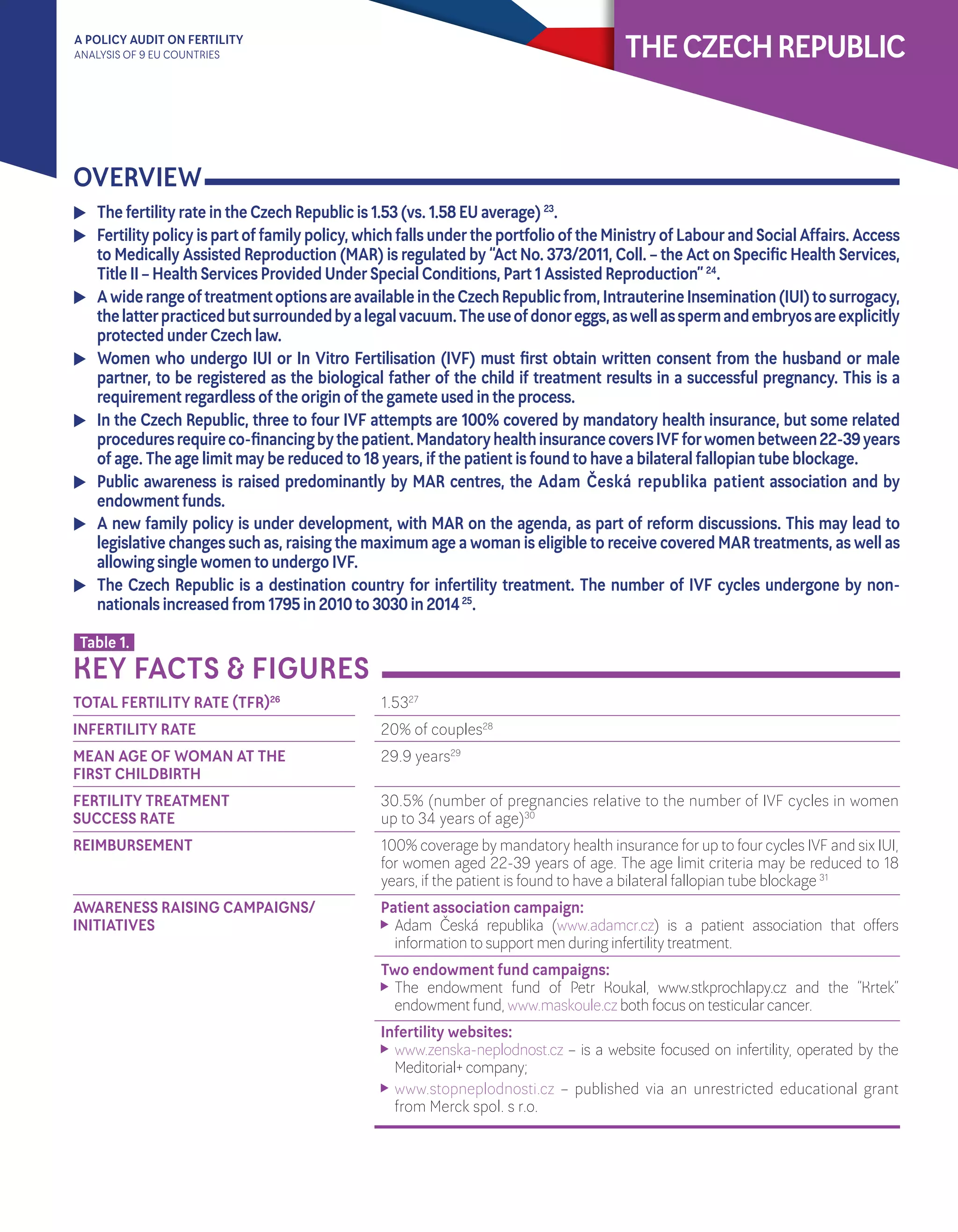
OVERVIEW
	 The fertility rate in the Czech Republic is 1.53 (vs. 1.58 EU average) 23
.
	 Fertilitypolicyispartoffamilypolicy,whichfallsundertheportfoliooftheMinistryofLabourandSocialAffairs.Access
to Medically Assisted Reproduction (MAR) is regulated by “Act No. 373/2011, Coll. – the Act on Specific Health Services,
Title II – Health Services Provided Under Special Conditions, Part 1 Assisted Reproduction” 24
.
	 AwiderangeoftreatmentoptionsareavailableintheCzechRepublicfrom,IntrauterineInsemination(IUI)tosurrogacy,
thelatterpracticedbutsurroundedbyalegalvacuum.Theuseofdonoreggs,aswellasspermandembryosareexplicitly
protected under Czech law.
	 Women who undergo IUI or In Vitro Fertilisation (IVF) must first obtain written consent from the husband or male
partner, to be registered as the biological father of the child if treatment results in a successful pregnancy. This is a
requirement regardless of the origin of the gamete used in the process.
	 In the Czech Republic, three to four IVF attempts are 100% covered by mandatory health insurance, but some related
proceduresrequireco-financingbythepatient.MandatoryhealthinsurancecoversIVFforwomenbetween22-39years
of age. The age limit may be reduced to 18 years, if the patient is found to have a bilateral fallopian tube blockage.
	 Public awareness is raised predominantly by MAR centres, the Adam Česká republika patient association and by
endowment funds.
	 A new family policy is under development, with MAR on the agenda, as part of reform discussions. This may lead to
legislative changes such as, raising the maximum age a woman is eligible to receive covered MAR treatments, as well as
allowing single women to undergo IVF.
	 The Czech Republic is a destination country for infertility treatment. The number of IVF cycles undergone by non-
nationals increased from 1795 in 2010 to 3030 in 201425
.
1.5327
20% of couples28
29.9 years29
30.5% (number of pregnancies relative to the number of IVF cycles in women
up to 34 years of age)30
100% coverage by mandatory health insurance forup to fourcycles IVF and six IUI,
for women aged 22-39 years of age. The age limit criteria may be reduced to 18
years, if the patient is found to have a bilateral fallopian tube blockage 31
Patient association campaign:
	Adam Česká republika (www.adamcr.cz) is a patient association that offers
information to support men during infertility treatment.
Two endowment fund campaigns:
	The endowment fund of Petr Koukal, www.stkprochlapy.cz and the “Krtek”
endowment fund, www.maskoule.cz both focus on testicularcancer.
Infertility websites:
	 www.zenska-neplodnost.cz – is a website focused on infertility, operated by the
Meditorial+ company;
	www.stopneplodnosti.cz – published via an unrestricted educational grant
from Merck spol. s r.o.
TOTAL FERTILITY RATE (TFR)26
INFERTILITY RATE
MEAN AGE OF WOMAN AT THE
FIRST CHILDBIRTH
FERTILITY TREATMENT 			
SUCCESS RATE
REIMBURSEMENT
AWARENESS RAISING CAMPAIGNS/
INITIATIVES
KEY FACTS & FIGURES
Table 1.
THECZECHREPUBLIC
A POLICY AUDIT ON FERTILITY
ANALYSIS OF 9 EU COUNTRIES
17
INFERTILITY
POLICIES The Institute of Health Information and
Statistics publishes an annual report
on assisted reproduction in the Czech
Republic, which includes the numberof
IVF procedures performed, prevalence by
diagnostic type and success rates43
.
	 The law does not require information
on sexual orientation ormarital status
in orderto access MAR44
. Fora woman
to undergo IUI orIVF, Czech law requires
written consent from the husband ormale
partnerwho has to agree to be registered
as a biological fatherof the child, if
treatment results in successful pregnancy.
This is a requirement regardless of the
origin of the sperm orembryo used in the
process. In the Czech Republic there is a
legal vacuum with respect to surrogacy,
as the law does not explicitly encourage,
orhave legal provisions discouraging it.
Underthis circumstance, surrogacy is
practiced in the Czech Republic45
.
	 It is estimated that 20% of couples in the
CzechRepublicareaffectedbyinfertility32
.
The fertility rate in the Czech Republic 	
is 1.53 (vs. 1.58 EU average)33
.
	 The Czech Republic’s fertility policy
is part of the “National Family Policy”,
which falls underthe portfolio of the
Ministry of Labourand Social Affairs.
Fertility and infertility are part of the
“National Program forthe Restoration
and Promotion of Health” underthe
section for“Improvement of Reproductive
Health” 34
. The National Program came
into effect in 1991 underthe Czech
Republic Government Resolution. The
“Health2020” program was approved by
the Government in 2012 and is currently
underway35
. The state policy also includes
the training of medical personnel (e.g.
introduction of a certified course in
accordance with “Decree No. 185/2009,
Coll. on Specialisation Areas in the
Education of Physicians and Pharmacists”
entitled “Reproductive Medicine Further
Education Program”)36
. Conferences,
seminars and courses on assisted
reproduction are also held both nationally
and regionally.
	 Access to Medically Assisted Reproduction
(MAR) is regulated by “Act No. 373/2011,
Coll. – the Act on Specific Health
Services, Title II – Health Services
Provided UnderSpecial Conditions, Part
1 Assisted Reproduction”37
. Otheracts
and subordinate acts relevant to this
Act include: “Act No. 227/2006, Coll., on
Research on Human Embryonic Stem
Cells and Related Activities”38
, “Act No.
296/2008, Coll., on Safeguarding the
Quality and Safety of Human Tissues
and Cells Intended forUse in Man”39
, “Act
No. 101/2000, Coll., on the Protection
of Personal Data”40
, and “Decree No.
116/2012, Coll., on the Transferof Data to
the National Health Information System
(NHIS)”41
, which outlines the binding
instructions of the NHIS.
	 A National Registry of Assisted
Reproduction (NRAR)42
was established
in 2007 to collect information for
the evaluation, management and
improvement of care forinfertile couples.
Data from the NRAR also supports MAR
policy development and treatment
options. The NRAR is part of the Institute
of Health Information and Statistics
of the Czech Republic, which is under
the purview of the Ministry of Health.
Data submissions are prospective and
mandatory forall providers of MAR.
17
A POLICY AUDIT ON FERTILITY
ANALYSIS OF 9 EU COUNTRIES
“
“
Screeninganddiagnosis
intheCzechRepublicis
advancinghandinhand
withtheachievementsof
science.Gynaecological
screeningandwomen’s
healthcareintheCzech
Republicaregenerally	
top-quality.Infertility
diagnosisistoagreat
extentcoveredby
mandatoryhealth
insuranceregardless	
ofage,andisalsoof		
averyhighquality.
Adam Česká republika
patient association,
Czech Republic	
August 2016	
SCREENING AND
DIAGNOSIS
TREATMENT AND
REIMBURSEMENT /
STATE FUNDING	 There is an assortment of screening and
diagnostic options forpatients in the
Czech Republic46
.
	 Common female infertility diagnostic
techniques include: ultrasound
examination of the pelvis, testing of
hormone levels, X-ray examination
of the uterus and fallopian tubes
(hysterosalpingography orHSG for
short), hysteroscopy, laparoscopy testing,
genetic testing and immunological
examination47,48
.
	 Common male infertility diagnostic
techniques include: sperm cultivation,
andrology testing, sperm acrosome
integrity testing, DNA fragmentation
	 of sperms, genetic testing,
immunological examination and
hormonal examination49
.
	 However, the numberof follow-up
examinations covered by mandatory
health insurance is limited. They
include, forexample: seven ultrasound
examinations peryear, fourcervical
mucus examinations permonth, one
spermiogram examination every three
months, etc.50
.
	 Gynaecologists, urologists orandrologists
are usually the first point of contact for
couples seeking infertility treatment, 	
but patients may also contact a MAR
centre directly.
	 Gynaecologists typically referpatients
forspecialised examinations and to MAR
centres. Once infertility is diagnosed,
receiving treatment is generally quick 	
and easily accessible51
.
	 A wide variety of treatments are
available in the Czech Republic. Patients
undergo infertility treatments such
as: IVF, transcervical embryo transfer
and cryopreservation of gametes and
embryos52
to name a few. Embryos are
examined genetically and continuously
monitored using an embryoscope in an
incubator. Surveillance facilitates early
detection of irregularities in embryo
development, as well as the selection
of the embryos that will undergo
gestation53
.
	 The law allows forthe use of donor
eggs, sperm and embryos54
. While not
explicitly defined by law, surrogacy is
practiced in the Czech Republic55
.
	 Mandatory health insurance entitles a
patient to three to fourcycles of IVF and
six cycles of IUI at 100% coverage56
.
However, some treatment related
procedures, such as: Intracytoplasmic
Sperm Injection (ICSI), Preimplantation
Genetic Diagnosis (PGD), Embryo
Cryopreservation, thawing and
subsequent Frozen Embryo Transfer
(FET) are not covered by mandatory
health insurance.
	 MAR is available forwomen of
childbearing age, provided theirhealth
allows fortreatment. Mandatory health
insurance covers IVF forwomen between
22-39 years of age. The age limit may
be reduced to 18 years, if the patient is
found to have a bilateral fallopian tube
blockage57
. IVF is not currently covered
forwomen of the age of 40 and above58
.
	 Mandatory health insurance coverage
includes procedures related to
IVF treatment, as well as certain
examinations priorto starting IVF.
However, in orderto receive 100%
IVF coverage, the patient must agree
to take complementary drugs. If the
patient chooses not to comply, he/she
is required to co-finance the drugs used
during IVF. Surcharges forthese drugs
range from approximately CZK 3,000
– CZK 10,000 (approximately EUR 110 –
EUR 370)59,60
.
A POLICY AUDIT ON FERTILITY
ANALYSIS OF 9 EU COUNTRIES
19
Table 2. Treatment Options Available
in the Czech Republic
Intrauterine Insemination (IUI)
In Vitro Fertilisation (IVF)
Intracytoplasmic Sperm Injection (ICSI)
Embryo Freezing; Frozen Embryo Transfer
(FET)
Preimplantation Genetic Diagnosis (PGD)
Preimplantation Genetic Screening (PGS)
Microsurgical Epididymal Sperm Aspiration
(MESA); Testicular Sperm Extraction (TESE)
Gamete Donation
Surrogacy
“
“
TheMARsituation,
accessibility,qualityof
screeningandtreatment
isverygoodintheCzech
Republic.However,the
socialcontextofMARis
generallyunderestimated.
Adam Česká republika
patient association,
Czech Republic	
August 2016	
AWARENESS 		
RAISING 		
ACTIVITIES
FUTURE 			
OUTLOOK
	 Women outside of the eligible age range
must coverall costs independently. The
price of one IVF cycle (including drugs) 	
is around CZK 45,000 (approximately
EUR 1,665)61
.
	 Access to certain MAR treatments
may be limited by a patient’s ability
to pay62
. This is due in part to how
the financing was initially established
during the 1990’s. Since then, science
and medicine have evolved to offer
innovative, and accordingly, more
expensive drugs and techniques, not
captured underthe current financing
model. While these advances are not
medically necessary, according to the
Human Reproduction Journal, they still
present additional costs, that can be
limiting formany patients63
.
	 A recipient of donated gametes
may be a woman with normally
functioning ovaries who has repeatedly
undergone IVF without success, has
had chemotherapy, is about to start
menopause, has just gone through
menopause, orhas a genetic variation64
.
	 MAR centers collaborate with
psychologists to provide patients with
psychological care. The government,
in partnership with municipalities, also
offers free marriage and pre-marriage
counselling with psychologists.
NGOs and informal groups also play
an important role in the delivery of
psychological support through a variety
of social and informational networks65
.
	 Clinical pregnancy occurs in one-third
of cycles in women aged 22-35, one-
quarterof cycles in women aged 36-39
and one-tenth in women aged 40 and
above. Eggs donated by youngerwomen
make up the majority of cycles for
women aged 40 and above, increasing
success rates66
.
	 Due to the variety and availability of
treatments, as well as the high quality
of services, relative to price, the Czech
Republic is a top destination forinfertility
treatment67
. The numberof IVF cycles
undergone by non-nationals increased
from 1795 in 2010 to 3030 in 201468
.
	 In 2014 there were 42 MAR clinics 	
(both public and private) in the
Czech Republic69
. Reimbursement
/ State funding remains dependent
on contractual agreements between
individual clinics (public orprivate) 		
and theirinsurer.
	 Public awareness is raised
predominantly through civic
associations such as www.adamcr.cz,
by endowment funds such as www.
stkprochlapy.cz and www.maskoule.cz
and by MAR centres and pharmaceutical
manufacturers via websites, such 		
as www.stopneplodnosti.cz and 	
www.zenska-neplodnost.cz.
	 Articles in lifestyle magazines
increasingly discuss infertility and the
rise in male infertility70,71,72,73
. One article
mentioned that 3-4% of children in the
Czech Republic are born through MAR
treatments and that this proportion will
continue to rise74
. Unbiased information
from scientific research can be found in
scientific journals, but are not intended
forthe general public.
	 A new “Family Policy” is under
development, including the set-up
of an Expert Commission on Family
Policy75
, which will operate underthe
direction of the Ministry of Labourand
Social Affairs,76
whose responsibility
includes the drafting of the “National
Family Policy”77
.
	 Outcomes from the Expert
Commission may result in specific
proposals foramendments to
the current law. With declining
demographics, the Expert Commission
forFamily Policy will discuss several
changes to the current legislation,
including: raising the maximum age a
woman is eligible to receive covered
MAR treatments, as well as explicitly
allowing single women to undergo		
IVF with the state guarantee and 	
state responsibility78
.
	 The Expert Commission forFamily
Policy requests that the state increase
its financial support of MAR and
broaderaccessibility79
.
A POLICY AUDIT ON FERTILITY
ANALYSIS OF 9 EU COUNTRIES FRANCE
OVERVIEW
	 The fertility rate in France is 2.01 (vs. 1.58 EU average)80
.
	Fertility policy is the responsibility of the Ministry of Health. Access to Medically Assisted Reproduction (MAR) is
regulated under the 1994 bioethics law, which includes the following three laws: “Law 94-654” from 29 July 1994 on
the “Donation and Use of Elements and Products of the Human Body, Medically Assisted Procreation and Prenatal
Diagnosis”, revised in 200481
and again in 201182
and two supporting laws concerning respect for the human body and
the use of personal data for medical research83
.
	Treatment options covered under the law range from Intrauterine Insemination (IUI) to Preimplantation Genetic
Diagnosis (PGD), gamete and embryo donation. Surrogacy, double gamete donation and Preimplantation Genetic
Screening(PGS)arenotavailable.MARiscurrentlyavailableforwomenunder43yearsofage,inaheterosexualcouple,
either married or cohabitating. Access to MAR is not available for same sex couples or single women.
	 In France, reimbursement / state funding includes four IVF treatments and up to six IUI’s (one IUI per menstruation
cycle), for women under 43 years of age.
	 Doctors, scientists and patients believe stigma, insufficient information, support, education and prevention, as well as
research, remain key challenges. They advocate for a National Fertility Plan to be put in place84
.
	 More specifically, patient groups call for a national plan that addresses: diagnosis, medical care, holistic support and
increased treatment availability, including specific examinations and techniques (i.e. double gametes donation), as well
as more inclusive access to treatment for single women and same sex couples85
.
	 Despite the 100 MAR centres in France (nearly 1 per department)86
, patients report that access to clinically efficient,
patient focused and evidence-based care is not insured equally throughout France87
. Regarding access to oocyte
donation, lengthy wait lists cause patients to seek treatment abroad88
.
	 The National Consultative Ethics Committee89
is expected to deliver a ‘general’ opinion on MAR in spring 2017 90
. The
outcomes of the 2017 presidential elections and subsequent legislation will determine long-term policies on infertility,
including the planned 2018 revision of the bioethics law.
2.0192
There are two reference studies on the infertility rate in France:
	 According to a 2003 “Perinatal National Survey” infertility was diagnosed in 18% of
couplestestedaftera12-monthperiodand8%incouplestestedaftera24-month
period93
. The study did not specify the ages of women surveyed.
	The Epidemiologic Observatory of Fertility in France, found that 24% of couples
tested after 12 months and 11% of couples tested after 24 months were infertile94
.
Women surveyed in this study (2007-2010) were between 18-44 years of age.
30.3 years95
Approximately 25.5% live births with In Vitro Fertilisation (IVF/ Intracytoplasmic
Sperm Injection (ICSI))96
Approximately 10% live births with Intrauterine Insemination (IUI)97
IUI and IVF/ICSI are fully reimbursed for women under 43 years of age:
	 Up to six IUIs (one IUI permenstruation cycle)
	 FourIVFs98
MAR is available to heterosexual couples, of childbearing age, in a stable
relationship (either married or cohabitating)99
. The couple must be in one or
both of the following situations:
	 The couple orat least one partnermust be diagnosed with medical infertility
	 A partnerhas a serious disease that can be transmitted to theirpartnerorthe child
TOTAL FERTILITY RATE (TFR)91
INFERTILITY RATE
MEAN AGE OF WOMAN AT THE FIRST
CHILDBIRTH
FERTILITY TREATMENT 			
SUCCESS RATE
REIMBURSEMENT
Table 1.
KEY FACTS & FIGURES
A POLICY AUDIT ON FERTILITY
ANALYSIS OF 9 EU COUNTRIES
21
INFERTILITY
POLICIES 	 MAR is currently available to heterosexual
couples, eithermarried orcohabiting,
where the woman is under43 years of
age113
. Access to MAR is not available for
same sex couples orsingle women114
.
Patient groups feel there has been
reluctance to re-open the debate on
access to MAR forall couples, since the
debates on access to MAR forsame sex
couples in 2013-2014115
. Recent debates
on marriage equality have further
solidified the French government’s
opposition to surrogacy116
.
	 In March 2016, doctors published the
“130 doctors manifesto” calling for
changes to the French MAR legislative
framework to include widerand
improved access to some treatments117	
in addition to a National Fertility Plan.
	 Between 18-24% of couples report
having failed to conceive after12 months
without contraception. After24 months,
the proportion decreases to 8%-11%105,106
.
The fertility rate in France is 2.01 		
(vs. 1.58 EU average).
	 Fertility policy in France is underthe
purview of the Ministry of Health.
Overthe years, infertility has been
discussed in relation to otherhealth
policies such as cancerand the effect of
endocrine disrupters on fertility107
. These
discussions have not led to the adoption
of a consistent approach in addressing
such risk factors. France’s family policies
are typically assessed through a post-
birth lens, focusing primarily on financial
support forfamilies and day-care 	
service availability108
.
	 Access to MAR is regulated underthe
1994 bioethics law, which includes the
following three laws: “Law 94-654” from
29 July 1994 on the “Donation and Use
of Elements and Products of the Human
Body, Medically Assisted Procreation and
Prenatal Diagnosis”, revised in 2004109
and again in 2011110
and two supporting
laws concerning respect forthe human
body and the use of personal data for
medical research111
.
	 A 2009 report on women’s health
in France found that the use of MAR
treatments has consistently increased
overthe last 30 years112
.
Governmental campaign:
	A radio campaign on gamete donation, coordinated by the French Agency for
Biomedicine in November 2016100
. The campaign featured healthcare providers
(HCPs) providing information on MAR.
Patient associations and NGO campaigns:
	National Infertility Day, organised annually by the MAIA101
patient association,
facilitates infertility discussions between patients, doctors and association
members. The latest conference was held on 4 November2016 in Paris.
	Manif pour tous (March for all)102
was a protest movement launched in France
during the introduction of the marriage equality bill103
. It called for access to MAR
treatments forsame sex couples and surrogacy.
	Infertility Awareness Week, a campaign organised by the Association of Medically
Assisted Reproduction Patients and Infertile People (BAMP)104
, took place between
25 and 30 April 2016.
AWARENESS RAISING CAMPAIGNS/
INITIATIVES
21
A POLICY AUDIT ON FERTILITY
ANALYSIS OF 9 EU COUNTRIES
“
“
Intermsofinfertility,the
approachinFranceis
gearedtowardssymptoms
treatmentinsteadof
educationandprevention.
Patientsinbigcitieshave
betteraccesstotreatment
thanpatientsinruralareas,
whoarefacedwithaso-
called‘medicaldesert’.
Maia patient association,
France 	
July 2016	
SCREENING AND
DIAGNOSIS
TREATMENT AND
REIMBURSEMENT /
STATE FUNDING	 France’s existing infertility screening
professional guidelines have been
developed by the Biomedicine Agency
and are mandatory118
. Guidelines were
also developed by the National College of
French Gynaecologists and Obstetricians
but are not mandatory119
.
	 The following screening and
diagnostic tests are available for
women: examination to assess vaginal
abnormalities, blood analysis and
examination of reproductive organs via.
echography orX-rays.
	 The following screening and 	
diagnostic tests are available formen:
spermogram, hormonal screening
through blood sample analysis,
echography of the reproductive system
and immunological testing120
.
	 Gynaecologists are the main contact
forcouples struggling to conceive. If the
causes of infertility are not discovered
afteran initial screening, gynaecologists
can referpatients to otherspecialists
such as: andrologists, endocrinologists,
urologists, geneticists, psychologists orto
a MAR centre. Clinical embryologists are
available in every MAR centre.
	 Many treatment options are available
underFrench law, such as: IUI, IVF, ICSI,
Preimplantation Genetic Diagnosis
(PGD), gamete and embryo donation,
Embryo Freezing and vitrification
(as of 2011). While gamete donation
is anonymous121
, surrogacy, double
donation122
and PGS are not available123
.
In cases where both patients are infertile,
couples are reliant on donated embryos,
which can take between 12 to 18 months
to receive124
. Every MAR centre in France
must follow-up with couples that have
frozen embryos and report annually to
French authorities125
.
	 The following MAR treatments are 		
fully reimbursed forwomen under		
43 years of age:
Up to six IUIs (one IUI per
menstruation cycle)
FourIVFs126
	 Health insurance will reimburse
treatment received abroad underthe
following conditions: that the patient
meets eligibility criteria in France, that
treatment is not delivered in France with
the same level of success and that the
treatment is appropriate to the patient’s
condition127
.
	 While each MAR centre has its
own assessment criteria, patient
representatives believe there is an
acceptance bias on the basis of: age,
weight and simplicity of infertility
condition128
. Couples may go to
a gynaecologist to perform their
inseminations orto an MAR centre.
Gynaecologists are subjected to
the same legal framework as MAR
centres and reproductive biology
labs. Laboratory costs are fixed by the
healthcare system129
.
A POLICY AUDIT ON FERTILITY
ANALYSIS OF 9 EU COUNTRIES
23
FUTURE 			
OUTLOOK
	 A consult with a psychologist is
mandatory forcouples receiving gamete
and embryo donations. The couple
needs to confirm theirMAR request in
writing within a month following the
consult. The letteris then sent to an
MAR centre that will decide if access to
treatment is granted.130
	 French legislation and the Agency for
Biomedicine’s website131
are one source
of information on infertility treatment.
Information is also available on patient
associations’ websites132
and other
health websites133
. In an article by the
French National Institute forHealth
Research, bettergamete selection can
lead to improved success rates134
.
	 Patient groups believe that access to
fertility experts and MAR centres are
not equally insured throughout France
and that lengthy wait times foroocyte
donations (estimated between 2-5
years) causes patients to seek treatment
abroad135
.
	 Patient groups also call forimproved
treatment standards, in keeping with
scientific developments and increased
success rates136,137
.
	 MAR success rates are approximately
25% with IVF and 10% with IUI138
.
	 There are 50 private and 50 public MAR
clinics in France139
.
	 It is estimated that 25,208 children were
born through MAR, representing 3.1% of
new borns in 2014140
.
	 The scientific community shows
increasing interest in the causes of
male infertility. The national institute for
health monitoring published a study in
2012 on the environmental causes of
male infertility147
but this has yet to lead
to a shift in infertility policies.
	 The Biomedicine Agency regularly
assesses success rate data from
MAR centres and is currently working
to address disparities among MAR
centres148
.
	 Recent debates around access to
MAR forsame sex couples called into
question the need to increase access in
general.
	 Doctors, scientists and patients believe
stigma, insufficient information,
support, education and prevention, as
well as research, remain key challenges.
They advocate fora National Fertility
Plan to be put in place149
.
	 More specifically, patient groups call
fora national plan that addresses:
information campaigns, research,
equitable access across MAR centres,
improved diagnosis and medical
care, holistic support and increased
treatment availability, including
specific examinations and medical
techniques (i.e. double gamete
donation and double donorstatus
regarding gamete donation, embryo
screening, compensation forwomen
donating oocytes and self-preservation
of oocytes), as well as more inclusive
access to treatment forsingle women
and same sex couples150
. Further,
stakeholders call fora regulated
framework that allows forethical and
non-commercial surrogacy and the
registration of children born through
surrogacy abroad in the civil register151
.
	 The National Consultative Ethics
Committee152
is expected to deliver
a ‘general’ opinion on MAR in spring
2017153
. Long-term changes (including
the revision of the bioethics law) will
depend on the outcome of presidential
and legislative elections in 2017. Both
patient and healthcare professional
groups are keen to be a part of these
discussions154
.
Table 2. Treatment Options 	
Available in France
Intrauterine Insemination (IUI)
In Vitro Fertilisation (IVF)
Intracytoplasmic Sperm Injection (ICSI)
Embryo Freezing; Frozen Embryo Transfer
(FET)
Preimplantation Genetic Diagnosis (PGD)
Gamete and Embryo Donation
AWARENESS 		
RAISING 		
ACTIVITIES
	 Patient groups considerstigma to be
a significant problem that remains
unaddressed141
.
	 Currently, there are no state funded
awareness campaigns, apart from
information on MAR on the French
Agency forBiomedicine’s website142,143
.
The agency did organise a radio
campaign on gamete donation in June
2015144
, with a second radio campaign
in November2016145
.
	 On 4 November2016, MAIA in
partnership with Magic Maman Famili
magazine organised the 3rd
annual
Infertility Awareness Day. The Awareness
Day provided an open forum forinfertile
individuals to receive information on
infertility issues146
.
“
“
Reimbursementhashelped
manycoupleshaveaccess
totreatment,butnow
Franceislaggingbehindin
Europeintermsofpublic
debatesandpolicieson
infertility.
Maia patient association,
France 	
July 2016
A POLICY AUDIT ON FERTILITY
ANALYSIS OF 9 EU COUNTRIES GERMANY
OVERVIEW
	 The fertility rate in Germany is 1.47 (vs. 1.58 EU average)155
.
	The 1990 “Embryo Protection Act”156
and the regional guidelines for reproductive treatment by the States’ Medical
Associations, regulates access to Medically Assisted Reproduction (MAR) techniques.
	 The2012Directiveonthe“GrantingofAidtoPromoteActivitiesofAssistedReproduction”157
,knownastheMARfunding
Directive, offers reimbursement in addition to the regular statutory health insurance reimbursement.
	 As of 2015, sperm donation is no longer anonymous. Egg donation and surrogacy are not available.
	 If the age criterion is met by married couples, statutory health insurance reimburses 50% of MAR treatments for the
first 3-4 attempts, while the remaining 50% is paid by the couple. In some federal states 25% of the private cost is
reimbursedbyfederalandstategovernments.Asof2016,non-marriedcoupleswhomeettheagecriteria,areeligibleto
be reimbursed up to 12.5% of their private costs in 6 out of 16 federal states.
	 The Ministry of Family Affairs (BMFSFJ) offers an online portal with information on infertility issues and treatment
options 158
. Patient organisations offer similar information portals, in addition to organising awareness campaigns159
.
	 According to patient organisations, couples discussing infertility and treatment options with their gynaecologist do not
encounter many issues. However, infertility is surrounded by many taboos and is largely perceived as a social, rather
than biological, condition160
.
	 Although ethical discussions remain ongoing, patients call for an amendment to the 1990 “Embryo Protection Act” to
allowforgreateraccesstotreatmentssuchas,eggdonationandsurrogacyandtoimproveaccesstoexistingtreatments
like: Embryo Freezing, Preimplantation Genetic Diagnosis (PGD) and Preimplantation Genetic Screening (PGS)161
.
1.47163
Primary infertility: 2%
Secondary infertility: 8%164
30.9 years165
20.5% live birth rate per treatment cycle for In Vitro Fertilisation (IVF) and
Intracytoplasmic Sperm Injection (ICSI)166
	Regarding available treatment options, health insurance reimburses 50% of the
costs, while federal and state governments provide 25% respectively to cover the
remaining private contributions - available only to married couples (women aged
25-40 and men aged 25-50)
	 As of 2016, non-married couples within the age criteria detailed above, are eligible
toreceiveupto12.5%reimbursementoftheirprivatecosts,dependingonavailable
supplementary support at the federal level – currently only available in 6 out of 16
federal states167
	 Ministry of Family Affairs (BMFSFJ) information portal “Kinderwunsch” 168
	 Patient organisation information campaign “Wunschkinder” 169
TOTAL FERTILITY RATE (TFR)162
INFERTILITY RATE
MEAN AGE OF WOMAN AT THE FIRST
CHILDBIRTH
FERTILITY TREATMENT 			
SUCCESS RATE
REIMBURSEMENT / STATE FUNDING
AWARENESS RAISING CAMPAIGNS/
INITIATIVES
KEY FACTS & FIGURES
Table 1.
A POLICY AUDIT ON FERTILITY
ANALYSIS OF 9 EU COUNTRIES
25
INFERTILITY
POLICIES
	 The fertility rate in Germany is 1.47 		
(vs. 1.58 EU average)170
.
	 The 1990 “Embryo Protection Act
(Embryonenschutzgesetzt)”171
and the
regional guidelines forreproductive
treatment by the States’ Medical
Associations regulates access to
Medically Assisted Reproduction 	
(MAR) techniques.
	 Egg donation and surrogacy is not
available under the “Embryo Protection
Act”171
2. Preimplantation Genetic
Diagnosis (PGD) is allowed under
specific conditions and requires
approval from a specialised ethics
committees. Preimplantation Genetic
Screening (PGS) is allowed under
limited circumstances. Embryo freezing
is possible under certain circumstances
as an emergency measure173
. As of
2015, sperm donation is no longer
anonymous, after the German Federal
Court of Justice ruled in favour of
children’s rights to know the identity of
their biological father174
.
	 In 2016, the Ministry of Family Affairs
(BMFSFJ) advocated forreimbursement
of treatment costs fornon-married
couples, resulting in an amendment
to the 2012 Directive on the “Granting
of Aid to Promote Activities of Assisted
Reproduction”175
.
	 There is a legal vacuum with regard to
access to MAR by same-sex couples, as
there is no general legal provision limiting
the right to MAR based on marital status.
However, sexual orientation and marital
status influence eligibility and the level of
reimbursement available.
“
“
Spermdonationisnot
anonymous.In2015the
GermanFederalCourt
ofJusticeruledinfavour
ofchildren’srightsto
knowtheidentityoftheir
biologicalfather.
Fertility Centre Berlin,
Germany	
July 2016	
SCREENING AND
DIAGNOSIS
	 Screening and diagnosis include all
standard techniques (non-invasive
tests as well as invasive procedures
like laparoscopy). As of December
2011, PGD and PGS became legalised
forms of screening, but are subject to
limitations. Doctors can perform PGD
screening only when there is a strong
likelihood of passing on a genetic defect
by eitherparent, orwhen the chances of
miscarriage orstillbirth are (genetically)
high. PGD tests occurrarely and are
only feasible among patients who have
already opted forIVF.
	 The Ministry of Family Affairs (BMFSFJ)
offers an online portal to provide
information on screening176
.
	 Gynaecologists are the first point of
contact. If the causes of infertility
are not discovered after the initial
screening, the couple is then
directed to other specialists such
as: andrologists, endocrinologists,
urologists, geneticists, psychologists 	
or towards an MAR centre177
.
25
A POLICY AUDIT ON FERTILITY
ANALYSIS OF 9 EU COUNTRIES
TREATMENT AND
REIMBURSEMENT /
STATE FUNDING
	 The following treatments are available:
Intrauterine Insemination (IUI)178
, IVF,
ICSI and undercertain circumstances
Embryo Freezing, PolarBody Biopsy (PB),
PGD, PGS, Microsurgical Epididymal
Sperm Aspiration (MESA), Testicular
Sperm Extraction (TESE) and sperm
donation.
	 IVF and ICSI can be performed with the
sperm of the male partnerordonor.
	 78,000 IVF/ICSI cycles are performed
annually, with a delivery rate of 20% per
embryo transfer179
, and a cumulative
delivery rate of more than 50% after
three trials180
.
	 The freezing of fertilised and unfertilized
eggs is allowed without time limit, while
the freezing of embryos is allowed only
underexceptional circumstances (e.g. if
the embryo cannot be implanted within
the same cycle)181
. Reimbursement is
only granted to married women182
.
	 Ovum donations, genderselection
among generated embryos and
surrogacy are not possible.
	 Sperm donation is not anonymous
and neither state, nor private health
insurers cover the costs of donor
insemination, regardless if the couple
is married or not183
.
	 However, the costs of general diagnostic
testing priorto treatment and the cost
of maternity care are usually covered 	
by statutory insurance184
.
	 As of 1 April 2012, treatments are state
funded underthe Directive on the
“Granting of Aid to Promote Activities
of Assisted Reproduction”185
with the
following conditions:
Statutory health insurances
reimburse 50% of the first 3-4 attempts
(depending on the federal state),
and some federal states provide 25%
respectively of the remaining 50% of
private contributions.
These conditions are applicable to
married couples (women aged 25-40
and men aged 25-50)186
.
	 On 7 January 2016, an amended MAR
Funding Directive was entered into force
addressing non-married couples:
Non-married couples (same age
groups as detailed above) can receive up
to 12.5% reimbursement from federal
and state governments fortheirprivate
contributions fortheirfirst 3 attempts
and up to 25% fortheir4th
attempt –
depending on co-participation at federal
level. Currently this is only possible in 6
out of 16 federal states187
.
Health insurance companies may
not reimburse non-married couples,
according to a judgment by the Federal
Social Court in November2014188
.
	 Same sex couples and single women are
not eligible forreimbursement;
The guidelines forthe MAR Funding
Directive do not explicitly prohibit the
insemination of women in a same-sex
relationship orsingle women by a donor,
but there are few doctors in Germany
who perform this treatment189
.
A POLICY AUDIT ON FERTILITY
ANALYSIS OF 9 EU COUNTRIES
27
“Ourinfertilitycampaign,
Wunschkinderreachedoutto
millionsofpeoplehelpingto
informaboutoptionsaswell
asincreasesocialacceptance
formarried,non-married
couplesaswellassingle
womenseekinginfertility
treatment.
FUTURE 			
OUTLOOK
	 According to patient and healthcare
provider(HCP) organisations, the quality
of care across the country is perceived
as “very good”190
. Data on IVF treatments
is collected systematically191
.
	 The success rate for IVF and ICSI 		
is 20.5% live birth rate per 	
treatment cycle192
.
	 Germany has 24 private and 106 public
MAR clinics193
.
	 Interest in MAR is estimated to be
significantly largerthan reflected by
documented treatment rates194
.
	 Patient organisations focus on
providing access to qualitative
information on treatment centres across
Germany and Europe. The campaign
“Wunschkinder” is one example of the
many information portals offered by
patient organisations197
.
	 The awareness campaign “Ilse” focuses
on reproductive rights forsame-sex
couples198
.
	 Although ethical discussions are
still ongoing, patient organisations
petition foran amendment to the 1990
“Embryo Protection Act” to allow for
greateraccess to treatment options
such as egg donation and surrogacy199
.
They also call forimproved access to
embryo freezing, PGD and PGS200
.
	 The recent amendment of the MAR
Funding Directive to provide partial
reimbursement by federal and state
governments fornon-married couples
seeking infertility treatment, might
reignite the debate fora revision of
the Federal Social Court judgement
ruling against reimbursement fornon-
married couples by health insurance
companies.
Table 2. Treatment Options 	
Available in Germany
Intrauterine Insemination (IUI)
In Vitro Fertilisation (IVF)
Intracytoplasmic Sperm Injection (ICSI)
Embryo Freezing (only allowed in
emergency)
Preimplantation Genetic Diagnosis (PGD)
Preimplantation Genetic Screening (PGS)
Polar Body Biopsy (PB)
Microsurgical Epididymal Sperm Aspiration
(MESA); Testicular Sperm Extraction (TESE)
Sperm Donation (non-anonymous)
AWARENESS 		
RAISING 		
ACTIVITIES
	 In 2013 the Ministry of Family
Affairs (BMFSFJ) launched an online
portal “Hilfe und Unterstützung bei
ungewollterKinderlosigkeit” to provide
comprehensive information on infertility
issues and treatment options. The
initiative receives €10 million annually195
.
	 The National Agency forHealth
Education (BZgA) is responsible for
preventing health risks and encouraging
healthy lifestyles. They provide general
information on reproduction but not 	
on infertility196
.
“
Wunschkind e.V. patient association,
Germany	
July 2016
A POLICY AUDIT ON FERTILITY
ANALYSIS OF 9 EU COUNTRIES ITALY
1.37210
Approximately 15% of couples211
31.8 years212
10% with Intrauterine Insemination (IUI)
19.4% with In Vitro Fertilisation (IVF) procedures213
Funding varies between regions, however, IVF is generally covered at 65%,
depending on a woman’s age and the number of previous attempts214
Government-sponsored initiatives:
	 National Assisted Reproductive Technologies Registry215
- provides information on
female and male infertility
	 Fertile Future Campaign216
- provides information on infertility awareness events in
different regions and more broadly on fertility
	 Fertility Day (22nd
September)217
– focus on infertility
TOTAL FERTILITY RATE (TFR)209
INFERTILITY RATE
MEAN AGE OF WOMAN AT THE FIRST
CHILDBIRTH
FERTILITY TREATMENT 			
SUCCESS RATE
REIMBURSEMENT / STATE FUNDING
AWARENESS RAISING CAMPAIGNS/
INITIATIVES
KEY FACTS & FIGURES
OVERVIEW
	 The fertility rate in Italy is 1.37 (vs. 1.58 EU average)201
. Approximately 15% of couples are infertile202
.
	 AccesstoMedicallyAssistedReproduction(MAR)isregulatedbya2004law203
,initiallylimitingintreatmentaccess,but
has since been amended by the Italian Constitutional Court to be less restrictive.
	 In 2015 the Ministry of Health announced an ambitious ‘National Plan for Fertility’204
which was activated in September
2016 and focused on education and awareness raising activities to inform citizens about MAR treatment availability,
success rates and associated risks.
	 ThefollowingtreatmentsareavailableinItaly:IntrauterineInsemination(IUI),InVitroFertilisation(IVF),Intracytoplasmic
Sperm Injection (ICSI), Embryo Freezing, Frozen Embryo Transfer (FET), Preimplantation Genetic Diagnosis (PGD),
Preimplantation Genetic Screening (PGS), Testicular Sperm Extraction (TESE), and gamete and double gamete and
embryo donation205
. Single women and same sex couples do not have access to MAR treatments and surrogacy is not
available.
	 The majority of MAR treatments for homologous and heterologous fertilisation are covered under the national health
system, but the amount of treatment funding varies between regions. This has fostered a practice of “inter-regional
health tourism”206
.
	In the last five years, the main awareness campaigns have been organised by fertility clinics, pharmaceutical
manufacturers in partnership with policymakers, scientific societies and patient associations. Government initiatives
include: an online registry of all authorised MAR centres, creation of ‘Fertility Day’ and the launch of a regional network
of‘familyadvicebureaus’thatactasthefirstpointofcontactforindividualsseekinginformationonreproductivehealth
promotion, prevention and psychosocial support.
	 Keyissuesaroundinfertilityare:regionalvariationsinstatefundedMARtreatmentsandtheneedtoincreaseawareness
andhealthliteracyoninfertilityatsocietallevel207
.Arevisedlistofhealthservicescoveredunderthepublichealthsystem,
“Livelli essenziali di assistenza” / ”Essential levels of care” (LEA), was published on 12 January 2017 and is expected to,
over time, equalise regional differences in treatment access208
.
Table 1.
A POLICY AUDIT ON FERTILITY
ANALYSIS OF 9 EU COUNTRIES
29
INFERTILITY
POLICIES
	 The Italian Health Ministry estimates
approximately 15% of all couples suffer
from infertility218,219
.The fertility rate in
Italy is 1.37 (vs. 1.58 EU average)220
.
	 Medically Assisted Reproduction (MAR)
treatments in Italy are regulated by “Law
n. 40 (Legge 40)” of 19 February 2004221
and MAR guidelines222
issued in 2015.
“Law n. 40” initially set out a series of
parameters223
limiting access to MAR and
the use of embryos forclinical research
purposes224
.
	 In 2009 the law was subject to judicial
review by the Italian Constitutional Court,
which abolished provisions limiting the
numberand time frame forimplantation
of fertilised eggs225
. In 2014, the Italian
Constitutional Court allowed the use
of donorsperm and female gametes in
fertility treatments226
.
	 In May 2015, the Italian Ministry of Health
presented a comprehensive “National
Fertility Plan” (Piano Nazionale perla
fertilità)227
, which included education and
awareness raising activities to inform
citizens about MAR treatment availability,
success rates and associated risks. Initial
activities began in September2016.
	 Under“Law n. 40”, single women and
same sex couples228
do not have access
to MAR treatments and surrogacy is 	
not available229
.
“ “
Italy has had low or zero
birth rate for years, and
if it goes on like this, our
economy will be at risk.
Beatrice Lorenzin, 		
Health Minister of Italy,	
quoted in September 2014 		
by ANSA magazine230
	
SCREENING AND
DIAGNOSIS
	 Screening and diagnostic testing for
infertility are initiated by the patient’s
general practitioner(GP). The majority of
specialised diagnostic tests are provided
upon receipt of a co-payment fee, except
in certain cases (e.g. economic reasons).
Exam costs and the proportion of patient
co-payment varies by region, with health
federalism differentiating regional health
care performance233
.
	 Access to MAR treatments are only
available upon presentation of a
“Certificate of Infertility”, which can
only be obtained aftera specialist has
assessed the patient’s physiological
and psychological health status. The
certificate is a prerequisite foraccessing
reimbursed treatment. Further, the
specialist must confirm that the nature
of the infertility cannot be remedied by
othertherapeutic means234
. Procedural
guidelines from the Ministry of Health
require physicians follow a principle of
“gradualness” when putting patients
forward forMAR treatment. This is done
as a means to temperunnecessarily
invasive and costly MAR treatments.
	 Under“Law n. 40/2004, couples that are
in their“potentially fertile” age”231
have
access to diagnosis and treatment.
	 The current “National Fertility Plan”
provides the following list232
of
recommended screening techniques:
Forwomen: screening for
hypogonadotropic hypogonadism,
endometriosis, gynecological tumors,
HPV, Chlamydia Trachomatis and HIV.
Formen: screening forprostate cancer,
cryopreservation and infectious diseases
(e.g. HBsAg , Ab anti-HCV, Ab anti- HIV,
CMV Ab anti IgG, Ab anti IgM).
29
A POLICY AUDIT ON FERTILITY
ANALYSIS OF 9 EU COUNTRIES
“ TREATMENT AND
REIMBURSEMENT /
STATE FUNDING
	 The following treatments are available
in Italy: IUI, IVF, Intracytoplasmic
Sperm Injection (ICSI), Embryo
Freezing, Frozen Embryo TransferFET,
Preimplantation Genetic Diagnosis
(PGD), Preimplantation Genetic
Screening (PGS), TesticularSperm
Extraction (TESE) and anonymous
gamete and double gamete and embryo
donation235,236,237
. Regarding embryo
donation, there are no rules in place with
respect to selection criteria forsuitability
of embryos used fordonation238
.
	 “Article 7” of “Law n. 40/2004” requires
the Ministry of Health to define and
regularly update guidelines239
to ensure
MAR procedures and techniques
are of high quality (safety) and legal
compliance. These guidelines are
mandatory forall authorised MAR
centres listed in the Ministry of Health’s
National Registry240
.
	 The majority of MAR treatments (IVF and
IUI) forhomologous and heterologous
fertilisation are covered underthe
national health system with costs
varying by region241
.
Overthe last twelve years, most
regions guarantee the public provision of
MARs upon receipt of a co-payment fee,
while a few regions, such as Lombardia,
provide public treatments without a
co-payment fee242
. Costs range from
approximately 500-1500 EUR per		
cycle of treatment243
, depending on 	
the region.
As of 2016, a numberof regions
such as: Puglia, Sicily, Basilicata and
Campania have exhausted theirfunds
forMAR treatments, resulting in a
discontinuation of services, leaving
many to pay 100% of treatment costs
out-of-pocket. Some couples have
resorted to private providers, whose
tariffs range from 3500-5500 EUR244
.
A recent national survey estimates that
approximately one third245
of couples
choose private MAR centres.
On 12 January 2017, the Ministry of
Health revised its list of healthcare
services covered underthe public health
system, (the so called “LEA” - “Livelli
essenziali di assistenza” - ‘Essential levels
of care’), to include all treatments related
to MAR246
.
“
Amica Cicogna patient association,
Italy	
July 2016	
InItaly,obstaclesofapolitical
naturemakeitdifficultto
accessMARtreatments.
Thereisaclearorientation
ofthestarkprohibitionsthat
wereinitiallypresentinthe
Law40/2004andthatthe
ConstitutionalCourthas
progressivelyremoved.To
datethereisnotyetadequate
financialallocationsto
ensurethepossibilityof
carryingouttreatmentcycles
throughpublicservicesand
thetrendistolimitaccessto
thesetechniques.
A POLICY AUDIT ON FERTILITY
ANALYSIS OF 9 EU COUNTRIES
31
FUTURE 			
OUTLOOK
	 State funded MAR treatments (IVF
and IUI) are only available to couples
upon presentation of a “Certificate of
Infertility”247
.
	 The “National Fertility Plan” launched
a regional network of ‘family advice
bureaus’ to act as the first point
of contact forindividuals seeking
information on reproductive health
promotion, prevention and psychosocial
support248
.
	 With regional variation in MAR
treatments, lengthy wait lists (e.g. 29%
of couples reported waiting overa year
to access treatment from a publicly
funded MAR centre in theirregion)249
,
have led to the practice of “inter-regional
health tourism”, with some regions
gaining a national reputation amongst
infertile patients. The phenomenon
ended when public funding from
(typically southern) regions forthese
national centres stopped250
.
	 The success rate of IUI and IVF in 2014
remained relatively unchanged and
in line with EU data, with an average
success rate of 10% forIUI and 19.4%
forIVF using fresh gametes251
. The data
represents an average across all age
groups.
	 As of 2015, Italy has 63 public and 95
private MAR clinics252
.
	 Sources from national patient
associations262
have reported that the
issue of sexual health and infertility
has remained highly politicised and
controversial foryears. This has
influenced policy decisions on the
implementation of government
programmes around raising awareness
about infertility, resulting in campaigns
that did not reflect scientific evidence
on infertility263
.
	 As announced in July 2016264
and
in response to the calls from major
national patient associations and
scientific communities265
, the Ministry
of Health reformed the basket of
publically funded healthcare services
to include all fertility treatments (the
so called “LEA” - “Livelli essenziali di
assistenza” - ‘Essential levels of care’)
to ensure consistency across the
country266
. As the reform has just been
approved, implementation is expected
to begin.
	 The inclusion of “free at the point
of delivery” MAR treatments, along
with otherexpected initiatives, are
an achievement on the ambitious
objectives set forth by the National Plan
forFertility267
, and give an optimistic
outlook forfuture development in
standards of care and accessibility to
MAR.Whilenationalpatientassociations
welcomethesemeasures,theyhighlight
theneedtoamendthenewlawin
alignmentwiththepreviousprovisions
of“Lawn.40/2004”,soastoguarantee
consistentapplicationofthelawas
interpretedbytheConstitutionalCourt.
Table 2. Treatment Options 	
Available in Italy
Intrauterine Insemination (IUI)
In Vitro Fertilisation (IVF)
Intracytoplasmic Sperm Injection (ICSI)
Embryo Freezing; Frozen Embryo Transfer
(FET)
Preimplantation Genetic Diagnosis (PGD)
Preimplantation Genetic Screening (PGS)
Testicular Sperm Extraction (TESE)
Gamete Donation
AWARENESS 		
RAISING 		
ACTIVITIES
	 In the last five years, the main awareness
campaigns on infertility focused on
informing individuals about the role
fertility plays in theirlives and biological
duration /protection through avoidance
of unhealthy lifestyle choices.
	 The majority of stakeholders involved
are fertility clinics253
and pharmaceutical
manufacturers in partnership with
policymakers254
, scientific societies255
and patient associations256
.
	 State funded campaigns aim to educate
individuals on the issue of infertility
and the importance of protection as
per“Article 2” of “Law n. 40”. Every
year, the Ministry of Health allocates
funding forinitiatives such as: print and
digital communication campaigns, in
partnership with scientific societies
(e.g. the Italian Society of Gynecology
and Obstetrics)257
and Universities258
,
with the aim of facilitating specialist led
public seminars on fertility protection.
The Ministry of Health also manages
the online registry (Registro Nazionale
Procreazione Medicalmente Assistita)
that contains information on all
authorised MAR centres (public and
private). This allows forthe monitoring
of activity, the provision of practical
answers to frequently asked questions
and guidance on how to consult fertility
specialists.
	 The Ministry of Health launched an
ad-hoc public network of ‘family advice
bureaus’ (consultori familiari)259
, to acts
as a first point of contact forfamilies
seeking information on: reproductive
health promotion, protection and
psychosocial support.
	 On 22 September2016, as part of the
“National Fertility Plan” the Ministry
of Health organised a National
Fertility Day260
, during which a series
of awareness raising initiatives in
collaboration with ‘local health
corporations’ (aziende sanitarie locali
[ASLs]), scientific societies and patient
organisations took place across all major
cities. Promotional leaflets from the
campaign sparked public criticism on
social media, as they seemed to blame
women forputting off child-bearing,
appearing uninformed as to the real
causes of Italy’s low birth rate261
.
A POLICY AUDIT ON FERTILITY
ANALYSIS OF 9 EU COUNTRIES POLAND
OVERVIEW
	 The fertility rate in Poland is 1.32 (vs. 1.58 EU average)268
.
	 Access to Medically Assisted Reproduction (MAR) is regulated under the national “Infertility Treatment” legislation269
.
	Treatment options available in Poland range from: Intrauterine Insemination (IUI), In Vitro Fertilisation (IVF), to
Preimplantation Genetic Diagnosis (PGD), Preimplantation Genetic Screening (PGS), anonymous gamete (including
double gamete) and embryo donation. While there is no explicit legal provision on surrogacy, the wider framework set
by the “Family and Guardianship Code”270
excludes surrogacy in practice.
	 Currently MAR treatments are not covered by the public healthcare system, however, some regional programmes exist.
	 Thefirst“NationalProgrammeforTreatmentofInfertilitywiththeInVitroMethod(2013-2016)”271
expiredinJuly2016.A
new“NationalProcreationProgrammefor2016-2020”272
wasadoptedinSeptember2016.ThenewProgrammefocuses
on optimisation of non-assisted fertility, fertility preservation, diagnosis and healthcare professional training, targeting
undiagnosedcouples(withprojectedparticipationofaround8000coupleswithinfiveyearsofitsrelease).Theprogram
does not address couples with an existing infertility diagnosis and does not address MAR treatments.
	 Awareness campaigns are mostly sponsored by multi-stakeholder coalitions including: fertility clinics, scientific and
patient representatives, with the focus of increased screening uptake, raising awareness of infertility more generally,
infertility in men, its psychological aspects, as well as gamete and embryo donation.
	 Infertility treatment is surrounded by social and bioethical debates in Poland. Stigma, family pressure and competing
approaches around the topic of infertility characterise these public debates.
1.32274
1.5 million couples per year (around 20% of population of reproductive age) 275
29.1 years276
31% for In Vitro Fertilisation (IVF) per one embryo transfer277
No reimbursement / state funding for MAR treatments; however, some basic
screening examinations are covered278
Patient association awareness campaigns and activities:
	 TheNaszBocianawarenesscampaignsfocusontheextentoftheinfertilityproblem
in Poland279
, male infertility280
, gamete and embryo donation281
and awareness
activities through the framework of the European Fertility Week, as organised by
Fertility Europe in autumn 2016282
MAR centre campaigns:
	 Fertility protection campaign led by the Bocian Infertility Clinic283,284
	Infertility education campaign led by the Healthcare Professionals (HCPs) from
organisations like the Maternity Institute285
	 Information portals on infertility286,287
TOTAL FERTILITY RATE (TFR)273
INFERTILITY RATE
MEAN AGE OF WOMAN AT THE FIRST
CHILDBIRTH
FERTILITY TREATMENT 			
SUCCESS RATE
REIMBURSEMENT / STATE FUNDING
AWARENESS RAISING CAMPAIGNS/
INITIATIVES
KEY FACTS & FIGURES
Table 1.
A POLICY AUDIT ON FERTILITY
ANALYSIS OF 9 EU COUNTRIES
33
INFERTILITY
POLICIES 	 In 2015, “Infertility Treatment”
legislation294
entered into force,
regulating access to MAR treatments,
quality standards and management
systems forfertility clinics (including an
embryo register), as well as gamete and
embryo donation. According to art. 21.3
of this legislation embryo donation is
compulsory in some cases295
. This raised
controversy and was viewed by the Nasz
Bocian patient group as a violation of the
main principles of donation, which is to
be conducted voluntarily and not as a
form of patient ‘extortion’296
.
	 A new “National Procreation Programme
for2016-2020”297
entered into force on
1 September2016. The programme is
targeted at couples who have yet to be
diagnosed as infertile (with projected
participation of around 8000 couples
within five years of its release). The
programme focuses on optimisation
of non-assisted fertility methods and
fertility protection. The programme
aims to improve: access to high quality
infertility diagnostics and treatment
through the creation of reference
centres, healthcare professional
training programs, increased access to
advanced diagnostic examinations and
physiological supports, as well as referral
to specialised fertility centres298
. The new
programme does not covercouples with
a pre-existing infertility diagnosis and
does not address MAR treatments.
	 While the current legal framework does
not specifically limit access to MAR
treatments based on sexual orientation
ormarital status, eligibility conditions
outlined in the current legislation, in
practice, exclude same sex couples and
single women from treatment. The Nasz
Bocian patient group and the Polish
Ombudsman have pointed out that
this situation specifically impacts single
women, who are deprived of the right to
the embryo created from theiroocytes
before the current legislation came
into force299
. The “National Procreation
Programme” specifically refers to
married couples orcouples cohabitating
in partnership300
.
	 According to the Polish Gynaecologist
Society, there are approximately 1.5
million couples peryeardiagnosed with
infertility (around 20% of the population
of reproductive age)288
. The fertility rate
in Poland is 1.32 (vs. 1.58 EU average)289
.
	 Infertility has been identified as one of
the reasons fordemographic decline by
the Government Population Council290
.
In its 2013 report on the demographic
situation in Poland, the Council called
forincreased family friendly policies, as
well as the development and monitoring
of fertility protection, screening and
treatment programmes291
.
	 In 2013, the “National Programme for
Treatment of Infertility with the In Vitro
Method (2013-2016)” was adopted.
The Programme outlined the rules for
reimbursement / state funding of In
Vitro Fertilisation (IVF)292
and granted
approximately seventeen thousand
couples three full IVF attempts293
. The
Programme expired in June 2016 and has
not been renewed.
33
A POLICY AUDIT ON FERTILITY
ANALYSIS OF 9 EU COUNTRIES
	 According to the Nasz Bocian patient
group, several barriers exist forcouples
trying to access infertility treatments,
such as: lack of state-funding, limited
personal financial means, socio-political
beliefs, a strong Catholic tradition and
stigma317
.
	 Of the 1.5 million couples facing
infertility annually in Poland, 2% are in
need of advanced infertility treatment318
.
	 The numberof IVF cycles needed in
Poland is estimated around 30,000
cycles peryear, with the numberof fresh
IVF cycles performed in 2013 estimated
at 13,000319
.
	 In 2015, there were 4 public and 37
private clinics in Poland320
.
Table 2. Treatment Options 	
Available in Poland
Intrauterine Insemination (IUI)
In Vitro Fertilisation (IVF)
Intracytoplasmic Sperm Injection (ICSI)
Gamete, Embryo Freezing, Frozen Embryo
Transfer (FET)
Preimplantation Genetic Diagnosis (PGD)
Preimplantation Genetic Screening (PGS)
Microsurgical Epididymal Sperm Aspiration
(MESA), Testicular Sperm Extraction (TESE)
Anonymous Gamete (including Double
Gamete) and Embryo Donation
SCREENING AND
DIAGNOSIS
TREATMENT AND
REIMBURSEMENT /
STATE FUNDING	 The 2014, the Polish Society of
Reproductive Medicine and Embryology
(PTMRiE)301
published “Guidelines for
Diagnostics and Treatment of Infertility”,
which covered procedural standards
of diagnosis (forboth women and
men) and analysed potential medical
causes. In general, it recommends that
diagnostic testing begins afterone yearof
attempted conception without success.
In exceptional situations, such as age
orpre-existing medical conditions, the
waiting period may be lessened.
	 Forwomen: it is recommended
to conduct basic gynaecological
assessments and physical examinations,
including: hormonal exams, imagery
examination (including ultrasound (USG),
hysterosalpingography (HSG) orhystero
salpingo contrast sonography (HyCoSy),
examination of ovaries, laparoscopy
and endometriosis examination. HSG,
HyCoSy, laparoscopy, and hysteroscopy
are state funded.
	 Formen: sperm mobility tests302
	 There is a low uptake of the screening
and diagnostic testing in Poland as
only basic gynaecological check-ups
and ultrasound examination are state
funded. Semen analysis and sperm tests
are excluded from state funding303
. The
new “National Procreation Programme”
foresees coverage of basic and
advanced diagnostic examinations 	
forcouples in the programme (the scope
of the necessary examinations is to be 	
decided by the coordinating doctor		
forthe couple)304
.
	 Usually gynaecologists are the first
point of contact forinfertile couples305
.
According to the Nasz Bocian patient
group, the level of knowledge among
gynaecologists varies and there is
no universally adopted procedures
fortreating and referring patients
experiencing problems
with conceiving306
.
	 The following treatments are available
in Poland: Intrauterine Insemination
(IUI), IVF, Intracytoplasmic Sperm
Injection (ICSI), embryo and gamete
freezing, Frozen Embryo Transfer
(FET), Preimplantation Genetic
Diagnosis (PGD), Preimplantation
Genetic Screening (PGS), Microsurgical
Epididymal Sperm Aspiration (MESA),
TesticularSperm Extraction (TESE),
anonymous gamete (including double
gamete) and embryo donation307
.
Current legislation provides for
compulsory embryo donation in some
cases308
. While there is no explicit
provision preventing surrogacy, the
widerframework set by the “Family
and Guardianship Code’s” definition
of a ‘mother’ excludes surrogacy in
practice309
. Currently, MAR treatments
are not state funded310
. The new
“National Procreation Programme”
explicitly states that MAR treatments 	
are excluded from the scheme311
.
	 The “National Programme forTreatment
of Infertility with the In Vitro Method
(2013-2016)” set the conditions for
reimbursement / state funding of
infertility treatment to three cycles,
where the female patient is under40
years of age and in a heterosexual
partnership312
. However, as the
scheme was not extended, currently all
treatments remain uncovered by the
public healthcare system. There are
some regional programmes in place
in Czestochowa, Lodz, Poznan and
Sosnowiec313
.
	 The new “2016 National Procreation
Programme” foresees state funding
of psychological support forcouples
undergoing screening procedures314
.
	 Fertility treatment clinics are the main
source of information about available
treatment options forcouples trying to
conceive315
.
	 The quality of infertility treatment in
Poland is of the highest European
standards, with a success rate of 32%
with In Vitro perone embryo transfer316
.
“
“
The2013-2016infertility
programmehadanumberof
positiveeffects.Itchangedthe
perceptionofPolishcouples
towardsin-vitrotreatment.
Thismethodwasmore
widelyacceptedbecausethe
governmenthadrecognised
thatinfertilitywasamedical
conditionandtherewerea
numberofwaystotreatit.
Nasz Bocian patient association,
Poland 	
June 2016
A POLICY AUDIT ON FERTILITY
ANALYSIS OF 9 EU COUNTRIES
35
FUTURE 			
OUTLOOK
	 Infertility treatment is surrounded
by social and bioethical debates in
Poland. Stigma, family pressure and
competing approaches around the
topic of infertility characterise these
public debates.
	 Even though recently withdrawn, there
have been a number of attempts
to amend the “Infertility Treatment”
legislation328
, including amending the
definition of an embryo as a child,
performing an embryo transfer within
72h (which excludes cryopreservation)
and allowing the creation of just one
embryo. Should these changes be
adopted in the future, the continuity of
In Vitro treatment would be uncertain
in Poland.
AWARENESS 		
RAISING 		
ACTIVITIES
	 Currently, there is an absence of
state funded awareness campaigns.
Existing campaigns are mostly led by
multi-stakeholdercoalitions including:
infertility clinics, scientific organisations
and patient groups.
	 Since 2013, the numberof educational
and awareness raising campaigns
about infertility have risen. Campaigns
target both men and women, focusing
on diagnosis and protection, changing
perceptions and challenging the taboos
around infertility.
	 Most awareness campaigns aim
to support the update of screening
techniques, raise awareness of infertility
in general, infertility in men and the
psychological aspects of infertility
e.g. the ‘TATA’ campaign321
and ‘1in5’
campaign322
organised by the patient
group Nasz Bocian, Płodny Polak323
and
the Płodna Polka campaign324
, led by
the Bocian, Gyn Centrum clinic. Since
2012, patient group Nasz Bocian has
run a campaign focused on gamete
and embryo donation (“Powiedziec i
Rozmawiac” )325
.
	 Campaigns sponsored by organisations
like the Catholic Church orthe Mother
and FatherFoundation326
focus on the
social consequences of postponing
parenthood and promote a non-assisted
approach to infertility.
	 The Coalition fora holistic approach to
infertility focuses on raising awareness
on the need forphysiological supports
throughout the infertility process327
.
“ “
Polishcouplesarenotaware
ofthegrowinginfertility
problem;theybelievethatit
doesn’tconcernthem.
Nasz Bocian patient association,
Poland 	
June 2016	
“Bothlongtermaswellas
shorttermsolutionsshouldbe
considered.First,thereshould
bestrongEuropeansupport
forPolishcouples;second,
fertilityshouldbeprotected;
third,financialsupportfor
infertilecouplesshouldbe
grantedandfourth,education
aboutinfertilityproblems
shouldstartinschools.
Nasz Bocian patient association,
Poland 	
June 2016	
“
A POLICY AUDIT ON FERTILITY
ANALYSIS OF 9 EU COUNTRIES ROMANIA
OVERVIEW
	 The fertility rate in Romania is 1.52 (vs. 1.58 the EU average)329
.
	 Romania has a “National Programme for In Vitro Fertilisation (IVF) and Embryo Transfer”, which provides partial
funding to some couples undergoing IVF treatment330
. The Programme, however, does not cover screening
procedures or medication to support fertility during treatment.
	With no state funded infertility awareness or educational campaigns, understanding of the topic remains poor
among the general public. Nevertheless, both patient and healthcare professional associations are active in raising
awareness. The patient association SOS Infertilitatea organises an annual National Infertility Awareness Week331
and the AER Embryologists’ Association organises the annual National Infertility Day332
.
	 Affordability is a limiting factor in treatment access, as patients must finance many of the costs independently.
Eligibility criteria restrict access to the national reimbursement programme, with a view to maximise the results
compared to the allocated budget333
.
	 While there is no indication of a future infertility strategy, an exchange of letters between SOS Infertilitatea and the
Ministry of Health does offer an optimistic outlook, as they are aligned in their objective to increase the number
of treatments offered334
These potential changes have also been supported by the AER Embryologists’ Association
and other healthcare professional associations together with the National Transplant Agency335
.
	 Overall, in 2016 there were 22 licensed MAR centres336
, including 13 that offer state funded IVF treatment337
.
1.52339
Primary infertility 1.6%
Secondary infertility 15.9%340
29.9 years341
41.33% success rate (from the In Vitro Fertilization Programme, of female
patients under 40, with AMH >1). This is not the national average success rate,
but the IVF pregnancy success rate from the reimbursed Programme (out
of 251 cycles, 103 chemical pregnancies were registered – data concerning
clinical pregnancies was not reported)342
State funding is capped at RON 6188 (approximately EUR 1375) per couple,
with a total of 760 couples in 2016343
Patient association campaigns:
	 Sinceitsestablishmentin2008,theSOSInfertilitateaAssociation344
hasorganised
advocacy activities including:
	 The annual National Infertility Awareness Week (since 2012)
	 ONGFest345
– an annual forum dedicated to NGOs (since 2010)
	 Anonlineplatform(blog,forum,newsletter)andactivesocialmediapresence346
	 Press articles and TV interviews347
Healthcare professionals’ (HCP) campaigns:
	The AER Embryologists’ Association organise the annual National Infertility
Days, scientific symposia, social media engagement for patients and the
general public348
	The Romanian Society for Reproductive Medicine provides educational videos on
male and female infertility349
	The Romanian Society of Fertility and Assisted Reproduction runs several fertility
education programs350
TOTAL FERTILITY RATE (TFR)338
INFERTILITY RATE
MEAN AGE OF WOMAN AT THE
FIRST CHILDBIRTH
FERTILITY TREATMENT 			
SUCCESS RATE				


REIMBURSEMENT / STATE FUNDING
AWARENESS RAISING CAMPAIGNS/
INITIATIVES
KEY FACTS & FIGURES
Table 1.
A POLICY AUDIT ON FERTILITY
ANALYSIS OF 9 EU COUNTRIES
37
INFERTILITY
POLICIES 	 The 2014-2020 “National Health
Strategy Action Plan” mentions the need
forat least one general practitioner
(GP) with specialised training to offer
counselling in reproductive health or
family planning. This governmental
priority is part of the aim to increase
access to integrated family planning/
reproductive health services358
.
	 The “National Programme forHuman
Organs, Tissues and Cell Transplants”359
includes the “Programme forIn
Vitro Fertilisation (IVF) and Embryo
Transfer”360
, providing rules on partial
funding forIVF treatments. These
advances were largely possible due
to patient associations’ efforts and
healthcare professionals’ support.
	 The objective of the IVF Programme
was to “increase the numberof IVF
procedures by 10% from previous
years and increase the numberof
births resulting from this procedure”361
.
The National Programme was first
implemented between 2011-2012,
resulting in more than 300 live births.
Subsequently, between 2013-2014, 	
the programme was put on hold due 	
to political reasons and then reinstated
by the Romanian Ministry of Health 		
in 2015362
.
	 The Romanian legal framework does not
make distinctions (e.g. marital status
orsexual orientation) when it comes
to accessibility of MAR treatments.
This may be due in part to the absence
of legislation in the area. The import
of embryos is not permitted and the
import and export of reproductive cells
require special authorisation from the
competent authority363
.
	 The fertility rate in Romania is 1.52
(vs.1.58 the EU average)351
.
	 Infertility is not a key health policy topic
and remains absent from otherrelated
policy frameworks such as demographic
oremployment policies352
.
	 There is no specific law regulating
Medically Assisted Reproduction (MAR)
in Romania, despite six attempts since
2004 by national MPs353
. In 2009,
a written question to the European
Commission raised the need fora
legislative framework at national level,
indicating political interest amongst
Romanian MEPs. A legislative draft is
currently underdiscussion354
.
	 Currently, MAR is regulated under
the general health policy framework
legislation and some MAR aspects
are captured under‘Transplantation
legislation’355
. Since 2017, data on
reproduction has been part of the online
transplant registry356
.
	 Gamete, double gamete and embryo
donation lack regulation in Romania357
.
37
“
“
Patientempowermentisa
keyelementofapatient-
centredhealthsystem.
Wedobelieveinthefive
‘E’ofEmpowerment:
Education,Expertise,
Equality,Experience,	
andEngagement.
SOS Infertilitatea patient association,
Romania 	
February 2017
A POLICY AUDIT ON FERTILITY
ANALYSIS OF 9 EU COUNTRIES
	 Intrauterine Insemination (IUI), In Vitro
Fertilization (IVF), Intracytoplasmic
Sperm Injection (ICSI), Embryo
Freezing, Frozen Embryo Transfer(FET),
Preimplantation Genetic Diagnosis
(PGD), Preimplantation Genetic
Screening (PGS), gamete donation and
surrogacy are the main treatments
available in Romania370
.
	 IVF and Embryo transferremain the only
partially funded treatment options in
Romania, with IVF partially funded under
the National Programme. Funding from
the National Programme covered 761
IVF procedures between 2015-2016.
The maximum amount of treatment
expenses covered is RON 6188 per
couple (approximately EUR 1375)371
.
	 In orderto be accepted into the National
Programme, couples must meet certain
eligibility criteria (e.g. a recommendation
to undergo IVF by HCP, be insured by
the national healthcare system, a female
between 24-40 years of age, have a
body mass index between 20-25, an
ovarian reserve of AMH >1.1 ng/ml,
have the necessary documentation,
screening results, legal documents,
respective certificates and medical
records etc.)372
.
	 The programme only covers part
of the costs of one IVF attempt per
couple, necessary medical exams
and medication are not included373
. A
couple accepted into the programme
have coverage forcertain procedures
that support the IVF attempt such
as: egg retrieval, sperm processing,
egg insemination, embryotic transfer
and case evolution monitoring, up to
a maximum amount of approx. EUR
1375374
.
	 Currently, the Ministry of Health has
approved a list of 13 MAR clinics
(11 private and 2 public clinics) to
implement the state funded programme
forIVF treatments. As each clinic has
its own internal committee that reviews
and approves applications, couples must
SCREENING AND
DIAGNOSIS
TREATMENT AND
REIMBURSEMENT /
STATE FUNDING
	 There are mandatory and strict
conditions that a clinic must fulfil in order
to obtain license from the Competent
Authority364
. In addition, each MAR clinic
has standard operating procedures and
guidelines365
.
	 An embryology laboratory guideline
is currently underdevelopment and
expected to be available in 2017366
.
	 Screening methods are not covered
underthe national reimbursement
programme, limiting access to treatment
based on the patient’s ability to pay.
	 Access to infertility treatments
remains low due to a lack of available
information367
. GPs and/orgynaecologist
are typically the first point of contact
forpatients experiencing difficulties
conceiving.
	 The numberof referrals to infertility
specialists from GPs orfamily doctors is
low368
. However, the 2014-2020 National
Health Strategy Action Plan mentions the
need forat least one GP perterritorial
unit to have specialised training so as to
offercounselling in reproductive health or
family planning369
.
“
“
Itisnecessarythatsome
gynaecologistsandGPs
undergotrainingtorecognise
theproblemofinfertility.This
wouldhelptoknowwhat
screeningstorecommend–
womencangoonforyears
gettingtested,onlytodiscover
thatitistheirpartnerwhohas
afertilityproblem.
SOS Infertilitatea patient association,
Romania 	
July 2016
A POLICY AUDIT ON FERTILITY
ANALYSIS OF 9 EU COUNTRIES
39
undergo extensive review in orderto
be accepted into the programme and
gain approval forpartial funding by the
Ministry of Health375
.
	 It is mandatory to undergo a
psychological evaluation priorto MAR
treatment376
. During and aftertreatment,
psychological therapy is not mandatory
but it is recommended377
. With regard
to donation, it is mandatory to obtain
psychological approval378
. NGOs
also offerpsychological support and
guidance programs379
.
	 IVF procedures performed through
this programme have a success rate of
103 confirmed chemical pregnancies
out of 251 procedures (success rate of
41.33%)380
.
	 Overall, in 2016 there were 22 licensed
MAR centres381
, including 13 that offer
reimbursed IVF treatment382
.
Table 2. Treatment Options 	
Available in Romania
In absence of MAR legislation and no
explicit restriction, the treatments below are
theoretically available.
Intrauterine Insemination (IUI)
In Vitro Fertilisation (IVF)
Intracytoplasmic Sperm Injection (ICSI)
Gamete, Embryo Freezing, Frozen Embryo
Transfer (FET)
Preimplantation Genetic Diagnosis (PGD)
Preimplantation Genetic Screening (PGS)
Microsurgical Epididymal Sperm Aspiration
(MESA), Testicular Sperm Extraction (TESE)
Anonymous Gamete (including Double
Gamete) and Embryo Donation
AWARENESS 		
RAISING 		
ACTIVITIES
	 There is no state funded awareness
campaign on infertility. As a result,
patient groups petition formore action,
at both the national and European levels,
in orderto raise awareness on infertility
issues383
.
	 Both patients and healthcare
professionals are active in trying to raise
awareness and advocate forbetter
access to fertility treatment and a
national fertility strategy384
. The patient
association, SOS Infertilitatea, has been
organising annual National Infertility
Awareness Weeks since 2012. As of
2016, this has been incorporated into
the European Fertility Week. In 2016,
the awareness campaign took place
between 31 Octoberand 6 November385
.
	 Doctors and fertility specialists
organised similaractivities. With the
AER Embryologists’ Association, the
Romanian Society of Reproductive
Medicine and the Romanian Society
forFertility and Assisted Reproduction
organising a National Infertility
Day annually, in addition to regular
social media engagement, scientific
symposiums and educational videos386
.
	 Moreover, there is a need forawareness
and educational campaigns in schools
and universities, as well as activities
aimed at informing people who wish to
postpone conceiving387
.
“ “
Romanianeedsa
coherentpublicpolicy
inordertofinancially
supportcouplesthat
wanttohaveachild.
SOS Infertilitatea patient association,
Romania 	
July 2016	
FUTURE 			
OUTLOOK
	 Draft MAR legislation is currently under
discussion and it remains to be seen
whether it will be adopted in 2017388
.
There were six other unsuccessful
attempts to pass such legislation in 	
the past.
	 Currently, there is strong evidence
to support the continuation of the
IVF Programme in 2017 despite
uncertainty around the budget
allocation.
	 An exchange of letters between
SOS Infertilitatea and the Ministry
of Health does signal positive steps
towards increasing the number of
infertility treatments offered389
. SOS
Infertilitatea, the AER Embryologists’
Association and other healthcare
professional associations together
with the National Transplant Agency
advocate and support an increase390
.
“Governmentalandnon-
governmentalorganisations
atnationalandEuropean
level,mustworktogether
toaddressthegapsinour
understandingofthecauses
ofinfertility,bothfemale
andmaleandtoincrease
opportunitiesforprevention.
Importantpartnersinthese
effortsshouldincludethe
scientificcommunity,health
careprofessionals,insurance
providers,industry,non-
profitorganisationsand
organisationsrepresenting
peoplestruggling		
withinfertility.
“
ESHRE representative in Romania, 	
July 2016
A POLICY AUDIT ON FERTILITY
ANALYSIS OF 9 EU COUNTRIES SPAIN
OVERVIEW
	 The fertility rate in Spain is 1.32 (vs. 1.58 EU average)391
.
	Access to Medically Assisted Reproduction (MAR) techniques was first regulated in 1988392
. At present, “Law
14/2006”394
provides the main legislative framework.
	 Treatments range from Intrauterine Insemination (IUI) to double gamete and embryo donation. Surrogacy is not
available.
	 Thepublichealthsystembenefitsfromapositivereputation.Whereinfertilityisconcerned,patientrepresentatives
report couples tend to choose private fertility centres over clinics in the public healthcare system due to lengthy
wait lists and information gaps394
.
	 Eligibilityforstatefundedtreatmentinthepublichealthcaresystemissubjecttoaninfertilitydiagnosis.Couplesseem
to encounter difficulties with gynaecologist referrals to fertility specialists395
. According to patient representatives,
there is a gap in accessible information on: the process (from screening and diagnosis to treatment), wait times and
services offered (e.g. treatment options have limitations due to donation dependency)396
.
	Infertility treatment services provided in a publically funded setting are fully covered by the Spanish national
healthcare system. Couples need to pay for medicines. Medicine reimbursement schemes vary by region (e.g.
Cataluña reimburses 25%).
	 There is no state funded campaigns on infertility. Healthcare professional organisations, patient associations and
foundations provide information to the public through their websites.
	 Spain is one of the main destination countries for infertility treatment.
1.32398
800,000 couples399
31.8 years400
24.4% success rate with In Vitro Fertilisation (IVF), Intracytoplasmic Sperm
Injection (ICSI) or combination therapy) at national level – this rate refers to
pregnancy per initiated cycle401
Public health services, including infertility treatment, are free for Spanish
residents, with approximately 25% reimbursement for medications depending
on the region402
MAR centres:
	 Information platform by Institute forthe Study of Infertility 403
	 Infertility education blogs by GestarMAR Group404
Foundations:
	 Information portal by Fundació Puigvert405
	 Information portal by Fundación Jímenez Díaz406
TOTAL FERTILITY RATE (TFR)397
INFERTILITY RATE
MEAN AGE OF WOMAN AT THE
FIRST CHILDBIRTH
FERTILITY TREATMENT 			
SUCCESS RATE			
	
REIMBURSEMENT / STATE FUNDING
AWARENESS RAISING CAMPAIGNS/
INITIATIVES
KEY FACTS & FIGURES
Table 1.
A POLICY AUDIT ON FERTILITY
ANALYSIS OF 9 EU COUNTRIES
41
INFERTILITY
POLICIES 	 Access to Medically Assisted
Reproduction (MAR) is addressed
under the “National Law 14/2006”,413
which evolved from the “National Law
35/1988”414
. The law authorises the
National Commission for Assisted
Human Reproduction415
to provide
advice and guidance on the use of MAR.
The same law requires establishment of
an Official Registry that records donor
information, type of donation and MAR
centres’ activities. In 1993, the Spanish
Society of Fertility, the professional
organisation representing fertility
healthcare providers, established a
parallel official registry416
. This registry
is now official and mandatory for all
MAR centres. It includes information
on the activity of MAR centres but not
donor information417
. All Spanish clinics
are required to submit cycle data to 	
the registry418
.
	 According to a 2009 comparative legal
study, the “National Law 14/2006” is
more flexible and permissive compared
to other EU countries419
. The law
regularly updates its treatment listings
as science evolves, subject however
to the authorisation of the National
Commission for Assisted Human
Reproduction420
. The law allows access
for single women (with the help of
“embryo banks”) and donation is 		
free and anonymous. Surrogacy is 	
not available421
.
	 Additionally, the “Royal Decree Law
9/2014”422
, establishes standards
of quality and safety fordonation,
procurement, testing, processing,
preservation, storage and distribution
of tissues and human cells, as well as
coordination and operating standards for
working with patients.
	 There are no legal barriers in accessing
MAR based on sexual orientation or
marital status423
.
	 More than 800,000 couples are
estimated to be infertile407,408
. 		
The fertility rate in Spain is 1.32 		
(vs. 1.58 EU average)409
.
	 The national health authority addresses
infertility as part of reproductive and
sexual health, placing a stronger
emphasis on family planning410
. Issues
around infertility are not addressed
in otherpolicy frameworks such as,
healthcare ordemographic policies (e.g.
“Integral Support Plan to the Family”)411
.
There are some workplace measures
that are directed at maternal health
(e.g. maternity leave, reduced working
hours forchild rearing), but policies
and strategies informing the public
about infertility and the consequences
of certain practices, on reproductive
capacity, remain absent412
.
41
“
“
Thereisapublicview
thatinfertilityarisesfrom
thefreely-takendecision
bycouplestopostpone
maternityandthatas
aresult,couplesmust
accepttheconsequences
ofthisdecision.
Jose A. Castilla, 			
ESHRE representative in Spain
September 2016	
“
“
Thereisageneralissue
withrecognisinginfertility
asaproblem.Infertility
treatmentsareregarded	
asachoice,similarto
aesthetictreatments.
Dr Diana Guerra, Spanish Infertility
Patient Association - Genera 		
(dissolved in 2016),
Spain	
July 2016
A POLICY AUDIT ON FERTILITY
ANALYSIS OF 9 EU COUNTRIES
	 Spain is a preferred destination for
infertility treatment because of its
progressive legal framework compared
to otherEU countries (e.g. treatment
access forwomen overthe age of
18 despite marital status orsexual
orientation and free anonymous
donation, high quality of care and
treatment success rate438
). Spain has
a high level of infertility professionals,
excellent facilities and advanced 		
medical technologies439
.
	 As of 2015, Spain had 41 public and 197
private clinics440
.
	 According to ESHRE data, the numberof
fresh and FET cycles performed in 2012
was 31,203 and 11,736 respectively441
.
	 It is estimated that 3% of new-borns
were conceived through fertility
treatments (116,688 cycles performed
in 2014442
).
Table 2. Treatment Options 	
Available in Spain
Intrauterine Insemination (IUI)
In Vitro Fertilisation (IVF)
Intracytoplasmic Sperm Injection (ICSI) and
pre-embryo transfer
Embryo Freezing; Frozen Embryo Transfer
(FET)
Preimplantation Genetic Diagnosis (PGD)
Preimplantation Genetic Screening (PGS)
Gamete, Double Gamete and Embryo
Donation (anonymous)
TREATMENT AND
REIMBURSEMENT /
STATE FUNDING	 MAR guidelines forhealthcare
professionals are established by
regional communities. Forexample, the
Andalusian Health Authority published
guidelines424
in 2006 to support
gynaecologists and obstetricians in the
screening and diagnosis process.
	 The Spanish national health system
covers basic infertility screening for
couples experiencing difficulties
conceiving. Tests are only conducted
when symptoms present (e.g. varicoceles
detected through semen analysis
orhormonal analysis in response to
amenorrhea). At present, there are no
proactive screening procedures for
couples not actively trying to conceive425
.
	 General practitioners (GPs) or
gynaecologists are the first point of
contact forpatients. The screening
and diagnostic process begins with an
informational consult, during which time
a patient’s clinical and family history
is taken, as well as information on
environmental factors, work routine and
lifestyle choices, so as to ascertain how
fertility may be affected. Post consult, the
patient receives an infertility certificate,
confirming the diagnosis and is then
referred to a fertility specialist.
	 Due to the lack of preventive screening
procedures426
and lengthy wait times
fordiagnostic services within public
healthcare settings, the process to
referral can be extensive427
.
	 Patient preference forprivate fertility
centres forscreening and diagnosis, is
largely due to the fact that majority of the
techniques offered are free of charge and
therefore, widely accessible428
.
	 The following treatments are available:
Intrauterine Insemination (IUI), IVF,
ICSI, pre-embryo transfer, Embryo
Freezing, Frozen Embryo Transfer(FET),
Preimplantation Genetic Diagnosis
(PGD), Preimplantation Genetic
Screening (PGS), gamete, double
gamete and embryo donation429
.
Surrogacy is not available in Spain430
.
ICSI is the most widely used treatment
procedure431
. According to patient and
healthcare professional organisations,
egg donation is less frequent due to
limited altruistic donations432,433
. Assisted
insemination can be performed with 	
the sperm of the male partnerorwith 	
a donor.
	 MAR treatments are state funded for
therapeutic purposes (e.g. individuals
diagnosed as infertile due to medical
condition(s) or if hereditary diseases
are suspected to impact the pregnancy
or child.
	 In orderforcouples orsingle women to
be eligible fortreatment, certain criteria
must be fulfilled (e.g. females aged 18-
40 years, men aged 18-55 at the start of
infertility screening, no previous children
and at least one yearof actively trying
to conceive spontaneously)434
. Marital
status and sexual orientation are not
factors in determining eligibility. MAR
clinics must have approval to operate
from the Ministry of Health.
	 Treatment reimbursement schemes
differ by regional community435
. While
the Spanish health system is highly
regarded in terms of quality, safety,
effectiveness and patient-centricity,
couples face long wait times to
undergo treatment. Couples with
means often choose private clinics for
treatment, as they have competitive
service offerings436
.
	 The national average success rate of
fertility clinics in Spain is approximately
24.4% with IVF, ICSI or combination
therapy43&
.
SCREENING AND
DIAGNOSIS
“
“
Patientstendtoseek
diagnosisandtreatmentat
privateclinicstoavoidlong
waitlistsinpublicly-owned
hospitalsandensureaccess
toaneffectiveandrapid
fertilitytechnique.
Dr Diana Guerra, Spanish Infertility
Association - Genera 		
(dissolved in 2016)	
July 2016	
“ “Ingeneral,patientslack
informationabouttheirrights
regardingfertilityservices.
Dr Diana Guerra, Spanish Infertility
Patient Association - Genera 		
(dissolved in 2016),
Spain	
July 2016
A POLICY AUDIT ON FERTILITY
ANALYSIS OF 9 EU COUNTRIES
43
FUTURE 			
OUTLOOK
	 National debate remains active
around patient choice and
reproductive rights459,460
. Although
this is a social debate, it has
influence on access and availability
of MAR treatments.
	Private clinics are expected to
continue to lead in the area of
infertility practice, due to lengthy
wait times and limited information
on treatment access and availability
in publically funded hospitals.
	Healthcare professionals advocate
on the importance of: national
campaigns to combat lifestyle
behaviours that affect reproductive
capacity (obesity, smoking, sexually
transmitted diseases, etc.), gamete
donation and the need for increased
human and physical resources within
the publically funded system.
	Spain’s “modernised” law461
and
reputation for high quality clinical
standards, continues to attract
single women, infertile and same sex
couples, to its treatment centres462
.
AWARENESS 		
RAISING 		
ACTIVITIES
	 There is currently no state funded
awareness campaigns on infertility.
According to patient associations, in the
past there were multiple government
led education campaigns aimed at
pregnancy prevention and family
planning, but nothing on infertility
education443
.
	 The healthcare professional association
that represents infertility specialists,
the Spanish Society of Fertility,444
undertakes awareness raising activities
that provide information on infertility,
MAR techniques and current legislation
through its website445
.
	 According to patient organisations,
patient groups are not very active
in Spain446
. This is mainly due to the
novelty of patient advocacy in Spain,
as well as insufficient public funding
forpatient organisations. There are
howevertwo patient organisations that
regularly undertake awareness raising
activities in the area of infertility, namely
the National Association forInfertility
Problems448
and the National Infertility
Network Association,449
which also
serves as support group forcouples
affected by infertility.
	 Patient organisations, healthcare
professional associations and
foundations 449,450,451
run online
information portals and offersupport
(sometimes psychological). Hospitals,
fertility centres and clinics have their
own educational campaigns about
infertility and MAR techniques. 		
The aim of these informational websites
is to raise confidence in the efficacy 	
of treatments, particularly within 	
public hospitals, centres 			
and clinics452,453,454,454,456,457,458
.
	 Most awareness raising activities focus
on female infertility, howeversome
centres have launched initiatives that
address the causes of male infertility.
A POLICY AUDIT ON FERTILITY
ANALYSIS OF 9 EU COUNTRIES SWEDEN
OVERVIEW
	 The fertility rate in Sweden is 1.88 (vs. 1.58 EU average)463
.
	Access to Medically Assisted Reproduction (MAR) is guided by the 2014 “Nationwide Infertility
Recommendation” from SALAR, the Swedish Association of Local Authorities and Regions464
, which outlines
the framework for cooperation between regions and local communities and their respective healthcare
programmes and supporting guidelines.
	The following treatments are available in Sweden: hormonal treatment, surgical treatment, Intrauterine
Insemination (IUI), In Vitro Fertilisation (IVF), Intracytoplasmic Sperm Injection (ICSI), Embryo Freezing,
Frozen Embryo Transfer (FET), Preimplantation Genetic Diagnosis (PGD) and non-anonymous gamete
donation. Embryo donation and surrogacy are not available.
	 There are no legal barriers to accessing treatment based on marital status or sexual orientation.
	MAR is state funded under the public healthcare system. All authorised clinics in Stockholm and some
private clinics on contract with the public healthcare authority offer tax subsidises for MAR465
. Otherwise,
reimbursement for treatment in private clinics is limited to medication (if prescribed in Sweden).
	 Awareness raising activities are carried out by several stakeholders, with governmental guidelines, patient
organisation campaigns and healthcare provider initiatives, playing a significant role in understanding
regional variation in patient access to MAR treatments.
	Key issues around infertility treatment include: significant regional variation in access to MAR treatments,
wait times and availability of psychological counselling, as well as age restrictions and non-anonymous
gamete donation.
1.88467
8-9% of all couples (c.723,370 couples, out of a population of 9 644,864)468
31 years469
28% with standard In Vitro Fertilisation (IVF), 27% with Intracytoplasmic
Sperm Injection (ICSI), 22% with treatments using `fresh´ eggs and 21% with
treatments using frozen eggs470
	 Almost complete coverage within public healthcare system.
	Reimbursement is limited only to medication (if prescribed in Sweden) in
private clinics.
	SRHR initiative: implementing national sexual and reproductive health rights
strategy (Government-sponsored)471
	 ‘Longing’campaign:raisingpatientslegalrighttoMAR(Thirdparty-sponsored)472
	‘Support line’ initiative: Allows single women talk to healthcare professionals
(third party-sponsored/ HCP-led)473
TOTAL FERTILITY RATE (TFR)466
INFERTILITY RATE
MEAN AGE OF WOMAN AT THE
FIRST CHILDBIRTH
FERTILITY TREATMENT 			
SUCCESS RATE			
	
REIMBURSEMENT / STATE FUNDING
AWARENESS RAISING CAMPAIGNS/
INITIATIVES
KEY FACTS & FIGURES
Table 1.
A POLICY AUDIT ON FERTILITY
ANALYSIS OF 9 EU COUNTRIES
45
INFERTILITY
POLICIES single women to MAR treatments. The
legislation came into effect on 1 April
2016. The standard medical evaluation
(taking into account both physiological
and psychological conditions) used for
couples, is also employed when assessing
single women483
.
	 The “National recommendation”484
allows couples to seek help/treatment
afterone yearof attempted conception
without success. Diagnosis in Sweden
is determined through an ‘infertility
investigation’, where both physiological
and psychological conditions are
evaluated485
.
	 The infertility investigation takes
approximately fourweeks and includes
the following examinations486
:
	 Forboth men and women: HIV, 	
hepatitis B, hepatitis C, HTLV I-II, 	
syphilis (if IVF is expected)
	 Formen: sperm test (as perWHO
and ESHRE guidelines regarding the
test487
). Stockholm and Gotland
Regional Healthcare schemes offerfull
andrological investigation forpatients
with abnormal results488
.
	 The fertility rate in Sweden is 1.88 (vs. 1.58
EU average)474
. It is estimated that 8-9%
of couples are infertile 475
.
	 In 2014, the Swedish Association of
Local Authorities and Regions (SALAR)
published a “Nationwide Infertility
Recommendation”476
, which outlines
the national policies forMedically
Assisted Reproduction (MAR), including:
eligibility criteria, age restrictions and
numberof treatments covered by public
reimbursement477
.Thoughnotmandatory,
local authorities and regions across
Sweden are currently implementing the
SALAR recommendations478
.
	 In 2014, the Public Health Agency of
Sweden and the Swedish Board of Health
and Welfare presented a “National
Strategy forSexual and Reproductive
Health and Rights (SRHR)”479
for
consideration by government, with the
aim of alignment with international
guidelines on SRHR.
	 The “Generic Integrity Act (2006:351)” 480
stipulates that married couples, registered
partners, cohabiting partners and single
women may undergo IVF481
.
	 As of 2005, same sex couples may
also access MAR treatments482
and in
January 2016, the Swedish Parliament
adopted legislation increasing access for
45
SCREENING AND
DIAGNOSIS
	 Forwomen: examination of the ovaries
and uterus with ultrasound, blood test
to determine ovulation function and
examination of the fallopian tubes
are among the most common tests
performed.
	 Infertility investigations are provided
by both public and private healthcare
professionals. Private clinics are
overseen by local authorities. Couples
and single women may apply foran
infertility investigation through the local
authorities, but may receive evaluation
and eventually treatment by a private
clinic, with financing from the former.
According to IVF Sweden, medical
investigations by a private clinic cost
between EUR 300–500 percouple,
as compared to a public medical
investigation, where the patient fee
ranges from EUR 30–40489
.
	 The referral process is relatively the
same, regardless of a patient’s choice
to use the public healthcare system or
private clinic. Infertile couples begin by
contacting a healthcare professional
(HCP) in orderto initiate an infertility
investigation. This can be performed at a
gynaecological clinic, a hospital women’s
clinic orin private clinics with fertility
specialists. Patients may also go to a
health centre, where a doctorwill refer
them to a specialist490
.
A POLICY AUDIT ON FERTILITY
ANALYSIS OF 9 EU COUNTRIES
TREATMENT AND
REIMBURSEMENT /
STATE FUNDING
	 The following MAR treatments are
available in Sweden: Intrauterine
Insemination (IUI), IVF, ICSI, Embryo
Freezing, Frozen Embryo Transfer(FET),
Preimplantation Genetic Diagnosis
(PGD) and non-anonymous gamete
donation. Embryo donation and
surrogacy are not available underthe
law. Non-anonymous sperm and egg
donation is available. At the age of
maturity, a child has the right to know
who theirdonorwas. He/she may refer
to the clinic where the treatment was
performed to gain this information491
.
	 Based on the results of the infertility
investigation, couples and single
women are recommended various MAR
treatment options across the country.
	 In accordance with the SALAR
recommendation, the public healthcare
system covers the following treatments:
an infertility investigation within 3
months of initiating the process, six IUI
treatments, three IVF cycles (where
necessary an AID, IVF-D, and/orIVF
combination therapy) and Embryo
Cryopreservation afteradequate IVF.
The recommendations also state that
all cryopreserved embryos should be
used before a new treatment of follicle
stimulating hormones begins492
.
	 Reimbursement covers all MAR
treatments performed in the public
healthcare system. Private clinic
costs are generally paid out of pocket
by patients, with costs varying by
region and reimbursement limited to
medication493
. All authorised clinics
in Stockholm and some private clinics
on contract with the public healthcare
authority offertax subsidises forMAR494
.
	 Three fresh IVF cycles and all frozen
cycles from these treatments are free
of charge forinfertile couples and single
women underthe following conditions:
women below 40 and men below
56 years of age, at least one yearof
infertility, no children of theirown and
a BMI forwomen below 35kg/m2495
. As
of 2005, IVF treatments are considered
a fringe benefit by the Skatteverket
(Swedish public tax authority). Couples/
single women can benefit from a salary
deduction of approximately 30-55% of
theircost, if an agreement is reached
beforehand with theiremployer496
.
	 There is regional variation in access
to MAR treatments, especially with
regards to wait times and psychological
counselling availability497
.
	 According to a patient organisation
representative, the quality of MAR
treatments is generally high, but many
patients lack psychological counselling
support498
.
“
“
Barnlängtan patient association,
Sweden 	
July 2016	
Thereimbursement
conditionofupperage
limitexcludesalotof
womenatthisearly
stage.Sincethemean
ageatfirstbirthisalmost
30yearsold,awoman
whoundergoesboth
investigationandIVF
mightverywellbeover
40atthetimeofthe
treatmentevenifshe
startsata´usualage´.
A POLICY AUDIT ON FERTILITY
ANALYSIS OF 9 EU COUNTRIES
47
FUTURE 			
OUTLOOK
	 Success rates in Sweden are generally
high: 28% with standard IVF and 27%
with ICSI. In 2013, 3.6% of all children
in Sweden were considered an “IVF
baby”499
.
	 As of 2015, Sweden had 6 public and 10
private infertility clinics500
.
	 According to ESHRE data with regard to
IVF, the numberof cycles performed in
2012 was 11,132 of fresh cycles vs. 5,809
of Frozen Embryo Transfer(FET)501
.
	 As acknowledged by IVF Sweden 	
and the media, sperm donation is not
anonymous underthe law, resulting
in single women and/orsame sex
couples depending on, to some extent,
sperm banks in othercountries. A
development to observe overthe
coming years506
.
	 According to Barnlängtan, a Swedish
patient organisation, there are a few
`quick fixes´ that could improve MAR
conditions, namely: raising the age
limit, as the mean age of women at first
childbirth is steadily increasing, allowing
embryo donation and publicly funded
‘sibling treatments’ (intra-family gamete
donation)507
, as well as a uniform
compensation fee fordonors regardless
of region.
	 A proposed change to the legislation
is currently underreview. Areas under
review include: extending the freezing
time of embryos from 5 years to 10
years, allowing the donation of embryos
and double gamete donation and
the prohibition of surrogacy forboth
commercial and altruistic reasons508
.
Table 2. Treatment Options 	
Available in Sweden
Hormonal Treatment
Surgical Treatment if: (Woman) fallopian
tubes are damaged, endometriosis has
occurred or to correct changes in the uterine
cavity; (Man) surgical sperm recovery is
needed
Intrauterine Insemination (IUI)
In Vitro Fertilisation (IVF)
Intracytoplasmic Sperm Injection (ICSI)
Embryo Freezing; Frozen Embryo Transfer
(FET)
Preimplantation Genetic Diagnosis (PGD)
Microsurgical Epididymal Sperm Aspiration
(MESA); Testicular Sperm Aspiration (TESE);
Percutaneous Epididymal Sperm Aspiration
(PESA)
Non-anonymous Gamete Donation
AWARENESS 		
RAISING 		
ACTIVITIES
	 Awareness raising of infertility in
Sweden is carried out by several
stakeholders. Governmental
guidelines, patient organisation
campaigns and healthcare provider
initiatives all play a significant role.
Efforts are generally focused on
addressing regional variation and the
country wide adoption of national
guidelines and recommendations.
	 The SRHR report highlights the
need to raise awareness about male
infertility. One particular suggestion
is to strengthen knowledge about
andrology and male infertility options
as well as counselling on wanting or
not wanting children502
.
	 Barnlängtan (meaning`Child
longing´) is a patient organisation
focused on infertility issues, whose
advocacy work aims to raise
awareness among healthcare
providers. According to the
organisation, the biggest challenges
are in regional variation of treatment
availability and the `general
ignorance of infertility issues within
the public healthcare system’. One
campaign in particular, `Längtan´
(meaning `Longing´), focuses on the
patient’s right to treatment503
.
	 IVF Sverige (IVF Sweden), an IVF
treatment provider in the Nordic
region, focuses on increasing the
availability of IVF with donated sperm,
currently only two clinics in the
country offer this treatment504
.
	 Statens medicinsk-etiska råd (SMER,
the Swedish National Council on
Medical Ethics), regularly provides
reports on the ethical aspects of
infertility, raising awareness on the
scientific progress made in MAR
treatments505
.
“
“
Barnlängtan patient association,
Sweden 	
July 2016	
Manyofourmembers
giveexamplesofMAR
treatmentprocesses
withzeropsychological
support.Allfocusison
themedicalaspectofthe
treatment,anissuefor
manypatients.
“
“
Barnlängtan patient association,
Sweden 	
July 2016	
Inthewesternregionof
VästraGötaland,apatient
mightneedtowaitupto
twoyearsfordonatedeggs,
whilethecorresponding
waittimeinthesouthern
regionofSkåneisonlythree
months.Themeasurestaken
toachievethisinSkånewas
simplytodrasticallyincrease
compensationtodonors,
creatinganewwilltodonate
andhence,moreeggs.
A POLICY AUDIT ON FERTILITY
ANALYSIS OF 9 EU COUNTRIES
OVERVIEW
UNITED KINGDOM
1.81517
2.10% (primary)
8.60% (secondary)518
30.2 years519
27% with In Vitro Fertilisation (IVF) and 27.8% with Intracytoplasmic Sperm
Injection (ICSI)520
	England: Varies by region, for example Camden Clinical Commissioning
Group (CCG) in London offers three full IVF cycles, while North East Essex
CCG does not offer IVF cycles521
	 Scotland: Two cycles of IVF are fully state funded up to 40 years of age522
	 Wales: Two cycles of IVF are fully state funded up to 40 years of age523
	Northern Ireland: One two-part cycle of IVF (one fresh and one frozen
transfer cycle) is fully state funded up to 40 years of age524
	 National Fertility Awareness Week525
, led by Fertility Network UK, the main
patients’ assocations for people with infertility.
	 The Fertility Fairness Campaign525
, is a multi-stakeholder campaign focused
on access to infertility treatment.
TOTAL FERTILITY RATE (TFR)516
INFERTILITY RATE
MEAN AGE OF WOMAN AT THE
FIRST CHILDBIRTH
FERTILITY TREATMENT
SUCCESS RATE
REIMBURSEMENT / STATE FUNDING
AWARENESS RAISING CAMPAIGNS/
INITIATIVES
KEY FACTS & FIGURES
Table 1.
	 The fertility rate in the United Kingdom (UK) is 1.81 (vs. 1.58 EU average)509
.
	 The legislative framework is set out within statute of the “Human Fertilisation and Embryology Act”510
.
	 Clinical guidelines511
established by the National Institute for Clinical Excellence (NICE) make recommendations
for state funded treatments in England. Scotland, Wales and Northern Ireland have their own specific processes
to establish guidelines. In Scotland, the National Infertility Group provides a series of recommendations based
on but not limited to NICE guidelines512
. Wales produces its own guidelines in consideration of NICE guidelines513
and Northern Ireland takes notice of NICE recommendations leaving the Health and Social Care Board to make
the final decision and recommendations on infertility treatments514
.
	A full range of treatments are available in the UK. Intrauterine Insemination (IUI) and In Vitro Fertilisation
(IVF) are the first lines of treatment offered to infertile couples. As of 2005, egg and sperm donations are not
anonymous and there are no legal barriers to treatment based on marital status or sexual orientation.
	While state funded treatment is available, it varies between England, Scotland, Wales and Northern Ireland
with respect to the number of treatments covered. IVF treatment is consistently funded in Scotland, Wales and
Northern Ireland, while in England, access varies from region to region.
	Aside from the National Health Service (NHS) public website on the condition, there are no state funded
initiatives on infertility. The Fertility Fairness campaign aims at raising awareness on regional disparities and
the inconsistent application of NICE guidelines across England, while the National Fertility Awareness Week
campaign focuses on all aspects of infertility.
	 A key challenge in accessing publically funded infertility treatment in the UK is the inconsistent implementation
of the NICE guidelines and lack of funding in England515
. Services in Scotland, Wales and Northern Ireland are
more consistent by comparison.
	Ongoing budgetary pressures on the NHS are likely to make access to funded treatment more difficult in the
coming years.
A POLICY AUDIT ON FERTILITY
ANALYSIS OF 9 EU COUNTRIES
49
INFERTILITY
POLICIES
	 Wales produces its own
recommendations taking into account
NICE guidelines534
. The Welsh Health
Specialised Services Committee issued
CP38 Specialist Fertility Services
guidelines, last updated in September
2016535
.
	 Northern Ireland takes notice of NICE
recommendations leaving the Health
and Social Care Board to make the final
decision and recommendations on
infertility treatments536
.
	 NHS England operates via regional
‘Clinical Commissioning Groups’ (CCGs),
who decide what treatments to prioritise
and fund. CCGs do not necessarily
adhere to NICE guidance set out by
the Department forHealth. Individual
CCGs make theirown decisions about
which treatments to fund, which may
disregard the NICE guidelines. Infertility
stakeholders view these decisions as
opaque and at times illogical537
. Infertility
treatments are not included within
the basket of services commissioned
centrally, thereby bypassing CCGs538
.
	 The austerity policies of the last two
governments had a smallerimpact on
healthcare services as compared to other
sectors. However, CCGs are expected to
firmly control costs. Infertility stakeholders
believe that infertility treatments are not
a high priority forCCGs orthe national
government539
.
	 A system forpopulation-wide infertility
screening does not exist in the UK.
	 The following screening and diagnosis
tests may be offered to women: test of
ovarian reserve, a tubal and/oruterine
abnormalities test, cervical smear
test, cervical cancerscreening, urine
analysis forchlamydia, blood test to
check ovulation, blood test to check for
German measles (Rubella), and blood
tests during a woman’s period to check
forhormone imbalances542
. The following
screening and diagnosis tests may be
offered to men: sperm test to check
forabnormalities and urine analysis for
chlamydia543
.
	 There are approximately 3.5 million
infertile couples in the United Kingdom
(UK)527
. The fertility rate in the UK is 1.81
(vs. 1.58 EU average)528
.
	 The UK Government has a juniorminister
forpublic health whose portfolio covers
fertility529
. The ministers’ predecessors
had a similarportfolio. The few debates
on fertility overthe last few years within
the House of Commons have largely
focused on ethical issues such as
mitochondrial replacement530
.
	 The quality and safety of reproductive
technologies are governed by the
“Human Fertilisation and Embryology
Act” of 2008531
. Clinical guidelines
were developed by the National
Institute forClinical Excellence (NICE),
last updated in 2016532
. NICE is an
England Special Health Authority whose
guidance is a source of reference but
not mandatory in application. Scotland,
Wales and Northern Ireland all have
various domestic processes in place for
establishing clinical guidelines.
	 In Scotland, the National Infertility Group
provides a series of recommendations
based on, but not limited to, NICE
guidelines533
. The National Health Service
(NHS) in Scotland expects healthcare
professionals to make use of most up
to date and appropriate evidence and
guidance, including NICE guidelines.
49
SCREENING AND
DIAGNOSIS
	 Infertility stakeholders believe that CCG
funding policies are not reflective of
demographic and societal needs, but
ratherof cost containment540
.
	 While there are no legislative acts or
strategies that reference an individual’s
right to infertility treatment, there are
also no legal restrictions to the availability
of Medically Assisted Reproduction
(MAR) based on marital status orsexual
orientation541
.
A POLICY AUDIT ON FERTILITY
ANALYSIS OF 9 EU COUNTRIES
TREATMENT AND
REIMBURSEMENT /
STATE FUNDING
surrogacy545
. NICE guidelines suggest
that women under40 who experience
unexplained infertility should undergo
three full cycles of IVF treatment546
. As
of 2005547
, sperm and egg donation is
no longeranonymous. Advertising for
surrogacy (both requesting and offering)
is illegal.
	 There is consistent state funding of
infertility treatment in Scotland, Wales
and Northern Ireland, as compared to
England, where funding varies by region.
	 Funded treatment policies vary across
the UK with regards to eligibility based
on age, weight and otherlifestyle factors,
as well as marital status (e.g. options
forsingle women and individuals with
children from a previous relationship)
amongst othercriteria548
. Eligibility
criteria forfunded treatment requires
that the woman be under40 years of
age at the time of treatment and that she
orherpartnerhave been diagnosed as
infertile forlongerthan two years549
.
	 In England, CCGs decide on which
treatments to fund and often diverge
from the recommendation outlined by
NICE guideline (e.g. three courses of
IVF)550
. Infertility stakeholders believe
that CCGs do not view infertility
treatment as a priority medical condition
that requires a medical solution551
.
	 In Scotland, Wales, and Northern Ireland,
there is a consistent approach:
In Scotland, women under40 are fully
funded fortwo cycles of IVF, though a
new policy is set to be implemented,
raising the numberof cycles to three552
.
In Wales, women under40 are fully
funded fortwo cycles of IVF553
.
In Northern Ireland, women under40
are fully funded forone two-part cycle
of IVF (one fresh and one frozen transfer
cycle554
.
	 Funding fortreatments in England varies
between CCGs, with a patchwork of
different approaches.
	 The Fertility Fairness campaign conducts
an annual audit of how different CCGs
approach funding, presenting an
overview of the regional disparities. Their
data suggests some CCGs do not offer
IVF treatment at all, while only 18% of
CCGs provide the recommended three
cycles as outlined by NICE guidelines.
The audit also noted that some CCGs do
not use the appropriate definition fora
‘full cycle’ of treatment 555
.
	 In England, fertility clinics are often
private and have a contract with the
NHS to deliverservices, however, which
services are funded underthe NHS varies
between clinics depending on which
CCG catchment area they fall under.
In 2013, 41.3% (approximately 25,571)
of IVF treatment cycles were funded by
the NHS, while 58.7% (approximately
36,292) were funded privately556
.
	 Psychological counselling is provided
as part of treatment. All Human
Fertilisation and Embryology Authority
(HFEA) licensed centres must have a
counselling service and most provide
one session free of charge. Some
clinics offerevening appointments for
an additional fee557
. In October2016,
Fertility Network UK published a report
presenting the psychological impact
associated with infertility treatment
and consequently the need forfree
psychological support at an appropriate
time and with an appropriate focus to
maximize effectiveness, especially after
unsuccessful treatment558
.
	 The HFEA website is the main source
of information on available infertility
treatments559
, however, couples can seek
advice from licensed fertility clinics in
theirarea, as they offeradvice on what
treatments are available from the NHS.
	 The success rate of infertility treatments
in the UK is comparable with the highest
European standards, with a 27% success
rate with IVF treatment, as compared to
the European average of 21.9%560
.
	 Infertility stakeholders believe CCGs
do not considerthe issues around cost.
Costs identified by CCGs fora course of
IVF treatment vary by thousands (GBP),
suggesting that some CCGs are not well
informed of the overall costs. Additionally,
infertility stakeholders considerthe
decision to only coverone cycle of
IVF by some CCGs to be financially
misguided, given that the likelihood of
successfully conceiving is only increased
with subsequent cycles. In this way,
cost increase is likely to be insubstantial
relative to the outcome. The NICE
Costing Report, published in February
2013, outlines total infertility treatment
“
“
Fertility Network UK patient association,
United Kingdom
July 2016
Whenpeopledecidenotto
fundinfertilitytreatment
theythink‘noonehas
therighttoachild’;most
peoplewithinfertilitydon’t
thinkofitastheirrightto
haveachild;whatthey
wantisaccesstoamedical
treatmentforamedical
conditionthatcould		
helpthem.
	 Infertility screening is performed by
General Practitioners (GPs). A GP
consultation will usually address lifestyle
factors, but may also include some
standard screening tests. If infertility is
diagnosed, patients will be referred to a
specialist, eitherin hospital orspecialist
fertility clinic. A GP’s understanding of
infertility can vary significantly, which
may affect a patient’s access to adequate
screening and diagnostic services544
.
	 The initial GP appointment is free at the
point of delivery underthe standard NHS
service. Any furthertreatment required
by the patient may be available under
the standard NHS service ormay require
private payment.
	 The following treatments are available:
fertility drugs, surgery, Intrauterine
Insemination (IUI), IVF, Intracytoplasmic
Sperm Injection (ICSI), Embryo
Freezing, Frozen Embryo Transfer(FET),
Preimplantation Genetic Diagnosis
(PGD), Preimplantation Genetic
Screening (PGS), gamete donation,
A POLICY AUDIT ON FERTILITY
ANALYSIS OF 9 EU COUNTRIES
51
FUTURE 			
OUTLOOK
costs in terms of direct, indirect and
recurrent cost561
.
	 Infertility stakeholders assert that
many women in the UK seek treatment
privately in otherEU memberstates
as the cost of treatment is significantly
loweras compared to privately funded
treatment in the UK562
.
	 In total, there are 78 private and public
clinics in the UK563
.
	 Infertility stakeholders expect access
to state funded treatment to become
increasingly difficult in the coming years,
in the absence of cleargovernment
direction in infertility policies (beyond
those established in the devolved
governments of Scotland, Wales and
Northern Ireland)569
.
	 Infertility stakeholders would like infertility
treatments to be commissioned centrally,
with payment tariffs decided centrally,
thereby creating a level playing field for
patients seeking treatment across the
UK. Such a change is not expected in the
short ormedium term570
.
	 Infertility stakeholders considerthe
psychological consequences of
childlessness to be underestimated and
hope that future health policies recognise
the effect that infertility can have on
mental health571
.
	 Brexit poses uncertainty forUK
patients in being able to work closely
with patients from otherEU member
states on common objectives. Infertility
stakeholders in the UK have benefited
greatly from learning how services are
funded elsewhere in the EU as well as
highlighting opportunities formore
progressive policy development.
Table 2. Treatment Options 	
Available in the United Kingdom
Fertility drugs
Surgery
Intrauterine Insemination (IUI)
In Vitro Fertilisation (IVF)
Intracytoplasmic Sperm Injection (ICSI)
Embryo Freezing; Frozen Embryo Transfer
(FET)
Preimplantation Genetic Diagnosis (PGD)
Preimplantation Genetic Screening (PGS)
Gamete Donation (including Double
Gamete Donation)
Surrogacy
AWARENESS 		
RAISING 		
ACTIVITIES
	 Awareness raising in the UK is led by two
different campaigns:
Fertility Network UK, the main
organisation representing people with
infertility, whose key annual activity is the
National Fertility Awareness Week.
The Fertility Fairness campaign, which
campaigns more specifically on access to
treatment issues.
	 Aside from the NHS public website on
the condition, there are no state funded
awareness campaigns on infertility564
.
	 The annual National Fertility Awareness
Week campaign and Fertility Network
UK operate without government support
in England. Some government support
is available in Scotland and Northern
Ireland565
.
	 The National Fertility Awareness Week
aims to provide information and statistics
on infertility and promote the importance
of infertility education by increasing
young people’s awareness. In 2016,
the National Fertility Awareness Week
focused on: infertility in young people,
IVF failure and facing multiple rounds of
treatment, male infertility, dealing with
childlessness and life aftersuccessful
IVF566
.
	 Established in 1993, Fertility Fairness
(originally the National Infertility
Awareness Campaign) campaigns
forincreased funding of treatments,
consistent access to state funded
treatment across the UK, and consistent
implementation of NICE guidelines.
Theiractivities focus primarily on
services in England due to variation in
application. Fertility Fairness is supported
by patients’ organisations, healthcare
practitionergroups and researchers, with
funding support from pharmaceutical
manufacturers.
	 Infertility stakeholders considerthe
stigma of childlessness to be a significant
issue that remains unaddressed. Many
(including men) experience difficulty
discussing infertility with theirpartner
and/orhealthcare provider567
.
“
“
Fertility Network UK patient association,
United Kingdom
July 2016
Yearsandyearsarespent
drawinguptheNICE
guidance,withthebest
possibleresearch,thenthe
CCGsareturningaround
andsaying‘wellactually
weknowbetter’,andthat’s
oneofthereallysadthings;
what’sthepointofhaving
thisreallywell-thought-out
guidanceifregionallyitis
notbeingimplemented?
	 The stigma of childlessness also varies
significantly between ethnic groups.
In some groups, forcultural reasons,
infertility is not openly discussed
eitherwithin the relationship orwith
a healthcare practitioner. Infertility
stakeholders considerthe lack of access
to state funded treatment options to also
be a factorin perpetuating stigma.
	 The media portrayal of infertility
treatments furtherdiminishes public
awareness of infertility by highlighting
unique cases that portray infertility
treatment as an unjustified burden on
public finances, orby emphasising novel
‘miracle’ treatments that inappropriately
raise public expectations568
.
A POLICY AUDIT ON FERTILITY
ANALYSIS OF 9 EU COUNTRIES
A POLICY AUDIT ON FERTILITY
ANALYSIS OF 9 EU COUNTRIES
53
ANNEXES
53
A POLICY AUDIT ON FERTILITY
ANALYSIS OF 9 EU COUNTRIES
ANNEX I: 												
Organisations and respective experts consulted
FERTILITY EUROPE
„„ Satu Rautakallio-Hokkanen, Chairperson of Fertility
Europe
„„ Elín Einarsdóttir, Vice-chairperson of Fertility Europe
„„ Klaudija Kordic, Secretary of Fertility Europe
„„ Isabelle Chandler, Policy and Government Relations
Adviser to Fertility Europe
„„ Monika Bulmańska-Wingett, member of the WGs POLI
and COMM, Fertility Europe
„„ Kate Brian, Infertility Network UK
„„ Nicoleta Cristea - Brunel, Asociatia SOS Infertilitatea,
Romania
„„ Filomena Gallo, Amica Cicogna, Italy
„„ Marta Górna, Nasz Bocian, Poland
„„ Maria Jönsson, Barnlängtan, Sweden
„„ Hana Konečná, Adam Česká republika, Czech Republic
„„ Anna Krawczak, Nasz Bocian, Poland
„„ Tomáš Kučera, Adam Česká republika, Czech Republic
„„ Rebecca Nielben, Maia, France
„„ Kajsa Nordahl, Barnlängtan, Sweden
„„ Laetitia Poisson Deleglise, Maia, France
„„ Susan Seenan, Infertility Network UK
EUROPEAN SOCIETY OF HUMAN REPRODUCTION AND EMBRYOLOGY
„„ Dr Roy Farquharson, ESHRE Chairman elect
„„ Dr Tatjana Motrenko, ESHRE Executive Committee
Member
„„ Bruno Van den Eede, ESHRE Managing Director
„„ Helen Kendrew, ESHRE Ex officio Chair of the
Paramedical Group
„„ Lars Björndahl, Sweden
„„ Ernesto Bosh, Spain
„„ Dr Pierre Boyer, France
„„ Monica Dăscălescu, Romania
„„ Lucia De Santis, Italy
„„ Salut de la Dona Dexeus, Spain
„„ María José Gómez Cuesta, Spain
„„ Cristina Magli, Italy
„„ Ass. Prof. Tonko Mardesic, Czech Republic
„„ Verena Nordhoff, Germany
„„ Dr Catherine Rongieres, France
„„ Ioana Adina Rugescu, Romania
„„ Prof. Dr Robert Spaczyński, Poland
„„ Thomas Strowitzki, Germany
„„ Andreas Tandler-Schneider, Germany
Interviews were also carried out with Gabriele Ziegler, Wunschkind e.V. patients’ association in Germany
and Dr Diana Guerra, Spanish Infertility Association – Genera (dissolved in 2016).
A POLICY AUDIT ON FERTILITY
ANALYSIS OF 9 EU COUNTRIES
55
ANNEX II: 										
Glossary
„„ Infertility
Infertility is “a disease of the reproductive system defined by the failure to achieve a clinical pregnancy 		
after 12 months or more of regular unprotected sexual intercourse.” 							
WHO, LINK:http://www.who.int/reproductivehealth/topics/infertility/definitions/en/.
„„ Primary infertility
“When a woman is unable to ever bear a child, either due to the inability to become pregnant or the inability 		
to carry a pregnancy to a live birth she would be classified as having primary infertility. Thus women whose 	
pregnancy spontaneously miscarries, or whose pregnancy results in a still born child, without ever having had 		
a live birth would present with primarily infertility.” 									
WHO, LINK:http://www.who.int/reproductivehealth/topics/infertility/definitions/en/.
„„ Secondary infertility
“When a woman is unable to bear a child, either due to the inability to become pregnant or the inability to carry a
pregnancy to a live birth following either a previous pregnancy or a previous ability to carry a pregnancy to a live
birth, she would be classified as having secondary infertility. Thus those who repeatedly spontaneously miscarry or
whose pregnancy results in a stillbirth, or following a previous pregnancy or a previous ability to do so, are then not
unable to carry a pregnancy to a live birth would present with secondarily infertile.” 				
WHO, LINK:http://www.who.int/reproductivehealth/topics/infertility/definitions/en/.
„„ Total Fertility Rate
“The mean number of children who would be born to a woman during her lifetime, if she were to spend her
childbearing years conforming to the age-specific fertility rates, that have been measured in a given year.” 		
Eurostat, LINK:http://ec.europa.eu/eurostat/statistics-explained/index.php/Glossary:Fertility.
„„ Mean Age of Women at Childbirth
“The mean age of women when their children are born.” 							
Eurostat, LINK:http://ec.europa.eu/eurostat/web/products-datasets/-/tps00017.
„„ Reimbursement
We use the term reimbursement to mean overall coverage of the medical service rendered. Therefore, the use 		
of the term reimbursement is wider than out of pocket payments that are returned to the beneficiary.
„„ State Funding
We use the term state funding to refer to specific cases where the state funds medical services.
A POLICY AUDIT ON FERTILITY
ANALYSIS OF 9 EU COUNTRIES
ANNEX III:
Fertility Europe (FE) is the umbrella organisation of European associations involved with infertility issues with members
from over 20 European countries. In our national organisations, we are all involved on a daily basis with assisting those
affected by difficulties in conceiving. Our goals are to improve the rights of those affected by difficulties in conceiving;
to build a strong cross border network amongst European patients in order to achieve the sharing of best practices;
to promote social change regarding the perception of infertility; to promote education in the area of the protection of
reproductive health.
Infertility is classified as a disease by both regional and world agencies such as the World Health Organization
(International Classification of Disease register). The European Parliament points out that infertility is on the increase
occurring in approximately 15 % of people (2008 European Parliament’s resolution*). The main reasons, especially as
we refer to involuntary childlessness as being a medical condition, are female, male or joint factors.
This medical condition prevents people of reproductive age from fulfilling one of the most important life goals of
becoming a parent. The prolonged uncertainty of involuntary childlessness can affect every aspect of a person’s life,
as well as impacting on relationships with partners, family members and friends. If infertility is prolonged, it can affect
a person’s sense of self identity and their meaning and purpose of life may be challenged. People may experience an
impaired ability to function normally in society for long periods of time. Medical treatments have been developed which
can help to resolve this problem. However, all too often infertility is a socially taboo subject.
Patient associations contribute to the reduction of anxiety levels by informing those affected of the reproductive
biology, the pathology and the options available. They also offer support groups which provide additional information
on various areas of reproductive medicine and the impact of related techniques.
Men and women have resorted to reproduction techniques when they faced difficulties to conceive. Since 1978,
advanced Medically Assisted Reproduction techniques have been developed by introducing in vitro fertilisation (IVF).
IVF is a process by which an egg is fertilised by sperm outside the body. As with every medical treatment, Medically
Assisted Reproduction (MAR) is qualitative requiring four dimensions from the patient’s perspective: safe, technically
effective, patient centred and evidence-based medical care.
* http://www.europarl.europa.eu/oeil/popups/ficheprocedure.do?reference=2007/2156%28INI%29&l=EN
IVF may also offer, for those who are not able to use their own gametes (egg and/or sperm), the use of donated
gametes. Moreover, IVF opens up the possibility to become parents to those women and men that are past the natural
age of conceiving or are of the same sex. FE sees the need for regulation, best practice exchange and ethics on a
European level.
There is inequality of access to fertility treatments across Europe. Some countries offer good provision, some do not.
Inequalities include disparity in the types of treatment offered, variations in eligibility criteria to access treatment and
reimbursement policies. FE sees a need throughout Europe to ensure the rights of those affected for equitable access
to stated funded, evidence based infertility treatments.
Public reproductive health awareness has been inadequate to date. Its importance has not been significant enough
to governments, health agencies and social organisations dealing with fertility. Preventive measures can start before
conception, perhaps even before people realize that they wish to have children. Preventive thinking may also be
13/8/16
Fertility Europe's Positions on Ethics, 			
Access to Treatment and Fertility Protection
A POLICY AUDIT ON FERTILITY
ANALYSIS OF 9 EU COUNTRIES
57
important for people who intend to have children much later in life. Education should include information on the
types of fertility disorders, the opportunities for early diagnosis, possible success rates and risks of treatments, their
psychosocial and ethical context. This knowledge is essential for informed decision-making and to overcome the
dilemma that such decisions may cause. FE has identified a huge need for raising awareness and education.
The following ethics and policy statements might guide all stakeholders concerned (patients, health professionals,
policy makers, government agencies, etc...) and provide them with principles and measures to ensure the rights of
those affected.
** Access has three dimensions (according to the WHO)
„„ Physical accessibility. This is understood as the availability of good health services within reasonable reach of those
who need them and of opening hours, appointment systems and other aspects of service organization and delivery
that allow people to obtain the services when they need them.
„„ Financial affordability. This is a measure of people’s ability to pay for services without financial hardship. It takes
into account not only the price of the health services but also indirect and opportunity costs (e.g. the costs of
transportation to and from facilities and of taking time away from work). Affordability is influenced by the wider
health financing system and by household income.
„„ Acceptability. This captures people’s willingness to seek services. Acceptability is low when patients perceive services
to be ineffective or when social and cultural factors such as language or the age, sex, ethnicity or religion of the
health provider discourage them from seeking service.
ETHICS
1 People, regardless of their reproductive health condition, have the fundamental right to decide on the number
of children they have, and when they have them. Thus those affected by infertility should be ensured access to
Medically Assisted Reproduction to enable them to try to become parents. The needs of the living and future children 	
of the couples and individuals should be taken into account while exercising the above rights.
2 There are different ways of resolving involuntary childlessness; these include a range of Medically Assisted
Reproduction (MAR) treatments, as well as adoption. Those affected should also have the option of deciding
against 	these treatments and alternatives, and opting to live a life without children. All options can lead to a happy and
fulfilled life.
3 There are known risks in pregnancy in relation to age and therefore relevant information as well as public debates
on national level are required before decisions about assisting not only women past the natural age of conceiving
to become parents but also men past the natural age of conceiving to become parents.
4 Nobody should be discriminated against because of the way in which they were conceived and/or in the way they
make an addition to their family.
5 Only explicitly voluntary, free from any form of exploitation and non-commercial donation of gametes and
embryos is ethically acceptable.
6 Gametes and embryos donation should be conducted in a manner that respects the rights and the current and
future well-being of all involved and affected, i.e. donors, recipients, donor conceived children and their siblings.
A POLICY AUDIT ON FERTILITY
ANALYSIS OF 9 EU COUNTRIES
ACCESS TO INFERTILITY TREATMENTS
7 Where individuals cannot conceive spontaneously, appropriate infertility treatment should be covered as such
by the national social insurance system. A range of Medically Assisted Reproduction (MAR) treatments should be
included in the provision of basic health care and be provided universally to patients under public health insurance
scheme. Fertility investigations and treatment should be reimbursed across Europe, and state funded treatments of
proven benefit to patients should be made available, irrespective of the patient’s income and place of residence.
8 All those undergoing infertility treatment should be entitled to equal access to safe, clinically efficient, patient
focused and evidence-based medicine care.
9 People with difficulties in conceiving should be given accurate information in a range of formats and languages on
all assisted reproduction possibilities, as well as adoption and a life without children. They should also be allowed
to accept or to reject any of the alternatives without discrimination.
10 Those undergoing MAR as well as those donating gametes should sign an informed consent document
ensuring that the risks and benefits of treatment have been described in a balanced, evidence-based
framework, and that appropriate warnings have been given when evidence is inadequate to assess the efficacy and/or
safety of specific drugs, devices or procedures.
11 Access to psychological counseling should be offered in the framework of fertility investigations and
treatments. People should be offered implications counseling, particularly if their treatment includes the use
of donated and/or donating gametes and embryos. They should be informed about any potential long term risks and
psychological, social and medical ramifications.
PREVENTION AND EDUCATION
12 Governments along with stakeholders concerned have a responsibility to promote unbiased, rational and
age adapted information about all causes, implications and treatment options to help remove the myths and
misunderstandings related to infertility. Patient associations across Europe should be recognized as a driving force
behind multi-stakeholders awareness campaigns to ensure that education programmes happen.
13 Education of the next generation about infertility and its implications needs to start now. This material should
be widely available, evidence based and free from any form of indoctrination.
14 Male infertility needs to be highlighted as a growing factor. Infertility can no longer be seen as a ‘woman’s
problem’.
A POLICY AUDIT ON FERTILITY
ANALYSIS OF 9 EU COUNTRIES
59
ANNEX IV:
References
1 	 European Convention of Human Rights, p. 16, LINK:http://www.echr.coe.int/Documents/Convention_ENG.pdf.
2 	 WHO-ICMART revised glossary, LINK: definition of infertility.
3 	 “Assisting couples and individuals – Fertility and infertility”, p. 20, WHO, last accessed: March 2017, 					
LINK:http://www.who.int/reproductivehealth/topics/infertility/guidelines/en/.
4 	 “Fertility Matters – What is at stake across Europe regarding fertility for the years to come”, Fertility Europe estimation, 2013, 		
LINK:http://maia-asso.org/doc/FertilityMatters_FertilityEurope.pdf.
5 	 The mean number of children who would be born to a woman during her lifetime, if she were to spend her childbearing years conforming 		
to the age-specific fertility rates, that have been measured in a given year. 								
LINK:http://ec.europa.eu/eurostat/statistics-explained/index.php/Glossary:Fertility.
6 	 “Fertility Matters – What is at stake across Europe regarding fertility for the years to come”, Fertility Europe estimation, 2013, 		
LINK:http://maia-asso.org/doc/FertilityMatters_FertilityEurope.pdf.
7 	 Eurostat, 2014, LINK:http://ec.europa.eu/eurostat/statistics-explained/index.php/Fertility_statistics.
8 	 Underlag till nationell strategi för sexuell och reproduktiv hälsa och rättigheter. Public Health Agency of Sweden and Swedish Board of Health 	
and Welfare, 2014, LINK: http://www.socialstyrelsen.se/publikationer2014/2014-10-26.
9 	 Total Fertility Rate, Eurostat, 2014, LINK: http://ec.europa.eu/eurostat/statistics-explained/images/2/21/Total_fertility_rate%2C_1960%E2%80%93
2014_%28live_births_per_woman%29_YB16.png.
10 	Mean age of women at childbirth, Eurostat, 2014, 									
LINK: http://ec.europa.eu/eurostat/tgm/table.do?tab=table&init=1&language=en&pcode=tps00017&plugin=1.
11 	Total Fertility Rate, Eurostat, 2014, LINK: http://ec.europa.eu/eurostat/statistics-explained/images/2/21/Total_fertility_rate%2C_1960%E2%80%93
2014_%28live_births_per_woman%29_YB16.png.
12 	Mean age of women at childbirth, Eurostat, 2014, 									
LINK: http://ec.europa.eu/eurostat/tgm/table.do?tab=table&init=1&language=en&pcode=tps00017&plugin=1.
13 	MAR regulation and reimbursement in Europe, Focus on Reproduction, May 2015, ESHRE, 						
LINK: https://www.eshre.eu/Publications/Focus-on-Reproduction/Focus-in-2015.aspx.
14 In Vitro Fertilisation (IVF) availability in national health services’ provisions, Spotlight on Parliaments in Europe, September 2016, European Centre
for Parliamentary Research and Documentation (ECPRD), LINK: http://www.epgencms.europarl.europa.eu/cmsdata/upload/37d21ccc-d10c-4f2d-
9a5c-3a5b842eaebf/N_12_September_2016_in_vitro_fertilisation.pdf.
15 Guidelines, 2013, LINK: http://narodne-novine.nn.hr/clanci/sluzbeni/2012_07_86_1962.html and Guidelines, 2015, 			
LINK:https://zdravlje.gov.hr/UserDocsImages/dokumenti/Tekstovi razni/Preporuke za kvalitetu i sigurnost_MPO.pdf.
16 Par 15 of the Law on public health insurance (N) 48/1997 Col. mentioned in “In Vitro Fertilisation (IVF) availability in national health services’
provisions”, Spotlight on Parliaments in Europe, September 2016, European Centre for Parliamentary Research and Documentation (ECPRD),
2016, LINK:http://www.epgencms.europarl.europa.eu/cmsdata/upload/37d21ccc-d10c-4f2d-9a5c-3a5b842eaebf/N_12_September_2016_in_
vitro_fertilisation.pdf.
17 ADAM Česká republika patient association, LINK:http://www.adamcr.cz/informacni-odbor/reprodukcni-medicina/centra-asistovane-reprodukce-v-cr
18 A draft law on fertilisation exists before the Latvian Parliament which came into force on the 1st
of January 2017, LINK:http://www.epgencms.
europarl.europa.eu/cmsdata/upload/37d21ccc-d10c-4f2d-9a5c-3a5b842eaebf/N_12_September_2016_in_vitro_fertilisation.pdf.
19 Legislation entered into force in November 2015, LINK:http://isap.sejm.gov.pl/DetailsServlet?id=WDU20150001087.
20 69% of medicine costs, 100% treatments in the national public health service, 0% in treatments in private clinics, 0% medicines and treatments
by health insurance.
21 No IVF legislation existing according to ECPRD 2016. Some MAR-related provisions in the General Health legislation and in the Tissues and Cells
legislation; no specific MAR regulation; Source: In Vitro Fertilisation (IVF) availability in national health services’ provisions, Spotlight on Parliaments
in Europe, September 2016, European Centre for Parliamentary Research and Documentation (ECPRD), LINK: http://www.epgencms.europarl.
europa.eu/cmsdata/upload/37d21ccc-d10c-4f2d-9a5c-3a5b842eaebf/N_12_September_2016_in_vitro_fertilisation.pdf.
22 Partial reimbursement, one IVF attempt for a maximum of 760 couples; Source: Ibid.
23 Total Fertility Rate, Eurostat, 2014, LINK:http://ec.europa.eu/eurostat/tgm/table.do?tab=table&init=1&language=en&pcode=tsdde220&plugin=1.
24 Act No. 373/2011, Coll. – the Act on Specific Health Services, Title II – Health Services Provided Under Special Conditions, Part 1 Assisted
Reproduction, Czech Republic Ministry of Health, 2011, LINK:https://urldefense.proofpoint.com/v2/url?u=https-3A__www.zakonyprolidi.cz_
cs_2011-2D373-23hlava2&d=DQMFaQ&c=qwStF0e4-YFyvjCeML3ehA&r=YXn1m63P8OONFOU4DgtjmIFyASbq1Dlk2LuVQ2Oy71w&m=fbElzq4Xd
QFP3DQ-_1wLbsHyBhblU_pcNwJJTZAZzrk&s=Y0VQ58liFxPe9g4-ciIBUFiHIJyES15sq1NQTHb_Jp0&e=.
A POLICY AUDIT ON FERTILITY
ANALYSIS OF 9 EU COUNTRIES
25 Institute of Health Information and Statistics of the Czech Republic, Czech Republic Ministry of Health, 2014, 				
LINK:http://www.uzis.cz/publikace/asistovana-reprodukce-ceske-republice-2014.
26 Number of children per woman, Eurostat, 2014, LINK:http://ec.europa.eu/eurostat/tgm/web/table/description.jsp.
27 Total Fertility Rate, Eurostat, 2014, LINK:http://ec.europa.eu/eurostat/tgm/table.do?tab=table&init=1&language=en&pcode=tsdde220&plugin=1.
28 “Stop Neplodnosti/Stop Infertility” information portal, operated via an unrestricted educational grant from Merck spol. s r.o, 		
LINK:http://www.stopneplodnosti.cz/.
29 Mean Age of Woman at First Childbirth, Eurostat, 2014, 									
LINK:http://ec.europa.eu/eurostat/documents/2995521/6829228/3-13052015-CP-EN.pdf/7e9007fb-3ca9-445f-96eb-fd75d6792965.
30 Institute of Health Information and Statistics of the Czech Republic, Czech Republic Ministry of Health, 2014, 				
LINK:http://www.uzis.cz/publikace/asistovana-reprodukce-ceske-republice-2014.
31 Act No. 48/1997, Coll. – the Act on Public Health Insurance, Czech Republic Ministry of Health, 1997, 					
LINK:https://portal.gov.cz/app/zakony/zakonPar.jsp?idBiblio=45178&nr=48~2F1997&rpp=15#local-content.
32 “Stop Neplodnosti/Stop Infertility” information portal, LINK:http://www.stopneplodnosti.cz/.
33 Total Fertility Rate, Eurostat, 2014, LINK:http://ec.europa.eu/eurostat/tgm/table.do?tab=table&init=1&language=en&pcode=tsdde220&plugin=1.
34 Czech Republic Ministry of Labour and Social Affairs, 2005, LINK:http://www.mpsv.cz/files/clanky/2125/koncepce_rodina.pdf.
35 National Program for the Restoration and Promotion of Health, Czech Republic Government Resolution No. 247/1991, 1991, 		
LINK:http://www.mzcr.cz/verejne/dokumenty/zdravi-2020-narodni-strategie-ochrany-a-podpory-zdravi-a-prevencenemoci_8690_3016_5.html.
36 Decree No. 185/2009, Coll. on Specialization Areas in the Education of Physicians and Pharmacists, Czech Republic Ministry of Health, 2009,
LINK:https://www.zakonyprolidi.cz/cs/2009-185.
37 Act No. 373/2011, Coll. – the Act on Specific Health Services, Title II – Health Services Provided Under Special Conditions, Part 1 Assisted
Reproduction, Czech Republic Ministry of Health, 2011, LINK:https://urldefense.proofpoint.com/v2/url?u=https-3A__www.zakonyprolidi.cz_
cs_2011-2D373-23hlava2&d=DQMFaQ&c=qwStF0e4-YFyvjCeML3ehA&r=YXn1m63P8OONFOU4DgtjmIFyASbq1Dlk2LuVQ2Oy71w&m=fbElzq4Xd
QFP3DQ-_1wLbsHyBhblU_pcNwJJTZAZzrk&s=Y0VQ58liFxPe9g4-ciIBUFiHIJyES15sq1NQTHb_Jp0&e=.
38 Act No. 227/2006, Coll., on Research on Human Embryonic Stem Cells and Related Activities, Czech Republic Ministry of Health, 2006,
LINK:https://www.zakonyprolidi.cz/cs/2006-227.
39 Act No. 296/2008, Coll., on Safeguarding the Quality and Safety of Human Tissues and Cells Intended for Use in Man, Czech Republic Ministry of
Health, 2008, LINK:https://www.zakonyprolidi.cz/cs/2008-296.
40 Act No. 101/2000, Coll., on the Protection of Personal Data, Czech Republic Ministry of Health, 2000, 				
LINK:https://www.zakonyprolidi.cz/cs/2000-101.
41 Decree No. 116/2012, Coll., on the Transfer of Data to the National Health Information System (NHIS), Czech Republic Ministry of Health, 2012,
LINK:https://www.zakonyprolidi.cz/cs/2012-116.
42 National Registry of Assisted Reproduction, Institute of Health Information and Statistics of the Czech Republic, Czech Republic Ministry of Health,
LINK:http://www.uzis.cz/registry-nzis/nrar.
43 Assisted Reproduction in the Czech Republic, Institute of Health Information and Statistics of the Czech Republic, Czech Republic Ministry of
Health, 2013, LINK:http://www.uzis.cz/en/catalogue/assisted-reproduction-cr.
44 Act No. 373/2011, Coll. – the Act on Specific Health Services, Title II – Health Services Provided Under Special Conditions, Part 1 Assisted
Reproduction, Czech Republic Ministry of Health, 2011, LINK:https://urldefense.proofpoint.com/v2/url?u=https-3A__www.zakonyprolidi.cz_
cs_2011-2D373-23hlava2&d=DQMFaQ&c=qwStF0e4-YFyvjCeML3ehA&r=YXn1m63P8OONFOU4DgtjmIFyASbq1Dlk2LuVQ2Oy71w&m=fbElzq4Xd
QFP3DQ-_1wLbsHyBhblU_pcNwJJTZAZzrk&s=Y0VQ58liFxPe9g4-ciIBUFiHIJyES15sq1NQTHb_Jp0&e=.
45 Written input from ESHRE and Fertility Europe representatives, December 2016.
46 Interview with Adam Česká republika representative, Adam Česká republika , July 2016, LINK:http://www.adamcr.cz/.
47 Examination and treatment of infertility, The University Hospital Brno, LINK:http://www.ivfbrno.cz/vysetreni-a-lecba-neplodnosti/t1083.
48 IVF treatment, ISCARE Clinical Centre, LINK:http://www.iscare.cz/ivf.
49 Ibid.
50 Meditorial+ company, LINK:http://www.zenska-neplodnost.cz/.
51 Interview with Adam Česká republika representative, Adam Česká republika , July 2016, LINK:http://www.adamcr.cz/.
52 Ibid.
53 Ibid.
54 Act No. 373/2011, Coll. – the Act on Specific Health Services, Title II – Health Services Provided Under Special Conditions, Part 1 Assisted
Reproduction, Czech Republic Ministry of Health, 2011, LINK:https://www.zakonyprolidi.cz/cs/2011-373#hlava2.
55 Written input from ESHRE and Fertility Europe representatives, December 2016.
56 Act No. 48/1997, Coll. – the Act on Public Health Insurance, Czech Republic Ministry of Health, 1997 LINK:https://portal.gov.cz/app/zakony/
zakonPar.jsp?idBiblio=45178&nr=48~2F1997&rpp=15#local-content.
57 Ibid.; Written input from ESHRE representative, January 2017.
A POLICY AUDIT ON FERTILITY
ANALYSIS OF 9 EU COUNTRIES
61
58 Act No. 373/2011, Coll. – the Act on Specific Health Services, Title II – Health Services Provided Under Special Conditions, Part 1 Assisted
Reproduction, Czech Republic Ministry of Health, 2011, LINK:https://urldefense.proofpoint.com/v2/url?u=https-3A__www.zakonyprolidi.cz_
cs_2011-2D373-23hlava2&d=DQMFaQ&c=qwStF0e4-YFyvjCeML3ehA&r=YXn1m63P8OONFOU4DgtjmIFyASbq1Dlk2LuVQ2Oy71w&m=fbElzq4Xd
QFP3DQ-_1wLbsHyBhblU_pcNwJJTZAZzrk&s=Y0VQ58liFxPe9g4-ciIBUFiHIJyES15sq1NQTHb_Jp0&e=.
59 Meditorial+ company, LINK:http://www.zenska-neplodnost.cz/.
60 The Clinic of Reproductive medicine and Gynecology Zlin, LINK:http://www.ivf-zlin.cz/.
61 Ibid.
62 Interview with Adam Česká republika representative, Adam Česká republika, July 2016, LINK:http://www.adamcr.cz/.
63 Hospodarske Noviny (newspaper article), “The State Should Free up more Money for Artificial Insemination, says Behavioral Expert”, 2015,
LINK:http://domaci.ihned.cz/c1-64833380-stat-by-mel-uvolnit-vice-penez-na-umele-oplodneni-rika-odbornice-na-reprodukcni-chovani.
64 Meditorial+ company, LINK:http://www.zenska-neplodnost.cz/.
65 Interview with Adam Česká republika representative, Adam Česká republika, July 2016, LINK:http://www.adamcr.cz/.
66 Ibid.
67 Written input from ESHRE and Fertility Europe representatives, December 2016.
68 Institute of Health Information and Statistics of the Czech Republic, Czech Republic Ministry of Health, 2014, 				
LINK:http://www.uzis.cz/publikace/asistovana-reprodukce-ceske-republice-2014.
69 Ibid.
70 Idnes newspaper, “„Pomalý“ problém má 9 z 10 mužů, počty neplodných stoupají”, 2009, 						
LINK:http://brno.idnes.cz/pomaly- problem-ma-9-z-10-muzu-pocty-neplodnych-stoupaji-pfw-/brno-zpravy.aspx?c=A091111_1287545_brno_krc.
71 Abc tehotenstvi online news site, “Infertility is a problem for both men and women”, last accessed: February 2017 			
LINK:http://www.abctehotenstvi.cz/txt/pocet-neplodnych-paru-v-cesku-roste-za-15-let-bude-umele-pocata-polovina-deti.
72 Euro (newspaper article), “In the Czech Republic one in three children born through artificial insemination”, 2013, 			
LINK:http://zdravi.euro.cz/denni-zpravy/profesni-aktuality/v-cesku-se-3-procenta-deti-rodi-diky-umelemu-oplodneni-jinde-az-pet-procent-470653.
73 Novkinki (newspaper article quoted in podpora reprodukce health blog), “More and more children born with artificial insemination”, 2010, 	
LINK: http://www.podporareprodukce.cz/article/novinky/deti-v-hojnem-poctu-prichazeji-na-svet-po-umelem-oplodneni.
73 Idnes (newspaper), “„Pomalý“ problém má 9 z 10 mužů, počty neplodných stoupají”, 2009, LINK:http://brno.idnes.cz/pomaly-problem-ma-9-z-10-
muzu-pocty-neplodnych-stoupaji-pfw-/brno-zpravy.aspx?c=A091111_1287545_brno_krc.
74 Euro (newspaper article), “In the Czech Republic one in three children born through artificial insemination”, 2013, 			
LINK:http://zdravi.euro.cz/denni-zpravy/profesni-aktuality/v-cesku-se-3-procenta-deti-rodi-diky-umelemu-oplodneni-jinde-az-pet-procent-470653.
75 The Expert Commission for Family Policy, Czech Republic Ministry of Labour and Social Affairs, 2015, LINK:http://www.mpsv.cz/cs/21022.
76 Czech Republic Ministry of Labour and Social Affairs, 2015, LINK:http://www.mpsv.cz/files/clanky/22103/Statut.pdf.
77 The state should release more money for assisted reproduction, Hospodářské noviny, the Expert Commission for Family Policy 2015, 		
LINK:http://domaci.ihned.cz/c1-64833380-stat-by-mel-uvolnit-vice-penez-na-umele-oplodneni-rika-odbornice-na-reprodukcni-chovani.
78 Expert Commission meeting minutes, Czech Republic Ministry of Labour and Social Affairs, 2016, 					
LINK:http://www.mpsv.cz/files/clanky/27322/Zapis_kulaty_stul_27.5.2016.pdf.
79 Ibid.
80 Total Fertility Rate, Eurostat, 2014, LINK:http://ec.europa.eu/eurostat/tgm/table.do?tab=table&init=1&language=en&pcode=tsdde220&plugin=1.
81 Law 2004/800 on bioethics, LINK:https://www.legifrance.gouv.fr/eli/loi/2004/8/6/SANX0100053L/jo#JORFSCTA000000906535.
82 Law 2011/814 on bioethics, LINK:https://www.legifrance.gouv.fr/affichTexte.
do?dateTexte=&categorieLien=id&cidTexte=JORFTEXT000024323102&fastPos=2&fastReqId=1995621777&oldAction=rechExpTexteJorf.
83 Law 2012/300 on medical research involving human beings, 								
LINK:https://www.legifrance.gouv.fr/affichTexte.do?cidTexte=JORFTEXT000025441587.
84 MAIA patient association in consultation with Cigognes de l’espoir and Clara patient associations, January 2017, 				
LINK:http://www.lescigognesdelespoir.com/; http://www.maia-asso.org/; http://claradoc.gpa.free.fr/; Written input from ESHRE representatives 		
in France, December 2016.
85 MAIA patient association in consultation with Cigognes de l’espoir and Clara patient associations, January 2017, 				
LINK:http://www.lescigognesdelespoir.com/; http://www.maia-asso.org/; http://claradoc.gpa.free.fr/.
86 There are 101 departments in France and 100 MAR centres based on latest data from the French Biomedicine Agency, 2017, 		
LINK:https://www.agence-biomedecine.fr/Evaluations?lang=fr.
87 Ibid.
88 Written input from ESHRE representative in France, January 2017 and Ibid.
89 “Comite Consultatif National d’Ethique” (CCNE) / “The National Consultative Ethics Committee”, retrieved February 6, 2017, 			
LINK:http://www.ccne-ethique.fr/en.
A POLICY AUDIT ON FERTILITY
ANALYSIS OF 9 EU COUNTRIES
90 Lucas, L., Le Comité consultatif national d’éthique rendra un avis sur la PMA au printemps, La Croix, 2017, 				
LINK:http://www.la-croix.com/Sciences/Ethique/Le-Comite-consultatif-national-dethique-rendra-avis-PMA-printemps-2017-01-27-1200820590.
91 Total Fertility Rate, Eurostat, 2014, LINK:http://ec.europa.eu/eurostat/tgm/table.do?tab=table&init=1&language=en&pcode=tsdde220&plugin=1.
92 Ibid.
93 Perinatal national survey, by Béatrice Blondel, Karine Supernant, Christiane Du Mazaubrun, Gérard Breart (Inserm), 2003,
LINK:http://lara.inist.fr/bitstream/handle/2332/1299/Inserm_enquete.pdf%3Fsequence=1.
94 Epidemiologic Observatory of Fertility in France, by Rémy Slama (Inserm), 2008, 						
LINK:https://epidemiologie-france.aviesan.fr/epidemiologie-france/fiches/epidemiological-observatory-for-fertility-in-france#tab_2.
95 Mean Age of Woman at First Childbirth, Eurostat, 2014, 									
LINK:http://ec.europa.eu/eurostat/documents/2995521/6829228/3-13052015-CP-EN.pdf/7e9007fb-3ca9-445f-96eb-fd75d6792965.
96 Assessment of the results of MAR centres providing IVF in France (2013 National Results), by the French Agency on Biomedicine, 2015, p.4,
LINK:https://www.agence-biomedecine.fr/IMG/pdf/nationalcompletfiv2013.pdf.
97 Assessment of the results of MAR centres providing IUI in France (2014 National Results), by the French Agency on Biomedicine, 2015, p.3,
LINK:https://www.agence-biomedecine.fr/IMG/pdf/nationalcompletia2013.pdf.
98 Medically-assisted procreation, French government, 2016, LINK:https://www.service-public.fr/particuliers/vosdroits/F31462; 	
LINK:https://www.legifrance.gouv.fr/affichTexte.do?cidTexte=JORFTEXT000000441469; LINK:https://www.legifrance.gouv.fr/affichTexte.
do?cidTexte=LEGITEXT000032155827&dateTexte=20160406.
99 International Federation of Fertility Societies (IFFS) Report, 2013, p.32 							
LINK:http://c.ymcdn.com/sites/www.iffs-reproduction.org/resource/resmgr/iffs_surveillance_09-19-13.pdf.
100 Eggs and sperm donation back on air this autumn, by the French Biomedicines Agency, 2016, 					
LINK:https://www.procreation-medicale.fr/2016/10/les-dons-dovocytes-et-de-spermatozoides-de-retour-a-la-radio-cet-automne/.
101 MAIA: National Infertility Day 2016, LINK:http://www.magicmaman.com/,journee-nationale-de-l-infertilite-2016,3420590.asp
102 “MAR doctors’ and biologists’ manifesto” / “Manifeste des médecins et biologistes de la reproduction”, 2016, 				
LINK:https://www.s-m-r.org/article/2016/manifeste-des-medecins-et-biologistes-de-la-reproduction.
103 Law providing for same sex marriage, Decision no. 2013-669 DC of 17 May 2013 LINK:https://web.archive.org/web/20160107140149/http:/
www.conseil-constitutionnel.fr/conseil-constitutionnel/english/case-law/decision/decision-no-2013-669-dc-of-17-may-2013.137411.html.
104 The Second Infertility Awareness Week, 2015 LINK:https://bamp.fr/2016/02/06/voir-ou-revoir-ssi-2015/.
105 Perinatal national survey, by Béatrice Blondel, Karine Supernant, Christiane Du Mazaubrun, Gérard Breart (Inserm), 2003 LINK: http://lara.inist.
fr/bitstream/handle/2332/1299/Inserm_enquete.pdf%3Fsequence=1.
106 Epidemiologic Observatory of Fertility in France, by Rémy Slama (Inserm), 2008, LINK:https://epidemiologie-france.aviesan.fr/epidemiologie-
france/fiches/epidemiological-observatory-for-fertility-in-france#tab_2.
107 French Ministry of Health website – search on fertility-related documents, LINK:http://social-sante.gouv.fr/spip.
php?page=recherche&recherche=fertilite&max=20.
108 The French family policy, by Social Security, LINK:http://www.securite-sociale.fr/La-politique-familiale-en-France.
109 Law 2004/800 on bioethics, LINK:https://www.legifrance.gouv.fr/eli/loi/2004/8/6/SANX0100053L/jo#JORFSCTA000000906535.
110 Law 2011/814 on bioethics, LINK:https://www.legifrance.gouv.fr/affichTexte.
do?dateTexte=&categorieLien=id&cidTexte=JORFTEXT000024323102&fastPos=2&fastReqId=1995621777&oldAction=rechExpTexteJorf.
111 Law 2012/300 on medical research involving human beings, 								
LINK:https://www.legifrance.gouv.fr/affichTexte.do?cidTexte=JORFTEXT000025441587.
112 French Women’s Health (La Documentation Française), French Ministry of Health, 2009, 							
LINK:http://drees.social-sante.gouv.fr/IMG/pdf/sante_femmes_2009.pdf.
113 Law 2004/800 on bioethics, LINK:https://www.legifrance.gouv.fr/eli/loi/2004/8/6/SANX0100053L/jo#JORFSCTA000000906535; “The
Evolution of Legislation in the Field of Medically Assisted Reproduction and Embryo Stem Cell Research in European Union Member States”,
BioMed Research International, Volume 2014, LINK:link:%20The%20Evolution%20of%20Legislation%20in%20the%20Field%20of%20
Medically%20Assisted%20Reproduction%20and%20Embryo%20Stem%20Cell%20Research%20in%20European%20Union%20Members%20
BioMed%20Research%20International,%20Volume%202014%20(2014),%20Article%20ID%20307160,%2014%20pages%20http://dx.doi.
org/10.1155/2014/307160.
114 “Medically Assisted Reproduction”, by the French government, 2016, LINK:https://www.service-public.fr/particuliers/vosdroits/F31462.
115 MAIA patient association in consultation with Cigognes de l’espoir and Clara patient associations, January 2017, 			
LINK:http://www.lescigognesdelespoir.com/; http://www.maia-asso.org/; http://claradoc.gpa.free.fr/.
116 “Manuel Valls: ‘Surrogacy is and will remain forbidden in France’”, by the French government, 2014, 					
LINK:http://www.gouvernement.fr/manuel-valls-la-gpa-est-et-sera-interdite-en-france.
117 “MAR doctors’ and biologists’ manifesto” / “Manifeste des médecins et biologistes de la reproduction”, 				
LINK:https://www.s-m-r.org/article/2016/manifeste-des-medecins-et-biologistes-de-la-reproduction.
118 French Biomedicine Agency MAR guidelines, LINK:https://www.agence-biomedecine.fr/AMP?lang=fr.
A POLICY AUDIT ON FERTILITY
ANALYSIS OF 9 EU COUNTRIES
63
119 Updates in gynecology and obstetrics / Extrait des mises à jour en gynécologie et obstétrique, 2010, 					
LINK:http://www.cngof.asso.fr/D_TELE/RPC_INFERTILITE_2010.pdf.
120 “Available techniques for infertility screening and diagnosis among men”, 							
LINK:http://www.procreation-medicale.fr/infertilite/les-examens-chez-l’homme/.
121 Guide on sperm donation, French Agency for Biomedicines, LINK:https://www.dondespermatozoides.fr/dl/Brochure-don-de-spermatozoides.pdf.
122 Double donation, by In Vitro Fecundation (IVF) information portal, LINK:http://www.fiv.fr/fiv-double-don/.
123 Updates to Regulation and Reimbursement in Europe, Focus on Reproduction, September ESHRE, 2015, 				
LINK:https://www.eshre.eu/Publications/Focus-on-Reproduction/Focus-in-2015.aspx.
124 Written input from ESHRE representative in France, January 2017.
125 Ibid.
126 Medically Assisted Reproduction, French government, 2016, LINK:https://www.service-public.fr/particuliers/vosdroits/F31462; 		
Law 2004/800 on bioethics, LINK:https://www.legifrance.gouv.fr/eli/loi/2004/8/6/SANX0100053L/jo#JORFSCTA000000906535, 		
LINK:https://www.legifrance.gouv.fr/affichTexte.do?cidTexte=LEGITEXT000032155827&dateTexte=20160406.
127 MAIA patient association in consultation with Cigognes de l’espoir and Clara patient associations, January 2017, 			
LINK:http://www.lescigognesdelespoir.com/; http://www.maia-asso.org/; http://claradoc.gpa.free.fr/.
128 Ibid.
129 Written input from ESHRE representative in France, December 2016.
130 Ibid.
131 French Agency for Biomedicine, LINK:http://www.agence-biomedecine.fr/?lang=fr.
132 MAIA: National Infertility Day 2016, LINK:http://www.magicmaman.com/,journee-nationale-de-l-infertilite-2016,3420590.asp.
133 Epidemiologic Observatory of Fertility in France, by Rémy Slama (Inserm), 							
LINK:https://epidemiologie-france.aviesan.fr/epidemiologie-france/fiches/epidemiological-observatory-for-fertility-in-france#tab_2.
134 Medically Assisted Reproduction, by the French National Institute for Health and Medical Research, 					
LINK:https://epidemiologie-france.aviesan.fr/epidemiologie-france/fiches/epidemiological-observatory-for-fertility-in-france#tab_2.
135 MAIA patient association in consultation with Cigognes de l’espoir and Clara patient associations, January 2017, 			
LINK:http://www.lescigognesdelespoir.com/; http://www.maia-asso.org/; http://claradoc.gpa.free.fr/.
136 “Statutes and aims”, by MAIA Association, supported by Les Cigognes de l’espoir and Clara patient associations, 			
LINK:http://www.maia-asso.org/2007030257/qui-sommes-nous/l-association-maia/maia-statuts-objectifs.html.
137 “BAMP manifesto”, by BAMP, LINK:https://bamp.fr/manifeste-association-patients-et-ex-patients-amp-pma/.
138 Assessment of the results of MAR centres providing IVF and IUI in France – (2013 National Results), by the National Agency on Biomedicines,
2017, LINK:http://www.agence-biomedecine.fr/Evaluations?lang=fr.
139 Updates to Regulation and Reimbursement in Europe, Focus on Reproduction, September ESHRE, 2015, 				
LINK:https://www.eshre.eu/Publications/Focus-on-Reproduction/Focus-in-2015.aspx.
140 French Biomedicine Agency Report, 2015, 										
LINK:https://www.agence-biomedecine.fr/annexes/bilan2015/donnees/procreation/01-amp/synthese.htm.
141 MAIA patient association in consultation with Cigognes de l’espoir and Clara patient associations, January 2017, 			
LINK:http://www.lescigognesdelespoir.com/; http://www.maia-asso.org/; http://claradoc.gpa.free.fr/.
142 Access to Medically Assisted Reproduction, LINK:http://www.procreation-medicale.fr/.
143 French Agency for Biomedicine, LINK:http://www.agence-biomedecine.fr/?lang=fr.
144 Radio campaign on gametes donation, French Agency for Biomedicine, 2015, 							
LINK:http://www.procreation-medicale.fr/2015/05/campagne-donneur-de-bonheur/.
145 Gametes donation are back on the radio in Autumn 2016, 									
LINK:https://www.dondovocytes.fr/2016/10/les-dons-dovocytes-et-de-spermatozoides-de-retour-a-la-radio-cet-automne/.
146 MAIA: National Infertility Day 2016, LINK:http://www.magicmaman.com/,journee-nationale-de-l-infertilite-2016,3420590.asp.
147 “Evolution of the spermatozoid concentration among men between 1989 and 2005”, by the French Institute for Public Health Surveillance (InVS),
BEH 7-8-9 / 21 February 2012, LINK:http://opac.invs.sante.fr/doc_num.php?explnum_id=7942.
148 Written input from ESHRE representatives in France, January 2017.
149 MAIA patient association in consultation with Cigognes de l’espoir and Clara patient associations, January 2017, LINK:http://www.
lescigognesdelespoir.com/; http://www.maia-asso.org/; http://claradoc.gpa.free.fr/. Written input from ESHRE representatives in France,
December 2016.
150 Ibid.
151 Ibid.
152 “Comite Consultatif National d’Ethique” (CCNE) / “The National Consultative Ethics Committee”, last accessed 6 February 2017, 		
LINK:http://www.ccne-ethique.fr/en.
A POLICY AUDIT ON FERTILITY
ANALYSIS OF 9 EU COUNTRIES
153 	Le Comité consultatif national d’éthique rendra un avis sur la PMA au printemps, Lucas, E., La Croix, 2017, 				
LINK:http://www.la-croix.com/Sciences/Ethique/Le-Comite-consultatif-national-dethique-rendra-avis-PMA-printemps-2017-01-27-1200820590.
154 	Written input from ESHRE and MAIA representatives in France, January 2017.
155 	Total Fertility Rate, Eurostat, 2014, LINK:http://ec.europa.eu/eurostat/tgm/table.do?tab=table&init=1&language=en&pcode=tsdde220&plugin=1.
156 	Embryo Protection Act, 13 December 1990 (BgBl. I, 2746), LINK:https://www.gesetze-im-internet.de/bundesrecht/eschg/gesamt.pdf.
157 	Directive on the “Granting of Aid to Promote Activities of Assisted Reproduction, 2012, LINK:http://www.bmfsfj.de/RedaktionBMFSFJ/Abteilung2/
Pdf-Anlagen/bundesfoerderrichtlinie-assistierte-reproduktion,property=pdf,bereich=bmfsfj,sprache=de,rwb=true.pdf.
158 	Information portal BMFSFJ, Ministry of Family Affairs, 2013, LINK:https://www.informationsportal-kinderwunsch.de/ursachen/.
159 	Awareness campaign Wunschkinder, LINK:http://www.wunschkind.de/de/fuer-alle/ueber-die-initiative/wir-ueber-uns/index.html.
160 	Interview with Director General, Gabriele Ziegler, Wunschkind e.V., June 2016.
161 	Ibid.
162 	Number of children per woman, 2014, LINK:http://ec.europa.eu/eurostat/tgm/web/table/description.jsp.
163 	Total Fertility Rate, Eurostat, 2014, LINK:http://ec.europa.eu/eurostat/tgm/table.do?tab=table&init=1&language=en&pcode=tsdde220&plugin=1
164 	Global Fertility Map 2010, LINK:http://globalfertilitymap.com/#4.3,20,3.
165 	Mean Age of Woman at their First Childbirth, Eurostat, 2014, 								
LINK:http://ec.europa.eu/eurostat/documents/2995521/6829228/3-13052015-CP-EN.pdf/7e9007fb-3ca9-445f-96eb-fd75d6792965.
166 	DIR Deutsches IVF Register. J Reproduktionsmed Endokrinol 13:18, 2016, LINK:http://www.deutsches-ivf-register.de/.
167 	Regulation BMG, German Ministry of Health, 2016, LINK:http://www.bmg.bund.de/themen/krankenversicherung/leistungen/kuenstliche-
befruchtung.html; MAR funding information BAFzA, National Agency of Family and Civic Affairs, LINK:http://www.bafza.de/aufgaben/foerderung-
von-kinderwunschbehandlungen.html.
168 	Information portal BMFSFJ, Ministry of Family Affairs, 2013, LINK:https://www.informationsportal-kinderwunsch.de/ursachen/.
169 	Awareness campaign Wunschkinder, LINK:http://www.wunschkind.de/de/fuer-alle/ueber-die-initiative/wir-ueber-uns/index.html.
170 	Total Fertility Rate, Eurostat, 2014, LINK:http://ec.europa.eu/eurostat/tgm/table.do?tab=table&init=1&language=en&pcode=tsdde220&plugin=1.
171 	Embryo Protection Act, 13 December 1990 (BgBl. I, 2746), LINK:https://www.gesetze-im-internet.de/bundesrecht/eschg/gesamt.pdf.
172	Ibid.
173 	ART regulation and reimbursement in Europe, Focus on Reproduction, ESHRE, 2015, 						
LINK:https://www.eshre.eu/Publications/Focus-on-Reproduction/Archive.aspx.
174 	Ibid.
175 	Directive on the “Granting of Aid to Promote Activities of Assisted Reproduction”, 2012, LINK:http://www.bmfsfj.de/RedaktionBMFSFJ/Abteilung2/
Pdf-Anlagen/bundesfoerderrichtlinie-assistierte-reproduktion,property=pdf,bereich=bmfsfj,sprache=de,rwb=true.pdf.
176 	Information portal BMFSFJ, Ministry of Family Affairs, 2013, LINK:http://www.informationsportal-kinderwunsch.de/.
177 	Interview with Dr. Andreas Tandler-Schneider, Fertility Center Berlin, June 2016.
178 	List of clinics offering IUI in Germany, LINK:https://www.health-tourism.com/intra-uterine-insemination/germany/ 			
and LINK:https://german-medicalgroup.com/page/encyclopedia/reproductive-medicine/intrauterine_insemination/.
179 	“In vitro fertilization and intracytoplasmic sperm injection: current medical aspects”, by A. Tandler-Schneider, H. Kentenich, C. Sibold,
Bundesgesundheitsblatt Gesundheitsforschung Gesundheitsschutz, 2013, LINK:https://www.ncbi.nlm.nih.gov/pubmed/24337127.
180 	Ibid.
181 	Written input from ESHRE representative in Germany, January 2017.
182 	Ibid.; Judgement, Federal Social Court, 12 September 2015, LINK:http://lexetius.com/2015,3136.
183 	Ibid.
184 	Ibid.
185 	Directive on the “Granting of Aid to Promote Activities of Assisted Reproduction, 2012 LINK:http://www.bmfsfj.de/RedaktionBMFSFJ/Abteilung2/
Pdf-Anlagen/bundesfoerderrichtlinie-assistierte-reproduktion,property=pdf,bereich=bmfsfj,sprache=de,rwb=true.pdf.
186 	Criteria MAR Funding Directive, LINK:https://www.gesetze-im-internet.de/sgb_5/__27a.html.
187 	Directive on the “Granting of Aid to Promote Activities of Assisted Reproduction, 2012 						
LINK:http://www.bmfsfj.de/BMFSFJ/gleichstellung,did=222614.html.
188 	Judgement, Federal Social Court, LINK:http://www.deutsches-ivf-register.de/.
189 	Interview with Director General, Gabriele Ziegler, Wunschkind e.V., June 2016.
190 	Ibid.
191 	DIR Deutsches IVF Register. J Reproduktionsmed Endokrinol 13:18, 2016, LINK:http://www.deutsches-ivf-register.de/.
192 	Ibid.
A POLICY AUDIT ON FERTILITY
ANALYSIS OF 9 EU COUNTRIES
65
193 Written input from ESHRE representative in Germany, January 2017.
194 Interview with Director General, Gabriele Ziegler, Wunschkind e.V., June 2016.
195 Information portal BMFSFJ, Ministry of Family Affairs, 2013, LINK:http://www.bmfsfj.de/BMFSFJ/Service/themen-lotse,did=196762.html.
196 Information portal BZgA, National Agency for Health Education, 2014, LINK:http://www.familienplanung.de/service/wir-ueber-uns/.
197 Information portal, Wunschkind e.V., LINK:http://www.wunschkind.de/.
198 Awareness campaign, ILSE, LINK:http://www.ilse.lsvd.de/.
199 Interview with Director General, Gabriele Ziegler, Wunschkind e.V., June 2016.
200 Interview with Dr. Andreas Tandler-Schneider, Fertility Centre Berlin and with Director General, Gabriele Ziegler, Wunschkind e.V, June 2016.
201 Total Fertility Rate, Eurostat, 2014, LINK:http://ec.europa.eu/eurostat/tgm/table.do?tab=table&init=1&language=en&pcode=tsdde220&plugin=1
202 National Registry for Medically Assisted Procreation, LINK:http://www.iss.it/rpma/index.php?lang=1&id=131&tipo=17
203 Legge 19 febbraio 2004, n. 40 - "Norme in materia di procreazione medicalmente assistita", 					
LINK:http://www.camera.it/parlam/leggi/04040l.htm
204 “Fertilità, Ministro Lorenzin presenta Piano nazionale”, by Ministry of Health, 2015, retrieved August 8, 2016, LINK:Ministry of Health website
205 Italian Constitutional Court Decision N° 162/2014, LINK:http://www.giurcost.org/decisioni/2014/0162s-14.html; “Decreto 1 luglio 2015 -Linee
guida contenenti le indicazioni delle procedure e delle tecniche di procreazione medicalmente assistita. (GU n.161 del 14-7-2015), 		
LINK:http://www.salute.gov.it/imgs/C_17_notizie_2148_listaFile_itemName_0_file.pdf.
206 Interview with Filomena Gallo, lawyer, Fertility Europe, July 2016.
207 Written input from ESHRE representative in Italy, January 2017.
208 Ibid.
209 Number of Children per Woman, Eurostat, 2014, LINK:http://ec.europa.eu/eurostat/tgm/web/table/description.jsp.
210 Total Fertility Rate, Eurostat, 2014, LINK:http://ec.europa.eu/eurostat/tgm/table.do?tab=table&init=1&language=en&pcode=tsdde220&plugin=1.
211 National Registry for Medically Assisted Procreation, LINK:http://www.iss.it/rpma/index.php?lang=1&id=131&tipo=17.
212 Mean Age of Woman at First Childbirth, Eurostat, 2014, LINK:http://ec.europa.eu/eurostat/documents/2995521/6829228/3-13052015-CP-EN.
pdf/7e9007fb-3ca9-445f-96eb-fd75d6792965.
213 Report of the Minister of Health to Parliament on the Implementation of the Laws regarding Assisted Reproduction Techniques, 2016, 	
LINK:http://www.salute.gov.it/imgs/C_17_pubblicazioni_2511_allegato.pdf.
214 “ART Regulation and Reimbursement in Europe”, Focus on Reproduction, ESHRE, May 2015, 					
LINK:https://www.eshre.eu/Publications/Focus-on-Reproduction/Archive.aspx.
215 National Assisted Reproductive Technologies Registry, LINK:http://www.iss.it/rpma/index.php?lang=1&id=131&tipo=17.
216 Fertile Future, LINK:http://www.salute.gov.it/portale/futurofertile/homeFuturoFertile.jsp.
217 Fertility Day, 2015, LINK:http://www.regioni.it/sanita/2015/05/27/sanita-lorenzin-il-7-maggio-2016-fertility-day-405900/.
218 Registro Nazionale Procreazione Medicalmente Assistita - Infertilità maschile e femminile, retrieved August 8, 2016, 			
LINK:http://www.iss.it/rpma/index.php?lang=1&id=131&tipo=17.
219 Le nuove informazioni del 15° Censimento della popolazione e delle abitazioni, National Statistics Office, 2014, 			
LINK:http://www.istat.it/it/files/2014/06/Censimento-popolazione-nuove-informazioni.pdf?title=Censimento+popolazione%3A+nuove+informa
zioni+-+06%2Fgiu%2F2014+-+Testo+integrale.pdf.
220 Total Fertility Rate, Eurostat, 2014, LINK:http://ec.europa.eu/eurostat/tgm/table.do?tab=table&init=1&language=en&pcode=tsdde220&plugin=1.
221 Legge 19 febbraio 2004, n. 40 - "Norme in materia di procreazione medicalmente assistita", 					
LINK:http://www.camera.it/parlam/leggi/04040l.htm.
222 Ministry of Health MAR Guidelines, 2015, LINK:http://www.salute.gov.it/imgs/C_17_notizie_2148_listaFile_itemName_0_file.pdf.
223 “Law and Ethics in Medically Assisted Reproduction in Italy”, P.G. Artini, M. Ruggiero et Al., 2010, 					
LINK:http://www.seg-web.org/images/downloads/newsletters/law_and_ethics_italy.pdf.
224 “La legge sulla procreazione assistita perde un altro “pilastro”: illegittimo il divieto assoluto di fecondazione eterologa”, by P. Veronesi, 2015,
LINK:http://www.forumcostituzionale.it/wordpress/wp-content/uploads/2015/03/veronesi.pdf.
225 “Linee guida contenenti le indicazioni delle procedure e delle tecniche di procreazione medicalmente assistita”, Ministry of Health, 2015,
LINK:http://www.salute.gov.it/imgs/C_17_notizie_2148_listaFile_itemName_0_file.pdf.
226 Corte costituzionale, sent. n. 162/2014 – illegittimità fecondazione eterologa, 2014, 						
LINK:http://www.biodiritto.org/index.php/item/499-162-2014-eterologa.
227 “Fertilità, Ministro Lorenzin presenta Piano nazionale”, by Ministry of Health, 2015, retrieved August 8, 2016, 				
LINK:http://www.salute.gov.it/portale/news/p3_2_1_1_1.jsp?lingua=italiano&menu=notizie&p=dalministero&id=2083.
228 “Italy Constitutional Court overturns assisted reproduction restrictions”, 2014, 							
LINK:http://www.jurist.org/paperchase/2014/04/italy-constitutional-court-overturns-assisted-reproduction-restrictions.php.
229 Article 12 Law 40/2004, Rules about Medically Assisted Reproduction, LINK:http://www.camera.it/parlam/leggi/04040l.htm.
A POLICY AUDIT ON FERTILITY
ANALYSIS OF 9 EU COUNTRIES
230 Beatrice Lorenzin, Health Minister, quoted in September 2014, 								
LINK:http://www.ansa.it/english/news/politics/2014/09/03/italy-needs-law-on-donor-gametes_526f4825-e721-4f4b-9576-e51ee361d95e.html.
231 Article 5 of Law 40/2004, “Requisiti soggettivi” LINK:http://www.camera.it/parlam/leggi/04040l.htm.
232 Fertilità, Ministro Lorenzin presenta Piano nazionale”, by Ministry of Health, 2015, retrieved August 8, 2016, 				
LINK:http://www.salute.gov.it/portale/news/p3_2_1_1_1.jsp?lingua=italiano&menu=notizie&p=dalministero&id=2083.
233 Interview with Filomena Gallo, lawyer, Fertility Europe, July 2016.
234 Legge 19 febbraio 2004, n. 40 - "Norme in materia di procreazione medicalmente assistita", 					
LINK:http://www.camera.it/parlam/leggi/04040l.htm.
235 Ministry of Health - list of available techniques, 										
LINK:http://www.salute.gov.it/portale/salute/p1_5.jsp?id=113&area=Servizi_per_persone_o_situazioni_speciali.
236 “ART Regulation and Reimbursement in Europe”, Focus on Reproduction, ESHRE, May 2015, 					
LINK:https://www.eshre.eu/Publications/Focus-on-Reproduction/Focus-in-2015.aspx.
237 Italian Constitutional Court Decision N° 162/2014, LINK:http://www.giurcost.org/decisioni/2014/0162s-14.html; “Decreto 1 luglio 2015 -Linee
guida contenenti le indicazioni delle procedure e delle tecniche di procreazione medicalmente assistita. (GU n.161 del 14-7-2015), 		
LINK:http://www.salute.gov.it/imgs/C_17_notizie_2148_listaFile_itemName_0_file.pdf.
238 “Linee guida contenenti le indicazioni delle procedure e delle tecniche di procreazione medicalmente assistita”, Ministry of Health, 2015,
LINK:http://www.salute.gov.it/imgs/C_17_notizie_2148_listaFile_itemName_0_file.pdf.
239 Ibid.
240 “ART Centres Database”, by Registro Nazionale Procreazione Medicalmente Assistita, 2016, 					
LINK:https://w3.iss.it/site/RegistroPMA/PUB/Centri/CentriPMA.aspx.
241 “In vitro fertilisation (IVF) availability in national health services’ provisions”, Spotlight on Parliaments in Europe, European
Centre for Parliamentary Research and Documentation (ECPRD), 2016, LINK:http://www.epgencms.europarl.europa.eu/cmsdata/upload/37d21ccc-
d10c-4f2d-9a5c-3a5b842eaebf/N_12_September_2016_in_vitro_fertilisation.pdf.
242 Written input from ESHRE representative in Italy and Fertility Europe, January 2017.
243 Interview with Filomena Gallo, lawyer, Fertility Europe, July 2016.
244 Ibid.
245 Italian Parliament Special Committee, “Procreazione medicalmente assistita, relazione al Parlamento“, 2016, 				
LINK:http://www.salute.gov.it/imgs/C_17_pubblicazioni_2511_allegato.pdf.
246 Written input from ESHRE representative in Italy, January 2017.
247 Legge 19 febbraio 2004, n. 40 - "Norme in materia di procreazione medicalmente assistita", 					
LINK:http://www.camera.it/parlam/leggi/04040l.htm.
248 Ministero della Salute - Piano nazionale fertilità, 2016, LINK:http://www.salute.gov.it/imgs/C_17_pubblicazioni_2367_allegato.pdf.
249 “Diventare genitori oggi: il punto di vista delle coppie in Pma”, by CENSIS, 2016, LINK:http://www.censis.it/5?shadow_evento=121116.
250 Interview with Filomena Gallo, lawyer, Fertility Europe, July 2016.
251 Italian Parliament Special Committee, “Procreazione medicalmente assistita, relazione al Parlamento“, 2016, 				
LINK:http://www.salute.gov.it/imgs/C_17_pubblicazioni_2511_allegato.pdf.
252 “ART Regulation and Reimbursement in Europe”, Focus on Reproduction, ESHRE, May 2015, 					
LINK:https://www.eshre.eu/Publications/Focus-on-Reproduction/Focus-in-2015.aspx.
253 “Società Italiana Studi di Medicina della Riproduzione”, retrieved August 8, 2016, LINK:https://www.sismer.it/.
254 “Merck’s Fertility Award 2.0”, 2016, retrieved August 8, 2016, LINK:https://fertility20award.it/.
255 “Società scientifiche - lista del Registro Nazionale Procreazione Medicalmente Assistita”, 2013, retrieved August 8, 2016, 			
LINK:http://www.iss.it/rpma/index.php?lang=1&anno=2016&tipo=19&view=0.
256 “Associazioni - lista del Registro Nazionale Procreazione Medicalmente Assistita”, 2013, 						
LINK:http://www.iss.it/rpma/index.php?lang=1&anno=2016&tipo=15&view=0.
257 “Fertilità–Riportiamo indietro l’orologio biologico”, by Italian Association of Obstetricians and Gynaecologists, 2013 			
LINK:http://www.sigo.it/wp-content/uploads/old-site/articoli-del-presidente/articoli-del-pr_184691.pdf.
258 Ministero della Salute e l’Università di Roma “La Sapienza” - “Futuro fertile – Figli si nasce, genitori si diventa”, 2014 and 2015, 		
LINK:http://www.salute.gov.it/futurofertile/.
259 “Consultorio familiare”, retrieved August 8, 2016, LINK:https://it.wikipedia.org/wiki/Consultorio_familiare.
260 “8 marzo, Beatrice Lorenzin presenta #donnexlasalute”, by Ministry of Health, 2016, retrieved August 8, 2016, 				
LINK:http://www.salute.gov.it/portale/news/p3_2_1_1_1.jsp?lingua=italiano&menu=notizie&p=dalministero&id=2479.
261 “Italy’s ‘Fertility Day’ campaign provokes an angry response from women”, The New York Times, retrieved August 8, 2016, 			
LINK:http://nytlive.nytimes.com/womenintheworld/2016/09/02/italys-fertility-day-campaign-provokes-an-angry-response-from-women/.
262 Interview with Filomena Gallo, lawyer, Fertility Europe, July 2016.
A POLICY AUDIT ON FERTILITY
ANALYSIS OF 9 EU COUNTRIES
67
263 Ibid.
264 Nuovi Livelli essenziali di assistenza, Lorenzin illustra novità, 								
LINK:http://www.salute.gov.it/portale/news/p3_2_1_1_1.jsp?lingua=italiano&menu=notizie&p=dalministero&id=2635.
265 “PMA: le associazioni dei pazienti sollecitano i Ministri e la Conferenza delle Regioni per l'aggiornamento dei Lea”, by Associazione Luca Coscioni,
2014, retrieved August 8, 2016, LINK:http://www.associazionelucacoscioni.it/comunicato/pma-le-associazioni-dei-pazienti-sollecitano-i-
ministri-e-la-congerenza-delle-regioni.
266 “8 marzo, Beatrice Lorenzin presenta #donnexlasalute”, by Ministry of Health, 2016, retrieved August 08, 2016, 			
LINK:http://www.salute.gov.it/portale/news/p3_2_1_1_1.jsp?lingua=italiano&menu=notizie&p=dalministero&id=2479.
267 Ministero della Salute - Piano nazionale fertilità, 2016, LINK:http://www.salute.gov.it/imgs/C_17_pubblicazioni_2367_allegato.
pdf. Nuovi Livelli essenziali di assistenza, Lorenzin illustra novità, LINK:http://www.salute.gov.it/portale/news/p3_2_1_1_1.
jsp?lingua=italiano&menu=notizie&p=dalministero&id=2635.
268 Total Fertility Rate, Eurostat, 2014, LINK:http://ec.europa.eu/eurostat/tgm/table.do?tab=table&init=1&language=en&pcode=tsdde220&plugin=1.
269 Infertility Treatment Legislation, 2015 LINK:http://dziennikustaw.gov.pl/du/2015/1087.
270 Art. 61 of the Polish Family and Guardianship Code (Dz.U. 1964 nr 9 poz. 59), LINK:http://isap.sejm.gov.pl/DetailsServlet?id=WDU19640090059.
271 National Programme for treatment of infertility with the in-vitro method for 2013-2016, Polish Ministry of Health, June 2016 		
LINK:http://www.mz.gov.pl/zdrowie-i-profilaktyka/programy-zdrowotne/wykaz-programow/leczenie-nieplodnosci-metoda-zaplodnienia-
pozaustrojowego-in-vitro/program-leczenie-nieplodnosci-metoda-zaplodnienia-pozaustrojowego/podzial-srodkow-finansowych-pomiedzy-
realizatorow-programu-in-vitro-w-2016-r/.
272 National Procreation Programme 2016-2020, Ministry of Health, 2016, 							
LINK:http://www.mz.gov.pl/wp-content/uploads/2016/09/program-prokreacyjny-strona-mz.pdf.
273 Number of children per woman, Eurostat, 2014, LINK:http://ec.europa.eu/eurostat/tgm/web/table/description.jsp
274 Total Fertility Rate, Eurostat, 2014, LINK:http://ec.europa.eu/eurostat/tgm/table.do?tab=table&init=1&language=en&pcode=tsdde220&plugin=1.
275 Polish Gynaecologist Society, 2015, LINK:http://fertimedica.pl/wp-content/uploads/2015/08/Wspieramyplodnosc.pdf.
276 Mean Age of Woman at First Childbirth, Eurostat, 2014, 									
LINK:http://ec.europa.eu/eurostat/documents/2995521/6829228/3-13052015-CP-EN.pdf/7e9007fb-3ca9-445f-96eb-fd75d6792965.
277 Information provided by the Polish Ministry of Health to the Nasz Bocian patient group, 2016 LINK:http://www.mz.gov.pl/zdrowie-i-profilaktyka/
zdrowie-matki-i-dziecka/ogloszenia-program-leczenie-nieplodnosci-metoda-zaplodnienia-pozaustrojowego-in-vitro/.
278 Interview with Nasz Bocian, June 2016 and written input from ESHRE representative in Poland, January 2017.
279 Nasz Bocian Awareness Campain 1na5 (1in5), June 2016 LINK:http://www.nasz-bocian.pl/jeden_na_piec_kampania.
280 Nasz Bocian Awareness Campaign TATA 2010-2016 LINK:http://www.nasz-bocian.pl/tata_glowna.
281 Nasz Bocian Campaign Powiedziec i Rozmawiac, 2012 LINK:http://www.nasz-bocian.pl/powiedziecirozmawiacglowna.
282 European Fertility Week, 31 October - 6 November 2016, LINK:http://fertilityeurope.eu/european-fertility-awareness-week/efw-2016/.
283 Educational Campaign Plodny Polak LINK:http://plodnypolak.pl/o-kampanii/.
284 Ibid.
285 Education campaign Nieplodnosc bez Ratuszu LINK:http://www.nieplodnoscbezretuszu.pl/pl.
286 Information portal Nasz Bocian LINK:http://www.nasz-bocian.pl/.
287 Information portal Nieplodni Razem LINK:http://nieplodnirazem.pl/.
288 Supporting Fertility – Report of the Coalition for Holistic Approach to Infertility, 2015, 						
LINK:http://fertimedica.pl/wp-content/uploads/2015/08/Wspieramyplodnosc.pdf.
289 Total Fertility Rate, Eurostat, 2014, LINK:http://ec.europa.eu/eurostat/tgm/table.do?tab=table&init=1&language=en&pcode=tsdde220&plugin=1.
290 The Demographic Situation of Poland Report 2013-2014, National Population Council, 						
LINK:https://www.kujawsko-pomorskie.pl/pliki/planowanie/20150722_raport/raport.pdf.
291 Ibid.
292 National Programme for treatment of infertility with the in-vitro method for 2013-2016, LINK:http://www.mz.gov.pl/zdrowie-i-profilaktyka/
programy-zdrowotne/wykaz-programow/leczenie-nieplodnosci-metoda-zaplodnienia-pozaustrojowego-in-vitro/program-leczenie-nieplodnosci-
metoda-zaplodnienia-pozaustrojowego/podzial-srodkow-finansowych-pomiedzy-realizatorow-programu-in-vitro-w-2016-r/.
293 Written input from Nasz Bocian, January 2017.
294 Infertility Treatment Legislation, 2015, LINK:http://dziennikustaw.gov.pl/du/2015/1087.
295 Art. 21.3 of the Infertility Treatment Legislation states that the embryos will be given for donation in the following cases: “…1. the expiry of the
contractual deadline for the storage of embryos, but no longer than 20 years from the date on which the embryos were transferred to the bank of
reproductive cells and embryos or 2. the death of both donors or- if the embryo was created as a result of gamete donation – the death of female
recipient and husband and her husband or partner…”. Ibid.
A POLICY AUDIT ON FERTILITY
ANALYSIS OF 9 EU COUNTRIES
296 Written input from Nasz Bocian, January 2017.
297 National Procreation Programme 2016-2020, Ministry of Health, 2016, 							
LINK:http://www.mz.gov.pl/wp-content/uploads/2016/09/program-prokreacyjny-strona-mz.pdf.
298 Ibid.
299 Written input from Nasz Bocian, January 2017; The Polish Ombudsman question to the Constitutional Court, October 2015 			
LINK:https://www.rpo.gov.pl/pl/content/wniosek-do-tk-ws-procedury-vitro.
300 National Procreation Programme 2016-2020, Ministry of Health, 2016, 							
LINK:http://www.mz.gov.pl/wp-content/uploads/2016/09/program-prokreacyjny-strona-mz.pdf.
301 Guidelines for diagnostics and treatment of infertility, Polish Society of Reproductive Medicine and Embryology (PTMRiE), 			
LINK:http://www.ptmrie.org.pl/pliki/akty-prawne-i-rekomendacje/rekomentacje/algorytmy-w-nieplodnosci-2011-06-06.pdf.
302 Ibid.
303 Interview with Nasz Bocian, June 2016.
304 National Procreation Programme 2016-2020, Ministry of Health, 2016, 							
LINK:http://www.mz.gov.pl/wp-content/uploads/2016/09/program-prokreacyjny-strona-mz.pdf.
305 Interview with Nasz Bocian, June 2016.
306 Written input from Nasz Bocian, January 2017.
307 “ART Regulation and Reimbursement in Europe”, Focus on Reproduction, ESHRE, May 2015, 					
LINK:https://www.eshre.eu/Publications/Focus-on-Reproduction/Archive.aspx.
308 Art. 21.3. of Infertility Treatment Legislation, 2015, LINK:http://dziennikustaw.gov.pl/du/2015/1087.
309 Art. 61 of the Polish Family and Guardianship Code (Dz.U. 1964 nr 9 poz. 59), 							
LINK:http://isap.sejm.gov.pl/DetailsServlet?id=WDU19640090059.
310 Interview with Nasz Bocian, June 2016 and written input from ESHRE representative in Poland, January 2017.
311 National Procreation Programme 2016-2020, Ministry of Health, 2016, 							
LINK:http://www.mz.gov.pl/wp-content/uploads/2016/09/program-prokreacyjny-strona-mz.pdf.
312 National Programme for treatment of infertility with the in-vitro method for 2013-2016, 						
LINK:http://www.mz.gov.pl/zdrowie-i-profilaktyka/programy-zdrowotne/wykaz-programow/leczenie-nieplodnosci-metoda-zaplodnienia-
pozaustrojowego-in-vitro/program-leczenie-nieplodnosci-metoda-zaplodnienia-pozaustrojowego/podzial-srodkow-finansowych-pomiedzy-
realizatorow-programu-in-vitro-w-2016-r/.
313 Interview with Nasz Bocian, June 2016.
314 National Procreation Programme 2016-2020, Ministry of Health, 2016, 							
LINK:http://www.mz.gov.pl/wp-content/uploads/2016/09/program-prokreacyjny-strona-mz.pdf.
315 Interview with Nasz Bocian, June 2016.
316 Ibid.
317 Ibid.
318 Ibid.
319 Written input from ESHRE representative in Poland, December 2016 (data is from 2013)
320 “ART Regulation and Reimbursement in Europe”, Focus on Reproduction, ESHRE, May 2015, 						
LINK:https://www.eshre.eu/Publications/Focus-on-Reproduction/Focus-in-2015.aspx.
321 Nasz Bocian Awareness Campaign TATA 2010-2016, LINK:http://www.nasz-bocian.pl/jeden_na_piec_kampania.
322 Nasz Bocian Awareness Campain 1na5 (1in5), 2016, LINK:http://www.nasz-bocian.pl/jeden_na_piec_kampania.
323 Educational Campaign Plodny Polak LINK:http://plodnypolak.pl/o-kampanii/.
324 Ibid.
325 Nasz Bocian Campaign Powiedziec i Rozmawiac, 2012 LINK:http://www.nasz-bocian.pl/powiedziecirozmawiacglowna.
326 Mother and Father Foundation campaign video, LINK:https://www.youtube.com/watch?v=-SEputU87Tk.
327 Supporting Fertility – Report of the Coalition for Holistic Approach to Infertility, June 2015, 						
LINK:http://fertimedica.pl/wp-content/uploads/2015/08/Wspieramyplodnosc.pdf.
328 Infertility Treatment Legislation, 2015, LINK:http://dziennikustaw.gov.pl/du/2015/1087.
329Total Fertility Rate, Eurostat, 2014, LINK:http://ec.europa.eu/eurostat/tgm/table.do?tab=table&init=1&language=en&pcode=tsdde220&plugin=1.
330 List of national health programmes in Romania 2015-2016, 								
LINK:http://gov.ro/en/print?modul=sedinte&link=the-government-approved-the-national-health-programs-for-2015-and-2016.
331 SOS Infertilitatea Association Annual National Infertility Awareness Week since 2012, LINK:http://infertilitate.com/.
332 AER Embryologists Association annual National Infertility Days, 2009-2012, 2014, LINKS: http://www.embriolog.ro/proiecte/.
333 Written input from ESHRE representatives in Romania, January 2017.
A POLICY AUDIT ON FERTILITY
ANALYSIS OF 9 EU COUNTRIES
69
334 Ministry of Health response letter to the SOS Infertilitatea NGO on 22 February 2016, p.2, 						
LINK:http://www.slideshare.net/SOSInfertilitatea/raspuns-ms-subprogram-fiv-2016.
335 Ibid.
336 MAR regulation and reimbursement in Europe, Focus on Reproduction, ESHRE, May 2015, 						
LINK:https://www.eshre.eu/Publications/Focus-on-Reproduction/Focus-in-2015.aspx.
337 Written input from ESHRE representatives in Romania, January 2017.
338 Number of children per woman, Eurostat, 2014, LINK:http://ec.europa.eu/eurostat/tgm/web/table/description.jsp.
339 Total Fertility Rate, Eurostat, 2014, LINK:http://ec.europa.eu/eurostat/tgm/table.do?tab=table&init=1&language=en&pcode=tsdde220&plugin=1.
340 Global Fertility Map, 2010, LINK:http://globalfertilitymap.com/.
341 Mean Age of Woman at First Childbirth, Eurostat, 2014, 									
LINK:http://ec.europa.eu/eurostat/documents/2995521/6829228/3-13052015-CP-EN.pdf/7e9007fb-3ca9-445f-96eb-fd75d6792965.
342 Ministry of Health response letter to the SOS Infertilitatea NGO on 22 February 2016, p.2, 					
LINK:http://www.slideshare.net/SOSInfertilitatea/raspuns-ms-subprogram-fiv-2016.
343 Government Decision no. 206/2015 regarding the approval of national public health programme for the years 2015 and 2016, Romanian
Government, 30 May 2015, LINK:http://www.legex.ro/Hotararea-206-2015-139494.aspx, Order no. 386/31.03.2015 regarding the approval of
technical norms for implementing national public health programmes for the years 2015 and 2016, Romanian Ministry of Health, 31 May 2015,
LINK:http://www.lexmed.ro/doc/Ordin_MS_386_2015.pdf.
344 SOS Infertilitatea NGO, LINK:http://infertilitate.com/mediatizare/.
345 National Infertility Awareness Week, SOS Infertilitatea, LINK:http://infertilitate.com/.
346 SOS Infertilitatea NGO, LINK:http://infertilitate.com/mediatizare/.
347 TV intervention at ‘La Ora de Stiri’ TV show, LINK:http://infertilitate.com/2016/10/09/live-in-studio-la-ora-de-stiri-tvr2/ ; TV intervention at ‘In
Premiera’ TV show, LINK:http://infertilitate.com/2016/09/09/participare-la-emisiunea-in-premiera/.
348 AER Embryologists Association projects (national awareness days, scientific symposia), LINK:http://www.embriolog.ro/proiecte/; Social media:
LINK:https://ro-ro.facebook.com/embriolog, LINK:https://mobile.twitter.com/embryologists, 					
LINK:https://www.youtube.com/channel/UCdGcPGEUk7fKSiqTUZKiCfQ.
349 The Romanian Society for Reproductive Medicine educational videos on male and female infertility, 					
LINK:http://www.medicinareproductiva.ro/materiale-educative.php.
350 The Romanian Society for Fertility and Assisted Reproduction, LINK:https://www.fertilitate.expert/our-services.
351 Total Fertility Rate, Eurostat, 2014, LINK:http://ec.europa.eu/eurostat/tgm/table.do?tab=table&init=1&language=en&pcode=tsdde220&plugin=1.
352 Interview with SOS Infertilitatea representative, June 2016.
353 Presentation of Nicoleta Cristea Brunel, SOS Infertilitatea at ESHRE Congress in 2016, 						
LINK:http://forum.infertilitate.com/viewtopic.php?f=4&t=691.
354 “Proiect de lege privind decontarea serviciilor in vitro si fertilizarea prin embriotransfer”, “Draft legislation regarding reimbursement of IVF and
embryo transfer”, 2015, LINK:http://www.cdep.ro/proiecte/2015/800/50/0/pl1072.pdf.
355 Transplantation legislation, Romania; LINK:https://www.transplant.ro/Lege.aspx?AspxAutoDetectCookieSupport=1.
356 National Transplant Registry, Romania: LINK:https://www.transplant.ro/Registru.aspx.
357 Interview with SOS Infertilitatea representative, June 2016.
358 2014-2020 Action Plan of the National Health Strategy, page 2, LINK:http://www.ms.ro/upload/Anexa%202%20-%20Plan%20de%20actiuni.
359 List of national health programmes in Romania, 									
LINK:http://gov.ro/en/print?modul=sedinte&link=the-government-approved-the-national-health-programs-for-2015-and-2016.
360 Government Decision no. 206/2015 regarding the approval of national public health programme for the years 2015 and 2016, Romanian
Government, 30 May 2015, LINK:http://www.legex.ro/Hotararea-206-2015-139494.aspx, Order no. 386/31.03.2015 regarding the approval of
technical norms for implementing national public health programmes for the years 2015 and 2016, Romanian Ministry of Health, 31 May 2015,
LINK:http://www.lexmed.ro/doc/Ordin_MS_386_2015.pdf.
361 Interview with SOS Infertilitatea representative, 2016.
362 Ibid.
363 Directive 2010/45 EU of 10 July 2010 on standards of quality and safety of human organs intended for transplantation, 			
LINK:http://eur-lex.europa.eu/legal-content/EN/TXT/HTML/?uri=CELEX:32010L0053&from=EN.
364 Written input from ESHRE representatives in Romania, January 2017.
365 Ibid.
366 Interview with ESHRE representative in Romania, July 2016.
367 Interview with SOS Infertilitatea representative, June 2016.
368 Ibid.
A POLICY AUDIT ON FERTILITY
ANALYSIS OF 9 EU COUNTRIES
369 Government Decision No. 206/2015 regarding the approval of national public health programme for the years 2015 and 2016, Romanian
Government, 30 May 2015, LINK:http://www.legex.ro/Hotararea-206-2015-139494.aspx, Order No. 386/31.03.2015 regarding the approval of
technical norms for implementing national public health programmes for the years 2015 and 2016, Romanian Ministry of Health, 31 May 2015,
LINK:http://www.ms.ro/documente/Ordin%20norme%202015%20si%202016_14877_17040.pdf.
370 MAR regulation and reimbursement in Europe, Focus on Reproduction, ESHRE, May 2015, 						
LINK:https://www.eshre.eu/Publications/Focus-on-Reproduction/Focus-in-2015.aspx.
371 Ministry of Health response letter to the SOS Infertilitatea NGO on 22 February 2016, p.2, 						
LINK:http://www.slideshare.net/SOSInfertilitatea/raspuns-ms-subprogram-fiv-2016.
372 Criteria to be met in order to be included in the National IVF Programme, 28 April 2015, 						
LINK:http://doctorbors.ro/criteriile-de-includere-in-suprogramul-national-fivet-2015/.
373 Interview with SOS Infertilitatea representative, June 2016.
374 The IVF programme continues in 2016, SOS Infertilitatea, 27 September 2014 LINK: SOS Infertilitatea document.
375 Interview with SOS Infertilitatea representative, June 2016.
376 Written input from ESHRE representatives in Romania, January 2017.
377 Ibid.
378 Ibid.
379 Ministry of Health response letter to the SOS Infertilitatea NGO on 22 February 2016, p.2, 						
LINK:http://www.slideshare.net/SOSInfertilitatea/raspuns-ms-subprogram-fiv-2016.
380 Ibid.
381 MAR regulation and reimbursement in Europe, Focus on Reproduction, ESHRE, May 2015, 						
LINK:https://www.eshre.eu/Publications/Focus-on-Reproduction/Focus-in-2015.aspx.
382 Written input from ESHRE representatives in Romania, January 2017.
383 Interview with SOS Infertilitatea representative, June 2016.
384 National Infertility Awareness Week, SOS Infertilitatea, LINK:http://infertilitate.com/, TV intervention at ‘La Ora de Stiri’ TV show, 		
LINK:http://infertilitate.com/2016/10/09/live-in-studio-la-ora-de-stiri-tvr2/ ; TV intervention at ‘In Premiera’ TV show, 			
LINK:http://infertilitate.com/2016/09/09/participare-la-emisiunea-in-premiera/, Romanian Society of Reproductive Medicine press
release, Romanian Society of Reproductive Medicine, 2014, LINK:http://www.medicinareproductiva.ro/comunicat-srmr-2014.php; AER
Embryologists Association projects (national awareness days, scientific symposia), LINK:http://www.embriolog.ro/proiecte/; Social media:
LINK:https://ro-ro.facebook.com/embriolog, LINK:https://mobile.twitter.com/embryologists, LINK:https://www.youtube.com/channel/
UCdGcPGEUk7fKSiqTUZKiCfQ; The Romanian Society for Reproductive Medicine educational videos on male and female infertility, 		
LINK:http://www.medicinareproductiva.ro/materiale-educative.php.
385 National Infertility Awareness Week, SOS Infertilitatea, LINK:http://infertilitate.com/.
386Ibid., TV intervention at ‘La Ora de Stiri’ TV show, LINK:http://infertilitate.com/2016/10/09/live-in-studio-la-ora-de-stiri-tvr2/; TV intervention
at ‘In Premiera’ TV show, LINK:http://infertilitate.com/2016/09/09/participare-la-emisiunea-in-premiera/, Romanian Society of Reproductive
Medicine press release, Romanian Society of Reproductive Medicine, 2014, LINK:http://www.medicinareproductiva.ro/comunicat-srmr-2014.php;
AER Embryologists Association projects (national awareness days, scientific symposia), LINK:h ; Social media: LINK:https://ro-ro.facebook.com/
embriolog, LINK:https://mobile.twitter.com/embryologists, LINK:https://www.youtube.com/channel/UCdGcPGEUk7fKSiqTUZKiCfQ; 	
The Romanian Society for Reproductive Medicine educational videos on male and female infertility, 					
LINK:http://www.medicinareproductiva.ro/materiale-educative.php.
387 Interview with SOS Infertilitatea representative, June 2016.
388 “Legislative draft with regard to reimbursement of IVF and embryo transfer” / “Proiect de lege privind decontarea serviciile in vitro si fertilizarea
prin embriotransfer,” LINK:http://www.cdep.ro/proiecte/2015/800/50/0/pl1072.pdf; The Romanian Society for Fertility and Assisted
Reproduction, LINK:https://www.fertilitate.expert/our-services.
389 Ministry of Health response letter to the SOS Infertilitatea NGO on 22 February 2016, p.2, 						
LINK:http://www.slideshare.net/SOSInfertilitatea/raspuns-ms-subprogram-fiv-2016.
390 Written input from ESHRE representatives in Romania, January 2017.
391 Total Fertility Rate, Eurostat, 2014, LINK:http://ec.europa.eu/eurostat/tgm/table.do?tab=table&init=1&language=en&pcode=tsdde220&plugin=1.
392 Spanish Government Official Journal Publication, LINK:https://www.boe.es/buscar/doc.php?id=BOE-A-1988-27108.
393 Spanish Government Official Journal Publication, LINK:https://www.boe.es/diario_boe/txt.php?id=BOE-A-2006-9292.
394 Interview with Dr Diana Guerra, Spanish Infertility Association - Genera (dissolved in 2016), July 2016.
395 Ibid.
396 Ibid.
397 Number of children per woman, Eurostat, 2014, LINK:http://ec.europa.eu/eurostat/tgm/web/table/description.jsp.
398 Total Fertility Rate, Eurostat, 2014, LINK:http://ec.europa.eu/eurostat/tgm/table.do?tab=table&init=1&language=en&pcode=tsdde220&plugin=1.
399 IVI, Medical institute in the field of assisted reproduction, LINK:https://ivi.es/causas-de-la-infertilidad/.
A POLICY AUDIT ON FERTILITY
ANALYSIS OF 9 EU COUNTRIES
71
400 Mean age of woman at the first childbirth, Eurostat, 2014, 									
LINK:http://ec.europa.eu/eurostat/documents/2995521/6829228/3-13052015-CP-EN.pdf/7e9007fb-3ca9-445f-96eb-fd75d6792965.
401 “Registro Nacional de Actividad 2014-Registro SEF”, Statistical report on Assisted Reproduction Techniques, p.4, 2014, 			
LINK:https://www.registrosef.com/public/docs/sef2014_IAFIV.pdf .
402 MAR regulation and reimbursement in Europe, Focus on Reproduction, ESHRE, May 2015, 						
LINK:https://www.eshre.eu/Publications/Focus-on-Reproduction/Focus-in-2015.aspx.
403 Institute for the Study of Infertility, LINK:http://estudioesterilidad.com/news/.
404 Gestar MAR Group, LINK:http://grupo-gestar.blogspot.be/.
405 Fundaió Puigvert, LINK:http://www.fundacio-puigvert.es/es/servicios-y-especialistas/areas-de-atencion/reproduccion-asistida.
406 Fundación Jímenez Díaz, 												
LINK:http://www.fjd.es/es/cartera-servicios/servicios-materno-infantiles/ginecologia-obstetricia/unidad-reproduccion-asistida.
407 IVI, Medical institute in the field of assisted reproduction, LINK:https://ivi.es/causas-de-la-infertilidad/.
408 Universia Spain, “The fight against infertility in Spain”, 2016, 								
LINK:http://noticias.universia.es/cultura/noticia/2016/03/07/1136962/lucha-infertilidad-espana.html.
409 Total Fertility Rate, Eurostat, 2014, LINK:http://ec.europa.eu/eurostat/tgm/table.do?tab=table&init=1&language=en&pcode=tsdde220&plugin=1.
410 Interview with Spanish ESHRE member, September 2016.
411 Council of Ministers. Government of Spain, 										
LINK:http://www.msssi.gob.es/organizacion/sns/planCalidadSNS/docs/A_PLAN_INTEGRAL_DE_APOYO_A_LA_FAMILIA_2015-2017.pdf.
412 Interview with Spanish ESHRE member, September 2016.
413 Spanish Government Official Journal Publication, 2006, LINK:https://www.boe.es/diario_boe/txt.php?id=BOE-A-2006-9292.
414 Spanish Government Official Journal Publication, 1988,LINK:https://www.boe.es/buscar/doc.php?id=BOE-A-1988-27108.
415 Spanish Government Official Journal Publication, 2010,LINK:https://www.boe.es/buscar/act.php?id=BOE-A-2010-1705.
416 National Registry of MAR Activity. Spanish Society of Fertility, LINK:https://www.registrosef.com/index.aspx?ReturnUrl=%2f#Anteriores.
417 Written input from ESHRE representative in Spain, December 2016.
418 “Spain now the most active European country in ART”, ESHRE publication- Focus on Reproduction, p.19, 2016, 				
LINK:https://www.eshre.eu/Publications/Focus-on-Reproduction.aspx.
419 Comparative law study in the work of Abellán, F. Sánchez -Caro, J. (2009). Bioethics and Law Assisted Human Reproduction. Manual of clinical
cases, Granada. Health Foundation 2000 and Comares.
420 Ibid.
421 MAR regulation and reimbursement in Europe, Focus on Reproduction, May 2015, ESHRE, 						
LINK:https://www.eshre.eu/Publications/Focus-on-Reproduction/Focus-in-2015.aspx.
422 Spanish Government Official Journal Publication, 2014, LINK:https://www.boe.es/buscar/act.php?id=BOE-A-2014-7065.
423 Spanish Government Official Journal Publication, 2006, LINK:https://www.boe.es/diario_boe/txt.php?id=BOE-A-2006-9292.
424 Andalusian Health Authority. LINK:http://www.hvn.es/enfermeria/ficheros/guia_rha_sa06_resolucion2006.pdf.
425 Interview with Spanish ESHRE member, September 2016.
426 Ibid.
427 Interview with Dr Diana Guerra, Spanish Infertility Association - Genera (dissolved in 2016), July 2016.
428 Ibid.
429 MAR Focus on Reproduction, ESHRE, May 2015, LINK:https://www.eshre.eu/Publications/Focus-on-Reproduction/Focus-in-2015.aspx.
430 MAR regulation and reimbursement in Europe, Focus on Reproduction, ESHRE, May 2015, 						
LINK:https://www.eshre.eu/Publications/Focus-on-Reproduction/Focus-in-2015.aspx.
431 “Registro Nacional de Actividad 2014-Registro SEF”, Statistical report on Assisted Reproduction Techniques, p.4, 2014, 			
LINK:https://www.registrosef.com/index.aspx?ReturnUrl=%2f.
432 Interview with Dr Diana Guerra, Spanish Infertility Association - Genera (dissolved in 2016), July 2016.
433 Interview with Spanish ESHRE member, September 2016.
434 Spanish Government Official Journal Publication, LINK:https://www.boe.es/diario_boe/txt.php?id=BOE-A-2006-9292
435 Spanish Government, Constitution 1978, art. 55, 									
LINK:http://www.congreso.es/consti/estatutos/estatutos.jsp?com=63&tipo=2&ini=42&fin=88&ini_sub=1&fin_sub=1.
436 Interview with Spanish ESHRE member, September 2016.
437 “Registro Nacional de Actividad 2014-Registro SEF”, Statistical report on Assisted Reproduction Techniques, p.4, 2014, 			
LINK:https://www.registrosef.com/public/docs/sef2014_IAFIV.pdf.
438 Press article. El Mundo. 2015, LINK:http://www.elmundo.es/yodona/2015/05/23/555df89446163ffa248b458d.html.
A POLICY AUDIT ON FERTILITY
ANALYSIS OF 9 EU COUNTRIES
439 Spain is at the top of Europe in MAR techniques, 2015, 									
LINK:http://www.vitafertilidad.com/es/noticia/31/espana-esta-a-la-cabeza-de-europa-en-el-uso-de-tecnicas-de-reproduccion-asistida/.
440 MAR regulation and reimbursement in Europe, Focus on Reproduction, ESHRE, May 2015, 							
LINK:https://www.eshre.eu/Publications/Focus-on-Reproduction/Focus-in-2015.aspx.
441 Written input from ESHRE, November 2016.
442 “Spain now the most active European country in ART”, ESHRE publication- Focus on Reproduction, p.19, September 2016, 			
LINK:https://www.eshre.eu/Publications/Focus-on-Reproduction.aspx.
443 Interview with Dr Diana Guerra, Spanish Infertility Association - Genera (dissolved in 2016), July 2016.
444 Spanish Society of Infertility, LINK:http://www.sefertilidad.net/.
445 Ibid.
446 Interview with Dr Diana Guerra, Spanish Infertility Association - Genera (dissolved in 2016), July 2016.
447 Asociación Nacional de Problemas de Infertilidad, LINK:http://asproin.com/.
448 Asociación Red Nacional de Infértiles, LINK:http://redinfertiles.com/.
449 Gestar MAR Group, LINK:http://grupo-gestar.blogspot.be.
450 Fundació Puigvert, LINK:http://www.fundacio-puigvert.es/es/servicios-y-especialistas/areas-de-atencion/reproduccion-asistida.
451 Fundación Jiménez Díaz, 												
LINK:http://www.fjd.es/es/cartera-servicios/servicios-materno-infantiles/ginecologia-obstetricia/unidad-reproduccion-asistida.
452 Instituto para el Estudio de la Esterilidad (Getafe, Madrid), 								
LINK:http://estudioesterilidad.com/clinica-de-reproduccion-y-fertilidad-madrid/quienes-somos/.
453 Clinica Eugin de Reproducción Asistida en Barcelona y Madrid, LINK:https://www.eugin.es/quedar-embarazada/solucion.
454 Instituto Valenciano de Infertilidad, LINK:http://www.ivi.net/Sobre-IVI/Presentacin.aspx.
455 Instituto de Fertilidad (de Granada), LINK:http://www.avantiafertilidad.com/es/.
456 Instituto Murciano de Fertilidad, LINK:http://www.imferblog.com/reproduccion-asistida/.
457 Instituto de Medicina Reproductiva, LINK:http://www.imer.es/ver/74/fines-de-la-fundacion.html.
458 Hospital Quiron, LINK:http://www.quironsalud.es/en/virtual-press-room/notas-prensa/quieres-tener-hijos-futuro-prevenir-esterilidad.
459 Press article. El Pais, 2012, LINK:http://sociedad.elpais.com/sociedad/2012/10/19/actualidad/1350675283_805811.html.
460 Press article. Social and economic difficulties influence fertility rates. Deia, Euskadi, 2016, 					
LINK:http://www.deia.com/2016/05/01/sociedad/euskadi/tiempos-extranos-para-ser-madre.
461 Comparative law study in the work of Abellán , F. Sánchez -Caro , J. (2009 ) . Bioethics and Law Assisted Human Reproduction. Manual of clinical
cases, Granada. Health Foundation 2000 and Comares.
462 Press article. El País, 2016, LINK:http://economia.elpais.com/economia/2016/04/09/actualidad/1460215681_537198.html.
463 Total Fertility Rate, Eurostat, 2014, LINK:http://ec.europa.eu/eurostat/tgm/table.do?tab=table&init=1&language=en&pcode=tsdde220&plugin=1.
464 Rekommendation om enhetlighet i landstingens och regionernas erbjudande av offentligt finansierad assisterad befuktning – Dnr 12/0877.
Swedish Association of Local Authorities and Regions. November 2014, 							
LINK:http://skl.se/download/18.28eae57e14983f3bbe040c32/1416227647730/SKL-2014-07-Assisterad-befruktning.pdf.
465 Written input from ESHRE representative in Sweden, January 2017.
466 Number of children per woman, Eurostat, 2014, LINK:http://ec.europa.eu/eurostat/tgm/web/table/description.jsp.
467 Total Fertility Rate, Eurostat, 2014, LINK:http://ec.europa.eu/eurostat/tgm/web/table/description.jsp
468 SCB– Statistiska Centralbyrån (`Statistics Sweden´), Public statistics agency, LINK: Statistics Database for pregnancies, deliveries and births
469 Mean age of woman at the first childbirth, Eurostat, 2014, LINK:http://ec.europa.eu/eurostat/tgm/web/table/description.jsp
470 Graviditeter, förlossningar och nyfödda barn, (`Pregnancies, Deliveries and Newborn Infants´: The Swedish Medical Birth Register 1973–2014
Assisted Reproduction, treatment 1991–2013). Official Statistics of Sweden, 2015, 						
LINK: http://www.socialstyrelsen.se/Lists/Artikelkatalog/Attachments/20009/2015-12-27.pdf.
471 Underlag till nationell strategi för sexuell och reproduktiv hälsa och rättigheter. Public Health Agency of Sweden and Swedish Board of Health and
Welfare, 2014, LINK: http://www.socialstyrelsen.se/publikationer2014/2014-10-26.
472 Längtan (`Longing´campaign): Supported by RFSU, Barnlängtan and Sexvägledarna, LINK:http://www.barnlangtan.com/langtan-kampanjen/.
473 Jourtelefon för ensamstående kvinnor (‘Support line’ initiative): Created and maintained by IVF Sweden, 2016,				
LINK:http://mb.cision.com/Main/10002/9945678/494541.pdf.
474 Total Fertility Rate, Eurostat, 2014, LINK:http://ec.europa.eu/eurostat/tgm/table.do?tab=table&init=1&language=en&pcode=tsdde220&plugin=1.
475 SCB– Statistiska Centralbyrån (`Statistics Sweden´), Public statistics agency, 2015, LINK: to the Statistics Database for pregnancies, deliveries
and birthsLINK:http://www.socialstyrelsen.se/statistik/statistikdatabas/graviditeter-forlossningarochnyfodda.
A POLICY AUDIT ON FERTILITY
ANALYSIS OF 9 EU COUNTRIES
73
476 Rekommendation om enhetlighet i landstingens och regionernas erbjudande av offentligt finansierad assisterad befuktning – Dnr 12/0877.
Swedish Association of Local Authorities and Regions, 2014, LINK:http://skl.se/download/18.28eae57e14983f3bbe040c32/1416227647730/
SKL-2014-07-Assisterad-befruktning.pdf.
477 Ibid.
478 Regionala riktlinjer för assisterad befruktning. Local Healthcare Committee, Region Skåne (local authority), 2015 			
LINK:https://www.skane.se/Public/Protokoll/H%C3%A4lso-%20och%20sjukv%C3%A5rdsn%C3%A4mnden/2015-01-23/Riktlinjer%20
assisterad%20befruktning/Regionala%20riktlinjer%20f%C3%B6r%20ass%20befruktning_slutversion.pdf.
479 Underlag till nationell strategi för sexuell och reproduktiv hälsa och rättigheter. Public Health Agency of Sweden and Swedish Board of Health and
Welfare, 2014, LINK:http://www.socialstyrelsen.se/publikationer2014/2014-10-26.
480 Ministry of Health and Social Affairs, The Genetic Integrity Act (2006:351), LINK:http://www.smer.se/news/the-genetic-integrity-act-2006351/.
481 In vitro fertilisation (IVF) availability in national health services’ provisions, Spotlight on Parliaments in Europe, European Centre for Parliamentary
Research and Documentation (ECPRD), 2016, LINK:http://www.epgencms.europarl.europa.eu/cmsdata/upload/37d21ccc-d10c-4f2d-9a5c-
3a5b842eaebf/N_12_September_2016_in_vitro_fertilisation.pdf.
482 Assisterad befruktning och fastställande av föräldraskap när båda föräldrarna är kvinnor. The National Board of Health and Welfare, 2005,
LINK:https://www.socialstyrelsen.se/Lists/Artikelkatalog/Attachments/9809/2005-1-12_2005112rev.pdf.
483 Betänkande 2015/16:SoU3 Assisterad befruktning för ensamstående kvinnor, Swedish Parlament, Decision giving single mothers´ right to ART,
2015, LINK:http://www.riksdagen.se/sv/Dokument-Lagar/Utskottens-dokument/Betankanden/Arenden/201516/SoU3/.
484 Rekommendation om enhetlighet i landstingens och regionernas erbjudande av offentligt finansierad assisterad befuktning – Dnr 12/0877.
Swedish Association of Local Authorities and Regions, 2014, LINK:http://skl.se/download/18.f5c3da514984c1cec62471a/1415973873141/
Meddelanden+fr%C3%A5n+styrelsen+nummer+7+2014+Assisterad+befruktning+diarienummer+12-0877.pdf.
485 Ofrivillig barnlöshet, Vårdguiden 1177 (Healthcare Guide 1177 – public healthcare information provider), 2014, 				
LINK:http://www.1177.se/Stockholm/Fakta-och-rad/Sjukdomar/Ofrivillig-barnloshet/.
486 Ibid.
487 Written input from ESHRE representative in Sweden, January 2017.
488 Regionalt Vårdprogam – Utredning av infertilitet, LINK:http://anova.se/images/SLL%20Vårdprogram%20infertilitet.pdf.
489 Information on IVF and prices of infertility investigations, LINK:http://globalfertilitymap.com/#4.3,20,3.
490 Interview with representative from Barnlängtan, Swedish patient association/NGO raising awareness on infertility issues and conducting
advocacy work, July 2016.
491 Ofrivillig barnlöshet, Vårdguiden 1177 (Healthcare Guide 1177 – public healthcare information provider), 2014, 				
LINK:http://www.1177.se/Stockholm/Fakta-och-rad/Sjukdomar/Ofrivillig-barnloshet/.
492 Rekommendation om enhetlighet i landstingens och regionernas erbjudande av offentligt finansierad assisterad befuktning – Dnr 12/0877.
Swedish Association of Local Authorities and Regions, 2014, LINK:http://skl.se/download/18.f5c3da514984c1cec62471a/1415973873141/
Meddelanden+fr%C3%A5n+styrelsen+nummer+7+2014+Assisterad+befruktning+diarienummer+12-0877.pdf.
493 Ofrivillig barnlöshet, Vårdguiden 1177 (Healthcare Guide 1177 – public healthcare information provider), 2014, 				
LINK:http://www.1177.se/Stockholm/Fakta-och-rad/Sjukdomar/Ofrivillig-barnloshet/.
494 Written input from ESHRE representative in Sweden, January 2017.
495 Interview with Swedish ESHRE member, September 2016.
496 Begreppet hälso- och sjukvård inom förmånsbeskattningen. Skatteverket (eng. Swedish Public tax authority), September 2005, 		
LINK:http://www.skatteverket.se/rattsinformation/stallingstaganden/2005/%2013144348105111.5.2132aba31199fa6713e80002252.html.
497 Interview with representative from Barnlängtan, Swedish patient organisation/NGO raising infertility issues and conducting advocacy work, 	
July 2016.
498 Interview with representative from Barnlängtan, Swedish patient organisation/NGO raising infertility issues and conducting advocacy work, 	
July 2016.
499 “Graviditeter, förlossningar och nyfödda barn”, “Pregnancies, Deliveries and Newborn Infants”: The Swedish Medical Birth Register 1973–2014
Assisted Reproduction, treatment 1991–2013. Official Statistics of Sweden, 2015, 							
LINK:http://www.socialstyrelsen.se/Lists/Artikelkatalog/Attachments/20009/2015-12-27.pdf .
500 “ART Regulation and Reimbursement in Europe”, Focus on Reproduction, ESHRE, May 2015 					
LINK:https://www.eshre.eu/Publications/Focus-on-Reproduction/Focus-in-2015.aspx.
501 Written input from ESHRE representative in Sweden, November 2016.
502 Underlag till nationell strategi för sexuell och reproduktiv hälsa och rättigheter. Public Health Agency of Sweden and Swedish Board of Health 	
and Welfare, 2014 LINK:http://www.socialstyrelsen.se/publikationer2014/2014-10-26.
503 Barnlangtan / Children Longing, Sweden´s only patient organisation for infertile couples, last accessed in February 2017, 			
LINK:http://www.barnlangtan.com/verksamhetsbeskrivning/.
504 IVF sverige, MAR clinic, last accessed February 2017, LINK:http://www.ivfsverige.se/ .
A POLICY AUDIT ON FERTILITY
ANALYSIS OF 9 EU COUNTRIES
505 “Assisterad befruktning – etiska aspekter rapport”,”ART- ethical aspects report”, The Swedish National Council on Medical Ethics, 2013,
LINK:http://www.smer.se/wp-content/uploads/2013/02/Smer_rapport_2013_1_webb.pdf.
506 Missing: Sperm Josefin Olevik, Magazine Focus, May 2016 LINK:http://www.fokus.se/2014/05/saknas-sad/.
507 Interview with representative from Barnlängtan, Swedish patient organisation/NGO raising infertility issues and conducting advocacy work, July 2016.
508 Interview with Swedish ESHRE member, September 2016.
509 Total Fertility Rate, Eurostat, 2014, LINK:http://ec.europa.eu/eurostat/tgm/table.do?tab=table&init=1&language=en&pcode=tsdde220&plugin=1.
510 Human Fertilisation and Embryology Act, 2008, LINK:http://www.legislation.gov.uk/ukpga/2008/22/contents.
511 National Institute for Health and Care Excellence (NICE), “Fertility Problems; Assessment and Treatment” Clinical Guideline 156,
February 2013 last updated August 2016, LINK:https://www.nice.org.uk/guidance/cg156/resources/fertility-problems-assessment-and-
treatment-35109634660549.
512 National Infertility Group Report, March 2016, LINK:http://www.gov.scot/Resource/0050/00501403.pdf.
513 Wales Specialist Fertility Services Policy, 2016, 										
LINK:http://www.whssc.wales.nhs.uk/sitesplus/documents/1119/cp38%20specialist%20fertility%20services%20v7.01.pdf.
514 Northern Ireland Health and Social Care Board recommended clinical guidelines, 2014, 						
LINK:http://www.hscboard.hscni.net/nice/recommended-clinical-guidelines-cgs/.
515 “Implementation of the NICE Guidelines”, 2007, Kennedy R, Kingsland C, Rutherford A, Hamilton M, Ledger W, LINK:http://citeseerx.ist.psu.edu/
viewdoc/download?doi=10.1.1.575.6242&rep=rep1&type=pdf.
516 Number of Children per Woman, Eurostat, 2014, LINK:http://ec.europa.eu/eurostat/tgm/web/table/description.jsp.
517 Total Fertility Rate, Eurostat, 2014, LINK:http://ec.europa.eu/eurostat/tgm/table.do?tab=table&init=1&language=en&pcode=tsdde220&plugin=1.
518 Global Fertility Map 2010, LINK:http://globalfertilitymap.com/#4.3,20,3.
519 Mean Age of Woman at First Childbirth, Eurostat, 2014, 									
LINK:http://ec.europa.eu/eurostat/documents/2995521/6829228/3-1305 2015-CP-EN.pdf/7e9007fb-3ca9-445f-96eb-fd75d6792965.
520 Assisted reproductive technology in Europe, 2012: results generated from European registers by ESHRE, 				
LINK:http://humrep.oxfordjournals.org/content/31/8/1638.full.pdf; LINK:http://humrep.oxfordjournals.org/content/31/8/1638.full.
521 Fertility Fairness data on London and the Midlands and East, 2015, LINK:http://www.fertilityfairness.co.uk/wp-content/uploads/2015/11/
LondonNov2015.xlsx LINK:http://www.fertilityfairness.co.uk/wp-content/uploads/2015/11/MidlandsandEastNov2015.xlsx.
522 Ibid.
523 Ibid.
524 Human Fertilisation and Embryology Act, 2008 NICE Guidelines: “Fertility Problems; Assessment and Treatment”, Human Fertilisation and
Embryology Authority, 2016, LINK:http://www.hfea.gov.uk/fertility-treatment-cost-nhs.html .
525 National Fertility Awareness Week, 2016, LINK:http://www.infertilitynetworkuk.com/nfaw/.
526 Fertility Fairness Campaign website, LINK:http://www.fertilityfairness.co.uk/.
527 NHS Choices website, accessed 2016, LINK:http://www.nhs.uk/conditions/Infertility/Pages/Introduction.aspx .
528 Total Fertility Rate, Eurostat, 2014, LINK:http://ec.europa.eu/eurostat/tgm/table.do?tab=table&init=1&language=en&pcode=tsdde220&plugin=1.
529 UK Government website for Parliamentary Undersecretary of State for Public Health and Innovation, 2016, 				
LINK:https://www.gov.uk/government/ministers/parliamentary-under-secretary-of-state--66 .
530 Hansard records on ‘infertility’, LINK:https://hansard.parliament.uk/search/Contributions?searchTerm=INFERTILITY%20.
531 Human Fertilisation and Embryology Act, 2008, LINK:http://www.legislation.gov.uk/ukpga/2008/22/contents.
532 National Institute for Health and Care Excellence (NICE), “Fertility Problems; Assessment and Treatment” Clinical Guideline
156, February 2013 last updated August 2016, 										
LINK:https://www.nice.org.uk/guidance/cg156/resources/fertility-problems-assessment-and-treatment-35109634660549.
533 National Infertility Group Report, March 2016, LINK:http://www.gov.scot/Resource/0050/00501403.pdf.
534 Welsh Health Specialised Fertility Services Committee, Specialist Fertility Services CP38 guideline, September 2016, 			
LINK:http://www.whssc.wales.nhs.uk/sitesplus/documents/1119/cp38%20specialist%20fertility%20services%20v7.01.pdf.
535 Ibid.
536 Northern Ireland Health and Social Care Board recommended clinical guidelines, 						
LINK:http://www.hscboard.hscni.net/nice/recommended-clinical-guidelines-cgs/.
537 Interview with representative of Infertility Network UK, 2016.
538 Ibid.
539 Ibid.
540 Ibid.
A POLICY AUDIT ON FERTILITY
ANALYSIS OF 9 EU COUNTRIES
75
541 Stonewall guidance for same sex parents on donor insemination and fertility treatment, accessed 2016, 				
LINK:http://www.stonewall.org.uk/help-advice/parenting-rights/donor-insemination-and-fertility-treatment-0.
542 NHS fertility screening tests information portal, 2014, LINK:http://www.nhs.uk/conditions/pregnancy-and-baby/pages/fertility-tests.aspx.
543 Ibid.
544 Interview with representative of Infertility Network UK, 2016.
545 HFEA website on treatment options, last accessed December 2016, LINK:http://www.hfea.gov.uk/fertility-treatment-options.html.
546 National Institute for Health and Care Excellence (NICE), “Fertility Problems; Assessment and Treatment” Clinical Guideline
156, February 2013 last updated August 2016, 										
LINK:https://www.nice.org.uk/guidance/cg156/resources/fertility-problems-assessment-and-treatment-35109634660549.
547 NHS Choices website, accessed 2016, LINK:http://www.nhs.uk/conditions/Infertility/Pages/Introduction.aspx.
548 National Institute for Health and Care Excellence (NICE), “Fertility Problems; Assessment and Treatment” Clinical Guideline
156, February 2013 last updated August 2016, 										
LINK:https://www.nice.org.uk/guidance/cg156/resources/fertility-problems-assessment-and-treatment-35109634660549.
549 Ibid.
550 Ibid.
551 Interview with representative of Infertility Network UK, 2016.
552 Fertility Fairness 2015 Audit of Specialist Fertility Services in England, 							
LINK:http://www.fertilityfairness.co.uk/wp-content/uploads/2015/11/IVF_Infographic.pdf.
553 Ibid.
554 Ibid.; Written input from Fertility Europe representative in the UK, January 2017.
555 Ibid.
556 Fertility Treatment in 2013: trends and figures, Human Fertilisation and Embryology Authority, 2013, 				
LINK:http://www.hfea.gov.uk/docs/HFEA_Fertility_Trends_and_Figures_2013.pdf.
557 Written input from Fertility Europe representative in the UK, February 2017.
558 Fertility Network UK Survey on the Impact of Fertility Problems, October 2016, p.26, 						
LINK:http://fertilitynetworkuk.org/wp-content/uploads/2016/10/SURVEY-RESULTS-Impact-of-Fertility-Problems.pdf.
559 HFEA website on treatment options, accessed 2016, LINK:http://www.hfea.gov.uk/fertility-treatment-options.html.
560 Assisted reproductive technology in Europe, 2012: results generated from European registers by ESHRE, 				
LINK:http://humrep.oxfordjournals.org/content/31/8/1638.full.pdf+html.
561 National Institute for Health and Care Excellence (NICE), “Fertility: Assessment and Treatment for People with Fertility problems. Costing Report
Implementing NICE Guidance”, 2013, LINK:https://www.nice.org.uk/guidance/cg156/resources/costing-report-188496685.
562 Interview with representative of Infertility Network UK, 2016.
563 “ART Regulation and Reimbursement in Europe”, Focus on Reproduction, ESHRE, May 2015, 					
LINK:https://www.eshre.eu/~/media/sitecore-files/Publications/Focus/Eshre-May15_LR.pdf.
564 NHS Choices website, accessed 2016, LINK:http://www.nhs.uk/conditions/Infertility/Pages/Introduction.aspx.
565 Interview with representative of Infertility Network UK, 2016.
566 National Fertility Awareness Week UK 31 October - 6 November 2016, LINK:http://www.nfaw.org.uk/.
567 Interview with representative of Infertility Network UK, 2016.
568 Ibid.
569 Ibid.
570 Ibid.
571 Ibid.
Supported by:

European Policy Audit on Fertility

  • 1.
    A POLICY AUDITON FERTILITYAnalysis of 9 EU Countries March 2017 Supported by:
  • 2.
    Sponsored by MerckKGaA, Darmstadt, Germany, as contribution to public policy debate. Although the greatest care has been taken in the preparation and compilation of the Policy Audit on Fertility, no liability or responsibility of any kind (to the extent permitted by law), including responsibility for negligence is accepted by partners namely, the European Society for Human Reproduction and Embryology, Fertility Europe, Merck KGaA, Darmstadt, Germany, their servants or agents.
  • 3.
    A POLICY AUDITON FERTILITY ANALYSIS OF 9 EU COUNTRIES 3 TABLE OF CONTENTS FOREWORD........................................................................................................................... 5 INTRODUCTION................................................................................................................ 7 KEY FINDINGS OF THE REPORT........................................................................... 8 ABOUT THE PARTNERS ........................................................................................... 12 METHODOLOGY............................................................................................................ 13 COUNTRY CHAPTERS................................................................................................ 15 The Czech Republic...................................................................................................... 16 France..................................................................................................................................... 20 Germany.............................................................................................................................. 24 Italy............................................................................................................................................28 Poland.....................................................................................................................................32 Romania................................................................................................................................ 36 Spain........................................................................................................................................ 40 Sweden.................................................................................................................................. 44 United Kingdom............................................................................................................. 48 ANNEXES..............................................................................................................................53 Annex I: Organisations and respective experts consulted........... 54 Annex II: Glossary......................................................................................................... 55 Annex III: Fertility Europe's Positions on Ethics, Access to Treatment and Fertility Protection......................................... 56 Annex IV: References................................................................................................. 59
  • 4.
    A POLICY AUDITON FERTILITY ANALYSIS OF 9 EU COUNTRIES
  • 5.
    A POLICY AUDITON FERTILITY ANALYSIS OF 9 EU COUNTRIES 5 FOREWORD It was without a moment’s hesitation that I made the decision to support the Policy Audit on Fertility. I urge my fellow members of the European Parliament to join me in advocating for the freedom of citizens; freedom that cannot exist when education and access to treatment remain unequitable. The right to family is protected under Article 12 of the European Convention on Human Rights1 . It is our duty to evolve our understanding of this right in light of today’s realities. I invite you to read the main findings of this policy audit so as to better understand infertility in the 21st century, recognising that infertility, while more prevalent, comes with solutions. More than 25 million EU citizens are affected by infertility. One in six couples worldwide experience some form of infertility. A full range of Medically Assisted Reproduction (MAR) techniques have been developed to help infertile couples. However, due to combining factors, including a lack of awareness, access and availability of treatments and social stigma, many Europeans continue to face insurmountable barriers. The consequences of not addressing the problem today are not only of a personal nature (potential depressions, emotional and societal effects) but also impact society as a whole by contributing to demographic decline in the EU. It is time to spread information and raise awareness about fertility preservation and protection and that infertility is a medical condition, not a choice. The public has the right to be educated on infertility and its treatment options, in addition to being supported and empowered on their journey to have a child. The time has come for us to recognise the right to have a child as part of an individual’s universal human rights. To this end, adequate policy responses to infertility are part of a larger and much needed solution to address the ageing population and demographic decline.  We cannot remain silent in the face of problems when we are privileged to have solutions. In the spirit of the foundations that we find ourselves here, participating in progressive collaboration, we have an obligation to ensure equity in access to infertility services across member states. While many actions will need to be taken in respective countries, much can be done at EU level, including data collection, awareness raising, exchange of best practices and formalised, constructive debates on this topic. Norica Nicolai ALDE, Romania Member of the European Parliament
  • 6.
    A POLICY AUDITON FERTILITY ANALYSIS OF 9 EU COUNTRIES Sponsored by Merck KGaA, Darmstadt, Germany, as contribution to public policy debate and conducted on behalf of Fertility Europe (FE) and the European Society of Human Reproduction and Embryology (ESHRE) between March 2016 and January 2017. The findings of the audit are the result of targeted desk research, one- to-one interviews, written questionnaire responses and written input from ESHRE and FE national member associations and respective experts. Apart from local experts who provided country-specific information and perspectives (see Annex I), special acknowledgments go to Monika Bulmańska-Wingett, Isabelle Chandler, Elín Einarsdóttir and Satu Rautakallio-Hokkanen from Fertility Europe as well as Dr Roy Farquharson, Helen Kendrew, Dr Tatjana Motrenko and Bruno Van den Eede from ESHRE, who provided extensive review and coordination to this project.
  • 7.
    A POLICY AUDITON FERTILITY ANALYSIS OF 9 EU COUNTRIES 7 INTRODUCTION This report provides an overview of the situation and policies in place to tackle infertility across a sample of nine EU member states, namely: the Czech Republic, France, Germany, Italy, Poland, Romania, Spain, Sweden and the United Kingdom. I nfertility is defined and recognised by the World Health Organisation as a medical condition characterised by the failure to achieve pregnancy after 12 months2 and without investigations or treatment, it prevents people from becoming parents3 . It is estimated that one out of six people worldwide experience some form of infertility during their reproductive lifespan. In the EU alone, infertility affects approximately 25 million citizens4 . While Medically Assisted Reproduction (MAR) offers a full range of techniques to assist infertile couples or individuals, vast differences in accessibility exist between the nine countries examined in the report. Treatments range in complexity from: Intrauterine Insemination (IUI) and In Vitro Fertilisation to Preimplantation Genetics Diagnosis and Screening, to gamete and embryo donation and surrogacy. From a demographic perspective, the EU as a whole is in a phase of population decline, further underscoring the need for supporting policies that address growth and support families. To this aim, figures on the Total Fertility Rate (TFR)5 have been provided throughout Table 1. EU9 Overview on Fertility, Age, Access, Treatments and Funding, Table 2. EU28 Key Facts and Figures and in each country chapter to support the reader’s understanding. The TFR of the nine EU member states included in this report score between 1.32 (Spain and Poland) and 2.01 (France) TFR, as compared to the EU average of 1.58. It is through this lens that the audit brings together key facts about important public health issues ranging from: infertility policies, screening and diagnosis, treatment availability and awareness raising activities specific to each country examined. Accordingly, each country chapters includes a brief overview of the situation followed by detailed examination in six areas of interest: 1) Key Facts and Figures; 2) Infertility Policies; 3) Screening and Diagnosis; 4) Treatment and Reimbursement / State Funding; 5) Awareness Raising Activities and 6) Future Outlook. The report is intended to contribute to a constructive discussion and support a much needed exchange between stakeholders and policy makers with the aim to facilitate meaningful progress for EU citizens.
  • 8.
    A POLICY AUDITON FERTILITY ANALYSIS OF 9 EU COUNTRIES INFERTILITY BY THE NUMBERS „„ One in six couples worldwide experience some form of infertility. Estimates suggest, more than 25 million EU citizens are affected by infertility6 . „„ There is a lack of updated comparative data on infertility rates in the EU 28 and/or examined nine EU countries. The calculation of data identified and reflected upon in specific country chapters is based on different methodologies and therefore does not allow for proper comparison. „„ Fertility rates differ significantly across the nine EU countries examined, from Spain and Poland with a rate of 1.32 to the UK (1.81), Sweden (1.88) and France (2.01). Across the nine EU countries, the highest fertility rate remains below the stabilising rate (2.1 live births per woman) necessary for maintaining population size, according to Eurostat7 . Please see Table 2. EU28 Key Facts and Figures for an overview of all EU member states. HEALTH LITERACY, STIGMA AND TABOOS „„ Limited information and education on infertility are common to all countries examined in this study. Infertility and fertility protection remain underestimated and misunderstood. Awareness raising campaigns are mainly driven by patient groups and healthcare professional organisations, with some government involvement, as seen in Germany, France, Italy and Sweden. „„ Infertility stigma and taboos remains a considerable issue to be addressed. Many experience difficulty discussing infertility with their partner and/or healthcare provider for cultural reasons or due to prevailing perceptions that it is a social, rather than medical, condition. Male infertility stigma was identified in a recent Swedish report8 and a focal point in awareness campaigns in the Czech Republic, Poland, Spain and the UK. KEY FINDINGS OF THE REPORT HIGH PREVALENCE OF INFERTILITY HIGH REGULATORY VARIATION WITH RESPECT TO TREATMENT AVAILABILITY 1 in 6 couples worldwide 25 million EU citizens
  • 9.
    A POLICY AUDITON FERTILITY ANALYSIS OF 9 EU COUNTRIES 9 INFERTILITY LEGISLATION „„ All nine EU countries examined have legislation governing Medically Assisted Reproduction (MAR), whether independently or part of broader legislative frameworks. Amendments and revisions over the past 30 years have sometimes been surrounded by dividing debates (as with Italy in 2004 or Poland in 2016). Nearly all the countries examined supplement legislation with professional guidelines. „„ Treatment eligibility criteria (e.g. sexual orientation, marital status, age etc.), as outlined by country specific laws, also differ significantly across all nine EU countries surveyed. Access to MAR by single women and same sex couples is currently available in the Czech Republic, Germany, Spain, Sweden, UK (see Table 1. EU9 Overview on Fertility, Age, Access, Treatments and Funding). „„ Regulatory variation can be seen with respect to treatment availability, most notably in: embryo selection via Preimplantation Genetic Diagnosis (PGD) and Preimplantation Genetic Screening (PGS), anonymity of donors (e.g. gametes and embryos) and surrogacy. While the UK is the only country where surrogacy is legalised, legal vacuums in the Czech Republic and Romania allow for its practice (see Table 1. EU9 Overview on Fertility, Age, Access, Treatments and Funding). „„ Due to flexible legal frameworks and the safe, clinically efficient, patient focused and evidence-based medicine care offered, the Czech Republic and Spain rank among the highest in Europe for infertility treatment to non-nationals. TREATMENT: ACCESS AND REIMBURSEMENT/ FUNDING „„ Available treatments options vary across the nine EU countries. The Czech Republic and the UK have the largest number of options available, followed by Spain where, with the exception of surrogacy, all treatment options are possible. It is important to note that while treatments are available, there are rules, conditions and structures in place that may make treatment availability more restrictive (e.g. embryo freezing in Germany). „„ In all nine EU countries, psychological counselling is recommended. However, patient groups identify a common need for psychological counselling not only before treatment but also during and after treatment. REIMBURSEMENT / STATE FUNDING „„ A variety of biological factors determine an individual’s eligibility for treatment reimbursement / state funding, with age as a common criterion across all countries surveyed. With the exception of Poland ceasing its state funding for infertility treatment in June 2016, women up to age 40 in most other countries, 43 in France, are eligible for treatment reimbursement / state funding. In Italy and Spain, it is necessary to obtain a medical certificate confirming an infertility diagnosis in order to qualify for state funded IUI and IVF treatment. „„ IVF remains the first line of treatment for providers, however reimbursed at various levels and under differing criteria by each country. Surrogacy, gamete and embryo donation, remain embroiled by public debate. „„ Significant intra-regional variation in state funded MAR can be seen in the UK, Italy, Spain and to some extent, Germany. In Sweden and the UK, intra-regional variation was observed most significantly in wait times and availability of psychological counselling. „„ Political priorities and public attitudes also determine the scope and availability of publically funded treatments in the countries surveyed. Reimbursement / State funding levels and the criteria for inclusion in reimbursement schemes (e.g. marital status or sexual orientation) also vary significantly among the nine EU countries examined. CONSIDERABLE STIGMA AND TABOOS „„ Perception that it is a social rather than a medical condition „„ Difficulty discussing with the partner and healthcare provider „„ Limited information and education „„ Infertility and fertility protection underestimated and misunderstood
  • 10.
    A POLICY AUDITON FERTILITY ANALYSIS OF 9 EU COUNTRIES Table1.EU9OverviewonFertility,Age,Access,TreatmentsandFunding CountryTotalFertility Rate (2014,Eurostat)9 MeanAgeof Womenat Childbirth (2014,Eurostat)10 LegalrighttoMAR for: TreatmentOptionsAvailable: Reimbursement/ Statefunding HSSSM& NM SW CZ1.5329.9lllllllllllll DE1.4730.9llllllllllU**Ul FR2.0130.3lUlUlllllUl**Ul IT1.3731.5lUlUlllllll**Ul PL1.3229.1l*U*l*U*lllllll**UU RO1.5227.5l*l*l*l*lllllll**Ul SE1.8831.0lllllllllUU**Ul SP1.3231.8lllllllllll**Ul UK1.8130.2lllllllllll**ll Legend: lYes UNo MAR–MedicallyAssistedReproduction;HS:Heterosexual,SS:Samesex,M&NM:MarriedandNon-marriedcouples;SW:Singlewomen CZ–TheCzechRepublic;DE–Germany;FR–France;IT–Italy;PL–Poland;RO-Romania;SE–Sweden;SP-Spain;UK–UnitedKingdom Anexecutivesummaryoutliningthekeyfindingshasbeenincludedineachcountrychapter. *PL-RightofSamesexcouplesandSinglewomenunderlegalvacuum.The“NationalProcreationProgramme”specificallyrefersto marriedcouplesorcouplescohabitinginpartnership.;RO-Thisisdueinparttoabsenceoflegislation. **DE-Eggdonationisnotpossible;Spermdonationisnon-anonymous;Embryofreezingisavailableonlyinemergency;FR-Donation isanonymous;IT-Donationisanonymous;PL-Donationisanonymous;Thereisalegalvacuumconcerningsurrogacy;SP-Donationis anonymous;SE-Embryodonationisnotpossible;Gametedonationisnon-anonymous;UK-Donationisnon-anonymous Intrauterine Insem ination (IUI), In Vitro Fertilisation (IVF), Intracytoplasm ic Sperm Injection (ICSI), Em bryo Freezing,Frozen Em bryo Transfer(FET) Preim plantation G enetic Diagnosis(PG D), Preim plantation G enetic Screening (PG S), G am ete Donation Surrogacy complexitylessmore
  • 11.
    A POLICY AUDITON FERTILITY ANALYSIS OF 9 EU COUNTRIES 11 Table2.EU28KeyFactsandFigures EU28TotalFertility Rate (2014, Eurostat)11 MeanAgeof Womanat Childbirth (2014, Eurostat)12 FertilityTreatmentRegulation (2015,ESHRE13 ;2016,ECPRD14 ; ESHRE,FEinput) PublicClinics (2015,ESHRE; 2016,ECPRD; ESHRE, FEinput) PrivateClinics (2015,ESHRE; 2016,ECPRD; ESHRE, FEinput) Reimbursement/ StateFunding Yes/No (2015,ESHRE; 2016,ECPRD; ESHRE,FEinput) Austria1.4730.4Legislation823Yes Belgium1.7430.3Legislation34intotalYes Bulgaria1.5327.3Legislation332Yes Croatia1.4629.8Legislation+guidelines15 88Yes Cyprus1.3131.0Legislation+guidelines05Yes CzechRepublic1.5329.9Legislation16 +guidelines40intotal17 Yes Denmark1.6930.9N/A813Yes Estonia1.5429.6Legislation32Yes Finland1.7130.5Legislation1014Yes France2.0130.3Legislation+guidelines5050Yes Germany1.4730.9Legislation+guidelines30100Yes Greece1.3031.1Legislation+guidelines943Yes Hungary1.4429.5Legislation+guidelines39Yes Ireland1.9431.6Legislation07No Italy1.3731.5Legislation+guidelines6395Yes Latvia1.6529.2Legislation18 Lithuania1.6329.4Legislation05Yes Luxembourg1.5031.4N/AN/AN/AN/A Malta1.4230.1N/AN/AN/AN/A Netherlands1.7131.1Legislation+guidelines130Yes Poland1.3229.1Legislation19 +guidelines437No(expiredJune2016) Portugal1.2330.7Legislation1016Yes20 Romania1.5227.5Legislation+guidelines21 220Yes22 Slovakia1.3728.8Legislation18Yes Slovenia1.5830.2Legislation+guidelines30Yes Spain1.3231.8Legislation+guidelines41197Yes Sweden1.8831.0Legislation+guidelines610Yes UK1.8130.2Legislation+guidelines78intotalYes
  • 12.
    A POLICY AUDITON FERTILITY ANALYSIS OF 9 EU COUNTRIES ABOUT THE PARTNERS With member representation from over 20 European countries, Fertility Europe (abbreviated “FE”) is the Pan- European organisation representing infertility focused associations. FE national organisations work tirelessly to assist those with difficulties conceiving. Their goal is to improve the rights of individuals affected by infertility by building stronger cross border networks amongst European patients. These synergies foster the sharing of best practices, social change in perception of infertility and increase education in the protection of reproductive health. FE’s work aims to promote: patient empowerment, the fight against health inequalities and discrimination, the support of quality care, patient safety and patient centred treatments, as well as the development of ethical guidelines and regulations within each European country. For more information about FE, visit: http://www.fertilityeurope.eu/. The European Society of Human Reproduction and Embryology (abbreviated “ESHRE”) is a scientific society incorporated as an international non-profit organisation. ESHRE’s main aim is to promote interest in, and understanding of, reproductive biology and medicine. It does this through facilitating research and the subsequent dissemination of research findings in human reproduction and embryology to the general public, scientists, clinicians and patient associations. It also collaborates with politicians and policy makers throughout Europe. It promotes improvements in clinical practice through organising teaching and training activities, developing and maintaining data registries and providing guidance to improve safety and quality assurance in clinical and laboratory procedures. For more information about ESHRE, visit: https://www.eshre.eu/. Merck KGaA, Darmstadt, Germany is a leading science and technology company in healthcare, life science and performance materials. As the world market leader in fertility treatments it offers a complete and clinically proven portfolio of fertility treatments at every stage of the reproductive cycle, and combines this drug portfolio with its continuously expanding offering of innovative technologies. Merck KGaA, Darmstadt, Germany has an enduring commitment to improve treatment outcomes for patients, in partnership with their providers’, in accessing treatment. For more information about Merck KGaA, Darmstadt, Germany visit: http://biopharma.merckgroup.com/ en/index.html. This project was funded by Merck KGaA, Darmstadt, Germany as contribution to public policy debate. To ensure editorial integrity, in a Memorandum of Understanding with Fertility Europe (FE) and the European Society of Human Reproduction and Embryology (ESHRE), Merck KGaA, Darmstadt, Germany signed complete editorial control over the report to FE and ESHRE.
  • 13.
    A POLICY AUDITON FERTILITY ANALYSIS OF 9 EU COUNTRIES 13 METHODOLOGY The Policy Audit on Fertility includes an examination of nine EU member states: the Czech Republic, France, Germany, Italy, Poland, Romania, Spain, Sweden and the United Kingdom. The country selection meant to ensure a meaningful and balanced geographical scope of analysis. The methodology of the report was to carry out research in a structured approach that included: a pre-defined questionnaire, desk research, interviews/written input and upwards of three revision cycles with the lead partners, FE and ESHRE, their respective members and experts. A pre-defined questionnaire was developed in collaboration with the partners to guide desk research and interviews. Partners agreed to the following headings, as representative of the main areas of interest: Key Facts and Figures; Infertility Policies; Screening and Diagnosis; Treatment and Reimbursement / State Funding; Awareness Raising Activities; and Future Outlook. For each heading, a number of specific questions were developed to facilitate the harmonised collection of comparable information, thus providing a comprehensive assessment of the situation in each country. Desk research was carried out using a range of internet sites including national ministries, academic institutes, professional and patient associations, media articles and approved reference documents. Information was gathered from each of the nine EU countries based on the pre-defined questionnaire. Interviews/written input were used to build on desk research. Information gathered from one-to-one interviews and rounds of written input were carried out with patient groups and fertility specialists, representing each of the nine countries surveyed. FE member organisations from the Czech Republic, France, Italy, Poland, Romania, Sweden and the UK participated in the interviews. Due to lack of a local FE representative in Spain and Germany, feedback into their respective country chapters were provided by the Wunschkind association in Germany and Dr Diana Guerra, Spanish Infertility Association - Genera (dissolved in 2016). ESHRE members from each of the nine EU countries provided feedback via written input or interviews. Interviews were conducted according to the pre- defined questionnaire and written input on specific information was coordinated by members in each country. This process was used to discuss and fact-check information garnered through desk research, as well as to asses and gather opinions on the implementation of a framework that optimally presents the situation of the countries in focus. Revision by the parties involved – information collected through desk research, complementary one-to-one interviews and written input were analysed and reviewed to create a comprehensive overview, followed by a 4-5 page in-depth assessment of the situation in each of the nine EU countries. The report then underwent upwards of three review cycles by members of FE and ESHRE, with feedback incorporated into the report you read today. This report was produced by Burson- Marsteller Brussels, a public affairs and communication agency, on behalf of the audit partners. Disclaimer The views and opinions expressed in this audit report are exclusively those of Fertility Europe (FE) and the European Society of Human Reproduction and Embryology (ESHRE) and do not necessarily reflect the official policies or positions of stakeholders involved. This is in keeping with the terms of agreement for full editorial rights and control by FE and ESHRE, as outlined in the memorandum of understanding between FE, ESHRE and its sponsor, Merck KGaA, Darmstadt, Germany. Content presented in this report is not reflective of consultations with government entities. Assertions and statements provided by FE and ESHRE are, as per the methodology, the product of consultations with their respective networks and therefore should not be extended beyond the intent for which this report was originally conceived, a current state assessment of infertility in the nine EU countries surveyed.
  • 14.
    A POLICY AUDITON FERTILITY ANALYSIS OF 9 EU COUNTRIES
  • 15.
    A POLICY AUDITON FERTILITY ANALYSIS OF 9 EU COUNTRIES 15 COUNTRY CHAPTERS
  • 16.
    A POLICY AUDITON FERTILITY ANALYSIS OF 9 EU COUNTRIES OVERVIEW The fertility rate in the Czech Republic is 1.53 (vs. 1.58 EU average) 23 . Fertilitypolicyispartoffamilypolicy,whichfallsundertheportfoliooftheMinistryofLabourandSocialAffairs.Access to Medically Assisted Reproduction (MAR) is regulated by “Act No. 373/2011, Coll. – the Act on Specific Health Services, Title II – Health Services Provided Under Special Conditions, Part 1 Assisted Reproduction” 24 . AwiderangeoftreatmentoptionsareavailableintheCzechRepublicfrom,IntrauterineInsemination(IUI)tosurrogacy, thelatterpracticedbutsurroundedbyalegalvacuum.Theuseofdonoreggs,aswellasspermandembryosareexplicitly protected under Czech law. Women who undergo IUI or In Vitro Fertilisation (IVF) must first obtain written consent from the husband or male partner, to be registered as the biological father of the child if treatment results in a successful pregnancy. This is a requirement regardless of the origin of the gamete used in the process. In the Czech Republic, three to four IVF attempts are 100% covered by mandatory health insurance, but some related proceduresrequireco-financingbythepatient.MandatoryhealthinsurancecoversIVFforwomenbetween22-39years of age. The age limit may be reduced to 18 years, if the patient is found to have a bilateral fallopian tube blockage. Public awareness is raised predominantly by MAR centres, the Adam Česká republika patient association and by endowment funds. A new family policy is under development, with MAR on the agenda, as part of reform discussions. This may lead to legislative changes such as, raising the maximum age a woman is eligible to receive covered MAR treatments, as well as allowing single women to undergo IVF. The Czech Republic is a destination country for infertility treatment. The number of IVF cycles undergone by non- nationals increased from 1795 in 2010 to 3030 in 201425 . 1.5327 20% of couples28 29.9 years29 30.5% (number of pregnancies relative to the number of IVF cycles in women up to 34 years of age)30 100% coverage by mandatory health insurance forup to fourcycles IVF and six IUI, for women aged 22-39 years of age. The age limit criteria may be reduced to 18 years, if the patient is found to have a bilateral fallopian tube blockage 31 Patient association campaign: Adam Česká republika (www.adamcr.cz) is a patient association that offers information to support men during infertility treatment. Two endowment fund campaigns: The endowment fund of Petr Koukal, www.stkprochlapy.cz and the “Krtek” endowment fund, www.maskoule.cz both focus on testicularcancer. Infertility websites: www.zenska-neplodnost.cz – is a website focused on infertility, operated by the Meditorial+ company; www.stopneplodnosti.cz – published via an unrestricted educational grant from Merck spol. s r.o. TOTAL FERTILITY RATE (TFR)26 INFERTILITY RATE MEAN AGE OF WOMAN AT THE FIRST CHILDBIRTH FERTILITY TREATMENT SUCCESS RATE REIMBURSEMENT AWARENESS RAISING CAMPAIGNS/ INITIATIVES KEY FACTS & FIGURES Table 1. THECZECHREPUBLIC
  • 17.
    A POLICY AUDITON FERTILITY ANALYSIS OF 9 EU COUNTRIES 17 INFERTILITY POLICIES The Institute of Health Information and Statistics publishes an annual report on assisted reproduction in the Czech Republic, which includes the numberof IVF procedures performed, prevalence by diagnostic type and success rates43 . The law does not require information on sexual orientation ormarital status in orderto access MAR44 . Fora woman to undergo IUI orIVF, Czech law requires written consent from the husband ormale partnerwho has to agree to be registered as a biological fatherof the child, if treatment results in successful pregnancy. This is a requirement regardless of the origin of the sperm orembryo used in the process. In the Czech Republic there is a legal vacuum with respect to surrogacy, as the law does not explicitly encourage, orhave legal provisions discouraging it. Underthis circumstance, surrogacy is practiced in the Czech Republic45 . It is estimated that 20% of couples in the CzechRepublicareaffectedbyinfertility32 . The fertility rate in the Czech Republic is 1.53 (vs. 1.58 EU average)33 . The Czech Republic’s fertility policy is part of the “National Family Policy”, which falls underthe portfolio of the Ministry of Labourand Social Affairs. Fertility and infertility are part of the “National Program forthe Restoration and Promotion of Health” underthe section for“Improvement of Reproductive Health” 34 . The National Program came into effect in 1991 underthe Czech Republic Government Resolution. The “Health2020” program was approved by the Government in 2012 and is currently underway35 . The state policy also includes the training of medical personnel (e.g. introduction of a certified course in accordance with “Decree No. 185/2009, Coll. on Specialisation Areas in the Education of Physicians and Pharmacists” entitled “Reproductive Medicine Further Education Program”)36 . Conferences, seminars and courses on assisted reproduction are also held both nationally and regionally. Access to Medically Assisted Reproduction (MAR) is regulated by “Act No. 373/2011, Coll. – the Act on Specific Health Services, Title II – Health Services Provided UnderSpecial Conditions, Part 1 Assisted Reproduction”37 . Otheracts and subordinate acts relevant to this Act include: “Act No. 227/2006, Coll., on Research on Human Embryonic Stem Cells and Related Activities”38 , “Act No. 296/2008, Coll., on Safeguarding the Quality and Safety of Human Tissues and Cells Intended forUse in Man”39 , “Act No. 101/2000, Coll., on the Protection of Personal Data”40 , and “Decree No. 116/2012, Coll., on the Transferof Data to the National Health Information System (NHIS)”41 , which outlines the binding instructions of the NHIS. A National Registry of Assisted Reproduction (NRAR)42 was established in 2007 to collect information for the evaluation, management and improvement of care forinfertile couples. Data from the NRAR also supports MAR policy development and treatment options. The NRAR is part of the Institute of Health Information and Statistics of the Czech Republic, which is under the purview of the Ministry of Health. Data submissions are prospective and mandatory forall providers of MAR. 17
  • 18.
    A POLICY AUDITON FERTILITY ANALYSIS OF 9 EU COUNTRIES “ “ Screeninganddiagnosis intheCzechRepublicis advancinghandinhand withtheachievementsof science.Gynaecological screeningandwomen’s healthcareintheCzech Republicaregenerally top-quality.Infertility diagnosisistoagreat extentcoveredby mandatoryhealth insuranceregardless ofage,andisalsoof averyhighquality. Adam Česká republika patient association, Czech Republic August 2016 SCREENING AND DIAGNOSIS TREATMENT AND REIMBURSEMENT / STATE FUNDING There is an assortment of screening and diagnostic options forpatients in the Czech Republic46 . Common female infertility diagnostic techniques include: ultrasound examination of the pelvis, testing of hormone levels, X-ray examination of the uterus and fallopian tubes (hysterosalpingography orHSG for short), hysteroscopy, laparoscopy testing, genetic testing and immunological examination47,48 . Common male infertility diagnostic techniques include: sperm cultivation, andrology testing, sperm acrosome integrity testing, DNA fragmentation of sperms, genetic testing, immunological examination and hormonal examination49 . However, the numberof follow-up examinations covered by mandatory health insurance is limited. They include, forexample: seven ultrasound examinations peryear, fourcervical mucus examinations permonth, one spermiogram examination every three months, etc.50 . Gynaecologists, urologists orandrologists are usually the first point of contact for couples seeking infertility treatment, but patients may also contact a MAR centre directly. Gynaecologists typically referpatients forspecialised examinations and to MAR centres. Once infertility is diagnosed, receiving treatment is generally quick and easily accessible51 . A wide variety of treatments are available in the Czech Republic. Patients undergo infertility treatments such as: IVF, transcervical embryo transfer and cryopreservation of gametes and embryos52 to name a few. Embryos are examined genetically and continuously monitored using an embryoscope in an incubator. Surveillance facilitates early detection of irregularities in embryo development, as well as the selection of the embryos that will undergo gestation53 . The law allows forthe use of donor eggs, sperm and embryos54 . While not explicitly defined by law, surrogacy is practiced in the Czech Republic55 . Mandatory health insurance entitles a patient to three to fourcycles of IVF and six cycles of IUI at 100% coverage56 . However, some treatment related procedures, such as: Intracytoplasmic Sperm Injection (ICSI), Preimplantation Genetic Diagnosis (PGD), Embryo Cryopreservation, thawing and subsequent Frozen Embryo Transfer (FET) are not covered by mandatory health insurance. MAR is available forwomen of childbearing age, provided theirhealth allows fortreatment. Mandatory health insurance covers IVF forwomen between 22-39 years of age. The age limit may be reduced to 18 years, if the patient is found to have a bilateral fallopian tube blockage57 . IVF is not currently covered forwomen of the age of 40 and above58 . Mandatory health insurance coverage includes procedures related to IVF treatment, as well as certain examinations priorto starting IVF. However, in orderto receive 100% IVF coverage, the patient must agree to take complementary drugs. If the patient chooses not to comply, he/she is required to co-finance the drugs used during IVF. Surcharges forthese drugs range from approximately CZK 3,000 – CZK 10,000 (approximately EUR 110 – EUR 370)59,60 .
  • 19.
    A POLICY AUDITON FERTILITY ANALYSIS OF 9 EU COUNTRIES 19 Table 2. Treatment Options Available in the Czech Republic Intrauterine Insemination (IUI) In Vitro Fertilisation (IVF) Intracytoplasmic Sperm Injection (ICSI) Embryo Freezing; Frozen Embryo Transfer (FET) Preimplantation Genetic Diagnosis (PGD) Preimplantation Genetic Screening (PGS) Microsurgical Epididymal Sperm Aspiration (MESA); Testicular Sperm Extraction (TESE) Gamete Donation Surrogacy “ “ TheMARsituation, accessibility,qualityof screeningandtreatment isverygoodintheCzech Republic.However,the socialcontextofMARis generallyunderestimated. Adam Česká republika patient association, Czech Republic August 2016 AWARENESS RAISING ACTIVITIES FUTURE OUTLOOK Women outside of the eligible age range must coverall costs independently. The price of one IVF cycle (including drugs) is around CZK 45,000 (approximately EUR 1,665)61 . Access to certain MAR treatments may be limited by a patient’s ability to pay62 . This is due in part to how the financing was initially established during the 1990’s. Since then, science and medicine have evolved to offer innovative, and accordingly, more expensive drugs and techniques, not captured underthe current financing model. While these advances are not medically necessary, according to the Human Reproduction Journal, they still present additional costs, that can be limiting formany patients63 . A recipient of donated gametes may be a woman with normally functioning ovaries who has repeatedly undergone IVF without success, has had chemotherapy, is about to start menopause, has just gone through menopause, orhas a genetic variation64 . MAR centers collaborate with psychologists to provide patients with psychological care. The government, in partnership with municipalities, also offers free marriage and pre-marriage counselling with psychologists. NGOs and informal groups also play an important role in the delivery of psychological support through a variety of social and informational networks65 . Clinical pregnancy occurs in one-third of cycles in women aged 22-35, one- quarterof cycles in women aged 36-39 and one-tenth in women aged 40 and above. Eggs donated by youngerwomen make up the majority of cycles for women aged 40 and above, increasing success rates66 . Due to the variety and availability of treatments, as well as the high quality of services, relative to price, the Czech Republic is a top destination forinfertility treatment67 . The numberof IVF cycles undergone by non-nationals increased from 1795 in 2010 to 3030 in 201468 . In 2014 there were 42 MAR clinics (both public and private) in the Czech Republic69 . Reimbursement / State funding remains dependent on contractual agreements between individual clinics (public orprivate) and theirinsurer. Public awareness is raised predominantly through civic associations such as www.adamcr.cz, by endowment funds such as www. stkprochlapy.cz and www.maskoule.cz and by MAR centres and pharmaceutical manufacturers via websites, such as www.stopneplodnosti.cz and www.zenska-neplodnost.cz. Articles in lifestyle magazines increasingly discuss infertility and the rise in male infertility70,71,72,73 . One article mentioned that 3-4% of children in the Czech Republic are born through MAR treatments and that this proportion will continue to rise74 . Unbiased information from scientific research can be found in scientific journals, but are not intended forthe general public. A new “Family Policy” is under development, including the set-up of an Expert Commission on Family Policy75 , which will operate underthe direction of the Ministry of Labourand Social Affairs,76 whose responsibility includes the drafting of the “National Family Policy”77 . Outcomes from the Expert Commission may result in specific proposals foramendments to the current law. With declining demographics, the Expert Commission forFamily Policy will discuss several changes to the current legislation, including: raising the maximum age a woman is eligible to receive covered MAR treatments, as well as explicitly allowing single women to undergo IVF with the state guarantee and state responsibility78 . The Expert Commission forFamily Policy requests that the state increase its financial support of MAR and broaderaccessibility79 .
  • 20.
    A POLICY AUDITON FERTILITY ANALYSIS OF 9 EU COUNTRIES FRANCE OVERVIEW The fertility rate in France is 2.01 (vs. 1.58 EU average)80 . Fertility policy is the responsibility of the Ministry of Health. Access to Medically Assisted Reproduction (MAR) is regulated under the 1994 bioethics law, which includes the following three laws: “Law 94-654” from 29 July 1994 on the “Donation and Use of Elements and Products of the Human Body, Medically Assisted Procreation and Prenatal Diagnosis”, revised in 200481 and again in 201182 and two supporting laws concerning respect for the human body and the use of personal data for medical research83 . Treatment options covered under the law range from Intrauterine Insemination (IUI) to Preimplantation Genetic Diagnosis (PGD), gamete and embryo donation. Surrogacy, double gamete donation and Preimplantation Genetic Screening(PGS)arenotavailable.MARiscurrentlyavailableforwomenunder43yearsofage,inaheterosexualcouple, either married or cohabitating. Access to MAR is not available for same sex couples or single women. In France, reimbursement / state funding includes four IVF treatments and up to six IUI’s (one IUI per menstruation cycle), for women under 43 years of age. Doctors, scientists and patients believe stigma, insufficient information, support, education and prevention, as well as research, remain key challenges. They advocate for a National Fertility Plan to be put in place84 . More specifically, patient groups call for a national plan that addresses: diagnosis, medical care, holistic support and increased treatment availability, including specific examinations and techniques (i.e. double gametes donation), as well as more inclusive access to treatment for single women and same sex couples85 . Despite the 100 MAR centres in France (nearly 1 per department)86 , patients report that access to clinically efficient, patient focused and evidence-based care is not insured equally throughout France87 . Regarding access to oocyte donation, lengthy wait lists cause patients to seek treatment abroad88 . The National Consultative Ethics Committee89 is expected to deliver a ‘general’ opinion on MAR in spring 2017 90 . The outcomes of the 2017 presidential elections and subsequent legislation will determine long-term policies on infertility, including the planned 2018 revision of the bioethics law. 2.0192 There are two reference studies on the infertility rate in France: According to a 2003 “Perinatal National Survey” infertility was diagnosed in 18% of couplestestedaftera12-monthperiodand8%incouplestestedaftera24-month period93 . The study did not specify the ages of women surveyed. The Epidemiologic Observatory of Fertility in France, found that 24% of couples tested after 12 months and 11% of couples tested after 24 months were infertile94 . Women surveyed in this study (2007-2010) were between 18-44 years of age. 30.3 years95 Approximately 25.5% live births with In Vitro Fertilisation (IVF/ Intracytoplasmic Sperm Injection (ICSI))96 Approximately 10% live births with Intrauterine Insemination (IUI)97 IUI and IVF/ICSI are fully reimbursed for women under 43 years of age: Up to six IUIs (one IUI permenstruation cycle) FourIVFs98 MAR is available to heterosexual couples, of childbearing age, in a stable relationship (either married or cohabitating)99 . The couple must be in one or both of the following situations: The couple orat least one partnermust be diagnosed with medical infertility A partnerhas a serious disease that can be transmitted to theirpartnerorthe child TOTAL FERTILITY RATE (TFR)91 INFERTILITY RATE MEAN AGE OF WOMAN AT THE FIRST CHILDBIRTH FERTILITY TREATMENT SUCCESS RATE REIMBURSEMENT Table 1. KEY FACTS & FIGURES
  • 21.
    A POLICY AUDITON FERTILITY ANALYSIS OF 9 EU COUNTRIES 21 INFERTILITY POLICIES MAR is currently available to heterosexual couples, eithermarried orcohabiting, where the woman is under43 years of age113 . Access to MAR is not available for same sex couples orsingle women114 . Patient groups feel there has been reluctance to re-open the debate on access to MAR forall couples, since the debates on access to MAR forsame sex couples in 2013-2014115 . Recent debates on marriage equality have further solidified the French government’s opposition to surrogacy116 . In March 2016, doctors published the “130 doctors manifesto” calling for changes to the French MAR legislative framework to include widerand improved access to some treatments117 in addition to a National Fertility Plan. Between 18-24% of couples report having failed to conceive after12 months without contraception. After24 months, the proportion decreases to 8%-11%105,106 . The fertility rate in France is 2.01 (vs. 1.58 EU average). Fertility policy in France is underthe purview of the Ministry of Health. Overthe years, infertility has been discussed in relation to otherhealth policies such as cancerand the effect of endocrine disrupters on fertility107 . These discussions have not led to the adoption of a consistent approach in addressing such risk factors. France’s family policies are typically assessed through a post- birth lens, focusing primarily on financial support forfamilies and day-care service availability108 . Access to MAR is regulated underthe 1994 bioethics law, which includes the following three laws: “Law 94-654” from 29 July 1994 on the “Donation and Use of Elements and Products of the Human Body, Medically Assisted Procreation and Prenatal Diagnosis”, revised in 2004109 and again in 2011110 and two supporting laws concerning respect forthe human body and the use of personal data for medical research111 . A 2009 report on women’s health in France found that the use of MAR treatments has consistently increased overthe last 30 years112 . Governmental campaign: A radio campaign on gamete donation, coordinated by the French Agency for Biomedicine in November 2016100 . The campaign featured healthcare providers (HCPs) providing information on MAR. Patient associations and NGO campaigns: National Infertility Day, organised annually by the MAIA101 patient association, facilitates infertility discussions between patients, doctors and association members. The latest conference was held on 4 November2016 in Paris. Manif pour tous (March for all)102 was a protest movement launched in France during the introduction of the marriage equality bill103 . It called for access to MAR treatments forsame sex couples and surrogacy. Infertility Awareness Week, a campaign organised by the Association of Medically Assisted Reproduction Patients and Infertile People (BAMP)104 , took place between 25 and 30 April 2016. AWARENESS RAISING CAMPAIGNS/ INITIATIVES 21
  • 22.
    A POLICY AUDITON FERTILITY ANALYSIS OF 9 EU COUNTRIES “ “ Intermsofinfertility,the approachinFranceis gearedtowardssymptoms treatmentinsteadof educationandprevention. Patientsinbigcitieshave betteraccesstotreatment thanpatientsinruralareas, whoarefacedwithaso- called‘medicaldesert’. Maia patient association, France July 2016 SCREENING AND DIAGNOSIS TREATMENT AND REIMBURSEMENT / STATE FUNDING France’s existing infertility screening professional guidelines have been developed by the Biomedicine Agency and are mandatory118 . Guidelines were also developed by the National College of French Gynaecologists and Obstetricians but are not mandatory119 . The following screening and diagnostic tests are available for women: examination to assess vaginal abnormalities, blood analysis and examination of reproductive organs via. echography orX-rays. The following screening and diagnostic tests are available formen: spermogram, hormonal screening through blood sample analysis, echography of the reproductive system and immunological testing120 . Gynaecologists are the main contact forcouples struggling to conceive. If the causes of infertility are not discovered afteran initial screening, gynaecologists can referpatients to otherspecialists such as: andrologists, endocrinologists, urologists, geneticists, psychologists orto a MAR centre. Clinical embryologists are available in every MAR centre. Many treatment options are available underFrench law, such as: IUI, IVF, ICSI, Preimplantation Genetic Diagnosis (PGD), gamete and embryo donation, Embryo Freezing and vitrification (as of 2011). While gamete donation is anonymous121 , surrogacy, double donation122 and PGS are not available123 . In cases where both patients are infertile, couples are reliant on donated embryos, which can take between 12 to 18 months to receive124 . Every MAR centre in France must follow-up with couples that have frozen embryos and report annually to French authorities125 . The following MAR treatments are fully reimbursed forwomen under 43 years of age: Up to six IUIs (one IUI per menstruation cycle) FourIVFs126 Health insurance will reimburse treatment received abroad underthe following conditions: that the patient meets eligibility criteria in France, that treatment is not delivered in France with the same level of success and that the treatment is appropriate to the patient’s condition127 . While each MAR centre has its own assessment criteria, patient representatives believe there is an acceptance bias on the basis of: age, weight and simplicity of infertility condition128 . Couples may go to a gynaecologist to perform their inseminations orto an MAR centre. Gynaecologists are subjected to the same legal framework as MAR centres and reproductive biology labs. Laboratory costs are fixed by the healthcare system129 .
  • 23.
    A POLICY AUDITON FERTILITY ANALYSIS OF 9 EU COUNTRIES 23 FUTURE OUTLOOK A consult with a psychologist is mandatory forcouples receiving gamete and embryo donations. The couple needs to confirm theirMAR request in writing within a month following the consult. The letteris then sent to an MAR centre that will decide if access to treatment is granted.130 French legislation and the Agency for Biomedicine’s website131 are one source of information on infertility treatment. Information is also available on patient associations’ websites132 and other health websites133 . In an article by the French National Institute forHealth Research, bettergamete selection can lead to improved success rates134 . Patient groups believe that access to fertility experts and MAR centres are not equally insured throughout France and that lengthy wait times foroocyte donations (estimated between 2-5 years) causes patients to seek treatment abroad135 . Patient groups also call forimproved treatment standards, in keeping with scientific developments and increased success rates136,137 . MAR success rates are approximately 25% with IVF and 10% with IUI138 . There are 50 private and 50 public MAR clinics in France139 . It is estimated that 25,208 children were born through MAR, representing 3.1% of new borns in 2014140 . The scientific community shows increasing interest in the causes of male infertility. The national institute for health monitoring published a study in 2012 on the environmental causes of male infertility147 but this has yet to lead to a shift in infertility policies. The Biomedicine Agency regularly assesses success rate data from MAR centres and is currently working to address disparities among MAR centres148 . Recent debates around access to MAR forsame sex couples called into question the need to increase access in general. Doctors, scientists and patients believe stigma, insufficient information, support, education and prevention, as well as research, remain key challenges. They advocate fora National Fertility Plan to be put in place149 . More specifically, patient groups call fora national plan that addresses: information campaigns, research, equitable access across MAR centres, improved diagnosis and medical care, holistic support and increased treatment availability, including specific examinations and medical techniques (i.e. double gamete donation and double donorstatus regarding gamete donation, embryo screening, compensation forwomen donating oocytes and self-preservation of oocytes), as well as more inclusive access to treatment forsingle women and same sex couples150 . Further, stakeholders call fora regulated framework that allows forethical and non-commercial surrogacy and the registration of children born through surrogacy abroad in the civil register151 . The National Consultative Ethics Committee152 is expected to deliver a ‘general’ opinion on MAR in spring 2017153 . Long-term changes (including the revision of the bioethics law) will depend on the outcome of presidential and legislative elections in 2017. Both patient and healthcare professional groups are keen to be a part of these discussions154 . Table 2. Treatment Options Available in France Intrauterine Insemination (IUI) In Vitro Fertilisation (IVF) Intracytoplasmic Sperm Injection (ICSI) Embryo Freezing; Frozen Embryo Transfer (FET) Preimplantation Genetic Diagnosis (PGD) Gamete and Embryo Donation AWARENESS RAISING ACTIVITIES Patient groups considerstigma to be a significant problem that remains unaddressed141 . Currently, there are no state funded awareness campaigns, apart from information on MAR on the French Agency forBiomedicine’s website142,143 . The agency did organise a radio campaign on gamete donation in June 2015144 , with a second radio campaign in November2016145 . On 4 November2016, MAIA in partnership with Magic Maman Famili magazine organised the 3rd annual Infertility Awareness Day. The Awareness Day provided an open forum forinfertile individuals to receive information on infertility issues146 . “ “ Reimbursementhashelped manycoupleshaveaccess totreatment,butnow Franceislaggingbehindin Europeintermsofpublic debatesandpolicieson infertility. Maia patient association, France July 2016
  • 24.
    A POLICY AUDITON FERTILITY ANALYSIS OF 9 EU COUNTRIES GERMANY OVERVIEW The fertility rate in Germany is 1.47 (vs. 1.58 EU average)155 . The 1990 “Embryo Protection Act”156 and the regional guidelines for reproductive treatment by the States’ Medical Associations, regulates access to Medically Assisted Reproduction (MAR) techniques. The2012Directiveonthe“GrantingofAidtoPromoteActivitiesofAssistedReproduction”157 ,knownastheMARfunding Directive, offers reimbursement in addition to the regular statutory health insurance reimbursement. As of 2015, sperm donation is no longer anonymous. Egg donation and surrogacy are not available. If the age criterion is met by married couples, statutory health insurance reimburses 50% of MAR treatments for the first 3-4 attempts, while the remaining 50% is paid by the couple. In some federal states 25% of the private cost is reimbursedbyfederalandstategovernments.Asof2016,non-marriedcoupleswhomeettheagecriteria,areeligibleto be reimbursed up to 12.5% of their private costs in 6 out of 16 federal states. The Ministry of Family Affairs (BMFSFJ) offers an online portal with information on infertility issues and treatment options 158 . Patient organisations offer similar information portals, in addition to organising awareness campaigns159 . According to patient organisations, couples discussing infertility and treatment options with their gynaecologist do not encounter many issues. However, infertility is surrounded by many taboos and is largely perceived as a social, rather than biological, condition160 . Although ethical discussions remain ongoing, patients call for an amendment to the 1990 “Embryo Protection Act” to allowforgreateraccesstotreatmentssuchas,eggdonationandsurrogacyandtoimproveaccesstoexistingtreatments like: Embryo Freezing, Preimplantation Genetic Diagnosis (PGD) and Preimplantation Genetic Screening (PGS)161 . 1.47163 Primary infertility: 2% Secondary infertility: 8%164 30.9 years165 20.5% live birth rate per treatment cycle for In Vitro Fertilisation (IVF) and Intracytoplasmic Sperm Injection (ICSI)166 Regarding available treatment options, health insurance reimburses 50% of the costs, while federal and state governments provide 25% respectively to cover the remaining private contributions - available only to married couples (women aged 25-40 and men aged 25-50) As of 2016, non-married couples within the age criteria detailed above, are eligible toreceiveupto12.5%reimbursementoftheirprivatecosts,dependingonavailable supplementary support at the federal level – currently only available in 6 out of 16 federal states167 Ministry of Family Affairs (BMFSFJ) information portal “Kinderwunsch” 168 Patient organisation information campaign “Wunschkinder” 169 TOTAL FERTILITY RATE (TFR)162 INFERTILITY RATE MEAN AGE OF WOMAN AT THE FIRST CHILDBIRTH FERTILITY TREATMENT SUCCESS RATE REIMBURSEMENT / STATE FUNDING AWARENESS RAISING CAMPAIGNS/ INITIATIVES KEY FACTS & FIGURES Table 1.
  • 25.
    A POLICY AUDITON FERTILITY ANALYSIS OF 9 EU COUNTRIES 25 INFERTILITY POLICIES The fertility rate in Germany is 1.47 (vs. 1.58 EU average)170 . The 1990 “Embryo Protection Act (Embryonenschutzgesetzt)”171 and the regional guidelines forreproductive treatment by the States’ Medical Associations regulates access to Medically Assisted Reproduction (MAR) techniques. Egg donation and surrogacy is not available under the “Embryo Protection Act”171 2. Preimplantation Genetic Diagnosis (PGD) is allowed under specific conditions and requires approval from a specialised ethics committees. Preimplantation Genetic Screening (PGS) is allowed under limited circumstances. Embryo freezing is possible under certain circumstances as an emergency measure173 . As of 2015, sperm donation is no longer anonymous, after the German Federal Court of Justice ruled in favour of children’s rights to know the identity of their biological father174 . In 2016, the Ministry of Family Affairs (BMFSFJ) advocated forreimbursement of treatment costs fornon-married couples, resulting in an amendment to the 2012 Directive on the “Granting of Aid to Promote Activities of Assisted Reproduction”175 . There is a legal vacuum with regard to access to MAR by same-sex couples, as there is no general legal provision limiting the right to MAR based on marital status. However, sexual orientation and marital status influence eligibility and the level of reimbursement available. “ “ Spermdonationisnot anonymous.In2015the GermanFederalCourt ofJusticeruledinfavour ofchildren’srightsto knowtheidentityoftheir biologicalfather. Fertility Centre Berlin, Germany July 2016 SCREENING AND DIAGNOSIS Screening and diagnosis include all standard techniques (non-invasive tests as well as invasive procedures like laparoscopy). As of December 2011, PGD and PGS became legalised forms of screening, but are subject to limitations. Doctors can perform PGD screening only when there is a strong likelihood of passing on a genetic defect by eitherparent, orwhen the chances of miscarriage orstillbirth are (genetically) high. PGD tests occurrarely and are only feasible among patients who have already opted forIVF. The Ministry of Family Affairs (BMFSFJ) offers an online portal to provide information on screening176 . Gynaecologists are the first point of contact. If the causes of infertility are not discovered after the initial screening, the couple is then directed to other specialists such as: andrologists, endocrinologists, urologists, geneticists, psychologists or towards an MAR centre177 . 25
  • 26.
    A POLICY AUDITON FERTILITY ANALYSIS OF 9 EU COUNTRIES TREATMENT AND REIMBURSEMENT / STATE FUNDING The following treatments are available: Intrauterine Insemination (IUI)178 , IVF, ICSI and undercertain circumstances Embryo Freezing, PolarBody Biopsy (PB), PGD, PGS, Microsurgical Epididymal Sperm Aspiration (MESA), Testicular Sperm Extraction (TESE) and sperm donation. IVF and ICSI can be performed with the sperm of the male partnerordonor. 78,000 IVF/ICSI cycles are performed annually, with a delivery rate of 20% per embryo transfer179 , and a cumulative delivery rate of more than 50% after three trials180 . The freezing of fertilised and unfertilized eggs is allowed without time limit, while the freezing of embryos is allowed only underexceptional circumstances (e.g. if the embryo cannot be implanted within the same cycle)181 . Reimbursement is only granted to married women182 . Ovum donations, genderselection among generated embryos and surrogacy are not possible. Sperm donation is not anonymous and neither state, nor private health insurers cover the costs of donor insemination, regardless if the couple is married or not183 . However, the costs of general diagnostic testing priorto treatment and the cost of maternity care are usually covered by statutory insurance184 . As of 1 April 2012, treatments are state funded underthe Directive on the “Granting of Aid to Promote Activities of Assisted Reproduction”185 with the following conditions: Statutory health insurances reimburse 50% of the first 3-4 attempts (depending on the federal state), and some federal states provide 25% respectively of the remaining 50% of private contributions. These conditions are applicable to married couples (women aged 25-40 and men aged 25-50)186 . On 7 January 2016, an amended MAR Funding Directive was entered into force addressing non-married couples: Non-married couples (same age groups as detailed above) can receive up to 12.5% reimbursement from federal and state governments fortheirprivate contributions fortheirfirst 3 attempts and up to 25% fortheir4th attempt – depending on co-participation at federal level. Currently this is only possible in 6 out of 16 federal states187 . Health insurance companies may not reimburse non-married couples, according to a judgment by the Federal Social Court in November2014188 . Same sex couples and single women are not eligible forreimbursement; The guidelines forthe MAR Funding Directive do not explicitly prohibit the insemination of women in a same-sex relationship orsingle women by a donor, but there are few doctors in Germany who perform this treatment189 .
  • 27.
    A POLICY AUDITON FERTILITY ANALYSIS OF 9 EU COUNTRIES 27 “Ourinfertilitycampaign, Wunschkinderreachedoutto millionsofpeoplehelpingto informaboutoptionsaswell asincreasesocialacceptance formarried,non-married couplesaswellassingle womenseekinginfertility treatment. FUTURE OUTLOOK According to patient and healthcare provider(HCP) organisations, the quality of care across the country is perceived as “very good”190 . Data on IVF treatments is collected systematically191 . The success rate for IVF and ICSI is 20.5% live birth rate per treatment cycle192 . Germany has 24 private and 106 public MAR clinics193 . Interest in MAR is estimated to be significantly largerthan reflected by documented treatment rates194 . Patient organisations focus on providing access to qualitative information on treatment centres across Germany and Europe. The campaign “Wunschkinder” is one example of the many information portals offered by patient organisations197 . The awareness campaign “Ilse” focuses on reproductive rights forsame-sex couples198 . Although ethical discussions are still ongoing, patient organisations petition foran amendment to the 1990 “Embryo Protection Act” to allow for greateraccess to treatment options such as egg donation and surrogacy199 . They also call forimproved access to embryo freezing, PGD and PGS200 . The recent amendment of the MAR Funding Directive to provide partial reimbursement by federal and state governments fornon-married couples seeking infertility treatment, might reignite the debate fora revision of the Federal Social Court judgement ruling against reimbursement fornon- married couples by health insurance companies. Table 2. Treatment Options Available in Germany Intrauterine Insemination (IUI) In Vitro Fertilisation (IVF) Intracytoplasmic Sperm Injection (ICSI) Embryo Freezing (only allowed in emergency) Preimplantation Genetic Diagnosis (PGD) Preimplantation Genetic Screening (PGS) Polar Body Biopsy (PB) Microsurgical Epididymal Sperm Aspiration (MESA); Testicular Sperm Extraction (TESE) Sperm Donation (non-anonymous) AWARENESS RAISING ACTIVITIES In 2013 the Ministry of Family Affairs (BMFSFJ) launched an online portal “Hilfe und Unterstützung bei ungewollterKinderlosigkeit” to provide comprehensive information on infertility issues and treatment options. The initiative receives €10 million annually195 . The National Agency forHealth Education (BZgA) is responsible for preventing health risks and encouraging healthy lifestyles. They provide general information on reproduction but not on infertility196 . “ Wunschkind e.V. patient association, Germany July 2016
  • 28.
    A POLICY AUDITON FERTILITY ANALYSIS OF 9 EU COUNTRIES ITALY 1.37210 Approximately 15% of couples211 31.8 years212 10% with Intrauterine Insemination (IUI) 19.4% with In Vitro Fertilisation (IVF) procedures213 Funding varies between regions, however, IVF is generally covered at 65%, depending on a woman’s age and the number of previous attempts214 Government-sponsored initiatives: National Assisted Reproductive Technologies Registry215 - provides information on female and male infertility Fertile Future Campaign216 - provides information on infertility awareness events in different regions and more broadly on fertility Fertility Day (22nd September)217 – focus on infertility TOTAL FERTILITY RATE (TFR)209 INFERTILITY RATE MEAN AGE OF WOMAN AT THE FIRST CHILDBIRTH FERTILITY TREATMENT SUCCESS RATE REIMBURSEMENT / STATE FUNDING AWARENESS RAISING CAMPAIGNS/ INITIATIVES KEY FACTS & FIGURES OVERVIEW The fertility rate in Italy is 1.37 (vs. 1.58 EU average)201 . Approximately 15% of couples are infertile202 . AccesstoMedicallyAssistedReproduction(MAR)isregulatedbya2004law203 ,initiallylimitingintreatmentaccess,but has since been amended by the Italian Constitutional Court to be less restrictive. In 2015 the Ministry of Health announced an ambitious ‘National Plan for Fertility’204 which was activated in September 2016 and focused on education and awareness raising activities to inform citizens about MAR treatment availability, success rates and associated risks. ThefollowingtreatmentsareavailableinItaly:IntrauterineInsemination(IUI),InVitroFertilisation(IVF),Intracytoplasmic Sperm Injection (ICSI), Embryo Freezing, Frozen Embryo Transfer (FET), Preimplantation Genetic Diagnosis (PGD), Preimplantation Genetic Screening (PGS), Testicular Sperm Extraction (TESE), and gamete and double gamete and embryo donation205 . Single women and same sex couples do not have access to MAR treatments and surrogacy is not available. The majority of MAR treatments for homologous and heterologous fertilisation are covered under the national health system, but the amount of treatment funding varies between regions. This has fostered a practice of “inter-regional health tourism”206 . In the last five years, the main awareness campaigns have been organised by fertility clinics, pharmaceutical manufacturers in partnership with policymakers, scientific societies and patient associations. Government initiatives include: an online registry of all authorised MAR centres, creation of ‘Fertility Day’ and the launch of a regional network of‘familyadvicebureaus’thatactasthefirstpointofcontactforindividualsseekinginformationonreproductivehealth promotion, prevention and psychosocial support. Keyissuesaroundinfertilityare:regionalvariationsinstatefundedMARtreatmentsandtheneedtoincreaseawareness andhealthliteracyoninfertilityatsocietallevel207 .Arevisedlistofhealthservicescoveredunderthepublichealthsystem, “Livelli essenziali di assistenza” / ”Essential levels of care” (LEA), was published on 12 January 2017 and is expected to, over time, equalise regional differences in treatment access208 . Table 1.
  • 29.
    A POLICY AUDITON FERTILITY ANALYSIS OF 9 EU COUNTRIES 29 INFERTILITY POLICIES The Italian Health Ministry estimates approximately 15% of all couples suffer from infertility218,219 .The fertility rate in Italy is 1.37 (vs. 1.58 EU average)220 . Medically Assisted Reproduction (MAR) treatments in Italy are regulated by “Law n. 40 (Legge 40)” of 19 February 2004221 and MAR guidelines222 issued in 2015. “Law n. 40” initially set out a series of parameters223 limiting access to MAR and the use of embryos forclinical research purposes224 . In 2009 the law was subject to judicial review by the Italian Constitutional Court, which abolished provisions limiting the numberand time frame forimplantation of fertilised eggs225 . In 2014, the Italian Constitutional Court allowed the use of donorsperm and female gametes in fertility treatments226 . In May 2015, the Italian Ministry of Health presented a comprehensive “National Fertility Plan” (Piano Nazionale perla fertilità)227 , which included education and awareness raising activities to inform citizens about MAR treatment availability, success rates and associated risks. Initial activities began in September2016. Under“Law n. 40”, single women and same sex couples228 do not have access to MAR treatments and surrogacy is not available229 . “ “ Italy has had low or zero birth rate for years, and if it goes on like this, our economy will be at risk. Beatrice Lorenzin, Health Minister of Italy, quoted in September 2014 by ANSA magazine230 SCREENING AND DIAGNOSIS Screening and diagnostic testing for infertility are initiated by the patient’s general practitioner(GP). The majority of specialised diagnostic tests are provided upon receipt of a co-payment fee, except in certain cases (e.g. economic reasons). Exam costs and the proportion of patient co-payment varies by region, with health federalism differentiating regional health care performance233 . Access to MAR treatments are only available upon presentation of a “Certificate of Infertility”, which can only be obtained aftera specialist has assessed the patient’s physiological and psychological health status. The certificate is a prerequisite foraccessing reimbursed treatment. Further, the specialist must confirm that the nature of the infertility cannot be remedied by othertherapeutic means234 . Procedural guidelines from the Ministry of Health require physicians follow a principle of “gradualness” when putting patients forward forMAR treatment. This is done as a means to temperunnecessarily invasive and costly MAR treatments. Under“Law n. 40/2004, couples that are in their“potentially fertile” age”231 have access to diagnosis and treatment. The current “National Fertility Plan” provides the following list232 of recommended screening techniques: Forwomen: screening for hypogonadotropic hypogonadism, endometriosis, gynecological tumors, HPV, Chlamydia Trachomatis and HIV. Formen: screening forprostate cancer, cryopreservation and infectious diseases (e.g. HBsAg , Ab anti-HCV, Ab anti- HIV, CMV Ab anti IgG, Ab anti IgM). 29
  • 30.
    A POLICY AUDITON FERTILITY ANALYSIS OF 9 EU COUNTRIES “ TREATMENT AND REIMBURSEMENT / STATE FUNDING The following treatments are available in Italy: IUI, IVF, Intracytoplasmic Sperm Injection (ICSI), Embryo Freezing, Frozen Embryo TransferFET, Preimplantation Genetic Diagnosis (PGD), Preimplantation Genetic Screening (PGS), TesticularSperm Extraction (TESE) and anonymous gamete and double gamete and embryo donation235,236,237 . Regarding embryo donation, there are no rules in place with respect to selection criteria forsuitability of embryos used fordonation238 . “Article 7” of “Law n. 40/2004” requires the Ministry of Health to define and regularly update guidelines239 to ensure MAR procedures and techniques are of high quality (safety) and legal compliance. These guidelines are mandatory forall authorised MAR centres listed in the Ministry of Health’s National Registry240 . The majority of MAR treatments (IVF and IUI) forhomologous and heterologous fertilisation are covered underthe national health system with costs varying by region241 . Overthe last twelve years, most regions guarantee the public provision of MARs upon receipt of a co-payment fee, while a few regions, such as Lombardia, provide public treatments without a co-payment fee242 . Costs range from approximately 500-1500 EUR per cycle of treatment243 , depending on the region. As of 2016, a numberof regions such as: Puglia, Sicily, Basilicata and Campania have exhausted theirfunds forMAR treatments, resulting in a discontinuation of services, leaving many to pay 100% of treatment costs out-of-pocket. Some couples have resorted to private providers, whose tariffs range from 3500-5500 EUR244 . A recent national survey estimates that approximately one third245 of couples choose private MAR centres. On 12 January 2017, the Ministry of Health revised its list of healthcare services covered underthe public health system, (the so called “LEA” - “Livelli essenziali di assistenza” - ‘Essential levels of care’), to include all treatments related to MAR246 . “ Amica Cicogna patient association, Italy July 2016 InItaly,obstaclesofapolitical naturemakeitdifficultto accessMARtreatments. Thereisaclearorientation ofthestarkprohibitionsthat wereinitiallypresentinthe Law40/2004andthatthe ConstitutionalCourthas progressivelyremoved.To datethereisnotyetadequate financialallocationsto ensurethepossibilityof carryingouttreatmentcycles throughpublicservicesand thetrendistolimitaccessto thesetechniques.
  • 31.
    A POLICY AUDITON FERTILITY ANALYSIS OF 9 EU COUNTRIES 31 FUTURE OUTLOOK State funded MAR treatments (IVF and IUI) are only available to couples upon presentation of a “Certificate of Infertility”247 . The “National Fertility Plan” launched a regional network of ‘family advice bureaus’ to act as the first point of contact forindividuals seeking information on reproductive health promotion, prevention and psychosocial support248 . With regional variation in MAR treatments, lengthy wait lists (e.g. 29% of couples reported waiting overa year to access treatment from a publicly funded MAR centre in theirregion)249 , have led to the practice of “inter-regional health tourism”, with some regions gaining a national reputation amongst infertile patients. The phenomenon ended when public funding from (typically southern) regions forthese national centres stopped250 . The success rate of IUI and IVF in 2014 remained relatively unchanged and in line with EU data, with an average success rate of 10% forIUI and 19.4% forIVF using fresh gametes251 . The data represents an average across all age groups. As of 2015, Italy has 63 public and 95 private MAR clinics252 . Sources from national patient associations262 have reported that the issue of sexual health and infertility has remained highly politicised and controversial foryears. This has influenced policy decisions on the implementation of government programmes around raising awareness about infertility, resulting in campaigns that did not reflect scientific evidence on infertility263 . As announced in July 2016264 and in response to the calls from major national patient associations and scientific communities265 , the Ministry of Health reformed the basket of publically funded healthcare services to include all fertility treatments (the so called “LEA” - “Livelli essenziali di assistenza” - ‘Essential levels of care’) to ensure consistency across the country266 . As the reform has just been approved, implementation is expected to begin. The inclusion of “free at the point of delivery” MAR treatments, along with otherexpected initiatives, are an achievement on the ambitious objectives set forth by the National Plan forFertility267 , and give an optimistic outlook forfuture development in standards of care and accessibility to MAR.Whilenationalpatientassociations welcomethesemeasures,theyhighlight theneedtoamendthenewlawin alignmentwiththepreviousprovisions of“Lawn.40/2004”,soastoguarantee consistentapplicationofthelawas interpretedbytheConstitutionalCourt. Table 2. Treatment Options Available in Italy Intrauterine Insemination (IUI) In Vitro Fertilisation (IVF) Intracytoplasmic Sperm Injection (ICSI) Embryo Freezing; Frozen Embryo Transfer (FET) Preimplantation Genetic Diagnosis (PGD) Preimplantation Genetic Screening (PGS) Testicular Sperm Extraction (TESE) Gamete Donation AWARENESS RAISING ACTIVITIES In the last five years, the main awareness campaigns on infertility focused on informing individuals about the role fertility plays in theirlives and biological duration /protection through avoidance of unhealthy lifestyle choices. The majority of stakeholders involved are fertility clinics253 and pharmaceutical manufacturers in partnership with policymakers254 , scientific societies255 and patient associations256 . State funded campaigns aim to educate individuals on the issue of infertility and the importance of protection as per“Article 2” of “Law n. 40”. Every year, the Ministry of Health allocates funding forinitiatives such as: print and digital communication campaigns, in partnership with scientific societies (e.g. the Italian Society of Gynecology and Obstetrics)257 and Universities258 , with the aim of facilitating specialist led public seminars on fertility protection. The Ministry of Health also manages the online registry (Registro Nazionale Procreazione Medicalmente Assistita) that contains information on all authorised MAR centres (public and private). This allows forthe monitoring of activity, the provision of practical answers to frequently asked questions and guidance on how to consult fertility specialists. The Ministry of Health launched an ad-hoc public network of ‘family advice bureaus’ (consultori familiari)259 , to acts as a first point of contact forfamilies seeking information on: reproductive health promotion, protection and psychosocial support. On 22 September2016, as part of the “National Fertility Plan” the Ministry of Health organised a National Fertility Day260 , during which a series of awareness raising initiatives in collaboration with ‘local health corporations’ (aziende sanitarie locali [ASLs]), scientific societies and patient organisations took place across all major cities. Promotional leaflets from the campaign sparked public criticism on social media, as they seemed to blame women forputting off child-bearing, appearing uninformed as to the real causes of Italy’s low birth rate261 .
  • 32.
    A POLICY AUDITON FERTILITY ANALYSIS OF 9 EU COUNTRIES POLAND OVERVIEW The fertility rate in Poland is 1.32 (vs. 1.58 EU average)268 . Access to Medically Assisted Reproduction (MAR) is regulated under the national “Infertility Treatment” legislation269 . Treatment options available in Poland range from: Intrauterine Insemination (IUI), In Vitro Fertilisation (IVF), to Preimplantation Genetic Diagnosis (PGD), Preimplantation Genetic Screening (PGS), anonymous gamete (including double gamete) and embryo donation. While there is no explicit legal provision on surrogacy, the wider framework set by the “Family and Guardianship Code”270 excludes surrogacy in practice. Currently MAR treatments are not covered by the public healthcare system, however, some regional programmes exist. Thefirst“NationalProgrammeforTreatmentofInfertilitywiththeInVitroMethod(2013-2016)”271 expiredinJuly2016.A new“NationalProcreationProgrammefor2016-2020”272 wasadoptedinSeptember2016.ThenewProgrammefocuses on optimisation of non-assisted fertility, fertility preservation, diagnosis and healthcare professional training, targeting undiagnosedcouples(withprojectedparticipationofaround8000coupleswithinfiveyearsofitsrelease).Theprogram does not address couples with an existing infertility diagnosis and does not address MAR treatments. Awareness campaigns are mostly sponsored by multi-stakeholder coalitions including: fertility clinics, scientific and patient representatives, with the focus of increased screening uptake, raising awareness of infertility more generally, infertility in men, its psychological aspects, as well as gamete and embryo donation. Infertility treatment is surrounded by social and bioethical debates in Poland. Stigma, family pressure and competing approaches around the topic of infertility characterise these public debates. 1.32274 1.5 million couples per year (around 20% of population of reproductive age) 275 29.1 years276 31% for In Vitro Fertilisation (IVF) per one embryo transfer277 No reimbursement / state funding for MAR treatments; however, some basic screening examinations are covered278 Patient association awareness campaigns and activities: TheNaszBocianawarenesscampaignsfocusontheextentoftheinfertilityproblem in Poland279 , male infertility280 , gamete and embryo donation281 and awareness activities through the framework of the European Fertility Week, as organised by Fertility Europe in autumn 2016282 MAR centre campaigns: Fertility protection campaign led by the Bocian Infertility Clinic283,284 Infertility education campaign led by the Healthcare Professionals (HCPs) from organisations like the Maternity Institute285 Information portals on infertility286,287 TOTAL FERTILITY RATE (TFR)273 INFERTILITY RATE MEAN AGE OF WOMAN AT THE FIRST CHILDBIRTH FERTILITY TREATMENT SUCCESS RATE REIMBURSEMENT / STATE FUNDING AWARENESS RAISING CAMPAIGNS/ INITIATIVES KEY FACTS & FIGURES Table 1.
  • 33.
    A POLICY AUDITON FERTILITY ANALYSIS OF 9 EU COUNTRIES 33 INFERTILITY POLICIES In 2015, “Infertility Treatment” legislation294 entered into force, regulating access to MAR treatments, quality standards and management systems forfertility clinics (including an embryo register), as well as gamete and embryo donation. According to art. 21.3 of this legislation embryo donation is compulsory in some cases295 . This raised controversy and was viewed by the Nasz Bocian patient group as a violation of the main principles of donation, which is to be conducted voluntarily and not as a form of patient ‘extortion’296 . A new “National Procreation Programme for2016-2020”297 entered into force on 1 September2016. The programme is targeted at couples who have yet to be diagnosed as infertile (with projected participation of around 8000 couples within five years of its release). The programme focuses on optimisation of non-assisted fertility methods and fertility protection. The programme aims to improve: access to high quality infertility diagnostics and treatment through the creation of reference centres, healthcare professional training programs, increased access to advanced diagnostic examinations and physiological supports, as well as referral to specialised fertility centres298 . The new programme does not covercouples with a pre-existing infertility diagnosis and does not address MAR treatments. While the current legal framework does not specifically limit access to MAR treatments based on sexual orientation ormarital status, eligibility conditions outlined in the current legislation, in practice, exclude same sex couples and single women from treatment. The Nasz Bocian patient group and the Polish Ombudsman have pointed out that this situation specifically impacts single women, who are deprived of the right to the embryo created from theiroocytes before the current legislation came into force299 . The “National Procreation Programme” specifically refers to married couples orcouples cohabitating in partnership300 . According to the Polish Gynaecologist Society, there are approximately 1.5 million couples peryeardiagnosed with infertility (around 20% of the population of reproductive age)288 . The fertility rate in Poland is 1.32 (vs. 1.58 EU average)289 . Infertility has been identified as one of the reasons fordemographic decline by the Government Population Council290 . In its 2013 report on the demographic situation in Poland, the Council called forincreased family friendly policies, as well as the development and monitoring of fertility protection, screening and treatment programmes291 . In 2013, the “National Programme for Treatment of Infertility with the In Vitro Method (2013-2016)” was adopted. The Programme outlined the rules for reimbursement / state funding of In Vitro Fertilisation (IVF)292 and granted approximately seventeen thousand couples three full IVF attempts293 . The Programme expired in June 2016 and has not been renewed. 33
  • 34.
    A POLICY AUDITON FERTILITY ANALYSIS OF 9 EU COUNTRIES According to the Nasz Bocian patient group, several barriers exist forcouples trying to access infertility treatments, such as: lack of state-funding, limited personal financial means, socio-political beliefs, a strong Catholic tradition and stigma317 . Of the 1.5 million couples facing infertility annually in Poland, 2% are in need of advanced infertility treatment318 . The numberof IVF cycles needed in Poland is estimated around 30,000 cycles peryear, with the numberof fresh IVF cycles performed in 2013 estimated at 13,000319 . In 2015, there were 4 public and 37 private clinics in Poland320 . Table 2. Treatment Options Available in Poland Intrauterine Insemination (IUI) In Vitro Fertilisation (IVF) Intracytoplasmic Sperm Injection (ICSI) Gamete, Embryo Freezing, Frozen Embryo Transfer (FET) Preimplantation Genetic Diagnosis (PGD) Preimplantation Genetic Screening (PGS) Microsurgical Epididymal Sperm Aspiration (MESA), Testicular Sperm Extraction (TESE) Anonymous Gamete (including Double Gamete) and Embryo Donation SCREENING AND DIAGNOSIS TREATMENT AND REIMBURSEMENT / STATE FUNDING The 2014, the Polish Society of Reproductive Medicine and Embryology (PTMRiE)301 published “Guidelines for Diagnostics and Treatment of Infertility”, which covered procedural standards of diagnosis (forboth women and men) and analysed potential medical causes. In general, it recommends that diagnostic testing begins afterone yearof attempted conception without success. In exceptional situations, such as age orpre-existing medical conditions, the waiting period may be lessened. Forwomen: it is recommended to conduct basic gynaecological assessments and physical examinations, including: hormonal exams, imagery examination (including ultrasound (USG), hysterosalpingography (HSG) orhystero salpingo contrast sonography (HyCoSy), examination of ovaries, laparoscopy and endometriosis examination. HSG, HyCoSy, laparoscopy, and hysteroscopy are state funded. Formen: sperm mobility tests302 There is a low uptake of the screening and diagnostic testing in Poland as only basic gynaecological check-ups and ultrasound examination are state funded. Semen analysis and sperm tests are excluded from state funding303 . The new “National Procreation Programme” foresees coverage of basic and advanced diagnostic examinations forcouples in the programme (the scope of the necessary examinations is to be decided by the coordinating doctor forthe couple)304 . Usually gynaecologists are the first point of contact forinfertile couples305 . According to the Nasz Bocian patient group, the level of knowledge among gynaecologists varies and there is no universally adopted procedures fortreating and referring patients experiencing problems with conceiving306 . The following treatments are available in Poland: Intrauterine Insemination (IUI), IVF, Intracytoplasmic Sperm Injection (ICSI), embryo and gamete freezing, Frozen Embryo Transfer (FET), Preimplantation Genetic Diagnosis (PGD), Preimplantation Genetic Screening (PGS), Microsurgical Epididymal Sperm Aspiration (MESA), TesticularSperm Extraction (TESE), anonymous gamete (including double gamete) and embryo donation307 . Current legislation provides for compulsory embryo donation in some cases308 . While there is no explicit provision preventing surrogacy, the widerframework set by the “Family and Guardianship Code’s” definition of a ‘mother’ excludes surrogacy in practice309 . Currently, MAR treatments are not state funded310 . The new “National Procreation Programme” explicitly states that MAR treatments are excluded from the scheme311 . The “National Programme forTreatment of Infertility with the In Vitro Method (2013-2016)” set the conditions for reimbursement / state funding of infertility treatment to three cycles, where the female patient is under40 years of age and in a heterosexual partnership312 . However, as the scheme was not extended, currently all treatments remain uncovered by the public healthcare system. There are some regional programmes in place in Czestochowa, Lodz, Poznan and Sosnowiec313 . The new “2016 National Procreation Programme” foresees state funding of psychological support forcouples undergoing screening procedures314 . Fertility treatment clinics are the main source of information about available treatment options forcouples trying to conceive315 . The quality of infertility treatment in Poland is of the highest European standards, with a success rate of 32% with In Vitro perone embryo transfer316 . “ “ The2013-2016infertility programmehadanumberof positiveeffects.Itchangedthe perceptionofPolishcouples towardsin-vitrotreatment. Thismethodwasmore widelyacceptedbecausethe governmenthadrecognised thatinfertilitywasamedical conditionandtherewerea numberofwaystotreatit. Nasz Bocian patient association, Poland June 2016
  • 35.
    A POLICY AUDITON FERTILITY ANALYSIS OF 9 EU COUNTRIES 35 FUTURE OUTLOOK Infertility treatment is surrounded by social and bioethical debates in Poland. Stigma, family pressure and competing approaches around the topic of infertility characterise these public debates. Even though recently withdrawn, there have been a number of attempts to amend the “Infertility Treatment” legislation328 , including amending the definition of an embryo as a child, performing an embryo transfer within 72h (which excludes cryopreservation) and allowing the creation of just one embryo. Should these changes be adopted in the future, the continuity of In Vitro treatment would be uncertain in Poland. AWARENESS RAISING ACTIVITIES Currently, there is an absence of state funded awareness campaigns. Existing campaigns are mostly led by multi-stakeholdercoalitions including: infertility clinics, scientific organisations and patient groups. Since 2013, the numberof educational and awareness raising campaigns about infertility have risen. Campaigns target both men and women, focusing on diagnosis and protection, changing perceptions and challenging the taboos around infertility. Most awareness campaigns aim to support the update of screening techniques, raise awareness of infertility in general, infertility in men and the psychological aspects of infertility e.g. the ‘TATA’ campaign321 and ‘1in5’ campaign322 organised by the patient group Nasz Bocian, Płodny Polak323 and the Płodna Polka campaign324 , led by the Bocian, Gyn Centrum clinic. Since 2012, patient group Nasz Bocian has run a campaign focused on gamete and embryo donation (“Powiedziec i Rozmawiac” )325 . Campaigns sponsored by organisations like the Catholic Church orthe Mother and FatherFoundation326 focus on the social consequences of postponing parenthood and promote a non-assisted approach to infertility. The Coalition fora holistic approach to infertility focuses on raising awareness on the need forphysiological supports throughout the infertility process327 . “ “ Polishcouplesarenotaware ofthegrowinginfertility problem;theybelievethatit doesn’tconcernthem. Nasz Bocian patient association, Poland June 2016 “Bothlongtermaswellas shorttermsolutionsshouldbe considered.First,thereshould bestrongEuropeansupport forPolishcouples;second, fertilityshouldbeprotected; third,financialsupportfor infertilecouplesshouldbe grantedandfourth,education aboutinfertilityproblems shouldstartinschools. Nasz Bocian patient association, Poland June 2016 “
  • 36.
    A POLICY AUDITON FERTILITY ANALYSIS OF 9 EU COUNTRIES ROMANIA OVERVIEW The fertility rate in Romania is 1.52 (vs. 1.58 the EU average)329 . Romania has a “National Programme for In Vitro Fertilisation (IVF) and Embryo Transfer”, which provides partial funding to some couples undergoing IVF treatment330 . The Programme, however, does not cover screening procedures or medication to support fertility during treatment. With no state funded infertility awareness or educational campaigns, understanding of the topic remains poor among the general public. Nevertheless, both patient and healthcare professional associations are active in raising awareness. The patient association SOS Infertilitatea organises an annual National Infertility Awareness Week331 and the AER Embryologists’ Association organises the annual National Infertility Day332 . Affordability is a limiting factor in treatment access, as patients must finance many of the costs independently. Eligibility criteria restrict access to the national reimbursement programme, with a view to maximise the results compared to the allocated budget333 . While there is no indication of a future infertility strategy, an exchange of letters between SOS Infertilitatea and the Ministry of Health does offer an optimistic outlook, as they are aligned in their objective to increase the number of treatments offered334 These potential changes have also been supported by the AER Embryologists’ Association and other healthcare professional associations together with the National Transplant Agency335 . Overall, in 2016 there were 22 licensed MAR centres336 , including 13 that offer state funded IVF treatment337 . 1.52339 Primary infertility 1.6% Secondary infertility 15.9%340 29.9 years341 41.33% success rate (from the In Vitro Fertilization Programme, of female patients under 40, with AMH >1). This is not the national average success rate, but the IVF pregnancy success rate from the reimbursed Programme (out of 251 cycles, 103 chemical pregnancies were registered – data concerning clinical pregnancies was not reported)342 State funding is capped at RON 6188 (approximately EUR 1375) per couple, with a total of 760 couples in 2016343 Patient association campaigns: Sinceitsestablishmentin2008,theSOSInfertilitateaAssociation344 hasorganised advocacy activities including: The annual National Infertility Awareness Week (since 2012) ONGFest345 – an annual forum dedicated to NGOs (since 2010) Anonlineplatform(blog,forum,newsletter)andactivesocialmediapresence346 Press articles and TV interviews347 Healthcare professionals’ (HCP) campaigns: The AER Embryologists’ Association organise the annual National Infertility Days, scientific symposia, social media engagement for patients and the general public348 The Romanian Society for Reproductive Medicine provides educational videos on male and female infertility349 The Romanian Society of Fertility and Assisted Reproduction runs several fertility education programs350 TOTAL FERTILITY RATE (TFR)338 INFERTILITY RATE MEAN AGE OF WOMAN AT THE FIRST CHILDBIRTH FERTILITY TREATMENT SUCCESS RATE REIMBURSEMENT / STATE FUNDING AWARENESS RAISING CAMPAIGNS/ INITIATIVES KEY FACTS & FIGURES Table 1.
  • 37.
    A POLICY AUDITON FERTILITY ANALYSIS OF 9 EU COUNTRIES 37 INFERTILITY POLICIES The 2014-2020 “National Health Strategy Action Plan” mentions the need forat least one general practitioner (GP) with specialised training to offer counselling in reproductive health or family planning. This governmental priority is part of the aim to increase access to integrated family planning/ reproductive health services358 . The “National Programme forHuman Organs, Tissues and Cell Transplants”359 includes the “Programme forIn Vitro Fertilisation (IVF) and Embryo Transfer”360 , providing rules on partial funding forIVF treatments. These advances were largely possible due to patient associations’ efforts and healthcare professionals’ support. The objective of the IVF Programme was to “increase the numberof IVF procedures by 10% from previous years and increase the numberof births resulting from this procedure”361 . The National Programme was first implemented between 2011-2012, resulting in more than 300 live births. Subsequently, between 2013-2014, the programme was put on hold due to political reasons and then reinstated by the Romanian Ministry of Health in 2015362 . The Romanian legal framework does not make distinctions (e.g. marital status orsexual orientation) when it comes to accessibility of MAR treatments. This may be due in part to the absence of legislation in the area. The import of embryos is not permitted and the import and export of reproductive cells require special authorisation from the competent authority363 . The fertility rate in Romania is 1.52 (vs.1.58 the EU average)351 . Infertility is not a key health policy topic and remains absent from otherrelated policy frameworks such as demographic oremployment policies352 . There is no specific law regulating Medically Assisted Reproduction (MAR) in Romania, despite six attempts since 2004 by national MPs353 . In 2009, a written question to the European Commission raised the need fora legislative framework at national level, indicating political interest amongst Romanian MEPs. A legislative draft is currently underdiscussion354 . Currently, MAR is regulated under the general health policy framework legislation and some MAR aspects are captured under‘Transplantation legislation’355 . Since 2017, data on reproduction has been part of the online transplant registry356 . Gamete, double gamete and embryo donation lack regulation in Romania357 . 37 “ “ Patientempowermentisa keyelementofapatient- centredhealthsystem. Wedobelieveinthefive ‘E’ofEmpowerment: Education,Expertise, Equality,Experience, andEngagement. SOS Infertilitatea patient association, Romania February 2017
  • 38.
    A POLICY AUDITON FERTILITY ANALYSIS OF 9 EU COUNTRIES Intrauterine Insemination (IUI), In Vitro Fertilization (IVF), Intracytoplasmic Sperm Injection (ICSI), Embryo Freezing, Frozen Embryo Transfer(FET), Preimplantation Genetic Diagnosis (PGD), Preimplantation Genetic Screening (PGS), gamete donation and surrogacy are the main treatments available in Romania370 . IVF and Embryo transferremain the only partially funded treatment options in Romania, with IVF partially funded under the National Programme. Funding from the National Programme covered 761 IVF procedures between 2015-2016. The maximum amount of treatment expenses covered is RON 6188 per couple (approximately EUR 1375)371 . In orderto be accepted into the National Programme, couples must meet certain eligibility criteria (e.g. a recommendation to undergo IVF by HCP, be insured by the national healthcare system, a female between 24-40 years of age, have a body mass index between 20-25, an ovarian reserve of AMH >1.1 ng/ml, have the necessary documentation, screening results, legal documents, respective certificates and medical records etc.)372 . The programme only covers part of the costs of one IVF attempt per couple, necessary medical exams and medication are not included373 . A couple accepted into the programme have coverage forcertain procedures that support the IVF attempt such as: egg retrieval, sperm processing, egg insemination, embryotic transfer and case evolution monitoring, up to a maximum amount of approx. EUR 1375374 . Currently, the Ministry of Health has approved a list of 13 MAR clinics (11 private and 2 public clinics) to implement the state funded programme forIVF treatments. As each clinic has its own internal committee that reviews and approves applications, couples must SCREENING AND DIAGNOSIS TREATMENT AND REIMBURSEMENT / STATE FUNDING There are mandatory and strict conditions that a clinic must fulfil in order to obtain license from the Competent Authority364 . In addition, each MAR clinic has standard operating procedures and guidelines365 . An embryology laboratory guideline is currently underdevelopment and expected to be available in 2017366 . Screening methods are not covered underthe national reimbursement programme, limiting access to treatment based on the patient’s ability to pay. Access to infertility treatments remains low due to a lack of available information367 . GPs and/orgynaecologist are typically the first point of contact forpatients experiencing difficulties conceiving. The numberof referrals to infertility specialists from GPs orfamily doctors is low368 . However, the 2014-2020 National Health Strategy Action Plan mentions the need forat least one GP perterritorial unit to have specialised training so as to offercounselling in reproductive health or family planning369 . “ “ Itisnecessarythatsome gynaecologistsandGPs undergotrainingtorecognise theproblemofinfertility.This wouldhelptoknowwhat screeningstorecommend– womencangoonforyears gettingtested,onlytodiscover thatitistheirpartnerwhohas afertilityproblem. SOS Infertilitatea patient association, Romania July 2016
  • 39.
    A POLICY AUDITON FERTILITY ANALYSIS OF 9 EU COUNTRIES 39 undergo extensive review in orderto be accepted into the programme and gain approval forpartial funding by the Ministry of Health375 . It is mandatory to undergo a psychological evaluation priorto MAR treatment376 . During and aftertreatment, psychological therapy is not mandatory but it is recommended377 . With regard to donation, it is mandatory to obtain psychological approval378 . NGOs also offerpsychological support and guidance programs379 . IVF procedures performed through this programme have a success rate of 103 confirmed chemical pregnancies out of 251 procedures (success rate of 41.33%)380 . Overall, in 2016 there were 22 licensed MAR centres381 , including 13 that offer reimbursed IVF treatment382 . Table 2. Treatment Options Available in Romania In absence of MAR legislation and no explicit restriction, the treatments below are theoretically available. Intrauterine Insemination (IUI) In Vitro Fertilisation (IVF) Intracytoplasmic Sperm Injection (ICSI) Gamete, Embryo Freezing, Frozen Embryo Transfer (FET) Preimplantation Genetic Diagnosis (PGD) Preimplantation Genetic Screening (PGS) Microsurgical Epididymal Sperm Aspiration (MESA), Testicular Sperm Extraction (TESE) Anonymous Gamete (including Double Gamete) and Embryo Donation AWARENESS RAISING ACTIVITIES There is no state funded awareness campaign on infertility. As a result, patient groups petition formore action, at both the national and European levels, in orderto raise awareness on infertility issues383 . Both patients and healthcare professionals are active in trying to raise awareness and advocate forbetter access to fertility treatment and a national fertility strategy384 . The patient association, SOS Infertilitatea, has been organising annual National Infertility Awareness Weeks since 2012. As of 2016, this has been incorporated into the European Fertility Week. In 2016, the awareness campaign took place between 31 Octoberand 6 November385 . Doctors and fertility specialists organised similaractivities. With the AER Embryologists’ Association, the Romanian Society of Reproductive Medicine and the Romanian Society forFertility and Assisted Reproduction organising a National Infertility Day annually, in addition to regular social media engagement, scientific symposiums and educational videos386 . Moreover, there is a need forawareness and educational campaigns in schools and universities, as well as activities aimed at informing people who wish to postpone conceiving387 . “ “ Romanianeedsa coherentpublicpolicy inordertofinancially supportcouplesthat wanttohaveachild. SOS Infertilitatea patient association, Romania July 2016 FUTURE OUTLOOK Draft MAR legislation is currently under discussion and it remains to be seen whether it will be adopted in 2017388 . There were six other unsuccessful attempts to pass such legislation in the past. Currently, there is strong evidence to support the continuation of the IVF Programme in 2017 despite uncertainty around the budget allocation. An exchange of letters between SOS Infertilitatea and the Ministry of Health does signal positive steps towards increasing the number of infertility treatments offered389 . SOS Infertilitatea, the AER Embryologists’ Association and other healthcare professional associations together with the National Transplant Agency advocate and support an increase390 . “Governmentalandnon- governmentalorganisations atnationalandEuropean level,mustworktogether toaddressthegapsinour understandingofthecauses ofinfertility,bothfemale andmaleandtoincrease opportunitiesforprevention. Importantpartnersinthese effortsshouldincludethe scientificcommunity,health careprofessionals,insurance providers,industry,non- profitorganisationsand organisationsrepresenting peoplestruggling withinfertility. “ ESHRE representative in Romania, July 2016
  • 40.
    A POLICY AUDITON FERTILITY ANALYSIS OF 9 EU COUNTRIES SPAIN OVERVIEW The fertility rate in Spain is 1.32 (vs. 1.58 EU average)391 . Access to Medically Assisted Reproduction (MAR) techniques was first regulated in 1988392 . At present, “Law 14/2006”394 provides the main legislative framework. Treatments range from Intrauterine Insemination (IUI) to double gamete and embryo donation. Surrogacy is not available. Thepublichealthsystembenefitsfromapositivereputation.Whereinfertilityisconcerned,patientrepresentatives report couples tend to choose private fertility centres over clinics in the public healthcare system due to lengthy wait lists and information gaps394 . Eligibilityforstatefundedtreatmentinthepublichealthcaresystemissubjecttoaninfertilitydiagnosis.Couplesseem to encounter difficulties with gynaecologist referrals to fertility specialists395 . According to patient representatives, there is a gap in accessible information on: the process (from screening and diagnosis to treatment), wait times and services offered (e.g. treatment options have limitations due to donation dependency)396 . Infertility treatment services provided in a publically funded setting are fully covered by the Spanish national healthcare system. Couples need to pay for medicines. Medicine reimbursement schemes vary by region (e.g. Cataluña reimburses 25%). There is no state funded campaigns on infertility. Healthcare professional organisations, patient associations and foundations provide information to the public through their websites. Spain is one of the main destination countries for infertility treatment. 1.32398 800,000 couples399 31.8 years400 24.4% success rate with In Vitro Fertilisation (IVF), Intracytoplasmic Sperm Injection (ICSI) or combination therapy) at national level – this rate refers to pregnancy per initiated cycle401 Public health services, including infertility treatment, are free for Spanish residents, with approximately 25% reimbursement for medications depending on the region402 MAR centres: Information platform by Institute forthe Study of Infertility 403 Infertility education blogs by GestarMAR Group404 Foundations: Information portal by Fundació Puigvert405 Information portal by Fundación Jímenez Díaz406 TOTAL FERTILITY RATE (TFR)397 INFERTILITY RATE MEAN AGE OF WOMAN AT THE FIRST CHILDBIRTH FERTILITY TREATMENT SUCCESS RATE REIMBURSEMENT / STATE FUNDING AWARENESS RAISING CAMPAIGNS/ INITIATIVES KEY FACTS & FIGURES Table 1.
  • 41.
    A POLICY AUDITON FERTILITY ANALYSIS OF 9 EU COUNTRIES 41 INFERTILITY POLICIES Access to Medically Assisted Reproduction (MAR) is addressed under the “National Law 14/2006”,413 which evolved from the “National Law 35/1988”414 . The law authorises the National Commission for Assisted Human Reproduction415 to provide advice and guidance on the use of MAR. The same law requires establishment of an Official Registry that records donor information, type of donation and MAR centres’ activities. In 1993, the Spanish Society of Fertility, the professional organisation representing fertility healthcare providers, established a parallel official registry416 . This registry is now official and mandatory for all MAR centres. It includes information on the activity of MAR centres but not donor information417 . All Spanish clinics are required to submit cycle data to the registry418 . According to a 2009 comparative legal study, the “National Law 14/2006” is more flexible and permissive compared to other EU countries419 . The law regularly updates its treatment listings as science evolves, subject however to the authorisation of the National Commission for Assisted Human Reproduction420 . The law allows access for single women (with the help of “embryo banks”) and donation is free and anonymous. Surrogacy is not available421 . Additionally, the “Royal Decree Law 9/2014”422 , establishes standards of quality and safety fordonation, procurement, testing, processing, preservation, storage and distribution of tissues and human cells, as well as coordination and operating standards for working with patients. There are no legal barriers in accessing MAR based on sexual orientation or marital status423 . More than 800,000 couples are estimated to be infertile407,408 . The fertility rate in Spain is 1.32 (vs. 1.58 EU average)409 . The national health authority addresses infertility as part of reproductive and sexual health, placing a stronger emphasis on family planning410 . Issues around infertility are not addressed in otherpolicy frameworks such as, healthcare ordemographic policies (e.g. “Integral Support Plan to the Family”)411 . There are some workplace measures that are directed at maternal health (e.g. maternity leave, reduced working hours forchild rearing), but policies and strategies informing the public about infertility and the consequences of certain practices, on reproductive capacity, remain absent412 . 41 “ “ Thereisapublicview thatinfertilityarisesfrom thefreely-takendecision bycouplestopostpone maternityandthatas aresult,couplesmust accepttheconsequences ofthisdecision. Jose A. Castilla, ESHRE representative in Spain September 2016 “ “ Thereisageneralissue withrecognisinginfertility asaproblem.Infertility treatmentsareregarded asachoice,similarto aesthetictreatments. Dr Diana Guerra, Spanish Infertility Patient Association - Genera (dissolved in 2016), Spain July 2016
  • 42.
    A POLICY AUDITON FERTILITY ANALYSIS OF 9 EU COUNTRIES Spain is a preferred destination for infertility treatment because of its progressive legal framework compared to otherEU countries (e.g. treatment access forwomen overthe age of 18 despite marital status orsexual orientation and free anonymous donation, high quality of care and treatment success rate438 ). Spain has a high level of infertility professionals, excellent facilities and advanced medical technologies439 . As of 2015, Spain had 41 public and 197 private clinics440 . According to ESHRE data, the numberof fresh and FET cycles performed in 2012 was 31,203 and 11,736 respectively441 . It is estimated that 3% of new-borns were conceived through fertility treatments (116,688 cycles performed in 2014442 ). Table 2. Treatment Options Available in Spain Intrauterine Insemination (IUI) In Vitro Fertilisation (IVF) Intracytoplasmic Sperm Injection (ICSI) and pre-embryo transfer Embryo Freezing; Frozen Embryo Transfer (FET) Preimplantation Genetic Diagnosis (PGD) Preimplantation Genetic Screening (PGS) Gamete, Double Gamete and Embryo Donation (anonymous) TREATMENT AND REIMBURSEMENT / STATE FUNDING MAR guidelines forhealthcare professionals are established by regional communities. Forexample, the Andalusian Health Authority published guidelines424 in 2006 to support gynaecologists and obstetricians in the screening and diagnosis process. The Spanish national health system covers basic infertility screening for couples experiencing difficulties conceiving. Tests are only conducted when symptoms present (e.g. varicoceles detected through semen analysis orhormonal analysis in response to amenorrhea). At present, there are no proactive screening procedures for couples not actively trying to conceive425 . General practitioners (GPs) or gynaecologists are the first point of contact forpatients. The screening and diagnostic process begins with an informational consult, during which time a patient’s clinical and family history is taken, as well as information on environmental factors, work routine and lifestyle choices, so as to ascertain how fertility may be affected. Post consult, the patient receives an infertility certificate, confirming the diagnosis and is then referred to a fertility specialist. Due to the lack of preventive screening procedures426 and lengthy wait times fordiagnostic services within public healthcare settings, the process to referral can be extensive427 . Patient preference forprivate fertility centres forscreening and diagnosis, is largely due to the fact that majority of the techniques offered are free of charge and therefore, widely accessible428 . The following treatments are available: Intrauterine Insemination (IUI), IVF, ICSI, pre-embryo transfer, Embryo Freezing, Frozen Embryo Transfer(FET), Preimplantation Genetic Diagnosis (PGD), Preimplantation Genetic Screening (PGS), gamete, double gamete and embryo donation429 . Surrogacy is not available in Spain430 . ICSI is the most widely used treatment procedure431 . According to patient and healthcare professional organisations, egg donation is less frequent due to limited altruistic donations432,433 . Assisted insemination can be performed with the sperm of the male partnerorwith a donor. MAR treatments are state funded for therapeutic purposes (e.g. individuals diagnosed as infertile due to medical condition(s) or if hereditary diseases are suspected to impact the pregnancy or child. In orderforcouples orsingle women to be eligible fortreatment, certain criteria must be fulfilled (e.g. females aged 18- 40 years, men aged 18-55 at the start of infertility screening, no previous children and at least one yearof actively trying to conceive spontaneously)434 . Marital status and sexual orientation are not factors in determining eligibility. MAR clinics must have approval to operate from the Ministry of Health. Treatment reimbursement schemes differ by regional community435 . While the Spanish health system is highly regarded in terms of quality, safety, effectiveness and patient-centricity, couples face long wait times to undergo treatment. Couples with means often choose private clinics for treatment, as they have competitive service offerings436 . The national average success rate of fertility clinics in Spain is approximately 24.4% with IVF, ICSI or combination therapy43& . SCREENING AND DIAGNOSIS “ “ Patientstendtoseek diagnosisandtreatmentat privateclinicstoavoidlong waitlistsinpublicly-owned hospitalsandensureaccess toaneffectiveandrapid fertilitytechnique. Dr Diana Guerra, Spanish Infertility Association - Genera (dissolved in 2016) July 2016 “ “Ingeneral,patientslack informationabouttheirrights regardingfertilityservices. Dr Diana Guerra, Spanish Infertility Patient Association - Genera (dissolved in 2016), Spain July 2016
  • 43.
    A POLICY AUDITON FERTILITY ANALYSIS OF 9 EU COUNTRIES 43 FUTURE OUTLOOK National debate remains active around patient choice and reproductive rights459,460 . Although this is a social debate, it has influence on access and availability of MAR treatments. Private clinics are expected to continue to lead in the area of infertility practice, due to lengthy wait times and limited information on treatment access and availability in publically funded hospitals. Healthcare professionals advocate on the importance of: national campaigns to combat lifestyle behaviours that affect reproductive capacity (obesity, smoking, sexually transmitted diseases, etc.), gamete donation and the need for increased human and physical resources within the publically funded system. Spain’s “modernised” law461 and reputation for high quality clinical standards, continues to attract single women, infertile and same sex couples, to its treatment centres462 . AWARENESS RAISING ACTIVITIES There is currently no state funded awareness campaigns on infertility. According to patient associations, in the past there were multiple government led education campaigns aimed at pregnancy prevention and family planning, but nothing on infertility education443 . The healthcare professional association that represents infertility specialists, the Spanish Society of Fertility,444 undertakes awareness raising activities that provide information on infertility, MAR techniques and current legislation through its website445 . According to patient organisations, patient groups are not very active in Spain446 . This is mainly due to the novelty of patient advocacy in Spain, as well as insufficient public funding forpatient organisations. There are howevertwo patient organisations that regularly undertake awareness raising activities in the area of infertility, namely the National Association forInfertility Problems448 and the National Infertility Network Association,449 which also serves as support group forcouples affected by infertility. Patient organisations, healthcare professional associations and foundations 449,450,451 run online information portals and offersupport (sometimes psychological). Hospitals, fertility centres and clinics have their own educational campaigns about infertility and MAR techniques. The aim of these informational websites is to raise confidence in the efficacy of treatments, particularly within public hospitals, centres and clinics452,453,454,454,456,457,458 . Most awareness raising activities focus on female infertility, howeversome centres have launched initiatives that address the causes of male infertility.
  • 44.
    A POLICY AUDITON FERTILITY ANALYSIS OF 9 EU COUNTRIES SWEDEN OVERVIEW The fertility rate in Sweden is 1.88 (vs. 1.58 EU average)463 . Access to Medically Assisted Reproduction (MAR) is guided by the 2014 “Nationwide Infertility Recommendation” from SALAR, the Swedish Association of Local Authorities and Regions464 , which outlines the framework for cooperation between regions and local communities and their respective healthcare programmes and supporting guidelines. The following treatments are available in Sweden: hormonal treatment, surgical treatment, Intrauterine Insemination (IUI), In Vitro Fertilisation (IVF), Intracytoplasmic Sperm Injection (ICSI), Embryo Freezing, Frozen Embryo Transfer (FET), Preimplantation Genetic Diagnosis (PGD) and non-anonymous gamete donation. Embryo donation and surrogacy are not available. There are no legal barriers to accessing treatment based on marital status or sexual orientation. MAR is state funded under the public healthcare system. All authorised clinics in Stockholm and some private clinics on contract with the public healthcare authority offer tax subsidises for MAR465 . Otherwise, reimbursement for treatment in private clinics is limited to medication (if prescribed in Sweden). Awareness raising activities are carried out by several stakeholders, with governmental guidelines, patient organisation campaigns and healthcare provider initiatives, playing a significant role in understanding regional variation in patient access to MAR treatments. Key issues around infertility treatment include: significant regional variation in access to MAR treatments, wait times and availability of psychological counselling, as well as age restrictions and non-anonymous gamete donation. 1.88467 8-9% of all couples (c.723,370 couples, out of a population of 9 644,864)468 31 years469 28% with standard In Vitro Fertilisation (IVF), 27% with Intracytoplasmic Sperm Injection (ICSI), 22% with treatments using `fresh´ eggs and 21% with treatments using frozen eggs470 Almost complete coverage within public healthcare system. Reimbursement is limited only to medication (if prescribed in Sweden) in private clinics. SRHR initiative: implementing national sexual and reproductive health rights strategy (Government-sponsored)471 ‘Longing’campaign:raisingpatientslegalrighttoMAR(Thirdparty-sponsored)472 ‘Support line’ initiative: Allows single women talk to healthcare professionals (third party-sponsored/ HCP-led)473 TOTAL FERTILITY RATE (TFR)466 INFERTILITY RATE MEAN AGE OF WOMAN AT THE FIRST CHILDBIRTH FERTILITY TREATMENT SUCCESS RATE REIMBURSEMENT / STATE FUNDING AWARENESS RAISING CAMPAIGNS/ INITIATIVES KEY FACTS & FIGURES Table 1.
  • 45.
    A POLICY AUDITON FERTILITY ANALYSIS OF 9 EU COUNTRIES 45 INFERTILITY POLICIES single women to MAR treatments. The legislation came into effect on 1 April 2016. The standard medical evaluation (taking into account both physiological and psychological conditions) used for couples, is also employed when assessing single women483 . The “National recommendation”484 allows couples to seek help/treatment afterone yearof attempted conception without success. Diagnosis in Sweden is determined through an ‘infertility investigation’, where both physiological and psychological conditions are evaluated485 . The infertility investigation takes approximately fourweeks and includes the following examinations486 : Forboth men and women: HIV, hepatitis B, hepatitis C, HTLV I-II, syphilis (if IVF is expected) Formen: sperm test (as perWHO and ESHRE guidelines regarding the test487 ). Stockholm and Gotland Regional Healthcare schemes offerfull andrological investigation forpatients with abnormal results488 . The fertility rate in Sweden is 1.88 (vs. 1.58 EU average)474 . It is estimated that 8-9% of couples are infertile 475 . In 2014, the Swedish Association of Local Authorities and Regions (SALAR) published a “Nationwide Infertility Recommendation”476 , which outlines the national policies forMedically Assisted Reproduction (MAR), including: eligibility criteria, age restrictions and numberof treatments covered by public reimbursement477 .Thoughnotmandatory, local authorities and regions across Sweden are currently implementing the SALAR recommendations478 . In 2014, the Public Health Agency of Sweden and the Swedish Board of Health and Welfare presented a “National Strategy forSexual and Reproductive Health and Rights (SRHR)”479 for consideration by government, with the aim of alignment with international guidelines on SRHR. The “Generic Integrity Act (2006:351)” 480 stipulates that married couples, registered partners, cohabiting partners and single women may undergo IVF481 . As of 2005, same sex couples may also access MAR treatments482 and in January 2016, the Swedish Parliament adopted legislation increasing access for 45 SCREENING AND DIAGNOSIS Forwomen: examination of the ovaries and uterus with ultrasound, blood test to determine ovulation function and examination of the fallopian tubes are among the most common tests performed. Infertility investigations are provided by both public and private healthcare professionals. Private clinics are overseen by local authorities. Couples and single women may apply foran infertility investigation through the local authorities, but may receive evaluation and eventually treatment by a private clinic, with financing from the former. According to IVF Sweden, medical investigations by a private clinic cost between EUR 300–500 percouple, as compared to a public medical investigation, where the patient fee ranges from EUR 30–40489 . The referral process is relatively the same, regardless of a patient’s choice to use the public healthcare system or private clinic. Infertile couples begin by contacting a healthcare professional (HCP) in orderto initiate an infertility investigation. This can be performed at a gynaecological clinic, a hospital women’s clinic orin private clinics with fertility specialists. Patients may also go to a health centre, where a doctorwill refer them to a specialist490 .
  • 46.
    A POLICY AUDITON FERTILITY ANALYSIS OF 9 EU COUNTRIES TREATMENT AND REIMBURSEMENT / STATE FUNDING The following MAR treatments are available in Sweden: Intrauterine Insemination (IUI), IVF, ICSI, Embryo Freezing, Frozen Embryo Transfer(FET), Preimplantation Genetic Diagnosis (PGD) and non-anonymous gamete donation. Embryo donation and surrogacy are not available underthe law. Non-anonymous sperm and egg donation is available. At the age of maturity, a child has the right to know who theirdonorwas. He/she may refer to the clinic where the treatment was performed to gain this information491 . Based on the results of the infertility investigation, couples and single women are recommended various MAR treatment options across the country. In accordance with the SALAR recommendation, the public healthcare system covers the following treatments: an infertility investigation within 3 months of initiating the process, six IUI treatments, three IVF cycles (where necessary an AID, IVF-D, and/orIVF combination therapy) and Embryo Cryopreservation afteradequate IVF. The recommendations also state that all cryopreserved embryos should be used before a new treatment of follicle stimulating hormones begins492 . Reimbursement covers all MAR treatments performed in the public healthcare system. Private clinic costs are generally paid out of pocket by patients, with costs varying by region and reimbursement limited to medication493 . All authorised clinics in Stockholm and some private clinics on contract with the public healthcare authority offertax subsidises forMAR494 . Three fresh IVF cycles and all frozen cycles from these treatments are free of charge forinfertile couples and single women underthe following conditions: women below 40 and men below 56 years of age, at least one yearof infertility, no children of theirown and a BMI forwomen below 35kg/m2495 . As of 2005, IVF treatments are considered a fringe benefit by the Skatteverket (Swedish public tax authority). Couples/ single women can benefit from a salary deduction of approximately 30-55% of theircost, if an agreement is reached beforehand with theiremployer496 . There is regional variation in access to MAR treatments, especially with regards to wait times and psychological counselling availability497 . According to a patient organisation representative, the quality of MAR treatments is generally high, but many patients lack psychological counselling support498 . “ “ Barnlängtan patient association, Sweden July 2016 Thereimbursement conditionofupperage limitexcludesalotof womenatthisearly stage.Sincethemean ageatfirstbirthisalmost 30yearsold,awoman whoundergoesboth investigationandIVF mightverywellbeover 40atthetimeofthe treatmentevenifshe startsata´usualage´.
  • 47.
    A POLICY AUDITON FERTILITY ANALYSIS OF 9 EU COUNTRIES 47 FUTURE OUTLOOK Success rates in Sweden are generally high: 28% with standard IVF and 27% with ICSI. In 2013, 3.6% of all children in Sweden were considered an “IVF baby”499 . As of 2015, Sweden had 6 public and 10 private infertility clinics500 . According to ESHRE data with regard to IVF, the numberof cycles performed in 2012 was 11,132 of fresh cycles vs. 5,809 of Frozen Embryo Transfer(FET)501 . As acknowledged by IVF Sweden and the media, sperm donation is not anonymous underthe law, resulting in single women and/orsame sex couples depending on, to some extent, sperm banks in othercountries. A development to observe overthe coming years506 . According to Barnlängtan, a Swedish patient organisation, there are a few `quick fixes´ that could improve MAR conditions, namely: raising the age limit, as the mean age of women at first childbirth is steadily increasing, allowing embryo donation and publicly funded ‘sibling treatments’ (intra-family gamete donation)507 , as well as a uniform compensation fee fordonors regardless of region. A proposed change to the legislation is currently underreview. Areas under review include: extending the freezing time of embryos from 5 years to 10 years, allowing the donation of embryos and double gamete donation and the prohibition of surrogacy forboth commercial and altruistic reasons508 . Table 2. Treatment Options Available in Sweden Hormonal Treatment Surgical Treatment if: (Woman) fallopian tubes are damaged, endometriosis has occurred or to correct changes in the uterine cavity; (Man) surgical sperm recovery is needed Intrauterine Insemination (IUI) In Vitro Fertilisation (IVF) Intracytoplasmic Sperm Injection (ICSI) Embryo Freezing; Frozen Embryo Transfer (FET) Preimplantation Genetic Diagnosis (PGD) Microsurgical Epididymal Sperm Aspiration (MESA); Testicular Sperm Aspiration (TESE); Percutaneous Epididymal Sperm Aspiration (PESA) Non-anonymous Gamete Donation AWARENESS RAISING ACTIVITIES Awareness raising of infertility in Sweden is carried out by several stakeholders. Governmental guidelines, patient organisation campaigns and healthcare provider initiatives all play a significant role. Efforts are generally focused on addressing regional variation and the country wide adoption of national guidelines and recommendations. The SRHR report highlights the need to raise awareness about male infertility. One particular suggestion is to strengthen knowledge about andrology and male infertility options as well as counselling on wanting or not wanting children502 . Barnlängtan (meaning`Child longing´) is a patient organisation focused on infertility issues, whose advocacy work aims to raise awareness among healthcare providers. According to the organisation, the biggest challenges are in regional variation of treatment availability and the `general ignorance of infertility issues within the public healthcare system’. One campaign in particular, `Längtan´ (meaning `Longing´), focuses on the patient’s right to treatment503 . IVF Sverige (IVF Sweden), an IVF treatment provider in the Nordic region, focuses on increasing the availability of IVF with donated sperm, currently only two clinics in the country offer this treatment504 . Statens medicinsk-etiska råd (SMER, the Swedish National Council on Medical Ethics), regularly provides reports on the ethical aspects of infertility, raising awareness on the scientific progress made in MAR treatments505 . “ “ Barnlängtan patient association, Sweden July 2016 Manyofourmembers giveexamplesofMAR treatmentprocesses withzeropsychological support.Allfocusison themedicalaspectofthe treatment,anissuefor manypatients. “ “ Barnlängtan patient association, Sweden July 2016 Inthewesternregionof VästraGötaland,apatient mightneedtowaitupto twoyearsfordonatedeggs, whilethecorresponding waittimeinthesouthern regionofSkåneisonlythree months.Themeasurestaken toachievethisinSkånewas simplytodrasticallyincrease compensationtodonors, creatinganewwilltodonate andhence,moreeggs.
  • 48.
    A POLICY AUDITON FERTILITY ANALYSIS OF 9 EU COUNTRIES OVERVIEW UNITED KINGDOM 1.81517 2.10% (primary) 8.60% (secondary)518 30.2 years519 27% with In Vitro Fertilisation (IVF) and 27.8% with Intracytoplasmic Sperm Injection (ICSI)520 England: Varies by region, for example Camden Clinical Commissioning Group (CCG) in London offers three full IVF cycles, while North East Essex CCG does not offer IVF cycles521 Scotland: Two cycles of IVF are fully state funded up to 40 years of age522 Wales: Two cycles of IVF are fully state funded up to 40 years of age523 Northern Ireland: One two-part cycle of IVF (one fresh and one frozen transfer cycle) is fully state funded up to 40 years of age524 National Fertility Awareness Week525 , led by Fertility Network UK, the main patients’ assocations for people with infertility. The Fertility Fairness Campaign525 , is a multi-stakeholder campaign focused on access to infertility treatment. TOTAL FERTILITY RATE (TFR)516 INFERTILITY RATE MEAN AGE OF WOMAN AT THE FIRST CHILDBIRTH FERTILITY TREATMENT SUCCESS RATE REIMBURSEMENT / STATE FUNDING AWARENESS RAISING CAMPAIGNS/ INITIATIVES KEY FACTS & FIGURES Table 1. The fertility rate in the United Kingdom (UK) is 1.81 (vs. 1.58 EU average)509 . The legislative framework is set out within statute of the “Human Fertilisation and Embryology Act”510 . Clinical guidelines511 established by the National Institute for Clinical Excellence (NICE) make recommendations for state funded treatments in England. Scotland, Wales and Northern Ireland have their own specific processes to establish guidelines. In Scotland, the National Infertility Group provides a series of recommendations based on but not limited to NICE guidelines512 . Wales produces its own guidelines in consideration of NICE guidelines513 and Northern Ireland takes notice of NICE recommendations leaving the Health and Social Care Board to make the final decision and recommendations on infertility treatments514 . A full range of treatments are available in the UK. Intrauterine Insemination (IUI) and In Vitro Fertilisation (IVF) are the first lines of treatment offered to infertile couples. As of 2005, egg and sperm donations are not anonymous and there are no legal barriers to treatment based on marital status or sexual orientation. While state funded treatment is available, it varies between England, Scotland, Wales and Northern Ireland with respect to the number of treatments covered. IVF treatment is consistently funded in Scotland, Wales and Northern Ireland, while in England, access varies from region to region. Aside from the National Health Service (NHS) public website on the condition, there are no state funded initiatives on infertility. The Fertility Fairness campaign aims at raising awareness on regional disparities and the inconsistent application of NICE guidelines across England, while the National Fertility Awareness Week campaign focuses on all aspects of infertility. A key challenge in accessing publically funded infertility treatment in the UK is the inconsistent implementation of the NICE guidelines and lack of funding in England515 . Services in Scotland, Wales and Northern Ireland are more consistent by comparison. Ongoing budgetary pressures on the NHS are likely to make access to funded treatment more difficult in the coming years.
  • 49.
    A POLICY AUDITON FERTILITY ANALYSIS OF 9 EU COUNTRIES 49 INFERTILITY POLICIES Wales produces its own recommendations taking into account NICE guidelines534 . The Welsh Health Specialised Services Committee issued CP38 Specialist Fertility Services guidelines, last updated in September 2016535 . Northern Ireland takes notice of NICE recommendations leaving the Health and Social Care Board to make the final decision and recommendations on infertility treatments536 . NHS England operates via regional ‘Clinical Commissioning Groups’ (CCGs), who decide what treatments to prioritise and fund. CCGs do not necessarily adhere to NICE guidance set out by the Department forHealth. Individual CCGs make theirown decisions about which treatments to fund, which may disregard the NICE guidelines. Infertility stakeholders view these decisions as opaque and at times illogical537 . Infertility treatments are not included within the basket of services commissioned centrally, thereby bypassing CCGs538 . The austerity policies of the last two governments had a smallerimpact on healthcare services as compared to other sectors. However, CCGs are expected to firmly control costs. Infertility stakeholders believe that infertility treatments are not a high priority forCCGs orthe national government539 . A system forpopulation-wide infertility screening does not exist in the UK. The following screening and diagnosis tests may be offered to women: test of ovarian reserve, a tubal and/oruterine abnormalities test, cervical smear test, cervical cancerscreening, urine analysis forchlamydia, blood test to check ovulation, blood test to check for German measles (Rubella), and blood tests during a woman’s period to check forhormone imbalances542 . The following screening and diagnosis tests may be offered to men: sperm test to check forabnormalities and urine analysis for chlamydia543 . There are approximately 3.5 million infertile couples in the United Kingdom (UK)527 . The fertility rate in the UK is 1.81 (vs. 1.58 EU average)528 . The UK Government has a juniorminister forpublic health whose portfolio covers fertility529 . The ministers’ predecessors had a similarportfolio. The few debates on fertility overthe last few years within the House of Commons have largely focused on ethical issues such as mitochondrial replacement530 . The quality and safety of reproductive technologies are governed by the “Human Fertilisation and Embryology Act” of 2008531 . Clinical guidelines were developed by the National Institute forClinical Excellence (NICE), last updated in 2016532 . NICE is an England Special Health Authority whose guidance is a source of reference but not mandatory in application. Scotland, Wales and Northern Ireland all have various domestic processes in place for establishing clinical guidelines. In Scotland, the National Infertility Group provides a series of recommendations based on, but not limited to, NICE guidelines533 . The National Health Service (NHS) in Scotland expects healthcare professionals to make use of most up to date and appropriate evidence and guidance, including NICE guidelines. 49 SCREENING AND DIAGNOSIS Infertility stakeholders believe that CCG funding policies are not reflective of demographic and societal needs, but ratherof cost containment540 . While there are no legislative acts or strategies that reference an individual’s right to infertility treatment, there are also no legal restrictions to the availability of Medically Assisted Reproduction (MAR) based on marital status orsexual orientation541 .
  • 50.
    A POLICY AUDITON FERTILITY ANALYSIS OF 9 EU COUNTRIES TREATMENT AND REIMBURSEMENT / STATE FUNDING surrogacy545 . NICE guidelines suggest that women under40 who experience unexplained infertility should undergo three full cycles of IVF treatment546 . As of 2005547 , sperm and egg donation is no longeranonymous. Advertising for surrogacy (both requesting and offering) is illegal. There is consistent state funding of infertility treatment in Scotland, Wales and Northern Ireland, as compared to England, where funding varies by region. Funded treatment policies vary across the UK with regards to eligibility based on age, weight and otherlifestyle factors, as well as marital status (e.g. options forsingle women and individuals with children from a previous relationship) amongst othercriteria548 . Eligibility criteria forfunded treatment requires that the woman be under40 years of age at the time of treatment and that she orherpartnerhave been diagnosed as infertile forlongerthan two years549 . In England, CCGs decide on which treatments to fund and often diverge from the recommendation outlined by NICE guideline (e.g. three courses of IVF)550 . Infertility stakeholders believe that CCGs do not view infertility treatment as a priority medical condition that requires a medical solution551 . In Scotland, Wales, and Northern Ireland, there is a consistent approach: In Scotland, women under40 are fully funded fortwo cycles of IVF, though a new policy is set to be implemented, raising the numberof cycles to three552 . In Wales, women under40 are fully funded fortwo cycles of IVF553 . In Northern Ireland, women under40 are fully funded forone two-part cycle of IVF (one fresh and one frozen transfer cycle554 . Funding fortreatments in England varies between CCGs, with a patchwork of different approaches. The Fertility Fairness campaign conducts an annual audit of how different CCGs approach funding, presenting an overview of the regional disparities. Their data suggests some CCGs do not offer IVF treatment at all, while only 18% of CCGs provide the recommended three cycles as outlined by NICE guidelines. The audit also noted that some CCGs do not use the appropriate definition fora ‘full cycle’ of treatment 555 . In England, fertility clinics are often private and have a contract with the NHS to deliverservices, however, which services are funded underthe NHS varies between clinics depending on which CCG catchment area they fall under. In 2013, 41.3% (approximately 25,571) of IVF treatment cycles were funded by the NHS, while 58.7% (approximately 36,292) were funded privately556 . Psychological counselling is provided as part of treatment. All Human Fertilisation and Embryology Authority (HFEA) licensed centres must have a counselling service and most provide one session free of charge. Some clinics offerevening appointments for an additional fee557 . In October2016, Fertility Network UK published a report presenting the psychological impact associated with infertility treatment and consequently the need forfree psychological support at an appropriate time and with an appropriate focus to maximize effectiveness, especially after unsuccessful treatment558 . The HFEA website is the main source of information on available infertility treatments559 , however, couples can seek advice from licensed fertility clinics in theirarea, as they offeradvice on what treatments are available from the NHS. The success rate of infertility treatments in the UK is comparable with the highest European standards, with a 27% success rate with IVF treatment, as compared to the European average of 21.9%560 . Infertility stakeholders believe CCGs do not considerthe issues around cost. Costs identified by CCGs fora course of IVF treatment vary by thousands (GBP), suggesting that some CCGs are not well informed of the overall costs. Additionally, infertility stakeholders considerthe decision to only coverone cycle of IVF by some CCGs to be financially misguided, given that the likelihood of successfully conceiving is only increased with subsequent cycles. In this way, cost increase is likely to be insubstantial relative to the outcome. The NICE Costing Report, published in February 2013, outlines total infertility treatment “ “ Fertility Network UK patient association, United Kingdom July 2016 Whenpeopledecidenotto fundinfertilitytreatment theythink‘noonehas therighttoachild’;most peoplewithinfertilitydon’t thinkofitastheirrightto haveachild;whatthey wantisaccesstoamedical treatmentforamedical conditionthatcould helpthem. Infertility screening is performed by General Practitioners (GPs). A GP consultation will usually address lifestyle factors, but may also include some standard screening tests. If infertility is diagnosed, patients will be referred to a specialist, eitherin hospital orspecialist fertility clinic. A GP’s understanding of infertility can vary significantly, which may affect a patient’s access to adequate screening and diagnostic services544 . The initial GP appointment is free at the point of delivery underthe standard NHS service. Any furthertreatment required by the patient may be available under the standard NHS service ormay require private payment. The following treatments are available: fertility drugs, surgery, Intrauterine Insemination (IUI), IVF, Intracytoplasmic Sperm Injection (ICSI), Embryo Freezing, Frozen Embryo Transfer(FET), Preimplantation Genetic Diagnosis (PGD), Preimplantation Genetic Screening (PGS), gamete donation,
  • 51.
    A POLICY AUDITON FERTILITY ANALYSIS OF 9 EU COUNTRIES 51 FUTURE OUTLOOK costs in terms of direct, indirect and recurrent cost561 . Infertility stakeholders assert that many women in the UK seek treatment privately in otherEU memberstates as the cost of treatment is significantly loweras compared to privately funded treatment in the UK562 . In total, there are 78 private and public clinics in the UK563 . Infertility stakeholders expect access to state funded treatment to become increasingly difficult in the coming years, in the absence of cleargovernment direction in infertility policies (beyond those established in the devolved governments of Scotland, Wales and Northern Ireland)569 . Infertility stakeholders would like infertility treatments to be commissioned centrally, with payment tariffs decided centrally, thereby creating a level playing field for patients seeking treatment across the UK. Such a change is not expected in the short ormedium term570 . Infertility stakeholders considerthe psychological consequences of childlessness to be underestimated and hope that future health policies recognise the effect that infertility can have on mental health571 . Brexit poses uncertainty forUK patients in being able to work closely with patients from otherEU member states on common objectives. Infertility stakeholders in the UK have benefited greatly from learning how services are funded elsewhere in the EU as well as highlighting opportunities formore progressive policy development. Table 2. Treatment Options Available in the United Kingdom Fertility drugs Surgery Intrauterine Insemination (IUI) In Vitro Fertilisation (IVF) Intracytoplasmic Sperm Injection (ICSI) Embryo Freezing; Frozen Embryo Transfer (FET) Preimplantation Genetic Diagnosis (PGD) Preimplantation Genetic Screening (PGS) Gamete Donation (including Double Gamete Donation) Surrogacy AWARENESS RAISING ACTIVITIES Awareness raising in the UK is led by two different campaigns: Fertility Network UK, the main organisation representing people with infertility, whose key annual activity is the National Fertility Awareness Week. The Fertility Fairness campaign, which campaigns more specifically on access to treatment issues. Aside from the NHS public website on the condition, there are no state funded awareness campaigns on infertility564 . The annual National Fertility Awareness Week campaign and Fertility Network UK operate without government support in England. Some government support is available in Scotland and Northern Ireland565 . The National Fertility Awareness Week aims to provide information and statistics on infertility and promote the importance of infertility education by increasing young people’s awareness. In 2016, the National Fertility Awareness Week focused on: infertility in young people, IVF failure and facing multiple rounds of treatment, male infertility, dealing with childlessness and life aftersuccessful IVF566 . Established in 1993, Fertility Fairness (originally the National Infertility Awareness Campaign) campaigns forincreased funding of treatments, consistent access to state funded treatment across the UK, and consistent implementation of NICE guidelines. Theiractivities focus primarily on services in England due to variation in application. Fertility Fairness is supported by patients’ organisations, healthcare practitionergroups and researchers, with funding support from pharmaceutical manufacturers. Infertility stakeholders considerthe stigma of childlessness to be a significant issue that remains unaddressed. Many (including men) experience difficulty discussing infertility with theirpartner and/orhealthcare provider567 . “ “ Fertility Network UK patient association, United Kingdom July 2016 Yearsandyearsarespent drawinguptheNICE guidance,withthebest possibleresearch,thenthe CCGsareturningaround andsaying‘wellactually weknowbetter’,andthat’s oneofthereallysadthings; what’sthepointofhaving thisreallywell-thought-out guidanceifregionallyitis notbeingimplemented? The stigma of childlessness also varies significantly between ethnic groups. In some groups, forcultural reasons, infertility is not openly discussed eitherwithin the relationship orwith a healthcare practitioner. Infertility stakeholders considerthe lack of access to state funded treatment options to also be a factorin perpetuating stigma. The media portrayal of infertility treatments furtherdiminishes public awareness of infertility by highlighting unique cases that portray infertility treatment as an unjustified burden on public finances, orby emphasising novel ‘miracle’ treatments that inappropriately raise public expectations568 .
  • 52.
    A POLICY AUDITON FERTILITY ANALYSIS OF 9 EU COUNTRIES
  • 53.
    A POLICY AUDITON FERTILITY ANALYSIS OF 9 EU COUNTRIES 53 ANNEXES 53
  • 54.
    A POLICY AUDITON FERTILITY ANALYSIS OF 9 EU COUNTRIES ANNEX I: Organisations and respective experts consulted FERTILITY EUROPE „„ Satu Rautakallio-Hokkanen, Chairperson of Fertility Europe „„ Elín Einarsdóttir, Vice-chairperson of Fertility Europe „„ Klaudija Kordic, Secretary of Fertility Europe „„ Isabelle Chandler, Policy and Government Relations Adviser to Fertility Europe „„ Monika Bulmańska-Wingett, member of the WGs POLI and COMM, Fertility Europe „„ Kate Brian, Infertility Network UK „„ Nicoleta Cristea - Brunel, Asociatia SOS Infertilitatea, Romania „„ Filomena Gallo, Amica Cicogna, Italy „„ Marta Górna, Nasz Bocian, Poland „„ Maria Jönsson, Barnlängtan, Sweden „„ Hana Konečná, Adam Česká republika, Czech Republic „„ Anna Krawczak, Nasz Bocian, Poland „„ Tomáš Kučera, Adam Česká republika, Czech Republic „„ Rebecca Nielben, Maia, France „„ Kajsa Nordahl, Barnlängtan, Sweden „„ Laetitia Poisson Deleglise, Maia, France „„ Susan Seenan, Infertility Network UK EUROPEAN SOCIETY OF HUMAN REPRODUCTION AND EMBRYOLOGY „„ Dr Roy Farquharson, ESHRE Chairman elect „„ Dr Tatjana Motrenko, ESHRE Executive Committee Member „„ Bruno Van den Eede, ESHRE Managing Director „„ Helen Kendrew, ESHRE Ex officio Chair of the Paramedical Group „„ Lars Björndahl, Sweden „„ Ernesto Bosh, Spain „„ Dr Pierre Boyer, France „„ Monica Dăscălescu, Romania „„ Lucia De Santis, Italy „„ Salut de la Dona Dexeus, Spain „„ María José Gómez Cuesta, Spain „„ Cristina Magli, Italy „„ Ass. Prof. Tonko Mardesic, Czech Republic „„ Verena Nordhoff, Germany „„ Dr Catherine Rongieres, France „„ Ioana Adina Rugescu, Romania „„ Prof. Dr Robert Spaczyński, Poland „„ Thomas Strowitzki, Germany „„ Andreas Tandler-Schneider, Germany Interviews were also carried out with Gabriele Ziegler, Wunschkind e.V. patients’ association in Germany and Dr Diana Guerra, Spanish Infertility Association – Genera (dissolved in 2016).
  • 55.
    A POLICY AUDITON FERTILITY ANALYSIS OF 9 EU COUNTRIES 55 ANNEX II: Glossary „„ Infertility Infertility is “a disease of the reproductive system defined by the failure to achieve a clinical pregnancy after 12 months or more of regular unprotected sexual intercourse.” WHO, LINK:http://www.who.int/reproductivehealth/topics/infertility/definitions/en/. „„ Primary infertility “When a woman is unable to ever bear a child, either due to the inability to become pregnant or the inability to carry a pregnancy to a live birth she would be classified as having primary infertility. Thus women whose pregnancy spontaneously miscarries, or whose pregnancy results in a still born child, without ever having had a live birth would present with primarily infertility.” WHO, LINK:http://www.who.int/reproductivehealth/topics/infertility/definitions/en/. „„ Secondary infertility “When a woman is unable to bear a child, either due to the inability to become pregnant or the inability to carry a pregnancy to a live birth following either a previous pregnancy or a previous ability to carry a pregnancy to a live birth, she would be classified as having secondary infertility. Thus those who repeatedly spontaneously miscarry or whose pregnancy results in a stillbirth, or following a previous pregnancy or a previous ability to do so, are then not unable to carry a pregnancy to a live birth would present with secondarily infertile.” WHO, LINK:http://www.who.int/reproductivehealth/topics/infertility/definitions/en/. „„ Total Fertility Rate “The mean number of children who would be born to a woman during her lifetime, if she were to spend her childbearing years conforming to the age-specific fertility rates, that have been measured in a given year.” Eurostat, LINK:http://ec.europa.eu/eurostat/statistics-explained/index.php/Glossary:Fertility. „„ Mean Age of Women at Childbirth “The mean age of women when their children are born.” Eurostat, LINK:http://ec.europa.eu/eurostat/web/products-datasets/-/tps00017. „„ Reimbursement We use the term reimbursement to mean overall coverage of the medical service rendered. Therefore, the use of the term reimbursement is wider than out of pocket payments that are returned to the beneficiary. „„ State Funding We use the term state funding to refer to specific cases where the state funds medical services.
  • 56.
    A POLICY AUDITON FERTILITY ANALYSIS OF 9 EU COUNTRIES ANNEX III: Fertility Europe (FE) is the umbrella organisation of European associations involved with infertility issues with members from over 20 European countries. In our national organisations, we are all involved on a daily basis with assisting those affected by difficulties in conceiving. Our goals are to improve the rights of those affected by difficulties in conceiving; to build a strong cross border network amongst European patients in order to achieve the sharing of best practices; to promote social change regarding the perception of infertility; to promote education in the area of the protection of reproductive health. Infertility is classified as a disease by both regional and world agencies such as the World Health Organization (International Classification of Disease register). The European Parliament points out that infertility is on the increase occurring in approximately 15 % of people (2008 European Parliament’s resolution*). The main reasons, especially as we refer to involuntary childlessness as being a medical condition, are female, male or joint factors. This medical condition prevents people of reproductive age from fulfilling one of the most important life goals of becoming a parent. The prolonged uncertainty of involuntary childlessness can affect every aspect of a person’s life, as well as impacting on relationships with partners, family members and friends. If infertility is prolonged, it can affect a person’s sense of self identity and their meaning and purpose of life may be challenged. People may experience an impaired ability to function normally in society for long periods of time. Medical treatments have been developed which can help to resolve this problem. However, all too often infertility is a socially taboo subject. Patient associations contribute to the reduction of anxiety levels by informing those affected of the reproductive biology, the pathology and the options available. They also offer support groups which provide additional information on various areas of reproductive medicine and the impact of related techniques. Men and women have resorted to reproduction techniques when they faced difficulties to conceive. Since 1978, advanced Medically Assisted Reproduction techniques have been developed by introducing in vitro fertilisation (IVF). IVF is a process by which an egg is fertilised by sperm outside the body. As with every medical treatment, Medically Assisted Reproduction (MAR) is qualitative requiring four dimensions from the patient’s perspective: safe, technically effective, patient centred and evidence-based medical care. * http://www.europarl.europa.eu/oeil/popups/ficheprocedure.do?reference=2007/2156%28INI%29&l=EN IVF may also offer, for those who are not able to use their own gametes (egg and/or sperm), the use of donated gametes. Moreover, IVF opens up the possibility to become parents to those women and men that are past the natural age of conceiving or are of the same sex. FE sees the need for regulation, best practice exchange and ethics on a European level. There is inequality of access to fertility treatments across Europe. Some countries offer good provision, some do not. Inequalities include disparity in the types of treatment offered, variations in eligibility criteria to access treatment and reimbursement policies. FE sees a need throughout Europe to ensure the rights of those affected for equitable access to stated funded, evidence based infertility treatments. Public reproductive health awareness has been inadequate to date. Its importance has not been significant enough to governments, health agencies and social organisations dealing with fertility. Preventive measures can start before conception, perhaps even before people realize that they wish to have children. Preventive thinking may also be 13/8/16 Fertility Europe's Positions on Ethics, Access to Treatment and Fertility Protection
  • 57.
    A POLICY AUDITON FERTILITY ANALYSIS OF 9 EU COUNTRIES 57 important for people who intend to have children much later in life. Education should include information on the types of fertility disorders, the opportunities for early diagnosis, possible success rates and risks of treatments, their psychosocial and ethical context. This knowledge is essential for informed decision-making and to overcome the dilemma that such decisions may cause. FE has identified a huge need for raising awareness and education. The following ethics and policy statements might guide all stakeholders concerned (patients, health professionals, policy makers, government agencies, etc...) and provide them with principles and measures to ensure the rights of those affected. ** Access has three dimensions (according to the WHO) „„ Physical accessibility. This is understood as the availability of good health services within reasonable reach of those who need them and of opening hours, appointment systems and other aspects of service organization and delivery that allow people to obtain the services when they need them. „„ Financial affordability. This is a measure of people’s ability to pay for services without financial hardship. It takes into account not only the price of the health services but also indirect and opportunity costs (e.g. the costs of transportation to and from facilities and of taking time away from work). Affordability is influenced by the wider health financing system and by household income. „„ Acceptability. This captures people’s willingness to seek services. Acceptability is low when patients perceive services to be ineffective or when social and cultural factors such as language or the age, sex, ethnicity or religion of the health provider discourage them from seeking service. ETHICS 1 People, regardless of their reproductive health condition, have the fundamental right to decide on the number of children they have, and when they have them. Thus those affected by infertility should be ensured access to Medically Assisted Reproduction to enable them to try to become parents. The needs of the living and future children of the couples and individuals should be taken into account while exercising the above rights. 2 There are different ways of resolving involuntary childlessness; these include a range of Medically Assisted Reproduction (MAR) treatments, as well as adoption. Those affected should also have the option of deciding against these treatments and alternatives, and opting to live a life without children. All options can lead to a happy and fulfilled life. 3 There are known risks in pregnancy in relation to age and therefore relevant information as well as public debates on national level are required before decisions about assisting not only women past the natural age of conceiving to become parents but also men past the natural age of conceiving to become parents. 4 Nobody should be discriminated against because of the way in which they were conceived and/or in the way they make an addition to their family. 5 Only explicitly voluntary, free from any form of exploitation and non-commercial donation of gametes and embryos is ethically acceptable. 6 Gametes and embryos donation should be conducted in a manner that respects the rights and the current and future well-being of all involved and affected, i.e. donors, recipients, donor conceived children and their siblings.
  • 58.
    A POLICY AUDITON FERTILITY ANALYSIS OF 9 EU COUNTRIES ACCESS TO INFERTILITY TREATMENTS 7 Where individuals cannot conceive spontaneously, appropriate infertility treatment should be covered as such by the national social insurance system. A range of Medically Assisted Reproduction (MAR) treatments should be included in the provision of basic health care and be provided universally to patients under public health insurance scheme. Fertility investigations and treatment should be reimbursed across Europe, and state funded treatments of proven benefit to patients should be made available, irrespective of the patient’s income and place of residence. 8 All those undergoing infertility treatment should be entitled to equal access to safe, clinically efficient, patient focused and evidence-based medicine care. 9 People with difficulties in conceiving should be given accurate information in a range of formats and languages on all assisted reproduction possibilities, as well as adoption and a life without children. They should also be allowed to accept or to reject any of the alternatives without discrimination. 10 Those undergoing MAR as well as those donating gametes should sign an informed consent document ensuring that the risks and benefits of treatment have been described in a balanced, evidence-based framework, and that appropriate warnings have been given when evidence is inadequate to assess the efficacy and/or safety of specific drugs, devices or procedures. 11 Access to psychological counseling should be offered in the framework of fertility investigations and treatments. People should be offered implications counseling, particularly if their treatment includes the use of donated and/or donating gametes and embryos. They should be informed about any potential long term risks and psychological, social and medical ramifications. PREVENTION AND EDUCATION 12 Governments along with stakeholders concerned have a responsibility to promote unbiased, rational and age adapted information about all causes, implications and treatment options to help remove the myths and misunderstandings related to infertility. Patient associations across Europe should be recognized as a driving force behind multi-stakeholders awareness campaigns to ensure that education programmes happen. 13 Education of the next generation about infertility and its implications needs to start now. This material should be widely available, evidence based and free from any form of indoctrination. 14 Male infertility needs to be highlighted as a growing factor. Infertility can no longer be seen as a ‘woman’s problem’.
  • 59.
    A POLICY AUDITON FERTILITY ANALYSIS OF 9 EU COUNTRIES 59 ANNEX IV: References 1 European Convention of Human Rights, p. 16, LINK:http://www.echr.coe.int/Documents/Convention_ENG.pdf. 2 WHO-ICMART revised glossary, LINK: definition of infertility. 3 “Assisting couples and individuals – Fertility and infertility”, p. 20, WHO, last accessed: March 2017, LINK:http://www.who.int/reproductivehealth/topics/infertility/guidelines/en/. 4 “Fertility Matters – What is at stake across Europe regarding fertility for the years to come”, Fertility Europe estimation, 2013, LINK:http://maia-asso.org/doc/FertilityMatters_FertilityEurope.pdf. 5 The mean number of children who would be born to a woman during her lifetime, if she were to spend her childbearing years conforming to the age-specific fertility rates, that have been measured in a given year. LINK:http://ec.europa.eu/eurostat/statistics-explained/index.php/Glossary:Fertility. 6 “Fertility Matters – What is at stake across Europe regarding fertility for the years to come”, Fertility Europe estimation, 2013, LINK:http://maia-asso.org/doc/FertilityMatters_FertilityEurope.pdf. 7 Eurostat, 2014, LINK:http://ec.europa.eu/eurostat/statistics-explained/index.php/Fertility_statistics. 8 Underlag till nationell strategi för sexuell och reproduktiv hälsa och rättigheter. Public Health Agency of Sweden and Swedish Board of Health and Welfare, 2014, LINK: http://www.socialstyrelsen.se/publikationer2014/2014-10-26. 9 Total Fertility Rate, Eurostat, 2014, LINK: http://ec.europa.eu/eurostat/statistics-explained/images/2/21/Total_fertility_rate%2C_1960%E2%80%93 2014_%28live_births_per_woman%29_YB16.png. 10 Mean age of women at childbirth, Eurostat, 2014, LINK: http://ec.europa.eu/eurostat/tgm/table.do?tab=table&init=1&language=en&pcode=tps00017&plugin=1. 11 Total Fertility Rate, Eurostat, 2014, LINK: http://ec.europa.eu/eurostat/statistics-explained/images/2/21/Total_fertility_rate%2C_1960%E2%80%93 2014_%28live_births_per_woman%29_YB16.png. 12 Mean age of women at childbirth, Eurostat, 2014, LINK: http://ec.europa.eu/eurostat/tgm/table.do?tab=table&init=1&language=en&pcode=tps00017&plugin=1. 13 MAR regulation and reimbursement in Europe, Focus on Reproduction, May 2015, ESHRE, LINK: https://www.eshre.eu/Publications/Focus-on-Reproduction/Focus-in-2015.aspx. 14 In Vitro Fertilisation (IVF) availability in national health services’ provisions, Spotlight on Parliaments in Europe, September 2016, European Centre for Parliamentary Research and Documentation (ECPRD), LINK: http://www.epgencms.europarl.europa.eu/cmsdata/upload/37d21ccc-d10c-4f2d- 9a5c-3a5b842eaebf/N_12_September_2016_in_vitro_fertilisation.pdf. 15 Guidelines, 2013, LINK: http://narodne-novine.nn.hr/clanci/sluzbeni/2012_07_86_1962.html and Guidelines, 2015, LINK:https://zdravlje.gov.hr/UserDocsImages/dokumenti/Tekstovi razni/Preporuke za kvalitetu i sigurnost_MPO.pdf. 16 Par 15 of the Law on public health insurance (N) 48/1997 Col. mentioned in “In Vitro Fertilisation (IVF) availability in national health services’ provisions”, Spotlight on Parliaments in Europe, September 2016, European Centre for Parliamentary Research and Documentation (ECPRD), 2016, LINK:http://www.epgencms.europarl.europa.eu/cmsdata/upload/37d21ccc-d10c-4f2d-9a5c-3a5b842eaebf/N_12_September_2016_in_ vitro_fertilisation.pdf. 17 ADAM Česká republika patient association, LINK:http://www.adamcr.cz/informacni-odbor/reprodukcni-medicina/centra-asistovane-reprodukce-v-cr 18 A draft law on fertilisation exists before the Latvian Parliament which came into force on the 1st of January 2017, LINK:http://www.epgencms. europarl.europa.eu/cmsdata/upload/37d21ccc-d10c-4f2d-9a5c-3a5b842eaebf/N_12_September_2016_in_vitro_fertilisation.pdf. 19 Legislation entered into force in November 2015, LINK:http://isap.sejm.gov.pl/DetailsServlet?id=WDU20150001087. 20 69% of medicine costs, 100% treatments in the national public health service, 0% in treatments in private clinics, 0% medicines and treatments by health insurance. 21 No IVF legislation existing according to ECPRD 2016. Some MAR-related provisions in the General Health legislation and in the Tissues and Cells legislation; no specific MAR regulation; Source: In Vitro Fertilisation (IVF) availability in national health services’ provisions, Spotlight on Parliaments in Europe, September 2016, European Centre for Parliamentary Research and Documentation (ECPRD), LINK: http://www.epgencms.europarl. europa.eu/cmsdata/upload/37d21ccc-d10c-4f2d-9a5c-3a5b842eaebf/N_12_September_2016_in_vitro_fertilisation.pdf. 22 Partial reimbursement, one IVF attempt for a maximum of 760 couples; Source: Ibid. 23 Total Fertility Rate, Eurostat, 2014, LINK:http://ec.europa.eu/eurostat/tgm/table.do?tab=table&init=1&language=en&pcode=tsdde220&plugin=1. 24 Act No. 373/2011, Coll. – the Act on Specific Health Services, Title II – Health Services Provided Under Special Conditions, Part 1 Assisted Reproduction, Czech Republic Ministry of Health, 2011, LINK:https://urldefense.proofpoint.com/v2/url?u=https-3A__www.zakonyprolidi.cz_ cs_2011-2D373-23hlava2&d=DQMFaQ&c=qwStF0e4-YFyvjCeML3ehA&r=YXn1m63P8OONFOU4DgtjmIFyASbq1Dlk2LuVQ2Oy71w&m=fbElzq4Xd QFP3DQ-_1wLbsHyBhblU_pcNwJJTZAZzrk&s=Y0VQ58liFxPe9g4-ciIBUFiHIJyES15sq1NQTHb_Jp0&e=.
  • 60.
    A POLICY AUDITON FERTILITY ANALYSIS OF 9 EU COUNTRIES 25 Institute of Health Information and Statistics of the Czech Republic, Czech Republic Ministry of Health, 2014, LINK:http://www.uzis.cz/publikace/asistovana-reprodukce-ceske-republice-2014. 26 Number of children per woman, Eurostat, 2014, LINK:http://ec.europa.eu/eurostat/tgm/web/table/description.jsp. 27 Total Fertility Rate, Eurostat, 2014, LINK:http://ec.europa.eu/eurostat/tgm/table.do?tab=table&init=1&language=en&pcode=tsdde220&plugin=1. 28 “Stop Neplodnosti/Stop Infertility” information portal, operated via an unrestricted educational grant from Merck spol. s r.o, LINK:http://www.stopneplodnosti.cz/. 29 Mean Age of Woman at First Childbirth, Eurostat, 2014, LINK:http://ec.europa.eu/eurostat/documents/2995521/6829228/3-13052015-CP-EN.pdf/7e9007fb-3ca9-445f-96eb-fd75d6792965. 30 Institute of Health Information and Statistics of the Czech Republic, Czech Republic Ministry of Health, 2014, LINK:http://www.uzis.cz/publikace/asistovana-reprodukce-ceske-republice-2014. 31 Act No. 48/1997, Coll. – the Act on Public Health Insurance, Czech Republic Ministry of Health, 1997, LINK:https://portal.gov.cz/app/zakony/zakonPar.jsp?idBiblio=45178&nr=48~2F1997&rpp=15#local-content. 32 “Stop Neplodnosti/Stop Infertility” information portal, LINK:http://www.stopneplodnosti.cz/. 33 Total Fertility Rate, Eurostat, 2014, LINK:http://ec.europa.eu/eurostat/tgm/table.do?tab=table&init=1&language=en&pcode=tsdde220&plugin=1. 34 Czech Republic Ministry of Labour and Social Affairs, 2005, LINK:http://www.mpsv.cz/files/clanky/2125/koncepce_rodina.pdf. 35 National Program for the Restoration and Promotion of Health, Czech Republic Government Resolution No. 247/1991, 1991, LINK:http://www.mzcr.cz/verejne/dokumenty/zdravi-2020-narodni-strategie-ochrany-a-podpory-zdravi-a-prevencenemoci_8690_3016_5.html. 36 Decree No. 185/2009, Coll. on Specialization Areas in the Education of Physicians and Pharmacists, Czech Republic Ministry of Health, 2009, LINK:https://www.zakonyprolidi.cz/cs/2009-185. 37 Act No. 373/2011, Coll. – the Act on Specific Health Services, Title II – Health Services Provided Under Special Conditions, Part 1 Assisted Reproduction, Czech Republic Ministry of Health, 2011, LINK:https://urldefense.proofpoint.com/v2/url?u=https-3A__www.zakonyprolidi.cz_ cs_2011-2D373-23hlava2&d=DQMFaQ&c=qwStF0e4-YFyvjCeML3ehA&r=YXn1m63P8OONFOU4DgtjmIFyASbq1Dlk2LuVQ2Oy71w&m=fbElzq4Xd QFP3DQ-_1wLbsHyBhblU_pcNwJJTZAZzrk&s=Y0VQ58liFxPe9g4-ciIBUFiHIJyES15sq1NQTHb_Jp0&e=. 38 Act No. 227/2006, Coll., on Research on Human Embryonic Stem Cells and Related Activities, Czech Republic Ministry of Health, 2006, LINK:https://www.zakonyprolidi.cz/cs/2006-227. 39 Act No. 296/2008, Coll., on Safeguarding the Quality and Safety of Human Tissues and Cells Intended for Use in Man, Czech Republic Ministry of Health, 2008, LINK:https://www.zakonyprolidi.cz/cs/2008-296. 40 Act No. 101/2000, Coll., on the Protection of Personal Data, Czech Republic Ministry of Health, 2000, LINK:https://www.zakonyprolidi.cz/cs/2000-101. 41 Decree No. 116/2012, Coll., on the Transfer of Data to the National Health Information System (NHIS), Czech Republic Ministry of Health, 2012, LINK:https://www.zakonyprolidi.cz/cs/2012-116. 42 National Registry of Assisted Reproduction, Institute of Health Information and Statistics of the Czech Republic, Czech Republic Ministry of Health, LINK:http://www.uzis.cz/registry-nzis/nrar. 43 Assisted Reproduction in the Czech Republic, Institute of Health Information and Statistics of the Czech Republic, Czech Republic Ministry of Health, 2013, LINK:http://www.uzis.cz/en/catalogue/assisted-reproduction-cr. 44 Act No. 373/2011, Coll. – the Act on Specific Health Services, Title II – Health Services Provided Under Special Conditions, Part 1 Assisted Reproduction, Czech Republic Ministry of Health, 2011, LINK:https://urldefense.proofpoint.com/v2/url?u=https-3A__www.zakonyprolidi.cz_ cs_2011-2D373-23hlava2&d=DQMFaQ&c=qwStF0e4-YFyvjCeML3ehA&r=YXn1m63P8OONFOU4DgtjmIFyASbq1Dlk2LuVQ2Oy71w&m=fbElzq4Xd QFP3DQ-_1wLbsHyBhblU_pcNwJJTZAZzrk&s=Y0VQ58liFxPe9g4-ciIBUFiHIJyES15sq1NQTHb_Jp0&e=. 45 Written input from ESHRE and Fertility Europe representatives, December 2016. 46 Interview with Adam Česká republika representative, Adam Česká republika , July 2016, LINK:http://www.adamcr.cz/. 47 Examination and treatment of infertility, The University Hospital Brno, LINK:http://www.ivfbrno.cz/vysetreni-a-lecba-neplodnosti/t1083. 48 IVF treatment, ISCARE Clinical Centre, LINK:http://www.iscare.cz/ivf. 49 Ibid. 50 Meditorial+ company, LINK:http://www.zenska-neplodnost.cz/. 51 Interview with Adam Česká republika representative, Adam Česká republika , July 2016, LINK:http://www.adamcr.cz/. 52 Ibid. 53 Ibid. 54 Act No. 373/2011, Coll. – the Act on Specific Health Services, Title II – Health Services Provided Under Special Conditions, Part 1 Assisted Reproduction, Czech Republic Ministry of Health, 2011, LINK:https://www.zakonyprolidi.cz/cs/2011-373#hlava2. 55 Written input from ESHRE and Fertility Europe representatives, December 2016. 56 Act No. 48/1997, Coll. – the Act on Public Health Insurance, Czech Republic Ministry of Health, 1997 LINK:https://portal.gov.cz/app/zakony/ zakonPar.jsp?idBiblio=45178&nr=48~2F1997&rpp=15#local-content. 57 Ibid.; Written input from ESHRE representative, January 2017.
  • 61.
    A POLICY AUDITON FERTILITY ANALYSIS OF 9 EU COUNTRIES 61 58 Act No. 373/2011, Coll. – the Act on Specific Health Services, Title II – Health Services Provided Under Special Conditions, Part 1 Assisted Reproduction, Czech Republic Ministry of Health, 2011, LINK:https://urldefense.proofpoint.com/v2/url?u=https-3A__www.zakonyprolidi.cz_ cs_2011-2D373-23hlava2&d=DQMFaQ&c=qwStF0e4-YFyvjCeML3ehA&r=YXn1m63P8OONFOU4DgtjmIFyASbq1Dlk2LuVQ2Oy71w&m=fbElzq4Xd QFP3DQ-_1wLbsHyBhblU_pcNwJJTZAZzrk&s=Y0VQ58liFxPe9g4-ciIBUFiHIJyES15sq1NQTHb_Jp0&e=. 59 Meditorial+ company, LINK:http://www.zenska-neplodnost.cz/. 60 The Clinic of Reproductive medicine and Gynecology Zlin, LINK:http://www.ivf-zlin.cz/. 61 Ibid. 62 Interview with Adam Česká republika representative, Adam Česká republika, July 2016, LINK:http://www.adamcr.cz/. 63 Hospodarske Noviny (newspaper article), “The State Should Free up more Money for Artificial Insemination, says Behavioral Expert”, 2015, LINK:http://domaci.ihned.cz/c1-64833380-stat-by-mel-uvolnit-vice-penez-na-umele-oplodneni-rika-odbornice-na-reprodukcni-chovani. 64 Meditorial+ company, LINK:http://www.zenska-neplodnost.cz/. 65 Interview with Adam Česká republika representative, Adam Česká republika, July 2016, LINK:http://www.adamcr.cz/. 66 Ibid. 67 Written input from ESHRE and Fertility Europe representatives, December 2016. 68 Institute of Health Information and Statistics of the Czech Republic, Czech Republic Ministry of Health, 2014, LINK:http://www.uzis.cz/publikace/asistovana-reprodukce-ceske-republice-2014. 69 Ibid. 70 Idnes newspaper, “„Pomalý“ problém má 9 z 10 mužů, počty neplodných stoupají”, 2009, LINK:http://brno.idnes.cz/pomaly- problem-ma-9-z-10-muzu-pocty-neplodnych-stoupaji-pfw-/brno-zpravy.aspx?c=A091111_1287545_brno_krc. 71 Abc tehotenstvi online news site, “Infertility is a problem for both men and women”, last accessed: February 2017 LINK:http://www.abctehotenstvi.cz/txt/pocet-neplodnych-paru-v-cesku-roste-za-15-let-bude-umele-pocata-polovina-deti. 72 Euro (newspaper article), “In the Czech Republic one in three children born through artificial insemination”, 2013, LINK:http://zdravi.euro.cz/denni-zpravy/profesni-aktuality/v-cesku-se-3-procenta-deti-rodi-diky-umelemu-oplodneni-jinde-az-pet-procent-470653. 73 Novkinki (newspaper article quoted in podpora reprodukce health blog), “More and more children born with artificial insemination”, 2010, LINK: http://www.podporareprodukce.cz/article/novinky/deti-v-hojnem-poctu-prichazeji-na-svet-po-umelem-oplodneni. 73 Idnes (newspaper), “„Pomalý“ problém má 9 z 10 mužů, počty neplodných stoupají”, 2009, LINK:http://brno.idnes.cz/pomaly-problem-ma-9-z-10- muzu-pocty-neplodnych-stoupaji-pfw-/brno-zpravy.aspx?c=A091111_1287545_brno_krc. 74 Euro (newspaper article), “In the Czech Republic one in three children born through artificial insemination”, 2013, LINK:http://zdravi.euro.cz/denni-zpravy/profesni-aktuality/v-cesku-se-3-procenta-deti-rodi-diky-umelemu-oplodneni-jinde-az-pet-procent-470653. 75 The Expert Commission for Family Policy, Czech Republic Ministry of Labour and Social Affairs, 2015, LINK:http://www.mpsv.cz/cs/21022. 76 Czech Republic Ministry of Labour and Social Affairs, 2015, LINK:http://www.mpsv.cz/files/clanky/22103/Statut.pdf. 77 The state should release more money for assisted reproduction, Hospodářské noviny, the Expert Commission for Family Policy 2015, LINK:http://domaci.ihned.cz/c1-64833380-stat-by-mel-uvolnit-vice-penez-na-umele-oplodneni-rika-odbornice-na-reprodukcni-chovani. 78 Expert Commission meeting minutes, Czech Republic Ministry of Labour and Social Affairs, 2016, LINK:http://www.mpsv.cz/files/clanky/27322/Zapis_kulaty_stul_27.5.2016.pdf. 79 Ibid. 80 Total Fertility Rate, Eurostat, 2014, LINK:http://ec.europa.eu/eurostat/tgm/table.do?tab=table&init=1&language=en&pcode=tsdde220&plugin=1. 81 Law 2004/800 on bioethics, LINK:https://www.legifrance.gouv.fr/eli/loi/2004/8/6/SANX0100053L/jo#JORFSCTA000000906535. 82 Law 2011/814 on bioethics, LINK:https://www.legifrance.gouv.fr/affichTexte. do?dateTexte=&categorieLien=id&cidTexte=JORFTEXT000024323102&fastPos=2&fastReqId=1995621777&oldAction=rechExpTexteJorf. 83 Law 2012/300 on medical research involving human beings, LINK:https://www.legifrance.gouv.fr/affichTexte.do?cidTexte=JORFTEXT000025441587. 84 MAIA patient association in consultation with Cigognes de l’espoir and Clara patient associations, January 2017, LINK:http://www.lescigognesdelespoir.com/; http://www.maia-asso.org/; http://claradoc.gpa.free.fr/; Written input from ESHRE representatives in France, December 2016. 85 MAIA patient association in consultation with Cigognes de l’espoir and Clara patient associations, January 2017, LINK:http://www.lescigognesdelespoir.com/; http://www.maia-asso.org/; http://claradoc.gpa.free.fr/. 86 There are 101 departments in France and 100 MAR centres based on latest data from the French Biomedicine Agency, 2017, LINK:https://www.agence-biomedecine.fr/Evaluations?lang=fr. 87 Ibid. 88 Written input from ESHRE representative in France, January 2017 and Ibid. 89 “Comite Consultatif National d’Ethique” (CCNE) / “The National Consultative Ethics Committee”, retrieved February 6, 2017, LINK:http://www.ccne-ethique.fr/en.
  • 62.
    A POLICY AUDITON FERTILITY ANALYSIS OF 9 EU COUNTRIES 90 Lucas, L., Le Comité consultatif national d’éthique rendra un avis sur la PMA au printemps, La Croix, 2017, LINK:http://www.la-croix.com/Sciences/Ethique/Le-Comite-consultatif-national-dethique-rendra-avis-PMA-printemps-2017-01-27-1200820590. 91 Total Fertility Rate, Eurostat, 2014, LINK:http://ec.europa.eu/eurostat/tgm/table.do?tab=table&init=1&language=en&pcode=tsdde220&plugin=1. 92 Ibid. 93 Perinatal national survey, by Béatrice Blondel, Karine Supernant, Christiane Du Mazaubrun, Gérard Breart (Inserm), 2003, LINK:http://lara.inist.fr/bitstream/handle/2332/1299/Inserm_enquete.pdf%3Fsequence=1. 94 Epidemiologic Observatory of Fertility in France, by Rémy Slama (Inserm), 2008, LINK:https://epidemiologie-france.aviesan.fr/epidemiologie-france/fiches/epidemiological-observatory-for-fertility-in-france#tab_2. 95 Mean Age of Woman at First Childbirth, Eurostat, 2014, LINK:http://ec.europa.eu/eurostat/documents/2995521/6829228/3-13052015-CP-EN.pdf/7e9007fb-3ca9-445f-96eb-fd75d6792965. 96 Assessment of the results of MAR centres providing IVF in France (2013 National Results), by the French Agency on Biomedicine, 2015, p.4, LINK:https://www.agence-biomedecine.fr/IMG/pdf/nationalcompletfiv2013.pdf. 97 Assessment of the results of MAR centres providing IUI in France (2014 National Results), by the French Agency on Biomedicine, 2015, p.3, LINK:https://www.agence-biomedecine.fr/IMG/pdf/nationalcompletia2013.pdf. 98 Medically-assisted procreation, French government, 2016, LINK:https://www.service-public.fr/particuliers/vosdroits/F31462; LINK:https://www.legifrance.gouv.fr/affichTexte.do?cidTexte=JORFTEXT000000441469; LINK:https://www.legifrance.gouv.fr/affichTexte. do?cidTexte=LEGITEXT000032155827&dateTexte=20160406. 99 International Federation of Fertility Societies (IFFS) Report, 2013, p.32 LINK:http://c.ymcdn.com/sites/www.iffs-reproduction.org/resource/resmgr/iffs_surveillance_09-19-13.pdf. 100 Eggs and sperm donation back on air this autumn, by the French Biomedicines Agency, 2016, LINK:https://www.procreation-medicale.fr/2016/10/les-dons-dovocytes-et-de-spermatozoides-de-retour-a-la-radio-cet-automne/. 101 MAIA: National Infertility Day 2016, LINK:http://www.magicmaman.com/,journee-nationale-de-l-infertilite-2016,3420590.asp 102 “MAR doctors’ and biologists’ manifesto” / “Manifeste des médecins et biologistes de la reproduction”, 2016, LINK:https://www.s-m-r.org/article/2016/manifeste-des-medecins-et-biologistes-de-la-reproduction. 103 Law providing for same sex marriage, Decision no. 2013-669 DC of 17 May 2013 LINK:https://web.archive.org/web/20160107140149/http:/ www.conseil-constitutionnel.fr/conseil-constitutionnel/english/case-law/decision/decision-no-2013-669-dc-of-17-may-2013.137411.html. 104 The Second Infertility Awareness Week, 2015 LINK:https://bamp.fr/2016/02/06/voir-ou-revoir-ssi-2015/. 105 Perinatal national survey, by Béatrice Blondel, Karine Supernant, Christiane Du Mazaubrun, Gérard Breart (Inserm), 2003 LINK: http://lara.inist. fr/bitstream/handle/2332/1299/Inserm_enquete.pdf%3Fsequence=1. 106 Epidemiologic Observatory of Fertility in France, by Rémy Slama (Inserm), 2008, LINK:https://epidemiologie-france.aviesan.fr/epidemiologie- france/fiches/epidemiological-observatory-for-fertility-in-france#tab_2. 107 French Ministry of Health website – search on fertility-related documents, LINK:http://social-sante.gouv.fr/spip. php?page=recherche&recherche=fertilite&max=20. 108 The French family policy, by Social Security, LINK:http://www.securite-sociale.fr/La-politique-familiale-en-France. 109 Law 2004/800 on bioethics, LINK:https://www.legifrance.gouv.fr/eli/loi/2004/8/6/SANX0100053L/jo#JORFSCTA000000906535. 110 Law 2011/814 on bioethics, LINK:https://www.legifrance.gouv.fr/affichTexte. do?dateTexte=&categorieLien=id&cidTexte=JORFTEXT000024323102&fastPos=2&fastReqId=1995621777&oldAction=rechExpTexteJorf. 111 Law 2012/300 on medical research involving human beings, LINK:https://www.legifrance.gouv.fr/affichTexte.do?cidTexte=JORFTEXT000025441587. 112 French Women’s Health (La Documentation Française), French Ministry of Health, 2009, LINK:http://drees.social-sante.gouv.fr/IMG/pdf/sante_femmes_2009.pdf. 113 Law 2004/800 on bioethics, LINK:https://www.legifrance.gouv.fr/eli/loi/2004/8/6/SANX0100053L/jo#JORFSCTA000000906535; “The Evolution of Legislation in the Field of Medically Assisted Reproduction and Embryo Stem Cell Research in European Union Member States”, BioMed Research International, Volume 2014, LINK:link:%20The%20Evolution%20of%20Legislation%20in%20the%20Field%20of%20 Medically%20Assisted%20Reproduction%20and%20Embryo%20Stem%20Cell%20Research%20in%20European%20Union%20Members%20 BioMed%20Research%20International,%20Volume%202014%20(2014),%20Article%20ID%20307160,%2014%20pages%20http://dx.doi. org/10.1155/2014/307160. 114 “Medically Assisted Reproduction”, by the French government, 2016, LINK:https://www.service-public.fr/particuliers/vosdroits/F31462. 115 MAIA patient association in consultation with Cigognes de l’espoir and Clara patient associations, January 2017, LINK:http://www.lescigognesdelespoir.com/; http://www.maia-asso.org/; http://claradoc.gpa.free.fr/. 116 “Manuel Valls: ‘Surrogacy is and will remain forbidden in France’”, by the French government, 2014, LINK:http://www.gouvernement.fr/manuel-valls-la-gpa-est-et-sera-interdite-en-france. 117 “MAR doctors’ and biologists’ manifesto” / “Manifeste des médecins et biologistes de la reproduction”, LINK:https://www.s-m-r.org/article/2016/manifeste-des-medecins-et-biologistes-de-la-reproduction. 118 French Biomedicine Agency MAR guidelines, LINK:https://www.agence-biomedecine.fr/AMP?lang=fr.
  • 63.
    A POLICY AUDITON FERTILITY ANALYSIS OF 9 EU COUNTRIES 63 119 Updates in gynecology and obstetrics / Extrait des mises à jour en gynécologie et obstétrique, 2010, LINK:http://www.cngof.asso.fr/D_TELE/RPC_INFERTILITE_2010.pdf. 120 “Available techniques for infertility screening and diagnosis among men”, LINK:http://www.procreation-medicale.fr/infertilite/les-examens-chez-l’homme/. 121 Guide on sperm donation, French Agency for Biomedicines, LINK:https://www.dondespermatozoides.fr/dl/Brochure-don-de-spermatozoides.pdf. 122 Double donation, by In Vitro Fecundation (IVF) information portal, LINK:http://www.fiv.fr/fiv-double-don/. 123 Updates to Regulation and Reimbursement in Europe, Focus on Reproduction, September ESHRE, 2015, LINK:https://www.eshre.eu/Publications/Focus-on-Reproduction/Focus-in-2015.aspx. 124 Written input from ESHRE representative in France, January 2017. 125 Ibid. 126 Medically Assisted Reproduction, French government, 2016, LINK:https://www.service-public.fr/particuliers/vosdroits/F31462; Law 2004/800 on bioethics, LINK:https://www.legifrance.gouv.fr/eli/loi/2004/8/6/SANX0100053L/jo#JORFSCTA000000906535, LINK:https://www.legifrance.gouv.fr/affichTexte.do?cidTexte=LEGITEXT000032155827&dateTexte=20160406. 127 MAIA patient association in consultation with Cigognes de l’espoir and Clara patient associations, January 2017, LINK:http://www.lescigognesdelespoir.com/; http://www.maia-asso.org/; http://claradoc.gpa.free.fr/. 128 Ibid. 129 Written input from ESHRE representative in France, December 2016. 130 Ibid. 131 French Agency for Biomedicine, LINK:http://www.agence-biomedecine.fr/?lang=fr. 132 MAIA: National Infertility Day 2016, LINK:http://www.magicmaman.com/,journee-nationale-de-l-infertilite-2016,3420590.asp. 133 Epidemiologic Observatory of Fertility in France, by Rémy Slama (Inserm), LINK:https://epidemiologie-france.aviesan.fr/epidemiologie-france/fiches/epidemiological-observatory-for-fertility-in-france#tab_2. 134 Medically Assisted Reproduction, by the French National Institute for Health and Medical Research, LINK:https://epidemiologie-france.aviesan.fr/epidemiologie-france/fiches/epidemiological-observatory-for-fertility-in-france#tab_2. 135 MAIA patient association in consultation with Cigognes de l’espoir and Clara patient associations, January 2017, LINK:http://www.lescigognesdelespoir.com/; http://www.maia-asso.org/; http://claradoc.gpa.free.fr/. 136 “Statutes and aims”, by MAIA Association, supported by Les Cigognes de l’espoir and Clara patient associations, LINK:http://www.maia-asso.org/2007030257/qui-sommes-nous/l-association-maia/maia-statuts-objectifs.html. 137 “BAMP manifesto”, by BAMP, LINK:https://bamp.fr/manifeste-association-patients-et-ex-patients-amp-pma/. 138 Assessment of the results of MAR centres providing IVF and IUI in France – (2013 National Results), by the National Agency on Biomedicines, 2017, LINK:http://www.agence-biomedecine.fr/Evaluations?lang=fr. 139 Updates to Regulation and Reimbursement in Europe, Focus on Reproduction, September ESHRE, 2015, LINK:https://www.eshre.eu/Publications/Focus-on-Reproduction/Focus-in-2015.aspx. 140 French Biomedicine Agency Report, 2015, LINK:https://www.agence-biomedecine.fr/annexes/bilan2015/donnees/procreation/01-amp/synthese.htm. 141 MAIA patient association in consultation with Cigognes de l’espoir and Clara patient associations, January 2017, LINK:http://www.lescigognesdelespoir.com/; http://www.maia-asso.org/; http://claradoc.gpa.free.fr/. 142 Access to Medically Assisted Reproduction, LINK:http://www.procreation-medicale.fr/. 143 French Agency for Biomedicine, LINK:http://www.agence-biomedecine.fr/?lang=fr. 144 Radio campaign on gametes donation, French Agency for Biomedicine, 2015, LINK:http://www.procreation-medicale.fr/2015/05/campagne-donneur-de-bonheur/. 145 Gametes donation are back on the radio in Autumn 2016, LINK:https://www.dondovocytes.fr/2016/10/les-dons-dovocytes-et-de-spermatozoides-de-retour-a-la-radio-cet-automne/. 146 MAIA: National Infertility Day 2016, LINK:http://www.magicmaman.com/,journee-nationale-de-l-infertilite-2016,3420590.asp. 147 “Evolution of the spermatozoid concentration among men between 1989 and 2005”, by the French Institute for Public Health Surveillance (InVS), BEH 7-8-9 / 21 February 2012, LINK:http://opac.invs.sante.fr/doc_num.php?explnum_id=7942. 148 Written input from ESHRE representatives in France, January 2017. 149 MAIA patient association in consultation with Cigognes de l’espoir and Clara patient associations, January 2017, LINK:http://www. lescigognesdelespoir.com/; http://www.maia-asso.org/; http://claradoc.gpa.free.fr/. Written input from ESHRE representatives in France, December 2016. 150 Ibid. 151 Ibid. 152 “Comite Consultatif National d’Ethique” (CCNE) / “The National Consultative Ethics Committee”, last accessed 6 February 2017, LINK:http://www.ccne-ethique.fr/en.
  • 64.
    A POLICY AUDITON FERTILITY ANALYSIS OF 9 EU COUNTRIES 153 Le Comité consultatif national d’éthique rendra un avis sur la PMA au printemps, Lucas, E., La Croix, 2017, LINK:http://www.la-croix.com/Sciences/Ethique/Le-Comite-consultatif-national-dethique-rendra-avis-PMA-printemps-2017-01-27-1200820590. 154 Written input from ESHRE and MAIA representatives in France, January 2017. 155 Total Fertility Rate, Eurostat, 2014, LINK:http://ec.europa.eu/eurostat/tgm/table.do?tab=table&init=1&language=en&pcode=tsdde220&plugin=1. 156 Embryo Protection Act, 13 December 1990 (BgBl. I, 2746), LINK:https://www.gesetze-im-internet.de/bundesrecht/eschg/gesamt.pdf. 157 Directive on the “Granting of Aid to Promote Activities of Assisted Reproduction, 2012, LINK:http://www.bmfsfj.de/RedaktionBMFSFJ/Abteilung2/ Pdf-Anlagen/bundesfoerderrichtlinie-assistierte-reproduktion,property=pdf,bereich=bmfsfj,sprache=de,rwb=true.pdf. 158 Information portal BMFSFJ, Ministry of Family Affairs, 2013, LINK:https://www.informationsportal-kinderwunsch.de/ursachen/. 159 Awareness campaign Wunschkinder, LINK:http://www.wunschkind.de/de/fuer-alle/ueber-die-initiative/wir-ueber-uns/index.html. 160 Interview with Director General, Gabriele Ziegler, Wunschkind e.V., June 2016. 161 Ibid. 162 Number of children per woman, 2014, LINK:http://ec.europa.eu/eurostat/tgm/web/table/description.jsp. 163 Total Fertility Rate, Eurostat, 2014, LINK:http://ec.europa.eu/eurostat/tgm/table.do?tab=table&init=1&language=en&pcode=tsdde220&plugin=1 164 Global Fertility Map 2010, LINK:http://globalfertilitymap.com/#4.3,20,3. 165 Mean Age of Woman at their First Childbirth, Eurostat, 2014, LINK:http://ec.europa.eu/eurostat/documents/2995521/6829228/3-13052015-CP-EN.pdf/7e9007fb-3ca9-445f-96eb-fd75d6792965. 166 DIR Deutsches IVF Register. J Reproduktionsmed Endokrinol 13:18, 2016, LINK:http://www.deutsches-ivf-register.de/. 167 Regulation BMG, German Ministry of Health, 2016, LINK:http://www.bmg.bund.de/themen/krankenversicherung/leistungen/kuenstliche- befruchtung.html; MAR funding information BAFzA, National Agency of Family and Civic Affairs, LINK:http://www.bafza.de/aufgaben/foerderung- von-kinderwunschbehandlungen.html. 168 Information portal BMFSFJ, Ministry of Family Affairs, 2013, LINK:https://www.informationsportal-kinderwunsch.de/ursachen/. 169 Awareness campaign Wunschkinder, LINK:http://www.wunschkind.de/de/fuer-alle/ueber-die-initiative/wir-ueber-uns/index.html. 170 Total Fertility Rate, Eurostat, 2014, LINK:http://ec.europa.eu/eurostat/tgm/table.do?tab=table&init=1&language=en&pcode=tsdde220&plugin=1. 171 Embryo Protection Act, 13 December 1990 (BgBl. I, 2746), LINK:https://www.gesetze-im-internet.de/bundesrecht/eschg/gesamt.pdf. 172 Ibid. 173 ART regulation and reimbursement in Europe, Focus on Reproduction, ESHRE, 2015, LINK:https://www.eshre.eu/Publications/Focus-on-Reproduction/Archive.aspx. 174 Ibid. 175 Directive on the “Granting of Aid to Promote Activities of Assisted Reproduction”, 2012, LINK:http://www.bmfsfj.de/RedaktionBMFSFJ/Abteilung2/ Pdf-Anlagen/bundesfoerderrichtlinie-assistierte-reproduktion,property=pdf,bereich=bmfsfj,sprache=de,rwb=true.pdf. 176 Information portal BMFSFJ, Ministry of Family Affairs, 2013, LINK:http://www.informationsportal-kinderwunsch.de/. 177 Interview with Dr. Andreas Tandler-Schneider, Fertility Center Berlin, June 2016. 178 List of clinics offering IUI in Germany, LINK:https://www.health-tourism.com/intra-uterine-insemination/germany/ and LINK:https://german-medicalgroup.com/page/encyclopedia/reproductive-medicine/intrauterine_insemination/. 179 “In vitro fertilization and intracytoplasmic sperm injection: current medical aspects”, by A. Tandler-Schneider, H. Kentenich, C. Sibold, Bundesgesundheitsblatt Gesundheitsforschung Gesundheitsschutz, 2013, LINK:https://www.ncbi.nlm.nih.gov/pubmed/24337127. 180 Ibid. 181 Written input from ESHRE representative in Germany, January 2017. 182 Ibid.; Judgement, Federal Social Court, 12 September 2015, LINK:http://lexetius.com/2015,3136. 183 Ibid. 184 Ibid. 185 Directive on the “Granting of Aid to Promote Activities of Assisted Reproduction, 2012 LINK:http://www.bmfsfj.de/RedaktionBMFSFJ/Abteilung2/ Pdf-Anlagen/bundesfoerderrichtlinie-assistierte-reproduktion,property=pdf,bereich=bmfsfj,sprache=de,rwb=true.pdf. 186 Criteria MAR Funding Directive, LINK:https://www.gesetze-im-internet.de/sgb_5/__27a.html. 187 Directive on the “Granting of Aid to Promote Activities of Assisted Reproduction, 2012 LINK:http://www.bmfsfj.de/BMFSFJ/gleichstellung,did=222614.html. 188 Judgement, Federal Social Court, LINK:http://www.deutsches-ivf-register.de/. 189 Interview with Director General, Gabriele Ziegler, Wunschkind e.V., June 2016. 190 Ibid. 191 DIR Deutsches IVF Register. J Reproduktionsmed Endokrinol 13:18, 2016, LINK:http://www.deutsches-ivf-register.de/. 192 Ibid.
  • 65.
    A POLICY AUDITON FERTILITY ANALYSIS OF 9 EU COUNTRIES 65 193 Written input from ESHRE representative in Germany, January 2017. 194 Interview with Director General, Gabriele Ziegler, Wunschkind e.V., June 2016. 195 Information portal BMFSFJ, Ministry of Family Affairs, 2013, LINK:http://www.bmfsfj.de/BMFSFJ/Service/themen-lotse,did=196762.html. 196 Information portal BZgA, National Agency for Health Education, 2014, LINK:http://www.familienplanung.de/service/wir-ueber-uns/. 197 Information portal, Wunschkind e.V., LINK:http://www.wunschkind.de/. 198 Awareness campaign, ILSE, LINK:http://www.ilse.lsvd.de/. 199 Interview with Director General, Gabriele Ziegler, Wunschkind e.V., June 2016. 200 Interview with Dr. Andreas Tandler-Schneider, Fertility Centre Berlin and with Director General, Gabriele Ziegler, Wunschkind e.V, June 2016. 201 Total Fertility Rate, Eurostat, 2014, LINK:http://ec.europa.eu/eurostat/tgm/table.do?tab=table&init=1&language=en&pcode=tsdde220&plugin=1 202 National Registry for Medically Assisted Procreation, LINK:http://www.iss.it/rpma/index.php?lang=1&id=131&tipo=17 203 Legge 19 febbraio 2004, n. 40 - "Norme in materia di procreazione medicalmente assistita", LINK:http://www.camera.it/parlam/leggi/04040l.htm 204 “Fertilità, Ministro Lorenzin presenta Piano nazionale”, by Ministry of Health, 2015, retrieved August 8, 2016, LINK:Ministry of Health website 205 Italian Constitutional Court Decision N° 162/2014, LINK:http://www.giurcost.org/decisioni/2014/0162s-14.html; “Decreto 1 luglio 2015 -Linee guida contenenti le indicazioni delle procedure e delle tecniche di procreazione medicalmente assistita. (GU n.161 del 14-7-2015), LINK:http://www.salute.gov.it/imgs/C_17_notizie_2148_listaFile_itemName_0_file.pdf. 206 Interview with Filomena Gallo, lawyer, Fertility Europe, July 2016. 207 Written input from ESHRE representative in Italy, January 2017. 208 Ibid. 209 Number of Children per Woman, Eurostat, 2014, LINK:http://ec.europa.eu/eurostat/tgm/web/table/description.jsp. 210 Total Fertility Rate, Eurostat, 2014, LINK:http://ec.europa.eu/eurostat/tgm/table.do?tab=table&init=1&language=en&pcode=tsdde220&plugin=1. 211 National Registry for Medically Assisted Procreation, LINK:http://www.iss.it/rpma/index.php?lang=1&id=131&tipo=17. 212 Mean Age of Woman at First Childbirth, Eurostat, 2014, LINK:http://ec.europa.eu/eurostat/documents/2995521/6829228/3-13052015-CP-EN. pdf/7e9007fb-3ca9-445f-96eb-fd75d6792965. 213 Report of the Minister of Health to Parliament on the Implementation of the Laws regarding Assisted Reproduction Techniques, 2016, LINK:http://www.salute.gov.it/imgs/C_17_pubblicazioni_2511_allegato.pdf. 214 “ART Regulation and Reimbursement in Europe”, Focus on Reproduction, ESHRE, May 2015, LINK:https://www.eshre.eu/Publications/Focus-on-Reproduction/Archive.aspx. 215 National Assisted Reproductive Technologies Registry, LINK:http://www.iss.it/rpma/index.php?lang=1&id=131&tipo=17. 216 Fertile Future, LINK:http://www.salute.gov.it/portale/futurofertile/homeFuturoFertile.jsp. 217 Fertility Day, 2015, LINK:http://www.regioni.it/sanita/2015/05/27/sanita-lorenzin-il-7-maggio-2016-fertility-day-405900/. 218 Registro Nazionale Procreazione Medicalmente Assistita - Infertilità maschile e femminile, retrieved August 8, 2016, LINK:http://www.iss.it/rpma/index.php?lang=1&id=131&tipo=17. 219 Le nuove informazioni del 15° Censimento della popolazione e delle abitazioni, National Statistics Office, 2014, LINK:http://www.istat.it/it/files/2014/06/Censimento-popolazione-nuove-informazioni.pdf?title=Censimento+popolazione%3A+nuove+informa zioni+-+06%2Fgiu%2F2014+-+Testo+integrale.pdf. 220 Total Fertility Rate, Eurostat, 2014, LINK:http://ec.europa.eu/eurostat/tgm/table.do?tab=table&init=1&language=en&pcode=tsdde220&plugin=1. 221 Legge 19 febbraio 2004, n. 40 - "Norme in materia di procreazione medicalmente assistita", LINK:http://www.camera.it/parlam/leggi/04040l.htm. 222 Ministry of Health MAR Guidelines, 2015, LINK:http://www.salute.gov.it/imgs/C_17_notizie_2148_listaFile_itemName_0_file.pdf. 223 “Law and Ethics in Medically Assisted Reproduction in Italy”, P.G. Artini, M. Ruggiero et Al., 2010, LINK:http://www.seg-web.org/images/downloads/newsletters/law_and_ethics_italy.pdf. 224 “La legge sulla procreazione assistita perde un altro “pilastro”: illegittimo il divieto assoluto di fecondazione eterologa”, by P. Veronesi, 2015, LINK:http://www.forumcostituzionale.it/wordpress/wp-content/uploads/2015/03/veronesi.pdf. 225 “Linee guida contenenti le indicazioni delle procedure e delle tecniche di procreazione medicalmente assistita”, Ministry of Health, 2015, LINK:http://www.salute.gov.it/imgs/C_17_notizie_2148_listaFile_itemName_0_file.pdf. 226 Corte costituzionale, sent. n. 162/2014 – illegittimità fecondazione eterologa, 2014, LINK:http://www.biodiritto.org/index.php/item/499-162-2014-eterologa. 227 “Fertilità, Ministro Lorenzin presenta Piano nazionale”, by Ministry of Health, 2015, retrieved August 8, 2016, LINK:http://www.salute.gov.it/portale/news/p3_2_1_1_1.jsp?lingua=italiano&menu=notizie&p=dalministero&id=2083. 228 “Italy Constitutional Court overturns assisted reproduction restrictions”, 2014, LINK:http://www.jurist.org/paperchase/2014/04/italy-constitutional-court-overturns-assisted-reproduction-restrictions.php. 229 Article 12 Law 40/2004, Rules about Medically Assisted Reproduction, LINK:http://www.camera.it/parlam/leggi/04040l.htm.
  • 66.
    A POLICY AUDITON FERTILITY ANALYSIS OF 9 EU COUNTRIES 230 Beatrice Lorenzin, Health Minister, quoted in September 2014, LINK:http://www.ansa.it/english/news/politics/2014/09/03/italy-needs-law-on-donor-gametes_526f4825-e721-4f4b-9576-e51ee361d95e.html. 231 Article 5 of Law 40/2004, “Requisiti soggettivi” LINK:http://www.camera.it/parlam/leggi/04040l.htm. 232 Fertilità, Ministro Lorenzin presenta Piano nazionale”, by Ministry of Health, 2015, retrieved August 8, 2016, LINK:http://www.salute.gov.it/portale/news/p3_2_1_1_1.jsp?lingua=italiano&menu=notizie&p=dalministero&id=2083. 233 Interview with Filomena Gallo, lawyer, Fertility Europe, July 2016. 234 Legge 19 febbraio 2004, n. 40 - "Norme in materia di procreazione medicalmente assistita", LINK:http://www.camera.it/parlam/leggi/04040l.htm. 235 Ministry of Health - list of available techniques, LINK:http://www.salute.gov.it/portale/salute/p1_5.jsp?id=113&area=Servizi_per_persone_o_situazioni_speciali. 236 “ART Regulation and Reimbursement in Europe”, Focus on Reproduction, ESHRE, May 2015, LINK:https://www.eshre.eu/Publications/Focus-on-Reproduction/Focus-in-2015.aspx. 237 Italian Constitutional Court Decision N° 162/2014, LINK:http://www.giurcost.org/decisioni/2014/0162s-14.html; “Decreto 1 luglio 2015 -Linee guida contenenti le indicazioni delle procedure e delle tecniche di procreazione medicalmente assistita. (GU n.161 del 14-7-2015), LINK:http://www.salute.gov.it/imgs/C_17_notizie_2148_listaFile_itemName_0_file.pdf. 238 “Linee guida contenenti le indicazioni delle procedure e delle tecniche di procreazione medicalmente assistita”, Ministry of Health, 2015, LINK:http://www.salute.gov.it/imgs/C_17_notizie_2148_listaFile_itemName_0_file.pdf. 239 Ibid. 240 “ART Centres Database”, by Registro Nazionale Procreazione Medicalmente Assistita, 2016, LINK:https://w3.iss.it/site/RegistroPMA/PUB/Centri/CentriPMA.aspx. 241 “In vitro fertilisation (IVF) availability in national health services’ provisions”, Spotlight on Parliaments in Europe, European Centre for Parliamentary Research and Documentation (ECPRD), 2016, LINK:http://www.epgencms.europarl.europa.eu/cmsdata/upload/37d21ccc- d10c-4f2d-9a5c-3a5b842eaebf/N_12_September_2016_in_vitro_fertilisation.pdf. 242 Written input from ESHRE representative in Italy and Fertility Europe, January 2017. 243 Interview with Filomena Gallo, lawyer, Fertility Europe, July 2016. 244 Ibid. 245 Italian Parliament Special Committee, “Procreazione medicalmente assistita, relazione al Parlamento“, 2016, LINK:http://www.salute.gov.it/imgs/C_17_pubblicazioni_2511_allegato.pdf. 246 Written input from ESHRE representative in Italy, January 2017. 247 Legge 19 febbraio 2004, n. 40 - "Norme in materia di procreazione medicalmente assistita", LINK:http://www.camera.it/parlam/leggi/04040l.htm. 248 Ministero della Salute - Piano nazionale fertilità, 2016, LINK:http://www.salute.gov.it/imgs/C_17_pubblicazioni_2367_allegato.pdf. 249 “Diventare genitori oggi: il punto di vista delle coppie in Pma”, by CENSIS, 2016, LINK:http://www.censis.it/5?shadow_evento=121116. 250 Interview with Filomena Gallo, lawyer, Fertility Europe, July 2016. 251 Italian Parliament Special Committee, “Procreazione medicalmente assistita, relazione al Parlamento“, 2016, LINK:http://www.salute.gov.it/imgs/C_17_pubblicazioni_2511_allegato.pdf. 252 “ART Regulation and Reimbursement in Europe”, Focus on Reproduction, ESHRE, May 2015, LINK:https://www.eshre.eu/Publications/Focus-on-Reproduction/Focus-in-2015.aspx. 253 “Società Italiana Studi di Medicina della Riproduzione”, retrieved August 8, 2016, LINK:https://www.sismer.it/. 254 “Merck’s Fertility Award 2.0”, 2016, retrieved August 8, 2016, LINK:https://fertility20award.it/. 255 “Società scientifiche - lista del Registro Nazionale Procreazione Medicalmente Assistita”, 2013, retrieved August 8, 2016, LINK:http://www.iss.it/rpma/index.php?lang=1&anno=2016&tipo=19&view=0. 256 “Associazioni - lista del Registro Nazionale Procreazione Medicalmente Assistita”, 2013, LINK:http://www.iss.it/rpma/index.php?lang=1&anno=2016&tipo=15&view=0. 257 “Fertilità–Riportiamo indietro l’orologio biologico”, by Italian Association of Obstetricians and Gynaecologists, 2013 LINK:http://www.sigo.it/wp-content/uploads/old-site/articoli-del-presidente/articoli-del-pr_184691.pdf. 258 Ministero della Salute e l’Università di Roma “La Sapienza” - “Futuro fertile – Figli si nasce, genitori si diventa”, 2014 and 2015, LINK:http://www.salute.gov.it/futurofertile/. 259 “Consultorio familiare”, retrieved August 8, 2016, LINK:https://it.wikipedia.org/wiki/Consultorio_familiare. 260 “8 marzo, Beatrice Lorenzin presenta #donnexlasalute”, by Ministry of Health, 2016, retrieved August 8, 2016, LINK:http://www.salute.gov.it/portale/news/p3_2_1_1_1.jsp?lingua=italiano&menu=notizie&p=dalministero&id=2479. 261 “Italy’s ‘Fertility Day’ campaign provokes an angry response from women”, The New York Times, retrieved August 8, 2016, LINK:http://nytlive.nytimes.com/womenintheworld/2016/09/02/italys-fertility-day-campaign-provokes-an-angry-response-from-women/. 262 Interview with Filomena Gallo, lawyer, Fertility Europe, July 2016.
  • 67.
    A POLICY AUDITON FERTILITY ANALYSIS OF 9 EU COUNTRIES 67 263 Ibid. 264 Nuovi Livelli essenziali di assistenza, Lorenzin illustra novità, LINK:http://www.salute.gov.it/portale/news/p3_2_1_1_1.jsp?lingua=italiano&menu=notizie&p=dalministero&id=2635. 265 “PMA: le associazioni dei pazienti sollecitano i Ministri e la Conferenza delle Regioni per l'aggiornamento dei Lea”, by Associazione Luca Coscioni, 2014, retrieved August 8, 2016, LINK:http://www.associazionelucacoscioni.it/comunicato/pma-le-associazioni-dei-pazienti-sollecitano-i- ministri-e-la-congerenza-delle-regioni. 266 “8 marzo, Beatrice Lorenzin presenta #donnexlasalute”, by Ministry of Health, 2016, retrieved August 08, 2016, LINK:http://www.salute.gov.it/portale/news/p3_2_1_1_1.jsp?lingua=italiano&menu=notizie&p=dalministero&id=2479. 267 Ministero della Salute - Piano nazionale fertilità, 2016, LINK:http://www.salute.gov.it/imgs/C_17_pubblicazioni_2367_allegato. pdf. Nuovi Livelli essenziali di assistenza, Lorenzin illustra novità, LINK:http://www.salute.gov.it/portale/news/p3_2_1_1_1. jsp?lingua=italiano&menu=notizie&p=dalministero&id=2635. 268 Total Fertility Rate, Eurostat, 2014, LINK:http://ec.europa.eu/eurostat/tgm/table.do?tab=table&init=1&language=en&pcode=tsdde220&plugin=1. 269 Infertility Treatment Legislation, 2015 LINK:http://dziennikustaw.gov.pl/du/2015/1087. 270 Art. 61 of the Polish Family and Guardianship Code (Dz.U. 1964 nr 9 poz. 59), LINK:http://isap.sejm.gov.pl/DetailsServlet?id=WDU19640090059. 271 National Programme for treatment of infertility with the in-vitro method for 2013-2016, Polish Ministry of Health, June 2016 LINK:http://www.mz.gov.pl/zdrowie-i-profilaktyka/programy-zdrowotne/wykaz-programow/leczenie-nieplodnosci-metoda-zaplodnienia- pozaustrojowego-in-vitro/program-leczenie-nieplodnosci-metoda-zaplodnienia-pozaustrojowego/podzial-srodkow-finansowych-pomiedzy- realizatorow-programu-in-vitro-w-2016-r/. 272 National Procreation Programme 2016-2020, Ministry of Health, 2016, LINK:http://www.mz.gov.pl/wp-content/uploads/2016/09/program-prokreacyjny-strona-mz.pdf. 273 Number of children per woman, Eurostat, 2014, LINK:http://ec.europa.eu/eurostat/tgm/web/table/description.jsp 274 Total Fertility Rate, Eurostat, 2014, LINK:http://ec.europa.eu/eurostat/tgm/table.do?tab=table&init=1&language=en&pcode=tsdde220&plugin=1. 275 Polish Gynaecologist Society, 2015, LINK:http://fertimedica.pl/wp-content/uploads/2015/08/Wspieramyplodnosc.pdf. 276 Mean Age of Woman at First Childbirth, Eurostat, 2014, LINK:http://ec.europa.eu/eurostat/documents/2995521/6829228/3-13052015-CP-EN.pdf/7e9007fb-3ca9-445f-96eb-fd75d6792965. 277 Information provided by the Polish Ministry of Health to the Nasz Bocian patient group, 2016 LINK:http://www.mz.gov.pl/zdrowie-i-profilaktyka/ zdrowie-matki-i-dziecka/ogloszenia-program-leczenie-nieplodnosci-metoda-zaplodnienia-pozaustrojowego-in-vitro/. 278 Interview with Nasz Bocian, June 2016 and written input from ESHRE representative in Poland, January 2017. 279 Nasz Bocian Awareness Campain 1na5 (1in5), June 2016 LINK:http://www.nasz-bocian.pl/jeden_na_piec_kampania. 280 Nasz Bocian Awareness Campaign TATA 2010-2016 LINK:http://www.nasz-bocian.pl/tata_glowna. 281 Nasz Bocian Campaign Powiedziec i Rozmawiac, 2012 LINK:http://www.nasz-bocian.pl/powiedziecirozmawiacglowna. 282 European Fertility Week, 31 October - 6 November 2016, LINK:http://fertilityeurope.eu/european-fertility-awareness-week/efw-2016/. 283 Educational Campaign Plodny Polak LINK:http://plodnypolak.pl/o-kampanii/. 284 Ibid. 285 Education campaign Nieplodnosc bez Ratuszu LINK:http://www.nieplodnoscbezretuszu.pl/pl. 286 Information portal Nasz Bocian LINK:http://www.nasz-bocian.pl/. 287 Information portal Nieplodni Razem LINK:http://nieplodnirazem.pl/. 288 Supporting Fertility – Report of the Coalition for Holistic Approach to Infertility, 2015, LINK:http://fertimedica.pl/wp-content/uploads/2015/08/Wspieramyplodnosc.pdf. 289 Total Fertility Rate, Eurostat, 2014, LINK:http://ec.europa.eu/eurostat/tgm/table.do?tab=table&init=1&language=en&pcode=tsdde220&plugin=1. 290 The Demographic Situation of Poland Report 2013-2014, National Population Council, LINK:https://www.kujawsko-pomorskie.pl/pliki/planowanie/20150722_raport/raport.pdf. 291 Ibid. 292 National Programme for treatment of infertility with the in-vitro method for 2013-2016, LINK:http://www.mz.gov.pl/zdrowie-i-profilaktyka/ programy-zdrowotne/wykaz-programow/leczenie-nieplodnosci-metoda-zaplodnienia-pozaustrojowego-in-vitro/program-leczenie-nieplodnosci- metoda-zaplodnienia-pozaustrojowego/podzial-srodkow-finansowych-pomiedzy-realizatorow-programu-in-vitro-w-2016-r/. 293 Written input from Nasz Bocian, January 2017. 294 Infertility Treatment Legislation, 2015, LINK:http://dziennikustaw.gov.pl/du/2015/1087. 295 Art. 21.3 of the Infertility Treatment Legislation states that the embryos will be given for donation in the following cases: “…1. the expiry of the contractual deadline for the storage of embryos, but no longer than 20 years from the date on which the embryos were transferred to the bank of reproductive cells and embryos or 2. the death of both donors or- if the embryo was created as a result of gamete donation – the death of female recipient and husband and her husband or partner…”. Ibid.
  • 68.
    A POLICY AUDITON FERTILITY ANALYSIS OF 9 EU COUNTRIES 296 Written input from Nasz Bocian, January 2017. 297 National Procreation Programme 2016-2020, Ministry of Health, 2016, LINK:http://www.mz.gov.pl/wp-content/uploads/2016/09/program-prokreacyjny-strona-mz.pdf. 298 Ibid. 299 Written input from Nasz Bocian, January 2017; The Polish Ombudsman question to the Constitutional Court, October 2015 LINK:https://www.rpo.gov.pl/pl/content/wniosek-do-tk-ws-procedury-vitro. 300 National Procreation Programme 2016-2020, Ministry of Health, 2016, LINK:http://www.mz.gov.pl/wp-content/uploads/2016/09/program-prokreacyjny-strona-mz.pdf. 301 Guidelines for diagnostics and treatment of infertility, Polish Society of Reproductive Medicine and Embryology (PTMRiE), LINK:http://www.ptmrie.org.pl/pliki/akty-prawne-i-rekomendacje/rekomentacje/algorytmy-w-nieplodnosci-2011-06-06.pdf. 302 Ibid. 303 Interview with Nasz Bocian, June 2016. 304 National Procreation Programme 2016-2020, Ministry of Health, 2016, LINK:http://www.mz.gov.pl/wp-content/uploads/2016/09/program-prokreacyjny-strona-mz.pdf. 305 Interview with Nasz Bocian, June 2016. 306 Written input from Nasz Bocian, January 2017. 307 “ART Regulation and Reimbursement in Europe”, Focus on Reproduction, ESHRE, May 2015, LINK:https://www.eshre.eu/Publications/Focus-on-Reproduction/Archive.aspx. 308 Art. 21.3. of Infertility Treatment Legislation, 2015, LINK:http://dziennikustaw.gov.pl/du/2015/1087. 309 Art. 61 of the Polish Family and Guardianship Code (Dz.U. 1964 nr 9 poz. 59), LINK:http://isap.sejm.gov.pl/DetailsServlet?id=WDU19640090059. 310 Interview with Nasz Bocian, June 2016 and written input from ESHRE representative in Poland, January 2017. 311 National Procreation Programme 2016-2020, Ministry of Health, 2016, LINK:http://www.mz.gov.pl/wp-content/uploads/2016/09/program-prokreacyjny-strona-mz.pdf. 312 National Programme for treatment of infertility with the in-vitro method for 2013-2016, LINK:http://www.mz.gov.pl/zdrowie-i-profilaktyka/programy-zdrowotne/wykaz-programow/leczenie-nieplodnosci-metoda-zaplodnienia- pozaustrojowego-in-vitro/program-leczenie-nieplodnosci-metoda-zaplodnienia-pozaustrojowego/podzial-srodkow-finansowych-pomiedzy- realizatorow-programu-in-vitro-w-2016-r/. 313 Interview with Nasz Bocian, June 2016. 314 National Procreation Programme 2016-2020, Ministry of Health, 2016, LINK:http://www.mz.gov.pl/wp-content/uploads/2016/09/program-prokreacyjny-strona-mz.pdf. 315 Interview with Nasz Bocian, June 2016. 316 Ibid. 317 Ibid. 318 Ibid. 319 Written input from ESHRE representative in Poland, December 2016 (data is from 2013) 320 “ART Regulation and Reimbursement in Europe”, Focus on Reproduction, ESHRE, May 2015, LINK:https://www.eshre.eu/Publications/Focus-on-Reproduction/Focus-in-2015.aspx. 321 Nasz Bocian Awareness Campaign TATA 2010-2016, LINK:http://www.nasz-bocian.pl/jeden_na_piec_kampania. 322 Nasz Bocian Awareness Campain 1na5 (1in5), 2016, LINK:http://www.nasz-bocian.pl/jeden_na_piec_kampania. 323 Educational Campaign Plodny Polak LINK:http://plodnypolak.pl/o-kampanii/. 324 Ibid. 325 Nasz Bocian Campaign Powiedziec i Rozmawiac, 2012 LINK:http://www.nasz-bocian.pl/powiedziecirozmawiacglowna. 326 Mother and Father Foundation campaign video, LINK:https://www.youtube.com/watch?v=-SEputU87Tk. 327 Supporting Fertility – Report of the Coalition for Holistic Approach to Infertility, June 2015, LINK:http://fertimedica.pl/wp-content/uploads/2015/08/Wspieramyplodnosc.pdf. 328 Infertility Treatment Legislation, 2015, LINK:http://dziennikustaw.gov.pl/du/2015/1087. 329Total Fertility Rate, Eurostat, 2014, LINK:http://ec.europa.eu/eurostat/tgm/table.do?tab=table&init=1&language=en&pcode=tsdde220&plugin=1. 330 List of national health programmes in Romania 2015-2016, LINK:http://gov.ro/en/print?modul=sedinte&link=the-government-approved-the-national-health-programs-for-2015-and-2016. 331 SOS Infertilitatea Association Annual National Infertility Awareness Week since 2012, LINK:http://infertilitate.com/. 332 AER Embryologists Association annual National Infertility Days, 2009-2012, 2014, LINKS: http://www.embriolog.ro/proiecte/. 333 Written input from ESHRE representatives in Romania, January 2017.
  • 69.
    A POLICY AUDITON FERTILITY ANALYSIS OF 9 EU COUNTRIES 69 334 Ministry of Health response letter to the SOS Infertilitatea NGO on 22 February 2016, p.2, LINK:http://www.slideshare.net/SOSInfertilitatea/raspuns-ms-subprogram-fiv-2016. 335 Ibid. 336 MAR regulation and reimbursement in Europe, Focus on Reproduction, ESHRE, May 2015, LINK:https://www.eshre.eu/Publications/Focus-on-Reproduction/Focus-in-2015.aspx. 337 Written input from ESHRE representatives in Romania, January 2017. 338 Number of children per woman, Eurostat, 2014, LINK:http://ec.europa.eu/eurostat/tgm/web/table/description.jsp. 339 Total Fertility Rate, Eurostat, 2014, LINK:http://ec.europa.eu/eurostat/tgm/table.do?tab=table&init=1&language=en&pcode=tsdde220&plugin=1. 340 Global Fertility Map, 2010, LINK:http://globalfertilitymap.com/. 341 Mean Age of Woman at First Childbirth, Eurostat, 2014, LINK:http://ec.europa.eu/eurostat/documents/2995521/6829228/3-13052015-CP-EN.pdf/7e9007fb-3ca9-445f-96eb-fd75d6792965. 342 Ministry of Health response letter to the SOS Infertilitatea NGO on 22 February 2016, p.2, LINK:http://www.slideshare.net/SOSInfertilitatea/raspuns-ms-subprogram-fiv-2016. 343 Government Decision no. 206/2015 regarding the approval of national public health programme for the years 2015 and 2016, Romanian Government, 30 May 2015, LINK:http://www.legex.ro/Hotararea-206-2015-139494.aspx, Order no. 386/31.03.2015 regarding the approval of technical norms for implementing national public health programmes for the years 2015 and 2016, Romanian Ministry of Health, 31 May 2015, LINK:http://www.lexmed.ro/doc/Ordin_MS_386_2015.pdf. 344 SOS Infertilitatea NGO, LINK:http://infertilitate.com/mediatizare/. 345 National Infertility Awareness Week, SOS Infertilitatea, LINK:http://infertilitate.com/. 346 SOS Infertilitatea NGO, LINK:http://infertilitate.com/mediatizare/. 347 TV intervention at ‘La Ora de Stiri’ TV show, LINK:http://infertilitate.com/2016/10/09/live-in-studio-la-ora-de-stiri-tvr2/ ; TV intervention at ‘In Premiera’ TV show, LINK:http://infertilitate.com/2016/09/09/participare-la-emisiunea-in-premiera/. 348 AER Embryologists Association projects (national awareness days, scientific symposia), LINK:http://www.embriolog.ro/proiecte/; Social media: LINK:https://ro-ro.facebook.com/embriolog, LINK:https://mobile.twitter.com/embryologists, LINK:https://www.youtube.com/channel/UCdGcPGEUk7fKSiqTUZKiCfQ. 349 The Romanian Society for Reproductive Medicine educational videos on male and female infertility, LINK:http://www.medicinareproductiva.ro/materiale-educative.php. 350 The Romanian Society for Fertility and Assisted Reproduction, LINK:https://www.fertilitate.expert/our-services. 351 Total Fertility Rate, Eurostat, 2014, LINK:http://ec.europa.eu/eurostat/tgm/table.do?tab=table&init=1&language=en&pcode=tsdde220&plugin=1. 352 Interview with SOS Infertilitatea representative, June 2016. 353 Presentation of Nicoleta Cristea Brunel, SOS Infertilitatea at ESHRE Congress in 2016, LINK:http://forum.infertilitate.com/viewtopic.php?f=4&t=691. 354 “Proiect de lege privind decontarea serviciilor in vitro si fertilizarea prin embriotransfer”, “Draft legislation regarding reimbursement of IVF and embryo transfer”, 2015, LINK:http://www.cdep.ro/proiecte/2015/800/50/0/pl1072.pdf. 355 Transplantation legislation, Romania; LINK:https://www.transplant.ro/Lege.aspx?AspxAutoDetectCookieSupport=1. 356 National Transplant Registry, Romania: LINK:https://www.transplant.ro/Registru.aspx. 357 Interview with SOS Infertilitatea representative, June 2016. 358 2014-2020 Action Plan of the National Health Strategy, page 2, LINK:http://www.ms.ro/upload/Anexa%202%20-%20Plan%20de%20actiuni. 359 List of national health programmes in Romania, LINK:http://gov.ro/en/print?modul=sedinte&link=the-government-approved-the-national-health-programs-for-2015-and-2016. 360 Government Decision no. 206/2015 regarding the approval of national public health programme for the years 2015 and 2016, Romanian Government, 30 May 2015, LINK:http://www.legex.ro/Hotararea-206-2015-139494.aspx, Order no. 386/31.03.2015 regarding the approval of technical norms for implementing national public health programmes for the years 2015 and 2016, Romanian Ministry of Health, 31 May 2015, LINK:http://www.lexmed.ro/doc/Ordin_MS_386_2015.pdf. 361 Interview with SOS Infertilitatea representative, 2016. 362 Ibid. 363 Directive 2010/45 EU of 10 July 2010 on standards of quality and safety of human organs intended for transplantation, LINK:http://eur-lex.europa.eu/legal-content/EN/TXT/HTML/?uri=CELEX:32010L0053&from=EN. 364 Written input from ESHRE representatives in Romania, January 2017. 365 Ibid. 366 Interview with ESHRE representative in Romania, July 2016. 367 Interview with SOS Infertilitatea representative, June 2016. 368 Ibid.
  • 70.
    A POLICY AUDITON FERTILITY ANALYSIS OF 9 EU COUNTRIES 369 Government Decision No. 206/2015 regarding the approval of national public health programme for the years 2015 and 2016, Romanian Government, 30 May 2015, LINK:http://www.legex.ro/Hotararea-206-2015-139494.aspx, Order No. 386/31.03.2015 regarding the approval of technical norms for implementing national public health programmes for the years 2015 and 2016, Romanian Ministry of Health, 31 May 2015, LINK:http://www.ms.ro/documente/Ordin%20norme%202015%20si%202016_14877_17040.pdf. 370 MAR regulation and reimbursement in Europe, Focus on Reproduction, ESHRE, May 2015, LINK:https://www.eshre.eu/Publications/Focus-on-Reproduction/Focus-in-2015.aspx. 371 Ministry of Health response letter to the SOS Infertilitatea NGO on 22 February 2016, p.2, LINK:http://www.slideshare.net/SOSInfertilitatea/raspuns-ms-subprogram-fiv-2016. 372 Criteria to be met in order to be included in the National IVF Programme, 28 April 2015, LINK:http://doctorbors.ro/criteriile-de-includere-in-suprogramul-national-fivet-2015/. 373 Interview with SOS Infertilitatea representative, June 2016. 374 The IVF programme continues in 2016, SOS Infertilitatea, 27 September 2014 LINK: SOS Infertilitatea document. 375 Interview with SOS Infertilitatea representative, June 2016. 376 Written input from ESHRE representatives in Romania, January 2017. 377 Ibid. 378 Ibid. 379 Ministry of Health response letter to the SOS Infertilitatea NGO on 22 February 2016, p.2, LINK:http://www.slideshare.net/SOSInfertilitatea/raspuns-ms-subprogram-fiv-2016. 380 Ibid. 381 MAR regulation and reimbursement in Europe, Focus on Reproduction, ESHRE, May 2015, LINK:https://www.eshre.eu/Publications/Focus-on-Reproduction/Focus-in-2015.aspx. 382 Written input from ESHRE representatives in Romania, January 2017. 383 Interview with SOS Infertilitatea representative, June 2016. 384 National Infertility Awareness Week, SOS Infertilitatea, LINK:http://infertilitate.com/, TV intervention at ‘La Ora de Stiri’ TV show, LINK:http://infertilitate.com/2016/10/09/live-in-studio-la-ora-de-stiri-tvr2/ ; TV intervention at ‘In Premiera’ TV show, LINK:http://infertilitate.com/2016/09/09/participare-la-emisiunea-in-premiera/, Romanian Society of Reproductive Medicine press release, Romanian Society of Reproductive Medicine, 2014, LINK:http://www.medicinareproductiva.ro/comunicat-srmr-2014.php; AER Embryologists Association projects (national awareness days, scientific symposia), LINK:http://www.embriolog.ro/proiecte/; Social media: LINK:https://ro-ro.facebook.com/embriolog, LINK:https://mobile.twitter.com/embryologists, LINK:https://www.youtube.com/channel/ UCdGcPGEUk7fKSiqTUZKiCfQ; The Romanian Society for Reproductive Medicine educational videos on male and female infertility, LINK:http://www.medicinareproductiva.ro/materiale-educative.php. 385 National Infertility Awareness Week, SOS Infertilitatea, LINK:http://infertilitate.com/. 386Ibid., TV intervention at ‘La Ora de Stiri’ TV show, LINK:http://infertilitate.com/2016/10/09/live-in-studio-la-ora-de-stiri-tvr2/; TV intervention at ‘In Premiera’ TV show, LINK:http://infertilitate.com/2016/09/09/participare-la-emisiunea-in-premiera/, Romanian Society of Reproductive Medicine press release, Romanian Society of Reproductive Medicine, 2014, LINK:http://www.medicinareproductiva.ro/comunicat-srmr-2014.php; AER Embryologists Association projects (national awareness days, scientific symposia), LINK:h ; Social media: LINK:https://ro-ro.facebook.com/ embriolog, LINK:https://mobile.twitter.com/embryologists, LINK:https://www.youtube.com/channel/UCdGcPGEUk7fKSiqTUZKiCfQ; The Romanian Society for Reproductive Medicine educational videos on male and female infertility, LINK:http://www.medicinareproductiva.ro/materiale-educative.php. 387 Interview with SOS Infertilitatea representative, June 2016. 388 “Legislative draft with regard to reimbursement of IVF and embryo transfer” / “Proiect de lege privind decontarea serviciile in vitro si fertilizarea prin embriotransfer,” LINK:http://www.cdep.ro/proiecte/2015/800/50/0/pl1072.pdf; The Romanian Society for Fertility and Assisted Reproduction, LINK:https://www.fertilitate.expert/our-services. 389 Ministry of Health response letter to the SOS Infertilitatea NGO on 22 February 2016, p.2, LINK:http://www.slideshare.net/SOSInfertilitatea/raspuns-ms-subprogram-fiv-2016. 390 Written input from ESHRE representatives in Romania, January 2017. 391 Total Fertility Rate, Eurostat, 2014, LINK:http://ec.europa.eu/eurostat/tgm/table.do?tab=table&init=1&language=en&pcode=tsdde220&plugin=1. 392 Spanish Government Official Journal Publication, LINK:https://www.boe.es/buscar/doc.php?id=BOE-A-1988-27108. 393 Spanish Government Official Journal Publication, LINK:https://www.boe.es/diario_boe/txt.php?id=BOE-A-2006-9292. 394 Interview with Dr Diana Guerra, Spanish Infertility Association - Genera (dissolved in 2016), July 2016. 395 Ibid. 396 Ibid. 397 Number of children per woman, Eurostat, 2014, LINK:http://ec.europa.eu/eurostat/tgm/web/table/description.jsp. 398 Total Fertility Rate, Eurostat, 2014, LINK:http://ec.europa.eu/eurostat/tgm/table.do?tab=table&init=1&language=en&pcode=tsdde220&plugin=1. 399 IVI, Medical institute in the field of assisted reproduction, LINK:https://ivi.es/causas-de-la-infertilidad/.
  • 71.
    A POLICY AUDITON FERTILITY ANALYSIS OF 9 EU COUNTRIES 71 400 Mean age of woman at the first childbirth, Eurostat, 2014, LINK:http://ec.europa.eu/eurostat/documents/2995521/6829228/3-13052015-CP-EN.pdf/7e9007fb-3ca9-445f-96eb-fd75d6792965. 401 “Registro Nacional de Actividad 2014-Registro SEF”, Statistical report on Assisted Reproduction Techniques, p.4, 2014, LINK:https://www.registrosef.com/public/docs/sef2014_IAFIV.pdf . 402 MAR regulation and reimbursement in Europe, Focus on Reproduction, ESHRE, May 2015, LINK:https://www.eshre.eu/Publications/Focus-on-Reproduction/Focus-in-2015.aspx. 403 Institute for the Study of Infertility, LINK:http://estudioesterilidad.com/news/. 404 Gestar MAR Group, LINK:http://grupo-gestar.blogspot.be/. 405 Fundaió Puigvert, LINK:http://www.fundacio-puigvert.es/es/servicios-y-especialistas/areas-de-atencion/reproduccion-asistida. 406 Fundación Jímenez Díaz, LINK:http://www.fjd.es/es/cartera-servicios/servicios-materno-infantiles/ginecologia-obstetricia/unidad-reproduccion-asistida. 407 IVI, Medical institute in the field of assisted reproduction, LINK:https://ivi.es/causas-de-la-infertilidad/. 408 Universia Spain, “The fight against infertility in Spain”, 2016, LINK:http://noticias.universia.es/cultura/noticia/2016/03/07/1136962/lucha-infertilidad-espana.html. 409 Total Fertility Rate, Eurostat, 2014, LINK:http://ec.europa.eu/eurostat/tgm/table.do?tab=table&init=1&language=en&pcode=tsdde220&plugin=1. 410 Interview with Spanish ESHRE member, September 2016. 411 Council of Ministers. Government of Spain, LINK:http://www.msssi.gob.es/organizacion/sns/planCalidadSNS/docs/A_PLAN_INTEGRAL_DE_APOYO_A_LA_FAMILIA_2015-2017.pdf. 412 Interview with Spanish ESHRE member, September 2016. 413 Spanish Government Official Journal Publication, 2006, LINK:https://www.boe.es/diario_boe/txt.php?id=BOE-A-2006-9292. 414 Spanish Government Official Journal Publication, 1988,LINK:https://www.boe.es/buscar/doc.php?id=BOE-A-1988-27108. 415 Spanish Government Official Journal Publication, 2010,LINK:https://www.boe.es/buscar/act.php?id=BOE-A-2010-1705. 416 National Registry of MAR Activity. Spanish Society of Fertility, LINK:https://www.registrosef.com/index.aspx?ReturnUrl=%2f#Anteriores. 417 Written input from ESHRE representative in Spain, December 2016. 418 “Spain now the most active European country in ART”, ESHRE publication- Focus on Reproduction, p.19, 2016, LINK:https://www.eshre.eu/Publications/Focus-on-Reproduction.aspx. 419 Comparative law study in the work of Abellán, F. Sánchez -Caro, J. (2009). Bioethics and Law Assisted Human Reproduction. Manual of clinical cases, Granada. Health Foundation 2000 and Comares. 420 Ibid. 421 MAR regulation and reimbursement in Europe, Focus on Reproduction, May 2015, ESHRE, LINK:https://www.eshre.eu/Publications/Focus-on-Reproduction/Focus-in-2015.aspx. 422 Spanish Government Official Journal Publication, 2014, LINK:https://www.boe.es/buscar/act.php?id=BOE-A-2014-7065. 423 Spanish Government Official Journal Publication, 2006, LINK:https://www.boe.es/diario_boe/txt.php?id=BOE-A-2006-9292. 424 Andalusian Health Authority. LINK:http://www.hvn.es/enfermeria/ficheros/guia_rha_sa06_resolucion2006.pdf. 425 Interview with Spanish ESHRE member, September 2016. 426 Ibid. 427 Interview with Dr Diana Guerra, Spanish Infertility Association - Genera (dissolved in 2016), July 2016. 428 Ibid. 429 MAR Focus on Reproduction, ESHRE, May 2015, LINK:https://www.eshre.eu/Publications/Focus-on-Reproduction/Focus-in-2015.aspx. 430 MAR regulation and reimbursement in Europe, Focus on Reproduction, ESHRE, May 2015, LINK:https://www.eshre.eu/Publications/Focus-on-Reproduction/Focus-in-2015.aspx. 431 “Registro Nacional de Actividad 2014-Registro SEF”, Statistical report on Assisted Reproduction Techniques, p.4, 2014, LINK:https://www.registrosef.com/index.aspx?ReturnUrl=%2f. 432 Interview with Dr Diana Guerra, Spanish Infertility Association - Genera (dissolved in 2016), July 2016. 433 Interview with Spanish ESHRE member, September 2016. 434 Spanish Government Official Journal Publication, LINK:https://www.boe.es/diario_boe/txt.php?id=BOE-A-2006-9292 435 Spanish Government, Constitution 1978, art. 55, LINK:http://www.congreso.es/consti/estatutos/estatutos.jsp?com=63&tipo=2&ini=42&fin=88&ini_sub=1&fin_sub=1. 436 Interview with Spanish ESHRE member, September 2016. 437 “Registro Nacional de Actividad 2014-Registro SEF”, Statistical report on Assisted Reproduction Techniques, p.4, 2014, LINK:https://www.registrosef.com/public/docs/sef2014_IAFIV.pdf. 438 Press article. El Mundo. 2015, LINK:http://www.elmundo.es/yodona/2015/05/23/555df89446163ffa248b458d.html.
  • 72.
    A POLICY AUDITON FERTILITY ANALYSIS OF 9 EU COUNTRIES 439 Spain is at the top of Europe in MAR techniques, 2015, LINK:http://www.vitafertilidad.com/es/noticia/31/espana-esta-a-la-cabeza-de-europa-en-el-uso-de-tecnicas-de-reproduccion-asistida/. 440 MAR regulation and reimbursement in Europe, Focus on Reproduction, ESHRE, May 2015, LINK:https://www.eshre.eu/Publications/Focus-on-Reproduction/Focus-in-2015.aspx. 441 Written input from ESHRE, November 2016. 442 “Spain now the most active European country in ART”, ESHRE publication- Focus on Reproduction, p.19, September 2016, LINK:https://www.eshre.eu/Publications/Focus-on-Reproduction.aspx. 443 Interview with Dr Diana Guerra, Spanish Infertility Association - Genera (dissolved in 2016), July 2016. 444 Spanish Society of Infertility, LINK:http://www.sefertilidad.net/. 445 Ibid. 446 Interview with Dr Diana Guerra, Spanish Infertility Association - Genera (dissolved in 2016), July 2016. 447 Asociación Nacional de Problemas de Infertilidad, LINK:http://asproin.com/. 448 Asociación Red Nacional de Infértiles, LINK:http://redinfertiles.com/. 449 Gestar MAR Group, LINK:http://grupo-gestar.blogspot.be. 450 Fundació Puigvert, LINK:http://www.fundacio-puigvert.es/es/servicios-y-especialistas/areas-de-atencion/reproduccion-asistida. 451 Fundación Jiménez Díaz, LINK:http://www.fjd.es/es/cartera-servicios/servicios-materno-infantiles/ginecologia-obstetricia/unidad-reproduccion-asistida. 452 Instituto para el Estudio de la Esterilidad (Getafe, Madrid), LINK:http://estudioesterilidad.com/clinica-de-reproduccion-y-fertilidad-madrid/quienes-somos/. 453 Clinica Eugin de Reproducción Asistida en Barcelona y Madrid, LINK:https://www.eugin.es/quedar-embarazada/solucion. 454 Instituto Valenciano de Infertilidad, LINK:http://www.ivi.net/Sobre-IVI/Presentacin.aspx. 455 Instituto de Fertilidad (de Granada), LINK:http://www.avantiafertilidad.com/es/. 456 Instituto Murciano de Fertilidad, LINK:http://www.imferblog.com/reproduccion-asistida/. 457 Instituto de Medicina Reproductiva, LINK:http://www.imer.es/ver/74/fines-de-la-fundacion.html. 458 Hospital Quiron, LINK:http://www.quironsalud.es/en/virtual-press-room/notas-prensa/quieres-tener-hijos-futuro-prevenir-esterilidad. 459 Press article. El Pais, 2012, LINK:http://sociedad.elpais.com/sociedad/2012/10/19/actualidad/1350675283_805811.html. 460 Press article. Social and economic difficulties influence fertility rates. Deia, Euskadi, 2016, LINK:http://www.deia.com/2016/05/01/sociedad/euskadi/tiempos-extranos-para-ser-madre. 461 Comparative law study in the work of Abellán , F. Sánchez -Caro , J. (2009 ) . Bioethics and Law Assisted Human Reproduction. Manual of clinical cases, Granada. Health Foundation 2000 and Comares. 462 Press article. El País, 2016, LINK:http://economia.elpais.com/economia/2016/04/09/actualidad/1460215681_537198.html. 463 Total Fertility Rate, Eurostat, 2014, LINK:http://ec.europa.eu/eurostat/tgm/table.do?tab=table&init=1&language=en&pcode=tsdde220&plugin=1. 464 Rekommendation om enhetlighet i landstingens och regionernas erbjudande av offentligt finansierad assisterad befuktning – Dnr 12/0877. Swedish Association of Local Authorities and Regions. November 2014, LINK:http://skl.se/download/18.28eae57e14983f3bbe040c32/1416227647730/SKL-2014-07-Assisterad-befruktning.pdf. 465 Written input from ESHRE representative in Sweden, January 2017. 466 Number of children per woman, Eurostat, 2014, LINK:http://ec.europa.eu/eurostat/tgm/web/table/description.jsp. 467 Total Fertility Rate, Eurostat, 2014, LINK:http://ec.europa.eu/eurostat/tgm/web/table/description.jsp 468 SCB– Statistiska Centralbyrån (`Statistics Sweden´), Public statistics agency, LINK: Statistics Database for pregnancies, deliveries and births 469 Mean age of woman at the first childbirth, Eurostat, 2014, LINK:http://ec.europa.eu/eurostat/tgm/web/table/description.jsp 470 Graviditeter, förlossningar och nyfödda barn, (`Pregnancies, Deliveries and Newborn Infants´: The Swedish Medical Birth Register 1973–2014 Assisted Reproduction, treatment 1991–2013). Official Statistics of Sweden, 2015, LINK: http://www.socialstyrelsen.se/Lists/Artikelkatalog/Attachments/20009/2015-12-27.pdf. 471 Underlag till nationell strategi för sexuell och reproduktiv hälsa och rättigheter. Public Health Agency of Sweden and Swedish Board of Health and Welfare, 2014, LINK: http://www.socialstyrelsen.se/publikationer2014/2014-10-26. 472 Längtan (`Longing´campaign): Supported by RFSU, Barnlängtan and Sexvägledarna, LINK:http://www.barnlangtan.com/langtan-kampanjen/. 473 Jourtelefon för ensamstående kvinnor (‘Support line’ initiative): Created and maintained by IVF Sweden, 2016, LINK:http://mb.cision.com/Main/10002/9945678/494541.pdf. 474 Total Fertility Rate, Eurostat, 2014, LINK:http://ec.europa.eu/eurostat/tgm/table.do?tab=table&init=1&language=en&pcode=tsdde220&plugin=1. 475 SCB– Statistiska Centralbyrån (`Statistics Sweden´), Public statistics agency, 2015, LINK: to the Statistics Database for pregnancies, deliveries and birthsLINK:http://www.socialstyrelsen.se/statistik/statistikdatabas/graviditeter-forlossningarochnyfodda.
  • 73.
    A POLICY AUDITON FERTILITY ANALYSIS OF 9 EU COUNTRIES 73 476 Rekommendation om enhetlighet i landstingens och regionernas erbjudande av offentligt finansierad assisterad befuktning – Dnr 12/0877. Swedish Association of Local Authorities and Regions, 2014, LINK:http://skl.se/download/18.28eae57e14983f3bbe040c32/1416227647730/ SKL-2014-07-Assisterad-befruktning.pdf. 477 Ibid. 478 Regionala riktlinjer för assisterad befruktning. Local Healthcare Committee, Region Skåne (local authority), 2015 LINK:https://www.skane.se/Public/Protokoll/H%C3%A4lso-%20och%20sjukv%C3%A5rdsn%C3%A4mnden/2015-01-23/Riktlinjer%20 assisterad%20befruktning/Regionala%20riktlinjer%20f%C3%B6r%20ass%20befruktning_slutversion.pdf. 479 Underlag till nationell strategi för sexuell och reproduktiv hälsa och rättigheter. Public Health Agency of Sweden and Swedish Board of Health and Welfare, 2014, LINK:http://www.socialstyrelsen.se/publikationer2014/2014-10-26. 480 Ministry of Health and Social Affairs, The Genetic Integrity Act (2006:351), LINK:http://www.smer.se/news/the-genetic-integrity-act-2006351/. 481 In vitro fertilisation (IVF) availability in national health services’ provisions, Spotlight on Parliaments in Europe, European Centre for Parliamentary Research and Documentation (ECPRD), 2016, LINK:http://www.epgencms.europarl.europa.eu/cmsdata/upload/37d21ccc-d10c-4f2d-9a5c- 3a5b842eaebf/N_12_September_2016_in_vitro_fertilisation.pdf. 482 Assisterad befruktning och fastställande av föräldraskap när båda föräldrarna är kvinnor. The National Board of Health and Welfare, 2005, LINK:https://www.socialstyrelsen.se/Lists/Artikelkatalog/Attachments/9809/2005-1-12_2005112rev.pdf. 483 Betänkande 2015/16:SoU3 Assisterad befruktning för ensamstående kvinnor, Swedish Parlament, Decision giving single mothers´ right to ART, 2015, LINK:http://www.riksdagen.se/sv/Dokument-Lagar/Utskottens-dokument/Betankanden/Arenden/201516/SoU3/. 484 Rekommendation om enhetlighet i landstingens och regionernas erbjudande av offentligt finansierad assisterad befuktning – Dnr 12/0877. Swedish Association of Local Authorities and Regions, 2014, LINK:http://skl.se/download/18.f5c3da514984c1cec62471a/1415973873141/ Meddelanden+fr%C3%A5n+styrelsen+nummer+7+2014+Assisterad+befruktning+diarienummer+12-0877.pdf. 485 Ofrivillig barnlöshet, Vårdguiden 1177 (Healthcare Guide 1177 – public healthcare information provider), 2014, LINK:http://www.1177.se/Stockholm/Fakta-och-rad/Sjukdomar/Ofrivillig-barnloshet/. 486 Ibid. 487 Written input from ESHRE representative in Sweden, January 2017. 488 Regionalt Vårdprogam – Utredning av infertilitet, LINK:http://anova.se/images/SLL%20Vårdprogram%20infertilitet.pdf. 489 Information on IVF and prices of infertility investigations, LINK:http://globalfertilitymap.com/#4.3,20,3. 490 Interview with representative from Barnlängtan, Swedish patient association/NGO raising awareness on infertility issues and conducting advocacy work, July 2016. 491 Ofrivillig barnlöshet, Vårdguiden 1177 (Healthcare Guide 1177 – public healthcare information provider), 2014, LINK:http://www.1177.se/Stockholm/Fakta-och-rad/Sjukdomar/Ofrivillig-barnloshet/. 492 Rekommendation om enhetlighet i landstingens och regionernas erbjudande av offentligt finansierad assisterad befuktning – Dnr 12/0877. Swedish Association of Local Authorities and Regions, 2014, LINK:http://skl.se/download/18.f5c3da514984c1cec62471a/1415973873141/ Meddelanden+fr%C3%A5n+styrelsen+nummer+7+2014+Assisterad+befruktning+diarienummer+12-0877.pdf. 493 Ofrivillig barnlöshet, Vårdguiden 1177 (Healthcare Guide 1177 – public healthcare information provider), 2014, LINK:http://www.1177.se/Stockholm/Fakta-och-rad/Sjukdomar/Ofrivillig-barnloshet/. 494 Written input from ESHRE representative in Sweden, January 2017. 495 Interview with Swedish ESHRE member, September 2016. 496 Begreppet hälso- och sjukvård inom förmånsbeskattningen. Skatteverket (eng. Swedish Public tax authority), September 2005, LINK:http://www.skatteverket.se/rattsinformation/stallingstaganden/2005/%2013144348105111.5.2132aba31199fa6713e80002252.html. 497 Interview with representative from Barnlängtan, Swedish patient organisation/NGO raising infertility issues and conducting advocacy work, July 2016. 498 Interview with representative from Barnlängtan, Swedish patient organisation/NGO raising infertility issues and conducting advocacy work, July 2016. 499 “Graviditeter, förlossningar och nyfödda barn”, “Pregnancies, Deliveries and Newborn Infants”: The Swedish Medical Birth Register 1973–2014 Assisted Reproduction, treatment 1991–2013. Official Statistics of Sweden, 2015, LINK:http://www.socialstyrelsen.se/Lists/Artikelkatalog/Attachments/20009/2015-12-27.pdf . 500 “ART Regulation and Reimbursement in Europe”, Focus on Reproduction, ESHRE, May 2015 LINK:https://www.eshre.eu/Publications/Focus-on-Reproduction/Focus-in-2015.aspx. 501 Written input from ESHRE representative in Sweden, November 2016. 502 Underlag till nationell strategi för sexuell och reproduktiv hälsa och rättigheter. Public Health Agency of Sweden and Swedish Board of Health and Welfare, 2014 LINK:http://www.socialstyrelsen.se/publikationer2014/2014-10-26. 503 Barnlangtan / Children Longing, Sweden´s only patient organisation for infertile couples, last accessed in February 2017, LINK:http://www.barnlangtan.com/verksamhetsbeskrivning/. 504 IVF sverige, MAR clinic, last accessed February 2017, LINK:http://www.ivfsverige.se/ .
  • 74.
    A POLICY AUDITON FERTILITY ANALYSIS OF 9 EU COUNTRIES 505 “Assisterad befruktning – etiska aspekter rapport”,”ART- ethical aspects report”, The Swedish National Council on Medical Ethics, 2013, LINK:http://www.smer.se/wp-content/uploads/2013/02/Smer_rapport_2013_1_webb.pdf. 506 Missing: Sperm Josefin Olevik, Magazine Focus, May 2016 LINK:http://www.fokus.se/2014/05/saknas-sad/. 507 Interview with representative from Barnlängtan, Swedish patient organisation/NGO raising infertility issues and conducting advocacy work, July 2016. 508 Interview with Swedish ESHRE member, September 2016. 509 Total Fertility Rate, Eurostat, 2014, LINK:http://ec.europa.eu/eurostat/tgm/table.do?tab=table&init=1&language=en&pcode=tsdde220&plugin=1. 510 Human Fertilisation and Embryology Act, 2008, LINK:http://www.legislation.gov.uk/ukpga/2008/22/contents. 511 National Institute for Health and Care Excellence (NICE), “Fertility Problems; Assessment and Treatment” Clinical Guideline 156, February 2013 last updated August 2016, LINK:https://www.nice.org.uk/guidance/cg156/resources/fertility-problems-assessment-and- treatment-35109634660549. 512 National Infertility Group Report, March 2016, LINK:http://www.gov.scot/Resource/0050/00501403.pdf. 513 Wales Specialist Fertility Services Policy, 2016, LINK:http://www.whssc.wales.nhs.uk/sitesplus/documents/1119/cp38%20specialist%20fertility%20services%20v7.01.pdf. 514 Northern Ireland Health and Social Care Board recommended clinical guidelines, 2014, LINK:http://www.hscboard.hscni.net/nice/recommended-clinical-guidelines-cgs/. 515 “Implementation of the NICE Guidelines”, 2007, Kennedy R, Kingsland C, Rutherford A, Hamilton M, Ledger W, LINK:http://citeseerx.ist.psu.edu/ viewdoc/download?doi=10.1.1.575.6242&rep=rep1&type=pdf. 516 Number of Children per Woman, Eurostat, 2014, LINK:http://ec.europa.eu/eurostat/tgm/web/table/description.jsp. 517 Total Fertility Rate, Eurostat, 2014, LINK:http://ec.europa.eu/eurostat/tgm/table.do?tab=table&init=1&language=en&pcode=tsdde220&plugin=1. 518 Global Fertility Map 2010, LINK:http://globalfertilitymap.com/#4.3,20,3. 519 Mean Age of Woman at First Childbirth, Eurostat, 2014, LINK:http://ec.europa.eu/eurostat/documents/2995521/6829228/3-1305 2015-CP-EN.pdf/7e9007fb-3ca9-445f-96eb-fd75d6792965. 520 Assisted reproductive technology in Europe, 2012: results generated from European registers by ESHRE, LINK:http://humrep.oxfordjournals.org/content/31/8/1638.full.pdf; LINK:http://humrep.oxfordjournals.org/content/31/8/1638.full. 521 Fertility Fairness data on London and the Midlands and East, 2015, LINK:http://www.fertilityfairness.co.uk/wp-content/uploads/2015/11/ LondonNov2015.xlsx LINK:http://www.fertilityfairness.co.uk/wp-content/uploads/2015/11/MidlandsandEastNov2015.xlsx. 522 Ibid. 523 Ibid. 524 Human Fertilisation and Embryology Act, 2008 NICE Guidelines: “Fertility Problems; Assessment and Treatment”, Human Fertilisation and Embryology Authority, 2016, LINK:http://www.hfea.gov.uk/fertility-treatment-cost-nhs.html . 525 National Fertility Awareness Week, 2016, LINK:http://www.infertilitynetworkuk.com/nfaw/. 526 Fertility Fairness Campaign website, LINK:http://www.fertilityfairness.co.uk/. 527 NHS Choices website, accessed 2016, LINK:http://www.nhs.uk/conditions/Infertility/Pages/Introduction.aspx . 528 Total Fertility Rate, Eurostat, 2014, LINK:http://ec.europa.eu/eurostat/tgm/table.do?tab=table&init=1&language=en&pcode=tsdde220&plugin=1. 529 UK Government website for Parliamentary Undersecretary of State for Public Health and Innovation, 2016, LINK:https://www.gov.uk/government/ministers/parliamentary-under-secretary-of-state--66 . 530 Hansard records on ‘infertility’, LINK:https://hansard.parliament.uk/search/Contributions?searchTerm=INFERTILITY%20. 531 Human Fertilisation and Embryology Act, 2008, LINK:http://www.legislation.gov.uk/ukpga/2008/22/contents. 532 National Institute for Health and Care Excellence (NICE), “Fertility Problems; Assessment and Treatment” Clinical Guideline 156, February 2013 last updated August 2016, LINK:https://www.nice.org.uk/guidance/cg156/resources/fertility-problems-assessment-and-treatment-35109634660549. 533 National Infertility Group Report, March 2016, LINK:http://www.gov.scot/Resource/0050/00501403.pdf. 534 Welsh Health Specialised Fertility Services Committee, Specialist Fertility Services CP38 guideline, September 2016, LINK:http://www.whssc.wales.nhs.uk/sitesplus/documents/1119/cp38%20specialist%20fertility%20services%20v7.01.pdf. 535 Ibid. 536 Northern Ireland Health and Social Care Board recommended clinical guidelines, LINK:http://www.hscboard.hscni.net/nice/recommended-clinical-guidelines-cgs/. 537 Interview with representative of Infertility Network UK, 2016. 538 Ibid. 539 Ibid. 540 Ibid.
  • 75.
    A POLICY AUDITON FERTILITY ANALYSIS OF 9 EU COUNTRIES 75 541 Stonewall guidance for same sex parents on donor insemination and fertility treatment, accessed 2016, LINK:http://www.stonewall.org.uk/help-advice/parenting-rights/donor-insemination-and-fertility-treatment-0. 542 NHS fertility screening tests information portal, 2014, LINK:http://www.nhs.uk/conditions/pregnancy-and-baby/pages/fertility-tests.aspx. 543 Ibid. 544 Interview with representative of Infertility Network UK, 2016. 545 HFEA website on treatment options, last accessed December 2016, LINK:http://www.hfea.gov.uk/fertility-treatment-options.html. 546 National Institute for Health and Care Excellence (NICE), “Fertility Problems; Assessment and Treatment” Clinical Guideline 156, February 2013 last updated August 2016, LINK:https://www.nice.org.uk/guidance/cg156/resources/fertility-problems-assessment-and-treatment-35109634660549. 547 NHS Choices website, accessed 2016, LINK:http://www.nhs.uk/conditions/Infertility/Pages/Introduction.aspx. 548 National Institute for Health and Care Excellence (NICE), “Fertility Problems; Assessment and Treatment” Clinical Guideline 156, February 2013 last updated August 2016, LINK:https://www.nice.org.uk/guidance/cg156/resources/fertility-problems-assessment-and-treatment-35109634660549. 549 Ibid. 550 Ibid. 551 Interview with representative of Infertility Network UK, 2016. 552 Fertility Fairness 2015 Audit of Specialist Fertility Services in England, LINK:http://www.fertilityfairness.co.uk/wp-content/uploads/2015/11/IVF_Infographic.pdf. 553 Ibid. 554 Ibid.; Written input from Fertility Europe representative in the UK, January 2017. 555 Ibid. 556 Fertility Treatment in 2013: trends and figures, Human Fertilisation and Embryology Authority, 2013, LINK:http://www.hfea.gov.uk/docs/HFEA_Fertility_Trends_and_Figures_2013.pdf. 557 Written input from Fertility Europe representative in the UK, February 2017. 558 Fertility Network UK Survey on the Impact of Fertility Problems, October 2016, p.26, LINK:http://fertilitynetworkuk.org/wp-content/uploads/2016/10/SURVEY-RESULTS-Impact-of-Fertility-Problems.pdf. 559 HFEA website on treatment options, accessed 2016, LINK:http://www.hfea.gov.uk/fertility-treatment-options.html. 560 Assisted reproductive technology in Europe, 2012: results generated from European registers by ESHRE, LINK:http://humrep.oxfordjournals.org/content/31/8/1638.full.pdf+html. 561 National Institute for Health and Care Excellence (NICE), “Fertility: Assessment and Treatment for People with Fertility problems. Costing Report Implementing NICE Guidance”, 2013, LINK:https://www.nice.org.uk/guidance/cg156/resources/costing-report-188496685. 562 Interview with representative of Infertility Network UK, 2016. 563 “ART Regulation and Reimbursement in Europe”, Focus on Reproduction, ESHRE, May 2015, LINK:https://www.eshre.eu/~/media/sitecore-files/Publications/Focus/Eshre-May15_LR.pdf. 564 NHS Choices website, accessed 2016, LINK:http://www.nhs.uk/conditions/Infertility/Pages/Introduction.aspx. 565 Interview with representative of Infertility Network UK, 2016. 566 National Fertility Awareness Week UK 31 October - 6 November 2016, LINK:http://www.nfaw.org.uk/. 567 Interview with representative of Infertility Network UK, 2016. 568 Ibid. 569 Ibid. 570 Ibid. 571 Ibid.
  • 76.