DEFINITION
Every medicine packincludes a patient information leaflet (PIL), which provides
information on using the medicine safely.
PILS are based on the Summaries of Product Characteristics (SPCs) which are a
description of a medicinal product's properties and the conditions attached to
its use.
3.
It contains everythingyou need to know about your medicine.
For example:
What the medicine is intended for.
How you should use the medicine.
When you should not use the medicine.
When caution is advised.
Which adverse events are possible.
Which ingredients the medicine contains.
4.
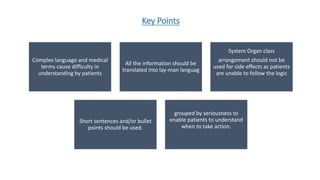
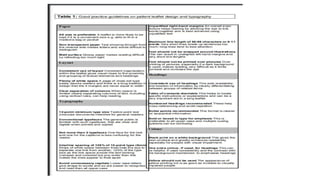
Key Points
Complex languageand medical
terms cause difficulty in
understanding by patients
All the information should be
translated into lay-man languag
System Organ class
arrangement should not be
used for side effects as patients
are unable to follow the logic
Short sentences and/or bullet
points should be used.
grouped by seriousness to
enable patients to understand
when to take action.
5.
Guidelines before youstart
taking the medicine
Read all of this leaflet carefully.
Keep this leaflet.
You may need to read it again.
If you have any further questions, ask your health care provider.
This medicine has been prescribed for you. Do not pass it on to others. It
may harm them, even if their symptoms are the same as yours.
If any of the side effects becomes serious, or if you notice any side
effects not listed in this leaflet, please tell your health care provider.
1. Identification ofthe medicine
The name of the medicine, the active substance(s), the pharmaceutical
form and the strength of the product should be stated.
2. Therapeutic Indications
The conditions for which the medicine is authorized must be listed. The
section should include any benefit information considered appropriate.
8.
3. Information necessarybefore
taking the medicine
Situations where the medicine should not be used, any precautions,
warnings, interactions with other medicines or foods, information for
special group of patients (pregnant or nursing mothers) and any effects
the medicine may have on the patient's ability to drive.
9.
4. Dosage
How totake or use the medicine including both the route and method
of administration.
How often it should be given.
How long the course of treatment will last.
10.
5. Description ofSide effects
All the effects which may occur under normal use of the medicine and
what action the patient should take if any of these occur. They should
be listed by seriousness and then by frequency.
11.
6. Additional Information
Thiscovers information on excipient detail, a description of the
product, registered pack sizes, storage conditions, name and address of
the manufacturer.
12.
Critical Appraisal
• Criticalappraisal is the process of carefully and systematically
assessing the outcome of scientific research (evidence) to judge its
trustworthiness, value and relevance in a particular context. Critical
appraisal looks at the way a study is conducted and examines factors
such as internal validity, generalizability and relevance.
13.
Critical Appraisal ofPIL
• Consistency.
• Summary.
• Clarity/ Lay Language/ Font/ Form/ Type should be standard.
• Headlines/ Headings/ Sub headings.
• Labelling in simplified way.
• Accuracy.
• Reliability (Reference/ source).
• Availability in paper size (A5 size is preferable) and online source.
15.
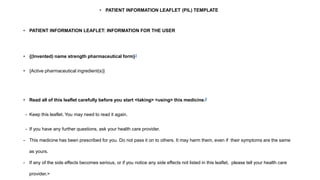
• PATIENT INFORMATIONLEAFLET (PIL) TEMPLATE
• PATIENT INFORMATION LEAFLET: INFORMATION FOR THE USER
• {(Invented) name strength pharmaceutical form}1
• {Active pharmaceutical ingredient(s)}
• Read all of this leaflet carefully before you start <taking> <using> this medicine.2
- Keep this leaflet. You may need to read it again.
- If you have any further questions, ask your health care provider.
- This medicine has been prescribed for you. Do not pass it on to others. It may harm them, even if their symptoms are the same
as yours.
- If any of the side effects becomes serious, or if you notice any side effects not listed in this leaflet, please tell your health care
provider.>
16.
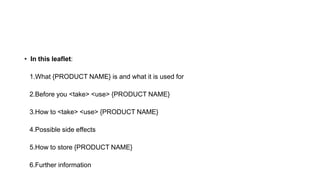
• In thisleaflet:
1.What {PRODUCT NAME} is and what it is used for
2.Before you <take> <use> {PRODUCT NAME}
3.How to <take> <use> {PRODUCT NAME}
4.Possible side effects
5.How to store {PRODUCT NAME}
6.Further information
17.
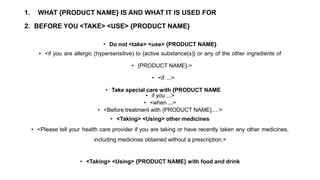
1. WHAT {PRODUCTNAME} IS AND WHAT IT IS USED FOR
2. BEFORE YOU <TAKE> <USE> {PRODUCT NAME}
• Do not <take> <use> {PRODUCT NAME}
• <if you are allergic (hypersensitive) to {active substance(s)} or any of the other ingredients of
• {PRODUCT NAME}.>
• <if ...>
• Take special care with {PRODUCT NAME
• if you ...>
• <when ...>
• <Before treatment with {PRODUCT NAME},…>
• <Taking> <Using> other medicines
• <Please tell your health care provider if you are taking or have recently taken any other medicines,
including medicines obtained without a prescription.>
• <Taking> <Using> {PRODUCT NAME} with food and drink
18.
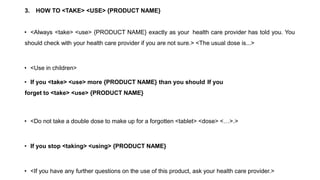
3. HOW TO<TAKE> <USE> {PRODUCT NAME}
• <Always <take> <use> {PRODUCT NAME} exactly as your health care provider has told you. You
should check with your health care provider if you are not sure.> <The usual dose is...>
• <Use in children>
• If you <take> <use> more {PRODUCT NAME} than you should If you
forget to <take> <use> {PRODUCT NAME}
• <Do not take a double dose to make up for a forgotten <tablet> <dose> <…>.>
• If you stop <taking> <using> {PRODUCT NAME}
• <If you have any further questions on the use of this product, ask your health care provider.>
19.
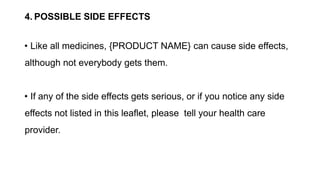
4. POSSIBLE SIDEEFFECTS
• Like all medicines, {PRODUCT NAME} can cause side effects,
although not everybody gets them.
• If any of the side effects gets serious, or if you notice any side
effects not listed in this leaflet, please tell your health care
provider.
20.
5. HOW TOSTORE {PRODUCT NAME}
• [For storage condition statements see prequalification guidance: Section Guidance for Part 3 — Patient Information
Leaflet (PIL) — of a WHO Public Assessment Report (WHOPAR).]
• Keep out of the reach and sight of children.
• <Do not store above ºC>, <Store in the original <container><carton>.>
• Do not use {PRODUCT NAME} after the expiry date which is stated on the <label> <carton> <bottle>
• <...> <after {abbreviation used for expiry date}.> <The expiry date refers to the last day of that month.>
• <Do not use {PRODUCT NAME} if you notice {description of the visible signs of deterioration}.>
• <Medicines should not be disposed of via wastewater or household waste. Ask your pharmacist how to dispose of
medicines no longer required. These measures will help to protect the environment.>
21.
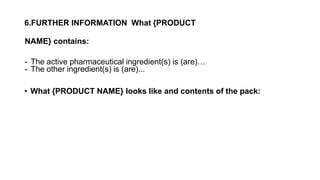
6.FURTHER INFORMATION What{PRODUCT
NAME} contains:
- The active pharmaceutical ingredient(s) is (are)…
- The other ingredient(s) is (are)...
• What {PRODUCT NAME} looks like and contents of the pack:
22.
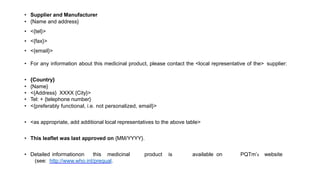
• Supplier andManufacturer
• {Name and address}
• <{tel}>
• <{fax}>
• <{email}>
• For any information about this medicinal product, please contact the <local representative of the> supplier:
• {Country}
• {Name}
• <{Address} XXXX {City}>
• Tel: + {telephone number}
• <{preferably functional, i.e. not personalized, email}>
• <as appropriate, add additional local representatives to the above table>
• This leaflet was last approved on {MM/YYYY}.
• Detailed informationon this medicinal product is available on PQTm’s website
(see: http://www.who.int/prequal.


![5. HOW TO STORE {PRODUCT NAME}
• [For storage condition statements see prequalification guidance: Section Guidance for Part 3 — Patient Information
Leaflet (PIL) — of a WHO Public Assessment Report (WHOPAR).]
• Keep out of the reach and sight of children.
• <Do not store above ºC>, <Store in the original <container><carton>.>
• Do not use {PRODUCT NAME} after the expiry date which is stated on the <label> <carton> <bottle>
• <...> <after {abbreviation used for expiry date}.> <The expiry date refers to the last day of that month.>
• <Do not use {PRODUCT NAME} if you notice {description of the visible signs of deterioration}.>
• <Medicines should not be disposed of via wastewater or household waste. Ask your pharmacist how to dispose of
medicines no longer required. These measures will help to protect the environment.>](https://image.slidesharecdn.com/patientinformationleaflet-230807054932-9e172a81/85/patient-information-leaflet-pptx-20-320.jpg)


![PERI-PROSTHETIC FRACTURE NAIL-PLATE CONSTRUCT [NPC].pptx](https://cdn.slidesharecdn.com/ss_thumbnails/drarunkumardrmohamedashrafperiprostheticfrasturenail-plateconstructnpc-260209164459-7e9d15a1-thumbnail.jpg?width=640&height=640&fit=bounds)


![ONFH[AVN HIP] -TRIPLE REGIME -A NOVAL SURGICAL CONCEPT .pptx](https://cdn.slidesharecdn.com/ss_thumbnails/onfhavnhip2026koaconcalicutdrgokuldevdrmashraf-260210064517-213ec005-thumbnail.jpg?width=640&height=640&fit=bounds)


