GATE Syllabus 2018 and
Exam Pattern
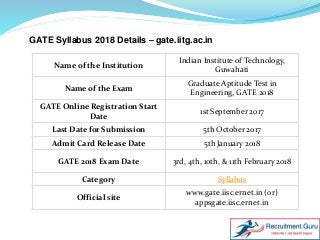
Name of the Institution
Indian Institute of Technology,
Guwahati
Name of the Exam
Graduate Aptitude Test in
Engineering, GATE 2018
GATE Online Registration Start
Date
1st September 2017
Last Date for Submission 5th October 2017
Admit Card Release Date 5th January 2018
GATE 2018 Exam Date 3rd, 4th, 10th, & 11th February 2018
Category Syllabus
Official site
www.gate.iisc.ernet.in (or)
appsgate.iisc.ernet.in
GATE Syllabus 2018 Details – gate.iitg.ac.in
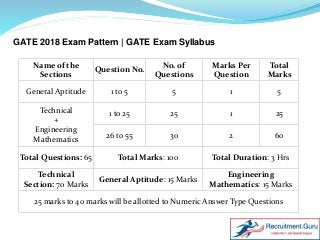
Name of the
Sections
Question No.
No. of
Questions
Marks Per
Question
Total
Marks
General Aptitude 1 to 5 5 1 5
Technical
+
Engineering
Mathematics
1 to 25 25 1 25
26 to 55 30 2 60
Total Questions: 65 Total Marks: 100 Total Duration: 3 Hrs
Technical
Section: 70 Marks
General Aptitude: 15 Marks
Engineering
Mathematics: 15 Marks
25 marks to 40 marks will be allotted to Numeric Answer Type Questions
GATE 2018 Exam Pattern | GATE Exam Syllabus
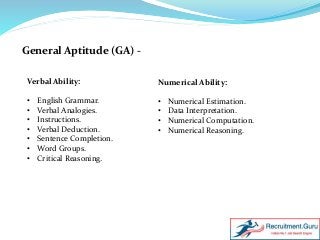
General Aptitude (GA) -
Verbal Ability:
• English Grammar.
• Verbal Analogies.
• Instructions.
• Verbal Deduction.
• Sentence Completion.
• Word Groups.
• Critical Reasoning.
Numerical Ability:
• Numerical Estimation.
• Data Interpretation.
• Numerical Computation.
• Numerical Reasoning.
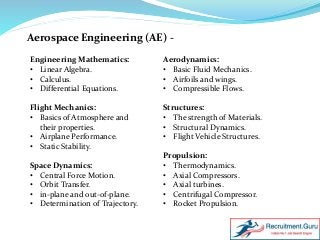
Aerospace Engineering (AE) -
Engineering Mathematics:
• Linear Algebra.
• Calculus.
• Differential Equations.
Flight Mechanics:
• Basics of Atmosphere and
their properties.
• Airplane Performance.
• Static Stability.
Space Dynamics:
• Central Force Motion.
• Orbit Transfer.
• in-plane and out-of-plane.
• Determination of Trajectory.
Aerodynamics:
• Basic Fluid Mechanics.
• Airfoils and wings.
• Compressible Flows.
Structures:
• The strength of Materials.
• Structural Dynamics.
• Flight Vehicle Structures.
Propulsion:
• Thermodynamics.
• Axial Compressors.
• Axial turbines.
• Centrifugal Compressor.
• Rocket Propulsion.
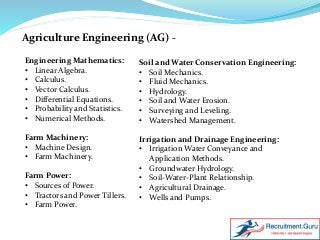
Agriculture Engineering (AG) -
Engineering Mathematics:
• Linear Algebra.
• Calculus.
• Vector Calculus.
• Differential Equations.
• Probability and Statistics.
• Numerical Methods.
Farm Machinery:
• Machine Design.
• Farm Machinery.
Farm Power:
• Sources of Power.
• Tractors and Power Tillers.
• Farm Power.
Soil and Water Conservation Engineering:
• Soil Mechanics.
• Fluid Mechanics.
• Hydrology.
• Soil and Water Erosion.
• Surveying and Leveling.
• Watershed Management.
Irrigation and Drainage Engineering:
• Irrigation Water Conveyance and
Application Methods.
• Groundwater Hydrology.
• Soil-Water-Plant Relationship.
• Agricultural Drainage.
• Wells and Pumps.
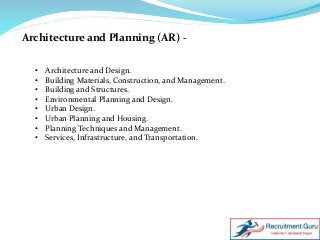
Architecture and Planning (AR) -
• Architecture and Design.
• Building Materials, Construction, and Management.
• Building and Structures.
• Environmental Planning and Design.
• Urban Design.
• Urban Planning and Housing.
• Planning Techniques and Management.
• Services, Infrastructure, and Transportation.
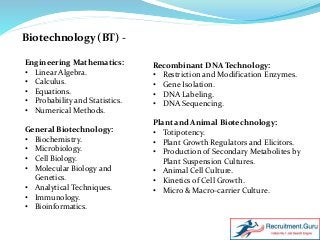
Biotechnology (BT) -
Engineering Mathematics:
• Linear Algebra.
• Calculus.
• Equations.
• Probability and Statistics.
• Numerical Methods.
General Biotechnology:
• Biochemistry.
• Microbiology.
• Cell Biology.
• Molecular Biology and
Genetics.
• Analytical Techniques.
• Immunology.
• Bioinformatics.
Recombinant DNA Technology:
• Restriction and Modification Enzymes.
• Gene Isolation.
• DNA Labeling.
• DNA Sequencing.
Plant and Animal Biotechnology:
• Totipotency.
• Plant Growth Regulators and Elicitors.
• Production of Secondary Metabolites by
Plant Suspension Cultures.
• Animal Cell Culture.
• Kinetics of Cell Growth.
• Micro & Macro-carrier Culture.
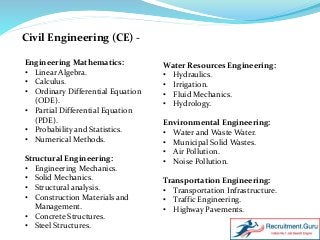
Civil Engineering (CE) -
Engineering Mathematics:
• Linear Algebra.
• Calculus.
• Ordinary Differential Equation
(ODE).
• Partial Differential Equation
(PDE).
• Probability and Statistics.
• Numerical Methods.
Structural Engineering:
• Engineering Mechanics.
• Solid Mechanics.
• Structural analysis.
• Construction Materials and
Management.
• Concrete Structures.
• Steel Structures.
Water Resources Engineering:
• Hydraulics.
• Irrigation.
• Fluid Mechanics.
• Hydrology.
Environmental Engineering:
• Water and Waste Water.
• Municipal Solid Wastes.
• Air Pollution.
• Noise Pollution.
Transportation Engineering:
• Transportation Infrastructure.
• Traffic Engineering.
• Highway Pavements.
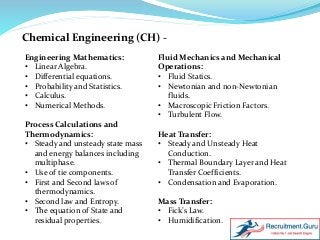
Chemical Engineering (CH) -
Engineering Mathematics:
• Linear Algebra.
• Differential equations.
• Probability and Statistics.
• Calculus.
• Numerical Methods.
Process Calculations and
Thermodynamics:
• Steady and unsteady state mass
and energy balances including
multiphase.
• Use of tie components.
• First and Second laws of
thermodynamics.
• Second law and Entropy.
• The equation of State and
residual properties.
Fluid Mechanics and Mechanical
Operations:
• Fluid Statics.
• Newtonian and non-Newtonian
fluids.
• Macroscopic Friction Factors.
• Turbulent Flow.
Heat Transfer:
• Steady and Unsteady Heat
Conduction.
• Thermal Boundary Layer and Heat
Transfer Coefficients.
• Condensation and Evaporation.
Mass Transfer:
• Fick’s Law.
• Humidification.
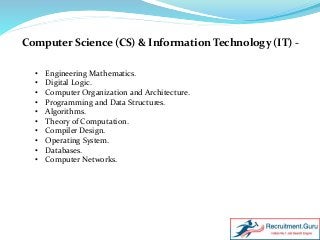
Computer Science (CS) & Information Technology (IT) -
• Engineering Mathematics.
• Digital Logic.
• Computer Organization and Architecture.
• Programming and Data Structures.
• Algorithms.
• Theory of Computation.
• Compiler Design.
• Operating System.
• Databases.
• Computer Networks.
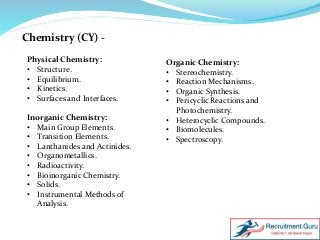
Chemistry (CY) -
Physical Chemistry:
• Structure.
• Equilibrium.
• Kinetics.
• Surfaces and Interfaces.
Inorganic Chemistry:
• Main Group Elements.
• Transition Elements.
• Lanthanides and Actinides.
• Organometallics.
• Radioactivity.
• Bioinorganic Chemistry.
• Solids.
• Instrumental Methods of
Analysis.
Organic Chemistry:
• Stereochemistry.
• Reaction Mechanisms.
• Organic Synthesis.
• Pericyclic Reactions and
Photochemistry.
• Heterocyclic Compounds.
• Biomolecules.
• Spectroscopy.
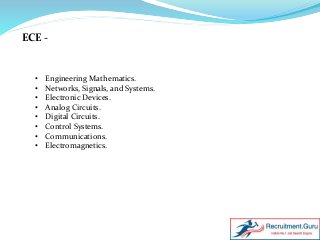
ECE -
• Engineering Mathematics.
• Networks, Signals, and Systems.
• Electronic Devices.
• Analog Circuits.
• Digital Circuits.
• Control Systems.
• Communications.
• Electromagnetics.
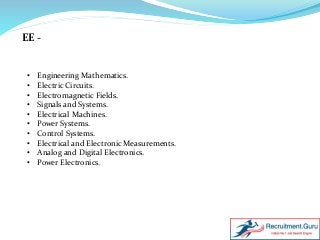
EE -
• Engineering Mathematics.
• Electric Circuits.
• Electromagnetic Fields.
• Signals and Systems.
• Electrical Machines.
• Power Systems.
• Control Systems.
• Electrical and Electronic Measurements.
• Analog and Digital Electronics.
• Power Electronics.
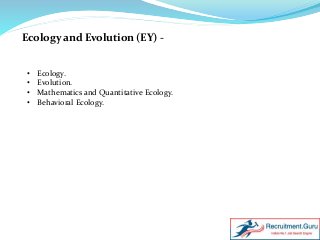
Ecology and Evolution (EY) -
• Ecology.
• Evolution.
• Mathematics and Quantitative Ecology.
• Behavioral Ecology.
For More information, please visit –
https://www.recruitment.guru/syllabus
/gate-syllabus/

Gate syllabus 2018 and Exam Pattern

  • 1.
    GATE Syllabus 2018and Exam Pattern
  • 2.
    Name of theInstitution Indian Institute of Technology, Guwahati Name of the Exam Graduate Aptitude Test in Engineering, GATE 2018 GATE Online Registration Start Date 1st September 2017 Last Date for Submission 5th October 2017 Admit Card Release Date 5th January 2018 GATE 2018 Exam Date 3rd, 4th, 10th, & 11th February 2018 Category Syllabus Official site www.gate.iisc.ernet.in (or) appsgate.iisc.ernet.in GATE Syllabus 2018 Details – gate.iitg.ac.in
  • 3.
    Name of the Sections QuestionNo. No. of Questions Marks Per Question Total Marks General Aptitude 1 to 5 5 1 5 Technical + Engineering Mathematics 1 to 25 25 1 25 26 to 55 30 2 60 Total Questions: 65 Total Marks: 100 Total Duration: 3 Hrs Technical Section: 70 Marks General Aptitude: 15 Marks Engineering Mathematics: 15 Marks 25 marks to 40 marks will be allotted to Numeric Answer Type Questions GATE 2018 Exam Pattern | GATE Exam Syllabus
  • 4.
    General Aptitude (GA)- Verbal Ability: • English Grammar. • Verbal Analogies. • Instructions. • Verbal Deduction. • Sentence Completion. • Word Groups. • Critical Reasoning. Numerical Ability: • Numerical Estimation. • Data Interpretation. • Numerical Computation. • Numerical Reasoning.
  • 5.
    Aerospace Engineering (AE)- Engineering Mathematics: • Linear Algebra. • Calculus. • Differential Equations. Flight Mechanics: • Basics of Atmosphere and their properties. • Airplane Performance. • Static Stability. Space Dynamics: • Central Force Motion. • Orbit Transfer. • in-plane and out-of-plane. • Determination of Trajectory. Aerodynamics: • Basic Fluid Mechanics. • Airfoils and wings. • Compressible Flows. Structures: • The strength of Materials. • Structural Dynamics. • Flight Vehicle Structures. Propulsion: • Thermodynamics. • Axial Compressors. • Axial turbines. • Centrifugal Compressor. • Rocket Propulsion.
  • 6.
    Agriculture Engineering (AG)- Engineering Mathematics: • Linear Algebra. • Calculus. • Vector Calculus. • Differential Equations. • Probability and Statistics. • Numerical Methods. Farm Machinery: • Machine Design. • Farm Machinery. Farm Power: • Sources of Power. • Tractors and Power Tillers. • Farm Power. Soil and Water Conservation Engineering: • Soil Mechanics. • Fluid Mechanics. • Hydrology. • Soil and Water Erosion. • Surveying and Leveling. • Watershed Management. Irrigation and Drainage Engineering: • Irrigation Water Conveyance and Application Methods. • Groundwater Hydrology. • Soil-Water-Plant Relationship. • Agricultural Drainage. • Wells and Pumps.
  • 7.
    Architecture and Planning(AR) - • Architecture and Design. • Building Materials, Construction, and Management. • Building and Structures. • Environmental Planning and Design. • Urban Design. • Urban Planning and Housing. • Planning Techniques and Management. • Services, Infrastructure, and Transportation.
  • 8.
    Biotechnology (BT) - EngineeringMathematics: • Linear Algebra. • Calculus. • Equations. • Probability and Statistics. • Numerical Methods. General Biotechnology: • Biochemistry. • Microbiology. • Cell Biology. • Molecular Biology and Genetics. • Analytical Techniques. • Immunology. • Bioinformatics. Recombinant DNA Technology: • Restriction and Modification Enzymes. • Gene Isolation. • DNA Labeling. • DNA Sequencing. Plant and Animal Biotechnology: • Totipotency. • Plant Growth Regulators and Elicitors. • Production of Secondary Metabolites by Plant Suspension Cultures. • Animal Cell Culture. • Kinetics of Cell Growth. • Micro & Macro-carrier Culture.
  • 9.
    Civil Engineering (CE)- Engineering Mathematics: • Linear Algebra. • Calculus. • Ordinary Differential Equation (ODE). • Partial Differential Equation (PDE). • Probability and Statistics. • Numerical Methods. Structural Engineering: • Engineering Mechanics. • Solid Mechanics. • Structural analysis. • Construction Materials and Management. • Concrete Structures. • Steel Structures. Water Resources Engineering: • Hydraulics. • Irrigation. • Fluid Mechanics. • Hydrology. Environmental Engineering: • Water and Waste Water. • Municipal Solid Wastes. • Air Pollution. • Noise Pollution. Transportation Engineering: • Transportation Infrastructure. • Traffic Engineering. • Highway Pavements.
  • 10.
    Chemical Engineering (CH)- Engineering Mathematics: • Linear Algebra. • Differential equations. • Probability and Statistics. • Calculus. • Numerical Methods. Process Calculations and Thermodynamics: • Steady and unsteady state mass and energy balances including multiphase. • Use of tie components. • First and Second laws of thermodynamics. • Second law and Entropy. • The equation of State and residual properties. Fluid Mechanics and Mechanical Operations: • Fluid Statics. • Newtonian and non-Newtonian fluids. • Macroscopic Friction Factors. • Turbulent Flow. Heat Transfer: • Steady and Unsteady Heat Conduction. • Thermal Boundary Layer and Heat Transfer Coefficients. • Condensation and Evaporation. Mass Transfer: • Fick’s Law. • Humidification.
  • 11.
    Computer Science (CS)& Information Technology (IT) - • Engineering Mathematics. • Digital Logic. • Computer Organization and Architecture. • Programming and Data Structures. • Algorithms. • Theory of Computation. • Compiler Design. • Operating System. • Databases. • Computer Networks.
  • 12.
    Chemistry (CY) - PhysicalChemistry: • Structure. • Equilibrium. • Kinetics. • Surfaces and Interfaces. Inorganic Chemistry: • Main Group Elements. • Transition Elements. • Lanthanides and Actinides. • Organometallics. • Radioactivity. • Bioinorganic Chemistry. • Solids. • Instrumental Methods of Analysis. Organic Chemistry: • Stereochemistry. • Reaction Mechanisms. • Organic Synthesis. • Pericyclic Reactions and Photochemistry. • Heterocyclic Compounds. • Biomolecules. • Spectroscopy.
  • 13.
    ECE - • EngineeringMathematics. • Networks, Signals, and Systems. • Electronic Devices. • Analog Circuits. • Digital Circuits. • Control Systems. • Communications. • Electromagnetics.
  • 14.
    EE - • EngineeringMathematics. • Electric Circuits. • Electromagnetic Fields. • Signals and Systems. • Electrical Machines. • Power Systems. • Control Systems. • Electrical and Electronic Measurements. • Analog and Digital Electronics. • Power Electronics.
  • 15.
    Ecology and Evolution(EY) - • Ecology. • Evolution. • Mathematics and Quantitative Ecology. • Behavioral Ecology.
  • 16.
    For More information,please visit – https://www.recruitment.guru/syllabus /gate-syllabus/