Beneath
the Surface
A review of key facts in the
oilsands debate
Simon Dyer
January 2013
2
Leading Canada’s transition
to a clean energy future
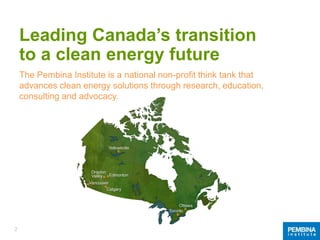
The Pembina Institute is a national non-profit think tank that
advances clean energy solutions through research, education,
consulting and advocacy.
Presentation Overview
• Climate and air
• Water
• Tailings
• Land and wildlife
• Economics
3
Climate and Air
Average oilsands production is significantly more
greenhouse gas (GHG)-intensive than conventional
oil production
• Production emissions typically 3.2 to 4.5 times more
greenhouse gas emissions than conventional oil
• Lifecycle emissions are higher than conventional (23% EU, 8-
37% Canada/US)
4
Climate and Air
Oilsands emissions are a growing problem
• Large per-barrel decreases in GHG intensity have stalled
or worsened
5
Past changes in industry-wide greenhouse gas intensity in the oilsands
Climate and Air
Oilsands emissions matter on a national scale,
and are a significant barrier to meeting Canada’s
2020 climate commitment
• Oilsands emissions accounted for 7% of Canada’s
emissions in 2010, forecasted to be 14% in 2020
• Emissions forecast to reach levels higher than the
emissions from every province except AB and ON
6
Climate and Air
Oilsands emissions matter on a global scale
• Canada is among top-10 GHG producers on absolute and
per capita basis
• Oilsands growth is challenging Canada to meet its
international climate target due to massive growth
• While other sectors in Canada’s economy are expected to
reduce GHGs by 67 Mt by 2020 (relative to 2005 levels),
oilsands GHGs are expected to add 72 Mt of GHGs
7
Climate and Air
Current regulations do not result in meaningful
reductions in greenhouse gas emissions from
oilsands development
• Alberta regulations ($15/tonne x 12% of emissions = $1.80
compliance cost)
• Carbon capture and storage costs $95-$225/tonne
8
Climate and Air
Air quality is starting to be impacted by oilsands
air pollution
• Air quality exceedances increasing
• 33X more exceedances in northeastern AB in 2009
compared to 2004
• Air concentrations for NO2, SO2, H2S and O3 getting close
to limit levels
9
Climate and Air
Forecasted growth in oilsands will present very
serious air pollution challenges in the Wood
Buffalo Region
• Approved production is almost triple current operating
levels
• Modeled predictions for NO2 levels already exceed
Alberta’s air quality limits
10
Water
Water monitoring in northeastern Alberta has
been inadequate, yet governments continue to
approve new oilsands projects
• Federal/Provincial plan not complete until 2015
• 5.2 million barrels approved
• Peer-reviewed research continues to show oilsands
development is having an impact on water quality
• Polycyclic aromatic hydrocarbons now 2.5 to 23 times
greater than 1960 levels in some lakes due to oilsands
development
11
Water
Oilsands extraction uses large amounts of water,
despite recycling efforts
• Mining – 2 to 4 barrels of water per barrel of bitumen after
recycling
• In situ extraction – 0.8 to 1.7 barrels of water to extract and
upgrade a barrel of oil
• In 2011, oilsands industry used 170 million cubic metres of
water, equivalent to the residential water use of 1.7 million
Canadians
12
Water
Oilsands companies are not required to
stop withdrawing water from the Athabasca
River, even if river flows are so low that
fisheries and habitat are at risk
• Water allocations from Athabasca River nearly
doubled in past decade due to oilsands
• Current water withdrawal management framework
prioritizes industry use over aquatic protection
• Missing element – Ecosystem Base Flow (EBF)
absolute cut off point above which no withdrawals are
allowed (rare event, 1/100 years)
• GoA now missed two deadlines to release final
framework
13
Tailings
Oilsands tailings volumes continue to grow due
to a permissive regulatory approach
• Current tailings rules not enforced
• Lack of transparent reporting to indicate how companies
are faring today
• Rules only address a portion of tailings production
• 250% increase in tailings area since 2005
• Current area = 176 square kilometres
• Current volume = 830 million cubic metres
14
Tailings
Tailings lakes house compounds known to be
acutely toxic to aquatic organisms
• Tailings concentrate naturally occurring compounds to
toxic levels over time
• Source of metals, PAHs, hydrocarbons, naphthenic acids
and solvents
15
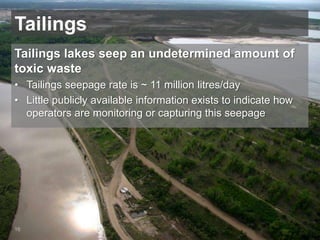
Tailings
Tailings lakes seep an undetermined amount of
toxic waste
• Tailings seepage rate is ~ 11 million litres/day
• Little publicly available information exists to indicate how
operators are monitoring or capturing this seepage
16
Tailings
Capping toxic tailings waste in end pit lakes with
water is an unproven and risky concept
• Could take decades to determine whether end pit lakes
are a viable and safe permanent storage site for tailings
• 29 end pit lakes have been proposed by oilsands
operators
17
Land and Wildlife
Restoration of wetlands continues to be a major
challenge and may never occur
• Peatlands likely to be permanently lost after mining
• As of 2011, approved mining production is expected to
result in a loss of approximately 28,000 hectares of
peatland
• Alberta has no wetland policy to prevent wetland loss in
northeastern Alberta
18
Land and Wildlife
The boreal forest will not be restored to its
native state following mine closure
• Objective is equivalent land capability vs. pre disturbance
state
• Forest uplands and end pit lakes vs. peatlands and old
growth forests
• Only 0.1% of total area disturbed by oilsands mining
certified as reclaimed
19
Land and Wildlife
20
Oilsands disturbance vs. reclamation from 1987-2008
Source: Alberta Environment
Land and Wildlife
In situ developments may affect a much larger
area than oilsands mining
• In situ potential 30X larger than mineable region
• More GHG-intensive than mining
• Results in significant landscape fragmentation
21
Land and Wildlife
Woodland caribou herds are declining in the
oilsands and are on track to be extirpated
• Local extinction likely in 30 years
• Federal recovery strategy identifies 65% intact habitat
target
• Undisturbed caribou habitat in Northeastern Alberta = 24%
22
Land and Wildlife
Oilsands development threatens to harm
millions of birds through habitat fragmentation
and destruction
• Regional bird populations currently healthy
• Mining may impact the breeding habitat for 280,000 to 3.6
million birds over 20-40 year period
• In situ development could impact as many as 14.5 million
birds
23
Economics
Taxpayers may foot the bill for cleanup of
oilsands mines
• Operators not responsible for 100% of cost of cleanup
• Little reclamation security and protection for Albertans over
life of mine until the end
24
Economics
The costs and benefits of oilsands development
are not spread evenly across Canada
• AB expected to reap 94% of GDP impacts from oilsands
development
• Jobs created by oilsands in next 25 years – 86% will
remain in AB
• Manufacturing sector declining while natural resource
sector booming
25
Economics
Relying on the volatile profits from oilsands
projects to fund essential services creates
financial risks for both the private and public
sector
• Oil grown from 18% to 46% of total Canadian commodity
production in past 15 years
• Price of oil fluctuates widely
• Oilsands producers have a narrow price window in which
to operate
• Oilsands roller coaster unreliable means to fund social
programs and provide ongoing revenue
26
Conclusions
• Significant opportunities to address oilsands
mismanagement
• Need a greater emphasis on management vs.
communications
• Pace and scale need to slow to accommodate
new policy solutions
• Role of technology limited without regulatory
drivers
27
pembina.org
pembina.org/subscription
Pembina eNews, Media releases, Publication alerts
twitter.com/pembina facebook.com/pembina.institute

Beneath the surface

  • 1.
    Beneath the Surface A reviewof key facts in the oilsands debate Simon Dyer January 2013
  • 2.
    2 Leading Canada’s transition toa clean energy future The Pembina Institute is a national non-profit think tank that advances clean energy solutions through research, education, consulting and advocacy.
  • 3.
    Presentation Overview • Climateand air • Water • Tailings • Land and wildlife • Economics 3
  • 4.
    Climate and Air Averageoilsands production is significantly more greenhouse gas (GHG)-intensive than conventional oil production • Production emissions typically 3.2 to 4.5 times more greenhouse gas emissions than conventional oil • Lifecycle emissions are higher than conventional (23% EU, 8- 37% Canada/US) 4
  • 5.
    Climate and Air Oilsandsemissions are a growing problem • Large per-barrel decreases in GHG intensity have stalled or worsened 5 Past changes in industry-wide greenhouse gas intensity in the oilsands
  • 6.
    Climate and Air Oilsandsemissions matter on a national scale, and are a significant barrier to meeting Canada’s 2020 climate commitment • Oilsands emissions accounted for 7% of Canada’s emissions in 2010, forecasted to be 14% in 2020 • Emissions forecast to reach levels higher than the emissions from every province except AB and ON 6
  • 7.
    Climate and Air Oilsandsemissions matter on a global scale • Canada is among top-10 GHG producers on absolute and per capita basis • Oilsands growth is challenging Canada to meet its international climate target due to massive growth • While other sectors in Canada’s economy are expected to reduce GHGs by 67 Mt by 2020 (relative to 2005 levels), oilsands GHGs are expected to add 72 Mt of GHGs 7
  • 8.
    Climate and Air Currentregulations do not result in meaningful reductions in greenhouse gas emissions from oilsands development • Alberta regulations ($15/tonne x 12% of emissions = $1.80 compliance cost) • Carbon capture and storage costs $95-$225/tonne 8
  • 9.
    Climate and Air Airquality is starting to be impacted by oilsands air pollution • Air quality exceedances increasing • 33X more exceedances in northeastern AB in 2009 compared to 2004 • Air concentrations for NO2, SO2, H2S and O3 getting close to limit levels 9
  • 10.
    Climate and Air Forecastedgrowth in oilsands will present very serious air pollution challenges in the Wood Buffalo Region • Approved production is almost triple current operating levels • Modeled predictions for NO2 levels already exceed Alberta’s air quality limits 10
  • 11.
    Water Water monitoring innortheastern Alberta has been inadequate, yet governments continue to approve new oilsands projects • Federal/Provincial plan not complete until 2015 • 5.2 million barrels approved • Peer-reviewed research continues to show oilsands development is having an impact on water quality • Polycyclic aromatic hydrocarbons now 2.5 to 23 times greater than 1960 levels in some lakes due to oilsands development 11
  • 12.
    Water Oilsands extraction useslarge amounts of water, despite recycling efforts • Mining – 2 to 4 barrels of water per barrel of bitumen after recycling • In situ extraction – 0.8 to 1.7 barrels of water to extract and upgrade a barrel of oil • In 2011, oilsands industry used 170 million cubic metres of water, equivalent to the residential water use of 1.7 million Canadians 12
  • 13.
    Water Oilsands companies arenot required to stop withdrawing water from the Athabasca River, even if river flows are so low that fisheries and habitat are at risk • Water allocations from Athabasca River nearly doubled in past decade due to oilsands • Current water withdrawal management framework prioritizes industry use over aquatic protection • Missing element – Ecosystem Base Flow (EBF) absolute cut off point above which no withdrawals are allowed (rare event, 1/100 years) • GoA now missed two deadlines to release final framework 13
  • 14.
    Tailings Oilsands tailings volumescontinue to grow due to a permissive regulatory approach • Current tailings rules not enforced • Lack of transparent reporting to indicate how companies are faring today • Rules only address a portion of tailings production • 250% increase in tailings area since 2005 • Current area = 176 square kilometres • Current volume = 830 million cubic metres 14
  • 15.
    Tailings Tailings lakes housecompounds known to be acutely toxic to aquatic organisms • Tailings concentrate naturally occurring compounds to toxic levels over time • Source of metals, PAHs, hydrocarbons, naphthenic acids and solvents 15
  • 16.
    Tailings Tailings lakes seepan undetermined amount of toxic waste • Tailings seepage rate is ~ 11 million litres/day • Little publicly available information exists to indicate how operators are monitoring or capturing this seepage 16
  • 17.
    Tailings Capping toxic tailingswaste in end pit lakes with water is an unproven and risky concept • Could take decades to determine whether end pit lakes are a viable and safe permanent storage site for tailings • 29 end pit lakes have been proposed by oilsands operators 17
  • 18.
    Land and Wildlife Restorationof wetlands continues to be a major challenge and may never occur • Peatlands likely to be permanently lost after mining • As of 2011, approved mining production is expected to result in a loss of approximately 28,000 hectares of peatland • Alberta has no wetland policy to prevent wetland loss in northeastern Alberta 18
  • 19.
    Land and Wildlife Theboreal forest will not be restored to its native state following mine closure • Objective is equivalent land capability vs. pre disturbance state • Forest uplands and end pit lakes vs. peatlands and old growth forests • Only 0.1% of total area disturbed by oilsands mining certified as reclaimed 19
  • 20.
    Land and Wildlife 20 Oilsandsdisturbance vs. reclamation from 1987-2008 Source: Alberta Environment
  • 21.
    Land and Wildlife Insitu developments may affect a much larger area than oilsands mining • In situ potential 30X larger than mineable region • More GHG-intensive than mining • Results in significant landscape fragmentation 21
  • 22.
    Land and Wildlife Woodlandcaribou herds are declining in the oilsands and are on track to be extirpated • Local extinction likely in 30 years • Federal recovery strategy identifies 65% intact habitat target • Undisturbed caribou habitat in Northeastern Alberta = 24% 22
  • 23.
    Land and Wildlife Oilsandsdevelopment threatens to harm millions of birds through habitat fragmentation and destruction • Regional bird populations currently healthy • Mining may impact the breeding habitat for 280,000 to 3.6 million birds over 20-40 year period • In situ development could impact as many as 14.5 million birds 23
  • 24.
    Economics Taxpayers may footthe bill for cleanup of oilsands mines • Operators not responsible for 100% of cost of cleanup • Little reclamation security and protection for Albertans over life of mine until the end 24
  • 25.
    Economics The costs andbenefits of oilsands development are not spread evenly across Canada • AB expected to reap 94% of GDP impacts from oilsands development • Jobs created by oilsands in next 25 years – 86% will remain in AB • Manufacturing sector declining while natural resource sector booming 25
  • 26.
    Economics Relying on thevolatile profits from oilsands projects to fund essential services creates financial risks for both the private and public sector • Oil grown from 18% to 46% of total Canadian commodity production in past 15 years • Price of oil fluctuates widely • Oilsands producers have a narrow price window in which to operate • Oilsands roller coaster unreliable means to fund social programs and provide ongoing revenue 26
  • 27.
    Conclusions • Significant opportunitiesto address oilsands mismanagement • Need a greater emphasis on management vs. communications • Pace and scale need to slow to accommodate new policy solutions • Role of technology limited without regulatory drivers 27
  • 28.
    pembina.org pembina.org/subscription Pembina eNews, Mediareleases, Publication alerts twitter.com/pembina facebook.com/pembina.institute