AIST MARKETING IDEAS EXCHANGE
THE ROLE OF PR, MORE THAN JUST A MEDIA RELEASE
PAUL CHEAL
21 JULY 2015
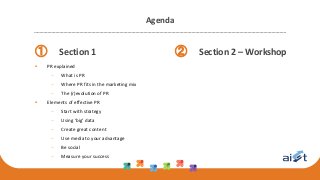
Agenda
① Section 1
 PR explained
 What is PR
 Where PR fits in the marketing mix
 The (r)evolution of PR
 Elements of effective PR
 Start with strategy
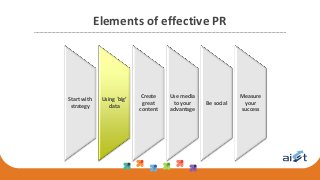
 Using ‘big’ data
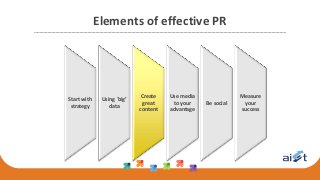
 Create great content
 Use media to your advantage
 Be social
 Measure your success
② Section 2 – Workshop
Section 1 – PR explained
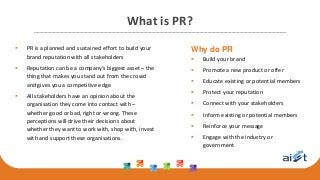
What is PR?
 PR is a planned and sustained effort to build your
brand reputation with all stakeholders
 Reputation can be a company’s biggest asset – the
thing that makes you stand out from the crowd
and gives you a competitive edge
 All stakeholders have an opinion about the
organisation they come into contact with –
whether good or bad, right or wrong. These
perceptions will drive their decisions about
whether they want to work with, shop with, invest
with and support these organisations.
Why do PR
 Build your brand
 Promote a new product or offer
 Educate existing or potential members
 Protect your reputation
 Connect with your stakeholders
 Inform existing or potential members
 Reinforce your message
 Engage with the industry or
government
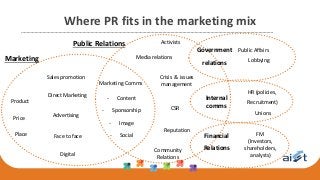
Where PR fits in the marketing mix
Marketing
Product
Price
Place
Sales promotion
- Content
- Sponsorship
- Image
- Social
Marketing Comms
Media relations
Government
relations
Public Affairs
Lobbying
Internal
comms
HR (policies,
Recruitment)
Unions
Financial
Relations
FM
(Investors,
shareholders,
analysts)
Community
Relations
Activists
CSR
Reputation
Crisis & issues
management
Direct Marketing
Advertising
Public Relations
Face to face
Digital
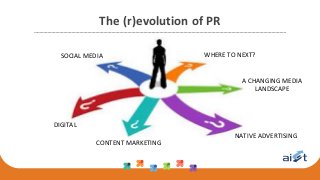
The (r)evolution of PR
SOCIAL MEDIA
CONTENT MARKETING
NATIVE ADVERTISING
DIGITAL
A CHANGING MEDIA
LANDSCAPE
WHERE TO NEXT?
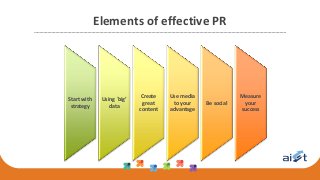
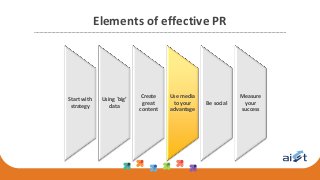
Elements of effective PR
Start with
strategy
Using ‘big’
data
Create
great
content
Use media
to your
advantage
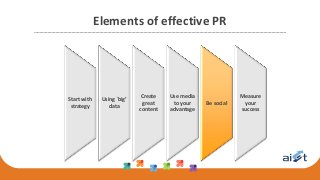
Be social
Measure
your
success
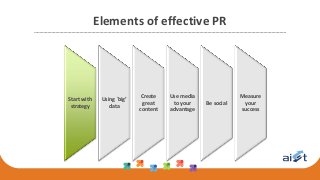
Elements of effective PR
Start with
strategy
Using ‘big’
data
Create
great
content
Use media
to your
advantage
Be social
Measure
your
success
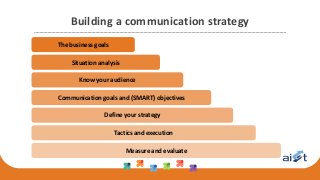
Building a communication strategy
The business goals
Know your audience
Situation analysis
Communication goals and (SMART) objectives
Tactics and execution
Define your strategy
Measure and evaluate
Elements of effective PR
Start with
strategy
Using ‘big’
data
Create
great
content
Use media
to your
advantage
Be social
Measure
your
success
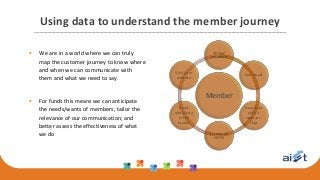
Using data to understand the member journey
 We are in a world where we can truly
map the customer journey to know where
and when we can communicate with
them and what we need to say
 For funds this means we can anticipate
the needs/wants of members; tailor the
relevance of our communication; and
better assess the effectiveness of what
we do
Member
Annual
statement
See an ad
Associate
with a
sponsor-
ship
Receive an
email
Read
about you
in the
media
Visit your
website
Elements of effective PR
Start with
strategy
Using ‘big’
data
Create
great
content
Use media
to your
advantage
Be social
Measure
your
success
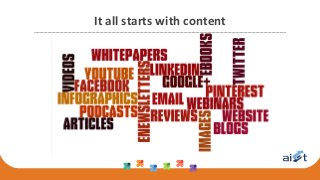
It all starts with content
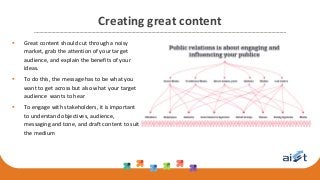
Creating great content
 Great content should cut through a noisy
market, grab the attention of your target
audience, and explain the benefits of your
ideas.
 To do this, the message has to be what you
want to get across but also what your target
audience wants to hear
 To engage with stakeholders, it is important
to understand objectives, audience,
messaging and tone, and draft content to suit
the medium
Elements of effective PR
Start with
strategy
Using ‘big’
data
Create
great
content
Use media
to your
advantage
Be social
Measure
your
success
Why engage with media?
 Third party validation of your story
 Another touch point in the communication mix
 Help maintain the dialogue with your
members/potential members
 Demonstrate your expertise
 Share business wins
 Demonstrate value – e.g. most members would
be unaware of the insurance
 Build relationships that will help if/when issues
arise
 Great for SEO
 Media will write about you anyway
Dos and don’ts of media engagement
Do’s
 Talk clearly – most people, including journalists
switch off if there is too much jargon or complex
business language. Plain and simple English is best
 Be patient – it can take time to build up a media
presence, especially for smaller companies. It’s
worth taking the time to get to know the media you
want to be in and familiarise yourself so you know
what’s of interest to them
 Be passionate – a journalist is only going to be
interested in your story if you are yourself! No need
to go OTT but have conviction when talking about
your business
 Think about quality over quantity – A larger profile
piece will make more impact than lots of small
mentions so consider taking a more targeted,
exclusive approach
Don’ts
 Pester a journalist – journalists don’t like to be
chased or called up checking to see if they received
your email. If you do call, make sure it’s adding
value!
 Assume – journalists on mainstream publications are
generalists so don’t assume they know anything
about what you do or who your client base are
 Say no comment – once you put yourselves out
there, you can’t dip in and out as you choose
Elements of effective PR
Start with
strategy
Using ‘big’
data
Create
great
content
Use media
to your
advantage
Be social
Measure
your
success
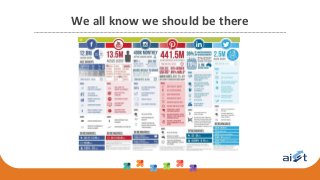
We all know we should be there
Getting started… or revamping your presence
When it comes to social media there are lots of questions to ask - understanding your objectives, knowing where your
audience is online, and defining your approach are all key
How do you want to be involved: proactive or reactive?
What do you want to talk about?
How will it help retain/attract members?
What are the appropriate measurement and metrics?
How will you assign resources, agree investment (time and money)?
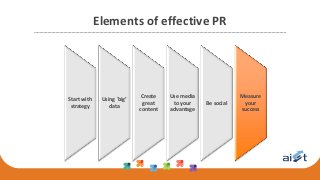
Elements of effective PR
Start with
strategy
Using ‘big’
data
Create
great
content
Use media
to your
advantage
Be social
Measure
your
success
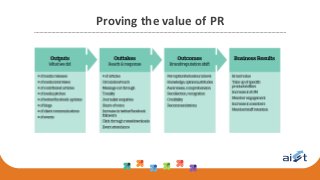
Proving the value of PR
Recap
 Communication needs to start with strategy and align to business goals
 Use data to drive your campaign
 Content is the heart of PR – creating rich, compelling content will drive your program
 Media is changing but still an important channel
 Social media is the new norm, how will your fund engage
 Create a dashboard to measure the success of your program
Paul Cheal
General Manager | Partner
Honner
+61 2 8248 3752
+61 427 755 296
paul@honner.com.au
twitter: @honnermedia

AIST Presentation: PR, more than just a media release

  • 1.
    AIST MARKETING IDEASEXCHANGE THE ROLE OF PR, MORE THAN JUST A MEDIA RELEASE PAUL CHEAL 21 JULY 2015
  • 2.
    Agenda ① Section 1 PR explained  What is PR  Where PR fits in the marketing mix  The (r)evolution of PR  Elements of effective PR  Start with strategy  Using ‘big’ data  Create great content  Use media to your advantage  Be social  Measure your success ② Section 2 – Workshop
  • 3.
    Section 1 –PR explained
  • 4.
    What is PR? PR is a planned and sustained effort to build your brand reputation with all stakeholders  Reputation can be a company’s biggest asset – the thing that makes you stand out from the crowd and gives you a competitive edge  All stakeholders have an opinion about the organisation they come into contact with – whether good or bad, right or wrong. These perceptions will drive their decisions about whether they want to work with, shop with, invest with and support these organisations. Why do PR  Build your brand  Promote a new product or offer  Educate existing or potential members  Protect your reputation  Connect with your stakeholders  Inform existing or potential members  Reinforce your message  Engage with the industry or government
  • 5.
    Where PR fitsin the marketing mix Marketing Product Price Place Sales promotion - Content - Sponsorship - Image - Social Marketing Comms Media relations Government relations Public Affairs Lobbying Internal comms HR (policies, Recruitment) Unions Financial Relations FM (Investors, shareholders, analysts) Community Relations Activists CSR Reputation Crisis & issues management Direct Marketing Advertising Public Relations Face to face Digital
  • 6.
    The (r)evolution ofPR SOCIAL MEDIA CONTENT MARKETING NATIVE ADVERTISING DIGITAL A CHANGING MEDIA LANDSCAPE WHERE TO NEXT?
  • 7.
    Elements of effectivePR Start with strategy Using ‘big’ data Create great content Use media to your advantage Be social Measure your success
  • 8.
    Elements of effectivePR Start with strategy Using ‘big’ data Create great content Use media to your advantage Be social Measure your success
  • 9.
    Building a communicationstrategy The business goals Know your audience Situation analysis Communication goals and (SMART) objectives Tactics and execution Define your strategy Measure and evaluate
  • 10.
    Elements of effectivePR Start with strategy Using ‘big’ data Create great content Use media to your advantage Be social Measure your success
  • 11.
    Using data tounderstand the member journey  We are in a world where we can truly map the customer journey to know where and when we can communicate with them and what we need to say  For funds this means we can anticipate the needs/wants of members; tailor the relevance of our communication; and better assess the effectiveness of what we do Member Annual statement See an ad Associate with a sponsor- ship Receive an email Read about you in the media Visit your website
  • 12.
    Elements of effectivePR Start with strategy Using ‘big’ data Create great content Use media to your advantage Be social Measure your success
  • 13.
    It all startswith content
  • 14.
    Creating great content Great content should cut through a noisy market, grab the attention of your target audience, and explain the benefits of your ideas.  To do this, the message has to be what you want to get across but also what your target audience wants to hear  To engage with stakeholders, it is important to understand objectives, audience, messaging and tone, and draft content to suit the medium
  • 15.
    Elements of effectivePR Start with strategy Using ‘big’ data Create great content Use media to your advantage Be social Measure your success
  • 16.
    Why engage withmedia?  Third party validation of your story  Another touch point in the communication mix  Help maintain the dialogue with your members/potential members  Demonstrate your expertise  Share business wins  Demonstrate value – e.g. most members would be unaware of the insurance  Build relationships that will help if/when issues arise  Great for SEO  Media will write about you anyway
  • 17.
    Dos and don’tsof media engagement Do’s  Talk clearly – most people, including journalists switch off if there is too much jargon or complex business language. Plain and simple English is best  Be patient – it can take time to build up a media presence, especially for smaller companies. It’s worth taking the time to get to know the media you want to be in and familiarise yourself so you know what’s of interest to them  Be passionate – a journalist is only going to be interested in your story if you are yourself! No need to go OTT but have conviction when talking about your business  Think about quality over quantity – A larger profile piece will make more impact than lots of small mentions so consider taking a more targeted, exclusive approach Don’ts  Pester a journalist – journalists don’t like to be chased or called up checking to see if they received your email. If you do call, make sure it’s adding value!  Assume – journalists on mainstream publications are generalists so don’t assume they know anything about what you do or who your client base are  Say no comment – once you put yourselves out there, you can’t dip in and out as you choose
  • 18.
    Elements of effectivePR Start with strategy Using ‘big’ data Create great content Use media to your advantage Be social Measure your success
  • 19.
    We all knowwe should be there
  • 20.
    Getting started… orrevamping your presence When it comes to social media there are lots of questions to ask - understanding your objectives, knowing where your audience is online, and defining your approach are all key How do you want to be involved: proactive or reactive? What do you want to talk about? How will it help retain/attract members? What are the appropriate measurement and metrics? How will you assign resources, agree investment (time and money)?
  • 21.
    Elements of effectivePR Start with strategy Using ‘big’ data Create great content Use media to your advantage Be social Measure your success
  • 22.
  • 23.
    Recap  Communication needsto start with strategy and align to business goals  Use data to drive your campaign  Content is the heart of PR – creating rich, compelling content will drive your program  Media is changing but still an important channel  Social media is the new norm, how will your fund engage  Create a dashboard to measure the success of your program
  • 24.
    Paul Cheal General Manager| Partner Honner +61 2 8248 3752 +61 427 755 296 paul@honner.com.au twitter: @honnermedia