Hafsat Abiola-Costello
1974—
Human rights activist
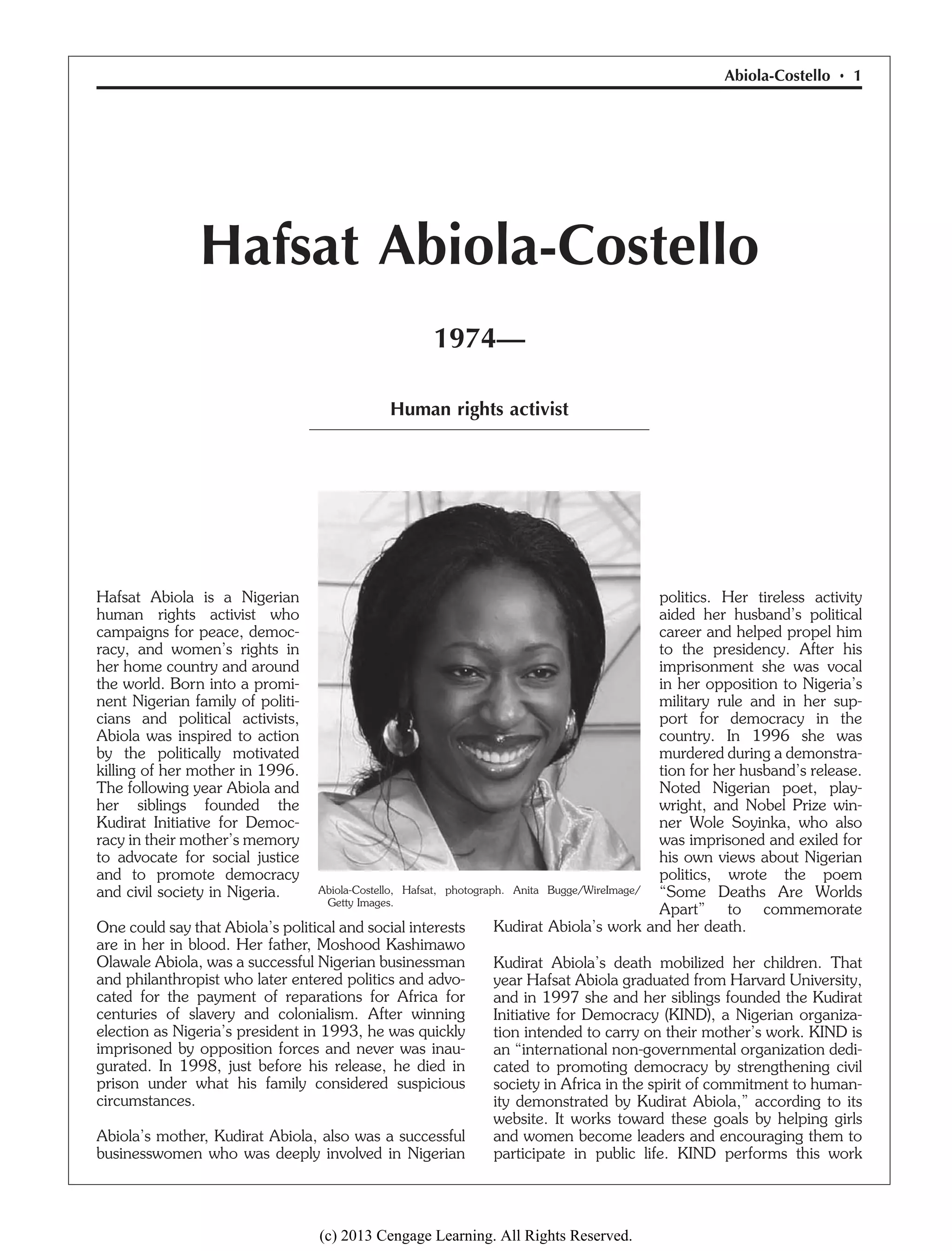
Hafsat Abiola is a Nigerian
human rights activist who
campaigns for peace, democ-
racy, and women’s rights in
her home country and around
the world. Born into a promi-
nent Nigerian family of politi-
cians and political activists,
Abiola was inspired to action
by the politically motivated
killing of her mother in 1996.
The following year Abiola and
her siblings founded the
Kudirat Initiative for Democ-
racy in their mother’s memory
to advocate for social justice
and to promote democracy
and civil society in Nigeria.
One could say that Abiola’s political and social interests
are in her in blood. Her father, Moshood Kashimawo
Olawale Abiola, was a successful Nigerian businessman
and philanthropist who later entered politics and advo-
cated for the payment of reparations for Africa for
centuries of slavery and colonialism. After winning
election as Nigeria’s president in 1993, he was quickly
imprisoned by opposition forces and never was inau-
gurated. In 1998, just before his release, he died in
prison under what his family considered suspicious
circumstances.
Abiola’s mother, Kudirat Abiola, also was a successful
businesswomen who was deeply involved in Nigerian
politics. Her tireless activity
aided her husband’s political
career and helped propel him
to the presidency. After his
imprisonment she was vocal
in her opposition to Nigeria’s
military rule and in her sup-
port for democracy in the
country. In 1996 she was
murdered during a demonstra-
tion for her husband’s release.
Noted Nigerian poet, play-
wright, and Nobel Prize win-
ner Wole Soyinka, who also
was imprisoned and exiled for
his own views about Nigerian
politics, wrote the poem
“Some Deaths Are Worlds
Apart” to commemorate
Kudirat Abiola’s work and her death.
Kudirat Abiola’s death mobilized her children. That
year Hafsat Abiola graduated from Harvard University,
and in 1997 she and her siblings founded the Kudirat
Initiative for Democracy (KIND), a Nigerian organiza-
tion intended to carry on their mother’s work. KIND is
an “international non-governmental organization dedi-
cated to promoting democracy by strengthening civil
society in Africa in the spirit of commitment to human-
ity demonstrated by Kudirat Abiola,” according to its
website. It works toward these goals by helping girls
and women become leaders and encouraging them to
participate in public life. KIND performs this work
Abiola-Costello, Hafsat, photograph. Anita Bugge/WireImage/
Getty Images.
Abiola-Costello • 1
(c) 2013 Cengage Learning. All Rights Reserved.
through its Kudra Leadership Programme, Junior
Kudra Leadership Programme, Make Women Safe
Campaign to support women’s safety, and other initia-
tives.
In addition to KIND, Abiola also has been affiliated with
many other organizations. She co-founded the State of
the World Forum’s Emerging Leaders Program and
served as executive director of Educate Girls Globally.
In addition, she acted as a councilor for the World
Future Council and as a global youth leader for the
World Economic Forum. She also was a member of
many international organizations focused on democ-
racy, leadership, women’s rights, youth, and other
issues.
After earning a master of international development
degree at Tsinghua University in Beijing, Abiola turned
her attention to Asia. In 2009 she founded China
Africa Bridge, which helped create business relation-
ships between African and Chinese companies and
provided research for such companies.
Abiola also used other tactics to shed light on women’s
issues. In 2006 she helped bring a production of Eve
Ensler’s playThe Vagina Monologues, which centers
on women’s bodies and their concerns, to theaters in
Nigeria. The play relates to KIND’s goal of celebrating,
educating, and helping women and its aim to educate
society about women and their experiences.
Abiola was herself a character in Seven, a documentary
play that incorporates interviews and biographical in-
formation about seven real-life female activists. The
play has been staged numerous times in several coun-
tries. Nigerian actress Stephanie Okereke portrayed
Abiola in a 2010 production of Seven in New York City
that was staged as part of the Women in the World
Summit, a conference addressing global women’s
problems.
Abiola also has addressed global women’s issues
through her work with the International Museum of
Women. She has worked with the online museum in a
variety of capacities, including serving as a guest cura-
tor for its 2011 Curating Change exhibit. As part of
that collection she chose writings that exemplified
justice and wrote about what justice meant to her. She
also has worked with the museum on other projects,
including serving as associate editor of the volume
Imagining Ourselves: Global Voices from a New
Generation of Women (2006), for another Interna-
tional Museum of Women exhibition. As the title
indicates, the anthology celebrates young women from
around the world in a collection of their writings and
art.
Like her mother before her, Abiola has served as a
prominent advocate and a visible promoter of Nigerian
democracy and women’s rights. Just as her mother’s
death motivated her, the imprisonment and later death
of her father also spurred Abiola to action. Her article
“A Daughter’s Demands” was published in the June of
1998 issue of Newsweek during her fatherapos;s
imprisonment, just before his death. In it Abiola de-
At a Glance . . .
Born Hafsat Abiola in 1974 in Lagos, Nigeria;
daughter of Moshood Kashimawo Olawale Abiola
(a politician and businessman) and Kudirat Abiola (an
activist and businesswoman); married Nicholas Costello
(a diplomat), 2005; children: Khalil, Annabella. Reli-
gion: Islam. Education: Harvard University, AB, devel-
opment economics, 1996, certificate, Global Leadership
and Public Policy for the 21st Century, 2008; Tsinghua
University, MID, international development, 2009.
Career: Kudirat Initiative for Democracy, founder and
president, 1997—; China Africa Bridge, founder and
chief executive officer, 2009–11; Ogun State govern-
ment, Nigeria, special advisor on Millennium Develop-
ment Goals, 2011—.
Memberships: Educate Girls Globally, executive direc-
tor; Fetzer Advisory Council on Non-Governmental
Organizations; Global Youth Connect; Institute of No-
etic Sciences; International Museum of Women, global
advisory council, 2001–10; Special Olympics; State of
the World Forum, Emerging Leaders Program, co-
founder; Thought Leadership Forum; Vital Voices:
Women in Democracy; Women’s Learning Partnership;
World Economic Forum, global youth leader, 2006–9;
World Future Council, councilor; World Wisdom Coun-
cil; Youth Employment Campaign.
Awards: Youth Peace and Justice Award, Cambridge
Peace Commission, 1997; Change Maker Award, State
of the World Forum, 1998; Women to Watch for Award,
Association for Women’s Rights in Development, 1999;
Global Leader of Tomorrow Award, World Economic
Forum, 2000; Global Award, Nuclear Age Peace Foun-
dation, 2001; Ashoka Fellowship, 2003; Haverford Col-
lege, honorary doctorate of public letters, 2004; Seeking
Common Ground Award, 2007.
Addresses: Office—Kudirat Initiative for Democracy, 60
Lanre Awolokun St., Gbagada Phase 2, Lagos, Nigeria.
Web—http://www.kind.org/archive/home.html.
2 • Contemporary Black Biography • Volume 108
(c) 2013 Cengage Learning. All Rights Reserved.
scribes the poor state of her father’s health and democ-
racy in Nigeria. “America must force the military to
release my imprisoned father and insist on a demo-
cratic future for troubled Nigeria,” she began, noting
that because the United States is a major buyer of
Nigeria’s oil, it has the power to influence the current
Nigerian government, a military regime that she con-
siders unjust. She added, “Injustice only breeds insta-
bility. The promotion of justice is the only guarantee of
peace.”
Abiola’s other writings chronicle both family and poli-
tics. For example, her essay “My Mum, My Heroine,”
was included in Celebrating Kudirat Abiola, a collection
of postings on the KIND website. The piece chronicles
her mother’s life, her political activity, and how she
inspired Abiola in her own life and work.
Abiola’s international work has garnered many inter-
national awards, including the Cambridge Peace Com-
mission’s Youth Peace and Justice Award, a Change
Maker Award from the State of the World Forum, the
Global Leader of Tomorrow Award from the World
Economic Forum, the Nuclear Age Peace Foundation’s
Global Award, and a Seeking Common Ground Award.
Her other honors include a Women to Watch for
Award from the Association for Women’s Rights in
Development and an honorary doctorate of public
letters from Haverford College in Pennsylvania.
International affairs have continued to play a role in
Abiola’s personal life. Her husband, Nick Costello, is a
British diplomat; married since 2005, the couple have
two children. Their work has taken the family around
the world, as Costello’s assignments have included
postings in China and Belgium, and Abiola’s work as a
special advisor on Millennium Development Goals to
Nigeria’s Ogun State government have taken her back
to Nigeria. These international diplomatic postings
provide further proof that for Abiola, the political and
the personal are inextricably linked.
Selected writings
(Associate editor) Imagining Ourselves: Global Voices
from a New Generation of Women, New World
Library, 2006.
Sources
Periodicals
Abiola, Hafsat, “A Daughter’s Demands,” Newsweek,
June 22, 1998, p. 40.
Bernstein, Dennis, and Lesley Kean, “Following in Her
Mother’s Footsteps,” The Progressive, August,
1996, p. 18.
Online
Duthiers, Vladimir, “Nigerian Activist Keeps Family
Legacy Alive,” CNN, December 27, 2012, http://
www.cnn.com/2012/12/27/world/africa/hafsat
-abiola-activist-nigeria (accessed February 5, 2013).
“Hafsat Abiola on Justice,” International Museum of
Women, Curating Change, 2011, http://www.imow
.org/curatingchange2011/abiola/ (accessed Febru-
ary 6, 2013).
“Kudirat Initiative for Democracy,” http://www.kind
.org/archive/home.html (accessed February 7,
2013).
“My Mum, My Heroine,” Kudirat Initiative for Democ-
racy, Celebrating Kudirat Abiola, 2011, http://www
.celebratekudiratabiola.info/hafsat.php (accessed
February 6, 2013).
Olaode, Funke, “Interview with Abiola Hafsat
-Costello,” Naijablog, February 19, 2006, http://
www.naijablog.co.uk/2006/02/interview-with-haf
sat-abiola-costello.html (accessed February 5, 2013).
—Pamela M. Zuber
Abiola-Costello • 3
(c) 2013 Cengage Learning. All Rights Reserved.

Writing clip_PZ_Abiola-Costello

  • 1.
    Hafsat Abiola-Costello 1974— Human rightsactivist Hafsat Abiola is a Nigerian human rights activist who campaigns for peace, democ- racy, and women’s rights in her home country and around the world. Born into a promi- nent Nigerian family of politi- cians and political activists, Abiola was inspired to action by the politically motivated killing of her mother in 1996. The following year Abiola and her siblings founded the Kudirat Initiative for Democ- racy in their mother’s memory to advocate for social justice and to promote democracy and civil society in Nigeria. One could say that Abiola’s political and social interests are in her in blood. Her father, Moshood Kashimawo Olawale Abiola, was a successful Nigerian businessman and philanthropist who later entered politics and advo- cated for the payment of reparations for Africa for centuries of slavery and colonialism. After winning election as Nigeria’s president in 1993, he was quickly imprisoned by opposition forces and never was inau- gurated. In 1998, just before his release, he died in prison under what his family considered suspicious circumstances. Abiola’s mother, Kudirat Abiola, also was a successful businesswomen who was deeply involved in Nigerian politics. Her tireless activity aided her husband’s political career and helped propel him to the presidency. After his imprisonment she was vocal in her opposition to Nigeria’s military rule and in her sup- port for democracy in the country. In 1996 she was murdered during a demonstra- tion for her husband’s release. Noted Nigerian poet, play- wright, and Nobel Prize win- ner Wole Soyinka, who also was imprisoned and exiled for his own views about Nigerian politics, wrote the poem “Some Deaths Are Worlds Apart” to commemorate Kudirat Abiola’s work and her death. Kudirat Abiola’s death mobilized her children. That year Hafsat Abiola graduated from Harvard University, and in 1997 she and her siblings founded the Kudirat Initiative for Democracy (KIND), a Nigerian organiza- tion intended to carry on their mother’s work. KIND is an “international non-governmental organization dedi- cated to promoting democracy by strengthening civil society in Africa in the spirit of commitment to human- ity demonstrated by Kudirat Abiola,” according to its website. It works toward these goals by helping girls and women become leaders and encouraging them to participate in public life. KIND performs this work Abiola-Costello, Hafsat, photograph. Anita Bugge/WireImage/ Getty Images. Abiola-Costello • 1 (c) 2013 Cengage Learning. All Rights Reserved.
  • 2.
    through its KudraLeadership Programme, Junior Kudra Leadership Programme, Make Women Safe Campaign to support women’s safety, and other initia- tives. In addition to KIND, Abiola also has been affiliated with many other organizations. She co-founded the State of the World Forum’s Emerging Leaders Program and served as executive director of Educate Girls Globally. In addition, she acted as a councilor for the World Future Council and as a global youth leader for the World Economic Forum. She also was a member of many international organizations focused on democ- racy, leadership, women’s rights, youth, and other issues. After earning a master of international development degree at Tsinghua University in Beijing, Abiola turned her attention to Asia. In 2009 she founded China Africa Bridge, which helped create business relation- ships between African and Chinese companies and provided research for such companies. Abiola also used other tactics to shed light on women’s issues. In 2006 she helped bring a production of Eve Ensler’s playThe Vagina Monologues, which centers on women’s bodies and their concerns, to theaters in Nigeria. The play relates to KIND’s goal of celebrating, educating, and helping women and its aim to educate society about women and their experiences. Abiola was herself a character in Seven, a documentary play that incorporates interviews and biographical in- formation about seven real-life female activists. The play has been staged numerous times in several coun- tries. Nigerian actress Stephanie Okereke portrayed Abiola in a 2010 production of Seven in New York City that was staged as part of the Women in the World Summit, a conference addressing global women’s problems. Abiola also has addressed global women’s issues through her work with the International Museum of Women. She has worked with the online museum in a variety of capacities, including serving as a guest cura- tor for its 2011 Curating Change exhibit. As part of that collection she chose writings that exemplified justice and wrote about what justice meant to her. She also has worked with the museum on other projects, including serving as associate editor of the volume Imagining Ourselves: Global Voices from a New Generation of Women (2006), for another Interna- tional Museum of Women exhibition. As the title indicates, the anthology celebrates young women from around the world in a collection of their writings and art. Like her mother before her, Abiola has served as a prominent advocate and a visible promoter of Nigerian democracy and women’s rights. Just as her mother’s death motivated her, the imprisonment and later death of her father also spurred Abiola to action. Her article “A Daughter’s Demands” was published in the June of 1998 issue of Newsweek during her fatherapos;s imprisonment, just before his death. In it Abiola de- At a Glance . . . Born Hafsat Abiola in 1974 in Lagos, Nigeria; daughter of Moshood Kashimawo Olawale Abiola (a politician and businessman) and Kudirat Abiola (an activist and businesswoman); married Nicholas Costello (a diplomat), 2005; children: Khalil, Annabella. Reli- gion: Islam. Education: Harvard University, AB, devel- opment economics, 1996, certificate, Global Leadership and Public Policy for the 21st Century, 2008; Tsinghua University, MID, international development, 2009. Career: Kudirat Initiative for Democracy, founder and president, 1997—; China Africa Bridge, founder and chief executive officer, 2009–11; Ogun State govern- ment, Nigeria, special advisor on Millennium Develop- ment Goals, 2011—. Memberships: Educate Girls Globally, executive direc- tor; Fetzer Advisory Council on Non-Governmental Organizations; Global Youth Connect; Institute of No- etic Sciences; International Museum of Women, global advisory council, 2001–10; Special Olympics; State of the World Forum, Emerging Leaders Program, co- founder; Thought Leadership Forum; Vital Voices: Women in Democracy; Women’s Learning Partnership; World Economic Forum, global youth leader, 2006–9; World Future Council, councilor; World Wisdom Coun- cil; Youth Employment Campaign. Awards: Youth Peace and Justice Award, Cambridge Peace Commission, 1997; Change Maker Award, State of the World Forum, 1998; Women to Watch for Award, Association for Women’s Rights in Development, 1999; Global Leader of Tomorrow Award, World Economic Forum, 2000; Global Award, Nuclear Age Peace Foun- dation, 2001; Ashoka Fellowship, 2003; Haverford Col- lege, honorary doctorate of public letters, 2004; Seeking Common Ground Award, 2007. Addresses: Office—Kudirat Initiative for Democracy, 60 Lanre Awolokun St., Gbagada Phase 2, Lagos, Nigeria. Web—http://www.kind.org/archive/home.html. 2 • Contemporary Black Biography • Volume 108 (c) 2013 Cengage Learning. All Rights Reserved.
  • 3.
    scribes the poorstate of her father’s health and democ- racy in Nigeria. “America must force the military to release my imprisoned father and insist on a demo- cratic future for troubled Nigeria,” she began, noting that because the United States is a major buyer of Nigeria’s oil, it has the power to influence the current Nigerian government, a military regime that she con- siders unjust. She added, “Injustice only breeds insta- bility. The promotion of justice is the only guarantee of peace.” Abiola’s other writings chronicle both family and poli- tics. For example, her essay “My Mum, My Heroine,” was included in Celebrating Kudirat Abiola, a collection of postings on the KIND website. The piece chronicles her mother’s life, her political activity, and how she inspired Abiola in her own life and work. Abiola’s international work has garnered many inter- national awards, including the Cambridge Peace Com- mission’s Youth Peace and Justice Award, a Change Maker Award from the State of the World Forum, the Global Leader of Tomorrow Award from the World Economic Forum, the Nuclear Age Peace Foundation’s Global Award, and a Seeking Common Ground Award. Her other honors include a Women to Watch for Award from the Association for Women’s Rights in Development and an honorary doctorate of public letters from Haverford College in Pennsylvania. International affairs have continued to play a role in Abiola’s personal life. Her husband, Nick Costello, is a British diplomat; married since 2005, the couple have two children. Their work has taken the family around the world, as Costello’s assignments have included postings in China and Belgium, and Abiola’s work as a special advisor on Millennium Development Goals to Nigeria’s Ogun State government have taken her back to Nigeria. These international diplomatic postings provide further proof that for Abiola, the political and the personal are inextricably linked. Selected writings (Associate editor) Imagining Ourselves: Global Voices from a New Generation of Women, New World Library, 2006. Sources Periodicals Abiola, Hafsat, “A Daughter’s Demands,” Newsweek, June 22, 1998, p. 40. Bernstein, Dennis, and Lesley Kean, “Following in Her Mother’s Footsteps,” The Progressive, August, 1996, p. 18. Online Duthiers, Vladimir, “Nigerian Activist Keeps Family Legacy Alive,” CNN, December 27, 2012, http:// www.cnn.com/2012/12/27/world/africa/hafsat -abiola-activist-nigeria (accessed February 5, 2013). “Hafsat Abiola on Justice,” International Museum of Women, Curating Change, 2011, http://www.imow .org/curatingchange2011/abiola/ (accessed Febru- ary 6, 2013). “Kudirat Initiative for Democracy,” http://www.kind .org/archive/home.html (accessed February 7, 2013). “My Mum, My Heroine,” Kudirat Initiative for Democ- racy, Celebrating Kudirat Abiola, 2011, http://www .celebratekudiratabiola.info/hafsat.php (accessed February 6, 2013). Olaode, Funke, “Interview with Abiola Hafsat -Costello,” Naijablog, February 19, 2006, http:// www.naijablog.co.uk/2006/02/interview-with-haf sat-abiola-costello.html (accessed February 5, 2013). —Pamela M. Zuber Abiola-Costello • 3 (c) 2013 Cengage Learning. All Rights Reserved.