Testing the
Untestable
Unit Tests are Great !
• Proof that your code does what it is supposed to do
• Proof that refactoring code doesn’t break its functionality
• Automated Regressions Tests
• Verify that new code doesn’t break existing code
• Unit Tests are a part of the documentation of the code
TDD is Great !
• Writing tests helps design how the code should work
• Write tests as we define the public methods
• All green tests tell us when the coding is complete
• Bugfixing
• Write test for bug
• Fix bug so that test passes
Testing the Untestable
• 100% Code Coverage is over-rated
• Prioritise writing Tests for the code that needs testing
• Diminishing returns
Testing the Untestable
• Test Doubles
• Let the code run
• Mock as little as possible
• Database access
• E-Mailing
• Test values
Testing the Untestable
• Constructor does Real Work
• Indirect Collaborators
• Global State & Singletons
• Class Does Too Much
Testing the Untestable
Constructor does Real Work
• Difficulties
• Creating/Initializing Collaborators
• Communicating with other services, and logic to set up its own
state
• Forcing subclasses/mocks to inherit unwanted behaviour
• Prevents instantiation or altering collaborators in the test.
Testing the Untestable
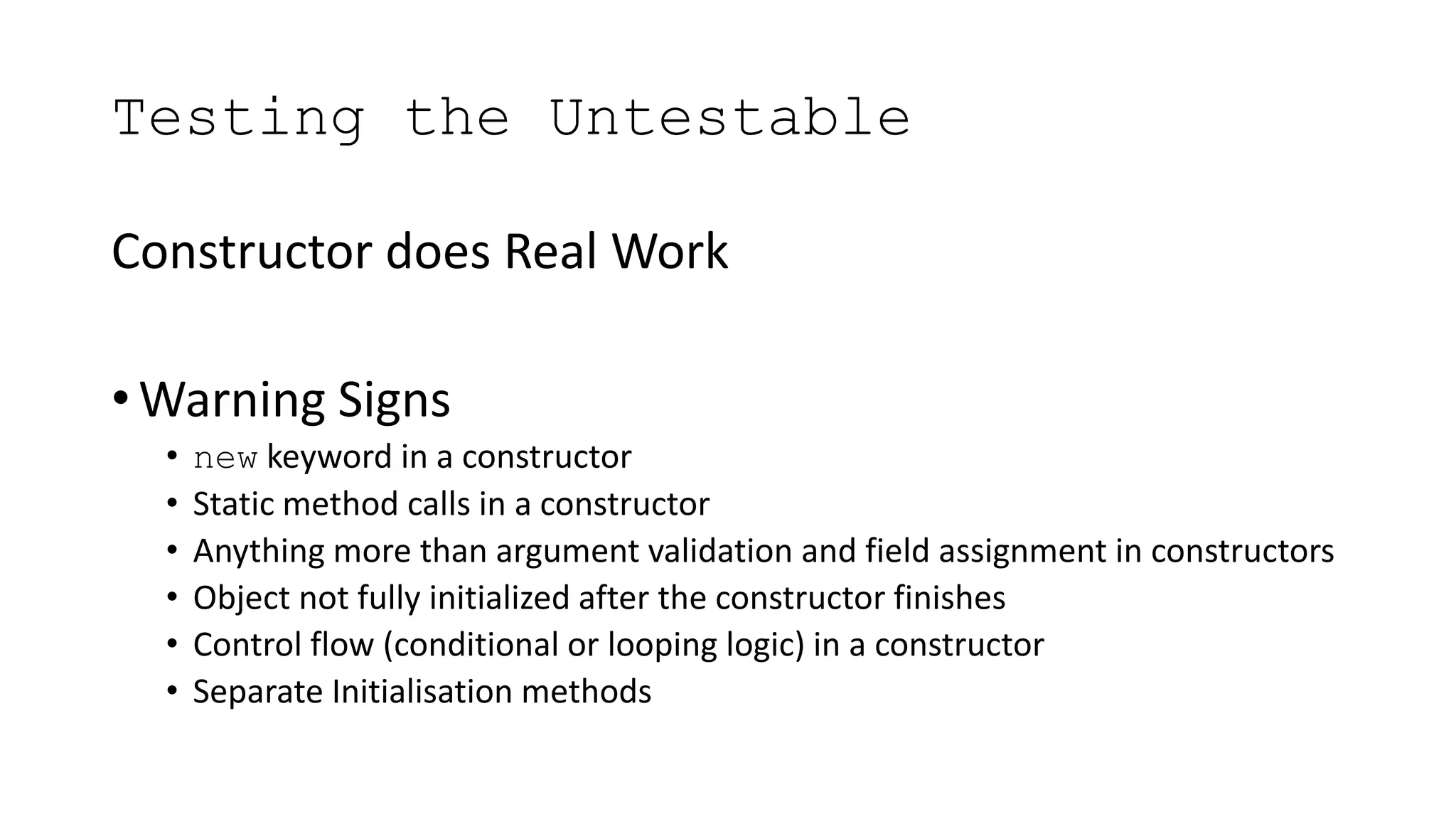
Constructor does Real Work
• Warning Signs
• new keyword in a constructor
• Static method calls in a constructor
• Anything more than argument validation and field assignment in constructors
• Object not fully initialized after the constructor finishes
• Control flow (conditional or looping logic) in a constructor
• Separate Initialisation methods
Testing the Untestable
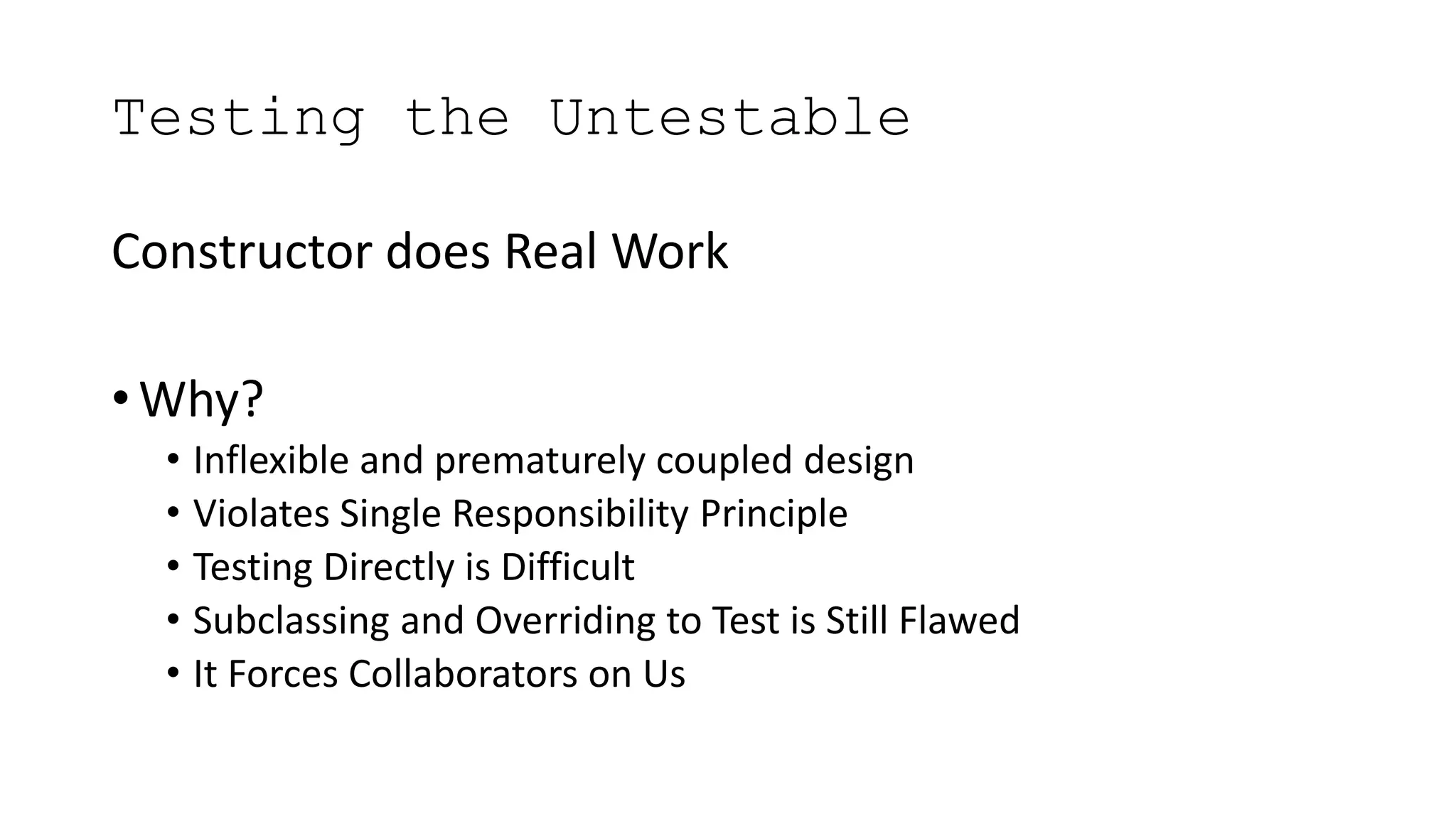
Constructor does Real Work
• Why?
• Inflexible and prematurely coupled design
• Violates Single Responsibility Principle
• Testing Directly is Difficult
• Subclassing and Overriding to Test is Still Flawed
• It Forces Collaborators on Us
Testing the Untestable
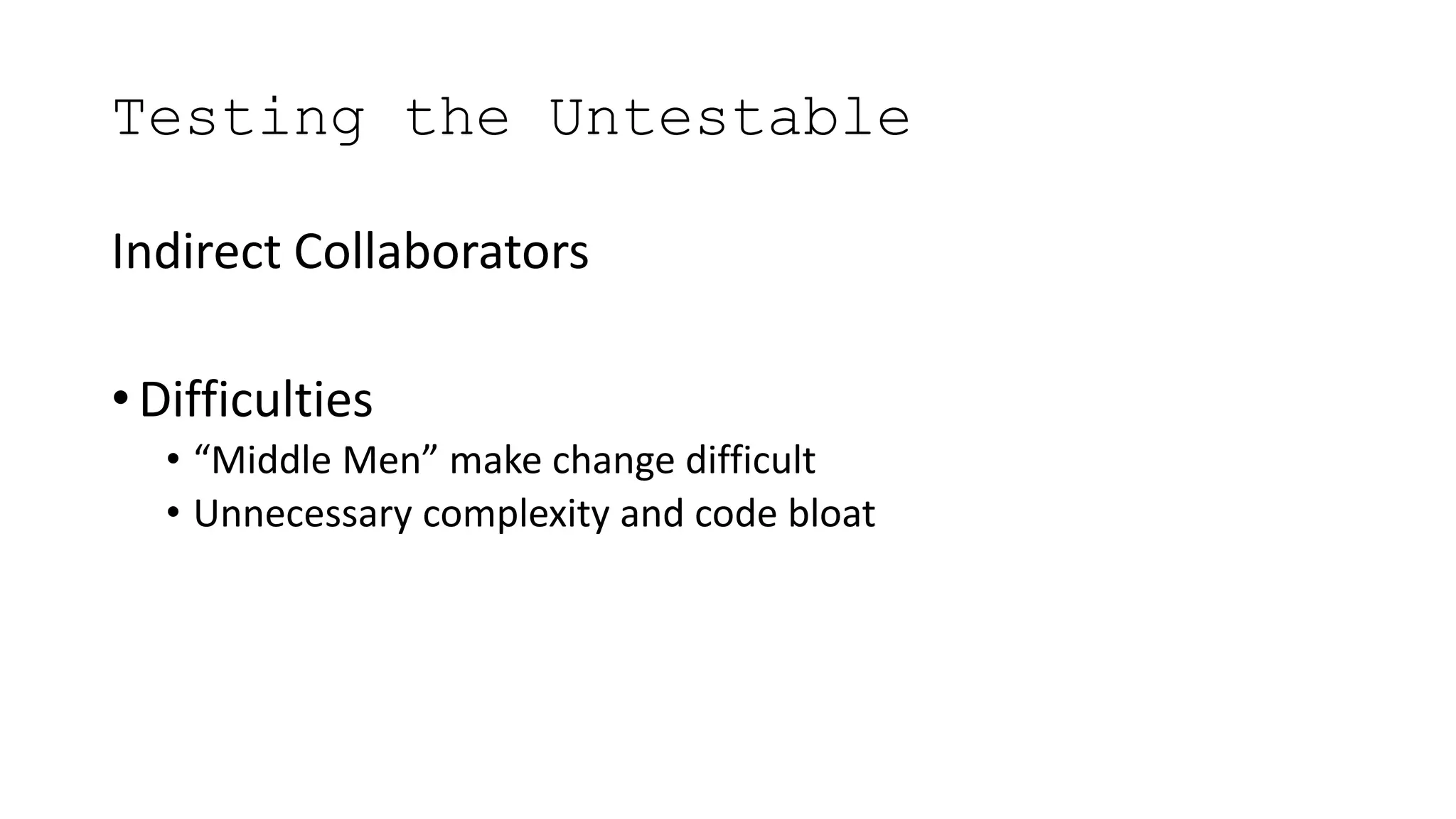
Indirect Collaborators
• Difficulties
• “Middle Men” make change difficult
• Unnecessary complexity and code bloat
Testing the Untestable
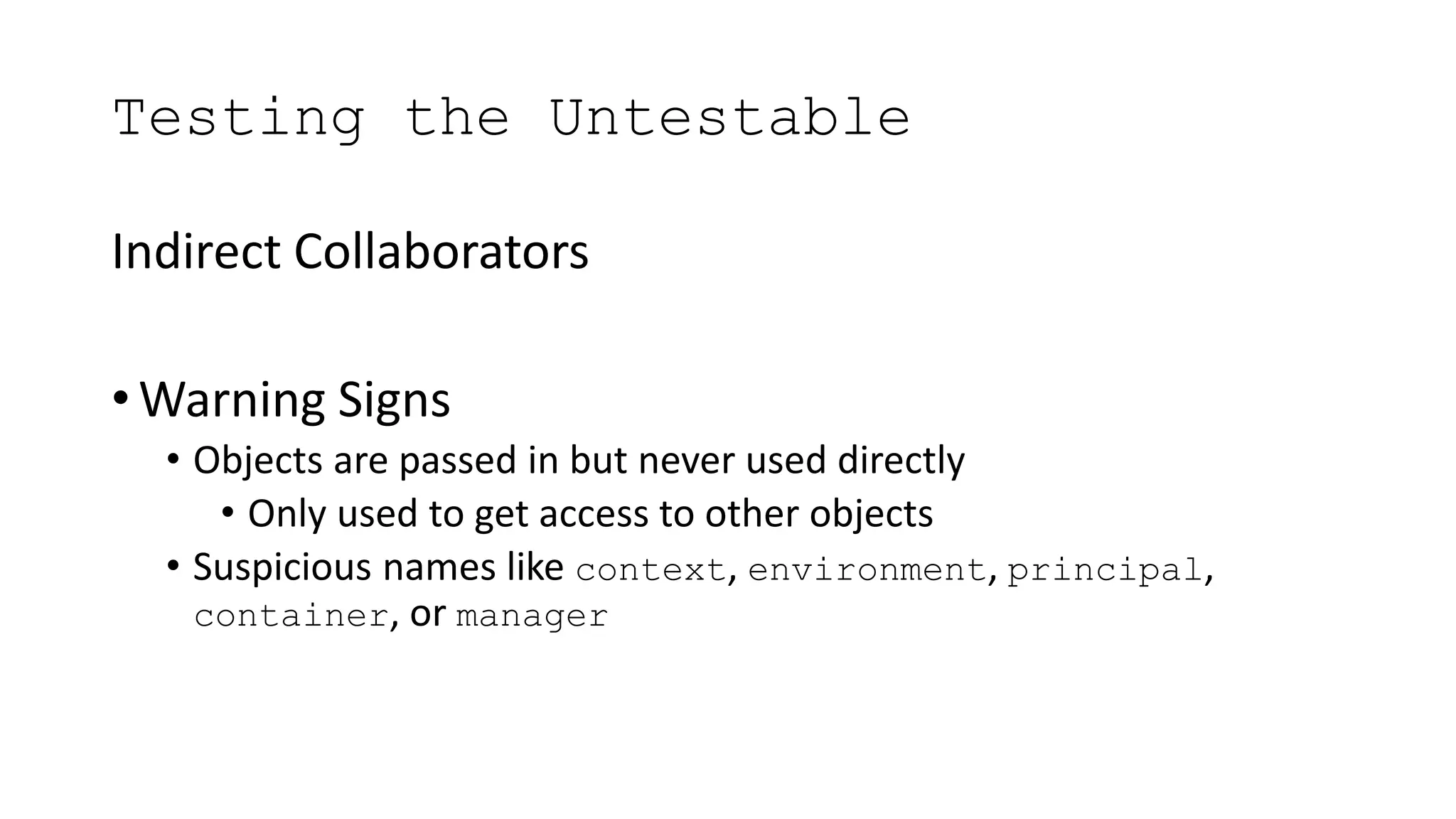
Indirect Collaborators
• Warning Signs
• Objects are passed in but never used directly
• Only used to get access to other objects
• Suspicious names like context, environment, principal,
container, or manager
Testing the Untestable
Indirect Collaborators
• Why?
• Hard to identify the collaborator methods that we need to mock
• Necessary to create mocks that return other mocks
Testing the Untestable
Global State & Singletons
• Difficulties
• Global state mutated in one test can cause a subsequent or
parallel test to fail unexpectedly.
• Forcing subclasses/mocks to inherit unwanted behaviour
• Prevents instantiation or altering collaborators in the test.
Testing the Untestable
Global State & Singletons
• Warning Signs
• Use of Singletons
• Using Static Properties or Methods
• Using Registries or Service Locators
• Static Initialisation Blocks
Testing the Untestable
Global State & Singletons
• Why?
• Changes to global state can be made from anywhere
• Unexpected initial state for individual tests
Testing the Untestable
• Class Does Too Much
• Difficulties
• Tests for individual Methods can’t easily be isolated from other
methods
Testing the Untestable
• Class Does Too Much
• Warning Signs
• Class description uses the word “and”
• Too many methods
• Too many properties
• Too many collaborators
Testing the Untestable
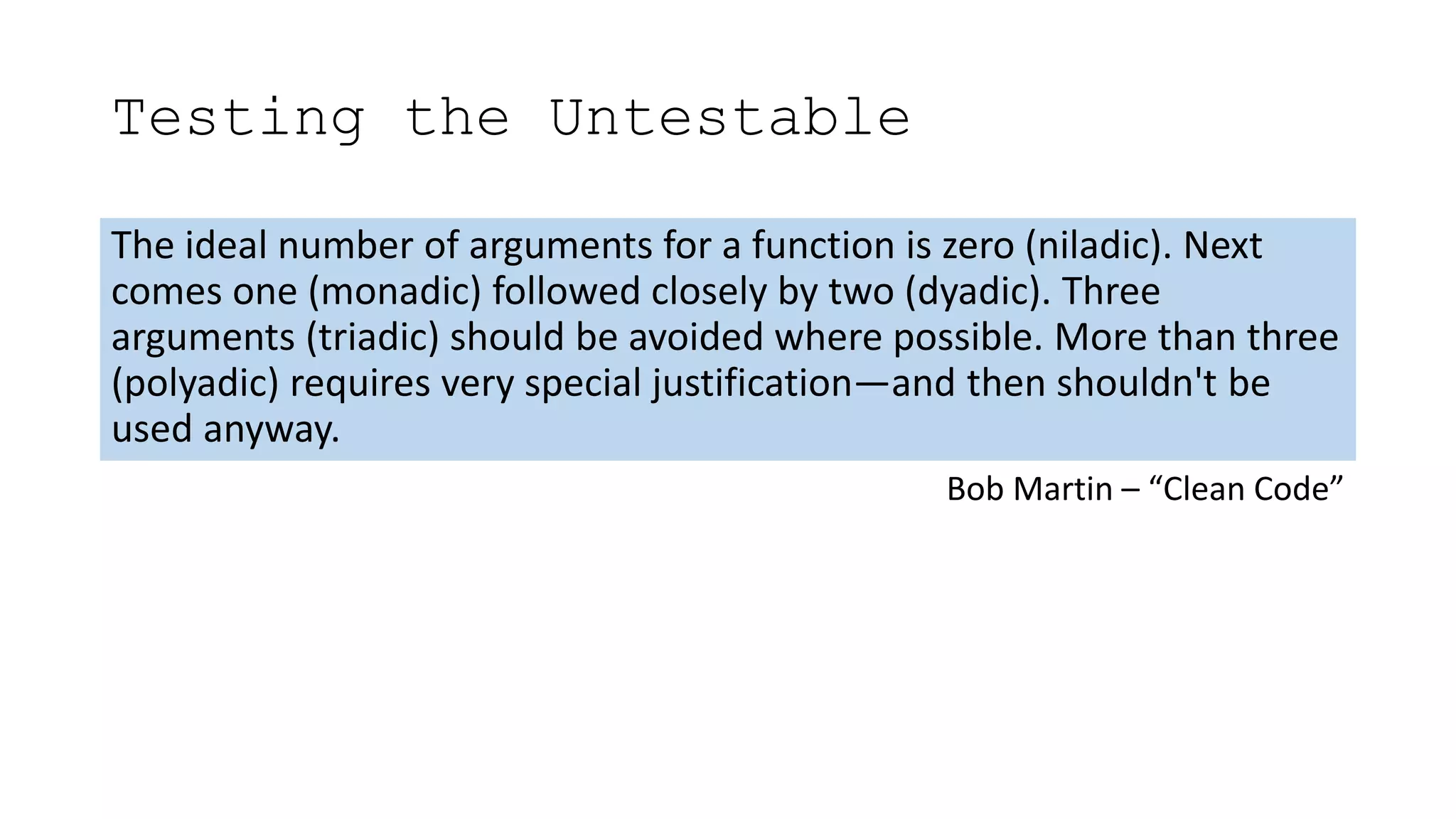
The ideal number of arguments for a function is zero (niladic). Next
comes one (monadic) followed closely by two (dyadic). Three
arguments (triadic) should be avoided where possible. More than three
(polyadic) requires very special justification—and then shouldn't be
used anyway.
Bob Martin – “Clean Code”
Testing the Untestable
public function __construct(
MagentoFrameworkModelContext $context,
MagentoFrameworkViewDesignInterface $design,
MagentoFrameworkRegistry $registry,
MagentoStoreModelAppEmulation $appEmulation,
MagentoStoreModelStoreManagerInterface $storeManager,
MagentoFrameworkAppRequestInterface $request,
MagentoNewsletterModelTemplateFilter $filter,
MagentoFrameworkAppConfigScopeConfigInterface $scopeConfig,
MagentoNewsletterModelTemplateFactory $templateFactory,
MagentoFrameworkFilterFilterManager $filterManager,
array $data = []
) {
parent::__construct($context, $design, $registry, $appEmulation, $storeManager, $data);
$this->_storeManager = $storeManager;
$this->_request = $request;
$this->_filter = $filter;
$this->_scopeConfig = $scopeConfig;
$this->_templateFactory = $templateFactory;
$this->_filterManager = $filterManager;
}
Testing the Untestable
• Class Does Too Much
• Why?
• Difficult to modify behaviour of one responsibility without
changing/breaking others
• Muddled Responsibilities
Testing the Untestable
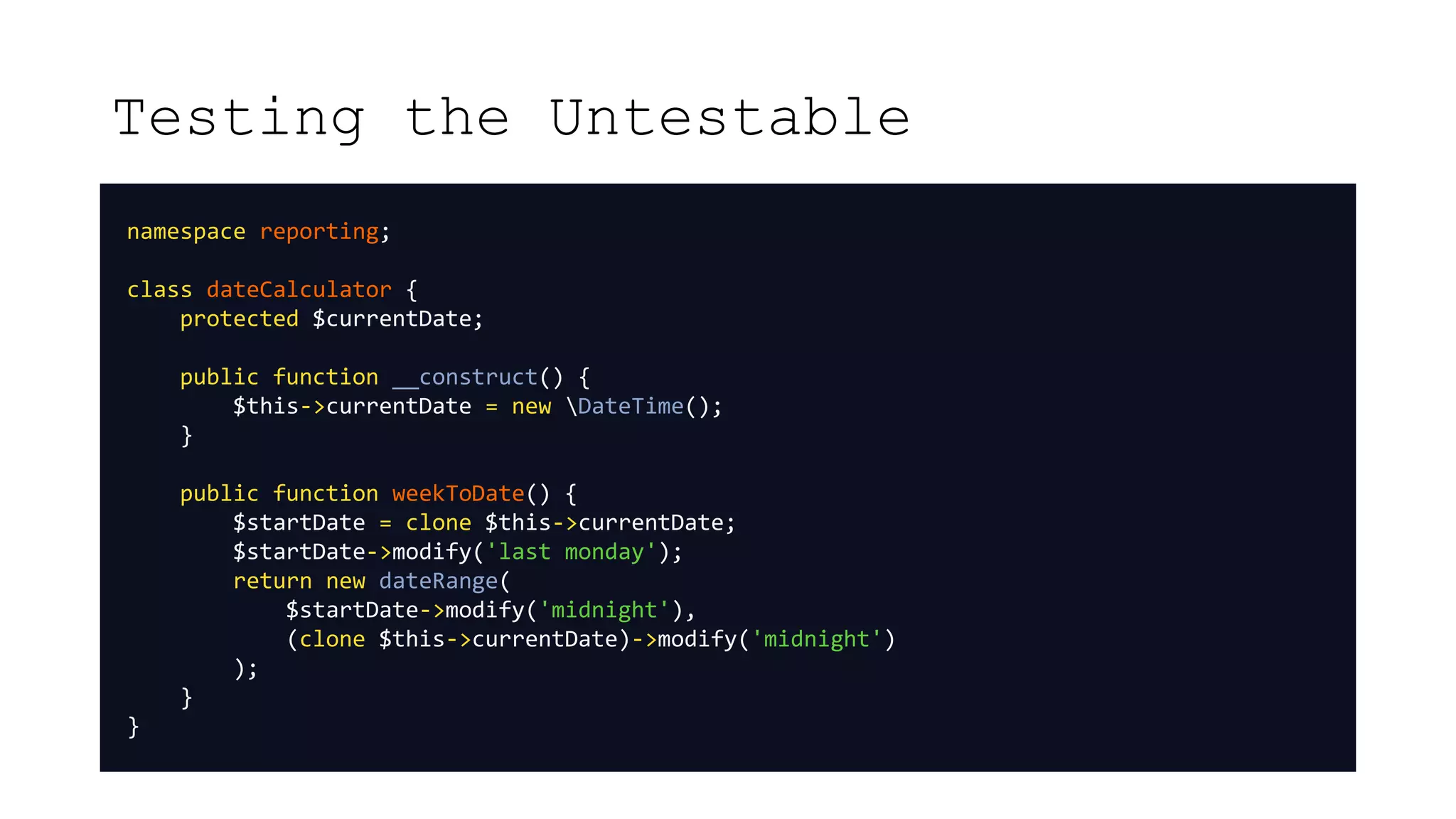
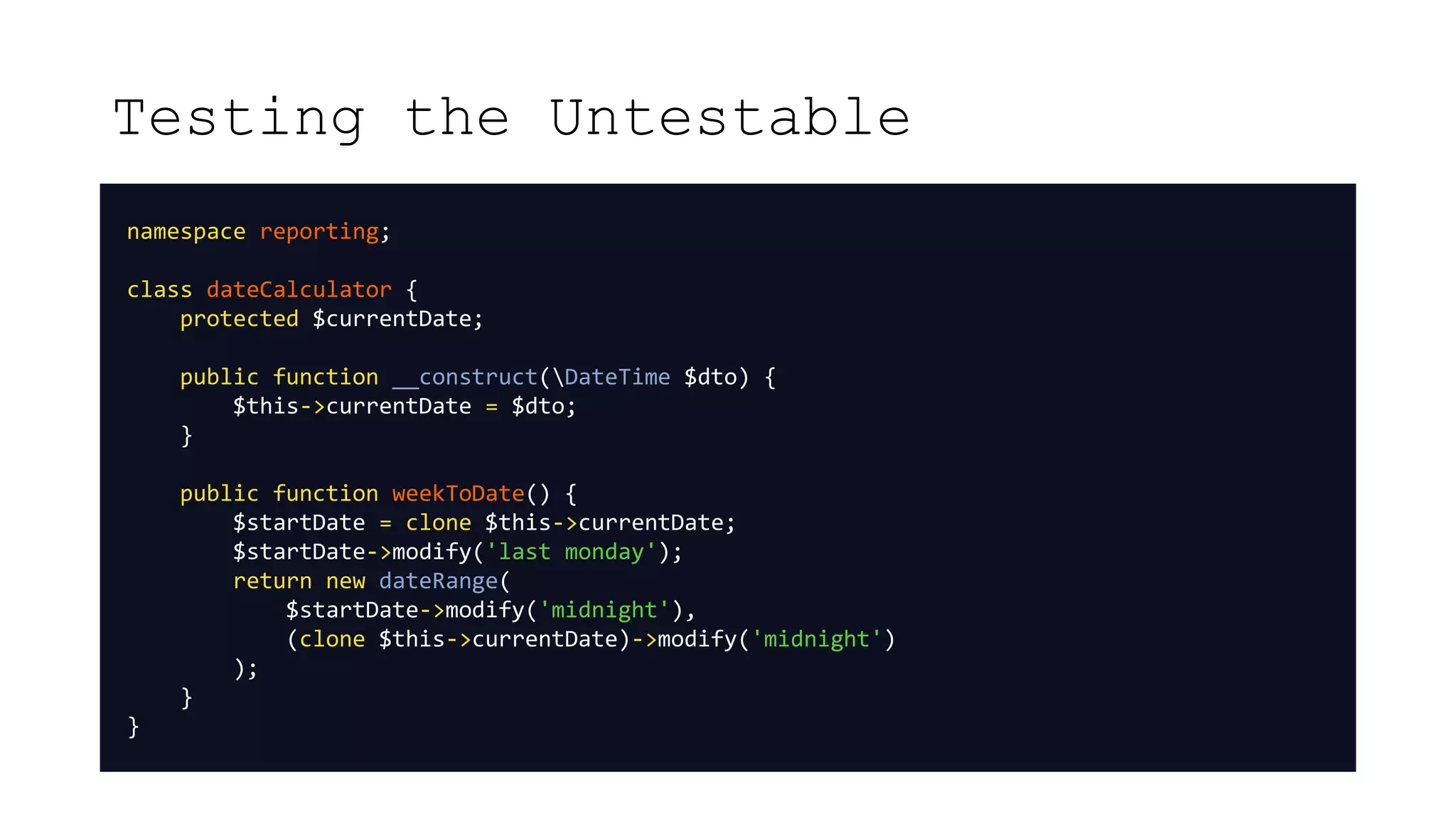
namespace reporting;
class dateCalculator {
protected $currentDate;
public function __construct() {
$this->currentDate = new DateTime();
}
public function weekToDate() {
$startDate = clone $this->currentDate;
$startDate->modify('last monday');
return new dateRange(
$startDate->modify('midnight'),
(clone $this->currentDate)->modify('midnight')
);
}
}
Testing the Untestable
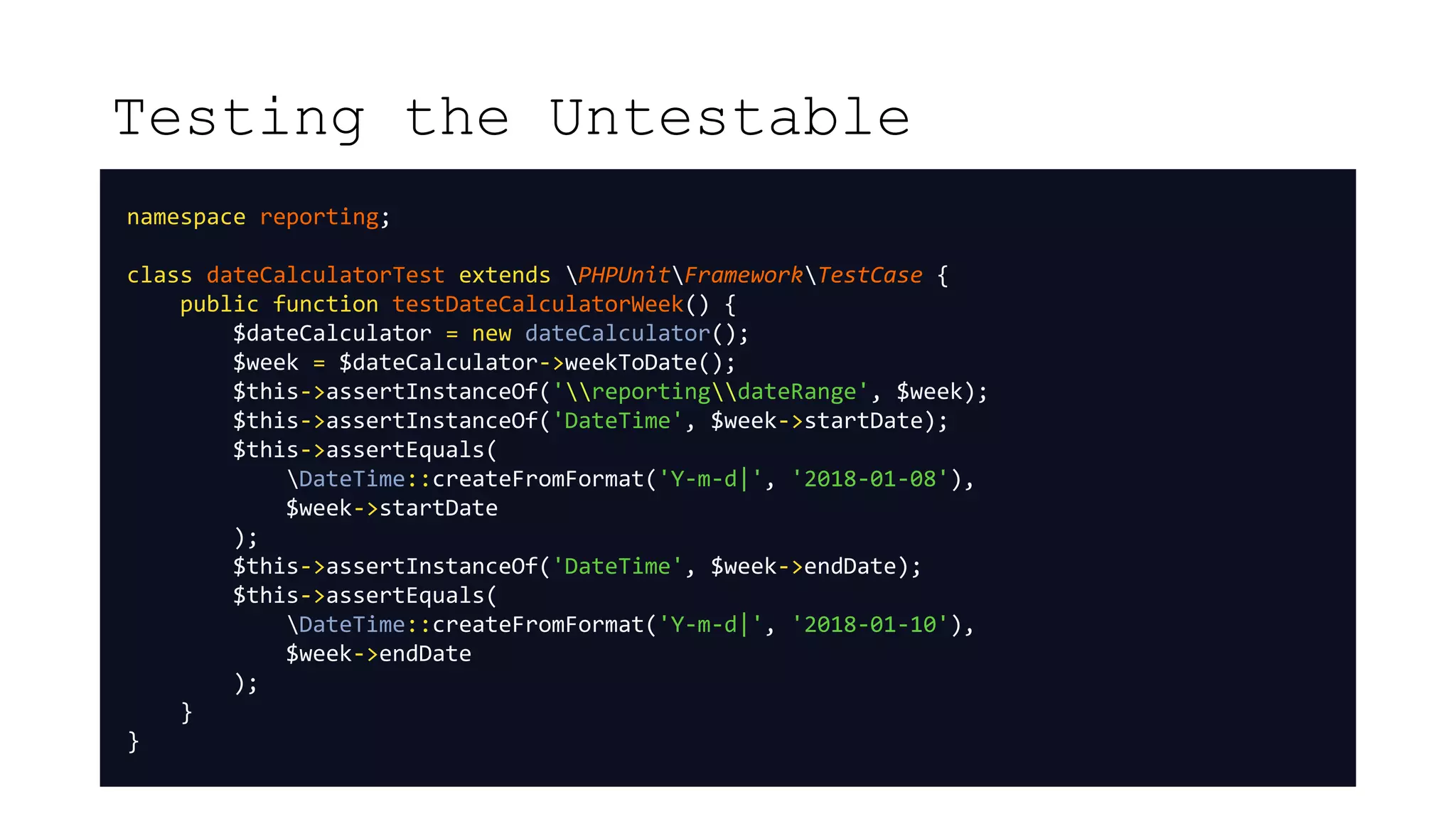
namespace reporting;
class dateCalculatorTest extends PHPUnitFrameworkTestCase {
public function testDateCalculatorWeek() {
$dateCalculator = new dateCalculator();
$week = $dateCalculator->weekToDate();
$this->assertInstanceOf('reportingdateRange', $week);
$this->assertInstanceOf('DateTime', $week->startDate);
$this->assertEquals(
DateTime::createFromFormat('Y-m-d|', '2018-01-08'),
$week->startDate
);
$this->assertInstanceOf('DateTime', $week->endDate);
$this->assertEquals(
DateTime::createFromFormat('Y-m-d|', '2018-01-10'),
$week->endDate
);
}
}
Testing the Untestable
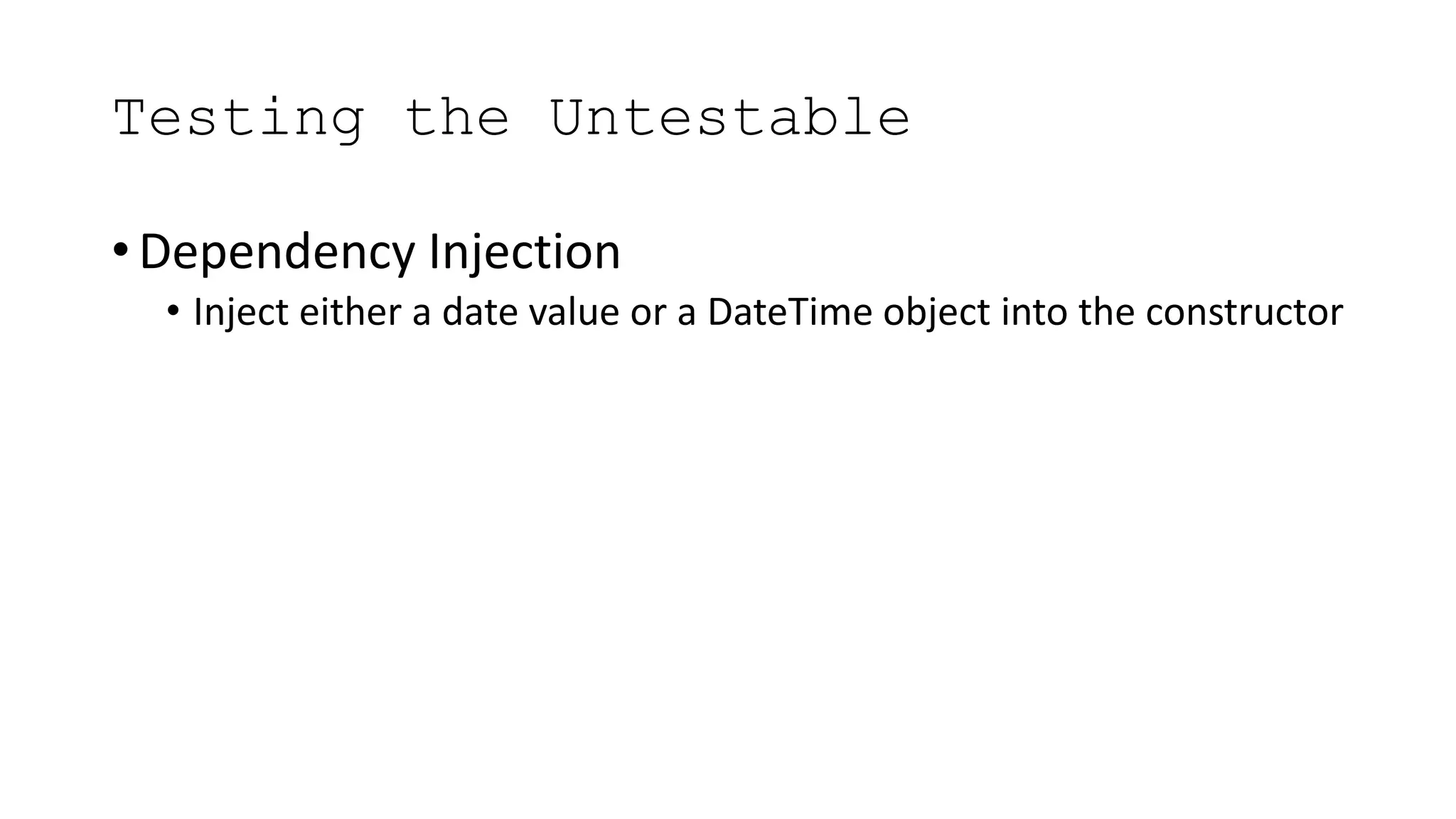
• Dependency Injection
• Inject either a date value or a DateTime object into the constructor
Testing the Untestable
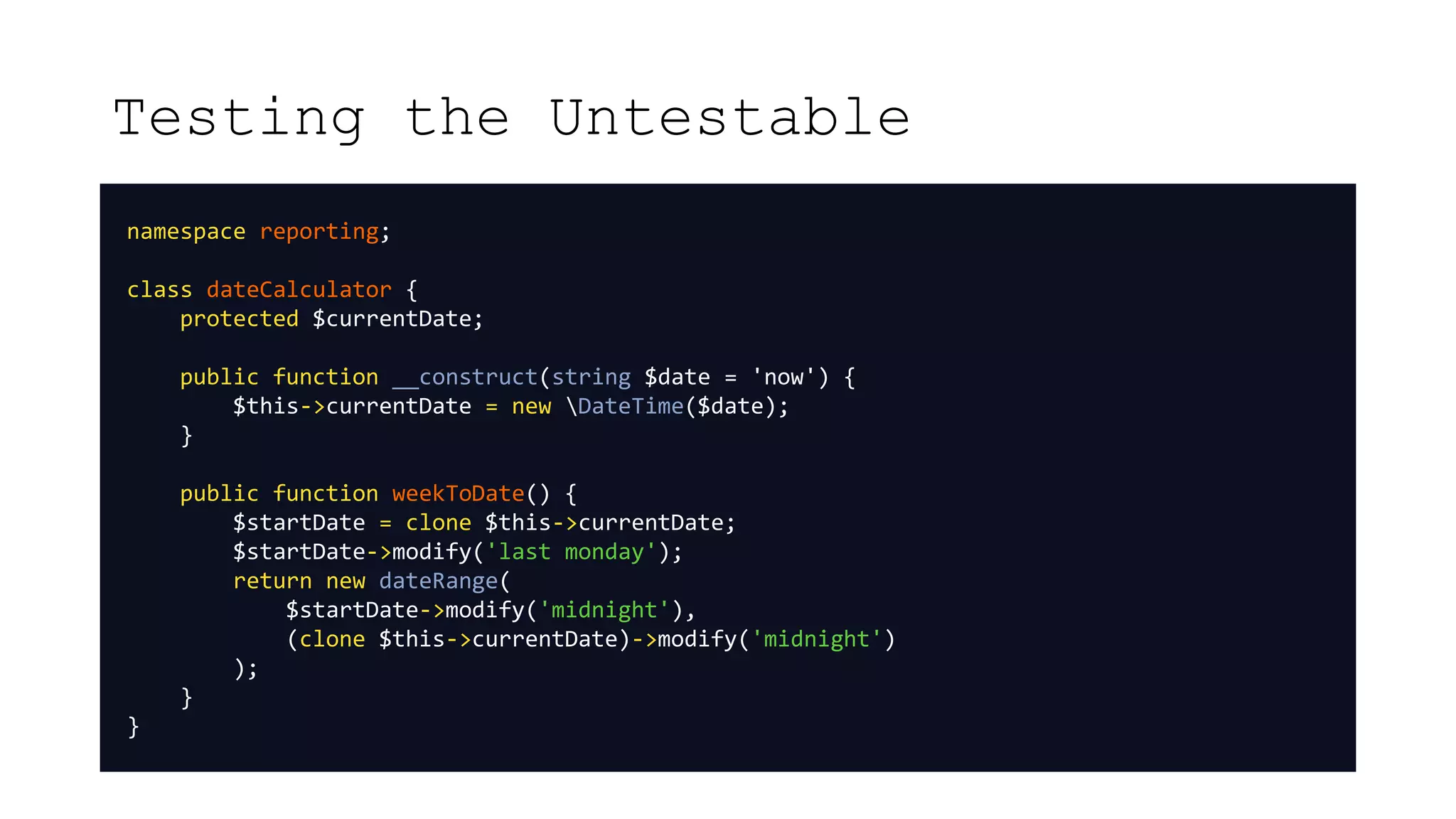
namespace reporting;
class dateCalculator {
protected $currentDate;
public function __construct(string $date = 'now') {
$this->currentDate = new DateTime($date);
}
public function weekToDate() {
$startDate = clone $this->currentDate;
$startDate->modify('last monday');
return new dateRange(
$startDate->modify('midnight'),
(clone $this->currentDate)->modify('midnight')
);
}
}
Testing the Untestable
namespace reporting;
class dateCalculator {
protected $currentDate;
public function __construct(DateTime $dto) {
$this->currentDate = $dto;
}
public function weekToDate() {
$startDate = clone $this->currentDate;
$startDate->modify('last monday');
return new dateRange(
$startDate->modify('midnight'),
(clone $this->currentDate)->modify('midnight')
);
}
}
Testing the Untestable
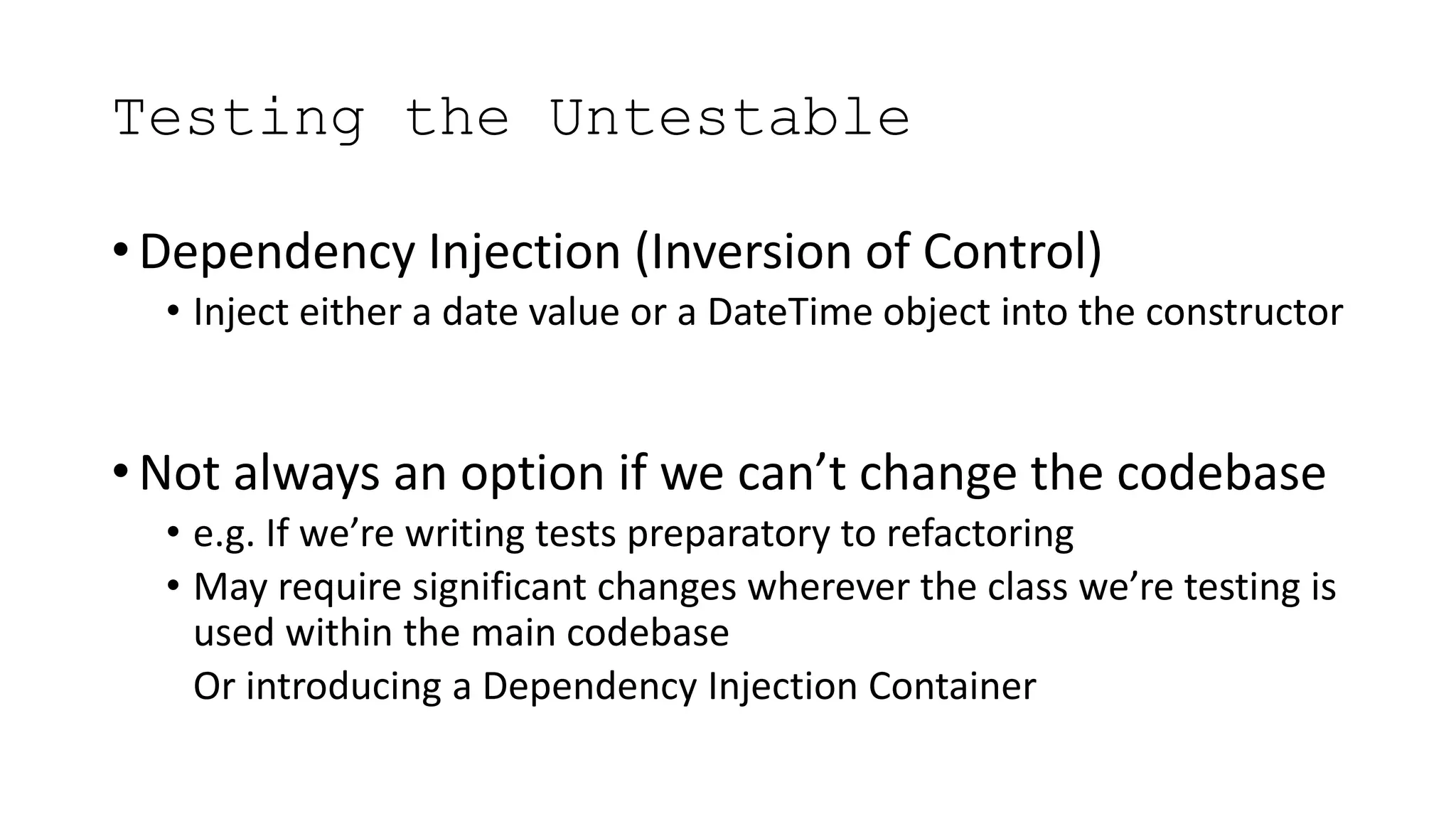
• Dependency Injection (Inversion of Control)
• Inject either a date value or a DateTime object into the constructor
• Not always an option if we can’t change the codebase
• e.g. If we’re writing tests preparatory to refactoring
• May require significant changes wherever the class we’re testing is
used within the main codebase
• Or introducing a Dependency Injection Container
Testing the Untestable
• In the case of DateTime, we can modify the the
DateTime constructor
• If we’re using namespacing
Testing the Untestable
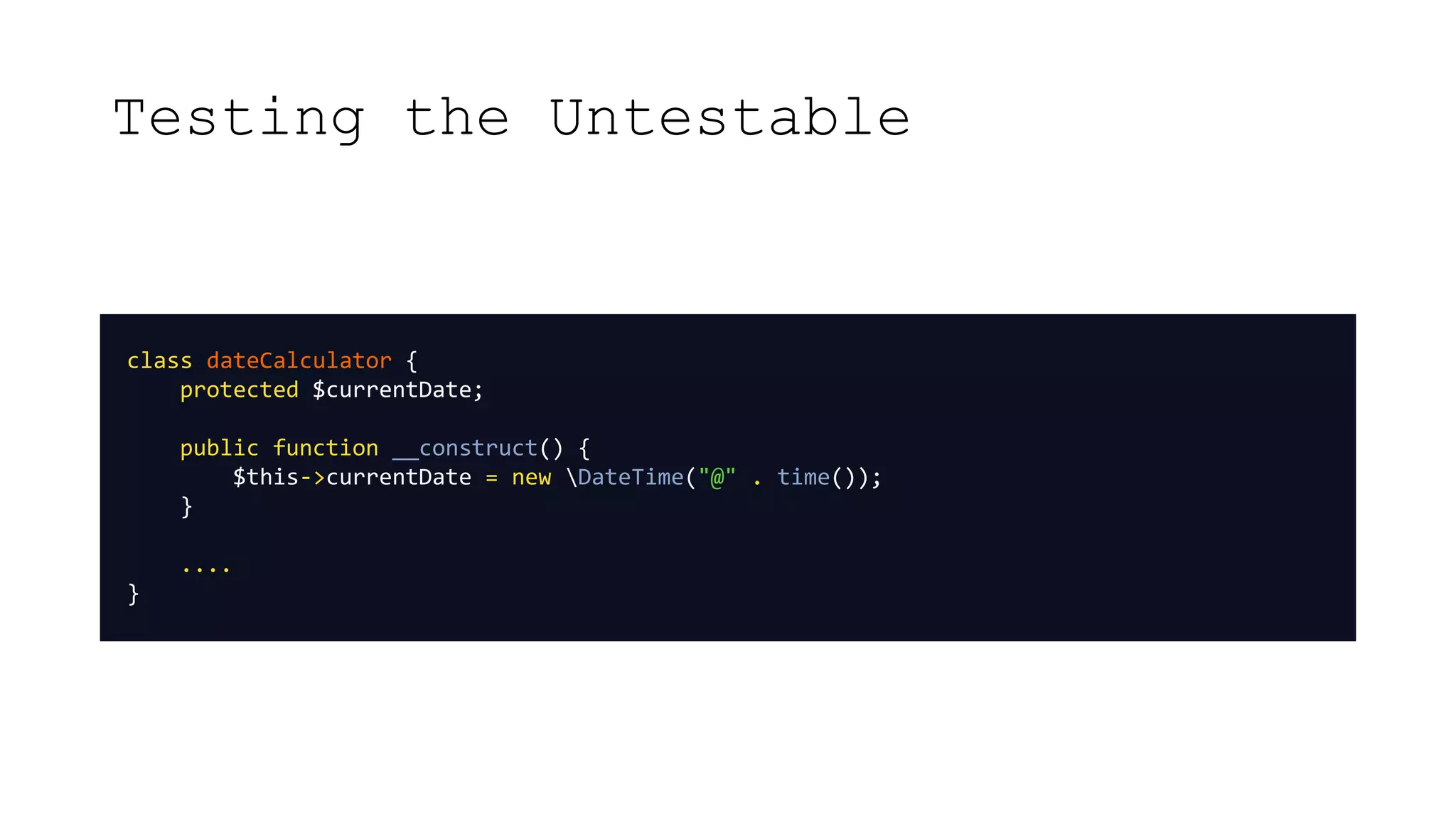
class dateCalculator {
protected $currentDate;
public function __construct() {
$this->currentDate = new DateTime("@" . time());
}
....
}
Testing the Untestable
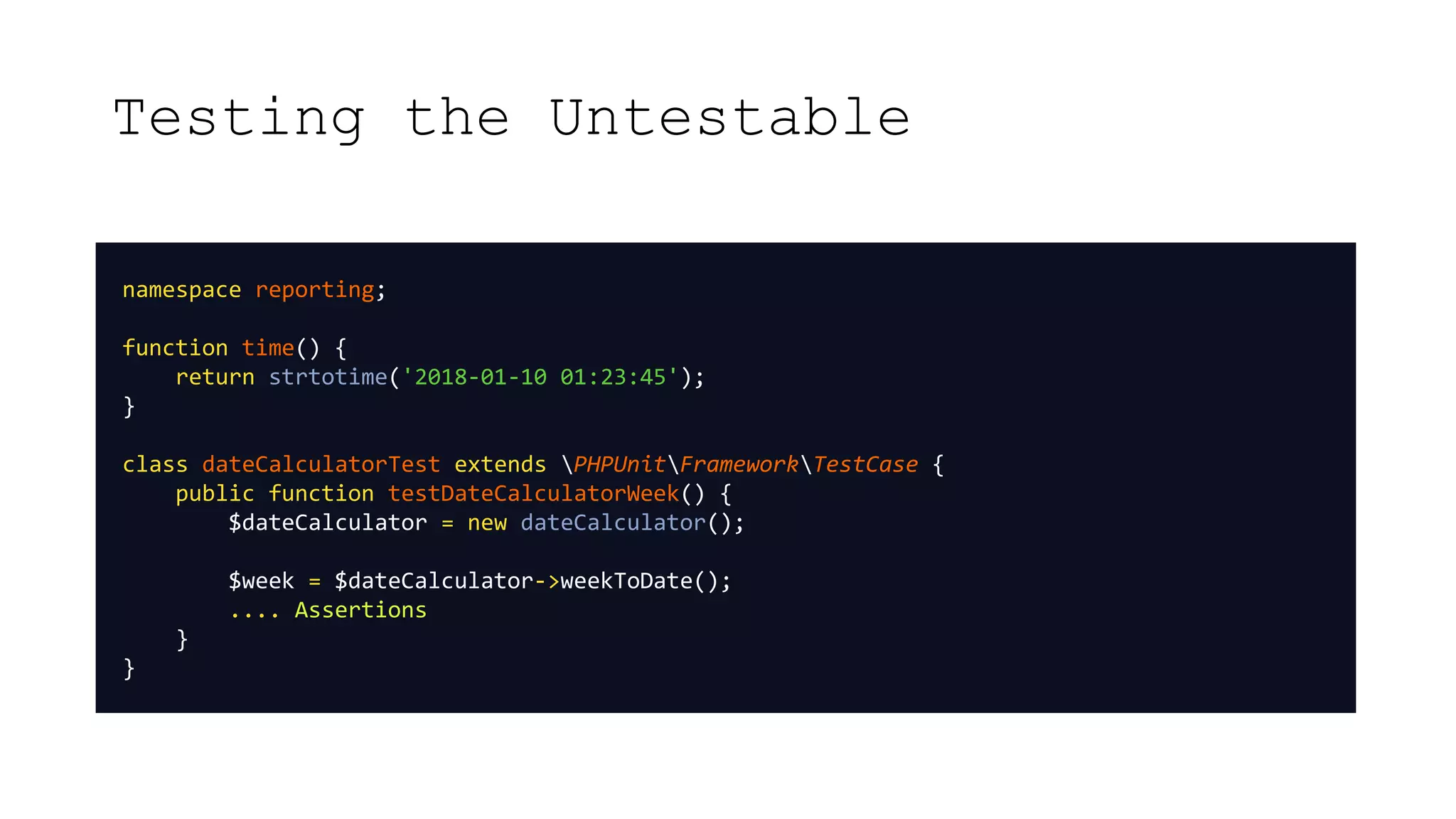
namespace reporting;
function time() {
return strtotime('2018-01-10 01:23:45');
}
class dateCalculatorTest extends PHPUnitFrameworkTestCase {
public function testDateCalculatorWeek() {
$dateCalculator = new dateCalculator();
$week = $dateCalculator->weekToDate();
.... Assertions
}
}
Testing the Untestable
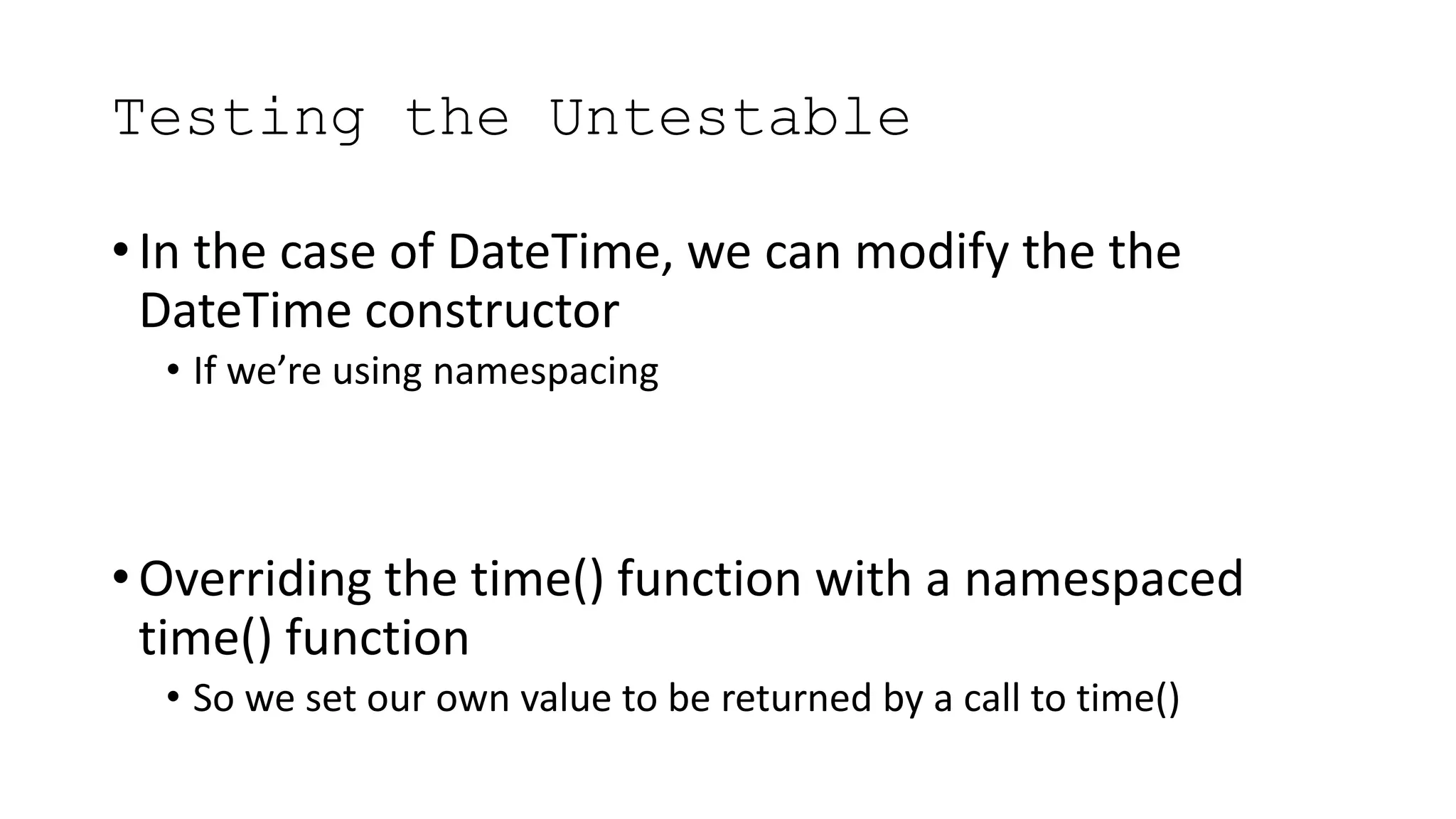
• In the case of DateTime, we can modify the the
DateTime constructor
• If we’re using namespacing
• Overriding the time() function with a namespaced
time() function
• So we set our own value to be returned by a call to time()
Testing the Untestable
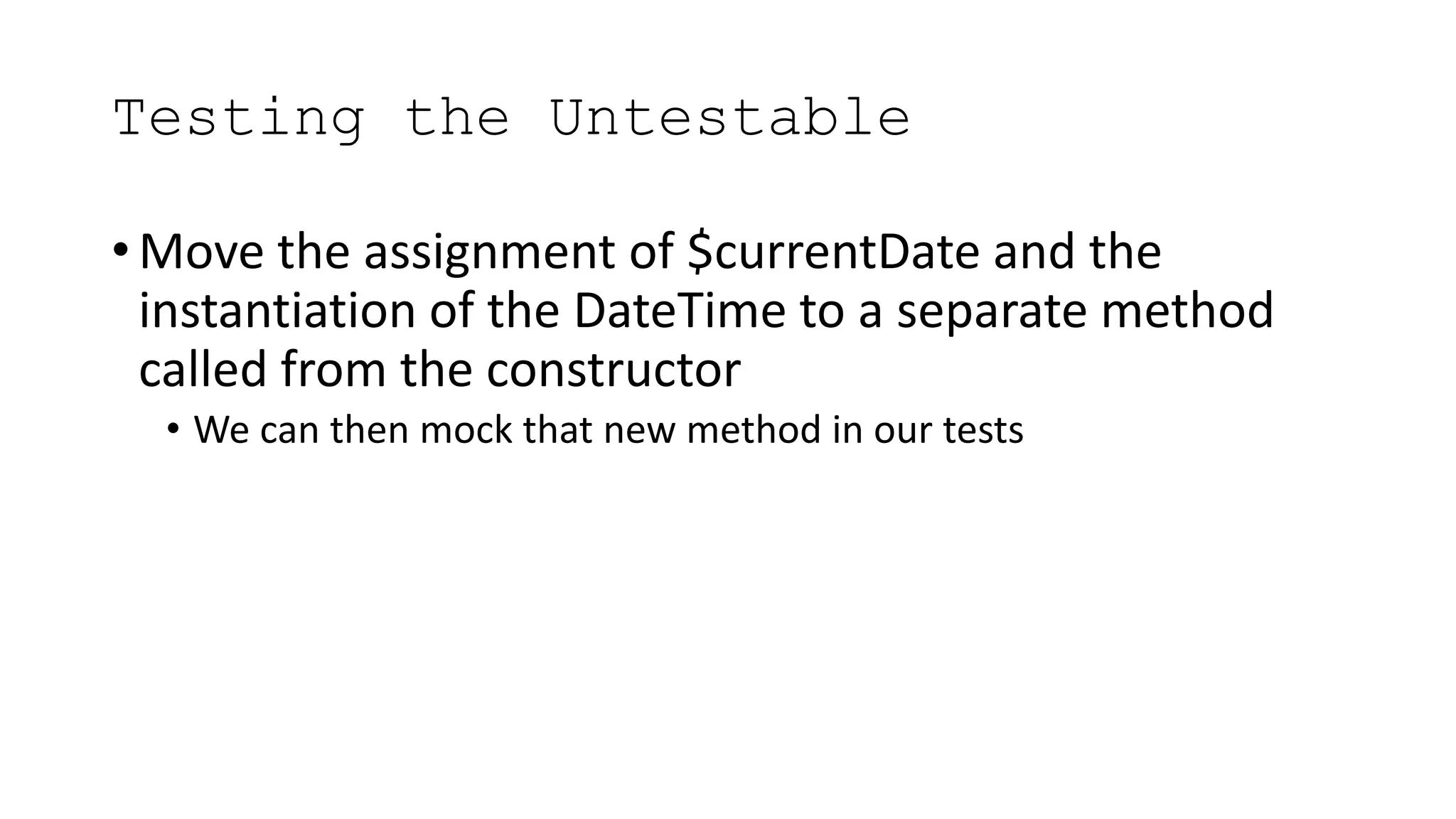
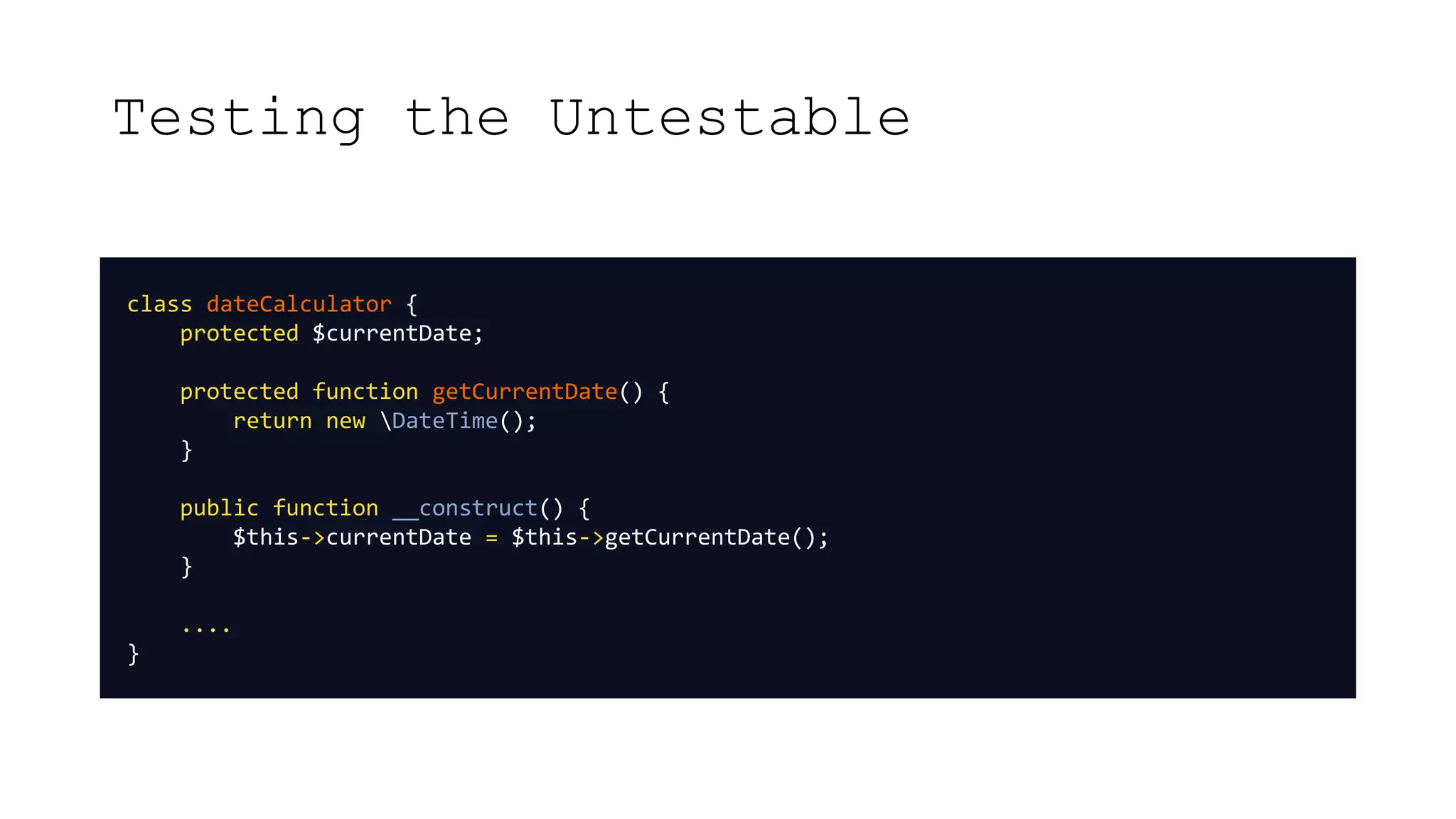
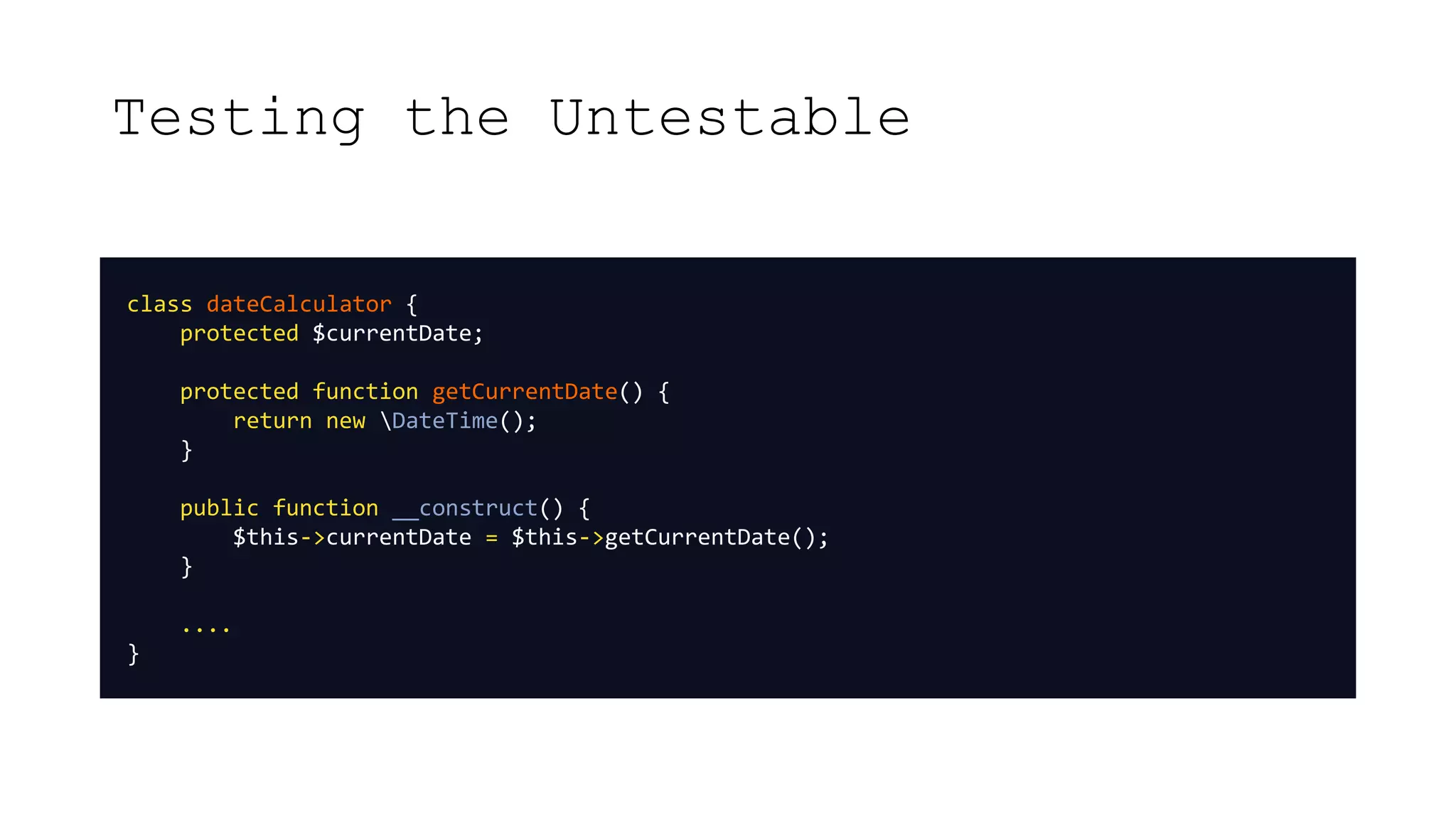
• Move the assignment of $currentDate and the
instantiation of the DateTime to a separate method
called from the constructor
• We can then mock that new method in our tests
Testing the Untestable
class dateCalculator {
protected $currentDate;
protected function getCurrentDate() {
return new DateTime();
}
public function __construct() {
$this->currentDate = $this->getCurrentDate();
}
....
}
Testing the Untestable
class dateCalculatorTest extends PHPUnitFrameworkTestCase {
public function testDateCalculatorWeek() {
$dateCalculator = $this->getMockBuilder('reportingdateCalculator')
->setMethods(['getCurrentDate'])
->getMock();
$dateCalculator->expects($this->once())
->method('getCurrentDate')
->will(
$this->returnValue(new DateTime('2018-01-10 01:23:45'))
);
$week = $dateCalculator->weekToDate();
.... Assertions
}
}
Testing the Untestable
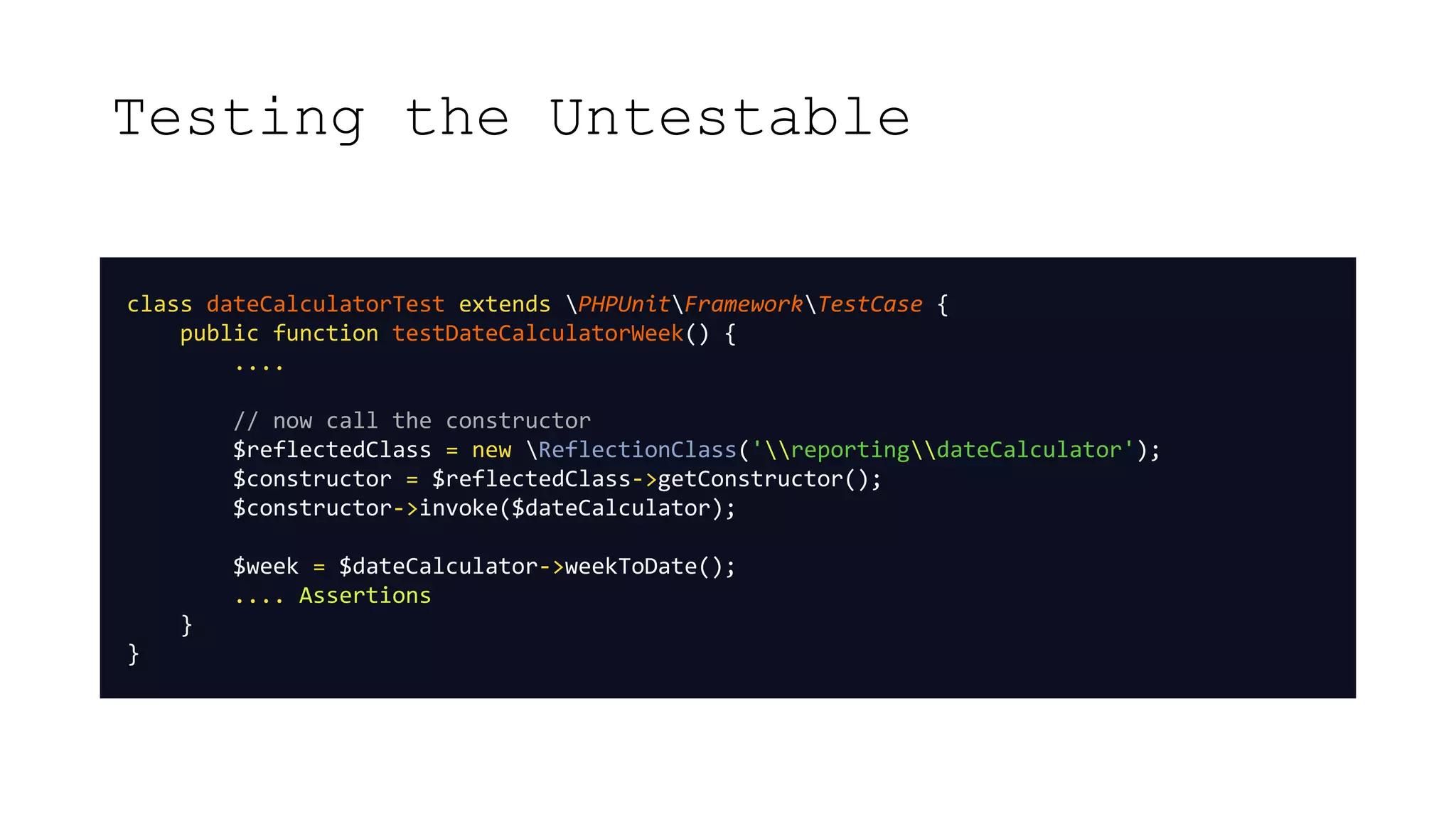
• Or Use Reflection
Testing the Untestable
class dateCalculator {
protected $currentDate;
protected function getCurrentDate() {
return new DateTime();
}
public function __construct() {
$this->currentDate = $this->getCurrentDate();
}
....
}
Testing the Untestable
class dateCalculatorTest extends PHPUnitFrameworkTestCase {
public function testDateCalculatorWeek() {
$dateCalculator = $this->getMockBuilder('reportingdateCalculator')
->disableOriginalConstructor()
->setMethods(['getCurrentDate'])
->getMock();
$dateCalculator->expects($this->once())
->method('getCurrentDate')
->will(
$this->returnValue(new DateTime('2018-01-10 01:23:45'))
);
....
}
}
Testing the Untestable
class dateCalculatorTest extends PHPUnitFrameworkTestCase {
public function testDateCalculatorWeek() {
....
// now call the constructor
$reflectedClass = new ReflectionClass('reportingdateCalculator');
$constructor = $reflectedClass->getConstructor();
$constructor->invoke($dateCalculator);
$week = $dateCalculator->weekToDate();
.... Assertions
}
}
Testing the Untestable
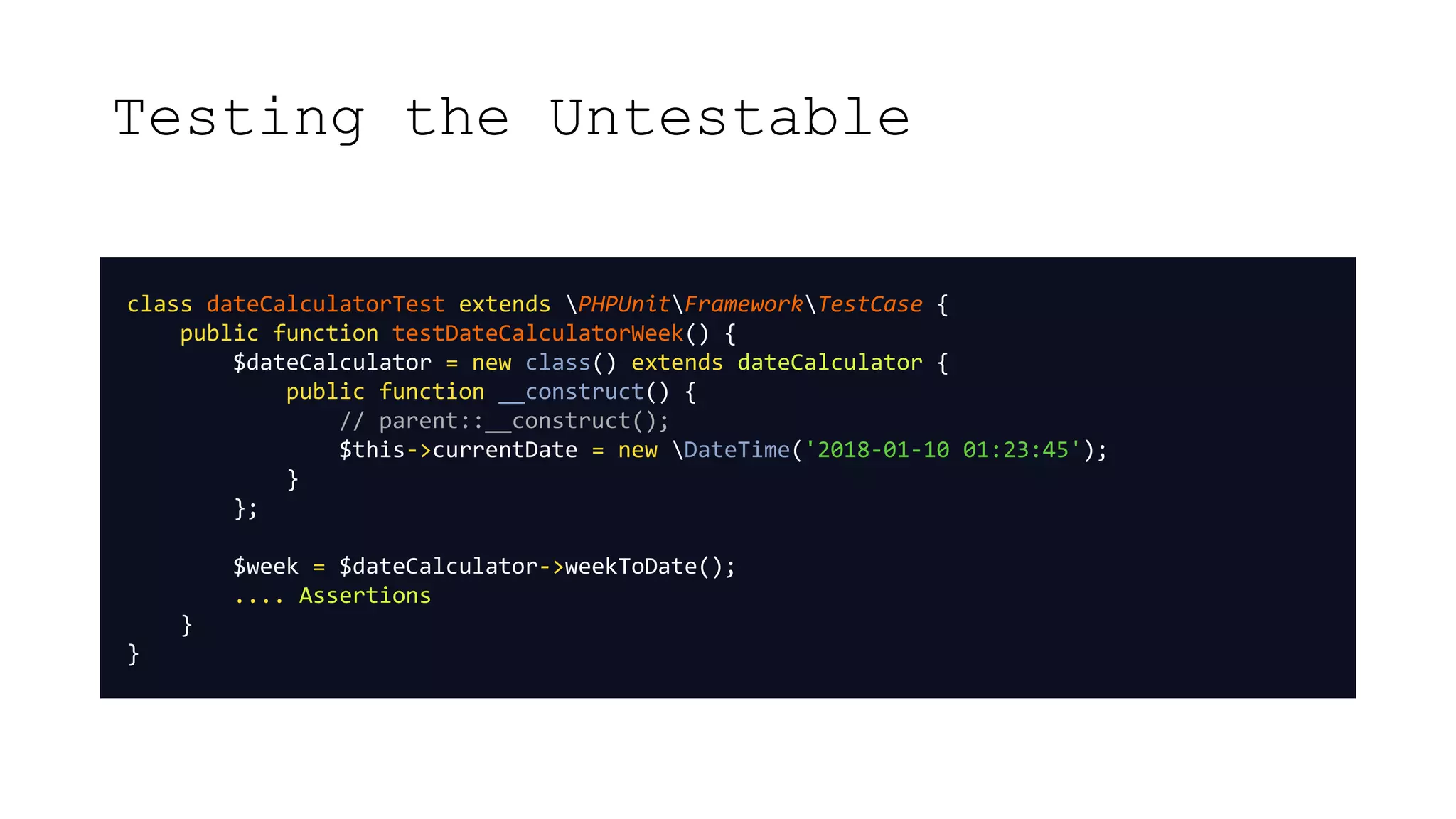
• Anonymous Classes
• http://php.net/manual/en/language.oop5.anonymous.php
Testing the Untestable
class dateCalculatorTest extends PHPUnitFrameworkTestCase {
public function testDateCalculatorWeek() {
$dateCalculator = new class() extends dateCalculator {
public function __construct() {
// parent::__construct();
$this->currentDate = new DateTime('2018-01-10 01:23:45');
}
};
$week = $dateCalculator->weekToDate();
.... Assertions
}
}
Testing the Untestable
• https://github.com/MarkBaker/SpyMaster
Testing the Untestable
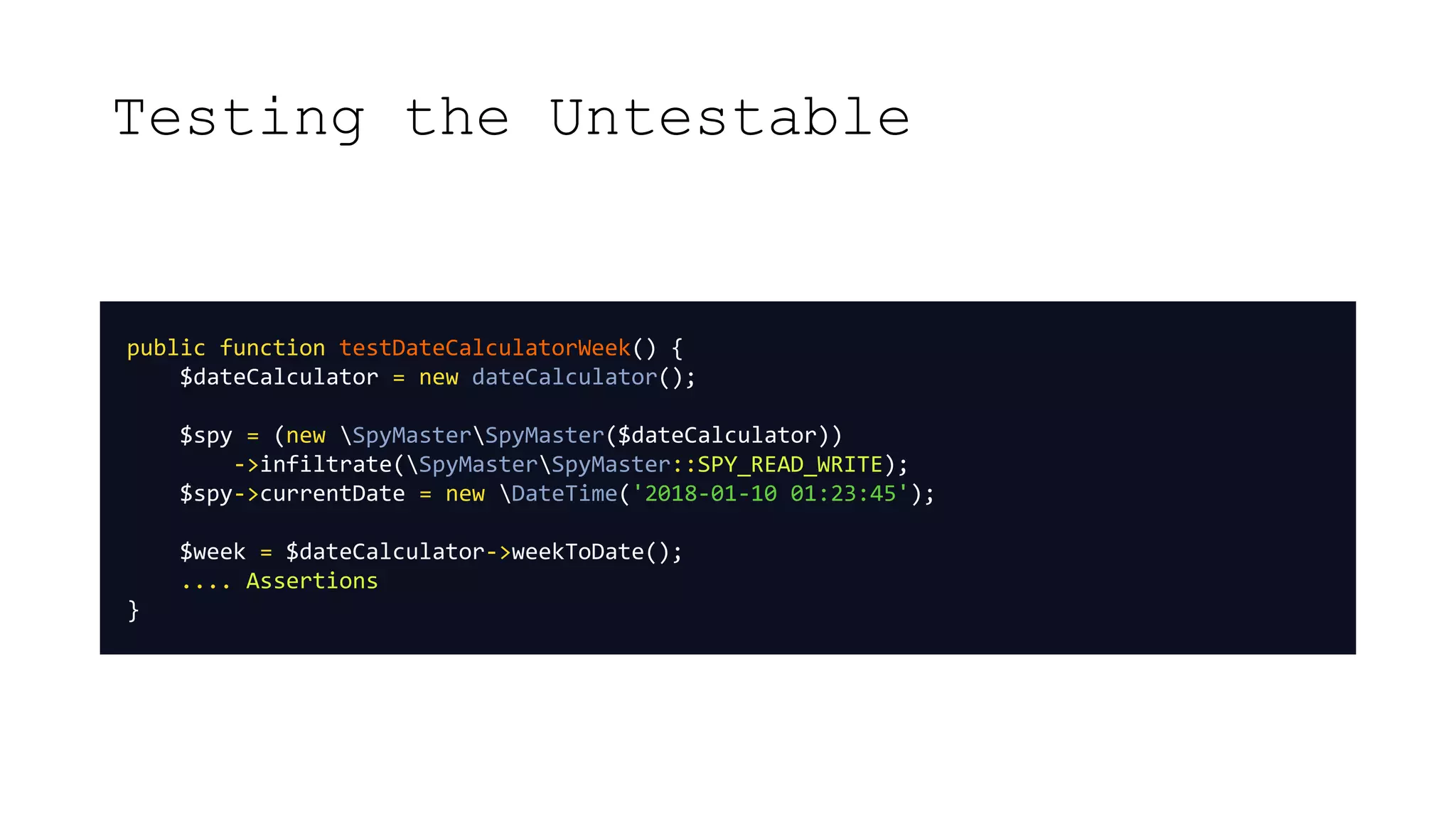
public function testDateCalculatorWeek() {
$dateCalculator = new dateCalculator();
$spy = (new SpyMasterSpyMaster($dateCalculator))
->infiltrate(SpyMasterSpyMaster::SPY_READ_WRITE);
$spy->currentDate = new DateTime('2018-01-10 01:23:45');
$week = $dateCalculator->weekToDate();
.... Assertions
}
Testing the Untestable
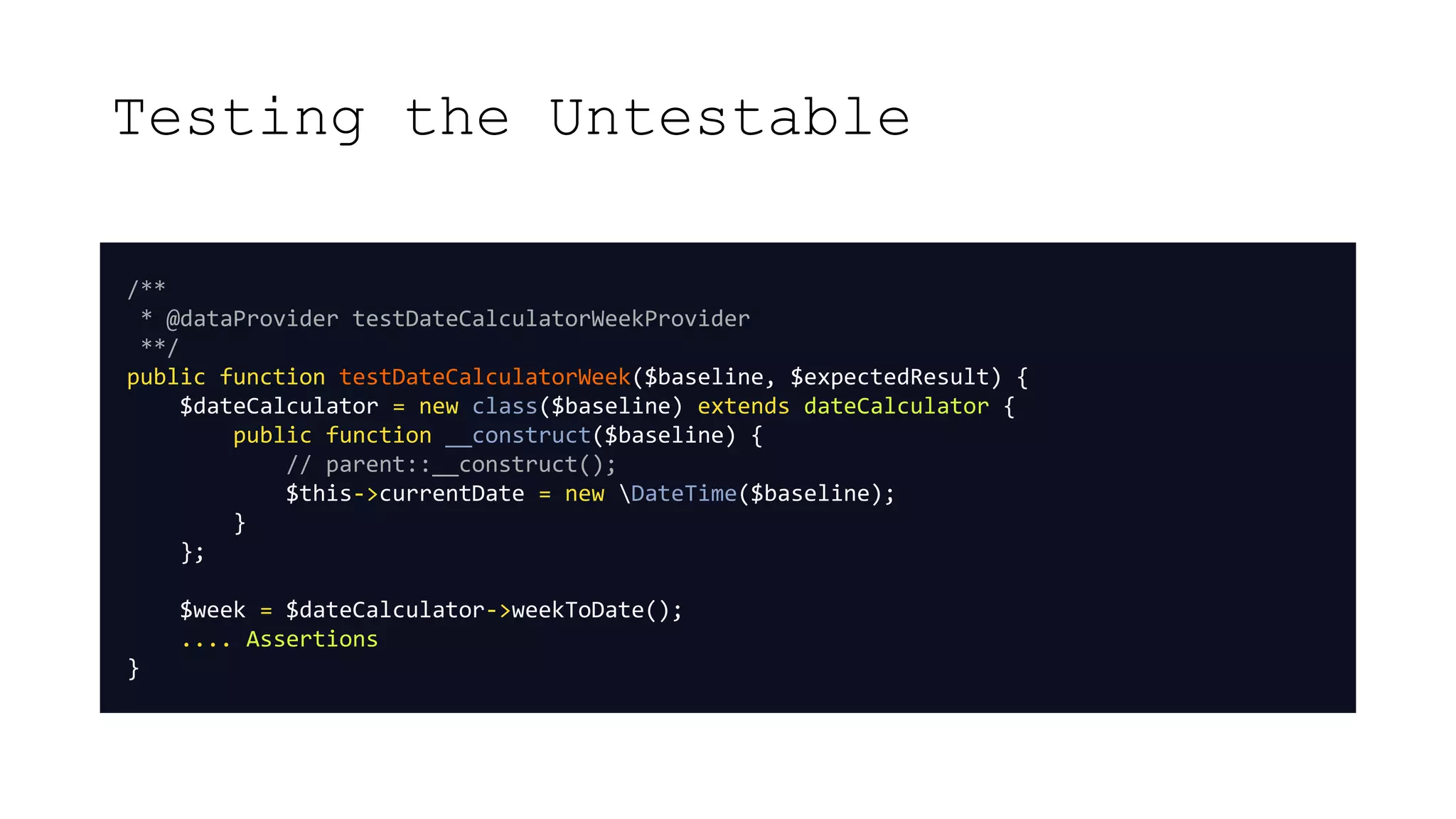
• Make sure we test against different dates using a
phpunit dataprovider
Testing the Untestable
/**
* @dataProvider testDateCalculatorWeekProvider
**/
public function testDateCalculatorWeek($baseline, $expectedResult) {
$dateCalculator = new class($baseline) extends dateCalculator {
public function __construct($baseline) {
// parent::__construct();
$this->currentDate = new DateTime($baseline);
}
};
$week = $dateCalculator->weekToDate();
.... Assertions
}
Testing the Untestable
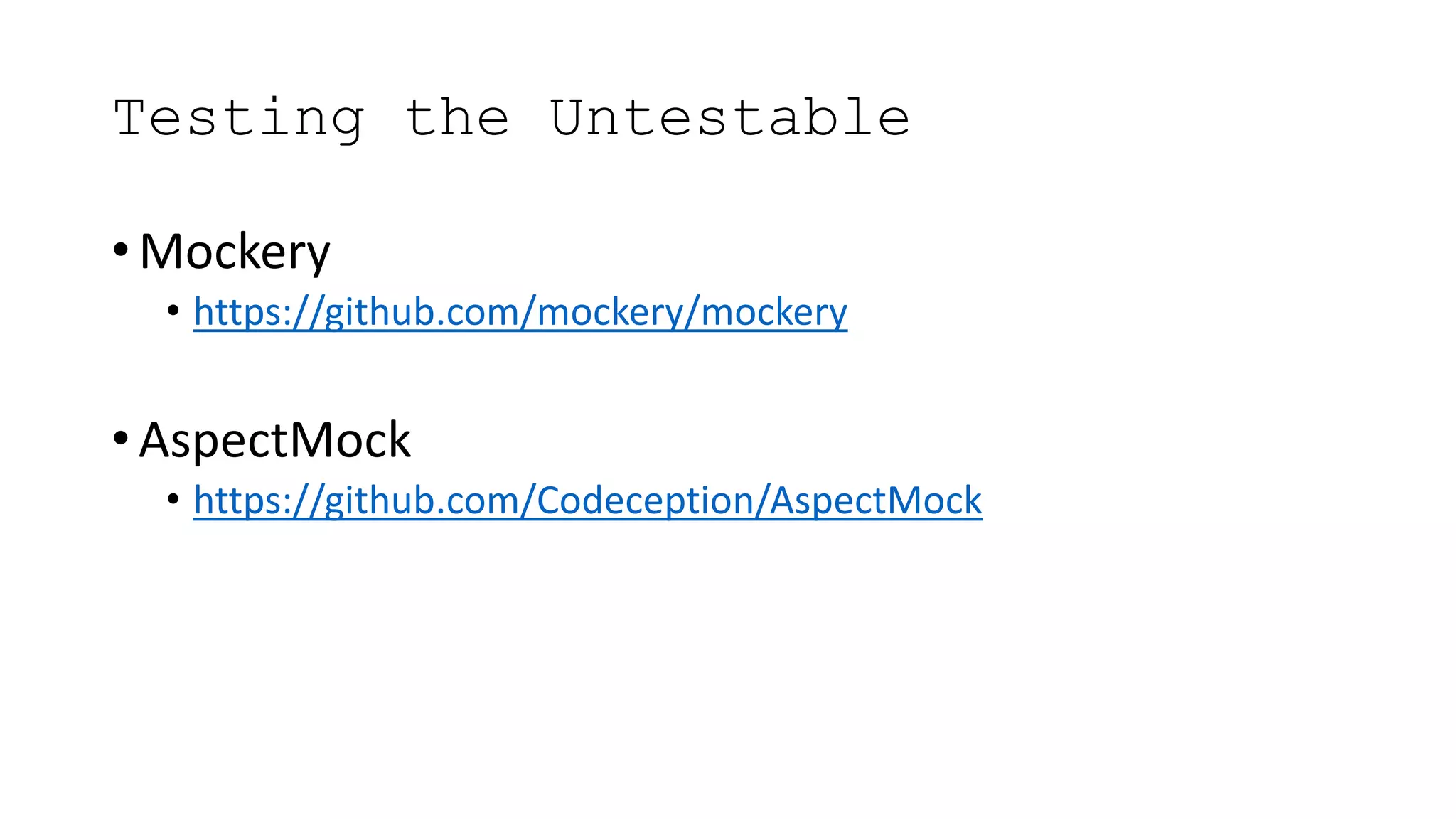
• Mockery
• https://github.com/mockery/mockery
• AspectMock
• https://github.com/Codeception/AspectMock
Testing the Untestable
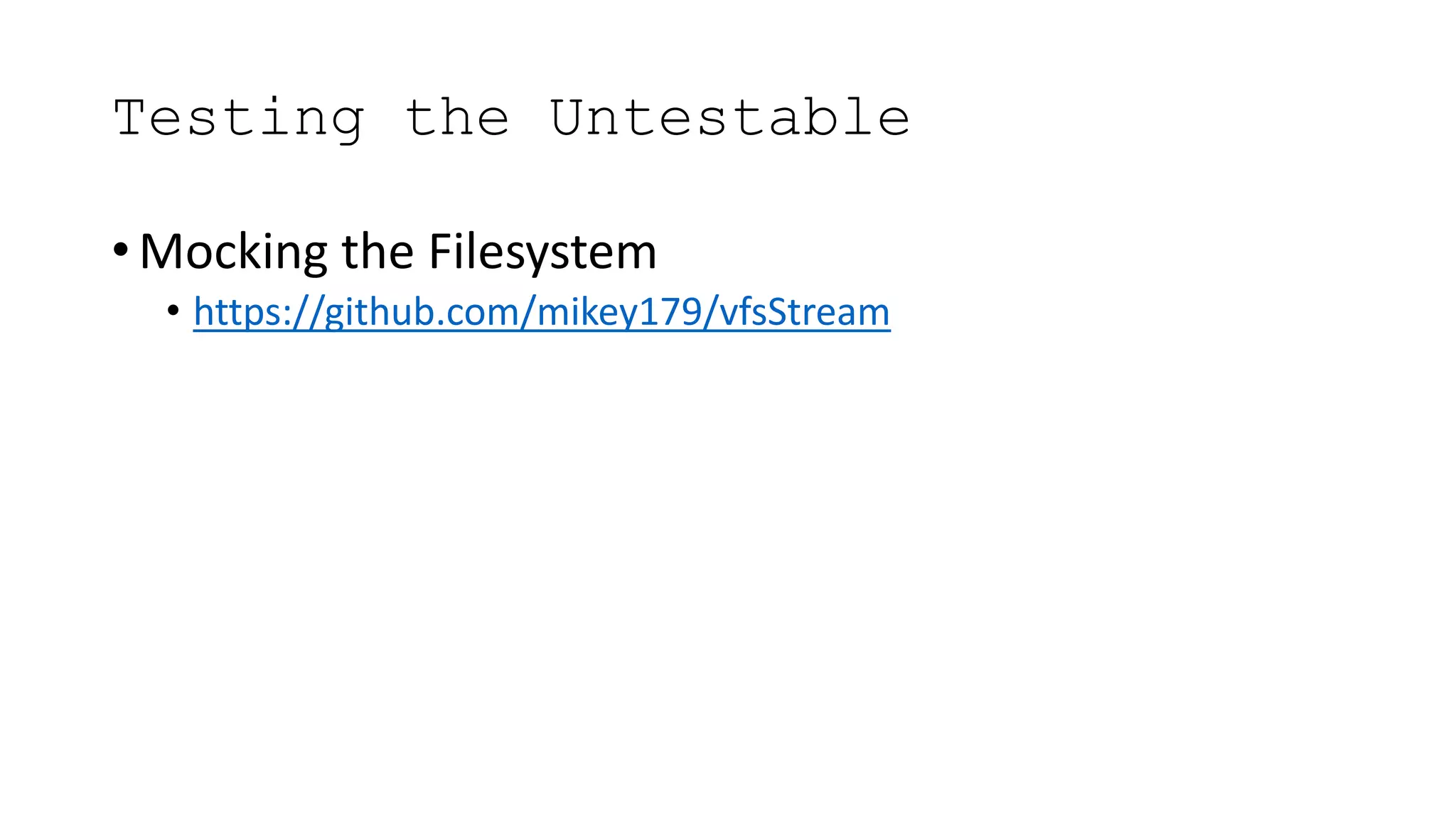
• Mocking the Filesystem
• https://github.com/mikey179/vfsStream
Testing the Untestable
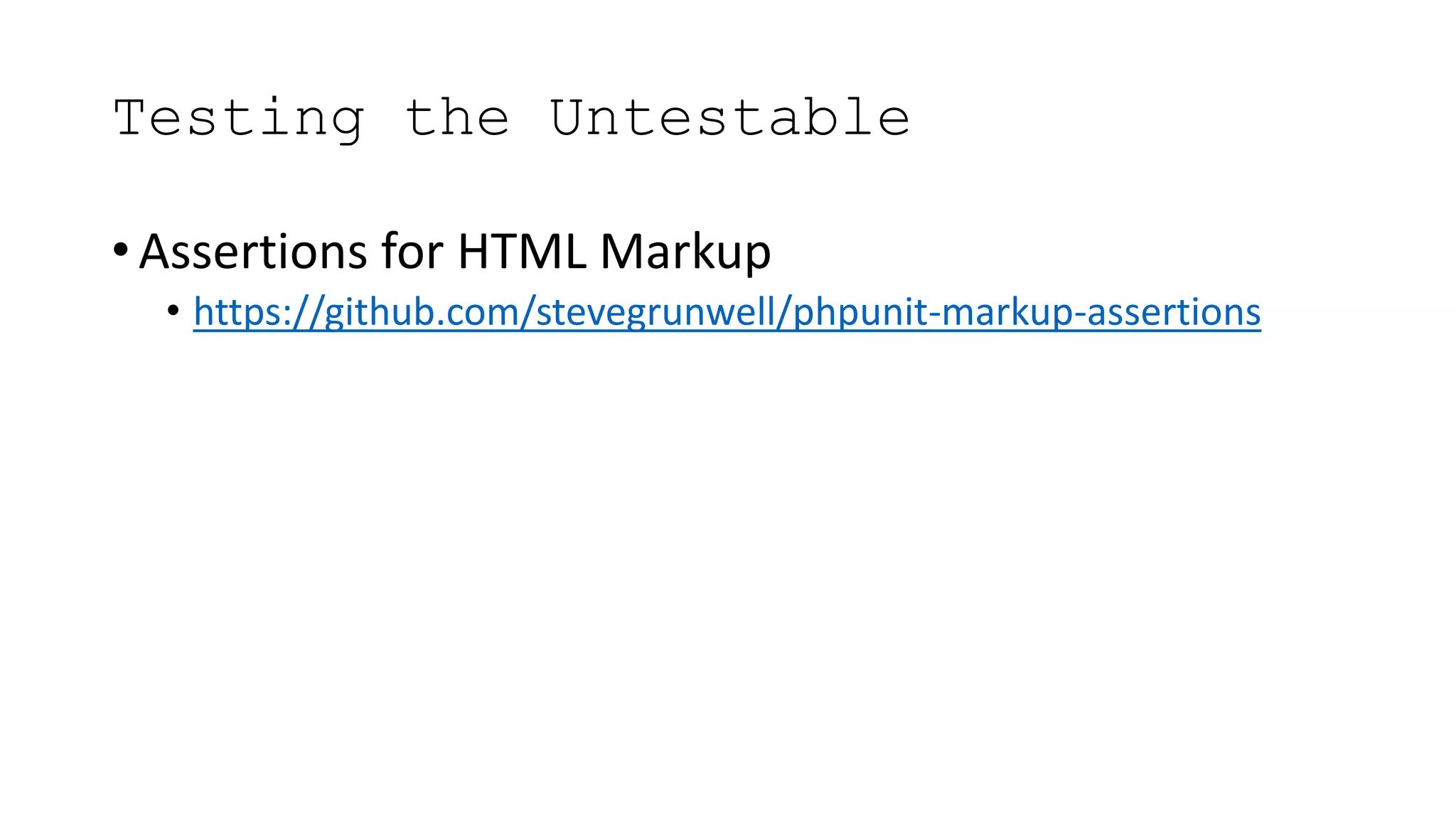
• Assertions for HTML Markup
• https://github.com/stevegrunwell/phpunit-markup-assertions
Who am I?
Mark Baker
@Mark_Baker
https://github.com/MarkBaker
http://uk.linkedin.com/pub/mark-baker/b/572/171
http://markbakeruk.net

Testing the Untestable

  • 1.
  • 2.
    Unit Tests areGreat ! • Proof that your code does what it is supposed to do • Proof that refactoring code doesn’t break its functionality • Automated Regressions Tests • Verify that new code doesn’t break existing code • Unit Tests are a part of the documentation of the code
  • 3.
    TDD is Great! • Writing tests helps design how the code should work • Write tests as we define the public methods • All green tests tell us when the coding is complete • Bugfixing • Write test for bug • Fix bug so that test passes
  • 4.
  • 5.
    Testing the Untestable •100% Code Coverage is over-rated • Prioritise writing Tests for the code that needs testing • Diminishing returns
  • 6.
    Testing the Untestable •Test Doubles • Let the code run • Mock as little as possible • Database access • E-Mailing • Test values
  • 7.
    Testing the Untestable •Constructor does Real Work • Indirect Collaborators • Global State & Singletons • Class Does Too Much
  • 8.
    Testing the Untestable Constructordoes Real Work • Difficulties • Creating/Initializing Collaborators • Communicating with other services, and logic to set up its own state • Forcing subclasses/mocks to inherit unwanted behaviour • Prevents instantiation or altering collaborators in the test.
  • 9.
    Testing the Untestable Constructordoes Real Work • Warning Signs • new keyword in a constructor • Static method calls in a constructor • Anything more than argument validation and field assignment in constructors • Object not fully initialized after the constructor finishes • Control flow (conditional or looping logic) in a constructor • Separate Initialisation methods
  • 10.
    Testing the Untestable Constructordoes Real Work • Why? • Inflexible and prematurely coupled design • Violates Single Responsibility Principle • Testing Directly is Difficult • Subclassing and Overriding to Test is Still Flawed • It Forces Collaborators on Us
  • 11.
    Testing the Untestable IndirectCollaborators • Difficulties • “Middle Men” make change difficult • Unnecessary complexity and code bloat
  • 12.
    Testing the Untestable IndirectCollaborators • Warning Signs • Objects are passed in but never used directly • Only used to get access to other objects • Suspicious names like context, environment, principal, container, or manager
  • 13.
    Testing the Untestable IndirectCollaborators • Why? • Hard to identify the collaborator methods that we need to mock • Necessary to create mocks that return other mocks
  • 14.
    Testing the Untestable GlobalState & Singletons • Difficulties • Global state mutated in one test can cause a subsequent or parallel test to fail unexpectedly. • Forcing subclasses/mocks to inherit unwanted behaviour • Prevents instantiation or altering collaborators in the test.
  • 15.
    Testing the Untestable GlobalState & Singletons • Warning Signs • Use of Singletons • Using Static Properties or Methods • Using Registries or Service Locators • Static Initialisation Blocks
  • 16.
    Testing the Untestable GlobalState & Singletons • Why? • Changes to global state can be made from anywhere • Unexpected initial state for individual tests
  • 17.
    Testing the Untestable •Class Does Too Much • Difficulties • Tests for individual Methods can’t easily be isolated from other methods
  • 18.
    Testing the Untestable •Class Does Too Much • Warning Signs • Class description uses the word “and” • Too many methods • Too many properties • Too many collaborators
  • 19.
    Testing the Untestable Theideal number of arguments for a function is zero (niladic). Next comes one (monadic) followed closely by two (dyadic). Three arguments (triadic) should be avoided where possible. More than three (polyadic) requires very special justification—and then shouldn't be used anyway. Bob Martin – “Clean Code”
  • 20.
    Testing the Untestable publicfunction __construct( MagentoFrameworkModelContext $context, MagentoFrameworkViewDesignInterface $design, MagentoFrameworkRegistry $registry, MagentoStoreModelAppEmulation $appEmulation, MagentoStoreModelStoreManagerInterface $storeManager, MagentoFrameworkAppRequestInterface $request, MagentoNewsletterModelTemplateFilter $filter, MagentoFrameworkAppConfigScopeConfigInterface $scopeConfig, MagentoNewsletterModelTemplateFactory $templateFactory, MagentoFrameworkFilterFilterManager $filterManager, array $data = [] ) { parent::__construct($context, $design, $registry, $appEmulation, $storeManager, $data); $this->_storeManager = $storeManager; $this->_request = $request; $this->_filter = $filter; $this->_scopeConfig = $scopeConfig; $this->_templateFactory = $templateFactory; $this->_filterManager = $filterManager; }
  • 21.
    Testing the Untestable •Class Does Too Much • Why? • Difficult to modify behaviour of one responsibility without changing/breaking others • Muddled Responsibilities
  • 22.
    Testing the Untestable namespacereporting; class dateCalculator { protected $currentDate; public function __construct() { $this->currentDate = new DateTime(); } public function weekToDate() { $startDate = clone $this->currentDate; $startDate->modify('last monday'); return new dateRange( $startDate->modify('midnight'), (clone $this->currentDate)->modify('midnight') ); } }
  • 23.
    Testing the Untestable namespacereporting; class dateCalculatorTest extends PHPUnitFrameworkTestCase { public function testDateCalculatorWeek() { $dateCalculator = new dateCalculator(); $week = $dateCalculator->weekToDate(); $this->assertInstanceOf('reportingdateRange', $week); $this->assertInstanceOf('DateTime', $week->startDate); $this->assertEquals( DateTime::createFromFormat('Y-m-d|', '2018-01-08'), $week->startDate ); $this->assertInstanceOf('DateTime', $week->endDate); $this->assertEquals( DateTime::createFromFormat('Y-m-d|', '2018-01-10'), $week->endDate ); } }
  • 24.
    Testing the Untestable •Dependency Injection • Inject either a date value or a DateTime object into the constructor
  • 25.
    Testing the Untestable namespacereporting; class dateCalculator { protected $currentDate; public function __construct(string $date = 'now') { $this->currentDate = new DateTime($date); } public function weekToDate() { $startDate = clone $this->currentDate; $startDate->modify('last monday'); return new dateRange( $startDate->modify('midnight'), (clone $this->currentDate)->modify('midnight') ); } }
  • 26.
    Testing the Untestable namespacereporting; class dateCalculator { protected $currentDate; public function __construct(DateTime $dto) { $this->currentDate = $dto; } public function weekToDate() { $startDate = clone $this->currentDate; $startDate->modify('last monday'); return new dateRange( $startDate->modify('midnight'), (clone $this->currentDate)->modify('midnight') ); } }
  • 27.
    Testing the Untestable •Dependency Injection (Inversion of Control) • Inject either a date value or a DateTime object into the constructor • Not always an option if we can’t change the codebase • e.g. If we’re writing tests preparatory to refactoring • May require significant changes wherever the class we’re testing is used within the main codebase • Or introducing a Dependency Injection Container
  • 28.
    Testing the Untestable •In the case of DateTime, we can modify the the DateTime constructor • If we’re using namespacing
  • 29.
    Testing the Untestable classdateCalculator { protected $currentDate; public function __construct() { $this->currentDate = new DateTime("@" . time()); } .... }
  • 30.
    Testing the Untestable namespacereporting; function time() { return strtotime('2018-01-10 01:23:45'); } class dateCalculatorTest extends PHPUnitFrameworkTestCase { public function testDateCalculatorWeek() { $dateCalculator = new dateCalculator(); $week = $dateCalculator->weekToDate(); .... Assertions } }
  • 31.
    Testing the Untestable •In the case of DateTime, we can modify the the DateTime constructor • If we’re using namespacing • Overriding the time() function with a namespaced time() function • So we set our own value to be returned by a call to time()
  • 32.
    Testing the Untestable •Move the assignment of $currentDate and the instantiation of the DateTime to a separate method called from the constructor • We can then mock that new method in our tests
  • 33.
    Testing the Untestable classdateCalculator { protected $currentDate; protected function getCurrentDate() { return new DateTime(); } public function __construct() { $this->currentDate = $this->getCurrentDate(); } .... }
  • 34.
    Testing the Untestable classdateCalculatorTest extends PHPUnitFrameworkTestCase { public function testDateCalculatorWeek() { $dateCalculator = $this->getMockBuilder('reportingdateCalculator') ->setMethods(['getCurrentDate']) ->getMock(); $dateCalculator->expects($this->once()) ->method('getCurrentDate') ->will( $this->returnValue(new DateTime('2018-01-10 01:23:45')) ); $week = $dateCalculator->weekToDate(); .... Assertions } }
  • 35.
    Testing the Untestable •Or Use Reflection
  • 36.
    Testing the Untestable classdateCalculator { protected $currentDate; protected function getCurrentDate() { return new DateTime(); } public function __construct() { $this->currentDate = $this->getCurrentDate(); } .... }
  • 37.
    Testing the Untestable classdateCalculatorTest extends PHPUnitFrameworkTestCase { public function testDateCalculatorWeek() { $dateCalculator = $this->getMockBuilder('reportingdateCalculator') ->disableOriginalConstructor() ->setMethods(['getCurrentDate']) ->getMock(); $dateCalculator->expects($this->once()) ->method('getCurrentDate') ->will( $this->returnValue(new DateTime('2018-01-10 01:23:45')) ); .... } }
  • 38.
    Testing the Untestable classdateCalculatorTest extends PHPUnitFrameworkTestCase { public function testDateCalculatorWeek() { .... // now call the constructor $reflectedClass = new ReflectionClass('reportingdateCalculator'); $constructor = $reflectedClass->getConstructor(); $constructor->invoke($dateCalculator); $week = $dateCalculator->weekToDate(); .... Assertions } }
  • 39.
    Testing the Untestable •Anonymous Classes • http://php.net/manual/en/language.oop5.anonymous.php
  • 40.
    Testing the Untestable classdateCalculatorTest extends PHPUnitFrameworkTestCase { public function testDateCalculatorWeek() { $dateCalculator = new class() extends dateCalculator { public function __construct() { // parent::__construct(); $this->currentDate = new DateTime('2018-01-10 01:23:45'); } }; $week = $dateCalculator->weekToDate(); .... Assertions } }
  • 41.
    Testing the Untestable •https://github.com/MarkBaker/SpyMaster
  • 42.
    Testing the Untestable publicfunction testDateCalculatorWeek() { $dateCalculator = new dateCalculator(); $spy = (new SpyMasterSpyMaster($dateCalculator)) ->infiltrate(SpyMasterSpyMaster::SPY_READ_WRITE); $spy->currentDate = new DateTime('2018-01-10 01:23:45'); $week = $dateCalculator->weekToDate(); .... Assertions }
  • 43.
    Testing the Untestable •Make sure we test against different dates using a phpunit dataprovider
  • 44.
    Testing the Untestable /** *@dataProvider testDateCalculatorWeekProvider **/ public function testDateCalculatorWeek($baseline, $expectedResult) { $dateCalculator = new class($baseline) extends dateCalculator { public function __construct($baseline) { // parent::__construct(); $this->currentDate = new DateTime($baseline); } }; $week = $dateCalculator->weekToDate(); .... Assertions }
  • 45.
    Testing the Untestable •Mockery • https://github.com/mockery/mockery • AspectMock • https://github.com/Codeception/AspectMock
  • 46.
    Testing the Untestable •Mocking the Filesystem • https://github.com/mikey179/vfsStream
  • 47.
    Testing the Untestable •Assertions for HTML Markup • https://github.com/stevegrunwell/phpunit-markup-assertions
  • 48.
    Who am I? MarkBaker @Mark_Baker https://github.com/MarkBaker http://uk.linkedin.com/pub/mark-baker/b/572/171 http://markbakeruk.net

Editor's Notes

  • #24 Problematic test only works on 10th January 2018
  • #26 Best solution is to modify the code to inject the date into the constructor, either as a date-recognisable string
  • #27 Or as a DateTime object This has the added advantage of allowing reports to be re-run for a particular historic date
  • #41 Using an anonymous class to extend the class being tested and override the constructor