Maintaining the
Tenancy
Lera Blevins, Esq.
3702 4th Ave.
San Diego, CA 92103
(619) 235-6180
info@sbsdlaw.com
© Simone & Blevins
In this presentation we will
discuss:
1. Whether AB 1482 or the City of San Diego's
Tenant's Right to Know Ordinance applies to
your rental property and what that all means.
2. How to best handle lease extensions, changing
the terms of the tenancy, and rent increases.
3. Understanding the Landlord's duty to repair,
limited right to enter, and responsibility to
relocate tenants during repairs.
AB 1482 and the City of San
Diego's Tenant's Right to
Know Ordinance
• Today will be a limited discussion on AB 1482
and the City of San Diego’s Tenant’s Right to
Know Ordinance.
• Tenancy Termination will be covered in the next
presentation hosted by AOA.
AB 1482 |Tenant Protection Act
• The Tenant Protection Act of 2019 (TPA)
• Just-Cause | Civil Code § 1946.2
• Rent Caps | Civil Code § 1947.12
• California Rent Control
• The TPA implemented statewide just-cause
termination requirements and rent increase
caps for many residential tenancies.
• It applies to the entire state of California.
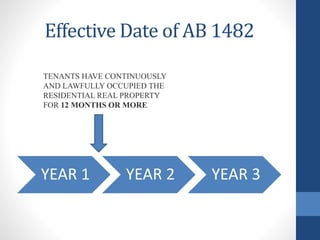
Effective Date of AB 1482
YEAR 1 YEAR 2 YEAR 3
TENANTS HAVE CONTINUOUSLY
AND LAWFULLY OCCUPIED THE
RESIDENTIAL REAL PROPERTY
FOR 12 MONTHS OR MORE
Exemptions
From
Rent Cap & Just-Cause
Terminations
AB 1482 Exemptions
•(1) Transient and tourist hotel
occupancy .
•(2) Housing accommodations in a
nonprofit hospital, religious facility,
extended care facility, licensed
residential care facility for the elderly.
•(3) Dormitories.
AB 1482 Exemptions
• (4) Housing accommodations in which the
tenant shares bathroom or kitchen
facilities with the owner who maintains
their principal residence at the residential
real property.
• NO restriction on type of property
• Ex: LL owns apartment building and lives in
one of the units with a roommate.
AB 1482 Exemptions
• (5) Single-family owner-occupied
residences, including both of the following:
• (A) A residence in which the owner-
occupant rents or leases no more than two
units or bedrooms, including, but not
limited to, an accessory dwelling unit or a
junior accessory dwelling unit.
• (B) A mobilehome.
• Ex: LL lives in the main house and rents
the ADU.
AB 1482 Exemptions
• (6) A property containing two separate
dwelling units within a single structure in
which the owner occupied one of the units
as the owner’s principal place of
residence at the beginning of the tenancy,
so long as the owner continues in
occupancy, and neither unit is an accessory
dwelling unit or a junior accessory
dwelling unit.
• Ex: Duplex
AB 1482 Exemptions
•(7) Housing that has been issued a
certificate of occupancy within the
previous 15 years, unless the housing
is a mobilehome.
• Certificate of Occupancy issued
after 2007
AB 1482 Exemptions
(8) Residential real property, that is alienable separate
from the title to any other dwelling unit, provided that
both of the following apply:
• (A) The owner is not any of the following:
• (i) A real estate investment trust.
• (ii) A corporation.
• (iii) A limited liability company in which at least one
member is a corporation.
• (iv) Management of a mobilehome park.
• (B) (i) The tenants have been provided written notice that
the residential property is exempt.
• Ex: Single family home, condo, or townhome that the LL
does not live in and has provided notice of exemption.
AB 1482 Exemptions
Written Notice of Exemption must state:
“This property is not subject to the rent limits imposed by
Section 1947.12 of the Civil Code and is not subject to the
just cause requirements of Section 1946.2 of the Civil
Code. This property meets the requirements of Sections
1947.12 (d)(5) and 1946.2 (e)(8) of the Civil Code and the
owner is not any of the following: (1) a real estate
investment trust, as defined by Section 856 of the Internal
Revenue Code; (2) a corporation; or (3) a limited liability
company in which at least one member is a corporation.”
*ONLY Applies to Exemption (8) - Residential real
property, that is alienable separate from the title to any
other dwelling unit.
AB 1482 Exemptions
• (9) Housing restricted by deed, regulatory
restriction contained in an agreement with a
government agency, or other recorded document
as affordable housing for persons and families
of very low, low, or moderate income, or subject
to an agreement that provides housing subsidies
for affordable housing for persons and families of
very low, low, or moderate income or comparable
federal statutes.
• Ex: Section 8 Tenancy or other government
program
AB 1482 Exemptions
EXEMPTION TAKEAWAYS
• YOU ONLY NEED TO QUALIFY FOR ONE
EXEMPTION!
• Notice of Exemption is only required for
exemption (8)
• Residential real property, that is alienable separate from
the title to any other dwelling unit.
• If you failed to provide the notice with the lease you
can incorporate it later. We will go over how to
incorporate the notice into your lease/rental agreement.

City of San Diego’s Tenant’s
Right to Know Ordinance
• San Diego Municipal Code 98.0701-
98.0760
• Effective March 30, 2004.
• Implements just cause requirement on
most residential tenancies of more than
two years in the City of San Diego.
• LINK TO MUNICIPAL CODE
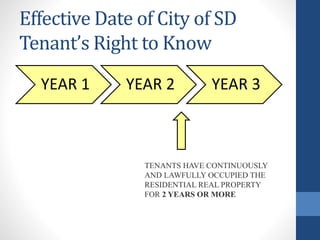
Effective Date of City of SD
Tenant’s Right to Know
YEAR 1 YEAR 2 YEAR 3
TENANTS HAVE CONTINUOUSLY
AND LAWFULLY OCCUPIED THE
RESIDENTIAL REAL PROPERTY
FOR 2 YEARS OR MORE
City of San Diego’s Tenant’s Right to
Know Ordinance - Exemptions
• Very limited exemptions. Institutional Facilities.
• Agency Owned or Subsidized Units. Ex.
Section 8
• Rooms Rented to Boarders. A rental-unit in
which the landlord owns the rental-unit,
shares kitchen or bath facilities with the
tenants, and also occupies the rental-unit or a
unit in the same building as his or her
principal residence.
• Rental-Units in Hotels, Motels, or Rooming
Houses Rented to Transient Guests.
• Mobile Homes.
• Transient occupancies.
City of San Diego’s No-Fault
Eviction Moratorium
• Ordinance No. O-21447
• Effective 5/22/22-9/30/22
• Applies to all residential tenancies in the
City of San Diego
• CAN terminate for At-Fault Just-Cause
• CANNOT terminate for No-Fault Just-
Cause with limited exceptions:
• 90 Day Owner-Relative Occupancy
• Government/Court Order or Health and Safety
• 6 Month Notice Withdraw from Rental Market
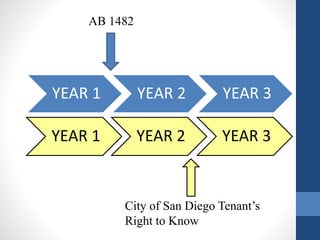
YEAR 1 YEAR 2 YEAR 3
City of San Diego Tenant’s
Right to Know
AB 1482
MAINTAINING THE
TENANCY
RIGHTS AND DUTIES OF THE LANDLORD
AND TENANT
• Most important part of maintaining a
tenancy is a written rental agreement/lease
that clearly states the rights and duties of
the LL/T
• In the following slides we will discuss:
• How to change the terms of your tenancy
• Terms to include
• Common issues that arise during the tenancy
MAINTAINING THE
TENANCY
CHANGE IN TERMS OF TENANCY
• Lease - Must use an Addendum signed by
the Tenants
• Month-to-Month - Serve the Tenants with a
30-Day Notice of Change in Terms of
Tenancy to add new terms. See California
Civil Code § 827(a)
• LINK TO AOA FORM
MAINTAINING THE TENANCY
CHANGING TERMS WHEN YOUR
LEASE EXPIRES
• Expired leases continue month-
to-month
• Lease v. Month-to-Month Rental
Agreement
• Lease extensions allow you to
update the language in your lease
• Rent caps apply during lease
extensions
RENT INCREASES
AMOUNT OF NOTICE REQUIRED
• The amount of notice depends on the
percentage increase in rent.
• 30 Day Notice – Less than 10% increase
within a calendar year.
• 90 Day Notice – More than 10% increase
within a calendar year. Only allowed IF
your property is:
• 1) exempt from rent control
• 2) no state of emergency in effect
RENT INCREASES
EXEMPT FROM RENT CONTROL
• If exempt, there is no cap on rent increases.
• HOWEVER, be aware of the anti-price gouging law.
• Penal Code § 396(e) - If the city, county, or state is in a
state of emergency, rent increases are capped at 10% per
year. This also applies to new tenancies.
• Exceptions:
• increase is directly attributable to additional costs
for repairs or additions beyond normal
maintenance that were amortized over the rental
term that caused the rent to be increased greater than
10 percent or
• increase was contractually agreed to by the tenant
prior to the proclamation or declaration.
• LINK TO WEBSITE - DETERMINE IF A STATE OF
EMERGENCY IS IN EFFECT
RENT INCREASES
NOT EXEMPT FROM RENT CONTROL
• If rent control applies: max increase is 5%
plus the CPI not to exceed 10% (CPI used is
the San Diego-Carlsbad metropolitan area)
• 9.1% (5% + CPI Increase of 4.1%) is the
allowable rent increase effective August 2021
to July 2022.
• 10% (5% + CPI Increase of 7.9%) is the
allowable rent increase effective August 2022
to July 2023.
• Limited to two increases per calendar year.
OTHER IMPORTANT TERMS
• Terms to include:
• Notice of Exemption
• Security Deposit
• Capped Attorney’s fees provision
• Relocation for Repairs
• Insurance
• Nuisance/Waste
• Non-curable subletting/assigning
• Late Fees Capped at 6%
LANDLORD’S DUTIES
TERMS YOU CANNOT CHANGE OR
ENFORCE
• All oral or written rental agreements include:
• Implied warranty of habitability
• Implied covenant of quiet enjoyment
• You cannot remove these obligations as a
Landlord or have the tenant waive their rights.
• Illegal terms are unenforceable even if the tenant
agrees to it in writing.
• Examples: Rent increase above caps, late fees over
6%, tenant responsible for major repairs, pest
control
LANDLORD’S DUTIES
HABITABILITY
California Civil Code §1941.1
• Effective waterproofing and weather protection
• Plumbing and gas facilities that conform with
applicable law
• Water supply – hot and cold water
• Heat
• Electrical lighting
• Premises at the time of the commencement of the
tenancy being in clean condition and good repair
• Adequate number of garbage receptacles
• Floors, stairways, and railings in good repair
• Locking mail receptacle for each unit
LIMITED RIGHT TO ENTER
24 Hour Notice to Enter
• To make necessary or agreed repairs
• To do necessary or agreed decorating
• To make necessary or agreed alterations or improvements
• To supply necessary or agreed services
• To exhibit the rental unit to prospective or actual purchasers*
• To exhibit the rental unit to prospective mortgagees
• To exhibit the rental unit to prospective tenants
• To exhibit the rental unit to workmen or contractors
• Pursuant to Court Order
• To inspect waterbed or liquid-filled furniture
• To test the smoke detector
• To verify Resident has abandoned premises
• To inspect the unit prior to the termination of the tenancy if
requested by Resident
DUTY TO REPAIR
• Read your Rental Agreement or Lease
provisions
• Tenant must give notice of needed repairs
• Landlord is not responsible for repairing
damages caused by the tenant, tenant’s
family, guests or pets
• Ex. Tenant clogged drain with baby
wipes, chicken bones in garbage disposal
• Advisable to fix the issue and bill the
tenant
DUTY TO REPAIR
• After receiving notice of repair LL should
investigate and arrange for repair work to be
performed.
• Some repairs may be covered by
homeowner’s insurance.
• LL has a reasonable amount of time to
complete the repairs.
• Refer to Lease/Rental Agreement for
procedure for extensive repairs that may
require relocation.
LANDLORD’S DUTY TO
RELOCATE
• California law does not require Landlord to pay
for relocation of tenants for repairs.
• Refer to Lease/Rental Agreement for rent credits
and/or notice requirements.
• If Lease/Rental Agreement is silent on
requirements for relocation consult with an
attorney for procedure.
Questions

Maintaining the Tenancy Presentation - WEBSITE.pptx

  • 1.
    Maintaining the Tenancy Lera Blevins,Esq. 3702 4th Ave. San Diego, CA 92103 (619) 235-6180 info@sbsdlaw.com © Simone & Blevins
  • 2.
    In this presentationwe will discuss: 1. Whether AB 1482 or the City of San Diego's Tenant's Right to Know Ordinance applies to your rental property and what that all means. 2. How to best handle lease extensions, changing the terms of the tenancy, and rent increases. 3. Understanding the Landlord's duty to repair, limited right to enter, and responsibility to relocate tenants during repairs.
  • 3.
    AB 1482 andthe City of San Diego's Tenant's Right to Know Ordinance • Today will be a limited discussion on AB 1482 and the City of San Diego’s Tenant’s Right to Know Ordinance. • Tenancy Termination will be covered in the next presentation hosted by AOA.
  • 4.
    AB 1482 |TenantProtection Act • The Tenant Protection Act of 2019 (TPA) • Just-Cause | Civil Code § 1946.2 • Rent Caps | Civil Code § 1947.12 • California Rent Control • The TPA implemented statewide just-cause termination requirements and rent increase caps for many residential tenancies. • It applies to the entire state of California.
  • 5.
    Effective Date ofAB 1482 YEAR 1 YEAR 2 YEAR 3 TENANTS HAVE CONTINUOUSLY AND LAWFULLY OCCUPIED THE RESIDENTIAL REAL PROPERTY FOR 12 MONTHS OR MORE
  • 6.
    Exemptions From Rent Cap &Just-Cause Terminations
  • 7.
    AB 1482 Exemptions •(1)Transient and tourist hotel occupancy . •(2) Housing accommodations in a nonprofit hospital, religious facility, extended care facility, licensed residential care facility for the elderly. •(3) Dormitories.
  • 8.
    AB 1482 Exemptions •(4) Housing accommodations in which the tenant shares bathroom or kitchen facilities with the owner who maintains their principal residence at the residential real property. • NO restriction on type of property • Ex: LL owns apartment building and lives in one of the units with a roommate.
  • 9.
    AB 1482 Exemptions •(5) Single-family owner-occupied residences, including both of the following: • (A) A residence in which the owner- occupant rents or leases no more than two units or bedrooms, including, but not limited to, an accessory dwelling unit or a junior accessory dwelling unit. • (B) A mobilehome. • Ex: LL lives in the main house and rents the ADU.
  • 10.
    AB 1482 Exemptions •(6) A property containing two separate dwelling units within a single structure in which the owner occupied one of the units as the owner’s principal place of residence at the beginning of the tenancy, so long as the owner continues in occupancy, and neither unit is an accessory dwelling unit or a junior accessory dwelling unit. • Ex: Duplex
  • 11.
    AB 1482 Exemptions •(7)Housing that has been issued a certificate of occupancy within the previous 15 years, unless the housing is a mobilehome. • Certificate of Occupancy issued after 2007
  • 12.
    AB 1482 Exemptions (8)Residential real property, that is alienable separate from the title to any other dwelling unit, provided that both of the following apply: • (A) The owner is not any of the following: • (i) A real estate investment trust. • (ii) A corporation. • (iii) A limited liability company in which at least one member is a corporation. • (iv) Management of a mobilehome park. • (B) (i) The tenants have been provided written notice that the residential property is exempt. • Ex: Single family home, condo, or townhome that the LL does not live in and has provided notice of exemption.
  • 13.
    AB 1482 Exemptions WrittenNotice of Exemption must state: “This property is not subject to the rent limits imposed by Section 1947.12 of the Civil Code and is not subject to the just cause requirements of Section 1946.2 of the Civil Code. This property meets the requirements of Sections 1947.12 (d)(5) and 1946.2 (e)(8) of the Civil Code and the owner is not any of the following: (1) a real estate investment trust, as defined by Section 856 of the Internal Revenue Code; (2) a corporation; or (3) a limited liability company in which at least one member is a corporation.” *ONLY Applies to Exemption (8) - Residential real property, that is alienable separate from the title to any other dwelling unit.
  • 14.
    AB 1482 Exemptions •(9) Housing restricted by deed, regulatory restriction contained in an agreement with a government agency, or other recorded document as affordable housing for persons and families of very low, low, or moderate income, or subject to an agreement that provides housing subsidies for affordable housing for persons and families of very low, low, or moderate income or comparable federal statutes. • Ex: Section 8 Tenancy or other government program
  • 15.
    AB 1482 Exemptions EXEMPTIONTAKEAWAYS • YOU ONLY NEED TO QUALIFY FOR ONE EXEMPTION! • Notice of Exemption is only required for exemption (8) • Residential real property, that is alienable separate from the title to any other dwelling unit. • If you failed to provide the notice with the lease you can incorporate it later. We will go over how to incorporate the notice into your lease/rental agreement.
  • 16.
    City of SanDiego’s Tenant’s Right to Know Ordinance • San Diego Municipal Code 98.0701- 98.0760 • Effective March 30, 2004. • Implements just cause requirement on most residential tenancies of more than two years in the City of San Diego. • LINK TO MUNICIPAL CODE
  • 17.
    Effective Date ofCity of SD Tenant’s Right to Know YEAR 1 YEAR 2 YEAR 3 TENANTS HAVE CONTINUOUSLY AND LAWFULLY OCCUPIED THE RESIDENTIAL REAL PROPERTY FOR 2 YEARS OR MORE
  • 18.
    City of SanDiego’s Tenant’s Right to Know Ordinance - Exemptions • Very limited exemptions. Institutional Facilities. • Agency Owned or Subsidized Units. Ex. Section 8 • Rooms Rented to Boarders. A rental-unit in which the landlord owns the rental-unit, shares kitchen or bath facilities with the tenants, and also occupies the rental-unit or a unit in the same building as his or her principal residence. • Rental-Units in Hotels, Motels, or Rooming Houses Rented to Transient Guests. • Mobile Homes. • Transient occupancies.
  • 19.
    City of SanDiego’s No-Fault Eviction Moratorium • Ordinance No. O-21447 • Effective 5/22/22-9/30/22 • Applies to all residential tenancies in the City of San Diego • CAN terminate for At-Fault Just-Cause • CANNOT terminate for No-Fault Just- Cause with limited exceptions: • 90 Day Owner-Relative Occupancy • Government/Court Order or Health and Safety • 6 Month Notice Withdraw from Rental Market
  • 20.
    YEAR 1 YEAR2 YEAR 3 YEAR 1 YEAR 2 YEAR 3 City of San Diego Tenant’s Right to Know AB 1482
  • 21.
    MAINTAINING THE TENANCY RIGHTS ANDDUTIES OF THE LANDLORD AND TENANT • Most important part of maintaining a tenancy is a written rental agreement/lease that clearly states the rights and duties of the LL/T • In the following slides we will discuss: • How to change the terms of your tenancy • Terms to include • Common issues that arise during the tenancy
  • 22.
    MAINTAINING THE TENANCY CHANGE INTERMS OF TENANCY • Lease - Must use an Addendum signed by the Tenants • Month-to-Month - Serve the Tenants with a 30-Day Notice of Change in Terms of Tenancy to add new terms. See California Civil Code § 827(a) • LINK TO AOA FORM
  • 23.
    MAINTAINING THE TENANCY CHANGINGTERMS WHEN YOUR LEASE EXPIRES • Expired leases continue month- to-month • Lease v. Month-to-Month Rental Agreement • Lease extensions allow you to update the language in your lease • Rent caps apply during lease extensions
  • 24.
    RENT INCREASES AMOUNT OFNOTICE REQUIRED • The amount of notice depends on the percentage increase in rent. • 30 Day Notice – Less than 10% increase within a calendar year. • 90 Day Notice – More than 10% increase within a calendar year. Only allowed IF your property is: • 1) exempt from rent control • 2) no state of emergency in effect
  • 25.
    RENT INCREASES EXEMPT FROMRENT CONTROL • If exempt, there is no cap on rent increases. • HOWEVER, be aware of the anti-price gouging law. • Penal Code § 396(e) - If the city, county, or state is in a state of emergency, rent increases are capped at 10% per year. This also applies to new tenancies. • Exceptions: • increase is directly attributable to additional costs for repairs or additions beyond normal maintenance that were amortized over the rental term that caused the rent to be increased greater than 10 percent or • increase was contractually agreed to by the tenant prior to the proclamation or declaration. • LINK TO WEBSITE - DETERMINE IF A STATE OF EMERGENCY IS IN EFFECT
  • 26.
    RENT INCREASES NOT EXEMPTFROM RENT CONTROL • If rent control applies: max increase is 5% plus the CPI not to exceed 10% (CPI used is the San Diego-Carlsbad metropolitan area) • 9.1% (5% + CPI Increase of 4.1%) is the allowable rent increase effective August 2021 to July 2022. • 10% (5% + CPI Increase of 7.9%) is the allowable rent increase effective August 2022 to July 2023. • Limited to two increases per calendar year.
  • 27.
    OTHER IMPORTANT TERMS •Terms to include: • Notice of Exemption • Security Deposit • Capped Attorney’s fees provision • Relocation for Repairs • Insurance • Nuisance/Waste • Non-curable subletting/assigning • Late Fees Capped at 6%
  • 28.
    LANDLORD’S DUTIES TERMS YOUCANNOT CHANGE OR ENFORCE • All oral or written rental agreements include: • Implied warranty of habitability • Implied covenant of quiet enjoyment • You cannot remove these obligations as a Landlord or have the tenant waive their rights. • Illegal terms are unenforceable even if the tenant agrees to it in writing. • Examples: Rent increase above caps, late fees over 6%, tenant responsible for major repairs, pest control
  • 29.
    LANDLORD’S DUTIES HABITABILITY California CivilCode §1941.1 • Effective waterproofing and weather protection • Plumbing and gas facilities that conform with applicable law • Water supply – hot and cold water • Heat • Electrical lighting • Premises at the time of the commencement of the tenancy being in clean condition and good repair • Adequate number of garbage receptacles • Floors, stairways, and railings in good repair • Locking mail receptacle for each unit
  • 30.
    LIMITED RIGHT TOENTER 24 Hour Notice to Enter • To make necessary or agreed repairs • To do necessary or agreed decorating • To make necessary or agreed alterations or improvements • To supply necessary or agreed services • To exhibit the rental unit to prospective or actual purchasers* • To exhibit the rental unit to prospective mortgagees • To exhibit the rental unit to prospective tenants • To exhibit the rental unit to workmen or contractors • Pursuant to Court Order • To inspect waterbed or liquid-filled furniture • To test the smoke detector • To verify Resident has abandoned premises • To inspect the unit prior to the termination of the tenancy if requested by Resident
  • 31.
    DUTY TO REPAIR •Read your Rental Agreement or Lease provisions • Tenant must give notice of needed repairs • Landlord is not responsible for repairing damages caused by the tenant, tenant’s family, guests or pets • Ex. Tenant clogged drain with baby wipes, chicken bones in garbage disposal • Advisable to fix the issue and bill the tenant
  • 32.
    DUTY TO REPAIR •After receiving notice of repair LL should investigate and arrange for repair work to be performed. • Some repairs may be covered by homeowner’s insurance. • LL has a reasonable amount of time to complete the repairs. • Refer to Lease/Rental Agreement for procedure for extensive repairs that may require relocation.
  • 33.
    LANDLORD’S DUTY TO RELOCATE •California law does not require Landlord to pay for relocation of tenants for repairs. • Refer to Lease/Rental Agreement for rent credits and/or notice requirements. • If Lease/Rental Agreement is silent on requirements for relocation consult with an attorney for procedure.
  • 34.