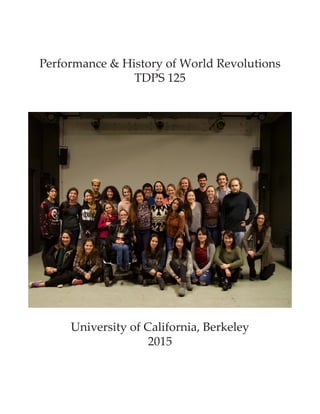
Performance & History of World Revolutions
TDPS 125
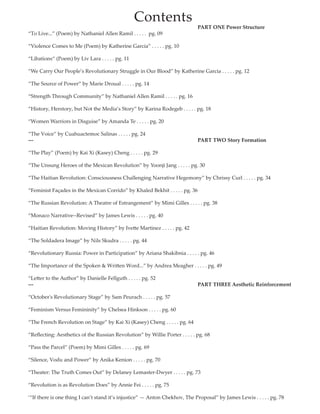
Contents
										PART ONE Power Structure
“To Live...” (Poem) by Nathaniel Allen Ramil . . . . . pg. 09
				                   	
“Violence Comes to Me (Poem) by Katherine Garcia” . . . . . pg. 10                     	           
	               	
“Libations“ (Poem) by Liv Lara . . . . . pg. 11 	                               
   	          
“We Carry Our People’s Revolutionary Struggle in Our Blood” by Katherine Garcia . . . . . pg. 12   
	                            	               	
“The Source of Power” by Marie Droual . . . . . pg. 14
	                                                   	
“Strength Through Community” by Nathaniel Allen Ramil . . . . . pg. 16
  	                               	                                       	             	
“History, Herstory, but Not the Media’s Story” by Karina Rodegeb . . . . . pg. 18   
	          	
“Women Warriors in Disguise” by Amanda Te . . . . . pg. 20              	
	                      	
“The Voice” by Cuahuactemoc Salinas . . . . . pg. 24    
---										PART TWO Story Formation
“The Play” (Poem) by Kai Xi (Kasey) Cheng . . . . . pg. 29                                  	
	
“The Unsung Heroes of the Mexican Revolution” by Yoonji Jang . . . . . pg. 30       	
	      
“The Haitian Revolution: Consciousness Challenging Narrative Hegemony” by Chrissy Curl . . . . . pg. 34
“Feminist Façades in the Mexican Corrido” by Khaled Bekhit . . . . . pg. 36                                	
	       	
“The Russian Revolution: A Theatre of Estrangement” by Mimi Gilles . . . . . pg. 38                   	
	       
“Monaco Narrative--Revised” by James Lewis . . . . . pg. 40    	        	
	 
“Haitian Revolution: Moving History” by Ivette Martinez . . . . . pg. 42    	
	                  	
“The Soldadera Image” by Nils Skudra . . . . . pg. 44                        	
	                        	
“Revolutionary Russia: Power in Participation” by Ariana Shakibnia . . . . . pg. 46      
	           	                         	
“The Importance of the Spoken & Written Word...” by Andrea Meagher . . . . . pg. 49    	
	             	                                  	
“Letter to the Author” by Danielle Fellguth . . . . . pg. 52                   	
---										PART THREE Aesthetic Reinforcement
“October's Revolutionary Stage” by Sam Peurach . . . . . pg. 57
	
“Feminism Versus Femininity” by Chelsea Hinkson . . . . . pg. 60                 	
	               	
“The French Revolution on Stage” by Kai Xi (Kasey) Cheng . . . . . pg. 64          	
	      
“Reflecting: Aesthetics of the Russian Revolution” by Willie Porter . . . . . pg. 68
“Pass the Parcel” (Poem) by Mimi Gilles . . . . . pg. 69  
	                
“Silence, Vodu and Power” by Anika Kenion . . . . . pg. 70                     	
	                      
“Theater: The Truth Comes Out” by Delaney Lemaster-Dwyer . . . . . pg. 73            	
	                      	
“Revolution is as Revolution Does” by Annie Fei . . . . . pg. 75           
‘“If there is one thing I can’t stand it’s injustice” — Anton Chekhov, The Proposal” by James Lewis . . . . . pg. 78
The day I sat down to write this introduction, Mario
Woods was shot in cold blood by a firing squad of the
SFPD. There was no trial. We all saw it on video, just like
Rodney King, just like… and the names go on and on.
In a post-Patriot Act moment, we are unsafe at a school,
a social service center, at a health clinic, or a church, re-
minding us that terror has always been as much here at
home as abroad. The crisis in Syria, displaced persons in
a shredded system of statehood, climate change corporate
hijackers; we are at war. It is in this context that we spent
the semester examining the conditions of revolution and
the performances that accompanied them in theaters, on
the streets, as scripts and memorials of the past.
	 Starting with the French and the Haitian revolutions
of the late 18th century and moving to the Russian, the
Mexican and the Cuban Revolutions of the 20th century,
we were concerned with what kinds of theater, dance
and the arts were happening in relation to those pivotal
moments of radical structural change. We also considered
the social dramas of revolutionary movements and their
constant and ongoing reproduction of history.
	 What we found when analyzing these various case
points was that performance tapped into the central
problems of revolutionary change: participation, repre-
sentation, spirit, virtuosity, and a renewed set of ideals.
The ability to speak and be heard was tantamount for the
left, for the right, by the reds and the whites to reinforce
and legitimate power. Where for Rousseau, the frivolity
of the theater was anathema to popular reason, destined
to be outside the revolution, the loas of Haitian dance
referred to the very word for laws. Performance had its
own laws, its own inside and outside of inclusion and its
own inside and outside of revolution. For theatre historian,
Susan Maslan, theater of the French Revolution generated
“perhaps the most significant crucible for the formation
and expression of public opinion” (2). Revolution is in
the dance; revolution also is the dance.
	 From the extremely stylized staged representations
of the worker’s machine-like preeminence (as in the work
of Meyerhold in the Russian Revolution) to corridos, or
ballads, of women soldiers of the Mexican Revolution,
we saw symbols like the train, the beret, like the fist in
the air move across mediums and across geographies
with tremendous influence. Even in an age of the Hunger
Games in which the Capitol sustains its opulence in a
dazzling media simulation, we are not so far from the
18th century newspaper editorials and theatrical scripts
that fabricated reality to make winners and losers, friends
and foe. As Michel Rolph-Truoillot argued, the hidden
text of that which was erased from history was just as
polemic and revealing as the triumphant and spectacular
raising of the flag or the toppling of statues.
	 We came together in this class on the understanding
that participation is a social practice that we could engage
more fully in our class in order to further analyze our
subject of performance and revolutions. We rehearsed
on a daily basis what it means to work in a group, what
it means to step up and step back, to make mistakes and
build trust, and learn together. We were critical to uphold
a singular ideal. While at the same time, we recognized
the power of a call to unity. I refer to a “we” as the class,
yet make no assumption that we all think alike, act alike
or move with one gesture. For some, our present reality
means gun control laws are the answer. For others it is
education, consciousness building and reform. Many
students recalled the teachings of the Black Panthers and
the Third World Liberation Movement to defend one’s
community and build from the inside. Still others are
trying to find a way to respond to a matrix of patterns
and privilege that feed us and also bleed us in all kinds
of ways.
Introduction
by Prof. Angela Marino
Each of us has a different perspective and together
we make a more balanced and just world. In the end,
students came up with a format of this zine to mirror
the cyclical reproduction of revolution based on three
phases: the power structure, story/narrative formation,
and aesthetic reinforcement. In the following pages, you
will find essays, collage, poetry, and images that depict
the various mediums and messages that we explored in
the classroom and the studio. We give a special thank you
and acknowledgment to Colette Eloi and her company
of El Wah Movement Theater and Michael Mansfield
of Theater, Dance and Performance Studies for leading
outstanding workshops respectively in Haitian dance
and Augusto Boal. Last, but not least, a special shout out
goes to Lulu Matute who very expertly brought their
work together into this design on web and in print. The
zine is their way of sharing ideas that contributed to this
class, and also to keep the conversation going, this time in
words and images that you can hold or see on a screen,
next time in the theater, or as performance on the streets.
Along the way we hope to edge closer to what it means
to do revolution better the next time.
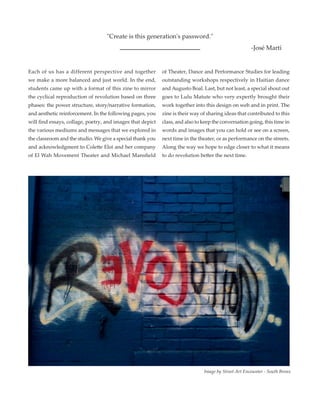
Image by Street Art Encounter - South Bronx
"Create is this generation's password."
-José Martí
6
7
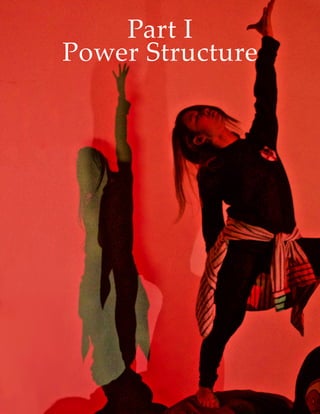
Part I
Power Structure
8
Power Structure Introduction
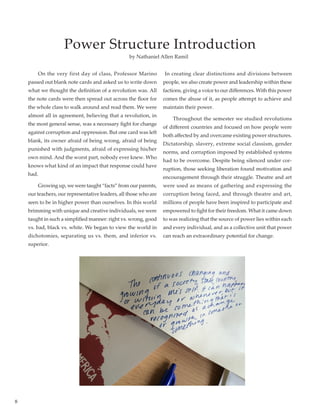
	 On the very first day of class, Professor Marino
passed out blank note cards and asked us to write down
what we thought the definition of a revolution was. All
the note cards were then spread out across the floor for
the whole class to walk around and read them. We were
almost all in agreement, believing that a revolution, in
the most general sense, was a necessary fight for change
against corruption and oppression. But one card was left
blank, its owner afraid of being wrong, afraid of being
punished with judgments, afraid of expressing his/her
own mind. And the worst part, nobody ever knew. Who
knows what kind of an impact that response could have
had. 	
	 Growing up, we were taught “facts” from our parents,
our teachers, our representative leaders, all those who are
seen to be in higher power than ourselves. In this world
brimming with unique and creative individuals, we were
taught in such a simplified manner: right vs. wrong, good
vs. bad, black vs. white. We began to view the world in
dichotomies, separating us vs. them, and inferior vs.
superior.
In creating clear distinctions and divisions between
people, we also create power and leadership within these
factions, giving a voice to our differences. With this power
comes the abuse of it, as people attempt to achieve and
maintain their power.
	 Throughout the semester we studied revolutions
of different countries and focused on how people were
both affected by and overcame existing power structures.
Dictatorship, slavery, extreme social classism, gender
norms, and corruption imposed by established systems
had to be overcome. Despite being silenced under cor-
ruption, those seeking liberation found motivation and
encouragement through their struggle. Theatre and art
were used as means of gathering and expressing the
corruption being faced, and through theatre and art,
millions of people have been inspired to participate and
empowered to fight for their freedom. What it came down
to was realizing that the source of power lies within each
and every individual, and as a collective unit that power
can reach an extraordinary potential for change.
by Nathaniel Allen Ramil
9
To Live…
To live for your work is not living at all
Chained to ideals that are corrupted, not mine
Lose myself daily, afraid to stand tall
Becoming an object that's yours to define
You live by oppressing in hopes to succeed
Desire wealth, power, false golden tokens
You've taught me one thing, my mind now can see
Nothing is beautiful 'bout being broken.
To live for you work is not living at all
But some how I find myself answering your call
by Nathaniel Allen Ramil
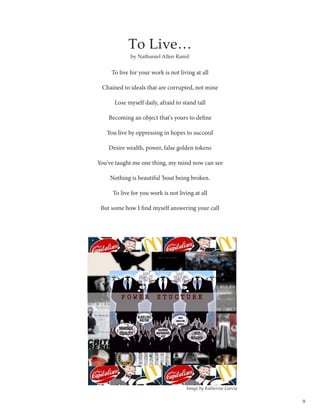
Image by Katherine Garcia
10
Violence Comes to Me
Peace and violence in fighting the power structure
Sometimes I lose the power to speak
My hands tremble my palms sweat I am speechless
My vocal cords stop working and I am left speechless
My television, computer and phone screen
As hate full words spill out of
The ignorance runs deep
Deep in the foundations of our institution that promotes its ties to social justice
but still keeps bones of natives locked away as artifacts.
Deep in the medias depiction of people of color as
violent radicals who spontaneously erupt into protest without just cause.
Continues to come to me, to my family, to my friends to our bodies
Peace will be used to be victorious and fight the oppressors that keep us silenced
If we use violent means we will lose is what I’m told
I did not bring violence, violence comes to me
So deep that the violence continues
But peace is the answer I’m told
Peace not violence
Violence will not work
Violence is not right
But wait lets put this on hold,
violence is tearing apart families
So don’t tell me peace is the only way
That peace is the only way to true revolutionary change
by Katherine Garcia
11
Libations
I buried you yesterday.
With the hurt I’ve been holding
Libations
In the form of water
Because water moves into the container you put it in
Because you are water
Cleansing water
From the prison of old thoughts
Based on fear
Based on western thought
Based on documentation
Based on contradictions
that were left over…
Libations
Para los ancestros que no tienen nombre
Para os antepassados motivados pelo material
Para los perdidos, los de abajo y los de arriba
Para os antepassados que lutaram por seus direito de existir
by Liv Lara
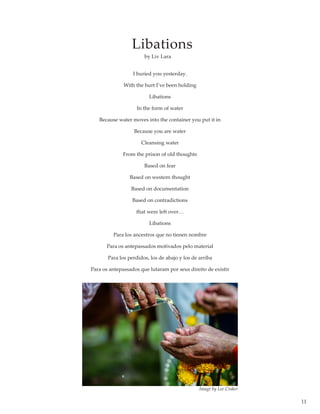
Image by Lee Craker
12
	 Historianshavecontinuallysilencedthehistoryofthe
Haitian revolution, as if it either didn’t exist or was not a
revolution at all. Prior to coming to Cal my knowledge
of the Haitian revolution was zero. Like many of my
classmates I always related Haiti to the natural disaster
that occurred there. Our lack of knowledge about the
Haitian revolution is not an accident. Much like the lack
of my own history as a Mexican American in text book’s
is not an accident. The Haitian revolution is silenced
because of how important it was. Professor Bayinnah
Bello stated in a interview that slave rebellions were
occurring everywhere in Jamaica, Cuba, Brazil and the
only difference was that Haiti succeeded in its revolution.
Haiti was the first colony under French control to gain
freedom and end slavery. That fact is essential in order
to understand the reason why their history has been
silenced. I will focus on how the performance of silenc-
ing history and discrediting it has affected people’s view
of the Haitian revolution today. I will begin by looking
at how people found the revolution as something that
was not possible. Furthermore, how performances are
discredited and viewed as satanic. Finally, I will show
how although some believe these performances are
satanic, they live on and carry the legacy of resistance.
	 The Haitian revolution was considered impossible
to many and it was often discredited as even taking
place. This discrediting of the victory of the enslaved
was on the basis that colonizers did not believe they
had the ability or intelligence to organize. According to
Trouillot, there are two similar themes that are reiterated
through history when spoken about the Haitian revo-
lution, “The first kind of tropes are formulas that tend
to erase directly the fact of revolution”(96) and “ The
second kind tends to empty a number of singular events
of their revolutionary content so that the entire string of
facts, gnawed from all sides, becomes trivialized”(96). 	
As was spoken in class, some people thought that this
revolution suddenly occurred and had no planning
or pretense. As professor Bello stated, the revolution
started since the people were being robbed from their
homelands to be enslaved. This was not a simple and
sudden uprising. The revolution took a lot of time and
effort from many and yet this history is not seen in texts
or taught in schools. This performance of silencing and
discreditingtheHaitianrevolutionbyhistoriansstemmed
from a racist belief system and also fear that it would
spread to other places where slavery was still in place.
Our lack of knowledge
about the Haitian revo-
lution is not an accident
	 A major part of the Haitian revolution was the perfor-
mances that took place, such as the Vodun performance
of Bois Caimen, yet much like the revolution as a whole
it was discredited. According to Elizabeth Mcalister “…
on 14August 1791, several hundred slaves from different
ethnic groups united under a leader named Boukman
and vowed to fight the French who ruled the colony and
used forced labor to fuel the sugar industry”(3). This
gathering is very important because it was considered the
inciting event prior to the revolution, which is believed
to have occurred two weeks later (3). As Haitian dance
instructor Collete Eloi said, people whom were enslaved
often didn’t speak the same language, but they knew
the same dances and rituals and that was their way of
communication. This performance was like a rehearsal
for revolution. A popular Christian figure Pat Roberton
stated on his show that the cause for the misfortunes
occurring in Haiti was the pact that they made with the
Devil in Bois Caimen. This view of the gathering that
occurred that night is not uncommon.
We Carry Our Peoples Revolutionary
Struggle in Our Blood
by Katherine Garcia
13
It continues to disregard the injustice that was occurring
to the enslaved people of Haiti and puts blame onto
them. This powerful performance that took place and
empowered the people to come together and get them
“pumped for revolution” as Collete Eloi stated during
our workshop, is viewed as something evil.
	 Although there is this discrediting of the perfor-
mance of the Vodun performance at Bois Caimen, the
legacy of it importance to the revolution of Haiti is still
present today. I saw the importance of it first hand in
the workshop we had as a class. As we all danced com-
munally to the beat of the drums I began to feel power
not only in my body but also spiritually. The songs sung
were also ways of communicating stories and messages.
The dance moves we were taught represented victory
and stopping the oppressor. Although the people were
robbed of their country, their families and home, they
still had this performance that brought them together.
200 years later the performance carries on with people
like Collete who continues the teachings. In the inter-
view with Collete Eloi she talks about how she shows
students the Haitian folkloric dance moves and it looks
similar to their own contemporary dance techniques.
Collete believes these are rituals that continue in their
blood even though generations have past. Although the
people in power of textual knowledge have attempted to
silence these histories, the performances that tell those
stories through song and dance live on.
	 The silencing of the history of the Haitian revolution
had a clear intent that was fueled by racism and the fear
of losing power. Trouillot even states how, “the silence”
is not only reproduced in the text books, but also in
“popular writings that are the prime sources on global
history for the literate masses in Europe, in theAmericas,
and large chunks of the third world”(Trouillot 98). This
important revolution, which freed the slaves of Haiti
is a forgotten and rejected truth. Many believed it was
an inconceivable occurrence that could not possibly be
true. They object to believe that “slaves” caused a revolu-
tion to take place. Instead of looking at these rituals as
powerful tools to communicate and create community,
some people considered them demonic practices. Even
though there is so much silencing and discrediting of
history, the legacy of resistance continues in the Haitian
folkloric dance. Their legacy of performance and resis-
tance continues to be taught and passed down to new
generations.
“In studying our story, we capture a
light from the past, which shines on the
road to the future.”
-Prof. Bayyinah Bello
14
The Source of Power
“To make a spectator of the people, while making sure
that the possibility of a spectator-actor reversibility re-
mains carefully controlled, is to maintain an alienation
that is the real form of power" (p 35).
	 For a long time, the vast majority of the French people
were impoverished and struggled to live, while watching
the wealthy aristocrats and royalty living unperturbed
by the struggles of those beneath them. After some time
of seeing this spectacle, the people of France could take it
no more, leading to what we now refer to as the French
Revolution. The government and the political institution
that ruled pre-revolutionary France was performing a
“spectacle” that the repressed and underrepresented
had watched for many years. The citizens were eagerly
awaiting their opportunity to transition from spectator to
‘actor’. Turner describes a metaphor as, “at its simplest,
a way of proceeding from the known to the unknown”
(p 25). The French Revolution is an immensely complex
part of not just revolutionary history, but of history
overall. The natural desire for the spectator to become
the actor can be used as a metaphor for understanding
the French Revolution a piece of theater all on its own.
The suppression of this transition is symbolic of the
power that the monarchy held over the masses, keeping
them as impoverished and powerless spectators of their
grandeur and power. When the citizen came into power,
they completed the transition, completing the cycle of
performance.
Onlythroughtheater,the
oppressed were allowed
to speak
	 Theater allows those participating in the creation
and production to express their opinions and ideas, and
the French theater of the Revolution was no exception.
The spectacle produced by the pre-revolutionary judicial
system can be described as an “organization in which
the activity of the actor (in the broadest sense) requires a
spectator and excludes his participation” (Maslan, p. 69).
Though the people are an obvious necessity to maintain
the structure of a government, the political power given
to the masses was extremely out of proportion to the
number of representatives in the National Assembly.
Only through theater, the oppressed were allowed to
speak. There were in fact many important leaders of
the Revolution involved in the theaters. In her writings,
Maslan describes that whether it be a puppet show or
execution, spectators flock to these events for the purpose
“of retelling, playing a role, assembling the neighbors
and getting them to listen…in which the spectator ulti-
mately finds his justification: to have become an actor”
(Maslan, p. 33). The fluidity from spectator to performer
is at the basis of everything from acting to retelling a
story to a friend. Every action we do is in and of itself
a performance, and all of these actions come from see-
ing someone else do them (Schechner).  After having to
watch the upper crust enjoy lavish lives while masses of
people were suffering in pre-revolutionary France, the
public was ready to complete the cycle of performance
and take power by re-performing the ‘spectacle’ as the
actors.
The lack of representation in the National Assembly is
one example of how the majority of people in France
were underrepresented and repressed. Symbolically,
they weren’t able to take their rightful role as actors
retelling the spectacle that the monarchy of France was
performing.  “To appeal to an audience is to appeal
to this possibility of a spectator-actor exchange, and
an audience that does not achieve this exchange, this
cycle, this transformation, is a mutilated audience – or,
one might say, an alienated one” (Huet, p 34). Written
word played a major role in the French Revolution as
an outlet for the public to perform by voicing their own
ideas and opinions. Written word is powerful, because it
is something that is permanent (unlike the spoken word)
and is able to copied and distributed widely. Simply said,
“paper is king” (Huet, p 6). With written word, important
landmark events were immortalized, and were made
available to many, so that even those who weren’t able
to be at the event can experience it through the notes of
the scribes. The citizen’s performances in theater gave
by Marie Droual
15
the public power. Many of the major revolutionary lead-
ers had close ties to the theatre. One notable instance
that demonstrates the power of written word is seen in
the movie Les Miserablés. At the beginning of the movie,
when Jean Valjean is a prisoner, a single slip of paper
with his probation written on it is holding him back,
preventing him from being able to reintegrate into
society. It is amazing when you think about the power
that this small piece of paper had, shunning him as an
outcast. When he decides to change and rips the paper
into shreds, he is symbolically tearing off the chains that
the new “monarchy” of France has put on him and tak-
ing power over his own life. This moment is symbolic of
the emergence of the revolution, as Valjean outwardly
demonstrates his defiance of the established order. It was
through the power of the citizen’s own written words
that they were able to get enough power to revolt, both
in the movie and during the French Revolution.
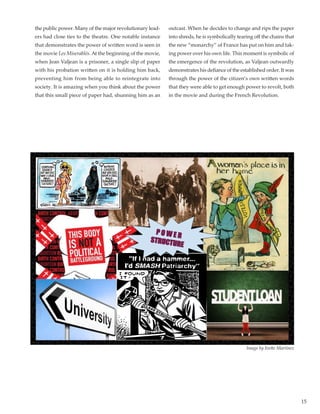
Image by Ivette Martinez
16
	 At the start of the unit, we were asked as a class to
come up with anything we knew about Haiti. Although
the French Revolution had become iconic in the percep-
tion of even American Independence and democracy,
Haiti was unknown. The more we were challenged to
think of other facts or news, the more we came to real-
ize that there is a lack of knowledge of Haiti’s past and
present; but why was that? History is the production of
colonial power and thus dictates what is presented and
what is hidden. Those in power are able to create masks:
one to cover up their blemishes while highlighting their
successes full of misconceptions and false accusations for
the inferior. In terms of Haiti, we see Haitians portrayed
in the media as a threat with their Vodou practices that
are perceived as dark and dangerous. In recent media,
reporters have suggested that Haiti’s “bad luck” with
natural disasters and extreme poverty is due to its
people’s "pact with the devil that was made in order to
liberate the country from French rule several years ago.
What is presented to us as factual has been altered with
and become popular belief. Even the Haitians cannot
have their voices heard when speaking against the false
information, speaking for themselves. Their voices are
unheard, or more likely muted by the public, because
historical accounts have depicted Haitians through a
discriminating lens. Despite being silenced in the midst
of racism and discrimination, many Haitians are able to
maintain their sense of culture and community through
the practice of Vodou. Their strong sense of unity and
spirituality guided them to freedom from European
colonialism, and in today’s world, it may guide them
to freedom from discrimination.
	 Vodou is a spiritual practice that emphasizes the
development of the individual and his/her role in help-
ing society advance. According to Professor Bayinnah
Bello, “our purpose on this earth is to build good char-
acter…so we can create a worthwhile society and have
a life of victory.” In doing so, there are seven principles,
or Seven Loas, that must not only be understood, but
acted upon in order to achieve good character. The
first social principle Professor Bello introduced was the
principle of Legba, which stresses that we must place
others before ourselves, and give them the opportunity
to better themselves and save them when they’ve gone
down a wrong path or things have gone awry. In the
ceremony at Bois Caiman, Boukman was the man who
acted upon the loa Legba. Boukman gathered slaves
from all across the region to lead and perform a Vodou
ceremony, one that Collette Eloi described as a liberat-
ing ceremony which allowed the Haitian slaves to take
charge of themselves as humans after being oppressed
and dehumanized by the French. The ceremony con-
sisted of loud music, chanting, dancing, and calling on
their god to give them the strength and courage to fight
against the colonial powers. In this situation, building
good character meant fighting against a corrupt higher
power, fighting not only for themselves, but also for the
people around them. Community was their strength,
and ultimately, as Colletee Eloi said, Haiti became the
first country to win a revolution against the colonial
powers.  Why is it though, that despite such a great
achievement, Haiti and Vodou is looked upon in such
a negative way?
What is presented to
us as factual has been
altered with...
	 The process of creating history, creating what we
think of as “knowledge of the past”, is susceptible to
straying away from the truth by misinterpretation and/
or alteration by those with power. In his book, Silencing
the Past, Power and the Production of History, Michel-Rolph
Trouillot states that history is produced in four funda-
mental steps, each step susceptible to having certain
aspects of the stories and events silenced or altered.
These four steps are "the making of source","making of
archive", "making of narratives", and  "making of history
Strength Through Community
by Nathaniel Allen Ramil
17
in the final instance" (26). I think the most important
step is the very first: making the sources in which facts
are created and events are documented. The first written
accounts of the ceremony at Bois Caiman were published
by the French. The Frenchmen who documented the
event may have indeed witnessed the ceremony, but as
outsiders and, in a sense, foreigners to the culture, they
are prone to misinterpret the event as savage, animalistic,
and chaotic. Such an account could easily be distributed
to other nations because France had the power, tools,
and connections to do so. The trend of altering and
silencing continues on as others who have read the
documentation interpret an already misperceived event,
thus straying away even more from the truth. As seen
today, evangelicals claim Vodou as a demonic practice.
From the numerous different interpretations of the event,
the evangelicals interpret what they “know” as a “blood
pact with Satan”, one that the people of Haiti made in
return for their freedom from the French.
	 Racism and discrimination also tie into how stories
are altered and what is hidden or silenced. As Collette
Eloi mentioned in her dance session, Haiti was the first
nation to free itself from colonial rule. The unthink-
able had been done. Rather than celebrating such an
achievement, stories were altered to shine a negative
light on Haiti and its people in order to discourage other
enslaved people from revolting, as well as to warn and
advise other colonial powers to reinforce their control
over the inferior.
	 What surprised me in this unit, and actually gave me
a sense of hope, is that Vodou is still practiced despite
what the world thinks. During the dance session, Collette
Eloi stated that Vodou allows different people from
different regions to practice Vodou, to dance, sing and
chant,. Through this, people of the culture understood
exactly what region the other Haitians’ ancestry is from.
They are able to gain a sense of understanding of where
the other Haitians came from, what they’ve dealt with
in the past, and ultimately what they are dealing with
today with the discrimination and false accusations of
their culture. The Haiti people are their strongest as a
community. United, the Haiti people won a revolution
against a powerful colonial nation, and as they reconnect
and gather with those of the same or similar ancestry
through the spiritual practice of Vodou, they will be
able to overcome this dominating negative perception
of Haiti.
“It is not only our understanding
of revolution but our conception of
freedom”
-Hannah Arendt
18
	 These days society as a whole, especially our age
group being the Millennial generation, learns most of
what they know about the world from social media like
Facebook, Instagram, Twitter, etc. and obviously from
the news, word of mouth, and what not. But what this
creates is a funnel of information that can be controlled,
manipulated, warped, produced, and manufactured to
suit those in power. Much like the case for the Haitian
Revolution, this creates is a whole faction of marginalized
people whose voices are not heard, stories are not told,
and existence is for the most part, unknown—unknown,
of course, until it is recognized by the media.  However,
as I said earlier, we are only exposed to a tiny part of
these stories by the media, and this is the case in historical
documentation as well. How do we know what is true
or what is manipulated? In our initial discussion of Haiti
in class, knowledge was extremely limited; most facts
known about Haiti surrounded the limitedly covered
2010 earthquake. And that’s not truly the fault of any of
us because Haiti’s story is predominantly unheard by the
world. In Michel Rolph Trouillot’s book, Silencing the
Past, he discusses how those in power (e.g. the media)
are those who produce our understanding of history
and this certainly applies to the people in Haiti and the
Haitian Revolution—they are the people whose voices are
unheard, and the performance of the Haitian Revolution
has left us with a very specific lens to view it through.
	 Personally, the Haitian dance lessons we were taught
by Colette Eloi were the most beneficial and resonated
the most with me when discussing performance and
its power in communication. While I am not Haitian,
I was able to connect to the energy and the movement
that we did. Colette would tell us the meaning of each
move in connection to the Haitian people and especially
the revolution. I could feel the power in each move and
was able to connect to its meaning from my toes to my
head, which just furthers the importance and influence
performance has on communication and revolution. One
thing that really struck me was when Ms. Eloi encour-
aged us to use our pelvic area as a place of importance
and power, and to not think of it as a sexualized object,
which is what it has become in Western culture. This is
yet another instance in which media has funneled our
views through a hegemonic agenda. I also surprisingly
became pretty emotional during some of the moves; I am
Chamorro and my people are from Guam, a U.S. territory
that has lost its culture and history through hundreds of
years of imperialism and conquer.
there is already a domi-
nant story that is con-
structed and told...
For instance, much of the original Chamorro language
has been completely decimated and mainly only the el-
ders know the language and at this point many of them
are passing away which creates urgency for preserving
what is still known. Similarly, Trouillot’s states that
“because these observers did not find grammar books
or dictionaries among the so-called savages, because
they could not understand or apply the grammatical
rules that governed these languages, they promptly
concluded that such rules did not exist” (pg. 7). Now, the
Chamorro language is basically a mix between Tagalog
(Filipino) and Castilian Spanish and some few original
Chamorro words. Therefore, like the Haitians, there is a
loss of history and an oppression that still does not afford
the Chamorro people liberties that mainland Americans
have. I can connect with idea of those in power silencing
those who are not, as Guam is probably another place that
not people probably cannot name too many facts about.
History, Herstory, but Not the Media’s
Story
by Karina Rodegeb
19
	 During the Haitian Revolution, the events that took
place at Bois Caiman are probably of the biggest “lega-
cies” still known today. It was here that Vodun priest,
Dutty Boukman, led a religious ceremony. It has since
been cited by Christian influencers as a ritual in making
a “pact with the devil” (McAllister) tainting the true
purpose and meaning of the ceremony. This is just one
of many examples demonstrating that “the very mecha-
nisms that make any historical recording possible also
ensure that historical facts are not created equal. They
reflect differential control of the means of historical
production…that transforms an event into a fact” (pg.
49). Furthermore, Vodun practices have been practically
demonized, misconstrued, and exaggerated in Western
culture mostly to perpetuate these longstanding fallacies
from the construction of “history” and for entertainment
values. Vodun is today, more commonly associated with
zombies, voodoo dolls, black magic. This demonstrates the
many ways to distort narratives which can come through
in games, songs, TV shows, movies, etc. Hollywood has
turned Vodun practices into a caricature to add dramatic
“flair” and create a subconscious instillation of fear in the
spectator.
	 The biggest problem with the “legacy” of the Haitian
Revolution is that there is already a dominant story that
is constructed and told by those who have control over
historical narrative, and Trouillot claims, “As sources
fill the historical landscape with their facts, they reduce
the room available to other facts. Even if we imagine the
landscape to be forever expandable, the rule of inter-
dependence implies that new facts cannot emerge in a
vacuum. They will have to gain their right to existence in
light of the field constituted by previously created facts”
(pg. 49).
20
	 In such a patriarchal world, women have lived under
centuries and centuries of suppression. They have been
left out of history, silenced, and “domesticated” in roles
that society deems they are appropriate for. The Mexican
Revolution, which is also known as the Mexican Civil
War, is viewed as a civil war for women. Not only did
women assist in the revolt against Díaz, but they created
their own revolt against stereotypical women’s roles, as
well.
They described women
who died during child-
birth as soldiers on a
battlefield
	 MaríaHerrera-Sobek’sTheMexicanCorrido:AFeminist
Analysis presents the idea that women soldiers, and their
power, have been in existence throughout history, despite
the popular belief. The title of her work in itself presents
such an empowering message, as it translates to “The
Mexican Narrative Song.” She basically states that this is
what Mexico’s history is truly built off. Sobek analyzes
the path women had to discover to build their succes-
sion.  In doing so, they were capable of so much more
than men or even they expected themselves to be. From
fighting alongside men, to taking a majority of positions,
to their mental strength during the war women proved
themselves to be of importance to the revolution when
the Spaniards were in constant battle with the Native
Americans.  As men fell alongside their ego women sup-
port became a necessity. This was recognized byAlonzo
de Ercilla y Zuñiga in his literary epic, La Araucana,
which described that when all was lost, Doña Mencía,
persisted in encouraging men to continue battling and
picked up weapons herself to fight along with them. He
shows that, while men began to give up, Mencía only
grew a stronger mentality and even offered herself as
a sacrifice in order to gain efforts in the war, proving
that women can be stronger than the average man. The
fact that he wrote about a woman also contributes to the
strong influence women must have had in the revolution,
as most men held society’s beliefs.Another woman who
proved a great influence was Doña Josefa Ortiz. She was
an inspirational independence leader who helped lead
the country to its independence and was honored,not
only in poetry but on Mexico’s currency, as well. María
Manuela Molina raised an army of men who fought and
won seven battles, dubbing her “La Capitana.” What is
even more impressive is the fact that she only died after
numerous fatal wounds. Her stubbornness to stand for
her justice and only die after truly being terminated
shows the vigor of absolute femininity. These women
uncovered their own way to proving their impact on
the world.
	 Kentner claimed that the reason for lack of women
inclusioninhistoryisduetothefactthatthereweresimply
too many who played active roles to name. In addition,
amongst these many women, there were several positions
they held, such as tending to the wounded, donating
to the cause, sacrificing themselves, cooking, and even
seducing. In fact, María Bernarda Espinosa was known
as a “seductress.” This talent, which is most often seen
as prostitution and taboo, can actually be categorized
alongside the many advantages women have over men.
Seduction doesn’t compare to the amount of cruelty
they practiced. Pepita Neri, dubbed “La Coronela,” and
Jovita Valdovinos, “The Generala,” are often described
as playing “men-like” roles, such as “dressing and acting
like men.” Valdovinos later reveals to the President that
she, having been so cruel to her victims and a woman,
had served him. This brings to question, again, the ex-
pectations of a woman and what defines their roles in
society. If she was capable of succeeding in such a task,
why is it still labeled as something men do, rather than
simply being a noble accomplishment? Finally, the most
impactful force that these women had over men was
Women Warriors in Disguiseby Amanda Te
21
the fact that they either expressed their beliefs of the
revolution through some art form, such as writings or
paintings,ormendocumentedorpraisedtheiractivitiesby
writing or painting them themselves. This is the greatest
power of them all because it is an influence that lingers
and is remembered for years to come. Their fight and
struggle lives on through these pieces of performance,
just as the strength behind the symbolism of the image
of a woman in military uniform. This is their form of
voicing their immortal opposition to tyranny, and even
more impressive is their courage to do so voluntarily
despite the risk of their life by involving themselves in
the danger of politics.
	 Most interestingly, Mesoamerica produced the
concept of a woman warrior, which was later inherited
by Mexico. They described women who died during
childbirth as soldiers on a battlefield. In this sense,
women fought in “war” more often than men did, and
more likely than not, succeeded. In addition, the ideol-
ogy of a woman warrior is extremely relatable to me,
personally. In a previous English class, I read the novel
The Woman Warrior: Memoirs of a Girlhood Among
Ghosts by Maxine Hong Kingston, which discusses the
view that women who are suppressed, in different ways,
fight their own type of battle and become their own type
of warrior. Although Mexican and Asian culture is very
different, I find myself relating myself to both, especially
after growing up in a dominantly hispanic area but
raised in an Asian household. I came to realize that as
the daughter of a low- income, underprivileged, refugee
family, I was expected to succeed in nothing more than
maybe graduating high school. Much of administration
believed our students had little potential, and, regardless
of the fact that my parents encouraged me to pursue a
higher education, many of my traditional family mem-
ber commented on my possible career paths as being
“a man’s job.” This novel made me realize that I am a
woman warrior fighting a battle against my family’s
and society’s expectations and views of my abilities.
This is exactly what the women of Mexico did during
the revolution, just in a different context.
	 Women were depicted as fragile and incapable of
surviving without the assistance of men. Because of
this and the fact that men dominated everyday society,
women were notably left unrecorded in history, despite
some important roles they proved to play. Sobek pro-
vides readers many influential women leaders and the
active positions they held in the war efforts. In addition,
she shows how, although men exercised control over
everything, down to the news and the arts, women still
have some appearance in it if one reads close enough.
Thus, these times war, yet giving them little credit for
their immense aid.
“Constructivism has forced the artist to
become both artist and engineer”
-Edward Braun
22
	 One of the main roles that representation has in regards to social move-
ments such as revolutions is that it unifies a group of people under one
common perspective. Though not every single individual of the particular
group is being heard through their own voice, the general concepts of their
corrupt society and their beliefs/hopes of a better society are being brought
to the forefront. Many of a group’s representatives are outspoken and take
on leadership roles, becoming icons and symbols of strength and hope.
	 Putting so much faith into these representatives, though, can also be a
downfall. With so much power and responsibility, the people depend on the
representatives, and when things begin to go awry and the worst comes, the
leading representatives are the ones to blame. It can also go in another direc-
tion in which the representative becomes more power-driven, more control-
ling, more like another corrupt leader. In either case, the people that are being
represented lose a sense of self-entitlement and self-control. Indeed, having a
leader to represent the group is key to moving forward, but the people need
to also understand that they are just as powerful and can make just as much of
an impact as these representatives in being active participants and represent-
ing themselves. That way, they aren’t only relying on their representatives
and putting all their eggs in one basket, but rather they, too, also have control
over themselves and the ideals that they are fighting for.
by Nathaniel Allen Ramil
Representation & Revolution
23
24
“That’s the history of the
world. His story is told,
hers isn’t.”
	 ThissimplebutyeteloquentquotebyDoloresHuerta
describes how the Mexican Revolution hxstory continues
to be seen and told. In the reading, “Mexican Corrido:
A Feminist Analysis,” by Maria Herrera Sobek attempts
to not only define corrido itself but incorporate the con-
struction of the Mexican Revolution through womxns
narrative, roles and participation. By incorporating and
developing this construction the womxn voice becomes
their story and possession.
	 Popular images of women during the Mexican
Revolution (1911-1920) often depict them as sexual be-
ings, but with “masculine” traits wearing a bandolier
and guns. As expressed in the reading, womxn roles
became minimal and as a result they were labeled “se-
ductresses.” “One of the greatest evils which we have
had from the beginning of this war…are the women
who, on account of their sex, have been the instrument
of seducing all classes of persons…(361)” They played
integral roles; however, like some of their voices, their
bodies were silenced. Over the course of the Mexican
Revolution, we are brainwashed to see the female soldier
as submissive, but  now we see them as a promiscuous
fighter (Si se puede). Objectivity has damaged our minds
in terms of how we see womxn, although they were
brave and strong soldiers, many men continue to see
them as objects. With this image instilled in our minds,
womxn were trying to make their image more vivid and
their involvement to the revolution became an essential
part of making their image more visible, however their
lives were still in danger, “these women demonstrated
their pluck and mettle in entering the political fray,
which entailed extreme danger to their own lives and
to the safety of their loved ones” (362). When gender
roles are being challenged, our hxstory and men have
the tendency to set and define womxn roles.
	 There are three types of soldaderes that are repre-
sented in the corrido. “These types vividly demonstrate
the historical process in the fashioning of an archetypal
image. Some corrido depict the soldadera in her true his-
torical dimension. Some romanticize the soldadera and
transform her into a love object. In others the soldadera
is transformed into a mythic archetypical figure.”Their
female beings and bodies in corrido tradition have si-
lenced some womxn and, as a result, many female roles
are seen as insignificant for both the revolution and cor-
ridista. “As we have seen, the historical record confirms
the involvement of Mexican women during the periods
or armed conflict. The heroic corrido corroborates the
participation of Mexicanas on the battlefields. For the
most part, however, the women appear as anonymous
entities, at times denominated solely by their first names,
at other times as “Juanas” or “galletas” (“cookies”), the
names usually given to soldaderas. Some are simply la-
beled “mujeres” (363). The historical struggle appears to
come from womxn being a part of the already established,
patriarchal society that our history has constructed. This
of course, can be said about how corrido tradition has
been established as well.
	 MayaAngelouoncesaid,“thesadnessofthewomen's
movement is that they don't allow the necessity of love.
See, I don't personally trust any revolution where love
is not allowed.” The reading implies, “Many women, of
course,joinedthestrugglesimplybecausetheirhusbands,
fathers, brothers, or lovers were deeply committed to
the ideals of the revolutionary movement. Still others
were drawn to the battleground by a combination of
motives…She, no doubt. Exemplifies many soldaderas
who were drawn into combat for love and ideals” (367).
The Voice
by Cuahuactemoc Salinas
25
Does love make a womxn weak? Does it make a womxn
seem invisible or does it suppress their power/bodies?
These questions can be answered by referencing a out
a quote on page 369, “the transposing of the soldadera
into a love object became problematic for the troubadour
since he or she could not employ the classic form of the
heroic corridor; a more flexible structure, a more lyri-
cal framework, had to be employed to fit the romantic
contents of the ballad.” Men wrote most of the corridos,
so the perception and history can easily be manipulated.
According to the research by Rosalva Resendiz, the
corridos categorized women into different archetypes:
“good mother, goddess, the lover, and the soldier.” The
female soldier is usually remembered in the corrido as
either strong or a love interest. By examining the different
depictions of the soldaderas in corrido we can see how
men can easily blur womxn roles and their image. In
essence, “Even with all the weaknesses inherent in the
genre, which cannot escape its patriarchal ideology, I find
the corridor a valid social document that can provide a
new perspective on Mexican women and their roles in
Mexican society” (375).
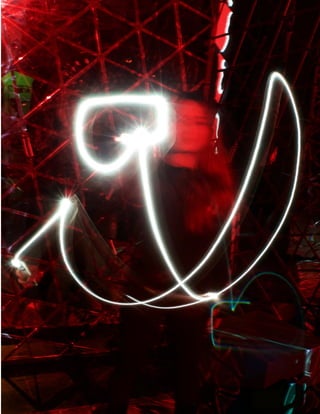
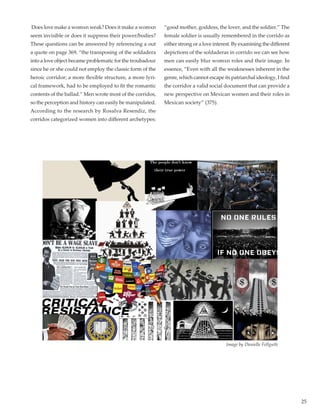
Image by Danielle Fellguth
26
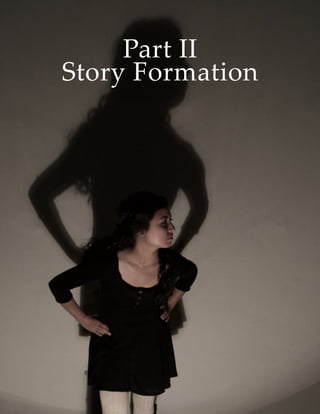
Part II
Story Formation
27
28
	 It’s one of the first things we all learn when we start
studying books as children: “introduction, rising, action,
climax, falling action, and resolution.”As we grow older
and come into contact with different forms, more compli-
cated concepts and bigger words start to make their way
into the mix: denouement, apotheosis, monomyth . . . Our
view of stories, however, whether fictional or real—or at
least as real as any story can be—is continually shaped by
that early image of the inverted checkmark, slashing its
way across the whiteboard and off into the untold future
of the story, remaining, as it were, as straight and stable
as its denouement. This picture of how narrative works
can be difficult to shake, even as we come to realize that
many narratives—whether fictional or historical—are
far more complicated than this, but become ensnared
by the media, by dominant discourses, and by our own
inherent biases and prejudices. What is complicated and
complete becomes simplified, or buried completely.
	 In this class, we took a long look at Michel Rolph-
Truillot’s book, Silencing the Past, which addresses the
many problems and questions surrounding historical
narrative formation. The book, which uses the oft-untold
story of the Haitian Revolution as its primary example,
became a cornerstone of our discussions about narratol-
ogy and how history is not just written post facto by the
victors, but by the victors who remain in power. Professor
Marino introduced our work with a reference to The
Hunger Games, and it is perhaps a fitting metaphor here
as well. The narrative of the “Victors” is used to define
and control the oppressed, and all those who suffer from
violence are used to prop up and reify those narratives.
	 Augusto Boal once said: “We are all actors: being a
citizen is not living in a society, it is changing it.” Boal
believed in a democracy in which everyone could speak,
and over the course of this class we have discovered new
ways of speaking and creating narratives that do not
seek to become the dominating discourse. Dance, song,
and performance have opened doors to simultaneous
individual expression and collective fiat—whether in a
blockbuster like Les Miserable, or in our own workshop
space. With Boal in mind and thinking of ourselves as
spect-actors, our own performances reminded us of how
those climactic dramas could be an institutional device
designed to keep the catharsis contained to the theatre,
dominating our will to act on the outside.
	 Ultimately our discussions of narrative formation
did not end with our study of any singular revolution.
As we read and watched and wrote about the stories of
various historical revolutions and looked for something
deeper than what Rodolfo Usigli’s Miguel might call
“truth,” we have discovered truth—without quotation
marks—in finding our voices and telling our own stories.
Story Formation Introduction
by James Lewis
29
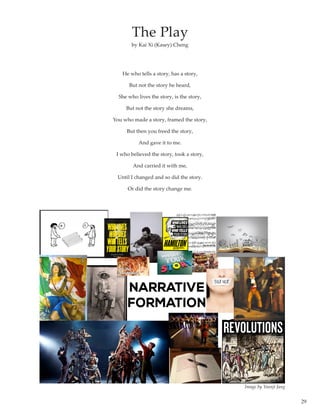
The Play
He who tells a story, has a story,
But not the story he heard,
She who lives the story, is the story,
But not the story she dreams,
You who made a story, framed the story,
But then you freed the story,
And gave it to me.
I who believed the story, took a story,
And carried it with me,
Until I changed and so did the story.
Or did the story change me.
by Kai Xi (Kasey) Cheng
Image by Yoonji Jang
30
	 Along with studying various revolutions in class,
I’ve recently started some research of my own on
the American Revolution by listening to Lin-Manuel
Miranda’s new show Hamilton: The Musical on repeat.
The musical focuses on the life of founding father and
America’s first Secretary of the Treasury, Alexander
Hamilton as well as the people in his life during the
time of the American Revolution. Aside from the bril-
liant music and lyrics, one thing Miranda succeeded
in was bringing up the idea of “who tells your story”?
The characters that really stood out for me in the show
were the women. The Schyuler Sisters: Angelica, Eliza
and Peggy  discuss their “legacy” and how they will go
down in history throughout the entire show. Angelica,
the eldest sister, states that her role in life is to marry
rich and climb the social ladder. However, she desires
to make her mark through politics and is eager to talk
to Thomas Jefferson to compel him to “include women
in the sequel”. Eliza, who marries Alexander Hamilton,
struggles to find her story inside her husband’s narrative
and asks Hamilton to let her be a “part of the narrative,
in the story that they will write someday”. Peggy, the
youngest sister is often in the background and forgot-
ten. The portrayal of women in Lin-Manuel Miranda’s
musical perfectly mirrors the Mexican Revolution.
While the men were in the spotlight fighting for new
government, land reform and class equality, the women
working behind the scenes or aside the men to help with
the war efforts were either forgotten, deliberately cut or
portrayed incorrectly throughout history.
         Soldaderas, an archetype of the “Woman Warrior”
inherited from the ancient Greeks, were female soldiers
during the Mexican Revolution. They engaged in vari-
ous substantial roles from “soldiers actually engaged
in battle... spies and couriers, “seductresses”… wives,
sweethearts, and daughters… cooks, nurses, fund rais-
ers… and camp followers” (87). As the current state of
society affected their wellbeing, the women actively
participated in the revolution. It’s amazing that certain
women were in charge of battalions, putting themselves
into dangerous situations and their lives on the line.
Rather than focusing on the woman as an individual
who acted out of her own accord, women are always
linked with men and characterized as docile beings
that follow their man out of love and devotion. Their
role is always beneath or for the man. Although many
did join “the struggle simply because their husbands,
fathers, brothers, or lovers were deeply committed to
the ideals of the revolutionary movement”, that wasn’t
their sole cause (367). Regardless of the reasons why
these women joined the cause, they all go down in his-
tory on the sidelines, as supporting the man or being
the vice of man.
Soldaderas are
romanticized and
hyper sexualized
         Herrera-Sobek in The Soldier Archetype discusses
the three types of Soldaderas introduced through cor-
ridos, songs and stories. The first is the true historical
depictions of these women. In class, we engaged in an
exercise where we researched Soldaderas and created
dialogue for them to put their voice back into the nar-
rative. Working with Katherine on the Castillo Sisters,
I was exposed to the harsh realities of their legacy. We
were not able to find much information about the sisters
and most of the class had the same issue. If we were
lucky, we found a paragraph on who these women were
and their impact on the Mexican Revolution.  A whole
life (in our case, four lives) reduced to one paragraph
from the perspective of men. Many of the women’s roles
during the revolution were not documented. Where did
their stories go? Is this how they wanted to go down in
history? What is the truth? The sisters, Carmen, Toña,
Concha and Lola had the task of being suppliers for the
revolution and bringing ammunition, clean clothes and
The Unsung Heroes of the Mexican Revolution
by Yoonji Jang
31
“candies” for the soldiers. They are praised and labeled
for their hard work and bravery, which become their
legacy. It is interesting and frustrating to see them praised
for their domestic role as “caretakers” who bring candy
and earn the compliments and approval of men rather
than their heroic deeds. They still remained voiceless
and opinion less. Katherine and I created dialogue for
the sisters where they could take charge and be a fighting
part of the revolution. In our story, the Castillo sisters
inspired by the ideals of the revolution and wanting to
do more, charge into the room at the end of The Imposter
and rally Julia into joining the revolution. Julia leaves
with the sisters in order to leave the patriarchal grasp
of her father and brother.
         Soldaderas are romanticized and hyper sexualized.
When you search Soldaderas on Google, one of the first
image that pops up is an overly sexualized image of
the warrior. You see a curvy woman, sticking her chest
out in a low cut top as her hair blows in the wind. The
author states “to neutralize the woman, by making her
a love object and thus presenting her in a less threaten-
ing manner” (104). This instills the idea that a woman
with thought and drive is dangerous and to minimize
her power, men put her into a submissive and roman-
ticized position. In The Imposter, Julia shows society’s
fascination and obsession with appearances and stan-
dards of beauty. When Julia’s mother, Elena tells her
that “physical beauty is not the only thing that attracts
men to us”, she responds by saying “no… but it’s the
one thing that keeps them from leaving us” (17). Julia is
desperate for the approval of men, even if it’s from her
own father. Women are always seeking men’s approval
who at the same time create unrealistic standards and
depictions of women. Women are shaped and molded
to fit a man’s world.
         Soldaderas are seen as the mythic archetypal fig-
ure (93). From real stories, Soldaderas are crafted into
sexual objects and romantic fantasies and the final step
is to immortalize this image. In corridos such as “Juana
Gallo”, she is given superhuman powers and becomes
the representation of every Soldaderas. The portrayal of
women during the Mexican Revolution influences the
view of female soldiers today. The media continues to
put female heroines into skimpy clothing or have them
fall in love, which distracts them from their ultimate
mission. Women make up half of the world’s population
and are responsible for great events throughout history,
yet only a small percentage is dedicated to them. As the
next generation of storytellers and practitioners of the
theater, we need to discover and tell these stories. Only
by creating new works of art and telling new narratives,
will we be able to change the perceived idea and make
headway for women.
“Morals are not corrected; they are
depicted, and an ugly face does not
appear ugly to him who wears it”
-Jean-Jaques Rousseau
32
	
	 Representational politics are at the heart of every revolutionary struggle.
From the Haitian Revolution to the Arab Spring to the Black Lives Matter
movement, revolutionary struggles cannot be separated from representa-
tion; this is especially true in today’s increasingly technological age where
images and ideas can be disseminated, mobilized, and politicized. As a queer
person of color, I understand the importance of representation in shaping
revolutionary struggle. However, I also understand that representation is a
tool; it can be deployed for the purpose of the revolution just as easily as it
can be used as a tool of repression.
	 The iconic image of Ché Guevara was instrumental in mobilizing Cubans
against the US-backed General Batista. The icon Ché became associated with
the revolutionary struggle against imperialism especially after he was as-
sassinated by the CIA. Soon thereafter, however, the capitalist propaganda
machine began its work; Che’s face was on all types of products and the
symbolism around his image changed. This is not to say that Ché is no lon-
ger a symbol of revolution. Rather, it is to say that the hyper representation
of Ché in a capitalist context made him so far removed from his struggle for
socialism, economic equality, and against imperialism. Ché was transformed
into a symbol and just that. Thus, it is not mere representation that we need
to mobilize but representation that has the power to dismantle hegemonic
structures, that is what must be at the crux of our revolutions.
by Khaled Bekhit
Representation & Revolution
33
"...it is not mere representation that we need to
mobilize but representation that has the power
to dismantle hegemonic structures, that is what
must be at the crux of our revolutions."
-Khaled Bekhit
34
	 Truthfully, I can’t say that I was delighted when
Professor Marino announced we would be learning
Haitian dance. Firstly, dance in my personal, American
experience is generally either for artists who are elevated
by their technical virtuosity or just for fun and social
bonding at parties. Secondly, I don’t consider myself
a spiritual person so I found the concept of the loa in-
teresting but not at all convincing. My expectations for
the dance class were that it would be intriguing from
an academic standpoint, but not moving on a personal
level. I am very happy to say that I was completely and
utterly wrong.
The spark for the Haitian
Revolution came not
from the written word,
but from a performance	
	 Likemanyothersinourclass,Iwasdeeplymovedand
inspired by my brief encounter with Haitian dance and
the knowledge of Colette Eloi. The power, the freedom,
and the joy in the movement took me to some higher
space, elevated beyond the everyday. The experience
of dancing with the class also brought me that feeling
of an idealized singularity that transcends individual
relationships and individual moments— I felt a con-
nection to my fellow humans that was core, visceral. 
After the class I kept thinking about it, wondering why
it felt so different, and I realized that for me dance was
a new kind of consciousness— a new way of knowing.
This experience really crystallized my understanding
of the deep rift between Haitians and Westerners in the
remembering and recording of the Haitian Revolution.
Epitomized by the reactions to the pivotal Bois Caïman
ceremony, the conflict over the production of Haiti’s
history arises because the Haitian Revolution shattered
Westerners’ fundamental way of knowing.
	 The birth of the Haitian Revolution was quite dif-
ferent than, for example, the French Revolution. While
the French Revolution included popular movements,
much of its momentum was fueled by the discourse and
writings of the Enlightenment thinkers. Intellectuals
like Rousseau worshiped the written word and its abil-
ity to both inspire and moralize. The rallying cry for
“liberté, egalité, fraternité” was the distillation of vast
amounts of philosophical text. Conversely, as Trouillot
points out in Silencing the Past, the Haitian Revolution
“was not preceded or even accompanied by an explicit
intellectual discourse” in part because of the illiteracy
of most slaves and because the idea of the revolution
was so radical it could only be established in discourse
after it had happened (88). The spark for the Haitian
Revolution came not from the written word, but from a
performance. As described by McAlister, the ceremony
at Bois Caïman was a foundational moment in Haitian
history. Hundreds of slaves assembled and united in
a vow to fight the French colonists, symbolized by an
animal sacrifice led by Boukman where each person
participated by touching the blood and raising his
hands up (3). In this kind of performance, the bound-
ary between actor and spectator is broken. Spectators
become actors, and in so doing become empowered to
create the next performance. Two weeks later, the slaves
rebelled— by burning the sugar plantations (McAlister
3). The symbolic potency of this gesture in addition to
its practical effect cannot go unnoticed. Though I can’t
assume the intended impact of this action, I think the
burning can be thought about, to use Schechner’s idea,
“as” performance— a continuation of the ritual at Bois
Caïman. Thus the first moments of the revolution sprang
from an ideological source extremely decentralized in
Western thought, rather than from the revered written
word that was considered the backbone of Enlightened
rationality.
	 In addition to the initial spark of the revolution, its
veryexistencewasalsoincomprehensibletocontemporary
The Haitian Revolution: Consciousness Challenging
Narrative Hegemony
by Chrissy Curl
35
Westerners. Though the French championed their
Declaration of the Rights of Man and Citizen, the idea
of an inherent hierarchy of men based on race went es-
sentially unquestioned. The colonists’ understanding
of the natural way of the world justified their capital
gains from slavery on the plantations, so philosophy
and economy reinforced one another. So ingrained was
their perception of the world and belief in the status
quo that, during the revolution and even afterwards,
the French outside Haiti did not even believe that the
reports were true. The practical obstacles slaves had to
face to overpower the French were massive and surely
a contributing factor to the initial disbelief. Yet Trouillot
argues that the revolution both in its time and the cen-
turies after was “unthinkable” because “the very deeds
of the revolution were incompatible with major tenets
of dominant Western ideologies” (95).
	 Fast forward to 2015, and it appears the Haitian
revolution remains incompatible with Western thought.
Trouillot demonstrates that history is a production
molded by those in power at the creation of sources, the
compiling of archives, the construction of narratives, and
the making of history (26). The significance of events
in their own time does not necessarily correlate with
the significance of events in the historical narrative, as
there are many points throughout the production where
stories and voices can be silenced—Haiti is the perfect
example of this. Slavery has played an enormous role in
the development of the Americas as well as in our his-
torical narrative, and the first successful slave revolution
leading to the first black republic is an immense moment
in history. Yet the Haitian Revolution is absent in our
textbooks and our popular knowledge, replaced with
images of disasters and destitution. The ceremony at Bois
Caïman— legendary to the Haitian people— is distorted
through a Christian lens and recast by Evangelicals as a
pact with the devil that has left Haiti cursed, and must
be righted by reclaiming the land for Jesus (McAlister
3). The Haitian spiritual practice of vodun has been bas-
tardized by Hollywood, bringing the misconception of
“voodoo dolls” into popular mythology and portraying
the spiritual rituals as some form of dark, mysterious
magic.
	 Though many Americans in 2015 are worlds away
from the contemporary beliefs of French colonists who
understood slavery as the natural order of the world, we
are clearly still failing to recognize the complexity and
importance of the Haitian Revolution. My experience
with Haitian dance made me realize how easy it is to
silence, unintentionally as well as purposely, things that
we do not understand— particularly when new truths
challenge our most fundamental ways of encountering
the world.
“We have to talk about liberating
minds as well as liberating society.”
-Angela Davis
36
	 As I read through Maria Herrera-Sobek’s feminist
analysis of corridos in revolutionary Mexico, I was struck
by the similar roles that both corridos and the story of
Bois Caiman played in the imaginaries of the respective
audiences that consumed them. Both related integral
parts of national identity to audiences and both were
co-opted to serve non-egalitarian purposes. In the case
of Haiti, the story of Bois Caiman was recast by religious
fundamentalists in the West, (namely in the United
states), in order to a serve a colonial agenda. Similarly,
corridos, a stylistically poetic method of storytelling, were
being redesignated as patriarchal tools of domination.
By historicizing and mythologizing the part that women
played in the Mexican Revolution, these corridos, which
appear to be feminist in nature, actually serve patriarchal
powers in that they maintain the narrative that feminist
power is an unattainable historical myth as opposed to
an aspect of a lived reality.
the conceptualization
of what soldadera was,
did not manifest itself
through combat rather
it hinged on the very
essence of womanhood
	 Herrera-Sobek explains how corridos historicize the
soldadera’s role in the revolution, “transform her into a
love object,” or transform her “into a mythic archetypal
figure” (Herrera-Sobek 93). Presenting women as such,
serves the patriarchal agenda and strips women of
their agency. Let us examine the historicization of the
soldadera first. Presenting the soldadera as a historical
phenomena, places her in the past -it traps her in a real-
ity that she cannot escape from because of the temporal
barrier that exists between her and the contemporary
women who wish to emulate her strength. Thus, the
soldadera is completely erased from the present not so
that contemporary women can forge their own paths,
but rather to present the soldadera as a purely histori-
cal figure who appeared during Mexico’s revolutionary
epoch and promptly disappeared when the revolution
was over. Such a notion is a radical departure from any
kind of reality, especially when considering how versa-
tile the original conceptualization of the soldadera was:
“the Azteca-Mexica considered women who perished
while giving birth to a child to be honorable soldiers”
(Herrera-Sobek 85). Thus, the conceptualization of
what soldadera was, did not manifest itself through
(just) combat, rather it hinged on the very essence of
womanhood. So, by defining such a universal concept,
in such narrow terms, the patriarchy is able to convince
contemporary women that brave soldaderas are a thing
of the past even though all women have the capacity,
the potential, and the ability to emulate the soldadera
	 Mythologizing the soldadera similarly distorts her
relevance. Juana Gallo is the name typically assigned to
the mythologized soldadera and this name exposes our
problematic. Gallo, translates to “cock,” though it is often
used as “a metaphor for ‘fighter,’ someone who is brave
and aggressive in the face of danger” (Herrera-Sobek
111). By associating such characteristics with masculinity,
the name “Juana Gallo” essentializes gender, reducing
it to a group of characteristics that are “inherently”
masculine (and therefore male) even when applied to
non-men. Thus, the term does not provide a conceptual
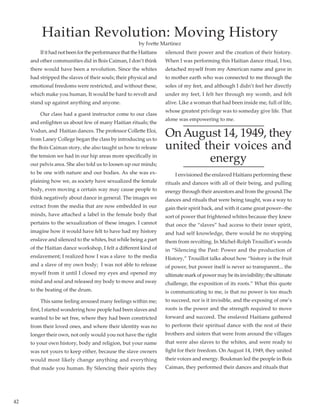
framework whereby femininity, (and therefore women)
can be understood as strong, powerful, and/or aggressive
without being (hyper) masculinized. As a result, Juana
Gallo becomes unnatural and unwomanly; she must
cast away her femininity and her womanhood in order
to become a soldadera and so, in this sense, she is not
truly a woman, rather she is the myth of a (masculine)
woman who is endowed with “the superhuman qualities
of the male” (Herrera-Sobek) and exists only in popular
mythologies or in this case certain corridos.
Feminist Façades in the Mexican Corrido
by Khaled Bekhit
37
	 ThethirdtypeofcorridothatHerrera-Sobekanalyzes
is that which romanticizes the soldadera, presenting her
as an object of male affection, in order to “neutralize the
woman by making her a love object and thus presenting
her in a less threatening manner” (Herrera-Sobek 104).
Unlike the other songs, these corridos “gloss over the
guerilleras’ actual involvement in the war and focus on
the male soldiers’ romantic liaisons with them” (Herrera-
Sobek 109). The soldadera is not taken seriously as a
soldier. Instead, she is objectified and offered up to the
male gaze; she does not participate directly in the war,
rather, she faithfully awaits the return of her (male) lover.
Thus, her role is limited to her capacity as the woman
behind the Man and so, this type of soldadera cannot
be conceived of independently of her (male) lover.  
	 The process of historical production exacerbates
the erasure of women from the annals of the Mexican
Revolution. Even though there was a consistent and
established “tradition of the valiant fighting women”
playing major roles in “Latin American revolutionary
upheavals” (Herrera-Sobek 86) not much of that was
documented, as a result of the relegation of women
working within the context of a patriarchal society.
During the Mexican Revolution, men’s feats were tran-
scribed along with their full names. On the other hand,
women’s feats are often difficult to document “owing to
the omission of their full names from the annals of war
and historical archives” (Herrera-Sobek 87). Trouillot’s
ideas with regards to the process through which history
is produced, might help us understand why this occurs.
The most important thing to keep in mind is that history
is never neutral -its production is influenced by differ-
ent power relations. Thus, in the case of women in the
Mexican revolution, the work that they do is deemed
less important because they are women in a patriarchal
society and so that work is not well-documented. It
may seem as though women had no part to play in the
Mexican Revolution as a result of their assumedly fragile
femininity when in fact it is precisely because they are
women that patriarchy drives us to these conclusions.
The soldadera’s that were “praised” in the corridos,
sometimes ended up “living in old age and forgotten”
(Herrera-Sobek), underlining the subversive nature of
an art form that reinscribes the patriarchal context that
it occurs in.
"Individuals start to see themselves
reflected in their work and to under-
stand their full stature as human beings
through the object created, through the
work accomplished.”
-Ché Guevara
38
	 In the years 1905 to 1917, Russia was shaken by war
and bloodshed. The idea for revolutionary social change
was at the forefront of the Russian psyche. One way
this manifested itself was through the power of theatre.
Politically engaged theatre of the Russian revolution
presents a spatial and temporal paradox as practitioners
in the late 19th and 20th centuries sought to overturn
theatrepracticesthatnolongerseemedappropriateforthe
modern world. In a complicated theatrical and historical
landscape, I would argue that an explicit act of political
propaganda, such as The Storming of the Winter Palace
(November 7th, 1920) is a very appropriate subject – the
space of history turning into a performance of history.
	 This mass spectacle was staged to promote and
enhance awareness of the revolutionary masses: includ-
ing ballet dancers, circus performers and witnessed
by an audience of around 100,00 people. Directed by
Nikolai Evreinov, a Russian director and dramatist, it
promotes an aesthetic to merge theatre and everyday
life, through rediscovering the theatre through play.
Moreover, and like his contemporary Meyerhold, the
aesthetics of Russian Symbolism ring clear; according
to Anatoly Lunacharsky, who was People’s Commissar
for Enlightenment: “In order to acquire a sense of self
the masses must outwardly manifest themselves, and
this is possible only when they become a spectacle
themselves.”[1] It united workers, soldiers, students and
artists and presented an interesting parallel of acting
and ‘reality’, as many had been actual participants of the
event in 1917. This aestheticisation, in which the people
play themselves, demonstrates theatre’s possibility of
establishing a new human relation. It is not a seamless
translation of life into art, nor an aestheticisation of
politics, yet it attempts to bridge the gap between the
past and the future – the future that was not available
then could be available now, at least as an idea, if only
in the theatre.
	 The event’s intimate engagement with history then,
could be seen as an exercise in theatrical estrangement.
For Evreinov, theatricality is inherent in humans as is the
will to play and his vision of theatre is full of sensuous
artifice – puppet like gestures, sharp angles, distance,
light.An emphasis is placed on visuals to submerge text
in favour of external forces. The external reality of the
theatre space,  that the actor is required to engage with
is also required of the spectator, thus, caught up in an
act of witnessing and estrangement; theatrical moments
highlight an awareness of the past. Evreinov’s use of
‘real’ people encompasses the passion of the Russian
Revolution, to expose those who are against collecti-
visation and “shake up old patterns of production”[2].
What is at stake for both politics and theatre are the very
activities of showing and saying through which some
are made visible who would otherwise have no political
agency being seen, and others get to speak who would
not in ‘normal’ circumstances count as speaking beings.
The art ... that
emerged from the
Russian Revolution
realised political poten-
tial like never before.
	 The Storming of The Winter Palace was depicted
too in popular culture, in Sergei Eisentsetin’s ‘October.’
Aesthetic qualities that are not dissimilar to Everinov
and Meyerhold are translated onto the screen, full of
radical jump cuts and visual metaphor – the spatial and
temporal paradox is presented in the image of the fall-
ing statue of the Czar – historical transformation all at
once becomes a ruin and construction site of the tenure
between past and future. Whether explicitly theatrical or
not, these depictions provide a context for a certain kind
of estrangement - human beings are fated to encounter
the strangeness of the human condition. The Russian
Revolution highlights the many possibilities of political
The Russian Revolution: A Theatre of Estrangement
by Mimi Gilles
39
theatre: its urgency to give hearing to voices of dissent
was also manifested inAgit-Prop brigades. With a focus
on dialogue to inspire action rather than visual, their
work is in direct contrast to the aesthetics of practitioners
like Everinov and Meyerhold - described as aggressive
and violent, they would publicly shame those in opposi-
tion to the revolution. An air of theatricality however,
is still present in Agit-Prop. It has the same immediacy
and potential to make the familiar strange as theatrical
illusion was broken down. Theatres conventions and
processes became its own topic  - the use of local mate-
rial and adaptability of space as troupes travelled the
countryside to unite the collective, contributing to the
determination of a common goal. Theatre allows us to
appreciate and address concepts of freedom, politics and
justice differently because the issues come in many forms.
	 This leads to another possibility of political theatre
– the opportunity to extend the range of popular culture.
Returning to discuss the role of the actor/spectator as a
witness, the 1981 film ‘Reds’ produced by Paramount
pictures demonstrates how varied versions of Russian
history co-exist and clash. Focusing on the participation
of John Reed in the Revolution of 1917, the film also
includes footage where 32 people bare testimony to
the film's text. It complicates the relationship between
art and history without attempting to define it perhaps
ultimately, because a Hollywood love-story, but more
than this, it elevates the status of the ‘documentary’ and
at the same time the strangeness of the human condi-
tion as a deeper identity of those playing themselves,
performing their own actual engagement in history.
	 Inconclusion,thethemeofthemassesenteringhistory
and history entering the masses was manifest in theatrical
works during the revolution and afterwards, as shown
in ‘The Storming of The Winter Palace’ and ‘Reds’.  This
demonstrates theatre’s untimeliness whilst at the same
time being a factor in estrangement  and distancing of
attachment. The art and theatre that emerged from the
Russian Revolution realised political potential like never
before. Theatrical work during time of revolution leads
us to question the nature of our engagement with the-
atre’s more untimely and uncomfortable appearances.
"When dictatorship is a fact, revolution
becomes a right."
-Victor Hugo
40
11:48:48 AM Adam Mike /unintelligible uncertainty broken
to address physical: resident address okay?
balcony outside collapsed—decided laboratory uncomfortable
duty blues pinned, private algorithm advise
survive pseudorandom assumptions. advise tase discolorations
erase black purple (yellow sick color)
crazy complex hysterical, ballistics theorem racked
optimization overpowered th- “Westbound Christian compliance”
prisons advise non-resistance; popular anti-inflammatory Naproxen
overpowered the riot—th- perturbed priori
traveling gesture struck / Frank Bruce 10-4
Black/Blue Monte Carlo,
40 random seconds. Christian crepitus variable
St. Anthony cleared omfg! Purportedly charges seen
so alright Fermi, embellish initial re-autopsy
uh shoot hurry . . . result 100% accuracy
contort stuff truly? circle firearm holes
gangway assumptions nice—simulate th- morphed
consistent incisions red, detained personality affects
clipping slider chamber: boom ss- solved
Monte Carlo potentials slant; exiting louder duck
a random drawing, approximate sss- car
children, 40, piggyback, tussling, primary gray
brown Yours truly-
Monaco Narrative--Revised
by James Lewis
41
42
	 IfithadnotbeenfortheperformancethattheHaitians
and other communities did in Bois Caiman, I don’t think
there would have been a revolution. Since the whites
had stripped the slaves of their souls; their physical and
emotional freedoms were restricted, and without these,
which make you human, It would be hard to revolt and
stand up against anything and anyone.
	 Our class had a guest instructor come to our class
and enlighten us about few of many Haitian rituals; the
Vodun, and Haitian dances. The professor Collette Eloi,
from Laney College began the class by introducing us to
the Bois Caiman story, she also taught us how to release
the tension we had in our hip areas more specifically in
our pelvis area. She also told us to loosen up our minds;
to be one with nature and our bodies. As she was ex-
plaining how we, as society have sexualized the female
body, even moving a certain way may cause people to
think negatively about dance in general. The images we
extract from the media that are now embedded in our
minds, have attached a label in the female body that
pertains to the sexualization of these images. I cannot
imagine how it would have felt to have had my history
enslave and silenced to the whites, but while being a part
of the Haitian dance workshop, I felt a different kind of
enslavement; I realized how I was a slave  to the media
and a slave of my own body; I was not able to release
myself from it until I closed my eyes and opened my
mind and soul and released my body to move and sway
to the beating of the drum.
	 This same feeling aroused many feelings within me;
first, I started wondering how people had been slaves and
wanted to be set free, where they had been constricted
from their loved ones, and where their identity was no
longer their own, not only would you not have the right
to your own history, body and religion, but your name
was not yours to keep either, because the slave owners
would most likely change anything and everything
that made you human. By Silencing their spirits they
silenced their power and the creation of their history.
When I was performing this Haitian dance ritual, I too,
detached myself from my American name and gave in
to mother earth who was connected to me through the
soles of my feet, and although I didn’t feel her directly
under my feet, I felt her through my womb, and felt
alive. Like a woman that had been inside me, full of life,
whose greatest privilege was to someday give life. That
alone was empowering to me.
OnAugust 14, 1949, they
united their voices and
energy
	 I envisioned the enslaved Haitians performing these
rituals and dances with all of their being, and pulling
energy through their ancestors and from the ground.The
dances and rituals that were being taught, was a way to
gain their spirit back, and with it came great power--the
sort of power that frightened whites because they knew
that once the “slaves” had access to their inner spirit,
and had self knowledge, there would be no stopping
them from revolting. In Michel-Rolph Trouillot’s words
in “Silencing the Past: Power and the production of
History,” Trouillot talks about how “history is the fruit
of power, but power itself is never so transparent... the
ultimatemarkofpowermaybeitsinvisibility;theultimate
challenge, the exposition of its roots.” What this quote
is communicating to me, is that no power is too much
to succeed, nor is it invisible, and the exposing of one’s
roots is the power and the strength required to move
forward and succeed. The enslaved Haitians gathered
to perform their spiritual dance with the rest of their
brothers and sisters that were from around the villages
that were also slaves to the whites, and were ready to
fight for their freedom. On August 14, 1949, they united
their voices and energy. Boukman led the people in Bois
Caiman, they performed their dances and rituals that
Haitian Revolution: Moving History
by Ivette Martinez
43
were sacred to them, which helped them gather the
strength they needed for their revolution.
	 The Haitian ritual dances, throughout the years have
shifted tremendously, and they have done so because
people outside of this tradition that are not open minded,
might see this traditional dance, through another lense,
and claim that the Haitians won the revolution because
of the pact the people made with the devil in order to
be set free. For some, this might sound silly to the ear,
or in fact, might be hard to comprehend even, but for
others that are fanatics of religion, that do not see how
this sort of idea has affected the people of Haiti because
it demonizes their culture and religion to the last bit of
their existence.
	 If we see the Haitian dance rituals in a different
context, perhaps in a more theatrical performative con-
text, that could possibly be utilized in a performance on
a stage, in a play or in a dance piece, all spaces where
the dance would be performed will essentially create
a different feel to the performance. The theatre space
would most likely have dialogue and could possibly
give a little bit of history to the audience members, which
could be very educational to those who are not familiar
with the history. On the other hand, if it were performed
in a dance piece, the audience might feel connected
with the music and the feel of the beating of the drums
through the ritual pieces, in some ways that would be
like reviving history through music, but perhaps would
be taken as just any dance piece. With that being said, we
can see that performance can definitely shape what we
know of the Haitian Revolution. In all the performance
whether on stage or in the woods in private with fewer
people; the audience members as individuals can take
with them a little bit of the past that has been silenced
and repressed through history and at the same time
stored in the movements of the ritual and dance, and
every time the drum beats a little bit of history is being
released.
“If you’re not careful, the newspapers
will have you hating the people who
are being oppressed, and loving the
people who are doing the oppressing.”
—Malcolm X
44
	 In the Mexican Revolution, thousands of women
participated in the guerilla forces of Emiliano Zapata
and Pancho Villa as frontline soldiers, with many earn-
ing notable reputations as field commanders. These
“soldaderas” have been commemorated in Mexican
popular culture (especially in corridos – folk ballads on
the Revolution) for the roles that they played, but the
form which this commemoration has taken includes
many deviations from historical fact. While a number of
corridos elaborate on the leadership roles of soldadera
heroines, other corridos convey images of the soldadera
as a romanticized or mythic figure. What does this
portrayal illustrate about the historical production of
gender roles in the Mexican Revolution? It illustrates
how this historical production was influenced by gender
biases and the consolidation of power by male leaders,
essentially formulating a narrative which legitimized
male leadership of Mexico and the return of women to
traditional roles in the post-revolutionary period.
	 In her book The Mexican Corrido:A FeministAnalysis,
María Herrera-Sobek explores the portrayal of the sol-
dadera in the corridos and the ways in which they ar-
ticulate gendered constructions. She points out that these
representations, in conjunction with historical scholarship
on the Mexican Revolution, have been characterized
by three categories: the depiction of the soldadera “in
her true historical dimension” as a significant soldier
or leader, the romanticized soldadera, and the “mythic
archetypal figure.”[1] While the first category com-
memorates the historical roles that soldaderas played
in the Revolution, Herrera-Sobek points out that it is
nonetheless characterized by gender constructions. For
example, while male figures in the corridos are typically
referred to by both names, the soldaderas are featured
primarilyasanonymousentities,referredtoeitherbytheir
first names or as “Juanas,” “galletas,” or “mujeres.”[2]
Although some corridos refer to soldadera leaders by
both names, this discrepancy is illustrative of women’s
reduction to secondary roles in the Revolution since it
places them in a background category while placing
male leaders at the forefront, conveying an impression
that soldadera leaders were a notable exception rather
than a rule.
a representation that
nonetheless served to
reinforce the legitimacy
ofpatriarchaldominance
in Mexico...  
	 Another significant aspect of the historical category
of corridos is that while some celebrate the heroic feats of
specific soldadera leaders, these corridos have a tendency
to articulate traditional perceptions of gender roles in
terms of the soldaderas’ behavior and their identities.
This is reflected in the ballad “DeAgripina” which com-
memorates the actions of Doña Agripina, a soldadera
who led anAgrarista army to victory during the Cristero
Rebellion. The lyrics initially laud the courageous leader-
ship of Doña Agripina and how a golden-winged dove
helped to provide weapons for her forces during the
battle, a juxtaposition which, the author notes, parallels
the patriarchal conception of women’s involvement in
war.[3] However, the corrido’s transition to portraying
Doña Agripina as a “damsel in distress” (through her
expression of fear and doubt regarding the arrival of
reinforcements) marks a poignant contrast between the
portrayals of soldaderas and male heroes: courage and
agency are esteemed characteristics which are lauded in
both categories, but the display of fear is not normally
allowed in lyrics about male leaders since it is considered
taboo.[4]Assigning this trait to female protagonists or
referring to them as wives of male revolutionaries (re-
flected in “La Toma de Papantla”) therefore contributes
to the reduction of soldaderas while strengthening the
image of male revolutionary leaders as heroic figures. 	
	 The second category of soldadera corridos, which
The Soldadera Image
by Nils Skudra
45
emphasizes the role of the soldadera as a romanticized
figure, had its roots in the patriarchal attitudes of Mexican
society which “could not readily accept the fighting
woman as reality was presenting her.”[5] However,
since corrido songwriters could not ignore the historical
reality of soldaderas, they were faced with the alterna-
tives of romanticizing or mythologizing the soldadera.
In opting to cast women soldiers as romanticized love
objects, the corridistas essentially served the purpose
of neutralizing soldaderas “and thus presenting [them]
in a less threatening manner.”[6] This romanticized im-
age is exemplified by the corrido “La Adelita” which
proclaims a male soldier’s love for his sweetheart and
implores her not to forget him as the soldier marches
off to the battlefield.[7] This corrido illustrates the neu-
tralization of soldaderas since it emphasizes the man’s
role as a soldier and the woman’s role as his lover who
remains behind to wait for him.[8] In a broader context,
the romanticization of the soldadera fits into the con-
nection between historical truth-making and political
legitimacy since it served the interest of strengthening the
position of male leaders, but it also served this purpose
by conceding to the people’s imagination of the female
protagonist as a soldadera without directly indicating
that identity, thus denying her “the proper honor and
respect she deserves.”[9]	
	 The final category of soldadera corridos emphasized
the soldadera’s identity as a mythic archetypal icon.
In her elaboration on the formulation of this image,
Herrera-Sobek notes that the mythic soldadera corrido
based its narrative “on the deification and glorification
of the soldadera as legend” rather than actual historic
events in which soldaderas had participated.[10] Citing
the corrido “Juana Gallo,” she points out that the pro-
tagonist’s name had its origin in association with the
male soldier, with the implication that she joined the
Revolution out of love for her male companion rather
thancommitmenttotheRevolution’sideals.[11]Although
the mythic genre provides the soldadera with a sense of
empowerment through its attribution of superhuman
qualities and leadership roles, this category of corridos
nonetheless plays a role in diminishing the historic
agency of soldaderas since it assigns the role of lover or
daughter (in the case of the corrido “La Chamuscada”)
to the female protagonist whose motivation for fighting
is attributed to love for her mate or father instead of
ideological commitment. Through this technique, the
mythic genre also contributes to reinforcing the legiti-
macy of Mexico’s male leadership while appealing to
audiences’ imagination of the soldadera.
	 In summation, the construction of the soldadera
image in Mexican scholarship and popular culture
profoundly demonstrates the role that gendered con-
structions played in crafting the historical narrative of
the Mexican Revolution. The various portrayals of the
soldadera as a historical participant, a romanticized object
and a mythologized figure reflected the gender biases
of the songwriters who wished to present the soldadera
in a way that appealed to audiences’ comfort level and
imagination.Consequently,whilethesecorridosprojected
the image of a heroic and empowered woman, it was a
representation that nonetheless served to reinforce the
legitimacy of patriarchal dominance in Mexico during
the post-revolutionary period. Indeed, this could be said
to coincide with the purpose of legitimizing the power of
Mexican elites as the heads of government. Since Mexico’s
government during the postwar years closely resembled
a Porfiriato dictatorship in which corruption flourished,
invoking images of heroic male revolutionaries while
casting soldaderas in a significant but secondary role
would have suited the elite’s purposes of maintaining
power while claiming to represent the Revolution.[12]
While Mexican government continued to be exercised in
the hands of male leaders during the 1930s, the reforms
passed by Lazaro Cardenas would have been seen as
truly honoring the Mexican Revolution’s legacy and the
goals of social change which the soldaderas fought to
achieve.[13]
46
	 Russian workers were exasperated from the continu-
ous oppression under the rule of the Czar. For decades,
exploitation was the reality of many people’s lives, and
hopes for a better future were rarely shared. However,
as what happens at the start of most revolutions, the
actions of a few inspired many to break the bonds of
apathy and demand change. The Bolshevik Revolution
served as a stage for Russians to express their dissatisfac-
tion with their ruler, and to transition to the new ways
of the world, culturally and industrially. As evidenced
through Meyerhold’s biomechanical performance and
the production of the movie Reds, Russian society un-
derwent immense political, social, and cultural changes
from the aristocratic rule of the Czar to the supposedly
equitable organizational system in the Soviet Union.
every person who joined
the revolution was an-
other spark igniting the
amassing flames of this
fierce movement
	 As news of the impending revolution spread, mem-
bers of the Russian working class began rallying together,
meeting in larger and larger spaces for assemblies and
forums. These meetings intended to provide a space for
the sharing of ideas, ways in which to move the revolu-
tion forward, and to promote a shared identity for these
working class Russians, the Bolsheviks. Having been at
the bottom tier of Russia’s very strict class system for so
long, these workers were ready for change, they were
ready to have their wants and needs represented on a
large scale. Every meeting, every speech, every person
who joined the revolution was another spark igniting the
amassing flames of this fierce movement driven almost
exclusively by working class folks.
	 Similarly to the French and Haitian revolutions,
modes of performance played fundamental roles in
creating a thriving political crusade to overthrow the
Czar and instate leaders with the common people’s needs
as their number one priority. Each rally that was held
included theatrical aspects, be it during emphatic call and
response speeches or through the artwork advertising
the rallies or the revolution’s initiatives. With the heart
of the revolution beating ceaselessly with the growing
masses of Bolsheviks in favor of equal representation,
it made sense that the theatre of the time reflected this
transition from individual benefits to group benefits.
	 Vsevolod Meyerhold pioneered a system of act-
ing, a new art form called “biomechanics,” which con-
nected machine and man, thereby combining work and
politics and the individual. With the falling of the Czar
came a new era of industrialization. Russia was finally
catching up with other nations and growing as a hub
for industry, which subsequently required an increase
in workers. This biomechanical approach to theatre
favored simple set design and staging in order to draw
the focus to the extremely sharp, technical movements
made by the actors. Biomechanics sought to transcend
the psychological aspect of theatre and instead encour-
age physiological movement to convey thoughts and
emotion. Meyerhold’s creation of “a skilled worker in
action,” enabled the working class to see themselves on
stage, and create narratives for themselves and for the
revolution (Meyerhold). These performances exposed
people to this new type of common language he aimed to
create, a language understood by common people. This
theatre was revolutionary in itself, as it conflicted with
most of the previous conceptions of theatrical arts, but
it also served as a mechanism for revolutionary actions
outside the theatre. 	
	 Looking specifically at the aesthetics of this biome-
chanical style of performing, we can see how Meyerhold
aimed to emulate industry work. In the short film we
watched in class, Charlie Chaplin is stationed at one part
of a conveyor belt and quickly becomes overwhelmed
Revolutionary Russia: Power in Participation
by Ariana Shakibnia
47
by the speed of the machine; soon he is unable to
complete his tasks quickly enough and the conveyor
belt must stop (“Factory Work”). This scene is one ex-
ample of what industrialization could do to society, as
it illustrates man becoming overtaken by the machine.
Contrastingly, Meyerhold’s biomechanics essentially
make man and the machine one entity, encouraging
attention to detail and sharp movements. Beyond the
individual actor’s role in performing this biomechanical
story, Meyerhold sought to emulate factory life / indus-
trial aesthetics via other theatrical features as well. Often,
Meyerhold’s performances had dramatic lighting and
set pieces arranged so as to cast dark shadows across the
stage. Additionally, intense music was played so as to
create “organized chaos” – something commonplace in
factories (Meyerhold). These additions to the theatrical
experiences promoted the new aesthetic in Russia dur-
ing the revolution and continuing post revolution – an
aesthetic aiming to appeal to the working class and to
deviate from the tiered, hierarchical system previously
plaguing Russian society.
	 The directors of the movie Reds similarly portrayed
people involved in the Russian revolution as working
class folks desiring a government accurately representing
them. In the film, when the American John Reed visited
Moscow and attended a revolutionary forum, he was
encouraged to stand up in front of the massive crowd
and make a speech. He was hesitant, and stated that he
had no credentials and thus should not be allowed to
be heard. A Russian replied stating, “you do not need
credentials, everyone may speak” (Reds). This was a
particularly moving scene, as earlier in the movie Reed
had been denied permission to speak at a meeting of
the American Socialist Party as he was told he had no
adequate credentials. Depicting the contrast between
forums illustrated the new Russian revolutionary ide-
als, that everyone should have a seat at the table. The
American Socialist Party’s denying Reed permission to
speak indicated a hierarchy remaining despite that be-
ing somewhat against their own ideals. Here, Russia’s
new aesthetic is clear – speak with a common language,
the language of revolution; appeal to the senses of the
common man so as to ensure everyone has equal access
to information and decision-making.
	 Although we see how the events in the Soviet Union
transpired, this revolution remains integral to studying
the affects industrialization had on theatre and politics
in Russia, as well as its role in the subsequent World
Wars. Theatre and performance can serve as incredible
vehicles for change, inspiring individuals to stand up
and join the revolutionary crowds. Each participant
becomes a cog in the revolutionary machine, playing a
part in inciting change.
"The young always inherit the
revolution "
-Huey P. Newton
48
49
	 To start a revolution, organization and passion must
be present.  In other words, there must be a method
to the madness that is revolution.  There needs to be a
fire going in the hearts of the people, and a means of
fueling that fire.  In the Russian Revolution, the fire in
the red hearts of the industrial workers came from the
corrupt social class system and the fuel for the fire came
from the theater.  Theater, both written and performed,
demonstrated to the Russian public the overwhelming
need for an end to classism.  The “Red” Bolsheviks used
propaganda posters, articles, speeches, and agitprop
theater to gain a following in the revolution against the
“Whites” who remained loyal to the Czar and the old
hierarchical system.  
Trotsky’s Communist
Policy Towards Art
describes how art
cannot be controlled
by one party...
	 The working class was too busy being overworked
by the Whites to have time to create art or theater for
the revolution.  Instead, revolutionary leaders, people
ranked above the working class but who saw the cor-
ruption within the hierarchal system and sided with the
lower class, were the artists. They created propaganda
posters that often idolized a single person with their
hand raised up showing a leader for everyone to get
behind.  Sometimes this leader was a worker, sometimes
it was Lenin, serving as a martyr to the revolution, or
sometimes an unknown character.  The purpose was
to have the image of someone who they were support-
ing.  The color red was very prominent in these posters,
symbolizing the bloodshed of the working class as they
fight for freedom and an end to classism.  The aesthetics
were also very geometric and sometimes industrial.  As
seen in Russian Avant-Garde Stage Design, examples of
paintings, posters, even costume design and sets. The
bright reds and sharp lines were a new form of Russian
art that developed largely because of Meyerhold and his
new form of theater called biomechanics.  The theater was
discreetly political yet humorous.  The costumes looked
“nothing so much as convict’s uniforms.”  And the sets
were composed of “an assortment of white-painted acting
instruments . . . each one conceal[ing] a trap” (186).  The
actors were acting as workers who were imprisoned and
controlled by the white people -- a direct analogy to the
white instruments of trickery.  This demoralized the
workers and made them into a spectacle for the world
to see, emphasizing the strict classism in place.  This
geometric interpretation of theater was carried into the
art and propaganda posters as a means of reminding the
workers of their virtual imprisonment under the Whites
and prompting them to fight for their liberty and equal-
ity.  Trotsky’s Communist Policy Towards Art describes
how art cannot be controlled by one party, but rather
is a collection of all views of the time.  Foreign artists
outside of the revolution contributed greatly to this
new style of art and often agreed with more left-sided
Marxist views.  The Reds produced more art in the form
of propaganda because they had to encourage the workers
to get involved, whereas the rich bourgeois inherited a
following because they wanted to keep their high profits
from underpaid and overworked minority workers, and
they did not fear the repercussions of fighting since they
had the Old Regime governors on their side.  
	 Another innovative forum for theater to be reflected
was in public speeches and agitprop theater.  Amateurs
spoke their opinions with young energetic voices, getting
the audience involved in the denunciation of authori-
ties, rallying for the cause.  Sometimes these speakers
became leaders like Goldman and Trotsky.  This form
of theater was called agitprop, and was a stark contrast
to the pre-revolutionary TRAM staged theater which
did not enable them to promote current issues.
The Importance of the Spoken and Written
Word Through Theater in Revolution
by Andrea Meagher
50
Although Lenin was not as animated as Goldman and
Trotsky, his speeches and leadership were vital to the
revolution.  Lenin delivered a speech in Moscow on
November 3rd 1920 explaining how “the transition from
bourgeois society to the policy of the proletariat is a very
difficult one, all the more so for the bourgeoisie inces-
santly slandering [Russia] through its entire apparatus
of propaganda and agitation” (352).  These types of
speeches even inspired some writers like Jack Reed to
become revolutionary speakers.  It is important to note
that any magazines and newspapers were censored by
the Whites and a large portion of the population was
illiterate, so speaking through agitprop theater was a
much more effective way to spread revolutionary ideas.
Furthermore, newspapers were read aloud to the com-
munity in a theatrical manner to convey information such
as legal and judicial decisions to the public.  A sign that
helped many of the Russians recognize the true corrup-
tion of the Czar was the Sacco and Vanzetti trial.  This
case demonstrated the injustice in the court system,
proving the national issues with security and individual
freedoms.  These kind of irrational cases showed how
much the people of the IWW were risking by revolting
against the government, further emphasizing the need for
propaganda and theatrical methods to get more people
to join together in the union. It is amazing how dedicated
the Reds were to their cause.  As demonstrated in the
Film Reds, Jack Reed chose to “lead the Revolutionary
train” and risk his relationship with his wife at home
and his own safety.  It was the theater, speeches, writ-
ings, and propaganda that held the revolution together
and encouraged the people to keep fighting for a fair
chance at success.  
	 The revolution in Russia promoted other countries,
particularly its allies like America, to pick up on the
trends. The Russian Czar was chosen for the people,
but Americans were able to vote on their president, and
they were still forced unwillingly to go to war.  Emma
GoldmanemphasizedthisantithesisinherSpeechAgainst
Conscription and War on June 14, 1917 declaring, “one
of [President Wilson’s] political advertisements bill post-
ers [was] posted all over the city with the picture of a
working woman and her children saying, "He has kept
us out of war."(2).  These catchphrases were mocking the
governmental system in America, specifically Wilson’s
betrayal to his word.  These types of posters were adopted
by the American workers who saw the progression of
the Russian Revolution and started using similar pro-
paganda tactics to gain power in their own country to
promote the anti-war viewpoint. The Russians revolted
strongly against the Czar and the social system whereas
the Americans revolted, but did not need to overthrow
the government because they already had more power
in the system.  Even today, locally in Berkeley, we can
see this demonstrated as students show greater resent-
ment towards the appointed regents of the university
than towards the elected Governor Brown. Songs were
also adopted from America to spread revolutionary
thought.  For example Yankee Doodle was first created
in America in the 1700s, but was sung in Russia during
the revolution (as seen in Reds), showing America’s
influence on the Russian Revolution.
	 A common misconception is that all the Russians
fighting against the Czar were the Reds.  In actuality, the
left side ranged from extremists to the middle-grounded,
more of a pink range.  The communists, anarchists, and
socialists were all radicals and considered Reds because
they were representing the lower working-class.  The
pink ideals promote a society with a central government
that is not repressive, allows freedom without classism
or segregation, and has people in power whom reflect
the desires of the people.  America was on its way to
this pink society and Russia wanted to follow, but many
people adopted Marxist ideals, which were too red to be
possible in society because of the natural human desire
for power and wealth. The impact theater has on his-
tory by initiating revolutions is not well recognized in
modern society, but it is hugely expansive and integral
in achieving a successful revolution.
51
52
Dear Susan Maslan:
	 I am writing to inform you that I just read an article
written by Marie Huet that seems to disagree with your
point that, during the French Revolution, “revolution-
ary theater and revolutionary politics did not transform
themselves into one another” (Maslan, 1). The discrep-
ancy between your and Huet's argument leads us to an
important discovery: if one is going to state that theater is
a vehicle for freedom and open communication—as you
and Huet both seem to do in different ways—one also
needs to be aware of what is influencing that freedom
and communication.  That influence is ultimately going
to define the type of freedom achieved.. Is that freedom
fueled by a desire to be heard and express opinions? Is
it a literal overturning of an oppressive structure?  Is it
a combination of both?
	 Specifically, Huet bluntly disagrees with your
point that “revolutionary politics [cannot] be read as a
theatrical text or performance” (Huet, 1). I understand
your argument that revolutionary theater and politics
need to be separate because having theatricality in-
volved in politics encourages politicians to lie to and
manipulate their constituents (4). This deception, as you
argue, would indeed be counterproductive to the goal
of transparency and open communication that revolu-
tionaries fought for (7). I can also see why you state that
combining revolutionary theater and politics takes away
a distinct theatrical space that revolutionaries and the
public use to define, discuss, and express their political
ideas in a manner that may not have been acceptable in
the political sphere. In other words, taking away that
space undermines the idea that the public engaging
with the theater helps create the “reflexive, reciprocal
process” that defines a new culture being formed (2).
Huet disagrees with both of these points. She begins her
article by describing how the trial and condemnation
of Louis XVI was, in itself, “a theatrical manifestation”
(15). Another one of the ideas that Huet situates is the
idea that being an actor and a spectator at a trial such
as this is essentially the same--meaning that roles are
fluid--which allows anyone to have a voice (34). Huet
fuses both of these ideas by stating that the trial and its
outcome create a theatrical text, in which multiple voices
are present and heard, that eventually gets turned into a
law (7). By taking part in Louis XVI's trial, participants
are not only communicating, but also gaining a freedom
because they are defining their society through law.
democracy, in turn,
helps citizens become
revolutionaries...
	 While you state that blurring the line between revo-
lutionary theater and politics decreases transparency in
the political system (Maslan, 2), Huet argues that making
them one of the same actually encourages transparency
because having actors and spectators present “protects
the accused” from enduring unfair proceedings (Huet,
7). Ultimately, Huet values the idea of freedom through
communication; however, unlike you, she believes that
that freedom is manifested through the existence of and
participation in politics. I am not sure if you are familiar
with it, but she has even created the term “network of
communication” to describe the ways in which “the
social nature of the theater” and its text--especially
when combined with major societal influences such as
theater--can have an end result larger than solely com-
munication within the theater (22). What fuels one's
desire for freedom and defines what freedom is, speaks
exactly to how society should be structured. You believe
that people should be involved in politics in a very
reactionary way. Your belief leads me to believe that a
citizen's unmediated reactions to political culture and
events help shape a democratic culture that is truly in
the name of the people. Additionally, in order to play a
significant role in politics, citizens need something to react
to, whether that be the degree to which representation
Letter To The Author
by Danielle Fellguth
53
is needed, a piece of political theater, or the National
Assembly. This structures society in such a way that
people can manipulate society through their commu-
nication and participation in a system in which political
events, though influenced by opinions, are separate
from the public. Huet thinks that, instead of reacting to
politics in order to mold and influence society, citizens
create their society through their own active communi-
cation and participation in a theater piece that creates a
political event. This forms a society in which the political
culture and structure do not necessarily already exist
but is created by the people. Looking at the intersection
of revolutionary theater and politics through a lens of
your arguments versus Huet's then determines what
type of freedom one enjoys. With your viewpoint, it is
the freedom to express one's opinions and have these
opinions be regarded as influential. However, in Huet's
view the freedom that is enjoyed is the freedom to not
only influence law but to create it.
	 Your and Huet's opinions differ greatly in some
respects, but I would like to point you to a statement
that Hannah Arendt makes. She believes that a pro-
ductive and content society can only be created if the
people actively work to generate an air of freedom that
inspires people to participate in politics and, in turn,
the revolution. The end result of this is that people can
live in a society that they approve of (Arendt, 43). It can
be argued that whether one believes that revolutionary
politics and theater are integrated or separate, both
beliefs ultimately encourage political participation.
Because citizens have the freedom and opportunity to
participate in politics, they are indeed generating an
air of freedom that inspires more political participa-
tion. Therefore, they are creating a society that they are
content with and can be productive in. I urge you not
to take too much issue with Marie Huet's arguments
because, while theater may play a varying role in each
of your arguments, her points, as well as yours, frame
theater as a vehicle for communication which leads to
political participation and democracy. That democracy,
in turn, helps citizens become revolutionaries that fight
for a society they can believe in. It is notable that you
both recognize the cultural impact that theater does
have on society and politics and neither of you agree
with the idea that the theater inherently influences the
status quo. Thank you for your time.
	Sincerely,
	 Danielle Fellguth
Image by LibertyManiacs
54
Part III
Aesthetic
55
Reinforcement
56
Aesthetic Reinforcement Introduction
In the last section we focused on ways that historical
narratives are created to effect change. We also looked
at how narratives can obscure some stories while they
highlight others. It is this double work of the story that
makes it crucial to pull back the layers of what makes a
story to examine a process of consolidation and reinforce-
ment. We noticed how these stories are preserved and
often times altered over generations.
The answer lies in the production and reproduction
of these stories.As stated by Michel-Rolph Trouillot in his
book, Silencing the Past: Power and the Production of History,
history is a performance of power and a reinforcement of
those who have the means to control it. This concept is
spreadacrossallofhistory:revolutions,wars,explorations,
accounts of daily life. Regarding revolutions, this idea of
stories being silenced and controlled by those in power
is prevalent in each of the cases this class studied this
semester. Haiti, France, Russia, Mexico, and Cuba. Each
movement and revolution well illustrates the tremendous
effects of aesthetics on firstly, the creation of the narrative,
but even more so, on the reproduction and passing on
of the narrative. The French revolution has been diluted
into musicals of “empty chairs” that portray only tiny
glimpses of the story. The Bois Caiman dance ceremony
of the Haitian revolution --an event that inspired courage
and communal uprising against the dehumanizing forces
of slavery—has yet to be fully recognized as a liberating
act since popular media and pentacostalism continue to
discredit the practice of vodun (see McAlister 2012). The
soldaderas of the Mexican revolution have been shrined
in paintings and corridos into mystical goddesses of the
war somewhere between the virgin and the vamp.
Ché Guevara in many ways remains a man of resilience
and sharp militancy, willing to shed blood, yet drifts into
beatnik tourism as his image sells on wallets and t-shirts.
The examples are endless, and the untold stories are in-
numerable.Art, music, shows, stories all have crucial roles
in revolution to create history, but more importantly, to
reproduce the history for the coming generations. It is
therefore absolutely essential to address the importance
of aesthetic reinforcement in order for us, as the next
generation, to ensure voices aren’t silenced and the re-
telling and reproduction of history is not forever in the
hands of those simply with the power and resources to
buy their way to posterity. Without art, revolution and
the retelling of history is just simply not possible.
byAnika J Kenion
“The Revolution introduced me to
art, and in turn, art introduced me to
the revolution!”
–Albert Einstein
57
	 Who has the power to change society? Whose ideas
are valued? Who in society are given more importance
than others? Each of these questions was aggressively
put to the test in the fall of 1917. Almost 100 years ago
in October of 1917, the Bolsheviks and the people that
didn’t matter in the eyes of society, got organized and
fought for their new place, in a new society. The fall
of 1917 was a harsh bitter chill of reality for the upper
wealthy class of Russia. The society of pre-revolutionary
Russia had certain credentials of the old society and new
“amateurs” were being put to the test of governing the
new country.
	 Simultaneously, the theatre of the new society was
changing and experimenting in new forms, mirroring
the change in ideas and values. Through the use of new
aesthetics, theatre groups like the TRAM theatre clubs
and later, shock workers were able to use the values of
the Socialist movement to explore new heights in artist
representation, aimed at educating the masses to be on
the side of the new state. It was the artistic and political
ideas of the amateurs, students and un-credentialed that
brought about the most change in Revolutionary Russia.
	 Prior to the Russian Revolution, the ideas of a
changing society were being explored. As seen in the
Cherry Orchard by Anton Chekhov in 1904, times were
changing and a new dawn was on the horizon. The shift
in society of the educated students, like the character
Pyotr Sergeyevich, were increasingly unsettled with the
way society was being handled. He embodies the values
of an early Bolshevik and young revolutionary in his
denouncements of institutions that are keeping people
back from freedom and even the institution of love.
	 He also mentions how the Intelligentsia was not
capable of change and weren’t doing anything but trying
to find ways to escape. With the First World War in full
swing and the rise of the technology industry, the gap
between the classes was increasing. The lines in society
started to be seen clearer on who or what was the cause
of the inequality happening in Russia.
	 Capitalism became the enemy that the Revolution
was fighting against. An economic institution that
through the writings of Karl Marx in Das Kapital and
other sociologists at the time of the mid 19th century,
was the back-bone of support and the fuel that oiled the
Revolutionary machine.
	 The film Reds (1983) is a great view into the spirit
of the age. The film does a great job of representing the
work of the leaders of certain parts of the revolution.
Ultimately, the film is a love story between Jake Reed
and Louise Bryant, and the film does a great job in ro-
manticizing the revolution. In the frame of the revolu-
tion the structure of the film and story are counter to
the aesthetics of the time because it is several decades
removed and done from an American point of view. The
ideas of of the revolution were captured in the speeches
given in the union organization meetings of the working
class. These ideas were juxtaposed with the hindsight
and comparison of the American society and Russian
Society at the time.
Whose lives matter and
whoselivesarebeingused
for those who matter?
	 The ideas of credentials are raised in the film as to
who has the right to speak up in the political arenas. In
America, Jack Reed is unable to engage in the political
process during the meetings of his own political party
because he does not have the credentials to speak. As
said in the film, “This floor is reserved to delegates!”
Compared with political meetings of the same political
party in Russia. These Russian meetings are similar to
the French Political Theaters where the audience was able
to participate. The meeting in this case was attended by
the people in the trenches of the revolution; the workers.
When he goes up on stage he is accompanied by a
October’s Revolutionary Stage
by Sam Peurach
58
translator and after his inspiring translated speech the
audience cheers and sing. This open floor, or stage policy
gave Jack the ability as an American in Russia to speak
freelytothosewhoneededtoheararevolutionaryspeech.
This shows that even though he is an American and has
the right of freedom of speech in his own country, it isn’t
until he is in Russia that he truly feels free.
	 “The ground has been cleared and on the ground the
younger communist generation must build a communist
society.”[Lenin 10/2/1920] The stage has been cleared,
the props have been struck and now it is time to build a
new set for the newest production on the world’s stage.
But like theater, the new society needs dedicated indi-
viduals to work together to create and put into motion
their creation. These individuals needed to devote their
life to the cause. In order to get these messages across to
the uneducated masses, to care for the greater collective
instead of the individual, the new government supported
Agit-prop groups to spread the ideas of Communism. In
a speech delivered by Lenin on November 3rd 1920 he
states, “We must re-educate the masses; they can be re-
educated only by agitation and propaganda.” This type
of re-education was being done on different platforms,
but the most influential and innovating forms were live
performances. Like our group project in class to recreate
a type of Agit-prop performance, the audience has an
opportunity to get involved unlike other art forms. The
importance of these theater performances was directly
influential to the other forms of propaganda.
	 Leon Trotsky was very critical of theater he believed
that it was doing no good to restage old plays that had
similar themes to what was going on his current world.
He believed that, “In general the place of art is in the
rear of the historic advance.” [Trotsky Revolutionary
and Socialist Art] What he was describing is that art,
in the understanding of the old society, cannot keep
up with the changing ideas of the present. As history is
happening in the years after the revolution, the theater
and the structure of theater doesn’t help the revolution.
The times called for new forms to reflect new ideas.
	 Though Trotsky wasn’t the biggest fan of the theatre
but he saw the usefulness of its platform and easy is was
for the audience to get the messages. In a description
he gives in chapter eight of his book Revolutionary and
Socialist Art, he describes how he doesn’t got to the
theater that often but when he does he was, “Impressed
with the fact of eagerly the audience caught every hint
at present-day life...” He desperately thought that there
needed to be new forms to keep up with current issues.
He explains,
	“A new class, a new life, new vices and new stupid-
ity, demand that they shall be released from silence,
and when this will happen we will have a new
dramatic art, for it is impossible to reproduce the
new stupidity without new methods.”
	 These new methods and forms are seen in the young
working-class putting on performances in the small clubs.
The TRAM Theater was a new type of theater created
by Working –Class Youth and was “bridge between
amateur and professional theaters...” (pg125 TRAM:
the Vanguard of Amateur Art) The group truly was a
Vanguard in every sense of the word.
	 “TRAM was one of the few theaters in the Soviet
Union that was not suffering a crisis of repertoire because
it made its own,” (pg 138) The success in the lower clubs
brought them much success in the new society. They
made the shift from the Amateur to the professional
but with the rise in success, they left themselves open
to ridicule. In this demanding climate of change once
they became “professional” the groups were not able to
operate the same because of frictions among the factions.
The politics on what was right started to break down
the group.
	 “...RAPP(RussianAssociation of Proletarian Writers)
charged that the TRAM movement, inspired by the
Leningard organization, was based on faulty and harmful
principles.” (140) Instead of the theatre able to function
how it was in its amateur status, it had to focus on fight-
ing against other groups trying to occupy the same
59
space. This lead to the end of the TRAM theatres in
Russia, but the artistic influence was adapted into other
forms like film and the live newspapers.
	 The credentials given to those in the old society were
useless to be apart of the development of a new society,
but the credentials of the new society started to form
quickly after, silencing the collective. The new society
was more than just a paradigm shift, but a practical
change in the distribution of goods and value of wealth.
This was only capable by getting full involvement by
the peasants and proletariats.
	 Who had the credentials?And who doesn’t? Whose
points are valid and whose aren’t? Whose lives matter
and whose lives are being used for those who matter?
With the power shifted by the masses and the ideas of
who is going to be in charge became more of an issue
than Communism. It became about whose ideas were
better for making society an equal playing stage and not
about the stage itself. The ideas on who was capable,
able and most of all qualified to bring change was be-
ing contested. What if the women of the revolution
were the ones in charge? As seen in the film Reds both
Emma Goldman and Louise Bryant played vital roles in
the revolution but who remembered from those days?
Emma Goldman called Patriotism “A Menace to Liberty”.
Emma Goldman had this to say about Patriotism;
	 “Indeed, conceit, arrogance, and egotism are the 	
	 essentials of Patriotism. Let me illustrate. Patriotism 	
	 assumes that our globe is divided into little specks, 	
	 each one surrounded by an iron gate.”
	 Like patriotism, the revolution became divided and
neither side was willing to listen to one another. The
pride and power of control was deeply seeded in the
lack of co-optation. Out of curiously, and ideas for the
future revolutions to come, what would the revolution
have been like if the paradigms had been changed, to
allow women more power in the revolution? Maybe the
new revolution will.
“At the risk of seeming ridiculous, let
me say that the true revolutionary is
guided by great feelings of love.”
-Ché Guevara
60
	 Protect the women and children! Save the women
and children! The women, grouped with the children
because women are just as helpless and fragile as chil-
dren, get on the lifeboats first, while the men stay on
the sinking ship and fight for their survival. When it
comes to revolutionary battle, it’s the same as the sink-
ing ship. But when the women take up arms and do
participate in the battle, give them credit where credit
is due, but not too much credit! Not enough credit to
where there might actually be equality amongst the men
and women! Instead, “neutralize the woman by mak-
ing her a love object and thus presenting her in a less
threatening manner or to transform the soldadera into a
mythic figure,” as Herrera-Sobek so appropriately states
(104). Women are depicted with extreme variations of
stereotypical “femininity,” making them of lesser value
and importance than men. Sexism is reinforced in the
making of the history of the Mexican Revolution through
the corridos of the time and Usigli’s The Impostor.
	 “Physical beauty is not the only thing that attracts
men to us, Julia.” Elena says this to Julia in response to
Julia’s previous comment that nobody loves her because
she isn’t pretty. This small exchange happens within the
first two pages of the play, the beginning, where the
characters are all first established. Usigli does not wait
until further into the play to introduce Julia’s internal
struggle to perhaps suggest she is more complex than
mere vanity. Instead, he throws it right out at the be-
ginning, making that the first impression of Julia. She
continues to berate her father for being a failure and it
isn’t until Cesar compliments her body in a most unchar-
acteristically non-paternal manner that Julia shows any
appreciation for Cesar. Julia is only able to show respect
to her father after he compliments her physical appear-
ance, displaying not only Julia’s vanity, but her need to
establish her self-worth from an outside source, most
particularly, men. The appreciation turns into affection
when Julia discovers, or thinks she discovers, that her
father is Cesar Rubio, the famous revolutionary. The
stage directions explicitly direct Julia to run and throw
her arms around her father, again displaying her as
superficial and frivolously two-dimensional.
In the heteronormative
society, loving a woman
is often portrayed as a
fatal flaw in men.
	 Elena, the only other female character in the play, is
also shown with a similar two-dimensionality as Julia.
After Bolton has been convinced that Cesar Rubio is the
Cesar Rubio, Elena gently steps in and privately questions
Cesar and his motives. Cesar doesn’t even respond and
instead exits the room, and Elena goes on to follow in
Cesar’s lie. Cesar doesn’t have to say a word to convince
Elena to go along with his lie! Elena decides to play
along with Cesar’s lie, convinced by him simply exiting
the stage. The portrayal of the voiceless, opinionless
woman is not a new concept and clearly not limited to
contemporaryAmerican society, as this play was written
in 1938 by a Mexican male playwright. Throughout the
scene where Guzman and his four companions try to
convince Cesar to run in the election, Elena expresses
her disagreement and wish that Cesar not participate in
several different lines; her opinions go completely un-
noticed. In one line, she even threatens to leave Cesar,
and this too, goes unnoticed and unacknowledged.
	 In the heteronormative society, loving a woman is
often portrayed as a fatal flaw in men. The love for a
woman is a vice, something to be wary of as it makes
men weak (and heaven forbid the ever-so-masculine
male becomes weak), making them susceptible to many
other vices. Beware! To love a woman is to die a slow
and painful death! Most likely, not. Demeaning and di-
minishing, this villainous take on the love for a woman
strips away a piece of her humanity, making her less
Feminism Versus Femininity
by Chelsea Hinkson
61
thanhuman,lessthanaman.Inthecorrido,“LaValentina”
is said to have been based off a “real-life guerrillera,”
although you’d never know it from the lyrics. “A passion
dominates me.” To dominate is to demand control, to
have unyielding power. There is a negative a connotation
under the word “dominate,” as there is a non-consensual
implication. There is a big difference in saying “domi-
nate” as opposed to, for example, a passion “moves”
me, or a passion “touches” me. “They say because of
your love, a bad turn will be done to me.” The lyrics
then go on to talk about alcohol and death. Alcohol is
considered a vice and death, well death is the end-all.
To group her love in with alcohol and death, again,
attaches a negative connotation to her. “I surrender at
your feet.” Surrender happens in battle. “Let them kill
me now.” Your love is so devastatingly painful that my
only option is to give up and die.
	 Lack of physical beauty, obsession with physical
beauty, voiceless, opinion-less, villainous, and love that
leads to fatality are a few of the characteristics attached to
thewomeninThe Impostorandthecorrido“LaValentina”;
both of those narratives being influenced by the Mexican
Revolution.  “I can bring home the bacon, fry it up in
a pan, and never, never, never let you forget you’re a
man.” Part of the lyrics to an Enjoli perfume commercial
from the 1980’s. What it says is that a woman can go to
work, just like the man, but mustn’t take any credit for
it and must instead be gentle with the male ego because
she wouldn’t want to “emasculate” him in any way,
much like the historicizing of the Mexican Revolution.
Women did indeed participate and play key roles in the
revolution but when it came time to produce that narra-
tive and document it, instead of receiving equality, the
women were “neutralized;” they were erased or even
demonized.
I think what motivates people is not great
hate, but great love for other people.
—Huey Newton
62
63
	 A revolution could not stand or even exist without the participation of
all. I think of it as a system: those “rebelling” participate by joining together
and creating a force, those against the rebels participate by opposing the
new ideals and creating conflict, and those whom are neutral participate by
being the observers of history. Whether we choose to “pick a side” or not
we already do in a sense by this process of participation. One can compare
my idea with one of the activities from the Boal workshop to gain a better
understanding.
	 At one point of the class, a single person had control of two people, who
then had control of two more people, and so on, so that one single person
had control of everyone.Any small movement was responded by movements
of the line of people; something as harmless as a flick of a finger was paral-
leled by a head-jerk of the people behind it. This just shows the true power
of participation in any activity, and the effect of our actions to cause a ripple
effect, one of benefit or also harm. A revolution is made up of and consists
of these forms of participation through the inspiration of representation.
by Amanda Te
Representation  Revolution
64
	 Theatre in itself is a form of entertainment for the
general public. It’s a reflection of social ideals and at the
same time an important platform for self-expression.
Throughout the history of democracy, theatre acts like
a vacuum that questions traditional beliefs and fosters
revolutionary ideas in order to promote greater degrees
of political freedom. Understanding the role of theatre
under a social setting from a specific period of time in
history requires different levels of interpretation and
analysis. The role of theatre during the French Revolution
demonstrates the progressive functions of entertainment,
social influence, and forces of revolution.
theatre acts like a vacuum
that questions traditional
beliefs and fosters revo-
lutionary ideas
	 On the first level of interpretation, theatre by seeking
to amuse the audience serves the primary purpose of en-
tertainment. People not only have the desire for external
pleasures, but also possess an innate need to seek a kind
of self-indulgence and release that a theatre performance
can provide. Rousseau argued that, “The stage is, in gen-
eral, a painting of the human passions…But if the Painter
neglected to flatter these passions, the Spectators would
soon be repelled…Hence the Author in this respect, only
follows public sentiment.”(Rousseau, 263) Rousseau ex-
presses the idea that theatre aims to perpetuate human
passions and private emotions in order to connect with
its audience. Interestingly, almost the same argument is
made by Susan Maslan in her book Revolutionary Acts.
She states, “Dramatic effects, on the contrary, served to
move and to touch spectators, and in doing so, to make
them into sensitive appreciators of art, to bring them
into the work of art, to make them moral beings, and to
encourage them to enter into a true community with each
other.” (Maslan, 4) Fulfilling human desires for entertain-
ment is the most rudimentary level of definition for theatre
performances. Nevertheless, theatre taps into the under-
lying human emotions, which builds up the sentiments
for a revolution, such as the French Revolution. People’s
desire for emotional discharge and self-liberation from
social constraints in daily life causes them to be attracted
to the theatre, where they receive reinforcements that
normalizes their concerns, fears, beliefs, and happiness
in life. Gradually, theatre became a public arena where
opinions toward the content of the performance can be
openly expressed; hence, slowly shaping the discourse on
political democracy. Despite their similarity, Rousseau and
Maslan hold very antithetical attitudes towards the role
of theatre in society. While Rousseau holds a more pes-
simistic and critical view on theatre’s function in society,
Maslan takes on a more positive attitude and approach
toward analyzing the role of theatre throughout history.
	 The second level of interpretation examines social
influences between theatre and the people. As a social
institution, theatre not only benefits the general public
with entertainment, but also takes a role to shape social
sentiments of the people. Even though Rousseau makes
a strong argument that theatre merely perpetrates the
already established social norms, the relationship between
theatre and its audience is a reciprocal one of mutual
influence. According to Rousseau, ”theater purges the
passions that one does not have and foments those that
one does.” (Rousseau, 266) He claims that theatre pacifies
the people by feeding them what they prefer to see, hence
gradually loses the power to change public opinion. On
the other hand, Maslan believes that French Revolution
theatre, as a massive social institution during the French
Revolution, promoted the development of modern de-
mocracy by acting as a platform for common voices to
be heard. In one paragraph she states, “for the people
in the audience decided what would be performed and
what would not; to be successful, representation in the
theater required the audience members’ explicit, active
assent.” (Maslan, 24) This description of French theatre
during the Revolution very much resembles the formal
The French Revolution on Stage
by Kai Xi (Kasey) Cheng
65
definition of a political democracy.	
	 Finally, the third level of interpretation takes it a step
further and examines the relationship between theatre
performances and political manifestations. vDuring the
French Revolution, theatre, as a prominent and popular
public institution, inevitably held intricate relations with
the politics of the time. Rousseau continues to denounce
the role of theatre by giving examples of theatre’s negative
social impacts. He argues that theatre, while consum-
ing a large amount of governmental budget, remains
a predominantly aristocratic activity that excludes the
poor population who are also paying taxes to support
theatres. Ultimately, this is not only unfair to the poor
but also increases social inequality. Taking on the ad-
vocate’ position, Maslan argues that many politicians
were active in the theatre sector not only by being part
of the audience, but also in contributing to literary works
thereby indirectly influencing the political discourse of
the public. Therefore, theatre was not simply a piece to
the aristocratic regime, but in reality, an important source
where political information is disseminated throughout
the public and returned back on stage for the politicians
to view as constructive criticism.Another author Marie-
Hélène Huet drew an interesting comparison between
the political arena and theatrical performance. She
claimed that political practices during the Revolution
often mirrored projections in theatre. At the same time,
theatre productions are also very much dependent on
the political power play at the time. Huet’s claim once
again brings the intricate and reciprocal relationship
between theatre and politics into the spotlight.
	 Theatre, like many other forms of aesthetic expres-
sion, not only constructs the social and political struggles
of the time but also memorializes critical moments in
history through the different lenses and perspectives. A
good example is the film Les Miserables by Victor Hugo,
which critically memorializes the French Revolution,
from 1815 to the June Rebellion in Paris, through a
unique narrative lens following the life story of an ex
convict named Jean Valjean.A performance produced at
the time of the French Revolution will differ from those
later reproductions of the performance in narration and
critique.AsRousseauproposesinhisLettertod’Alembert,
“the same object offered to the same people at different
times taught men at first to despise their own lives and,
later, to make sport of the lives of others.” (Rousseau,
263) Despite Rousseau’s negative tone of speech, he is
alluding to the idea of retrospection and how theatre
also demonstrates retrospective expression in its unique
ways. Therefore, democracy and revolutions will have a
different interpretation and additional layers of mean-
ings for people of different times and social contexts.
“In its organization, the theatre
embodies a revolution.”
-Marie-Héléne Huet
66
	 Representation is a necessary part of revolution. Representation, be it comic
strips, visual art or other, serves to reinforce the values of whomever is pre-
senting them. The role of representation is one of explanation. Revolutionary
ideals such as freedom need images and feeling attached to them in order
to be understood. The visual poster art of the Russian Revolution strongly
reinforced the revolutionary values through image and colour representa-
tion. Reinforcement can also be done through writing, however aesthetics
can sometimes appeal more to our senses making ideas come across more
as an experience to be had, as something you can see and feel and taste.
Representation through photography such as used by the literacy students of
ALFIN, mentioned in the Poetics of the Oppressed article about Boal's work,
served a language to the literacy students when they were unable to express
their ideas and feelings using the limitations of the Spanish language, so they
turned to the image based language of photography which was able to better
serve their needs and portray their concepts and ideas. Artistic representa-
tions serve to give the ideas or concepts shape and form so that they may be
better understood.
	 The media assumes that representation corresponds with consumer de-
mands for that media. That is why we are in trouble now because now we
have a millionaire presidential candidate who is denying climate change. He
is successfully able to represent himself and his view because he has money.
Our media and representations can quite often be bought. It is possible to
have access to resources and influence to represent yourself without money,
but it is rare. Most often money is power and money is our voice.
by Shawna Madrone Jeavons-Leler
Representation  Revolution
Image Black White Red Blue by Chrissy Curl
67
68
	 In Anton Chekhov's play The Cherry Orchard, the
young revolutionary tutor, Petya Trofimov, adequately
sums up the longstanding conflict around class politics
at the heart of the Russian revolution: “To own living
souls — that has changed all of you, your whole fam-
ily. Your mother, you, your uncle don’t even notice
that you are living on the credit of all those centuries of
people.” Since beginning to work on this production in
September, this has been the quote that has consistently
struck me as poignantly speaking to the heart of the
revolutionary conflict felt throughout Russia’s turbulent
class struggle in the early 1900’s. This same sentiment of
class conflict, and the industrialization that followed, is
seen throughout the theater of this time, most notably
the performance of agitprop brigades and Vsevolod
Meyerhold’s biomechanics.
	 While many performances came out of, and have
been made about, this revolutionary period, the form
that most deeply reflected the heart and intent of the
revolution was the aesthetic and practice of agitprop
amateur groups. These agitprop brigades were revolu-
tionary in their own right; they denounced traditional
theatrical training and structure, instead insisting on
a more personal and “in your face” type of aesthetic
(Mally 146).  The goal was beyond entertaining--instead
the agitprop groups aimed to “change their viewers’
actions” (Mally 147).
the agitprop brigades
became the symbolic
language and voice of
the new government
This facet of their work mirrors what the Russian
Revolution was constantly aiming to do. The goal was
to create radical change in the lives of the former serfs
and switch the culture to a communist and utilitarian
society, and that active change in behavior is mirrored
in the aims of agitprop theater. Contrary to much of the
amateur and intervention performance of today such
as rallies and protests that fight against the status quo
, agitprop brigades were actively promoting the ideals
of the new state, calling out and denouncing those who
still stood in opposition to the revolution. While both still
support a kind of revolution, agitprop had state support
while modern intervention performance fights against
the government. Using their performances as a way to
incite change through drawing on local experiences and
material, agitprop theatre used the support from the state
to not only help spread their message, but to actually
incite real change (Mally 154). This aesthetic and aim
so closely mirrored the goals of the Russian revolution
that the agitprop brigades became the symbolic language
and voice of the new government, which recognized the
power of the people in this major cultural shift.
	 Meyerholdapproachedthechangingdynamicsofthe
Russian revolution with a somewhat different emphasis,
focusing on the industrial aspect of the class struggle.
By focusing on the intersection of industrialization and
classism, Meyerhold brought the factory dynamics into
the theater. He recognized how much it would change
the world outside the factory; “In future the actor must
go even further in relating his technique to the industrial
situation. For he will be working in a society where labour
is no longer regarded as a curse, but as a joyful, vital
necessity” (Braun 197). The most distinctive contribu-
tion Meyerhold made during this time period was the
notion of biomechanics. Biomechanics is the concept of
the actor most efficiency using their body and energy,
and realizing that each action has three phases: inten-
tion, realization, and reaction (Braun 201). These three
phases in Meyerhold’s challenge to the old aesthetic
of performance also very closely mirror the process of
revolution. The intention to change took many attempts
and negotiations to actually happen, as seen through the
various attempts at revolution in 1905 and the multiple
phases in 1917. However, the realization of the
Reflecting:AestheticsoftheRussianRevolution
by Willie Porter
69
revolution created multiple reactions throughout law,
structure, culture, and the aesthetics of theatre and art.
This illustrates that life, as well as work, has the poten-
tial to border on art, as Meyerhold so clearly aimed to
achieve in his revolutionary aesthetic.
	 There is much to learn from the Russian Revolution
and its effects on the theater of its time. From challenging
the body to take on the utility and efficiency of indus-
trialization, to the intervention performance of agitprop
brigades that aimed to use theater as a way to inform,
interrogate, and change action, the art movement that
came out of the Russian Revolution was clearly affected
by the political and economic struggles that were at the
heart of the revolution’s cry. This movement was cen-
tered around economic equality and the overthrow of
the serf labor structure, and these two challenges to the
old aesthetic’s status quo demonstrate a change in art
from being for the benefit of the cultural elite, to being
for, and about, the people.
Pass The Parcel
Lets play pass the parcel
But time is the ache
Pass it on
In absence there is presence
Pass it on
Connect
Take it, feel it
Waiting for unmediated truth
Not for me or you,
Not for ourselves,
But for someone
Somewhere
One day
Pass it on
Because there is no better way
by Mimi Gilles
70
“What do you know about Haiti?”
“Hm, well…  I know there was an earthquake there.”
	 Just the other day after class, I asked one of my apart-
ment mates this question and that was her reply. Not
surprising to me, she knew nothing of Haiti besides the
huge earthquake that hit in 2009. Why does the average
American know little to nothing about Haiti? Before this
section, I had no idea that there was even a revolution
that occurred in Haiti; and I’m sure I wasn’t the only
one. How is it that such a deep, rich event crucial to the
status of that island managed to escape from textbooks
and so from the average person’s radar of knowledge?
The answer to this skewed and incomplete history lies
embedded in the performances and portrayals of the
Haitian revolution and the island of Haiti itself by oth-
ers and Haitians themselves. The history of the Haitian
revolution is continuously taken over by the production
of those in “higher power,” and the performances cre-
ated as a result reinforce that production.
	 The Haitian revolution’s birthplace is found in per-
formance. The Bois Caïman ceremony is a vodu ritual
that encompassed animal sacrifices and vodu deities, as
well as the slaves’ final preparations for the revolution.
What began as a representation of the starting point of
a new era of post-colonialism and freedom and equal-
ity given to all, has evolved as a result of incomplete
historical narratives to appear as a highly exaggerated
demonic ritual where a pact with satan was created.  If
we were discussing the Boston tea party, most people
don’t recall that event as an economic waste or an in-
considerate action disrespecting the British; most people
would applaud the American revolutionists’ actions. In
his novel, Silencing the Past, Michel-Rolph Trouillot com-
ments on the idea that this heavily misguided narrative
is “due to the uneven power in the production of sources,
archives and narratives” (27). During French occupation
of Haiti, vodu was forbidden and the colonists looked
at vodu as primitive and strange; so naturally their later
recollection of this ceremony would be skewed, as one
can see in accounts of vodu and artist depictions of the
ceremony in paintings (which is a performance of a per-
formance in of itself). Troulliot explains that one stage
in the production of history is the making of sources.
Most slaves couldn’t read or write and had no access to
any arena allowing them to record their accounts; and
so, we are left with sources, like artist depictions and
colonist statements, that are far removed and from the
hands of the powerful. The production of just this one
ceremony by “higher powers”, in this instance the colo-
nists, has set the trajectory of how the Haitian revolution
would be perceived and has continued to be seen in the
minds of many- erroneously with it’s biggest legacy as
a deal made with the devil. The performance of vodu
has continued to reinforce that history perpetuated by
those with more power in their production. Through
the creation of several movies and television shows,
Hollywood performances of vodu has capitalized on
the Haitian colonists’ idea of vodu- that which includes
devil worship, possession, dolls, zombies, etc. They are
in effect documenting Haitian history and culture for
the Haitians simply because they have a larger soapbox
to stand on, and greater resources to enable their voice
to be heard. The ability of those with more power to
completely take over the representation and emergence
of a culture to the world is one that has been exercised
largely over Haitian vodu practice.
The Haitian revolution’s
birthplace is found in
performance
	 The revolution itself as a performance to the colonial
world demonstrates the hijacking of Haitian history by
the powerful. Troulliot writes that “not only was the
revolution unthinkable and, therefore unannounced in
the West, it was also-to a large extent- - unspoken among
the slaves themselves” (89). The Haitian ex-slaves’
Silence, Vodu and Power
by Anika Kenion
71
“performances” about the revolution served not to lift
up the revolution, but rather to put it down. If the slaves
weren’t speaking of the revolution they had just fought,
who but the powerful would swoop into the historical
void the Haitian people left?	
	 The Haitian revolution has continued to be swept
under the rug from this continuation of silence, so
when higher powers produce the narrative, they con-
demn the revolution, calling it a revolt and a rebellion.
Furthermore, as Haiti was one of the first colonies that
broke free from their motherland, it can be considered
the “first free black republic”. The production of history,
and specifically the history of the Haitian revolution is
“systematicallyrecastbymanyparticipantsandobservers
to fit a world of possibilities” (95, Trouillot Silencing the
Past). As a result, one can argue that as a country, Haiti
performs to represent the first black republic and many
argue that they have continued to falter tremendously.
Many reporters and scholars highlight modern day Haiti
as characteristic of poverty, helplessness, turmoil and
poor infrastructure.  Unfortunately for many colonists,
and surely even some people today, the idea of a fully
functioning and well maintained society full of blacks
was and is outside the scope of their beliefs. It seems
as though the vast majority of the world have accepted
that blacks, not only in Haiti but around the world,
have and always will struggle to meet the invisible bar
of success and independence as defined by the world.
The performance of Haiti as a country today reinforces
the world’s production that portrays Haiti as a country
that will continue to fail.After a long history of expected
performance at low standards, it is even possible that
Haitians have come to accept this production as well,
and so the positively reinforced misguided production
by higher powers persists.
	 The performance of Haitian history and the revo-
lution continues to reinforce the ability of those in
power to inaccurately produce it. It’s interesting as the
Haitians fought so hard to have their voices heard, but
even in the act of this desire to be heard, they have been
silenced; that in their freedom from colonialism, they
have become so dependent on others; in their freedom
to practice their own culture and religion, they are
constantly harassed by the stigmas placed on them. It
is very true, the Haitians won the revolution; but if their
revolution is considered a rebellion (if considered at all),
their freedom of self-government entails occupation by
others and their freedom of culture condemned by the
world, then what have they won?
“... perhaps the theater is not revolution-
ary in itself, but it is surely a rehearsal for
the revolution. The liberated spectator, as
a whole person, launches into action. No
matter that the action is fictional; what
matters is that it is action!”
-Augusto Boal
72
73
	 Revolutions constitute change in perspective and
attitude amongst the people, towards the dominant
and traditional institutional order (Yoder, p. 441, 1926).
They promote the participation of the people by sug-
gesting the idea of freedom from the injustice that the
institutional order subjects its people to (Arendt, p. 19,
1963). Over time, the perspectives of social justice shift,
as the understanding of the rights of humans becomes
more prevalent and concentrated in society. This shift
in perspective has proven to lead to revolutions of
the masses, as was the case in the French Revolution
in 1789-1799, because the people desired a change in
the institutional order; the people wanted to be heard,
respected, and cared for— they wanted power. The
people’s desire for power and their voices to be heard,
is reflected in the performances found throughout the
French Revolution, both in the theater and outside of it.
The theater and the performance of the French Revolution
played a large part in determining the outcome of who
holds the power in society. Different ideas of democracy
have been portrayed by the theater during the revolution
and the performance of the French Revolution-- both
have allowed the people to have a voice, question and
change who holds the power in society, and promote the
written word. I am going to use Marie H. Huet’s writ-
ing, Rehearsing the Revolution: The Staging of Marat’s
Death, and Victor Hugo’s film Les Miserables, to show
how these ideas of democracy were portrayed by the
theater and the performance of the French Revolution.
the people no longer
appropriated the power
of approval to the king	
	 Many of the events of the French Revolution can be
examined as a performance (Schechner, p. 23).According
to Huet, the real performance and display of democracy
during the French Revolution was not seen in the theaters,
but rather in the events that took place in society itself,
like that of the trial of King Louis XVI (p. 1). On page
12 in Huet’s writing, Huet notes the six main events, or
the network of communication, of the French Revolution
from a theatrical standpoint. It begins with the trial of
Louis XVI, and ends with the theatrical representation
of Marat’s death. The theatricality displayed in the trial
is remarkable. It is regarded as a spectacle in which the
people participated in. Their blatant disregard for the
authority of the king is shown by how they regard the
trial as something of a spectacle in which they bring
snacks and voice their opinions; this demonstrates their
desire for a change in power. The people want to be in
charge, rather than have the king continue his reign.
	 Although Huet argues that the real performance was
outside of the theater, the theater did play a large part
in the road to democracy, as mentioned by Maslan in
her work, Revolutionary Acts. The theater allowed the
people to start voicing their opinions about the govern-
ing institutions and social injustice. From the power felt
through the theatrical performances, the people started
to take power into their own hands, shifting who their
actions are “in the name of” (Huet, p. 104); the people
no longer appropriated the power of approval to the
king. For example, Charlotte Corday played out a dra-
matic and symbolic act that added to the theatricality
of the French Revolution, as she assassinated Jean-Paul
Marat, vulnerable in his bathtub. This act of defiance
and demand for social reform was justified by Corday
herself; the political act was “in the name of” Corday.
	 During the French Revolution, there was a desire for
a shift in power from the king to the people, which was
seen in the film Les Miserables. The movie demonstrates
the ideas of who and how people should participate in
the revolution by both its songs and its performance
venues. The beginning of the song, “Do You Hear the
People Sing?”, is sung by one person, but amounts to
the entirety of the people singing the song together.
Theater: The Truth Comes Out
by Delaney Lemaster-Dwyer
74
This shows how the power in numbers influenced people
to speak up and voice their opinions and desires for
change. The venue of the barricade, which was a symbolic
act of defiance and revolution in the movie, was a small
barricade in the middle of town, symbolizing that the
desire for change rested on the streets with the people.
The movie mobilizes sentiment in the United States by
sharing its symbolism and intensity of the fight for human
rights and democracy in the French Revolution. The red
flag seen throughout the movie with the revolutionists,
shows the importance of freedom from the oppression.
So many people were willing to lose their lives for the
possibility of freedom. This fact presses sentiment into the
American people because we have democracy, freedom,
and human rights, which were so heavily sought for in
the French Revolution. This desire for democracy, as
portrayed in the theatrical display of the movie, stresses
to the American people the importance of our freedom
and the luck that we all have because we have achieved
this level of democracy.
	 A significant aspect of democracy, as noted by
Huet, is the written word and the acknowledgement of
its power. During the shift in power in the revolution,
the people discovered that there is power in knowing
the whole truth. Everything said and unsaid in the trial
of King Louis XVI was written down and made acces-
sible to the people; the written word grants power to
the people because they have access to information and
they can document injustice.
	 The concept of freedom of the people and change
in social structure, has led to many revolutions, like that
of the French Revolution. I feel as though the desire for
democracy, and the different ideas of democracy, such
as the idea that power should rest with the people, have
been portrayed through the theater and the performances
of the French Revolution.
If I can't dance, I don't want to be part
of your revolution.
-Emma Goldman
75
	 The Russian Revolution is nothing like what I
thought it would be. To me, the Soviet Union used to
be synonymous with The People’s Republic of China-
-at least in terms of propaganda, oppression, and the
high death toll of counter-revolutionaries. Here is what
I thought I knew: propaganda was government-issued
and only had an effect on the people because by that
point, they were all brainwashed aliens, there is no sense
of freedom within revolutions, meaning, all motives
were centralized and only the big picture of revolution
mattered, and finally, everyone who doesn’t like the
revolution dies. Yes, that last one is a bit dramatic, but
based on all the anti-Communist films I’ve seen, that
really seems to be the case. What I’ve learned from our
Russian Revolution unit is that there is individuality
in revolution, even though the assembly of masses is
crucial to a revolution’s success. I saw propaganda as
more than just rigid Chinese faces plastered on every
surface of every city. Although, I stand by the idea that
brainwashing has much to do with the success of pro-
paganda, though I now notice the performativity.
	 The movie Reds was a long one--riddled with use-
less scenes showcasing a relationship that is obviously
doomed from the very beginning. Yet, through the
director’s lens, I saw a different side to the Red Scare.
The opposing side, will you. The rise ofAgitprop theater
after the success of political propaganda after the Russian
Revolution is an interesting study for political theater
in the 20th century. It’s ironic, in contrast to the stark
“good” and “evil” figures within Agitprop, I realized
that societal conditions within a revolution are rarely
black or white. In fact, the act of revolution falls into a
grey-zone: there isn’t simply pure good or evil and the
United States is not right about everything.
	 Jack Reed. What an interesting specimen. Once
I got past all of Louise’s fussiness and all of Warren
Beatty’s “look at me, I’m a charming lead actor-man”,
I realized that I was watching a protagonist that does
not hate communism. I really like following rules. So,
when I was taught in middle school that communism
was bad, I decided to think communism was bad too. In
high school, when we studied the Russian Revolution
and when we mainly focused on the Red Scare, I decided
that revolution must be pretty bad--unless it was hap-
pening in the United States, because let’s face it, it was
impossible for us to be wrong about anything. Then,
along comes Reds, a movie about a radical man who
fights for workers’ rights and seems to be a feminist of
his time, who voluntarily and continuously enters revo-
lutionary Russia and even starts his own Communist
party in the United States. The conditions in Russia are
portrayed in a way I wouldn’t expect--at least, in the
first half of the film. When Jack participates in a peaceful
assembly in the Unites States, he’s beaten by police who
break up the meeting. Yet, in Russia, even though Jack
has “no credentials” at a revolutionary assembly, he is
welcomed onto the stage and revered for his passion.
And here I was, thinking that the United States was the
best playground for free speech.
the act of revolution falls
into a grey-zone: there
isn’t simply pure good
or evil
	 I’m not saying that the Russian Revolution was
perfect, or that it was without purposeful performance.
Agitprop took full advantage of the political stage. The
“oral-agitation networks” were great examples of using
performance as an instrument to convince peasants of
Bolshevik ideology. Soldiers were distributed to different
parts of the country dressed in their pristine uniforms,
armed with expert knowledge of Bolshevik ideology. I
imagine they marched in perfect unison as well. These
are the images that play in my head when I think about
Communist China. Revolutionaries also realized that if
Revolution is as Revolution Does
by Annie Fei
76
they were going to amass peasants for their cause, they
had to increase literacy amongst the public. Lenin then
created the People’s Commissariat of Enlightenment
to take down illiteracy and bring about more followers
for his regime.
	 The United States is/was so afraid of revolution. Take
the Sacco and Vanzetti case for example: two innocent
people were executed because they had the audacity
to believe in a different ideology and the United States
was afraid keeping them around meant a heightened
possibility of increased anarchy on our soil. It’s obvious
in Reds how much tension rose as the revolution picked
up speed. Jack first came and went as he pleased, and
as the revolution continued, he was no longer allowed
to leave for the sake of the revolution, and was even
imprisoned. The Russian Revolution started out as a
wonderful, idealistic cause. Take down the Tsar, improve
the lives of the working (or indentured) class, and give
Russia back to its people. The continuing struggles
between the Bolsheviks, Whites, and the socialists in
my opinion, resulted in a waste of resources and lives.
In any revolution, the original intentions can become
muddled as more agendas come into play.
	 Performance can be seen throughout the Russian
Revolution. While Agitprop is the most obvious ex-
ample, any assembly or meeting of “comrades” must
have qualities of a performance. The main goal of these
performances and the revolution is to incite more people
to join the cause. Jack Reed started out as a radical jour-
nalist, interested primarily in the labor union crusades
within the United States. However, as time passed
and world conditions changed, so did his ideology.
Performance has a great role in this transition. The Red
Scare is hardly the most important takeaway from the
Russian Revolution. I’m grateful to have seen the other
side of revolution and the individual motives that drive
it.
Our vanguard revolutionaries must
idealize this love of the people, of the
most sacred causes, and make it one
and indivisible.”
-Ché Guevara
77
Image by Yoonji Jang
78
	 I have spent the past two months learning by heart
the words of a Russian Revolutionary. I have talked
about “higher truth,” and I have harangued the upper
class for their apathy. I have railed against the ineffec-
tive “intelligentsia,” and I have witnessed firsthand
the depth of the chasm between wealth and poverty in
pre-Soviet Russia. I have even participated in a magic
trick within the greater illusion that has made all of this
possible: the theatre. There’s something palpable and
inevitable happening behind the slow-moving train of
Anton Chekhov's The Cherry Orchard. It is the puffing
and chugging of the agitprop train just starting to pull
out of the station, steam billowing and pistons still vis-
ible in their slow push and pull, chug and un-chug; the
slumbering giant whose half-wakened throes are just as
unstoppable as her battle charge. That’s what the theater
has the potential to be, and it’s what the agitprop group
literally embodied: a snowballing roll towards something
waiting at the bottom—not the top, but the bottom—of
a long and obstacled hill, be it truth, justice, equality, or
freedom. Where the agitprop performances, our own
in-class performances, and The Cherry Orchard past and
present meet and intersect is in the depiction of injus-
tice. It sounds like a simple concept, and each type of
performance makes its own sorts of waves, but the key,
it seems, is in this depiction of injustice from which all
other choices derive.
	 Take, for instance, the relatively neutral way in which
The Cherry Orchard depicts injustice. While my character,
Petya, talks a lot about the injustices of the world, the
play itself doesn’t depict him actually doing anything.
I’ve taken to throwing in small moments in which he
tries to do the right thing, only a little too late, and in-
deed he is often called out for ‘not doing anything’ and
for being too old to still be a student. On top of all that,
I am really the only one to talk about these injustices.
The script reveals inequalities by depicting the extreme
poverty of the freed serfs—but this is only in a single
moment; the rest is silence. Our production highlights
this moment, but we have also found it very easy to cast
the play’s sympathies on the upper class. The pendulum
swings and the rich are given their just reward for their
frivolity: foreclosure—and yet, we can’t help but feel
sorry for them as well. It’s a funny story and it’s also a
sad story. You could argue that its melancholy arises
from its unequivocally sad ending, or from the fact that
the lower classes don’t rise up to take the property and
it instead only changes hands to a different kind of up-
per class. And yet the sympathy for Lyubov and Gayev
losing their childhood home feels like something that
would only disappear after being rooted out: either by
a truly vindictive audience, or by pushing the script into
melodramaticfarce.IthinkitisTheCherryOrchard’snature
as a “traditional” play (i.e. one that uses a script) that
allows for its neutrality—it only takes on what we might
think of as a “revolutionary” bent when the practitioners
of the theater bring in the element of interpretation.
...the slumbering giant
whose half-wakened
throes are just as unstop-
pableasherbattlecharge.
	 Our own in-class agitprop performances, however,
all depicted injustices, and yet they also took very ac-
tive roles in denouncing those injustices. The tenants’
rights group did this through narrative and hyperbole:
by depicting the injustice in a larger-than-life way, in
all of its dramatic nastiness, from the perspective of the
victim. (It’s important to note here The Cherry Orchard
script’s virtual erasure of victims).
	 My own group, focusing on UC contracted workers’
rights, chose a call to action as the means that followed
from our depiction of the unfair wages and conditions
to which contracted workers are subjected. Again, we
If there's one thing I can't stand, it's injustice!
-Anton Chekhov, The Proposal
by James Lewis
79
cancomparetoTheCherryOrchard—specifically,ourproduc-
tion’s use of anterooms that were intended to be Brechtian
viewing areas, in which the actors watched their own play
and commented on it. The result, however, has been more
of an amelioration of the erasure of the serfs as people in
the play, than a true location for any kind of commentary,
call to action, or breaking of the 4th wall to interact with
the audience such as in our workers’ rights performance.
	 The group performance on the Marcy and Coward
debates also depicted injustice, but did so comparatively:
they chose to compare two different injustices to show how
the system was built to perpetuate cycles of injustice. They
also used satire by extrapolating the secret conversations
of those in power and opening them up to public ridicule.
These techniques seem more in line with the agitprop
tactics.
	 Lynn Mally discusses how the agitprop aesthetics
functioned upon the “unspoken assumption that censure
was a more effective means of motivation than praise”
(Mally 161). Mally assigns a kind of good/evil valence to
the conflict by describing the two factions as heroes and
villains: “These little villains with their bad deeds were
the stock and trade of agitprop productions” (Mally 161).
When compared to The Cherry Orchard, the contrast is
significant, as it would again take some serious artisanal
or audience-induced interpretation to craft any of the
characters as evil (except perhaps Yasha—but he is by no
means the antagonist, and his evil acts seem to rarely jump
across the trenches of class.) Our in-class performances,
however, all took a similar approach, each with their own
villains: the landlord, the Math andAstronomy department
heads, Janet Napolitano. While our performances used
this agitprop tactic, I think it’s important to note that they
did not fall into a binary paradigm of good and evil. They
portrayed the injustice as it was, sometimes dramatically
and even hyperbolically, but they did not descend into the
maniacal melodrama at which Mally seems to hint. I think
this comes back to the question of depicting injustice as the
key to problem-solving theater. It has to be clear what the
injustice is, why it is unjust, and who is the perpetrator,
but at the same time it cannot descend into the ridiculous
or else it risks its legitimacy—there is a ration of respect-
ability politics there that remains, a certain dignity of the
attack that demands to be taken seriously.
	 While the agitprop brigades demonized and “isolated”
their opponents, such as “kulaks, better-off peasants who
were blocking collectivization,” (Mally 158) The Cherry
Orchard walks along the other side of the balance between
offense and neutrality in the depiction of injustice. Indeed
in the play kulak is used as an insult by the aristocracy. It
seems there was little room for any sort of middle ground
at the time: theater was either aggressively egalitarian, or
neutrally interpretable—just as the social structure that
demanded the elimination of the higher class would nec-
essarily demand the exclusion of any ‘kulak’ middle class
that rose to take its place.
A revolution is a struggle to the death
between the future and the past.
—Fidel Castro
Arendt, Hannah. “Intro  Chp 1”. On Revolution. Penguin 	
	 Classics, 2006. 1-48.
Boal, Augusto. Chp 1  2. Theatre of the Oppressed. Trans. 	
	 Charles A. McBride and Maria-Odilia Leal McBride. 	
	 Theatre Communications Group, 1985. 32-155.
Braun, Edward. Part 5. Meyerhold on Theatre. Bloomsbury 	
	 Methuen Drama, 1978. 159-230.
DeFronzo, James. Chp 2  5.” Revolutions  Revolutionary 	
	 Movements. 4th ed. Westview Press , 2011. 39-61, 203-248.
Frederik, Laurie A. Chp 4. Trumpets in the Mountain. Duke 	
	 University Press, 2012. 142-174.
Guevara, Che. Socialism and Man in Cuba. Cuba Revolution	
	 Today (1965): 1-15.
Guevara, Che. Arts Revolution. Notes for the Study of Man 	
	  Socialism in Cuba (1965): 1-5.
Herrea-Sobek, Maria. Chp 5. Mexican Corrido: A Feminist 	
	 Analysis. Indiana University Press, 1990. 84-116.
Huet, Marie- Helene. Chp 1,2,3, 5. Rehearsing the		
	 Revolution: the staging of Marat’s Death. University of 	
	 California Press, 1982. 1-69, 99-116.
Mally, Lynn. Chp 4  5. Revolutionary Acts: Amateur 	
	 Theater and the Soviet State, 1917-1938. Cornell University
	 Press, 2000. 109-180.
Maslan, Susan. Intro  Chp 1. Revolutionary Acts. John 	
	 Hopkins University Press, 2005. 1-24.
A People’s History of the Mexican Revolution, La Revolución 	
	 Mexicana. Dir. Laura Moreno, Harry Simón Salazar, and 	
	 Leyla Torres. Somos Raza, 2013. https://www.youtube.	
	 com/watch?v=6olifItvePo. Rousseau, Jean-Jaques. Letter
	 to D'Alembert  Writings for the Theater. Vol. 10. University
	 of New England, 2004. 256-276, 297-335.
Schechner, Richard. ”What Is Performance. Performance 	
	 Studies.Palgrave Macmillian, 2003. 22-44.
Triana, Jose. Night of the Assassins. Trans. Margaret Carson. 	
	 Stages of Conflict: A Critical Anthology of Latin Theater 	
	 and	Performance.Ann Arbor: University of Michigan 	
	 Press, 2008. 196-219.
Turner, Victor. “Chp 1: Social Dramas  the Stories about Them”.
	 Dramas, Fields, And Metaphors. Cornell University 	
	 Press, 1975. 23-59.
Usigli, Rodolfo. The Imposter. Trans. Ramon Layera. Pittsburgh:
	 Latin American Literary Review Press, 2005. 14-127.
Yoder, Dale. Current Definitions of Revolution. The American
	 Journal of Sociology 32:3 (1926): 433-41.
Zizek , Slavoj . The Universal Exception. Bloomsbury: London,	
	 2006. p.48.
In text citations:
TheRussianRevolution:ATheatreofEstrangementbyMimiGilles
[1]Slavoj Zizek ‘The Universal Exception’ (Bloomsbury:London,
	 2006) p.48
[2]Lynn Mally ‘Revolutionary Acts: Amateur Theater and The 	
	 Soviet State, 1917 – 1938’ (Cornell University Press, 2000) 	
	p.150
The Soldadera Image: Fact and Historical...Nils Skudra
[1] María Herrera-Sobek, The Mexican Corrido: A Feminist
	 Analysis. Bloomington  Indianapolis: Indiana University
	 Press, 1990. 92-93.
[2] Herrera-Sobek, The Mexican Corrido:A FeministAnalysis. 93.
[3] Ibid, 96. [4] Ibid. [5] Ibid, 103. [6] Ibid, 104. [7] Ibid, 105.
[8] Ibid, 106. [9] Ibid, 109. [10] Ibid, 110. [11] Ibid, 111.
[12] “A People’s History of the Mexican Revolution, La	
	 Revolución Mexicana.” Published 3 March 2013. https://	
	 www.youtube.com/watch?v=6olifItvePo. [13] Ibid.
Bibliography
Photographs by Sam Peurach. Image edits by Chrissy
Curl, Yoonji Jang  Lulu Matute
Zine Production by Lulu Matute
lulumatute@gmail.com
Performance  History of World Revolutions
TDPS 125
University of California, Berkeley
2015
Revolutionize! PDF

Revolutionize! PDF

  • 2.
    Performance & Historyof World Revolutions TDPS 125
  • 3.
    Contents PART ONE PowerStructure “To Live...” (Poem) by Nathaniel Allen Ramil . . . . . pg. 09                     “Violence Comes to Me (Poem) by Katherine Garcia” . . . . . pg. 10                                                 “Libations“ (Poem) by Liv Lara . . . . . pg. 11                                              “We Carry Our People’s Revolutionary Struggle in Our Blood” by Katherine Garcia . . . . . pg. 12                                                “The Source of Power” by Marie Droual . . . . . pg. 14                                                    “Strength Through Community” by Nathaniel Allen Ramil . . . . . pg. 16                                                                                         “History, Herstory, but Not the Media’s Story” by Karina Rodegeb . . . . . pg. 18               “Women Warriors in Disguise” by Amanda Te . . . . . pg. 20                                     “The Voice” by Cuahuactemoc Salinas . . . . . pg. 24     --- PART TWO Story Formation “The Play” (Poem) by Kai Xi (Kasey) Cheng . . . . . pg. 29                                   “The Unsung Heroes of the Mexican Revolution” by Yoonji Jang . . . . . pg. 30              “The Haitian Revolution: Consciousness Challenging Narrative Hegemony” by Chrissy Curl . . . . . pg. 34 “Feminist Façades in the Mexican Corrido” by Khaled Bekhit . . . . . pg. 36                                         “The Russian Revolution: A Theatre of Estrangement” by Mimi Gilles . . . . . pg. 38                           “Monaco Narrative--Revised” by James Lewis . . . . . pg. 40               “Haitian Revolution: Moving History” by Ivette Martinez . . . . . pg. 42                        “The Soldadera Image” by Nils Skudra . . . . . pg. 44                                                  “Revolutionary Russia: Power in Participation” by Ariana Shakibnia . . . . . pg. 46                                            “The Importance of the Spoken & Written Word...” by Andrea Meagher . . . . . pg. 49                                                     “Letter to the Author” by Danielle Fellguth . . . . . pg. 52                    --- PART THREE Aesthetic Reinforcement “October's Revolutionary Stage” by Sam Peurach . . . . . pg. 57 “Feminism Versus Femininity” by Chelsea Hinkson . . . . . pg. 60                                  “The French Revolution on Stage” by Kai Xi (Kasey) Cheng . . . . . pg. 64                  “Reflecting: Aesthetics of the Russian Revolution” by Willie Porter . . . . . pg. 68 “Pass the Parcel” (Poem) by Mimi Gilles . . . . . pg. 69                    “Silence, Vodu and Power” by Anika Kenion . . . . . pg. 70                                            “Theater: The Truth Comes Out” by Delaney Lemaster-Dwyer . . . . . pg. 73                                    “Revolution is as Revolution Does” by Annie Fei . . . . . pg. 75            ‘“If there is one thing I can’t stand it’s injustice” — Anton Chekhov, The Proposal” by James Lewis . . . . . pg. 78
  • 4.
    The day Isat down to write this introduction, Mario Woods was shot in cold blood by a firing squad of the SFPD. There was no trial. We all saw it on video, just like Rodney King, just like… and the names go on and on. In a post-Patriot Act moment, we are unsafe at a school, a social service center, at a health clinic, or a church, re- minding us that terror has always been as much here at home as abroad. The crisis in Syria, displaced persons in a shredded system of statehood, climate change corporate hijackers; we are at war. It is in this context that we spent the semester examining the conditions of revolution and the performances that accompanied them in theaters, on the streets, as scripts and memorials of the past. Starting with the French and the Haitian revolutions of the late 18th century and moving to the Russian, the Mexican and the Cuban Revolutions of the 20th century, we were concerned with what kinds of theater, dance and the arts were happening in relation to those pivotal moments of radical structural change. We also considered the social dramas of revolutionary movements and their constant and ongoing reproduction of history. What we found when analyzing these various case points was that performance tapped into the central problems of revolutionary change: participation, repre- sentation, spirit, virtuosity, and a renewed set of ideals. The ability to speak and be heard was tantamount for the left, for the right, by the reds and the whites to reinforce and legitimate power. Where for Rousseau, the frivolity of the theater was anathema to popular reason, destined to be outside the revolution, the loas of Haitian dance referred to the very word for laws. Performance had its own laws, its own inside and outside of inclusion and its own inside and outside of revolution. For theatre historian, Susan Maslan, theater of the French Revolution generated “perhaps the most significant crucible for the formation and expression of public opinion” (2). Revolution is in the dance; revolution also is the dance. From the extremely stylized staged representations of the worker’s machine-like preeminence (as in the work of Meyerhold in the Russian Revolution) to corridos, or ballads, of women soldiers of the Mexican Revolution, we saw symbols like the train, the beret, like the fist in the air move across mediums and across geographies with tremendous influence. Even in an age of the Hunger Games in which the Capitol sustains its opulence in a dazzling media simulation, we are not so far from the 18th century newspaper editorials and theatrical scripts that fabricated reality to make winners and losers, friends and foe. As Michel Rolph-Truoillot argued, the hidden text of that which was erased from history was just as polemic and revealing as the triumphant and spectacular raising of the flag or the toppling of statues. We came together in this class on the understanding that participation is a social practice that we could engage more fully in our class in order to further analyze our subject of performance and revolutions. We rehearsed on a daily basis what it means to work in a group, what it means to step up and step back, to make mistakes and build trust, and learn together. We were critical to uphold a singular ideal. While at the same time, we recognized the power of a call to unity. I refer to a “we” as the class, yet make no assumption that we all think alike, act alike or move with one gesture. For some, our present reality means gun control laws are the answer. For others it is education, consciousness building and reform. Many students recalled the teachings of the Black Panthers and the Third World Liberation Movement to defend one’s community and build from the inside. Still others are trying to find a way to respond to a matrix of patterns and privilege that feed us and also bleed us in all kinds of ways. Introduction by Prof. Angela Marino
  • 5.
    Each of ushas a different perspective and together we make a more balanced and just world. In the end, students came up with a format of this zine to mirror the cyclical reproduction of revolution based on three phases: the power structure, story/narrative formation, and aesthetic reinforcement. In the following pages, you will find essays, collage, poetry, and images that depict the various mediums and messages that we explored in the classroom and the studio. We give a special thank you and acknowledgment to Colette Eloi and her company of El Wah Movement Theater and Michael Mansfield of Theater, Dance and Performance Studies for leading outstanding workshops respectively in Haitian dance and Augusto Boal. Last, but not least, a special shout out goes to Lulu Matute who very expertly brought their work together into this design on web and in print. The zine is their way of sharing ideas that contributed to this class, and also to keep the conversation going, this time in words and images that you can hold or see on a screen, next time in the theater, or as performance on the streets. Along the way we hope to edge closer to what it means to do revolution better the next time. Image by Street Art Encounter - South Bronx "Create is this generation's password." -José Martí
  • 6.
  • 7.
  • 8.
    8 Power Structure Introduction On the very first day of class, Professor Marino passed out blank note cards and asked us to write down what we thought the definition of a revolution was. All the note cards were then spread out across the floor for the whole class to walk around and read them. We were almost all in agreement, believing that a revolution, in the most general sense, was a necessary fight for change against corruption and oppression. But one card was left blank, its owner afraid of being wrong, afraid of being punished with judgments, afraid of expressing his/her own mind. And the worst part, nobody ever knew. Who knows what kind of an impact that response could have had. Growing up, we were taught “facts” from our parents, our teachers, our representative leaders, all those who are seen to be in higher power than ourselves. In this world brimming with unique and creative individuals, we were taught in such a simplified manner: right vs. wrong, good vs. bad, black vs. white. We began to view the world in dichotomies, separating us vs. them, and inferior vs. superior. In creating clear distinctions and divisions between people, we also create power and leadership within these factions, giving a voice to our differences. With this power comes the abuse of it, as people attempt to achieve and maintain their power. Throughout the semester we studied revolutions of different countries and focused on how people were both affected by and overcame existing power structures. Dictatorship, slavery, extreme social classism, gender norms, and corruption imposed by established systems had to be overcome. Despite being silenced under cor- ruption, those seeking liberation found motivation and encouragement through their struggle. Theatre and art were used as means of gathering and expressing the corruption being faced, and through theatre and art, millions of people have been inspired to participate and empowered to fight for their freedom. What it came down to was realizing that the source of power lies within each and every individual, and as a collective unit that power can reach an extraordinary potential for change. by Nathaniel Allen Ramil
  • 9.
    9 To Live… To livefor your work is not living at all Chained to ideals that are corrupted, not mine Lose myself daily, afraid to stand tall Becoming an object that's yours to define You live by oppressing in hopes to succeed Desire wealth, power, false golden tokens You've taught me one thing, my mind now can see Nothing is beautiful 'bout being broken. To live for you work is not living at all But some how I find myself answering your call by Nathaniel Allen Ramil Image by Katherine Garcia
  • 10.
    10 Violence Comes toMe Peace and violence in fighting the power structure Sometimes I lose the power to speak My hands tremble my palms sweat I am speechless My vocal cords stop working and I am left speechless My television, computer and phone screen As hate full words spill out of The ignorance runs deep Deep in the foundations of our institution that promotes its ties to social justice but still keeps bones of natives locked away as artifacts. Deep in the medias depiction of people of color as violent radicals who spontaneously erupt into protest without just cause. Continues to come to me, to my family, to my friends to our bodies Peace will be used to be victorious and fight the oppressors that keep us silenced If we use violent means we will lose is what I’m told I did not bring violence, violence comes to me So deep that the violence continues But peace is the answer I’m told Peace not violence Violence will not work Violence is not right But wait lets put this on hold, violence is tearing apart families So don’t tell me peace is the only way That peace is the only way to true revolutionary change by Katherine Garcia
  • 11.
    11 Libations I buried youyesterday. With the hurt I’ve been holding Libations In the form of water Because water moves into the container you put it in Because you are water Cleansing water From the prison of old thoughts Based on fear Based on western thought Based on documentation Based on contradictions that were left over… Libations Para los ancestros que no tienen nombre Para os antepassados motivados pelo material Para los perdidos, los de abajo y los de arriba Para os antepassados que lutaram por seus direito de existir by Liv Lara Image by Lee Craker
  • 12.
    12 Historianshavecontinuallysilencedthehistoryofthe Haitian revolution,as if it either didn’t exist or was not a revolution at all. Prior to coming to Cal my knowledge of the Haitian revolution was zero. Like many of my classmates I always related Haiti to the natural disaster that occurred there. Our lack of knowledge about the Haitian revolution is not an accident. Much like the lack of my own history as a Mexican American in text book’s is not an accident. The Haitian revolution is silenced because of how important it was. Professor Bayinnah Bello stated in a interview that slave rebellions were occurring everywhere in Jamaica, Cuba, Brazil and the only difference was that Haiti succeeded in its revolution. Haiti was the first colony under French control to gain freedom and end slavery. That fact is essential in order to understand the reason why their history has been silenced. I will focus on how the performance of silenc- ing history and discrediting it has affected people’s view of the Haitian revolution today. I will begin by looking at how people found the revolution as something that was not possible. Furthermore, how performances are discredited and viewed as satanic. Finally, I will show how although some believe these performances are satanic, they live on and carry the legacy of resistance. The Haitian revolution was considered impossible to many and it was often discredited as even taking place. This discrediting of the victory of the enslaved was on the basis that colonizers did not believe they had the ability or intelligence to organize. According to Trouillot, there are two similar themes that are reiterated through history when spoken about the Haitian revo- lution, “The first kind of tropes are formulas that tend to erase directly the fact of revolution”(96) and “ The second kind tends to empty a number of singular events of their revolutionary content so that the entire string of facts, gnawed from all sides, becomes trivialized”(96). As was spoken in class, some people thought that this revolution suddenly occurred and had no planning or pretense. As professor Bello stated, the revolution started since the people were being robbed from their homelands to be enslaved. This was not a simple and sudden uprising. The revolution took a lot of time and effort from many and yet this history is not seen in texts or taught in schools. This performance of silencing and discreditingtheHaitianrevolutionbyhistoriansstemmed from a racist belief system and also fear that it would spread to other places where slavery was still in place. Our lack of knowledge about the Haitian revo- lution is not an accident A major part of the Haitian revolution was the perfor- mances that took place, such as the Vodun performance of Bois Caimen, yet much like the revolution as a whole it was discredited. According to Elizabeth Mcalister “… on 14August 1791, several hundred slaves from different ethnic groups united under a leader named Boukman and vowed to fight the French who ruled the colony and used forced labor to fuel the sugar industry”(3). This gathering is very important because it was considered the inciting event prior to the revolution, which is believed to have occurred two weeks later (3). As Haitian dance instructor Collete Eloi said, people whom were enslaved often didn’t speak the same language, but they knew the same dances and rituals and that was their way of communication. This performance was like a rehearsal for revolution. A popular Christian figure Pat Roberton stated on his show that the cause for the misfortunes occurring in Haiti was the pact that they made with the Devil in Bois Caimen. This view of the gathering that occurred that night is not uncommon. We Carry Our Peoples Revolutionary Struggle in Our Blood by Katherine Garcia
  • 13.
    13 It continues todisregard the injustice that was occurring to the enslaved people of Haiti and puts blame onto them. This powerful performance that took place and empowered the people to come together and get them “pumped for revolution” as Collete Eloi stated during our workshop, is viewed as something evil. Although there is this discrediting of the perfor- mance of the Vodun performance at Bois Caimen, the legacy of it importance to the revolution of Haiti is still present today. I saw the importance of it first hand in the workshop we had as a class. As we all danced com- munally to the beat of the drums I began to feel power not only in my body but also spiritually. The songs sung were also ways of communicating stories and messages. The dance moves we were taught represented victory and stopping the oppressor. Although the people were robbed of their country, their families and home, they still had this performance that brought them together. 200 years later the performance carries on with people like Collete who continues the teachings. In the inter- view with Collete Eloi she talks about how she shows students the Haitian folkloric dance moves and it looks similar to their own contemporary dance techniques. Collete believes these are rituals that continue in their blood even though generations have past. Although the people in power of textual knowledge have attempted to silence these histories, the performances that tell those stories through song and dance live on. The silencing of the history of the Haitian revolution had a clear intent that was fueled by racism and the fear of losing power. Trouillot even states how, “the silence” is not only reproduced in the text books, but also in “popular writings that are the prime sources on global history for the literate masses in Europe, in theAmericas, and large chunks of the third world”(Trouillot 98). This important revolution, which freed the slaves of Haiti is a forgotten and rejected truth. Many believed it was an inconceivable occurrence that could not possibly be true. They object to believe that “slaves” caused a revolu- tion to take place. Instead of looking at these rituals as powerful tools to communicate and create community, some people considered them demonic practices. Even though there is so much silencing and discrediting of history, the legacy of resistance continues in the Haitian folkloric dance. Their legacy of performance and resis- tance continues to be taught and passed down to new generations. “In studying our story, we capture a light from the past, which shines on the road to the future.” -Prof. Bayyinah Bello
  • 14.
    14 The Source ofPower “To make a spectator of the people, while making sure that the possibility of a spectator-actor reversibility re- mains carefully controlled, is to maintain an alienation that is the real form of power" (p 35). For a long time, the vast majority of the French people were impoverished and struggled to live, while watching the wealthy aristocrats and royalty living unperturbed by the struggles of those beneath them. After some time of seeing this spectacle, the people of France could take it no more, leading to what we now refer to as the French Revolution. The government and the political institution that ruled pre-revolutionary France was performing a “spectacle” that the repressed and underrepresented had watched for many years. The citizens were eagerly awaiting their opportunity to transition from spectator to ‘actor’. Turner describes a metaphor as, “at its simplest, a way of proceeding from the known to the unknown” (p 25). The French Revolution is an immensely complex part of not just revolutionary history, but of history overall. The natural desire for the spectator to become the actor can be used as a metaphor for understanding the French Revolution a piece of theater all on its own. The suppression of this transition is symbolic of the power that the monarchy held over the masses, keeping them as impoverished and powerless spectators of their grandeur and power. When the citizen came into power, they completed the transition, completing the cycle of performance. Onlythroughtheater,the oppressed were allowed to speak Theater allows those participating in the creation and production to express their opinions and ideas, and the French theater of the Revolution was no exception. The spectacle produced by the pre-revolutionary judicial system can be described as an “organization in which the activity of the actor (in the broadest sense) requires a spectator and excludes his participation” (Maslan, p. 69). Though the people are an obvious necessity to maintain the structure of a government, the political power given to the masses was extremely out of proportion to the number of representatives in the National Assembly. Only through theater, the oppressed were allowed to speak. There were in fact many important leaders of the Revolution involved in the theaters. In her writings, Maslan describes that whether it be a puppet show or execution, spectators flock to these events for the purpose “of retelling, playing a role, assembling the neighbors and getting them to listen…in which the spectator ulti- mately finds his justification: to have become an actor” (Maslan, p. 33). The fluidity from spectator to performer is at the basis of everything from acting to retelling a story to a friend. Every action we do is in and of itself a performance, and all of these actions come from see- ing someone else do them (Schechner).  After having to watch the upper crust enjoy lavish lives while masses of people were suffering in pre-revolutionary France, the public was ready to complete the cycle of performance and take power by re-performing the ‘spectacle’ as the actors. The lack of representation in the National Assembly is one example of how the majority of people in France were underrepresented and repressed. Symbolically, they weren’t able to take their rightful role as actors retelling the spectacle that the monarchy of France was performing.  “To appeal to an audience is to appeal to this possibility of a spectator-actor exchange, and an audience that does not achieve this exchange, this cycle, this transformation, is a mutilated audience – or, one might say, an alienated one” (Huet, p 34). Written word played a major role in the French Revolution as an outlet for the public to perform by voicing their own ideas and opinions. Written word is powerful, because it is something that is permanent (unlike the spoken word) and is able to copied and distributed widely. Simply said, “paper is king” (Huet, p 6). With written word, important landmark events were immortalized, and were made available to many, so that even those who weren’t able to be at the event can experience it through the notes of the scribes. The citizen’s performances in theater gave by Marie Droual
  • 15.
    15 the public power.Many of the major revolutionary lead- ers had close ties to the theatre. One notable instance that demonstrates the power of written word is seen in the movie Les Miserablés. At the beginning of the movie, when Jean Valjean is a prisoner, a single slip of paper with his probation written on it is holding him back, preventing him from being able to reintegrate into society. It is amazing when you think about the power that this small piece of paper had, shunning him as an outcast. When he decides to change and rips the paper into shreds, he is symbolically tearing off the chains that the new “monarchy” of France has put on him and tak- ing power over his own life. This moment is symbolic of the emergence of the revolution, as Valjean outwardly demonstrates his defiance of the established order. It was through the power of the citizen’s own written words that they were able to get enough power to revolt, both in the movie and during the French Revolution. Image by Ivette Martinez
  • 16.
    16 At thestart of the unit, we were asked as a class to come up with anything we knew about Haiti. Although the French Revolution had become iconic in the percep- tion of even American Independence and democracy, Haiti was unknown. The more we were challenged to think of other facts or news, the more we came to real- ize that there is a lack of knowledge of Haiti’s past and present; but why was that? History is the production of colonial power and thus dictates what is presented and what is hidden. Those in power are able to create masks: one to cover up their blemishes while highlighting their successes full of misconceptions and false accusations for the inferior. In terms of Haiti, we see Haitians portrayed in the media as a threat with their Vodou practices that are perceived as dark and dangerous. In recent media, reporters have suggested that Haiti’s “bad luck” with natural disasters and extreme poverty is due to its people’s "pact with the devil that was made in order to liberate the country from French rule several years ago. What is presented to us as factual has been altered with and become popular belief. Even the Haitians cannot have their voices heard when speaking against the false information, speaking for themselves. Their voices are unheard, or more likely muted by the public, because historical accounts have depicted Haitians through a discriminating lens. Despite being silenced in the midst of racism and discrimination, many Haitians are able to maintain their sense of culture and community through the practice of Vodou. Their strong sense of unity and spirituality guided them to freedom from European colonialism, and in today’s world, it may guide them to freedom from discrimination. Vodou is a spiritual practice that emphasizes the development of the individual and his/her role in help- ing society advance. According to Professor Bayinnah Bello, “our purpose on this earth is to build good char- acter…so we can create a worthwhile society and have a life of victory.” In doing so, there are seven principles, or Seven Loas, that must not only be understood, but acted upon in order to achieve good character. The first social principle Professor Bello introduced was the principle of Legba, which stresses that we must place others before ourselves, and give them the opportunity to better themselves and save them when they’ve gone down a wrong path or things have gone awry. In the ceremony at Bois Caiman, Boukman was the man who acted upon the loa Legba. Boukman gathered slaves from all across the region to lead and perform a Vodou ceremony, one that Collette Eloi described as a liberat- ing ceremony which allowed the Haitian slaves to take charge of themselves as humans after being oppressed and dehumanized by the French. The ceremony con- sisted of loud music, chanting, dancing, and calling on their god to give them the strength and courage to fight against the colonial powers. In this situation, building good character meant fighting against a corrupt higher power, fighting not only for themselves, but also for the people around them. Community was their strength, and ultimately, as Colletee Eloi said, Haiti became the first country to win a revolution against the colonial powers.  Why is it though, that despite such a great achievement, Haiti and Vodou is looked upon in such a negative way? What is presented to us as factual has been altered with... The process of creating history, creating what we think of as “knowledge of the past”, is susceptible to straying away from the truth by misinterpretation and/ or alteration by those with power. In his book, Silencing the Past, Power and the Production of History, Michel-Rolph Trouillot states that history is produced in four funda- mental steps, each step susceptible to having certain aspects of the stories and events silenced or altered. These four steps are "the making of source","making of archive", "making of narratives", and  "making of history Strength Through Community by Nathaniel Allen Ramil
  • 17.
    17 in the finalinstance" (26). I think the most important step is the very first: making the sources in which facts are created and events are documented. The first written accounts of the ceremony at Bois Caiman were published by the French. The Frenchmen who documented the event may have indeed witnessed the ceremony, but as outsiders and, in a sense, foreigners to the culture, they are prone to misinterpret the event as savage, animalistic, and chaotic. Such an account could easily be distributed to other nations because France had the power, tools, and connections to do so. The trend of altering and silencing continues on as others who have read the documentation interpret an already misperceived event, thus straying away even more from the truth. As seen today, evangelicals claim Vodou as a demonic practice. From the numerous different interpretations of the event, the evangelicals interpret what they “know” as a “blood pact with Satan”, one that the people of Haiti made in return for their freedom from the French. Racism and discrimination also tie into how stories are altered and what is hidden or silenced. As Collette Eloi mentioned in her dance session, Haiti was the first nation to free itself from colonial rule. The unthink- able had been done. Rather than celebrating such an achievement, stories were altered to shine a negative light on Haiti and its people in order to discourage other enslaved people from revolting, as well as to warn and advise other colonial powers to reinforce their control over the inferior. What surprised me in this unit, and actually gave me a sense of hope, is that Vodou is still practiced despite what the world thinks. During the dance session, Collette Eloi stated that Vodou allows different people from different regions to practice Vodou, to dance, sing and chant,. Through this, people of the culture understood exactly what region the other Haitians’ ancestry is from. They are able to gain a sense of understanding of where the other Haitians came from, what they’ve dealt with in the past, and ultimately what they are dealing with today with the discrimination and false accusations of their culture. The Haiti people are their strongest as a community. United, the Haiti people won a revolution against a powerful colonial nation, and as they reconnect and gather with those of the same or similar ancestry through the spiritual practice of Vodou, they will be able to overcome this dominating negative perception of Haiti. “It is not only our understanding of revolution but our conception of freedom” -Hannah Arendt
  • 18.
    18 These dayssociety as a whole, especially our age group being the Millennial generation, learns most of what they know about the world from social media like Facebook, Instagram, Twitter, etc. and obviously from the news, word of mouth, and what not. But what this creates is a funnel of information that can be controlled, manipulated, warped, produced, and manufactured to suit those in power. Much like the case for the Haitian Revolution, this creates is a whole faction of marginalized people whose voices are not heard, stories are not told, and existence is for the most part, unknown—unknown, of course, until it is recognized by the media.  However, as I said earlier, we are only exposed to a tiny part of these stories by the media, and this is the case in historical documentation as well. How do we know what is true or what is manipulated? In our initial discussion of Haiti in class, knowledge was extremely limited; most facts known about Haiti surrounded the limitedly covered 2010 earthquake. And that’s not truly the fault of any of us because Haiti’s story is predominantly unheard by the world. In Michel Rolph Trouillot’s book, Silencing the Past, he discusses how those in power (e.g. the media) are those who produce our understanding of history and this certainly applies to the people in Haiti and the Haitian Revolution—they are the people whose voices are unheard, and the performance of the Haitian Revolution has left us with a very specific lens to view it through. Personally, the Haitian dance lessons we were taught by Colette Eloi were the most beneficial and resonated the most with me when discussing performance and its power in communication. While I am not Haitian, I was able to connect to the energy and the movement that we did. Colette would tell us the meaning of each move in connection to the Haitian people and especially the revolution. I could feel the power in each move and was able to connect to its meaning from my toes to my head, which just furthers the importance and influence performance has on communication and revolution. One thing that really struck me was when Ms. Eloi encour- aged us to use our pelvic area as a place of importance and power, and to not think of it as a sexualized object, which is what it has become in Western culture. This is yet another instance in which media has funneled our views through a hegemonic agenda. I also surprisingly became pretty emotional during some of the moves; I am Chamorro and my people are from Guam, a U.S. territory that has lost its culture and history through hundreds of years of imperialism and conquer. there is already a domi- nant story that is con- structed and told... For instance, much of the original Chamorro language has been completely decimated and mainly only the el- ders know the language and at this point many of them are passing away which creates urgency for preserving what is still known. Similarly, Trouillot’s states that “because these observers did not find grammar books or dictionaries among the so-called savages, because they could not understand or apply the grammatical rules that governed these languages, they promptly concluded that such rules did not exist” (pg. 7). Now, the Chamorro language is basically a mix between Tagalog (Filipino) and Castilian Spanish and some few original Chamorro words. Therefore, like the Haitians, there is a loss of history and an oppression that still does not afford the Chamorro people liberties that mainland Americans have. I can connect with idea of those in power silencing those who are not, as Guam is probably another place that not people probably cannot name too many facts about. History, Herstory, but Not the Media’s Story by Karina Rodegeb
  • 19.
    19 During theHaitian Revolution, the events that took place at Bois Caiman are probably of the biggest “lega- cies” still known today. It was here that Vodun priest, Dutty Boukman, led a religious ceremony. It has since been cited by Christian influencers as a ritual in making a “pact with the devil” (McAllister) tainting the true purpose and meaning of the ceremony. This is just one of many examples demonstrating that “the very mecha- nisms that make any historical recording possible also ensure that historical facts are not created equal. They reflect differential control of the means of historical production…that transforms an event into a fact” (pg. 49). Furthermore, Vodun practices have been practically demonized, misconstrued, and exaggerated in Western culture mostly to perpetuate these longstanding fallacies from the construction of “history” and for entertainment values. Vodun is today, more commonly associated with zombies, voodoo dolls, black magic. This demonstrates the many ways to distort narratives which can come through in games, songs, TV shows, movies, etc. Hollywood has turned Vodun practices into a caricature to add dramatic “flair” and create a subconscious instillation of fear in the spectator. The biggest problem with the “legacy” of the Haitian Revolution is that there is already a dominant story that is constructed and told by those who have control over historical narrative, and Trouillot claims, “As sources fill the historical landscape with their facts, they reduce the room available to other facts. Even if we imagine the landscape to be forever expandable, the rule of inter- dependence implies that new facts cannot emerge in a vacuum. They will have to gain their right to existence in light of the field constituted by previously created facts” (pg. 49).
  • 20.
    20 In sucha patriarchal world, women have lived under centuries and centuries of suppression. They have been left out of history, silenced, and “domesticated” in roles that society deems they are appropriate for. The Mexican Revolution, which is also known as the Mexican Civil War, is viewed as a civil war for women. Not only did women assist in the revolt against Díaz, but they created their own revolt against stereotypical women’s roles, as well. They described women who died during child- birth as soldiers on a battlefield MaríaHerrera-Sobek’sTheMexicanCorrido:AFeminist Analysis presents the idea that women soldiers, and their power, have been in existence throughout history, despite the popular belief. The title of her work in itself presents such an empowering message, as it translates to “The Mexican Narrative Song.” She basically states that this is what Mexico’s history is truly built off. Sobek analyzes the path women had to discover to build their succes- sion.  In doing so, they were capable of so much more than men or even they expected themselves to be. From fighting alongside men, to taking a majority of positions, to their mental strength during the war women proved themselves to be of importance to the revolution when the Spaniards were in constant battle with the Native Americans.  As men fell alongside their ego women sup- port became a necessity. This was recognized byAlonzo de Ercilla y Zuñiga in his literary epic, La Araucana, which described that when all was lost, Doña Mencía, persisted in encouraging men to continue battling and picked up weapons herself to fight along with them. He shows that, while men began to give up, Mencía only grew a stronger mentality and even offered herself as a sacrifice in order to gain efforts in the war, proving that women can be stronger than the average man. The fact that he wrote about a woman also contributes to the strong influence women must have had in the revolution, as most men held society’s beliefs.Another woman who proved a great influence was Doña Josefa Ortiz. She was an inspirational independence leader who helped lead the country to its independence and was honored,not only in poetry but on Mexico’s currency, as well. María Manuela Molina raised an army of men who fought and won seven battles, dubbing her “La Capitana.” What is even more impressive is the fact that she only died after numerous fatal wounds. Her stubbornness to stand for her justice and only die after truly being terminated shows the vigor of absolute femininity. These women uncovered their own way to proving their impact on the world. Kentner claimed that the reason for lack of women inclusioninhistoryisduetothefactthatthereweresimply too many who played active roles to name. In addition, amongst these many women, there were several positions they held, such as tending to the wounded, donating to the cause, sacrificing themselves, cooking, and even seducing. In fact, María Bernarda Espinosa was known as a “seductress.” This talent, which is most often seen as prostitution and taboo, can actually be categorized alongside the many advantages women have over men. Seduction doesn’t compare to the amount of cruelty they practiced. Pepita Neri, dubbed “La Coronela,” and Jovita Valdovinos, “The Generala,” are often described as playing “men-like” roles, such as “dressing and acting like men.” Valdovinos later reveals to the President that she, having been so cruel to her victims and a woman, had served him. This brings to question, again, the ex- pectations of a woman and what defines their roles in society. If she was capable of succeeding in such a task, why is it still labeled as something men do, rather than simply being a noble accomplishment? Finally, the most impactful force that these women had over men was Women Warriors in Disguiseby Amanda Te
  • 21.
    21 the fact thatthey either expressed their beliefs of the revolution through some art form, such as writings or paintings,ormendocumentedorpraisedtheiractivitiesby writing or painting them themselves. This is the greatest power of them all because it is an influence that lingers and is remembered for years to come. Their fight and struggle lives on through these pieces of performance, just as the strength behind the symbolism of the image of a woman in military uniform. This is their form of voicing their immortal opposition to tyranny, and even more impressive is their courage to do so voluntarily despite the risk of their life by involving themselves in the danger of politics. Most interestingly, Mesoamerica produced the concept of a woman warrior, which was later inherited by Mexico. They described women who died during childbirth as soldiers on a battlefield. In this sense, women fought in “war” more often than men did, and more likely than not, succeeded. In addition, the ideol- ogy of a woman warrior is extremely relatable to me, personally. In a previous English class, I read the novel The Woman Warrior: Memoirs of a Girlhood Among Ghosts by Maxine Hong Kingston, which discusses the view that women who are suppressed, in different ways, fight their own type of battle and become their own type of warrior. Although Mexican and Asian culture is very different, I find myself relating myself to both, especially after growing up in a dominantly hispanic area but raised in an Asian household. I came to realize that as the daughter of a low- income, underprivileged, refugee family, I was expected to succeed in nothing more than maybe graduating high school. Much of administration believed our students had little potential, and, regardless of the fact that my parents encouraged me to pursue a higher education, many of my traditional family mem- ber commented on my possible career paths as being “a man’s job.” This novel made me realize that I am a woman warrior fighting a battle against my family’s and society’s expectations and views of my abilities. This is exactly what the women of Mexico did during the revolution, just in a different context. Women were depicted as fragile and incapable of surviving without the assistance of men. Because of this and the fact that men dominated everyday society, women were notably left unrecorded in history, despite some important roles they proved to play. Sobek pro- vides readers many influential women leaders and the active positions they held in the war efforts. In addition, she shows how, although men exercised control over everything, down to the news and the arts, women still have some appearance in it if one reads close enough. Thus, these times war, yet giving them little credit for their immense aid. “Constructivism has forced the artist to become both artist and engineer” -Edward Braun
  • 22.
    22 One ofthe main roles that representation has in regards to social move- ments such as revolutions is that it unifies a group of people under one common perspective. Though not every single individual of the particular group is being heard through their own voice, the general concepts of their corrupt society and their beliefs/hopes of a better society are being brought to the forefront. Many of a group’s representatives are outspoken and take on leadership roles, becoming icons and symbols of strength and hope. Putting so much faith into these representatives, though, can also be a downfall. With so much power and responsibility, the people depend on the representatives, and when things begin to go awry and the worst comes, the leading representatives are the ones to blame. It can also go in another direc- tion in which the representative becomes more power-driven, more control- ling, more like another corrupt leader. In either case, the people that are being represented lose a sense of self-entitlement and self-control. Indeed, having a leader to represent the group is key to moving forward, but the people need to also understand that they are just as powerful and can make just as much of an impact as these representatives in being active participants and represent- ing themselves. That way, they aren’t only relying on their representatives and putting all their eggs in one basket, but rather they, too, also have control over themselves and the ideals that they are fighting for. by Nathaniel Allen Ramil Representation & Revolution
  • 23.
  • 24.
    24 “That’s the historyof the world. His story is told, hers isn’t.” ThissimplebutyeteloquentquotebyDoloresHuerta describes how the Mexican Revolution hxstory continues to be seen and told. In the reading, “Mexican Corrido: A Feminist Analysis,” by Maria Herrera Sobek attempts to not only define corrido itself but incorporate the con- struction of the Mexican Revolution through womxns narrative, roles and participation. By incorporating and developing this construction the womxn voice becomes their story and possession. Popular images of women during the Mexican Revolution (1911-1920) often depict them as sexual be- ings, but with “masculine” traits wearing a bandolier and guns. As expressed in the reading, womxn roles became minimal and as a result they were labeled “se- ductresses.” “One of the greatest evils which we have had from the beginning of this war…are the women who, on account of their sex, have been the instrument of seducing all classes of persons…(361)” They played integral roles; however, like some of their voices, their bodies were silenced. Over the course of the Mexican Revolution, we are brainwashed to see the female soldier as submissive, but  now we see them as a promiscuous fighter (Si se puede). Objectivity has damaged our minds in terms of how we see womxn, although they were brave and strong soldiers, many men continue to see them as objects. With this image instilled in our minds, womxn were trying to make their image more vivid and their involvement to the revolution became an essential part of making their image more visible, however their lives were still in danger, “these women demonstrated their pluck and mettle in entering the political fray, which entailed extreme danger to their own lives and to the safety of their loved ones” (362). When gender roles are being challenged, our hxstory and men have the tendency to set and define womxn roles. There are three types of soldaderes that are repre- sented in the corrido. “These types vividly demonstrate the historical process in the fashioning of an archetypal image. Some corrido depict the soldadera in her true his- torical dimension. Some romanticize the soldadera and transform her into a love object. In others the soldadera is transformed into a mythic archetypical figure.”Their female beings and bodies in corrido tradition have si- lenced some womxn and, as a result, many female roles are seen as insignificant for both the revolution and cor- ridista. “As we have seen, the historical record confirms the involvement of Mexican women during the periods or armed conflict. The heroic corrido corroborates the participation of Mexicanas on the battlefields. For the most part, however, the women appear as anonymous entities, at times denominated solely by their first names, at other times as “Juanas” or “galletas” (“cookies”), the names usually given to soldaderas. Some are simply la- beled “mujeres” (363). The historical struggle appears to come from womxn being a part of the already established, patriarchal society that our history has constructed. This of course, can be said about how corrido tradition has been established as well. MayaAngelouoncesaid,“thesadnessofthewomen's movement is that they don't allow the necessity of love. See, I don't personally trust any revolution where love is not allowed.” The reading implies, “Many women, of course,joinedthestrugglesimplybecausetheirhusbands, fathers, brothers, or lovers were deeply committed to the ideals of the revolutionary movement. Still others were drawn to the battleground by a combination of motives…She, no doubt. Exemplifies many soldaderas who were drawn into combat for love and ideals” (367). The Voice by Cuahuactemoc Salinas
  • 25.
    25 Does love makea womxn weak? Does it make a womxn seem invisible or does it suppress their power/bodies? These questions can be answered by referencing a out a quote on page 369, “the transposing of the soldadera into a love object became problematic for the troubadour since he or she could not employ the classic form of the heroic corridor; a more flexible structure, a more lyri- cal framework, had to be employed to fit the romantic contents of the ballad.” Men wrote most of the corridos, so the perception and history can easily be manipulated. According to the research by Rosalva Resendiz, the corridos categorized women into different archetypes: “good mother, goddess, the lover, and the soldier.” The female soldier is usually remembered in the corrido as either strong or a love interest. By examining the different depictions of the soldaderas in corrido we can see how men can easily blur womxn roles and their image. In essence, “Even with all the weaknesses inherent in the genre, which cannot escape its patriarchal ideology, I find the corridor a valid social document that can provide a new perspective on Mexican women and their roles in Mexican society” (375). Image by Danielle Fellguth
  • 26.
  • 27.
  • 28.
    28 It’s oneof the first things we all learn when we start studying books as children: “introduction, rising, action, climax, falling action, and resolution.”As we grow older and come into contact with different forms, more compli- cated concepts and bigger words start to make their way into the mix: denouement, apotheosis, monomyth . . . Our view of stories, however, whether fictional or real—or at least as real as any story can be—is continually shaped by that early image of the inverted checkmark, slashing its way across the whiteboard and off into the untold future of the story, remaining, as it were, as straight and stable as its denouement. This picture of how narrative works can be difficult to shake, even as we come to realize that many narratives—whether fictional or historical—are far more complicated than this, but become ensnared by the media, by dominant discourses, and by our own inherent biases and prejudices. What is complicated and complete becomes simplified, or buried completely. In this class, we took a long look at Michel Rolph- Truillot’s book, Silencing the Past, which addresses the many problems and questions surrounding historical narrative formation. The book, which uses the oft-untold story of the Haitian Revolution as its primary example, became a cornerstone of our discussions about narratol- ogy and how history is not just written post facto by the victors, but by the victors who remain in power. Professor Marino introduced our work with a reference to The Hunger Games, and it is perhaps a fitting metaphor here as well. The narrative of the “Victors” is used to define and control the oppressed, and all those who suffer from violence are used to prop up and reify those narratives. Augusto Boal once said: “We are all actors: being a citizen is not living in a society, it is changing it.” Boal believed in a democracy in which everyone could speak, and over the course of this class we have discovered new ways of speaking and creating narratives that do not seek to become the dominating discourse. Dance, song, and performance have opened doors to simultaneous individual expression and collective fiat—whether in a blockbuster like Les Miserable, or in our own workshop space. With Boal in mind and thinking of ourselves as spect-actors, our own performances reminded us of how those climactic dramas could be an institutional device designed to keep the catharsis contained to the theatre, dominating our will to act on the outside. Ultimately our discussions of narrative formation did not end with our study of any singular revolution. As we read and watched and wrote about the stories of various historical revolutions and looked for something deeper than what Rodolfo Usigli’s Miguel might call “truth,” we have discovered truth—without quotation marks—in finding our voices and telling our own stories. Story Formation Introduction by James Lewis
  • 29.
    29 The Play He whotells a story, has a story, But not the story he heard, She who lives the story, is the story, But not the story she dreams, You who made a story, framed the story, But then you freed the story, And gave it to me. I who believed the story, took a story, And carried it with me, Until I changed and so did the story. Or did the story change me. by Kai Xi (Kasey) Cheng Image by Yoonji Jang
  • 30.
    30 Along withstudying various revolutions in class, I’ve recently started some research of my own on the American Revolution by listening to Lin-Manuel Miranda’s new show Hamilton: The Musical on repeat. The musical focuses on the life of founding father and America’s first Secretary of the Treasury, Alexander Hamilton as well as the people in his life during the time of the American Revolution. Aside from the bril- liant music and lyrics, one thing Miranda succeeded in was bringing up the idea of “who tells your story”? The characters that really stood out for me in the show were the women. The Schyuler Sisters: Angelica, Eliza and Peggy  discuss their “legacy” and how they will go down in history throughout the entire show. Angelica, the eldest sister, states that her role in life is to marry rich and climb the social ladder. However, she desires to make her mark through politics and is eager to talk to Thomas Jefferson to compel him to “include women in the sequel”. Eliza, who marries Alexander Hamilton, struggles to find her story inside her husband’s narrative and asks Hamilton to let her be a “part of the narrative, in the story that they will write someday”. Peggy, the youngest sister is often in the background and forgot- ten. The portrayal of women in Lin-Manuel Miranda’s musical perfectly mirrors the Mexican Revolution. While the men were in the spotlight fighting for new government, land reform and class equality, the women working behind the scenes or aside the men to help with the war efforts were either forgotten, deliberately cut or portrayed incorrectly throughout history.          Soldaderas, an archetype of the “Woman Warrior” inherited from the ancient Greeks, were female soldiers during the Mexican Revolution. They engaged in vari- ous substantial roles from “soldiers actually engaged in battle... spies and couriers, “seductresses”… wives, sweethearts, and daughters… cooks, nurses, fund rais- ers… and camp followers” (87). As the current state of society affected their wellbeing, the women actively participated in the revolution. It’s amazing that certain women were in charge of battalions, putting themselves into dangerous situations and their lives on the line. Rather than focusing on the woman as an individual who acted out of her own accord, women are always linked with men and characterized as docile beings that follow their man out of love and devotion. Their role is always beneath or for the man. Although many did join “the struggle simply because their husbands, fathers, brothers, or lovers were deeply committed to the ideals of the revolutionary movement”, that wasn’t their sole cause (367). Regardless of the reasons why these women joined the cause, they all go down in his- tory on the sidelines, as supporting the man or being the vice of man. Soldaderas are romanticized and hyper sexualized          Herrera-Sobek in The Soldier Archetype discusses the three types of Soldaderas introduced through cor- ridos, songs and stories. The first is the true historical depictions of these women. In class, we engaged in an exercise where we researched Soldaderas and created dialogue for them to put their voice back into the nar- rative. Working with Katherine on the Castillo Sisters, I was exposed to the harsh realities of their legacy. We were not able to find much information about the sisters and most of the class had the same issue. If we were lucky, we found a paragraph on who these women were and their impact on the Mexican Revolution.  A whole life (in our case, four lives) reduced to one paragraph from the perspective of men. Many of the women’s roles during the revolution were not documented. Where did their stories go? Is this how they wanted to go down in history? What is the truth? The sisters, Carmen, Toña, Concha and Lola had the task of being suppliers for the revolution and bringing ammunition, clean clothes and The Unsung Heroes of the Mexican Revolution by Yoonji Jang
  • 31.
    31 “candies” for thesoldiers. They are praised and labeled for their hard work and bravery, which become their legacy. It is interesting and frustrating to see them praised for their domestic role as “caretakers” who bring candy and earn the compliments and approval of men rather than their heroic deeds. They still remained voiceless and opinion less. Katherine and I created dialogue for the sisters where they could take charge and be a fighting part of the revolution. In our story, the Castillo sisters inspired by the ideals of the revolution and wanting to do more, charge into the room at the end of The Imposter and rally Julia into joining the revolution. Julia leaves with the sisters in order to leave the patriarchal grasp of her father and brother.          Soldaderas are romanticized and hyper sexualized. When you search Soldaderas on Google, one of the first image that pops up is an overly sexualized image of the warrior. You see a curvy woman, sticking her chest out in a low cut top as her hair blows in the wind. The author states “to neutralize the woman, by making her a love object and thus presenting her in a less threaten- ing manner” (104). This instills the idea that a woman with thought and drive is dangerous and to minimize her power, men put her into a submissive and roman- ticized position. In The Imposter, Julia shows society’s fascination and obsession with appearances and stan- dards of beauty. When Julia’s mother, Elena tells her that “physical beauty is not the only thing that attracts men to us”, she responds by saying “no… but it’s the one thing that keeps them from leaving us” (17). Julia is desperate for the approval of men, even if it’s from her own father. Women are always seeking men’s approval who at the same time create unrealistic standards and depictions of women. Women are shaped and molded to fit a man’s world.          Soldaderas are seen as the mythic archetypal fig- ure (93). From real stories, Soldaderas are crafted into sexual objects and romantic fantasies and the final step is to immortalize this image. In corridos such as “Juana Gallo”, she is given superhuman powers and becomes the representation of every Soldaderas. The portrayal of women during the Mexican Revolution influences the view of female soldiers today. The media continues to put female heroines into skimpy clothing or have them fall in love, which distracts them from their ultimate mission. Women make up half of the world’s population and are responsible for great events throughout history, yet only a small percentage is dedicated to them. As the next generation of storytellers and practitioners of the theater, we need to discover and tell these stories. Only by creating new works of art and telling new narratives, will we be able to change the perceived idea and make headway for women. “Morals are not corrected; they are depicted, and an ugly face does not appear ugly to him who wears it” -Jean-Jaques Rousseau
  • 32.
    32 Representational politicsare at the heart of every revolutionary struggle. From the Haitian Revolution to the Arab Spring to the Black Lives Matter movement, revolutionary struggles cannot be separated from representa- tion; this is especially true in today’s increasingly technological age where images and ideas can be disseminated, mobilized, and politicized. As a queer person of color, I understand the importance of representation in shaping revolutionary struggle. However, I also understand that representation is a tool; it can be deployed for the purpose of the revolution just as easily as it can be used as a tool of repression. The iconic image of Ché Guevara was instrumental in mobilizing Cubans against the US-backed General Batista. The icon Ché became associated with the revolutionary struggle against imperialism especially after he was as- sassinated by the CIA. Soon thereafter, however, the capitalist propaganda machine began its work; Che’s face was on all types of products and the symbolism around his image changed. This is not to say that Ché is no lon- ger a symbol of revolution. Rather, it is to say that the hyper representation of Ché in a capitalist context made him so far removed from his struggle for socialism, economic equality, and against imperialism. Ché was transformed into a symbol and just that. Thus, it is not mere representation that we need to mobilize but representation that has the power to dismantle hegemonic structures, that is what must be at the crux of our revolutions. by Khaled Bekhit Representation & Revolution
  • 33.
    33 "...it is notmere representation that we need to mobilize but representation that has the power to dismantle hegemonic structures, that is what must be at the crux of our revolutions." -Khaled Bekhit
  • 34.
    34 Truthfully, Ican’t say that I was delighted when Professor Marino announced we would be learning Haitian dance. Firstly, dance in my personal, American experience is generally either for artists who are elevated by their technical virtuosity or just for fun and social bonding at parties. Secondly, I don’t consider myself a spiritual person so I found the concept of the loa in- teresting but not at all convincing. My expectations for the dance class were that it would be intriguing from an academic standpoint, but not moving on a personal level. I am very happy to say that I was completely and utterly wrong. The spark for the Haitian Revolution came not from the written word, but from a performance Likemanyothersinourclass,Iwasdeeplymovedand inspired by my brief encounter with Haitian dance and the knowledge of Colette Eloi. The power, the freedom, and the joy in the movement took me to some higher space, elevated beyond the everyday. The experience of dancing with the class also brought me that feeling of an idealized singularity that transcends individual relationships and individual moments— I felt a con- nection to my fellow humans that was core, visceral.  After the class I kept thinking about it, wondering why it felt so different, and I realized that for me dance was a new kind of consciousness— a new way of knowing. This experience really crystallized my understanding of the deep rift between Haitians and Westerners in the remembering and recording of the Haitian Revolution. Epitomized by the reactions to the pivotal Bois Caïman ceremony, the conflict over the production of Haiti’s history arises because the Haitian Revolution shattered Westerners’ fundamental way of knowing. The birth of the Haitian Revolution was quite dif- ferent than, for example, the French Revolution. While the French Revolution included popular movements, much of its momentum was fueled by the discourse and writings of the Enlightenment thinkers. Intellectuals like Rousseau worshiped the written word and its abil- ity to both inspire and moralize. The rallying cry for “liberté, egalité, fraternité” was the distillation of vast amounts of philosophical text. Conversely, as Trouillot points out in Silencing the Past, the Haitian Revolution “was not preceded or even accompanied by an explicit intellectual discourse” in part because of the illiteracy of most slaves and because the idea of the revolution was so radical it could only be established in discourse after it had happened (88). The spark for the Haitian Revolution came not from the written word, but from a performance. As described by McAlister, the ceremony at Bois Caïman was a foundational moment in Haitian history. Hundreds of slaves assembled and united in a vow to fight the French colonists, symbolized by an animal sacrifice led by Boukman where each person participated by touching the blood and raising his hands up (3). In this kind of performance, the bound- ary between actor and spectator is broken. Spectators become actors, and in so doing become empowered to create the next performance. Two weeks later, the slaves rebelled— by burning the sugar plantations (McAlister 3). The symbolic potency of this gesture in addition to its practical effect cannot go unnoticed. Though I can’t assume the intended impact of this action, I think the burning can be thought about, to use Schechner’s idea, “as” performance— a continuation of the ritual at Bois Caïman. Thus the first moments of the revolution sprang from an ideological source extremely decentralized in Western thought, rather than from the revered written word that was considered the backbone of Enlightened rationality. In addition to the initial spark of the revolution, its veryexistencewasalsoincomprehensibletocontemporary The Haitian Revolution: Consciousness Challenging Narrative Hegemony by Chrissy Curl
  • 35.
    35 Westerners. Though theFrench championed their Declaration of the Rights of Man and Citizen, the idea of an inherent hierarchy of men based on race went es- sentially unquestioned. The colonists’ understanding of the natural way of the world justified their capital gains from slavery on the plantations, so philosophy and economy reinforced one another. So ingrained was their perception of the world and belief in the status quo that, during the revolution and even afterwards, the French outside Haiti did not even believe that the reports were true. The practical obstacles slaves had to face to overpower the French were massive and surely a contributing factor to the initial disbelief. Yet Trouillot argues that the revolution both in its time and the cen- turies after was “unthinkable” because “the very deeds of the revolution were incompatible with major tenets of dominant Western ideologies” (95). Fast forward to 2015, and it appears the Haitian revolution remains incompatible with Western thought. Trouillot demonstrates that history is a production molded by those in power at the creation of sources, the compiling of archives, the construction of narratives, and the making of history (26). The significance of events in their own time does not necessarily correlate with the significance of events in the historical narrative, as there are many points throughout the production where stories and voices can be silenced—Haiti is the perfect example of this. Slavery has played an enormous role in the development of the Americas as well as in our his- torical narrative, and the first successful slave revolution leading to the first black republic is an immense moment in history. Yet the Haitian Revolution is absent in our textbooks and our popular knowledge, replaced with images of disasters and destitution. The ceremony at Bois Caïman— legendary to the Haitian people— is distorted through a Christian lens and recast by Evangelicals as a pact with the devil that has left Haiti cursed, and must be righted by reclaiming the land for Jesus (McAlister 3). The Haitian spiritual practice of vodun has been bas- tardized by Hollywood, bringing the misconception of “voodoo dolls” into popular mythology and portraying the spiritual rituals as some form of dark, mysterious magic. Though many Americans in 2015 are worlds away from the contemporary beliefs of French colonists who understood slavery as the natural order of the world, we are clearly still failing to recognize the complexity and importance of the Haitian Revolution. My experience with Haitian dance made me realize how easy it is to silence, unintentionally as well as purposely, things that we do not understand— particularly when new truths challenge our most fundamental ways of encountering the world. “We have to talk about liberating minds as well as liberating society.” -Angela Davis
  • 36.
    36 As Iread through Maria Herrera-Sobek’s feminist analysis of corridos in revolutionary Mexico, I was struck by the similar roles that both corridos and the story of Bois Caiman played in the imaginaries of the respective audiences that consumed them. Both related integral parts of national identity to audiences and both were co-opted to serve non-egalitarian purposes. In the case of Haiti, the story of Bois Caiman was recast by religious fundamentalists in the West, (namely in the United states), in order to a serve a colonial agenda. Similarly, corridos, a stylistically poetic method of storytelling, were being redesignated as patriarchal tools of domination. By historicizing and mythologizing the part that women played in the Mexican Revolution, these corridos, which appear to be feminist in nature, actually serve patriarchal powers in that they maintain the narrative that feminist power is an unattainable historical myth as opposed to an aspect of a lived reality. the conceptualization of what soldadera was, did not manifest itself through combat rather it hinged on the very essence of womanhood Herrera-Sobek explains how corridos historicize the soldadera’s role in the revolution, “transform her into a love object,” or transform her “into a mythic archetypal figure” (Herrera-Sobek 93). Presenting women as such, serves the patriarchal agenda and strips women of their agency. Let us examine the historicization of the soldadera first. Presenting the soldadera as a historical phenomena, places her in the past -it traps her in a real- ity that she cannot escape from because of the temporal barrier that exists between her and the contemporary women who wish to emulate her strength. Thus, the soldadera is completely erased from the present not so that contemporary women can forge their own paths, but rather to present the soldadera as a purely histori- cal figure who appeared during Mexico’s revolutionary epoch and promptly disappeared when the revolution was over. Such a notion is a radical departure from any kind of reality, especially when considering how versa- tile the original conceptualization of the soldadera was: “the Azteca-Mexica considered women who perished while giving birth to a child to be honorable soldiers” (Herrera-Sobek 85). Thus, the conceptualization of what soldadera was, did not manifest itself through (just) combat, rather it hinged on the very essence of womanhood. So, by defining such a universal concept, in such narrow terms, the patriarchy is able to convince contemporary women that brave soldaderas are a thing of the past even though all women have the capacity, the potential, and the ability to emulate the soldadera Mythologizing the soldadera similarly distorts her relevance. Juana Gallo is the name typically assigned to the mythologized soldadera and this name exposes our problematic. Gallo, translates to “cock,” though it is often used as “a metaphor for ‘fighter,’ someone who is brave and aggressive in the face of danger” (Herrera-Sobek 111). By associating such characteristics with masculinity, the name “Juana Gallo” essentializes gender, reducing it to a group of characteristics that are “inherently” masculine (and therefore male) even when applied to non-men. Thus, the term does not provide a conceptual framework whereby femininity, (and therefore women) can be understood as strong, powerful, and/or aggressive without being (hyper) masculinized. As a result, Juana Gallo becomes unnatural and unwomanly; she must cast away her femininity and her womanhood in order to become a soldadera and so, in this sense, she is not truly a woman, rather she is the myth of a (masculine) woman who is endowed with “the superhuman qualities of the male” (Herrera-Sobek) and exists only in popular mythologies or in this case certain corridos. Feminist Façades in the Mexican Corrido by Khaled Bekhit
  • 37.
    37 ThethirdtypeofcorridothatHerrera-Sobekanalyzes is thatwhich romanticizes the soldadera, presenting her as an object of male affection, in order to “neutralize the woman by making her a love object and thus presenting her in a less threatening manner” (Herrera-Sobek 104). Unlike the other songs, these corridos “gloss over the guerilleras’ actual involvement in the war and focus on the male soldiers’ romantic liaisons with them” (Herrera- Sobek 109). The soldadera is not taken seriously as a soldier. Instead, she is objectified and offered up to the male gaze; she does not participate directly in the war, rather, she faithfully awaits the return of her (male) lover. Thus, her role is limited to her capacity as the woman behind the Man and so, this type of soldadera cannot be conceived of independently of her (male) lover.   The process of historical production exacerbates the erasure of women from the annals of the Mexican Revolution. Even though there was a consistent and established “tradition of the valiant fighting women” playing major roles in “Latin American revolutionary upheavals” (Herrera-Sobek 86) not much of that was documented, as a result of the relegation of women working within the context of a patriarchal society. During the Mexican Revolution, men’s feats were tran- scribed along with their full names. On the other hand, women’s feats are often difficult to document “owing to the omission of their full names from the annals of war and historical archives” (Herrera-Sobek 87). Trouillot’s ideas with regards to the process through which history is produced, might help us understand why this occurs. The most important thing to keep in mind is that history is never neutral -its production is influenced by differ- ent power relations. Thus, in the case of women in the Mexican revolution, the work that they do is deemed less important because they are women in a patriarchal society and so that work is not well-documented. It may seem as though women had no part to play in the Mexican Revolution as a result of their assumedly fragile femininity when in fact it is precisely because they are women that patriarchy drives us to these conclusions. The soldadera’s that were “praised” in the corridos, sometimes ended up “living in old age and forgotten” (Herrera-Sobek), underlining the subversive nature of an art form that reinscribes the patriarchal context that it occurs in. "Individuals start to see themselves reflected in their work and to under- stand their full stature as human beings through the object created, through the work accomplished.” -Ché Guevara
  • 38.
    38 In theyears 1905 to 1917, Russia was shaken by war and bloodshed. The idea for revolutionary social change was at the forefront of the Russian psyche. One way this manifested itself was through the power of theatre. Politically engaged theatre of the Russian revolution presents a spatial and temporal paradox as practitioners in the late 19th and 20th centuries sought to overturn theatrepracticesthatnolongerseemedappropriateforthe modern world. In a complicated theatrical and historical landscape, I would argue that an explicit act of political propaganda, such as The Storming of the Winter Palace (November 7th, 1920) is a very appropriate subject – the space of history turning into a performance of history. This mass spectacle was staged to promote and enhance awareness of the revolutionary masses: includ- ing ballet dancers, circus performers and witnessed by an audience of around 100,00 people. Directed by Nikolai Evreinov, a Russian director and dramatist, it promotes an aesthetic to merge theatre and everyday life, through rediscovering the theatre through play. Moreover, and like his contemporary Meyerhold, the aesthetics of Russian Symbolism ring clear; according to Anatoly Lunacharsky, who was People’s Commissar for Enlightenment: “In order to acquire a sense of self the masses must outwardly manifest themselves, and this is possible only when they become a spectacle themselves.”[1] It united workers, soldiers, students and artists and presented an interesting parallel of acting and ‘reality’, as many had been actual participants of the event in 1917. This aestheticisation, in which the people play themselves, demonstrates theatre’s possibility of establishing a new human relation. It is not a seamless translation of life into art, nor an aestheticisation of politics, yet it attempts to bridge the gap between the past and the future – the future that was not available then could be available now, at least as an idea, if only in the theatre. The event’s intimate engagement with history then, could be seen as an exercise in theatrical estrangement. For Evreinov, theatricality is inherent in humans as is the will to play and his vision of theatre is full of sensuous artifice – puppet like gestures, sharp angles, distance, light.An emphasis is placed on visuals to submerge text in favour of external forces. The external reality of the theatre space,  that the actor is required to engage with is also required of the spectator, thus, caught up in an act of witnessing and estrangement; theatrical moments highlight an awareness of the past. Evreinov’s use of ‘real’ people encompasses the passion of the Russian Revolution, to expose those who are against collecti- visation and “shake up old patterns of production”[2]. What is at stake for both politics and theatre are the very activities of showing and saying through which some are made visible who would otherwise have no political agency being seen, and others get to speak who would not in ‘normal’ circumstances count as speaking beings. The art ... that emerged from the Russian Revolution realised political poten- tial like never before. The Storming of The Winter Palace was depicted too in popular culture, in Sergei Eisentsetin’s ‘October.’ Aesthetic qualities that are not dissimilar to Everinov and Meyerhold are translated onto the screen, full of radical jump cuts and visual metaphor – the spatial and temporal paradox is presented in the image of the fall- ing statue of the Czar – historical transformation all at once becomes a ruin and construction site of the tenure between past and future. Whether explicitly theatrical or not, these depictions provide a context for a certain kind of estrangement - human beings are fated to encounter the strangeness of the human condition. The Russian Revolution highlights the many possibilities of political The Russian Revolution: A Theatre of Estrangement by Mimi Gilles
  • 39.
    39 theatre: its urgencyto give hearing to voices of dissent was also manifested inAgit-Prop brigades. With a focus on dialogue to inspire action rather than visual, their work is in direct contrast to the aesthetics of practitioners like Everinov and Meyerhold - described as aggressive and violent, they would publicly shame those in opposi- tion to the revolution. An air of theatricality however, is still present in Agit-Prop. It has the same immediacy and potential to make the familiar strange as theatrical illusion was broken down. Theatres conventions and processes became its own topic  - the use of local mate- rial and adaptability of space as troupes travelled the countryside to unite the collective, contributing to the determination of a common goal. Theatre allows us to appreciate and address concepts of freedom, politics and justice differently because the issues come in many forms. This leads to another possibility of political theatre – the opportunity to extend the range of popular culture. Returning to discuss the role of the actor/spectator as a witness, the 1981 film ‘Reds’ produced by Paramount pictures demonstrates how varied versions of Russian history co-exist and clash. Focusing on the participation of John Reed in the Revolution of 1917, the film also includes footage where 32 people bare testimony to the film's text. It complicates the relationship between art and history without attempting to define it perhaps ultimately, because a Hollywood love-story, but more than this, it elevates the status of the ‘documentary’ and at the same time the strangeness of the human condi- tion as a deeper identity of those playing themselves, performing their own actual engagement in history. Inconclusion,thethemeofthemassesenteringhistory and history entering the masses was manifest in theatrical works during the revolution and afterwards, as shown in ‘The Storming of The Winter Palace’ and ‘Reds’.  This demonstrates theatre’s untimeliness whilst at the same time being a factor in estrangement  and distancing of attachment. The art and theatre that emerged from the Russian Revolution realised political potential like never before. Theatrical work during time of revolution leads us to question the nature of our engagement with the- atre’s more untimely and uncomfortable appearances. "When dictatorship is a fact, revolution becomes a right." -Victor Hugo
  • 40.
    40 11:48:48 AM AdamMike /unintelligible uncertainty broken to address physical: resident address okay? balcony outside collapsed—decided laboratory uncomfortable duty blues pinned, private algorithm advise survive pseudorandom assumptions. advise tase discolorations erase black purple (yellow sick color) crazy complex hysterical, ballistics theorem racked optimization overpowered th- “Westbound Christian compliance” prisons advise non-resistance; popular anti-inflammatory Naproxen overpowered the riot—th- perturbed priori traveling gesture struck / Frank Bruce 10-4 Black/Blue Monte Carlo, 40 random seconds. Christian crepitus variable St. Anthony cleared omfg! Purportedly charges seen so alright Fermi, embellish initial re-autopsy uh shoot hurry . . . result 100% accuracy contort stuff truly? circle firearm holes gangway assumptions nice—simulate th- morphed consistent incisions red, detained personality affects clipping slider chamber: boom ss- solved Monte Carlo potentials slant; exiting louder duck a random drawing, approximate sss- car children, 40, piggyback, tussling, primary gray brown Yours truly- Monaco Narrative--Revised by James Lewis
  • 41.
  • 42.
    42 IfithadnotbeenfortheperformancethattheHaitians and othercommunities did in Bois Caiman, I don’t think there would have been a revolution. Since the whites had stripped the slaves of their souls; their physical and emotional freedoms were restricted, and without these, which make you human, It would be hard to revolt and stand up against anything and anyone. Our class had a guest instructor come to our class and enlighten us about few of many Haitian rituals; the Vodun, and Haitian dances. The professor Collette Eloi, from Laney College began the class by introducing us to the Bois Caiman story, she also taught us how to release the tension we had in our hip areas more specifically in our pelvis area. She also told us to loosen up our minds; to be one with nature and our bodies. As she was ex- plaining how we, as society have sexualized the female body, even moving a certain way may cause people to think negatively about dance in general. The images we extract from the media that are now embedded in our minds, have attached a label in the female body that pertains to the sexualization of these images. I cannot imagine how it would have felt to have had my history enslave and silenced to the whites, but while being a part of the Haitian dance workshop, I felt a different kind of enslavement; I realized how I was a slave  to the media and a slave of my own body; I was not able to release myself from it until I closed my eyes and opened my mind and soul and released my body to move and sway to the beating of the drum. This same feeling aroused many feelings within me; first, I started wondering how people had been slaves and wanted to be set free, where they had been constricted from their loved ones, and where their identity was no longer their own, not only would you not have the right to your own history, body and religion, but your name was not yours to keep either, because the slave owners would most likely change anything and everything that made you human. By Silencing their spirits they silenced their power and the creation of their history. When I was performing this Haitian dance ritual, I too, detached myself from my American name and gave in to mother earth who was connected to me through the soles of my feet, and although I didn’t feel her directly under my feet, I felt her through my womb, and felt alive. Like a woman that had been inside me, full of life, whose greatest privilege was to someday give life. That alone was empowering to me. OnAugust 14, 1949, they united their voices and energy I envisioned the enslaved Haitians performing these rituals and dances with all of their being, and pulling energy through their ancestors and from the ground.The dances and rituals that were being taught, was a way to gain their spirit back, and with it came great power--the sort of power that frightened whites because they knew that once the “slaves” had access to their inner spirit, and had self knowledge, there would be no stopping them from revolting. In Michel-Rolph Trouillot’s words in “Silencing the Past: Power and the production of History,” Trouillot talks about how “history is the fruit of power, but power itself is never so transparent... the ultimatemarkofpowermaybeitsinvisibility;theultimate challenge, the exposition of its roots.” What this quote is communicating to me, is that no power is too much to succeed, nor is it invisible, and the exposing of one’s roots is the power and the strength required to move forward and succeed. The enslaved Haitians gathered to perform their spiritual dance with the rest of their brothers and sisters that were from around the villages that were also slaves to the whites, and were ready to fight for their freedom. On August 14, 1949, they united their voices and energy. Boukman led the people in Bois Caiman, they performed their dances and rituals that Haitian Revolution: Moving History by Ivette Martinez
  • 43.
    43 were sacred tothem, which helped them gather the strength they needed for their revolution. The Haitian ritual dances, throughout the years have shifted tremendously, and they have done so because people outside of this tradition that are not open minded, might see this traditional dance, through another lense, and claim that the Haitians won the revolution because of the pact the people made with the devil in order to be set free. For some, this might sound silly to the ear, or in fact, might be hard to comprehend even, but for others that are fanatics of religion, that do not see how this sort of idea has affected the people of Haiti because it demonizes their culture and religion to the last bit of their existence. If we see the Haitian dance rituals in a different context, perhaps in a more theatrical performative con- text, that could possibly be utilized in a performance on a stage, in a play or in a dance piece, all spaces where the dance would be performed will essentially create a different feel to the performance. The theatre space would most likely have dialogue and could possibly give a little bit of history to the audience members, which could be very educational to those who are not familiar with the history. On the other hand, if it were performed in a dance piece, the audience might feel connected with the music and the feel of the beating of the drums through the ritual pieces, in some ways that would be like reviving history through music, but perhaps would be taken as just any dance piece. With that being said, we can see that performance can definitely shape what we know of the Haitian Revolution. In all the performance whether on stage or in the woods in private with fewer people; the audience members as individuals can take with them a little bit of the past that has been silenced and repressed through history and at the same time stored in the movements of the ritual and dance, and every time the drum beats a little bit of history is being released. “If you’re not careful, the newspapers will have you hating the people who are being oppressed, and loving the people who are doing the oppressing.” —Malcolm X
  • 44.
    44 In theMexican Revolution, thousands of women participated in the guerilla forces of Emiliano Zapata and Pancho Villa as frontline soldiers, with many earn- ing notable reputations as field commanders. These “soldaderas” have been commemorated in Mexican popular culture (especially in corridos – folk ballads on the Revolution) for the roles that they played, but the form which this commemoration has taken includes many deviations from historical fact. While a number of corridos elaborate on the leadership roles of soldadera heroines, other corridos convey images of the soldadera as a romanticized or mythic figure. What does this portrayal illustrate about the historical production of gender roles in the Mexican Revolution? It illustrates how this historical production was influenced by gender biases and the consolidation of power by male leaders, essentially formulating a narrative which legitimized male leadership of Mexico and the return of women to traditional roles in the post-revolutionary period. In her book The Mexican Corrido:A FeministAnalysis, María Herrera-Sobek explores the portrayal of the sol- dadera in the corridos and the ways in which they ar- ticulate gendered constructions. She points out that these representations, in conjunction with historical scholarship on the Mexican Revolution, have been characterized by three categories: the depiction of the soldadera “in her true historical dimension” as a significant soldier or leader, the romanticized soldadera, and the “mythic archetypal figure.”[1] While the first category com- memorates the historical roles that soldaderas played in the Revolution, Herrera-Sobek points out that it is nonetheless characterized by gender constructions. For example, while male figures in the corridos are typically referred to by both names, the soldaderas are featured primarilyasanonymousentities,referredtoeitherbytheir first names or as “Juanas,” “galletas,” or “mujeres.”[2] Although some corridos refer to soldadera leaders by both names, this discrepancy is illustrative of women’s reduction to secondary roles in the Revolution since it places them in a background category while placing male leaders at the forefront, conveying an impression that soldadera leaders were a notable exception rather than a rule. a representation that nonetheless served to reinforce the legitimacy ofpatriarchaldominance in Mexico...   Another significant aspect of the historical category of corridos is that while some celebrate the heroic feats of specific soldadera leaders, these corridos have a tendency to articulate traditional perceptions of gender roles in terms of the soldaderas’ behavior and their identities. This is reflected in the ballad “DeAgripina” which com- memorates the actions of Doña Agripina, a soldadera who led anAgrarista army to victory during the Cristero Rebellion. The lyrics initially laud the courageous leader- ship of Doña Agripina and how a golden-winged dove helped to provide weapons for her forces during the battle, a juxtaposition which, the author notes, parallels the patriarchal conception of women’s involvement in war.[3] However, the corrido’s transition to portraying Doña Agripina as a “damsel in distress” (through her expression of fear and doubt regarding the arrival of reinforcements) marks a poignant contrast between the portrayals of soldaderas and male heroes: courage and agency are esteemed characteristics which are lauded in both categories, but the display of fear is not normally allowed in lyrics about male leaders since it is considered taboo.[4]Assigning this trait to female protagonists or referring to them as wives of male revolutionaries (re- flected in “La Toma de Papantla”) therefore contributes to the reduction of soldaderas while strengthening the image of male revolutionary leaders as heroic figures. The second category of soldadera corridos, which The Soldadera Image by Nils Skudra
  • 45.
    45 emphasizes the roleof the soldadera as a romanticized figure, had its roots in the patriarchal attitudes of Mexican society which “could not readily accept the fighting woman as reality was presenting her.”[5] However, since corrido songwriters could not ignore the historical reality of soldaderas, they were faced with the alterna- tives of romanticizing or mythologizing the soldadera. In opting to cast women soldiers as romanticized love objects, the corridistas essentially served the purpose of neutralizing soldaderas “and thus presenting [them] in a less threatening manner.”[6] This romanticized im- age is exemplified by the corrido “La Adelita” which proclaims a male soldier’s love for his sweetheart and implores her not to forget him as the soldier marches off to the battlefield.[7] This corrido illustrates the neu- tralization of soldaderas since it emphasizes the man’s role as a soldier and the woman’s role as his lover who remains behind to wait for him.[8] In a broader context, the romanticization of the soldadera fits into the con- nection between historical truth-making and political legitimacy since it served the interest of strengthening the position of male leaders, but it also served this purpose by conceding to the people’s imagination of the female protagonist as a soldadera without directly indicating that identity, thus denying her “the proper honor and respect she deserves.”[9] The final category of soldadera corridos emphasized the soldadera’s identity as a mythic archetypal icon. In her elaboration on the formulation of this image, Herrera-Sobek notes that the mythic soldadera corrido based its narrative “on the deification and glorification of the soldadera as legend” rather than actual historic events in which soldaderas had participated.[10] Citing the corrido “Juana Gallo,” she points out that the pro- tagonist’s name had its origin in association with the male soldier, with the implication that she joined the Revolution out of love for her male companion rather thancommitmenttotheRevolution’sideals.[11]Although the mythic genre provides the soldadera with a sense of empowerment through its attribution of superhuman qualities and leadership roles, this category of corridos nonetheless plays a role in diminishing the historic agency of soldaderas since it assigns the role of lover or daughter (in the case of the corrido “La Chamuscada”) to the female protagonist whose motivation for fighting is attributed to love for her mate or father instead of ideological commitment. Through this technique, the mythic genre also contributes to reinforcing the legiti- macy of Mexico’s male leadership while appealing to audiences’ imagination of the soldadera. In summation, the construction of the soldadera image in Mexican scholarship and popular culture profoundly demonstrates the role that gendered con- structions played in crafting the historical narrative of the Mexican Revolution. The various portrayals of the soldadera as a historical participant, a romanticized object and a mythologized figure reflected the gender biases of the songwriters who wished to present the soldadera in a way that appealed to audiences’ comfort level and imagination.Consequently,whilethesecorridosprojected the image of a heroic and empowered woman, it was a representation that nonetheless served to reinforce the legitimacy of patriarchal dominance in Mexico during the post-revolutionary period. Indeed, this could be said to coincide with the purpose of legitimizing the power of Mexican elites as the heads of government. Since Mexico’s government during the postwar years closely resembled a Porfiriato dictatorship in which corruption flourished, invoking images of heroic male revolutionaries while casting soldaderas in a significant but secondary role would have suited the elite’s purposes of maintaining power while claiming to represent the Revolution.[12] While Mexican government continued to be exercised in the hands of male leaders during the 1930s, the reforms passed by Lazaro Cardenas would have been seen as truly honoring the Mexican Revolution’s legacy and the goals of social change which the soldaderas fought to achieve.[13]
  • 46.
    46 Russian workerswere exasperated from the continu- ous oppression under the rule of the Czar. For decades, exploitation was the reality of many people’s lives, and hopes for a better future were rarely shared. However, as what happens at the start of most revolutions, the actions of a few inspired many to break the bonds of apathy and demand change. The Bolshevik Revolution served as a stage for Russians to express their dissatisfac- tion with their ruler, and to transition to the new ways of the world, culturally and industrially. As evidenced through Meyerhold’s biomechanical performance and the production of the movie Reds, Russian society un- derwent immense political, social, and cultural changes from the aristocratic rule of the Czar to the supposedly equitable organizational system in the Soviet Union. every person who joined the revolution was an- other spark igniting the amassing flames of this fierce movement As news of the impending revolution spread, mem- bers of the Russian working class began rallying together, meeting in larger and larger spaces for assemblies and forums. These meetings intended to provide a space for the sharing of ideas, ways in which to move the revolu- tion forward, and to promote a shared identity for these working class Russians, the Bolsheviks. Having been at the bottom tier of Russia’s very strict class system for so long, these workers were ready for change, they were ready to have their wants and needs represented on a large scale. Every meeting, every speech, every person who joined the revolution was another spark igniting the amassing flames of this fierce movement driven almost exclusively by working class folks. Similarly to the French and Haitian revolutions, modes of performance played fundamental roles in creating a thriving political crusade to overthrow the Czar and instate leaders with the common people’s needs as their number one priority. Each rally that was held included theatrical aspects, be it during emphatic call and response speeches or through the artwork advertising the rallies or the revolution’s initiatives. With the heart of the revolution beating ceaselessly with the growing masses of Bolsheviks in favor of equal representation, it made sense that the theatre of the time reflected this transition from individual benefits to group benefits. Vsevolod Meyerhold pioneered a system of act- ing, a new art form called “biomechanics,” which con- nected machine and man, thereby combining work and politics and the individual. With the falling of the Czar came a new era of industrialization. Russia was finally catching up with other nations and growing as a hub for industry, which subsequently required an increase in workers. This biomechanical approach to theatre favored simple set design and staging in order to draw the focus to the extremely sharp, technical movements made by the actors. Biomechanics sought to transcend the psychological aspect of theatre and instead encour- age physiological movement to convey thoughts and emotion. Meyerhold’s creation of “a skilled worker in action,” enabled the working class to see themselves on stage, and create narratives for themselves and for the revolution (Meyerhold). These performances exposed people to this new type of common language he aimed to create, a language understood by common people. This theatre was revolutionary in itself, as it conflicted with most of the previous conceptions of theatrical arts, but it also served as a mechanism for revolutionary actions outside the theatre. Looking specifically at the aesthetics of this biome- chanical style of performing, we can see how Meyerhold aimed to emulate industry work. In the short film we watched in class, Charlie Chaplin is stationed at one part of a conveyor belt and quickly becomes overwhelmed Revolutionary Russia: Power in Participation by Ariana Shakibnia
  • 47.
    47 by the speedof the machine; soon he is unable to complete his tasks quickly enough and the conveyor belt must stop (“Factory Work”). This scene is one ex- ample of what industrialization could do to society, as it illustrates man becoming overtaken by the machine. Contrastingly, Meyerhold’s biomechanics essentially make man and the machine one entity, encouraging attention to detail and sharp movements. Beyond the individual actor’s role in performing this biomechanical story, Meyerhold sought to emulate factory life / indus- trial aesthetics via other theatrical features as well. Often, Meyerhold’s performances had dramatic lighting and set pieces arranged so as to cast dark shadows across the stage. Additionally, intense music was played so as to create “organized chaos” – something commonplace in factories (Meyerhold). These additions to the theatrical experiences promoted the new aesthetic in Russia dur- ing the revolution and continuing post revolution – an aesthetic aiming to appeal to the working class and to deviate from the tiered, hierarchical system previously plaguing Russian society. The directors of the movie Reds similarly portrayed people involved in the Russian revolution as working class folks desiring a government accurately representing them. In the film, when the American John Reed visited Moscow and attended a revolutionary forum, he was encouraged to stand up in front of the massive crowd and make a speech. He was hesitant, and stated that he had no credentials and thus should not be allowed to be heard. A Russian replied stating, “you do not need credentials, everyone may speak” (Reds). This was a particularly moving scene, as earlier in the movie Reed had been denied permission to speak at a meeting of the American Socialist Party as he was told he had no adequate credentials. Depicting the contrast between forums illustrated the new Russian revolutionary ide- als, that everyone should have a seat at the table. The American Socialist Party’s denying Reed permission to speak indicated a hierarchy remaining despite that be- ing somewhat against their own ideals. Here, Russia’s new aesthetic is clear – speak with a common language, the language of revolution; appeal to the senses of the common man so as to ensure everyone has equal access to information and decision-making. Although we see how the events in the Soviet Union transpired, this revolution remains integral to studying the affects industrialization had on theatre and politics in Russia, as well as its role in the subsequent World Wars. Theatre and performance can serve as incredible vehicles for change, inspiring individuals to stand up and join the revolutionary crowds. Each participant becomes a cog in the revolutionary machine, playing a part in inciting change. "The young always inherit the revolution " -Huey P. Newton
  • 48.
  • 49.
    49 To starta revolution, organization and passion must be present.  In other words, there must be a method to the madness that is revolution.  There needs to be a fire going in the hearts of the people, and a means of fueling that fire.  In the Russian Revolution, the fire in the red hearts of the industrial workers came from the corrupt social class system and the fuel for the fire came from the theater.  Theater, both written and performed, demonstrated to the Russian public the overwhelming need for an end to classism.  The “Red” Bolsheviks used propaganda posters, articles, speeches, and agitprop theater to gain a following in the revolution against the “Whites” who remained loyal to the Czar and the old hierarchical system.   Trotsky’s Communist Policy Towards Art describes how art cannot be controlled by one party... The working class was too busy being overworked by the Whites to have time to create art or theater for the revolution.  Instead, revolutionary leaders, people ranked above the working class but who saw the cor- ruption within the hierarchal system and sided with the lower class, were the artists. They created propaganda posters that often idolized a single person with their hand raised up showing a leader for everyone to get behind.  Sometimes this leader was a worker, sometimes it was Lenin, serving as a martyr to the revolution, or sometimes an unknown character.  The purpose was to have the image of someone who they were support- ing.  The color red was very prominent in these posters, symbolizing the bloodshed of the working class as they fight for freedom and an end to classism.  The aesthetics were also very geometric and sometimes industrial.  As seen in Russian Avant-Garde Stage Design, examples of paintings, posters, even costume design and sets. The bright reds and sharp lines were a new form of Russian art that developed largely because of Meyerhold and his new form of theater called biomechanics.  The theater was discreetly political yet humorous.  The costumes looked “nothing so much as convict’s uniforms.”  And the sets were composed of “an assortment of white-painted acting instruments . . . each one conceal[ing] a trap” (186).  The actors were acting as workers who were imprisoned and controlled by the white people -- a direct analogy to the white instruments of trickery.  This demoralized the workers and made them into a spectacle for the world to see, emphasizing the strict classism in place.  This geometric interpretation of theater was carried into the art and propaganda posters as a means of reminding the workers of their virtual imprisonment under the Whites and prompting them to fight for their liberty and equal- ity.  Trotsky’s Communist Policy Towards Art describes how art cannot be controlled by one party, but rather is a collection of all views of the time.  Foreign artists outside of the revolution contributed greatly to this new style of art and often agreed with more left-sided Marxist views.  The Reds produced more art in the form of propaganda because they had to encourage the workers to get involved, whereas the rich bourgeois inherited a following because they wanted to keep their high profits from underpaid and overworked minority workers, and they did not fear the repercussions of fighting since they had the Old Regime governors on their side.   Another innovative forum for theater to be reflected was in public speeches and agitprop theater.  Amateurs spoke their opinions with young energetic voices, getting the audience involved in the denunciation of authori- ties, rallying for the cause.  Sometimes these speakers became leaders like Goldman and Trotsky.  This form of theater was called agitprop, and was a stark contrast to the pre-revolutionary TRAM staged theater which did not enable them to promote current issues. The Importance of the Spoken and Written Word Through Theater in Revolution by Andrea Meagher
  • 50.
    50 Although Lenin wasnot as animated as Goldman and Trotsky, his speeches and leadership were vital to the revolution.  Lenin delivered a speech in Moscow on November 3rd 1920 explaining how “the transition from bourgeois society to the policy of the proletariat is a very difficult one, all the more so for the bourgeoisie inces- santly slandering [Russia] through its entire apparatus of propaganda and agitation” (352).  These types of speeches even inspired some writers like Jack Reed to become revolutionary speakers.  It is important to note that any magazines and newspapers were censored by the Whites and a large portion of the population was illiterate, so speaking through agitprop theater was a much more effective way to spread revolutionary ideas. Furthermore, newspapers were read aloud to the com- munity in a theatrical manner to convey information such as legal and judicial decisions to the public.  A sign that helped many of the Russians recognize the true corrup- tion of the Czar was the Sacco and Vanzetti trial.  This case demonstrated the injustice in the court system, proving the national issues with security and individual freedoms.  These kind of irrational cases showed how much the people of the IWW were risking by revolting against the government, further emphasizing the need for propaganda and theatrical methods to get more people to join together in the union. It is amazing how dedicated the Reds were to their cause.  As demonstrated in the Film Reds, Jack Reed chose to “lead the Revolutionary train” and risk his relationship with his wife at home and his own safety.  It was the theater, speeches, writ- ings, and propaganda that held the revolution together and encouraged the people to keep fighting for a fair chance at success.   The revolution in Russia promoted other countries, particularly its allies like America, to pick up on the trends. The Russian Czar was chosen for the people, but Americans were able to vote on their president, and they were still forced unwillingly to go to war.  Emma GoldmanemphasizedthisantithesisinherSpeechAgainst Conscription and War on June 14, 1917 declaring, “one of [President Wilson’s] political advertisements bill post- ers [was] posted all over the city with the picture of a working woman and her children saying, "He has kept us out of war."(2).  These catchphrases were mocking the governmental system in America, specifically Wilson’s betrayal to his word.  These types of posters were adopted by the American workers who saw the progression of the Russian Revolution and started using similar pro- paganda tactics to gain power in their own country to promote the anti-war viewpoint. The Russians revolted strongly against the Czar and the social system whereas the Americans revolted, but did not need to overthrow the government because they already had more power in the system.  Even today, locally in Berkeley, we can see this demonstrated as students show greater resent- ment towards the appointed regents of the university than towards the elected Governor Brown. Songs were also adopted from America to spread revolutionary thought.  For example Yankee Doodle was first created in America in the 1700s, but was sung in Russia during the revolution (as seen in Reds), showing America’s influence on the Russian Revolution. A common misconception is that all the Russians fighting against the Czar were the Reds.  In actuality, the left side ranged from extremists to the middle-grounded, more of a pink range.  The communists, anarchists, and socialists were all radicals and considered Reds because they were representing the lower working-class.  The pink ideals promote a society with a central government that is not repressive, allows freedom without classism or segregation, and has people in power whom reflect the desires of the people.  America was on its way to this pink society and Russia wanted to follow, but many people adopted Marxist ideals, which were too red to be possible in society because of the natural human desire for power and wealth. The impact theater has on his- tory by initiating revolutions is not well recognized in modern society, but it is hugely expansive and integral in achieving a successful revolution.
  • 51.
  • 52.
    52 Dear Susan Maslan: I am writing to inform you that I just read an article written by Marie Huet that seems to disagree with your point that, during the French Revolution, “revolution- ary theater and revolutionary politics did not transform themselves into one another” (Maslan, 1). The discrep- ancy between your and Huet's argument leads us to an important discovery: if one is going to state that theater is a vehicle for freedom and open communication—as you and Huet both seem to do in different ways—one also needs to be aware of what is influencing that freedom and communication.  That influence is ultimately going to define the type of freedom achieved.. Is that freedom fueled by a desire to be heard and express opinions? Is it a literal overturning of an oppressive structure?  Is it a combination of both? Specifically, Huet bluntly disagrees with your point that “revolutionary politics [cannot] be read as a theatrical text or performance” (Huet, 1). I understand your argument that revolutionary theater and politics need to be separate because having theatricality in- volved in politics encourages politicians to lie to and manipulate their constituents (4). This deception, as you argue, would indeed be counterproductive to the goal of transparency and open communication that revolu- tionaries fought for (7). I can also see why you state that combining revolutionary theater and politics takes away a distinct theatrical space that revolutionaries and the public use to define, discuss, and express their political ideas in a manner that may not have been acceptable in the political sphere. In other words, taking away that space undermines the idea that the public engaging with the theater helps create the “reflexive, reciprocal process” that defines a new culture being formed (2). Huet disagrees with both of these points. She begins her article by describing how the trial and condemnation of Louis XVI was, in itself, “a theatrical manifestation” (15). Another one of the ideas that Huet situates is the idea that being an actor and a spectator at a trial such as this is essentially the same--meaning that roles are fluid--which allows anyone to have a voice (34). Huet fuses both of these ideas by stating that the trial and its outcome create a theatrical text, in which multiple voices are present and heard, that eventually gets turned into a law (7). By taking part in Louis XVI's trial, participants are not only communicating, but also gaining a freedom because they are defining their society through law. democracy, in turn, helps citizens become revolutionaries... While you state that blurring the line between revo- lutionary theater and politics decreases transparency in the political system (Maslan, 2), Huet argues that making them one of the same actually encourages transparency because having actors and spectators present “protects the accused” from enduring unfair proceedings (Huet, 7). Ultimately, Huet values the idea of freedom through communication; however, unlike you, she believes that that freedom is manifested through the existence of and participation in politics. I am not sure if you are familiar with it, but she has even created the term “network of communication” to describe the ways in which “the social nature of the theater” and its text--especially when combined with major societal influences such as theater--can have an end result larger than solely com- munication within the theater (22). What fuels one's desire for freedom and defines what freedom is, speaks exactly to how society should be structured. You believe that people should be involved in politics in a very reactionary way. Your belief leads me to believe that a citizen's unmediated reactions to political culture and events help shape a democratic culture that is truly in the name of the people. Additionally, in order to play a significant role in politics, citizens need something to react to, whether that be the degree to which representation Letter To The Author by Danielle Fellguth
  • 53.
    53 is needed, apiece of political theater, or the National Assembly. This structures society in such a way that people can manipulate society through their commu- nication and participation in a system in which political events, though influenced by opinions, are separate from the public. Huet thinks that, instead of reacting to politics in order to mold and influence society, citizens create their society through their own active communi- cation and participation in a theater piece that creates a political event. This forms a society in which the political culture and structure do not necessarily already exist but is created by the people. Looking at the intersection of revolutionary theater and politics through a lens of your arguments versus Huet's then determines what type of freedom one enjoys. With your viewpoint, it is the freedom to express one's opinions and have these opinions be regarded as influential. However, in Huet's view the freedom that is enjoyed is the freedom to not only influence law but to create it. Your and Huet's opinions differ greatly in some respects, but I would like to point you to a statement that Hannah Arendt makes. She believes that a pro- ductive and content society can only be created if the people actively work to generate an air of freedom that inspires people to participate in politics and, in turn, the revolution. The end result of this is that people can live in a society that they approve of (Arendt, 43). It can be argued that whether one believes that revolutionary politics and theater are integrated or separate, both beliefs ultimately encourage political participation. Because citizens have the freedom and opportunity to participate in politics, they are indeed generating an air of freedom that inspires more political participa- tion. Therefore, they are creating a society that they are content with and can be productive in. I urge you not to take too much issue with Marie Huet's arguments because, while theater may play a varying role in each of your arguments, her points, as well as yours, frame theater as a vehicle for communication which leads to political participation and democracy. That democracy, in turn, helps citizens become revolutionaries that fight for a society they can believe in. It is notable that you both recognize the cultural impact that theater does have on society and politics and neither of you agree with the idea that the theater inherently influences the status quo. Thank you for your time. Sincerely, Danielle Fellguth Image by LibertyManiacs
  • 54.
  • 55.
  • 56.
    56 Aesthetic Reinforcement Introduction Inthe last section we focused on ways that historical narratives are created to effect change. We also looked at how narratives can obscure some stories while they highlight others. It is this double work of the story that makes it crucial to pull back the layers of what makes a story to examine a process of consolidation and reinforce- ment. We noticed how these stories are preserved and often times altered over generations. The answer lies in the production and reproduction of these stories.As stated by Michel-Rolph Trouillot in his book, Silencing the Past: Power and the Production of History, history is a performance of power and a reinforcement of those who have the means to control it. This concept is spreadacrossallofhistory:revolutions,wars,explorations, accounts of daily life. Regarding revolutions, this idea of stories being silenced and controlled by those in power is prevalent in each of the cases this class studied this semester. Haiti, France, Russia, Mexico, and Cuba. Each movement and revolution well illustrates the tremendous effects of aesthetics on firstly, the creation of the narrative, but even more so, on the reproduction and passing on of the narrative. The French revolution has been diluted into musicals of “empty chairs” that portray only tiny glimpses of the story. The Bois Caiman dance ceremony of the Haitian revolution --an event that inspired courage and communal uprising against the dehumanizing forces of slavery—has yet to be fully recognized as a liberating act since popular media and pentacostalism continue to discredit the practice of vodun (see McAlister 2012). The soldaderas of the Mexican revolution have been shrined in paintings and corridos into mystical goddesses of the war somewhere between the virgin and the vamp. Ché Guevara in many ways remains a man of resilience and sharp militancy, willing to shed blood, yet drifts into beatnik tourism as his image sells on wallets and t-shirts. The examples are endless, and the untold stories are in- numerable.Art, music, shows, stories all have crucial roles in revolution to create history, but more importantly, to reproduce the history for the coming generations. It is therefore absolutely essential to address the importance of aesthetic reinforcement in order for us, as the next generation, to ensure voices aren’t silenced and the re- telling and reproduction of history is not forever in the hands of those simply with the power and resources to buy their way to posterity. Without art, revolution and the retelling of history is just simply not possible. byAnika J Kenion “The Revolution introduced me to art, and in turn, art introduced me to the revolution!” –Albert Einstein
  • 57.
    57 Who hasthe power to change society? Whose ideas are valued? Who in society are given more importance than others? Each of these questions was aggressively put to the test in the fall of 1917. Almost 100 years ago in October of 1917, the Bolsheviks and the people that didn’t matter in the eyes of society, got organized and fought for their new place, in a new society. The fall of 1917 was a harsh bitter chill of reality for the upper wealthy class of Russia. The society of pre-revolutionary Russia had certain credentials of the old society and new “amateurs” were being put to the test of governing the new country. Simultaneously, the theatre of the new society was changing and experimenting in new forms, mirroring the change in ideas and values. Through the use of new aesthetics, theatre groups like the TRAM theatre clubs and later, shock workers were able to use the values of the Socialist movement to explore new heights in artist representation, aimed at educating the masses to be on the side of the new state. It was the artistic and political ideas of the amateurs, students and un-credentialed that brought about the most change in Revolutionary Russia. Prior to the Russian Revolution, the ideas of a changing society were being explored. As seen in the Cherry Orchard by Anton Chekhov in 1904, times were changing and a new dawn was on the horizon. The shift in society of the educated students, like the character Pyotr Sergeyevich, were increasingly unsettled with the way society was being handled. He embodies the values of an early Bolshevik and young revolutionary in his denouncements of institutions that are keeping people back from freedom and even the institution of love. He also mentions how the Intelligentsia was not capable of change and weren’t doing anything but trying to find ways to escape. With the First World War in full swing and the rise of the technology industry, the gap between the classes was increasing. The lines in society started to be seen clearer on who or what was the cause of the inequality happening in Russia. Capitalism became the enemy that the Revolution was fighting against. An economic institution that through the writings of Karl Marx in Das Kapital and other sociologists at the time of the mid 19th century, was the back-bone of support and the fuel that oiled the Revolutionary machine. The film Reds (1983) is a great view into the spirit of the age. The film does a great job of representing the work of the leaders of certain parts of the revolution. Ultimately, the film is a love story between Jake Reed and Louise Bryant, and the film does a great job in ro- manticizing the revolution. In the frame of the revolu- tion the structure of the film and story are counter to the aesthetics of the time because it is several decades removed and done from an American point of view. The ideas of of the revolution were captured in the speeches given in the union organization meetings of the working class. These ideas were juxtaposed with the hindsight and comparison of the American society and Russian Society at the time. Whose lives matter and whoselivesarebeingused for those who matter? The ideas of credentials are raised in the film as to who has the right to speak up in the political arenas. In America, Jack Reed is unable to engage in the political process during the meetings of his own political party because he does not have the credentials to speak. As said in the film, “This floor is reserved to delegates!” Compared with political meetings of the same political party in Russia. These Russian meetings are similar to the French Political Theaters where the audience was able to participate. The meeting in this case was attended by the people in the trenches of the revolution; the workers. When he goes up on stage he is accompanied by a October’s Revolutionary Stage by Sam Peurach
  • 58.
    58 translator and afterhis inspiring translated speech the audience cheers and sing. This open floor, or stage policy gave Jack the ability as an American in Russia to speak freelytothosewhoneededtoheararevolutionaryspeech. This shows that even though he is an American and has the right of freedom of speech in his own country, it isn’t until he is in Russia that he truly feels free. “The ground has been cleared and on the ground the younger communist generation must build a communist society.”[Lenin 10/2/1920] The stage has been cleared, the props have been struck and now it is time to build a new set for the newest production on the world’s stage. But like theater, the new society needs dedicated indi- viduals to work together to create and put into motion their creation. These individuals needed to devote their life to the cause. In order to get these messages across to the uneducated masses, to care for the greater collective instead of the individual, the new government supported Agit-prop groups to spread the ideas of Communism. In a speech delivered by Lenin on November 3rd 1920 he states, “We must re-educate the masses; they can be re- educated only by agitation and propaganda.” This type of re-education was being done on different platforms, but the most influential and innovating forms were live performances. Like our group project in class to recreate a type of Agit-prop performance, the audience has an opportunity to get involved unlike other art forms. The importance of these theater performances was directly influential to the other forms of propaganda. Leon Trotsky was very critical of theater he believed that it was doing no good to restage old plays that had similar themes to what was going on his current world. He believed that, “In general the place of art is in the rear of the historic advance.” [Trotsky Revolutionary and Socialist Art] What he was describing is that art, in the understanding of the old society, cannot keep up with the changing ideas of the present. As history is happening in the years after the revolution, the theater and the structure of theater doesn’t help the revolution. The times called for new forms to reflect new ideas. Though Trotsky wasn’t the biggest fan of the theatre but he saw the usefulness of its platform and easy is was for the audience to get the messages. In a description he gives in chapter eight of his book Revolutionary and Socialist Art, he describes how he doesn’t got to the theater that often but when he does he was, “Impressed with the fact of eagerly the audience caught every hint at present-day life...” He desperately thought that there needed to be new forms to keep up with current issues. He explains, “A new class, a new life, new vices and new stupid- ity, demand that they shall be released from silence, and when this will happen we will have a new dramatic art, for it is impossible to reproduce the new stupidity without new methods.” These new methods and forms are seen in the young working-class putting on performances in the small clubs. The TRAM Theater was a new type of theater created by Working –Class Youth and was “bridge between amateur and professional theaters...” (pg125 TRAM: the Vanguard of Amateur Art) The group truly was a Vanguard in every sense of the word. “TRAM was one of the few theaters in the Soviet Union that was not suffering a crisis of repertoire because it made its own,” (pg 138) The success in the lower clubs brought them much success in the new society. They made the shift from the Amateur to the professional but with the rise in success, they left themselves open to ridicule. In this demanding climate of change once they became “professional” the groups were not able to operate the same because of frictions among the factions. The politics on what was right started to break down the group. “...RAPP(RussianAssociation of Proletarian Writers) charged that the TRAM movement, inspired by the Leningard organization, was based on faulty and harmful principles.” (140) Instead of the theatre able to function how it was in its amateur status, it had to focus on fight- ing against other groups trying to occupy the same
  • 59.
    59 space. This leadto the end of the TRAM theatres in Russia, but the artistic influence was adapted into other forms like film and the live newspapers. The credentials given to those in the old society were useless to be apart of the development of a new society, but the credentials of the new society started to form quickly after, silencing the collective. The new society was more than just a paradigm shift, but a practical change in the distribution of goods and value of wealth. This was only capable by getting full involvement by the peasants and proletariats. Who had the credentials?And who doesn’t? Whose points are valid and whose aren’t? Whose lives matter and whose lives are being used for those who matter? With the power shifted by the masses and the ideas of who is going to be in charge became more of an issue than Communism. It became about whose ideas were better for making society an equal playing stage and not about the stage itself. The ideas on who was capable, able and most of all qualified to bring change was be- ing contested. What if the women of the revolution were the ones in charge? As seen in the film Reds both Emma Goldman and Louise Bryant played vital roles in the revolution but who remembered from those days? Emma Goldman called Patriotism “A Menace to Liberty”. Emma Goldman had this to say about Patriotism; “Indeed, conceit, arrogance, and egotism are the essentials of Patriotism. Let me illustrate. Patriotism assumes that our globe is divided into little specks, each one surrounded by an iron gate.” Like patriotism, the revolution became divided and neither side was willing to listen to one another. The pride and power of control was deeply seeded in the lack of co-optation. Out of curiously, and ideas for the future revolutions to come, what would the revolution have been like if the paradigms had been changed, to allow women more power in the revolution? Maybe the new revolution will. “At the risk of seeming ridiculous, let me say that the true revolutionary is guided by great feelings of love.” -Ché Guevara
  • 60.
    60 Protect thewomen and children! Save the women and children! The women, grouped with the children because women are just as helpless and fragile as chil- dren, get on the lifeboats first, while the men stay on the sinking ship and fight for their survival. When it comes to revolutionary battle, it’s the same as the sink- ing ship. But when the women take up arms and do participate in the battle, give them credit where credit is due, but not too much credit! Not enough credit to where there might actually be equality amongst the men and women! Instead, “neutralize the woman by mak- ing her a love object and thus presenting her in a less threatening manner or to transform the soldadera into a mythic figure,” as Herrera-Sobek so appropriately states (104). Women are depicted with extreme variations of stereotypical “femininity,” making them of lesser value and importance than men. Sexism is reinforced in the making of the history of the Mexican Revolution through the corridos of the time and Usigli’s The Impostor. “Physical beauty is not the only thing that attracts men to us, Julia.” Elena says this to Julia in response to Julia’s previous comment that nobody loves her because she isn’t pretty. This small exchange happens within the first two pages of the play, the beginning, where the characters are all first established. Usigli does not wait until further into the play to introduce Julia’s internal struggle to perhaps suggest she is more complex than mere vanity. Instead, he throws it right out at the be- ginning, making that the first impression of Julia. She continues to berate her father for being a failure and it isn’t until Cesar compliments her body in a most unchar- acteristically non-paternal manner that Julia shows any appreciation for Cesar. Julia is only able to show respect to her father after he compliments her physical appear- ance, displaying not only Julia’s vanity, but her need to establish her self-worth from an outside source, most particularly, men. The appreciation turns into affection when Julia discovers, or thinks she discovers, that her father is Cesar Rubio, the famous revolutionary. The stage directions explicitly direct Julia to run and throw her arms around her father, again displaying her as superficial and frivolously two-dimensional. In the heteronormative society, loving a woman is often portrayed as a fatal flaw in men. Elena, the only other female character in the play, is also shown with a similar two-dimensionality as Julia. After Bolton has been convinced that Cesar Rubio is the Cesar Rubio, Elena gently steps in and privately questions Cesar and his motives. Cesar doesn’t even respond and instead exits the room, and Elena goes on to follow in Cesar’s lie. Cesar doesn’t have to say a word to convince Elena to go along with his lie! Elena decides to play along with Cesar’s lie, convinced by him simply exiting the stage. The portrayal of the voiceless, opinionless woman is not a new concept and clearly not limited to contemporaryAmerican society, as this play was written in 1938 by a Mexican male playwright. Throughout the scene where Guzman and his four companions try to convince Cesar to run in the election, Elena expresses her disagreement and wish that Cesar not participate in several different lines; her opinions go completely un- noticed. In one line, she even threatens to leave Cesar, and this too, goes unnoticed and unacknowledged. In the heteronormative society, loving a woman is often portrayed as a fatal flaw in men. The love for a woman is a vice, something to be wary of as it makes men weak (and heaven forbid the ever-so-masculine male becomes weak), making them susceptible to many other vices. Beware! To love a woman is to die a slow and painful death! Most likely, not. Demeaning and di- minishing, this villainous take on the love for a woman strips away a piece of her humanity, making her less Feminism Versus Femininity by Chelsea Hinkson
  • 61.
    61 thanhuman,lessthanaman.Inthecorrido,“LaValentina” is said tohave been based off a “real-life guerrillera,” although you’d never know it from the lyrics. “A passion dominates me.” To dominate is to demand control, to have unyielding power. There is a negative a connotation under the word “dominate,” as there is a non-consensual implication. There is a big difference in saying “domi- nate” as opposed to, for example, a passion “moves” me, or a passion “touches” me. “They say because of your love, a bad turn will be done to me.” The lyrics then go on to talk about alcohol and death. Alcohol is considered a vice and death, well death is the end-all. To group her love in with alcohol and death, again, attaches a negative connotation to her. “I surrender at your feet.” Surrender happens in battle. “Let them kill me now.” Your love is so devastatingly painful that my only option is to give up and die. Lack of physical beauty, obsession with physical beauty, voiceless, opinion-less, villainous, and love that leads to fatality are a few of the characteristics attached to thewomeninThe Impostorandthecorrido“LaValentina”; both of those narratives being influenced by the Mexican Revolution.  “I can bring home the bacon, fry it up in a pan, and never, never, never let you forget you’re a man.” Part of the lyrics to an Enjoli perfume commercial from the 1980’s. What it says is that a woman can go to work, just like the man, but mustn’t take any credit for it and must instead be gentle with the male ego because she wouldn’t want to “emasculate” him in any way, much like the historicizing of the Mexican Revolution. Women did indeed participate and play key roles in the revolution but when it came time to produce that narra- tive and document it, instead of receiving equality, the women were “neutralized;” they were erased or even demonized. I think what motivates people is not great hate, but great love for other people. —Huey Newton
  • 62.
  • 63.
    63 A revolutioncould not stand or even exist without the participation of all. I think of it as a system: those “rebelling” participate by joining together and creating a force, those against the rebels participate by opposing the new ideals and creating conflict, and those whom are neutral participate by being the observers of history. Whether we choose to “pick a side” or not we already do in a sense by this process of participation. One can compare my idea with one of the activities from the Boal workshop to gain a better understanding. At one point of the class, a single person had control of two people, who then had control of two more people, and so on, so that one single person had control of everyone.Any small movement was responded by movements of the line of people; something as harmless as a flick of a finger was paral- leled by a head-jerk of the people behind it. This just shows the true power of participation in any activity, and the effect of our actions to cause a ripple effect, one of benefit or also harm. A revolution is made up of and consists of these forms of participation through the inspiration of representation. by Amanda Te Representation Revolution
  • 64.
    64 Theatre initself is a form of entertainment for the general public. It’s a reflection of social ideals and at the same time an important platform for self-expression. Throughout the history of democracy, theatre acts like a vacuum that questions traditional beliefs and fosters revolutionary ideas in order to promote greater degrees of political freedom. Understanding the role of theatre under a social setting from a specific period of time in history requires different levels of interpretation and analysis. The role of theatre during the French Revolution demonstrates the progressive functions of entertainment, social influence, and forces of revolution. theatre acts like a vacuum that questions traditional beliefs and fosters revo- lutionary ideas On the first level of interpretation, theatre by seeking to amuse the audience serves the primary purpose of en- tertainment. People not only have the desire for external pleasures, but also possess an innate need to seek a kind of self-indulgence and release that a theatre performance can provide. Rousseau argued that, “The stage is, in gen- eral, a painting of the human passions…But if the Painter neglected to flatter these passions, the Spectators would soon be repelled…Hence the Author in this respect, only follows public sentiment.”(Rousseau, 263) Rousseau ex- presses the idea that theatre aims to perpetuate human passions and private emotions in order to connect with its audience. Interestingly, almost the same argument is made by Susan Maslan in her book Revolutionary Acts. She states, “Dramatic effects, on the contrary, served to move and to touch spectators, and in doing so, to make them into sensitive appreciators of art, to bring them into the work of art, to make them moral beings, and to encourage them to enter into a true community with each other.” (Maslan, 4) Fulfilling human desires for entertain- ment is the most rudimentary level of definition for theatre performances. Nevertheless, theatre taps into the under- lying human emotions, which builds up the sentiments for a revolution, such as the French Revolution. People’s desire for emotional discharge and self-liberation from social constraints in daily life causes them to be attracted to the theatre, where they receive reinforcements that normalizes their concerns, fears, beliefs, and happiness in life. Gradually, theatre became a public arena where opinions toward the content of the performance can be openly expressed; hence, slowly shaping the discourse on political democracy. Despite their similarity, Rousseau and Maslan hold very antithetical attitudes towards the role of theatre in society. While Rousseau holds a more pes- simistic and critical view on theatre’s function in society, Maslan takes on a more positive attitude and approach toward analyzing the role of theatre throughout history. The second level of interpretation examines social influences between theatre and the people. As a social institution, theatre not only benefits the general public with entertainment, but also takes a role to shape social sentiments of the people. Even though Rousseau makes a strong argument that theatre merely perpetrates the already established social norms, the relationship between theatre and its audience is a reciprocal one of mutual influence. According to Rousseau, ”theater purges the passions that one does not have and foments those that one does.” (Rousseau, 266) He claims that theatre pacifies the people by feeding them what they prefer to see, hence gradually loses the power to change public opinion. On the other hand, Maslan believes that French Revolution theatre, as a massive social institution during the French Revolution, promoted the development of modern de- mocracy by acting as a platform for common voices to be heard. In one paragraph she states, “for the people in the audience decided what would be performed and what would not; to be successful, representation in the theater required the audience members’ explicit, active assent.” (Maslan, 24) This description of French theatre during the Revolution very much resembles the formal The French Revolution on Stage by Kai Xi (Kasey) Cheng
  • 65.
    65 definition of apolitical democracy. Finally, the third level of interpretation takes it a step further and examines the relationship between theatre performances and political manifestations. vDuring the French Revolution, theatre, as a prominent and popular public institution, inevitably held intricate relations with the politics of the time. Rousseau continues to denounce the role of theatre by giving examples of theatre’s negative social impacts. He argues that theatre, while consum- ing a large amount of governmental budget, remains a predominantly aristocratic activity that excludes the poor population who are also paying taxes to support theatres. Ultimately, this is not only unfair to the poor but also increases social inequality. Taking on the ad- vocate’ position, Maslan argues that many politicians were active in the theatre sector not only by being part of the audience, but also in contributing to literary works thereby indirectly influencing the political discourse of the public. Therefore, theatre was not simply a piece to the aristocratic regime, but in reality, an important source where political information is disseminated throughout the public and returned back on stage for the politicians to view as constructive criticism.Another author Marie- Hélène Huet drew an interesting comparison between the political arena and theatrical performance. She claimed that political practices during the Revolution often mirrored projections in theatre. At the same time, theatre productions are also very much dependent on the political power play at the time. Huet’s claim once again brings the intricate and reciprocal relationship between theatre and politics into the spotlight. Theatre, like many other forms of aesthetic expres- sion, not only constructs the social and political struggles of the time but also memorializes critical moments in history through the different lenses and perspectives. A good example is the film Les Miserables by Victor Hugo, which critically memorializes the French Revolution, from 1815 to the June Rebellion in Paris, through a unique narrative lens following the life story of an ex convict named Jean Valjean.A performance produced at the time of the French Revolution will differ from those later reproductions of the performance in narration and critique.AsRousseauproposesinhisLettertod’Alembert, “the same object offered to the same people at different times taught men at first to despise their own lives and, later, to make sport of the lives of others.” (Rousseau, 263) Despite Rousseau’s negative tone of speech, he is alluding to the idea of retrospection and how theatre also demonstrates retrospective expression in its unique ways. Therefore, democracy and revolutions will have a different interpretation and additional layers of mean- ings for people of different times and social contexts. “In its organization, the theatre embodies a revolution.” -Marie-Héléne Huet
  • 66.
    66 Representation isa necessary part of revolution. Representation, be it comic strips, visual art or other, serves to reinforce the values of whomever is pre- senting them. The role of representation is one of explanation. Revolutionary ideals such as freedom need images and feeling attached to them in order to be understood. The visual poster art of the Russian Revolution strongly reinforced the revolutionary values through image and colour representa- tion. Reinforcement can also be done through writing, however aesthetics can sometimes appeal more to our senses making ideas come across more as an experience to be had, as something you can see and feel and taste. Representation through photography such as used by the literacy students of ALFIN, mentioned in the Poetics of the Oppressed article about Boal's work, served a language to the literacy students when they were unable to express their ideas and feelings using the limitations of the Spanish language, so they turned to the image based language of photography which was able to better serve their needs and portray their concepts and ideas. Artistic representa- tions serve to give the ideas or concepts shape and form so that they may be better understood. The media assumes that representation corresponds with consumer de- mands for that media. That is why we are in trouble now because now we have a millionaire presidential candidate who is denying climate change. He is successfully able to represent himself and his view because he has money. Our media and representations can quite often be bought. It is possible to have access to resources and influence to represent yourself without money, but it is rare. Most often money is power and money is our voice. by Shawna Madrone Jeavons-Leler Representation Revolution Image Black White Red Blue by Chrissy Curl
  • 67.
  • 68.
    68 In AntonChekhov's play The Cherry Orchard, the young revolutionary tutor, Petya Trofimov, adequately sums up the longstanding conflict around class politics at the heart of the Russian revolution: “To own living souls — that has changed all of you, your whole fam- ily. Your mother, you, your uncle don’t even notice that you are living on the credit of all those centuries of people.” Since beginning to work on this production in September, this has been the quote that has consistently struck me as poignantly speaking to the heart of the revolutionary conflict felt throughout Russia’s turbulent class struggle in the early 1900’s. This same sentiment of class conflict, and the industrialization that followed, is seen throughout the theater of this time, most notably the performance of agitprop brigades and Vsevolod Meyerhold’s biomechanics. While many performances came out of, and have been made about, this revolutionary period, the form that most deeply reflected the heart and intent of the revolution was the aesthetic and practice of agitprop amateur groups. These agitprop brigades were revolu- tionary in their own right; they denounced traditional theatrical training and structure, instead insisting on a more personal and “in your face” type of aesthetic (Mally 146).  The goal was beyond entertaining--instead the agitprop groups aimed to “change their viewers’ actions” (Mally 147). the agitprop brigades became the symbolic language and voice of the new government This facet of their work mirrors what the Russian Revolution was constantly aiming to do. The goal was to create radical change in the lives of the former serfs and switch the culture to a communist and utilitarian society, and that active change in behavior is mirrored in the aims of agitprop theater. Contrary to much of the amateur and intervention performance of today such as rallies and protests that fight against the status quo , agitprop brigades were actively promoting the ideals of the new state, calling out and denouncing those who still stood in opposition to the revolution. While both still support a kind of revolution, agitprop had state support while modern intervention performance fights against the government. Using their performances as a way to incite change through drawing on local experiences and material, agitprop theatre used the support from the state to not only help spread their message, but to actually incite real change (Mally 154). This aesthetic and aim so closely mirrored the goals of the Russian revolution that the agitprop brigades became the symbolic language and voice of the new government, which recognized the power of the people in this major cultural shift. Meyerholdapproachedthechangingdynamicsofthe Russian revolution with a somewhat different emphasis, focusing on the industrial aspect of the class struggle. By focusing on the intersection of industrialization and classism, Meyerhold brought the factory dynamics into the theater. He recognized how much it would change the world outside the factory; “In future the actor must go even further in relating his technique to the industrial situation. For he will be working in a society where labour is no longer regarded as a curse, but as a joyful, vital necessity” (Braun 197). The most distinctive contribu- tion Meyerhold made during this time period was the notion of biomechanics. Biomechanics is the concept of the actor most efficiency using their body and energy, and realizing that each action has three phases: inten- tion, realization, and reaction (Braun 201). These three phases in Meyerhold’s challenge to the old aesthetic of performance also very closely mirror the process of revolution. The intention to change took many attempts and negotiations to actually happen, as seen through the various attempts at revolution in 1905 and the multiple phases in 1917. However, the realization of the Reflecting:AestheticsoftheRussianRevolution by Willie Porter
  • 69.
    69 revolution created multiplereactions throughout law, structure, culture, and the aesthetics of theatre and art. This illustrates that life, as well as work, has the poten- tial to border on art, as Meyerhold so clearly aimed to achieve in his revolutionary aesthetic. There is much to learn from the Russian Revolution and its effects on the theater of its time. From challenging the body to take on the utility and efficiency of indus- trialization, to the intervention performance of agitprop brigades that aimed to use theater as a way to inform, interrogate, and change action, the art movement that came out of the Russian Revolution was clearly affected by the political and economic struggles that were at the heart of the revolution’s cry. This movement was cen- tered around economic equality and the overthrow of the serf labor structure, and these two challenges to the old aesthetic’s status quo demonstrate a change in art from being for the benefit of the cultural elite, to being for, and about, the people. Pass The Parcel Lets play pass the parcel But time is the ache Pass it on In absence there is presence Pass it on Connect Take it, feel it Waiting for unmediated truth Not for me or you, Not for ourselves, But for someone Somewhere One day Pass it on Because there is no better way by Mimi Gilles
  • 70.
    70 “What do youknow about Haiti?” “Hm, well…  I know there was an earthquake there.” Just the other day after class, I asked one of my apart- ment mates this question and that was her reply. Not surprising to me, she knew nothing of Haiti besides the huge earthquake that hit in 2009. Why does the average American know little to nothing about Haiti? Before this section, I had no idea that there was even a revolution that occurred in Haiti; and I’m sure I wasn’t the only one. How is it that such a deep, rich event crucial to the status of that island managed to escape from textbooks and so from the average person’s radar of knowledge? The answer to this skewed and incomplete history lies embedded in the performances and portrayals of the Haitian revolution and the island of Haiti itself by oth- ers and Haitians themselves. The history of the Haitian revolution is continuously taken over by the production of those in “higher power,” and the performances cre- ated as a result reinforce that production. The Haitian revolution’s birthplace is found in per- formance. The Bois Caïman ceremony is a vodu ritual that encompassed animal sacrifices and vodu deities, as well as the slaves’ final preparations for the revolution. What began as a representation of the starting point of a new era of post-colonialism and freedom and equal- ity given to all, has evolved as a result of incomplete historical narratives to appear as a highly exaggerated demonic ritual where a pact with satan was created.  If we were discussing the Boston tea party, most people don’t recall that event as an economic waste or an in- considerate action disrespecting the British; most people would applaud the American revolutionists’ actions. In his novel, Silencing the Past, Michel-Rolph Trouillot com- ments on the idea that this heavily misguided narrative is “due to the uneven power in the production of sources, archives and narratives” (27). During French occupation of Haiti, vodu was forbidden and the colonists looked at vodu as primitive and strange; so naturally their later recollection of this ceremony would be skewed, as one can see in accounts of vodu and artist depictions of the ceremony in paintings (which is a performance of a per- formance in of itself). Troulliot explains that one stage in the production of history is the making of sources. Most slaves couldn’t read or write and had no access to any arena allowing them to record their accounts; and so, we are left with sources, like artist depictions and colonist statements, that are far removed and from the hands of the powerful. The production of just this one ceremony by “higher powers”, in this instance the colo- nists, has set the trajectory of how the Haitian revolution would be perceived and has continued to be seen in the minds of many- erroneously with it’s biggest legacy as a deal made with the devil. The performance of vodu has continued to reinforce that history perpetuated by those with more power in their production. Through the creation of several movies and television shows, Hollywood performances of vodu has capitalized on the Haitian colonists’ idea of vodu- that which includes devil worship, possession, dolls, zombies, etc. They are in effect documenting Haitian history and culture for the Haitians simply because they have a larger soapbox to stand on, and greater resources to enable their voice to be heard. The ability of those with more power to completely take over the representation and emergence of a culture to the world is one that has been exercised largely over Haitian vodu practice. The Haitian revolution’s birthplace is found in performance The revolution itself as a performance to the colonial world demonstrates the hijacking of Haitian history by the powerful. Troulliot writes that “not only was the revolution unthinkable and, therefore unannounced in the West, it was also-to a large extent- - unspoken among the slaves themselves” (89). The Haitian ex-slaves’ Silence, Vodu and Power by Anika Kenion
  • 71.
    71 “performances” about therevolution served not to lift up the revolution, but rather to put it down. If the slaves weren’t speaking of the revolution they had just fought, who but the powerful would swoop into the historical void the Haitian people left? The Haitian revolution has continued to be swept under the rug from this continuation of silence, so when higher powers produce the narrative, they con- demn the revolution, calling it a revolt and a rebellion. Furthermore, as Haiti was one of the first colonies that broke free from their motherland, it can be considered the “first free black republic”. The production of history, and specifically the history of the Haitian revolution is “systematicallyrecastbymanyparticipantsandobservers to fit a world of possibilities” (95, Trouillot Silencing the Past). As a result, one can argue that as a country, Haiti performs to represent the first black republic and many argue that they have continued to falter tremendously. Many reporters and scholars highlight modern day Haiti as characteristic of poverty, helplessness, turmoil and poor infrastructure.  Unfortunately for many colonists, and surely even some people today, the idea of a fully functioning and well maintained society full of blacks was and is outside the scope of their beliefs. It seems as though the vast majority of the world have accepted that blacks, not only in Haiti but around the world, have and always will struggle to meet the invisible bar of success and independence as defined by the world. The performance of Haiti as a country today reinforces the world’s production that portrays Haiti as a country that will continue to fail.After a long history of expected performance at low standards, it is even possible that Haitians have come to accept this production as well, and so the positively reinforced misguided production by higher powers persists. The performance of Haitian history and the revo- lution continues to reinforce the ability of those in power to inaccurately produce it. It’s interesting as the Haitians fought so hard to have their voices heard, but even in the act of this desire to be heard, they have been silenced; that in their freedom from colonialism, they have become so dependent on others; in their freedom to practice their own culture and religion, they are constantly harassed by the stigmas placed on them. It is very true, the Haitians won the revolution; but if their revolution is considered a rebellion (if considered at all), their freedom of self-government entails occupation by others and their freedom of culture condemned by the world, then what have they won? “... perhaps the theater is not revolution- ary in itself, but it is surely a rehearsal for the revolution. The liberated spectator, as a whole person, launches into action. No matter that the action is fictional; what matters is that it is action!” -Augusto Boal
  • 72.
  • 73.
    73 Revolutions constitutechange in perspective and attitude amongst the people, towards the dominant and traditional institutional order (Yoder, p. 441, 1926). They promote the participation of the people by sug- gesting the idea of freedom from the injustice that the institutional order subjects its people to (Arendt, p. 19, 1963). Over time, the perspectives of social justice shift, as the understanding of the rights of humans becomes more prevalent and concentrated in society. This shift in perspective has proven to lead to revolutions of the masses, as was the case in the French Revolution in 1789-1799, because the people desired a change in the institutional order; the people wanted to be heard, respected, and cared for— they wanted power. The people’s desire for power and their voices to be heard, is reflected in the performances found throughout the French Revolution, both in the theater and outside of it. The theater and the performance of the French Revolution played a large part in determining the outcome of who holds the power in society. Different ideas of democracy have been portrayed by the theater during the revolution and the performance of the French Revolution-- both have allowed the people to have a voice, question and change who holds the power in society, and promote the written word. I am going to use Marie H. Huet’s writ- ing, Rehearsing the Revolution: The Staging of Marat’s Death, and Victor Hugo’s film Les Miserables, to show how these ideas of democracy were portrayed by the theater and the performance of the French Revolution. the people no longer appropriated the power of approval to the king Many of the events of the French Revolution can be examined as a performance (Schechner, p. 23).According to Huet, the real performance and display of democracy during the French Revolution was not seen in the theaters, but rather in the events that took place in society itself, like that of the trial of King Louis XVI (p. 1). On page 12 in Huet’s writing, Huet notes the six main events, or the network of communication, of the French Revolution from a theatrical standpoint. It begins with the trial of Louis XVI, and ends with the theatrical representation of Marat’s death. The theatricality displayed in the trial is remarkable. It is regarded as a spectacle in which the people participated in. Their blatant disregard for the authority of the king is shown by how they regard the trial as something of a spectacle in which they bring snacks and voice their opinions; this demonstrates their desire for a change in power. The people want to be in charge, rather than have the king continue his reign. Although Huet argues that the real performance was outside of the theater, the theater did play a large part in the road to democracy, as mentioned by Maslan in her work, Revolutionary Acts. The theater allowed the people to start voicing their opinions about the govern- ing institutions and social injustice. From the power felt through the theatrical performances, the people started to take power into their own hands, shifting who their actions are “in the name of” (Huet, p. 104); the people no longer appropriated the power of approval to the king. For example, Charlotte Corday played out a dra- matic and symbolic act that added to the theatricality of the French Revolution, as she assassinated Jean-Paul Marat, vulnerable in his bathtub. This act of defiance and demand for social reform was justified by Corday herself; the political act was “in the name of” Corday. During the French Revolution, there was a desire for a shift in power from the king to the people, which was seen in the film Les Miserables. The movie demonstrates the ideas of who and how people should participate in the revolution by both its songs and its performance venues. The beginning of the song, “Do You Hear the People Sing?”, is sung by one person, but amounts to the entirety of the people singing the song together. Theater: The Truth Comes Out by Delaney Lemaster-Dwyer
  • 74.
    74 This shows howthe power in numbers influenced people to speak up and voice their opinions and desires for change. The venue of the barricade, which was a symbolic act of defiance and revolution in the movie, was a small barricade in the middle of town, symbolizing that the desire for change rested on the streets with the people. The movie mobilizes sentiment in the United States by sharing its symbolism and intensity of the fight for human rights and democracy in the French Revolution. The red flag seen throughout the movie with the revolutionists, shows the importance of freedom from the oppression. So many people were willing to lose their lives for the possibility of freedom. This fact presses sentiment into the American people because we have democracy, freedom, and human rights, which were so heavily sought for in the French Revolution. This desire for democracy, as portrayed in the theatrical display of the movie, stresses to the American people the importance of our freedom and the luck that we all have because we have achieved this level of democracy. A significant aspect of democracy, as noted by Huet, is the written word and the acknowledgement of its power. During the shift in power in the revolution, the people discovered that there is power in knowing the whole truth. Everything said and unsaid in the trial of King Louis XVI was written down and made acces- sible to the people; the written word grants power to the people because they have access to information and they can document injustice. The concept of freedom of the people and change in social structure, has led to many revolutions, like that of the French Revolution. I feel as though the desire for democracy, and the different ideas of democracy, such as the idea that power should rest with the people, have been portrayed through the theater and the performances of the French Revolution. If I can't dance, I don't want to be part of your revolution. -Emma Goldman
  • 75.
    75 The RussianRevolution is nothing like what I thought it would be. To me, the Soviet Union used to be synonymous with The People’s Republic of China- -at least in terms of propaganda, oppression, and the high death toll of counter-revolutionaries. Here is what I thought I knew: propaganda was government-issued and only had an effect on the people because by that point, they were all brainwashed aliens, there is no sense of freedom within revolutions, meaning, all motives were centralized and only the big picture of revolution mattered, and finally, everyone who doesn’t like the revolution dies. Yes, that last one is a bit dramatic, but based on all the anti-Communist films I’ve seen, that really seems to be the case. What I’ve learned from our Russian Revolution unit is that there is individuality in revolution, even though the assembly of masses is crucial to a revolution’s success. I saw propaganda as more than just rigid Chinese faces plastered on every surface of every city. Although, I stand by the idea that brainwashing has much to do with the success of pro- paganda, though I now notice the performativity. The movie Reds was a long one--riddled with use- less scenes showcasing a relationship that is obviously doomed from the very beginning. Yet, through the director’s lens, I saw a different side to the Red Scare. The opposing side, will you. The rise ofAgitprop theater after the success of political propaganda after the Russian Revolution is an interesting study for political theater in the 20th century. It’s ironic, in contrast to the stark “good” and “evil” figures within Agitprop, I realized that societal conditions within a revolution are rarely black or white. In fact, the act of revolution falls into a grey-zone: there isn’t simply pure good or evil and the United States is not right about everything. Jack Reed. What an interesting specimen. Once I got past all of Louise’s fussiness and all of Warren Beatty’s “look at me, I’m a charming lead actor-man”, I realized that I was watching a protagonist that does not hate communism. I really like following rules. So, when I was taught in middle school that communism was bad, I decided to think communism was bad too. In high school, when we studied the Russian Revolution and when we mainly focused on the Red Scare, I decided that revolution must be pretty bad--unless it was hap- pening in the United States, because let’s face it, it was impossible for us to be wrong about anything. Then, along comes Reds, a movie about a radical man who fights for workers’ rights and seems to be a feminist of his time, who voluntarily and continuously enters revo- lutionary Russia and even starts his own Communist party in the United States. The conditions in Russia are portrayed in a way I wouldn’t expect--at least, in the first half of the film. When Jack participates in a peaceful assembly in the Unites States, he’s beaten by police who break up the meeting. Yet, in Russia, even though Jack has “no credentials” at a revolutionary assembly, he is welcomed onto the stage and revered for his passion. And here I was, thinking that the United States was the best playground for free speech. the act of revolution falls into a grey-zone: there isn’t simply pure good or evil I’m not saying that the Russian Revolution was perfect, or that it was without purposeful performance. Agitprop took full advantage of the political stage. The “oral-agitation networks” were great examples of using performance as an instrument to convince peasants of Bolshevik ideology. Soldiers were distributed to different parts of the country dressed in their pristine uniforms, armed with expert knowledge of Bolshevik ideology. I imagine they marched in perfect unison as well. These are the images that play in my head when I think about Communist China. Revolutionaries also realized that if Revolution is as Revolution Does by Annie Fei
  • 76.
    76 they were goingto amass peasants for their cause, they had to increase literacy amongst the public. Lenin then created the People’s Commissariat of Enlightenment to take down illiteracy and bring about more followers for his regime. The United States is/was so afraid of revolution. Take the Sacco and Vanzetti case for example: two innocent people were executed because they had the audacity to believe in a different ideology and the United States was afraid keeping them around meant a heightened possibility of increased anarchy on our soil. It’s obvious in Reds how much tension rose as the revolution picked up speed. Jack first came and went as he pleased, and as the revolution continued, he was no longer allowed to leave for the sake of the revolution, and was even imprisoned. The Russian Revolution started out as a wonderful, idealistic cause. Take down the Tsar, improve the lives of the working (or indentured) class, and give Russia back to its people. The continuing struggles between the Bolsheviks, Whites, and the socialists in my opinion, resulted in a waste of resources and lives. In any revolution, the original intentions can become muddled as more agendas come into play. Performance can be seen throughout the Russian Revolution. While Agitprop is the most obvious ex- ample, any assembly or meeting of “comrades” must have qualities of a performance. The main goal of these performances and the revolution is to incite more people to join the cause. Jack Reed started out as a radical jour- nalist, interested primarily in the labor union crusades within the United States. However, as time passed and world conditions changed, so did his ideology. Performance has a great role in this transition. The Red Scare is hardly the most important takeaway from the Russian Revolution. I’m grateful to have seen the other side of revolution and the individual motives that drive it. Our vanguard revolutionaries must idealize this love of the people, of the most sacred causes, and make it one and indivisible.” -Ché Guevara
  • 77.
  • 78.
    78 I havespent the past two months learning by heart the words of a Russian Revolutionary. I have talked about “higher truth,” and I have harangued the upper class for their apathy. I have railed against the ineffec- tive “intelligentsia,” and I have witnessed firsthand the depth of the chasm between wealth and poverty in pre-Soviet Russia. I have even participated in a magic trick within the greater illusion that has made all of this possible: the theatre. There’s something palpable and inevitable happening behind the slow-moving train of Anton Chekhov's The Cherry Orchard. It is the puffing and chugging of the agitprop train just starting to pull out of the station, steam billowing and pistons still vis- ible in their slow push and pull, chug and un-chug; the slumbering giant whose half-wakened throes are just as unstoppable as her battle charge. That’s what the theater has the potential to be, and it’s what the agitprop group literally embodied: a snowballing roll towards something waiting at the bottom—not the top, but the bottom—of a long and obstacled hill, be it truth, justice, equality, or freedom. Where the agitprop performances, our own in-class performances, and The Cherry Orchard past and present meet and intersect is in the depiction of injus- tice. It sounds like a simple concept, and each type of performance makes its own sorts of waves, but the key, it seems, is in this depiction of injustice from which all other choices derive. Take, for instance, the relatively neutral way in which The Cherry Orchard depicts injustice. While my character, Petya, talks a lot about the injustices of the world, the play itself doesn’t depict him actually doing anything. I’ve taken to throwing in small moments in which he tries to do the right thing, only a little too late, and in- deed he is often called out for ‘not doing anything’ and for being too old to still be a student. On top of all that, I am really the only one to talk about these injustices. The script reveals inequalities by depicting the extreme poverty of the freed serfs—but this is only in a single moment; the rest is silence. Our production highlights this moment, but we have also found it very easy to cast the play’s sympathies on the upper class. The pendulum swings and the rich are given their just reward for their frivolity: foreclosure—and yet, we can’t help but feel sorry for them as well. It’s a funny story and it’s also a sad story. You could argue that its melancholy arises from its unequivocally sad ending, or from the fact that the lower classes don’t rise up to take the property and it instead only changes hands to a different kind of up- per class. And yet the sympathy for Lyubov and Gayev losing their childhood home feels like something that would only disappear after being rooted out: either by a truly vindictive audience, or by pushing the script into melodramaticfarce.IthinkitisTheCherryOrchard’snature as a “traditional” play (i.e. one that uses a script) that allows for its neutrality—it only takes on what we might think of as a “revolutionary” bent when the practitioners of the theater bring in the element of interpretation. ...the slumbering giant whose half-wakened throes are just as unstop- pableasherbattlecharge. Our own in-class agitprop performances, however, all depicted injustices, and yet they also took very ac- tive roles in denouncing those injustices. The tenants’ rights group did this through narrative and hyperbole: by depicting the injustice in a larger-than-life way, in all of its dramatic nastiness, from the perspective of the victim. (It’s important to note here The Cherry Orchard script’s virtual erasure of victims). My own group, focusing on UC contracted workers’ rights, chose a call to action as the means that followed from our depiction of the unfair wages and conditions to which contracted workers are subjected. Again, we If there's one thing I can't stand, it's injustice! -Anton Chekhov, The Proposal by James Lewis
  • 79.
    79 cancomparetoTheCherryOrchard—specifically,ourproduc- tion’s use ofanterooms that were intended to be Brechtian viewing areas, in which the actors watched their own play and commented on it. The result, however, has been more of an amelioration of the erasure of the serfs as people in the play, than a true location for any kind of commentary, call to action, or breaking of the 4th wall to interact with the audience such as in our workers’ rights performance. The group performance on the Marcy and Coward debates also depicted injustice, but did so comparatively: they chose to compare two different injustices to show how the system was built to perpetuate cycles of injustice. They also used satire by extrapolating the secret conversations of those in power and opening them up to public ridicule. These techniques seem more in line with the agitprop tactics. Lynn Mally discusses how the agitprop aesthetics functioned upon the “unspoken assumption that censure was a more effective means of motivation than praise” (Mally 161). Mally assigns a kind of good/evil valence to the conflict by describing the two factions as heroes and villains: “These little villains with their bad deeds were the stock and trade of agitprop productions” (Mally 161). When compared to The Cherry Orchard, the contrast is significant, as it would again take some serious artisanal or audience-induced interpretation to craft any of the characters as evil (except perhaps Yasha—but he is by no means the antagonist, and his evil acts seem to rarely jump across the trenches of class.) Our in-class performances, however, all took a similar approach, each with their own villains: the landlord, the Math andAstronomy department heads, Janet Napolitano. While our performances used this agitprop tactic, I think it’s important to note that they did not fall into a binary paradigm of good and evil. They portrayed the injustice as it was, sometimes dramatically and even hyperbolically, but they did not descend into the maniacal melodrama at which Mally seems to hint. I think this comes back to the question of depicting injustice as the key to problem-solving theater. It has to be clear what the injustice is, why it is unjust, and who is the perpetrator, but at the same time it cannot descend into the ridiculous or else it risks its legitimacy—there is a ration of respect- ability politics there that remains, a certain dignity of the attack that demands to be taken seriously. While the agitprop brigades demonized and “isolated” their opponents, such as “kulaks, better-off peasants who were blocking collectivization,” (Mally 158) The Cherry Orchard walks along the other side of the balance between offense and neutrality in the depiction of injustice. Indeed in the play kulak is used as an insult by the aristocracy. It seems there was little room for any sort of middle ground at the time: theater was either aggressively egalitarian, or neutrally interpretable—just as the social structure that demanded the elimination of the higher class would nec- essarily demand the exclusion of any ‘kulak’ middle class that rose to take its place. A revolution is a struggle to the death between the future and the past. —Fidel Castro
  • 80.
    Arendt, Hannah. “Intro Chp 1”. On Revolution. Penguin Classics, 2006. 1-48. Boal, Augusto. Chp 1 2. Theatre of the Oppressed. Trans. Charles A. McBride and Maria-Odilia Leal McBride. Theatre Communications Group, 1985. 32-155. Braun, Edward. Part 5. Meyerhold on Theatre. Bloomsbury Methuen Drama, 1978. 159-230. DeFronzo, James. Chp 2 5.” Revolutions Revolutionary Movements. 4th ed. Westview Press , 2011. 39-61, 203-248. Frederik, Laurie A. Chp 4. Trumpets in the Mountain. Duke University Press, 2012. 142-174. Guevara, Che. Socialism and Man in Cuba. Cuba Revolution Today (1965): 1-15. Guevara, Che. Arts Revolution. Notes for the Study of Man Socialism in Cuba (1965): 1-5. Herrea-Sobek, Maria. Chp 5. Mexican Corrido: A Feminist Analysis. Indiana University Press, 1990. 84-116. Huet, Marie- Helene. Chp 1,2,3, 5. Rehearsing the Revolution: the staging of Marat’s Death. University of California Press, 1982. 1-69, 99-116. Mally, Lynn. Chp 4 5. Revolutionary Acts: Amateur Theater and the Soviet State, 1917-1938. Cornell University Press, 2000. 109-180. Maslan, Susan. Intro Chp 1. Revolutionary Acts. John Hopkins University Press, 2005. 1-24. A People’s History of the Mexican Revolution, La Revolución Mexicana. Dir. Laura Moreno, Harry Simón Salazar, and Leyla Torres. Somos Raza, 2013. https://www.youtube. com/watch?v=6olifItvePo. Rousseau, Jean-Jaques. Letter to D'Alembert Writings for the Theater. Vol. 10. University of New England, 2004. 256-276, 297-335. Schechner, Richard. ”What Is Performance. Performance Studies.Palgrave Macmillian, 2003. 22-44. Triana, Jose. Night of the Assassins. Trans. Margaret Carson. Stages of Conflict: A Critical Anthology of Latin Theater and Performance.Ann Arbor: University of Michigan Press, 2008. 196-219. Turner, Victor. “Chp 1: Social Dramas the Stories about Them”. Dramas, Fields, And Metaphors. Cornell University Press, 1975. 23-59. Usigli, Rodolfo. The Imposter. Trans. Ramon Layera. Pittsburgh: Latin American Literary Review Press, 2005. 14-127. Yoder, Dale. Current Definitions of Revolution. The American Journal of Sociology 32:3 (1926): 433-41. Zizek , Slavoj . The Universal Exception. Bloomsbury: London, 2006. p.48. In text citations: TheRussianRevolution:ATheatreofEstrangementbyMimiGilles [1]Slavoj Zizek ‘The Universal Exception’ (Bloomsbury:London, 2006) p.48 [2]Lynn Mally ‘Revolutionary Acts: Amateur Theater and The Soviet State, 1917 – 1938’ (Cornell University Press, 2000) p.150 The Soldadera Image: Fact and Historical...Nils Skudra [1] María Herrera-Sobek, The Mexican Corrido: A Feminist Analysis. Bloomington Indianapolis: Indiana University Press, 1990. 92-93. [2] Herrera-Sobek, The Mexican Corrido:A FeministAnalysis. 93. [3] Ibid, 96. [4] Ibid. [5] Ibid, 103. [6] Ibid, 104. [7] Ibid, 105. [8] Ibid, 106. [9] Ibid, 109. [10] Ibid, 110. [11] Ibid, 111. [12] “A People’s History of the Mexican Revolution, La Revolución Mexicana.” Published 3 March 2013. https:// www.youtube.com/watch?v=6olifItvePo. [13] Ibid. Bibliography Photographs by Sam Peurach. Image edits by Chrissy Curl, Yoonji Jang Lulu Matute Zine Production by Lulu Matute lulumatute@gmail.com
  • 81.
    Performance Historyof World Revolutions TDPS 125 University of California, Berkeley 2015