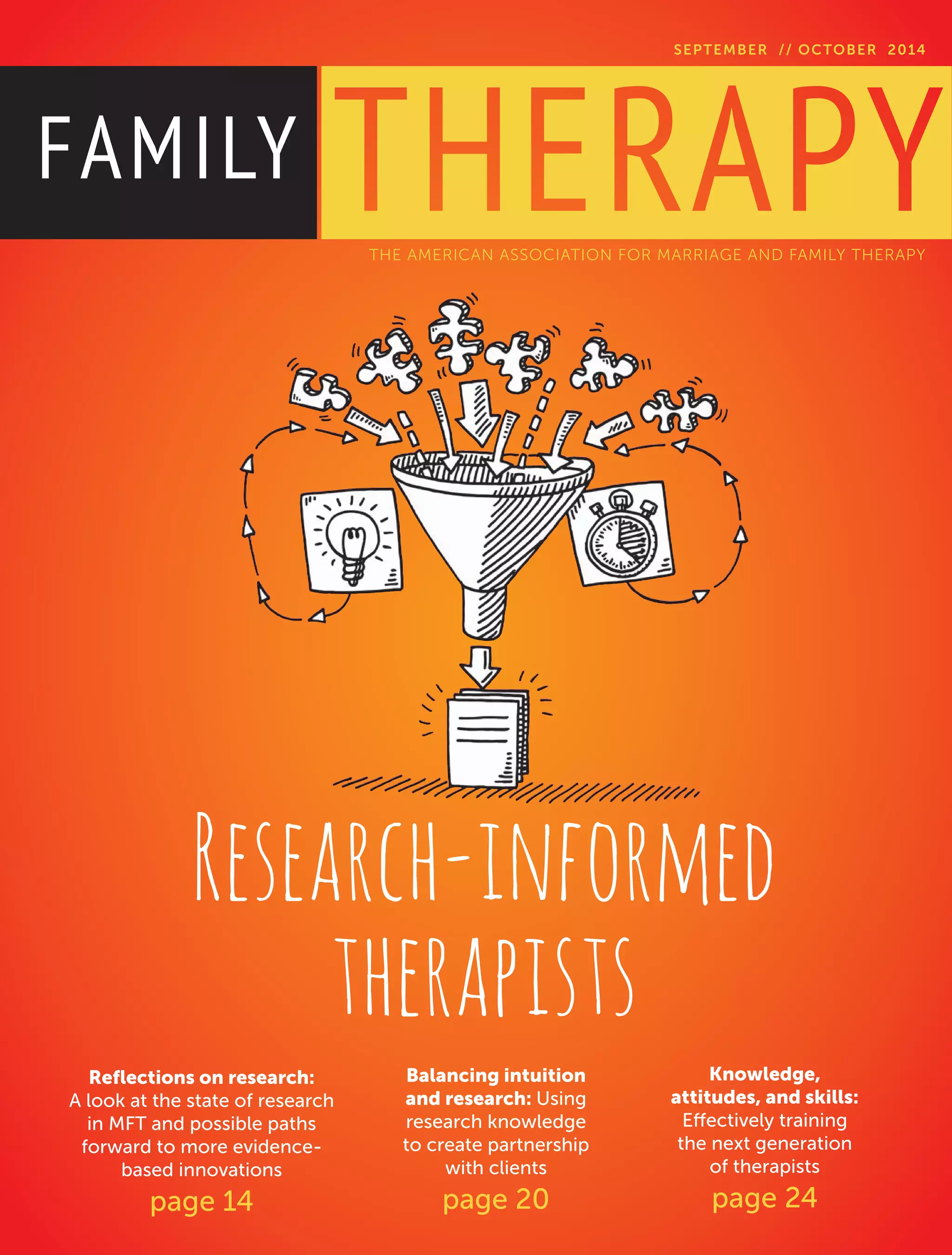
THE AMERICAN ASSOCIATION FOR MARRIAGE AND FAMILY THERAPY
SEPTEMBER // OCTOBER 2014
Research-informed
therapists
Reflections on research:
A look at the state of research
in MFT and possible paths
forward to more evidence-
based innovations
page 14
Knowledge,
attitudes, and skills:
Effectively training
the next generation
of therapists
page 24
Balancing intuition
and research: Using
research knowledge
to create partnership
with clients
page 20
46 FAMILY THERAPY MAGAZINE
perspectives
Reclaiming the Lost Art of Sensate Focus:
A Clinician’s Guide
Sensate Focus is a widely used, long-standing
intervention strategy for treating a multitude
of sexual and relationship difficulties. A
recent study of sexologists found that more
than 85 percent of 115 respondents utilize
sensate focus in their practice today, in some
fashion (Weiner & Stiritz, 2014). While Drs.
William Masters and Virginia Johnson (Masters
& Johnson, 1970) developed Sensate Focus,
their publications have left many clinicians
confused about the difference between
Sensate Focus and erotic touch exercises.
What Is Sensate Focus?
Sensate Focus is a hierarchical series of touch exercises
aimed in its initial phase at managing or eliminating
performance expectations for any specific emotion, whether
it be pleasure, relaxation, or arousal. These performance
demands result in anxiety, or fears of performance, that
interfere with sexual involvement (Weiner & Avery-Clark,
2014). The critical difference between Sensate Focus
and erotic touch exercises is that Sensate Focus involves
touching for one’s own interest, curosity, and exploration,
not for one’s pleasure or arousal, and not for one’s partner’s
pleasure or arousal. When couples get distracted with
anxious thoughts while engaged in Sensate Focus, they are
taught to mindfully focus on and explore the concrete and
reliably available aspects of touch, namely temperature,
pressure, and texture (TPT).
How it works
Suggest that your clients:
• Dedicate one hour of uninterrupted time, two or three
times a week, to Sensate Focus
• Disconnect from electronics, pets, children, or other
distractions
• Take turns touching, and alternate who initiates the touch
(although the more anxious client may initiate the early
sessions)
• Make sure that:
- There is some lighting in the room
- There is comfortable temperature
• Remove as much clothing as possible, preferably all
• Use only non-verbal communication to maintain sensory
focus
• Keep eyes opened or closed, whichever aids absorption
• Avoid alcohol or recreational drug use
Touch
The goal is for each of your clients to focus entirely on
his or her own touch experience. Intentional sexual
pleasuring, orgasmic release, and/or intercourse are strongly
discouraged during the first stages of Sensate Focus.
Instead, each is to turn his or her attention to TPT as often
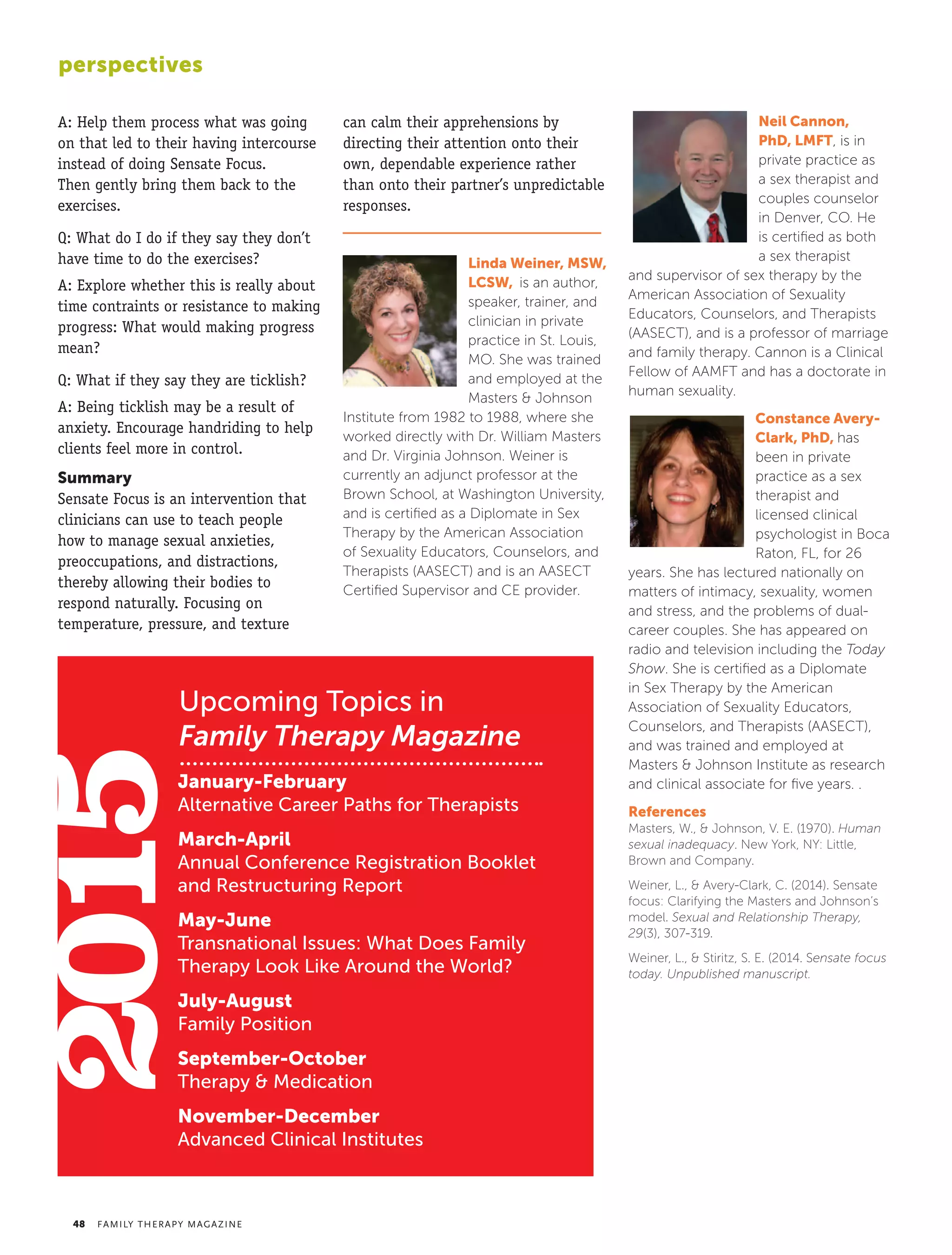
Linda Weiner, MSW	 Neil Cannon, PhD	 Constance Avery-Clark, PhD
SEPTEMBER/OCTOBER 2014 47
as needed, focusing on: What is the
temperature? Where is it cooler or
warmer? Is the hair and skin texture
smooth? Dry? Rough? What is harder or
firmer? Where is it lighter or softer?
In order to emphasize the non-demand
attitude of touching for one’s own
exploration, clients are encouraged
at first to avoid breasts, chest, and
genitals. If arousal occurs, let your
clients know that this is completely
natural. They should experience the
aroused feeling without doing anything
about it, and then return their focus
to TPT. If orgasm occurs, they are
encouraged to continue with the
touching.
These points are continually reinforced
by the clinician who emphasizes:
• Touch for your own interest and
curiosity. Sensate Focus is not
massage, it is not sex, and it is not
intended to arouse you or your
partner, although it may. If arousal
occurs, just notice and refocus on TPT
• Touch using hands and fingers only;
no kissing or full body contact
• Include all of the body in the
contact, except for areas that are off
limits
• Focus on sensations of TPT. If
distracted by anything else, including
anxieties, refocus on TPT and then
move to a new part of the body once
fully focused on sensations again
• Touch long enough to get over any
initial awkwardness but not so long
as to get tired or bored (if that
happens, move to a new spot)
• Take turns touching and being
touched in each session
• Protect your partner from doing
anything physically uncomfortable
by non-verbally redirecting his or
her hand away from that area for the
moment, or by practicing handriding,
the placement of the hand over or
under the partner’s to non-verbally
communicate, as needed. The toucher
can always return to that area a little
while later
Stage I: Body exploration without
touching the breasts and genitals
In the initial phase, your clients are
urged to choose any position that
is comfortable. They touch avoiding
breasts and genitals, focusing on TPT
and refocusing when attention shifts.
For variety, they can add hypoallergenic,
water soluble, lanolin-free lotion once
they have mastered touching for their
own interest and as long as this does
not promote a demand for pleasure,
relaxation, or arousal.
Stage II: Body exploration with
breast and genital touching
Next, clients are encouraged to
build upon these first suggestions
by assuming positions that include
breast and genital contact. The person
touching sits up against the headboard,
pillows behind, with his or her legs
out in front in a V, or slightly opened,
shape. The partner lies face up, legs
bent up and over the toucher’s thighs
with genitals close but not touching.
The breasts and genitals can be
included in the touching, excluding
finger insertion. Breasts and genitals
are included as any other part of the
body, and not as the main focus. The
focus continues to be on TPT.
Stage III: Mutual touching
Next, patients add mutual touching in
any position they choose. Now there
are sensations of touching and being
touched simultaneously, complicating
the focus. Clients move their attention
back and forth.
Stage IV: Mutual touching with
astride
The next step is for one partner to
go astride the other, and engage in
genital-to-genital contact. The genitals
are used exactly like the hands, simply
as a focal point for TPT.
Stage V: Mutual touching and
astride with insertion
During Level 1 of astride with
insertion, the astride partner
can slowly insert the penis while
maintaining focus on containment
sensations, and with no thrusting
movement. During Level 2, movement
is gradually included as long as a
non-demand attitude is maintained.
These instructions can be modified as
appropriate for couples who do not
desire insertion and/or modified for
partners interested in anal rather than
vaginal insertion as part of their sexual
expression.
Processing the touching sessions
in therapy
During the therapy session, you, the
clinician, may find these questions
helpful:
• Can each of you tell me about
the touching sessions from your
perspective?
• How many times were you able to do
the sessions?
• Who initiated each? How did you
each initiate?
• Can you tell me in TPT terms the
sensations on which you were able to
focus when you were touching?
• When you were being touched, what
touch sensations did you notice, and
were there any differences from when
you were touching?
• What were some distractions, and
what did you do to handle these?
• Did you experience arousal and, if so,
what did you do? What was that like?
• Did you need to move your partner’s
hand away from something
uncomfortable?
Frequently asked questions by
clinicians
Q: What do I as the clinician do if the
clients have intercourse before they are
supposed to?
48 FAMILY THERAPY MAGAZINE
A: Help them process what was going
on that led to their having intercourse
instead of doing Sensate Focus.
Then gently bring them back to the
exercises.
Q: What do I do if they say they don’t
have time to do the exercises?
A: Explore whether this is really about
time contraints or resistance to making
progress: What would making progress
mean?
Q: What if they say they are ticklish?
A: Being ticklish may be a result of
anxiety. Encourage handriding to help
clients feel more in control.
Summary
Sensate Focus is an intervention that
clinicians can use to teach people
how to manage sexual anxieties,
preoccupations, and distractions,
thereby allowing their bodies to
respond naturally. Focusing on
temperature, pressure, and texture
can calm their apprehensions by
directing their attention onto their
own, dependable experience rather
than onto their partner’s unpredictable
responses.
Linda Weiner, MSW,
LCSW, is an author,
speaker, trainer, and
clinician in private
practice in St. Louis,
MO. She was trained
and employed at the
Masters  Johnson
Institute from 1982 to 1988, where she
worked directly with Dr. William Masters
and Dr. Virginia Johnson. Weiner is
currently an adjunct professor at the
Brown School, at Washington University,
and is certified as a Diplomate in Sex
Therapy by the American Association
of Sexuality Educators, Counselors, and
Therapists (AASECT) and is an AASECT
Certified Supervisor and CE provider.
Neil Cannon,
PhD, LMFT, is in
private practice as
a sex therapist and
couples counselor
in Denver, CO. He
is certified as both
a sex therapist
and supervisor of sex therapy by the
American Association of Sexuality
Educators, Counselors, and Therapists
(AASECT), and is a professor of marriage
and family therapy. Cannon is a Clinical
Fellow of AAMFT and has a doctorate in
human sexuality.
Constance Avery-
Clark, PhD, has
been in private
practice as a sex
therapist and
licensed clinical
psychologist in Boca
Raton, FL, for 26
years. She has lectured nationally on
matters of intimacy, sexuality, women
and stress, and the problems of dual-
career couples. She has appeared on
radio and television including the Today
Show. She is certified as a Diplomate
in Sex Therapy by the American
Association of Sexuality Educators,
Counselors, and Therapists (AASECT),
and was trained and employed at
Masters  Johnson Institute as research
and clinical associate for five years. .
References
Masters, W.,  Johnson, V. E. (1970). Human
sexual inadequacy. New York, NY: Little,
Brown and Company.
Weiner, L.,  Avery-Clark, C. (2014). Sensate
focus: Clarifying the Masters and Johnson’s
model. Sexual and Relationship Therapy,
29(3), 307-319.
Weiner, L.,  Stiritz, S. E. (2014. Sensate focus
today. Unpublished manuscript.
perspectives
Upcoming Topics in
Family Therapy Magazine
January-February	
Alternative Career Paths for Therapists
March-April	
Annual Conference Registration Booklet
and Restructuring Report
May-June	
Transnational Issues: What Does Family
Therapy Look Like Around the World?
July-August	
Family Position
September-October	
Therapy  Medication
November-December	
Advanced Clinical Institutes
2015

Reclaiming-the-Lost-Art-of-Sensate-Focus_Family-Therapy_Sep.Oct-2014

  • 1.
    THE AMERICAN ASSOCIATIONFOR MARRIAGE AND FAMILY THERAPY SEPTEMBER // OCTOBER 2014 Research-informed therapists Reflections on research: A look at the state of research in MFT and possible paths forward to more evidence- based innovations page 14 Knowledge, attitudes, and skills: Effectively training the next generation of therapists page 24 Balancing intuition and research: Using research knowledge to create partnership with clients page 20
  • 2.
    46 FAMILY THERAPYMAGAZINE perspectives Reclaiming the Lost Art of Sensate Focus: A Clinician’s Guide Sensate Focus is a widely used, long-standing intervention strategy for treating a multitude of sexual and relationship difficulties. A recent study of sexologists found that more than 85 percent of 115 respondents utilize sensate focus in their practice today, in some fashion (Weiner & Stiritz, 2014). While Drs. William Masters and Virginia Johnson (Masters & Johnson, 1970) developed Sensate Focus, their publications have left many clinicians confused about the difference between Sensate Focus and erotic touch exercises. What Is Sensate Focus? Sensate Focus is a hierarchical series of touch exercises aimed in its initial phase at managing or eliminating performance expectations for any specific emotion, whether it be pleasure, relaxation, or arousal. These performance demands result in anxiety, or fears of performance, that interfere with sexual involvement (Weiner & Avery-Clark, 2014). The critical difference between Sensate Focus and erotic touch exercises is that Sensate Focus involves touching for one’s own interest, curosity, and exploration, not for one’s pleasure or arousal, and not for one’s partner’s pleasure or arousal. When couples get distracted with anxious thoughts while engaged in Sensate Focus, they are taught to mindfully focus on and explore the concrete and reliably available aspects of touch, namely temperature, pressure, and texture (TPT). How it works Suggest that your clients: • Dedicate one hour of uninterrupted time, two or three times a week, to Sensate Focus • Disconnect from electronics, pets, children, or other distractions • Take turns touching, and alternate who initiates the touch (although the more anxious client may initiate the early sessions) • Make sure that: - There is some lighting in the room - There is comfortable temperature • Remove as much clothing as possible, preferably all • Use only non-verbal communication to maintain sensory focus • Keep eyes opened or closed, whichever aids absorption • Avoid alcohol or recreational drug use Touch The goal is for each of your clients to focus entirely on his or her own touch experience. Intentional sexual pleasuring, orgasmic release, and/or intercourse are strongly discouraged during the first stages of Sensate Focus. Instead, each is to turn his or her attention to TPT as often Linda Weiner, MSW Neil Cannon, PhD Constance Avery-Clark, PhD
  • 3.
    SEPTEMBER/OCTOBER 2014 47 asneeded, focusing on: What is the temperature? Where is it cooler or warmer? Is the hair and skin texture smooth? Dry? Rough? What is harder or firmer? Where is it lighter or softer? In order to emphasize the non-demand attitude of touching for one’s own exploration, clients are encouraged at first to avoid breasts, chest, and genitals. If arousal occurs, let your clients know that this is completely natural. They should experience the aroused feeling without doing anything about it, and then return their focus to TPT. If orgasm occurs, they are encouraged to continue with the touching. These points are continually reinforced by the clinician who emphasizes: • Touch for your own interest and curiosity. Sensate Focus is not massage, it is not sex, and it is not intended to arouse you or your partner, although it may. If arousal occurs, just notice and refocus on TPT • Touch using hands and fingers only; no kissing or full body contact • Include all of the body in the contact, except for areas that are off limits • Focus on sensations of TPT. If distracted by anything else, including anxieties, refocus on TPT and then move to a new part of the body once fully focused on sensations again • Touch long enough to get over any initial awkwardness but not so long as to get tired or bored (if that happens, move to a new spot) • Take turns touching and being touched in each session • Protect your partner from doing anything physically uncomfortable by non-verbally redirecting his or her hand away from that area for the moment, or by practicing handriding, the placement of the hand over or under the partner’s to non-verbally communicate, as needed. The toucher can always return to that area a little while later Stage I: Body exploration without touching the breasts and genitals In the initial phase, your clients are urged to choose any position that is comfortable. They touch avoiding breasts and genitals, focusing on TPT and refocusing when attention shifts. For variety, they can add hypoallergenic, water soluble, lanolin-free lotion once they have mastered touching for their own interest and as long as this does not promote a demand for pleasure, relaxation, or arousal. Stage II: Body exploration with breast and genital touching Next, clients are encouraged to build upon these first suggestions by assuming positions that include breast and genital contact. The person touching sits up against the headboard, pillows behind, with his or her legs out in front in a V, or slightly opened, shape. The partner lies face up, legs bent up and over the toucher’s thighs with genitals close but not touching. The breasts and genitals can be included in the touching, excluding finger insertion. Breasts and genitals are included as any other part of the body, and not as the main focus. The focus continues to be on TPT. Stage III: Mutual touching Next, patients add mutual touching in any position they choose. Now there are sensations of touching and being touched simultaneously, complicating the focus. Clients move their attention back and forth. Stage IV: Mutual touching with astride The next step is for one partner to go astride the other, and engage in genital-to-genital contact. The genitals are used exactly like the hands, simply as a focal point for TPT. Stage V: Mutual touching and astride with insertion During Level 1 of astride with insertion, the astride partner can slowly insert the penis while maintaining focus on containment sensations, and with no thrusting movement. During Level 2, movement is gradually included as long as a non-demand attitude is maintained. These instructions can be modified as appropriate for couples who do not desire insertion and/or modified for partners interested in anal rather than vaginal insertion as part of their sexual expression. Processing the touching sessions in therapy During the therapy session, you, the clinician, may find these questions helpful: • Can each of you tell me about the touching sessions from your perspective? • How many times were you able to do the sessions? • Who initiated each? How did you each initiate? • Can you tell me in TPT terms the sensations on which you were able to focus when you were touching? • When you were being touched, what touch sensations did you notice, and were there any differences from when you were touching? • What were some distractions, and what did you do to handle these? • Did you experience arousal and, if so, what did you do? What was that like? • Did you need to move your partner’s hand away from something uncomfortable? Frequently asked questions by clinicians Q: What do I as the clinician do if the clients have intercourse before they are supposed to?
  • 4.
    48 FAMILY THERAPYMAGAZINE A: Help them process what was going on that led to their having intercourse instead of doing Sensate Focus. Then gently bring them back to the exercises. Q: What do I do if they say they don’t have time to do the exercises? A: Explore whether this is really about time contraints or resistance to making progress: What would making progress mean? Q: What if they say they are ticklish? A: Being ticklish may be a result of anxiety. Encourage handriding to help clients feel more in control. Summary Sensate Focus is an intervention that clinicians can use to teach people how to manage sexual anxieties, preoccupations, and distractions, thereby allowing their bodies to respond naturally. Focusing on temperature, pressure, and texture can calm their apprehensions by directing their attention onto their own, dependable experience rather than onto their partner’s unpredictable responses. Linda Weiner, MSW, LCSW, is an author, speaker, trainer, and clinician in private practice in St. Louis, MO. She was trained and employed at the Masters Johnson Institute from 1982 to 1988, where she worked directly with Dr. William Masters and Dr. Virginia Johnson. Weiner is currently an adjunct professor at the Brown School, at Washington University, and is certified as a Diplomate in Sex Therapy by the American Association of Sexuality Educators, Counselors, and Therapists (AASECT) and is an AASECT Certified Supervisor and CE provider. Neil Cannon, PhD, LMFT, is in private practice as a sex therapist and couples counselor in Denver, CO. He is certified as both a sex therapist and supervisor of sex therapy by the American Association of Sexuality Educators, Counselors, and Therapists (AASECT), and is a professor of marriage and family therapy. Cannon is a Clinical Fellow of AAMFT and has a doctorate in human sexuality. Constance Avery- Clark, PhD, has been in private practice as a sex therapist and licensed clinical psychologist in Boca Raton, FL, for 26 years. She has lectured nationally on matters of intimacy, sexuality, women and stress, and the problems of dual- career couples. She has appeared on radio and television including the Today Show. She is certified as a Diplomate in Sex Therapy by the American Association of Sexuality Educators, Counselors, and Therapists (AASECT), and was trained and employed at Masters Johnson Institute as research and clinical associate for five years. . References Masters, W., Johnson, V. E. (1970). Human sexual inadequacy. New York, NY: Little, Brown and Company. Weiner, L., Avery-Clark, C. (2014). Sensate focus: Clarifying the Masters and Johnson’s model. Sexual and Relationship Therapy, 29(3), 307-319. Weiner, L., Stiritz, S. E. (2014. Sensate focus today. Unpublished manuscript. perspectives Upcoming Topics in Family Therapy Magazine January-February Alternative Career Paths for Therapists March-April Annual Conference Registration Booklet and Restructuring Report May-June Transnational Issues: What Does Family Therapy Look Like Around the World? July-August Family Position September-October Therapy Medication November-December Advanced Clinical Institutes 2015