Fiber in the
10th year
Koichi Sasada
ko1@cookpad.com
About this talk
•Behavior of Fiber
•History of Fiber
•Implementation of Fiber
•Auto Fiber proposal
Koichi Sasada
http://atdot.net/~ko1/
•A programmer
•2006-2012 Faculty
•2012-2017 Heroku, Inc.
•2017- Cookpad Inc.
•Job: MRI development
•Core parts
•VM, Threads, GC, etc
Fiber
User-defined context switching
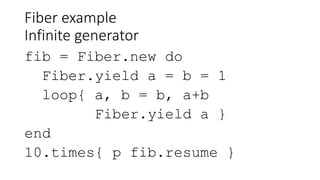
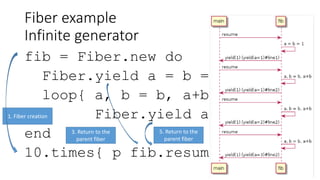
Fiber example
Infinite generator
fib = Fiber.new do
Fiber.yield a = b = 1
loop{ a, b = b, a+b
Fiber.yield a }
end
10.times{ p fib.resume }
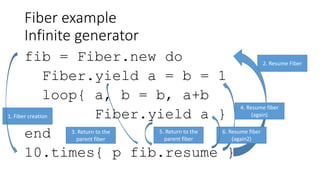
Fiber example
Infinite generator
fib = Fiber.new do
Fiber.yield a = b = 1
loop{ a, b = b, a+b
Fiber.yield a }
end
10.times{ p fib.resume }
1. Fiber creation
2. Resume Fiber
3. Return to the
parent fiber
4. Resume fiber
(again)
5. Return to the
parent fiber
6. Resume fiber
(again2)
Fiber example
Infinite generator
fib = Fiber.new do
Fiber.yield a = b = 1
loop{ a, b = b, a+b
Fiber.yield a }
end
10.times{ p fib.resume }
1. Fiber creation
2. Resume Fiber
3. Return to the
parent fiber
4. Resume fiber
(again)
5. Return to the
parent fiber
6. Resume fiber
(again2)
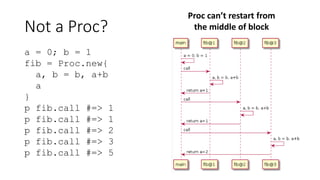
Not a Proc?
a = 0; b = 1
fib = Proc.new{
a, b = b, a+b
a
}
p fib.call #=> 1
p fib.call #=> 1
p fib.call #=> 2
p fib.call #=> 3
p fib.call #=> 5
Proc can’t restart from
the middle of block
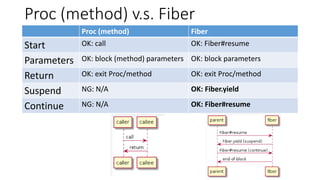
Proc (method) v.s. Fiber
Proc (method) Fiber
Start OK: call OK: Fiber#resume
Parameters OK: block (method) parameters OK: block parameters
Return OK: exit Proc/method OK: exit Proc/method
Suspend NG: N/A OK: Fiber.yield
Continue NG: N/A OK: Fiber#resume
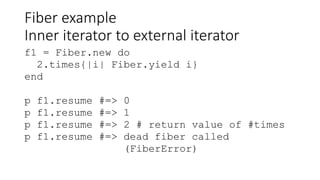
Fiber example
Inner iterator to external iterator
f1 = Fiber.new do
2.times{|i| Fiber.yield i}
end
p f1.resume #=> 0
p f1.resume #=> 1
p f1.resume #=> 2 # return value of #times
p f1.resume #=> dead fiber called
(FiberError)
Fiber example
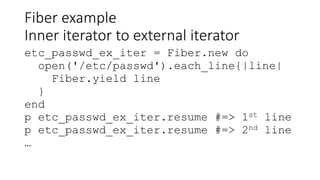
Inner iterator to external iterator
etc_passwd_ex_iter = Fiber.new do
open('/etc/passwd').each_line{|line|
Fiber.yield line
}
end
p etc_passwd_ex_iter.resume #=> 1st line
p etc_passwd_ex_iter.resume #=> 2nd line
…
Fiber example
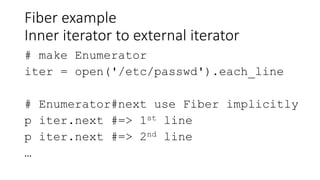
Inner iterator to external iterator
# make Enumerator
iter = open('/etc/passwd').each_line
# Enumerator#next use Fiber implicitly
p iter.next #=> 1st line
p iter.next #=> 2nd line
…
Fiber example
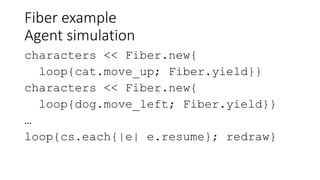
Agent simulation
characters << Fiber.new{
loop{cat.move_up; Fiber.yield}}
characters << Fiber.new{
loop{dog.move_left; Fiber.yield}}
…
loop{cs.each{|e| e.resume}; redraw}
Fiber example
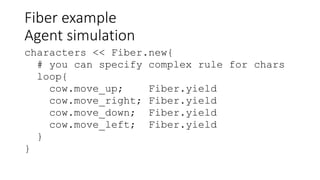
Agent simulation
characters << Fiber.new{
# you can specify complex rule for chars
loop{
cow.move_up; Fiber.yield
cow.move_right; Fiber.yield
cow.move_down; Fiber.yield
cow.move_left; Fiber.yield
}
}
Fiber example
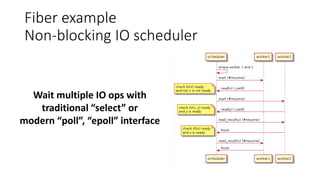
Non-blocking IO scheduler
Wait multiple IO ops with
traditional “select” or
modern “poll”, “epoll” interface
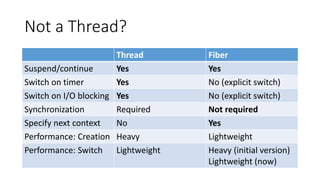
Not a Thread?
Thread Fiber
Suspend/continue Yes Yes
Switch on timer Yes No (explicit switch)
Switch on I/O blocking Yes No (explicit switch)
Synchronization Required Not required
Specify next context No Yes
Performance: Creation Heavy Lightweight
Performance: Switch Lightweight Heavy (initial version)
Lightweight (now)
Brief History of Fibers
Fiber: Brief history
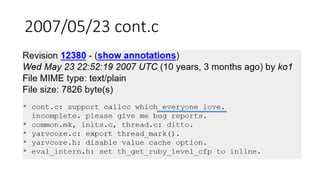
•2007/05/23 cont.c (for callcc)
•2007/05/25 Fiber impl. [ruby-dev:30827]
•2007/05/28 Fiber introduced into cont.c
•2007/08/25 Fix Fiber spec
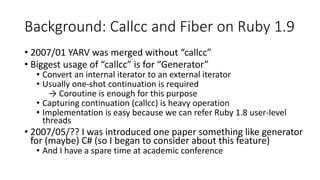
Background: Callcc and Fiber on Ruby 1.9
• 2007/01 YARV was merged without “callcc”
• Biggest usage of “callcc” is for “Generator”
• Convert an internal iterator to an external iterator
• Usually one-shot continuation is required
→ Coroutine is enough for this purpose
• Capturing continuation (callcc) is heavy operation
• Implementation is easy because we can refer Ruby 1.8 user-level
threads
• 2007/05/?? I was introduced one paper something like generator
for (maybe) C# (so I began to consider about this feature)
• And I have a spare time at academic conference
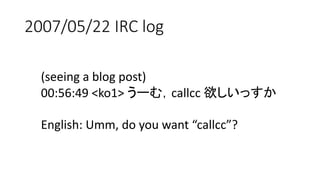
2007/05/22 IRC log
(seeing a blog post)
00:56:49 <ko1> うーむ,callcc 欲しいっすか
English: Umm, do you want “callcc”?
2007/05/23 cont.c
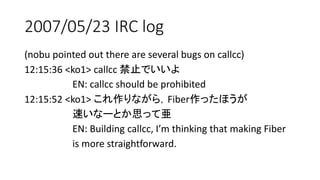
2007/05/23 IRC log
(nobu pointed out there are several bugs on callcc)
12:15:36 <ko1> callcc 禁止でいいよ
EN: callcc should be prohibited
12:15:52 <ko1> これ作りながら,Fiber作ったほうが
速いなーとか思って亜
EN: Building callcc, I’m thinking that making Fiber
is more straightforward.
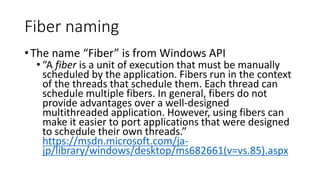
Fiber naming
•The name “Fiber” is from Windows API
• “A fiber is a unit of execution that must be manually
scheduled by the application. Fibers run in the context
of the threads that schedule them. Each thread can
schedule multiple fibers. In general, fibers do not
provide advantages over a well-designed
multithreaded application. However, using fibers can
make it easier to port applications that were designed
to schedule their own threads.”
https://msdn.microsoft.com/ja-
jp/library/windows/desktop/ms682661(v=vs.85).aspx
[ruby-dev:30828] Re: Supporting Fiber
Naming of Fiber
“Fiberでいいんじゃないでしょうか。
何かかっこいいですよね。” by shugo
EN: “I’m ok the name of “Fiber”.
Somewhat cool.” by shugo
2007/05/28 Introduction
r13295, [ruby-dev:30827]
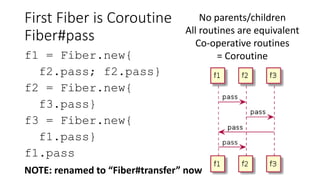
First Fiber is Coroutine
Fiber#pass
f1 = Fiber.new{
f2.pass; f2.pass}
f2 = Fiber.new{
f3.pass}
f3 = Fiber.new{
f1.pass}
f1.pass
No parents/children
All routines are equivalent
Co-operative routines
= Coroutine
NOTE: renamed to “Fiber#transfer” now
Fiber#pass → Fiber#yield
[ruby-dev:30847] Re: Supporting Fiber
Matz’s idea
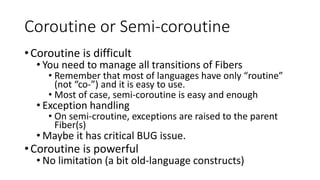
Coroutine or Semi-coroutine
•Coroutine is difficult
• You need to manage all transitions of Fibers
• Remember that most of languages have only “routine”
(not “co-”) and it is easy to use.
• Most of case, semi-coroutine is easy and enough
• Exception handling
• On semi-croutine, exceptions are raised to the parent
Fiber(s)
• Maybe it has critical BUG issue.
•Coroutine is powerful
• No limitation (a bit old-language constructs)
[ruby-dev:31583] Fiber reviesed
Semi-coroutine (Fiber) and Coroutine (Fiber::Core)
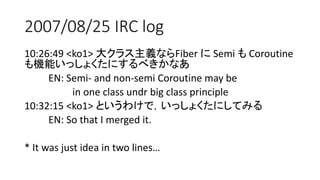
2007/08/25 IRC log
10:26:49 <ko1> 大クラス主義ならFiber に Semi も Coroutine
も機能いっしょくたにするべきかなあ
EN: Semi- and non-semi Coroutine may be
in one class undr big class principle
10:32:15 <ko1> というわけで,いっしょくたにしてみる
EN: So that I merged it.
* It was just idea in two lines…
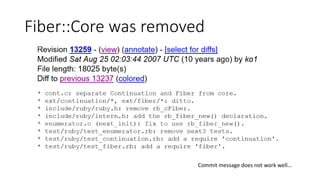
Fiber::Core was removed
Commit message does not work well…
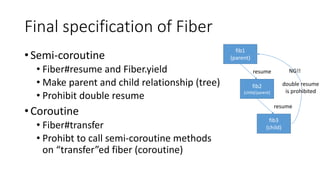
Final specification of Fiber
• Semi-coroutine
• Fiber#resume and Fiber.yield
• Make parent and child relationship (tree)
• Prohibit double resume
• Coroutine
• Fiber#transfer
• Prohibt to call semi-coroutine methods
on “transfer”ed fiber (coroutine)
fib1
(parent)
fib2
(child/parent)
fib3
(child)
resume
resume
double resume
is prohibited
NG!!
Implementation of Fibers
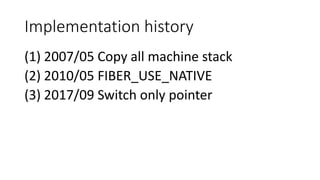
Implementation history
(1) 2007/05 Copy all machine stack
(2) 2010/05 FIBER_USE_NATIVE
(3) 2017/09 Switch only pointer
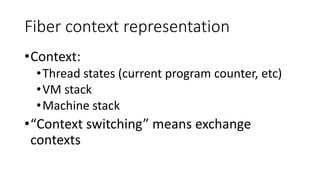
Fiber context representation
•Context:
•Thread states (current program counter, etc)
•VM stack
•Machine stack
•“Context switching” means exchange
contexts
Fiber implementation
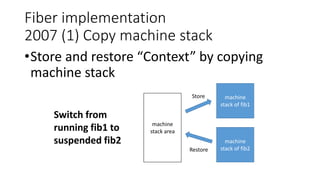
2007 (1) Copy machine stack
•Store and restore “Context” by copying
machine stack
machine
stack area
machine
stack of fib1
machine
stack of fib2
Store
Restore
Switch from
running fib1 to
suspended fib2
Fiber implementation
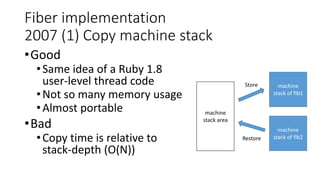
2007 (1) Copy machine stack
•Good
•Same idea of a Ruby 1.8
user-level thread code
•Not so many memory usage
•Almost portable
•Bad
•Copy time is relative to
stack-depth (O(N))
machine
stack area
machine
stack of fib1
machine
stack of fib2
Store
Restore
Fiber implementation
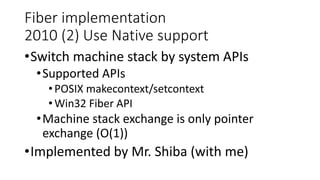
2010 (2) Use Native support
•Switch machine stack by system APIs
•Supported APIs
•POSIX makecontext/setcontext
•Win32 Fiber API
•Machine stack exchange is only pointer
exchange (O(1))
•Implemented by Mr. Shiba (with me)
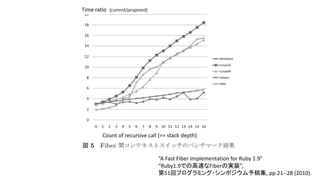
“A Fast Fiber Implementation for Ruby 1.9”
“Ruby1.9での高速なFiberの実装”,
第51回プログラミング・シンポジウム予稿集, pp.21--28 (2010).
Time ratio
Count of recursive call (== stack depth)
Fiber implementation
2017 (3) More lightweight switching
•Context exchange
•[copy] Thread states
•[ptr exchange] VM stack
•[ptr exchange] Machine stack
•“setcontext” calls sigprocmask
•Ruby threads/fibers use same signal mask
→ Useless system call
Fiber implementation
2017 (3) More lightweight switching
•Context exchange
•[copy->ptr exchange] Thread states
Before After
Thread
fib1
fib2
Store
Restore
Thread
fib1
fib2
ec1
ec2
ptr exchange
fib1
context fib2
context
fib1
context
fib2
context
Fiber implementation
2017 (3) More lightweight switching
•[Futurework] Use custom “setcontext” excludes
sigprocmask
•setcontext issues “sigprocmask” system call to restore
signal mask, but MRI doesn’t change signalmask so
that it is completely useless.
•This idea is also proposed at
https://rethinkdb.com/blog/making-coroutines-fast/
•License?
Fiber implementation
2017 (3) More lightweight switching
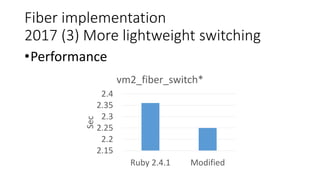
•Performance
2.15
2.2
2.25
2.3
2.35
2.4
Ruby 2.4.1 Modified
Sec
vm2_fiber_switch*
Fiber implementation
2017 (3) More lightweight switching
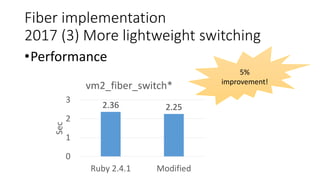
•Performance
2.36 2.25
0
1
2
3
Ruby 2.4.1 Modified
Sec
vm2_fiber_switch*
5%
improvement!
Fiber implementation
2017 (3) More lightweight switching
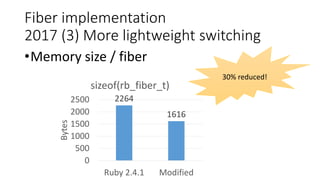
•Memory size / fiber
30% reduced!
2264
1616
0
500
1000
1500
2000
2500
Ruby 2.4.1 Modified
Bytes
sizeof(rb_fiber_t)
Fiber implementation
2017 (3) More lightweight switching
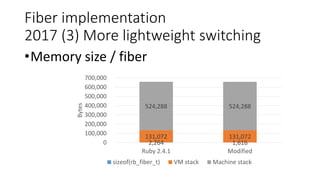
•Memory size / fiber
2,264 1,616
131,072 131,072
524,288 524,288
0
100,000
200,000
300,000
400,000
500,000
600,000
700,000
Ruby 2.4.1 Modified
Bytes
sizeof(rb_fiber_t) VM stack Machine stack
2017 (3) More lightweight switching
Not a valuable work?
•I spent this hack 2 or 3 months because of
code complicity.
•This work (hopefully) will be a basis of Guild
work (we need to pass context information
for each APIs like mrb_state on mruby)
Auto-Fiber proposal
Auto Fiber proposal
•“Fiber” enables writing scheduler by Ruby
programmer
•Maybe Seki-san introduce one example
•Why doesn’t an interpreter support it
natively? → Auto Fiber proposal
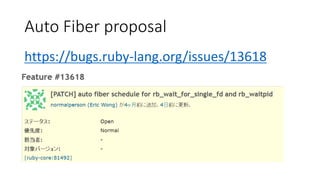
Auto Fiber proposal
https://bugs.ruby-lang.org/issues/13618
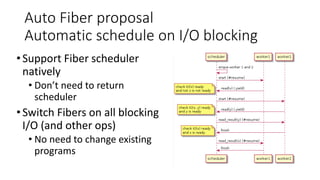
Auto Fiber proposal
Automatic schedule on I/O blocking
•Support Fiber scheduler
natively
• Don’t need to return
scheduler
•Switch Fibers on all blocking
I/O (and other ops)
• No need to change existing
programs
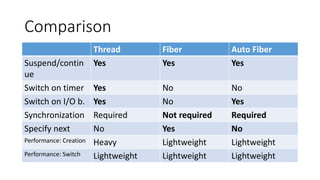
Comparison
Thread Fiber Auto Fiber
Suspend/contin
ue
Yes Yes Yes
Switch on timer Yes No No
Switch on I/O b. Yes No Yes
Synchronization Required Not required Required
Specify next No Yes No
Performance: Creation Heavy Lightweight Lightweight
Performance: Switch Lightweight Lightweight Lightweight
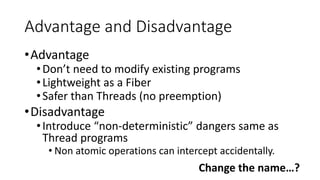
Advantage and Disadvantage
•Advantage
•Don’t need to modify existing programs
•Lightweight as a Fiber
•Safer than Threads (no preemption)
•Disadvantage
•Introduce “non-deterministic” dangers same as
Thread programs
• Non atomic operations can intercept accidentally.
Change the name…?
About this talk
•Behavior of Fiber
•History of Fiber
•Implementation of Fiber
•Auto Fiber proposal
Thank you for your attention
Koichi Sasada
<ko1@cookpad.com>

Fiber in the 10th year

  • 1.
    Fiber in the 10thyear Koichi Sasada ko1@cookpad.com
  • 2.
    About this talk •Behaviorof Fiber •History of Fiber •Implementation of Fiber •Auto Fiber proposal
  • 3.
    Koichi Sasada http://atdot.net/~ko1/ •A programmer •2006-2012Faculty •2012-2017 Heroku, Inc. •2017- Cookpad Inc. •Job: MRI development •Core parts •VM, Threads, GC, etc
  • 4.
  • 5.
    Fiber example Infinite generator fib= Fiber.new do Fiber.yield a = b = 1 loop{ a, b = b, a+b Fiber.yield a } end 10.times{ p fib.resume }
  • 6.
    Fiber example Infinite generator fib= Fiber.new do Fiber.yield a = b = 1 loop{ a, b = b, a+b Fiber.yield a } end 10.times{ p fib.resume } 1. Fiber creation 2. Resume Fiber 3. Return to the parent fiber 4. Resume fiber (again) 5. Return to the parent fiber 6. Resume fiber (again2)
  • 7.
    Fiber example Infinite generator fib= Fiber.new do Fiber.yield a = b = 1 loop{ a, b = b, a+b Fiber.yield a } end 10.times{ p fib.resume } 1. Fiber creation 2. Resume Fiber 3. Return to the parent fiber 4. Resume fiber (again) 5. Return to the parent fiber 6. Resume fiber (again2)
  • 8.
    Not a Proc? a= 0; b = 1 fib = Proc.new{ a, b = b, a+b a } p fib.call #=> 1 p fib.call #=> 1 p fib.call #=> 2 p fib.call #=> 3 p fib.call #=> 5 Proc can’t restart from the middle of block
  • 9.
    Proc (method) v.s.Fiber Proc (method) Fiber Start OK: call OK: Fiber#resume Parameters OK: block (method) parameters OK: block parameters Return OK: exit Proc/method OK: exit Proc/method Suspend NG: N/A OK: Fiber.yield Continue NG: N/A OK: Fiber#resume
  • 10.
    Fiber example Inner iteratorto external iterator f1 = Fiber.new do 2.times{|i| Fiber.yield i} end p f1.resume #=> 0 p f1.resume #=> 1 p f1.resume #=> 2 # return value of #times p f1.resume #=> dead fiber called (FiberError)
  • 11.
    Fiber example Inner iteratorto external iterator etc_passwd_ex_iter = Fiber.new do open('/etc/passwd').each_line{|line| Fiber.yield line } end p etc_passwd_ex_iter.resume #=> 1st line p etc_passwd_ex_iter.resume #=> 2nd line …
  • 12.
    Fiber example Inner iteratorto external iterator # make Enumerator iter = open('/etc/passwd').each_line # Enumerator#next use Fiber implicitly p iter.next #=> 1st line p iter.next #=> 2nd line …
  • 13.
    Fiber example Agent simulation characters<< Fiber.new{ loop{cat.move_up; Fiber.yield}} characters << Fiber.new{ loop{dog.move_left; Fiber.yield}} … loop{cs.each{|e| e.resume}; redraw}
  • 14.
    Fiber example Agent simulation characters<< Fiber.new{ # you can specify complex rule for chars loop{ cow.move_up; Fiber.yield cow.move_right; Fiber.yield cow.move_down; Fiber.yield cow.move_left; Fiber.yield } }
  • 15.
    Fiber example Non-blocking IOscheduler Wait multiple IO ops with traditional “select” or modern “poll”, “epoll” interface
  • 16.
    Not a Thread? ThreadFiber Suspend/continue Yes Yes Switch on timer Yes No (explicit switch) Switch on I/O blocking Yes No (explicit switch) Synchronization Required Not required Specify next context No Yes Performance: Creation Heavy Lightweight Performance: Switch Lightweight Heavy (initial version) Lightweight (now)
  • 17.
  • 18.
    Fiber: Brief history •2007/05/23cont.c (for callcc) •2007/05/25 Fiber impl. [ruby-dev:30827] •2007/05/28 Fiber introduced into cont.c •2007/08/25 Fix Fiber spec
  • 19.
    Background: Callcc andFiber on Ruby 1.9 • 2007/01 YARV was merged without “callcc” • Biggest usage of “callcc” is for “Generator” • Convert an internal iterator to an external iterator • Usually one-shot continuation is required → Coroutine is enough for this purpose • Capturing continuation (callcc) is heavy operation • Implementation is easy because we can refer Ruby 1.8 user-level threads • 2007/05/?? I was introduced one paper something like generator for (maybe) C# (so I began to consider about this feature) • And I have a spare time at academic conference
  • 20.
    2007/05/22 IRC log (seeinga blog post) 00:56:49 <ko1> うーむ,callcc 欲しいっすか English: Umm, do you want “callcc”?
  • 21.
  • 22.
    2007/05/23 IRC log (nobupointed out there are several bugs on callcc) 12:15:36 <ko1> callcc 禁止でいいよ EN: callcc should be prohibited 12:15:52 <ko1> これ作りながら,Fiber作ったほうが 速いなーとか思って亜 EN: Building callcc, I’m thinking that making Fiber is more straightforward.
  • 23.
    Fiber naming •The name“Fiber” is from Windows API • “A fiber is a unit of execution that must be manually scheduled by the application. Fibers run in the context of the threads that schedule them. Each thread can schedule multiple fibers. In general, fibers do not provide advantages over a well-designed multithreaded application. However, using fibers can make it easier to port applications that were designed to schedule their own threads.” https://msdn.microsoft.com/ja- jp/library/windows/desktop/ms682661(v=vs.85).aspx
  • 24.
    [ruby-dev:30828] Re: SupportingFiber Naming of Fiber “Fiberでいいんじゃないでしょうか。 何かかっこいいですよね。” by shugo EN: “I’m ok the name of “Fiber”. Somewhat cool.” by shugo
  • 25.
  • 26.
    First Fiber isCoroutine Fiber#pass f1 = Fiber.new{ f2.pass; f2.pass} f2 = Fiber.new{ f3.pass} f3 = Fiber.new{ f1.pass} f1.pass No parents/children All routines are equivalent Co-operative routines = Coroutine NOTE: renamed to “Fiber#transfer” now
  • 27.
    Fiber#pass → Fiber#yield [ruby-dev:30847]Re: Supporting Fiber Matz’s idea
  • 28.
    Coroutine or Semi-coroutine •Coroutineis difficult • You need to manage all transitions of Fibers • Remember that most of languages have only “routine” (not “co-”) and it is easy to use. • Most of case, semi-coroutine is easy and enough • Exception handling • On semi-croutine, exceptions are raised to the parent Fiber(s) • Maybe it has critical BUG issue. •Coroutine is powerful • No limitation (a bit old-language constructs)
  • 29.
    [ruby-dev:31583] Fiber reviesed Semi-coroutine(Fiber) and Coroutine (Fiber::Core)
  • 30.
    2007/08/25 IRC log 10:26:49<ko1> 大クラス主義ならFiber に Semi も Coroutine も機能いっしょくたにするべきかなあ EN: Semi- and non-semi Coroutine may be in one class undr big class principle 10:32:15 <ko1> というわけで,いっしょくたにしてみる EN: So that I merged it. * It was just idea in two lines…
  • 31.
    Fiber::Core was removed Commitmessage does not work well…
  • 32.
    Final specification ofFiber • Semi-coroutine • Fiber#resume and Fiber.yield • Make parent and child relationship (tree) • Prohibit double resume • Coroutine • Fiber#transfer • Prohibt to call semi-coroutine methods on “transfer”ed fiber (coroutine) fib1 (parent) fib2 (child/parent) fib3 (child) resume resume double resume is prohibited NG!!
  • 33.
  • 34.
    Implementation history (1) 2007/05Copy all machine stack (2) 2010/05 FIBER_USE_NATIVE (3) 2017/09 Switch only pointer
  • 35.
    Fiber context representation •Context: •Threadstates (current program counter, etc) •VM stack •Machine stack •“Context switching” means exchange contexts
  • 36.
    Fiber implementation 2007 (1)Copy machine stack •Store and restore “Context” by copying machine stack machine stack area machine stack of fib1 machine stack of fib2 Store Restore Switch from running fib1 to suspended fib2
  • 37.
    Fiber implementation 2007 (1)Copy machine stack •Good •Same idea of a Ruby 1.8 user-level thread code •Not so many memory usage •Almost portable •Bad •Copy time is relative to stack-depth (O(N)) machine stack area machine stack of fib1 machine stack of fib2 Store Restore
  • 38.
    Fiber implementation 2010 (2)Use Native support •Switch machine stack by system APIs •Supported APIs •POSIX makecontext/setcontext •Win32 Fiber API •Machine stack exchange is only pointer exchange (O(1)) •Implemented by Mr. Shiba (with me)
  • 39.
    “A Fast FiberImplementation for Ruby 1.9” “Ruby1.9での高速なFiberの実装”, 第51回プログラミング・シンポジウム予稿集, pp.21--28 (2010). Time ratio Count of recursive call (== stack depth)
  • 40.
    Fiber implementation 2017 (3)More lightweight switching •Context exchange •[copy] Thread states •[ptr exchange] VM stack •[ptr exchange] Machine stack •“setcontext” calls sigprocmask •Ruby threads/fibers use same signal mask → Useless system call
  • 41.
    Fiber implementation 2017 (3)More lightweight switching •Context exchange •[copy->ptr exchange] Thread states Before After Thread fib1 fib2 Store Restore Thread fib1 fib2 ec1 ec2 ptr exchange fib1 context fib2 context fib1 context fib2 context
  • 42.
    Fiber implementation 2017 (3)More lightweight switching •[Futurework] Use custom “setcontext” excludes sigprocmask •setcontext issues “sigprocmask” system call to restore signal mask, but MRI doesn’t change signalmask so that it is completely useless. •This idea is also proposed at https://rethinkdb.com/blog/making-coroutines-fast/ •License?
  • 43.
    Fiber implementation 2017 (3)More lightweight switching •Performance 2.15 2.2 2.25 2.3 2.35 2.4 Ruby 2.4.1 Modified Sec vm2_fiber_switch*
  • 44.
    Fiber implementation 2017 (3)More lightweight switching •Performance 2.36 2.25 0 1 2 3 Ruby 2.4.1 Modified Sec vm2_fiber_switch* 5% improvement!
  • 45.
    Fiber implementation 2017 (3)More lightweight switching •Memory size / fiber 30% reduced! 2264 1616 0 500 1000 1500 2000 2500 Ruby 2.4.1 Modified Bytes sizeof(rb_fiber_t)
  • 46.
    Fiber implementation 2017 (3)More lightweight switching •Memory size / fiber 2,264 1,616 131,072 131,072 524,288 524,288 0 100,000 200,000 300,000 400,000 500,000 600,000 700,000 Ruby 2.4.1 Modified Bytes sizeof(rb_fiber_t) VM stack Machine stack
  • 47.
    2017 (3) Morelightweight switching Not a valuable work? •I spent this hack 2 or 3 months because of code complicity. •This work (hopefully) will be a basis of Guild work (we need to pass context information for each APIs like mrb_state on mruby)
  • 48.
  • 49.
    Auto Fiber proposal •“Fiber”enables writing scheduler by Ruby programmer •Maybe Seki-san introduce one example •Why doesn’t an interpreter support it natively? → Auto Fiber proposal
  • 50.
  • 51.
    Auto Fiber proposal Automaticschedule on I/O blocking •Support Fiber scheduler natively • Don’t need to return scheduler •Switch Fibers on all blocking I/O (and other ops) • No need to change existing programs
  • 52.
    Comparison Thread Fiber AutoFiber Suspend/contin ue Yes Yes Yes Switch on timer Yes No No Switch on I/O b. Yes No Yes Synchronization Required Not required Required Specify next No Yes No Performance: Creation Heavy Lightweight Lightweight Performance: Switch Lightweight Lightweight Lightweight
  • 53.
    Advantage and Disadvantage •Advantage •Don’tneed to modify existing programs •Lightweight as a Fiber •Safer than Threads (no preemption) •Disadvantage •Introduce “non-deterministic” dangers same as Thread programs • Non atomic operations can intercept accidentally. Change the name…?
  • 54.
    About this talk •Behaviorof Fiber •History of Fiber •Implementation of Fiber •Auto Fiber proposal
  • 55.
    Thank you foryour attention Koichi Sasada <ko1@cookpad.com>