Patently Strategic
Musings
ASHLEY SLOAT | January 26, 2020
This presentation is for information purposes only and does not constitute legal advice.
WELCOME! – Format
• 10 Minutes Ice: Breaker
• 15-20 Minutes: Problem Solving
• 30-35 Minutes: New Material
Ice Breaker
• New people - introduce yourself
• What’s the best professional
development book you ever read?
Shared Problem Solving
• Fun Strategy Tidbits?
• Any problems you are encountering with the
USPTO?
• Any practice issues arising?
• Any technical issues you are facing?
“On-Sale” in the U.S.
Pre-AIA: A person shall be entitled to a patent unless –
the invention was …in public use or on sale in this country, more than
one year prior to the date of application for patent in the United States
AIA: A person shall be entitled to a patent unless—
the claimed invention was … on sale, or otherwise available to the
public before the effective filing date of the claimed invention...
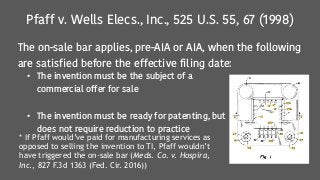
Pfaff v. Wells Elecs., Inc., 525 U.S. 55, 67 (1998)
The on-sale bar applies, pre-AIA or AIA, when the following
are satisfied before the effective filing date:
• The invention must be the subject of a
commercial offer for sale
• The invention must be ready for patenting, but
does not require reduction to practice
* If Pfaff would’ve paid for manufacturing services as
opposed to selling the invention to TI, Pfaff wouldn’t
have triggered the on-sale bar (Meds. Co. v. Hospira,
Inc., 827 F.3d 1363 (Fed. Cir. 2016))
Group One, Ltd. v. Hallmark Cards, Inc., 254 F.3d 1041, 1048 (Fed.
Cir. 2001)
• "We have developed a machine which can curl and shred ribbon so that
Hallmark can produce the product you see enclosed — a bag of already
curled and shredded ribbon. . . . We could provide the machine and/or the
technology and work on a license/royalty basis.”
• ”while the pre-critical-date communications between Group One and
Hallmark did not constitute a formal offer for sale in the contract sense,
they did constitute an offer for sale in the § 102(b) on-sale bar context.”
• Leases and Licenses also trigger the on-sale bar (Minton v. NASDAQ Inc.
336 F.3d 1473 (Fed.Cir.2003))
See also: Lacks Indus., Inc. v. McKechnie Vehicle Components USA, Inc., 322 F.3d 1335, 1348 (Fed. Cir. 2003)
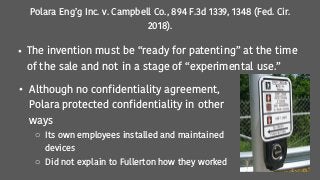
Polara Eng’g Inc. v. Campbell Co., 894 F.3d 1339, 1348 (Fed. Cir.
2018).
• The invention must be “ready for patenting” at the time
of the sale and not in a stage of “experimental use.”
• Although no confidentiality agreement,
Polara protected confidentiality in other
ways
o Its own employees installed and maintained
devices
o Did not explain to Fullerton how they worked
RCA Corp. v. Data General Corp., 887 F.2d 1056, 12 USPQ2d 1449
(Fed. Cir. 1989)
• More than 1 year before filing, RCA submitted a proposal
in response to a Request for Proposal put out by the
Federal Aviation Administration (FAA) for character
generation equipment for use in air traffic control centers
o Invention had been reduced to
practice prior to the FAA proposal
o Court ruled this as a definite offer to
sell the Cole invention
Quest Integrity USA, LLC v. Cokebusters USA Inc., No. 2017-2423
(Fed. Cir. May 21, 2019)
• Quest only provided final reports as a service, no
hardware or software was provided to the client
• Performance of the service for the client triggered the
on-sale bar — rather than the sale of the physical or
digital product
• Performing a method indicates that the product is ready
for patenting
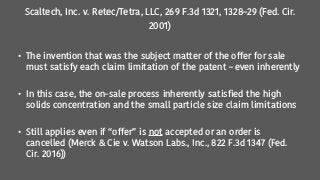
Scaltech, Inc. v. Retec/Tetra, LLC, 269 F.3d 1321, 1328–29 (Fed. Cir.
2001)
• The invention that was the subject matter of the offer for sale
must satisfy each claim limitation of the patent – even inherently
• In this case, the on-sale process inherently satisfied the high
solids concentration and the small particle size claim limitations
• Still applies even if “offer” is not accepted or an order is
cancelled (Merck & Cie v. Watson Labs., Inc., 822 F.3d 1347 (Fed.
Cir. 2016))
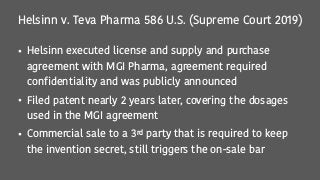
Helsinn v. Teva Pharma 586 U.S. (Supreme Court 2019)
• Helsinn executed license and supply and purchase
agreement with MGI Pharma, agreement required
confidentiality and was publicly announced
• Filed patent nearly 2 years later, covering the dosages
used in the MGI agreement
• Commercial sale to a 3rd party that is required to keep
the invention secret, still triggers the on-sale bar
this Quote
• “[i]t is a condition upon an inventor’s right to a patent
that he shall not exploit his discovery competitively
after it is ready for patenting; he must content himself
with either secrecy, or legal monopoly.”
– Pfaff, 525 U.S. at 68 (quoting Metallizing Eng’g Co. v. Kenyon
Bearing & Auto Parts Oc., 153 F.2d 516, 529 (2d Cir. 1946))
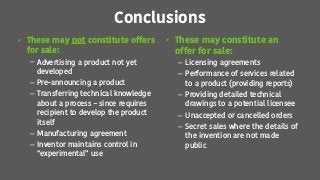
Conclusions
• These may not constitute offers
for sale:
– Advertising a product not yet
developed
– Pre-announcing a product
– Transferring technical knowledge
about a process – since requires
recipient to develop the product
itself
– Manufacturing agreement
– Inventor maintains control in
“experimental” use
• These may constitute an
offer for sale:
– Licensing agreements
– Performance of services related
to a product (providing reports)
– Providing detailed technical
drawings to a potential licensee
– Unaccepted or cancelled orders
– Secret sales where the details of
the invention are not made
public
On-sale Bar: Patentability and Selling Your Invention

On-sale Bar: Patentability and Selling Your Invention

  • 1.
    Patently Strategic Musings ASHLEY SLOAT| January 26, 2020 This presentation is for information purposes only and does not constitute legal advice.
  • 2.
    WELCOME! – Format •10 Minutes Ice: Breaker • 15-20 Minutes: Problem Solving • 30-35 Minutes: New Material
  • 3.
    Ice Breaker • Newpeople - introduce yourself • What’s the best professional development book you ever read?
  • 4.
    Shared Problem Solving •Fun Strategy Tidbits? • Any problems you are encountering with the USPTO? • Any practice issues arising? • Any technical issues you are facing?
  • 6.
    “On-Sale” in theU.S. Pre-AIA: A person shall be entitled to a patent unless – the invention was …in public use or on sale in this country, more than one year prior to the date of application for patent in the United States AIA: A person shall be entitled to a patent unless— the claimed invention was … on sale, or otherwise available to the public before the effective filing date of the claimed invention...
  • 7.
    Pfaff v. WellsElecs., Inc., 525 U.S. 55, 67 (1998) The on-sale bar applies, pre-AIA or AIA, when the following are satisfied before the effective filing date: • The invention must be the subject of a commercial offer for sale • The invention must be ready for patenting, but does not require reduction to practice * If Pfaff would’ve paid for manufacturing services as opposed to selling the invention to TI, Pfaff wouldn’t have triggered the on-sale bar (Meds. Co. v. Hospira, Inc., 827 F.3d 1363 (Fed. Cir. 2016))
  • 8.
    Group One, Ltd.v. Hallmark Cards, Inc., 254 F.3d 1041, 1048 (Fed. Cir. 2001) • "We have developed a machine which can curl and shred ribbon so that Hallmark can produce the product you see enclosed — a bag of already curled and shredded ribbon. . . . We could provide the machine and/or the technology and work on a license/royalty basis.” • ”while the pre-critical-date communications between Group One and Hallmark did not constitute a formal offer for sale in the contract sense, they did constitute an offer for sale in the § 102(b) on-sale bar context.” • Leases and Licenses also trigger the on-sale bar (Minton v. NASDAQ Inc. 336 F.3d 1473 (Fed.Cir.2003)) See also: Lacks Indus., Inc. v. McKechnie Vehicle Components USA, Inc., 322 F.3d 1335, 1348 (Fed. Cir. 2003)
  • 9.
    Polara Eng’g Inc.v. Campbell Co., 894 F.3d 1339, 1348 (Fed. Cir. 2018). • The invention must be “ready for patenting” at the time of the sale and not in a stage of “experimental use.” • Although no confidentiality agreement, Polara protected confidentiality in other ways o Its own employees installed and maintained devices o Did not explain to Fullerton how they worked
  • 10.
    RCA Corp. v.Data General Corp., 887 F.2d 1056, 12 USPQ2d 1449 (Fed. Cir. 1989) • More than 1 year before filing, RCA submitted a proposal in response to a Request for Proposal put out by the Federal Aviation Administration (FAA) for character generation equipment for use in air traffic control centers o Invention had been reduced to practice prior to the FAA proposal o Court ruled this as a definite offer to sell the Cole invention
  • 11.
    Quest Integrity USA,LLC v. Cokebusters USA Inc., No. 2017-2423 (Fed. Cir. May 21, 2019) • Quest only provided final reports as a service, no hardware or software was provided to the client • Performance of the service for the client triggered the on-sale bar — rather than the sale of the physical or digital product • Performing a method indicates that the product is ready for patenting
  • 12.
    Scaltech, Inc. v.Retec/Tetra, LLC, 269 F.3d 1321, 1328–29 (Fed. Cir. 2001) • The invention that was the subject matter of the offer for sale must satisfy each claim limitation of the patent – even inherently • In this case, the on-sale process inherently satisfied the high solids concentration and the small particle size claim limitations • Still applies even if “offer” is not accepted or an order is cancelled (Merck & Cie v. Watson Labs., Inc., 822 F.3d 1347 (Fed. Cir. 2016))
  • 13.
    Helsinn v. TevaPharma 586 U.S. (Supreme Court 2019) • Helsinn executed license and supply and purchase agreement with MGI Pharma, agreement required confidentiality and was publicly announced • Filed patent nearly 2 years later, covering the dosages used in the MGI agreement • Commercial sale to a 3rd party that is required to keep the invention secret, still triggers the on-sale bar
  • 14.
    this Quote • “[i]tis a condition upon an inventor’s right to a patent that he shall not exploit his discovery competitively after it is ready for patenting; he must content himself with either secrecy, or legal monopoly.” – Pfaff, 525 U.S. at 68 (quoting Metallizing Eng’g Co. v. Kenyon Bearing & Auto Parts Oc., 153 F.2d 516, 529 (2d Cir. 1946))
  • 15.
    Conclusions • These maynot constitute offers for sale: – Advertising a product not yet developed – Pre-announcing a product – Transferring technical knowledge about a process – since requires recipient to develop the product itself – Manufacturing agreement – Inventor maintains control in “experimental” use • These may constitute an offer for sale: – Licensing agreements – Performance of services related to a product (providing reports) – Providing detailed technical drawings to a potential licensee – Unaccepted or cancelled orders – Secret sales where the details of the invention are not made public