DAVID GAUNTLETT
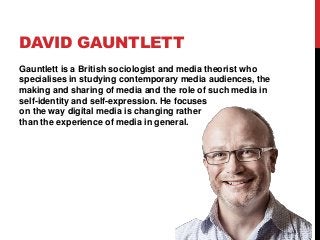
Gauntlett isa British sociologist and media theorist who
specialises in studying contemporary media audiences, the
making and sharing of media and the role of such media in
self-identity and self-expression. He focuses
on the way digital media is changing rather
than the experience of media in general.
3.
WEB 2.0
In 2007Gauntlett published ‘Media Studies 2.0’ online, which
argues that classic media studies fails to properly define
when the categories of audiences and producers unite, and
that new and altered teaching methods are needed.
Web 2.0 refers to websites that emphasize user generated
content and usability, meaning social networking sites like
Facebook and Twitter and video sharing sites like YouTube.
Gauntlett states that because of Web 2.0, audiences are able
to become producers thanks to websites such as YouTube,
so through this we can influence our own identity and even
influence other peoples.
4.
HOW HAS THISAFFECTED THE
MUSIC INDUSTRY?
Web 2.0 has democratised the music industry by putting
everyone on a level playing field. Previously musicians could
only have their music videos be shown on MTV and a select
few channels if they were popular enough, but now any
creator with internet access can upload to YouTube, and any
audience member with internet access can choose which
music videos they want to watch on YouTube.
This means that the big companies and popular artists no
longer have the same huge advantage as they did in the past,
as ultimately they are now relying on a system that anyone
can use and anyone can get views on.
5.
HOW HAS THISAFFECTED THE
MUSIC INDUSTRY?
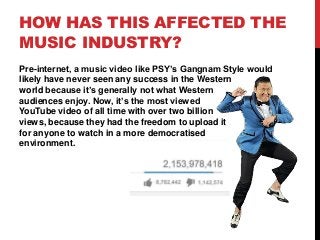
Pre-internet, a music video like PSY’s Gangnam Style would
likely have never seen any success in the Western
world because it’s generally not what Western
audiences enjoy. Now, it’s the most viewed
YouTube video of all time with over two billion
views, because they had the freedom to upload it
for anyone to watch in a more democratised
environment.
6.
HOW IS THISAPPLIED TO US?
We are effectively able to make and upload our music video
because of Web 2.0. We’ve conducted research using
websites that are Web 2.0, we’re using blogs to document
our progress which is an example of Web 2.0, and when we
have finished the video we will upload it onto the Web 2.0
video sharing website YouTube.
Ultimately, we are also audience members who have become
producers, as Gauntlett talked about in his studies. We are
both fans of the song and band we are making the music
video for, and we are able to become producers now because
Web 2.0 allows for audiences to take on that more active role
in the music industry.