PRESENTATION OUTLINE PORT OF DHAMRA PART I NEED FOR THE PORT PART II THE PORT PART III ENVIRONMENTAL CONCERNS- MYTHS AND FACTS
I. NEED FOR A PORT
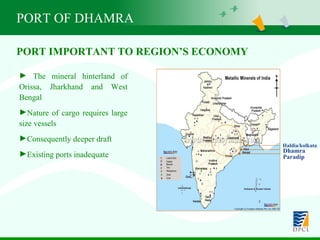
PORT OF DHAMRA The mineral hinterland of Orissa, Jharkhand and West Bengal Nature of cargo requires large size vessels Consequently deeper draft  Existing ports inadequate PORT IMPORTANT TO REGION’S ECONOMY Haldia/kolkata Dhamra Paradip
CHIEF CRITERIA TRANQUILITY DETERMINES COST OF BREAK WATER AND CORE STRUCTURES NEARNESS TO DEEP SEA DETERMINES LENGTH OF CHANNEL CHANNEL SUSTAINABILITY DETERMINES MAINTENANCE COST OF CHANNEL VIABLE PORT LOCATION
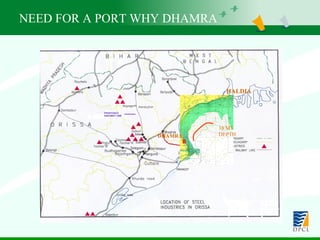
NEED FOR A PORT WHY DHAMRA HALDIA DHAMRA 18 MT DEPTH
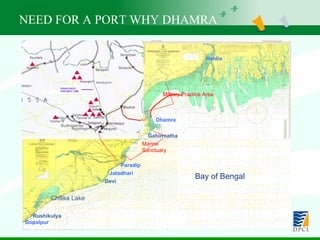
NEED FOR A PORT WHY DHAMRA Dhamra Haldia Gopalpur Gahirmatha Paradip Rushikulya Devi Jatadhari Military Practice Area Marine Sanctuary Bay of Bengal Chilika Lake
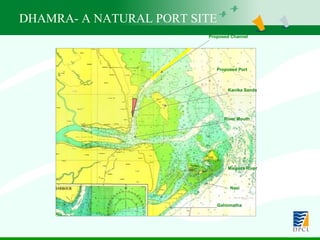
DHAMRA- A NATURAL PORT SITE Proposed Port Proposed Channel Kanika Sands River Mouth Maipura River Nasi Gahirmatha
II.   THE PORT OF DHAMRA
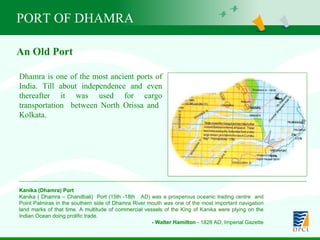
PORT OF DHAMRA Dhamra is one of the most ancient ports of India. Till about independence and even thereafter it was used for cargo transportation  between North Orissa and  Kolkata.   An Old Port Kanika (Dhamra) Port Kanika ( Dhamra – Chandbali)  Port (15th -18th  AD) was a prosperous oceanic trading centre  and Point Palmiras in the southern side of Dhamra River mouth was one of the most important navigation land marks of that time. A multitude of commercial vessels of the King of Kanika were plying on the Indian Ocean doing prolific trade. - Walter Hamilton  - 1828 AD, Imperial Gazette
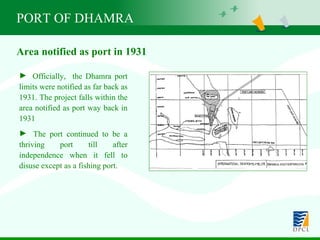
PORT OF DHAMRA Officially,  the Dhamra port limits were notified as far back as 1931. The project falls within the area notified as port way back in 1931  The port continued to be a thriving port till after independence when it fell to disuse except as a fishing port. Area notified as port in 1931
PORT OF DHAMRA The Government of Orissa, based on a RITES Study decided to develop Dhamra as a modern deep port on PPP mode DPCL was formed as a special purpose vehicle to develop the port under a concession agreement from GoI Originally a JV of L&T and two foreign companies, DPCL is now a 50:50 JV of L&T and TATA Steel DPCL FORMED
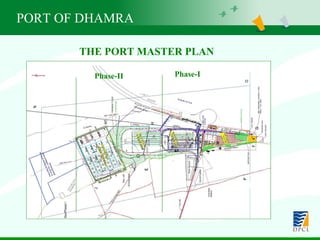
PORT OF DHAMRA THE PORT MASTER PLAN Phase-I Phase-II
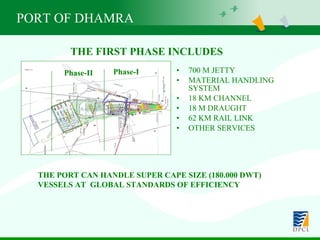
700 M JETTY MATERIAL HANDLING SYSTEM 18 KM CHANNEL 18 M DRAUGHT 62 KM RAIL LINK OTHER SERVICES PORT OF DHAMRA THE FIRST PHASE INCLUDES THE PORT CAN HANDLE SUPER CAPE SIZE (180.000 DWT) VESSELS AT  GLOBAL STANDARDS OF EFFICIENCY   Phase-I Phase-II
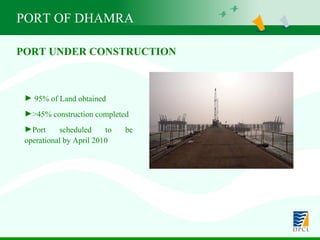
PORT OF DHAMRA 95% of Land obtained >45% construction completed Port scheduled to be operational by April 2010 PORT UNDER CONSTRUCTION
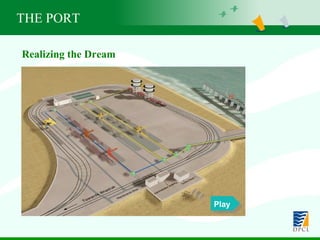
THE PORT Realizing the Dream Play
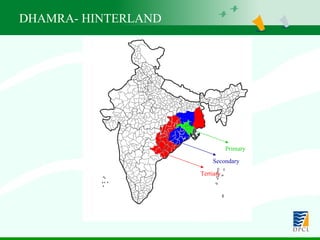
DHAMRA- HINTERLAND Primary Secondary Tertiary
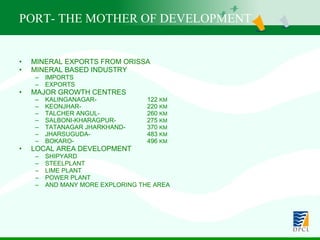
PORT- THE MOTHER OF DEVELOPMENT MINERAL EXPORTS FROM ORISSA MINERAL BASED INDUSTRY IMPORTS EXPORTS MAJOR GROWTH CENTRES KALINGANAGAR- 122  KM KEONJHAR-  220  KM TALCHER ANGUL-   260  KM SALBONI-KHARAGPUR-  275  KM TATANAGAR JHARKHAND- 370  KM JHARSUGUDA-  483  KM BOKARO-  496  KM LOCAL AREA DEVELOPMENT SHIPYARD STEELPLANT LIME PLANT POWER PLANT AND MANY MORE EXPLORING THE AREA
III.  ENVIRONMENTAL CONCERNS- MYTHS AND FACTS
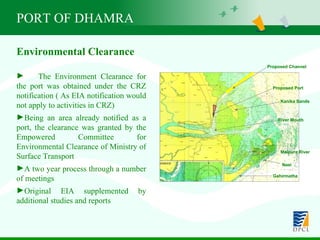
PORT OF DHAMRA Environmental Clearance The Environment Clearance for the port was obtained under the CRZ notification ( As EIA notification would not apply to activities in CRZ) Being an area already notified as a port, the clearance was granted by the Empowered Committee for Environmental Clearance of Ministry of Surface Transport A two year process through a number of meetings Original EIA supplemented by additional studies and reports Proposed Port Proposed Channel Kanika Sands River Mouth Maipura River Nasi Gahirmatha
PORT OF DHAMRA Environmental Clearance Upheld By National Environment Appellate Authority The Environment Clearance was challenged before the NEAA. NEAA after visiting the site observed as follows : “ The grant of EC for the said Port Expansion Project is made by Empowered  Committee for Environmental Clearance for Port Projects of MoST by  following the guidelines issued for Environmental Clearance of Ports issued  vide SO no (E) dated 9.7.97.” “ The area between the Low Tide Line and High Tide Line in the area to be  covered by Dhamra Port Expansion Project being of clay soil and very sticky it  could never become a breeding center for turtles.” The NEAA in a detailed judgment have upheld the Environment Clearance
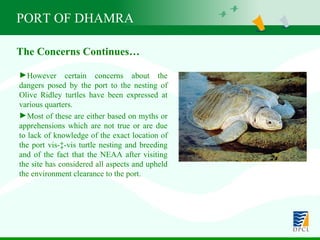
PORT OF DHAMRA However certain concerns about the dangers posed by the port to the nesting of Olive Ridley turtles have been expressed at various quarters.  Most of these are either based on myths or apprehensions which are not true or are due to lack of knowledge of the exact location of the port vis-à-vis turtle nesting and breeding and of the fact that the NEAA after visiting the site has considered all aspects and upheld the environment clearance to the port. The Concerns Continues…
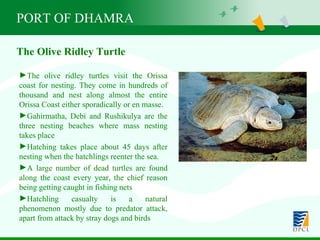
PORT OF DHAMRA The olive ridley turtles visit the Orissa coast for nesting. They come in hundreds of thousand and nest along almost the entire Orissa Coast either sporadically or en masse. Gahirmatha, Debi and Rushikulya are the three nesting beaches where mass nesting takes place Hatching takes place about 45 days after nesting when the hatchlings reenter the sea. A large number of dead turtles are found along the coast every year, the chief reason being getting caught in fishing nets Hatchling casualty is a natural phenomenon mostly due to predator attack, apart from attack by stray dogs and birds The Olive Ridley Turtle
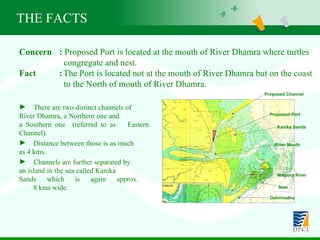
THE FACTS Concern  :  Proposed Port is located at the mouth of River Dhamra where turtles    congregate and nest. Fact  : The Port is located not at the mouth of River Dhamra but on the coast    to the North of mouth of River Dhamra. There are two distinct channels of  River Dhamra, a Northern one and  a Southern one  (referred to as  Eastern Channel).  Distance between those is as much  as 4 kms.  Channels are further separated by  an island in the sea called Kanika  Sands which is again approx.  8 kms wide. Proposed Port Proposed Channel Kanika Sands River Mouth Maipura River Nasi Gahirmatha
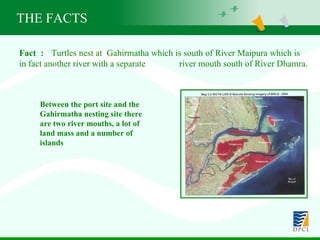
Fact  : Turtles nest at  Gahirmatha which is south of River Maipura which is  in fact another river with a separate  river mouth south of River Dhamra. THE FACTS Between the port site and the Gahirmatha nesting site there are two river mouths, a lot of land mass and a number of islands
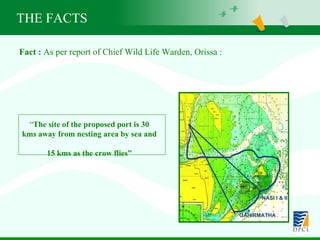
“ The site of the proposed port is 30 kms away from nesting area by sea and  15 kms as the crow flies” Fact :  As per report of Chief Wild Life Warden, Orissa : THE FACTS GAHIRMATHA  NASI I & II
Fact  :  The Proposed Port site is unsuitable for turtle nesting. Observations Of National Environment Appellate Authority “ The area between the low tide line and high tide line in the area to be covered by Dhamra Port expansion project being of clay soil and very sticky could never become a breeding center for turtles.” THE FACTS
Fact  :  Proposed site for Port lies in the only sector of  Orissa coast where  turtles do not nest Source:  Book titled  “Olive Ridley Sea Turtle (Lepidochelys Olivacea) and its nesting habitats along Orissa coast, India - a status survey”   by  B.Pandav ,  B. C. Choudhury  and  C. S. Kar  ;  Wildlife Institute of India, Dehradun, July 1994 THE FACTS Wide beach; Scattered sand dunes 1-2 m high; Degraded casuarinas vegetation  Turtle nesting in 2-km  long sand spits. Sandy Ganjam (60 kms) VIII Sand binder vegetation; sand dunes 5-6 m high; Turtle nesting is sporadic. Sandy Chilka (70 kms) VII Casuarinas vegetation; very high sand dunes 10-12 m high; Turtle nesting is sporadic. Sandy Puri (55 kms) VI Mangroves degraded; sand binder & casuarinas vegetation; Wide beach; sand dunes scattered 2-3 m high.  Turtle nesting in 3-km long sand spits. Sandy Devi (30 kms) V Scattered sand dunes; extensive Casuarinas plantation; Turtle nesting is sporadic. Sandy Kujang (30 kms) IV Depleted Mangroves & extensive Casuarinas vegetation; Turtle nesting is sporadic. Sandy Paradeep (55 kms) III Wide beach; Extensive mangrove and Casuarinas vegetation;  Turtle nesting in 4-km long sand spits.   Sandy Gahirmatha (35 kms) II Shallow Coast; no turtle nesting Generally Muddy Balasore (130 kms) [Dhamra Port area comes under this stretch] I Features Nature of Beach Coast Name  & Length Sl. No.
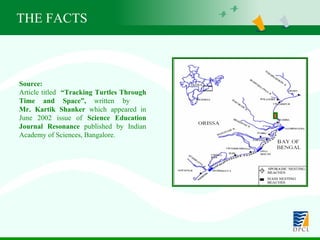
Source:   Article titled  “Tracking Turtles Through Time and Space”,  written by  Mr. Kartik Shanker  which appeared in June 2002 issue of  Science Education Journal Resonance  published by Indian Academy of Sciences, Bangalore.  THE FACTS
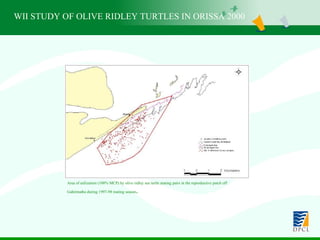
WII STUDY OF OLIVE RIDLEY TURTLES IN ORISSA 2000 Area of utilization (100% MCP) by olive ridley sea turtle mating pairs in the reproductive patch off Gahirmatha during 1997-98 mating season .
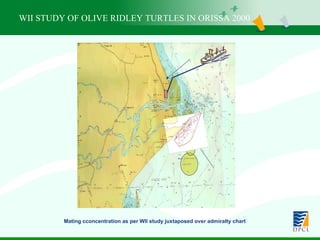
WII STUDY OF OLIVE RIDLEY TURTLES IN ORISSA 2000 Mating cconcentration as per WII study juxtaposed over admiralty chart
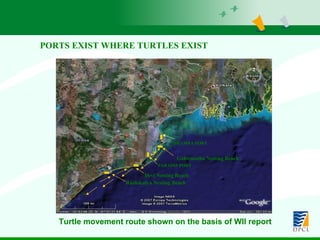
Turtle movement route shown on the basis of WII report PORTS EXIST WHERE TURTLES EXIST DHAMRA PORT Gahirmatha Nesting Beach PARADIP PORT Rushikulya Nesting Beach Devi Nesting Beach
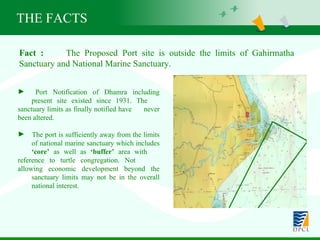
Fact :   The Proposed Port site is outside the limits of Gahirmatha  Sanctuary and National Marine Sanctuary. Port Notification of Dhamra including  present site existed since 1931. The  sanctuary limits as finally notified have  never been altered. The port is sufficiently away from the limits  of national marine sanctuary which includes  ‘core’  as well as  ‘buffer’  area with  reference to turtle congregation. Not  allowing economic development beyond the  sanctuary limits may not be in the overall  national interest. THE FACTS
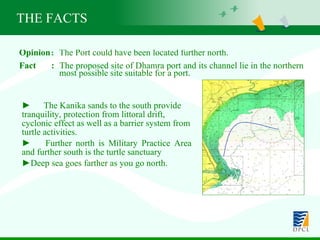
The Kanika sands to the south provide tranquility, protection from littoral drift, cyclonic effect as well as a barrier system from turtle activities. Further north is Military Practice Area and further south is the turtle sanctuary Deep sea goes farther as you go north. Opinion : The Port could have been located further north. Fact  :  The proposed site of Dhamra port and its channel lie in the northern  most possible site suitable for a port. THE FACTS
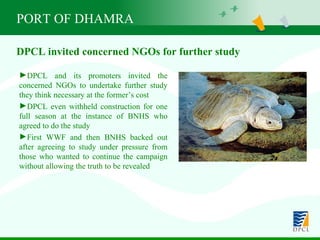
PORT OF DHAMRA DPCL and its promoters invited the concerned NGOs to undertake further study they think necessary at the former’s cost  DPCL even withheld construction for one full season at the instance of BNHS who agreed to do the study First WWF and then BNHS backed out after agreeing to study under pressure from those who wanted to continue the campaign without allowing the truth to be revealed  DPCL invited concerned NGOs for further study
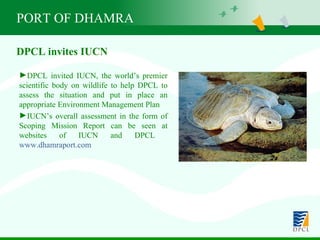
PORT OF DHAMRA DPCL invited IUCN, the world’s premier scientific body on wildlife to help DPCL to assess the situation and put in place an appropriate Environment Management Plan IUCN’s overall assessment in the form of Scoping Mission Report can be seen at websites of IUCN and DPCL  www.dhamraport.com   DPCL invites IUCN
IUCN RECOMMENDATIONS  While reaffirming that shipping activity and turtle habitations coexist in many parts of the world, IUCN have identified two potential  areas for extra care and precautions Dredging Illumination  DPCL is taking elaborate measures under constant advice of IUCN to mitigate harm from dredging and lighting The IUCN has posted a full time Project Manager for the Dhamra project.
ENVIRONMENT MONITORING MECHANISM   Environment Monitoring Committee To ensure compliance with conditions of clearance Regional Research Laboratory To monitor sea water quality with reference to marine productivity  National Institute of Oceanography To study impact of dredging on beach profile International Union for Conservation of Nature To advise on measures to be taken during construction and prepare Environment Management Plan to be implemented during operation
A malicious campaign which started only after entry of Tata Steel  In May, 2007 Greenpeace went to press with a report said to be prepared by North Orissa University (NOU). NOU in  a press conference disowned the report as the original report had been doctored Greenpeace circulates falsehood about EIA, BNP Paribas  etc. DPCL reply to all Greenpeace concerns can be seen at the website  www.dhamraport.com GREENPEACE OPPOSITION TO THE PORT
An attempt made to engage Greenpeace and others in a dialogue  DPCL agreed to facilitate and fund further studies Greenpeace started a new demand that construction be stopped pending study Greenpeace resumes campaign DIALOGUE WITH GREENPEACE AND OTHERS
The port is a public infrastructure identified as a requirement for the region  DPCL is undertaking the task with environmental measures globally accepted as best DPCL is aware of its social and environmental responsibility DPCL is  committed to sustainable development The port is already under construction and will be completed as per schedule DPCL NOT TO BE DETERRED
Thank You

Ecofriendly Dhamra

  • 1.
  • 2.
    PRESENTATION OUTLINE PORTOF DHAMRA PART I NEED FOR THE PORT PART II THE PORT PART III ENVIRONMENTAL CONCERNS- MYTHS AND FACTS
  • 3.
  • 4.
    PORT OF DHAMRAThe mineral hinterland of Orissa, Jharkhand and West Bengal Nature of cargo requires large size vessels Consequently deeper draft Existing ports inadequate PORT IMPORTANT TO REGION’S ECONOMY Haldia/kolkata Dhamra Paradip
  • 5.
    CHIEF CRITERIA TRANQUILITYDETERMINES COST OF BREAK WATER AND CORE STRUCTURES NEARNESS TO DEEP SEA DETERMINES LENGTH OF CHANNEL CHANNEL SUSTAINABILITY DETERMINES MAINTENANCE COST OF CHANNEL VIABLE PORT LOCATION
  • 6.
    NEED FOR APORT WHY DHAMRA HALDIA DHAMRA 18 MT DEPTH
  • 7.
    NEED FOR APORT WHY DHAMRA Dhamra Haldia Gopalpur Gahirmatha Paradip Rushikulya Devi Jatadhari Military Practice Area Marine Sanctuary Bay of Bengal Chilika Lake
  • 8.
    DHAMRA- A NATURALPORT SITE Proposed Port Proposed Channel Kanika Sands River Mouth Maipura River Nasi Gahirmatha
  • 9.
    II. THE PORT OF DHAMRA
  • 10.
    PORT OF DHAMRADhamra is one of the most ancient ports of India. Till about independence and even thereafter it was used for cargo transportation between North Orissa and Kolkata. An Old Port Kanika (Dhamra) Port Kanika ( Dhamra – Chandbali) Port (15th -18th AD) was a prosperous oceanic trading centre and Point Palmiras in the southern side of Dhamra River mouth was one of the most important navigation land marks of that time. A multitude of commercial vessels of the King of Kanika were plying on the Indian Ocean doing prolific trade. - Walter Hamilton - 1828 AD, Imperial Gazette
  • 11.
    PORT OF DHAMRAOfficially, the Dhamra port limits were notified as far back as 1931. The project falls within the area notified as port way back in 1931 The port continued to be a thriving port till after independence when it fell to disuse except as a fishing port. Area notified as port in 1931
  • 12.
    PORT OF DHAMRAThe Government of Orissa, based on a RITES Study decided to develop Dhamra as a modern deep port on PPP mode DPCL was formed as a special purpose vehicle to develop the port under a concession agreement from GoI Originally a JV of L&T and two foreign companies, DPCL is now a 50:50 JV of L&T and TATA Steel DPCL FORMED
  • 13.
    PORT OF DHAMRATHE PORT MASTER PLAN Phase-I Phase-II
  • 14.
    700 M JETTYMATERIAL HANDLING SYSTEM 18 KM CHANNEL 18 M DRAUGHT 62 KM RAIL LINK OTHER SERVICES PORT OF DHAMRA THE FIRST PHASE INCLUDES THE PORT CAN HANDLE SUPER CAPE SIZE (180.000 DWT) VESSELS AT GLOBAL STANDARDS OF EFFICIENCY Phase-I Phase-II
  • 15.
    PORT OF DHAMRA95% of Land obtained >45% construction completed Port scheduled to be operational by April 2010 PORT UNDER CONSTRUCTION
  • 16.
    THE PORT Realizingthe Dream Play
  • 17.
    DHAMRA- HINTERLAND PrimarySecondary Tertiary
  • 18.
    PORT- THE MOTHEROF DEVELOPMENT MINERAL EXPORTS FROM ORISSA MINERAL BASED INDUSTRY IMPORTS EXPORTS MAJOR GROWTH CENTRES KALINGANAGAR- 122 KM KEONJHAR- 220 KM TALCHER ANGUL- 260 KM SALBONI-KHARAGPUR- 275 KM TATANAGAR JHARKHAND- 370 KM JHARSUGUDA- 483 KM BOKARO- 496 KM LOCAL AREA DEVELOPMENT SHIPYARD STEELPLANT LIME PLANT POWER PLANT AND MANY MORE EXPLORING THE AREA
  • 19.
    III. ENVIRONMENTALCONCERNS- MYTHS AND FACTS
  • 20.
    PORT OF DHAMRAEnvironmental Clearance The Environment Clearance for the port was obtained under the CRZ notification ( As EIA notification would not apply to activities in CRZ) Being an area already notified as a port, the clearance was granted by the Empowered Committee for Environmental Clearance of Ministry of Surface Transport A two year process through a number of meetings Original EIA supplemented by additional studies and reports Proposed Port Proposed Channel Kanika Sands River Mouth Maipura River Nasi Gahirmatha
  • 21.
    PORT OF DHAMRAEnvironmental Clearance Upheld By National Environment Appellate Authority The Environment Clearance was challenged before the NEAA. NEAA after visiting the site observed as follows : “ The grant of EC for the said Port Expansion Project is made by Empowered Committee for Environmental Clearance for Port Projects of MoST by following the guidelines issued for Environmental Clearance of Ports issued vide SO no (E) dated 9.7.97.” “ The area between the Low Tide Line and High Tide Line in the area to be covered by Dhamra Port Expansion Project being of clay soil and very sticky it could never become a breeding center for turtles.” The NEAA in a detailed judgment have upheld the Environment Clearance
  • 22.
    PORT OF DHAMRAHowever certain concerns about the dangers posed by the port to the nesting of Olive Ridley turtles have been expressed at various quarters. Most of these are either based on myths or apprehensions which are not true or are due to lack of knowledge of the exact location of the port vis-à-vis turtle nesting and breeding and of the fact that the NEAA after visiting the site has considered all aspects and upheld the environment clearance to the port. The Concerns Continues…
  • 23.
    PORT OF DHAMRAThe olive ridley turtles visit the Orissa coast for nesting. They come in hundreds of thousand and nest along almost the entire Orissa Coast either sporadically or en masse. Gahirmatha, Debi and Rushikulya are the three nesting beaches where mass nesting takes place Hatching takes place about 45 days after nesting when the hatchlings reenter the sea. A large number of dead turtles are found along the coast every year, the chief reason being getting caught in fishing nets Hatchling casualty is a natural phenomenon mostly due to predator attack, apart from attack by stray dogs and birds The Olive Ridley Turtle
  • 24.
    THE FACTS Concern : Proposed Port is located at the mouth of River Dhamra where turtles congregate and nest. Fact : The Port is located not at the mouth of River Dhamra but on the coast to the North of mouth of River Dhamra. There are two distinct channels of River Dhamra, a Northern one and a Southern one (referred to as Eastern Channel). Distance between those is as much as 4 kms. Channels are further separated by an island in the sea called Kanika Sands which is again approx. 8 kms wide. Proposed Port Proposed Channel Kanika Sands River Mouth Maipura River Nasi Gahirmatha
  • 25.
    Fact :Turtles nest at Gahirmatha which is south of River Maipura which is in fact another river with a separate river mouth south of River Dhamra. THE FACTS Between the port site and the Gahirmatha nesting site there are two river mouths, a lot of land mass and a number of islands
  • 26.
    “ The siteof the proposed port is 30 kms away from nesting area by sea and 15 kms as the crow flies” Fact : As per report of Chief Wild Life Warden, Orissa : THE FACTS GAHIRMATHA NASI I & II
  • 27.
    Fact : The Proposed Port site is unsuitable for turtle nesting. Observations Of National Environment Appellate Authority “ The area between the low tide line and high tide line in the area to be covered by Dhamra Port expansion project being of clay soil and very sticky could never become a breeding center for turtles.” THE FACTS
  • 28.
    Fact : Proposed site for Port lies in the only sector of Orissa coast where turtles do not nest Source: Book titled “Olive Ridley Sea Turtle (Lepidochelys Olivacea) and its nesting habitats along Orissa coast, India - a status survey” by B.Pandav , B. C. Choudhury and C. S. Kar ; Wildlife Institute of India, Dehradun, July 1994 THE FACTS Wide beach; Scattered sand dunes 1-2 m high; Degraded casuarinas vegetation Turtle nesting in 2-km long sand spits. Sandy Ganjam (60 kms) VIII Sand binder vegetation; sand dunes 5-6 m high; Turtle nesting is sporadic. Sandy Chilka (70 kms) VII Casuarinas vegetation; very high sand dunes 10-12 m high; Turtle nesting is sporadic. Sandy Puri (55 kms) VI Mangroves degraded; sand binder & casuarinas vegetation; Wide beach; sand dunes scattered 2-3 m high. Turtle nesting in 3-km long sand spits. Sandy Devi (30 kms) V Scattered sand dunes; extensive Casuarinas plantation; Turtle nesting is sporadic. Sandy Kujang (30 kms) IV Depleted Mangroves & extensive Casuarinas vegetation; Turtle nesting is sporadic. Sandy Paradeep (55 kms) III Wide beach; Extensive mangrove and Casuarinas vegetation; Turtle nesting in 4-km long sand spits. Sandy Gahirmatha (35 kms) II Shallow Coast; no turtle nesting Generally Muddy Balasore (130 kms) [Dhamra Port area comes under this stretch] I Features Nature of Beach Coast Name & Length Sl. No.
  • 29.
    Source: Article titled “Tracking Turtles Through Time and Space”, written by Mr. Kartik Shanker which appeared in June 2002 issue of Science Education Journal Resonance published by Indian Academy of Sciences, Bangalore. THE FACTS
  • 30.
    WII STUDY OFOLIVE RIDLEY TURTLES IN ORISSA 2000 Area of utilization (100% MCP) by olive ridley sea turtle mating pairs in the reproductive patch off Gahirmatha during 1997-98 mating season .
  • 31.
    WII STUDY OFOLIVE RIDLEY TURTLES IN ORISSA 2000 Mating cconcentration as per WII study juxtaposed over admiralty chart
  • 32.
    Turtle movement routeshown on the basis of WII report PORTS EXIST WHERE TURTLES EXIST DHAMRA PORT Gahirmatha Nesting Beach PARADIP PORT Rushikulya Nesting Beach Devi Nesting Beach
  • 33.
    Fact : The Proposed Port site is outside the limits of Gahirmatha Sanctuary and National Marine Sanctuary. Port Notification of Dhamra including present site existed since 1931. The sanctuary limits as finally notified have never been altered. The port is sufficiently away from the limits of national marine sanctuary which includes ‘core’ as well as ‘buffer’ area with reference to turtle congregation. Not allowing economic development beyond the sanctuary limits may not be in the overall national interest. THE FACTS
  • 34.
    The Kanika sandsto the south provide tranquility, protection from littoral drift, cyclonic effect as well as a barrier system from turtle activities. Further north is Military Practice Area and further south is the turtle sanctuary Deep sea goes farther as you go north. Opinion : The Port could have been located further north. Fact : The proposed site of Dhamra port and its channel lie in the northern most possible site suitable for a port. THE FACTS
  • 35.
    PORT OF DHAMRADPCL and its promoters invited the concerned NGOs to undertake further study they think necessary at the former’s cost DPCL even withheld construction for one full season at the instance of BNHS who agreed to do the study First WWF and then BNHS backed out after agreeing to study under pressure from those who wanted to continue the campaign without allowing the truth to be revealed DPCL invited concerned NGOs for further study
  • 36.
    PORT OF DHAMRADPCL invited IUCN, the world’s premier scientific body on wildlife to help DPCL to assess the situation and put in place an appropriate Environment Management Plan IUCN’s overall assessment in the form of Scoping Mission Report can be seen at websites of IUCN and DPCL www.dhamraport.com DPCL invites IUCN
  • 37.
    IUCN RECOMMENDATIONS While reaffirming that shipping activity and turtle habitations coexist in many parts of the world, IUCN have identified two potential areas for extra care and precautions Dredging Illumination DPCL is taking elaborate measures under constant advice of IUCN to mitigate harm from dredging and lighting The IUCN has posted a full time Project Manager for the Dhamra project.
  • 38.
    ENVIRONMENT MONITORING MECHANISM Environment Monitoring Committee To ensure compliance with conditions of clearance Regional Research Laboratory To monitor sea water quality with reference to marine productivity National Institute of Oceanography To study impact of dredging on beach profile International Union for Conservation of Nature To advise on measures to be taken during construction and prepare Environment Management Plan to be implemented during operation
  • 39.
    A malicious campaignwhich started only after entry of Tata Steel In May, 2007 Greenpeace went to press with a report said to be prepared by North Orissa University (NOU). NOU in a press conference disowned the report as the original report had been doctored Greenpeace circulates falsehood about EIA, BNP Paribas etc. DPCL reply to all Greenpeace concerns can be seen at the website www.dhamraport.com GREENPEACE OPPOSITION TO THE PORT
  • 40.
    An attempt madeto engage Greenpeace and others in a dialogue DPCL agreed to facilitate and fund further studies Greenpeace started a new demand that construction be stopped pending study Greenpeace resumes campaign DIALOGUE WITH GREENPEACE AND OTHERS
  • 41.
    The port isa public infrastructure identified as a requirement for the region DPCL is undertaking the task with environmental measures globally accepted as best DPCL is aware of its social and environmental responsibility DPCL is committed to sustainable development The port is already under construction and will be completed as per schedule DPCL NOT TO BE DETERRED
  • 42.