Learn how to get started studying for the Graduate Record Exam (GRE) including:
- When to start preparing for the exam
- What GRE books are best
- How to approach the math section (if you haven't taken math in years)
Introduction to theGRE
Webinar
Rich Carriero
Academic Manager, Next Step Test Preparation
1
2.
Introductions
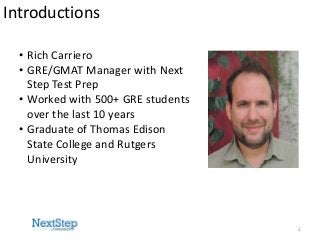
• Rich Carriero
•GRE/GMAT Manager with Next
Step Test Prep
• Worked with 500+ GRE students
over the last 10 years
• Graduate of Thomas Edison
State College and Rutgers
University
2
When should Itake the GRE?
Whenever is most convenient for you.
The score is good for 5 years.
If you are facing an application deadline, set a failsafe test
date of no few than three weeks before the deadline.
Give yourself the opportunity to take it more than once.
4
5.
How long shouldyou prepare for the GRE?
• If you have significant free
time, 2-3 months.
• If you have a busy work
schedule, 3-5 months.
• You can start working on
your vocabulary and
reading at any time.
5
6.
How is theGRE Scored?
• Raw score: number of questions right out of total (out of 40 for
quantitative and verbal)
• Scaled score: 130-170 per section
• 50th percentile: 151 verbal, 152 quant
• 91st percentile: 163 verbal, 165 quant
• Computer Adaptive: the GRE adapts by section.
Your goal score depends on your goals.
6
7.
“Ok, so whatdo I need to do to pass?”
There isn’t a passing score. The higher your score, the better your
chances of admission (and financial aid) at more prestigious schools.
While most graduate programs won’t tell you what score you need to
gain admission, they will often publish 25th and 75th percentile GRE
scores of last year’s accepted applicants.
Research the programs you want to attend before you take the GRE.
7
8.
Great….so, just tellme what I need to pass!
It’s in your extreme best interest to get your best
possible score on the GRE
Graduate schools use the GRE to make admissions decisions but also financial aid.
Why?
8
9.
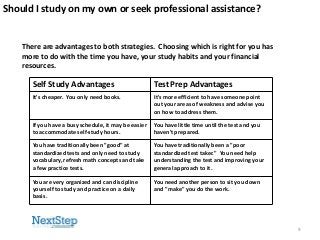
Should I studyon my own or seek professional assistance?
There are advantages to both strategies. Choosing which is right for you has
more to do with the time you have, your study habits and your financial
resources.
Self Study Advantages
Test Prep Advantages
It's cheaper. You only need books.
It's more efficient to have someone point
out your areas of weakness and advise you
on how to address them.
Reading Comprehension until the test and you
You have little time
If you have a busy schedule, it may be easier
to accommodate self-study hours.
You have traditionally been "good" at
standardized tests and only need to study
vocabulary, refresh math concepts and take
a few practice tests.
You are very organized and can discipline
yourself to study and practice on a daily
basis.
haven't prepared.
You have traditionally been a "poor
standardized test taker." You need help
understanding the test and improving your
general approach to it.
Reading Comprehension
You need another person to sit you down
and "make" you do the work.
9
Take the testwith YOUR goals in mind
• The GRE is different for everyone.
• Each multiple choice section has 20 questions.
• Know how many questions per section correspond
to your goal score.
11
12.
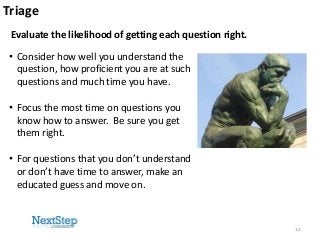
Triage
Evaluate the likelihoodof getting each question right.
• Consider how well you understand the
question, how proficient you are at such
questions and much time you have.
• Focus the most time on questions you
know how to answer. Be sure you get
them right.
• For questions that you don’t understand
or don’t have time to answer, make an
educated guess and move on.
12
13.
Answer EVERYTHING
Unlike theSAT, there is no wrong answer penalty on the
GRE, therefore, always choose an answer, even if it’s a blind guess.
13
14.
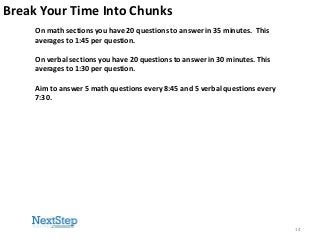
Break Your TimeInto Chunks
On math sections you have 20 questions to answer in 35 minutes. This
averages to 1:45 per question.
On verbal sections you have 20 questions to answer in 30 minutes. This
averages to 1:30 per question.
Aim to answer 5 math questions every 8:45 and 5 verbal questions every
7:30.
14
15.
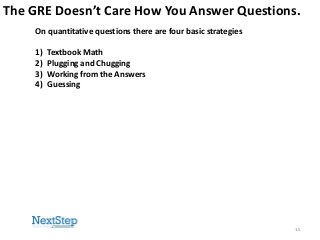
The GRE Doesn’tCare How You Answer Questions.
On quantitative questions there are four basic strategies
1)
2)
3)
4)
Textbook Math
Plugging and Chugging
Working from the Answers
Guessing
15
16.
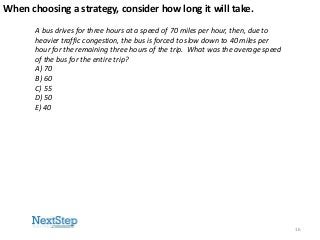
When choosing astrategy, consider how long it will take.
A bus drives for three hours at a speed of 70 miles per hour, then, due to
heavier traffic congestion, the bus is forced to slow down to 40 miles per
hour for the remaining three hours of the trip. What was the average speed
of the bus for the entire trip?
A) 70
B) 60
C) 55
D) 50
E) 40
16
17.
A bus drivesfor three hours at a speed of 70 miles per hour, then, due to
heavier traffic congestion, the bus is forced to slow down to 40 miles per
hour for the remaining three hours of the trip. What was the average speed
of the bus for the entire trip?
A) 70
B) 60
C) 55
D) 50
E) 40
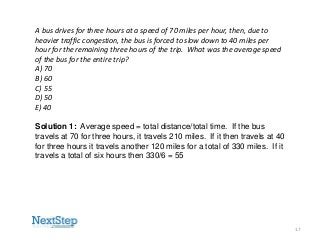
Solution 1: Average speed = total distance/total time. If the bus
travels at 70 for three hours, it travels 210 miles. If it then travels at 40
for three hours it travels another 120 miles for a total of 330 miles. If it
travels a total of six hours then 330/6 = 55
17
18.
A bus drivesfor three hours at a speed of 70 miles per hour, then, due to
heavier traffic congestion, the bus is forced to slow down to 40 miles per
hour for the remaining three hours of the trip. What was the average speed
of the bus for the entire trip?
A) 70
B) 60
C) 55
D) 50
E) 40
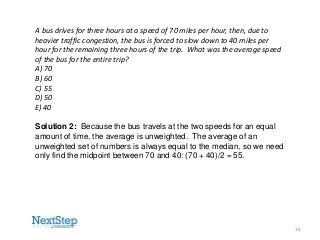
Solution 2: Because the bus travels at the two speeds for an equal
amount of time, the average is unweighted. The average of an
unweighted set of numbers is always equal to the median, so we need
only find the midpoint between 70 and 40: (70 + 40)/2 = 55.
18
19.
A bus drivesfor three hours at a speed of 70 miles per hour, then, due to
heavier traffic congestion, the bus is forced to slow down to 40 miles per
hour for the remaining three hours of the trip. What was the average speed
of the bus for the entire trip?
A) 70
B) 60
C) 55
D) 50
E) 40
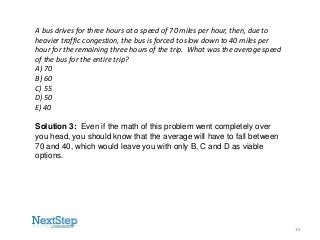
Solution 3: Even if the math of this problem went completely over
you head, you should know that the average will have to fall between
70 and 40, which would leave you with only B, C and D as viable
options.
19
20.
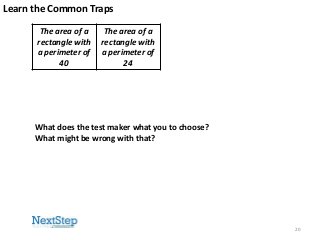
Learn the CommonTraps
The area of a
rectangle with
a perimeter of
40
The area of a
rectangle with
a perimeter of
24
What does the test maker what you to choose?
What might be wrong with that?
20
21.
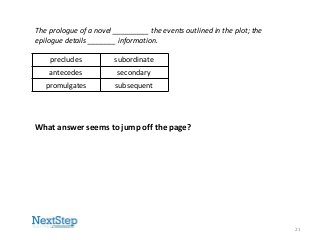
The prologue ofa novel _________ the events outlined in the plot; the
epilogue details _______ information.
precludes
subordinate
antecedes
secondary
promulgates
subsequent
What answer seems to jump off the page?
21
22.
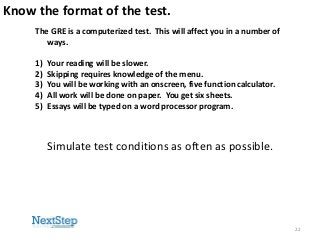
Know the formatof the test.
The GRE is a computerized test. This will affect you in a number of
ways.
1)
2)
3)
4)
5)
Your reading will be slower.
Skipping requires knowledge of the menu.
You will be working with an onscreen, five function calculator.
All work will be done on paper. You get six sheets.
Essays will be typed on a word processor program.
Simulate test conditions as often as possible.
22
23.
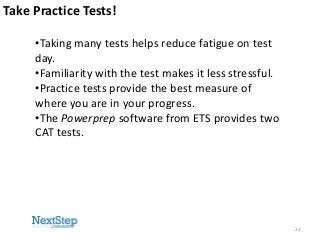
Take Practice Tests!
•Takingmany tests helps reduce fatigue on test
day.
•Familiarity with the test makes it less stressful.
•Practice tests provide the best measure of
where you are in your progress.
•The Powerprep software from ETS provides two
CAT tests.
23
24.
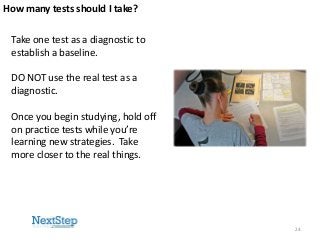
How many testsshould I take?
Take one test as a diagnostic to
establish a baseline.
DO NOT use the real test as a
diagnostic.
Once you begin studying, hold off
on practice tests while you’re
learning new strategies. Take
more closer to the real things.
24
25.
Take good careof yourself
Some basic tips for healthy and effective study.
1) Exercise relieves stress and helps your brain work better.
2) A balanced diet and sleep will help keep your energy level and
concentration up during study time and on the GRE.
3) Give yourself one day off from studying a week.
4) DO NOT study the night before the test.
5) Keep your test day stress to a minimum by giving yourself plenty
of time.
25
26.
Strategy Tips Review
1.Take the test with your goals in mind
2. Triage every question
3. Answer everything
4. Break your time into chunks
5. The GRE doesn’t care how you answer a question
6. When choosing a strategy, consider how long it will
take.
7. Learn the common traps
8. Know the format of the test
9. Take practice tests
10. Take good care of yourself
26
Thank you forlistening!
Please contact me if you have any questions
about the GRE or grad school admissions.
Rich Carriero
rich@nextsteptestprep.com
303-459-4339
www.nextsteptestprep.com
28