February 21, 2019
Privacy Considerations in the Digital Age
Brian Ray, J.D.
Professor of Law, Cleveland State University
Suzanne Rivera, Ph.D.
Associate Professor of Bioethics, Case Western Reserve University
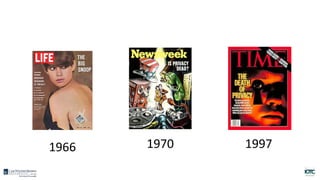
1970 19971966
Privacy Defined
• the state or condition of being free from being observed or disturbed
by other people
• freedom from unauthorized intrusion
• the right to keep one’s personal matters secret
• the ability of an individual or group to seclude themselves, or
information about themselves, and thereby express themselves
selectively
• the ability to determine whether, when, how, and to whom one’s
personal information is to be revealed
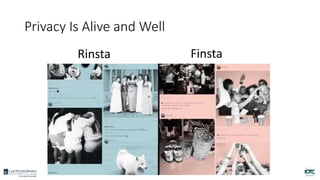
Privacy Is Alive and Well
Rinsta Finsta
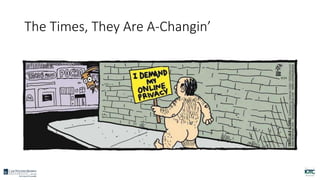
The Times, They Are A-Changin’
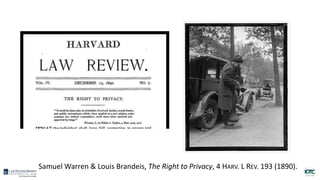
Samuel Warren & Louis Brandeis, The Right to Privacy, 4 HARV. L REV. 193 (1890).
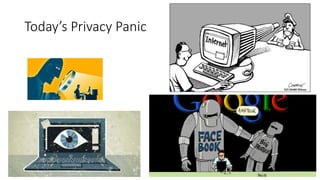
Today’s Privacy Panic
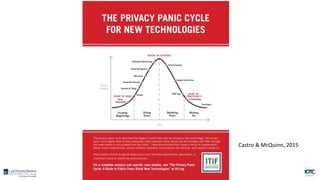
Castro & McQuinn, 2015
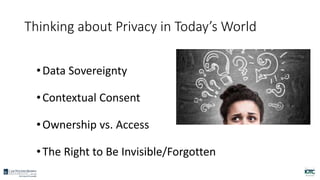
Thinking about Privacy in Today’s World
•Data Sovereignty
•Contextual Consent
•Ownership vs. Access
•The Right to Be Invisible/Forgotten
Ethical Principles for 21st Century Problems
•Respect for Persons
•Beneficence
•Justice
•Non-maleficence
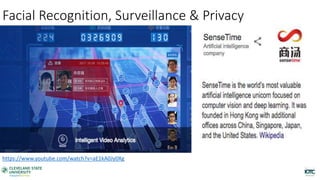
Facial Recognition, Surveillance & Privacy
https://www.youtube.com/watch?v=aE1kA0Jy0Xg
https://www.youtube.com/watch?time_co
ntinue=2&v=D1gj_9aKRJU
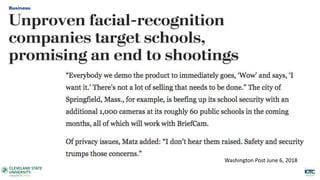
Washington Post June 6, 2018
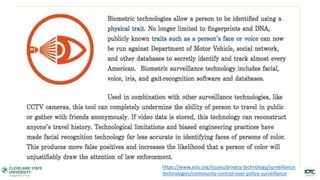
https://www.aclu.org/issues/privacy-technology/surveillance-
technologies/community-control-over-police-surveillance
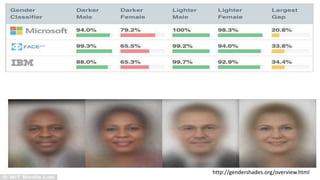
http://gendershades.org/overview.html
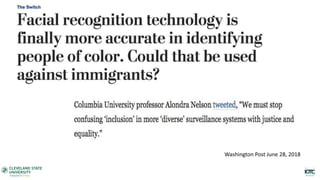
Washington Post June 28, 2018
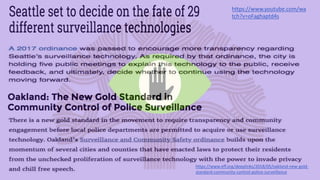
https://www.youtube.com/wa
tch?v=oFaghaptd4s
https://www.eff.org/deeplinks/2018/05/oakland-new-gold-
standard-community-control-police-surveillance
Your Questions

Privacy considerations in the digital age

Editor's Notes

  • #2 Titles: Calibri - 44 - Bold - Color: HEX #595959 Body: Calibri - 24 - Color: HEX #595959 Blue Color: HEX #003658 Green Color: HEX #046648
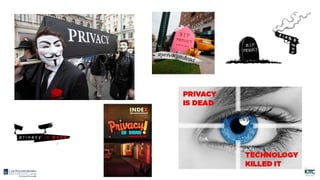
  • #4 Good morning! I want to begin today with a provocative statement: People who say “privacy is dead” are being irresponsible and silly. Lots of people say this and I just want to reject it out of hand. Privacy is not dead. That’s hyperbole. Or, perhaps, it would be more appropriate for me to paraphrase the statement Mark Twain was said to have made when he allegedly quipped, “The report of my death has been greatly exaggerated.” Reports about the death of privacy are greatly exaggerated.
  • #5 And, if you think fears about the death of privacy are unprecedented, please allow me to take you on a little walk down memory lane… Here we have the covers of Life Magazine, Newsweek, and Time. Now, some of you are too young to remember these as the authoritative news sources of their day. I can’t think of an ostensibly neutral publication today with such appeal to “mainstream” consumers of digested news media. But, take my word for it– they were important. Let me draw your attention to the dates of publication. According to these sources, privacy has been dead since 1997 but it was on life support since at least 1966.
  • #6 Well, of course that’s kind of funny because we all think we know what privacy is and, since we want to protect it, it can't have already died. So, what is privacy, really? READ DEFINITIONS I’ve called out in red the words that I think are especially important in order to focus our attention on a few concepts. One is that a violation feels harmful. The other is that individual autonomy or control is really important. We want to decide for ourselves what we protect and what we share. And when we share, we want to know we can trust whomever receives our confidence.
  • #7 And when you think about these definitions, it becomes pretty clear that—despite new technological advances—privacy as a concept is not dead. It is very much alive. As evidence of this, I want to ask how many people here have teenagers who use Instagram or snapchat. Raise your hands. OK. The reason there is a Snapchat is because kids want to say things privately and then have then disappear so unauthorized viewers won’t see them. And Instagram? I’m sorry to be the bearer of this news, but most young people with Insta accounts also have “Finstas.” Never heard of Finsta? Who here can tell us what a Finsta is? POINT OUT DIFFERENCES IN PHOTO CONTENT So, yes. The concept of privacy is alive and well.
  • #8 But, it’s true that our ideas about privacy have changed over time. The pledge in the Hippocratic oath (5th century B.C.), includes the following phrase: "Whatever I see or hear in the lives of my patients ... which ought not to be spoken of outside, I will keep secret, as considering all such things to be private." By today’s standards, as promulgated and reinforced via the Privacy Rule of HIPAA, the unauthorized viewing or sharing of just the gender or zipcode of a patient--- with no other identifying information attached--- is considered a privacy violation. So, in that regard, we’ve gotten much more strict. And, if you are familiar with the EU’s GDPR rules, you know some think we need to be even more strict.
  • #9 Conversely, it might surprise you to know that, in 1890, Samuel Warren and Louis Brandeis wrote a seminal piece in the Harvard Law Review called “The Right to Privacy.” In it. they argued that “[i]nstantaneous photographs and newspaper enterprise have invaded the sacred precincts of private and domestic life; and numerous mechanical devices threaten to make good the prediction that ‘what is whispered in the closet shall be proclaimed from the housetops.” In their day, the idea of a still photograph ending up in a newspaper felt like a dangerous threat to civilized society. Now, by today’s standards, that sounds downright nutty. And, in truth, it turns out that this article, which is one of the most cited law review articles ever, was written because Warren didn’t approve of the way his daughter’s wedding was covered in the newspapers. So, just imagine what they would have to say about YouTube. Or the phenomenon we have come to know as “revenge porn.” What I’m trying to say is that attitudes change. Eventually, people in the United States (and around the world) adjusted to a new paradigm for journalistic inquiry that included still photography –an advance that, in hindsight, improved reporting by providing more specific information to readers. This was followed by video journalism and then internet journalism, each bringing about a shift in consumers’ expectations about where precisely the camera would go and how the images would be delivered. But, in 1890, as people were still getting used to the newly widespread availability of cameras, a kind of privacy panic took hold.
  • #10 When it comes to the use of digital records and data today, some privacy advocates are feeling a similar panic. Their fear is that the widespread creation, collection, sharing and aggregation of personal data will not only violate privacy but also can cause harm.   And their fear remains even when the data are de-identified. Why? Because of the possibility of re-identification, and a worry that such information could be used in a harmful way (such as discrimination) or used to develop commercial products for which the sources of those data receive no compensation.
  • #11 Castro and McQuinn (2015) have written a thought-provoking piece called “The Privacy Panic Cycle,” in which they walk readers through the various phases of this cycle, which begin with trusting beginnings, escalate into panic, reach a height of what they call “hysteria,” then fears start to deflate as people grow accustomed to the new technology (or perhaps their standards change), and then they move on.   The people who are most aggrieved, they call “privacy fundamentalists.”   Many people, however, recognize that the benefits of gathering and analyzing data from apps, from websites, from our phones or fitbits, may outweigh the real and perceived risks to privacy. They are willing to make tradeoffs between privacy and other values, such as convenience, or cost-savings, or the common good.
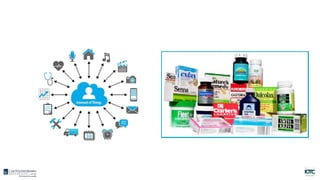
  • #12 For example, let’s take an IOT use case related to public health. It turns out that if you track the purchase of laxatives at drugstores, this can help predict opioid overdose hotspots because it indicates a spike in opioid-induced constipation.   Now, we might like to think our drugstore purchases are private. After all, that’s where we buy condoms and tampons and Rogaine! But if you have a CVS or Walgreen’s customer loyalty card to get discounts, I assure you, they already are mining your data to sell you more stuff. They know your favorite shampoo. They know if you toss in a pack of gum at the check-out counter. That’s a trade-off you already made because you like the coupons. So, if those same data could help save lives by assisting municipalities to allocate scarce stockpiles of Narcan to the zipcodes that need it most, especially if the data are de-identified, I think many people– not all but many-- would feel that’s an ok use of data analytics for the common good.
  • #13 So, what I think we should be focusing on is not whether the concept of privacy is dead or alive, but rather: How Should We Think about Privacy in the Digital Age? And, to do this, I will highlight a few themes that are in flux: Data Sovereignty: data stored digitally are subject to the laws of the country where they reside. Very tricky. Contextual Consent: rejects public/private dichotomy and asks about acceptability under various conditions. Ownership vs. Access: could we get to a point in the future where one’s data belong to them (not to their hospital or their employer, for example) and we each can control to whom we give access *and* monetize that access in an open market? The “Right” to Be Invisible/Forgotten--Google says it has received more than 650,000 requests to remove certain websites from its search results since a European court ordered the company to allow Europeans the "right to be forgotten" in 2014. All of these are thorny and complicated and worthy of deep thinking.
  • #14 Finally, I think it’s healthy to remind ourselves of the over-arching Ethical Principles that guide our thinking about any new advances in science and technology, and to think intentionally about their application in a 21st Century Context   Respect for Persons— activate moral values such as autonomy, honesty, kindness, etc. Beneficence—emphasis on potential for good Justice—what are we doing to close the “digital divide” rather than widen it? Non-maleficence—like Google’s “don’t be evil” but more importantly: when faced with two or more less-than-perfect options, how can we decide which option is least evil? For many of the problems we are facing now, a strict utilitarian equation will not give us the best answers. With that, I’’d like to hand the mic over to my colleague Brian.
  • #15 Facial Recognition and Privacy: IOTC interdisciplinary research project focused on local/state govt policies/practices These technologies provide tremendous value but pose serious privacy risks Many government entities are deploying without considering privacy either individual tech or aggregate effect Quick video clip unabashed illustration of real-time video surveillance tech
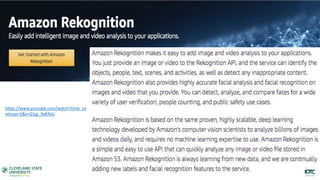
  • #16 Chinese are at the forefront in developing and deploying surveillance but major tech cos in US are aggressively marketing Amazon gained notoriety for its work with Orlando police Yet they still post this video on the homepage
  • #17 Tech cos are finding variety of angles to push deployment This article highlighted significant increase in adoption by schools in response to shootings
  • #18 In addition to lack of awareness/sensitivity to privacy several other concerns including racial bias in operation
  • #19 MIT researcher Joy Buolamwini created gendershades after she discovered major FR platforms didn’t recognize her face until she put on a white mask
  • #20 - Of course improving the tech doesn’t solve the fundamental problem of its use in surveillance and privacy
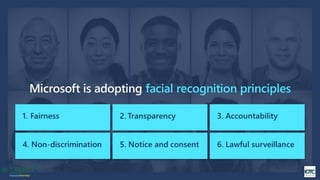
  • #21 Good news is that there is growing awareness among public and responses by corps Microsoft has been at the forefront in vocally pushing for regulation Motives somewhat suspect—both marketing and desire for uniform federal reg to avoid CA-type privacy laws Nonetheless serious effort to develop basic norms And significant that these are being pushed by major provider of the tech as norms gov’t should adhere to
  • #22 Even more significant: rise in what Ira Rubenstein calls “privacy Localism”: local communities reacting to unreflective deployment of surveillance tech and developing citizen engagement and control mechanisms This is the focus of the Workshop we’re organizing on March 29: bringing in policy experts and gov’t officials form Seattle and Oakland as well as federal, state and local law enforcement: FBI, DHS, statepolice biometric