International Journal of Electrical and Computer Engineering (IJECE)
Vol. 13, No. 5, October 2023, pp. 5824~5832
ISSN: 2088-8708, DOI: 10.11591/ijece.v13i5.pp5824-5832  5824
Journal homepage: http://ijece.iaescore.com
Regional feature learning using attribute structural analysis in
bipartite attention framework for vehicle re-identification
Cynthia Sherin, Kayalvizhi Jayavel
Department of Networking and Communications, School of Computing, SRM Institute of Science and Technology, Chennai, India
Article Info ABSTRACT
Article history:
Received Oct 18, 2022
Revised Feb 16, 2023
Accepted Mar 9, 2023
Vehicle re-identification identifies target vehicles using images obtained by
numerous non-overlapping real-time surveillance cameras. The effectiveness
of re-identification is further challenging because of illumination changes,
pose differences of captured images, and resolution. Fine-grained appearance
changes in vehicles are recognized in addition to the coarse-grained
characteristics like color of the vehicle along with model, and other custom
features like logo stickers, annual service signs, and hangings to overcome
these challenges. To prove the efficiency of our proposed bipartite attention
framework, a novel dataset called Attributes27 which has 27 labelled
attributes for each class are created. Our framework contains three major
sections: The first section where the overall and semantic characteristics of
every individual vehicle image are extracted by a double branch convolutional
neural network (CNN) layer. Secondly, to identify the region of interests
(ROIs) each branch has a self-attention block linked to it. Lastly to extract the
regional features from the obtained ROIs, a partition-alignment block is
deployed. The results of our proposed system’s evaluation on the Attributes27
and VeRi-776 datasets has highlighted significant regional attributes of each
vehicle and improved the accuracy. Attributes27 and VeRi-776 datasets
exhibits 98.5% and 84.3% accuracy respectively which are comparatively
higher than the existing methods with 78.6% accuracy.
Keywords:
Bipartite framework
Partition-alignment
Region detection
Self-attention
Vehicle re-ID
This is an open access article under the CC BY-SA license.
Corresponding Author:
Cynthia Sherin
Department of Networking and Communications, School of Computing, SRM Institute of Science and
Technology
Kattankulathur, Chennai-603203, India
Email: cb4881@srmist.edu.in
1. INTRODUCTION
Detection and re-identification of vehicles [1] have gained significant importance in computer vision
because of its varied applications on video surveillance. In intelligent transportation, it is highly challenging to
accurately perform vehicle re-identification (Re-ID) by retrieving images of vehicles captured by multiple
non-overlapping cameras. This is mostly performed in illegal vehicle search systems and urban surveillance.
Due to the similarity in vehicle appearance, person re-identification methods failed to provide adequate results
for vehicle reidentification. They can be distinguished as similar vehicles in varied models (inter-class
similarity) as in Figure 1(a) and same vehicle appearing different (intra-class differences) as in Figure 1(b)
along with similarly looking various vehicles of the same model exhibited in Figure 1(c). More emphasis is
given on the distinct regional features which differentiate every vehicle like the ocular lights, inspection
markings of yearly maintenance, decorative mirror hangings and personalized designs [2]. These minute details
of each vehicle are used for accurate re-identification. Thus, the key component of vehicle re-identification is
to distinguish the fine-grained dissimilarities of each vehicle thereby highlighting the distinct regions. The
Int J Elec & Comp Eng ISSN: 2088-8708 
Regional feature learning using attribute structural analysis in bipartite attention … (Cynthia Sherin)
5825
global features of the vehicle such as color, model and make details about the brand and the spatial-temporal
information from varied camera angles provides the vehicle direction in the given space and time [3] along
with its appearance. The license plate details distinguish each vehicle individually but are commonly not
available because of privacy issues, possibility of faking it, distortions, occlusion, motion blur and illumination
in the real-world scenario. Lastly the vehicle orientation and camera angles [4] are sometimes unreliable
because of the low resolutions in capturing minute visual appearances.
(a) (b) (c)
Figure 1. Changes in vehicle appearance (a) similar vehicles of varied models, (b) different appearances of
same vehicle, and (c) different vehicles of same model
Personalized local features are considered in addition to the overall structural appearance to enhance
the performance of re-identification. An ordered vehicle dataset with 27 labelled classes of attributes are
collected and named as Attributes27 dataset in proper bounding boxes which includes various types of cars,
windshield glass, wheels, tissue box and back mirror. These images were gathered from a variety of
surveillance cameras in urban locations and features several vehicles from various angles (top, face, rear, along
with left, and right sides of vehicle), both during the day and at night. Table 1 provides a comprehensive list of
the vehicle attributes, when combined with the personalized attributes to improve the efficiency of vehicle
re-identification. By using the characteristic attribute data gathered, Attributes27 dataset is leveraged for
diverse purposes such as analysis of vehicles along with its tracking [5] and detection, highly defined
model-based identification of vehicles [6], logo detection [7], detection of vehicle plate for improved
re-identification [8]. Vehicle tracking, model detection, and vehicle re-ID requires varying degrees of structural
data.
Table 1. Hierarchical list of labelled attributes (Attributes27)
No Viewing angle Dataset attributes
1 Top Sliding roof Luggage Antenna Vehicle carrier
2 Front and Rear Front lights New Signs Back mirror Safety belt
Entry License Hanging Light cover Lay Ornament
Windshield glass Logo Tissue box Number plate
Annual service signs
3 Sides (Left, Right) Windows Wheel Decorative markings
4 Type of Vehicle SUV Sedan Hatchback Truck Bus Pick-up Jeep
Numerous existing works successfully explains the retrieval mechanisms of positive images along
with the loss relationship using multiple vehicle re-identification datasets. With the aid of 20 cameras
Liu et al. [9] gathered 40,000 images of 619 vehicle identities from unobstructed traffic conditions and devised
an re-identification method based on appearance to extract the global and semantic characteristics on the VeRi
dataset. To calculate the relative distance between vehicles, Liu et al. [10] used a double branched deep
convolutional neural network (CNN) on a large labeled re-ID dataset called VehicleID which contains 2,22,000
images of 26,267 vehicle identities from varied real world surveillance cameras. Distinct vehicle datasets based
on regional features with proper labelled attributes [11] with the help of bounding boxes are utilized for license
plate and logo identification [12]. Along with these information semantic data including vehicle color, surface
texture, proportion, and geometric data also enhances the re-identification performance. Vehicle model, color,
and unique identification features are taken into account by Liu et al. [13] in his multi-branch architecture to
improve the performance of re-identification. The cross-sectional manipulation of vehicles is improved by
generative adversarial networks (GAN) [14], by feeding the network with vehicle images from various angles.
Zhouy and Shao [15] classification system divided the images based on viewpoints into various classes, which
were combined together to generate the global features. He et al. [16] trained the model by merging the local
model with the attention heatmaps to obtain the region of interest (ROI) recommendations. Teng et al. [17]
obtained the final features of the image by making use of the spatial and channel attention data as a weight
 ISSN: 2088-8708
Int J Elec & Comp Eng, Vol. 13, No. 5, October 2023: 5824-5832
5826
map. Multi-attribute-based attention module was employed by Wang et al. [18] to enhance the reidentification
task. Zhang et al. [19] presented a part-guided attention learning model to uniquely identify the fine-grained
attributes such as distinct designs, yearly maintenance stickers, and tissue box to emphasize the various part
regions. As a result, the regional features extracted by the self attention model are vital to show up the
distinctive qualities of each vehicle image. The relationship between the correctly and wrongly identified
images in comparison with the query is determined by the loss function in vehicle re-ID. To produce the loss
function, Ding et al. [20] employed L2 norms to limit the loss function for the positive and negative images.
Schroff et al. [21] developed a constant value from the triplet loss function by distinguishing the similar and
dissimilar image pairs.
A bipartite framework divides the images into two non-coinciding parts using the numerous labelled
attributes. The pattern branch and identity branch are the two main branches which make up the bipartite
framework. The self attention model trains the labeled images effectively and the partition-alignment model
enhances the accuracy of re-identification.
The significant contributions are in brief, as follows:
− To gather an annotated dataset of labelled vehicle images comprising of 27 attributes per class. For efficient
vehicle re-identification, the selective features of individual vehicles are examined using the multi-class
attributes.
− To construct a bipartite framework with multiple attributes and independent feature maps for the pattern
branch as well as identity branch. The resultant framework produces an effective triplet loss function
thereby diminishing the conflict between the multiple attributes.
− To design a self-attention model to produce centralized multi-attribute attention heatmaps in combination
with partition-alignment model to precisely identify the windshield area and bumper sections of the vehicle
to highlight the fine-grained information.
Our proposed research work has the following sections: section 2 elaborates the comprehensive
mechanism of the proposed method along with its architecture. Section 3 displays the experimental results
obtained for the proposed method on Attributes27 dataset and standard vehicle re-id dataset VeRi-776.
Section 4 concludes the overall analysis.
2. METHOD
2.1. Characteristics of Attributes27 dataset
Our proposed Attributes27 dataset comprises of 8,271 images gathered from variety of datasets under
various environments. The VAC21 vehicle dataset served as a model for Attributes27 dataset containing
21 classes of labeled attributes. To strengthen the regional feature learning capability and detection accuracy
of smaller areas, our dataset has been updated with extra attributes. The labeled attributes for each image in the
dataset are displayed in Table 1. The visual representation of the labeled attributes is given in Figure 2. This
dataset captures minute information of the vehicle at various levels. In the entry level the type of the vehicle
image captured is concluded by the body type such as bus, jeep, truck, sedan, sport utility vehicle (SUV),
hatchback. In the second level, the vehicle make and model are determined. The final level records the unique
vehicle characteristics like yearly maintenance stickers, newer signs, and decorative hangings.
Figure 2. Attributes distribution in a sample image of Attributes27 dataset
2.2. Overall architecture
Typically, multiple attributes are used in mono branched CNN architecture, by allocating a common
feature space for vehicle re-identification techniques. To address this issue, a bipartite framework with dual
Int J Elec & Comp Eng ISSN: 2088-8708 
Regional feature learning using attribute structural analysis in bipartite attention … (Cynthia Sherin)
5827
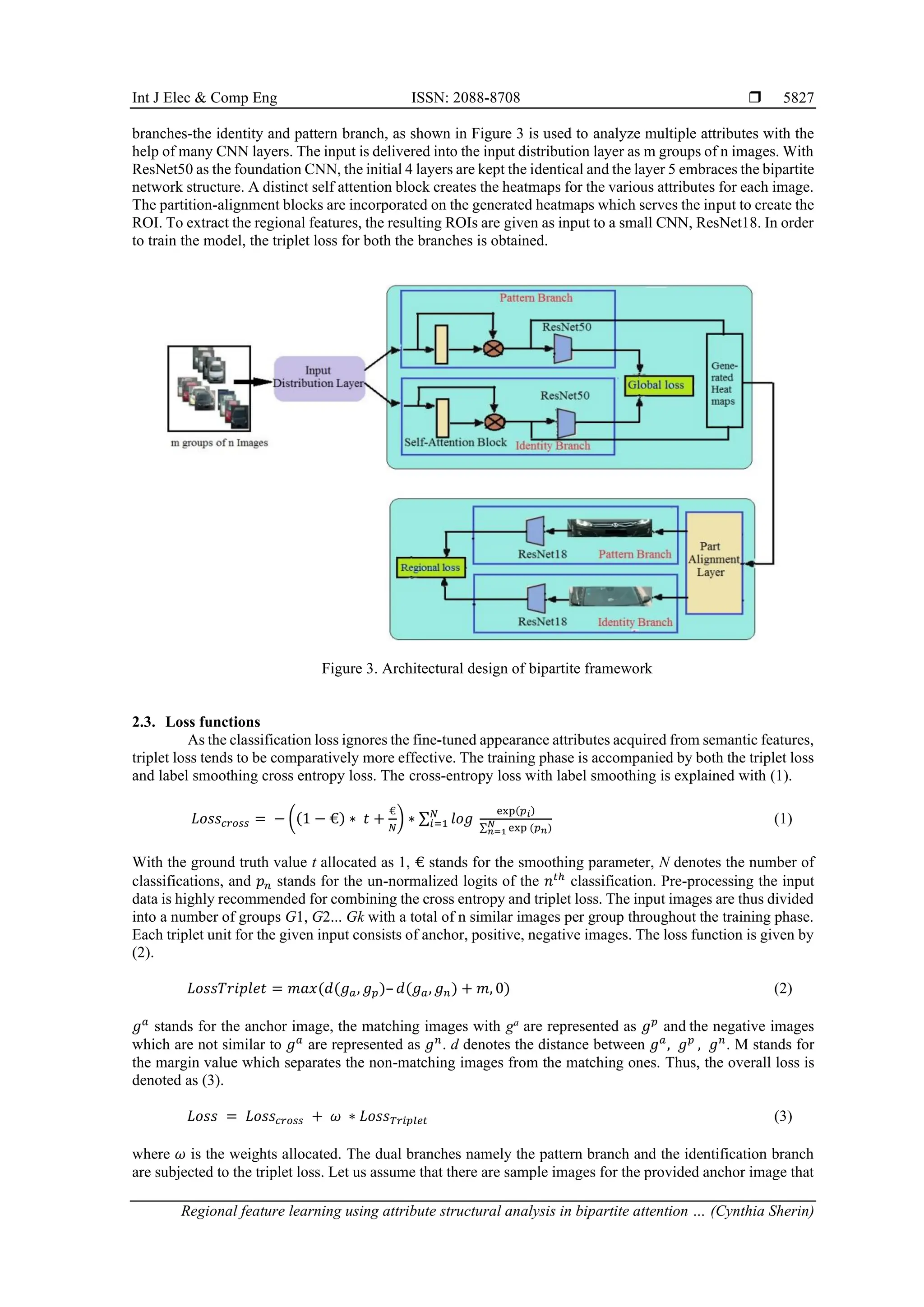
branches-the identity and pattern branch, as shown in Figure 3 is used to analyze multiple attributes with the
help of many CNN layers. The input is delivered into the input distribution layer as m groups of n images. With
ResNet50 as the foundation CNN, the initial 4 layers are kept the identical and the layer 5 embraces the bipartite
network structure. A distinct self attention block creates the heatmaps for the various attributes for each image.
The partition-alignment blocks are incorporated on the generated heatmaps which serves the input to create the
ROI. To extract the regional features, the resulting ROIs are given as input to a small CNN, ResNet18. In order
to train the model, the triplet loss for both the branches is obtained.
Figure 3. Architectural design of bipartite framework
2.3. Loss functions
As the classification loss ignores the fine-tuned appearance attributes acquired from semantic features,
triplet loss tends to be comparatively more effective. The training phase is accompanied by both the triplet loss
and label smoothing cross entropy loss. The cross-entropy loss with label smoothing is explained with (1).
𝐿𝑜𝑠𝑠𝑐𝑟𝑜𝑠𝑠 = − ((1 − €) ∗ 𝑡 +
€
𝑁
) ∗ ∑ 𝑙𝑜𝑔
𝑁
𝑖=1
exp(𝑝𝑖)
∑ exp (𝑝𝑛)
𝑁
𝑛=1
(1)
With the ground truth value t allocated as 1, € stands for the smoothing parameter, N denotes the number of
classifications, and 𝑝𝑛 stands for the un-normalized logits of the 𝑛𝑡ℎ
classification. Pre-processing the input
data is highly recommended for combining the cross entropy and triplet loss. The input images are thus divided
into a number of groups G1, G2... Gk with a total of n similar images per group throughout the training phase.
Each triplet unit for the given input consists of anchor, positive, negative images. The loss function is given by
(2).
𝐿𝑜𝑠𝑠𝑇𝑟𝑖𝑝𝑙𝑒𝑡 = 𝑚𝑎𝑥(𝑑(𝑔𝑎, 𝑔𝑝)– 𝑑(𝑔𝑎, 𝑔𝑛) + 𝑚, 0) (2)
𝑔𝑎
stands for the anchor image, the matching images with ga
are represented as 𝑔𝑝
and the negative images
which are not similar to 𝑔𝑎
are represented as 𝑔𝑛
. d denotes the distance between 𝑔𝑎
, 𝑔𝑝
, 𝑔𝑛
. M stands for
the margin value which separates the non-matching images from the matching ones. Thus, the overall loss is
denoted as (3).
𝐿𝑜𝑠𝑠 = 𝐿𝑜𝑠𝑠𝑐𝑟𝑜𝑠𝑠 + 𝜔 ∗ 𝐿𝑜𝑠𝑠𝑇𝑟𝑖𝑝𝑙𝑒𝑡 (3)
where 𝜔 is the weights allocated. The dual branches namely the pattern branch and the identification branch
are subjected to the triplet loss. Let us assume that there are sample images for the provided anchor image that
 ISSN: 2088-8708
Int J Elec & Comp Eng, Vol. 13, No. 5, October 2023: 5824-5832
5828
has different identities. L is the distance between the sample images and anchor image. When the identity
branch is trained, the distance L increases as the images belong to various identities and when the images from
the same model are trained, L becomes closer. With the advantage of dual branch in the proposed system it
overcomes the conflicts of single branch framework, thereby improving the performance. The experimental
analysis on VeRi-776 and Attributes27 dataset results in 84.3% and 98.5% of mAP respectively for the
proposed bipartite structure with self attention. Figure 4 displays the comparative study of the framework with
enhanced performance and accurate detection of windshield and bumper zones.
Figure 4. Comparative study of self-attention bipartite framework
2.4. Self-attention block
The bipartite structure has a separate feature space for each branch, and an attention model adds more
emphasis to the specific areas. The various positions of the similar input image are focused by the self-attention
model and the acquired output belongs to the same input series. Thus the independent features are brought
together by the self-attention [22] mechanism incorporated in the bipartite network. Figure 5(a) gives the brief
architecture of the self-attention framework. The three 1×1 convolution layers C1, C2, C3 are fed with the
input X to generate the 𝑓, 𝑔 and ℎ heatmaps. The correlation matrix is generated as a product of the heatmaps
g and f yielding s which is the probability map. For the input X the final self-attention map SA is generated by
the cross product of probability map s and feature map ℎ. The self- attention map is given as (4).
𝑆𝑒𝑙𝑓 − 𝑎𝑡𝑡𝑒𝑛𝑡𝑖𝑜𝑛 𝑀𝑎𝑝 (𝑆𝐴) = ℎ ⊗ ( 𝑆𝑜𝑓𝑡𝑚𝑎𝑥 ( 𝑔𝑇
⊗ 𝑓) )𝑇
(4)
2.5. Partition-alignment block
With the generated attention heatmap of every attribute, the ROIs are constructed by the
partition-alignment block for deriving the final regional features. Multi-level attention pooling is used in the
partition-alignment block to produce the ROIs. SAp and SAi are the self attention heatmaps produced by the
identity and pattern branches respectively which is indicated in the partition-alignment block sample structure
as shown in Figure 5(b). The output feature maps highlight essential information with important features.
(a) (b)
Figure 5. Bipartite network structure (a) self-attention block and (b) windshield and bumper regions
highlighted by partition-alignment block
Int J Elec & Comp Eng ISSN: 2088-8708 
Regional feature learning using attribute structural analysis in bipartite attention … (Cynthia Sherin)
5829
Various average pooling sizes are used since the size of the windshield area is less than the bumper
area. After the detection of pattern branch, the bumper area is detected by applying 4×12 average pooling on
the heatmap SAp. For detecting the smaller sized inspection stickers in the occluded windshield area SAi, a 3×3
pooling layer is utilized. The 4×10 average pooling layer processes the pooled map which is assigned as the
seed. The resulting heatmaps are separately linked with the input image to distinguish the bumper and
windshield regions. The algorithmic explanations of both the self-attention block and partition-alignment block
are listed in Table 2.
Table 2. Algorithmic explanation of self-attention block and partition-alignment block
Algorithm 1: Outline of self-attention block Algorithm 2: Outline of partition-alignment block
Requirement: Let X be the input image.
To Accomplish: Generation of the feature maps f, g, and h
along with resultant self-attention map SA.
Step 1: Generate the feature maps h, f and g by applying
the input X on three individual 1×1 convolution
layers C1, C2, and C3 respectively.
Step 2: The probability map s is produced by the product
of f and g.
Step 3: The Self-Attention map SA for each branch is
generated by the product of h and the probability
map s.
Requirement: Generated heatmaps for the pattern and identity branch,
SAp and SAi respectively.
To Accomplish: Obtain bumper and windshield region coordinates 𝐻𝑝
and 𝐻𝑖.
Step 1: Generation of new heatmap 𝑆𝐴𝑝
′
by executing 4×12 average
pooling on SAp;
Step 2: The coordinates 𝐻𝑝 denotes the maximum value on 𝑆𝐴𝑝
′
;
Step 3: Generate a new heatmap 𝑆𝐴𝑖
′
by performing a 3×3 average
pooling on the initial heatmap SAi ;
Step 4: Another heatmap 𝑆𝐴𝑖
′′
is generated with 𝑆𝐴𝑖
′
by undergoing 4×10
average pooling;
Step 5: In 𝑆𝐴𝑖
′
, the pixel with the highest value becomes the seed value;
Step 6: The pixel in 𝑆𝐴𝑖
′′
includes the region covered by SAi, adding
them to the candidate areas;
Step 7: The coordinates 𝐻𝑖 denotes the candidate region’s maximum
value;
Step 8: Return the values 𝐻𝑝 and 𝐻𝑖 .
3. RESULTS AND DISCUSSION
To precisely accomplish the re-identification of vehicles, the entire experimental analysis is carried
out on the Amazon elastic cloud compute (EC2) instance of amazon web services (AWS) console. Pytorch and
Tensorflow are used in conjunction with a high frequency Intel Xeon Scalable Processor in the p2.xlarge
instance for accelerated computing. The bipartite self attention framework is analyzed on both Attributes27
and VeRi-776 dataset. The VeRi-776 dataset consists of 50,000 images of 776 distinct vehicles taken by
20 cameras from various angles. A testing set contains 11,579 images of 200 vehicle identities, while the
training set has 37,778 images of 576 vehicles. ResNet-50 and ResNet-18, allocated with ImageNet pretrained
weights in the training phase are applied on the bipartite framework and subnet respectively. Through data
augmentation techniques the input images are randomly cropped to 224×224×3 with a probability of 0.5. The
Adam optimizer [23] is employed with a weight decay of 5×10⁻⁴
and momentum of 0.9. Each batch with 16
different identities of the augmented images are obtained with a size of 120 per batch. A random selection of
instances with the same ID is performed, and the count is set to 10. The learning rate set to 0.001 for
100 epochs. The similarity rate between the query and the collection of galleries imaged are provided by
Euclidean distance (L2), which is used to assess the final ranking outcome.
The re-identification performance is evaluated by mean average precision (mAP) and cumulative
match curve (CMC). The area covered by the precision-recall curve is termed as average precision (AP) and
mAP stands for the ith
query of mean average precision for the total of N gallery images. The collective
percentage of the accurately matching images from top-K images is given by CMC. Rank@1 and rank@5
scores are used to analyze the accuracy in re-identification. The formulae for mAP is given as (5).
𝑚𝐴𝑃 =
1
𝑁
∑ 𝐴𝑃(𝑖)
𝑁
𝑖=1 (5)
The performance evaluation of the bipartite self-attention framework on VeRi-776 and Attributes27
dataset for both the self attention block and partition alignment block is given in the Table 3. The training
accuracy and loss for an average of 10 epochs is tabulated for the trained ResNet-50 and ResNet-18 CNN
models for both the blocks respectively to exhibit its robustness in the VeRi-776 and Attributes27 dataset. The
overall performance analysis report of the bipartite framework is analyzed based on the metrics such as
precision, accuracy and recall. The graph for these metrics plotted in Figure 6 clearly indicates that the
accuracy, precision and recall of bipartite with self attention framework shows 86.4%, 86.1%, 86.3% in
VeRi-776 and 98.5%, 97.1%, 98.3% in Attributes27 dataset respectively.
 ISSN: 2088-8708
Int J Elec & Comp Eng, Vol. 13, No. 5, October 2023: 5824-5832
5830
Table 3. Average values of accuracy and loss data for Attributes27 and VeRi-776 dataset
VeRi-776 Dataset Attributes27 Dataset
ResNet-50(Self-Attention
block)
ResNet-18(Partition-
Alignment block)
ResNet-50(Self-
Attention block)
ResNet-18(Partition-
Alignment block)
Epochs Loss Accuracy Loss Accuracy Loss Accuracy Loss Accuracy
10 4.175 0.221 2.352 0.358 3.562 0.369 1.953 0.399
20 2.311 0.376 1.971 0.412 3.021 0.492 1.661 0.460
30 1.878 0.354 1.325 0.498 2.746 0.534 1.234 0.523
40 1.235 0.492 0.652 0.547 1.854 0.597 0.863 0.587
50 0.741 0.531 0.551 0.581 1.432 0.662 0.625 0.682
60 0.708 0.658 0.506 0.603 0.896 0.715 0.442 0.731
70 0.567 0.719 0.361 0.711 0.651 0.784 0.360 0.853
80 0.421 0.742 0.225 0.754 0.376 0.861 0.258 0.924
90 0.359 0.809 0.201 0.829 0.258 0.906 0.153 0.968
100 0.274 0.812 0.136 0.843 0.186 0.938 0.102 0.985
Figure 6. Overall performance analysis for the bipartite framework
3.1. Comparison with other methods and results
With the use of the multi-view images from VeRi-776 and Attributes27 datasets, feature maps are
created to get the ROIs that provide the regional features needed to compare the performance of re-ID with
other cutting-edge techniques. mAP and CMC are employed in VeR1-776 dataset in comparison with the
state-of-art methods which is shown in Figure 7. The findings of the comparative analysis on the VeRi-776
dataset show that VAMI+STR [15] and FACT [9] obtain more information from multi-attributes. VAMI [15]
and OIFE(4views+ST) [24] gets the multi-view information with the help of attention model. In the case of
MSVF, SCAN the dual-branch architecture is utilized and PR+GLBW [16] makes use of LocalNet [25] to get
the local information of each vehicle. Our bipartite framework when applied on Attributes27 and VeRi-776
dataset displayed a good improvement in performance of 98.5% and 84.3% respectively. Due to the varied
image categories the percentage of accuracy in VeRi-779 dataset has decreased when compared with the
Attributes27 dataset.
Figure 7. Comparison of VeRi-776 dataset with state-of-art methods
Int J Elec & Comp Eng ISSN: 2088-8708 
Regional feature learning using attribute structural analysis in bipartite attention … (Cynthia Sherin)
5831
Figure 8(a) shows the outcome of partition alignment and the regions that were detected for the
windshield and bumper. With the use of attention heatmaps, the windshield region provides data about the
identity branch, and the bumper region provides details of the pattern branch. The back focused images are
accurately found with the help of the local features which boosts re-identification. The first five ranking
retrieval samples of VeRi-776 and Attributes27 dataset are displayed in Figure 8(b). The query image is present
in the leftmost corner and the obtained results are from the gallery images. The correctly retrieved images to
the anchor image are highlighted in green color and the wrong entries are displayed red. Similarity in
appearance, local and global features, illumination changes can sometimes result in false retrievals in some
cases. Thus, our proposed system has effectively overcome the defects of other methods and provided 98.5%
re-identification accuracy.
(a) (b)
Figure 8. Results of experimental analysis (a) Heatmaps generated on VeRi-776 after partition-alignment and
(b) Top 5 rank images on Attributes27(1) and VeRi-776 (2, 3)
4. CONCLUSION
In this paper, we have effectively gathered the regional features with the help of 27 labelled classes
of structured attributes in Attributes27 dataset. Both the Attributes27 and VeRi-776 dataset are tested on the
proposed bipartite attention framework to achieve remarkable re-identification results. VeRi-776 dataset
achieved 99.1% and Attributes27 dataset with 98.4% accuracy results with triplet loss incorporated in the
bipartite framework when compared with the other techniques with only 65.7% and 78.6% accuracy. Bipartite
architecture successfully overcomes the conflict between the triplet losses. The attention heatmaps generated
by the self-attention block combines the individual features and with these heatmaps, the partition-alignment
block detects the local regions. An excellent performance of 84.3% and 98.5% is achieved on VeRi-776 and
Attributes27 datasets respectively with effective detection of windshield and bumper areas in the captured front
angle images.
REFERENCES
[1] W. Fang, J. Chen, C. Liang, Y. Wang, and R. Hu, “Vehicle re-identification collaborating visual and temporal-spatial network,” in
Proceedings of the Fifth International Conference on Internet Multimedia Computing and Service, Aug. 2013, pp. 121–125, doi:
10.1145/2499788.2499844.
[2] L. Yang, P. Luo, C. C. Loy, and X. Tang, “A large-scale car dataset for fine-grained categorization and verification,” Prepr.
arXiv.1506.08959, Jun. 2015.
[3] X. Liu, W. Liu, T. Mei, and H. Ma, “PROVID: Progressive and multimodal vehicle reidentification for large-scale urban
surveillance,” IEEE Transactions on Multimedia, vol. 20, no. 3, pp. 645–658, Mar. 2018, doi: 10.1109/TMM.2017.2751966.
[4] Y. Lou, Y. Bai, J. Liu, S. Wang, and L.-Y. Duan, “Embedding adversarial learning for vehicle re-identification,” IEEE Transactions
on Image Processing, vol. 28, no. 8, pp. 3794–3807, Aug. 2019, doi: 10.1109/TIP.2019.2902112.
[5] B. C. Matei, H. S. Sawhney, and S. Samarasekera, “Vehicle tracking across nonoverlapping cameras using joint kinematic and
appearance features,” in CVPR 2011, Jun. 2011, pp. 3465–3472, doi: 10.1109/CVPR.2011.5995575.
[6] A. Psyllos, C. N. Anagnostopoulos, and E. Kayafas, “Vehicle model recognition from frontal view image measurements,” Computer
Standards & Interfaces, vol. 33, no. 2, pp. 142–151, Feb. 2011, doi: 10.1016/j.csi.2010.06.005.
[7] Y. Huang, R. Wu, Y. Sun, W. Wang, and X. Ding, “Vehicle logo recognition system based on convolutional neural networks with
a pretraining strategy,” IEEE Transactions on Intelligent Transportation Systems, vol. 16, no. 4, pp. 1951–1960, Aug. 2015, doi:
10.1109/TITS.2014.2387069.
[8] D. Zapletal and A. Herout, “Vehicle re-identification for automatic video traffic surveillance,” in 2016 IEEE Conference
on Computer Vision and Pattern Recognition Workshops (CVPRW), Jun. 2016, pp. 1568–1574,
doi: 10.1109/CVPRW.2016.195.
[9] X. Liu, W. Liu, H. Ma, and H. Fu, “Large-scale vehicle re-identification in urban surveillance videos,” in 2016 IEEE International
Conference on Multimedia and Expo (ICME), Jul. 2016, pp. 1–6, doi: 10.1109/ICME.2016.7553002.
[10] H. Liu, Y. Tian, Y. Wang, L. Pang, and T. Huang, “Deep relative distance learning: Tell the difference between similar vehicles,”
in 2016 IEEE Conference on Computer Vision and Pattern Recognition (CVPR), Jun. 2016, pp. 2167–2175, doi:
10.1109/CVPR.2016.238.
 ISSN: 2088-8708
Int J Elec & Comp Eng, Vol. 13, No. 5, October 2023: 5824-5832
5832
[11] Y. Zhao, C. Shen, H. Wang, and S. Chen, “Structural analysis of attributes for vehicle re-identification and retrieval,” IEEE
Transactions on Intelligent Transportation Systems, vol. 21, no. 2, pp. 723–734, Feb. 2020, doi: 10.1109/TITS.2019.2896273.
[12] D. F. Llorca, R. Arroyo, and M. A. Sotelo, “Vehicle logo recognition in traffic images using HOG features and SVM,” in 16th
International IEEE Conference on Intelligent Transportation Systems (ITSC 2013), Oct. 2013, pp. 2229–2234, doi:
10.1109/ITSC.2013.6728559.
[13] X. Liu, S. Zhang, Q. Huang, and W. Gao, “RAM: a region-aware deep model for vehicle re-identification,” Prepr.
arXiv.1806.09283, Jun. 2018.
[14] Y. Wang, Z. Liu, and F. Xiao, “A fast coarse-to-fine vehicle logo detection and recognition method,” in 2007 IEEE International
Conference on Robotics and Biomimetics (ROBIO), Dec. 2007, pp. 691–696, doi: 10.1109/ROBIO.2007.4522246.
[15] Y. Zhouy and L. Shao, “Viewpoint-aware attentive multi-view inference for vehicle re-identification,” in 2018 IEEE/CVF
Conference on Computer Vision and Pattern Recognition, Jun. 2018, pp. 6489–6498, doi: 10.1109/CVPR.2018.00679.
[16] B. He, J. Li, Y. Zhao, and Y. Tian, “Part-regularized near-duplicate vehicle re-identification,” in 2019 IEEE/CVF Conference on
Computer Vision and Pattern Recognition (CVPR), Jun. 2019, pp. 3992–4000, doi: 10.1109/CVPR.2019.00412.
[17] S. Teng, X. Liu, S. Zhang, and Q. Huang, “SCAN: Spatial and channel attention network for vehicle re-identification,” in PCM
2018: Advances in Multimedia Information Processing – PCM 2018, 2018, pp. 350–361.
[18] H. Wang, J. Peng, D. Chen, G. Jiang, T. Zhao, and X. Fu, “Attribute-guided feature learning network for vehicle re-identification,”
Prepr. arXiv.2001.03872, Jan. 2020.
[19] X. Zhang, R. Zhang, J. Cao, D. Gong, M. You, and C. Shen, “Part-guided attention learning for vehicle instance retrieval,” Prepr.
arXiv.1909.06023, Sep. 2019.
[20] S. Ding, L. Lin, G. Wang, and H. Chao, “Deep feature learning with relative distance comparison for person re-identification,”
Prepr. arXiv.1512.03622, Dec. 2015.
[21] F. Schroff, D. Kalenichenko, and J. Philbin, “FaceNet: a unified embedding for face recognition and clustering,” in 2015 IEEE
Conference on Computer Vision and Pattern Recognition (CVPR), Jun. 2015, pp. 815–823, doi: 10.1109/CVPR.2015.7298682.
[22] A. Vaswani et al., “Attention Is All You Need,” Prepr. arXiv:1706.03762, Jun. 2017.
[23] D. P. Kingma and J. Ba, “Adam: A method for stochastic optimization,” Prepr. arXiv.1412.6980, Dec. 2014.
[24] Z. Wang et al., “Orientation invariant feature embedding and spatial temporal regularization for vehicle re-identification,” in 2017
IEEE International Conference on Computer Vision (ICCV), Oct. 2017, pp. 379–387, doi: 10.1109/ICCV.2017.49.
[25] P. Khorramshahi, A. Kumar, N. Peri, S. S. Rambhatla, J.-C. Chen, and R. Chellappa, “A dual-path model with adaptive attention
for vehicle re-identification,” Prepr. arXiv.1905.03397, May 2019.
BIOGRAPHIES OF AUTHORS
Cynthia Sherin received the B.Tech. degree in Information Technology and M.E.
degree in Computer Science Engineering from Anna University, Chennai, in 2012 and 2018.
She is currently pursuing her Ph.D. degree in Networking and Communication engineering from
SRM University, Chennai, India. She has a corporate experience of 2 years in networking and
teaching experience of 2 years as Assistant Professor at the Department of Computer Science
Engineering. Her research interests include machine learning and deep learning techniques in
computer vision, image processing, ad hoc networks and internet of things. She can be contacted
at email: cb4881@srmist.edu.in.
Kayalvizhi Jayavel is founder of IoT Alliance club, a not to profit unit to train
students in the field of IoT, www.iotalliance.in. She served as IT Coordinator for National
Family Health Survey (NFHS5) for Tamilnadu-South under Ministry of Health and Family
Welfare, Government of India. She has published papers in reputed journals with international
collaborations with countries including Japan, Oman and Rwanda. She is Professor Mentor for
few Samsung research worklets implemented at SRM. She is invited Professor and international
research supervisor at African Centre of Excellence of Internet of Things (ACEIoT), University
of Rwanda (2019 to till date). She is Faculty advisor for ACM SIGAI chapter at SRM, which
received a fund of 2000 Euros from AI Journal towards the application submission “AAIW
for under privileged” (2019). She has been a visiting researcher to NEC (Japan) for a
collaborative research project in the domain of WSN (2011). She can be contacted at email:
kayalvij@srmist.edu.in.

Regional feature learning using attribute structural analysis in bipartite attention framework for vehicle re-identification

  • 1.
    International Journal ofElectrical and Computer Engineering (IJECE) Vol. 13, No. 5, October 2023, pp. 5824~5832 ISSN: 2088-8708, DOI: 10.11591/ijece.v13i5.pp5824-5832  5824 Journal homepage: http://ijece.iaescore.com Regional feature learning using attribute structural analysis in bipartite attention framework for vehicle re-identification Cynthia Sherin, Kayalvizhi Jayavel Department of Networking and Communications, School of Computing, SRM Institute of Science and Technology, Chennai, India Article Info ABSTRACT Article history: Received Oct 18, 2022 Revised Feb 16, 2023 Accepted Mar 9, 2023 Vehicle re-identification identifies target vehicles using images obtained by numerous non-overlapping real-time surveillance cameras. The effectiveness of re-identification is further challenging because of illumination changes, pose differences of captured images, and resolution. Fine-grained appearance changes in vehicles are recognized in addition to the coarse-grained characteristics like color of the vehicle along with model, and other custom features like logo stickers, annual service signs, and hangings to overcome these challenges. To prove the efficiency of our proposed bipartite attention framework, a novel dataset called Attributes27 which has 27 labelled attributes for each class are created. Our framework contains three major sections: The first section where the overall and semantic characteristics of every individual vehicle image are extracted by a double branch convolutional neural network (CNN) layer. Secondly, to identify the region of interests (ROIs) each branch has a self-attention block linked to it. Lastly to extract the regional features from the obtained ROIs, a partition-alignment block is deployed. The results of our proposed system’s evaluation on the Attributes27 and VeRi-776 datasets has highlighted significant regional attributes of each vehicle and improved the accuracy. Attributes27 and VeRi-776 datasets exhibits 98.5% and 84.3% accuracy respectively which are comparatively higher than the existing methods with 78.6% accuracy. Keywords: Bipartite framework Partition-alignment Region detection Self-attention Vehicle re-ID This is an open access article under the CC BY-SA license. Corresponding Author: Cynthia Sherin Department of Networking and Communications, School of Computing, SRM Institute of Science and Technology Kattankulathur, Chennai-603203, India Email: cb4881@srmist.edu.in 1. INTRODUCTION Detection and re-identification of vehicles [1] have gained significant importance in computer vision because of its varied applications on video surveillance. In intelligent transportation, it is highly challenging to accurately perform vehicle re-identification (Re-ID) by retrieving images of vehicles captured by multiple non-overlapping cameras. This is mostly performed in illegal vehicle search systems and urban surveillance. Due to the similarity in vehicle appearance, person re-identification methods failed to provide adequate results for vehicle reidentification. They can be distinguished as similar vehicles in varied models (inter-class similarity) as in Figure 1(a) and same vehicle appearing different (intra-class differences) as in Figure 1(b) along with similarly looking various vehicles of the same model exhibited in Figure 1(c). More emphasis is given on the distinct regional features which differentiate every vehicle like the ocular lights, inspection markings of yearly maintenance, decorative mirror hangings and personalized designs [2]. These minute details of each vehicle are used for accurate re-identification. Thus, the key component of vehicle re-identification is to distinguish the fine-grained dissimilarities of each vehicle thereby highlighting the distinct regions. The
  • 2.
    Int J Elec& Comp Eng ISSN: 2088-8708  Regional feature learning using attribute structural analysis in bipartite attention … (Cynthia Sherin) 5825 global features of the vehicle such as color, model and make details about the brand and the spatial-temporal information from varied camera angles provides the vehicle direction in the given space and time [3] along with its appearance. The license plate details distinguish each vehicle individually but are commonly not available because of privacy issues, possibility of faking it, distortions, occlusion, motion blur and illumination in the real-world scenario. Lastly the vehicle orientation and camera angles [4] are sometimes unreliable because of the low resolutions in capturing minute visual appearances. (a) (b) (c) Figure 1. Changes in vehicle appearance (a) similar vehicles of varied models, (b) different appearances of same vehicle, and (c) different vehicles of same model Personalized local features are considered in addition to the overall structural appearance to enhance the performance of re-identification. An ordered vehicle dataset with 27 labelled classes of attributes are collected and named as Attributes27 dataset in proper bounding boxes which includes various types of cars, windshield glass, wheels, tissue box and back mirror. These images were gathered from a variety of surveillance cameras in urban locations and features several vehicles from various angles (top, face, rear, along with left, and right sides of vehicle), both during the day and at night. Table 1 provides a comprehensive list of the vehicle attributes, when combined with the personalized attributes to improve the efficiency of vehicle re-identification. By using the characteristic attribute data gathered, Attributes27 dataset is leveraged for diverse purposes such as analysis of vehicles along with its tracking [5] and detection, highly defined model-based identification of vehicles [6], logo detection [7], detection of vehicle plate for improved re-identification [8]. Vehicle tracking, model detection, and vehicle re-ID requires varying degrees of structural data. Table 1. Hierarchical list of labelled attributes (Attributes27) No Viewing angle Dataset attributes 1 Top Sliding roof Luggage Antenna Vehicle carrier 2 Front and Rear Front lights New Signs Back mirror Safety belt Entry License Hanging Light cover Lay Ornament Windshield glass Logo Tissue box Number plate Annual service signs 3 Sides (Left, Right) Windows Wheel Decorative markings 4 Type of Vehicle SUV Sedan Hatchback Truck Bus Pick-up Jeep Numerous existing works successfully explains the retrieval mechanisms of positive images along with the loss relationship using multiple vehicle re-identification datasets. With the aid of 20 cameras Liu et al. [9] gathered 40,000 images of 619 vehicle identities from unobstructed traffic conditions and devised an re-identification method based on appearance to extract the global and semantic characteristics on the VeRi dataset. To calculate the relative distance between vehicles, Liu et al. [10] used a double branched deep convolutional neural network (CNN) on a large labeled re-ID dataset called VehicleID which contains 2,22,000 images of 26,267 vehicle identities from varied real world surveillance cameras. Distinct vehicle datasets based on regional features with proper labelled attributes [11] with the help of bounding boxes are utilized for license plate and logo identification [12]. Along with these information semantic data including vehicle color, surface texture, proportion, and geometric data also enhances the re-identification performance. Vehicle model, color, and unique identification features are taken into account by Liu et al. [13] in his multi-branch architecture to improve the performance of re-identification. The cross-sectional manipulation of vehicles is improved by generative adversarial networks (GAN) [14], by feeding the network with vehicle images from various angles. Zhouy and Shao [15] classification system divided the images based on viewpoints into various classes, which were combined together to generate the global features. He et al. [16] trained the model by merging the local model with the attention heatmaps to obtain the region of interest (ROI) recommendations. Teng et al. [17] obtained the final features of the image by making use of the spatial and channel attention data as a weight
  • 3.
     ISSN: 2088-8708 IntJ Elec & Comp Eng, Vol. 13, No. 5, October 2023: 5824-5832 5826 map. Multi-attribute-based attention module was employed by Wang et al. [18] to enhance the reidentification task. Zhang et al. [19] presented a part-guided attention learning model to uniquely identify the fine-grained attributes such as distinct designs, yearly maintenance stickers, and tissue box to emphasize the various part regions. As a result, the regional features extracted by the self attention model are vital to show up the distinctive qualities of each vehicle image. The relationship between the correctly and wrongly identified images in comparison with the query is determined by the loss function in vehicle re-ID. To produce the loss function, Ding et al. [20] employed L2 norms to limit the loss function for the positive and negative images. Schroff et al. [21] developed a constant value from the triplet loss function by distinguishing the similar and dissimilar image pairs. A bipartite framework divides the images into two non-coinciding parts using the numerous labelled attributes. The pattern branch and identity branch are the two main branches which make up the bipartite framework. The self attention model trains the labeled images effectively and the partition-alignment model enhances the accuracy of re-identification. The significant contributions are in brief, as follows: − To gather an annotated dataset of labelled vehicle images comprising of 27 attributes per class. For efficient vehicle re-identification, the selective features of individual vehicles are examined using the multi-class attributes. − To construct a bipartite framework with multiple attributes and independent feature maps for the pattern branch as well as identity branch. The resultant framework produces an effective triplet loss function thereby diminishing the conflict between the multiple attributes. − To design a self-attention model to produce centralized multi-attribute attention heatmaps in combination with partition-alignment model to precisely identify the windshield area and bumper sections of the vehicle to highlight the fine-grained information. Our proposed research work has the following sections: section 2 elaborates the comprehensive mechanism of the proposed method along with its architecture. Section 3 displays the experimental results obtained for the proposed method on Attributes27 dataset and standard vehicle re-id dataset VeRi-776. Section 4 concludes the overall analysis. 2. METHOD 2.1. Characteristics of Attributes27 dataset Our proposed Attributes27 dataset comprises of 8,271 images gathered from variety of datasets under various environments. The VAC21 vehicle dataset served as a model for Attributes27 dataset containing 21 classes of labeled attributes. To strengthen the regional feature learning capability and detection accuracy of smaller areas, our dataset has been updated with extra attributes. The labeled attributes for each image in the dataset are displayed in Table 1. The visual representation of the labeled attributes is given in Figure 2. This dataset captures minute information of the vehicle at various levels. In the entry level the type of the vehicle image captured is concluded by the body type such as bus, jeep, truck, sedan, sport utility vehicle (SUV), hatchback. In the second level, the vehicle make and model are determined. The final level records the unique vehicle characteristics like yearly maintenance stickers, newer signs, and decorative hangings. Figure 2. Attributes distribution in a sample image of Attributes27 dataset 2.2. Overall architecture Typically, multiple attributes are used in mono branched CNN architecture, by allocating a common feature space for vehicle re-identification techniques. To address this issue, a bipartite framework with dual
  • 4.
    Int J Elec& Comp Eng ISSN: 2088-8708  Regional feature learning using attribute structural analysis in bipartite attention … (Cynthia Sherin) 5827 branches-the identity and pattern branch, as shown in Figure 3 is used to analyze multiple attributes with the help of many CNN layers. The input is delivered into the input distribution layer as m groups of n images. With ResNet50 as the foundation CNN, the initial 4 layers are kept the identical and the layer 5 embraces the bipartite network structure. A distinct self attention block creates the heatmaps for the various attributes for each image. The partition-alignment blocks are incorporated on the generated heatmaps which serves the input to create the ROI. To extract the regional features, the resulting ROIs are given as input to a small CNN, ResNet18. In order to train the model, the triplet loss for both the branches is obtained. Figure 3. Architectural design of bipartite framework 2.3. Loss functions As the classification loss ignores the fine-tuned appearance attributes acquired from semantic features, triplet loss tends to be comparatively more effective. The training phase is accompanied by both the triplet loss and label smoothing cross entropy loss. The cross-entropy loss with label smoothing is explained with (1). 𝐿𝑜𝑠𝑠𝑐𝑟𝑜𝑠𝑠 = − ((1 − €) ∗ 𝑡 + € 𝑁 ) ∗ ∑ 𝑙𝑜𝑔 𝑁 𝑖=1 exp(𝑝𝑖) ∑ exp (𝑝𝑛) 𝑁 𝑛=1 (1) With the ground truth value t allocated as 1, € stands for the smoothing parameter, N denotes the number of classifications, and 𝑝𝑛 stands for the un-normalized logits of the 𝑛𝑡ℎ classification. Pre-processing the input data is highly recommended for combining the cross entropy and triplet loss. The input images are thus divided into a number of groups G1, G2... Gk with a total of n similar images per group throughout the training phase. Each triplet unit for the given input consists of anchor, positive, negative images. The loss function is given by (2). 𝐿𝑜𝑠𝑠𝑇𝑟𝑖𝑝𝑙𝑒𝑡 = 𝑚𝑎𝑥(𝑑(𝑔𝑎, 𝑔𝑝)– 𝑑(𝑔𝑎, 𝑔𝑛) + 𝑚, 0) (2) 𝑔𝑎 stands for the anchor image, the matching images with ga are represented as 𝑔𝑝 and the negative images which are not similar to 𝑔𝑎 are represented as 𝑔𝑛 . d denotes the distance between 𝑔𝑎 , 𝑔𝑝 , 𝑔𝑛 . M stands for the margin value which separates the non-matching images from the matching ones. Thus, the overall loss is denoted as (3). 𝐿𝑜𝑠𝑠 = 𝐿𝑜𝑠𝑠𝑐𝑟𝑜𝑠𝑠 + 𝜔 ∗ 𝐿𝑜𝑠𝑠𝑇𝑟𝑖𝑝𝑙𝑒𝑡 (3) where 𝜔 is the weights allocated. The dual branches namely the pattern branch and the identification branch are subjected to the triplet loss. Let us assume that there are sample images for the provided anchor image that
  • 5.
     ISSN: 2088-8708 IntJ Elec & Comp Eng, Vol. 13, No. 5, October 2023: 5824-5832 5828 has different identities. L is the distance between the sample images and anchor image. When the identity branch is trained, the distance L increases as the images belong to various identities and when the images from the same model are trained, L becomes closer. With the advantage of dual branch in the proposed system it overcomes the conflicts of single branch framework, thereby improving the performance. The experimental analysis on VeRi-776 and Attributes27 dataset results in 84.3% and 98.5% of mAP respectively for the proposed bipartite structure with self attention. Figure 4 displays the comparative study of the framework with enhanced performance and accurate detection of windshield and bumper zones. Figure 4. Comparative study of self-attention bipartite framework 2.4. Self-attention block The bipartite structure has a separate feature space for each branch, and an attention model adds more emphasis to the specific areas. The various positions of the similar input image are focused by the self-attention model and the acquired output belongs to the same input series. Thus the independent features are brought together by the self-attention [22] mechanism incorporated in the bipartite network. Figure 5(a) gives the brief architecture of the self-attention framework. The three 1×1 convolution layers C1, C2, C3 are fed with the input X to generate the 𝑓, 𝑔 and ℎ heatmaps. The correlation matrix is generated as a product of the heatmaps g and f yielding s which is the probability map. For the input X the final self-attention map SA is generated by the cross product of probability map s and feature map ℎ. The self- attention map is given as (4). 𝑆𝑒𝑙𝑓 − 𝑎𝑡𝑡𝑒𝑛𝑡𝑖𝑜𝑛 𝑀𝑎𝑝 (𝑆𝐴) = ℎ ⊗ ( 𝑆𝑜𝑓𝑡𝑚𝑎𝑥 ( 𝑔𝑇 ⊗ 𝑓) )𝑇 (4) 2.5. Partition-alignment block With the generated attention heatmap of every attribute, the ROIs are constructed by the partition-alignment block for deriving the final regional features. Multi-level attention pooling is used in the partition-alignment block to produce the ROIs. SAp and SAi are the self attention heatmaps produced by the identity and pattern branches respectively which is indicated in the partition-alignment block sample structure as shown in Figure 5(b). The output feature maps highlight essential information with important features. (a) (b) Figure 5. Bipartite network structure (a) self-attention block and (b) windshield and bumper regions highlighted by partition-alignment block
  • 6.
    Int J Elec& Comp Eng ISSN: 2088-8708  Regional feature learning using attribute structural analysis in bipartite attention … (Cynthia Sherin) 5829 Various average pooling sizes are used since the size of the windshield area is less than the bumper area. After the detection of pattern branch, the bumper area is detected by applying 4×12 average pooling on the heatmap SAp. For detecting the smaller sized inspection stickers in the occluded windshield area SAi, a 3×3 pooling layer is utilized. The 4×10 average pooling layer processes the pooled map which is assigned as the seed. The resulting heatmaps are separately linked with the input image to distinguish the bumper and windshield regions. The algorithmic explanations of both the self-attention block and partition-alignment block are listed in Table 2. Table 2. Algorithmic explanation of self-attention block and partition-alignment block Algorithm 1: Outline of self-attention block Algorithm 2: Outline of partition-alignment block Requirement: Let X be the input image. To Accomplish: Generation of the feature maps f, g, and h along with resultant self-attention map SA. Step 1: Generate the feature maps h, f and g by applying the input X on three individual 1×1 convolution layers C1, C2, and C3 respectively. Step 2: The probability map s is produced by the product of f and g. Step 3: The Self-Attention map SA for each branch is generated by the product of h and the probability map s. Requirement: Generated heatmaps for the pattern and identity branch, SAp and SAi respectively. To Accomplish: Obtain bumper and windshield region coordinates 𝐻𝑝 and 𝐻𝑖. Step 1: Generation of new heatmap 𝑆𝐴𝑝 ′ by executing 4×12 average pooling on SAp; Step 2: The coordinates 𝐻𝑝 denotes the maximum value on 𝑆𝐴𝑝 ′ ; Step 3: Generate a new heatmap 𝑆𝐴𝑖 ′ by performing a 3×3 average pooling on the initial heatmap SAi ; Step 4: Another heatmap 𝑆𝐴𝑖 ′′ is generated with 𝑆𝐴𝑖 ′ by undergoing 4×10 average pooling; Step 5: In 𝑆𝐴𝑖 ′ , the pixel with the highest value becomes the seed value; Step 6: The pixel in 𝑆𝐴𝑖 ′′ includes the region covered by SAi, adding them to the candidate areas; Step 7: The coordinates 𝐻𝑖 denotes the candidate region’s maximum value; Step 8: Return the values 𝐻𝑝 and 𝐻𝑖 . 3. RESULTS AND DISCUSSION To precisely accomplish the re-identification of vehicles, the entire experimental analysis is carried out on the Amazon elastic cloud compute (EC2) instance of amazon web services (AWS) console. Pytorch and Tensorflow are used in conjunction with a high frequency Intel Xeon Scalable Processor in the p2.xlarge instance for accelerated computing. The bipartite self attention framework is analyzed on both Attributes27 and VeRi-776 dataset. The VeRi-776 dataset consists of 50,000 images of 776 distinct vehicles taken by 20 cameras from various angles. A testing set contains 11,579 images of 200 vehicle identities, while the training set has 37,778 images of 576 vehicles. ResNet-50 and ResNet-18, allocated with ImageNet pretrained weights in the training phase are applied on the bipartite framework and subnet respectively. Through data augmentation techniques the input images are randomly cropped to 224×224×3 with a probability of 0.5. The Adam optimizer [23] is employed with a weight decay of 5×10⁻⁴ and momentum of 0.9. Each batch with 16 different identities of the augmented images are obtained with a size of 120 per batch. A random selection of instances with the same ID is performed, and the count is set to 10. The learning rate set to 0.001 for 100 epochs. The similarity rate between the query and the collection of galleries imaged are provided by Euclidean distance (L2), which is used to assess the final ranking outcome. The re-identification performance is evaluated by mean average precision (mAP) and cumulative match curve (CMC). The area covered by the precision-recall curve is termed as average precision (AP) and mAP stands for the ith query of mean average precision for the total of N gallery images. The collective percentage of the accurately matching images from top-K images is given by CMC. Rank@1 and rank@5 scores are used to analyze the accuracy in re-identification. The formulae for mAP is given as (5). 𝑚𝐴𝑃 = 1 𝑁 ∑ 𝐴𝑃(𝑖) 𝑁 𝑖=1 (5) The performance evaluation of the bipartite self-attention framework on VeRi-776 and Attributes27 dataset for both the self attention block and partition alignment block is given in the Table 3. The training accuracy and loss for an average of 10 epochs is tabulated for the trained ResNet-50 and ResNet-18 CNN models for both the blocks respectively to exhibit its robustness in the VeRi-776 and Attributes27 dataset. The overall performance analysis report of the bipartite framework is analyzed based on the metrics such as precision, accuracy and recall. The graph for these metrics plotted in Figure 6 clearly indicates that the accuracy, precision and recall of bipartite with self attention framework shows 86.4%, 86.1%, 86.3% in VeRi-776 and 98.5%, 97.1%, 98.3% in Attributes27 dataset respectively.
  • 7.
     ISSN: 2088-8708 IntJ Elec & Comp Eng, Vol. 13, No. 5, October 2023: 5824-5832 5830 Table 3. Average values of accuracy and loss data for Attributes27 and VeRi-776 dataset VeRi-776 Dataset Attributes27 Dataset ResNet-50(Self-Attention block) ResNet-18(Partition- Alignment block) ResNet-50(Self- Attention block) ResNet-18(Partition- Alignment block) Epochs Loss Accuracy Loss Accuracy Loss Accuracy Loss Accuracy 10 4.175 0.221 2.352 0.358 3.562 0.369 1.953 0.399 20 2.311 0.376 1.971 0.412 3.021 0.492 1.661 0.460 30 1.878 0.354 1.325 0.498 2.746 0.534 1.234 0.523 40 1.235 0.492 0.652 0.547 1.854 0.597 0.863 0.587 50 0.741 0.531 0.551 0.581 1.432 0.662 0.625 0.682 60 0.708 0.658 0.506 0.603 0.896 0.715 0.442 0.731 70 0.567 0.719 0.361 0.711 0.651 0.784 0.360 0.853 80 0.421 0.742 0.225 0.754 0.376 0.861 0.258 0.924 90 0.359 0.809 0.201 0.829 0.258 0.906 0.153 0.968 100 0.274 0.812 0.136 0.843 0.186 0.938 0.102 0.985 Figure 6. Overall performance analysis for the bipartite framework 3.1. Comparison with other methods and results With the use of the multi-view images from VeRi-776 and Attributes27 datasets, feature maps are created to get the ROIs that provide the regional features needed to compare the performance of re-ID with other cutting-edge techniques. mAP and CMC are employed in VeR1-776 dataset in comparison with the state-of-art methods which is shown in Figure 7. The findings of the comparative analysis on the VeRi-776 dataset show that VAMI+STR [15] and FACT [9] obtain more information from multi-attributes. VAMI [15] and OIFE(4views+ST) [24] gets the multi-view information with the help of attention model. In the case of MSVF, SCAN the dual-branch architecture is utilized and PR+GLBW [16] makes use of LocalNet [25] to get the local information of each vehicle. Our bipartite framework when applied on Attributes27 and VeRi-776 dataset displayed a good improvement in performance of 98.5% and 84.3% respectively. Due to the varied image categories the percentage of accuracy in VeRi-779 dataset has decreased when compared with the Attributes27 dataset. Figure 7. Comparison of VeRi-776 dataset with state-of-art methods
  • 8.
    Int J Elec& Comp Eng ISSN: 2088-8708  Regional feature learning using attribute structural analysis in bipartite attention … (Cynthia Sherin) 5831 Figure 8(a) shows the outcome of partition alignment and the regions that were detected for the windshield and bumper. With the use of attention heatmaps, the windshield region provides data about the identity branch, and the bumper region provides details of the pattern branch. The back focused images are accurately found with the help of the local features which boosts re-identification. The first five ranking retrieval samples of VeRi-776 and Attributes27 dataset are displayed in Figure 8(b). The query image is present in the leftmost corner and the obtained results are from the gallery images. The correctly retrieved images to the anchor image are highlighted in green color and the wrong entries are displayed red. Similarity in appearance, local and global features, illumination changes can sometimes result in false retrievals in some cases. Thus, our proposed system has effectively overcome the defects of other methods and provided 98.5% re-identification accuracy. (a) (b) Figure 8. Results of experimental analysis (a) Heatmaps generated on VeRi-776 after partition-alignment and (b) Top 5 rank images on Attributes27(1) and VeRi-776 (2, 3) 4. CONCLUSION In this paper, we have effectively gathered the regional features with the help of 27 labelled classes of structured attributes in Attributes27 dataset. Both the Attributes27 and VeRi-776 dataset are tested on the proposed bipartite attention framework to achieve remarkable re-identification results. VeRi-776 dataset achieved 99.1% and Attributes27 dataset with 98.4% accuracy results with triplet loss incorporated in the bipartite framework when compared with the other techniques with only 65.7% and 78.6% accuracy. Bipartite architecture successfully overcomes the conflict between the triplet losses. The attention heatmaps generated by the self-attention block combines the individual features and with these heatmaps, the partition-alignment block detects the local regions. An excellent performance of 84.3% and 98.5% is achieved on VeRi-776 and Attributes27 datasets respectively with effective detection of windshield and bumper areas in the captured front angle images. REFERENCES [1] W. Fang, J. Chen, C. Liang, Y. Wang, and R. Hu, “Vehicle re-identification collaborating visual and temporal-spatial network,” in Proceedings of the Fifth International Conference on Internet Multimedia Computing and Service, Aug. 2013, pp. 121–125, doi: 10.1145/2499788.2499844. [2] L. Yang, P. Luo, C. C. Loy, and X. Tang, “A large-scale car dataset for fine-grained categorization and verification,” Prepr. arXiv.1506.08959, Jun. 2015. [3] X. Liu, W. Liu, T. Mei, and H. Ma, “PROVID: Progressive and multimodal vehicle reidentification for large-scale urban surveillance,” IEEE Transactions on Multimedia, vol. 20, no. 3, pp. 645–658, Mar. 2018, doi: 10.1109/TMM.2017.2751966. [4] Y. Lou, Y. Bai, J. Liu, S. Wang, and L.-Y. Duan, “Embedding adversarial learning for vehicle re-identification,” IEEE Transactions on Image Processing, vol. 28, no. 8, pp. 3794–3807, Aug. 2019, doi: 10.1109/TIP.2019.2902112. [5] B. C. Matei, H. S. Sawhney, and S. Samarasekera, “Vehicle tracking across nonoverlapping cameras using joint kinematic and appearance features,” in CVPR 2011, Jun. 2011, pp. 3465–3472, doi: 10.1109/CVPR.2011.5995575. [6] A. Psyllos, C. N. Anagnostopoulos, and E. Kayafas, “Vehicle model recognition from frontal view image measurements,” Computer Standards & Interfaces, vol. 33, no. 2, pp. 142–151, Feb. 2011, doi: 10.1016/j.csi.2010.06.005. [7] Y. Huang, R. Wu, Y. Sun, W. Wang, and X. Ding, “Vehicle logo recognition system based on convolutional neural networks with a pretraining strategy,” IEEE Transactions on Intelligent Transportation Systems, vol. 16, no. 4, pp. 1951–1960, Aug. 2015, doi: 10.1109/TITS.2014.2387069. [8] D. Zapletal and A. Herout, “Vehicle re-identification for automatic video traffic surveillance,” in 2016 IEEE Conference on Computer Vision and Pattern Recognition Workshops (CVPRW), Jun. 2016, pp. 1568–1574, doi: 10.1109/CVPRW.2016.195. [9] X. Liu, W. Liu, H. Ma, and H. Fu, “Large-scale vehicle re-identification in urban surveillance videos,” in 2016 IEEE International Conference on Multimedia and Expo (ICME), Jul. 2016, pp. 1–6, doi: 10.1109/ICME.2016.7553002. [10] H. Liu, Y. Tian, Y. Wang, L. Pang, and T. Huang, “Deep relative distance learning: Tell the difference between similar vehicles,” in 2016 IEEE Conference on Computer Vision and Pattern Recognition (CVPR), Jun. 2016, pp. 2167–2175, doi: 10.1109/CVPR.2016.238.
  • 9.
     ISSN: 2088-8708 IntJ Elec & Comp Eng, Vol. 13, No. 5, October 2023: 5824-5832 5832 [11] Y. Zhao, C. Shen, H. Wang, and S. Chen, “Structural analysis of attributes for vehicle re-identification and retrieval,” IEEE Transactions on Intelligent Transportation Systems, vol. 21, no. 2, pp. 723–734, Feb. 2020, doi: 10.1109/TITS.2019.2896273. [12] D. F. Llorca, R. Arroyo, and M. A. Sotelo, “Vehicle logo recognition in traffic images using HOG features and SVM,” in 16th International IEEE Conference on Intelligent Transportation Systems (ITSC 2013), Oct. 2013, pp. 2229–2234, doi: 10.1109/ITSC.2013.6728559. [13] X. Liu, S. Zhang, Q. Huang, and W. Gao, “RAM: a region-aware deep model for vehicle re-identification,” Prepr. arXiv.1806.09283, Jun. 2018. [14] Y. Wang, Z. Liu, and F. Xiao, “A fast coarse-to-fine vehicle logo detection and recognition method,” in 2007 IEEE International Conference on Robotics and Biomimetics (ROBIO), Dec. 2007, pp. 691–696, doi: 10.1109/ROBIO.2007.4522246. [15] Y. Zhouy and L. Shao, “Viewpoint-aware attentive multi-view inference for vehicle re-identification,” in 2018 IEEE/CVF Conference on Computer Vision and Pattern Recognition, Jun. 2018, pp. 6489–6498, doi: 10.1109/CVPR.2018.00679. [16] B. He, J. Li, Y. Zhao, and Y. Tian, “Part-regularized near-duplicate vehicle re-identification,” in 2019 IEEE/CVF Conference on Computer Vision and Pattern Recognition (CVPR), Jun. 2019, pp. 3992–4000, doi: 10.1109/CVPR.2019.00412. [17] S. Teng, X. Liu, S. Zhang, and Q. Huang, “SCAN: Spatial and channel attention network for vehicle re-identification,” in PCM 2018: Advances in Multimedia Information Processing – PCM 2018, 2018, pp. 350–361. [18] H. Wang, J. Peng, D. Chen, G. Jiang, T. Zhao, and X. Fu, “Attribute-guided feature learning network for vehicle re-identification,” Prepr. arXiv.2001.03872, Jan. 2020. [19] X. Zhang, R. Zhang, J. Cao, D. Gong, M. You, and C. Shen, “Part-guided attention learning for vehicle instance retrieval,” Prepr. arXiv.1909.06023, Sep. 2019. [20] S. Ding, L. Lin, G. Wang, and H. Chao, “Deep feature learning with relative distance comparison for person re-identification,” Prepr. arXiv.1512.03622, Dec. 2015. [21] F. Schroff, D. Kalenichenko, and J. Philbin, “FaceNet: a unified embedding for face recognition and clustering,” in 2015 IEEE Conference on Computer Vision and Pattern Recognition (CVPR), Jun. 2015, pp. 815–823, doi: 10.1109/CVPR.2015.7298682. [22] A. Vaswani et al., “Attention Is All You Need,” Prepr. arXiv:1706.03762, Jun. 2017. [23] D. P. Kingma and J. Ba, “Adam: A method for stochastic optimization,” Prepr. arXiv.1412.6980, Dec. 2014. [24] Z. Wang et al., “Orientation invariant feature embedding and spatial temporal regularization for vehicle re-identification,” in 2017 IEEE International Conference on Computer Vision (ICCV), Oct. 2017, pp. 379–387, doi: 10.1109/ICCV.2017.49. [25] P. Khorramshahi, A. Kumar, N. Peri, S. S. Rambhatla, J.-C. Chen, and R. Chellappa, “A dual-path model with adaptive attention for vehicle re-identification,” Prepr. arXiv.1905.03397, May 2019. BIOGRAPHIES OF AUTHORS Cynthia Sherin received the B.Tech. degree in Information Technology and M.E. degree in Computer Science Engineering from Anna University, Chennai, in 2012 and 2018. She is currently pursuing her Ph.D. degree in Networking and Communication engineering from SRM University, Chennai, India. She has a corporate experience of 2 years in networking and teaching experience of 2 years as Assistant Professor at the Department of Computer Science Engineering. Her research interests include machine learning and deep learning techniques in computer vision, image processing, ad hoc networks and internet of things. She can be contacted at email: cb4881@srmist.edu.in. Kayalvizhi Jayavel is founder of IoT Alliance club, a not to profit unit to train students in the field of IoT, www.iotalliance.in. She served as IT Coordinator for National Family Health Survey (NFHS5) for Tamilnadu-South under Ministry of Health and Family Welfare, Government of India. She has published papers in reputed journals with international collaborations with countries including Japan, Oman and Rwanda. She is Professor Mentor for few Samsung research worklets implemented at SRM. She is invited Professor and international research supervisor at African Centre of Excellence of Internet of Things (ACEIoT), University of Rwanda (2019 to till date). She is Faculty advisor for ACM SIGAI chapter at SRM, which received a fund of 2000 Euros from AI Journal towards the application submission “AAIW for under privileged” (2019). She has been a visiting researcher to NEC (Japan) for a collaborative research project in the domain of WSN (2011). She can be contacted at email: kayalvij@srmist.edu.in.