Workshop on Climate Change
Reporting


Michael Nugent
Senior Manager, IFAC /
Technical Director, IIRC

Geneva
16 March 2012


                           Page 1 | Confidential and Proprietary Information
IFAC

Overview


       (1) IAASB: International Standard on Assurance
                 Engagements (ISAE) 3410
  “Assurance Engagements on Greenhouse Gas Statements”


             (2) PAIB Committee “Investor Demand for
        Environmental, Social, and Governance Disclosures:
       Implications for Professional Accountants in Business”


                                                Page 2 | Confidential and Proprietary Information
(1) IAASB

ISAE 3410


 • Sustainability reporting v. single issue
 • Entities increasingly quantifying emissions
      – Emissions Trading Schemes
      – Regulatory disclosure regimes
      – Voluntary disclosure (e.g., sustainability reports, CDP)
 • Timeline
      –     2007 – Project proposal
      –     2008 – Roundtables
      –     2009 – Consultation paper
      –     2010/11 – Exposure Draft
      –     2012 – Standard (yesterday!)


                                                         Page 3 | Confidential and Proprietary Information
(1) IAASB

ISAE 3410


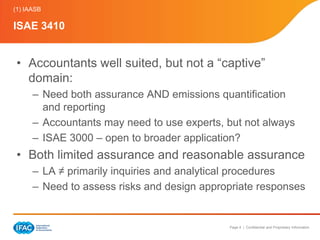
 • Accountants well suited, but not a “captive”
   domain:
      – Need both assurance AND emissions quantification
        and reporting
      – Accountants may need to use experts, but not always
      – ISAE 3000 – open to broader application?
 • Both limited assurance and reasonable assurance
      – LA ≠ primarily inquiries and analytical procedures
      – Need to assess risks and design appropriate responses


                                             Page 4 | Confidential and Proprietary Information
(2) PAIB Committee

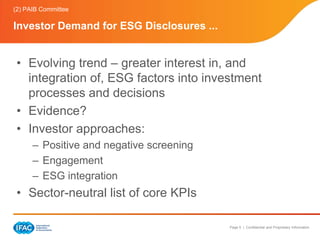
Investor Demand for ESG Disclosures ...


 • Evolving trend – greater interest in, and
   integration of, ESG factors into investment
   processes and decisions
 • Evidence?
 • Investor approaches:
      – Positive and negative screening
      – Engagement
      – ESG integration
 • Sector-neutral list of core KPIs

                                          Page 5 | Confidential and Proprietary Information
(2) PAIB Committee
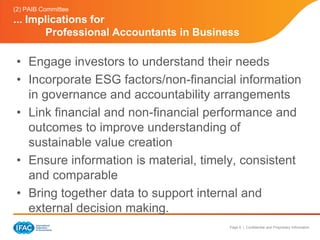
... Implications for
       Professional Accountants in Business

 • Engage investors to understand their needs
 • Incorporate ESG factors/non-financial information
   in governance and accountability arrangements
 • Link financial and non-financial performance and
   outcomes to improve understanding of
   sustainable value creation
 • Ensure information is material, timely, consistent
   and comparable
 • Bring together data to support internal and
   external decision making.
                                         Page 6 | Confidential and Proprietary Information
michaelnugent@ifac.org
michael.nugent@theiirc.org


                        Page 7 | Confidential and Proprietary Information

Workshop on Climate Change Reporting

  • 1.
    Workshop on ClimateChange Reporting Michael Nugent Senior Manager, IFAC / Technical Director, IIRC Geneva 16 March 2012 Page 1 | Confidential and Proprietary Information
  • 2.
    IFAC Overview (1) IAASB: International Standard on Assurance Engagements (ISAE) 3410 “Assurance Engagements on Greenhouse Gas Statements” (2) PAIB Committee “Investor Demand for Environmental, Social, and Governance Disclosures: Implications for Professional Accountants in Business” Page 2 | Confidential and Proprietary Information
  • 3.
    (1) IAASB ISAE 3410 • Sustainability reporting v. single issue • Entities increasingly quantifying emissions – Emissions Trading Schemes – Regulatory disclosure regimes – Voluntary disclosure (e.g., sustainability reports, CDP) • Timeline – 2007 – Project proposal – 2008 – Roundtables – 2009 – Consultation paper – 2010/11 – Exposure Draft – 2012 – Standard (yesterday!) Page 3 | Confidential and Proprietary Information
  • 4.
    (1) IAASB ISAE 3410 • Accountants well suited, but not a “captive” domain: – Need both assurance AND emissions quantification and reporting – Accountants may need to use experts, but not always – ISAE 3000 – open to broader application? • Both limited assurance and reasonable assurance – LA ≠ primarily inquiries and analytical procedures – Need to assess risks and design appropriate responses Page 4 | Confidential and Proprietary Information
  • 5.
    (2) PAIB Committee InvestorDemand for ESG Disclosures ... • Evolving trend – greater interest in, and integration of, ESG factors into investment processes and decisions • Evidence? • Investor approaches: – Positive and negative screening – Engagement – ESG integration • Sector-neutral list of core KPIs Page 5 | Confidential and Proprietary Information
  • 6.
    (2) PAIB Committee ...Implications for Professional Accountants in Business • Engage investors to understand their needs • Incorporate ESG factors/non-financial information in governance and accountability arrangements • Link financial and non-financial performance and outcomes to improve understanding of sustainable value creation • Ensure information is material, timely, consistent and comparable • Bring together data to support internal and external decision making. Page 6 | Confidential and Proprietary Information
  • 7.
    michaelnugent@ifac.org michael.nugent@theiirc.org Page 7 | Confidential and Proprietary Information

Editor's Notes

  • #3 The PAIB Committee exists in the context of IFAC’s vision statement that “The global accountancy profession be recognized as a valued leader in the development of strong and sustainable organizations, financial markets and economies.”While the audit-based assurance of reliable, transparent and accurate reporting lubricates the financial markets, the success of economies is also dependent on the generation of wealth within the business world and sound, effective financial processes within government bodies. That takes place within individual business and public sector organizations. These are the domain of the PAIB, or what we might also call the ‘managerial accountant’, who is thus central to the vision. Both directly and through their influence on and enabling of others, these members of our profession are effectively our front-line troops in the struggle to keep organizations ethical, responsible, sustainable, and resilient.Within this context, my Committee’s focus is on achieving two mutually reinforcing strategic objectives. One is to increase awareness of the important role professional accountants play in securing sustainable value for organizations and their stakeholders. The second is to support member bodies in enhancing the competence of their members by sharing good practice. The first is about promoting the value PAIBs can bring to their organizations. The second is about helping to ensure that they will be properly equipped to perform in a way that demonstrates the truth of that claim.We develop publications and materials that IFAC and its members can use both to promote and support PAIBs, and so to enhance understanding and positively influence perceptions of the managerial accountant – both within and outside the profession itself.The reality underlying the perceived reputation requires professional accountants to be qualified – and supported after they qualify – in the competency areas needed by their employing organizations. You should have received a copy of our recent publication Competent and Versatile: How Professional Accountants in Business Drive Sustainable Organizational Successwhich has been distributed to all member bodies. This employer-driven approach is intended to assist the global accountancy profession to facilitate sustainable organizational success through the education, training, and development of professional accountants. In practice this means working with and through IFAC’s member bodies, as the prime customers of our output, encouraging them to own our aims, and helping them, not only with relevant, internationally developed material, but with help to make the best use of it. We also recognize that the underlying reality needs continuous development so that professional accountants are qualified and supported post-qualification in the competency areas required by organizations – i.e., their employers. Competent and Versatile, which has been distributed to all member bodies, is an employer-driven approach aimed at helping the global accountancy profession facilitate sustainable organizational success through the education, training, and development of professional accountants. In practice this means working with and through IFAC’s member bodies, as the prime customers of our output, encouraging them to own our aims, and helping them, not only with relevant, internationally developed material, but with help to make the best use of it.
  • #4 The PAIB Committee exists in the context of IFAC’s vision statement that “The global accountancy profession be recognized as a valued leader in the development of strong and sustainable organizations, financial markets and economies.”While the audit-based assurance of reliable, transparent and accurate reporting lubricates the financial markets, the success of economies is also dependent on the generation of wealth within the business world and sound, effective financial processes within government bodies. That takes place within individual business and public sector organizations. These are the domain of the PAIB, or what we might also call the ‘managerial accountant’, who is thus central to the vision. Both directly and through their influence on and enabling of others, these members of our profession are effectively our front-line troops in the struggle to keep organizations ethical, responsible, sustainable, and resilient.Within this context, my Committee’s focus is on achieving two mutually reinforcing strategic objectives. One is to increase awareness of the important role professional accountants play in securing sustainable value for organizations and their stakeholders. The second is to support member bodies in enhancing the competence of their members by sharing good practice. The first is about promoting the value PAIBs can bring to their organizations. The second is about helping to ensure that they will be properly equipped to perform in a way that demonstrates the truth of that claim.We develop publications and materials that IFAC and its members can use both to promote and support PAIBs, and so to enhance understanding and positively influence perceptions of the managerial accountant – both within and outside the profession itself.The reality underlying the perceived reputation requires professional accountants to be qualified – and supported after they qualify – in the competency areas needed by their employing organizations. You should have received a copy of our recent publication Competent and Versatile: How Professional Accountants in Business Drive Sustainable Organizational Successwhich has been distributed to all member bodies. This employer-driven approach is intended to assist the global accountancy profession to facilitate sustainable organizational success through the education, training, and development of professional accountants. In practice this means working with and through IFAC’s member bodies, as the prime customers of our output, encouraging them to own our aims, and helping them, not only with relevant, internationally developed material, but with help to make the best use of it. We also recognize that the underlying reality needs continuous development so that professional accountants are qualified and supported post-qualification in the competency areas required by organizations – i.e., their employers. Competent and Versatile, which has been distributed to all member bodies, is an employer-driven approach aimed at helping the global accountancy profession facilitate sustainable organizational success through the education, training, and development of professional accountants. In practice this means working with and through IFAC’s member bodies, as the prime customers of our output, encouraging them to own our aims, and helping them, not only with relevant, internationally developed material, but with help to make the best use of it.
  • #5 The PAIB Committee exists in the context of IFAC’s vision statement that “The global accountancy profession be recognized as a valued leader in the development of strong and sustainable organizations, financial markets and economies.”While the audit-based assurance of reliable, transparent and accurate reporting lubricates the financial markets, the success of economies is also dependent on the generation of wealth within the business world and sound, effective financial processes within government bodies. That takes place within individual business and public sector organizations. These are the domain of the PAIB, or what we might also call the ‘managerial accountant’, who is thus central to the vision. Both directly and through their influence on and enabling of others, these members of our profession are effectively our front-line troops in the struggle to keep organizations ethical, responsible, sustainable, and resilient.Within this context, my Committee’s focus is on achieving two mutually reinforcing strategic objectives. One is to increase awareness of the important role professional accountants play in securing sustainable value for organizations and their stakeholders. The second is to support member bodies in enhancing the competence of their members by sharing good practice. The first is about promoting the value PAIBs can bring to their organizations. The second is about helping to ensure that they will be properly equipped to perform in a way that demonstrates the truth of that claim.We develop publications and materials that IFAC and its members can use both to promote and support PAIBs, and so to enhance understanding and positively influence perceptions of the managerial accountant – both within and outside the profession itself.The reality underlying the perceived reputation requires professional accountants to be qualified – and supported after they qualify – in the competency areas needed by their employing organizations. You should have received a copy of our recent publication Competent and Versatile: How Professional Accountants in Business Drive Sustainable Organizational Successwhich has been distributed to all member bodies. This employer-driven approach is intended to assist the global accountancy profession to facilitate sustainable organizational success through the education, training, and development of professional accountants. In practice this means working with and through IFAC’s member bodies, as the prime customers of our output, encouraging them to own our aims, and helping them, not only with relevant, internationally developed material, but with help to make the best use of it. We also recognize that the underlying reality needs continuous development so that professional accountants are qualified and supported post-qualification in the competency areas required by organizations – i.e., their employers. Competent and Versatile, which has been distributed to all member bodies, is an employer-driven approach aimed at helping the global accountancy profession facilitate sustainable organizational success through the education, training, and development of professional accountants. In practice this means working with and through IFAC’s member bodies, as the prime customers of our output, encouraging them to own our aims, and helping them, not only with relevant, internationally developed material, but with help to make the best use of it.
  • #6 The PAIB Committee exists in the context of IFAC’s vision statement that “The global accountancy profession be recognized as a valued leader in the development of strong and sustainable organizations, financial markets and economies.”While the audit-based assurance of reliable, transparent and accurate reporting lubricates the financial markets, the success of economies is also dependent on the generation of wealth within the business world and sound, effective financial processes within government bodies. That takes place within individual business and public sector organizations. These are the domain of the PAIB, or what we might also call the ‘managerial accountant’, who is thus central to the vision. Both directly and through their influence on and enabling of others, these members of our profession are effectively our front-line troops in the struggle to keep organizations ethical, responsible, sustainable, and resilient.Within this context, my Committee’s focus is on achieving two mutually reinforcing strategic objectives. One is to increase awareness of the important role professional accountants play in securing sustainable value for organizations and their stakeholders. The second is to support member bodies in enhancing the competence of their members by sharing good practice. The first is about promoting the value PAIBs can bring to their organizations. The second is about helping to ensure that they will be properly equipped to perform in a way that demonstrates the truth of that claim.We develop publications and materials that IFAC and its members can use both to promote and support PAIBs, and so to enhance understanding and positively influence perceptions of the managerial accountant – both within and outside the profession itself.The reality underlying the perceived reputation requires professional accountants to be qualified – and supported after they qualify – in the competency areas needed by their employing organizations. You should have received a copy of our recent publication Competent and Versatile: How Professional Accountants in Business Drive Sustainable Organizational Successwhich has been distributed to all member bodies. This employer-driven approach is intended to assist the global accountancy profession to facilitate sustainable organizational success through the education, training, and development of professional accountants. In practice this means working with and through IFAC’s member bodies, as the prime customers of our output, encouraging them to own our aims, and helping them, not only with relevant, internationally developed material, but with help to make the best use of it. We also recognize that the underlying reality needs continuous development so that professional accountants are qualified and supported post-qualification in the competency areas required by organizations – i.e., their employers. Competent and Versatile, which has been distributed to all member bodies, is an employer-driven approach aimed at helping the global accountancy profession facilitate sustainable organizational success through the education, training, and development of professional accountants. In practice this means working with and through IFAC’s member bodies, as the prime customers of our output, encouraging them to own our aims, and helping them, not only with relevant, internationally developed material, but with help to make the best use of it.
  • #7 The PAIB Committee exists in the context of IFAC’s vision statement that “The global accountancy profession be recognized as a valued leader in the development of strong and sustainable organizations, financial markets and economies.”While the audit-based assurance of reliable, transparent and accurate reporting lubricates the financial markets, the success of economies is also dependent on the generation of wealth within the business world and sound, effective financial processes within government bodies. That takes place within individual business and public sector organizations. These are the domain of the PAIB, or what we might also call the ‘managerial accountant’, who is thus central to the vision. Both directly and through their influence on and enabling of others, these members of our profession are effectively our front-line troops in the struggle to keep organizations ethical, responsible, sustainable, and resilient.Within this context, my Committee’s focus is on achieving two mutually reinforcing strategic objectives. One is to increase awareness of the important role professional accountants play in securing sustainable value for organizations and their stakeholders. The second is to support member bodies in enhancing the competence of their members by sharing good practice. The first is about promoting the value PAIBs can bring to their organizations. The second is about helping to ensure that they will be properly equipped to perform in a way that demonstrates the truth of that claim.We develop publications and materials that IFAC and its members can use both to promote and support PAIBs, and so to enhance understanding and positively influence perceptions of the managerial accountant – both within and outside the profession itself.The reality underlying the perceived reputation requires professional accountants to be qualified – and supported after they qualify – in the competency areas needed by their employing organizations. You should have received a copy of our recent publication Competent and Versatile: How Professional Accountants in Business Drive Sustainable Organizational Successwhich has been distributed to all member bodies. This employer-driven approach is intended to assist the global accountancy profession to facilitate sustainable organizational success through the education, training, and development of professional accountants. In practice this means working with and through IFAC’s member bodies, as the prime customers of our output, encouraging them to own our aims, and helping them, not only with relevant, internationally developed material, but with help to make the best use of it. We also recognize that the underlying reality needs continuous development so that professional accountants are qualified and supported post-qualification in the competency areas required by organizations – i.e., their employers. Competent and Versatile, which has been distributed to all member bodies, is an employer-driven approach aimed at helping the global accountancy profession facilitate sustainable organizational success through the education, training, and development of professional accountants. In practice this means working with and through IFAC’s member bodies, as the prime customers of our output, encouraging them to own our aims, and helping them, not only with relevant, internationally developed material, but with help to make the best use of it.