The 10 Principles of Applied Artificial Intelligence 1
The 10 Principles of
Applied Artificial Intelligence
How to Implement AI in Your Software Solution
The 10 Principles of Applied Artificial Intelligence 2
Artificial intelligence (AI) is rapidly
moving out of the laboratory and into
business and consumer applications.
The 10 Principles of Applied Artificial Intelligence 3
The result is a fundamental shift
in how software is built, and
what it’s capable of doing.
The 10 Principles of Applied Artificial Intelligence 4The 10 Principles of Applied Artificial Intelligence 4
Of course, the sort of AI
we mean isn’t the artificial
general intelligence
of science fiction.
The 10 Principles of Applied Artificial Intelligence 5
Instead, we’re talking
about the specialized
uses of artificial
narrow intelligence
that are already being
used to power some
of today’s most
successful technology
businesses.
The 10 Principles of Applied Artificial Intelligence 6
In this SlideShare, we’re going
to take a look at the principles
governing how that AI should
be applied to your business.
The 10 Principles of Applied Artificial Intelligence 7The 10 Principles of Applied Artificial Intelligence 7
It’s important to point out that
applied artificial intelligence
(applied AI) has a lot in common
with applied analytics.
The 10 Principles of Applied Artificial Intelligence 8
That’s because in some
ways applied analytics is
a subset of applied AI.
The 10 Principles of Applied Artificial Intelligence 9The 10 Principles of Applied Artificial Intelligence 9
But our applied AI
principles extend the
applied analytics
model with…
The 10 Principles of Applied Artificial Intelligence 10
ü An increased focus on
end-to-end process
automation.
The 10 Principles of Applied Artificial Intelligence 11
ü Use of advanced machine
learning techniques.
The 10 Principles of Applied Artificial Intelligence 12
ü Better articulated
performance objectives
and model accuracy.
The 10 Principles of Applied Artificial Intelligence 13
ü Appropriate use of
human judgement and
automated predictions.
The 10 Principles of Applied Artificial Intelligence 14
ü Continuous learning
and adaptation through
feedback loops.
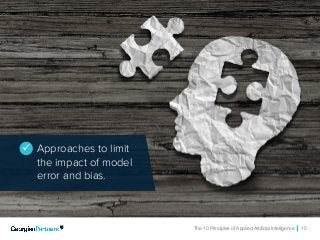
The 10 Principles of Applied Artificial Intelligence 15
ü Approaches to limit
the impact of model
error and bias.
The 10 Principles of Applied Artificial Intelligence 16The 10 Principles of Applied Artificial Intelligence 16
But the biggest
difference of all may
be in its potential for
business impact.
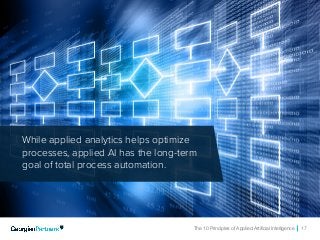
The 10 Principles of Applied Artificial Intelligence 17
While applied analytics helps optimize
processes, applied AI has the long-term
goal of total process automation.
The 10 Principles of Applied Artificial Intelligence 18The 10 Principles of Applied Artificial Intelligence 18
With that context in
mind, let’s take a look
at the principles
of applied AI.
The 10 Principles of Applied Artificial Intelligence 19The 10 Principles of Applied Artificial Intelligence 19
Understand all
processes.
1
The 10 Principles of Applied Artificial Intelligence 20
As with analytics, it’s
important to start with
business processes.
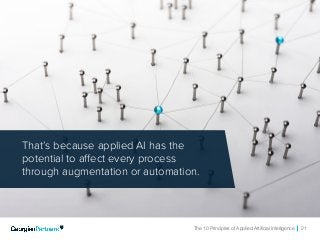
The 10 Principles of Applied Artificial Intelligence 21
That’s because applied AI has the
potential to affect every process
through augmentation or automation.
The 10 Principles of Applied Artificial Intelligence 22
So consider customer, partner
and competitor processes, as
well as those you control today.
The 10 Principles of Applied Artificial Intelligence 23The 10 Principles of Applied Artificial Intelligence 23
And even entirely
new processes that
weren’t possible before.
The 10 Principles of Applied Artificial Intelligence 24
Document the decisions
and actions for each.
The 10 Principles of Applied Artificial Intelligence 25
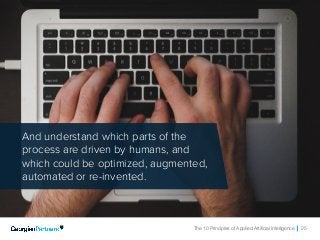
And understand which parts of the
process are driven by humans, and
which could be optimized, augmented,
automated or re-invented.
The 10 Principles of Applied Artificial Intelligence 26The 10 Principles of Applied Artificial Intelligence 26
2Prioritize the most
valuable processes.
The 10 Principles of Applied Artificial Intelligence 27
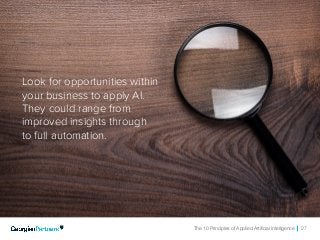
Look for opportunities within
your business to apply AI.
They could range from
improved insights through
to full automation.
The 10 Principles of Applied Artificial Intelligence 28
Start with the desired outcomes that
would have the greatest impact
within your customers’ processes.
The 10 Principles of Applied Artificial Intelligence 29The 10 Principles of Applied Artificial Intelligence 29
Recognize where in those
processes you’re short
on instrumentation or
integrations.
The 10 Principles of Applied Artificial Intelligence 30
Then score potential opportunities
across various dimensions to
identify your top priorities.
The 10 Principles of Applied Artificial Intelligence 31The 10 Principles of Applied Artificial Intelligence 31
Design frictionless
integrations.
3
The 10 Principles of Applied Artificial Intelligence 32
Try to design solutions that
are as automated, natural
and complete as possible.
The 10 Principles of Applied Artificial Intelligence 33The 10 Principles of Applied Artificial Intelligence 33
To do so, take an
outside-in approach.
The 10 Principles of Applied Artificial Intelligence 34
Think about how your AI-enabled
process or solution will be
integrated (and used).
The 10 Principles of Applied Artificial Intelligence 35
Then identify interdependencies
with other processes such as...
The 10 Principles of Applied Artificial Intelligence 36
How other software
processes (or humans) will
access its capabilities.
The 10 Principles of Applied Artificial Intelligence 37
Remember, the more integrated
your applied AI solution is,
the greater the value.
The 10 Principles of Applied Artificial Intelligence 38The 10 Principles of Applied Artificial Intelligence 38
Integrate human
judgement as
required.
4
The 10 Principles of Applied Artificial Intelligence 39
Understand the roles people
play in your solution.
The 10 Principles of Applied Artificial Intelligence 40
They may be sources of data,
trainers, reviewers or users.
The 10 Principles of Applied Artificial Intelligence 41The 10 Principles of Applied Artificial Intelligence 41
Having humans in the loop
may be a user, market or
regulatory requirement.
The 10 Principles of Applied Artificial Intelligence 42
So even if full automation is
possible, human oversight
may be necessary.
The 10 Principles of Applied Artificial Intelligence 43The 10 Principles of Applied Artificial Intelligence 43
Understand
performance
objectives.
5
The 10 Principles of Applied Artificial Intelligence 44
Understand what model
performance levels are required
to add business value.
The 10 Principles of Applied Artificial Intelligence 45The 10 Principles of Applied Artificial Intelligence 45
Model performance
includes error rates,
consistency and bias.
The 10 Principles of Applied Artificial Intelligence 46
Determine the cost of improving
model accuracy vs. the business
impact of false predictions.
The 10 Principles of Applied Artificial Intelligence 47
And avoid models where
the impact of false
predictions is greater than
the business can tolerate.
The 10 Principles of Applied Artificial Intelligence 48The 10 Principles of Applied Artificial Intelligence 48
Match modeling
techniques to
requirements.
6
The 10 Principles of Applied Artificial Intelligence 49
Artificial intelligence and
machine learning techniques
are changing fast.
The 10 Principles of Applied Artificial Intelligence 50
Always aim for the simplest
model that can do the largest
part of the job…
The 10 Principles of Applied Artificial Intelligence 51The 10 Principles of Applied Artificial Intelligence 51
And consider whether
explainability of the
model is a requirement.
The 10 Principles of Applied Artificial Intelligence 52
Next, simplify processes using
decomposition as needed to
fit simpler models.
The 10 Principles of Applied Artificial Intelligence 53
Then hire experienced
machine learning scientists
for optimal outcomes.
The 10 Principles of Applied Artificial Intelligence 54The 10 Principles of Applied Artificial Intelligence 54
Test for and compare
model performance.
The 10 Principles of Applied Artificial Intelligence 55
And have a plan for
evaluating new more
sophisticated models.
The 10 Principles of Applied Artificial Intelligence 56The 10 Principles of Applied Artificial Intelligence 56
Capture relevant
data to support
your models.
7
The 10 Principles of Applied Artificial Intelligence 57
Capture comprehensive and
diverse data from your target
business processes.
The 10 Principles of Applied Artificial Intelligence 58The 10 Principles of Applied Artificial Intelligence 58
Then use this
experience data to
train your models.
The 10 Principles of Applied Artificial Intelligence 59
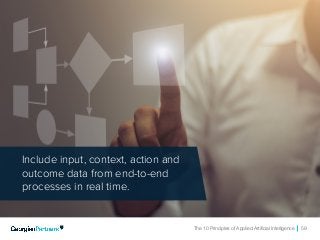
Include input, context, action and
outcome data from end-to-end
processes in real time.
The 10 Principles of Applied Artificial Intelligence 60The 10 Principles of Applied Artificial Intelligence 60
And derive general and
edge case experience data
using simulation techniques
if necessary.
The 10 Principles of Applied Artificial Intelligence 61The 10 Principles of Applied Artificial Intelligence 61
Manage quality
for error and bias.
8
The 10 Principles of Applied Artificial Intelligence 62
Machine learning is only fair
and objective if it’s free of bias.
The 10 Principles of Applied Artificial Intelligence 63
Implement processes to monitor
for bias and other errors such as
inaccurate predictions.
The 10 Principles of Applied Artificial Intelligence 64The 10 Principles of Applied Artificial Intelligence 64
Bias may come from
existing business
processes and their data.
The 10 Principles of Applied Artificial Intelligence 65
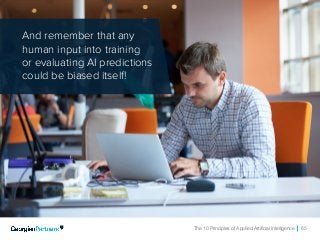
And remember that any
human input into training
or evaluating AI predictions
could be biased itself!
The 10 Principles of Applied Artificial Intelligence 66The 10 Principles of Applied Artificial Intelligence 66
Build fault tolerance
as part of model
integration.
9
The 10 Principles of Applied Artificial Intelligence 67
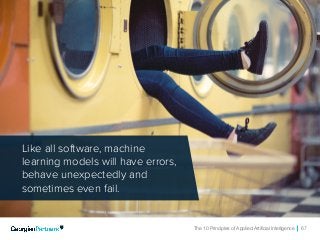
Like all software, machine
learning models will have errors,
behave unexpectedly and
sometimes even fail.
The 10 Principles of Applied Artificial Intelligence 68The 10 Principles of Applied Artificial Intelligence 68
And some machine
learning models will
change over time with
new data.
The 10 Principles of Applied Artificial Intelligence 69
Automation will also
amplify the impact
of errors.
The 10 Principles of Applied Artificial Intelligence 70The 10 Principles of Applied Artificial Intelligence 70
Traditional approaches
to error detection
and elimination are
inadequate.
The 10 Principles of Applied Artificial Intelligence 71
So increase system
dependency through
fault tolerance.
The 10 Principles of Applied Artificial Intelligence 72The 10 Principles of Applied Artificial Intelligence 72
• Rule-based circuit breakers
• Human and AI-based monitoring and audits
• Check-and-balance redundancy
• Mandatory human review
• Kill switches
• Least-harm actions
And consider techniques like:
The 10 Principles of Applied Artificial Intelligence 73The 10 Principles of Applied Artificial Intelligence 73
Defend your legal
and ethical stance.
10
The 10 Principles of Applied Artificial Intelligence 74
Understand and articulate
the overall benefits of AI
to your market.
The 10 Principles of Applied Artificial Intelligence 75
Consider external factors
such as legislation as well
as customer sentiment.
The 10 Principles of Applied Artificial Intelligence 76
Keep in mind that regulation
may restrict automation levels to
reduce risk and consequence.
The 10 Principles of Applied Artificial Intelligence 77
Don’t gloss over the
replacement of human
effort with automation.
The 10 Principles of Applied Artificial Intelligence 78The 10 Principles of Applied Artificial Intelligence 78
Instead, be open
and transparent.
The 10 Principles of Applied Artificial Intelligence 79
Applied AI is already
fundamentally changing the
nature of work and life.
The 10 Principles of Applied Artificial Intelligence 80The 10 Principles of Applied Artificial Intelligence 80
Understand all processes.
Prioritize the most valuable
processes.
Design frictionless integrations.
Integrate human judgement
as required.
Understand performance
objectives.
4
7
8
9
1
2
3
Match modeling techniques to
requirements.
Capture relevant data to support
your models.
Manage quality for error and bias.
Build fault tolerance as part of
model integration.
Defend your legal and ethical
stance.
Big, long-term strategic changes lie
ahead. To deal with them, remember
these principles:
6
5
10
The 10 Principles of Applied Artificial Intelligence 81The 10 Principles of Applied Artificial Intelligence 81
Want to learn
more about
artificial intelligence?
Download our white paper on
the “10 Principles of Applied
Artificial Intelligence.”
The 10 Principles of Applied Artificial Intelligence 81

The Principles of Applied Artificial Intelligence

  • 1.
    The 10 Principlesof Applied Artificial Intelligence 1 The 10 Principles of Applied Artificial Intelligence How to Implement AI in Your Software Solution
  • 2.
    The 10 Principlesof Applied Artificial Intelligence 2 Artificial intelligence (AI) is rapidly moving out of the laboratory and into business and consumer applications.
  • 3.
    The 10 Principlesof Applied Artificial Intelligence 3 The result is a fundamental shift in how software is built, and what it’s capable of doing.
  • 4.
    The 10 Principlesof Applied Artificial Intelligence 4The 10 Principles of Applied Artificial Intelligence 4 Of course, the sort of AI we mean isn’t the artificial general intelligence of science fiction.
  • 5.
    The 10 Principlesof Applied Artificial Intelligence 5 Instead, we’re talking about the specialized uses of artificial narrow intelligence that are already being used to power some of today’s most successful technology businesses.
  • 6.
    The 10 Principlesof Applied Artificial Intelligence 6 In this SlideShare, we’re going to take a look at the principles governing how that AI should be applied to your business.
  • 7.
    The 10 Principlesof Applied Artificial Intelligence 7The 10 Principles of Applied Artificial Intelligence 7 It’s important to point out that applied artificial intelligence (applied AI) has a lot in common with applied analytics.
  • 8.
    The 10 Principlesof Applied Artificial Intelligence 8 That’s because in some ways applied analytics is a subset of applied AI.
  • 9.
    The 10 Principlesof Applied Artificial Intelligence 9The 10 Principles of Applied Artificial Intelligence 9 But our applied AI principles extend the applied analytics model with…
  • 10.
    The 10 Principlesof Applied Artificial Intelligence 10 ü An increased focus on end-to-end process automation.
  • 11.
    The 10 Principlesof Applied Artificial Intelligence 11 ü Use of advanced machine learning techniques.
  • 12.
    The 10 Principlesof Applied Artificial Intelligence 12 ü Better articulated performance objectives and model accuracy.
  • 13.
    The 10 Principlesof Applied Artificial Intelligence 13 ü Appropriate use of human judgement and automated predictions.
  • 14.
    The 10 Principlesof Applied Artificial Intelligence 14 ü Continuous learning and adaptation through feedback loops.
  • 15.
    The 10 Principlesof Applied Artificial Intelligence 15 ü Approaches to limit the impact of model error and bias.
  • 16.
    The 10 Principlesof Applied Artificial Intelligence 16The 10 Principles of Applied Artificial Intelligence 16 But the biggest difference of all may be in its potential for business impact.
  • 17.
    The 10 Principlesof Applied Artificial Intelligence 17 While applied analytics helps optimize processes, applied AI has the long-term goal of total process automation.
  • 18.
    The 10 Principlesof Applied Artificial Intelligence 18The 10 Principles of Applied Artificial Intelligence 18 With that context in mind, let’s take a look at the principles of applied AI.
  • 19.
    The 10 Principlesof Applied Artificial Intelligence 19The 10 Principles of Applied Artificial Intelligence 19 Understand all processes. 1
  • 20.
    The 10 Principlesof Applied Artificial Intelligence 20 As with analytics, it’s important to start with business processes.
  • 21.
    The 10 Principlesof Applied Artificial Intelligence 21 That’s because applied AI has the potential to affect every process through augmentation or automation.
  • 22.
    The 10 Principlesof Applied Artificial Intelligence 22 So consider customer, partner and competitor processes, as well as those you control today.
  • 23.
    The 10 Principlesof Applied Artificial Intelligence 23The 10 Principles of Applied Artificial Intelligence 23 And even entirely new processes that weren’t possible before.
  • 24.
    The 10 Principlesof Applied Artificial Intelligence 24 Document the decisions and actions for each.
  • 25.
    The 10 Principlesof Applied Artificial Intelligence 25 And understand which parts of the process are driven by humans, and which could be optimized, augmented, automated or re-invented.
  • 26.
    The 10 Principlesof Applied Artificial Intelligence 26The 10 Principles of Applied Artificial Intelligence 26 2Prioritize the most valuable processes.
  • 27.
    The 10 Principlesof Applied Artificial Intelligence 27 Look for opportunities within your business to apply AI. They could range from improved insights through to full automation.
  • 28.
    The 10 Principlesof Applied Artificial Intelligence 28 Start with the desired outcomes that would have the greatest impact within your customers’ processes.
  • 29.
    The 10 Principlesof Applied Artificial Intelligence 29The 10 Principles of Applied Artificial Intelligence 29 Recognize where in those processes you’re short on instrumentation or integrations.
  • 30.
    The 10 Principlesof Applied Artificial Intelligence 30 Then score potential opportunities across various dimensions to identify your top priorities.
  • 31.
    The 10 Principlesof Applied Artificial Intelligence 31The 10 Principles of Applied Artificial Intelligence 31 Design frictionless integrations. 3
  • 32.
    The 10 Principlesof Applied Artificial Intelligence 32 Try to design solutions that are as automated, natural and complete as possible.
  • 33.
    The 10 Principlesof Applied Artificial Intelligence 33The 10 Principles of Applied Artificial Intelligence 33 To do so, take an outside-in approach.
  • 34.
    The 10 Principlesof Applied Artificial Intelligence 34 Think about how your AI-enabled process or solution will be integrated (and used).
  • 35.
    The 10 Principlesof Applied Artificial Intelligence 35 Then identify interdependencies with other processes such as...
  • 36.
    The 10 Principlesof Applied Artificial Intelligence 36 How other software processes (or humans) will access its capabilities.
  • 37.
    The 10 Principlesof Applied Artificial Intelligence 37 Remember, the more integrated your applied AI solution is, the greater the value.
  • 38.
    The 10 Principlesof Applied Artificial Intelligence 38The 10 Principles of Applied Artificial Intelligence 38 Integrate human judgement as required. 4
  • 39.
    The 10 Principlesof Applied Artificial Intelligence 39 Understand the roles people play in your solution.
  • 40.
    The 10 Principlesof Applied Artificial Intelligence 40 They may be sources of data, trainers, reviewers or users.
  • 41.
    The 10 Principlesof Applied Artificial Intelligence 41The 10 Principles of Applied Artificial Intelligence 41 Having humans in the loop may be a user, market or regulatory requirement.
  • 42.
    The 10 Principlesof Applied Artificial Intelligence 42 So even if full automation is possible, human oversight may be necessary.
  • 43.
    The 10 Principlesof Applied Artificial Intelligence 43The 10 Principles of Applied Artificial Intelligence 43 Understand performance objectives. 5
  • 44.
    The 10 Principlesof Applied Artificial Intelligence 44 Understand what model performance levels are required to add business value.
  • 45.
    The 10 Principlesof Applied Artificial Intelligence 45The 10 Principles of Applied Artificial Intelligence 45 Model performance includes error rates, consistency and bias.
  • 46.
    The 10 Principlesof Applied Artificial Intelligence 46 Determine the cost of improving model accuracy vs. the business impact of false predictions.
  • 47.
    The 10 Principlesof Applied Artificial Intelligence 47 And avoid models where the impact of false predictions is greater than the business can tolerate.
  • 48.
    The 10 Principlesof Applied Artificial Intelligence 48The 10 Principles of Applied Artificial Intelligence 48 Match modeling techniques to requirements. 6
  • 49.
    The 10 Principlesof Applied Artificial Intelligence 49 Artificial intelligence and machine learning techniques are changing fast.
  • 50.
    The 10 Principlesof Applied Artificial Intelligence 50 Always aim for the simplest model that can do the largest part of the job…
  • 51.
    The 10 Principlesof Applied Artificial Intelligence 51The 10 Principles of Applied Artificial Intelligence 51 And consider whether explainability of the model is a requirement.
  • 52.
    The 10 Principlesof Applied Artificial Intelligence 52 Next, simplify processes using decomposition as needed to fit simpler models.
  • 53.
    The 10 Principlesof Applied Artificial Intelligence 53 Then hire experienced machine learning scientists for optimal outcomes.
  • 54.
    The 10 Principlesof Applied Artificial Intelligence 54The 10 Principles of Applied Artificial Intelligence 54 Test for and compare model performance.
  • 55.
    The 10 Principlesof Applied Artificial Intelligence 55 And have a plan for evaluating new more sophisticated models.
  • 56.
    The 10 Principlesof Applied Artificial Intelligence 56The 10 Principles of Applied Artificial Intelligence 56 Capture relevant data to support your models. 7
  • 57.
    The 10 Principlesof Applied Artificial Intelligence 57 Capture comprehensive and diverse data from your target business processes.
  • 58.
    The 10 Principlesof Applied Artificial Intelligence 58The 10 Principles of Applied Artificial Intelligence 58 Then use this experience data to train your models.
  • 59.
    The 10 Principlesof Applied Artificial Intelligence 59 Include input, context, action and outcome data from end-to-end processes in real time.
  • 60.
    The 10 Principlesof Applied Artificial Intelligence 60The 10 Principles of Applied Artificial Intelligence 60 And derive general and edge case experience data using simulation techniques if necessary.
  • 61.
    The 10 Principlesof Applied Artificial Intelligence 61The 10 Principles of Applied Artificial Intelligence 61 Manage quality for error and bias. 8
  • 62.
    The 10 Principlesof Applied Artificial Intelligence 62 Machine learning is only fair and objective if it’s free of bias.
  • 63.
    The 10 Principlesof Applied Artificial Intelligence 63 Implement processes to monitor for bias and other errors such as inaccurate predictions.
  • 64.
    The 10 Principlesof Applied Artificial Intelligence 64The 10 Principles of Applied Artificial Intelligence 64 Bias may come from existing business processes and their data.
  • 65.
    The 10 Principlesof Applied Artificial Intelligence 65 And remember that any human input into training or evaluating AI predictions could be biased itself!
  • 66.
    The 10 Principlesof Applied Artificial Intelligence 66The 10 Principles of Applied Artificial Intelligence 66 Build fault tolerance as part of model integration. 9
  • 67.
    The 10 Principlesof Applied Artificial Intelligence 67 Like all software, machine learning models will have errors, behave unexpectedly and sometimes even fail.

  • 68.
    The 10 Principlesof Applied Artificial Intelligence 68The 10 Principles of Applied Artificial Intelligence 68 And some machine learning models will change over time with new data.


  • 69.
    The 10 Principlesof Applied Artificial Intelligence 69 Automation will also amplify the impact of errors.
  • 70.
    The 10 Principlesof Applied Artificial Intelligence 70The 10 Principles of Applied Artificial Intelligence 70 Traditional approaches to error detection and elimination are inadequate.
  • 71.
    The 10 Principlesof Applied Artificial Intelligence 71 So increase system dependency through fault tolerance.
  • 72.
    The 10 Principlesof Applied Artificial Intelligence 72The 10 Principles of Applied Artificial Intelligence 72 • Rule-based circuit breakers • Human and AI-based monitoring and audits • Check-and-balance redundancy • Mandatory human review • Kill switches • Least-harm actions And consider techniques like:
  • 73.
    The 10 Principlesof Applied Artificial Intelligence 73The 10 Principles of Applied Artificial Intelligence 73 Defend your legal and ethical stance. 10
  • 74.
    The 10 Principlesof Applied Artificial Intelligence 74 Understand and articulate the overall benefits of AI to your market.
  • 75.
    The 10 Principlesof Applied Artificial Intelligence 75 Consider external factors such as legislation as well as customer sentiment.
  • 76.
    The 10 Principlesof Applied Artificial Intelligence 76 Keep in mind that regulation may restrict automation levels to reduce risk and consequence.
  • 77.
    The 10 Principlesof Applied Artificial Intelligence 77 Don’t gloss over the replacement of human effort with automation.
  • 78.
    The 10 Principlesof Applied Artificial Intelligence 78The 10 Principles of Applied Artificial Intelligence 78 Instead, be open and transparent.
  • 79.
    The 10 Principlesof Applied Artificial Intelligence 79 Applied AI is already fundamentally changing the nature of work and life.
  • 80.
    The 10 Principlesof Applied Artificial Intelligence 80The 10 Principles of Applied Artificial Intelligence 80 Understand all processes. Prioritize the most valuable processes. Design frictionless integrations. Integrate human judgement as required. Understand performance objectives. 4 7 8 9 1 2 3 Match modeling techniques to requirements. Capture relevant data to support your models. Manage quality for error and bias. Build fault tolerance as part of model integration. Defend your legal and ethical stance. Big, long-term strategic changes lie ahead. To deal with them, remember these principles: 6 5 10
  • 81.
    The 10 Principlesof Applied Artificial Intelligence 81The 10 Principles of Applied Artificial Intelligence 81 Want to learn more about artificial intelligence? Download our white paper on the “10 Principles of Applied Artificial Intelligence.” The 10 Principles of Applied Artificial Intelligence 81