¿Cómo construye la gente trans
Española identidades nacionales en
la España contemporanea?
Claire St John Eve
How do trans Spaniards construct
national identities in contemporary
Spain?
My project..
• Was conducted in Zaragoza, Spain.
• I chose this topic as I was starting to become
interested in gender studies, and the
ethnographic approach because I wanted to talk
to people!
• Interviews with 4 Spanish natives who identified
with the term ‘trans’, found through a local LGBT+
community centre.
• I also attended events at the group ‘trezciclo’ at
the centre.
Findings
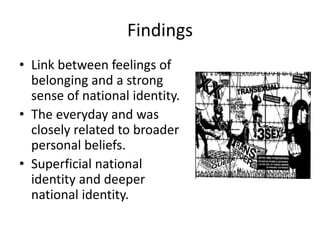
• Link between feelings of
belonging and a strong
sense of national identity.
• The everyday and was
closely related to broader
personal beliefs.
• Superficial national
identity and deeper
national identity.
Difficulties
• Finding participants and motivating myself
• Trying to relate to people who were not very
receptive to my research
• Using Spanish
Successes
• I was able to gather enough data to come up
with some interesting conclusions – I would
love to come back and research this subject
again in more depth in postgraduate study.
• I was able to explore life in another country
and the YARP was a really integral part of my
year abroad.
• The sense of achievement I felt at the end of it
all.

Student Presentation 2 - Trans*national identity

  • 1.
    ¿Cómo construye lagente trans Española identidades nacionales en la España contemporanea? Claire St John Eve How do trans Spaniards construct national identities in contemporary Spain?
  • 2.
    My project.. • Wasconducted in Zaragoza, Spain. • I chose this topic as I was starting to become interested in gender studies, and the ethnographic approach because I wanted to talk to people! • Interviews with 4 Spanish natives who identified with the term ‘trans’, found through a local LGBT+ community centre. • I also attended events at the group ‘trezciclo’ at the centre.
  • 3.
    Findings • Link betweenfeelings of belonging and a strong sense of national identity. • The everyday and was closely related to broader personal beliefs. • Superficial national identity and deeper national identity.
  • 4.
    Difficulties • Finding participantsand motivating myself • Trying to relate to people who were not very receptive to my research • Using Spanish
  • 5.
    Successes • I wasable to gather enough data to come up with some interesting conclusions – I would love to come back and research this subject again in more depth in postgraduate study. • I was able to explore life in another country and the YARP was a really integral part of my year abroad. • The sense of achievement I felt at the end of it all.