Modellering af LAR anlæg samt modellering af
stoffjernelse i LAR anlæg og bassiner
Morten Just Kjølby, DHI
Background & Objective
© DHI
• Developed under the umbrella of research project: “Cities in Water
Balance”, 2011-2014
• Objective: Develop modelling support of green storm water
infrastructure in MIKE URBAN:
− Support modelling of various LID technologies in a generic but
relative simple user interface
− It shall be possible to connect implemented LID technology
hydraulically to existing drainage network
− Support of various treatment options
MIKE URBAN - Modelling of LID technologies at two levels
© DHI
• Screening method (Catchment based)
− Method for assessment of the required capacity or efficiency of
instalment of various LID controls in a catchment. The LID controls
are integrated with MIKE 1D and the runoff model B
• Detailed method (Network based)
− Detailed hydraulic assessment of Soakaway solutions with option
to couple to existing drainage network.
− Option for assessment of various treatments using ECO Lab.
Terminology
© DHI
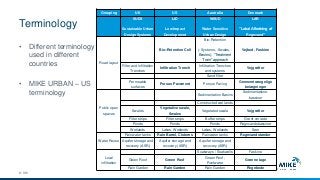
• Different terminology
used in different
countries
• MIKE URBAN – US
terminology
Grouping UK US Australia Denmark
SUDS
Sustainable Urban
Design Systems
LID
Low Impact
Development
WSUD
Water Sensitive
Urban Design
LAR
”Lokal Afledning af
Regnvand”
Road layout
Bio–Retention Cell
Bio-Retention
(- Systems, -Swales, -
Basins), “Treatment
Train” approach
Vejbed, Faskine
Filter and Infiltration
Trenches
Infiltration Trench
Infiltration Trenches
and systems
Vejgrøfter
Sand filter
Permeable
surfaces
Porous Pavement Porous Paving
Gennemtrængelige
belægninger
Public open
spaces
Sedimentation Basins
Sedimentations-
bassiner
Constructed wet lands
Swales
Vegetative swale,
Swales
Vegetated swale Vejgrøfter
Filter strips Filter strips Buffer strips Grønt område
Ponds Ponds Ponds Regnvandsbassiner
Wetlands Lakes, Wetlands Lakes, Wetlands Søer
Water Reuse
Rainwater tanks Rain Barrel, Cisterns Rainwater tanks Regnvandstønder
Aquifer storage and
recovery (ASR)
Aquifer storage and
recovery (ASR)
Aquifer storage and
recovery (ASR)
Local
infiltration
Soakways / Soakwells Faskine
Green Roof Green Roof
Green Roof ,
Roofwater
Grønne tage
Rain Garden Rain Garden Rain Garden Regnbede
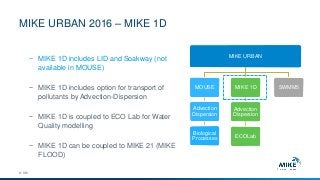
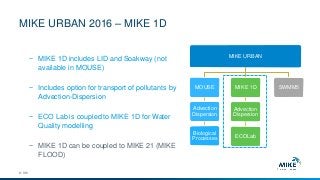
MIKE URBAN 2016 – MIKE 1D
© DHI
MIKE URBAN
MOUSE
Advection
Dispersion
Biological
Processes
SWMM5MIKE 1D
Advection
Dispersion
ECOLab
− MIKE 1D includes LID and Soakway (not
available in MOUSE)
− MIKE 1D includes option for transport of
pollutants by Advection-Dispersion
− MIKE 1D is coupled to ECO Lab for Water
Quality modelling
− MIKE 1D can be coupled to MIKE 21 (MIKE
FLOOD)
Screening Level - LID Controls
© DHI
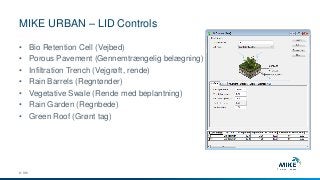
MIKE URBAN – LID Controls
© DHI
• Bio Retention Cell (Vejbed)
• Porous Pavement (Gennemtrængelig belægning)
• Infiltration Trench (Vejgrøft, rende)
• Rain Barrels (Regntønder)
• Vegetative Swale (Rende med beplantning)
• Rain Garden (Regnbede)
• Green Roof (Grønt tag)
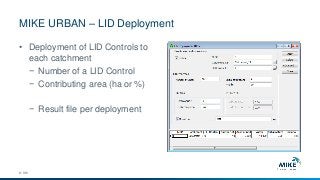
MIKE URBAN – LID Deployment
© DHI
• Deployment of LID Controls to
each catchment
− Number of a LID Control
− Contributing area (ha or %)
− Result file per deployment
MIKE URBAN – Principle of catchment based LID modelling
© DHI
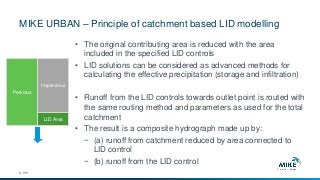
• The original contributing area is reduced with the area
included in the specified LID controls
• LID solutions can be considered as advanced methods for
calculating the effective precipitation (storage and infiltration)
• Runoff from the LID controls towards outlet point is routed with
the same routing method and parameters as used for the total
catchment
• The result is a composite hydrograph made up by:
− (a) runoff from catchment reduced by area connected to
LID control
− (b) runoff from the LID control
Pervious
Impervious
LID Area
Bio-retention Cell (Vejbed)
© DHI
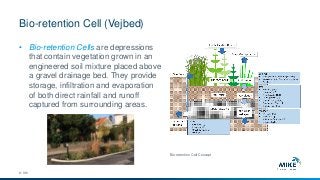
• Bio-retention Cells are depressions
that contain vegetation grown in an
engineered soil mixture placed above
a gravel drainage bed. They provide
storage, infiltration and evaporation
of both direct rainfall and runoff
captured from surrounding areas.
Bio-retention Cell Concept
Porous Pavement (Gennemtrængelig belægning)
© DHI
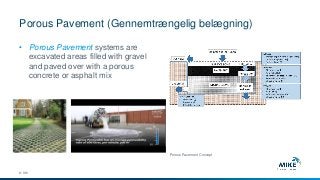
• Porous Pavement systems are
excavated areas filled with gravel
and paved over with a porous
concrete or asphalt mix
Porous Pavement Concept
Infiltration Trench (Vej grøft)
© DHI
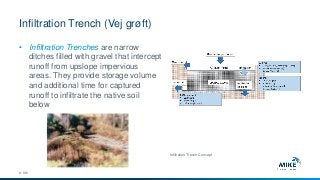
• Infiltration Trenches are narrow
ditches filled with gravel that intercept
runoff from upslope impervious
areas. They provide storage volume
and additional time for captured
runoff to infiltrate the native soil
below
Infiltration Trench Concept
Rain Barrel (Regn tønder)
© DHI
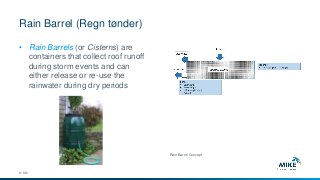
• Rain Barrels (or Cisterns) are
containers that collect roof runoff
during storm events and can
either release or re-use the
rainwater during dry periods
Rain Barrel Concept
Vegetative Swales (Render med beplantning)
© DHI
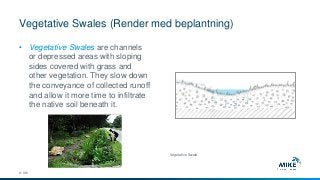
• Vegetative Swales are channels
or depressed areas with sloping
sides covered with grass and
other vegetation. They slow down
the conveyance of collected runoff
and allow it more time to infiltrate
the native soil beneath it.
Vegetative Swale
Rain Gardens (Regnbede)
© DHI
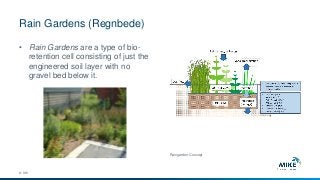
• Rain Gardens are a type of bio-
retention cell consisting of just the
engineered soil layer with no
gravel bed below it.
Raingarden Concept
Green Roof (Grønne tage)
© DHI
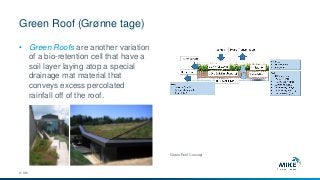
• Green Roofs are another variation
of a bio-retention cell that have a
soil layer laying atop a special
drainage mat material that
conveys excess percolated
rainfall off of the roof.
Green Roof Concept
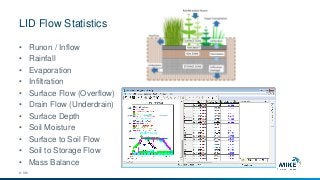
LID Flow Statistics
© DHI
• Runon / Inflow
• Rainfall
• Evaporation
• Infiltration
• Surface Flow (Overflow)
• Drain Flow (Underdrain)
• Surface Depth
• Soil Moisture
• Surface to Soil Flow
• Soil to Storage Flow
• Mass Balance
Detailed Level – “Soakaway”
© DHI
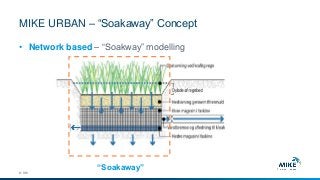
MIKE URBAN – “Soakaway” Concept
© DHI
• Network based – “Soakway” modelling
“Soakaway”
Key numbers – Lindevang, Brøndby
© DHI
• 7 bio-retention cells
• 2*8 metres in dimension
• Partially decoupled with overflow to
drainage system
• Sizing – 3 year rain event with climate
factor 1.56
• Decoupled road area: approx. 2000
m2
• Volume: 112 m3
• Traffic: max. 30 km/h
Bio-retention cells – Lindevang, Brøndby
© DHI
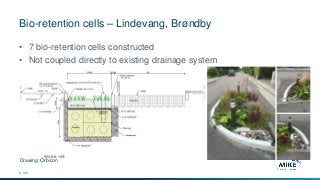
• 7 bio-retention cells constructed
• Not coupled directly to existing drainage system
Drawing: Orbicon
Key numbers – Møllebakken, Brønshøj
© DHI
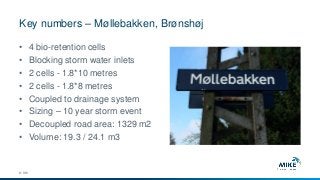
• 4 bio-retention cells
• Blocking storm water inlets
• 2 cells - 1.8*10 metres
• 2 cells - 1.8*8 metres
• Coupled to drainage system
• Sizing – 10 year storm event
• Decoupled road area: 1329 m2
• Volume: 19.3 / 24.1 m3
Bio-retention cells – Møllebakken, Brønshøj
© DHI
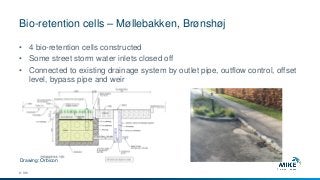
• 4 bio-retention cells constructed
• Some street storm water inlets closed off
• Connected to existing drainage system by outlet pipe, outflow control, offset
level, bypass pipe and weir
Drawing: Orbicon
MIKE URBAN – ”Soakaway”
© DHI
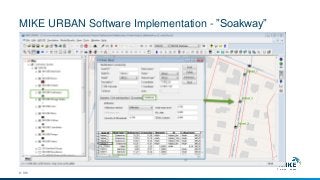
• New node type (ID, point feature)
− User defined basin geometry
− An average porosity of filling material
• (under consideration to support multiple layers)
• Boundary Condition
− Initial water level
• Infiltration
− No infiltration
− Constant infiltration
− Infiltration through side and bottom as a function of water level
• Saturated hydraulic conductivity (side and bottom)
MIKE URBAN Software Implementation - ”Soakway”
© DHI
MIKE URBAN – “Soakaway” infiltration formula
© DHI
h
Qin
Qof
Qf
Qof
Qin
l
w
𝑄 𝑓 = 𝐾(𝑙 ∗ 𝑤 + 2ℎ 𝑙 + 𝑤 )
𝑑ℎ
𝑑𝑡
=
1
𝑙∗𝑤∗𝜃
(𝑄𝑖𝑛 𝑡 − 𝑄 𝑓 𝑡 − 𝑄 𝑜𝑓 𝑡 )
𝑄 𝑓 = 𝐾𝑏𝑜𝑡𝑡𝑜𝑚 ∗ 𝐴 𝑠, ℎ=0 + 𝐾𝑠𝑖𝑑𝑒 ∗ (2 ∗ 𝐴 𝑐 + 2 ∗
𝑉𝑜𝑙
𝐴 𝑐
)
Definition and SI unit Symbol
Soakway porosity [-] θ
Field-saturated hydraulic conductivity [m/s], bottom Kfs, bottom
Field-saturated hydraulic conductivity [m/s], side Kfs, side
Water level (calculated by MIKE 1D) h
Surface Area As
Cross sectional Area Ac
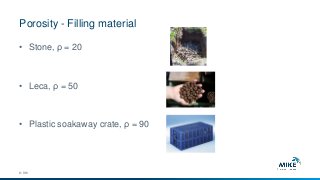
Porosity - Filling material
© DHI
• Stone, ρ = 20
• Leca, ρ = 50
• Plastic soakaway crate, ρ = 90
Water level and Infiltration flow for various soil conductivities
© DHI
• Typical values for various soil
classifications
Soil classification Hydraulic Conductivity [m/s]
Gravel 1e
-3
to 0.1
Sand 1e
-5
to 1e
-2
Silt 1e
-9
to 1e
-5
Clay Below 1e
-9
to 1e
-2
“Moræneler” 1e
-10
to 1e
-6
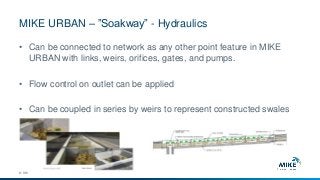
MIKE URBAN – ”Soakway” - Hydraulics
© DHI
• Can be connected to network as any other point feature in MIKE
URBAN with links, weirs, orifices, gates, and pumps.
• Flow control on outlet can be applied
• Can be coupled in series by weirs to represent constructed swales
Water Quality – Treatment using ECO Lab
© DHI
MIKE URBAN 2016 – MIKE 1D
© DHI
MIKE URBAN
MOUSE
Advection
Dispersion
Biological
Processes
SWMM5MIKE 1D
Advection
Dispersion
ECOLab
− MIKE 1D includes LID and Soakway (not
available in MOUSE)
− Includes option for transport of pollutants by
Advection-Dispersion
− ECO Lab is coupled to MIKE 1D for Water
Quality modelling
− MIKE 1D can be coupled to MIKE 21 (MIKE
FLOOD)
What is “ECO Lab“?
• A numerical laboratory for ecological modelling in aquatic environments
− Open Equation solver for coupled ordinary differential equations
− Designed for point descriptions of processes of chemistry, ecology etc.
− All equations, parameters contained in generic, portable ECO Lab templates
• Seamless coupled into most Mike-by-DHI hydraulic engines
− Transport calculations, result representation etc.
© DHI
ECO Lab
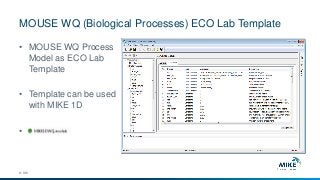
MOUSE WQ (Biological Processes) ECO Lab Template
© DHI
• MOUSE WQ Process
Model as ECO Lab
Template
• Template can be used
with MIKE 1D
• .
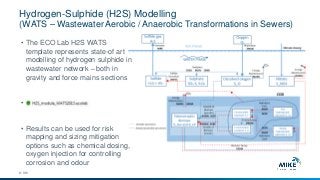
Hydrogen-Sulphide (H2S) Modelling
(WATS – Wastewater Aerobic / Anaerobic Transformations in Sewers)
© DHI
• The ECO Lab H2S WATS
template represents state-of art
modelling of hydrogen sulphide in
wastewater network – both in
gravity and force mains sections
• .
• Results can be used for risk
mapping and sizing mitigation
options such as chemical dosing,
oxygen injection for controlling
corrosion and odour
Modelling of Storm Water Quality – Treatment Processes
© DHI
• Selected constituents
− SS
− Dissolved COD
− Ammonia
− Total-N
− Dissolved P
− Total-P
− Heavy metals
− E. Coli ?
• Generic Treatment Processes
− Sedimentation
− Sand filtering
− Adsorption
− Infiltration
− Biological processes
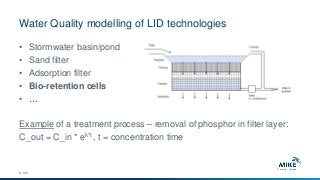
Water Quality modelling of LID technologies
© DHI
• Stormwater basin/pond
• Sand filter
• Adsorption filter
• Bio-retention cells
• …
Example of a treatment process – removal of phosphor in filter layer:
C_out = C_in * ek*t , t = concentration time
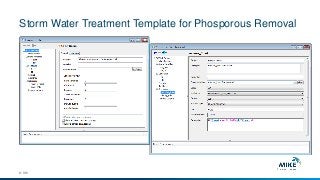
Storm Water Treatment Template for Phosporous Removal
© DHI
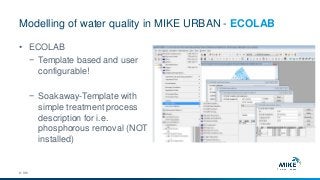
Modelling of water quality in MIKE URBAN - ECOLAB
© DHI
• ECOLAB
− Template based and user
configurable!
− Soakaway-Template with
simple treatment process
description for i.e.
phosphorous removal (NOT
installed)
Conclusion
© DHI
• Screening Level
− LID Concept (Hydrology)
• Detailed Level
− Soakaway (Hydraulics)
− Soakaway (Hydraulics) + Treatment (Advection-Dispersion + ECO
Lab)
Ongoing - storm water modelling for green cities
© DHI
• Student Applications
− 2 * Master Thesis at DTU, Denmark
− 1 * Master Thesis at Calmers University of Technology, Sweden
• MIKE Seminar the 10 March, 2016, Hørsholm
• DHI Academy training course (2 day). “Modelling of storm water for
green cities”. September 2016, Hørsholm
Thank you – any questions / spørgsmål?
Morten Just Kjølby, DHI
© DHI

4 modellering af lar anlæg

  • 1.
    Modellering af LARanlæg samt modellering af stoffjernelse i LAR anlæg og bassiner Morten Just Kjølby, DHI
  • 2.
    Background & Objective ©DHI • Developed under the umbrella of research project: “Cities in Water Balance”, 2011-2014 • Objective: Develop modelling support of green storm water infrastructure in MIKE URBAN: − Support modelling of various LID technologies in a generic but relative simple user interface − It shall be possible to connect implemented LID technology hydraulically to existing drainage network − Support of various treatment options
  • 3.
    MIKE URBAN -Modelling of LID technologies at two levels © DHI • Screening method (Catchment based) − Method for assessment of the required capacity or efficiency of instalment of various LID controls in a catchment. The LID controls are integrated with MIKE 1D and the runoff model B • Detailed method (Network based) − Detailed hydraulic assessment of Soakaway solutions with option to couple to existing drainage network. − Option for assessment of various treatments using ECO Lab.
  • 4.
    Terminology © DHI • Differentterminology used in different countries • MIKE URBAN – US terminology Grouping UK US Australia Denmark SUDS Sustainable Urban Design Systems LID Low Impact Development WSUD Water Sensitive Urban Design LAR ”Lokal Afledning af Regnvand” Road layout Bio–Retention Cell Bio-Retention (- Systems, -Swales, - Basins), “Treatment Train” approach Vejbed, Faskine Filter and Infiltration Trenches Infiltration Trench Infiltration Trenches and systems Vejgrøfter Sand filter Permeable surfaces Porous Pavement Porous Paving Gennemtrængelige belægninger Public open spaces Sedimentation Basins Sedimentations- bassiner Constructed wet lands Swales Vegetative swale, Swales Vegetated swale Vejgrøfter Filter strips Filter strips Buffer strips Grønt område Ponds Ponds Ponds Regnvandsbassiner Wetlands Lakes, Wetlands Lakes, Wetlands Søer Water Reuse Rainwater tanks Rain Barrel, Cisterns Rainwater tanks Regnvandstønder Aquifer storage and recovery (ASR) Aquifer storage and recovery (ASR) Aquifer storage and recovery (ASR) Local infiltration Soakways / Soakwells Faskine Green Roof Green Roof Green Roof , Roofwater Grønne tage Rain Garden Rain Garden Rain Garden Regnbede
  • 5.
    MIKE URBAN 2016– MIKE 1D © DHI MIKE URBAN MOUSE Advection Dispersion Biological Processes SWMM5MIKE 1D Advection Dispersion ECOLab − MIKE 1D includes LID and Soakway (not available in MOUSE) − MIKE 1D includes option for transport of pollutants by Advection-Dispersion − MIKE 1D is coupled to ECO Lab for Water Quality modelling − MIKE 1D can be coupled to MIKE 21 (MIKE FLOOD)
  • 6.
    Screening Level -LID Controls © DHI
  • 7.
    MIKE URBAN –LID Controls © DHI • Bio Retention Cell (Vejbed) • Porous Pavement (Gennemtrængelig belægning) • Infiltration Trench (Vejgrøft, rende) • Rain Barrels (Regntønder) • Vegetative Swale (Rende med beplantning) • Rain Garden (Regnbede) • Green Roof (Grønt tag)
  • 8.
    MIKE URBAN –LID Deployment © DHI • Deployment of LID Controls to each catchment − Number of a LID Control − Contributing area (ha or %) − Result file per deployment
  • 9.
    MIKE URBAN –Principle of catchment based LID modelling © DHI • The original contributing area is reduced with the area included in the specified LID controls • LID solutions can be considered as advanced methods for calculating the effective precipitation (storage and infiltration) • Runoff from the LID controls towards outlet point is routed with the same routing method and parameters as used for the total catchment • The result is a composite hydrograph made up by: − (a) runoff from catchment reduced by area connected to LID control − (b) runoff from the LID control Pervious Impervious LID Area
  • 10.
    Bio-retention Cell (Vejbed) ©DHI • Bio-retention Cells are depressions that contain vegetation grown in an engineered soil mixture placed above a gravel drainage bed. They provide storage, infiltration and evaporation of both direct rainfall and runoff captured from surrounding areas. Bio-retention Cell Concept
  • 11.
    Porous Pavement (Gennemtrængeligbelægning) © DHI • Porous Pavement systems are excavated areas filled with gravel and paved over with a porous concrete or asphalt mix Porous Pavement Concept
  • 12.
    Infiltration Trench (Vejgrøft) © DHI • Infiltration Trenches are narrow ditches filled with gravel that intercept runoff from upslope impervious areas. They provide storage volume and additional time for captured runoff to infiltrate the native soil below Infiltration Trench Concept
  • 13.
    Rain Barrel (Regntønder) © DHI • Rain Barrels (or Cisterns) are containers that collect roof runoff during storm events and can either release or re-use the rainwater during dry periods Rain Barrel Concept
  • 14.
    Vegetative Swales (Rendermed beplantning) © DHI • Vegetative Swales are channels or depressed areas with sloping sides covered with grass and other vegetation. They slow down the conveyance of collected runoff and allow it more time to infiltrate the native soil beneath it. Vegetative Swale
  • 15.
    Rain Gardens (Regnbede) ©DHI • Rain Gardens are a type of bio- retention cell consisting of just the engineered soil layer with no gravel bed below it. Raingarden Concept
  • 16.
    Green Roof (Grønnetage) © DHI • Green Roofs are another variation of a bio-retention cell that have a soil layer laying atop a special drainage mat material that conveys excess percolated rainfall off of the roof. Green Roof Concept
  • 17.
    LID Flow Statistics ©DHI • Runon / Inflow • Rainfall • Evaporation • Infiltration • Surface Flow (Overflow) • Drain Flow (Underdrain) • Surface Depth • Soil Moisture • Surface to Soil Flow • Soil to Storage Flow • Mass Balance
  • 18.
    Detailed Level –“Soakaway” © DHI
  • 19.
    MIKE URBAN –“Soakaway” Concept © DHI • Network based – “Soakway” modelling “Soakaway”
  • 20.
    Key numbers –Lindevang, Brøndby © DHI • 7 bio-retention cells • 2*8 metres in dimension • Partially decoupled with overflow to drainage system • Sizing – 3 year rain event with climate factor 1.56 • Decoupled road area: approx. 2000 m2 • Volume: 112 m3 • Traffic: max. 30 km/h
  • 21.
    Bio-retention cells –Lindevang, Brøndby © DHI • 7 bio-retention cells constructed • Not coupled directly to existing drainage system Drawing: Orbicon
  • 22.
    Key numbers –Møllebakken, Brønshøj © DHI • 4 bio-retention cells • Blocking storm water inlets • 2 cells - 1.8*10 metres • 2 cells - 1.8*8 metres • Coupled to drainage system • Sizing – 10 year storm event • Decoupled road area: 1329 m2 • Volume: 19.3 / 24.1 m3
  • 23.
    Bio-retention cells –Møllebakken, Brønshøj © DHI • 4 bio-retention cells constructed • Some street storm water inlets closed off • Connected to existing drainage system by outlet pipe, outflow control, offset level, bypass pipe and weir Drawing: Orbicon
  • 24.
    MIKE URBAN –”Soakaway” © DHI • New node type (ID, point feature) − User defined basin geometry − An average porosity of filling material • (under consideration to support multiple layers) • Boundary Condition − Initial water level • Infiltration − No infiltration − Constant infiltration − Infiltration through side and bottom as a function of water level • Saturated hydraulic conductivity (side and bottom)
  • 25.
    MIKE URBAN SoftwareImplementation - ”Soakway” © DHI
  • 26.
    MIKE URBAN –“Soakaway” infiltration formula © DHI h Qin Qof Qf Qof Qin l w 𝑄 𝑓 = 𝐾(𝑙 ∗ 𝑤 + 2ℎ 𝑙 + 𝑤 ) 𝑑ℎ 𝑑𝑡 = 1 𝑙∗𝑤∗𝜃 (𝑄𝑖𝑛 𝑡 − 𝑄 𝑓 𝑡 − 𝑄 𝑜𝑓 𝑡 ) 𝑄 𝑓 = 𝐾𝑏𝑜𝑡𝑡𝑜𝑚 ∗ 𝐴 𝑠, ℎ=0 + 𝐾𝑠𝑖𝑑𝑒 ∗ (2 ∗ 𝐴 𝑐 + 2 ∗ 𝑉𝑜𝑙 𝐴 𝑐 ) Definition and SI unit Symbol Soakway porosity [-] θ Field-saturated hydraulic conductivity [m/s], bottom Kfs, bottom Field-saturated hydraulic conductivity [m/s], side Kfs, side Water level (calculated by MIKE 1D) h Surface Area As Cross sectional Area Ac
  • 27.
    Porosity - Fillingmaterial © DHI • Stone, ρ = 20 • Leca, ρ = 50 • Plastic soakaway crate, ρ = 90
  • 28.
    Water level andInfiltration flow for various soil conductivities © DHI • Typical values for various soil classifications Soil classification Hydraulic Conductivity [m/s] Gravel 1e -3 to 0.1 Sand 1e -5 to 1e -2 Silt 1e -9 to 1e -5 Clay Below 1e -9 to 1e -2 “Moræneler” 1e -10 to 1e -6
  • 29.
    MIKE URBAN –”Soakway” - Hydraulics © DHI • Can be connected to network as any other point feature in MIKE URBAN with links, weirs, orifices, gates, and pumps. • Flow control on outlet can be applied • Can be coupled in series by weirs to represent constructed swales
  • 30.
    Water Quality –Treatment using ECO Lab © DHI
  • 31.
    MIKE URBAN 2016– MIKE 1D © DHI MIKE URBAN MOUSE Advection Dispersion Biological Processes SWMM5MIKE 1D Advection Dispersion ECOLab − MIKE 1D includes LID and Soakway (not available in MOUSE) − Includes option for transport of pollutants by Advection-Dispersion − ECO Lab is coupled to MIKE 1D for Water Quality modelling − MIKE 1D can be coupled to MIKE 21 (MIKE FLOOD)
  • 32.
    What is “ECOLab“? • A numerical laboratory for ecological modelling in aquatic environments − Open Equation solver for coupled ordinary differential equations − Designed for point descriptions of processes of chemistry, ecology etc. − All equations, parameters contained in generic, portable ECO Lab templates • Seamless coupled into most Mike-by-DHI hydraulic engines − Transport calculations, result representation etc. © DHI ECO Lab
  • 33.
    MOUSE WQ (BiologicalProcesses) ECO Lab Template © DHI • MOUSE WQ Process Model as ECO Lab Template • Template can be used with MIKE 1D • .
  • 34.
    Hydrogen-Sulphide (H2S) Modelling (WATS– Wastewater Aerobic / Anaerobic Transformations in Sewers) © DHI • The ECO Lab H2S WATS template represents state-of art modelling of hydrogen sulphide in wastewater network – both in gravity and force mains sections • . • Results can be used for risk mapping and sizing mitigation options such as chemical dosing, oxygen injection for controlling corrosion and odour
  • 35.
    Modelling of StormWater Quality – Treatment Processes © DHI • Selected constituents − SS − Dissolved COD − Ammonia − Total-N − Dissolved P − Total-P − Heavy metals − E. Coli ? • Generic Treatment Processes − Sedimentation − Sand filtering − Adsorption − Infiltration − Biological processes
  • 36.
    Water Quality modellingof LID technologies © DHI • Stormwater basin/pond • Sand filter • Adsorption filter • Bio-retention cells • … Example of a treatment process – removal of phosphor in filter layer: C_out = C_in * ek*t , t = concentration time
  • 37.
    Storm Water TreatmentTemplate for Phosporous Removal © DHI
  • 38.
    Modelling of waterquality in MIKE URBAN - ECOLAB © DHI • ECOLAB − Template based and user configurable! − Soakaway-Template with simple treatment process description for i.e. phosphorous removal (NOT installed)
  • 39.
    Conclusion © DHI • ScreeningLevel − LID Concept (Hydrology) • Detailed Level − Soakaway (Hydraulics) − Soakaway (Hydraulics) + Treatment (Advection-Dispersion + ECO Lab)
  • 40.
    Ongoing - stormwater modelling for green cities © DHI • Student Applications − 2 * Master Thesis at DTU, Denmark − 1 * Master Thesis at Calmers University of Technology, Sweden • MIKE Seminar the 10 March, 2016, Hørsholm • DHI Academy training course (2 day). “Modelling of storm water for green cities”. September 2016, Hørsholm
  • 41.
    Thank you –any questions / spørgsmål? Morten Just Kjølby, DHI © DHI