Article 102 of the Treaty on the
functioning of the European Union
By - Ayush Verma
Introduction
Article 102 of the TFEU prohibits dominant undertakings from abusing their position within an
internal market or in a substantial part of it, as incompatible with the internal market in so far as it
affects trade between member states.
Such abuse may consist of:
● Imposing unfair purchase or selling prices, or unfair trade conditions, directly or indirectly.
● Restraining production, markets or technical development which might be detrimental to the
customers.
● Discriminating between the trade parties by placing dissimilar conditions to equivalent
transactions.
● Making the original contract subject to acceptance of supplementary obligations which by their
nature or commercial usage, have no connection with the subject of such contracts.
Explanation of specific terms
Undertakings: The undertakings that are talked about in the Article 102 are those who have a
dominant position or where two or more undertakings are collectively dominant.
Effect on Inter-State Trade: It is given to provide context to the law governing competition. The law
applies to every agreement in the European Union that may affect trade between member states.
Dominant Position: The Court of Justice in the case of United Brands defined the dominant position
as a position of economic strength enjoyed by an undertaking which gives it power to prevent effective
competition in the relevant market, and to behave independently of its competitors, customers and
consumers.
Substantial Part of the Internal Market: To determine whether a territory amounts to a “substantial
part of the internal market”, the volume of consumption and production of the said product of an
undertaking need to be assessed, in addition to this, habits and economic opportunities of the vendors
and buyers must also be considered.
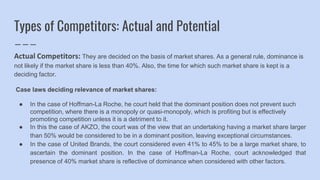
Types of Competitors: Actual and Potential
Actual Competitors: They are decided on the basis of market shares. As a general rule, dominance is
not likely if the market share is less than 40%. Also, the time for which such market share is kept is a
deciding factor.
Case laws deciding relevance of market shares:
● In the case of Hoffman-La Roche, he court held that the dominant position does not prevent such
competition, where there is a monopoly or quasi-monopoly, which is profiting but is effectively
promoting competition unless it is a detriment to it.
● In this the case of AKZO, the court was of the view that an undertaking having a market share larger
than 50% would be considered to be in a dominant position, leaving exceptional circumstances.
● In the case of United Brands, the court considered even 41% to 45% to be a large market share, to
ascertain the dominant position. In the case of Hoffman-La Roche, court acknowledged that
presence of 40% market share is reflective of dominance when considered with other factors.
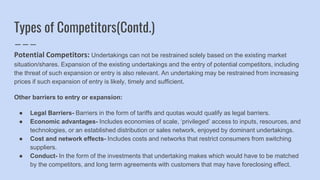
Types of Competitors(Contd.)
Potential Competitors: Undertakings can not be restrained solely based on the existing market
situation/shares. Expansion of the existing undertakings and the entry of potential competitors, including
the threat of such expansion or entry is also relevant. An undertaking may be restrained from increasing
prices if such expansion of entry is likely, timely and sufficient.
Other barriers to entry or expansion:
● Legal Barriers- Barriers in the form of tariffs and quotas would qualify as legal barriers.
● Economic advantages- Includes economies of scale, ‘privileged’ access to inputs, resources, and
technologies, or an established distribution or sales network, enjoyed by dominant undertakings.
● Cost and network effects- Includes costs and networks that restrict consumers from switching
suppliers.
● Conduct- In the form of the investments that undertaking makes which would have to be matched
by the competitors, and long term agreements with customers that may have foreclosing effect.
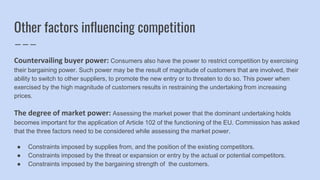
Other factors influencing competition
Countervailing buyer power: Consumers also have the power to restrict competition by exercising
their bargaining power. Such power may be the result of magnitude of customers that are involved, their
ability to switch to other suppliers, to promote the new entry or to threaten to do so. This power when
exercised by the high magnitude of customers results in restraining the undertaking from increasing
prices.
The degree of market power: Assessing the market power that the dominant undertaking holds
becomes important for the application of Article 102 of the functioning of the EU. Commission has asked
that the three factors need to be considered while assessing the market power.
● Constraints imposed by supplies from, and the position of the existing competitors.
● Constraints imposed by the threat or expansion or entry by the actual or potential competitors.
● Constraints imposed by the bargaining strength of the customers.

Article 102 TFEU

  • 1.
    Article 102 ofthe Treaty on the functioning of the European Union By - Ayush Verma
  • 2.
    Introduction Article 102 ofthe TFEU prohibits dominant undertakings from abusing their position within an internal market or in a substantial part of it, as incompatible with the internal market in so far as it affects trade between member states. Such abuse may consist of: ● Imposing unfair purchase or selling prices, or unfair trade conditions, directly or indirectly. ● Restraining production, markets or technical development which might be detrimental to the customers. ● Discriminating between the trade parties by placing dissimilar conditions to equivalent transactions. ● Making the original contract subject to acceptance of supplementary obligations which by their nature or commercial usage, have no connection with the subject of such contracts.
  • 3.
    Explanation of specificterms Undertakings: The undertakings that are talked about in the Article 102 are those who have a dominant position or where two or more undertakings are collectively dominant. Effect on Inter-State Trade: It is given to provide context to the law governing competition. The law applies to every agreement in the European Union that may affect trade between member states. Dominant Position: The Court of Justice in the case of United Brands defined the dominant position as a position of economic strength enjoyed by an undertaking which gives it power to prevent effective competition in the relevant market, and to behave independently of its competitors, customers and consumers. Substantial Part of the Internal Market: To determine whether a territory amounts to a “substantial part of the internal market”, the volume of consumption and production of the said product of an undertaking need to be assessed, in addition to this, habits and economic opportunities of the vendors and buyers must also be considered.
  • 4.
    Types of Competitors:Actual and Potential Actual Competitors: They are decided on the basis of market shares. As a general rule, dominance is not likely if the market share is less than 40%. Also, the time for which such market share is kept is a deciding factor. Case laws deciding relevance of market shares: ● In the case of Hoffman-La Roche, he court held that the dominant position does not prevent such competition, where there is a monopoly or quasi-monopoly, which is profiting but is effectively promoting competition unless it is a detriment to it. ● In this the case of AKZO, the court was of the view that an undertaking having a market share larger than 50% would be considered to be in a dominant position, leaving exceptional circumstances. ● In the case of United Brands, the court considered even 41% to 45% to be a large market share, to ascertain the dominant position. In the case of Hoffman-La Roche, court acknowledged that presence of 40% market share is reflective of dominance when considered with other factors.
  • 5.
    Types of Competitors(Contd.) PotentialCompetitors: Undertakings can not be restrained solely based on the existing market situation/shares. Expansion of the existing undertakings and the entry of potential competitors, including the threat of such expansion or entry is also relevant. An undertaking may be restrained from increasing prices if such expansion of entry is likely, timely and sufficient. Other barriers to entry or expansion: ● Legal Barriers- Barriers in the form of tariffs and quotas would qualify as legal barriers. ● Economic advantages- Includes economies of scale, ‘privileged’ access to inputs, resources, and technologies, or an established distribution or sales network, enjoyed by dominant undertakings. ● Cost and network effects- Includes costs and networks that restrict consumers from switching suppliers. ● Conduct- In the form of the investments that undertaking makes which would have to be matched by the competitors, and long term agreements with customers that may have foreclosing effect.
  • 6.
    Other factors influencingcompetition Countervailing buyer power: Consumers also have the power to restrict competition by exercising their bargaining power. Such power may be the result of magnitude of customers that are involved, their ability to switch to other suppliers, to promote the new entry or to threaten to do so. This power when exercised by the high magnitude of customers results in restraining the undertaking from increasing prices. The degree of market power: Assessing the market power that the dominant undertaking holds becomes important for the application of Article 102 of the functioning of the EU. Commission has asked that the three factors need to be considered while assessing the market power. ● Constraints imposed by supplies from, and the position of the existing competitors. ● Constraints imposed by the threat or expansion or entry by the actual or potential competitors. ● Constraints imposed by the bargaining strength of the customers.