We provide custom printed carbonless forms and blank carbonless paper with many features available. Free shipping, free design and setup, free color inks.
What is carbonlesspaper, and how
does it work?
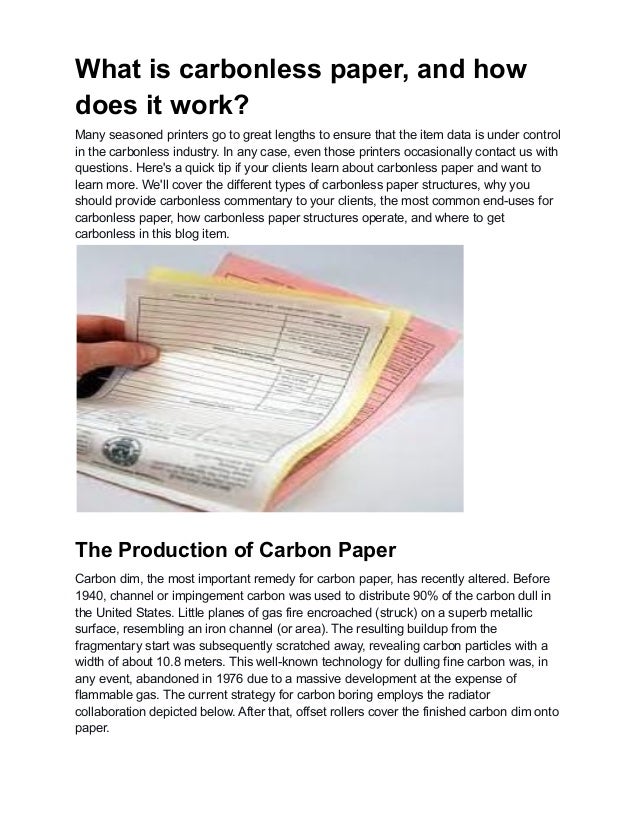
Many seasoned printers go to great lengths to ensure that the item data is under control
in the carbonless industry. In any case, even those printers occasionally contact us with
questions. Here's a quick tip if your clients learn about carbonless paper and want to
learn more. We'll cover the different types of carbonless paper structures, why you
should provide carbonless commentary to your clients, the most common end-uses for
carbonless paper, how carbonless paper structures operate, and where to get
carbonless in this blog item.
The Production of Carbon Paper
Carbon dim, the most important remedy for carbon paper, has recently altered. Before
1940, channel or impingement carbon was used to distribute 90% of the carbon dull in
the United States. Little planes of gas fire encroached (struck) on a superb metallic
surface, resembling an iron channel (or area). The resulting buildup from the
fragmentary start was subsequently scratched away, revealing carbon particles with a
width of about 10.8 meters. This well-known technology for dulling fine carbon was, in
any event, abandoned in 1976 due to a massive development at the expense of
flammable gas. The current strategy for carbon boring employs the radiator
collaboration depicted below. After that, offset rollers cover the finished carbon dim onto
paper.
2.
Quality Assurance
Carbon paperis a vital standard, but producing it isn't easy. A state-of-the-art carbon
paper manufacturer conducts quality checks on raw parts. Carbon dim can be subjected
to many tests, including those for colors and sulfur content. The carbon dims chosen
should have a good atom size, which may be determined by using electron amplifying
equipment to measure the ordinary broadness of a dull carbon particle. Furthermore, it
should require less oil maintenance, and the responsiveness and pH of the carbon soft
should be tested before use. The inks are scrutinized for grain fineness, which impacts
the final flawlessness of the covering. Only the wax folio should be inserted into the
paper, and it should be of the right consistency. The quantity of wax transferred under
strain is attempted to ensure actual letters.
The real paper should be smooth, nonporous, and free of blemishes on the surface.
Even though it should be a thin tissue, it should also be solid and thick. There should be
no deserts on the completed carbon paper: no offset, chipping, crimps, or turn. It should
function well, and the resulting copy should be free of flaws and clear. The covering
should be sufficiently difficult to satisfy its intended usage; for example, carbon doesn't
require as hard a covering as typewriter carbon, which should also have a thicker, more
toned covering to be reused in general.
For completed carbon paper, there are a variety of tests available. An illustration of
carbon paper is chosen and measured to determine the proportion of ink saved. Its ink
supply is thus erroneously wiped away before being reevaluated. The weight
qualification shows the percentage of ink saved. Bend is a progressive complaint about
carbonless paper, even though carbon paper is sometimes covered on both sides (one
with carbon, the other with assist wax) to combat the problem. To test for bend under
various conditions, a piece of carbon paper is placed on a flat surface and exposed to
various humidities at a regulated temperature. The longevity of reusable typewriter
carbon paper is tested regularly, with the carbon forming in one place until it wears out.
The copy, as well as the carbon paper itself, must be spotless. A chronicle is
constructed to test the underpinnings, and the copy is dissected to see if it is perfect. To
test the second, an unblemished, collapsed piece of paper is scraped across the carbon
side, which is then dissected to examine how much carbon has zeroed in on. The
carbon's tone and thickness should be checked to see if they meet quality standards.
The Long Run
More than 62,000 enormous metric heaps of carbon paper were transported in the
United States in 1991. Over 600,000 enormous metric heaps of carbonless commercial
paper were produced during a comparable era. The carbonless paper uses artificially
covered sheets that react under tension to create a hidden picture, making it ideal for
3.
handwritten accounts. Onthe other hand, carbonless paper is heavier than carbon
paper and is less ideal for typewritten and electronic documents; yet, it has the virtue of
not being as inconvenient as carbon paper. (This interest in "standard" paper can also
be attributed to the growing availability of scanners.) Carbon paper will age substantially
as electronic correspondence becomes more inevitable, which is logical.
Carbonless Paper: How Do I Create An NCR
Form?
Carbonless paper, known commonly as NCR paper, was first developed in the late
1800s as part of an innovative approach to printing and writing. The National Cash
Register Company was the first to use NCR forms to create carbon copies of sales
receipts. Today, carbonless paper can be used in many business areas, including
accounting and tax preparation and retail settings, where it may be used in the form of
receipts or direct mailers. To create an NCR form, you need the correct type of printer
and carbonless paper designed specifically for your printer model.
What is an NCR paper?
Carbonless paper, otherwise known as NCR paper (no carbon required), is a great way
to keep records on hand without worrying about accidental loss or destruction. It's
durable and has a low-carbon footprint, good for your pocketbook and our environment.
4.
There are severaltypes of carbonless forms that you can use in your business, with
many businesses leaning towards either sales receipts or invoices, depending on what
they do. Sales receipts are great for documenting customer transactions, while invoices
offer businesses a way to generate professional-looking documents at a minimal cost.
Please keep reading to learn more about both types of carbonless forms and how they
work!
Types of NCR forms
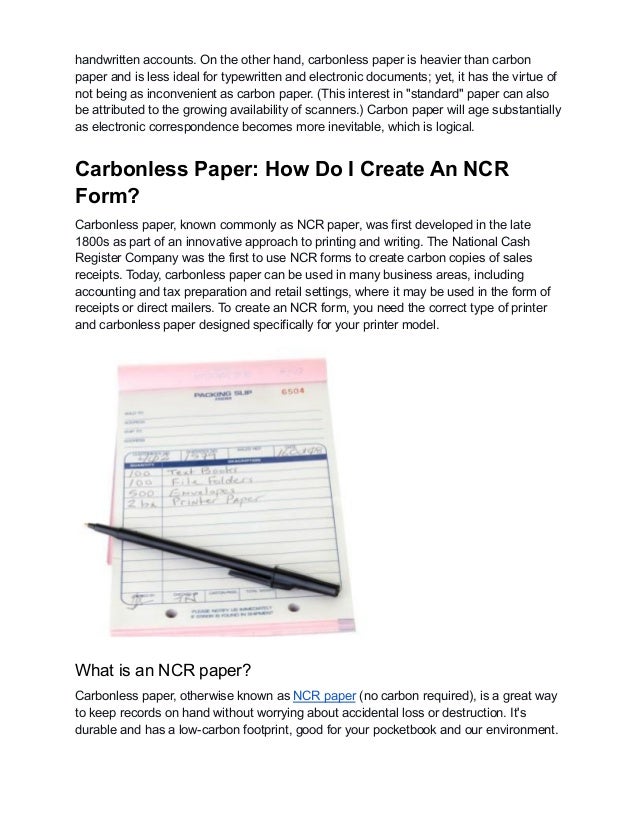
Carbonless forms come in various types, with each type requiring its specific method for
creating an NCR form. Carbonless invoices, for example, can be created using carbon
paper and special invoice forms that are designed to use carbon copies. To create an
invoice using carbonless paper, you enter your customer's information on one set of
lines on your original copy of a blank invoice form and then pass it through a machine
that prints (using ink) or stamps (using indelible ink) onto another set of lines on the
second set of paper. That second piece is what is known as your copy.
Choosing the correct type of form
It's important to keep a few things in mind when choosing your form, such as how long
you need it to last and whether or not you want it to be carbonless. Carbonless forms
are less expensive than traditional paper because they only require one set of original
copies, but that initial cost can add up quickly. It's also worth noting that carbonless will
not be an option if your forms must be completely customized—for example, if you want
them bound or pre-printed with Do Not Duplicate on every page. Keep these differences
in mind when shopping around for carbonless paper.
Printing your forms
To create your carbonless forms, first, you will need to choose which type of paper stock
you would like to use. Carbonless forms are available in gloss and matte-finish stocks,
allowing for a professional appearance. The next step is to determine what size paper
stock you need and whether or not they should be stitched on three sides (to facilitate
completion). Choose if you want your completed form bound into booklet or spiral
format or simply in a stack. Once that's been determined, it's time to order your
carbonless forms from one of our printing facilities! We offer fast turnaround times,
competitive pricing, and quality paper products so that you can get exactly what you
need for your project.
5.
Filling out andtabbing your form
When filling out an NCR form, each time you sign one of your lines, flip it over and tab it
with a number. Doing so lets you easily find your previous lines and not lose track of
them when reviewing your work, but it also saves you from having to write down
numbers on a separate sheet of paper when submitting forms to others. Your unique tab
number is important information so remember to write that down too! This can be an
effective way to keep accountancy records; fold up all completed tabs and file them in
numerical order in a folder or box until required again!
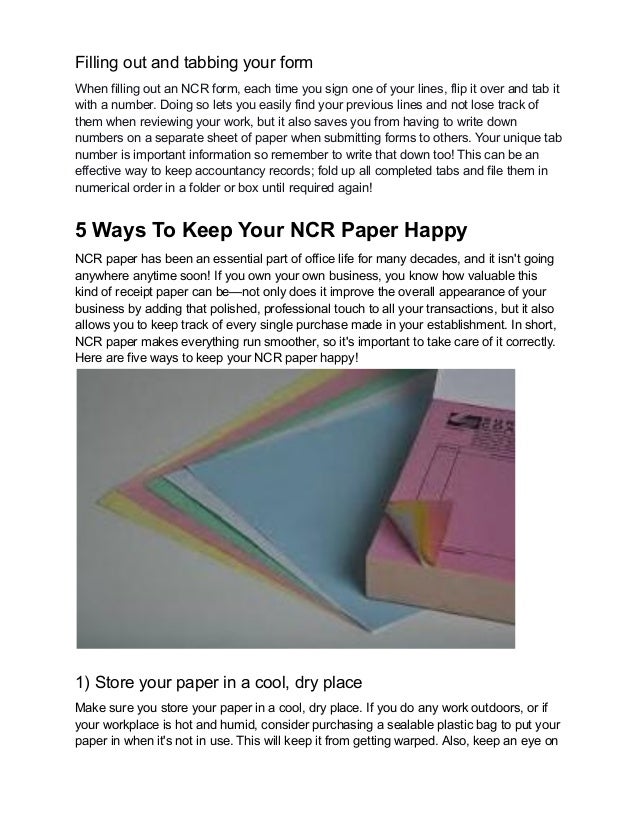
5 Ways To Keep Your NCR Paper Happy
NCR paper has been an essential part of office life for many decades, and it isn't going
anywhere anytime soon! If you own your own business, you know how valuable this
kind of receipt paper can be—not only does it improve the overall appearance of your
business by adding that polished, professional touch to all your transactions, but it also
allows you to keep track of every single purchase made in your establishment. In short,
NCR paper makes everything run smoother, so it's important to take care of it correctly.
Here are five ways to keep your NCR paper happy!
1) Store your paper in a cool, dry place
Make sure you store your paper in a cool, dry place. If you do any work outdoors, or if
your workplace is hot and humid, consider purchasing a sealable plastic bag to put your
paper in when it's not in use. This will keep it from getting warped. Also, keep an eye on
6.
it when youtake it out of storage so that you can straighten anything that may have
become warped while stored. If necessary, use weight on top of each stack to flatten
any ripples. If possible, try to leave your paper flat for at least two hours before using it
so that ripples have time to disappear.
2) Handle your receipts by the edges
If you grab paper by its body, it may leave fingerprints on your receipts. Fingerprints can
mess with your inventory management system or payment processing (if you need to
enter payments manually), making it harder to track your finances. So remember to
always handle receipts by their edges when you're scanning them in. This also protects
them from ripping and helps keep them as accurate as possible. After all, every receipt
is a piece of hard evidence that your business generates; why would you want to get rid
of any part of that? By handling NCR paper carefully, you'll protect yourself and keep
things running smoothly for years to come.
3) Take advantage of recycling programs
Recycling programs have made it easy to recycle large quantities of old paper and
cardboard—programs that would have been much more difficult and expensive just a
few years ago. This means you can keep your NCR paper happy while helping local
communities, lowering your carbon footprint, and reducing waste in landfills. You should
check with your local government or community centers to see if a recycling program is
available for you to use. If not, you might be able to get together with some friends or
colleagues at work and start one up yourself!
4) Use protective covers on your registers
A printer cover serves two functions. First, it protects your printer from damage. Second,
it keeps dust and debris from getting into your printer. Use a cover to protect your
hardware and keep things clean so you don't have to replace or repair broken
components. If you find that your paper jams, you might want to get a bigger cover;
sometimes, dust or other small particles can sneak between where you print and where
you keep your register. You can also purchase covers made of stronger materials for
even better protection against wear and tear in high-use areas like bars or restaurants.
Not sure if yours needs an upgrade? Ask yourself if any of these common issues sound
familiar.
5) Check out this infographic to learn more
How to Stay Healthy in a Cold Office. And remember, there are always ways to make
your environment more comfortable! Investing in blankets, slippers, and throw pillows
7.
for your officeis an affordable and practical way to stay warm. For those who are lucky
enough to have a fireplace or woodstove (or fireplace heater), try to hang out by it as
much as possible; it's worth sacrificing some work time when you can be cozy inside.
With a nice fire! :)