UNDERWRITING GUIDELINES
(Applicant and Income Requirements)
Guaranteed Rural Housing Loan Program
United States Department of Agriculture Rural Development
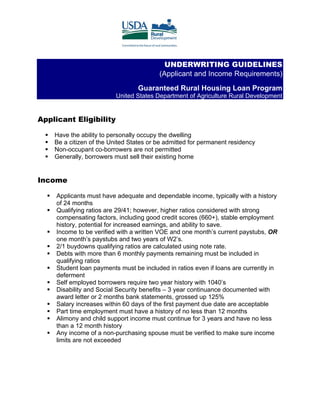
Applicant Eligibility
 Have the ability to personally occupy the dwelling
 Be a citizen of the United States or be admitted for permanent residency
 Non-occupant co-borrowers are not permitted
 Generally, borrowers must sell their existing home
Income
 Applicants must have adequate and dependable income, typically with a history
of 24 months
 Qualifying ratios are 29/41; however, higher ratios considered with strong
compensating factors, including good credit scores (660+), stable employment
history, potential for increased earnings, and ability to save.
 Income to be verified with a written VOE and one month’s current paystubs, OR
one month’s paystubs and two years of W2’s.
 2/1 buydowns qualifying ratios are calculated using note rate.
 Debts with more than 6 monthly payments remaining must be included in
qualifying ratios
 Student loan payments must be included in ratios even if loans are currently in
deferment
 Self employed borrowers require two year history with 1040’s
 Disability and Social Security benefits – 3 year continuance documented with
award letter or 2 months bank statements, grossed up 125%
 Salary increases within 60 days of the first payment due date are acceptable
 Part time employment must have a history of no less than 12 months
 Alimony and child support income must continue for 3 years and have no less
than a 12 month history
 Any income of a non-purchasing spouse must be verified to make sure income
limits are not exceeded
Income Calculations
USDA Rural Development determines applicant’s income in two manners:
Eligibility Income – Includes all income (salary, tips, bonus, overtime, alimony, child
support, etc..) received by the applicant and co-applicant(s). This income is used to
calculate qualifying ratios.
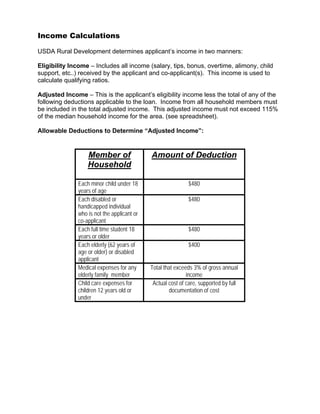
Adjusted Income – This is the applicant’s eligibility income less the total of any of the
following deductions applicable to the loan. Income from all household members must
be included in the total adjusted income. This adjusted income must not exceed 115%
of the median household income for the area. (see spreadsheet).
Allowable Deductions to Determine “Adjusted Income”:
Member of
Household
Amount of Deduction
Each minor child under 18
years of age
$480
Each disabled or
handicapped individual
who is not the applicant or
co-applicant
$480
Each full time student 18
years or older
$480
Each elderly (62 years of
age or older) or disabled
applicant
$400
Medical expenses for any
elderly family member
Total that exceeds 3% of gross annual
income
Child care expenses for
children 12 years old or
under
Actual cost of care, supported by full
documentation of cost
UNDERWRITING GUIDELINES
(Credit Requirements)
Guaranteed Rural Housing Loan Program
United States Department of Agriculture Rural Development
Credit History
Applicants must have a credit history that indicates a reasonable ability and willingness
to meet obligations as they become due. A credit history reflecting any or all of the
following is considered unacceptable credit history:
 More than one 30-day late within the past 12 months.
 Bankruptcy or foreclosure discharged less than 36 months
 Outstanding judgments within the past 12 months
 Two or more rent payments 30 days late within the past 3 years.
 Outstanding collection accounts with no payment arrangements
 Outstanding tax liens or delinquent federal debt with no payment arrangements
 Accounts converted to collections in the past 12 months.
Mitigating Factors to Unacceptable Credit:
Adverse credit waivers may be granted for mitigating factors to establish the applicant’s
intent to good credit. Lenders must document these circumstances which were beyond
the borrower’s control and have been removed:
 Circumstances for adverse credit were temporary in nature, beyond the
applicant’s control and have been removed. Examples: increased expenses due
to illness and/or medical expenses, injury, death, etc.
 Tri-merge credit reports are required and must be no more than 90 days old at
the time the Conditional Commitment is issued
 Applicants must not be delinquent on any debts owed to the Federal Government
 CAIVRs must be checked and documented in the loan submission package.
UNDERWRITING GUIDELINES
(Utilizing Credit Scores)
Guaranteed Rural Housing Loan Program
United States Department of Agriculture Rural Development
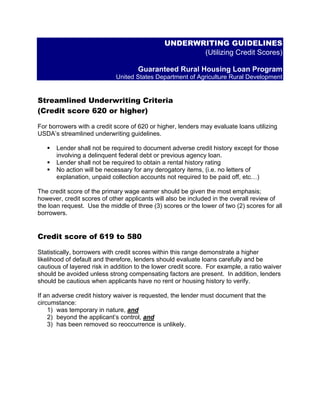
Streamlined Underwriting Criteria
(Credit score 620 or higher)
For borrowers with a credit score of 620 or higher, lenders may evaluate loans utilizing
USDA’s streamlined underwriting guidelines.
 Lender shall not be required to document adverse credit history except for those
involving a delinquent federal debt or previous agency loan.
 Lender shall not be required to obtain a rental history rating
 No action will be necessary for any derogatory items, (i.e. no letters of
explanation, unpaid collection accounts not required to be paid off, etc…)
The credit score of the primary wage earner should be given the most emphasis;
however, credit scores of other applicants will also be included in the overall review of
the loan request. Use the middle of three (3) scores or the lower of two (2) scores for all
borrowers.
Credit score of 619 to 580
Statistically, borrowers with credit scores within this range demonstrate a higher
likelihood of default and therefore, lenders should evaluate loans carefully and be
cautious of layered risk in addition to the lower credit score. For example, a ratio waiver
should be avoided unless strong compensating factors are present. In addition, lenders
should be cautious when applicants have no rent or housing history to verify.
If an adverse credit history waiver is requested, the lender must document that the
circumstance:
1) was temporary in nature, and
2) beyond the applicant’s control, and
3) has been removed so reoccurrence is unlikely.
Credit score of 580 or below
Statistically, borrowers with credit scores within this range have demonstrated a much
higher rate of default in the GRH program. Lenders should not approve loans with
credit scores of 580 and below if they exhibit any of the following:
 One or more 30-day lates in the past 12 months.
 Bankruptcy or foreclosure discharged less than 36 months.
 Outstanding judgments within the past 12 months.
 Two or more rent payments 30 days late within the past 3 years.
 Outstanding collection accounts with no payment arrangements that are currently
due.
 Outstanding tax liens or delinquent federal debts with no payment arrangements
 Accounts converted to collections in the past 12 months.
Extraordinary compensating factors must be present to allow an adverse credit history
waiver. Additional risk layers in addition to the lower score is not recommended.
No credit score – Non-traditional credit
No additional layers of risk are advisable for applicants with non-traditional credit.
At least 4 non-traditional credit references, for a period of 12 months or more, should be
developed, comprised of the following:
 Rental or housing payment
 Utility payment records
 Insurance payments
 Payments to a retail store
"The U.S. Department of Agriculture (USDA) prohibits discrimination in all its programs and activities on the basis of race, color,
national origin, age, disability, and where applicable, sex, marital status, familial status, parental status, religion, sexual orientation,
genetic information, political beliefs, reprisal, or because all or a part of an individual's income is derived from any public assistance
program. (Not all prohibited bases apply to all programs.) Persons with disabilities who require alternative means for
communication of program information (braille, large print, audiotape, etc.) should contact USDA's TARGET Center at (202) 720-
2600 (voice and TDD). To file a complaint of discrimination write to USDA, Director, Office of Civil Rights, 1400 Independence
Avenue, S.W., Washington, D.C. 20250-9410 or call (800) 795-3272 (voice) or (202) 720-6382 (TDD). USDA is an equal
opportunity provider, employer, and lender."
7/09
UNDERWRITING GUIDELINES
Debt Ratio Waivers
Guaranteed Rural Housing Loan Program
United States Department of Agriculture Rural Development
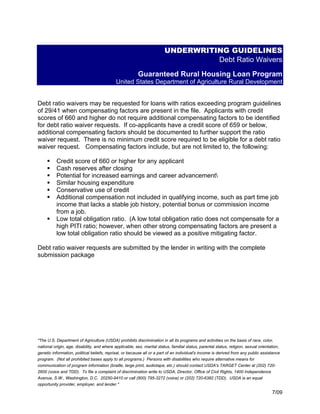
Debt ratio waivers may be requested for loans with ratios exceeding program guidelines
of 29/41 when compensating factors are present in the file. Applicants with credit
scores of 660 and higher do not require additional compensating factors to be identified
for debt ratio waiver requests. If co-applicants have a credit score of 659 or below,
additional compensating factors should be documented to further support the ratio
waiver request. There is no minimum credit score required to be eligible for a debt ratio
waiver request. Compensating factors include, but are not limited to, the following:
 Credit score of 660 or higher for any applicant
 Cash reserves after closing
 Potential for increased earnings and career advancement
 Similar housing expenditure
 Conservative use of credit
 Additional compensation not included in qualifying income, such as part time job
income that lacks a stable job history, potential bonus or commission income
from a job.
 Low total obligation ratio. (A low total obligation ratio does not compensate for a
high PITI ratio; however, when other strong compensating factors are present a
low total obligation ratio should be viewed as a positive mitigating factor.
Debt ratio waiver requests are submitted by the lender in writing with the complete
submission package

USDA Guidelines

  • 1.
    UNDERWRITING GUIDELINES (Applicant andIncome Requirements) Guaranteed Rural Housing Loan Program United States Department of Agriculture Rural Development Applicant Eligibility  Have the ability to personally occupy the dwelling  Be a citizen of the United States or be admitted for permanent residency  Non-occupant co-borrowers are not permitted  Generally, borrowers must sell their existing home Income  Applicants must have adequate and dependable income, typically with a history of 24 months  Qualifying ratios are 29/41; however, higher ratios considered with strong compensating factors, including good credit scores (660+), stable employment history, potential for increased earnings, and ability to save.  Income to be verified with a written VOE and one month’s current paystubs, OR one month’s paystubs and two years of W2’s.  2/1 buydowns qualifying ratios are calculated using note rate.  Debts with more than 6 monthly payments remaining must be included in qualifying ratios  Student loan payments must be included in ratios even if loans are currently in deferment  Self employed borrowers require two year history with 1040’s  Disability and Social Security benefits – 3 year continuance documented with award letter or 2 months bank statements, grossed up 125%  Salary increases within 60 days of the first payment due date are acceptable  Part time employment must have a history of no less than 12 months  Alimony and child support income must continue for 3 years and have no less than a 12 month history  Any income of a non-purchasing spouse must be verified to make sure income limits are not exceeded
  • 2.
    Income Calculations USDA RuralDevelopment determines applicant’s income in two manners: Eligibility Income – Includes all income (salary, tips, bonus, overtime, alimony, child support, etc..) received by the applicant and co-applicant(s). This income is used to calculate qualifying ratios. Adjusted Income – This is the applicant’s eligibility income less the total of any of the following deductions applicable to the loan. Income from all household members must be included in the total adjusted income. This adjusted income must not exceed 115% of the median household income for the area. (see spreadsheet). Allowable Deductions to Determine “Adjusted Income”: Member of Household Amount of Deduction Each minor child under 18 years of age $480 Each disabled or handicapped individual who is not the applicant or co-applicant $480 Each full time student 18 years or older $480 Each elderly (62 years of age or older) or disabled applicant $400 Medical expenses for any elderly family member Total that exceeds 3% of gross annual income Child care expenses for children 12 years old or under Actual cost of care, supported by full documentation of cost
  • 3.
    UNDERWRITING GUIDELINES (Credit Requirements) GuaranteedRural Housing Loan Program United States Department of Agriculture Rural Development Credit History Applicants must have a credit history that indicates a reasonable ability and willingness to meet obligations as they become due. A credit history reflecting any or all of the following is considered unacceptable credit history:  More than one 30-day late within the past 12 months.  Bankruptcy or foreclosure discharged less than 36 months  Outstanding judgments within the past 12 months  Two or more rent payments 30 days late within the past 3 years.  Outstanding collection accounts with no payment arrangements  Outstanding tax liens or delinquent federal debt with no payment arrangements  Accounts converted to collections in the past 12 months. Mitigating Factors to Unacceptable Credit: Adverse credit waivers may be granted for mitigating factors to establish the applicant’s intent to good credit. Lenders must document these circumstances which were beyond the borrower’s control and have been removed:  Circumstances for adverse credit were temporary in nature, beyond the applicant’s control and have been removed. Examples: increased expenses due to illness and/or medical expenses, injury, death, etc.  Tri-merge credit reports are required and must be no more than 90 days old at the time the Conditional Commitment is issued  Applicants must not be delinquent on any debts owed to the Federal Government  CAIVRs must be checked and documented in the loan submission package.
  • 4.
    UNDERWRITING GUIDELINES (Utilizing CreditScores) Guaranteed Rural Housing Loan Program United States Department of Agriculture Rural Development Streamlined Underwriting Criteria (Credit score 620 or higher) For borrowers with a credit score of 620 or higher, lenders may evaluate loans utilizing USDA’s streamlined underwriting guidelines.  Lender shall not be required to document adverse credit history except for those involving a delinquent federal debt or previous agency loan.  Lender shall not be required to obtain a rental history rating  No action will be necessary for any derogatory items, (i.e. no letters of explanation, unpaid collection accounts not required to be paid off, etc…) The credit score of the primary wage earner should be given the most emphasis; however, credit scores of other applicants will also be included in the overall review of the loan request. Use the middle of three (3) scores or the lower of two (2) scores for all borrowers. Credit score of 619 to 580 Statistically, borrowers with credit scores within this range demonstrate a higher likelihood of default and therefore, lenders should evaluate loans carefully and be cautious of layered risk in addition to the lower credit score. For example, a ratio waiver should be avoided unless strong compensating factors are present. In addition, lenders should be cautious when applicants have no rent or housing history to verify. If an adverse credit history waiver is requested, the lender must document that the circumstance: 1) was temporary in nature, and 2) beyond the applicant’s control, and 3) has been removed so reoccurrence is unlikely.
  • 5.
    Credit score of580 or below Statistically, borrowers with credit scores within this range have demonstrated a much higher rate of default in the GRH program. Lenders should not approve loans with credit scores of 580 and below if they exhibit any of the following:  One or more 30-day lates in the past 12 months.  Bankruptcy or foreclosure discharged less than 36 months.  Outstanding judgments within the past 12 months.  Two or more rent payments 30 days late within the past 3 years.  Outstanding collection accounts with no payment arrangements that are currently due.  Outstanding tax liens or delinquent federal debts with no payment arrangements  Accounts converted to collections in the past 12 months. Extraordinary compensating factors must be present to allow an adverse credit history waiver. Additional risk layers in addition to the lower score is not recommended. No credit score – Non-traditional credit No additional layers of risk are advisable for applicants with non-traditional credit. At least 4 non-traditional credit references, for a period of 12 months or more, should be developed, comprised of the following:  Rental or housing payment  Utility payment records  Insurance payments  Payments to a retail store
  • 6.
    "The U.S. Departmentof Agriculture (USDA) prohibits discrimination in all its programs and activities on the basis of race, color, national origin, age, disability, and where applicable, sex, marital status, familial status, parental status, religion, sexual orientation, genetic information, political beliefs, reprisal, or because all or a part of an individual's income is derived from any public assistance program. (Not all prohibited bases apply to all programs.) Persons with disabilities who require alternative means for communication of program information (braille, large print, audiotape, etc.) should contact USDA's TARGET Center at (202) 720- 2600 (voice and TDD). To file a complaint of discrimination write to USDA, Director, Office of Civil Rights, 1400 Independence Avenue, S.W., Washington, D.C. 20250-9410 or call (800) 795-3272 (voice) or (202) 720-6382 (TDD). USDA is an equal opportunity provider, employer, and lender." 7/09 UNDERWRITING GUIDELINES Debt Ratio Waivers Guaranteed Rural Housing Loan Program United States Department of Agriculture Rural Development Debt ratio waivers may be requested for loans with ratios exceeding program guidelines of 29/41 when compensating factors are present in the file. Applicants with credit scores of 660 and higher do not require additional compensating factors to be identified for debt ratio waiver requests. If co-applicants have a credit score of 659 or below, additional compensating factors should be documented to further support the ratio waiver request. There is no minimum credit score required to be eligible for a debt ratio waiver request. Compensating factors include, but are not limited to, the following:  Credit score of 660 or higher for any applicant  Cash reserves after closing  Potential for increased earnings and career advancement  Similar housing expenditure  Conservative use of credit  Additional compensation not included in qualifying income, such as part time job income that lacks a stable job history, potential bonus or commission income from a job.  Low total obligation ratio. (A low total obligation ratio does not compensate for a high PITI ratio; however, when other strong compensating factors are present a low total obligation ratio should be viewed as a positive mitigating factor. Debt ratio waiver requests are submitted by the lender in writing with the complete submission package