NEW TESTAMENT LESSON #42
Justified by faith or by action?
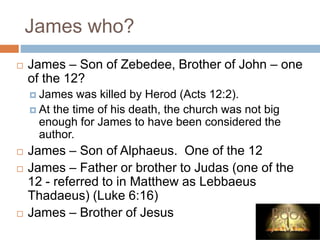
James who?
 James – Son of Zebedee, Brother of John – one
of the 12?
 James was killed by Herod (Acts 12:2).
 At the time of his death, the church was not big
enough for James to have been considered the
author.
 James – Son of Alphaeus. One of the 12
 James – Father or brother to Judas (one of the
12 - referred to in Matthew as Lebbaeus
Thadaeus) (Luke 6:16)
 James – Brother of Jesus
James who?
 James – Brother of Jesus
 Most probably the author.
 Scriptural references:
 "Is not this the carpenter's son? is not his mother called
Mary? and his brethren, James, and Joses, and Simon, and
Judas?" (Matthew 13:55)
 Paul writes of having seen James at Jerusalem (Galatians 1:17-
19).
 Paul makes reference to James as one of the pillars of the
Church. The incident mentioned occurred after the death of
James, the brother of John (Galatians 2:9-10).
 James was the Bishop of Jerusalem.
 Historians from that time say he was killed about 62 A.D.
 Sources from that period indicate that James
prayed so much that his knees were as calloused
as those of a camel.
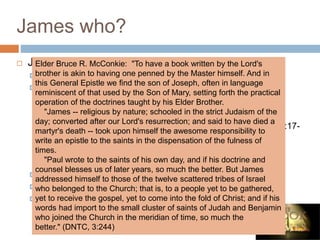
Elder Bruce R. McConkie: "To have a book written by the Lord's
brother is akin to having one penned by the Master himself. And in
this General Epistle we find the son of Joseph, often in language
reminiscent of that used by the Son of Mary, setting forth the practical
operation of the doctrines taught by his Elder Brother.
"James -- religious by nature; schooled in the strict Judaism of the
day; converted after our Lord's resurrection; and said to have died a
martyr's death -- took upon himself the awesome responsibility to
write an epistle to the saints in the dispensation of the fulness of
times.
"Paul wrote to the saints of his own day, and if his doctrine and
counsel blesses us of later years, so much the better. But James
addressed himself to those of the twelve scattered tribes of Israel
who belonged to the Church; that is, to a people yet to be gathered,
yet to receive the gospel, yet to come into the fold of Christ; and if his
words had import to the small cluster of saints of Judah and Benjamin
who joined the Church in the meridian of time, so much the
better." (DNTC, 3:244)
The problem with James….
 Martin Luther
 "Many sweat to reconcile
St. Paul and St. James, but in
vain. 'Faith justifies' and 'faith
does not justify' contradict each other flatly. If any
one can harmonize them I will give him my
doctor's hood and let him call me a fool."
 "We should throw the Epistle of
James out of this school
[the University of Wittenberg]...."
Chapter 1
 v. 2-4
 No pain that we suffer, no trial that we experience
is wasted. It ministers to our education, to the
development of such qualities as patience, faith,
fortitude and humility. All that we suffer and all
that we endure, especially when we endure it
patiently, builds up our characters, purifies our
hearts, expands our souls, and makes us more
tender and charitable, more worthy to be called
the children of God"(Orson F. Whitney, quoted in
Spencer W. Kimball, Faith Precedes the
Miracle, p. 98).
Chapter 1
 v. 5
 "This single verse of scripture has had a greater
impact and more far-reaching effect upon
mankind than any other single sentence ever
recorded by any prophet in any age" (Bruce R.
McConkie, Doctrinal New Testament
Commentary, 3:246-247).
Joseph Smith History – Chapter 1
11 While I was laboring under the extreme difficulties caused by
the contests of these parties of religionists, I was one day
reading the Epistle of James, first chapter and fifth verse, which
reads: If any of you lack wisdom, let him ask of God, that giveth
to all men liberally, and upbraideth not; and it shall be given him.
12 Never did any passage of scripture come with more power
to the heart of man than this did at this time to mine. It seemed
to enter with great force into every feeling of my heart. I
reflected on it again and again, knowing that if any person
needed wisdom from God, I did; for how to act I did not know,
and unless I could get more wisdom than I then had, I would
never know; for the teachers of religion of the different sects
understood the same passages of scripture so differently as to
destroy all confidence in settling the question by an appeal to
the Bible.
Chapter 1
 v. 27 - "Pure religion and undefiled before God and the
Father is this, To visit the fatherless and widows in their
affliction, and to keep himself unspotted from the vices
of the world."
 “I will tell you all that your faith, religion, and profession
of religion, will never save one soul of you in the
Celestial Kingdom of our God, unless you carry out just
such principles as I am now teaching you. Go and bring
in those people now on the plains. And attend strictly to
those things which we call temporal, or temporal duties.
Otherwise, your faith will be in vain. The preaching you
have heard will be in vain to you, and you will sink to
Hell, unless you attend to the things we tell you.”
Brigham Young
Chapter 2
 v. 14-16 –
 14 What doth it profit, my brethren, though a man
say he hath faith, and have not works? can faith
save him?
 15 If a brother or sister be naked, and destitute of
daily food,
 16 And one of you say unto them, Depart in
peace, be ye warmed and filled; notwithstanding
ye give them not those things which are needful
to the body; what doth it profit?
"I am often, I believe, praying for others when I
should be doing things for them. It's so much
easier to pray for a bore than to go and see
him" (C.S. Lewis, from Letters to Malcolm:
Chiefly on Prayer, quoted in The C.S. Lewis
Bible, p. 1397).
Chapter 2
 v. 17-24
 Even so faith, if it have not works is dead, being
alone.
 Therefore wilt thou know, O vain man, that faith
without works is dead and cannot save you? Thou
believest there is one God; thou doest well; the devils
also believer, and tremble; thou hast made thyself like
unto them, not being justified. Was not Abraham our
father justified by works, when he had offered Isaac
his son upon the altar? Seest thou how works
wrought with his faith, and by works was faith made
perfect?"
"Christians have often disputed as to
whether what leads the Christian home is
good actions, or Faith in Christ. I have no
right really to speak on such a difficult
question, but it does seem to me like
asking which blade in a pair of scissors is
most necessary. A serious moral effort is
the only thing that will bring you to the
point where you throw up the
sponge [Americans might say "throw in
the towel"]. Faith in Christ is the only thing
to save you from despair at that point: and
out of that Faith in Him good actions must
inevitably come" (C.S. Lewis, from Mere
Christianity, quoted in The C.S. Lewis
Bible, p. 1396).
Chapter 3
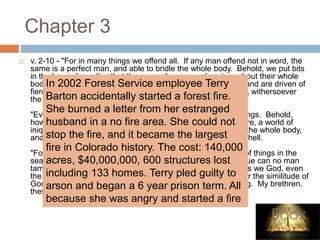
 v. 2-10 - "For in many things we offend all. If any man offend not in word, the
same is a perfect man, and able to bridle the whole body. Behold, we put bits
in the horses' mouths, that they may obey us; and we turn about their whole
body. Behold also the ships, which though they be so great, and are driven of
fierce winds, yet are they turned about with a very small helm, withersoever
the governor listeth.
"Even so the tongue is a little member, and boasteth great things. Behold,
how great a matter a little fire kindleth? And the tongue is a fire, a world of
iniquity; so is the tongue among our members, that it defileth the whole body,
and setteth on fire the course of nature; and it is set on fire of hell.
"For every kind of beasts, and of birds, and of serpents, and of things in the
sea, is tamed, and hath been tamed of mankind; but the tongue can no man
tame; it is an unruly evil, full of deadly poison. Therewith bless we God, even
the Father; and therewith curse we men, which are made after the similitude of
God. Out of the same mouth proceedeth blessing and cursing. My brethren,
these things ought not so to be."
In 2002 Forest Service employee Terry
Barton accidentally started a forest fire.
She burned a letter from her estranged
husband in a no fire area. She could not
stop the fire, and it became the largest
fire in Colorado history. The cost: 140,000
acres, $40,000,000, 600 structures lost
including 133 homes. Terry pled guilty to
arson and began a 6 year prison term. All
because she was angry and started a fire
The Prophet Joseph Smith deepened our understanding of
the power of speech when he taught:
 'It is by words … [that] every being works when he works by faith. God said,
‘Let there be light: and there was light.’ Joshua spake, and the great lights
which God had created stood still. Elijah commanded, and the heavens were
stayed for the space of three years and six months, so that it did not rain. …
All this was done by faith. … Faith, then, works by words; and with [words] its
mightiest works have been, and will be, performed...
 "The voice that bears profound testimony, utters fervent prayer, and sings the
hymns of Zion can be the same voice that berates and criticizes, embarrasses
and demeans, inflicts pain and destroys the spirit of oneself and of others in
the process. 'Out of the same mouth proceedeth blessing and cursing,' James
grieves. 'My brethren [and sisters], these things ought not so to be.‘
 "Our words, like our deeds, should be filled with faith and hope and charity, the
three great Christian imperatives so desperately needed in the world today.
With such words, spoken under the influence of the Spirit, tears can be dried,
hearts can be healed, lives can be elevated, hope can return, confidence can
prevail." (Jeffrey R. Holland, "The Tongue of Angels," April 2007 General
Conference)
Chapter 4
 v. 3 - "Ye ask, and receive not, because ye
ask amiss, that ye may consume it upon your
lusts.“
 v. 17 - "To him that knoweth to do good, and
doeth it not, to him it is sin."
Chapter 5
 v. 14-16 - "Is any sick among you? let him call
for the elders of the church; and let them pray
over him, anointing him with oil in the name of
the Lord: And the prayer of faith shall save the
sick, and the Lord shall raise him up; and if he
have committed sins, they shall be forgiven
him."

Lesson 42 james

  • 1.
    NEW TESTAMENT LESSON#42 Justified by faith or by action?
  • 2.
    James who?  James– Son of Zebedee, Brother of John – one of the 12?  James was killed by Herod (Acts 12:2).  At the time of his death, the church was not big enough for James to have been considered the author.  James – Son of Alphaeus. One of the 12  James – Father or brother to Judas (one of the 12 - referred to in Matthew as Lebbaeus Thadaeus) (Luke 6:16)  James – Brother of Jesus
  • 3.
    James who?  James– Brother of Jesus  Most probably the author.  Scriptural references:  "Is not this the carpenter's son? is not his mother called Mary? and his brethren, James, and Joses, and Simon, and Judas?" (Matthew 13:55)  Paul writes of having seen James at Jerusalem (Galatians 1:17- 19).  Paul makes reference to James as one of the pillars of the Church. The incident mentioned occurred after the death of James, the brother of John (Galatians 2:9-10).  James was the Bishop of Jerusalem.  Historians from that time say he was killed about 62 A.D.  Sources from that period indicate that James prayed so much that his knees were as calloused as those of a camel. Elder Bruce R. McConkie: "To have a book written by the Lord's brother is akin to having one penned by the Master himself. And in this General Epistle we find the son of Joseph, often in language reminiscent of that used by the Son of Mary, setting forth the practical operation of the doctrines taught by his Elder Brother. "James -- religious by nature; schooled in the strict Judaism of the day; converted after our Lord's resurrection; and said to have died a martyr's death -- took upon himself the awesome responsibility to write an epistle to the saints in the dispensation of the fulness of times. "Paul wrote to the saints of his own day, and if his doctrine and counsel blesses us of later years, so much the better. But James addressed himself to those of the twelve scattered tribes of Israel who belonged to the Church; that is, to a people yet to be gathered, yet to receive the gospel, yet to come into the fold of Christ; and if his words had import to the small cluster of saints of Judah and Benjamin who joined the Church in the meridian of time, so much the better." (DNTC, 3:244)
  • 4.
    The problem withJames….  Martin Luther  "Many sweat to reconcile St. Paul and St. James, but in vain. 'Faith justifies' and 'faith does not justify' contradict each other flatly. If any one can harmonize them I will give him my doctor's hood and let him call me a fool."  "We should throw the Epistle of James out of this school [the University of Wittenberg]...."
  • 5.
    Chapter 1  v.2-4  No pain that we suffer, no trial that we experience is wasted. It ministers to our education, to the development of such qualities as patience, faith, fortitude and humility. All that we suffer and all that we endure, especially when we endure it patiently, builds up our characters, purifies our hearts, expands our souls, and makes us more tender and charitable, more worthy to be called the children of God"(Orson F. Whitney, quoted in Spencer W. Kimball, Faith Precedes the Miracle, p. 98).
  • 6.
    Chapter 1  v.5  "This single verse of scripture has had a greater impact and more far-reaching effect upon mankind than any other single sentence ever recorded by any prophet in any age" (Bruce R. McConkie, Doctrinal New Testament Commentary, 3:246-247). Joseph Smith History – Chapter 1 11 While I was laboring under the extreme difficulties caused by the contests of these parties of religionists, I was one day reading the Epistle of James, first chapter and fifth verse, which reads: If any of you lack wisdom, let him ask of God, that giveth to all men liberally, and upbraideth not; and it shall be given him. 12 Never did any passage of scripture come with more power to the heart of man than this did at this time to mine. It seemed to enter with great force into every feeling of my heart. I reflected on it again and again, knowing that if any person needed wisdom from God, I did; for how to act I did not know, and unless I could get more wisdom than I then had, I would never know; for the teachers of religion of the different sects understood the same passages of scripture so differently as to destroy all confidence in settling the question by an appeal to the Bible.
  • 7.
    Chapter 1  v.27 - "Pure religion and undefiled before God and the Father is this, To visit the fatherless and widows in their affliction, and to keep himself unspotted from the vices of the world."  “I will tell you all that your faith, religion, and profession of religion, will never save one soul of you in the Celestial Kingdom of our God, unless you carry out just such principles as I am now teaching you. Go and bring in those people now on the plains. And attend strictly to those things which we call temporal, or temporal duties. Otherwise, your faith will be in vain. The preaching you have heard will be in vain to you, and you will sink to Hell, unless you attend to the things we tell you.” Brigham Young
  • 8.
    Chapter 2  v.14-16 –  14 What doth it profit, my brethren, though a man say he hath faith, and have not works? can faith save him?  15 If a brother or sister be naked, and destitute of daily food,  16 And one of you say unto them, Depart in peace, be ye warmed and filled; notwithstanding ye give them not those things which are needful to the body; what doth it profit? "I am often, I believe, praying for others when I should be doing things for them. It's so much easier to pray for a bore than to go and see him" (C.S. Lewis, from Letters to Malcolm: Chiefly on Prayer, quoted in The C.S. Lewis Bible, p. 1397).
  • 9.
    Chapter 2  v.17-24  Even so faith, if it have not works is dead, being alone.  Therefore wilt thou know, O vain man, that faith without works is dead and cannot save you? Thou believest there is one God; thou doest well; the devils also believer, and tremble; thou hast made thyself like unto them, not being justified. Was not Abraham our father justified by works, when he had offered Isaac his son upon the altar? Seest thou how works wrought with his faith, and by works was faith made perfect?" "Christians have often disputed as to whether what leads the Christian home is good actions, or Faith in Christ. I have no right really to speak on such a difficult question, but it does seem to me like asking which blade in a pair of scissors is most necessary. A serious moral effort is the only thing that will bring you to the point where you throw up the sponge [Americans might say "throw in the towel"]. Faith in Christ is the only thing to save you from despair at that point: and out of that Faith in Him good actions must inevitably come" (C.S. Lewis, from Mere Christianity, quoted in The C.S. Lewis Bible, p. 1396).
  • 10.
    Chapter 3  v.2-10 - "For in many things we offend all. If any man offend not in word, the same is a perfect man, and able to bridle the whole body. Behold, we put bits in the horses' mouths, that they may obey us; and we turn about their whole body. Behold also the ships, which though they be so great, and are driven of fierce winds, yet are they turned about with a very small helm, withersoever the governor listeth. "Even so the tongue is a little member, and boasteth great things. Behold, how great a matter a little fire kindleth? And the tongue is a fire, a world of iniquity; so is the tongue among our members, that it defileth the whole body, and setteth on fire the course of nature; and it is set on fire of hell. "For every kind of beasts, and of birds, and of serpents, and of things in the sea, is tamed, and hath been tamed of mankind; but the tongue can no man tame; it is an unruly evil, full of deadly poison. Therewith bless we God, even the Father; and therewith curse we men, which are made after the similitude of God. Out of the same mouth proceedeth blessing and cursing. My brethren, these things ought not so to be." In 2002 Forest Service employee Terry Barton accidentally started a forest fire. She burned a letter from her estranged husband in a no fire area. She could not stop the fire, and it became the largest fire in Colorado history. The cost: 140,000 acres, $40,000,000, 600 structures lost including 133 homes. Terry pled guilty to arson and began a 6 year prison term. All because she was angry and started a fire
  • 11.
    The Prophet JosephSmith deepened our understanding of the power of speech when he taught:  'It is by words … [that] every being works when he works by faith. God said, ‘Let there be light: and there was light.’ Joshua spake, and the great lights which God had created stood still. Elijah commanded, and the heavens were stayed for the space of three years and six months, so that it did not rain. … All this was done by faith. … Faith, then, works by words; and with [words] its mightiest works have been, and will be, performed...  "The voice that bears profound testimony, utters fervent prayer, and sings the hymns of Zion can be the same voice that berates and criticizes, embarrasses and demeans, inflicts pain and destroys the spirit of oneself and of others in the process. 'Out of the same mouth proceedeth blessing and cursing,' James grieves. 'My brethren [and sisters], these things ought not so to be.‘  "Our words, like our deeds, should be filled with faith and hope and charity, the three great Christian imperatives so desperately needed in the world today. With such words, spoken under the influence of the Spirit, tears can be dried, hearts can be healed, lives can be elevated, hope can return, confidence can prevail." (Jeffrey R. Holland, "The Tongue of Angels," April 2007 General Conference)
  • 12.
    Chapter 4  v.3 - "Ye ask, and receive not, because ye ask amiss, that ye may consume it upon your lusts.“  v. 17 - "To him that knoweth to do good, and doeth it not, to him it is sin."
  • 13.
    Chapter 5  v.14-16 - "Is any sick among you? let him call for the elders of the church; and let them pray over him, anointing him with oil in the name of the Lord: And the prayer of faith shall save the sick, and the Lord shall raise him up; and if he have committed sins, they shall be forgiven him."