Downloaded 22 times
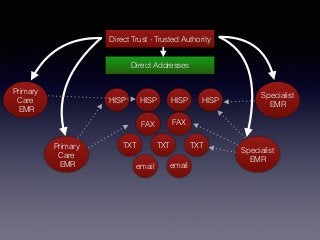
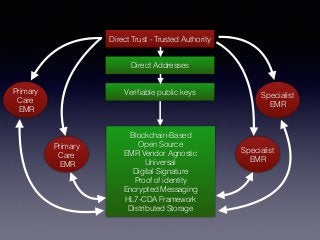

Proposal for Blockchain-Based Health Information Exchange (HIE) Charles Kaplan MD Tucson, AZ csk9000@gmail.com The first slide illustrates the current state of HIE, emphasizing the complexity, high cost (red), and the multiple areas of disconnect. The second slide illustrates an alternative model in which information flows through an open-source, distributed, encrypted system with a blockchain ledger. Meaningful Use 2 mandates the transfer of CDA documents with a standardized structure. This is a golden opportunity to create a low cost, high adoption, standardized framework which can be universally applied immediately. This would solve a number of problems that are prevalent with the current HISP-based system: 1. Patients should not have to deal with 3 or 4 portals to track their health data, as they do now if they have primary care, plus specialists, plus a hospital. A universal ledger for CDA would allow for a single unified portal for patients. 2. Similarly, there is presently a tremendous amount of duplication of records in health care providers' EMRs, with many unresolved discrepancies. The creation of a centralized ledger to manage CDA would reduce this duplication, waste, and would reduce discrepancies and errors. 3. A unified ledge for CDA would have a dramatic effect reducing unnecessary duplication of testing, such as duplicate lab orders and duplicate imaging studies, which is a very prevalent problem as patient move between different provider environments (primary care, specialty care, ER's, hospitals, rehab facilities, SNFs, hospices, etc). 4. The current system does not have a uniform method to document acknowledgement of receipt of health information. This unified, open source proposal could be easily developed to include this very important feature, as there is precedent for acknowledgement methods in other blockchain-based ledgers. 5. The distributed nature of blockchain nodes protects the system from single points of failure, in the event of network outages or power outages. It will be critical that a system of registering and verifying public keys be put into place, much like Direct Addresses are currently verified. This is a policy issue that could be brought to the attention of current certifying agencies and entities that are providing Direct Trust and EMR certification already.


