www.hachen-engineering.com
1 of 4
Change is inevitable in the current almost chaotic business environ-
ment, and some long-established rules seem no longer valid and must
be adopted or even replaced. In this situation, it is tempting to focus
on short-term actions.
But complex problems with many variables and possible solutions still
need a systematic approach to minimize the risk of making wrong and
costly choices. Therefore, creativity is required to come up with new and
different viewpoints on a subject.
A practical problem-solving procedure must be easy to understand
and adaptable depending on the complexity of the problem. But it must
be insisted here that the creativity and feasibility of the solutions rely
entirely on the motivation and skills of the actors involved.
In summary, a sound solution-finding procedure
1)	 also helps non-participants to understand the solution-finding
process,
2)	 increases the probability of finding acceptable solutions also in less
favorable environments,
3)	 helps remove blocks and barriers to creative thinking,
4)	 helps to remove biased thinking that excludes some possible solu-
tions, and
5)	 promotes team building, communication, and coordination between
the different actors and parts of the organization.
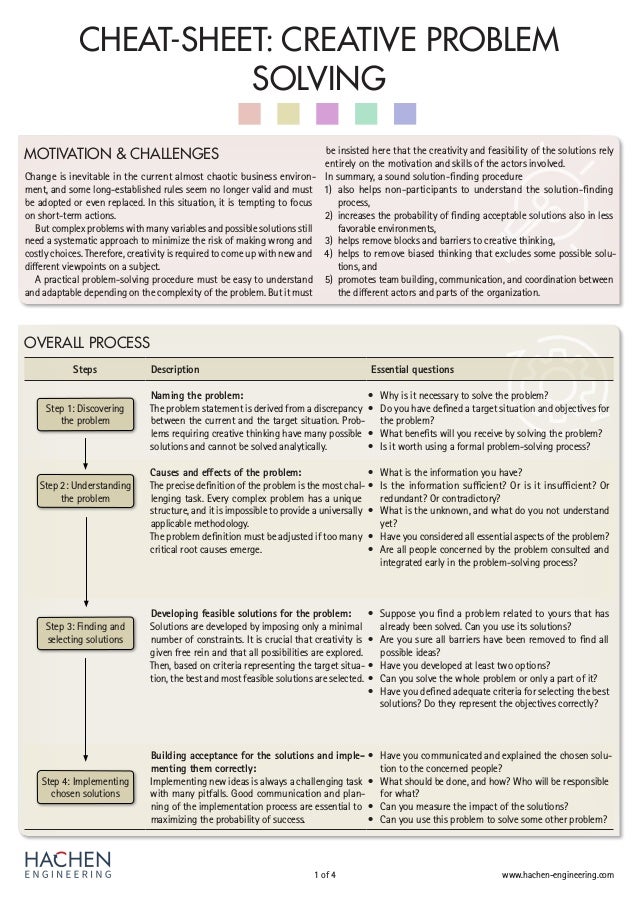
OVERALL PROCESS
MOTIVATION & CHALLENGES
CHEAT-SHEET: CREATIVE PROBLEM
SOLVING
Steps Description Essential questions
Naming the problem:
The problem statement is derived from a discrepancy
between the current and the target situation. Prob-
lems requiring creative thinking have many possible
solutions and cannot be solved analytically.
•	 Why is it necessary to solve the problem?
•	 Do you have defined a target situation and objectives for
the problem?
•	 What benefits will you receive by solving the problem?
•	 Is it worth using a formal problem-solving process?
Causes and effects of the problem:
The precise definition of the problem is the most chal-
lenging task. Every complex problem has a unique
structure, and it is impossible to provide a universally
applicable methodology.
The problem definition must be adjusted if too many
critical root causes emerge.
•	 What is the information you have?
•	 Is the information sufficient? Or is it insufficient? Or
redundant? Or contradictory?
•	 What is the unknown, and what do you not understand
yet?
•	 Have you considered all essential aspects of the problem?
•	 Are all people concerned by the problem consulted and
integrated early in the problem-solving process?
Developing feasible solutions for the problem:
Solutions are developed by imposing only a minimal
number of constraints. It is crucial that creativity is
given free rein and that all possibilities are explored.
Then, based on criteria representing the target situa-
tion, the best and most feasible solutions are selected.
•	 Suppose you find a problem related to yours that has
already been solved. Can you use its solutions?
•	 Are you sure all barriers have been removed to find all
possible ideas?
•	 Have you developed at least two options?
•	 Can you solve the whole problem or only a part of it?
•	 Have you defined adequate criteria for selecting the best
solutions? Do they represent the objectives correctly?
Building acceptance for the solutions and imple-
menting them correctly:
Implementing new ideas is always a challenging task
with many pitfalls. Good communication and plan-
ning of the implementation process are essential to
maximizing the probability of success.
•	 Have you communicated and explained the chosen solu-
tion to the concerned people?
•	 What should be done, and how? Who will be responsible
for what?
•	 Can you measure the impact of the solutions?
•	 Can you use this problem to solve some other problem?
Step 2: Understanding
the problem
Step 3: Finding and
selecting solutions
Step 4: Implementing
chosen solutions
Step 1: Discovering
the problem
www.hachen-engineering.com
2 of 4
GENERAL CONCEPTS
PROCESS STEPS
The basic idea-generating process
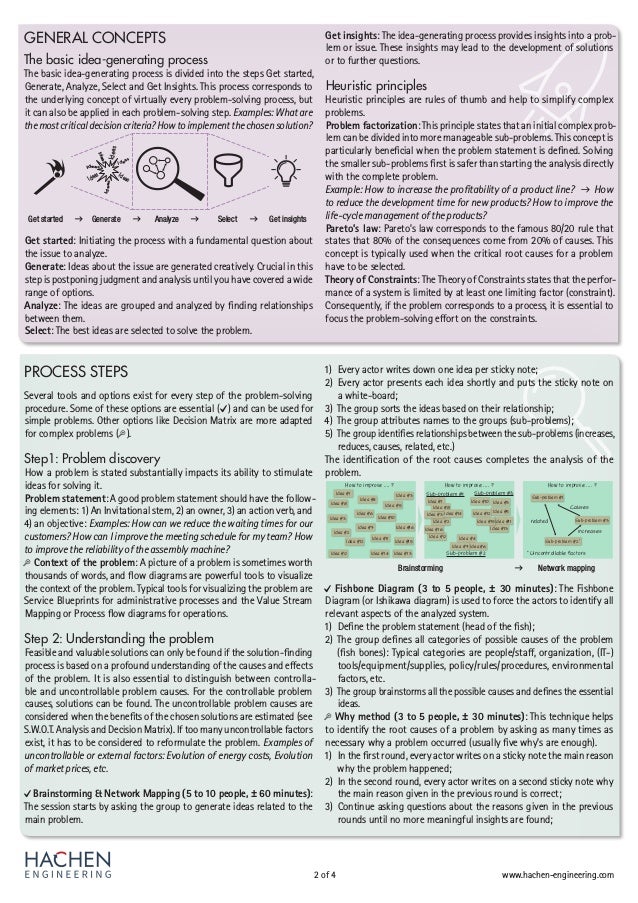
The basic idea-generating process is divided into the steps Get started,
Generate, Analyze, Select and Get Insights. This process corresponds to
the underlying concept of virtually every problem-solving process, but
it can also be applied in each problem-solving step. Examples: What are
themostcriticaldecisioncriteria?Howtoimplementthechosensolution?
Get started: Initiating the process with a fundamental question about
the issue to analyze.
Generate: Ideas about the issue are generated creatively. Crucial in this
step is postponing judgment and analysis until you have covered a wide
range of options.
Analyze: The ideas are grouped and analyzed by finding relationships
between them.
Select: The best ideas are selected to solve the problem.
Several tools and options exist for every step of the problem-solving
procedure. Some of these options are essential (✓) and can be used for
simple problems. Other options like Decision Matrix are more adapted
for complex problems ().
Step1: Problem discovery
How a problem is stated substantially impacts its ability to stimulate
ideas for solving it.
Problem statement: A good problem statement should have the follow-
ing elements: 1) An Invitational stem, 2) an owner, 3) an action verb, and
4) an objective: Examples: How can we reduce the waiting times for our
customers? How can I improve the meeting schedule for my team? How
to improve the reliability of the assembly machine?
 Context of the problem: A picture of a problem is sometimes worth
thousands of words, and flow diagrams are powerful tools to visualize
the context of the problem. Typical tools for visualizing the problem are
Service Blueprints for administrative processes and the Value Stream
Mapping or Process flow diagrams for operations.
Step 2: Understanding the problem
Feasible and valuable solutions can only be found if the solution-finding
process is based on a profound understanding of the causes and effects
of the problem. It is also essential to distinguish between controlla-
ble and uncontrollable problem causes. For the controllable problem
causes, solutions can be found. The uncontrollable problem causes are
considered when the benefits of the chosen solutions are estimated (see
S.W.O.T. Analysis and Decision Matrix). If too many uncontrollable factors
exist, it has to be considered to reformulate the problem. Examples of
uncontrollable or external factors: Evolution of energy costs, Evolution
of market prices, etc.
✓ Brainstorming & Network Mapping (5 to 10 people, ± 60 minutes):
The session starts by asking the group to generate ideas related to the
main problem.
Get insights: The idea-generating process provides insights into a prob-
lem or issue. These insights may lead to the development of solutions
or to further questions.
Heuristic principles
Heuristic principles are rules of thumb and help to simplify complex
problems.
Problem factorization: This principle states that an initial complex prob-
lem can be divided into more manageable sub-problems. This concept is
particularly beneficial when the problem statement is defined. Solving
the smaller sub-problems first is safer than starting the analysis directly
with the complete problem.
Example: How to increase the profitability of a product line?  → How
to reduce the development time for new products? How to improve the
life-cycle management of the products?
Pareto’s law: Pareto’s law corresponds to the famous 80/20 rule that
states that 80% of the consequences come from 20% of causes. This
concept is typically used when the critical root causes for a problem
have to be selected.
Theory of Constraints: The Theory of Constraints states that the perfor-
mance of a system is limited by at least one limiting factor (constraint).
Consequently, if the problem corresponds to a process, it is essential to
focus the problem-solving effort on the constraints.
1)	 Every actor writes down one idea per sticky note;
2)	 Every actor presents each idea shortly and puts the sticky note on
a white-board;
3)	The group sorts the ideas based on their relationship;
4)	 The group attributes names to the groups (sub-problems);
5)	The group identifies relationships between the sub-problems (increases,
reduces, causes, related, etc.)
The identification of the root causes completes the analysis of the
problem.
✓ Fishbone Diagram (3 to 5 people, ± 30 minutes): The Fishbone
Diagram (or Ishikawa diagram) is used to force the actors to identify all
relevant aspects of the analyzed system.
1)	 Define the problem statement (head of the fish);
2)	 The group defines all categories of possible causes of the problem
(fish bones): Typical categories are people/staff, organization, (IT-)
tools/equipment/supplies, policy/rules/procedures, environmental
factors, etc.
3)	The group brainstorms all the possible causes and defines the essential
ideas.
 Why method (3 to 5 people, ± 30 minutes): This technique helps
to identify the root causes of a problem by asking as many times as
necessary why a problem occurred (usually five why’s are enough).
1)	 In the first round, every actor writes on a sticky note the main reason
why the problem happened;
2)	 In the second round, every actor writes on a second sticky note why
the main reason given in the previous round is correct;
3)	 Continue asking questions about the reasons given in the previous
rounds until no more meaningful insights are found;
Network mapping
Brainstorming →
Idea #1
Idea #2
Idea #3
Idea #3
Idea #4
Idea #5
Idea #6
Idea #7
Idea #8
Idea #9
Idea #10
Idea #11
Idea #12
Idea #13
Idea #16
Idea #14
Idea #15
How to improve .... ?
Idea #1
Idea #2
Idea #3
Idea #3
Idea #4
Idea #5
Idea #6
Idea #7
Idea #8
Idea #9
Idea #10
Idea #11
Idea #12
Idea #13
Idea #16
Idea #14
Idea #15
How to improve .... ?
Sub-problem #1
Sub-problem #2
Sub-problem #3
How to improve .... ?
Sub-problem #1
Sub-problem #2 *
Sub-problem #3
increases
Causes
related
*
Uncontrollable factors
I
d
e
a
s
Id
e
a
s
Ideas
Ideas
Ideas
Ideas
I
d
e
a
s
Analyze Select
Generate
Get started Get insights
→ → → →
www.hachen-engineering.com
3 of 4
4)	 The group compares all the answers found by the actors and selects
the most significant causes of the problem.
Step 3: Finding and selecting solutions
Finding solutions:
Solutions can be found with the Brainstorming method or with the
following techniques that help to stimulate the solution-finding process.
✓ The ideal solution method (3 to 5 people, ± 60 minutes): A typical
technique for stimulating the development of solutions is to start the
process by defining a perfect solution to the problem. This solution
should be achievable under ideal conditions, too unrealistic solutions
should be avoided.
Brainwriting (5 people, ± 60 minutes): Brainwriting is the perfect
method to provide privacy for participants, and ideas can be developed
comfortably. Each actor starts with a sheet of paper that has been divided
into usually 15 blocks. Each actor writes three ideas (solutions) on their
sheet and places then the sheet in the center of the group. The actors
exchange the sheets, reading what has already been written and adding
three new ideas. Typically, this is repeated five times. In the end, the group
evaluates the ideas and selects the best ones.
 Scamper (3 to 5 people, ± 60 minutes): The Scamper method
corresponds to questions that help question new or existing solutions.
1)	 Substitute? Can other, more efficient solutions replace some solutions?
2)	 Combine? Can the solutions be combined with existing or new
solutions?
3)	Adapt? Can the solutions be adapted to improve their impact?
4)	 Modify? Can the solutions be modified to improve their impact?
5)	 Put to other uses? Can the solutions be used for other problems?
6)	 Eliminate? Is the solution beneficial? Can it be eliminated?
7)	 Rearrange? Can the solutions be rearranged if implemented in a
specific sequence?
Evaluating & Selecting solutions:
✓ Dot voting (3 to 10 people, ± 10 minutes): This technique is the
classical technique to prioritize or select the best ideas or solutions.
Every actor is given a certain number of sticky dots that they can use a
vote depending on their personal opinion (see Impact & Effort matrix).
Forced ranking (3 to 5 people, ± 30 minutes): This simple technique
forces the actors to make difficult decisions about the relative value of
each solution. This method aims to define a ranking of the proposed
solutions, from the best to the worst.
✓ Impact & Effort matrix (3 to 6 people, ± 30 minutes): The simplest
method for choosing the best ideas is to classify them based on the
two factors: Effort (or costs) to implement and estimated impact. Each
actor is given a sticky dot per solution that they can put on the matrix
depending on their personal opinion. After the vote, the group discusses
the result and selects the most valuable solutions.
 S.W.O.T. Analysis (3 to 5 people, ± 90 minutes): A classical method
for evaluating the value of an idea is to analyze it based on the following
four criteria.
1)	 Strengths: Positive elements that can be controlled;
2)	 Weaknesses: Negative elements that can be controlled and improved;
3)	 Opportunities: Positive elements that are controlled by external forces;
4)	 Threats: Negative elements that cannot be controlled.
Each actor evaluates the proposed solutions based on the four criteria
by focusing only on the essential characteristics. In the next step, all the
ideas are presented and put on the whiteboard. After the analysis, the
group discusses the results and selects the ideas with the most strengths
and opportunities.
 Decision matrix (3 to 5 people, ± 90 minutes): A decision matrix
must be used if several decision criteria exist (costs, efficiency, etc.) and
some are uncontrollable.
1)	 The decision criteria (quantitative of qualitative) are defined;
2)	 Scenarios are developed for uncontrollable factors (external factors);
3)	The estimated outcomes are defined for all criteria and scenarios;
4)	 The best (↑), the weakest (↓), and the critical (!) outcomes are deter-
mined. Critical outcomes are in conflict with the objectives
5)	 Depending on the results and the weighting of the different criteria,
the group decides the best solution (Dot voting, Secret voting, etc.).
Step 4: Implementation chosen solutions
Project organization: A simple tool for organizing and following the
implementation phase is the Who/What/When matrix (✓). An A3 report
() is more adapted for complex projects since it allows to summarize
all essential elements of the problem-solving process.
✓ Prototype: Acceptance for new solutions is assured if they can be
tested in a limited environment. Such prototypes also help to verify the
assumptions of the chosen solution.
 Measuring the impact of the chosen solutions: The effect of the
selected solutions has to be verified with the help of key performance
indicators if the implementation costs are high. Ideally, the required indi-
cators are in place before the implementation of the selected solutions
has started. A complete set of key performance indicators may also serve
as an early warning system for potential problems.
WHY method
Fishbone Diagram
Cause #1
Cause #1
WHY?
Sub-problem Actor #1 Actor #2 Actor #2
WHY?
WHY?
WHY?
WHY?
→
→
→
→
Cause #2
Cause #3
Cause #4
Cause #5
Cause #5
Cause #7
Cause #8
Cause #9
Cause #10
Cause #11
Cause #12
→
→
→
→
→
Most significant causes
Sub-problem
People/Organization
Supplies
Equipment
Policies/Rules
Cause #2
Cause #3
Cause #4
Cause #5
Cause #6
Cause #7
Cause #8
Round 1
Brain writing 6-3-5: 6 people, 3 ideas each, 5 times
Round 2 Round 3 Round 4 Round 5
Idea 1
Idea 2
Idea 3
Problem
SWOT analysis
Impact & Effort Matrix
High
Effort
Impact
High
Medium
Low
Medium Low
Solution #1
Solution #2
Solution #3
Strenghs Weaknesses
Opportunities
Threat
Threats
Threat
Weakness
Opportunity
Strength Strength
Opportunity
Threat
Weakness
Opportunity Opportunity
Strength
Criteria 1
Decision Matrix
Criteria 2
Critera 3
Criteria 4
Solution 1
Solution 2
Criteria 3
High Low
Medium
50‘000.-
20‘000.-
100‘000.-
Satisfactory
Good
Excellent 7%
2%
9%
-15%
0%
40%
0%
2%
5%
8% 5% 2%
Best outcome
Weakest
outcome
Critical
outcome
!
!
A3 Report
Who/What/When Matrix
Problem naming:
WHAT?
WHO? WHEN?
Actor 1
Actor 2
Actor 3
Actor 2
Action #1
Action #2
Action #3
Action #4
2/4/22
18/4/22
20/5/22
20/5/22
STATUS?
OK
OK
Ongoing
Current state & Objectives:
Follow-up:
Measured Impact:
Solutions:
Root cause analysis:
www.hachen-engineering.com
4 of 4
Campbell J. C. The phoenix checklist: Turning complex problems into simple solutions, Campbell & Company Publishing: A helpful list of
questions for assuring the coherence of your problem-solving process.
Cordoba Rubino S., M. Huisman, and W. Hazenberg. 75 Tools to be creative, BIS Publishers: A handy collection of cards illustrating many good
ideas for all the steps of your problem-solving process.
Gray D., S. Brown, and J. Macanufo. Game storming: A playbook for innovators, rulebreakers, and changemakers, O’Reilly Media: A playful
collection of concepts and tools helping improve your creativity.
Grünig R., and R. Kühn. Successful decision-making: A systematic approach to complex problems, Springer: A classic book about the decision-
making process.
Isaksen S. G, K. B. Dorval, and D.J. Treffinger. Creative approaches to problem-solving: A framework for innovation and change, SAGE Publications:
A detailed description of an innovative problem-solving framework adapted for highly complex issues with high ambiguity.
Proctor T., Creative problem solving for managers, Routledge Publications: A classic book about problem-solving, with some scientific background
about creativity and innovation.
AUDIT
TO GO FURTHER...
The following audit helps to verify the actual level of achievement of the problem-solving process.
People Process Tools
Level 4
Robust
The management is asking for a struc-
tured problem-solving approach for all
significant problems.
Enough people are available with partic-
ular skills for animating problem-solving
sessions.
Training programs are available and
promoted to train people in basic prob-
lem-solving techniques.
It is easy for non-participants to under-
stand the problem-solving process, all
data is available, and assumptions are
clearly explained.
Essential insights learned from the prob-
lem-solving process are communicated
organization-wide and reused if possible.
Most problems are found with the help
of problem-discovering tools, such as
KPIs, process analyzing tools, and the
continuous improvement process (Lean,
Six Sigma, etc.).
Space is available for exposing posters
summarizing the insights of finished or
ongoing problem-solving sessions. This
information serves as inspiration for
forthcoming problem-solving sessions.
Meeting rooms are available, equipped
with all required tools (whiteboards, stick-
ers, markers, etc.).
The available KPIs serve as an early warn-
ing system, and critical problems can be
anticipated.
Level 3
Essential
All relevant people are involved in the
creative problem-solving process and
know and follow the basic rules of this
process.
All parts of the organization are partic-
ipating actively in the problem-solving
process.
A brochure explaining the essential prob-
lem-solving process is distributed to all
employees.
Training material (books, presentations,
websites, etc.) about basic problem-solv-
ing techniques are available.
The impact of implemented solutions
can be measured organization-wide by
general goal indicators (profitability, sales,
etc.) and operational cause indicators
(quality issues, market share, employee
satisfaction, service and inventory levels,
etc.).
Level 2
Minimal
When critical problems occur, creative
problem-solving is used in some parts of
the organization.
People directly concerned by the problem
are participating in the problem-solving
process.
A standard exists for basic creative prob-
lem-solving techniques and is available
for everybody (process description, docu-
ment templates, etc.).
Equipment for brainstorming sessions is
available (whiteboards, stickers, etc.).
Operational cause indicators exist in some
areas of the organization (operations).
Level 1
Insignificant
A limited number of people analyze and
solve complex problems, and there is no
coordination between the different parts
of the organization.
No guidelines or standards exist for the
problem-solving process.
Problems are treated on an ad hoc basis.
The decision-finding process is not trans-
parent for non-participants.
Some general goal indicators exist (sales,
etc.), but they don’t allow identification
of potential causes of problems.
No specific material is available for facil-
itating brainstorming sessions.
Cheat-Sheet-Creative-Problem-Solving-EN.pdf

  • 1.
    www.hachen-engineering.com 1 of 4 Changeis inevitable in the current almost chaotic business environ- ment, and some long-established rules seem no longer valid and must be adopted or even replaced. In this situation, it is tempting to focus on short-term actions. But complex problems with many variables and possible solutions still need a systematic approach to minimize the risk of making wrong and costly choices. Therefore, creativity is required to come up with new and different viewpoints on a subject. A practical problem-solving procedure must be easy to understand and adaptable depending on the complexity of the problem. But it must be insisted here that the creativity and feasibility of the solutions rely entirely on the motivation and skills of the actors involved. In summary, a sound solution-finding procedure 1) also helps non-participants to understand the solution-finding process, 2) increases the probability of finding acceptable solutions also in less favorable environments, 3) helps remove blocks and barriers to creative thinking, 4) helps to remove biased thinking that excludes some possible solu- tions, and 5) promotes team building, communication, and coordination between the different actors and parts of the organization. OVERALL PROCESS MOTIVATION & CHALLENGES CHEAT-SHEET: CREATIVE PROBLEM SOLVING Steps Description Essential questions Naming the problem: The problem statement is derived from a discrepancy between the current and the target situation. Prob- lems requiring creative thinking have many possible solutions and cannot be solved analytically. • Why is it necessary to solve the problem? • Do you have defined a target situation and objectives for the problem? • What benefits will you receive by solving the problem? • Is it worth using a formal problem-solving process? Causes and effects of the problem: The precise definition of the problem is the most chal- lenging task. Every complex problem has a unique structure, and it is impossible to provide a universally applicable methodology. The problem definition must be adjusted if too many critical root causes emerge. • What is the information you have? • Is the information sufficient? Or is it insufficient? Or redundant? Or contradictory? • What is the unknown, and what do you not understand yet? • Have you considered all essential aspects of the problem? • Are all people concerned by the problem consulted and integrated early in the problem-solving process? Developing feasible solutions for the problem: Solutions are developed by imposing only a minimal number of constraints. It is crucial that creativity is given free rein and that all possibilities are explored. Then, based on criteria representing the target situa- tion, the best and most feasible solutions are selected. • Suppose you find a problem related to yours that has already been solved. Can you use its solutions? • Are you sure all barriers have been removed to find all possible ideas? • Have you developed at least two options? • Can you solve the whole problem or only a part of it? • Have you defined adequate criteria for selecting the best solutions? Do they represent the objectives correctly? Building acceptance for the solutions and imple- menting them correctly: Implementing new ideas is always a challenging task with many pitfalls. Good communication and plan- ning of the implementation process are essential to maximizing the probability of success. • Have you communicated and explained the chosen solu- tion to the concerned people? • What should be done, and how? Who will be responsible for what? • Can you measure the impact of the solutions? • Can you use this problem to solve some other problem? Step 2: Understanding the problem Step 3: Finding and selecting solutions Step 4: Implementing chosen solutions Step 1: Discovering the problem
  • 2.
    www.hachen-engineering.com 2 of 4 GENERALCONCEPTS PROCESS STEPS The basic idea-generating process The basic idea-generating process is divided into the steps Get started, Generate, Analyze, Select and Get Insights. This process corresponds to the underlying concept of virtually every problem-solving process, but it can also be applied in each problem-solving step. Examples: What are themostcriticaldecisioncriteria?Howtoimplementthechosensolution? Get started: Initiating the process with a fundamental question about the issue to analyze. Generate: Ideas about the issue are generated creatively. Crucial in this step is postponing judgment and analysis until you have covered a wide range of options. Analyze: The ideas are grouped and analyzed by finding relationships between them. Select: The best ideas are selected to solve the problem. Several tools and options exist for every step of the problem-solving procedure. Some of these options are essential (✓) and can be used for simple problems. Other options like Decision Matrix are more adapted for complex problems (). Step1: Problem discovery How a problem is stated substantially impacts its ability to stimulate ideas for solving it. Problem statement: A good problem statement should have the follow- ing elements: 1) An Invitational stem, 2) an owner, 3) an action verb, and 4) an objective: Examples: How can we reduce the waiting times for our customers? How can I improve the meeting schedule for my team? How to improve the reliability of the assembly machine?  Context of the problem: A picture of a problem is sometimes worth thousands of words, and flow diagrams are powerful tools to visualize the context of the problem. Typical tools for visualizing the problem are Service Blueprints for administrative processes and the Value Stream Mapping or Process flow diagrams for operations. Step 2: Understanding the problem Feasible and valuable solutions can only be found if the solution-finding process is based on a profound understanding of the causes and effects of the problem. It is also essential to distinguish between controlla- ble and uncontrollable problem causes. For the controllable problem causes, solutions can be found. The uncontrollable problem causes are considered when the benefits of the chosen solutions are estimated (see S.W.O.T. Analysis and Decision Matrix). If too many uncontrollable factors exist, it has to be considered to reformulate the problem. Examples of uncontrollable or external factors: Evolution of energy costs, Evolution of market prices, etc. ✓ Brainstorming & Network Mapping (5 to 10 people, ± 60 minutes): The session starts by asking the group to generate ideas related to the main problem. Get insights: The idea-generating process provides insights into a prob- lem or issue. These insights may lead to the development of solutions or to further questions. Heuristic principles Heuristic principles are rules of thumb and help to simplify complex problems. Problem factorization: This principle states that an initial complex prob- lem can be divided into more manageable sub-problems. This concept is particularly beneficial when the problem statement is defined. Solving the smaller sub-problems first is safer than starting the analysis directly with the complete problem. Example: How to increase the profitability of a product line?  → How to reduce the development time for new products? How to improve the life-cycle management of the products? Pareto’s law: Pareto’s law corresponds to the famous 80/20 rule that states that 80% of the consequences come from 20% of causes. This concept is typically used when the critical root causes for a problem have to be selected. Theory of Constraints: The Theory of Constraints states that the perfor- mance of a system is limited by at least one limiting factor (constraint). Consequently, if the problem corresponds to a process, it is essential to focus the problem-solving effort on the constraints. 1) Every actor writes down one idea per sticky note; 2) Every actor presents each idea shortly and puts the sticky note on a white-board; 3) The group sorts the ideas based on their relationship; 4) The group attributes names to the groups (sub-problems); 5) The group identifies relationships between the sub-problems (increases, reduces, causes, related, etc.) The identification of the root causes completes the analysis of the problem. ✓ Fishbone Diagram (3 to 5 people, ± 30 minutes): The Fishbone Diagram (or Ishikawa diagram) is used to force the actors to identify all relevant aspects of the analyzed system. 1) Define the problem statement (head of the fish); 2) The group defines all categories of possible causes of the problem (fish bones): Typical categories are people/staff, organization, (IT-) tools/equipment/supplies, policy/rules/procedures, environmental factors, etc. 3) The group brainstorms all the possible causes and defines the essential ideas.  Why method (3 to 5 people, ± 30 minutes): This technique helps to identify the root causes of a problem by asking as many times as necessary why a problem occurred (usually five why’s are enough). 1) In the first round, every actor writes on a sticky note the main reason why the problem happened; 2) In the second round, every actor writes on a second sticky note why the main reason given in the previous round is correct; 3) Continue asking questions about the reasons given in the previous rounds until no more meaningful insights are found; Network mapping Brainstorming → Idea #1 Idea #2 Idea #3 Idea #3 Idea #4 Idea #5 Idea #6 Idea #7 Idea #8 Idea #9 Idea #10 Idea #11 Idea #12 Idea #13 Idea #16 Idea #14 Idea #15 How to improve .... ? Idea #1 Idea #2 Idea #3 Idea #3 Idea #4 Idea #5 Idea #6 Idea #7 Idea #8 Idea #9 Idea #10 Idea #11 Idea #12 Idea #13 Idea #16 Idea #14 Idea #15 How to improve .... ? Sub-problem #1 Sub-problem #2 Sub-problem #3 How to improve .... ? Sub-problem #1 Sub-problem #2 * Sub-problem #3 increases Causes related * Uncontrollable factors I d e a s Id e a s Ideas Ideas Ideas Ideas I d e a s Analyze Select Generate Get started Get insights → → → →
  • 3.
    www.hachen-engineering.com 3 of 4 4) The group compares all the answers found by the actors and selects the most significant causes of the problem. Step 3: Finding and selecting solutions Finding solutions: Solutions can be found with the Brainstorming method or with the following techniques that help to stimulate the solution-finding process. ✓ The ideal solution method (3 to 5 people, ± 60 minutes): A typical technique for stimulating the development of solutions is to start the process by defining a perfect solution to the problem. This solution should be achievable under ideal conditions, too unrealistic solutions should be avoided. Brainwriting (5 people, ± 60 minutes): Brainwriting is the perfect method to provide privacy for participants, and ideas can be developed comfortably. Each actor starts with a sheet of paper that has been divided into usually 15 blocks. Each actor writes three ideas (solutions) on their sheet and places then the sheet in the center of the group. The actors exchange the sheets, reading what has already been written and adding three new ideas. Typically, this is repeated five times. In the end, the group evaluates the ideas and selects the best ones.  Scamper (3 to 5 people, ± 60 minutes): The Scamper method corresponds to questions that help question new or existing solutions. 1) Substitute? Can other, more efficient solutions replace some solutions? 2) Combine? Can the solutions be combined with existing or new solutions? 3) Adapt? Can the solutions be adapted to improve their impact? 4) Modify? Can the solutions be modified to improve their impact? 5) Put to other uses? Can the solutions be used for other problems? 6) Eliminate? Is the solution beneficial? Can it be eliminated? 7) Rearrange? Can the solutions be rearranged if implemented in a specific sequence? Evaluating & Selecting solutions: ✓ Dot voting (3 to 10 people, ± 10 minutes): This technique is the classical technique to prioritize or select the best ideas or solutions. Every actor is given a certain number of sticky dots that they can use a vote depending on their personal opinion (see Impact & Effort matrix). Forced ranking (3 to 5 people, ± 30 minutes): This simple technique forces the actors to make difficult decisions about the relative value of each solution. This method aims to define a ranking of the proposed solutions, from the best to the worst. ✓ Impact & Effort matrix (3 to 6 people, ± 30 minutes): The simplest method for choosing the best ideas is to classify them based on the two factors: Effort (or costs) to implement and estimated impact. Each actor is given a sticky dot per solution that they can put on the matrix depending on their personal opinion. After the vote, the group discusses the result and selects the most valuable solutions.  S.W.O.T. Analysis (3 to 5 people, ± 90 minutes): A classical method for evaluating the value of an idea is to analyze it based on the following four criteria. 1) Strengths: Positive elements that can be controlled; 2) Weaknesses: Negative elements that can be controlled and improved; 3) Opportunities: Positive elements that are controlled by external forces; 4) Threats: Negative elements that cannot be controlled. Each actor evaluates the proposed solutions based on the four criteria by focusing only on the essential characteristics. In the next step, all the ideas are presented and put on the whiteboard. After the analysis, the group discusses the results and selects the ideas with the most strengths and opportunities.  Decision matrix (3 to 5 people, ± 90 minutes): A decision matrix must be used if several decision criteria exist (costs, efficiency, etc.) and some are uncontrollable. 1) The decision criteria (quantitative of qualitative) are defined; 2) Scenarios are developed for uncontrollable factors (external factors); 3) The estimated outcomes are defined for all criteria and scenarios; 4) The best (↑), the weakest (↓), and the critical (!) outcomes are deter- mined. Critical outcomes are in conflict with the objectives 5) Depending on the results and the weighting of the different criteria, the group decides the best solution (Dot voting, Secret voting, etc.). Step 4: Implementation chosen solutions Project organization: A simple tool for organizing and following the implementation phase is the Who/What/When matrix (✓). An A3 report () is more adapted for complex projects since it allows to summarize all essential elements of the problem-solving process. ✓ Prototype: Acceptance for new solutions is assured if they can be tested in a limited environment. Such prototypes also help to verify the assumptions of the chosen solution.  Measuring the impact of the chosen solutions: The effect of the selected solutions has to be verified with the help of key performance indicators if the implementation costs are high. Ideally, the required indi- cators are in place before the implementation of the selected solutions has started. A complete set of key performance indicators may also serve as an early warning system for potential problems. WHY method Fishbone Diagram Cause #1 Cause #1 WHY? Sub-problem Actor #1 Actor #2 Actor #2 WHY? WHY? WHY? WHY? → → → → Cause #2 Cause #3 Cause #4 Cause #5 Cause #5 Cause #7 Cause #8 Cause #9 Cause #10 Cause #11 Cause #12 → → → → → Most significant causes Sub-problem People/Organization Supplies Equipment Policies/Rules Cause #2 Cause #3 Cause #4 Cause #5 Cause #6 Cause #7 Cause #8 Round 1 Brain writing 6-3-5: 6 people, 3 ideas each, 5 times Round 2 Round 3 Round 4 Round 5 Idea 1 Idea 2 Idea 3 Problem SWOT analysis Impact & Effort Matrix High Effort Impact High Medium Low Medium Low Solution #1 Solution #2 Solution #3 Strenghs Weaknesses Opportunities Threat Threats Threat Weakness Opportunity Strength Strength Opportunity Threat Weakness Opportunity Opportunity Strength Criteria 1 Decision Matrix Criteria 2 Critera 3 Criteria 4 Solution 1 Solution 2 Criteria 3 High Low Medium 50‘000.- 20‘000.- 100‘000.- Satisfactory Good Excellent 7% 2% 9% -15% 0% 40% 0% 2% 5% 8% 5% 2% Best outcome Weakest outcome Critical outcome ! ! A3 Report Who/What/When Matrix Problem naming: WHAT? WHO? WHEN? Actor 1 Actor 2 Actor 3 Actor 2 Action #1 Action #2 Action #3 Action #4 2/4/22 18/4/22 20/5/22 20/5/22 STATUS? OK OK Ongoing Current state & Objectives: Follow-up: Measured Impact: Solutions: Root cause analysis:
  • 4.
    www.hachen-engineering.com 4 of 4 CampbellJ. C. The phoenix checklist: Turning complex problems into simple solutions, Campbell & Company Publishing: A helpful list of questions for assuring the coherence of your problem-solving process. Cordoba Rubino S., M. Huisman, and W. Hazenberg. 75 Tools to be creative, BIS Publishers: A handy collection of cards illustrating many good ideas for all the steps of your problem-solving process. Gray D., S. Brown, and J. Macanufo. Game storming: A playbook for innovators, rulebreakers, and changemakers, O’Reilly Media: A playful collection of concepts and tools helping improve your creativity. Grünig R., and R. Kühn. Successful decision-making: A systematic approach to complex problems, Springer: A classic book about the decision- making process. Isaksen S. G, K. B. Dorval, and D.J. Treffinger. Creative approaches to problem-solving: A framework for innovation and change, SAGE Publications: A detailed description of an innovative problem-solving framework adapted for highly complex issues with high ambiguity. Proctor T., Creative problem solving for managers, Routledge Publications: A classic book about problem-solving, with some scientific background about creativity and innovation. AUDIT TO GO FURTHER... The following audit helps to verify the actual level of achievement of the problem-solving process. People Process Tools Level 4 Robust The management is asking for a struc- tured problem-solving approach for all significant problems. Enough people are available with partic- ular skills for animating problem-solving sessions. Training programs are available and promoted to train people in basic prob- lem-solving techniques. It is easy for non-participants to under- stand the problem-solving process, all data is available, and assumptions are clearly explained. Essential insights learned from the prob- lem-solving process are communicated organization-wide and reused if possible. Most problems are found with the help of problem-discovering tools, such as KPIs, process analyzing tools, and the continuous improvement process (Lean, Six Sigma, etc.). Space is available for exposing posters summarizing the insights of finished or ongoing problem-solving sessions. This information serves as inspiration for forthcoming problem-solving sessions. Meeting rooms are available, equipped with all required tools (whiteboards, stick- ers, markers, etc.). The available KPIs serve as an early warn- ing system, and critical problems can be anticipated. Level 3 Essential All relevant people are involved in the creative problem-solving process and know and follow the basic rules of this process. All parts of the organization are partic- ipating actively in the problem-solving process. A brochure explaining the essential prob- lem-solving process is distributed to all employees. Training material (books, presentations, websites, etc.) about basic problem-solv- ing techniques are available. The impact of implemented solutions can be measured organization-wide by general goal indicators (profitability, sales, etc.) and operational cause indicators (quality issues, market share, employee satisfaction, service and inventory levels, etc.). Level 2 Minimal When critical problems occur, creative problem-solving is used in some parts of the organization. People directly concerned by the problem are participating in the problem-solving process. A standard exists for basic creative prob- lem-solving techniques and is available for everybody (process description, docu- ment templates, etc.). Equipment for brainstorming sessions is available (whiteboards, stickers, etc.). Operational cause indicators exist in some areas of the organization (operations). Level 1 Insignificant A limited number of people analyze and solve complex problems, and there is no coordination between the different parts of the organization. No guidelines or standards exist for the problem-solving process. Problems are treated on an ad hoc basis. The decision-finding process is not trans- parent for non-participants. Some general goal indicators exist (sales, etc.), but they don’t allow identification of potential causes of problems. No specific material is available for facil- itating brainstorming sessions.