The 2010 Gross National
Happiness Index : Part III


    The Centre for Bhutan Studies
                2011
Part III:
Increasing Happiness
1.   GNH Index and Policy: concern for Unhappiness
2.   Insufficiencies by Dzongkhag
3.   Insufficiencies by region
4.   Insufficiencies by gender
5.   Insufficiencies by age group
6.   Insufficiencies by marital status
7.   Insufficiencies by occupational group
8.   Policy recommendations
9.   Sustaining GNH
Part III:
Increasing Happiness
1.   GNH Index and Policy: concern for Unhappiness
2.   Insufficiencies by Dzongkhag
3.   Insufficiencies by region
4.   Insufficiencies by gender
5.   Insufficiencies by age group
6.   Insufficiencies by marital status
7.   Insufficiencies by occupational group
8.   Policy recommendations
9.   Sustaining GNH
The GNH Index is formulated to provide an
incentive to Increase Happiness.
Civil servants, business leaders, and citizens
of Bhutan may ask, ‘how can I help to
increase GNH?’

The GNH Index can help them answer this
question in practical ways.
Increasing GNH
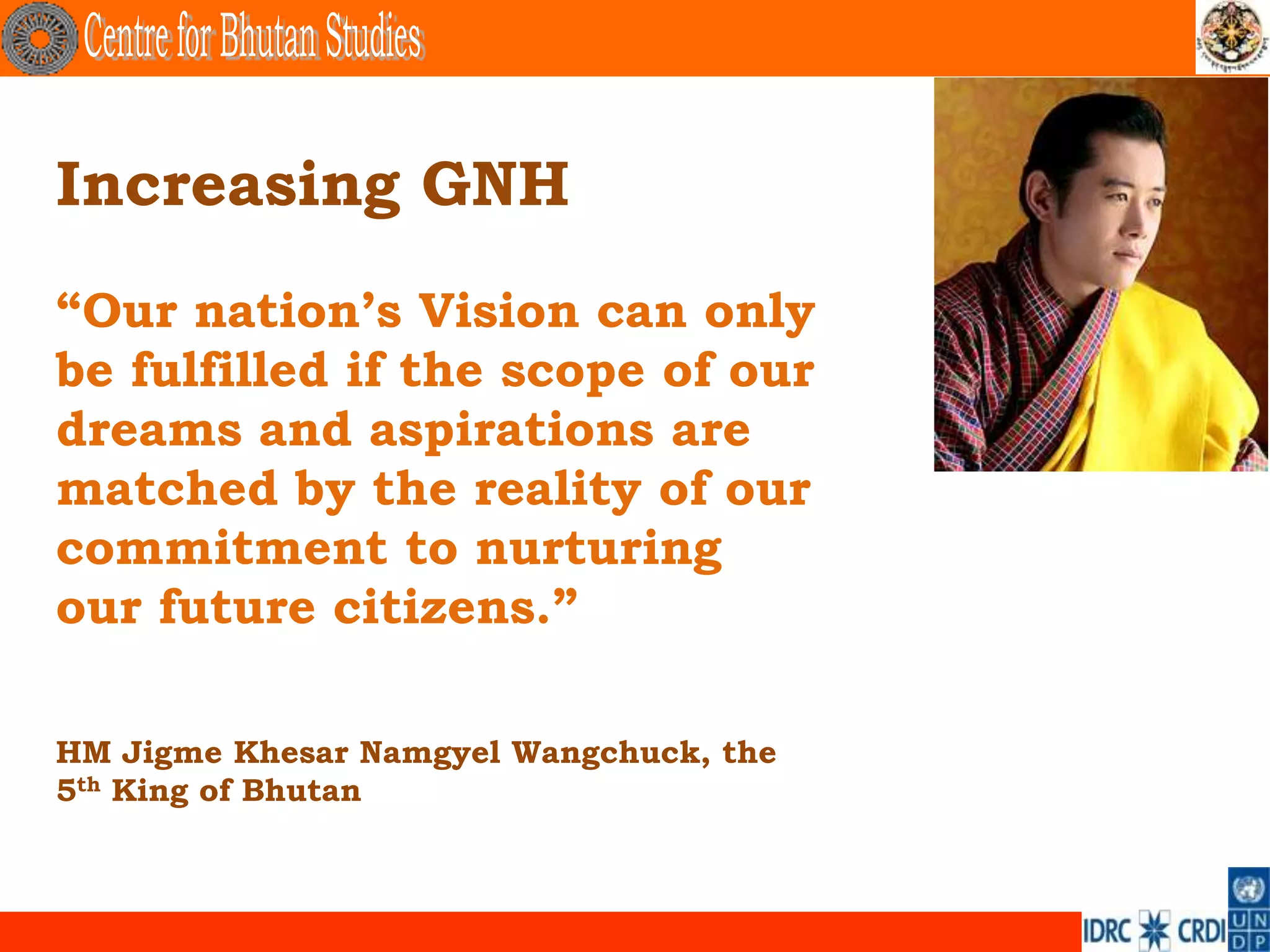
“Our nation‟s Vision can only
be fulfilled if the scope of our
dreams and aspirations are
matched by the reality of our
commitment to nurturing
our future citizens.”

HM Jigme Khesar Namgyel Wangchuck, the
5th King of Bhutan
Increasing GNH
 To Increase happiness, we need to ask a
 new set of questions.

 We have to identify people who are not yet
 happy.

 And we have to ask, where do they lack
 sufficiency? What must more be done?

 This analysis is of direct relevance for policy.
National GNH Index: .743 using
the happiness threshold of 66%
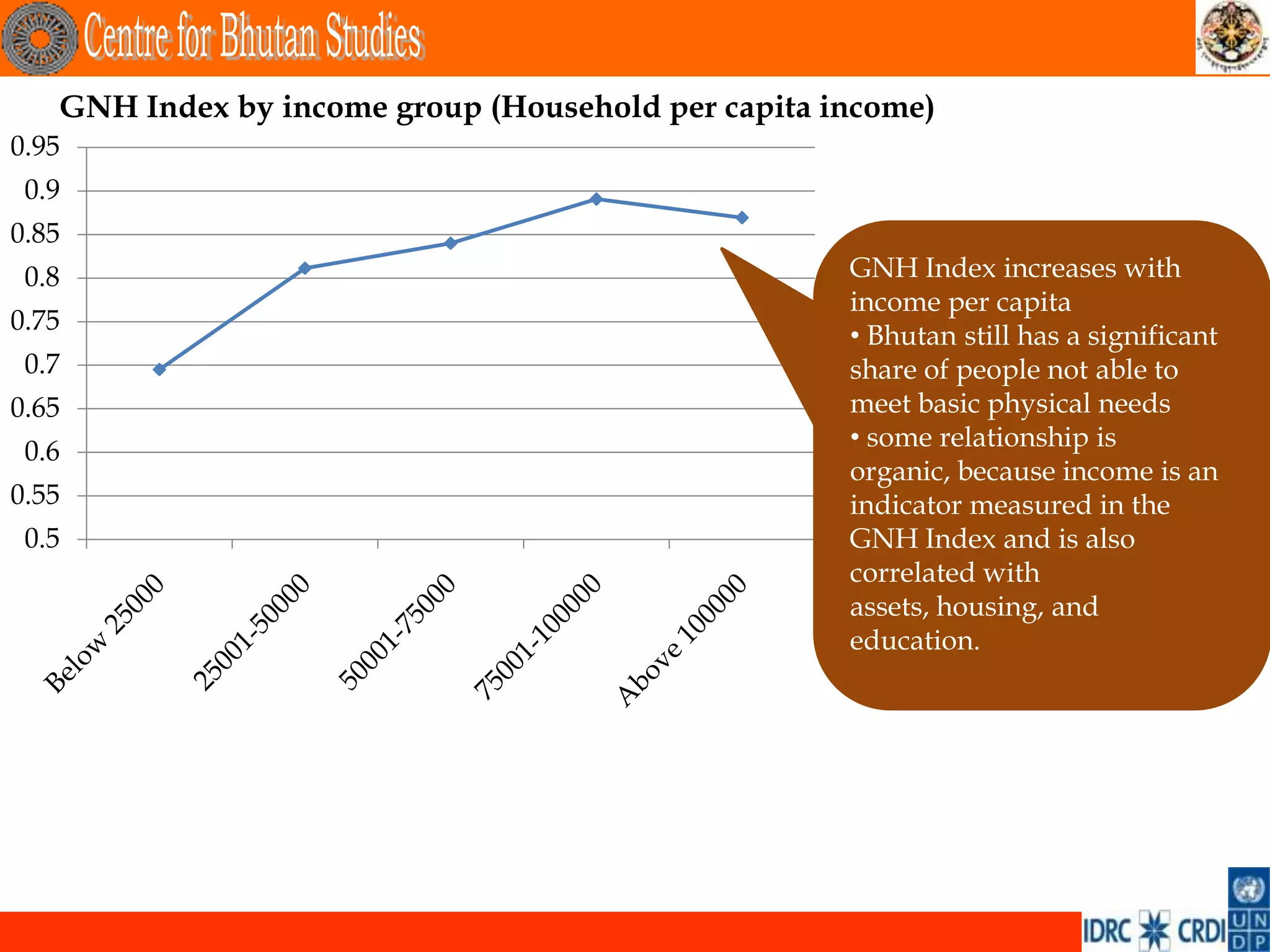
GNH Index by income group (Household per capita income)
0.95
 0.9
0.85
 0.8                                                GNH Index increases with
                                                    income per capita
0.75
                                                    • Bhutan still has a significant
 0.7                                                share of people not able to
0.65                                                meet basic physical needs
                                                    • some relationship is
 0.6
                                                    organic, because income is an
0.55                                                indicator measured in the
 0.5                                                GNH Index and is also
                                                    correlated with
                                                    assets, housing, and
                                                    education.
National
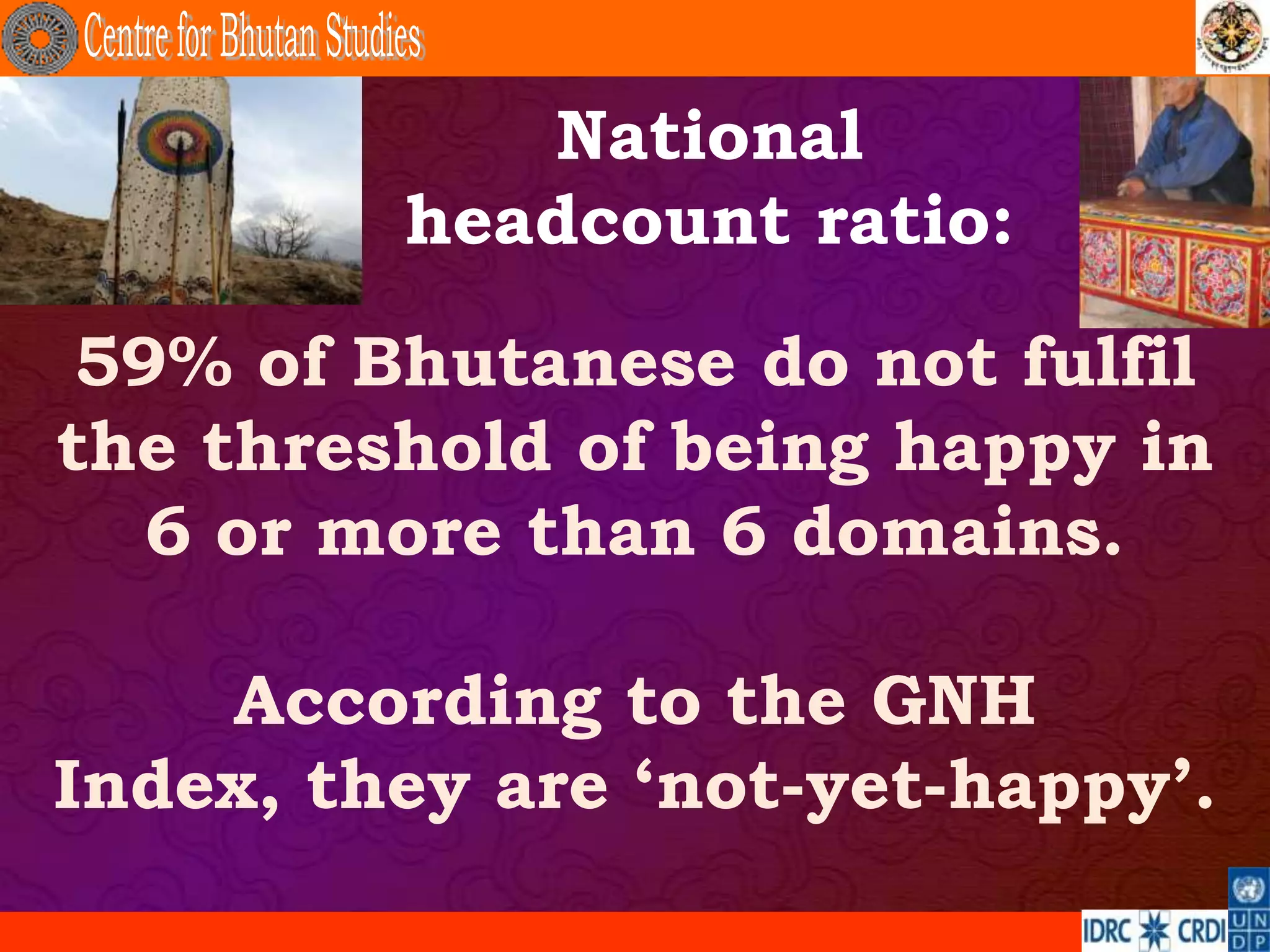
         headcount ratio:

 59% of Bhutanese do not fulfil
the threshold of being happy in
   6 or more than 6 domains.

    According to the GNH
Index, they are „not-yet-happy‟.
Of course, happiness is deeply
  personal. Some of these people
  may regard themselves as fully
 flourishing. That is why we need
to discuss GNH widely in Bhutan.
National Breadth
            (Lack of
          sufficiency):
   Of the Bhutanese who are
unhappy, on average they have
  insufficiency in 43% of the
 domains (roughly equal to 4
            domains)
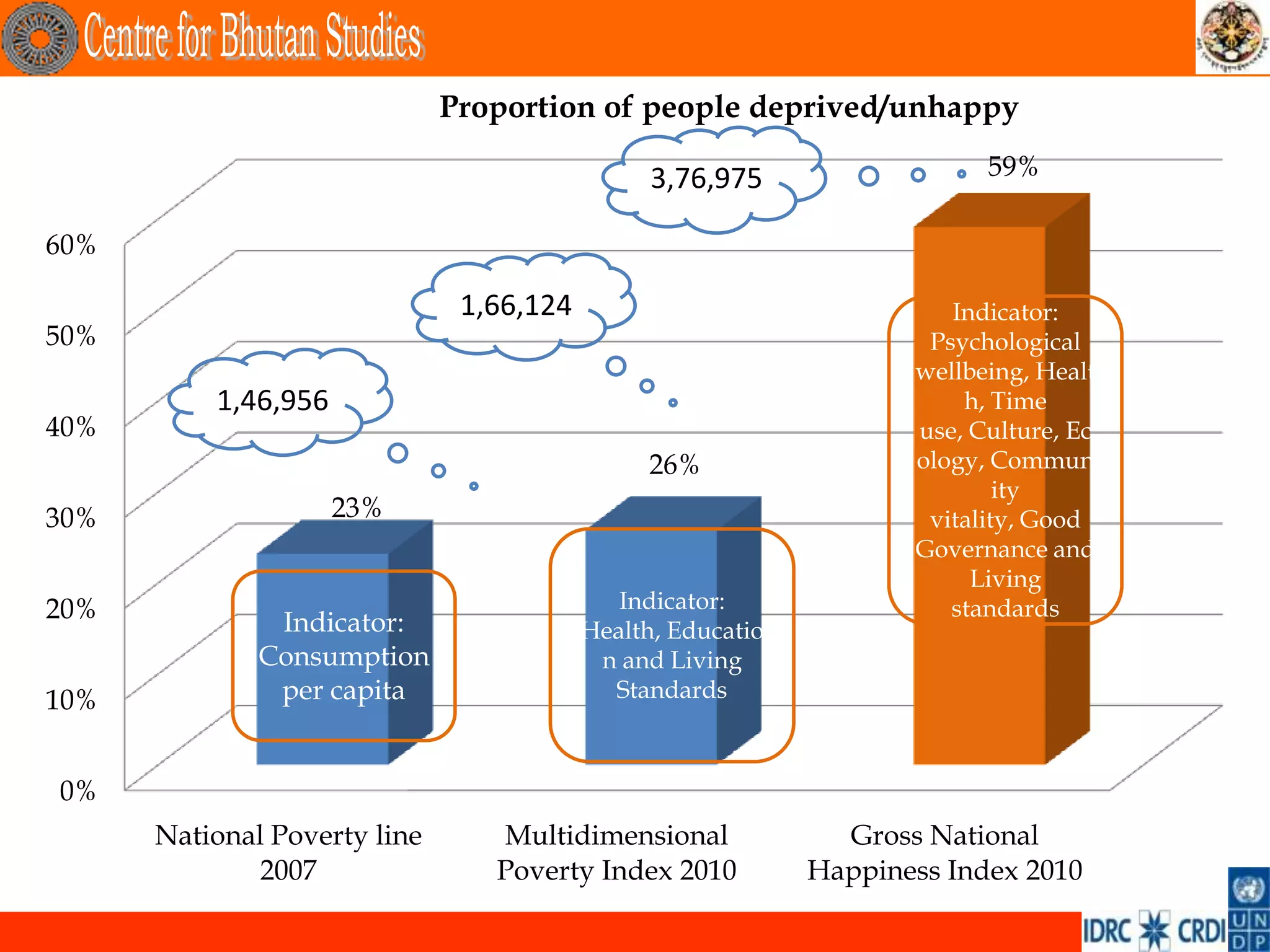
Proportion of people deprived/unhappy

                                                3,76,975                  59%

60%

                               1,66,124                                Indicator:
50%                                                                  Psychological
                                                                    wellbeing, Healt
          1,46,956                                                      h, Time
40%                                                                 use, Culture, Ec
                                                26%                 ology, Commun
                                                                            ity
30%                  23%                                             vitality, Good
                                                                    Governance and
                                                                         Living
20%                                          Indicator:                standards
               Indicator:                 Health, Educatio
              Consumption                  n and Living
10%            per capita                   Standards


0%
      National Poverty line      Multidimensional              Gross National
              2007               Poverty Index 2010          Happiness Index 2010

                                                                                       .
0%
                                                    10%
                                                    20%
                                                    40%
                                                    50%
                                                    60%
                                                    70%
                                                    80%
                                                    90%
                                                   100%


                                                    30%
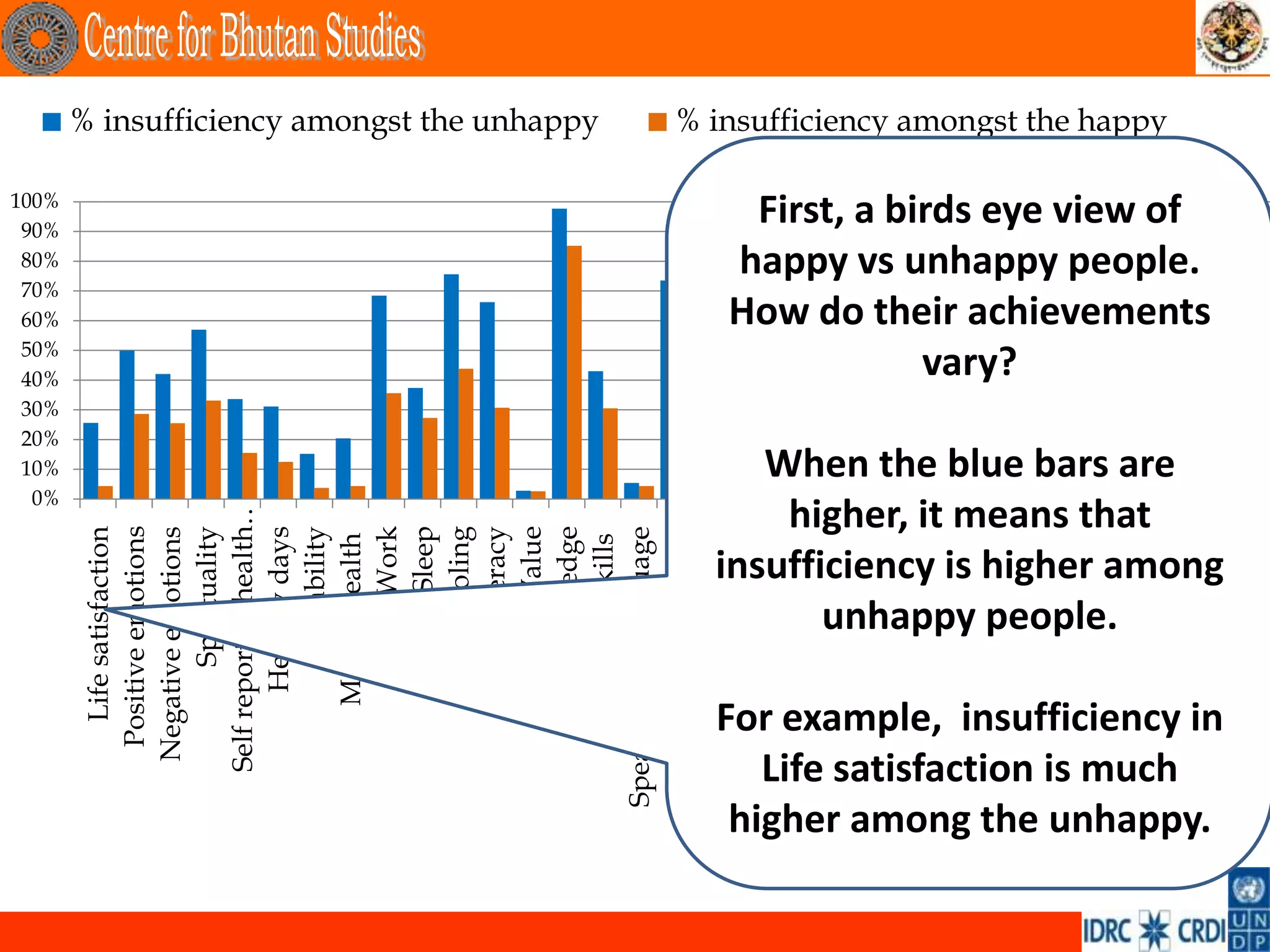
              Life satisfaction
            Positive emotions
          Negative emotions
                   Spirituality
         Self reported health…
                Healthy days
                     Disability
               Mental health
                         Work
                          Sleep
                    Schooling
                      Literacy
                         Value
                   Knowledge
                                                                                              % insufficiency amongst the unhappy


                Artisan skills
       Speak native language
        Cultural participation
            Driglam Namzha

     Fundamental rights
                  Services
   Political participation
       Donations (time &…
 Community relationship
                   Family
                    Safety
                                                                            vary?


         Ecological issues
            Responsibility…
                                       unhappy people.


 Wildlife damage (Rural)
                                    higher, it means that


     Urbanization issues
                                                                                              % insufficiency amongst the happy


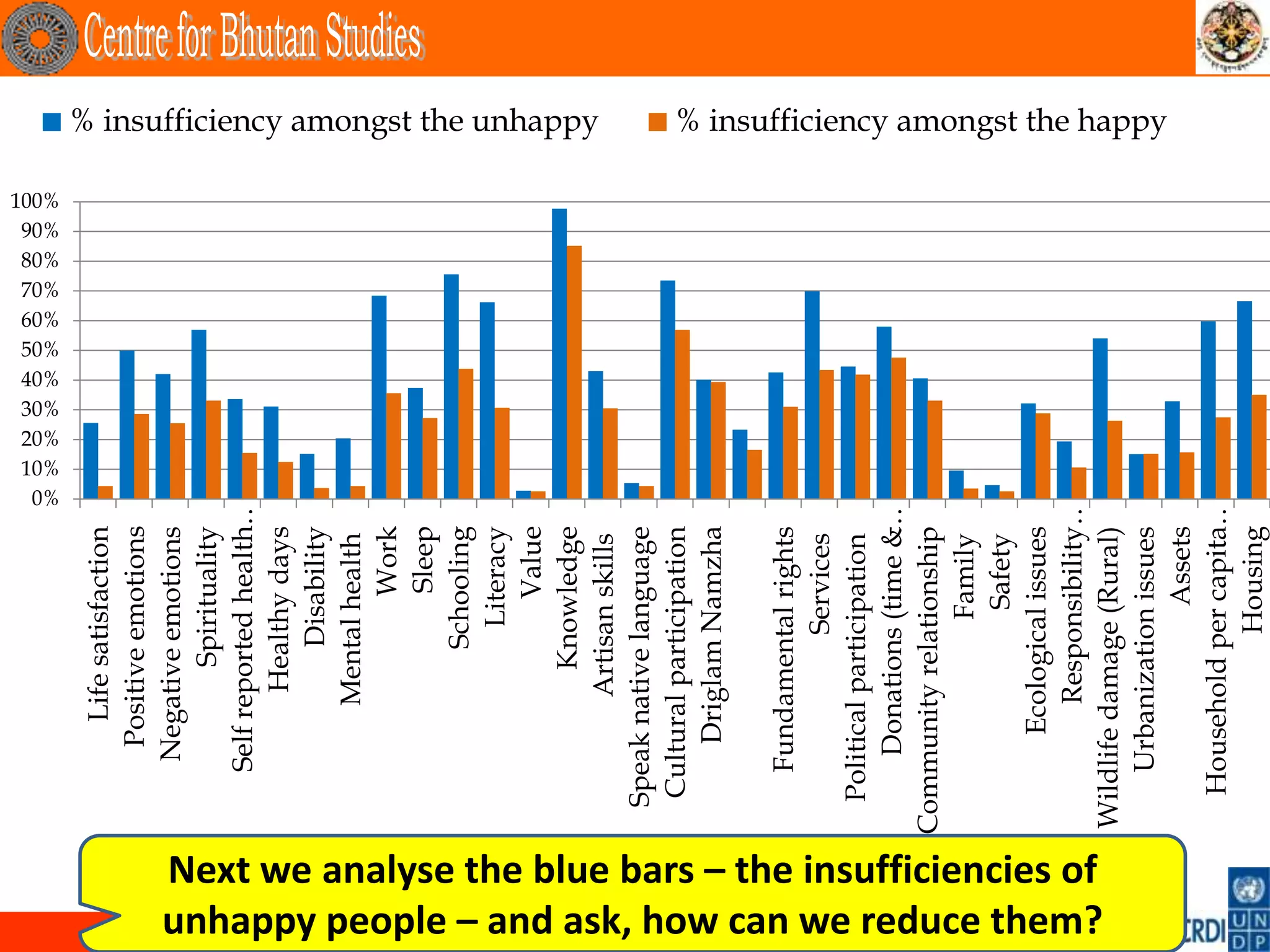
                                   When the blue bars are


   Life satisfaction is much
                                                                 First, a birds eye view of


                    Assets
                                                                happy vs unhappy people.
                                                                How do their achievements


 higher among the unhappy.
For example, insufficiency in
                                insufficiency is higher among


   Household per capita…
                  Housing
0%
                                                                                                                             10%
                                                                                                                             20%
                                                                                                                             40%
                                                                                                                             50%
                                                                                                                             60%
                                                                                                                             70%
                                                                                                                             80%
                                                                                                                             90%
                                                                                                                            100%


                                                                                                                             30%
                                     Life satisfaction
                                   Positive emotions
                                 Negative emotions
                                          Spirituality
                                Self reported health…
                                       Healthy days
                                            Disability
                                      Mental health
                                                Work
                                                 Sleep
                                           Schooling
                                             Literacy
                                                Value
                                          Knowledge
                                                                                                                                   % insufficiency amongst the unhappy


                                       Artisan skills
                              Speak native language
                               Cultural participation
                                   Driglam Namzha

                  Fundamental rights

                Let’s look further.
                               Services
                Political participation
                    Donations (time &…
              Community relationship
                                Family
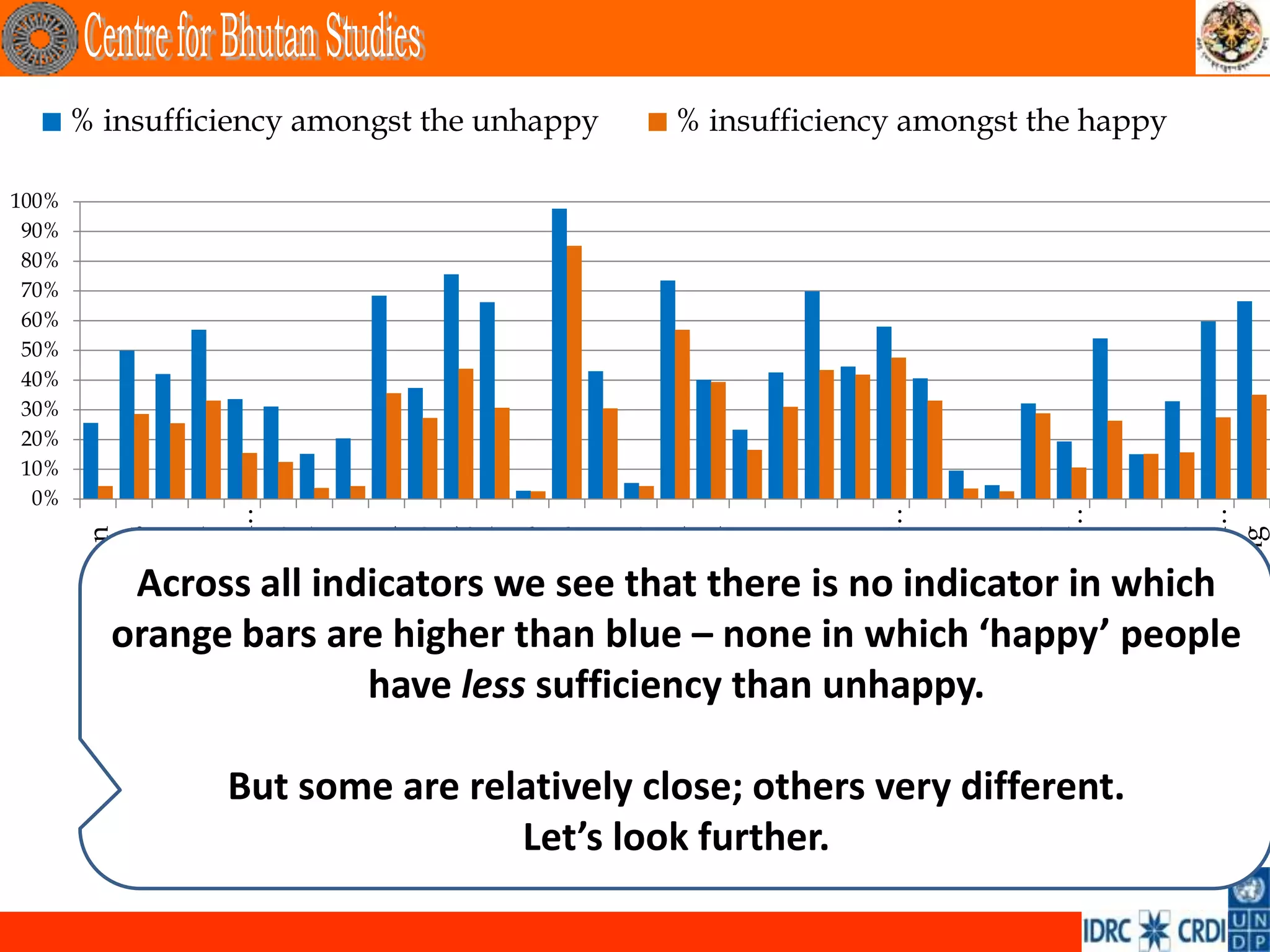
                                                                       have less sufficiency than unhappy.


                                 Safety
                      Ecological issues
                         Responsibility…
But some are relatively close; others very different.


              Wildlife damage (Rural)
                  Urbanization issues
                                                                                                                                   % insufficiency amongst the happy


                                 Assets
                                                         Across all indicators we see that there is no indicator in which


                Household per capita…
                                                        orange bars are higher than blue – none in which ‘happy’ people


                               Housing
0%
                                              10%
                                                    20%
                                                                40%
                                                                      50%
                                                                            60%
                                                                                  70%
                                                                                         80%
                                                                                                     90%


                                                          30%
            Life satisfaction                                                                              100%

        Positive emotions
       Negative emotions                                                            well-being
                      Spirituality
Self reported health status
                  Healthy days
                                                                                    Psychological Health


                            Disability
               Mental health
                                Work
                                Sleep
                                                                                              Time Use


                            Schooling
                             Literacy
                               Value
                                                                                                                  % insufficiency amongst the unhappy


                      Knowledge
                 Artisan skills
   Speak native language
    Cultural participation
        Driglam Namzha
Government performance
      Fundamental rights
                             Services
    Political participation
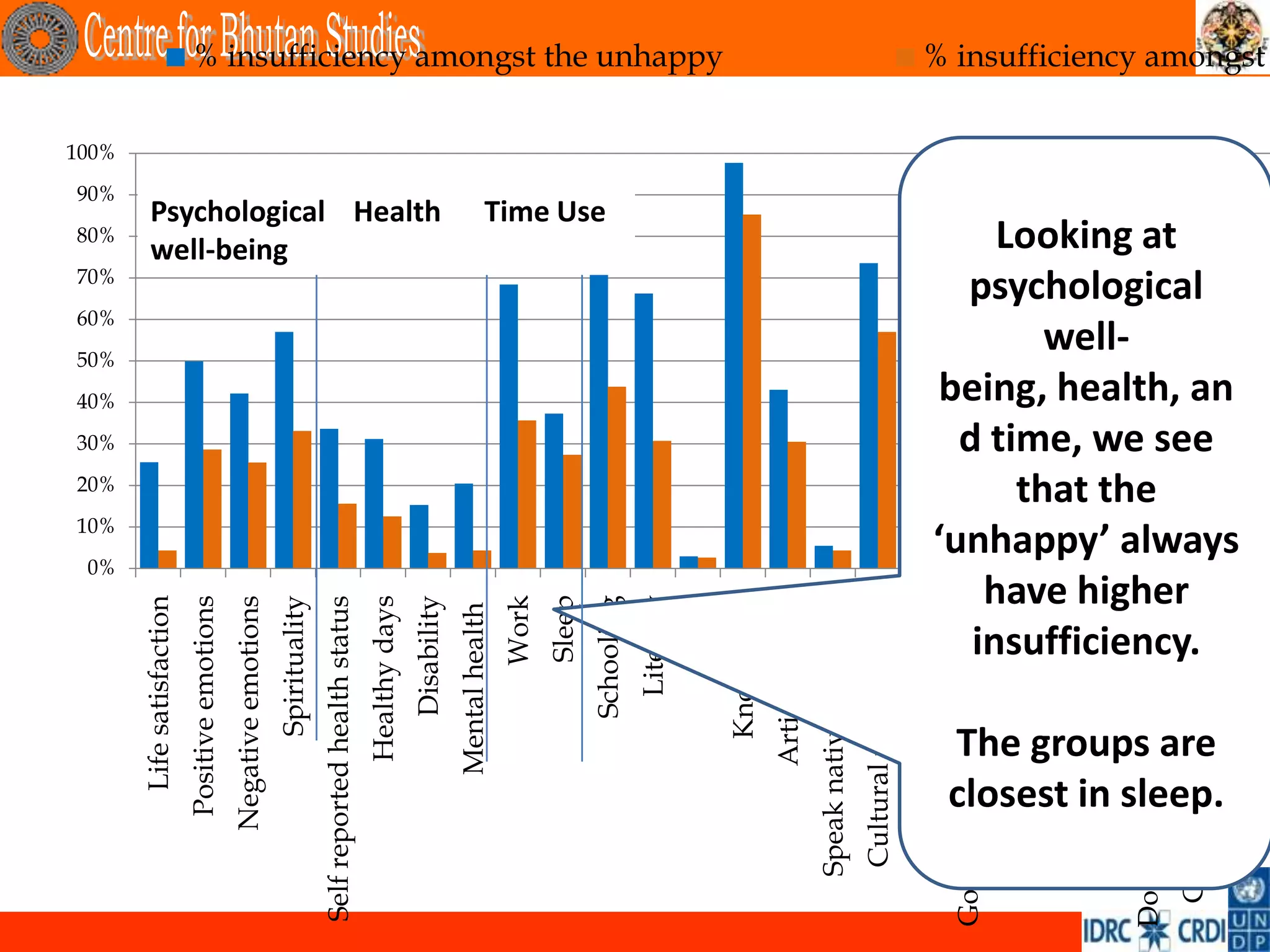
                                        well-


                                      that the


Donations (time & money)
                                     Looking at


                                    have higher
                                   insufficiency.
                                  psychological


 Community relationship
                                  d time, we see


        The groups are
        closest in sleep.
                                 being, health, an


                                ‘unhappy’ always


                              Family
                                                                                                                  % insufficiency amongst
Schooling
                     Literacy
                       Value
                                                    e unhappy

                                       Education
                 Knowledge
              Artisan skills
      Speak native language
      Cultural participation
                                       Culture


          Driglam Namzha
  Government performance
        Fundamental rights
                     Services
      Political participation
                                       Governance


  Donations (time & money)
    Community relationship
                      Family
                      Safety
           Ecological issues
     Responsibility towards…
                                                    % insufficiency amongst the happy


    Wildlife damage (Rural)
        Urbanization issues
                       Assets
Household per capita income
                     Housing
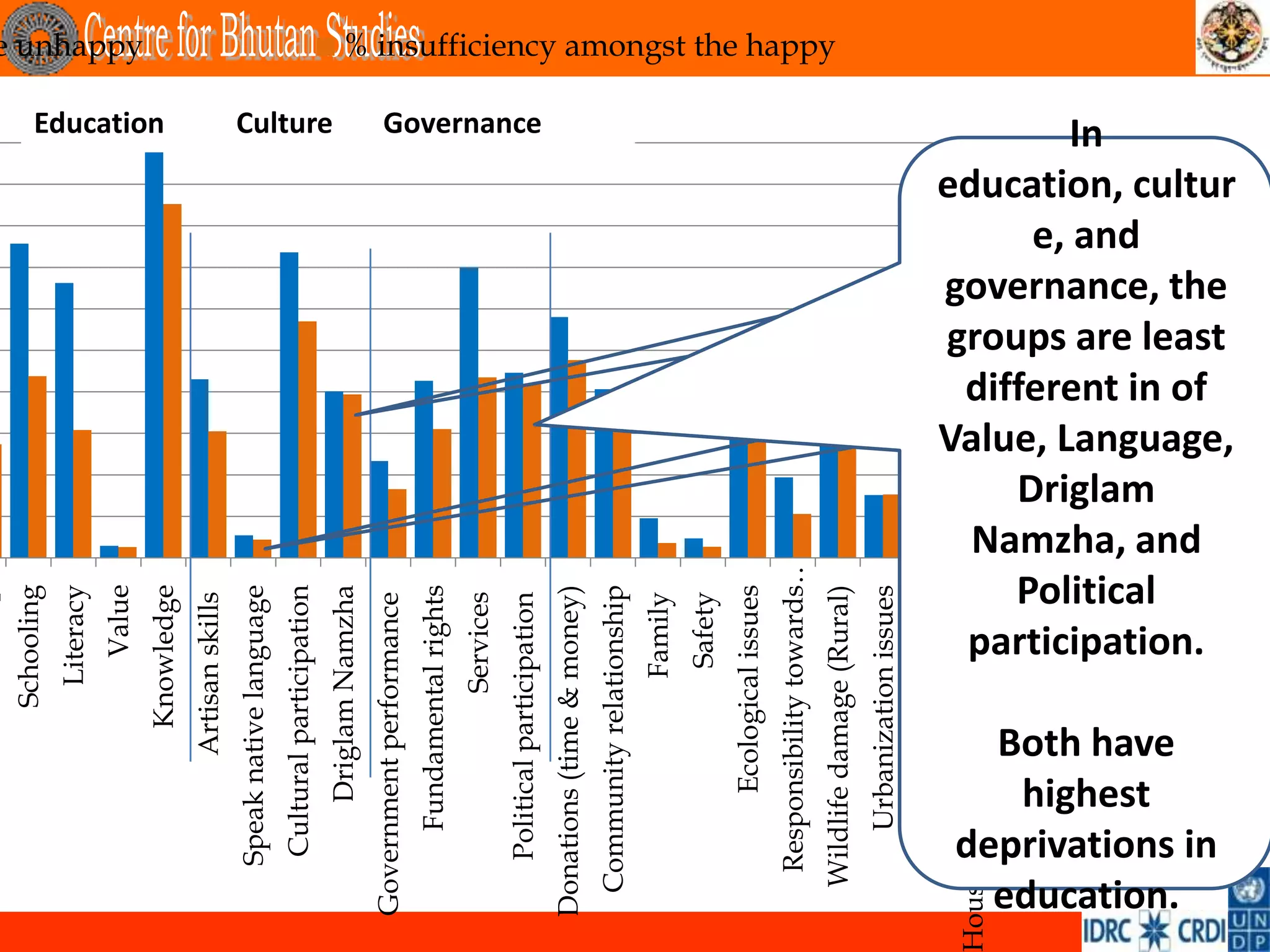
                               In

                            e, and


     highest
                           Driglam

                           Political


    Both have


    education.
                         Namzha, and

                        participation.
                        different in of


  deprivations in
                       groups are least
                       governance, the


                       Value, Language,
                       education, cultur
In
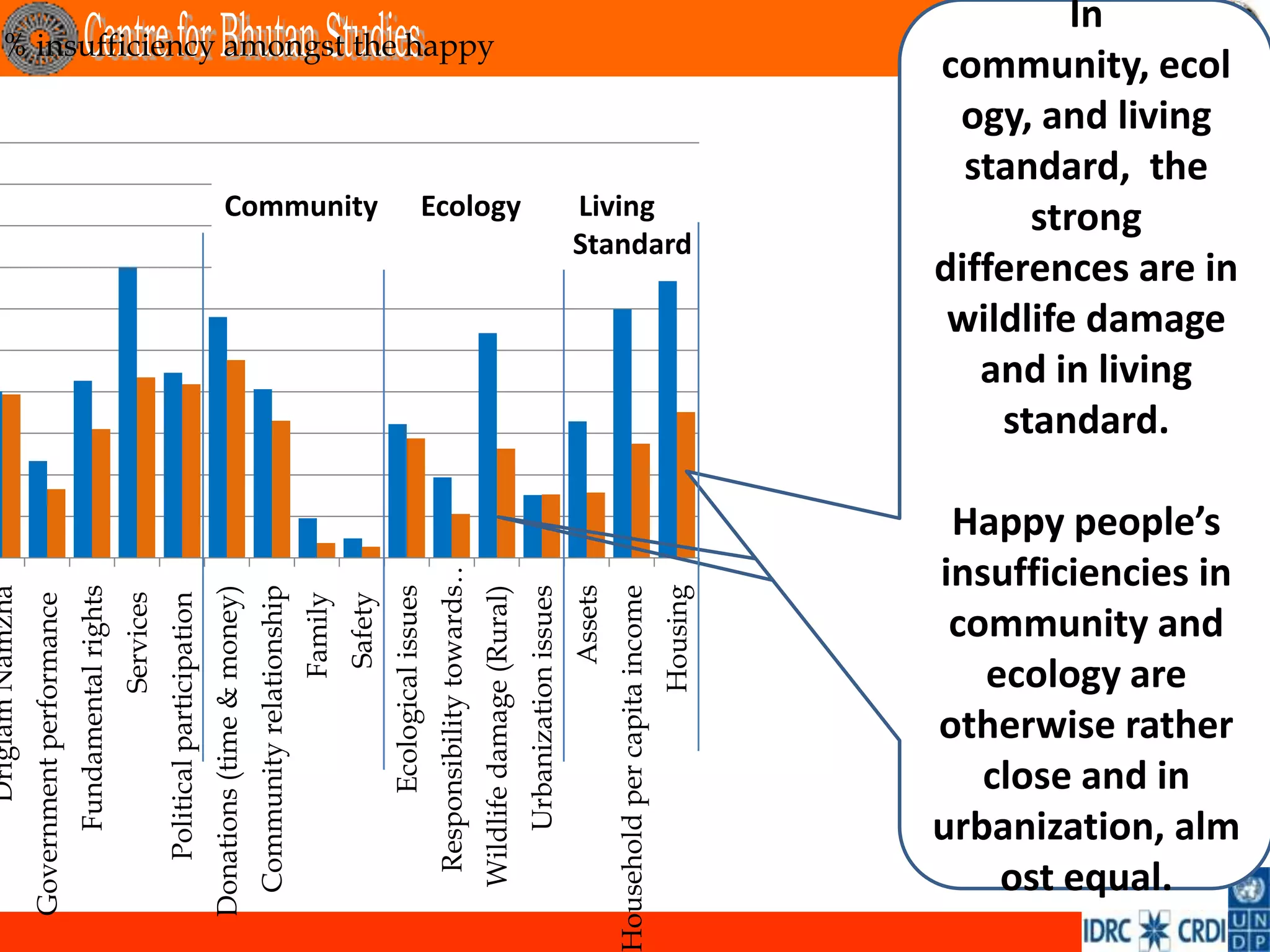
      % insufficiency amongst the happy
                                                                                                                                                                                                                                                                                                                         community, ecol
                                                                                                                                                                                                                                                                                                                          ogy, and living
                                                                                                                                                                                                                                                                                                                           standard, the
                                                                                                             Community                                                                   Ecology                                                                        Living                                                 strong
                                                                                                                                                                                                                                                                        Standard
                                                                                                                                                                                                                                                                                                                         differences are in
                                                                                                                                                                                                                                                                                                                          wildlife damage
                                                                                                                                                                                                                                                                                                                            and in living
                                                                                                                                                                                                                                                                                                                             standard.

                                                                                                                                                                                                                                                                                                                          Happy people’s
                                                                                                                                                                                                                                                                                                                         insufficiencies in
                                                                                                                                                                                              Responsibility towards…


                                                                                                                                                                                                                                                                                                               Housing
                                                                                                                                                                                                                                                                        Assets
                                                                                                                                                                          Ecological issues
Driglam Namzha


                                          Fundamental rights


                                                                                                                                                                                                                        Wildlife damage (Rural)
                                                                                                    Donations (time & money)


                                                                                                                                                                                                                                                                                 Household per capita income
                                                                                                                               Community relationship


                                                                                                                                                                                                                                                  Urbanization issues
                                                                                                                                                                 Safety
                                                               Services


                                                                                                                                                        Family
                                                                          Political participation
                 Government performance


                                                                                                                                                                                                                                                                                                                          community and
                                                                                                                                                                                                                                                                                                                            ecology are
                                                                                                                                                                                                                                                                                                                         otherwise rather
                                                                                                                                                                                                                                                                                                                            close and in
                                                                                                                                                                                                                                                                                                                         urbanization, alm
                                                                                                                                                                                                                                                                                                                             ost equal.
0%
                                                                                  10%
                                                                                  20%
                                                                                  40%
                                                                                  50%
                                                                                  60%
                                                                                  70%
                                                                                  80%
                                                                                  90%
                                                                                 100%


                                                                                  30%
                                                                  Life satisfaction
                                                                Positive emotions
                                                              Negative emotions
                                                                       Spirituality
                                                             Self reported health…
                                                                    Healthy days
                                                                         Disability
                                                                   Mental health
                                                                             Work
                                                                              Sleep
                                                                        Schooling
                                                                          Literacy
                                                                             Value
                                                                       Knowledge
                                                                                        % insufficiency amongst the unhappy


                                                                    Artisan skills
                                                           Speak native language
                                                            Cultural participation
                                                                Driglam Namzha

                                                             Fundamental rights
                                                                          Services
                                                           Political participation
                                                               Donations (time &…
                                                         Community relationship
                                                                           Family
                                                                            Safety
                                                                 Ecological issues
                                                                    Responsibility…
Next we analyse the blue bars – the insufficiencies of
unhappy people – and ask, how can we reduce them?


                                                         Wildlife damage (Rural)
                                                             Urbanization issues
                                                                                        % insufficiency amongst the happy


                                                                            Assets
                                                           Household per capita…
                                                                          Housing
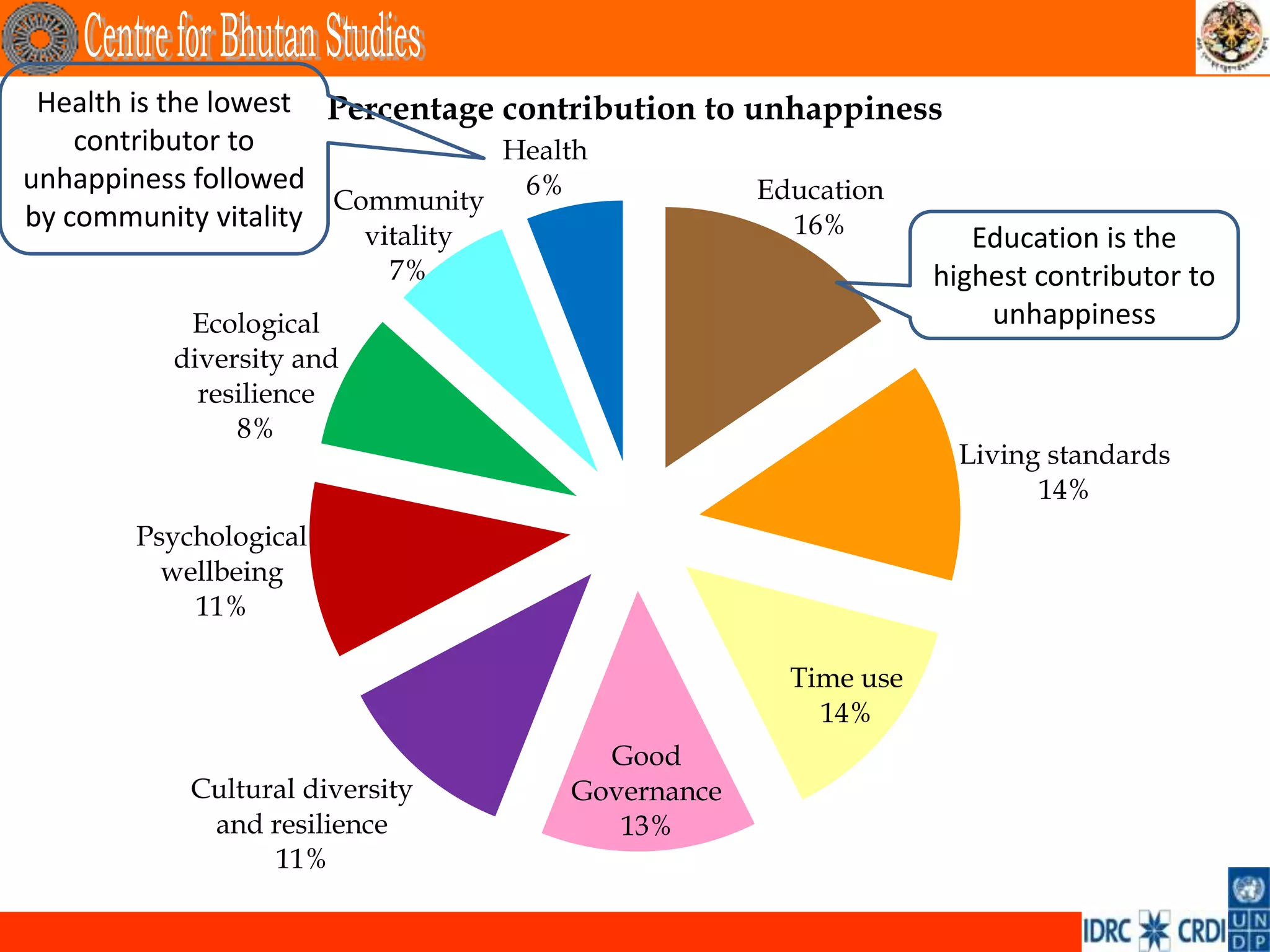
Health is the lowest Percentage contribution to unhappiness
    contributor to               Health
unhappiness followed              6%              Education
                      Community
by community vitality                               16%
                         vitality                               Education is the
                           7%                                highest contributor to
          Ecological                                             unhappiness
         diversity and
           resilience
              8%
                                                               Living standards
                                                                     14%
       Psychological
         wellbeing
           11%

                                                  Time use
                                                    14%
                                      Good
           Cultural diversity       Governance
            and resilience             13%
                 11%
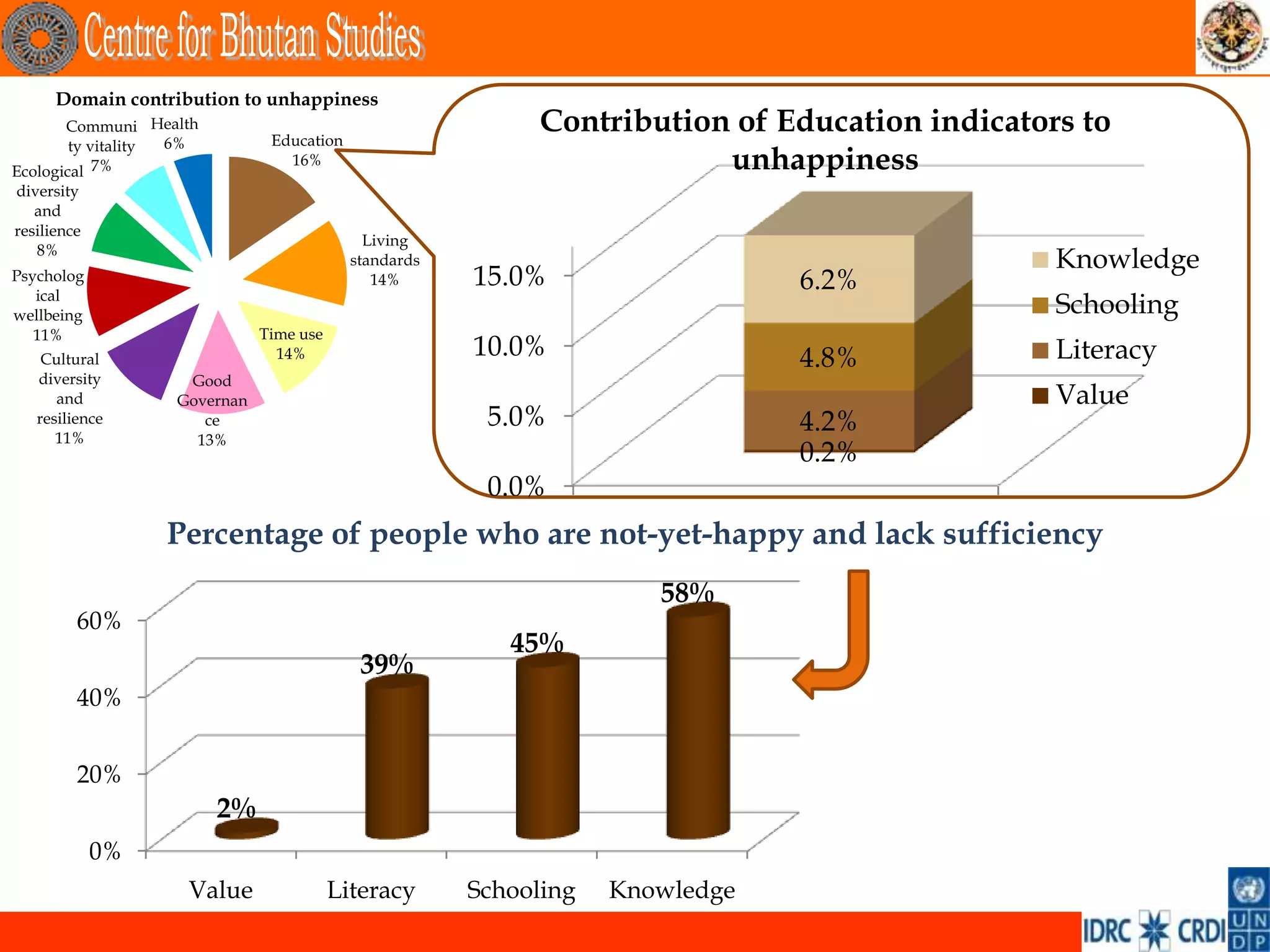
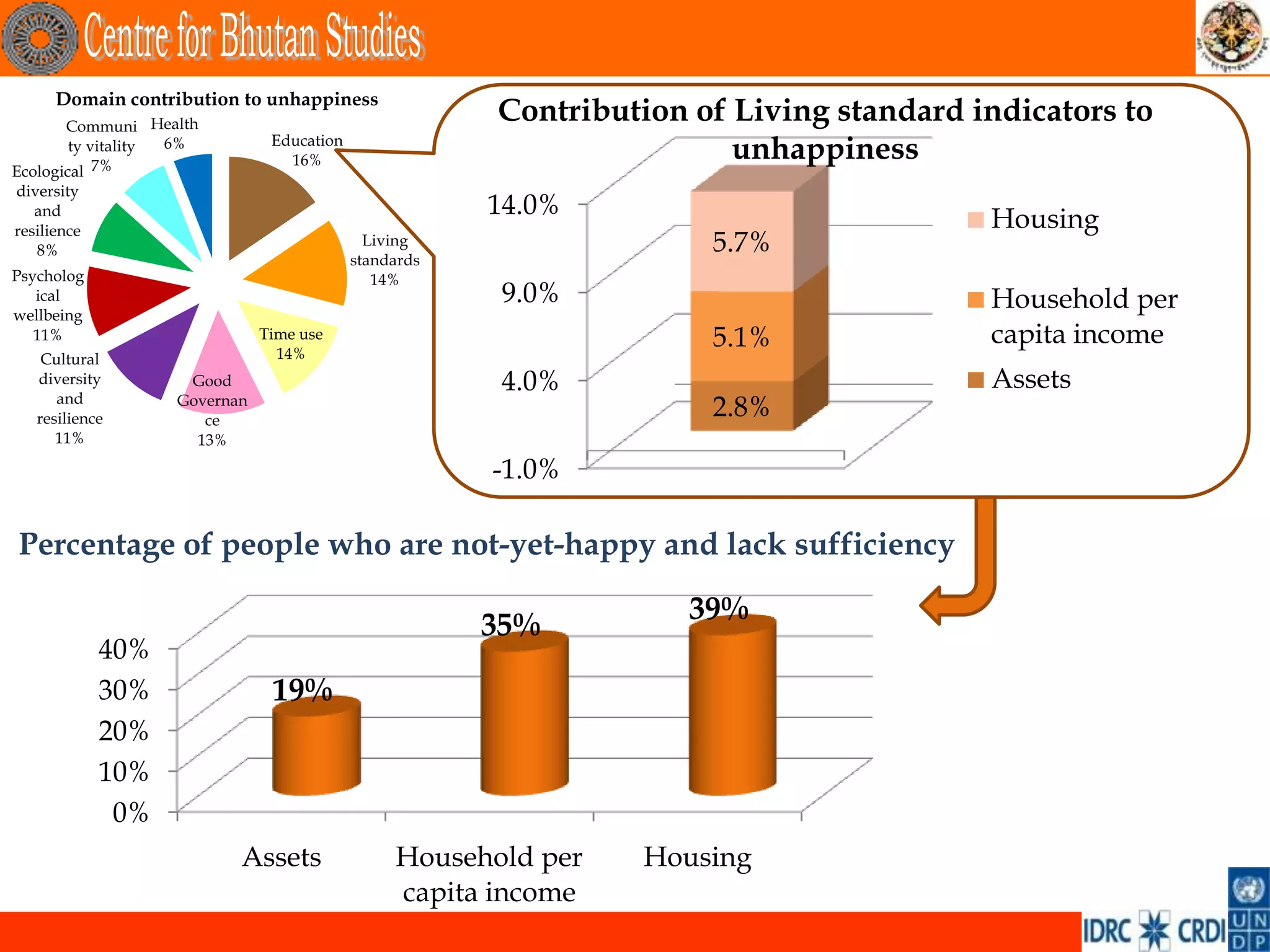
Domain contribution to unhappiness
       Communi Health
                               Education
                                                             Contribution of Education indicators to
        ty vitality 6%
Ecological  7%                   16%                                     unhappiness
diversity
   and
resilience
                                             Living
   8%
                                           standards                                            Knowledge
Psycholog                                     14%      15.0%                   6.2%
   ical
wellbeing                                                                                       Schooling
   11%                        Time use
    Cultural                    14%                    10.0%                   4.8%             Literacy
   diversity        Good
      and          Governan                                                                     Value
   resilience         ce                                5.0%                   4.2%
      11%            13%
                                                                               0.2%
                                                        0.0%
                  Percentage of people who are not-yet-happy and lack sufficiency
                                                                      58%
         60%
                                                          45%
                                            39%
         40%


         20%
                         2%
             0%
                    Value                Literacy      Schooling   Knowledge
Domain contribution to unhappiness
       Communi Health
                                                       Contribution of Living standard indicators to
        ty vitality
            7%
                    6%         Education
                                 16%                                   unhappiness
Ecological
diversity
   and                                                 14.0%                            Housing
resilience
   8%
                                             Living
                                           standards
                                                                     5.7%
Psycholog                                     14%
   ical                                                 9.0%                            Household per
wellbeing
   11%                        Time use                               5.1%               capita income
    Cultural                    14%
   diversity        Good                                4.0%                            Assets
      and
   resilience
                   Governan
                      ce
                                                                     2.8%
      11%            13%

                                                       -1.0%

Percentage of people who are not-yet-happy and lack sufficiency

                                                                    39%
                                                       35%
             40%
             30%               19%
             20%
             10%
              0%
                          Assets                Household per    Housing
                                                capita income
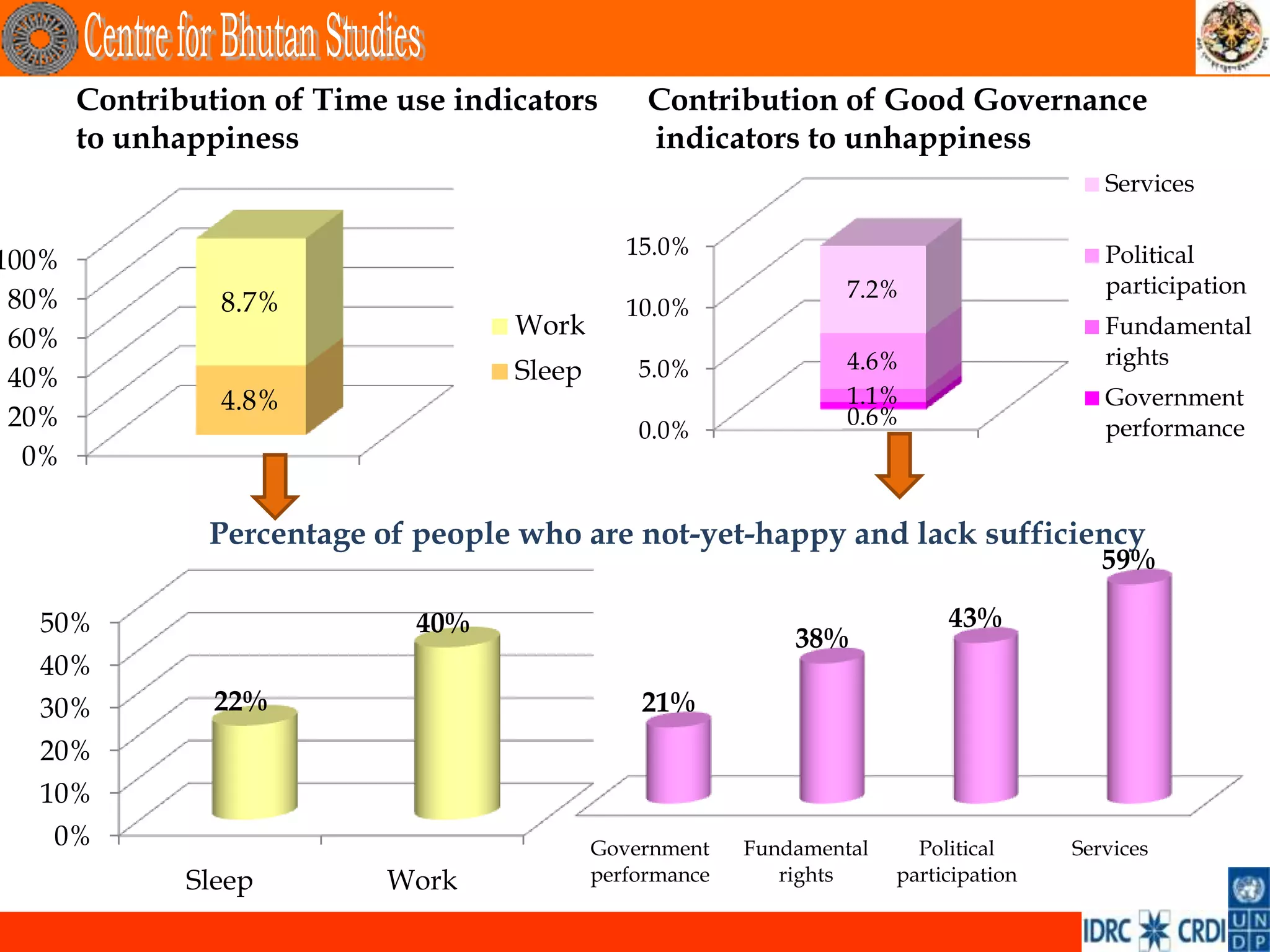
Contribution of Time use indicators       Contribution of Good Governance
       to unhappiness                            indicators to unhappiness
                                                                                           Services

                                               15.0%                                       Political
100%
                                                                   7.2%                    participation
 80%            8.7%                           10.0%
 60%                                Work                                                   Fundamental
                                                                   4.6%                    rights
 40%                                Sleep       5.0%
                4.8%                                               1.1%                    Government
 20%                                            0.0%
                                                                   0.6%                    performance
  0%

               Percentage of people who are not-yet-happy and lack sufficiency
                                                                                           59%

  50%                        40%                                             43%
                                                              38%
  40%
  30%           22%                             21%
  20%
  10%
   0%                                       Government    Fundamental     Political     Services
              Sleep        Work             performance      rights     participation
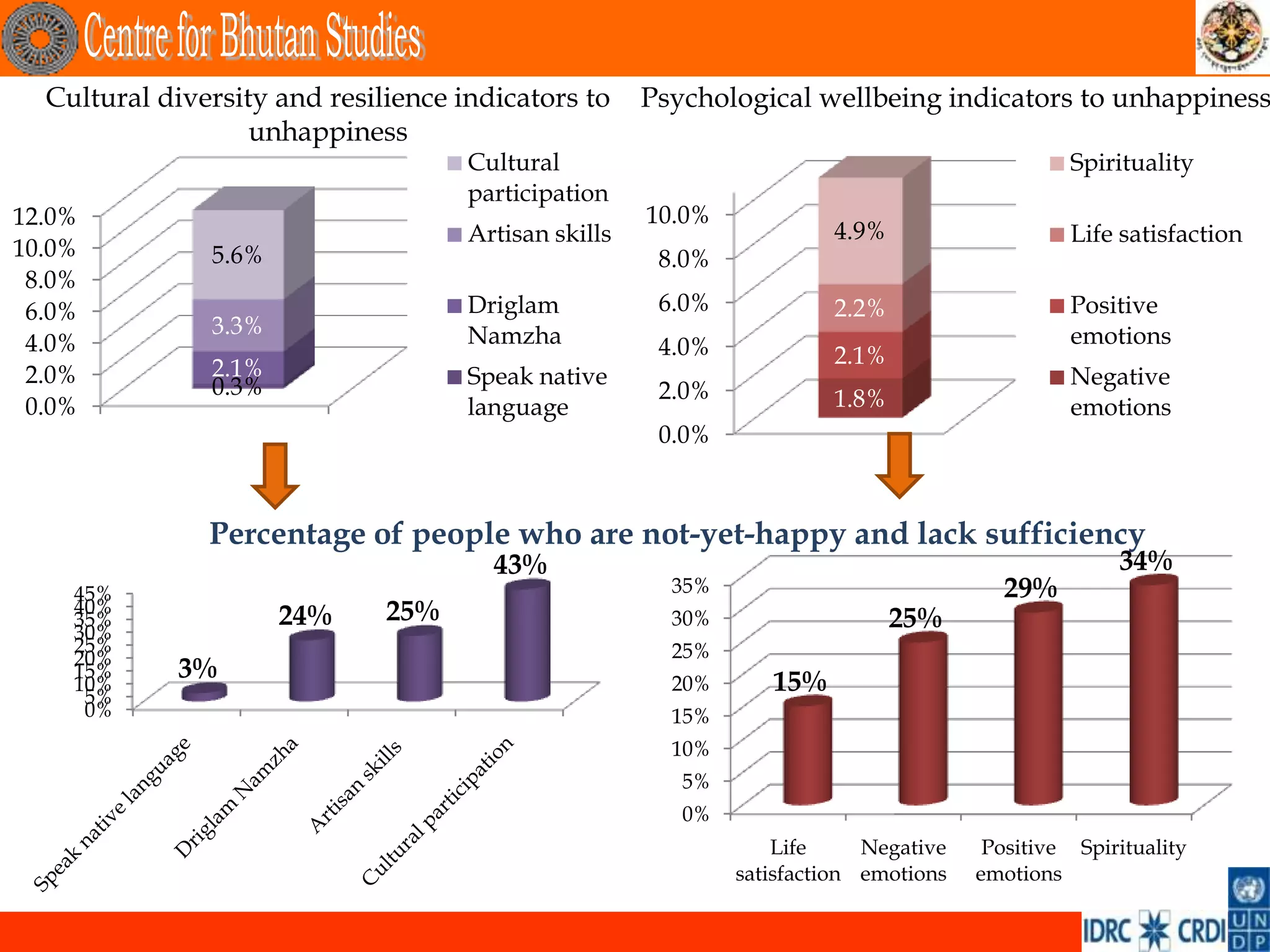
Cultural diversity and resilience indicators to     Psychological wellbeing indicators to unhappiness
                   unhappiness
                                     Cultural                                                  Spirituality
                                     participation
12.0%                                                 10.0%
                                     Artisan skills                    4.9%                    Life satisfaction
10.0%          5.6%                                    8.0%
 8.0%
 6.0%                                Driglam           6.0%            2.2%                    Positive
               3.3%                  Namzha                                                    emotions
 4.0%                                                  4.0%            2.1%
 2.0%          2.1%                  Speak native                                              Negative
               0.3%                                    2.0%            1.8%
 0.0%                                language                                                  emotions
                                                       0.0%


               Percentage of people who are not-yet-happy and lack sufficiency
                                       43%                                                          34%
    45%                                                 35%                             29%
    40%                       25%
    35%               24%                               30%                   25%
    30%
    25%                                                 25%
    20%
    15%
    10%
             3%                                         20%      15%
     5%
     0%                                                 15%
                                                        10%
                                                         5%
                                                         0%
                                                                  Life     Negative    Positive Spirituality
                                                              satisfaction emotions   emotions
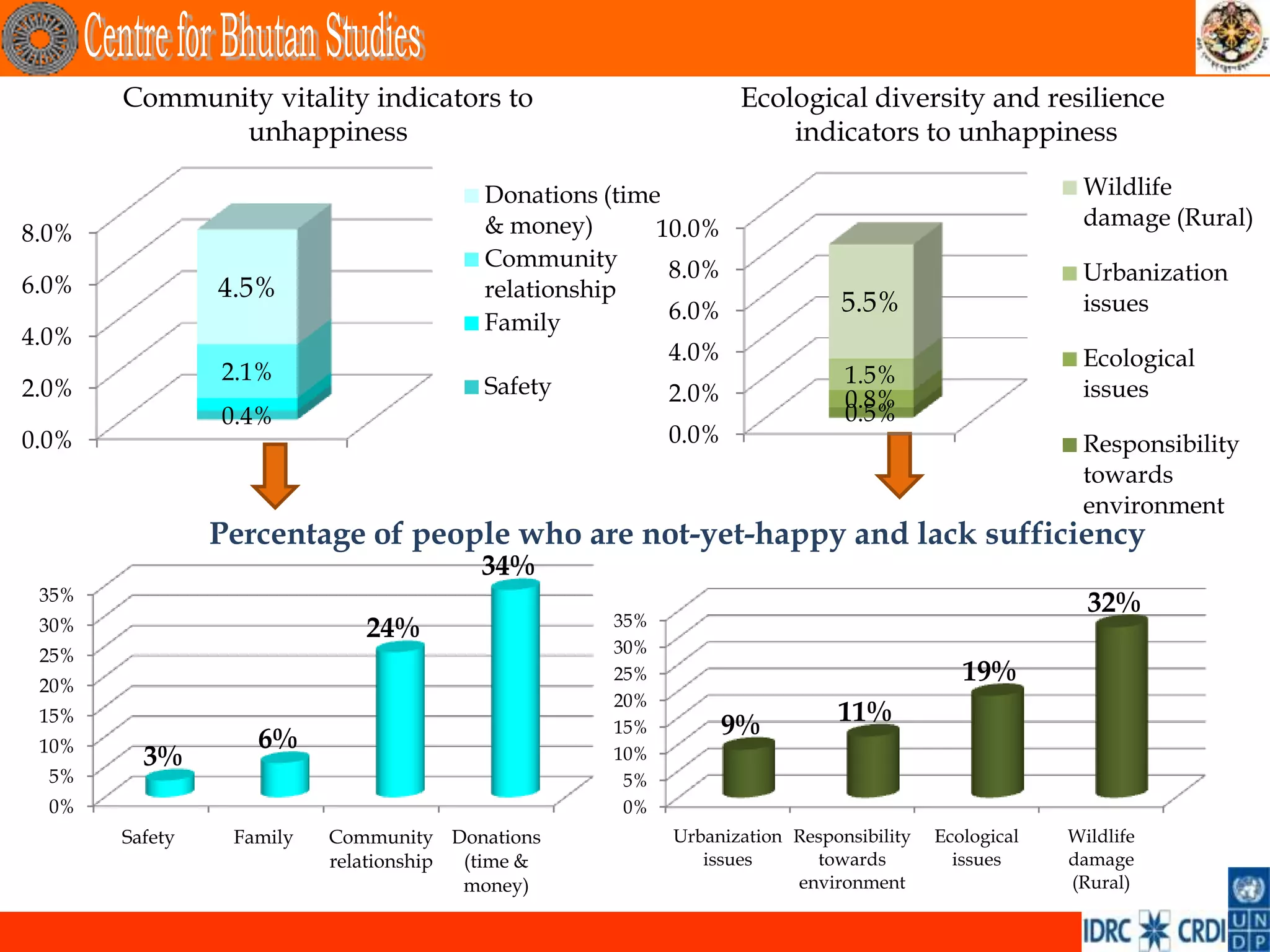
Community vitality indicators to                         Ecological diversity and resilience
              unhappiness                                           indicators to unhappiness

                                        Donations (time                                             Wildlife
                                        & money)       10.0%                                        damage (Rural)
8.0%
                                        Community       8.0%                                        Urbanization
6.0%            4.5%                    relationship
                                                        6.0%               5.5%                     issues
                                        Family
4.0%
                                                        4.0%                                        Ecological
                2.1%                                                       1.5%
2.0%                                    Safety          2.0%                                        issues
                                                                           0.8%
                0.4%                                                       0.5%
0.0%                                                    0.0%                                        Responsibility
                                                                                                    towards
                                                                                                    environment
                Percentage of people who are not-yet-happy and lack sufficiency
                                        34%
 35%
                                                                                                     32%
                                                  35%
 30%                         24%
 25%                                              30%

 20%
                                                  25%                                    19%
                                                  20%
 15%
                                                  15%          9%         11%
 10%               6%
         3%                                       10%
  5%                                               5%
  0%                                               0%
       Safety    Family   Community Donations           Urbanization Responsibility   Ecological   Wildlife
                          relationship (time &             issues      towards          issues     damage
                                       money)                        environment                   (Rural)
Domain contribution to unhappiness
       Communi Health
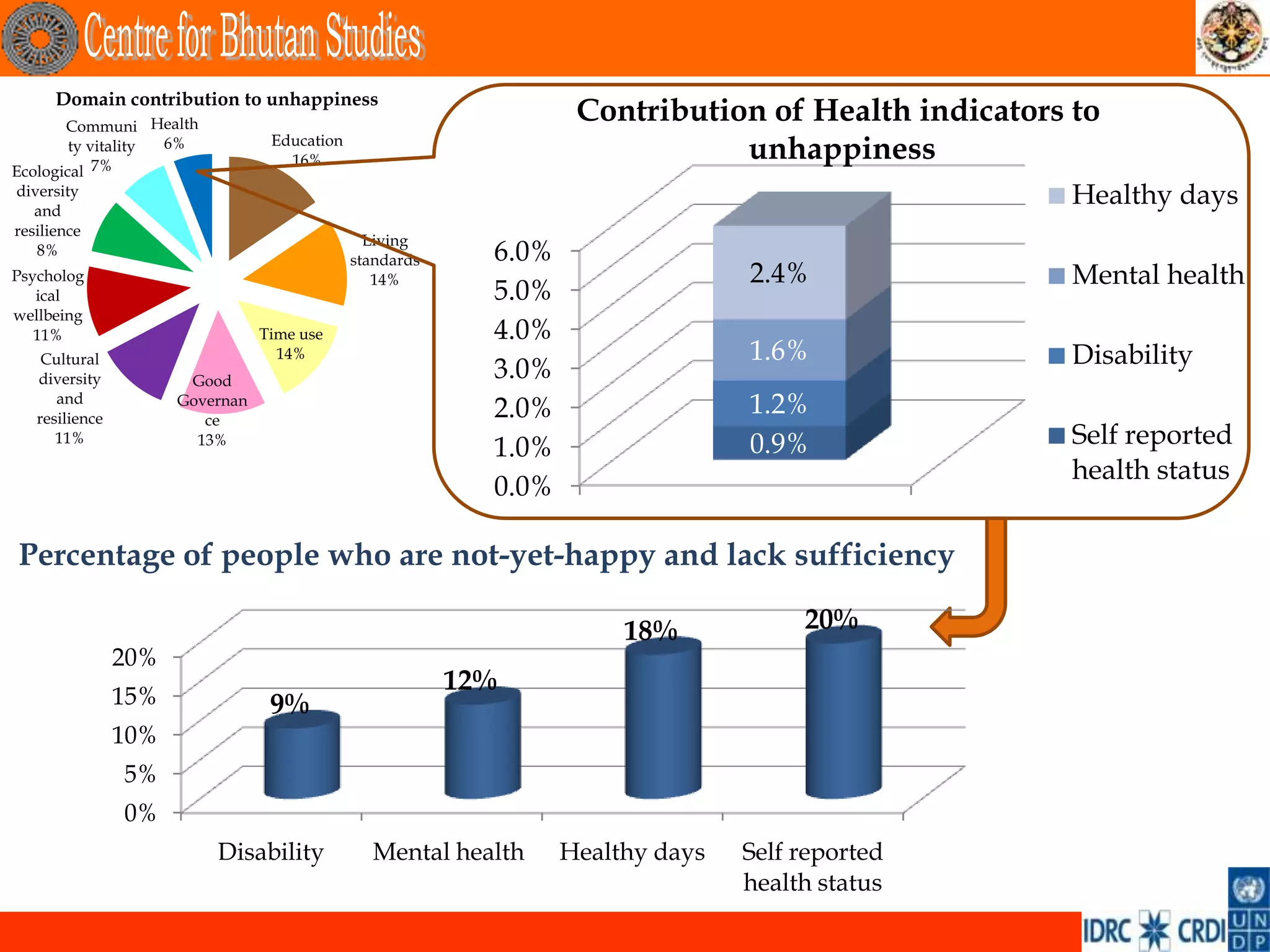
                                                                    Contribution of Health indicators to
        ty vitality
            7%
                    6%            Education
                                    16%                                        unhappiness
Ecological
diversity
   and
                                                                                                      Healthy days
resilience
                                                Living
   8%
                                              standards     6.0%
Psycholog                                        14%                              2.4%                Mental health
   ical                                                     5.0%
wellbeing
   11%                           Time use                   4.0%
    Cultural                       14%                                            1.6%                Disability
   diversity           Good
                                                            3.0%
      and
   resilience
                      Governan
                         ce
                                                            2.0%                  1.2%
      11%               13%
                                                            1.0%                  0.9%                Self reported
                                                                                                      health status
                                                            0.0%

Percentage of people who are not-yet-happy and lack sufficiency

                                                                        18%            20%
                20%
                                                          12%
                15%               9%
                10%
                5%
                0%
                          Disability            Mental health      Healthy days   Self reported
                                                                                  health status
0.0%
                                                                10.0%
                                                                        20.0%
                                                                                30.0%
                                                                                        40.0%
                                                                                                50.0%
                                                                                                        60.0%
                                                                                                                70.0%
                                                                                                                        80.0%
                                                                                                                                90.0%
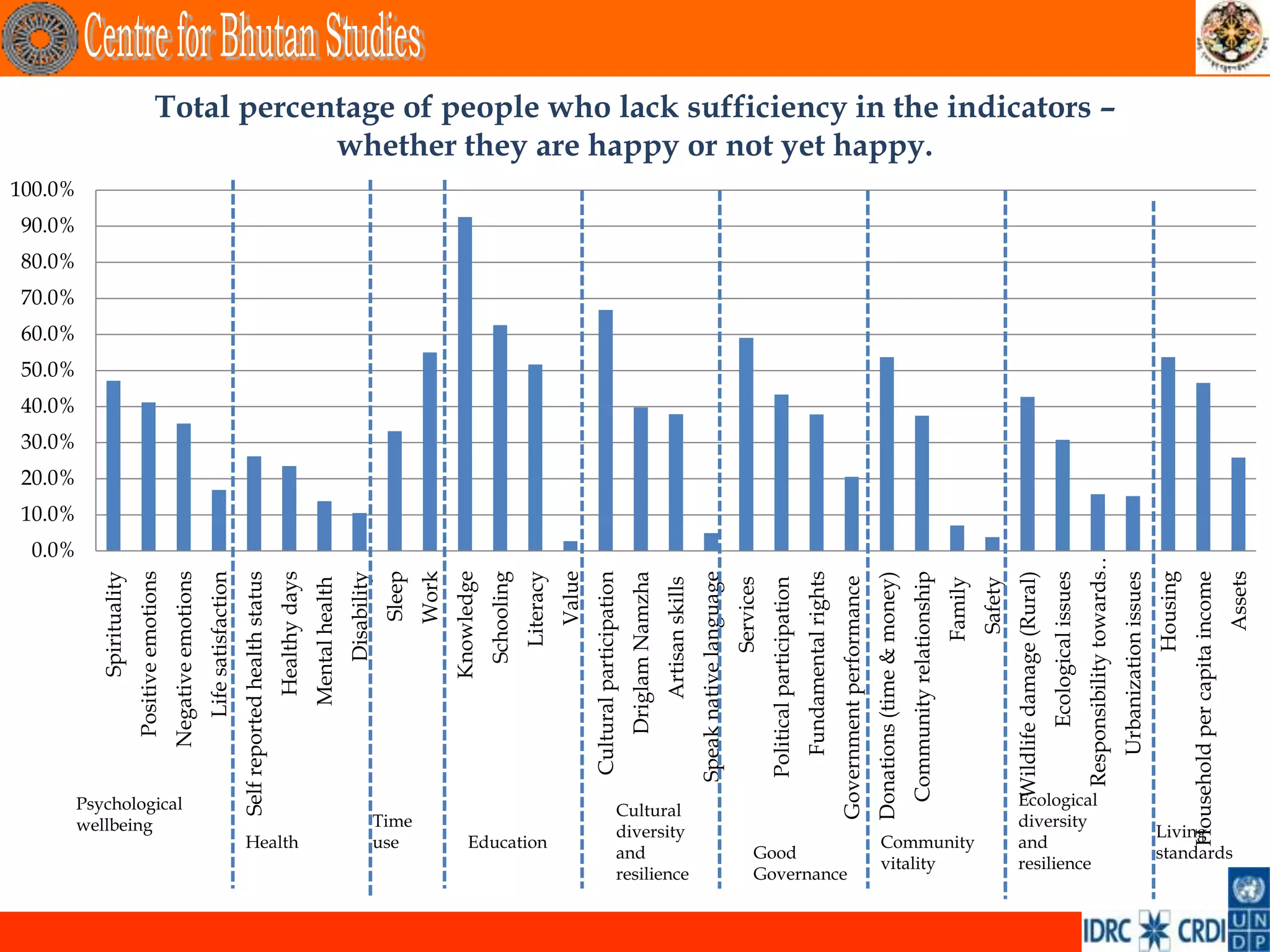
                                                                                                                                        100.0%
                                         Spirituality


              wellbeing
                                   Positive emotions


              Psychological
                                 Negative emotions
                                     Life satisfaction
                    Self reported health status


       Health
                                       Healthy days
                                      Mental health
                                           Disability


       use
                                                Sleep


       Time
                                               Work
                                         Knowledge
                                           Schooling


       Education
                                             Literacy
                                               Value
                               Cultural participation


and
                                   Driglam Namzha


Cultural
diversity

resilience
                                       Artisan skills
                              Speak native language
                                            Services
                              Political participation


Good
                                 Fundamental rights

Governance
                   Government performance
                   Donations (time & money)
                                                                                                                                                             whether they are happy or not yet happy.


                        Community relationship
  vitality


                                             Family
  Community


                                              Safety
                         Wildlife damage (Rural)
  and


                                    Ecological issues
  diversity

  resilience
  Ecological


                              Responsibility towards…
                                                                                                                                                 Total percentage of people who lack sufficiency in the indicators –


                                 Urbanization issues
                                            Housing
    Living


         Household per capita income
    standards


                                               Assets
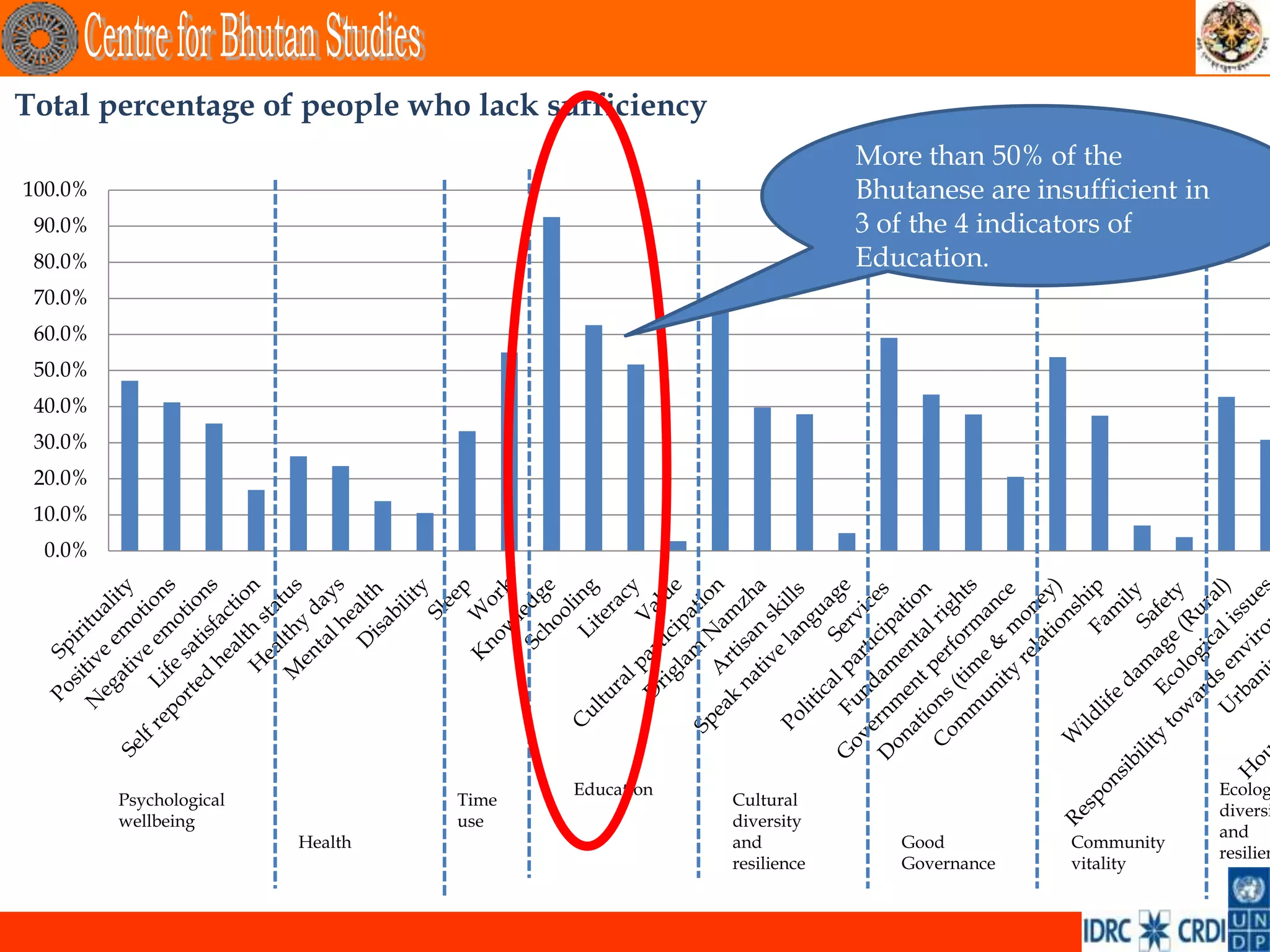
Total percentage of people who lack sufficiency
                                                                  More than 50% of the
100.0%                                                            Bhutanese are insufficient in
 90.0%                                                            3 of the 4 indicators of
 80.0%                                                            Education.
 70.0%
 60.0%
 50.0%
 40.0%
 30.0%
 20.0%
 10.0%
  0.0%


                                         Education                                                Ecolog
         Psychological            Time               Cultural
                                                                                                  diversi
         wellbeing                use                diversity
                                                                                                  and
                         Health                      and             Good          Community
                                                                                                  resilien
                                                     resilience      Governance    vitality
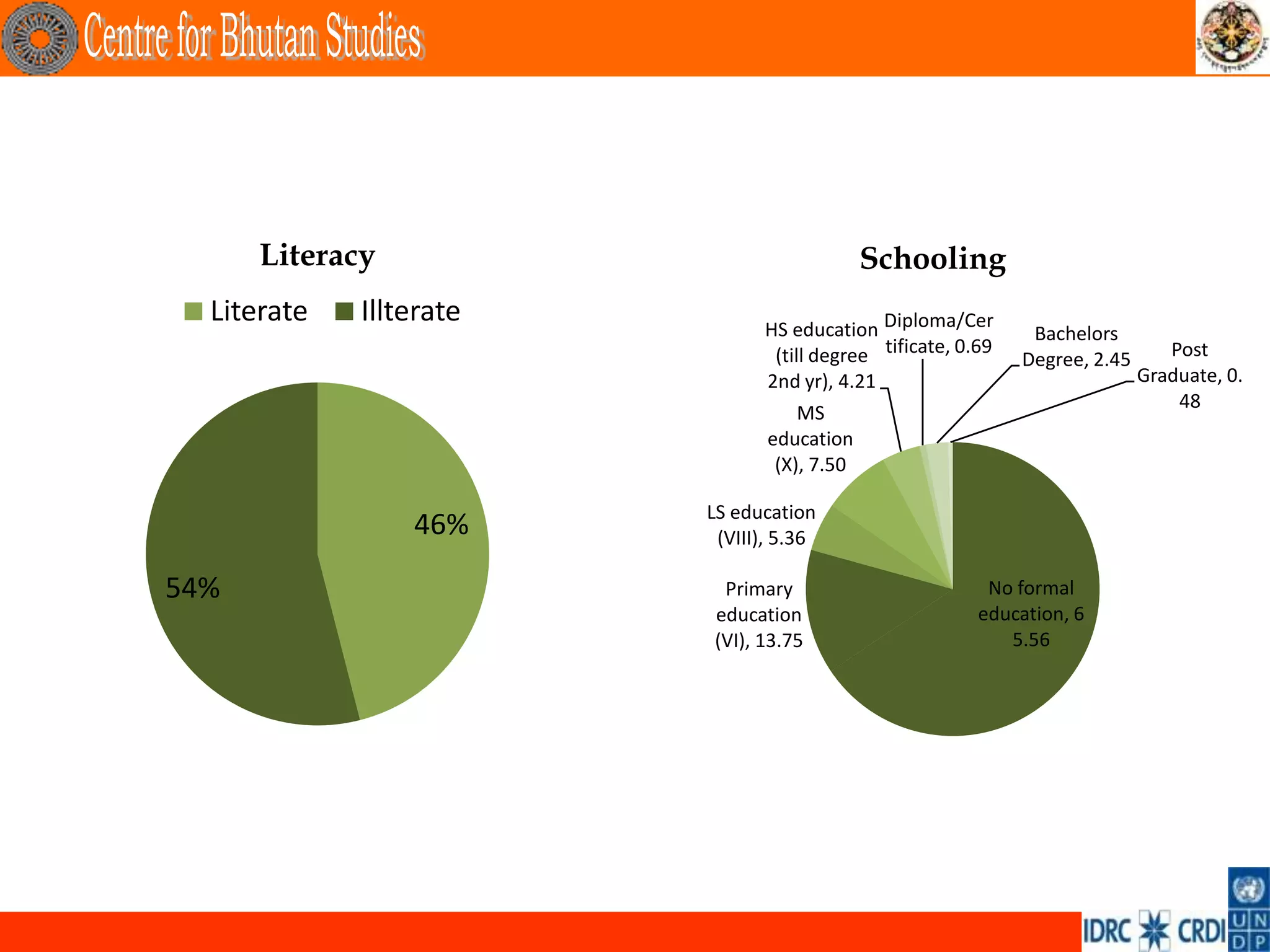
Literacy                            Schooling
  Literate   Illterate         HS education Diploma/Cer        Bachelors
                                (till degree tificate, 0.69   Degree, 2.45      Post
                               2nd yr), 4.21                                 Graduate, 0.
                                                                                 48
                                    MS
                               education
                                (X), 7.50

                         LS education
                 46%      (VIII), 5.36

54%                       Primary                         No formal
                         education                       education, 6
                         (VI), 13.75                        5.56
Knowledge
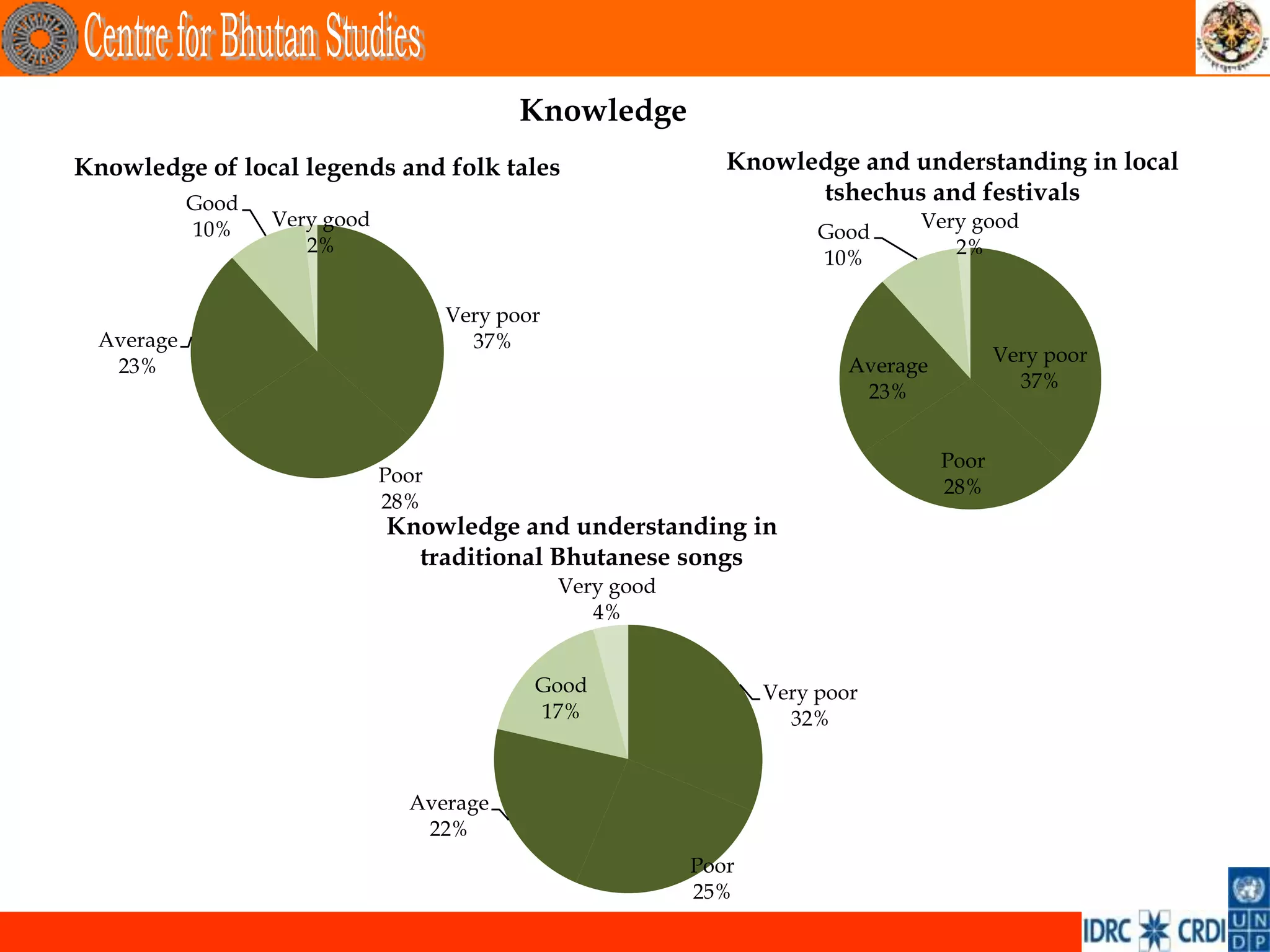
Knowledge of local legends and folk tales                        Knowledge and understanding in local
            Good                                                       tshechus and festivals
            10%    Very good                                                       Very good
                                                                          Good
                      2%                                                              2%
                                                                          10%

                                      Very poor
  Average                               37%
                                                                                              Very poor
   23%                                                                       Average
                                                                              23%               37%


                                                                                       Poor
                               Poor
                                                                                       28%
                               28%
                               Knowledge and understanding in
                                 traditional Bhutanese songs
                                                  Very good
                                                     4%


                                              Good                   Very poor
                                              17%                      32%


                                 Average
                                  22%
                                                              Poor
                                                              25%
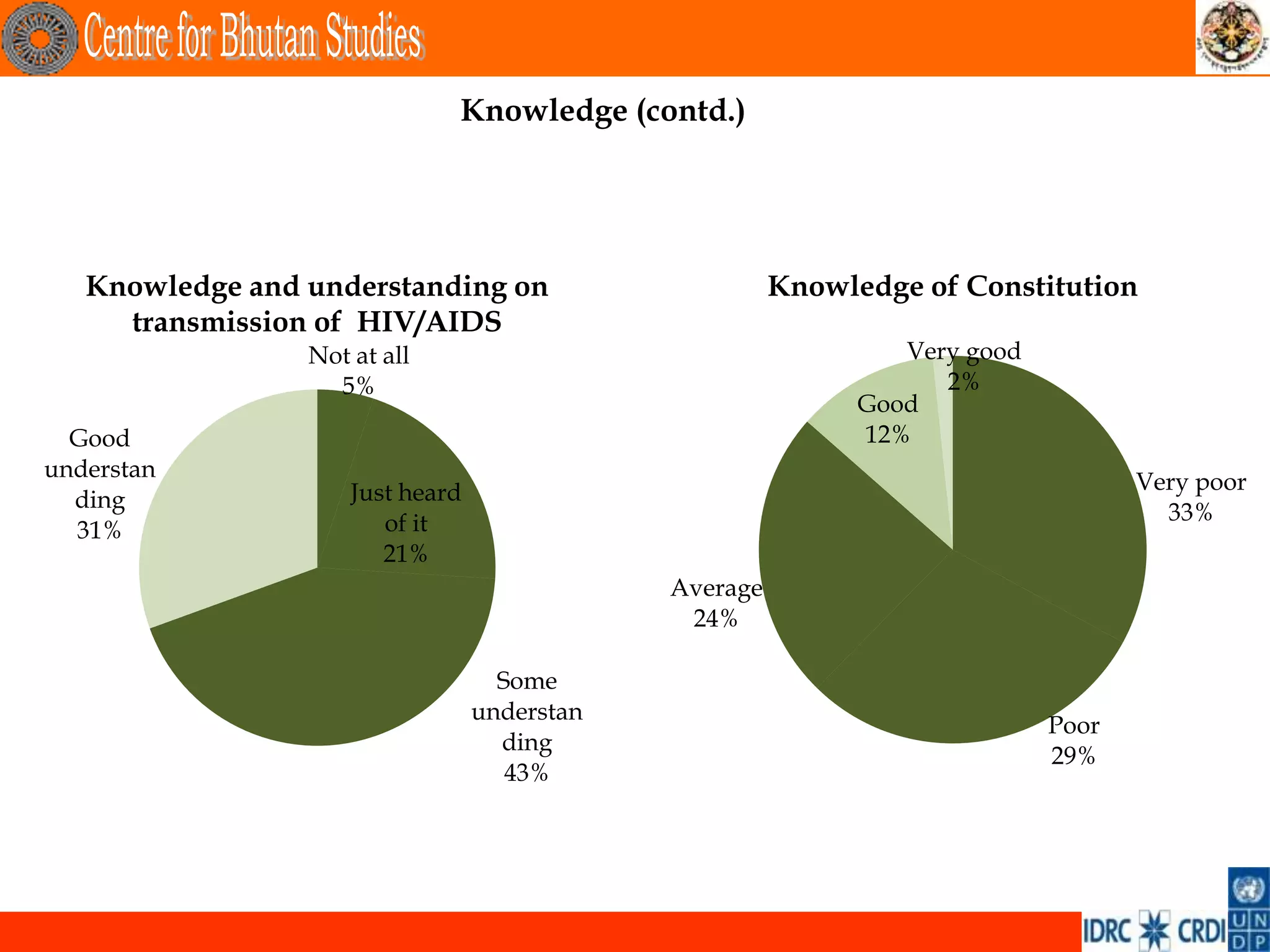
Knowledge (contd.)


   Knowledge and understanding on                       Knowledge of Constitution
     transmission of HIV/AIDS
                 Not at all                                      Very good
                   5%                                               2%
                                                              Good
  Good                                                        12%
understan
                     Just heard                                                     Very poor
  ding
                        of it                                                         33%
  31%
                        21%
                                              Average
                                               24%

                                    Some
                                  understan
                                                                             Poor
                                    ding
                                                                             29%
                                     43%
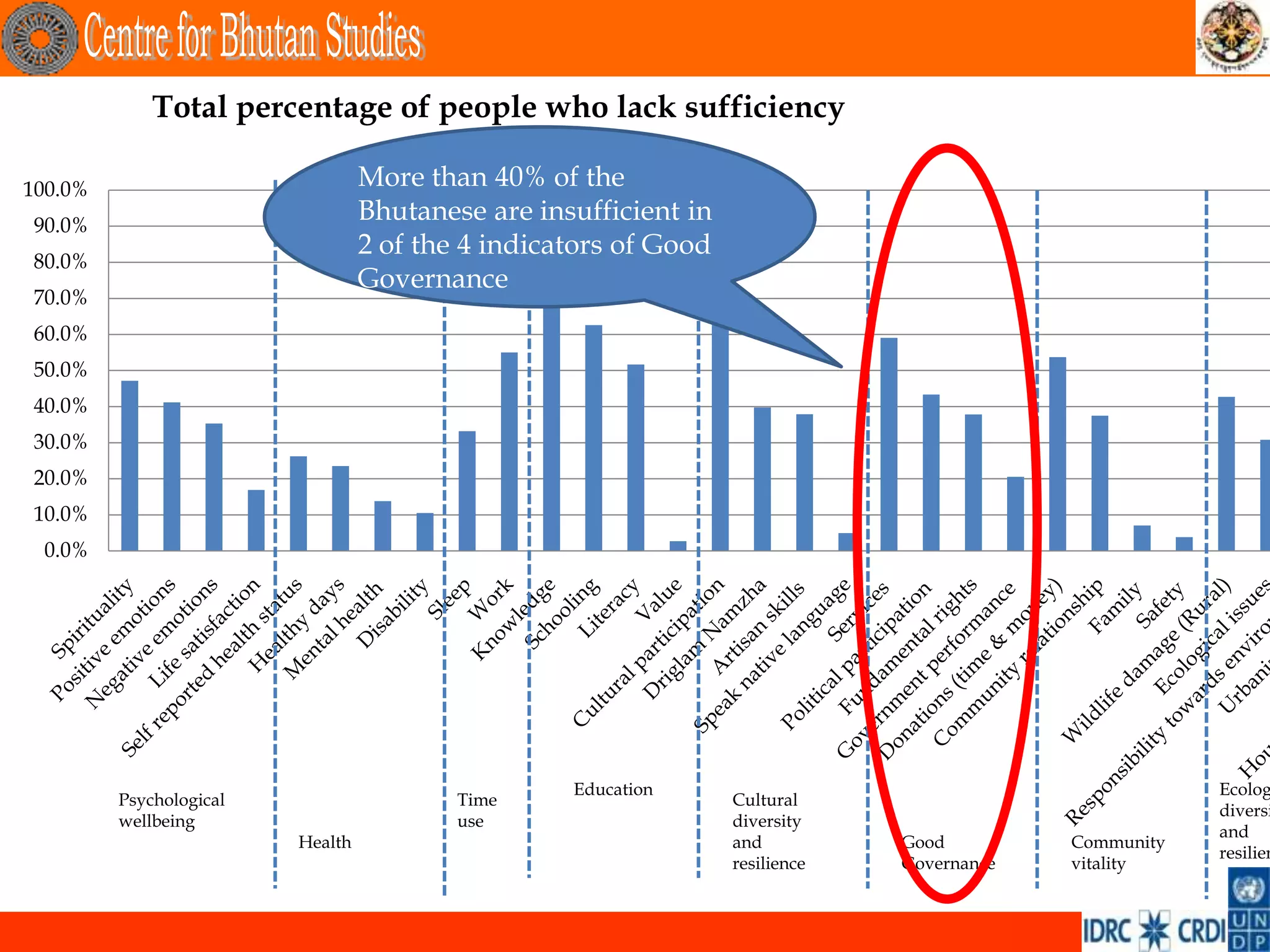
Total percentage of people who lack sufficiency

100.0%                            More than 40% of the
90.0%
                                  Bhutanese are insufficient in
                                  2 of the 4 indicators of Good
80.0%
                                  Governance
70.0%
60.0%
50.0%
40.0%
30.0%
20.0%
10.0%
 0.0%


                                                   Education                                            Ecolog
         Psychological                    Time                    Cultural
                                                                                                        diversi
         wellbeing                        use                     diversity
                                                                                                        and
                         Health                                   and          Good         Community
                                                                                                        resilien
                                                                  resilience   Governance   vitality
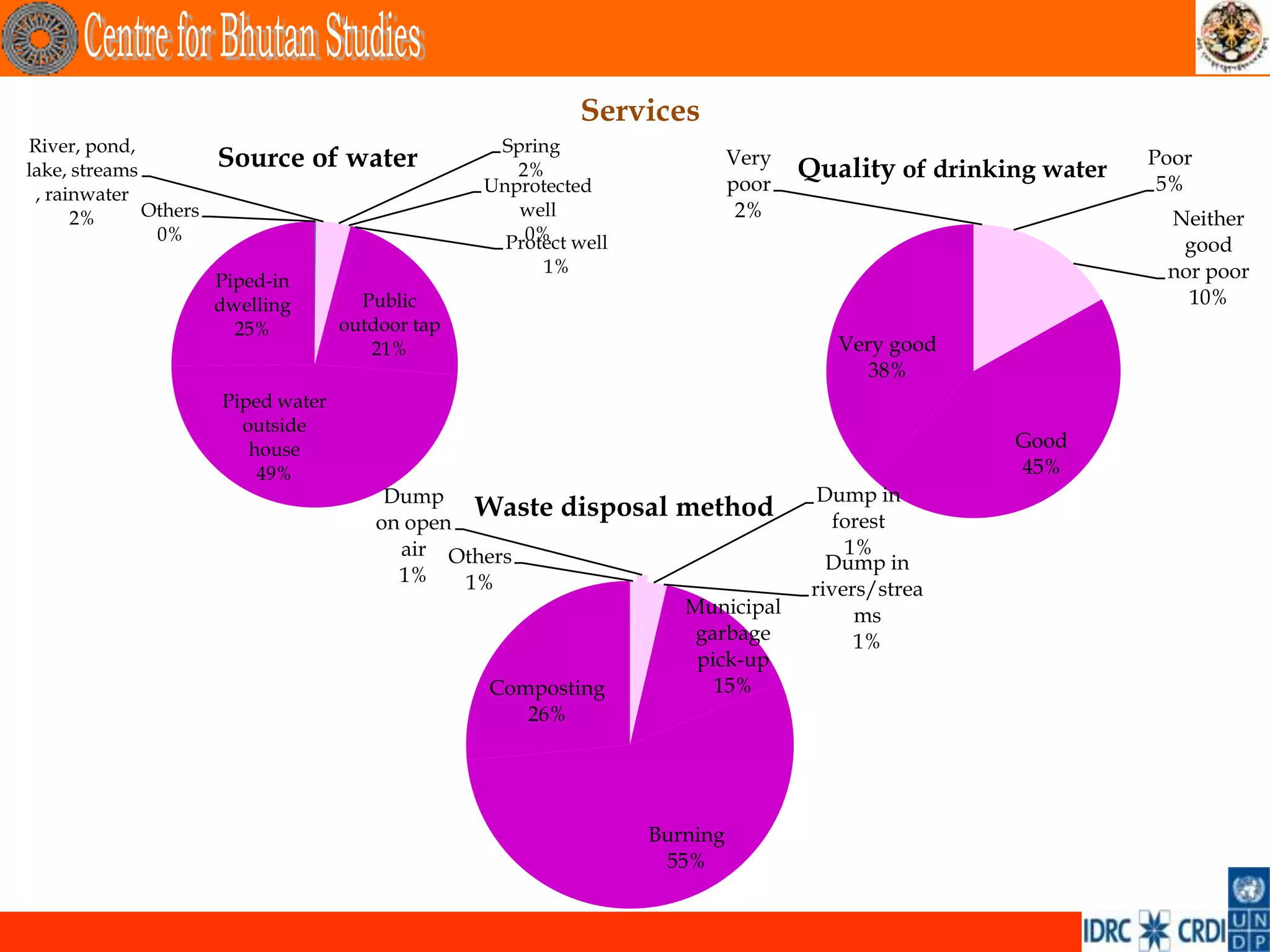
Services
River, pond,                                        Spring
lake, streams          Source of water                2%
                                                                              Very
                                                                                     Quality of drinking water   Poor
 , rainwater                                       Unprotected                poor                                5%
      2%      Others                                  well                     2%                                 Neither
               0%                                      0%
                                                     Protect well                                                  good
                                                         1%                                                       nor poor
                       Piped-in
                       dwelling        Public                                                                       10%
                         25%         outdoor tap
                                        21%                                             Very good
                                                                                           38%
                       Piped water
                         outside
                          house                                                                       Good
                           49%                                                                        45%
                                         Dump                                          Dump in
                                        on open
                                                 Waste     disposal method               forest
                                          air Others                                      1%
                                                                                        Dump in
                                          1%    1%                                    rivers/strea
                                                                       Municipal           ms
                                                                        garbage            1%
                                                                        pick-up
                                                   Composting             15%
                                                      26%


                                                                    Burning
                                                                     55%
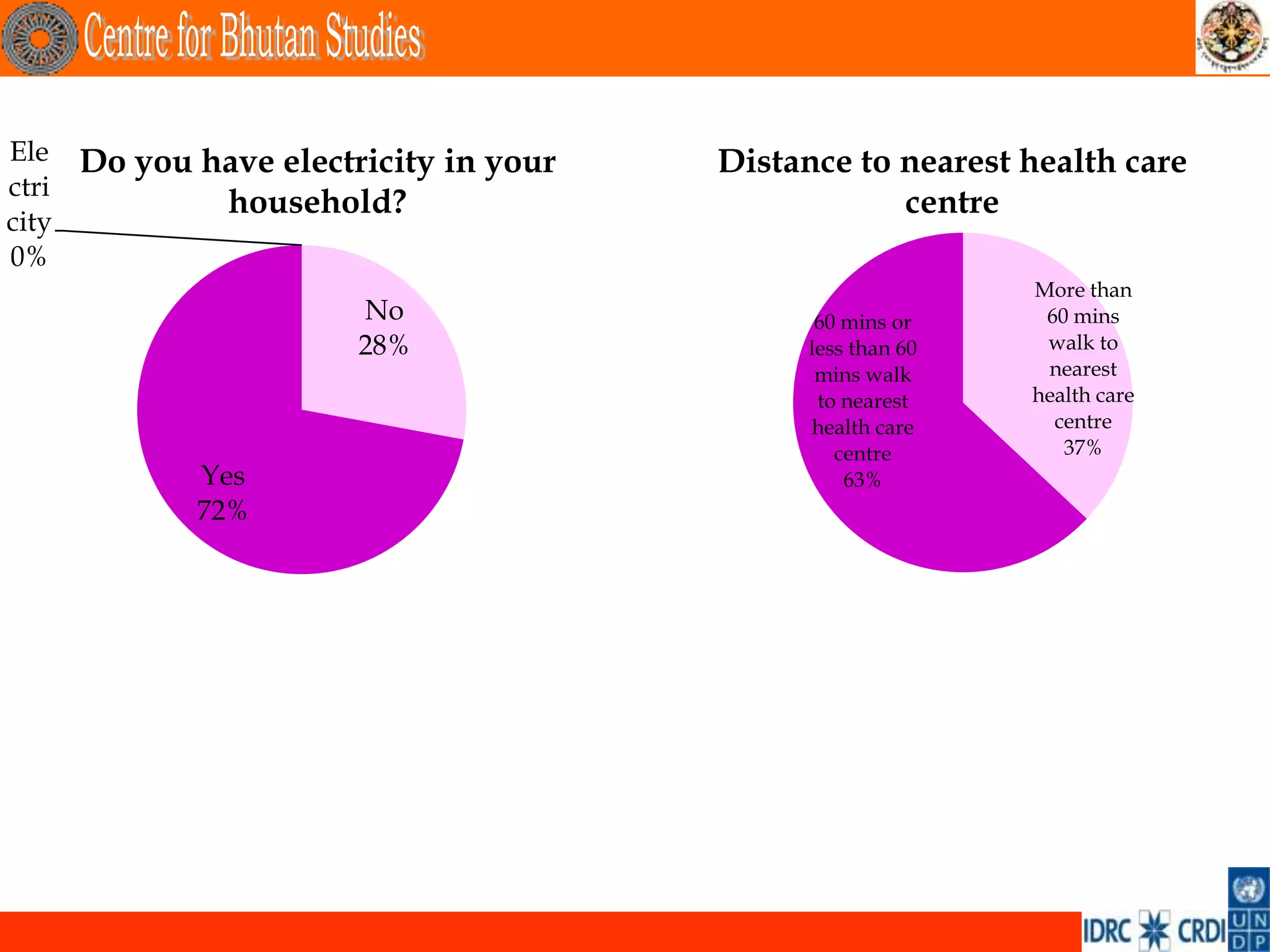
Ele    Do you have electricity in your   Distance to nearest health care
ctri
               household?                            centre
city
0%
                                                              More than
                         No                     60 mins or     60 mins
                         28%                   less than 60    walk to
                                                mins walk      nearest
                                                to nearest    health care
                                               health care      centre
                                                  centre         37%
              Yes                                  63%
              72%
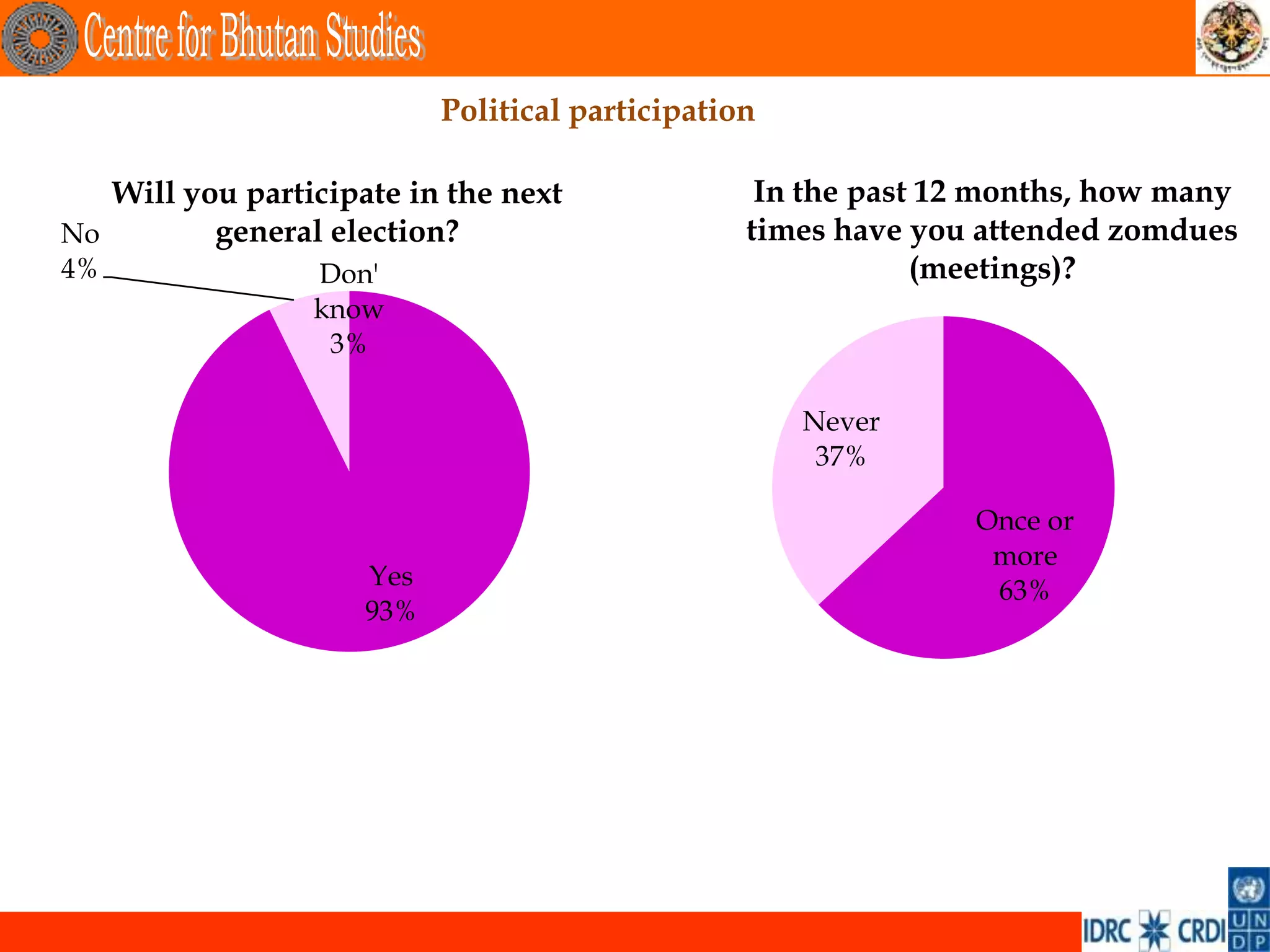
Political participation

   Will you participate in the next               In the past 12 months, how many
No        general election?                      times have you attended zomdues
4%               Don'                                        (meetings)?
                 know
                  3%

                                                     Never
                                                      37%

                                                               Once or
                                                                more
                     Yes
                                                                63%
                     93%
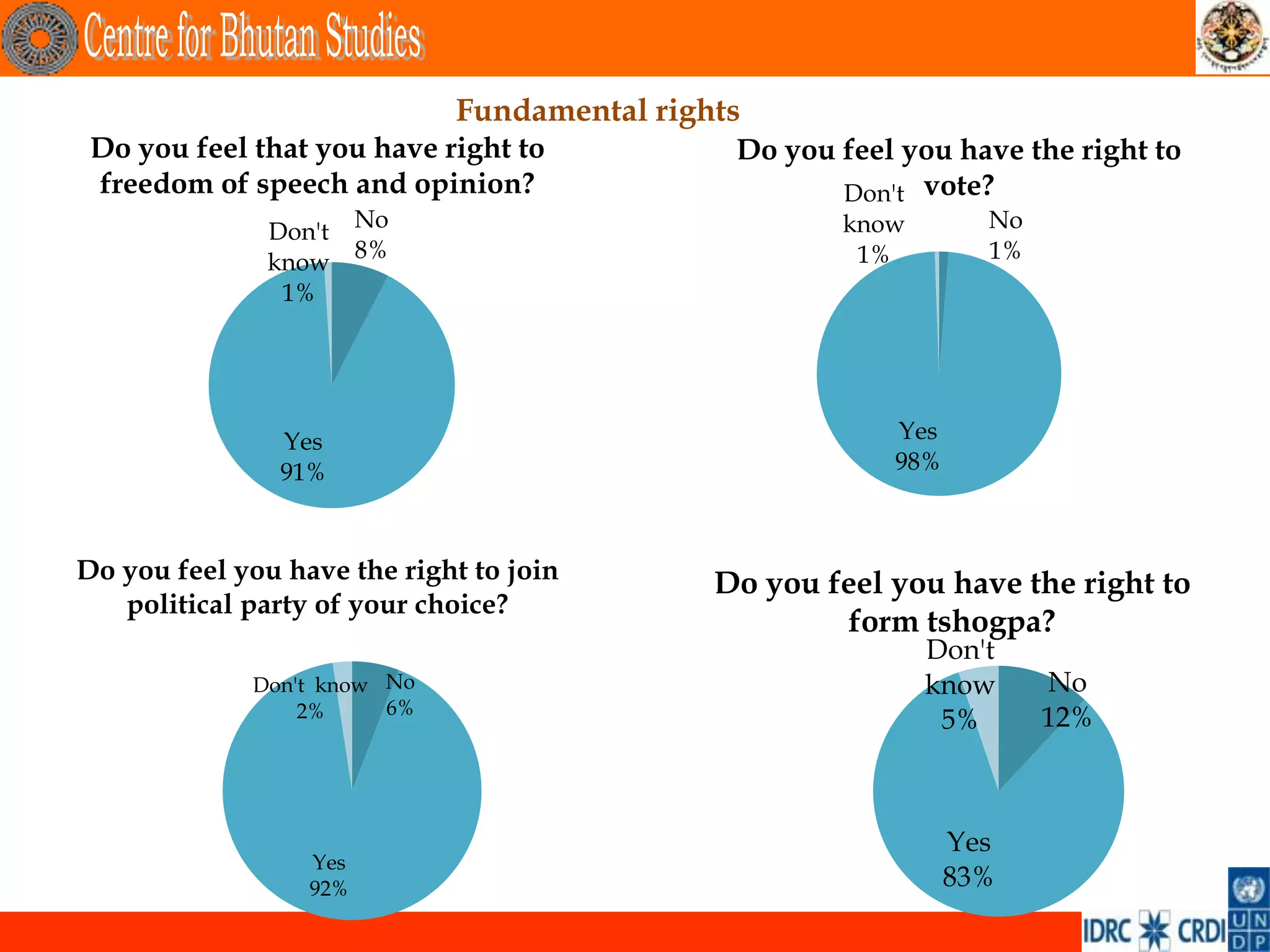
Fundamental rights
 Do you feel that you have right to           Do you feel you have the right to
 freedom of speech and opinion?                      Don't vote?
               Don't No                              know        No
               know 8%                                1%         1%
                1%


                Yes                                      Yes
                91%                                      98%


Do you feel you have the right to join       Do you feel you have the right to
   political party of your choice?
                                                      form tshogpa?
                                                            Don't
             Don't know No                                  know      No
                 2%     6%
                                                             5%       12%


                                                               Yes
                  Yes
                  92%                                          83%
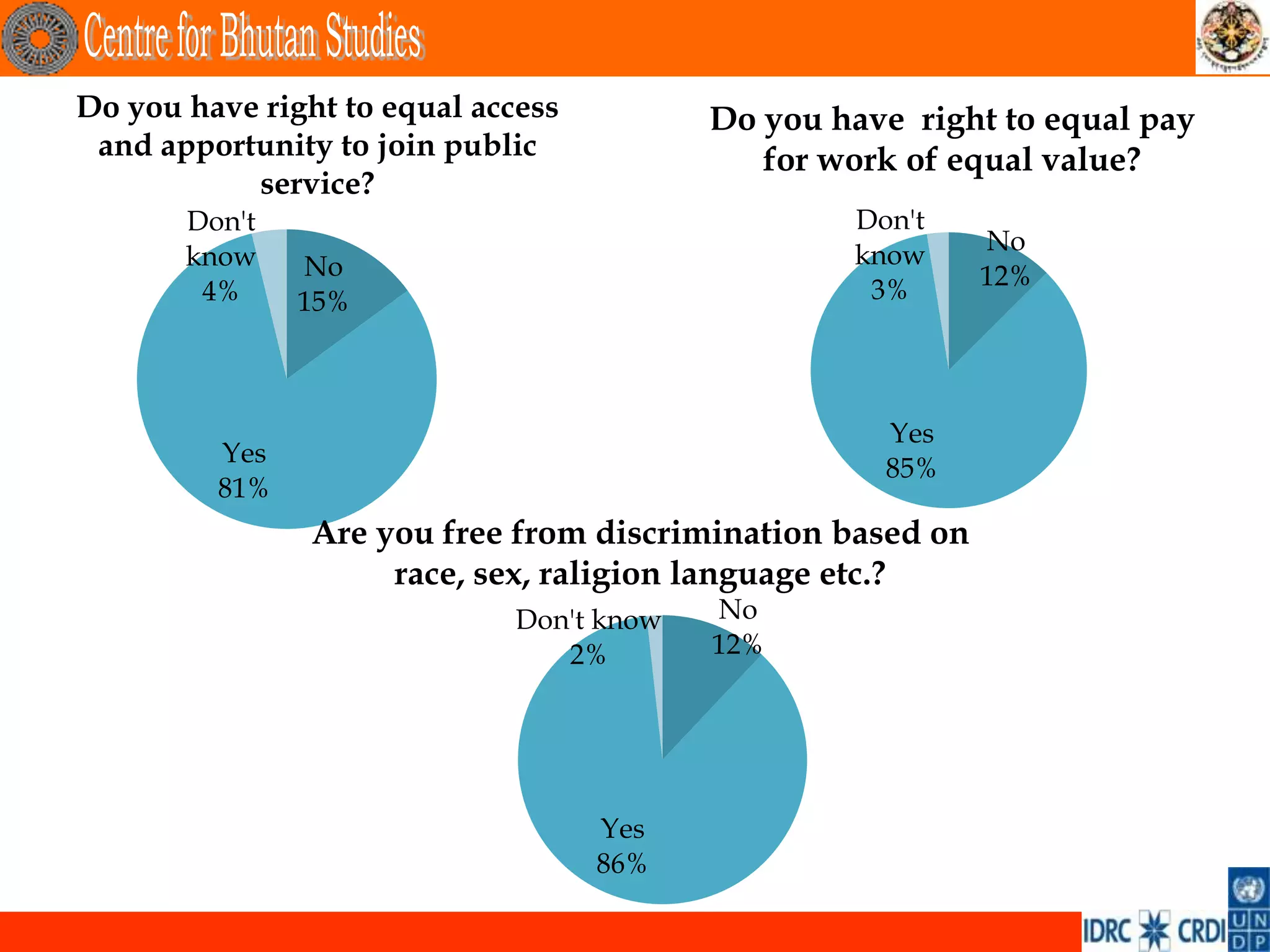
Do you have right to equal access          Do you have right to equal pay
 and apportunity to join public               for work of equal value?
           service?
       Don't                                       Don't
                                                   know     No
       know    No
                                                    3%      12%
        4%     15%


                                                     Yes
         Yes
                                                     85%
         81%
                Are you free from discrimination based on
                     race, sex, raligion language etc.?
                              Don't know   No
                                 2%        12%


                                    Yes
                                    86%
Part III:
Increasing Happiness
1.   GNH Index and Policy: concern for Unhappiness
2.   Insufficiencies by Dzongkhag
3.   Insufficiencies by region
4.   Insufficiencies by gender
5.   Insufficiencies by age group
6.   Insufficiencies by marital status
7.   Insufficiencies by occupational group
8.   Policy recommendations
9.   Sustaining GNH
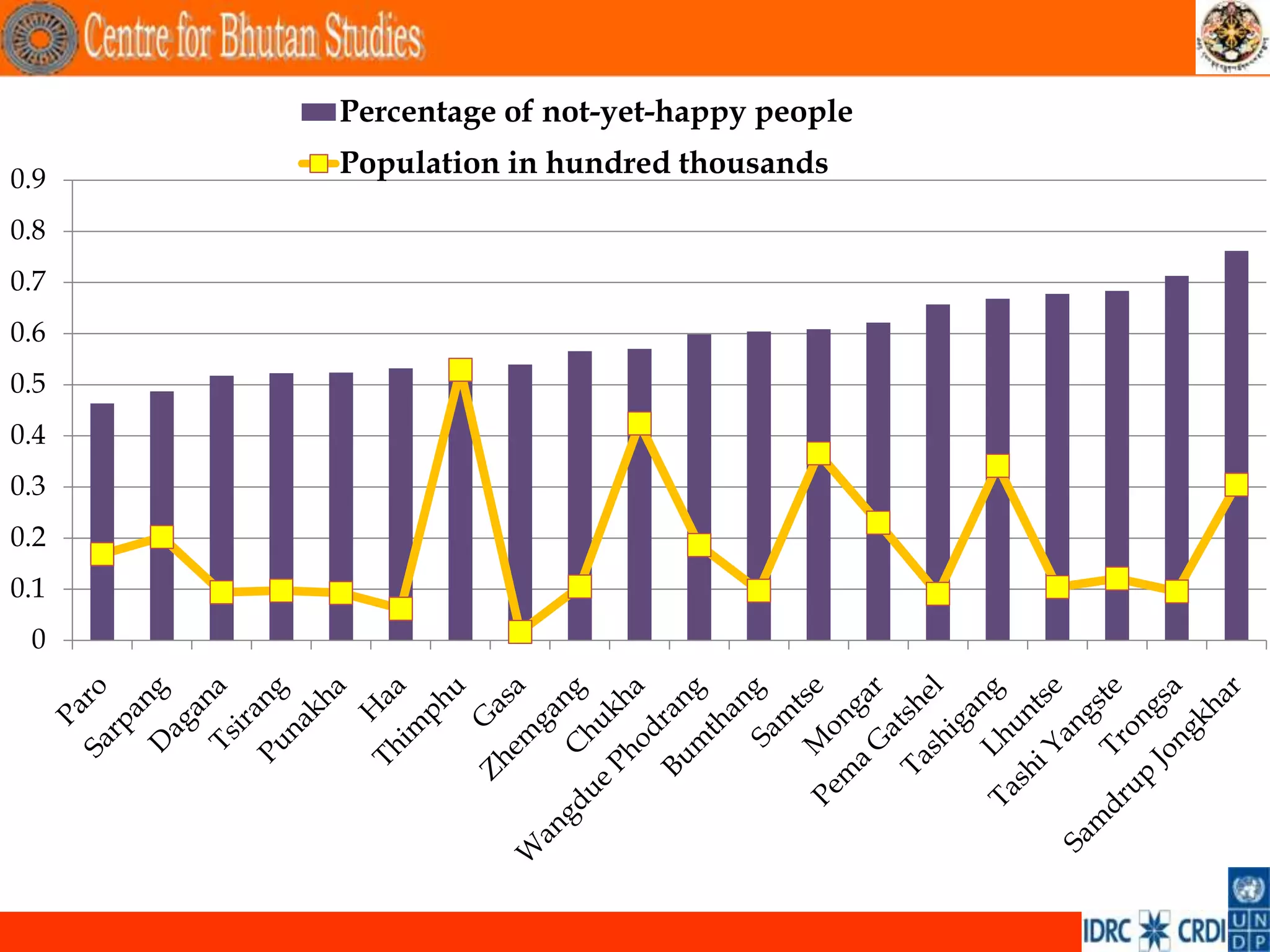
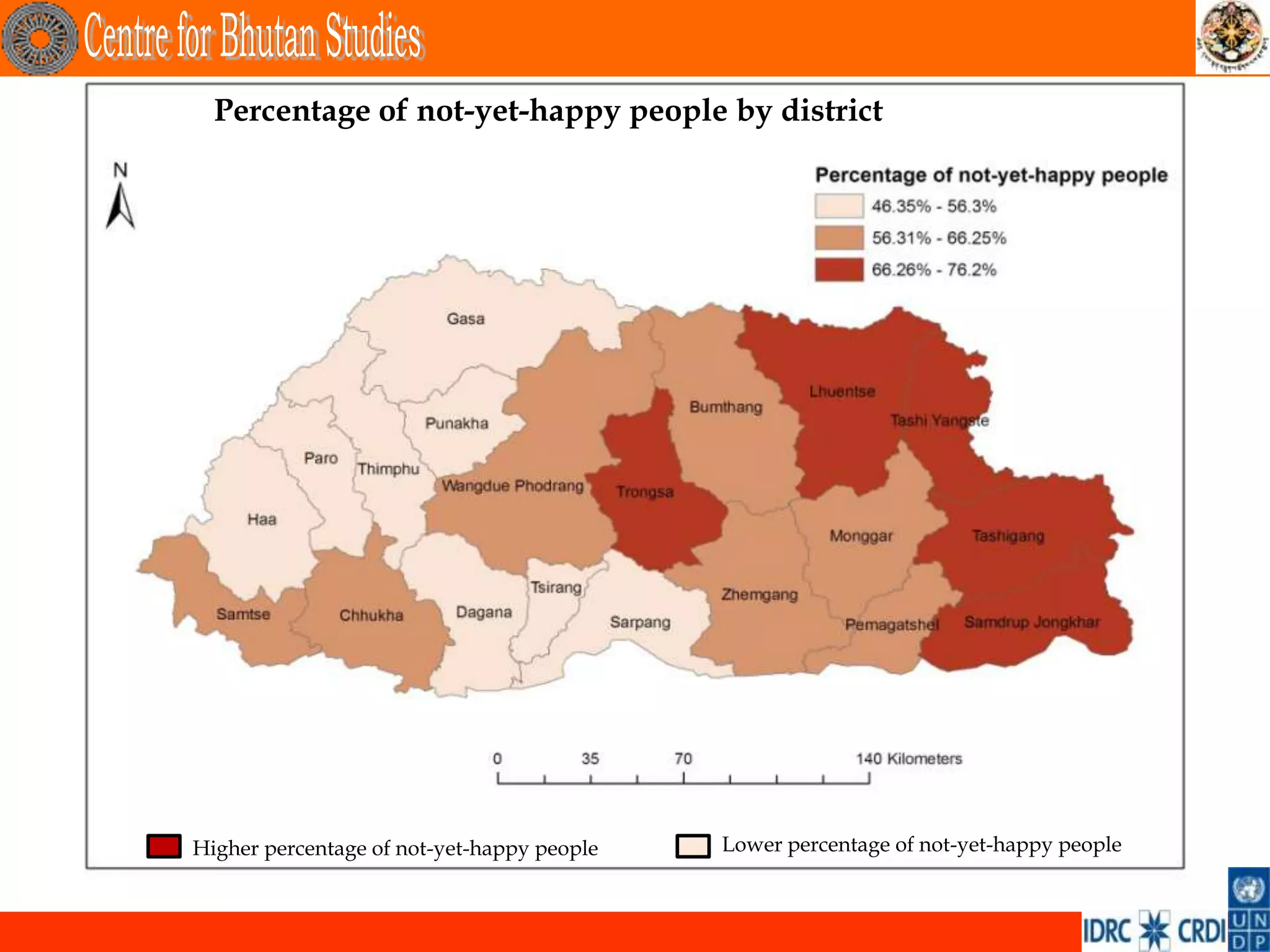
Percentage of not-yet-happy people by district


Higher percentage of not-yet-happy people   Lower percentage of not-yet-happy people
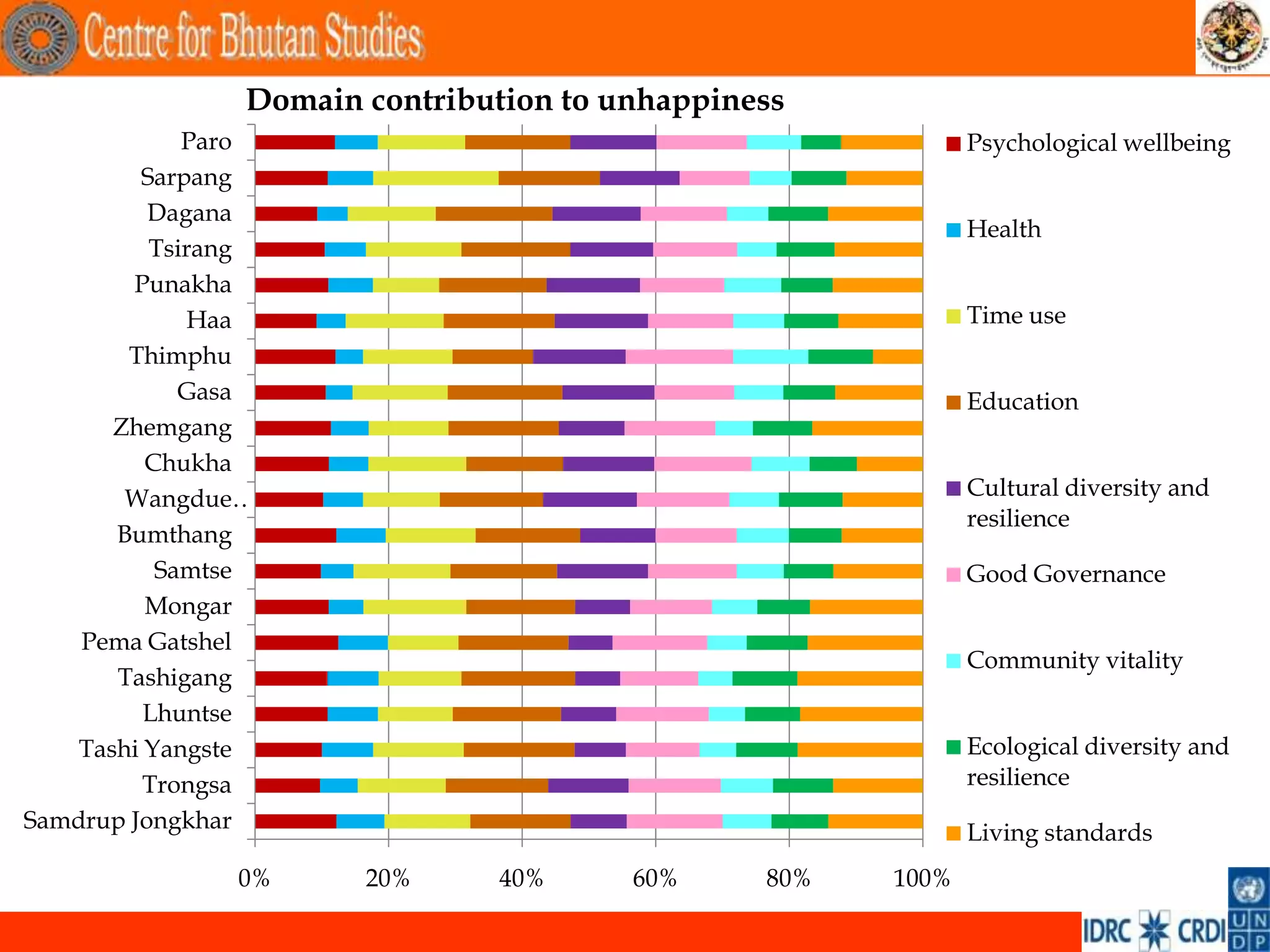
Domain contribution to unhappiness
             Paro                                            Psychological wellbeing
         Sarpang
          Dagana
                                                             Health
          Tsirang
        Punakha
              Haa                                            Time use
        Thimphu
             Gasa                                            Education
       Zhemgang
          Chukha
        Wangdue…                                             Cultural diversity and
                                                             resilience
       Bumthang
           Samtse                                            Good Governance
          Mongar
    Pema Gatshel
                                                             Community vitality
       Tashigang
          Lhuntse
    Tashi Yangste                                            Ecological diversity and
          Trongsa                                            resilience
Samdrup Jongkhar                                             Living standards
               0%      20%      40%     60%     80%   100%

                                                                                        .
0%
                                          10%
                                                20%
                                                      30%
                                                            40%
                                                                  50%
                                                                        60%
                                                                              70%
                                                                                    80%
                      Life satisfaction
                           Spirituality


        wellbeing
                  Negative emotions


        Psychological
                    Positive emotions
                             Disability
                       Mental health


      Health
          Self reported health status
                         Healthy days
                                  Sleep


        use
        Time
                                  Work
                                 Value
                                                                                          Paro


                               Literacy
                            Schooling


               Education
                           Knowledge
              Speak native language


    and
                    Driglam Namzha


    Cultural
                        Artisan skills


    diversity

    resilience
               Cultural participation
          Government performance
                 Fundamental rights


    Good
               Political participation


    Governance
                              Services
                                                                                          Samdrup Jongkhar


                                Safety
                               Family
    vitality


           Community relationship
    Community


          Donations (time & money)
                     Ecological issues
    and


             Responsibility towards…
    diversity

    resilience
    Ecological


                 Urbanization issues
            Wildlife damage (Rural)
               Household per capita…
           Living


                                Assets
           standards


                              Housing
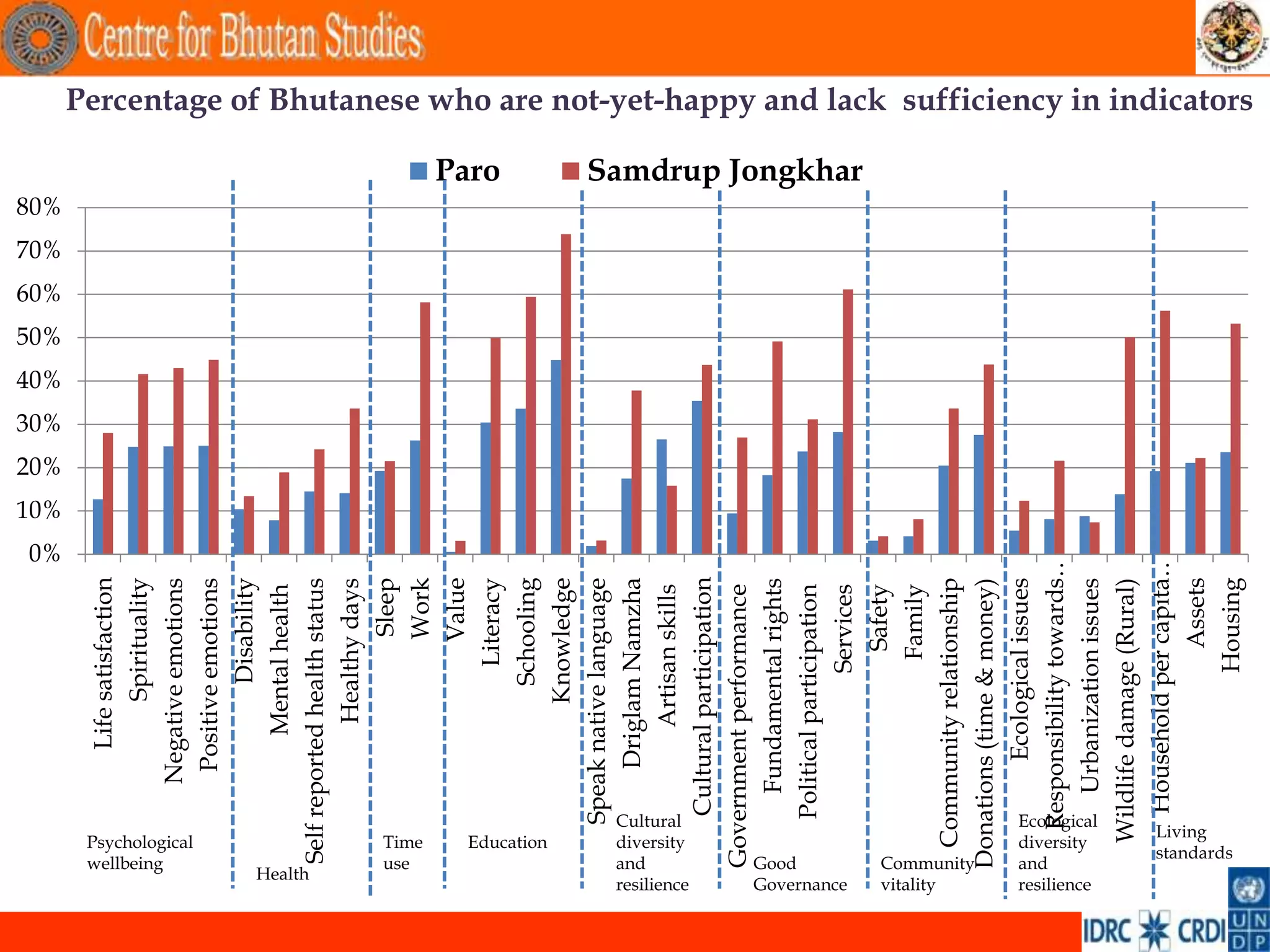
                                                                                                             Percentage of Bhutanese who are not-yet-happy and lack sufficiency in indicators


.
Percentage of not-yet-happy people

0.9
      Population in hundred thousands

0.8
0.7
0.6
0.5
0.4
0.3
0.2
0.1
 0


                                           .
Pema                                          Thimphu
                  Punakha, 9,278                             Haa, 6,198
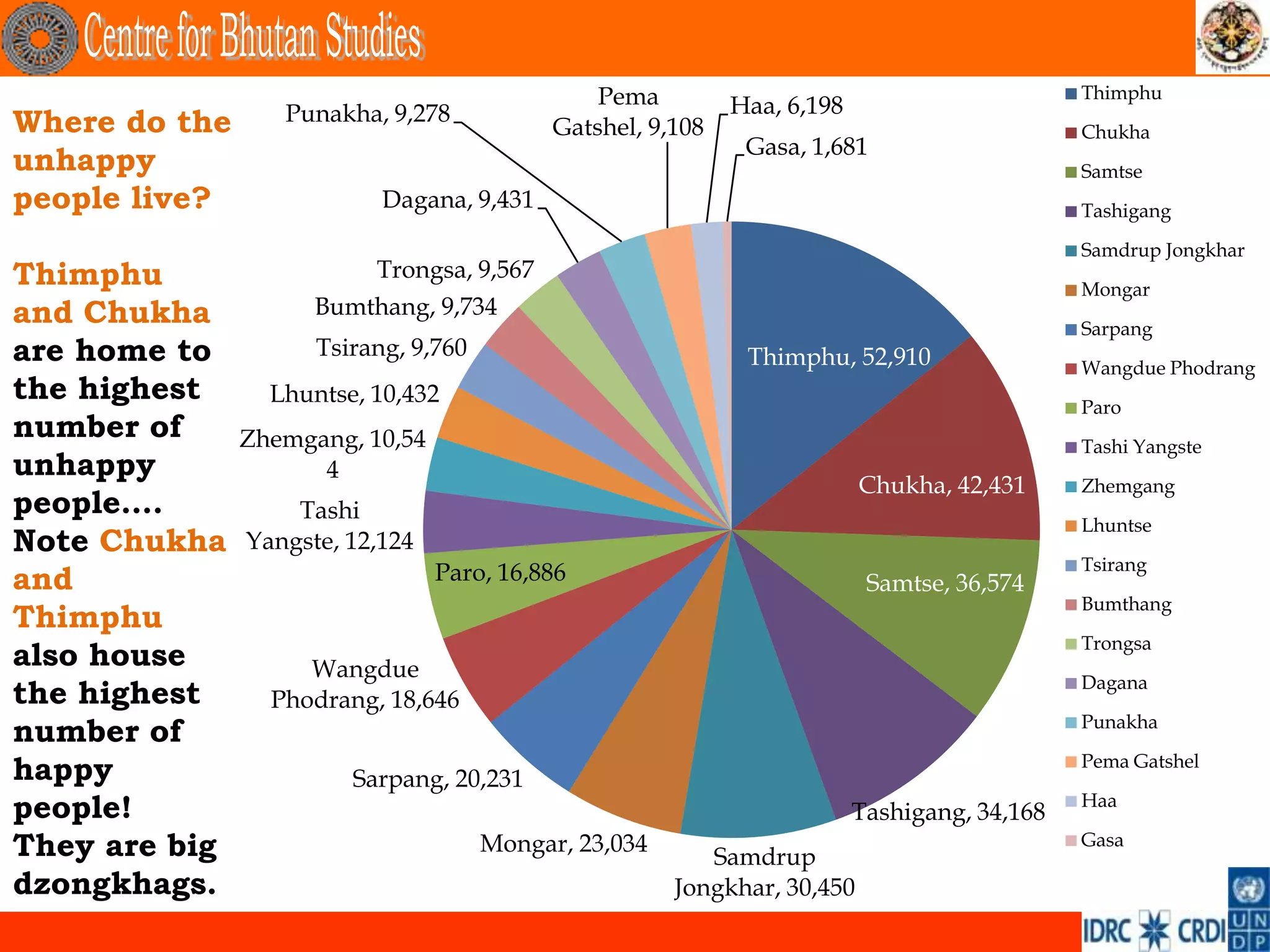
Where do the                                Gatshel, 9,108                                    Chukha
                                                              Gasa, 1,681
unhappy                                                                                       Samtse
people live?               Dagana, 9,431                                                      Tashigang

                                                                                              Samdrup Jongkhar
Thimphu                  Trongsa, 9,567
                                                                                              Mongar
and Chukha           Bumthang, 9,734
                                                                                              Sarpang
are home to          Tsirang, 9,760                           Thimphu, 52,910                 Wangdue Phodrang
the highest      Lhuntse, 10,432                                                              Paro
number of      Zhemgang, 10,54                                                                Tashi Yangste
unhappy              4
                                                                          Chukha, 42,431      Zhemgang
people….           Tashi
                                                                                              Lhuntse
Note Chukha    Yangste, 12,124
                                 Paro, 16,886                                                 Tsirang
and                                                                        Samtse, 36,574
                                                                                              Bumthang
Thimphu
                                                                                              Trongsa
also house          Wangdue                                                                   Dagana
the highest      Phodrang, 18,646
                                                                                              Punakha
number of
                                                                                              Pema Gatshel
happy                   Sarpang, 20,231
people!                                                                   Tashigang, 34,168
                                                                                              Haa

They are big                          Mongar, 23,034
                                                          Samdrup
                                                                                              Gasa

dzongkhags.                                            Jongkhar, 30,450
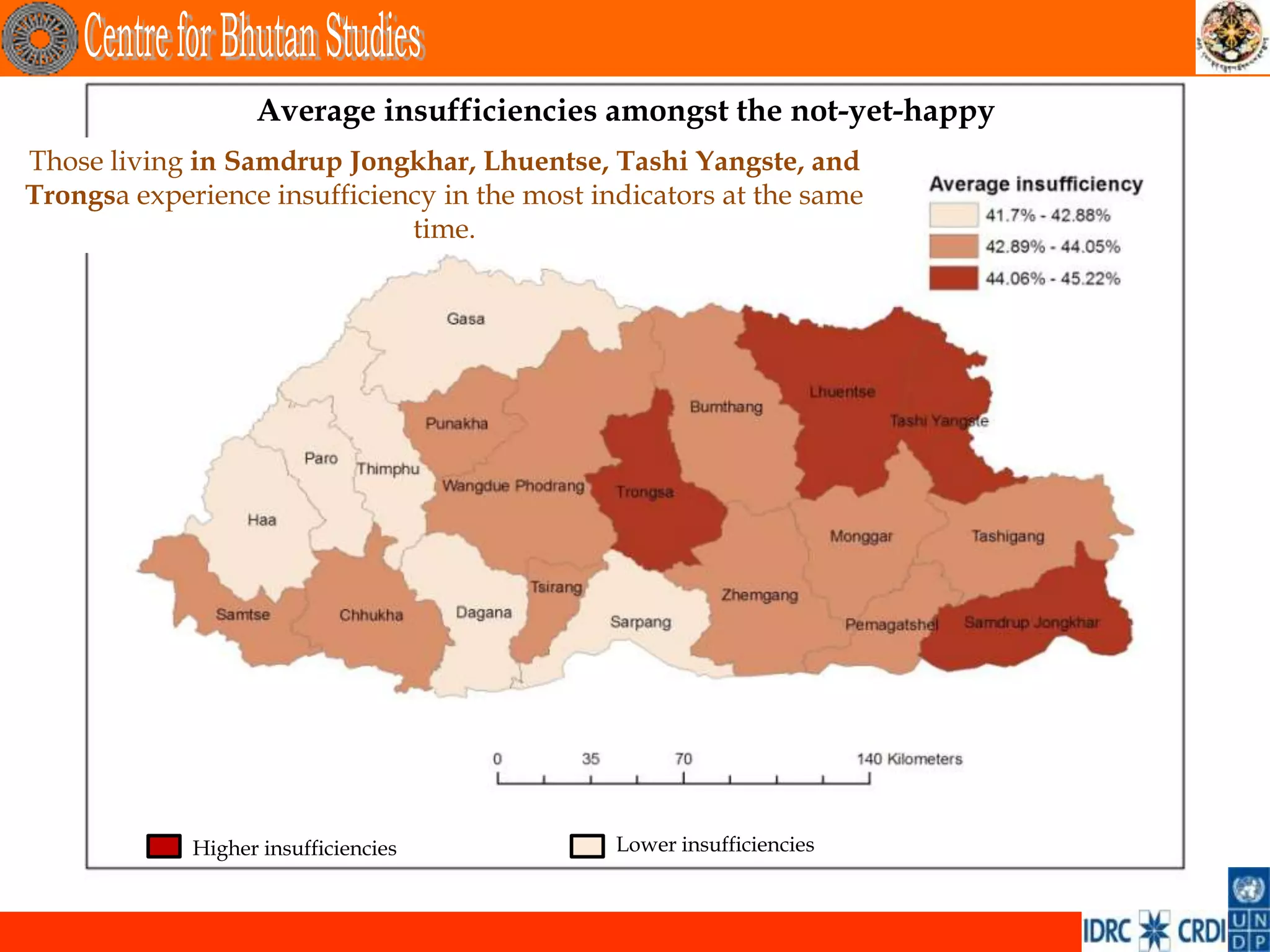
Average insufficiencies amongst the not-yet-happy
Those living in Samdrup Jongkhar, Lhuentse, Tashi Yangste, and
Trongsa experience insufficiency in the most indicators at the same
                              time.


             Higher insufficiencies            Lower insufficiencies
Part III:
Increasing Happiness
1.   GNH Index and Policy: concern for Unhappiness
2.   Insufficiencies by Dzongkhag
3.   Insufficiencies by region
4.   Insufficiencies by gender
5.   Insufficiencies by age group
6.   Insufficiencies by marital status
7.   Insufficiencies by occupational group
8.   Policy recommendations
9.   Sustaining GNH
70%         63%

                        50%
60%
                                       44%     42%
50%
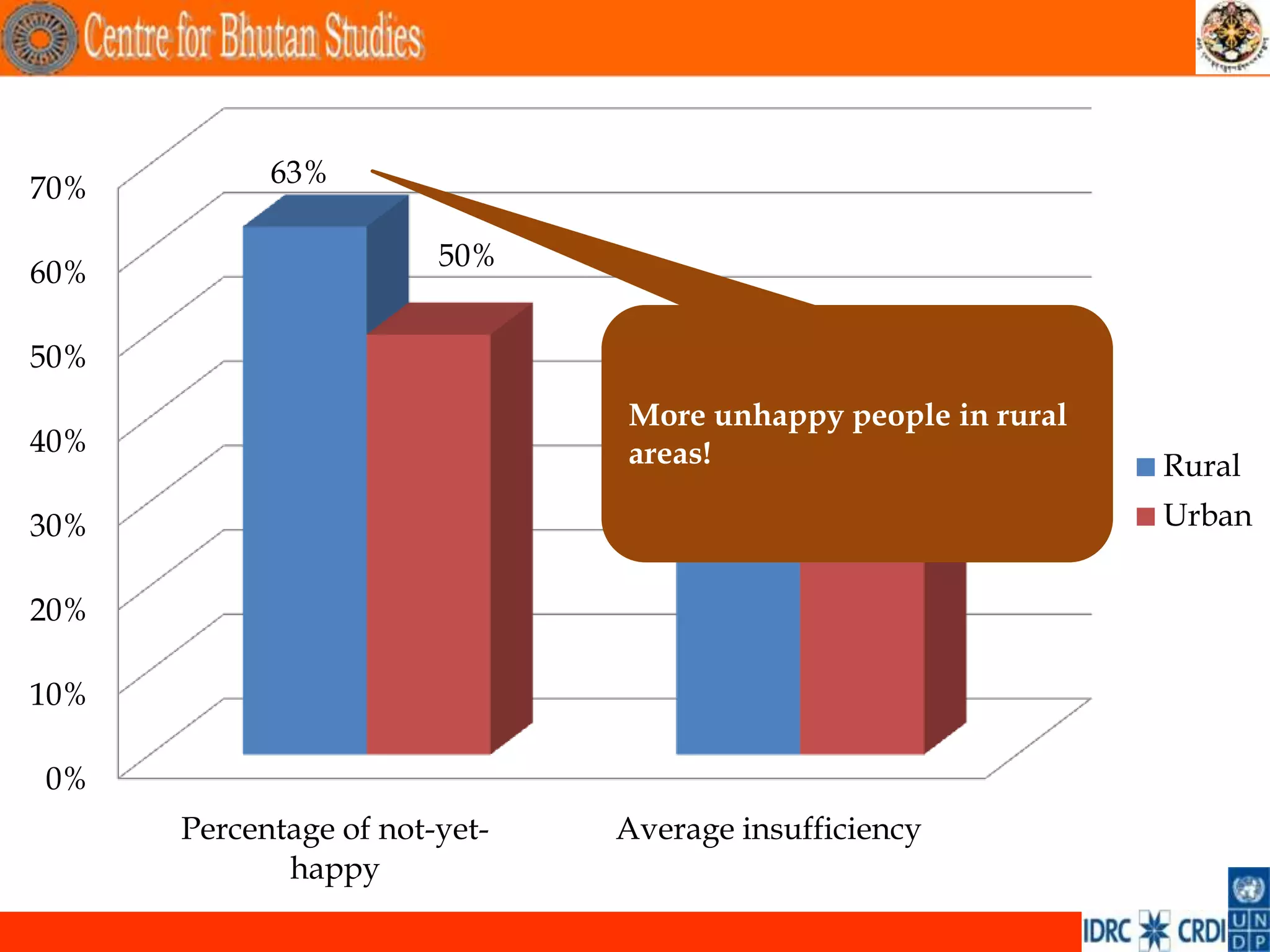
                               More unhappy people in rural
40%                            areas!                         Rural
30%                                                           Urban

20%

10%

0%
      Percentage of not-yet-   Average insufficiency
             happy
                                                                      .
67%
70%
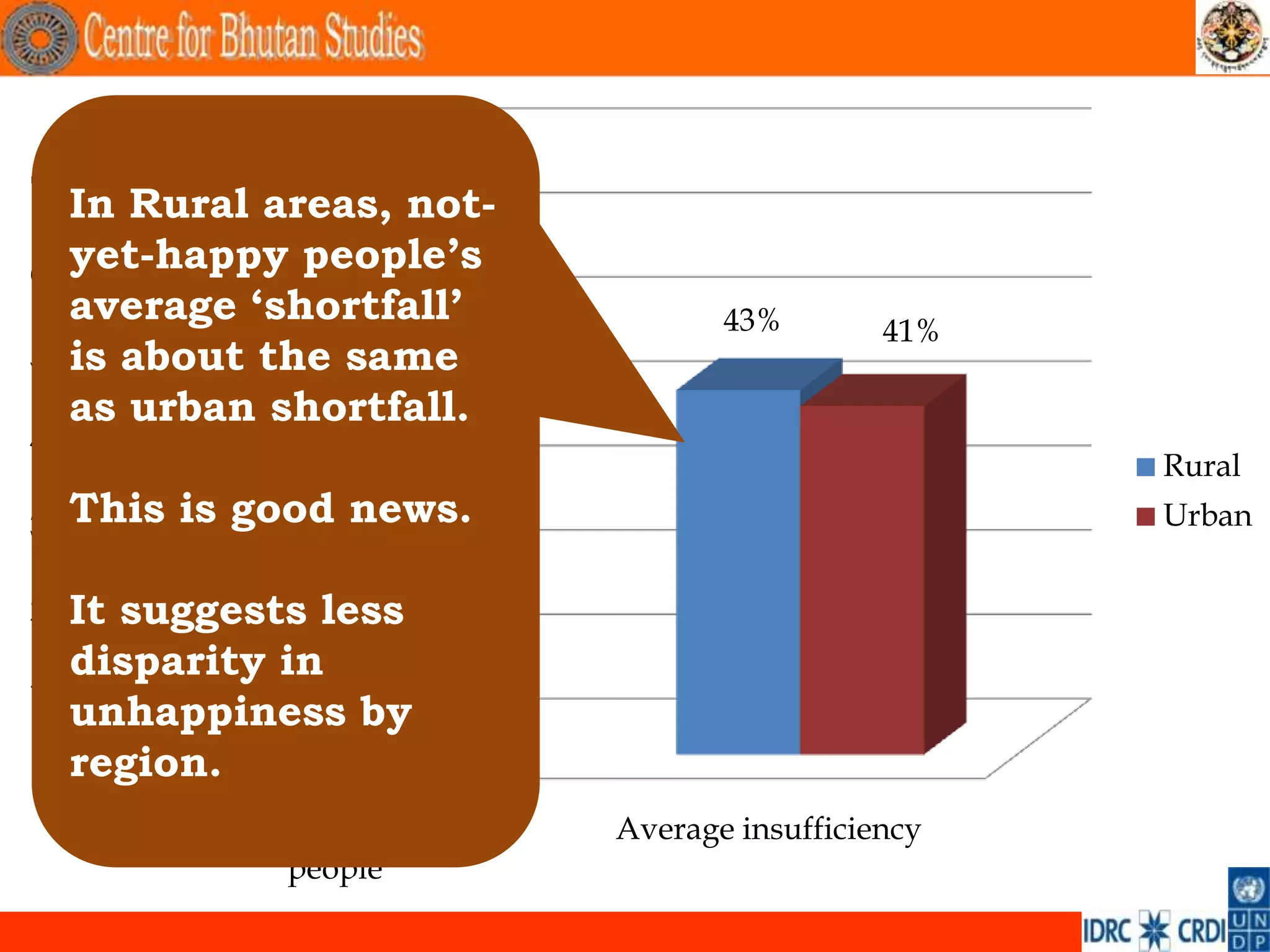
  In Rural areas, not-
  yet-happy people‟s
60%               55%
  average „shortfall‟                   43%        41%
50% about the same
  is
  as urban shortfall.
40%
                                                         Rural
  This
30%      is good news.                                   Urban


  It
20% suggests less
  disparity in
10%
  unhappiness by
  region.
 0%
         Percentage of unhappy   Average insufficiency
                 people
                                                                 .
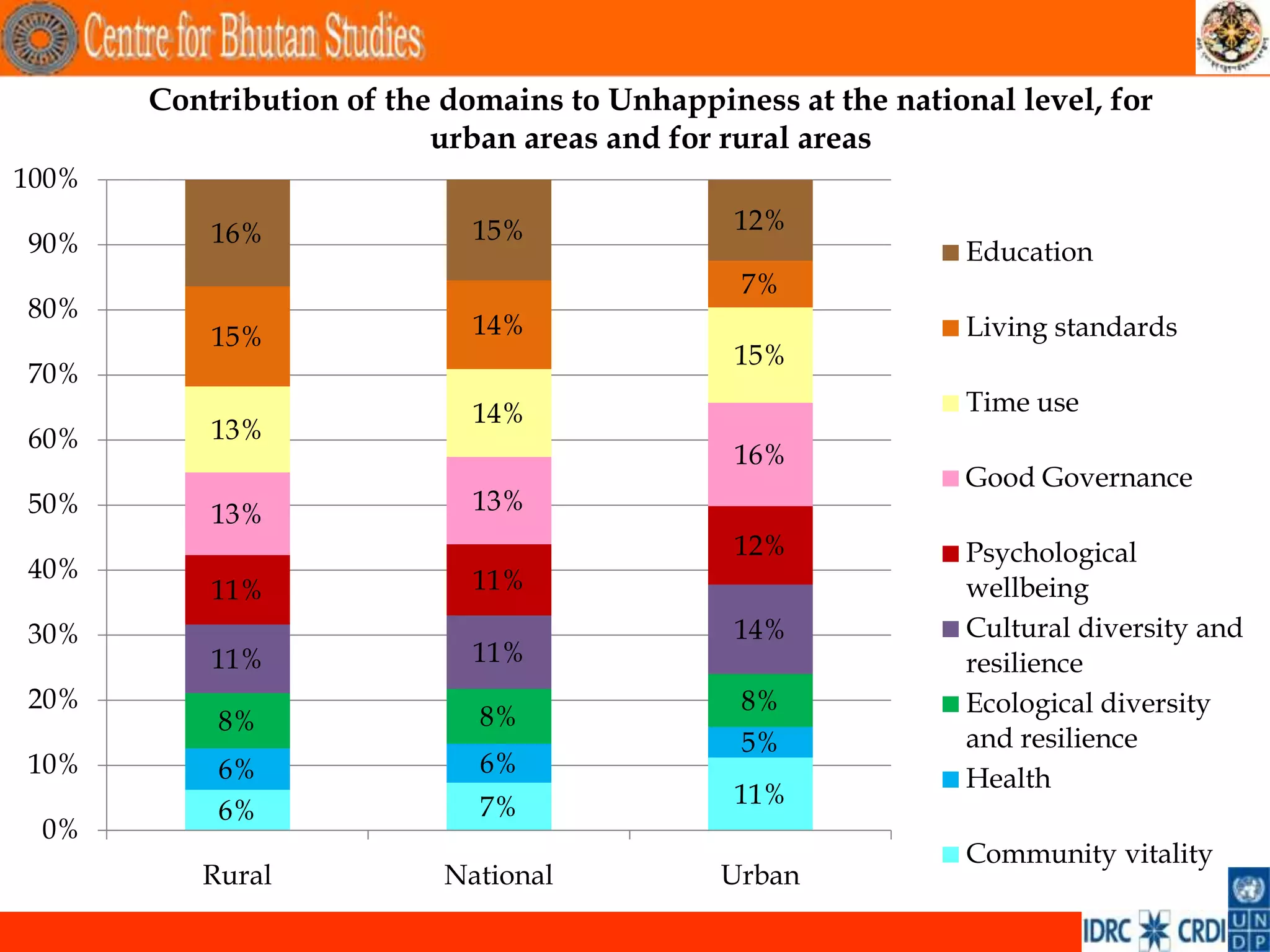
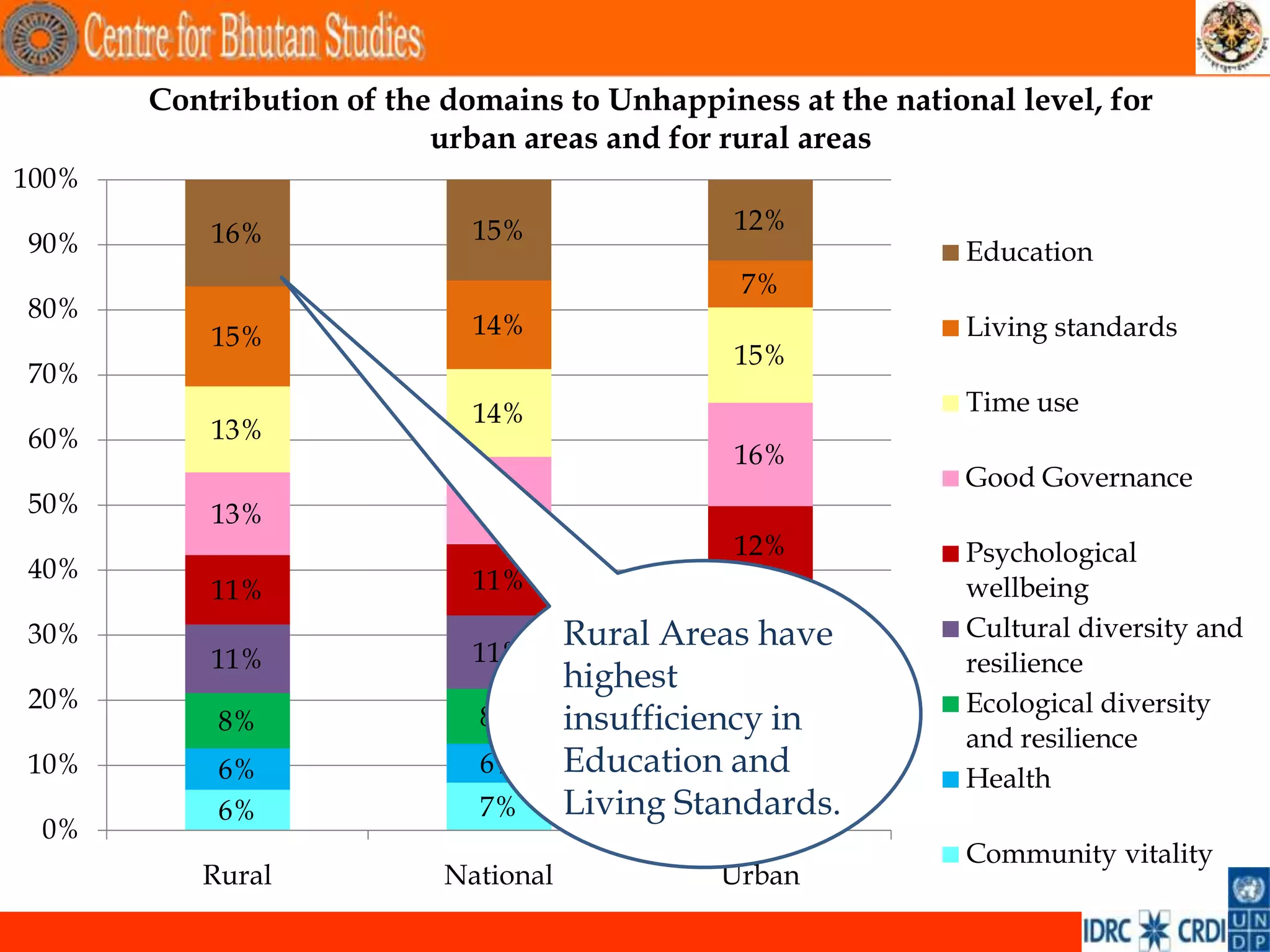
Contribution of the domains to Unhappiness at the national level, for
                          urban areas and for rural areas
100%
           16%               15%               12%
90%                                                            Education
                                               7%
80%
           15%               14%                               Living standards
                                               15%
70%
                             14%                               Time use
60%        13%
                                               16%
                                                               Good Governance
50%        13%               13%
                                               12%             Psychological
40%                          11%
           11%                                                 wellbeing
30%                                            14%             Cultural diversity and
           11%               11%                               resilience
20%                                            8%              Ecological diversity
           8%                8%
                                               5%              and resilience
10%        6%                6%
                                                               Health
                             7%                11%
           6%
 0%
                                                               Community vitality
          Rural            National           Urban
                                                                                        .
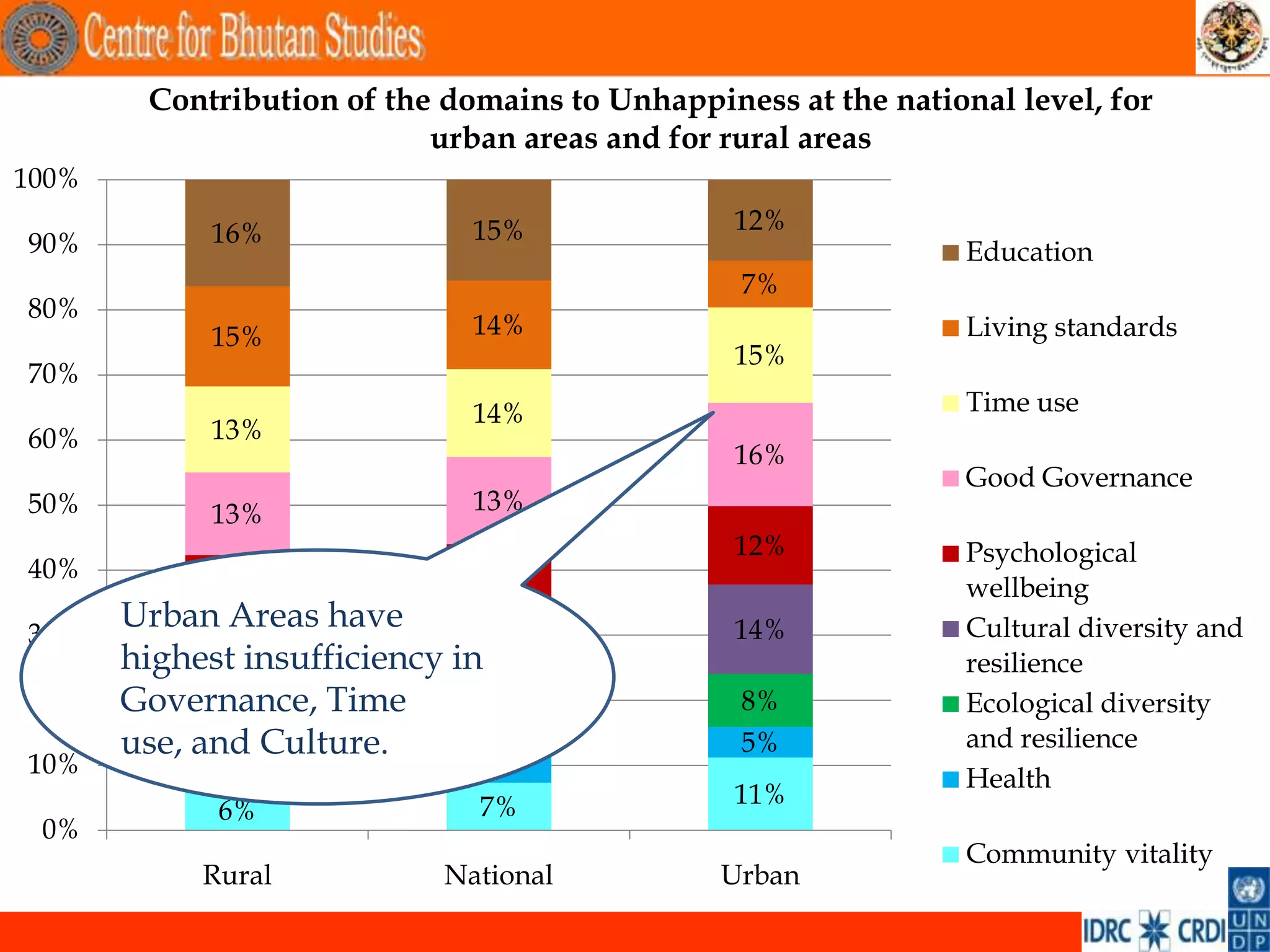
Contribution of the domains to Unhappiness at the national level, for
                           urban areas and for rural areas
100%
             16%              15%               12%
90%                                                             Education
                                                7%
80%
             15%              14%                               Living standards
                                                15%
70%
                              14%                               Time use
60%          13%
                                                16%
                                                                Good Governance
50%          13%              13%
                                                12%             Psychological
40%                           11%
             11%                                                wellbeing
30%
       Urban Areas have                         14%             Cultural diversity and
       highest insufficiency in
             11%               11%                              resilience
20%    Governance, Time        8%
                                                8%              Ecological diversity
             8%
       use, and Culture.                        5%              and resilience
10%          6%               6%
                                                                Health
                              7%                11%
             6%
 0%
                                                                Community vitality
            Rural           National           Urban
                                                                                         .
Contribution of the domains to Unhappiness at the national level, for
                          urban areas and for rural areas
100%
           16%               15%                12%
90%                                                            Education
                                                7%
80%
           15%               14%                               Living standards
                                                15%
70%
                             14%                               Time use
60%        13%
                                                16%
                                                               Good Governance
50%        13%               13%
                                                12%            Psychological
40%                          11%
           11%                                                 wellbeing
30%                                   Rural Areas have
                                                 14%           Cultural diversity and
           11%               11%                               resilience
                                      highest
20%                                               8%           Ecological diversity
           8%                8%       insufficiency in
                                                  5%           and resilience
10%        6%                6%       Education and            Health
                             7%                  11%
                                      Living Standards.
           6%
 0%
                                                               Community vitality
          Rural            National            Urban
                                                                                        .
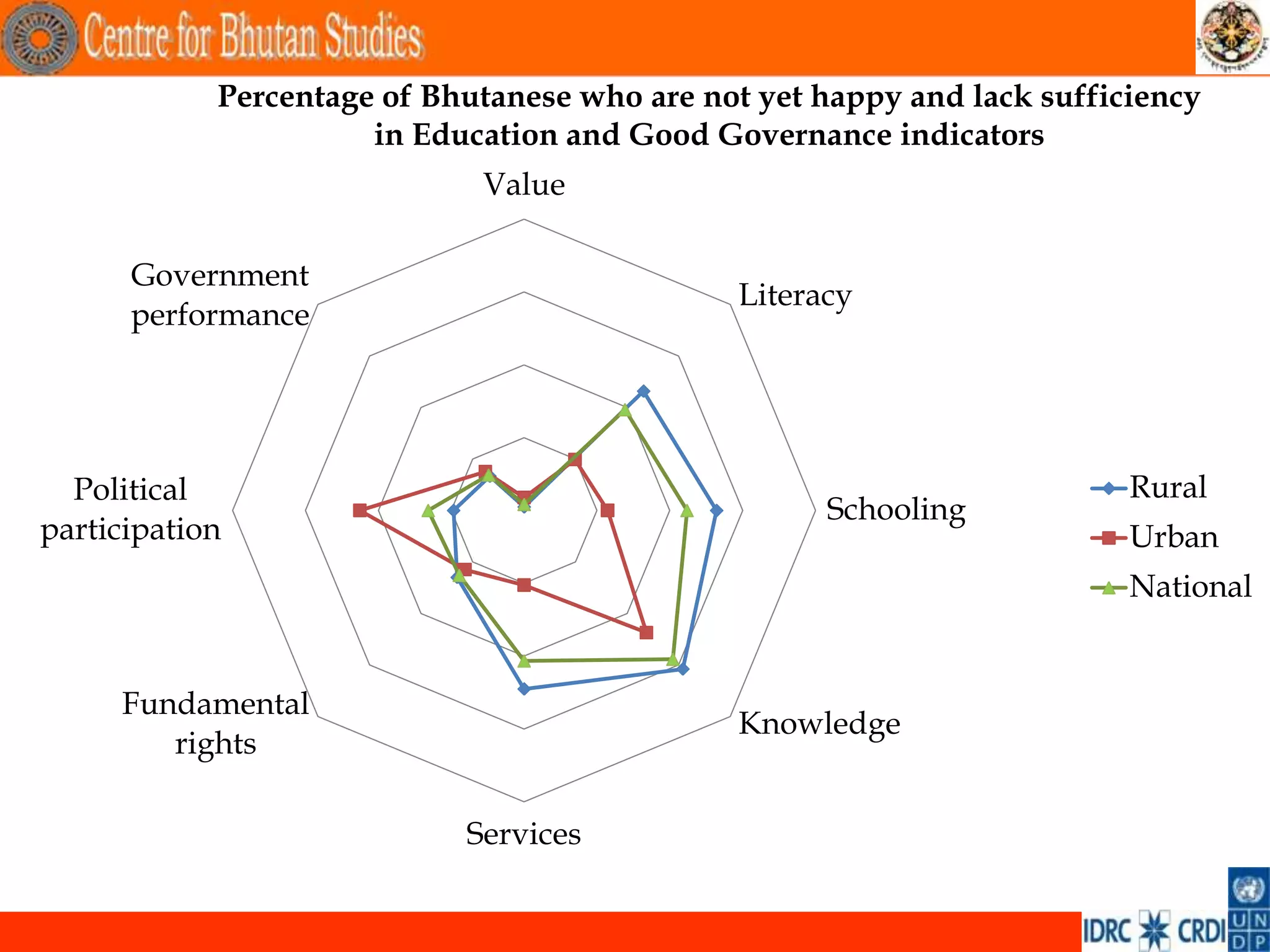
Percentage of Bhutanese who are not yet happy and lack sufficiency
                      in Education and Good Governance indicators
                             Value

      Government
                                              Literacy
      performance


  Political                                                              Rural
                                                    Schooling
participation                                                            Urban
                                                                         National


     Fundamental
                                              Knowledge
        rights

                            Services


                                                                                 .
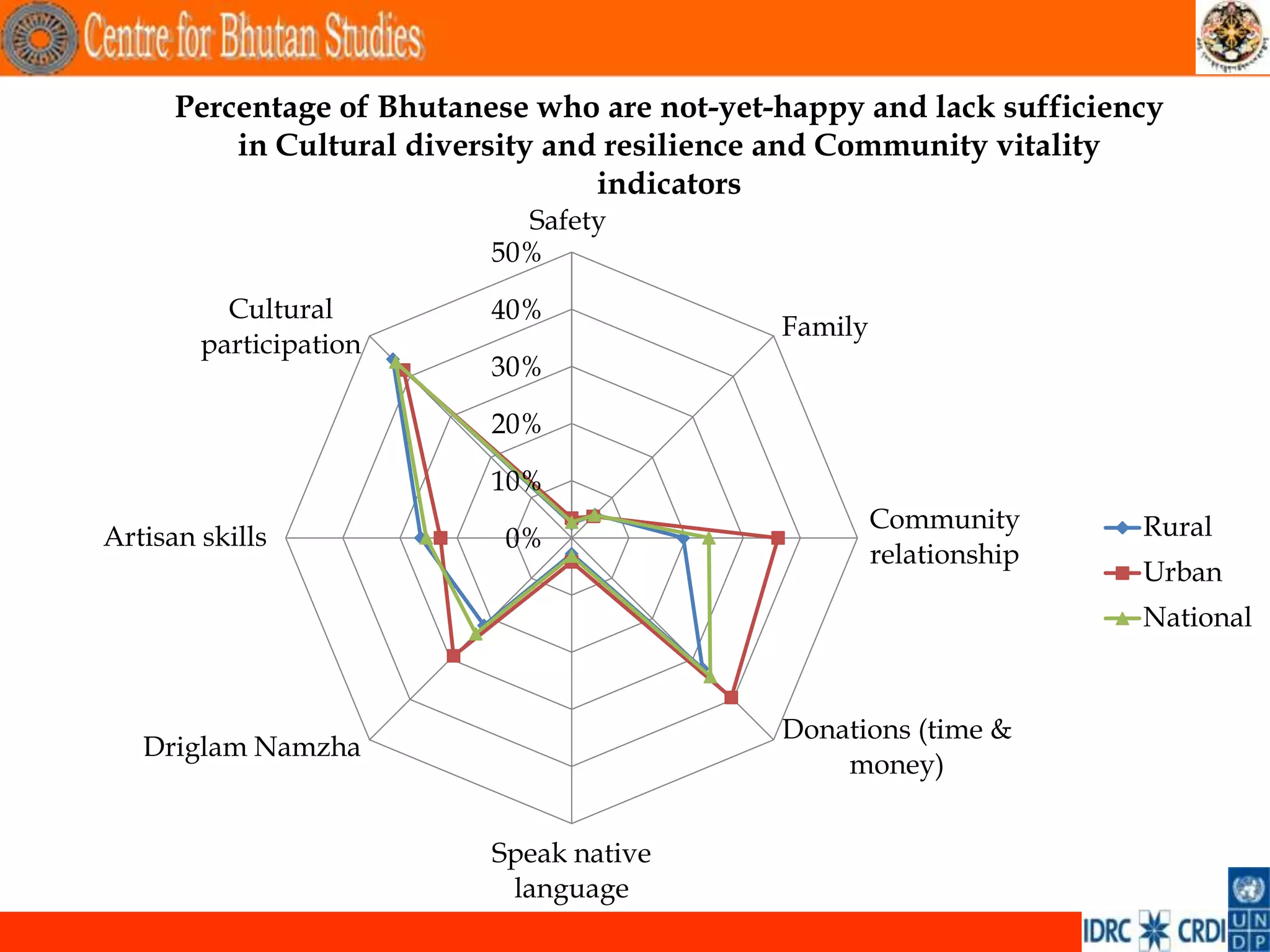
Percentage of Bhutanese who are not-yet-happy and lack sufficiency
          in Cultural diversity and resilience and Community vitality
                                   indicators
                             Safety
                           50%

          Cultural         40%
                                              Family
        participation
                           30%

                           20%

                           10%
                                                       Community      Rural
Artisan skills              0%
                                                       relationship
                                                                      Urban
                                                                      National


                                              Donations (time &
   Driglam Namzha
                                                  money)


                           Speak native
                            language
                                                                              .
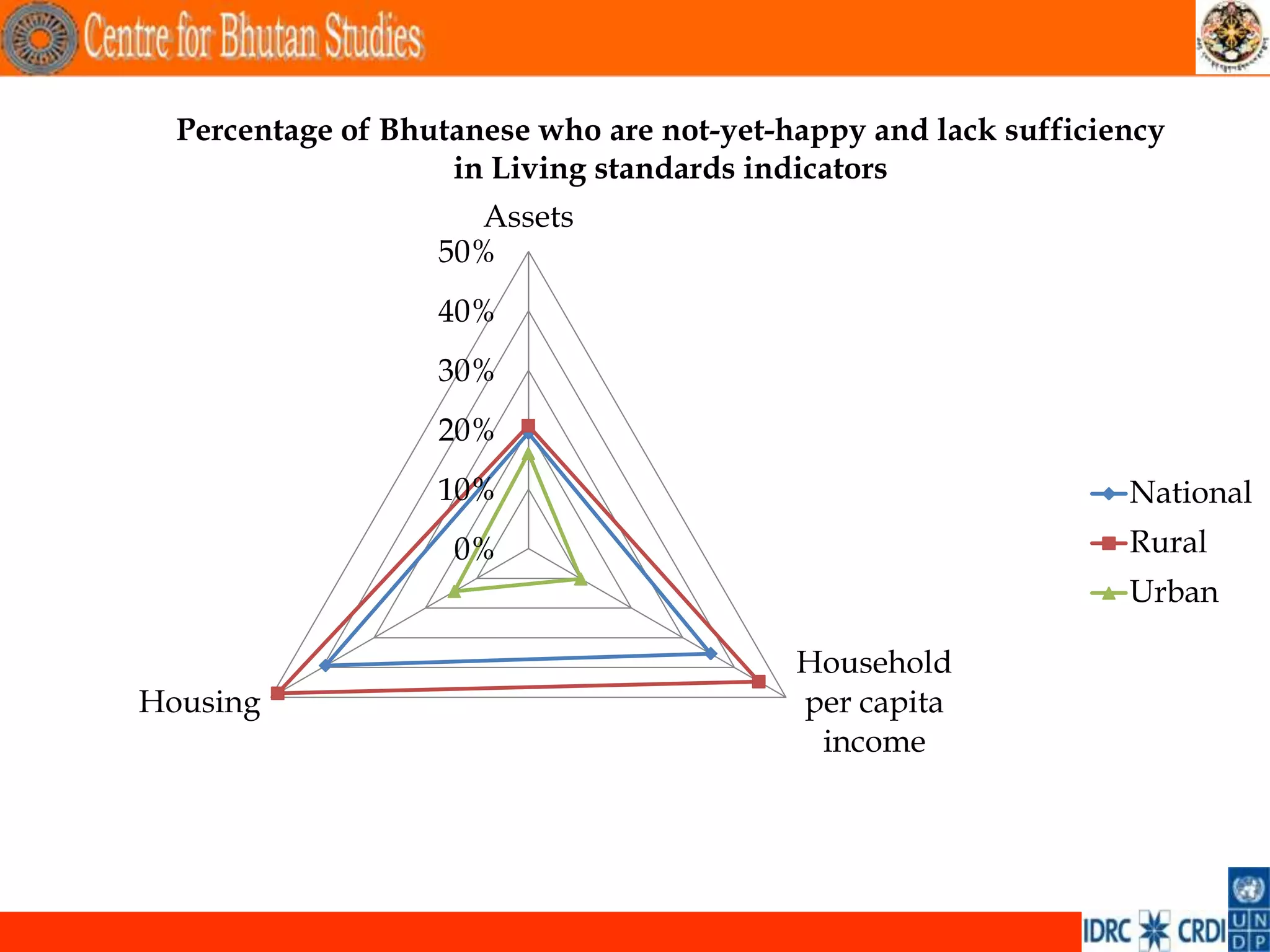
Percentage of Bhutanese who are not-yet-happy and lack sufficiency
                    in Living standards indicators
                     Assets
                   50%
                   40%
                   30%
                   20%
                   10%                                           National
                    0%                                           Rural
                                                                 Urban

                                           Household
Housing                                    per capita
                                            income


                                                                         .
Part III:
Increasing Happiness
1.   GNH Index and Policy: concern for Unhappiness
2.   Insufficiencies by Dzongkhag
3.   Insufficiencies by region
4.   Insufficiencies by gender
5.   Insufficiencies by age group
6.   Insufficiencies by marital status
7.   Insufficiencies by occupational group
8.   Policy recommendations
9.   Sustaining GNH
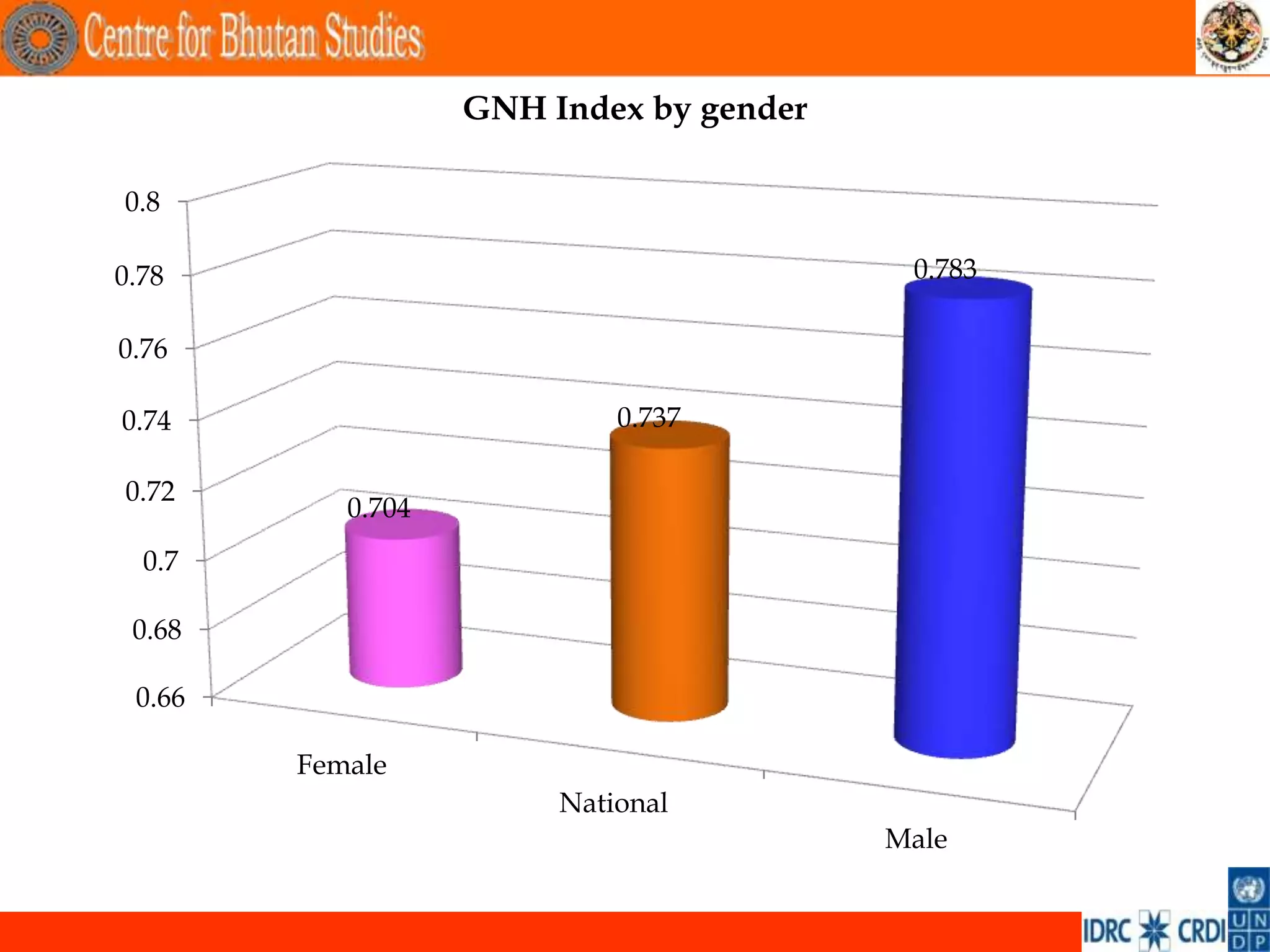
GNH Index by gender

0.8

0.78                                      0.783

0.76

0.74                        0.737

0.72
           0.704
  0.7

 0.68

 0.66

        Female
                        National
                                         Male


                                                  .
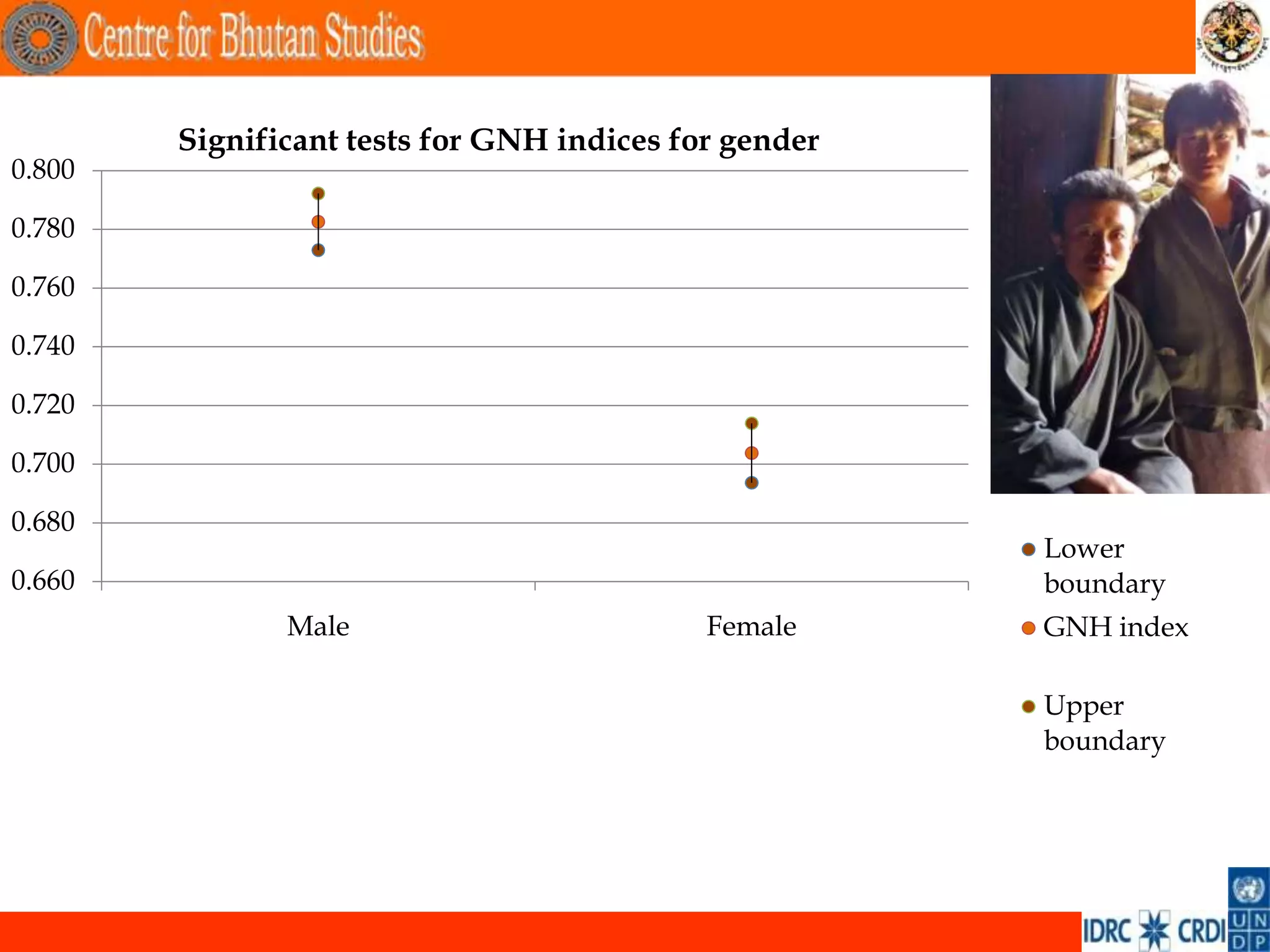
Significant tests for GNH indices for gender
0.800

0.780

0.760

0.740

0.720

0.700

0.680
                                                       Lower
0.660                                                  boundary
               Male                         Female     GNH index

                                                       Upper
                                                       boundary


                                                                   .
67%
70%

60%
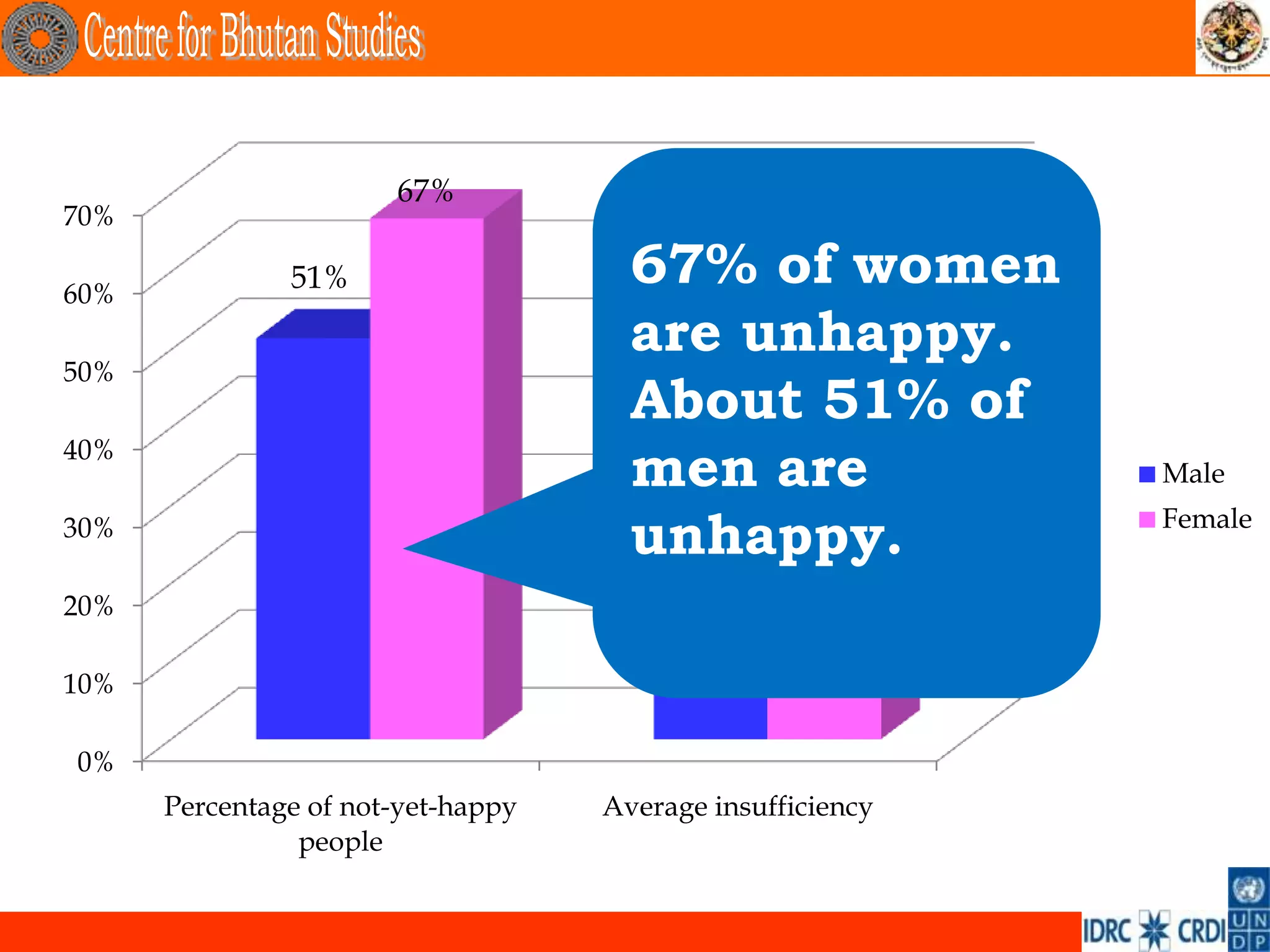
               51%                    67% of women
                                      are unhappy.
                                            44%
50%                                     42%
                                      About 51% of
40%
                                      men are               Male
30%
                                      unhappy.              Female


20%

10%

0%
      Percentage of not-yet-happy   Average insufficiency
                people
67%
70%
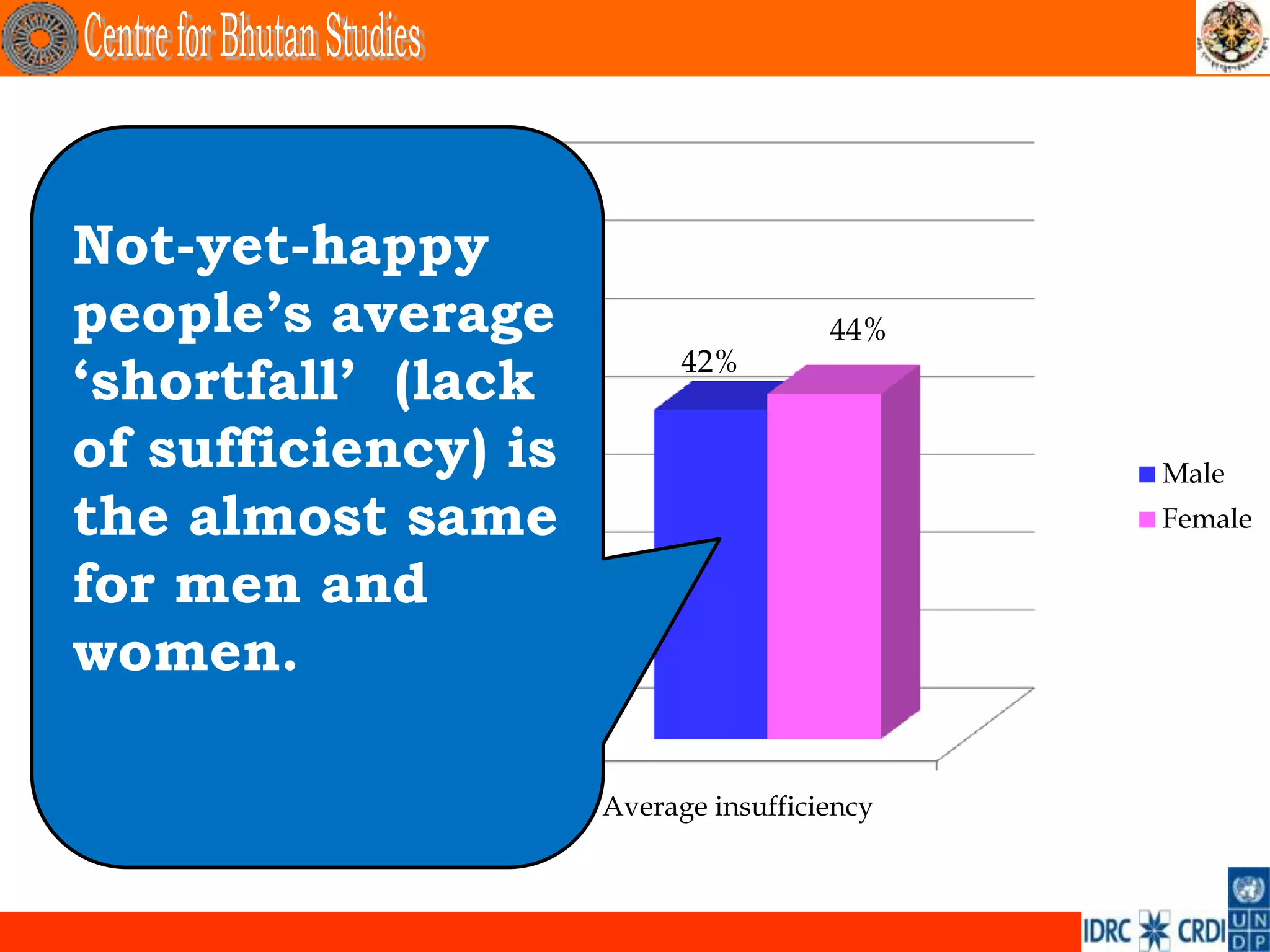
 Not-yet-happy
         51%
60%
 people‟s average                              44%
                                    42%
 „shortfall‟ (lack
50%

40% sufficiency) is
 of                                                   Male
 the almost same
30%                                                   Female

 for men and
20%
 women.
10%

0%
      Percentage of unhappy   Average insufficiency
              people
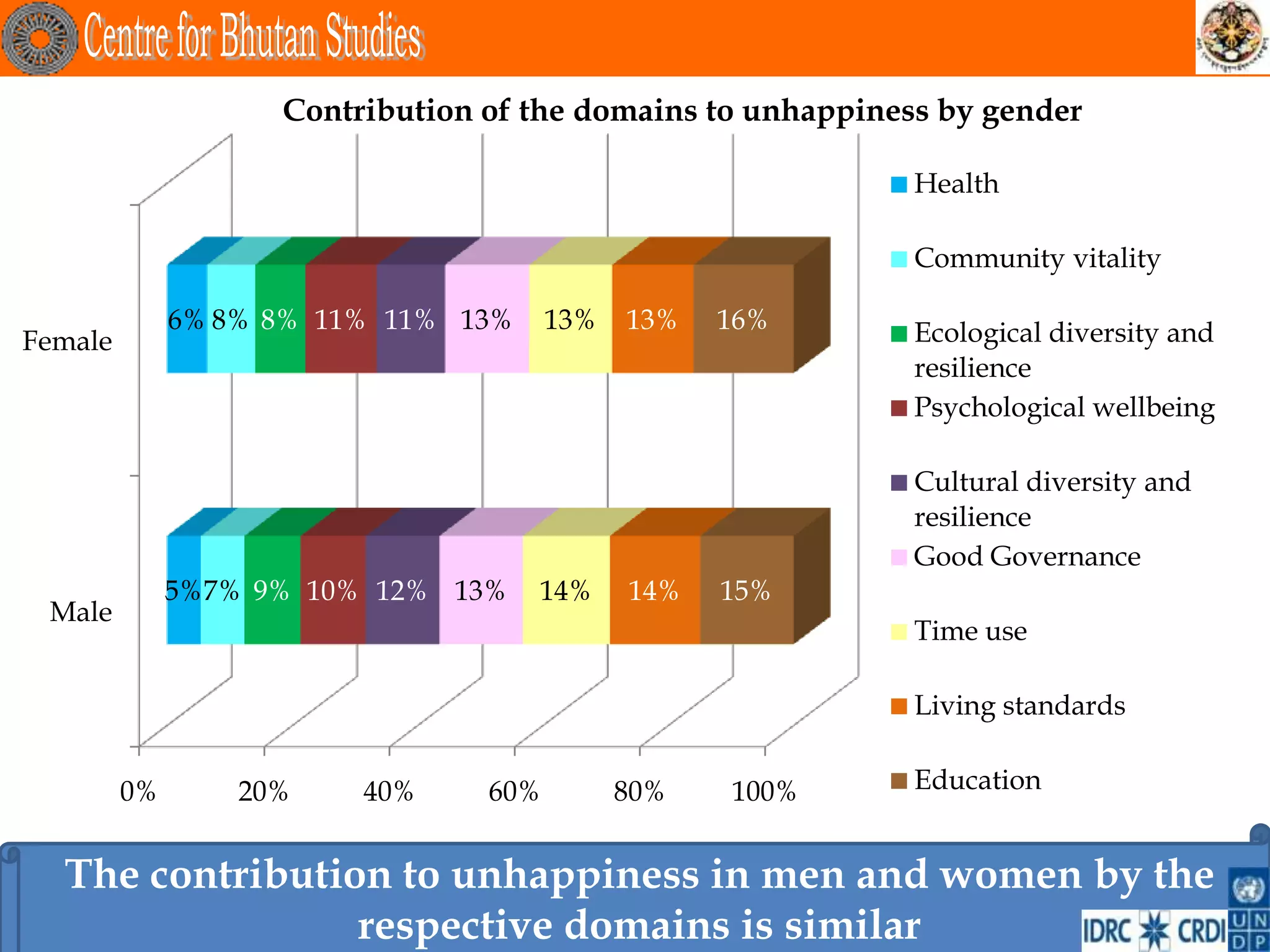
Contribution of the domains to unhappiness by gender

                                                             Health

                                                             Community vitality

              6% 8% 8% 11% 11% 13%     13%   13%   16%       Ecological diversity and
Female
                                                             resilience
                                                             Psychological wellbeing

                                                             Cultural diversity and
                                                             resilience
                                                             Good Governance
              5% 7% 9% 10% 12% 13%   14%     14%   15%
 Male
                                                             Time use

                                                             Living standards


         0%       20%    40%     60%         80%   100%      Education


  The contribution to unhappiness in men and women by the
                 respective domains is similar
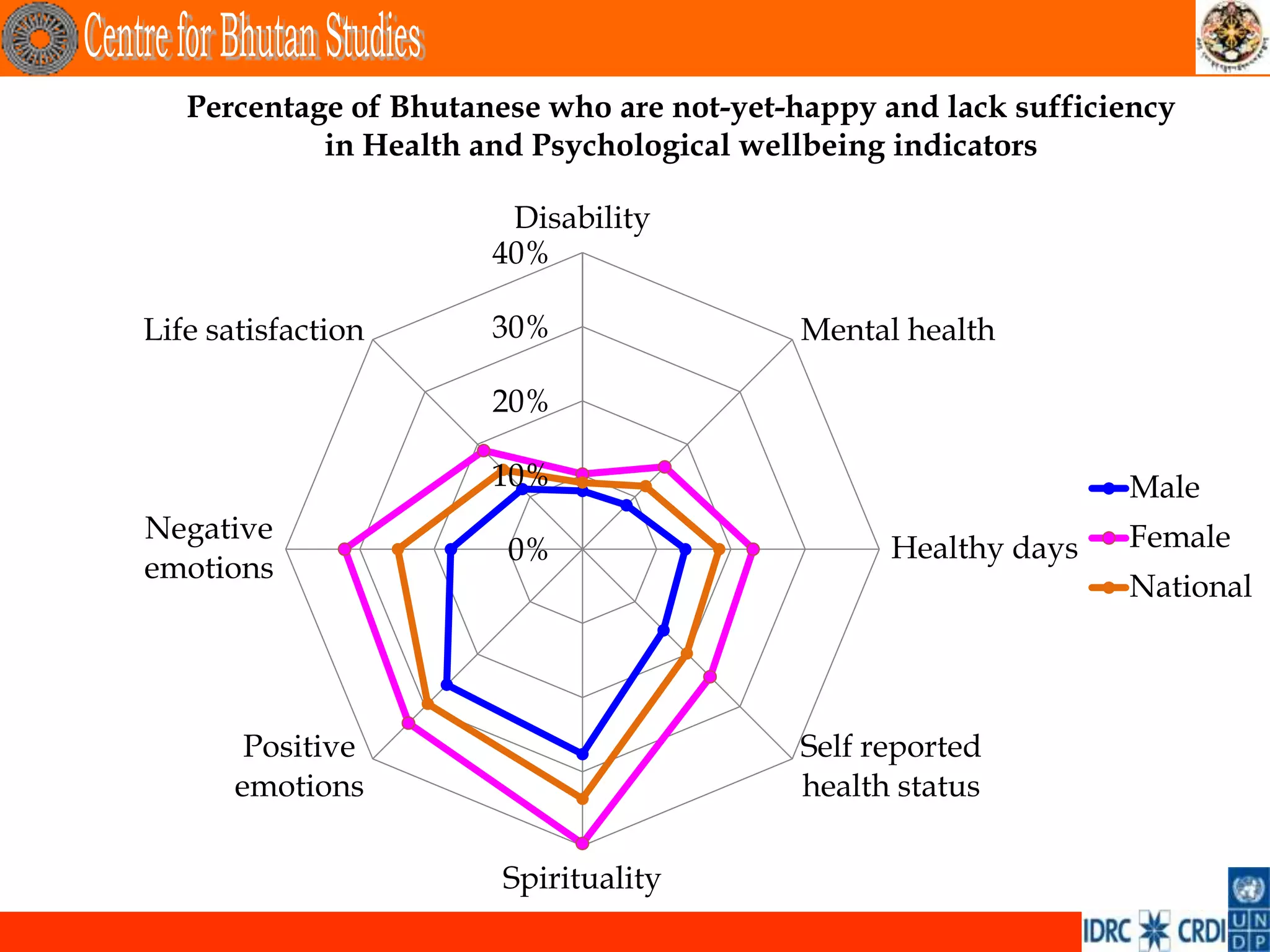
Percentage of Bhutanese who are not-yet-happy and lack sufficiency
            in Health and Psychological wellbeing indicators

                        Disability
                       40%

Life satisfaction      30%                 Mental health

                       20%

                       10%                                       Male
Negative                                                         Female
                        0%                        Healthy days
emotions
                                                                 National


        Positive                           Self reported
       emotions                            health status

                        Spirituality
Part III:
Increasing Happiness
1.   GNH Index and Policy: concern for Unhappiness
2.   Insufficiencies by Dzongkhag
3.   Insufficiencies by region
4.   Insufficiencies by gender
5.   Insufficiencies by age group
6.   Insufficiencies by marital status
7.   Insufficiencies by occupational group
8.   Policy recommendations
9.   Sustaining GNH
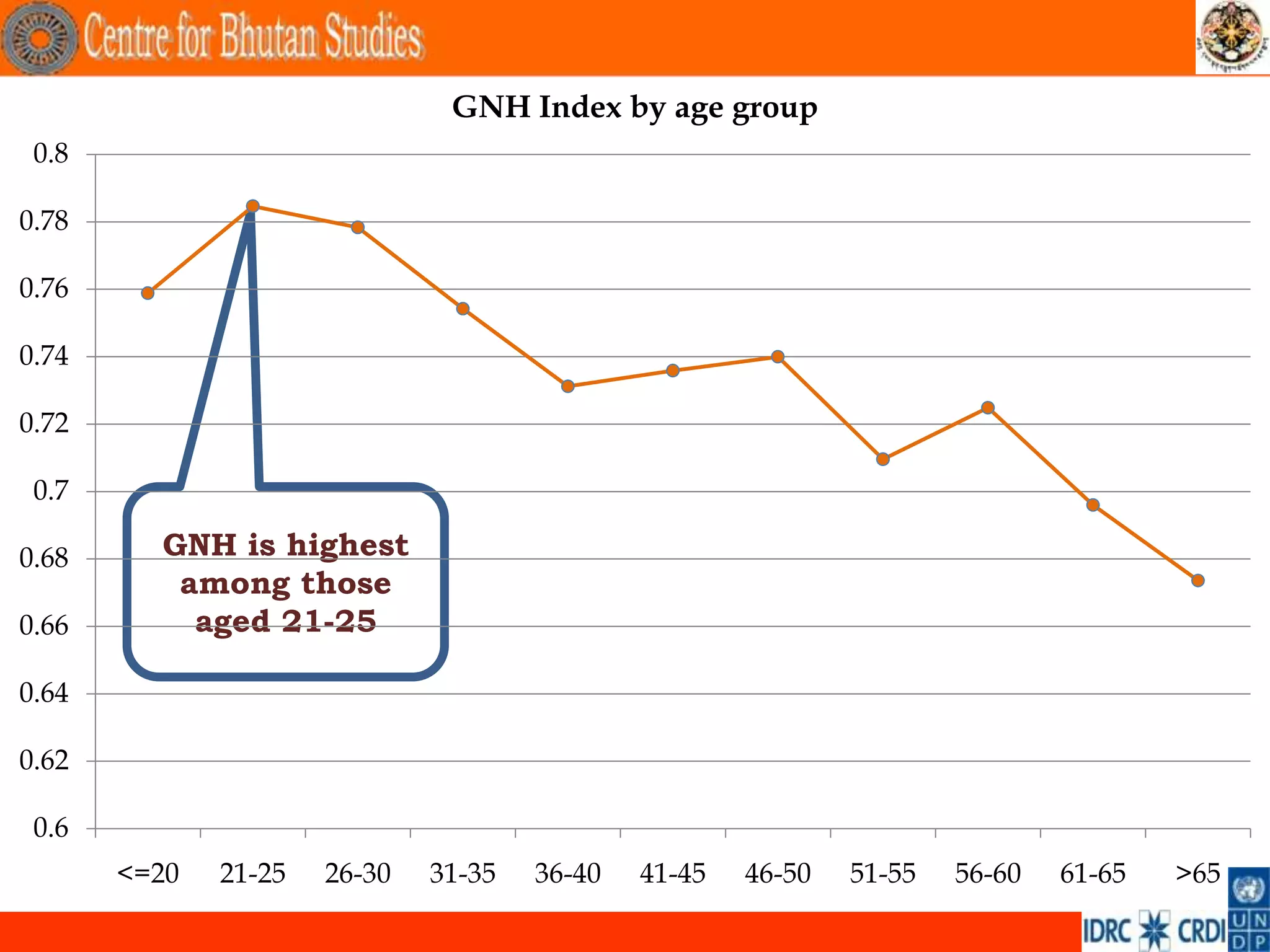
GNH Index by age group
 0.8

0.78

0.76

0.74

0.72

 0.7

0.68     GNH is highest
          among those
0.66       aged 21-25

0.64

0.62

 0.6
       <=20   21-25   26-30   31-35   36-40   41-45   46-50   51-55   56-60   61-65   >65

                                                                                            .
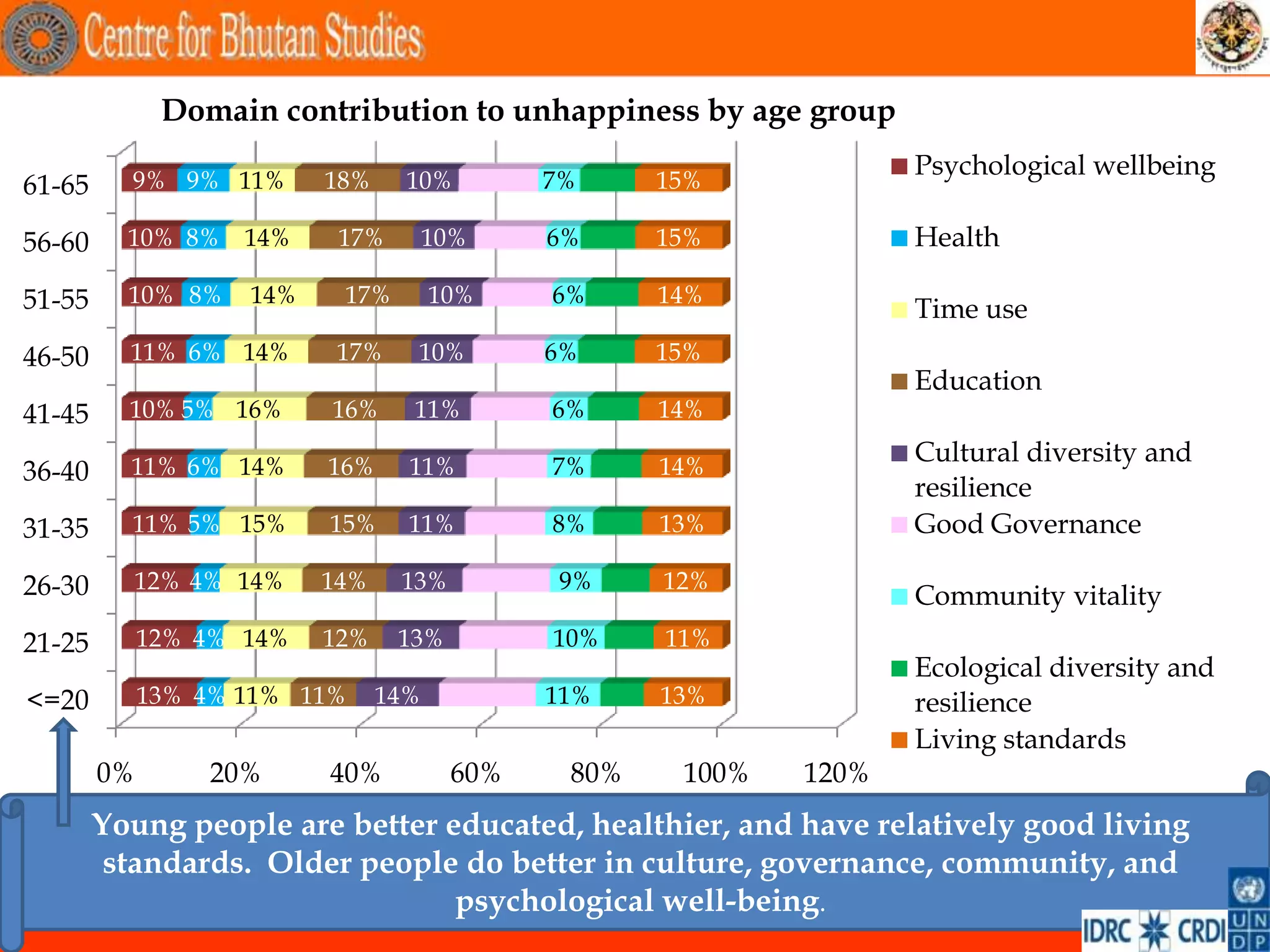
Domain contribution to unhappiness by age group
                                                                   Psychological wellbeing
61-65     9% 9% 11%       18%     10%        7%     15%

56-60     10% 8%    14%    17%        10%    6%     15%            Health

51-55     10% 8%    14%    17%        10%    6%     14%
                                                                   Time use
46-50     11% 6% 14%       17%    10%        6%     15%
                                                                   Education
41-45     10% 5% 16%      16%     11%        6%     14%

          11% 6% 14%      16%     11%        7%     14%
                                                                   Cultural diversity and
36-40
                                                                   resilience
31-35     11% 5% 15%      15%     11%        8%     13%            Good Governance

26-30        12% 4% 14%   14%    13%         9%     12%
                                                                   Community vitality
21-25        12% 4% 14%   12%    13%         10%    11%
                                                                   Ecological diversity and
<=20         13% 4% 11% 11%     14%          11%    13%            resilience
                                                                   Living standards
        0%        20%     40%          60%    80%    100%   120%
        Young people are better educated, healthier, and have relatively good living
         standards. Older people do better in culture, governance, community, and
                                 psychological well-being.
                                                                                              .
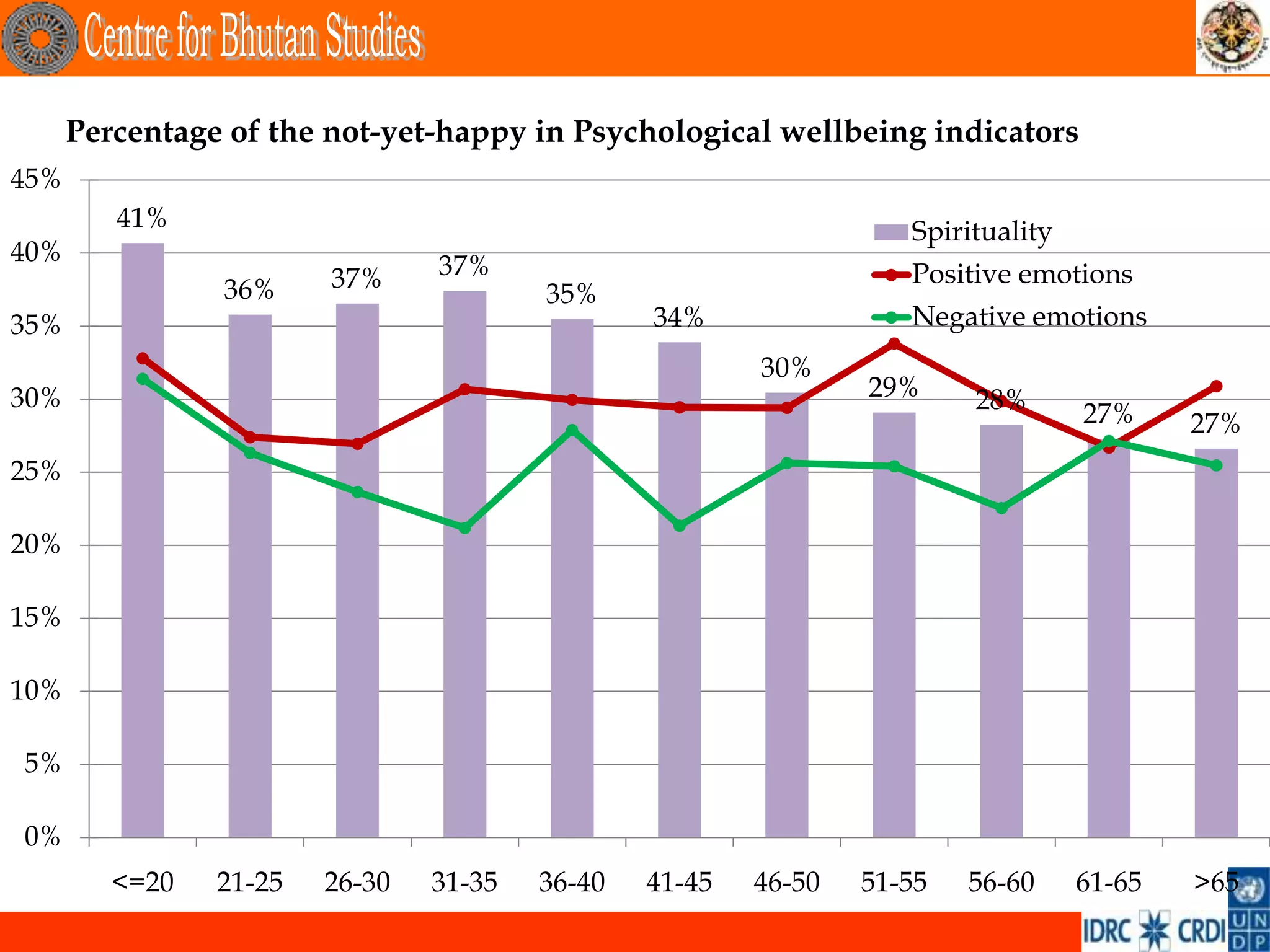
Percentage of the not-yet-happy in Psychological wellbeing indicators
45%
         41%                                                       Spirituality
40%                             37%
                        37%                                        Positive emotions
                36%                     35%
35%                                             34%                Negative emotions
                                                        30%
30%                                                             29%     28%       27%     27%
25%

20%

15%

10%

5%

0%
         <=20   21-25   26-30   31-35   36-40   41-45   46-50   51-55   56-60     61-65   >65
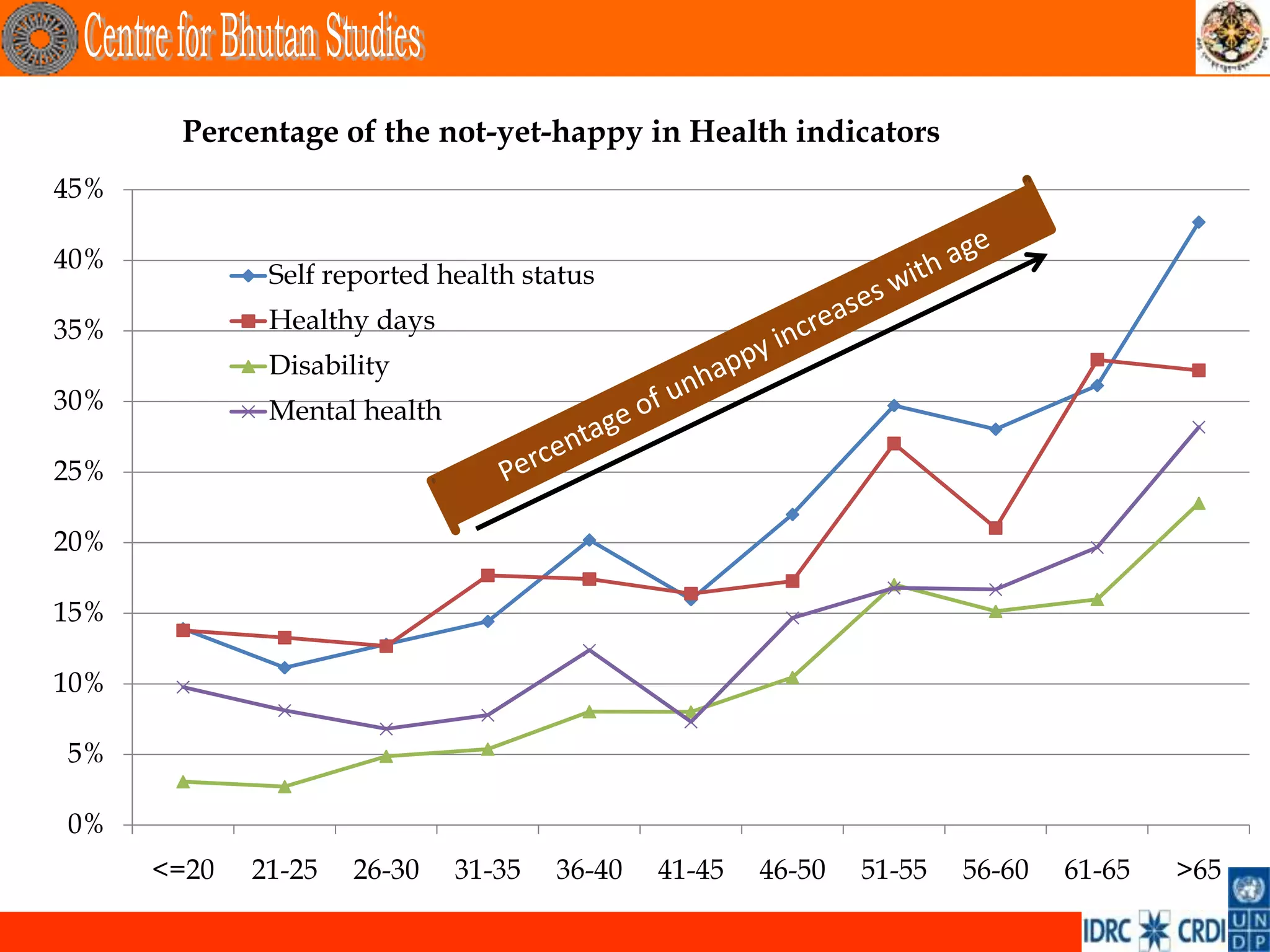
Percentage of the not-yet-happy in Health indicators
45%

40%
              Self reported health status
35%           Healthy days
              Disability
30%           Mental health

25%

20%

15%

10%

5%

0%
      <=20   21-25   26-30    31-35   36-40   41-45   46-50   51-55   56-60   61-65   >65
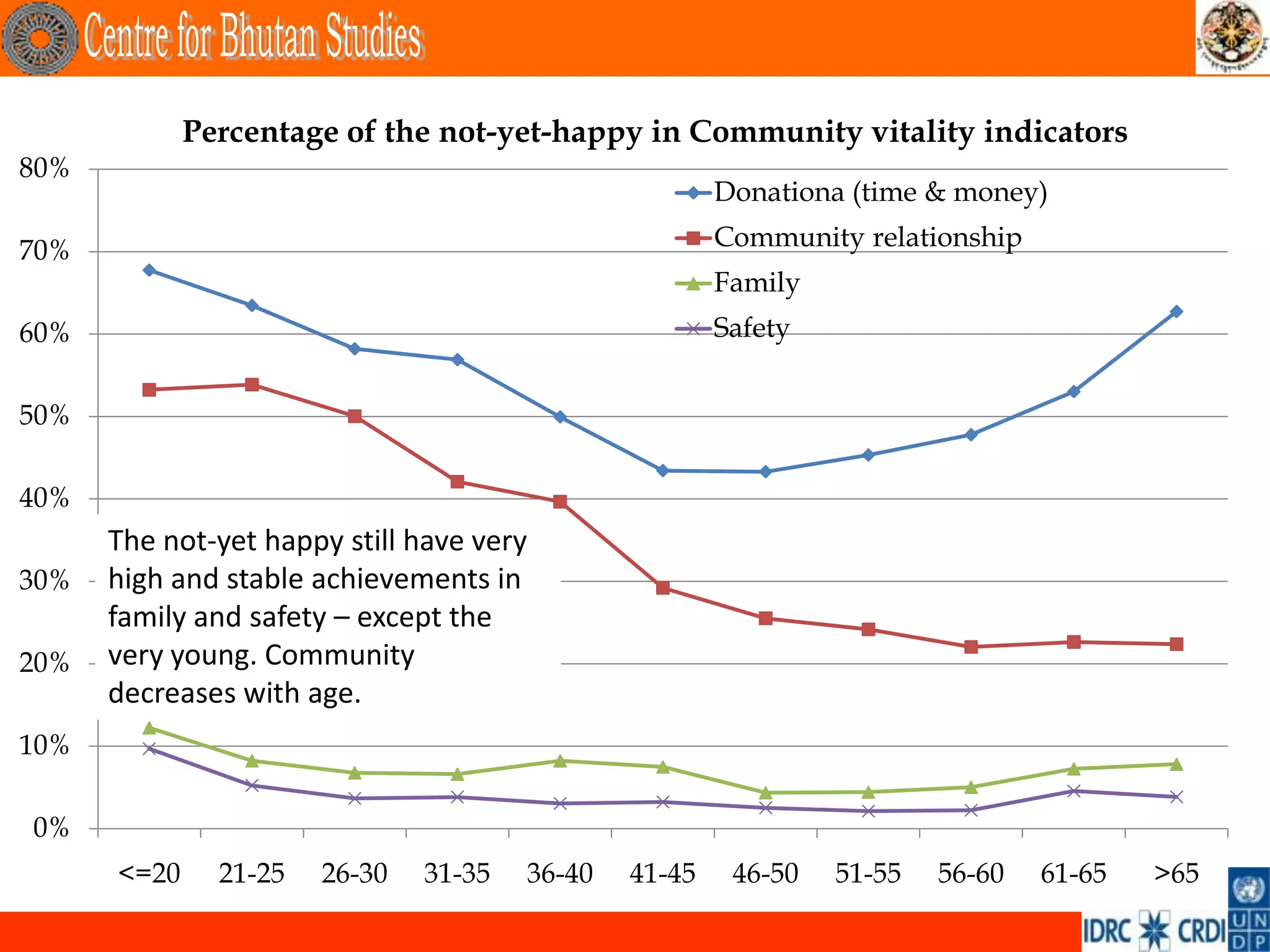
Percentage of the not-yet-happy in Community vitality indicators
80%
                                                       Donationa (time & money)

70%                                                    Community relationship
                                                       Family
60%                                                    Safety


50%

40%
      The not-yet happy still have very
30%   high and stable achievements in
      family and safety – except the
20%   very young. Community
      decreases with age.
10%

0%
      <=20     21-25   26-30   31-35   36-40   41-45    46-50   51-55   56-60   61-65   >65
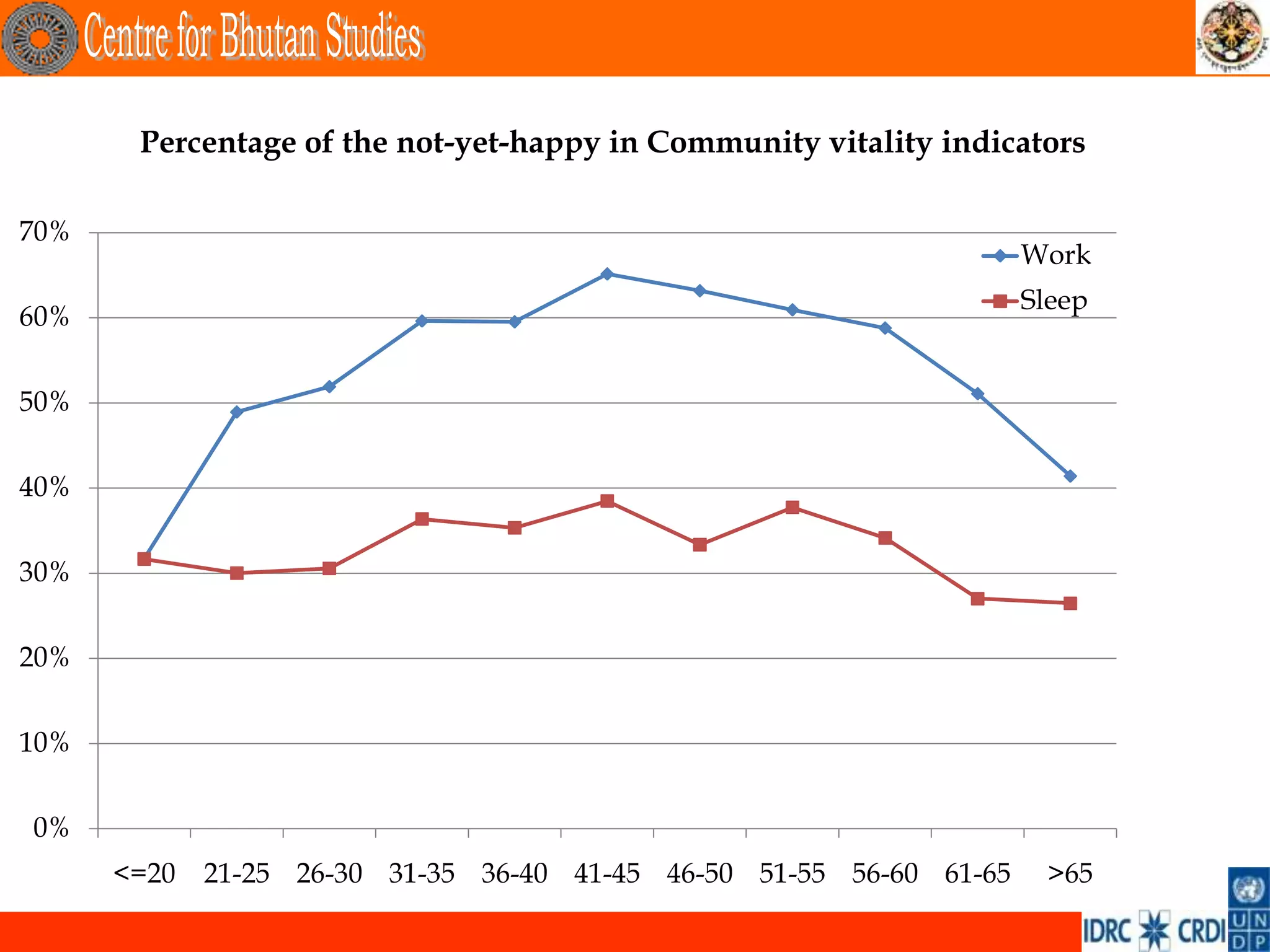
Percentage of the not-yet-happy in Community vitality indicators

70%
                                                                     Work
                                                                     Sleep
60%


50%


40%


30%


20%


10%


0%
      <=20   21-25 26-30 31-35 36-40 41-45 46-50 51-55 56-60 61-65    >65
Part III:
Increasing Happiness
1.   GNH Index and Policy: concern for Unhappiness
2.   Insufficiencies by Dzongkhag
3.   Insufficiencies by region
4.   Insufficiencies by gender
5.   Insufficiencies by age group
6.   Insufficiencies by marital status
7.   Insufficiencies by occupational group
8.   Policy recommendations
9.   Sustaining GNH
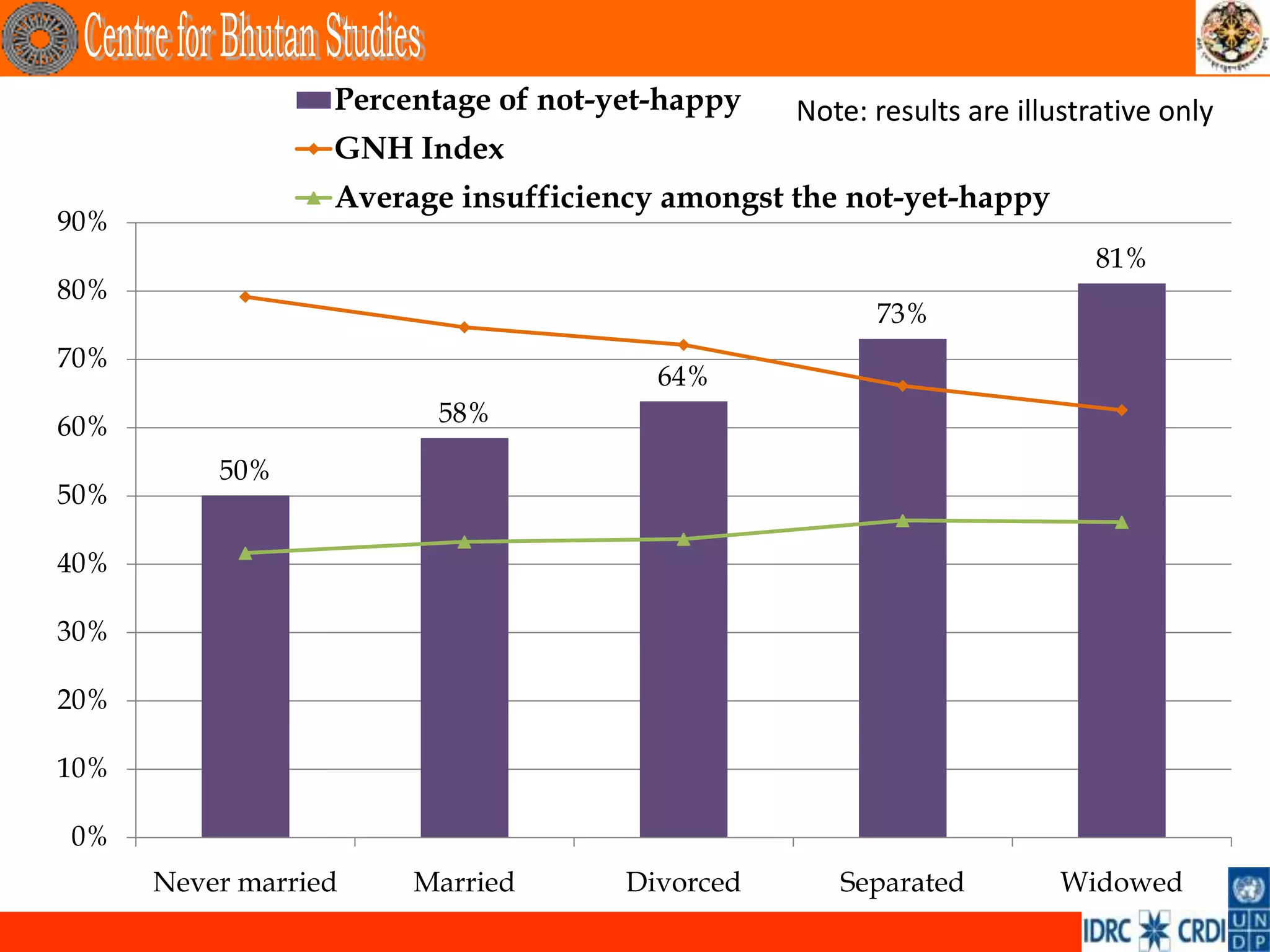
Percentage of not-yet-happy   Note: results are illustrative only
                  GNH Index
                  Average insufficiency amongst the not-yet-happy
90%
                                                                         81%
80%
                                                      73%
70%
                                       64%
60%                     58%

          50%
50%

40%

30%

20%

10%

0%
      Never married    Married       Divorced      Separated          Widowed
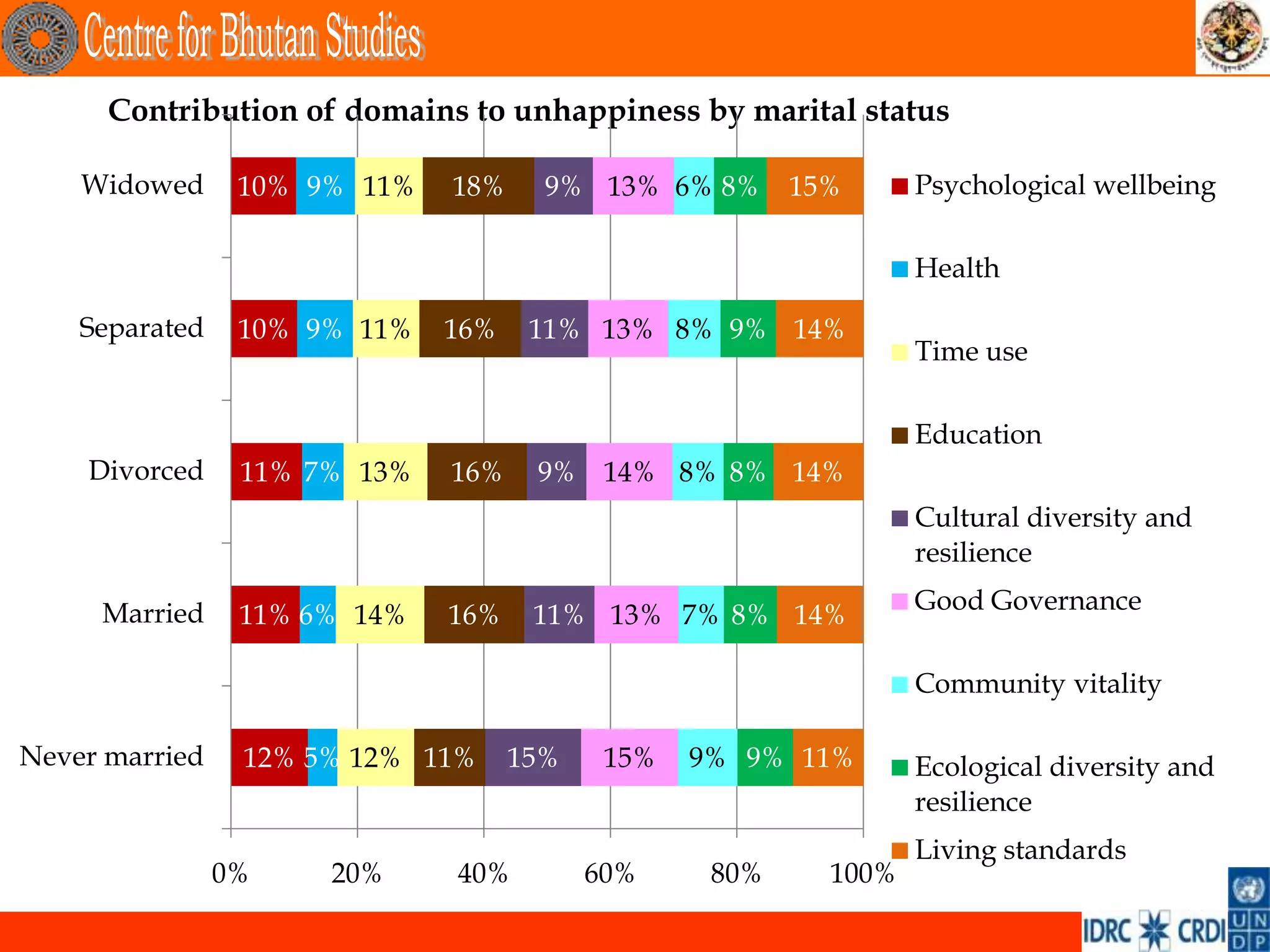
Contribution of domains to unhappiness by marital status

    Widowed      10% 9% 11%   18%     9% 13% 6% 8%      15%      Psychological wellbeing

                                                                 Health

    Separated    10% 9% 11%   16%    11% 13% 8% 9% 14%
                                                                 Time use

                                                                 Education
    Divorced     11% 7% 13%   16%    9% 14% 8% 8% 14%
                                                                 Cultural diversity and
                                                                 resilience

     Married                                                     Good Governance
                 11% 6% 14%   16%    11% 13% 7% 8% 14%

                                                                 Community vitality

Never married    12% 5% 12% 11%     15%    15%   9% 9% 11%       Ecological diversity and
                                                                 resilience
                                                                 Living standards
                0%    20%     40%         60%     80%     100%
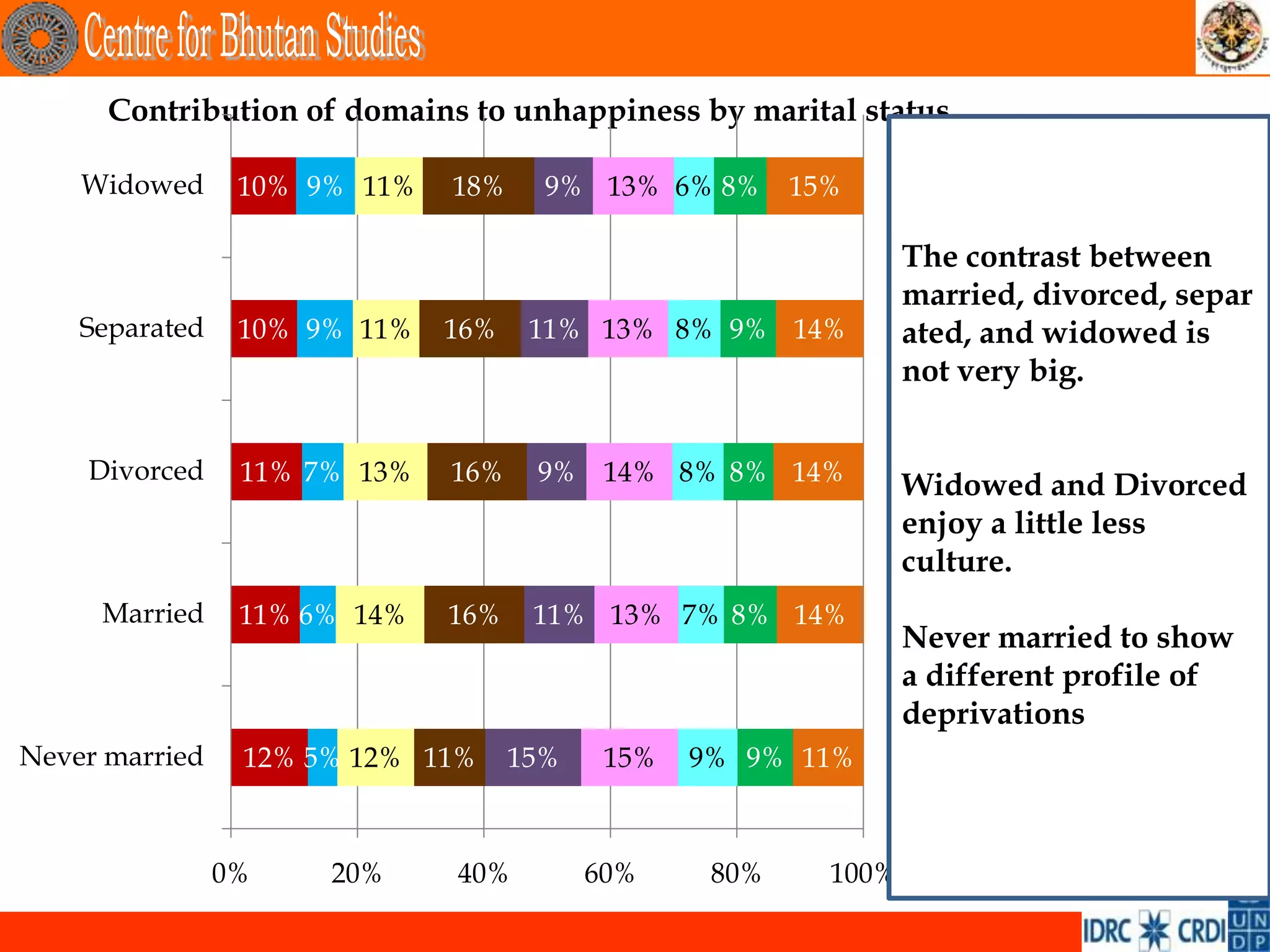
Contribution of domains to unhappiness by marital status

    Widowed      10% 9% 11%   18%     9% 13% 6% 8%      15%      Psychological wellbeing

                                                                 The contrast between
                                                                  Health
                                                                 married, divorced, separ
    Separated    10% 9% 11%   16%    11% 13% 8% 9% 14%           ated, and widowed is
                                                                  Time use
                                                                 not very big.
                                                                 Education
    Divorced     11% 7% 13%   16%    9% 14% 8% 8% 14%            Widowed and Divorced
                                                                 enjoy a little lessand
                                                                  Cultural diversity
                                                                  resilience
                                                                 culture.
     Married                                                     Good Governance
                 11% 6% 14%   16%    11% 13% 7% 8% 14%
                                                                 Never married to show
                                                                 aCommunityprofile of
                                                                   different vitality
                                                                 deprivations
Never married    12% 5% 12% 11%     15%    15%   9% 9% 11%       Ecological diversity and
                                                                 resilience
                                                                 Living standards
                0%    20%     40%         60%     80%     100%
Part III:
Increasing Happiness
1.   GNH Index and Policy: concern for Unhappiness
2.   Insufficiencies by Dzongkhag
3.   Insufficiencies by region
4.   Insufficiencies by gender
5.   Insufficiencies by age group
6.   Insufficiencies by marital status
7.   Insufficiencies by occupational group
8.   Policy recommendations
9.   Sustaining GNH
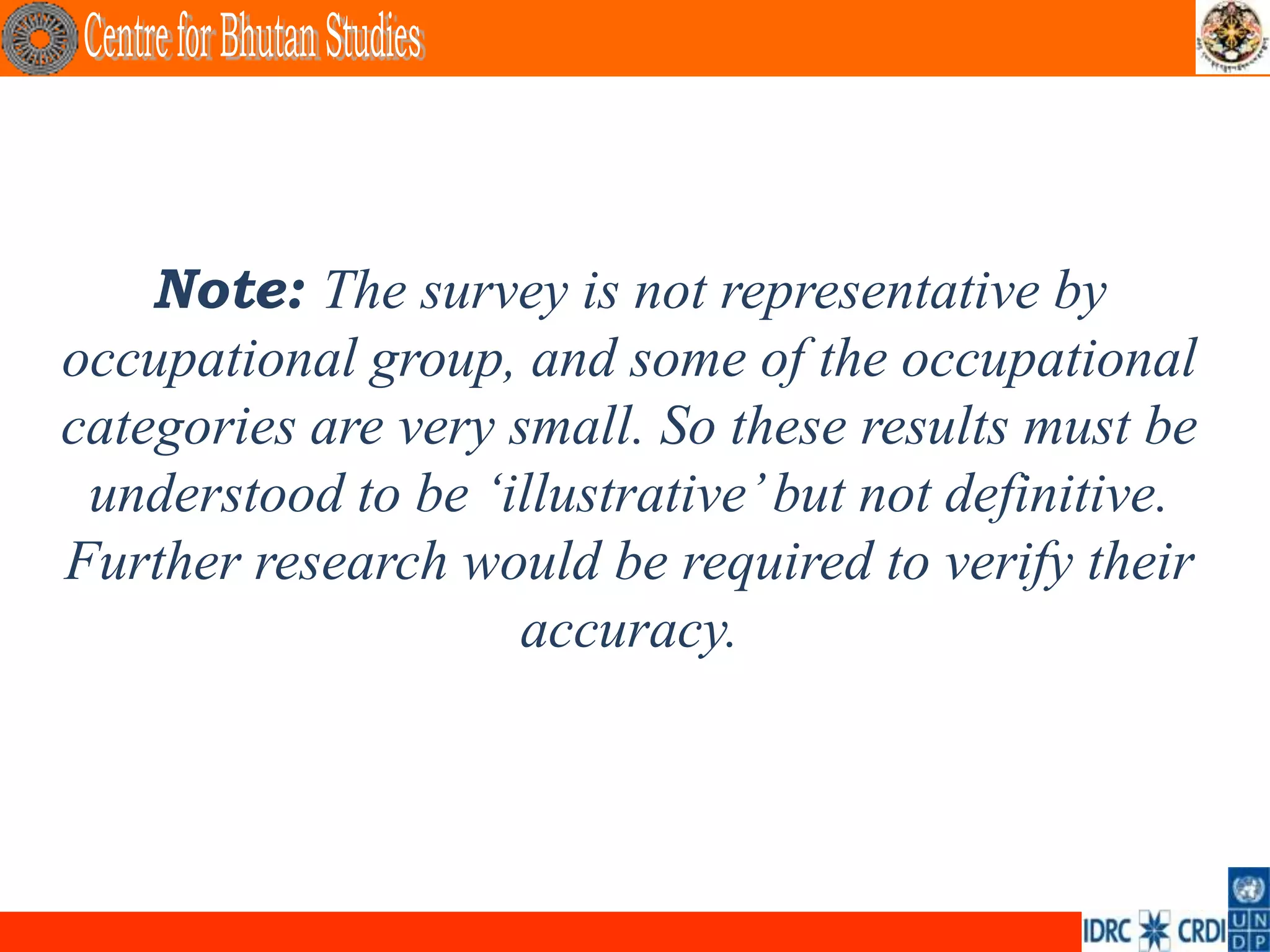
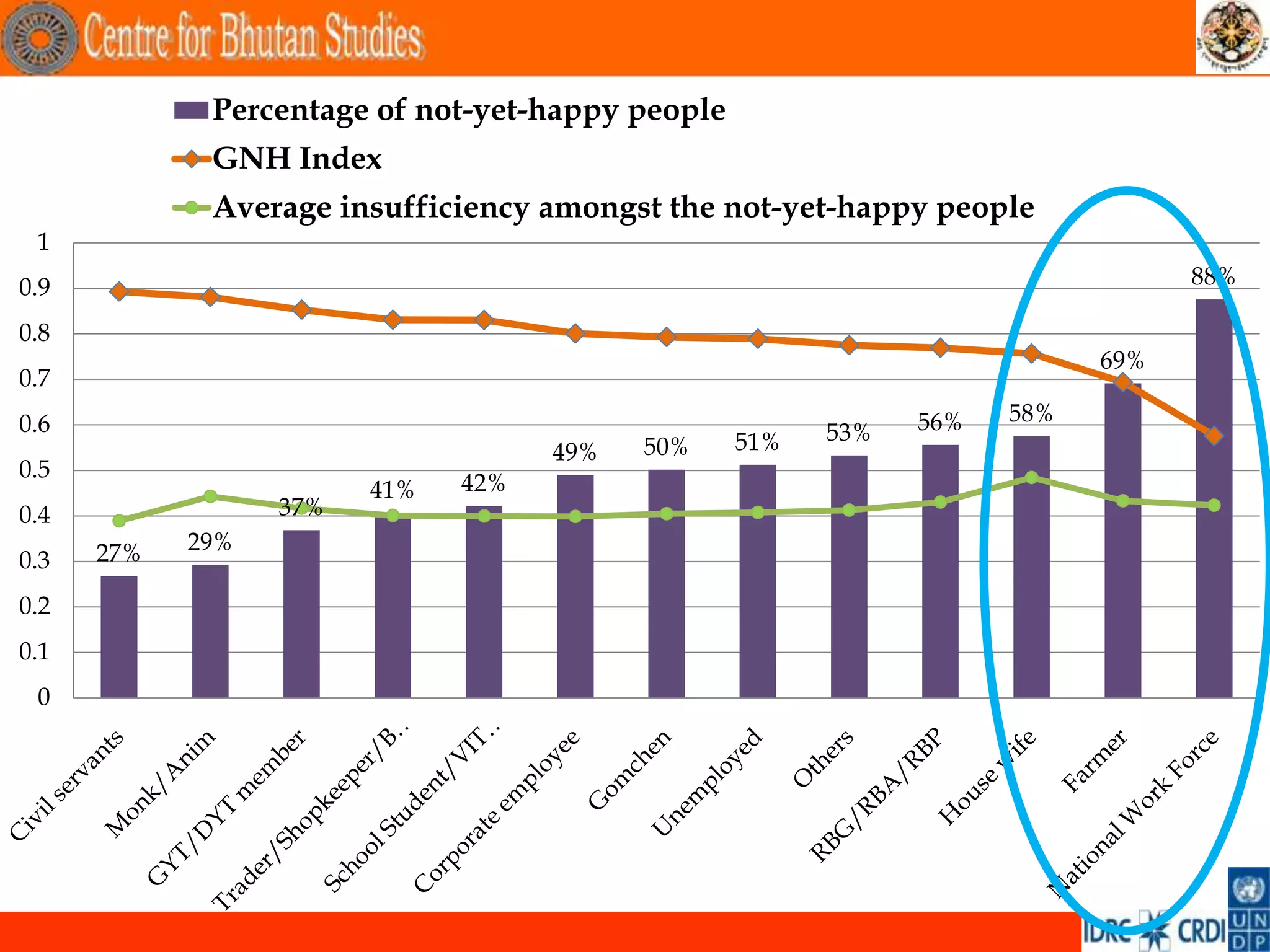
Note: The survey is not representative by
occupational group, and some of the occupational
categories are very small. So these results must be
 understood to be ‘illustrative’ but not definitive.
Further research would be required to verify their
                    accuracy.
Percentage of not-yet-happy people
             GNH Index
             Average insufficiency amongst the not-yet-happy people
 1
0.9                                                                             88%

0.8
                                                                          69%
0.7
0.6                                                           56%   58%
                                                  51%   53%
                                    49%   50%
0.5
                        41%   42%
0.4               37%
      27%   29%
0.3
0.2
0.1
 0


                                                                                      .
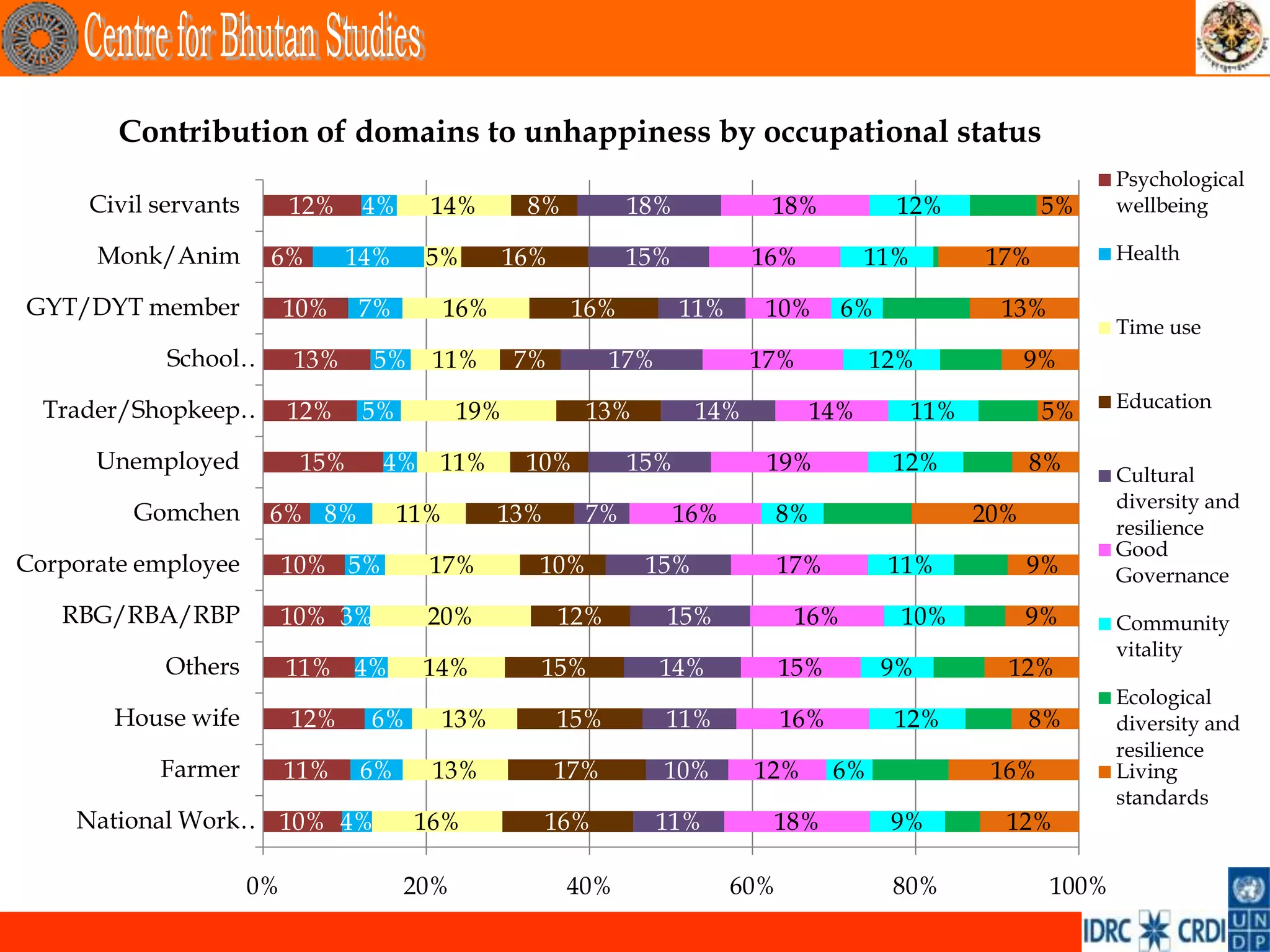
Contribution of domains to unhappiness by occupational status
                                                                                                                    Psychological
     Civil servants        12%    4%      14%       8%          18%           18%             12%            5%     wellbeing

      Monk/Anim        6%        14%     5%        16%          15%          16%          11%         17%           Health

GYT/DYT member             10%    7%         16%          16%         11%     10%        6%            13%
                                                                                                                    Time use
            School…        13%      5%    11%       7%         17%           17%             12%            9%

  Trader/Shopkeep… 12%                                                                                              Education
                                  5%         19%           13%         14%          14%         11%          5%

      Unemployed            15%     4% 11%          10%         15%           19%             12%           8%      Cultural
                                                                                                                    diversity and
         Gomchen       6% 8%           11%         13%     7%         16%         8%                  20%
                                                                                                                    resilience
                                                                                                                    Good
Corporate employee         10% 5%         17%        10%         15%              17%         11%           9%      Governance
   RBG/RBA/RBP             10% 3%        20%             12%         15%           16%         10%          9%      Community
                                                                                                                    vitality
            Others         11% 4%        14%         15%             14%          15%         9%        12%
                                                                                                                    Ecological
       House wife          12%    6%      13%            15%         11%          16%         12%           8%      diversity and
                                                                                                                    resilience
           Farmer          11%    6%      13%            17%         10%     12%        6%             16%          Living
                                                                                                                    standards
    National Work… 10% 4%                16%             16%         11%      18%             9%        12%

                      0%               20%                40%               60%               80%            100%
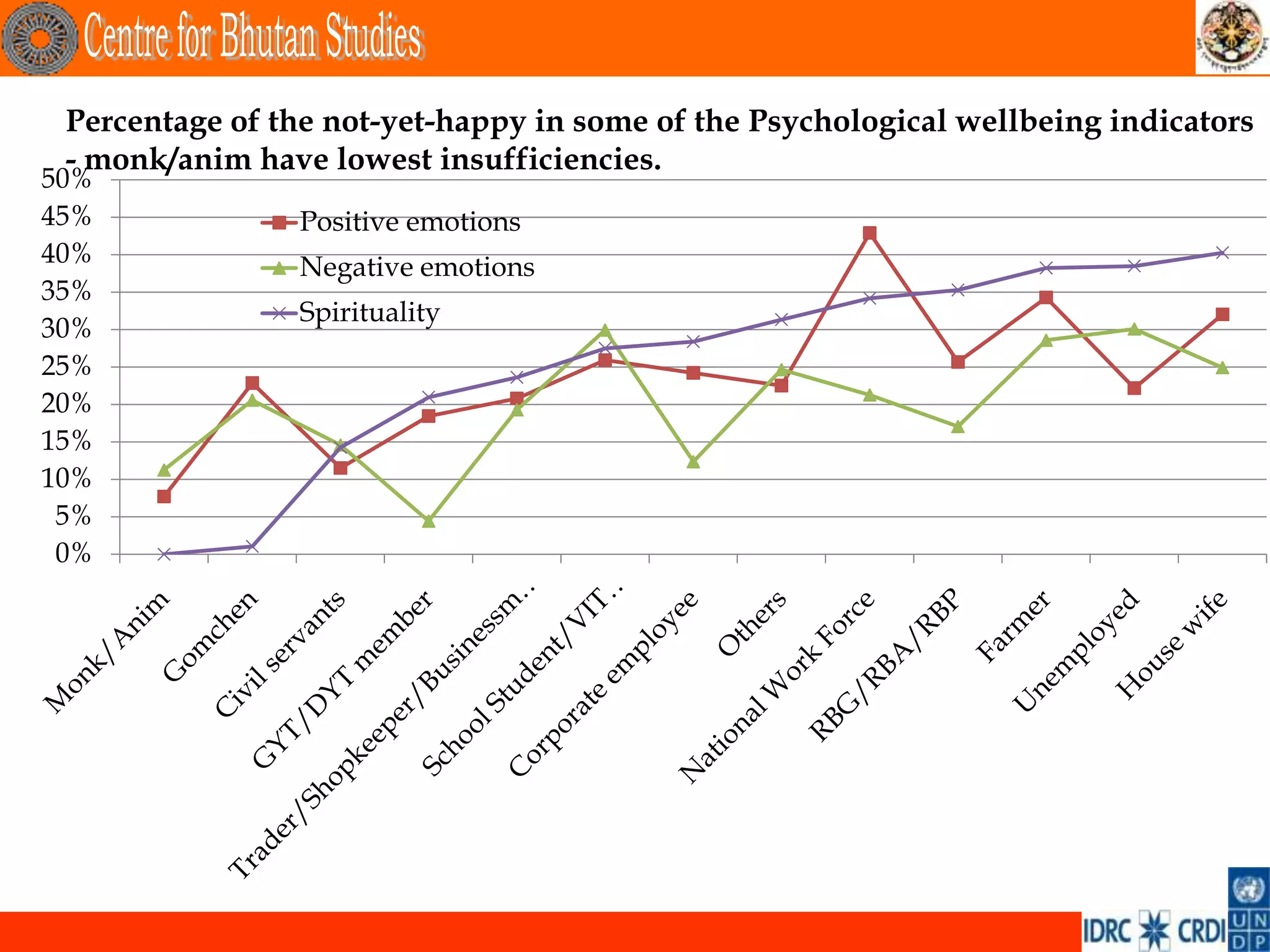
Percentage of the not-yet-happy in some of the Psychological wellbeing indicators
 - monk/anim have lowest insufficiencies.
50%
45%             Positive emotions
40%             Negative emotions
35%
                Spirituality
30%
25%
20%
15%
10%
 5%
 0%
Part III:
Increasing Happiness
1.   GNH Index and Policy: concern for Unhappiness
2.   Insufficiencies by Dzongkhag
3.   Insufficiencies by region
4.   Insufficiencies by gender
5.   Insufficiencies by age group
6.   Insufficiencies by marital status
7.   Insufficiencies by occupational group
8.   Policy recommendations
9.   Sustaining GNH
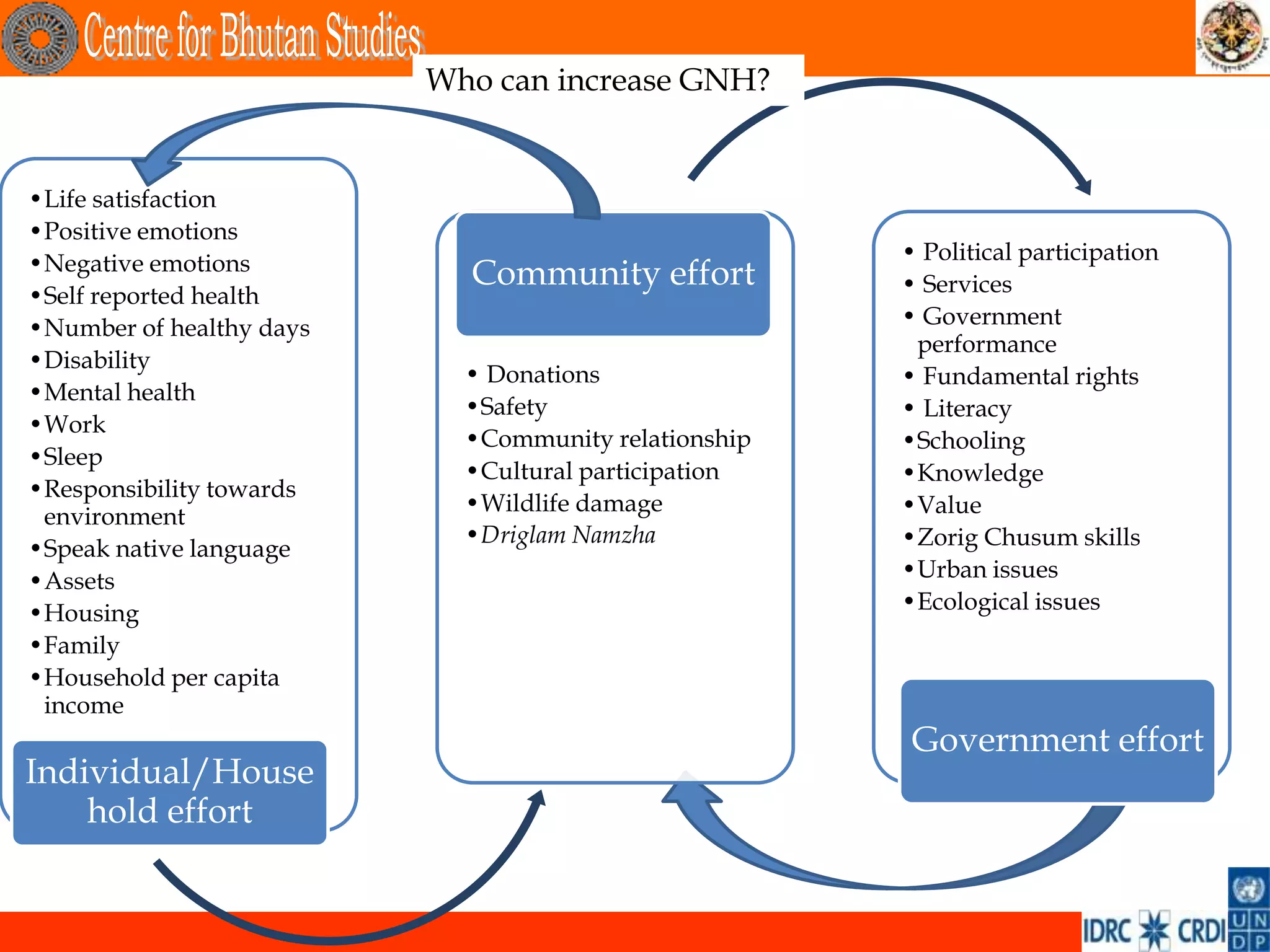
Who can increase GNH?


•Life satisfaction
•Positive emotions
•Negative emotions                                    • Political participation
                            Community effort          • Services
•Self reported health
•Number of healthy days                               • Government
                                                       performance
•Disability
                            • Donations               • Fundamental rights
•Mental health
                            •Safety                   • Literacy
•Work
                            •Community relationship   •Schooling
•Sleep
                            •Cultural participation   •Knowledge
•Responsibility towards
                            •Wildlife damage          •Value
 environment
                            •Driglam Namzha           •Zorig Chusum skills
•Speak native language
•Assets                                               •Urban issues
•Housing                                              •Ecological issues
•Family
•Household per capita
 income
                                                       Government effort
Individual/House
    hold effort
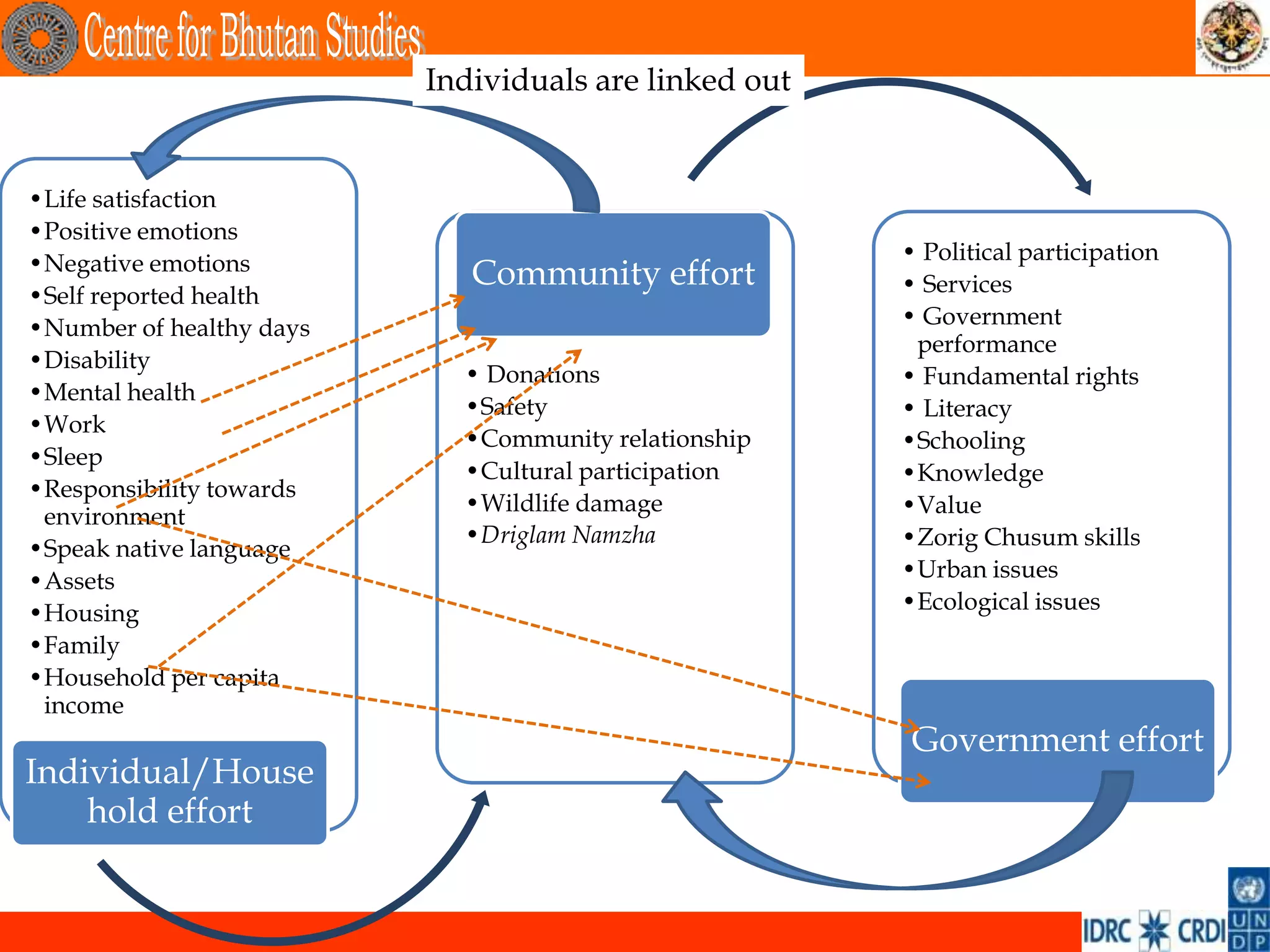
Individuals are linked out


•Life satisfaction
•Positive emotions
•Negative emotions                                     • Political participation
                             Community effort          • Services
•Self reported health
•Number of healthy days                                • Government
                                                        performance
•Disability
                            • Donations                • Fundamental rights
•Mental health
                            •Safety                    • Literacy
•Work
                            •Community relationship    •Schooling
•Sleep
                            •Cultural participation    •Knowledge
•Responsibility towards
                            •Wildlife damage           •Value
 environment
                            •Driglam Namzha            •Zorig Chusum skills
•Speak native language
•Assets                                                •Urban issues
•Housing                                               •Ecological issues
•Family
•Household per capita
 income
                                                        Government effort
Individual/House
    hold effort
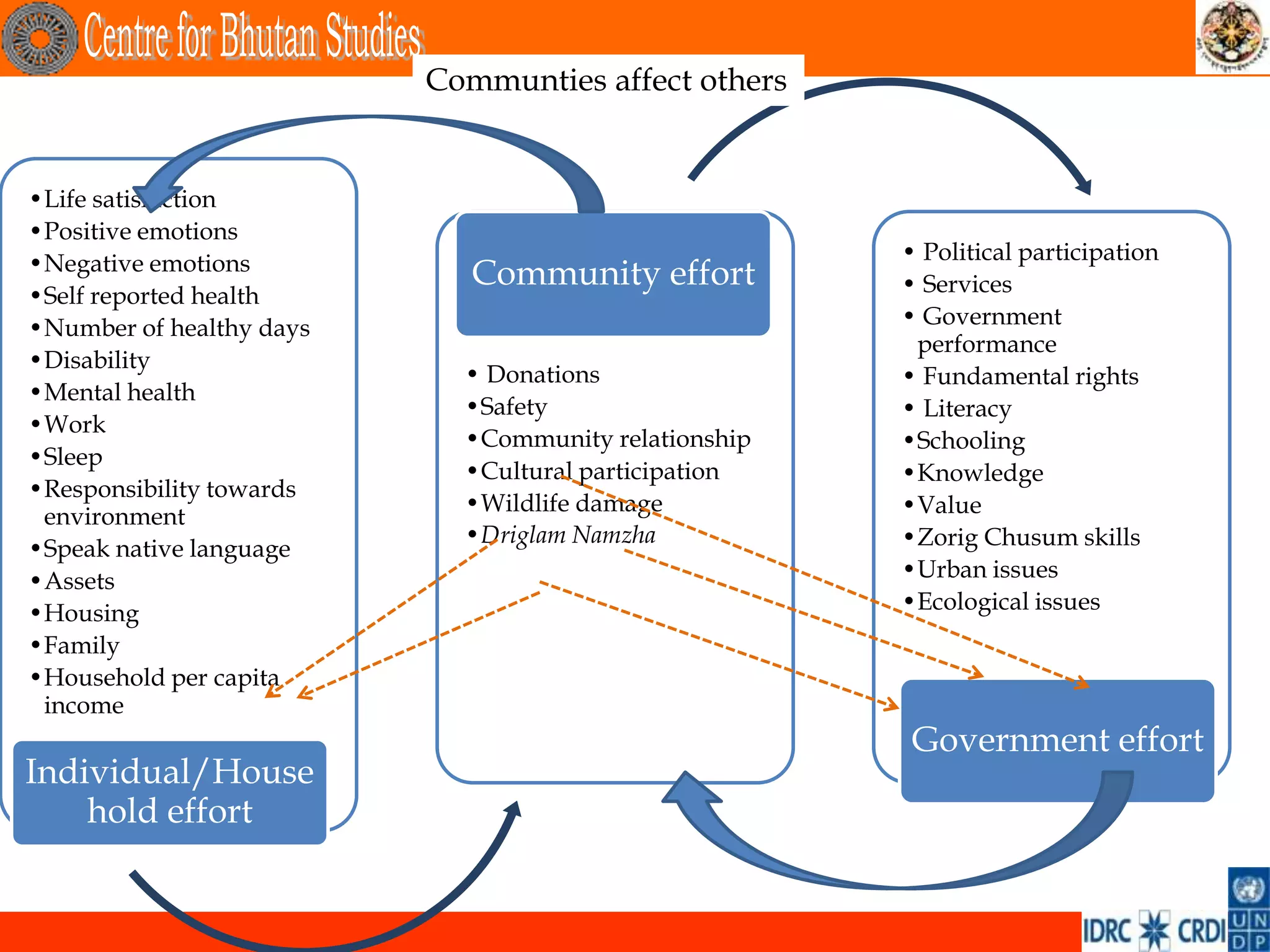
Communties affect others


•Life satisfaction
•Positive emotions
•Negative emotions                                    • Political participation
                             Community effort         • Services
•Self reported health
•Number of healthy days                               • Government
                                                       performance
•Disability
                            • Donations               • Fundamental rights
•Mental health
                            •Safety                   • Literacy
•Work
                            •Community relationship   •Schooling
•Sleep
                            •Cultural participation   •Knowledge
•Responsibility towards
                            •Wildlife damage          •Value
 environment
                            •Driglam Namzha           •Zorig Chusum skills
•Speak native language
•Assets                                               •Urban issues
•Housing                                              •Ecological issues
•Family
•Household per capita
 income
                                                       Government effort
Individual/House
    hold effort
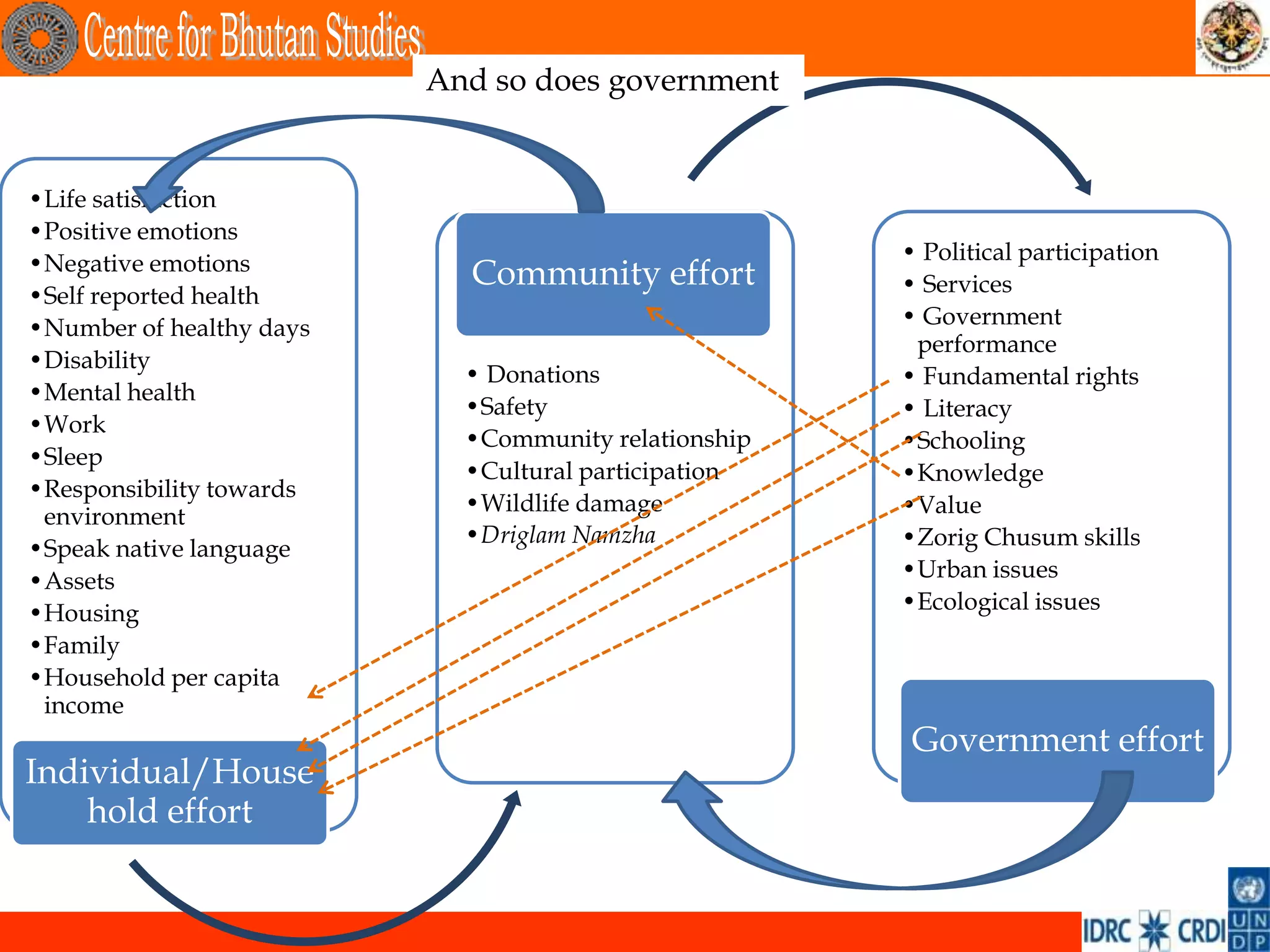
And so does government


•Life satisfaction
•Positive emotions
•Negative emotions                                    • Political participation
                            Community effort          • Services
•Self reported health
•Number of healthy days                               • Government
                                                       performance
•Disability
                            • Donations               • Fundamental rights
•Mental health
                            •Safety                   • Literacy
•Work
                            •Community relationship   •Schooling
•Sleep
                            •Cultural participation   •Knowledge
•Responsibility towards
                            •Wildlife damage          •Value
 environment
                            •Driglam Namzha           •Zorig Chusum skills
•Speak native language
•Assets                                               •Urban issues
•Housing                                              •Ecological issues
•Family
•Household per capita
 income
                                                       Government effort
Individual/House
    hold effort
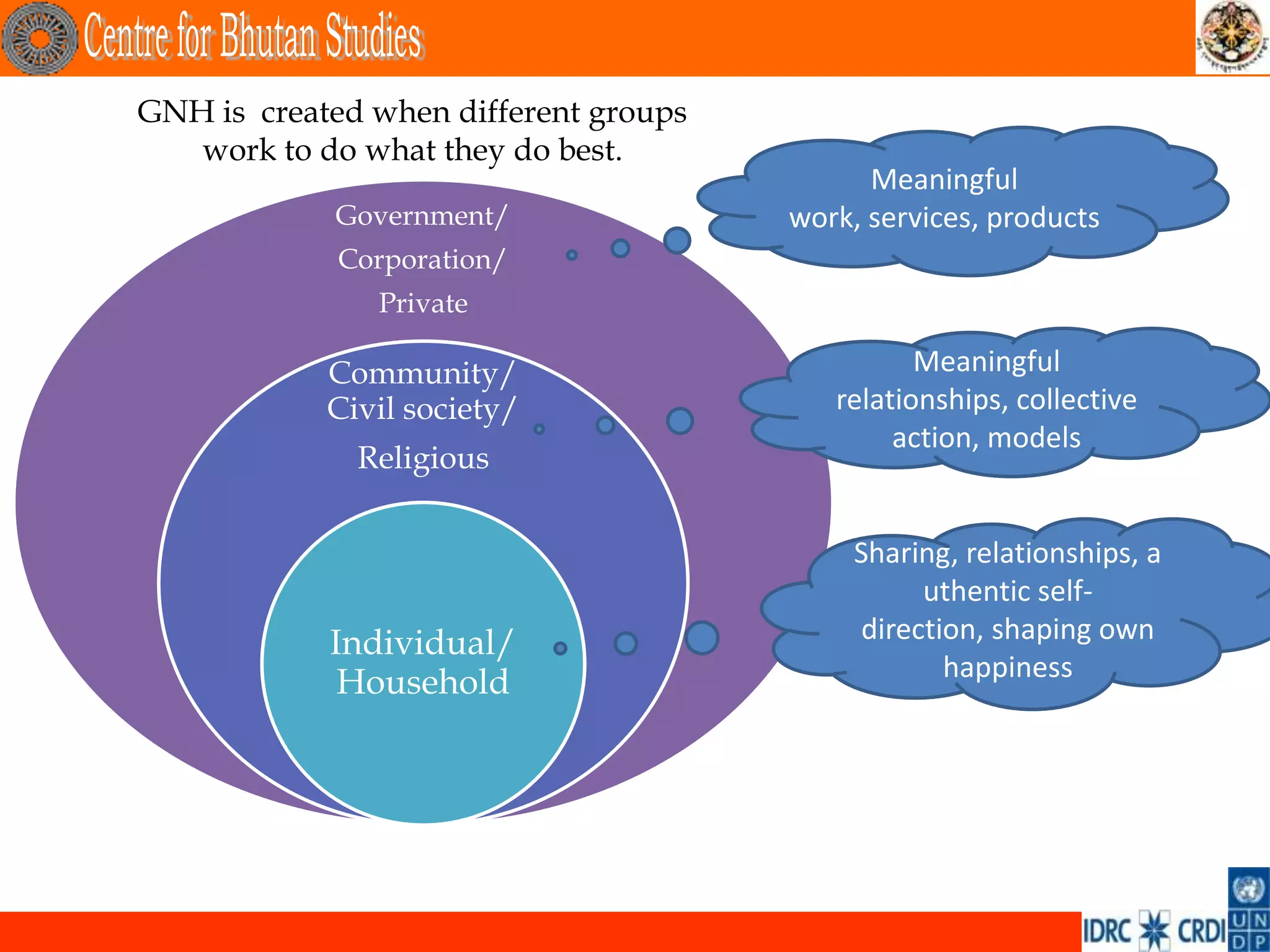
GNH is created when different groups
   work to do what they do best.
                                             Meaningful
            Government/                work, services, products
             Corporation/
               Private

            Community/                           Meaningful
            Civil society/                relationships, collective
                                               action, models
              Religious

                                            Sharing, relationships, a
                                                 uthentic self-
            Individual/                     direction, shaping own
                                                   happiness
             Household
GNH Index highlights- Education

 Education is the highest contributor to
  unhappiness as per GNH Index

 Bhutanese have more than 50% insufficiency in 3
  of the 4 indicators

 The highest insufficiency being in the
  knowledge indicator. Bhutanese experience low
  levels of knowledge in cultural & historical
  aspects of the country & in health and politics.
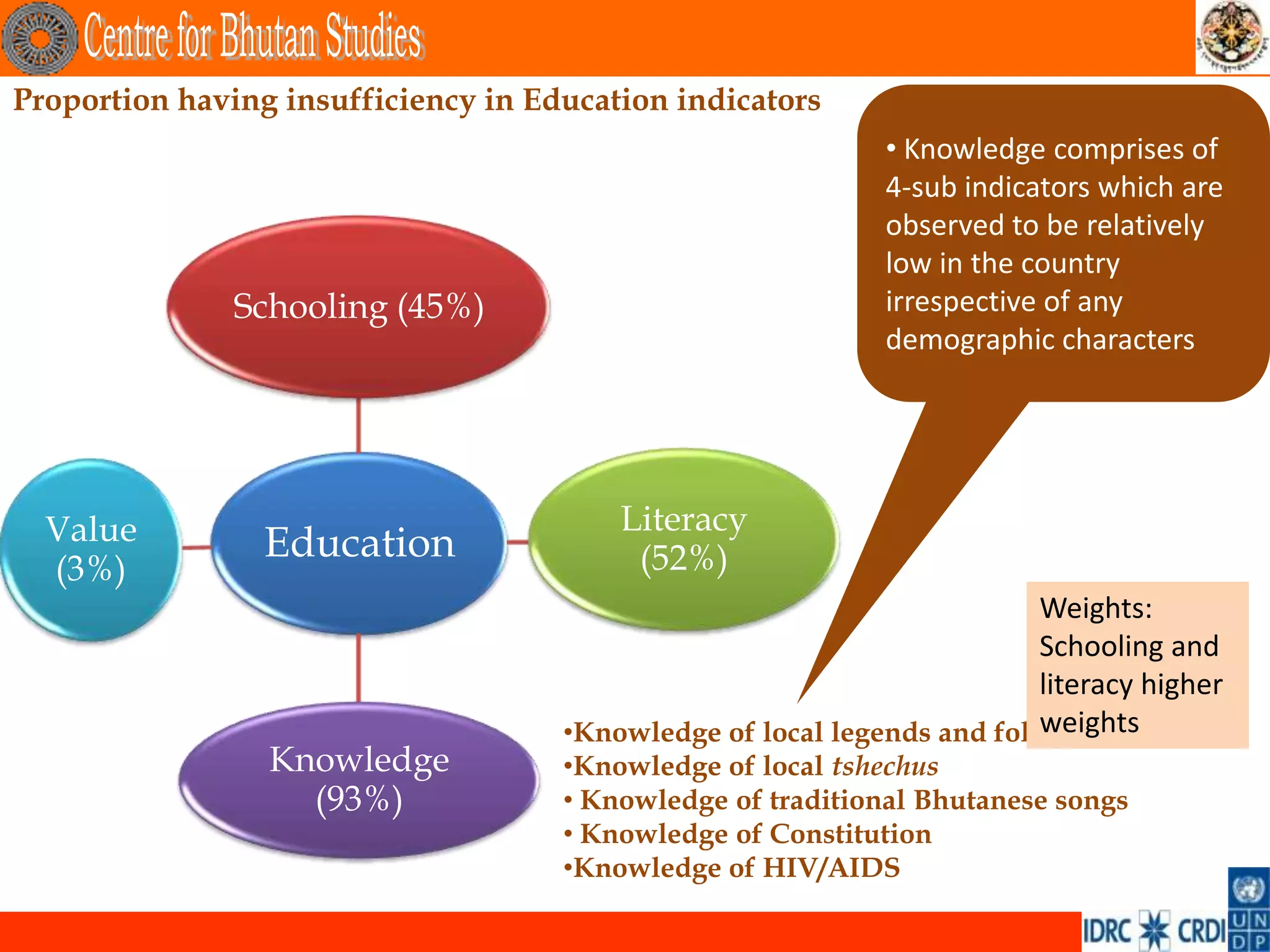
Proportion having insufficiency in Education indicators
                                                             • Knowledge comprises of
                                                             4-sub indicators which are
                                                             observed to be relatively
                                                             low in the country
               Schooling (45%)                               irrespective of any
                                                             demographic characters


  Value                                  Literacy
                 Education                (52%)
  (3%)
                                                                         Weights:
                                                                         Schooling and
                                                                         literacy higher
                                                                         weights
                                     •Knowledge of local legends and folk stories
                 Knowledge           •Knowledge of local tshechus
                   (93%)             • Knowledge of traditional Bhutanese songs
                                     • Knowledge of Constitution
                                     •Knowledge of HIV/AIDS
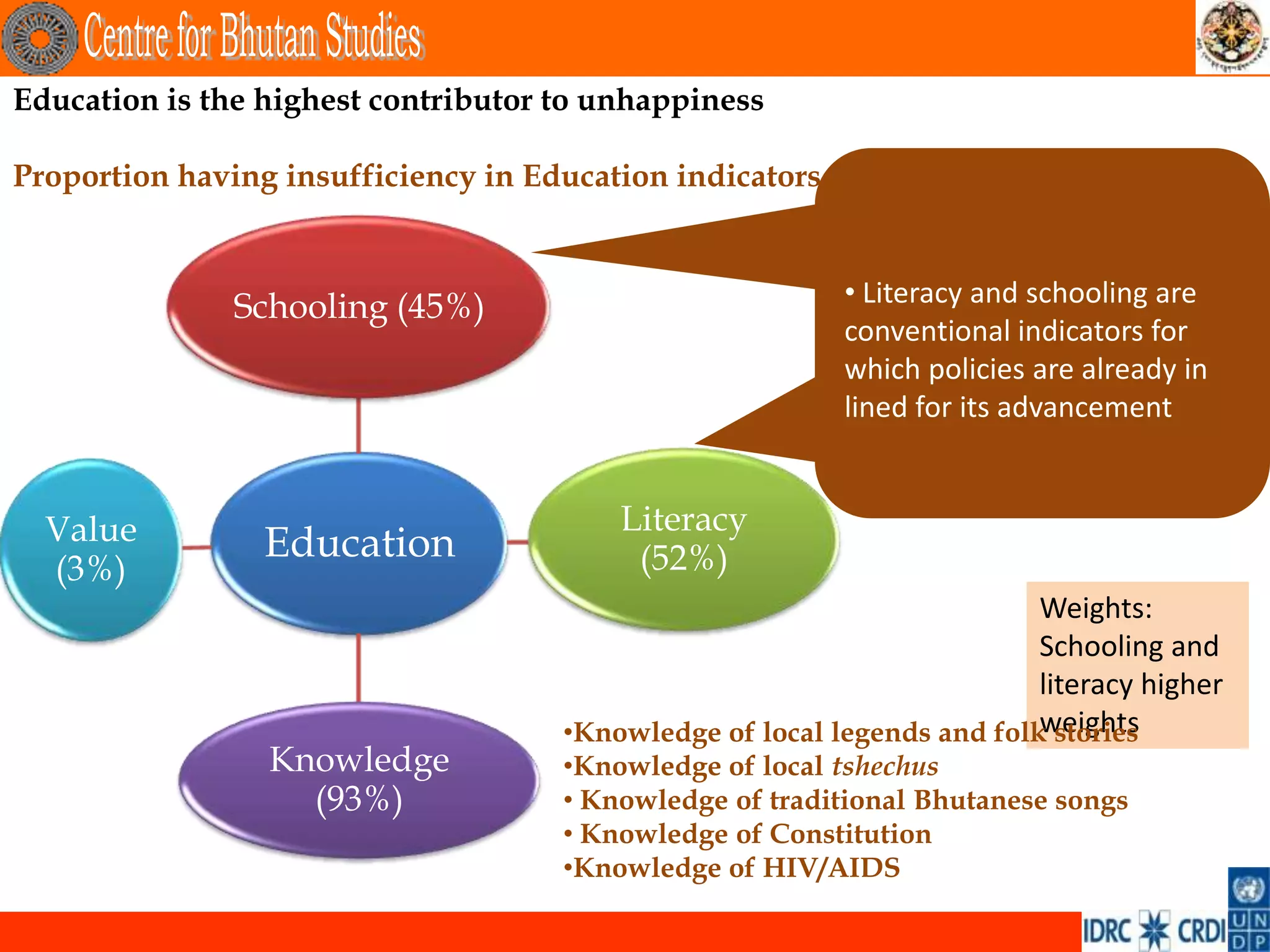
Education is the highest contributor to unhappiness

Proportion having insufficiency in Education indicators


               Schooling (45%)                            • Literacy and schooling are
                                                          •
                                                          conventional indicators for
                                                          which policies are already in
                                                          lined for its advancement


  Value                                  Literacy
                 Education                (52%)
  (3%)
                                                                         Weights:
                                                                         Schooling and
                                                                         literacy higher
                                                                         weights
                                     •Knowledge of local legends and folk stories
                 Knowledge           •Knowledge of local tshechus
                   (93%)             • Knowledge of traditional Bhutanese songs
                                     • Knowledge of Constitution
                                     •Knowledge of HIV/AIDS
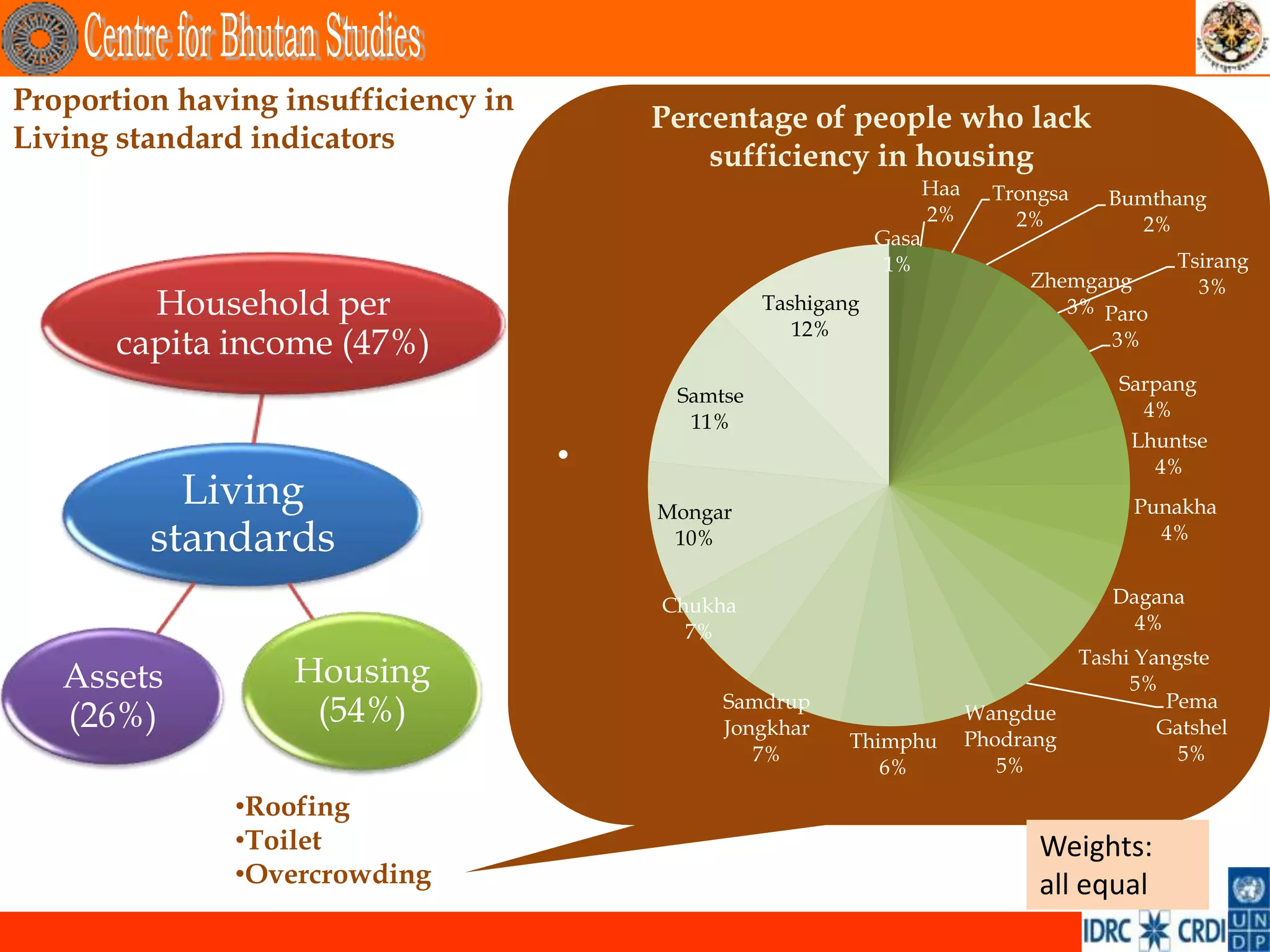
Proportion having insufficiency in
                                         Percentage of people who lack
Living standard indicators
                                             sufficiency in housing
                                                                      Haa     Trongsa      Bumthang
                                                                      2%        2%           2%
                                                               Gasa
                                                                1%                               Tsirang
                                                                                 Zhemgang          3%
         Household per                             Tashigang                        3% Paro
                                                      12%
       capita income (47%)                                                                 3%

                                                                                            Sarpang
                                          Samtse
                                                                                              4%
                                           11%
                                                                                             Lhuntse
                                     •                                                         4%
           Living                        Mongar                                              Punakha
         standards                        10%                                                  4%


                                         Chukha                                            Dagana
                                           7%                                                4%
                                                                                        Tashi Yangste
   Assets          Housing                                                                   5%
                                              Samdrup                                            Pema
   (26%)            (54%)                     Jongkhar
                                                                            Wangdue
                                                                                                Gatshel
                                                           Thimphu          Phodrang
                                                 7%                                               5%
                                                              6%               5%

               •Roofing
               •Toilet                                                            Weights:
               •Overcrowding                                                      all equal
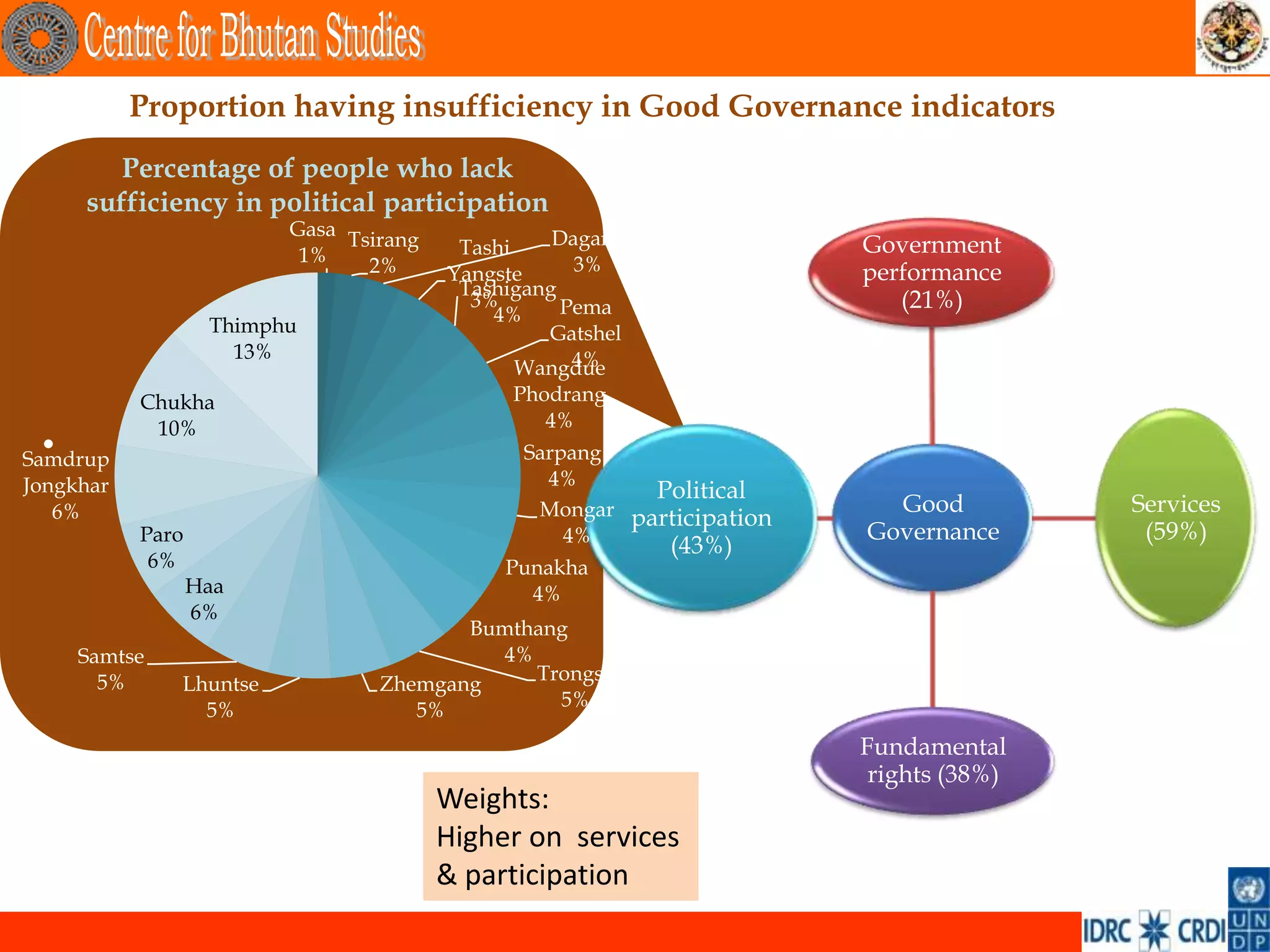
Proportion having insufficiency in Good Governance indicators
        Percentage of people who lack
     sufficiency in political participation
                         Gasa Tsirang             Dagana
                          1%             Tashi                        Government
                                2%      Yangste     3%                performance
                                         Tashigang
                                          3%       Pema                  (21%)
                                            4%
                   Thimphu                       Gatshel
                     13%                            4%
                                               Wangdue
           Chukha                            Phodrang
            10%                                 4%
 •
Samdrup                                       Sarpang
Jongkhar                                        4%
                                                        Political
   6%                                          Mongar participation     Good          Services
           Paro                                   4%                  Governance       (59%)
                                                           (43%)
            6%                               Punakha
                  Haa                          4%
                  6%
                                        Bumthang
     Samtse                               4%
       5%                                    Trongsa
              Lhuntse            Zhemgang
                                               5%
                5%                  5%
                                                                      Fundamental
                                                                       rights (38%)
                                        Weights:
                                        Higher on services
                                        & participation
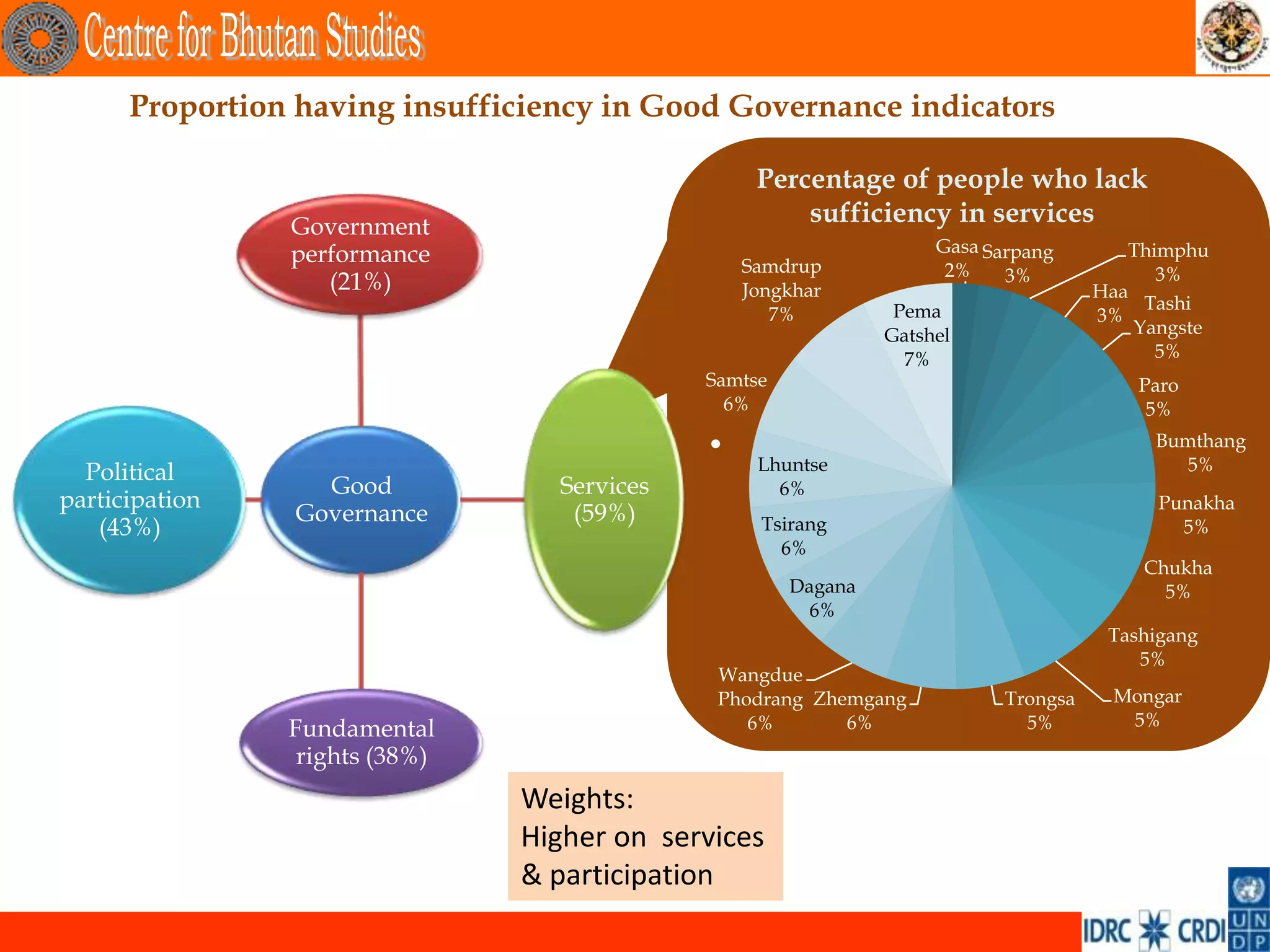
Proportion having insufficiency in Good Governance indicators

                                                  Percentage of people who lack
                Government
                                                      sufficiency in services
                performance                                         Gasa Sarpang        Thimphu
                                                 Samdrup             2%    3%              3%
                   (21%)                         Jongkhar                            Haa
                                                                Pema                      Tashi
                                                    7%                               3%
                                                               Gatshel                   Yangste
                                                                 7%                        5%
                                             Samtse                                      Paro
                                               6%                                         5%

                                             •    Lhuntse
                                                                                          Bumthang
                                                                                             5%
  Political
                  Good            Services          6%
participation                                                                              Punakha
                Governance         (59%)
   (43%)                                          Tsirang                                    5%
                                                    6%
                                                                                         Chukha
                                                      Dagana                               5%
                                                        6%
                                                                                      Tashigang
                                                                                         5%
                                              Wangdue
                                              Phodrang Zhemgang            Trongsa    Mongar
                                                 6%       6%                 5%        5%
                Fundamental
                 rights (38%)
                                Weights:
                                Higher on services
                                & participation
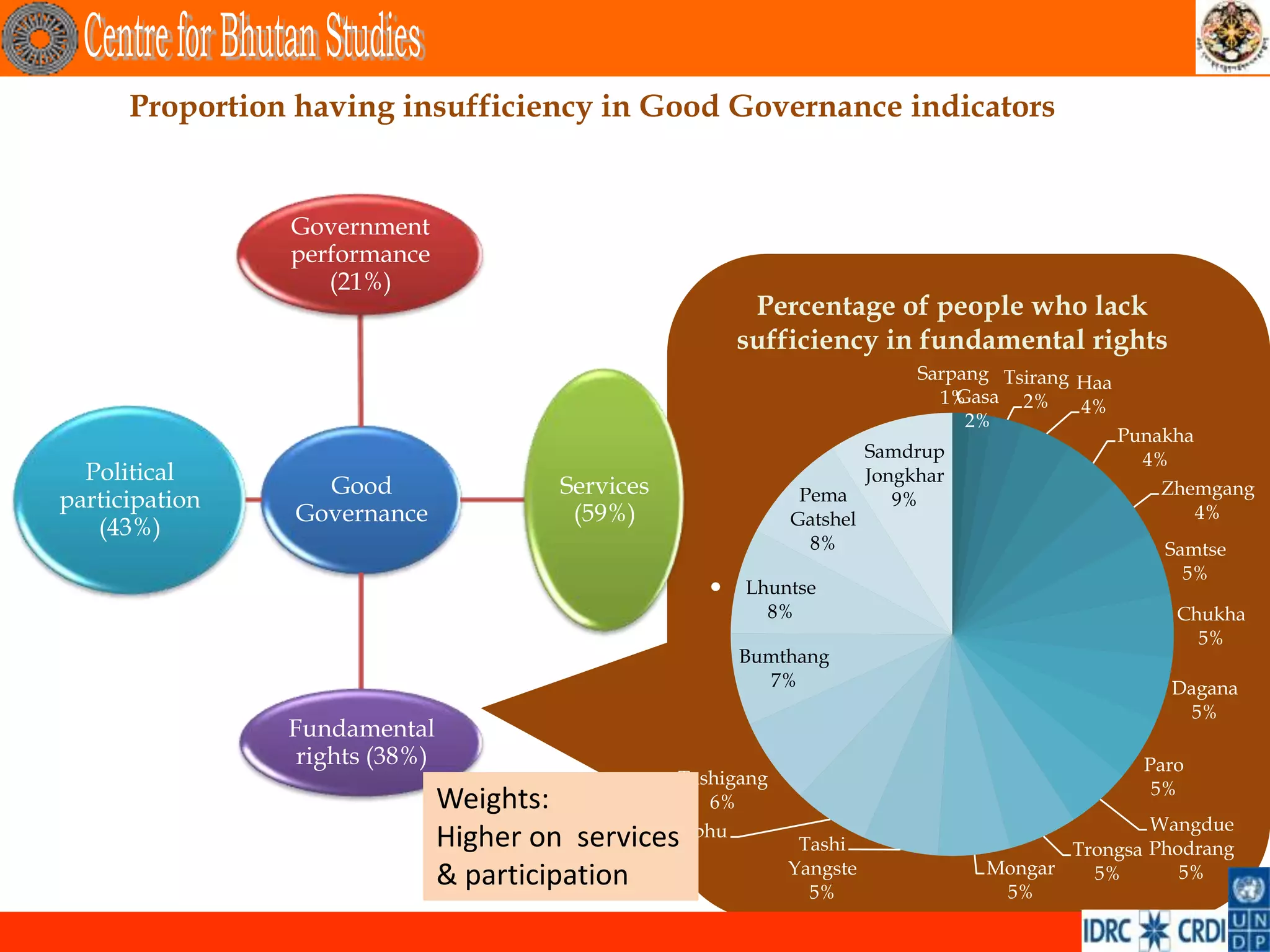
Proportion having insufficiency in Good Governance indicators


                Government
                performance
                   (21%)
                                                           Percentage of people who lack
                                                          sufficiency in fundamental rights
                                                                            Sarpang Tsirang Haa
                                                                              1%Gasa 2%
                                                                                            4%
                                                                                 2%
                                                                                                  Punakha
                                                                       Samdrup                      4%
  Political                                                            Jongkhar
                  Good                   Services               Pema                                  Zhemgang
participation                                                             9%
                Governance                (59%)                Gatshel                                    4%
   (43%)
                                                                 8%                                   Samtse
                                                                                                        5%
                                                      •   Lhuntse
                                                            8%                                         Chukha
                                                                                                         5%
                                                          Bumthang
                                                             7%                                       Dagana
                                                                                                        5%
                Fundamental
                 rights (38%)                                                                       Paro
                                                   Tashigang
                                                                                                     5%
                                Weights:              6%
                                                Thimphu                                          Wangdue
                                Higher on services 6%
                                                                Tashi                    Trongsa Phodrang
                                                               Yangste            Mongar
                                & participation                  5%                5%
                                                                                           5%       5%
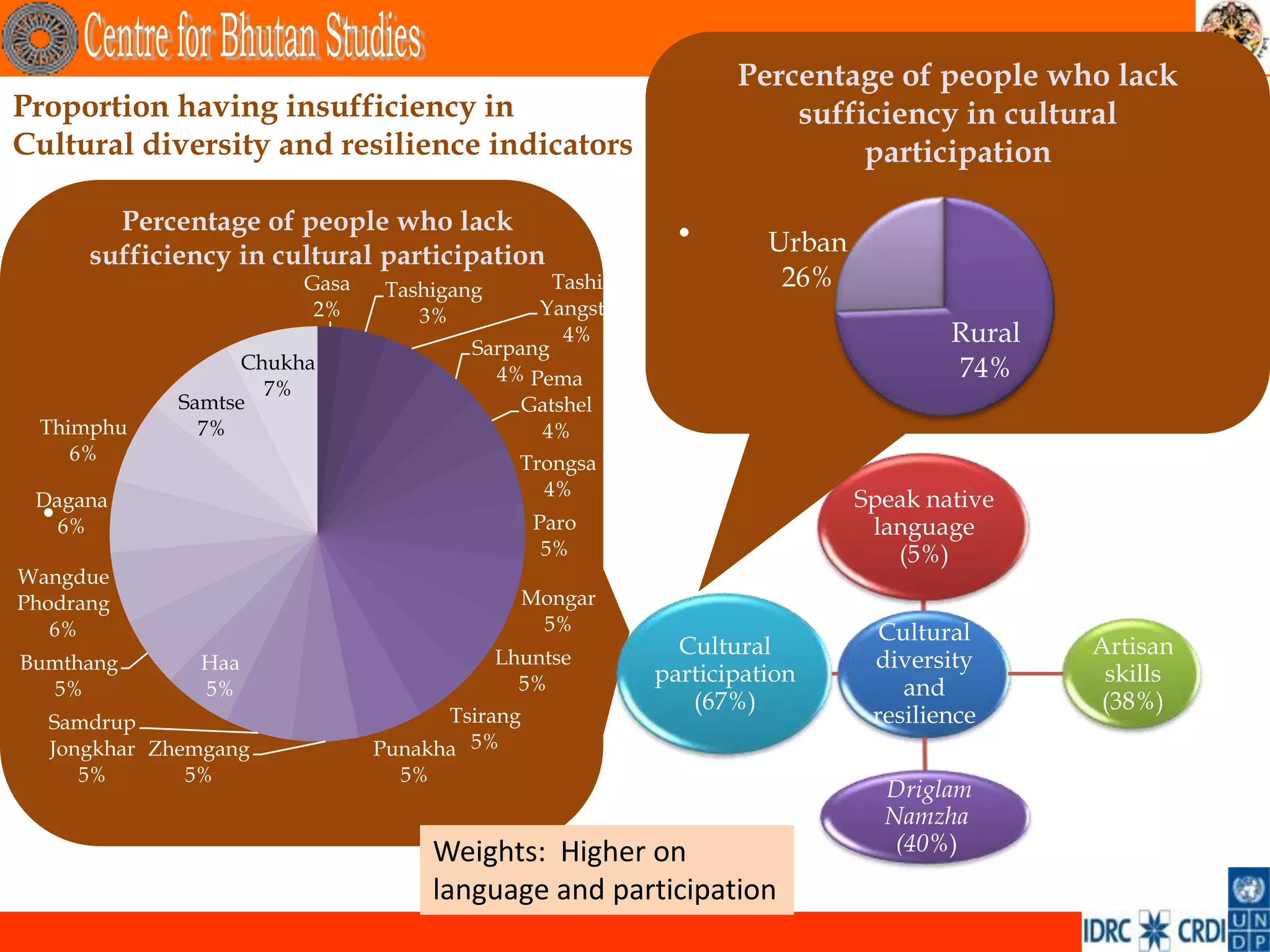
Percentage of people who lack
Proportion having insufficiency in                                 sufficiency in cultural
Cultural diversity and resilience indicators                            participation

        Percentage of people who lack
                                                          •       Urban
      sufficiency in cultural participation
                        Gasa    Tashigang       Tashi              26%
                         2%        3%         Yangste
                                        Sarpang
                                                 4%                               Rural
                   Chukha                                                         74%
                                          4% Pema
                     7%
             Samtse                          Gatshel
 Thimphu       7%                              4%
    6%                                        Trongsa
                                                4%
 Dagana                                                                   Speak native
  •6%                                          Paro                        language
                                                5%                           (5%)
Wangdue
Phodrang                                       Mongar
   6%                                           5%                          Cultural
                                            Lhuntse       Cultural                        Artisan
Bumthang       Haa                                                         diversity
                                              5%        participation                      skills
  5%           5%                                                             and
                                                           (67%)                           (38%)
  Samdrup                            Tsirang                               resilience
  Jongkhar Zhemgang            Punakha 5%
     5%       5%                 5%
                                                                            Driglam
                                                                            Namzha
                                      Weights: Higher on                     (40%)
                                      language and participation
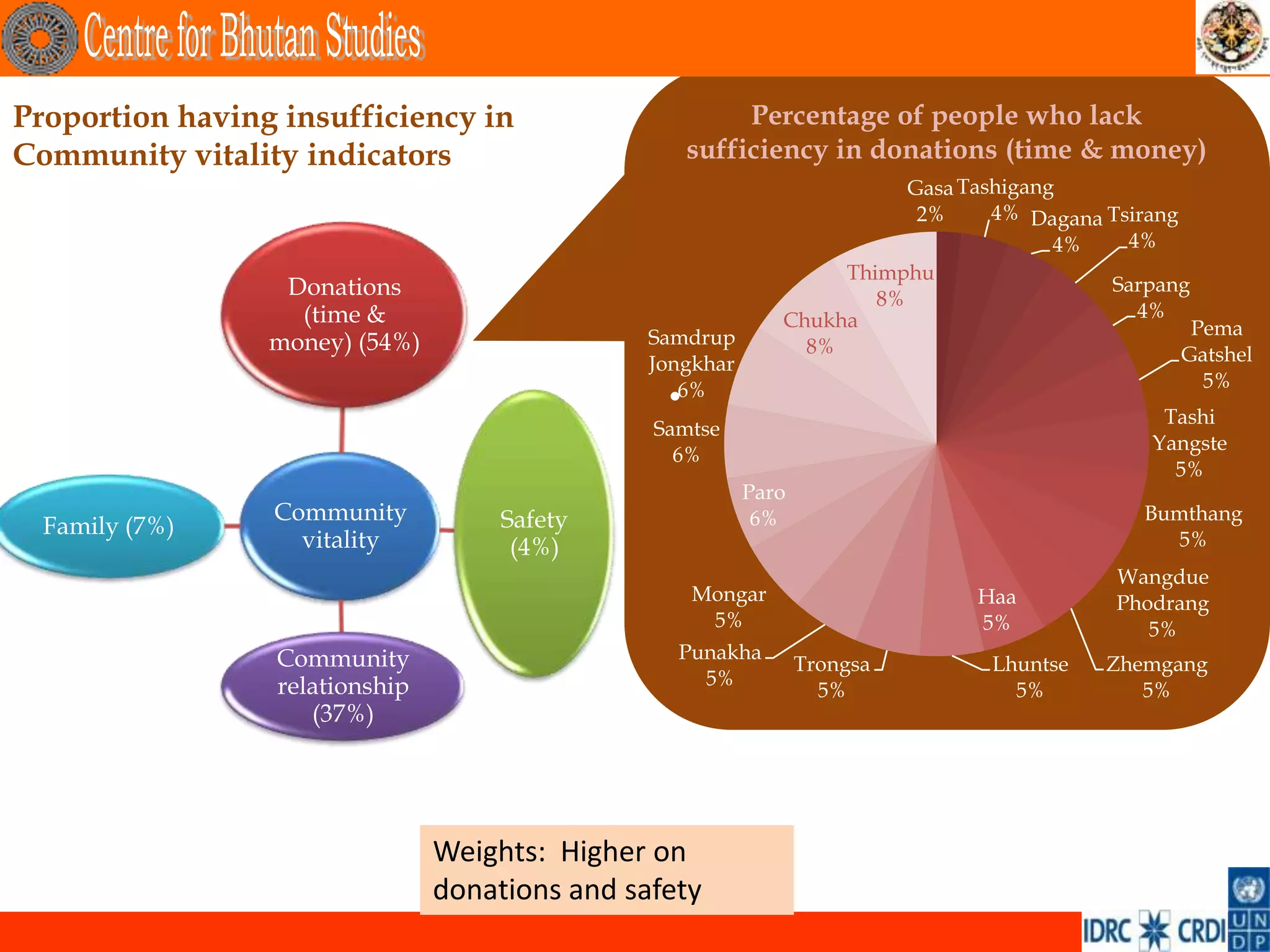
Proportion having insufficiency in                        Percentage of people who lack
Community vitality indicators                        sufficiency in donations (time & money)
                                                                            Gasa Tashigang
                                                                             2%     4% Dagana Tsirang
                                                                                          4%    4%
                                                                   Thimphu
                  Donations                                                                   Sarpang
                                                                      8%
                   (time &                                    Chukha                            4%
                                                Samdrup                                                  Pema
                 money) (54%)                                   8%                                      Gatshel
                                                Jongkhar
                                                                                                          5%
                                                 • 6%
                                                                                                   Tashi
                                                Samtse
                                                                                                  Yangste
                                                  6%
                                                                                                    5%
                                                           Paro
                 Community           Safety                 6%                                   Bumthang
  Family (7%)
                   vitality           (4%)                                                         5%
                                                                                               Wangdue
                                                     Mongar                       Haa          Phodrang
                                                      5%                          5%              5%
                 Community                        Punakha
                                                                  Trongsa          Lhuntse    Zhemgang
                 relationship                       5%
                                                                    5%               5%          5%
                    (37%)


                                Weights: Higher on
                                donations and safety
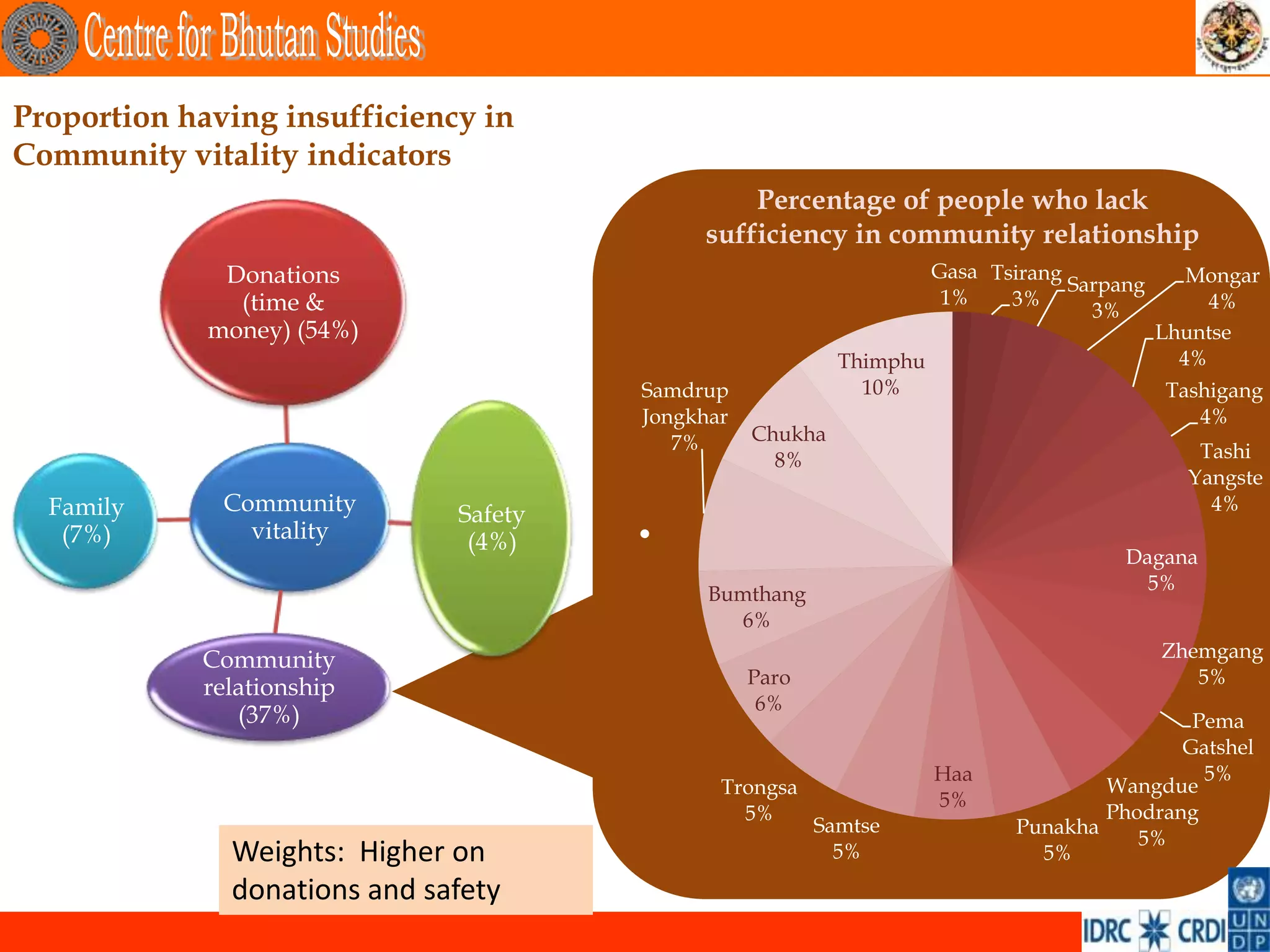
Proportion having insufficiency in
Community vitality indicators
                                                Percentage of people who lack
                                            sufficiency in community relationship
              Donations                                              Gasa Tsirang              Mongar
                                                                                  Sarpang
               (time &                                                1%    3%                   4%
                                                                                    3%
             money) (54%)                                                                   Lhuntse
                                                           Thimphu                            4%
                                       Samdrup               10%                            Tashigang
                                       Jongkhar                                                4%
                                          7%      Chukha
                                                    8%                                         Tashi
                                                                                              Yangste
  Family      Community       Safety                                                            4%
   (7%)         vitality       (4%)    •                                               Dagana
                                                                                         5%
                                             Bumthang
                                               6%
            Community                                                                       Zhemgang
                                                  Paro                                         5%
            relationship
                                                   6%
               (37%)                                                                        Pema
                                                                                           Gatshel
                                                                     Haa                     5%
                                              Trongsa                               Wangdue
                                                                     5%
                                                5%                                  Phodrang
                                                         Samtse             Punakha
                                                                                       5%
              Weights: Higher on                           5%                 5%
              donations and safety
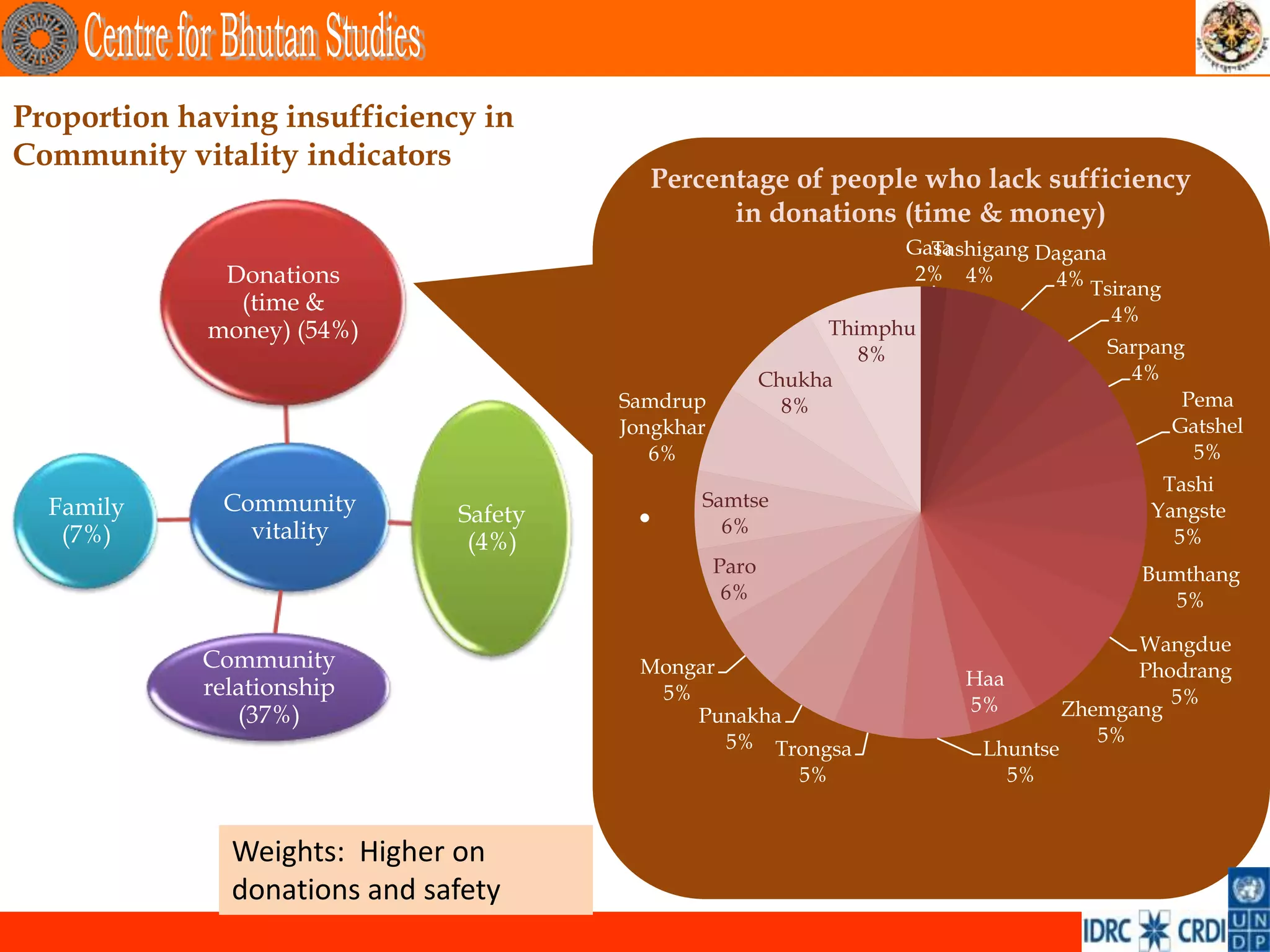
Proportion having insufficiency in
Community vitality indicators
                                         Percentage of people who lack sufficiency
                                               in donations (time & money)
                                                                     Gasa
                                                                       Tashigang Dagana
              Donations                                               2% 4%        4% Tsirang
               (time &                                                                  4%
             money) (54%)                                      Thimphu
                                                                  8%                    Sarpang
                                                         Chukha                            4%
                                       Samdrup             8%                                  Pema
                                       Jongkhar                                               Gatshel
                                          6%                                                    5%
                                                                                               Tashi
  Family      Community                       Samtse                                          Yangste
   (7%)         vitality
                              Safety    •       6%
                                                                                                5%
                               (4%)
                                                  Paro                                       Bumthang
                                                   6%                                          5%

                                                                                             Wangdue
            Community                   Mongar                                               Phodrang
            relationship                                                   Haa
                                         5%                                                     5%
                                                                           5%          Zhemgang
               (37%)                        Punakha
                                               5% Trongsa                                 5%
                                                                             Lhuntse
                                                            5%                 5%


              Weights: Higher on
              donations and safety
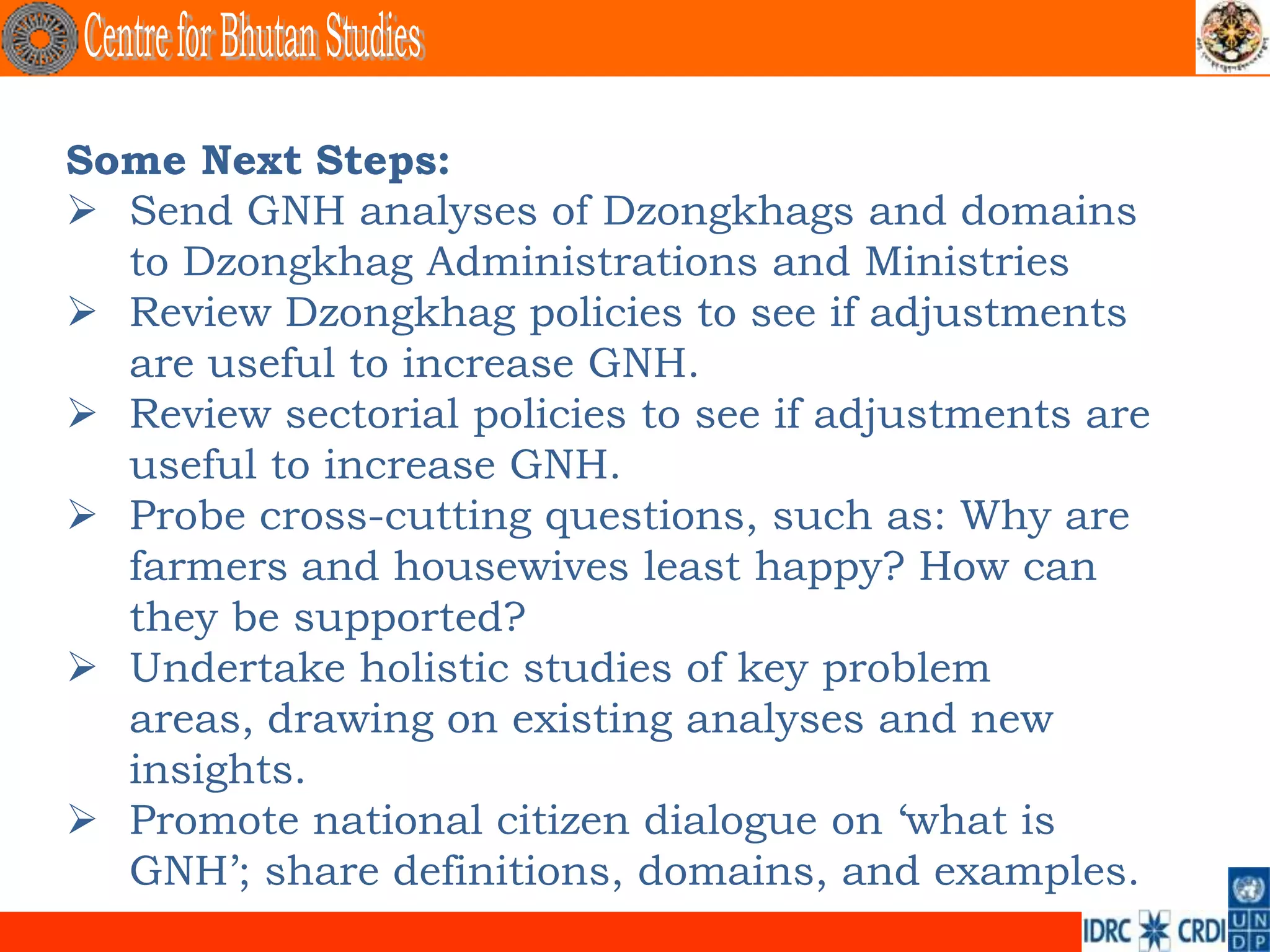
Some Next Steps:
 Send GNH analyses of Dzongkhags and domains
  to Dzongkhag Administrations and Ministries
 Review Dzongkhag policies to see if adjustments
  are useful to increase GNH.
 Review sectorial policies to see if adjustments are
  useful to increase GNH.
 Probe cross-cutting questions, such as: Why are
  farmers and housewives least happy? How can
  they be supported?
 Undertake holistic studies of key problem
  areas, drawing on existing analyses and new
  insights.
 Promote national citizen dialogue on ‘what is
  GNH’; share definitions, domains, and examples.
Part III:
Increasing Happiness
1.   GNH Index and Policy: concern for Unhappiness
2.   Insufficiencies by Dzongkhag
3.   Insufficiencies by region
4.   Insufficiencies by gender
5.   Insufficiencies by age group
6.   Insufficiencies by marital status
7.   Insufficiencies by occupational group
8.   Policy recommendations
9.   Sustaining GNH
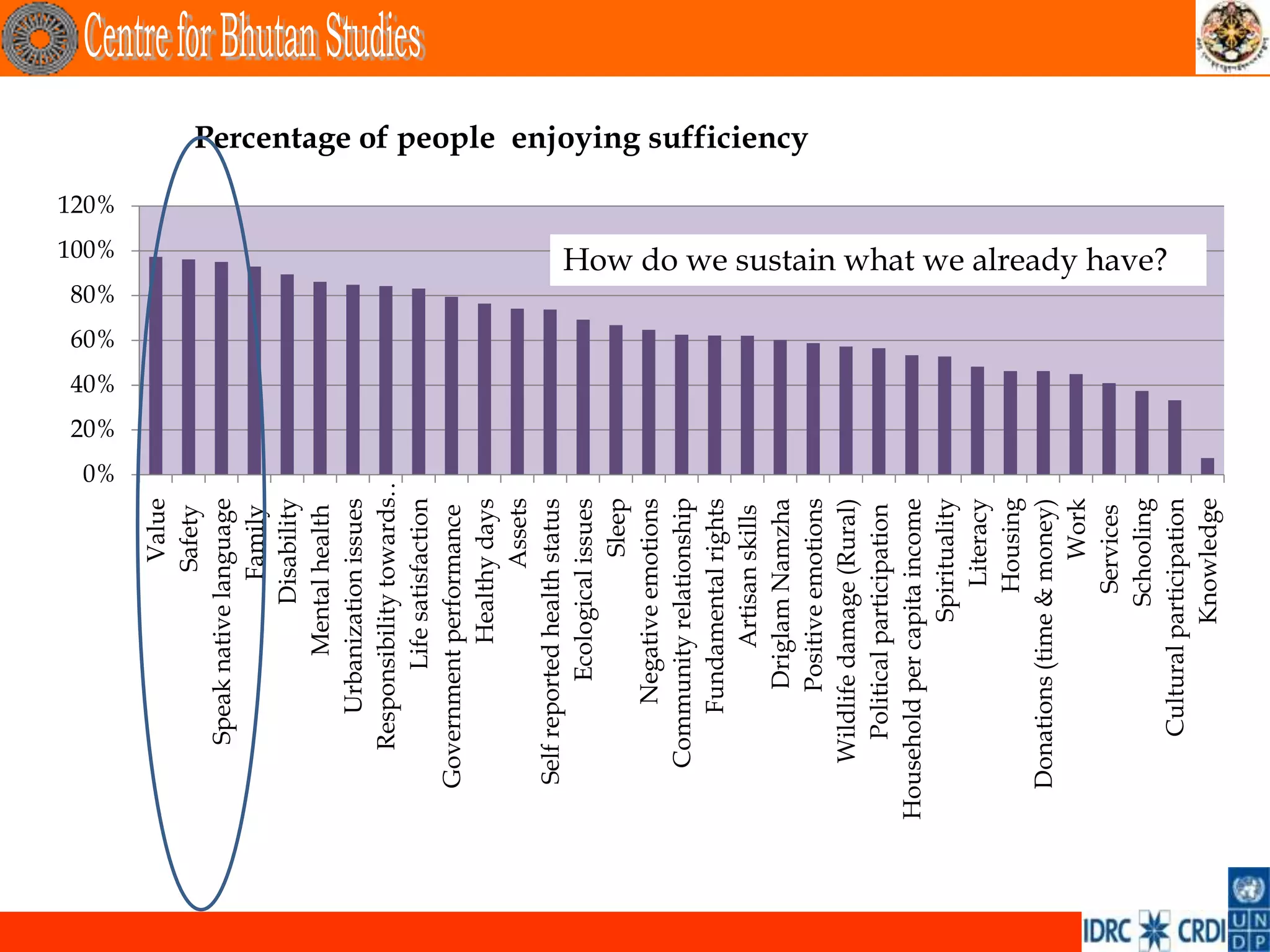
0%
                                                                        100%
                                                                                                    120%


                                  20%
                                        40%
                                              60%
                                                    80%
                         Value
                        Safety
      Speak native language
                       Family
                     Disability
               Mental health
         Urbanization issues
     Responsibility towards…
              Life satisfaction
  Government performance
                 Healthy days
                        Assets
  Self reported health status
             Ecological issues
                          Sleep
          Negative emotions
   Community relationship
         Fundamental rights
                Artisan skills
            Driglam Namzha
                                                                                                           Percentage of people enjoying sufficiency


            Positive emotions
    Wildlife damage (Rural)
       Political participation
Household per capita income
                   Spirituality
                      Literacy
                      Housing
  Donations (time & money)
                         Work
                      Services
                    Schooling
                                                          How do we sustain what we already have?


       Cultural participation
                   Knowledge
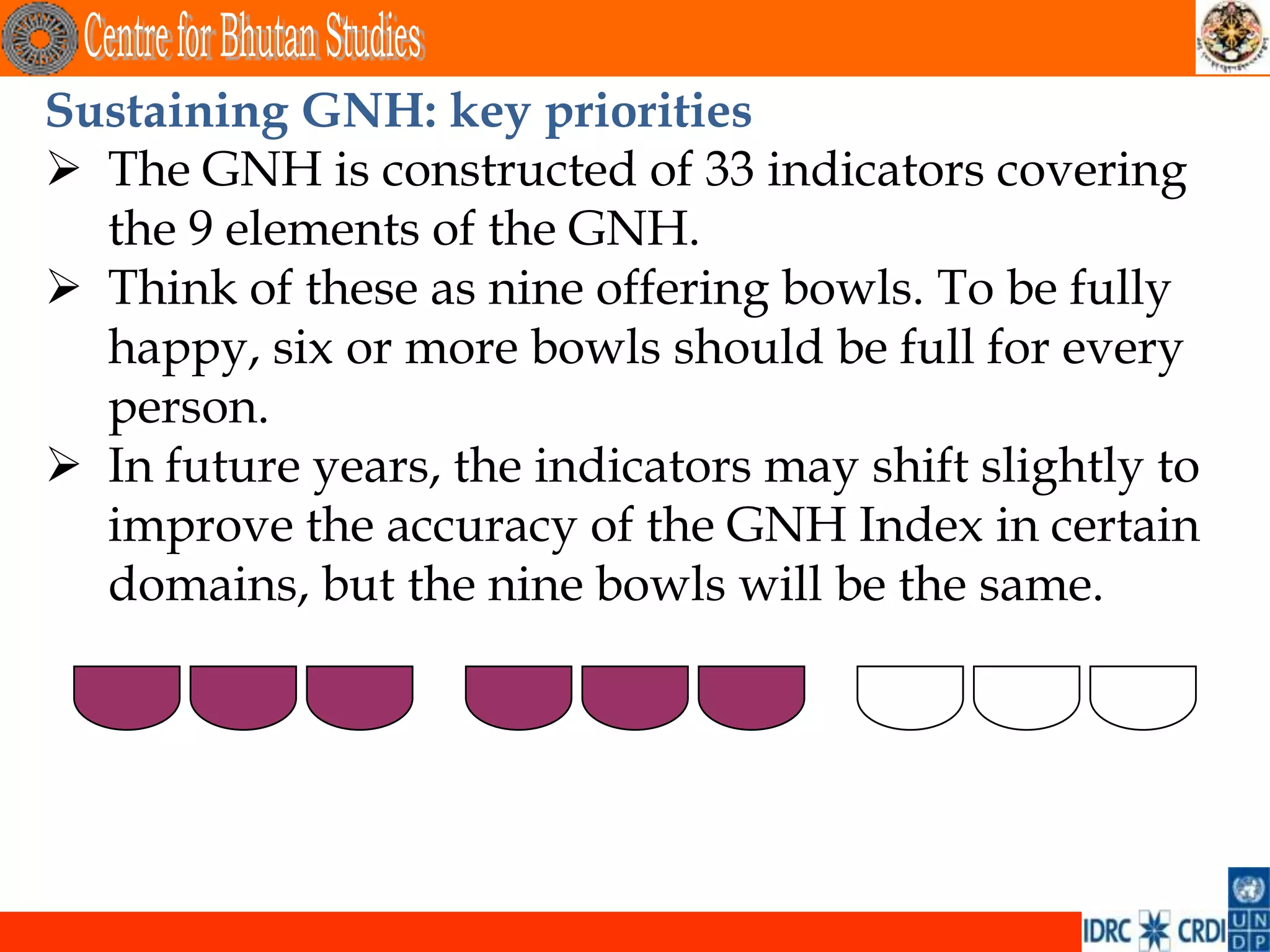
Sustaining GNH: key priorities
 The GNH is constructed of 33 indicators covering
  the 9 elements of the GNH.
 Think of these as nine offering bowls. To be fully
  happy, six or more bowls should be full for every
  person.
 In future years, the indicators may shift slightly to
  improve the accuracy of the GNH Index in certain
  domains, but the nine bowls will be the same.
What does this mean for me?

As a person, think of each of the nine domains in
your life. Which bowls are full? Which are empty?
How can you fill the empty bowls more?

Think of your family, your friends: how can you
help them to fill their offering bowls?

Think of your responsibilities at work or at home or
at school: how can you help fill all nine offering bowls
for other people?
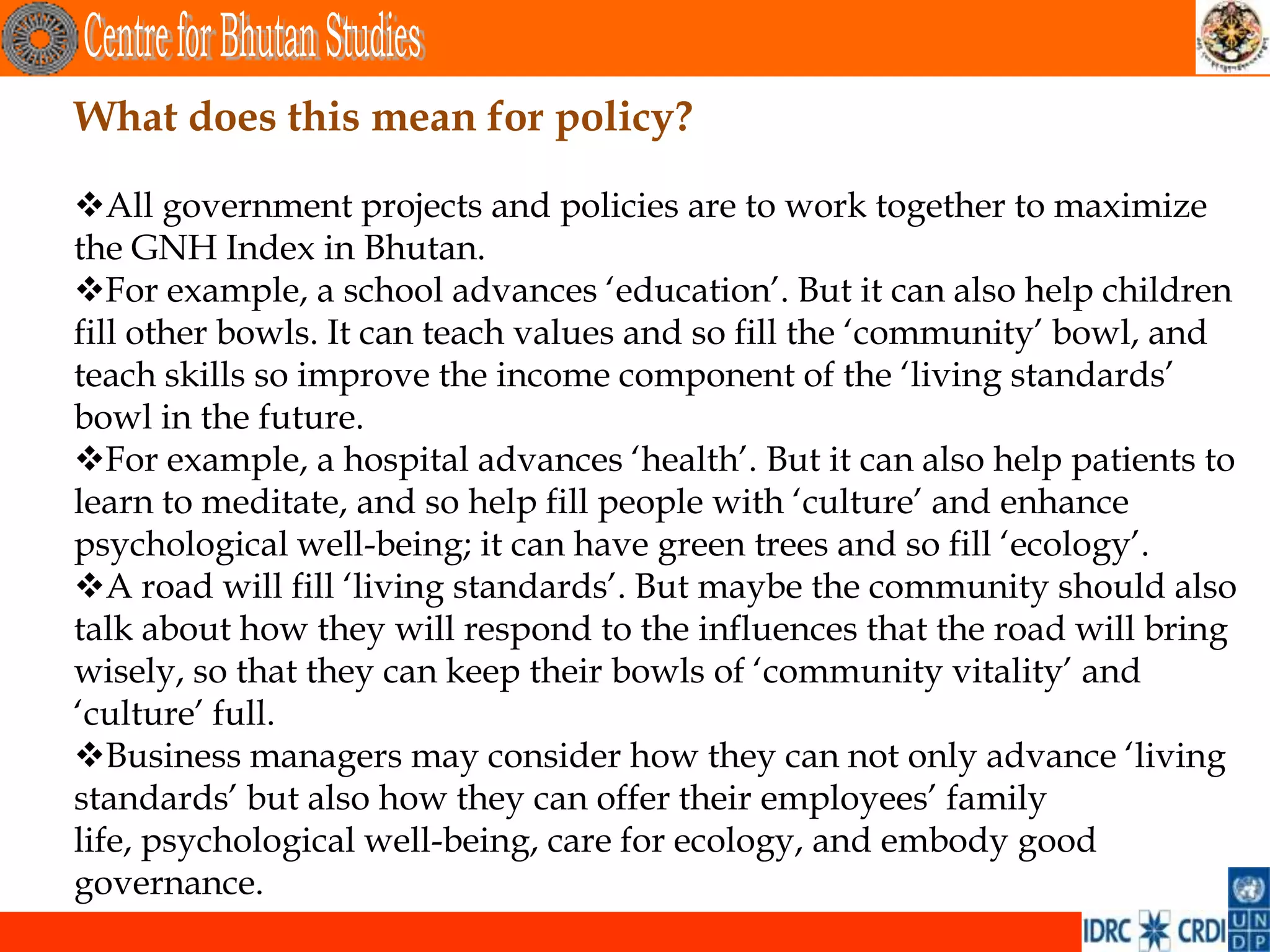
What does this mean for policy?

All government projects and policies are to work together to maximize
the GNH Index in Bhutan.
For example, a school advances ‘education’. But it can also help children
fill other bowls. It can teach values and so fill the ‘community’ bowl, and
teach skills so improve the income component of the ‘living standards’
bowl in the future.
For example, a hospital advances ‘health’. But it can also help patients to
learn to meditate, and so help fill people with ‘culture’ and enhance
psychological well-being; it can have green trees and so fill ‘ecology’.
A road will fill ‘living standards’. But maybe the community should also
talk about how they will respond to the influences that the road will bring
wisely, so that they can keep their bowls of ‘community vitality’ and
‘culture’ full.
Business managers may consider how they can not only advance ‘living
standards’ but also how they can offer their employees’ family
life, psychological well-being, care for ecology, and embody good
governance.
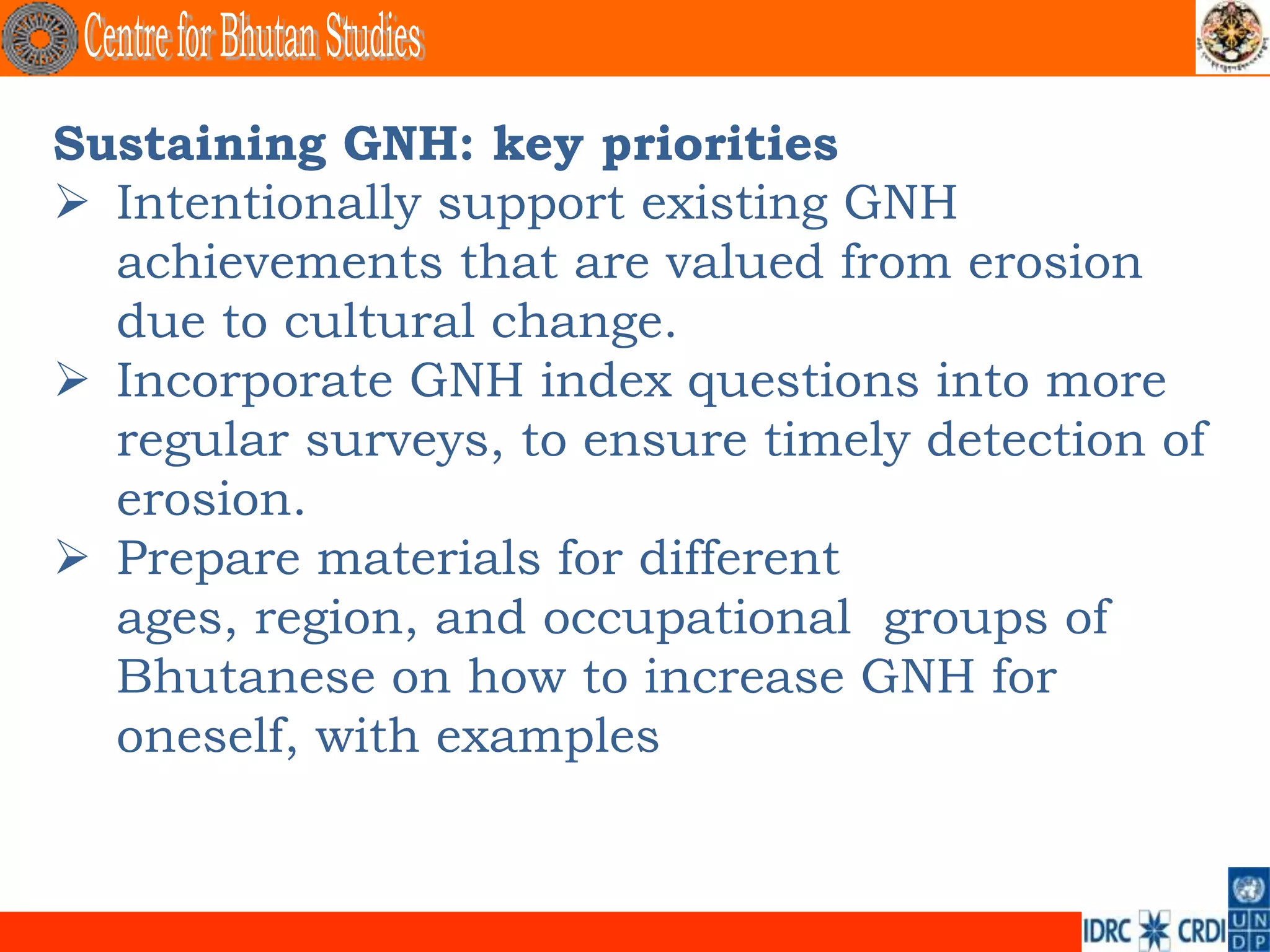
Sustaining GNH: key priorities
 Intentionally support existing GNH
  achievements that are valued from erosion
  due to cultural change.
 Incorporate GNH index questions into more
  regular surveys, to ensure timely detection of
  erosion.
 Prepare materials for different
  ages, region, and occupational groups of
  Bhutanese on how to increase GNH for
  oneself, with examples
The 2010 Gross National
Happiness Index : Part III


    The Centre for Bhutan Studies
                2011

Part 3 2

  • 1.
    The 2010 GrossNational Happiness Index : Part III The Centre for Bhutan Studies 2011
  • 2.
    Part III: Increasing Happiness 1. GNH Index and Policy: concern for Unhappiness 2. Insufficiencies by Dzongkhag 3. Insufficiencies by region 4. Insufficiencies by gender 5. Insufficiencies by age group 6. Insufficiencies by marital status 7. Insufficiencies by occupational group 8. Policy recommendations 9. Sustaining GNH
  • 3.
    Part III: Increasing Happiness 1. GNH Index and Policy: concern for Unhappiness 2. Insufficiencies by Dzongkhag 3. Insufficiencies by region 4. Insufficiencies by gender 5. Insufficiencies by age group 6. Insufficiencies by marital status 7. Insufficiencies by occupational group 8. Policy recommendations 9. Sustaining GNH
  • 4.
    The GNH Indexis formulated to provide an incentive to Increase Happiness. Civil servants, business leaders, and citizens of Bhutan may ask, ‘how can I help to increase GNH?’ The GNH Index can help them answer this question in practical ways.
  • 5.
    Increasing GNH “Our nation‟sVision can only be fulfilled if the scope of our dreams and aspirations are matched by the reality of our commitment to nurturing our future citizens.” HM Jigme Khesar Namgyel Wangchuck, the 5th King of Bhutan
  • 6.
    Increasing GNH ToIncrease happiness, we need to ask a new set of questions. We have to identify people who are not yet happy. And we have to ask, where do they lack sufficiency? What must more be done? This analysis is of direct relevance for policy.
  • 7.
    National GNH Index:.743 using the happiness threshold of 66%
  • 8.
    GNH Index byincome group (Household per capita income) 0.95 0.9 0.85 0.8 GNH Index increases with income per capita 0.75 • Bhutan still has a significant 0.7 share of people not able to 0.65 meet basic physical needs • some relationship is 0.6 organic, because income is an 0.55 indicator measured in the 0.5 GNH Index and is also correlated with assets, housing, and education.
  • 9.
    National headcount ratio: 59% of Bhutanese do not fulfil the threshold of being happy in 6 or more than 6 domains. According to the GNH Index, they are „not-yet-happy‟.
  • 10.
    Of course, happinessis deeply personal. Some of these people may regard themselves as fully flourishing. That is why we need to discuss GNH widely in Bhutan.
  • 11.
    National Breadth (Lack of sufficiency): Of the Bhutanese who are unhappy, on average they have insufficiency in 43% of the domains (roughly equal to 4 domains)
  • 12.
    Proportion of peopledeprived/unhappy 3,76,975 59% 60% 1,66,124 Indicator: 50% Psychological wellbeing, Healt 1,46,956 h, Time 40% use, Culture, Ec 26% ology, Commun ity 30% 23% vitality, Good Governance and Living 20% Indicator: standards Indicator: Health, Educatio Consumption n and Living 10% per capita Standards 0% National Poverty line Multidimensional Gross National 2007 Poverty Index 2010 Happiness Index 2010 .
  • 13.
    0% 10% 20% 40% 50% 60% 70% 80% 90% 100% 30% Life satisfaction Positive emotions Negative emotions Spirituality Self reported health… Healthy days Disability Mental health Work Sleep Schooling Literacy Value Knowledge % insufficiency amongst the unhappy Artisan skills Speak native language Cultural participation Driglam Namzha Fundamental rights Services Political participation Donations (time &… Community relationship Family Safety vary? Ecological issues Responsibility… unhappy people. Wildlife damage (Rural) higher, it means that Urbanization issues % insufficiency amongst the happy When the blue bars are Life satisfaction is much First, a birds eye view of Assets happy vs unhappy people. How do their achievements higher among the unhappy. For example, insufficiency in insufficiency is higher among Household per capita… Housing
  • 14.
    0% 10% 20% 40% 50% 60% 70% 80% 90% 100% 30% Life satisfaction Positive emotions Negative emotions Spirituality Self reported health… Healthy days Disability Mental health Work Sleep Schooling Literacy Value Knowledge % insufficiency amongst the unhappy Artisan skills Speak native language Cultural participation Driglam Namzha Fundamental rights Let’s look further. Services Political participation Donations (time &… Community relationship Family have less sufficiency than unhappy. Safety Ecological issues Responsibility… But some are relatively close; others very different. Wildlife damage (Rural) Urbanization issues % insufficiency amongst the happy Assets Across all indicators we see that there is no indicator in which Household per capita… orange bars are higher than blue – none in which ‘happy’ people Housing
  • 15.
    0% 10% 20% 40% 50% 60% 70% 80% 90% 30% Life satisfaction 100% Positive emotions Negative emotions well-being Spirituality Self reported health status Healthy days Psychological Health Disability Mental health Work Sleep Time Use Schooling Literacy Value % insufficiency amongst the unhappy Knowledge Artisan skills Speak native language Cultural participation Driglam Namzha Government performance Fundamental rights Services Political participation well- that the Donations (time & money) Looking at have higher insufficiency. psychological Community relationship d time, we see The groups are closest in sleep. being, health, an ‘unhappy’ always Family % insufficiency amongst
  • 16.
    Schooling Literacy Value e unhappy Education Knowledge Artisan skills Speak native language Cultural participation Culture Driglam Namzha Government performance Fundamental rights Services Political participation Governance Donations (time & money) Community relationship Family Safety Ecological issues Responsibility towards… % insufficiency amongst the happy Wildlife damage (Rural) Urbanization issues Assets Household per capita income Housing In e, and highest Driglam Political Both have education. Namzha, and participation. different in of deprivations in groups are least governance, the Value, Language, education, cultur
  • 17.
    In % insufficiency amongst the happy community, ecol ogy, and living standard, the Community Ecology Living strong Standard differences are in wildlife damage and in living standard. Happy people’s insufficiencies in Responsibility towards… Housing Assets Ecological issues Driglam Namzha Fundamental rights Wildlife damage (Rural) Donations (time & money) Household per capita income Community relationship Urbanization issues Safety Services Family Political participation Government performance community and ecology are otherwise rather close and in urbanization, alm ost equal.
  • 18.
    0% 10% 20% 40% 50% 60% 70% 80% 90% 100% 30% Life satisfaction Positive emotions Negative emotions Spirituality Self reported health… Healthy days Disability Mental health Work Sleep Schooling Literacy Value Knowledge % insufficiency amongst the unhappy Artisan skills Speak native language Cultural participation Driglam Namzha Fundamental rights Services Political participation Donations (time &… Community relationship Family Safety Ecological issues Responsibility… Next we analyse the blue bars – the insufficiencies of unhappy people – and ask, how can we reduce them? Wildlife damage (Rural) Urbanization issues % insufficiency amongst the happy Assets Household per capita… Housing
  • 19.
    Health is thelowest Percentage contribution to unhappiness contributor to Health unhappiness followed 6% Education Community by community vitality 16% vitality Education is the 7% highest contributor to Ecological unhappiness diversity and resilience 8% Living standards 14% Psychological wellbeing 11% Time use 14% Good Cultural diversity Governance and resilience 13% 11%
  • 20.
    Domain contribution tounhappiness Communi Health Education Contribution of Education indicators to ty vitality 6% Ecological 7% 16% unhappiness diversity and resilience Living 8% standards Knowledge Psycholog 14% 15.0% 6.2% ical wellbeing Schooling 11% Time use Cultural 14% 10.0% 4.8% Literacy diversity Good and Governan Value resilience ce 5.0% 4.2% 11% 13% 0.2% 0.0% Percentage of people who are not-yet-happy and lack sufficiency 58% 60% 45% 39% 40% 20% 2% 0% Value Literacy Schooling Knowledge
  • 21.
    Domain contribution tounhappiness Communi Health Contribution of Living standard indicators to ty vitality 7% 6% Education 16% unhappiness Ecological diversity and 14.0% Housing resilience 8% Living standards 5.7% Psycholog 14% ical 9.0% Household per wellbeing 11% Time use 5.1% capita income Cultural 14% diversity Good 4.0% Assets and resilience Governan ce 2.8% 11% 13% -1.0% Percentage of people who are not-yet-happy and lack sufficiency 39% 35% 40% 30% 19% 20% 10% 0% Assets Household per Housing capita income
  • 22.
    Contribution of Timeuse indicators Contribution of Good Governance to unhappiness indicators to unhappiness Services 15.0% Political 100% 7.2% participation 80% 8.7% 10.0% 60% Work Fundamental 4.6% rights 40% Sleep 5.0% 4.8% 1.1% Government 20% 0.0% 0.6% performance 0% Percentage of people who are not-yet-happy and lack sufficiency 59% 50% 40% 43% 38% 40% 30% 22% 21% 20% 10% 0% Government Fundamental Political Services Sleep Work performance rights participation
  • 23.
    Cultural diversity andresilience indicators to Psychological wellbeing indicators to unhappiness unhappiness Cultural Spirituality participation 12.0% 10.0% Artisan skills 4.9% Life satisfaction 10.0% 5.6% 8.0% 8.0% 6.0% Driglam 6.0% 2.2% Positive 3.3% Namzha emotions 4.0% 4.0% 2.1% 2.0% 2.1% Speak native Negative 0.3% 2.0% 1.8% 0.0% language emotions 0.0% Percentage of people who are not-yet-happy and lack sufficiency 43% 34% 45% 35% 29% 40% 25% 35% 24% 30% 25% 30% 25% 25% 20% 15% 10% 3% 20% 15% 5% 0% 15% 10% 5% 0% Life Negative Positive Spirituality satisfaction emotions emotions
  • 24.
    Community vitality indicatorsto Ecological diversity and resilience unhappiness indicators to unhappiness Donations (time Wildlife & money) 10.0% damage (Rural) 8.0% Community 8.0% Urbanization 6.0% 4.5% relationship 6.0% 5.5% issues Family 4.0% 4.0% Ecological 2.1% 1.5% 2.0% Safety 2.0% issues 0.8% 0.4% 0.5% 0.0% 0.0% Responsibility towards environment Percentage of people who are not-yet-happy and lack sufficiency 34% 35% 32% 35% 30% 24% 25% 30% 20% 25% 19% 20% 15% 15% 9% 11% 10% 6% 3% 10% 5% 5% 0% 0% Safety Family Community Donations Urbanization Responsibility Ecological Wildlife relationship (time & issues towards issues damage money) environment (Rural)
  • 25.
    Domain contribution tounhappiness Communi Health Contribution of Health indicators to ty vitality 7% 6% Education 16% unhappiness Ecological diversity and Healthy days resilience Living 8% standards 6.0% Psycholog 14% 2.4% Mental health ical 5.0% wellbeing 11% Time use 4.0% Cultural 14% 1.6% Disability diversity Good 3.0% and resilience Governan ce 2.0% 1.2% 11% 13% 1.0% 0.9% Self reported health status 0.0% Percentage of people who are not-yet-happy and lack sufficiency 18% 20% 20% 12% 15% 9% 10% 5% 0% Disability Mental health Healthy days Self reported health status
  • 26.
    0.0% 10.0% 20.0% 30.0% 40.0% 50.0% 60.0% 70.0% 80.0% 90.0% 100.0% Spirituality wellbeing Positive emotions Psychological Negative emotions Life satisfaction Self reported health status Health Healthy days Mental health Disability use Sleep Time Work Knowledge Schooling Education Literacy Value Cultural participation and Driglam Namzha Cultural diversity resilience Artisan skills Speak native language Services Political participation Good Fundamental rights Governance Government performance Donations (time & money) whether they are happy or not yet happy. Community relationship vitality Family Community Safety Wildlife damage (Rural) and Ecological issues diversity resilience Ecological Responsibility towards… Total percentage of people who lack sufficiency in the indicators – Urbanization issues Housing Living Household per capita income standards Assets
  • 27.
    Total percentage ofpeople who lack sufficiency More than 50% of the 100.0% Bhutanese are insufficient in 90.0% 3 of the 4 indicators of 80.0% Education. 70.0% 60.0% 50.0% 40.0% 30.0% 20.0% 10.0% 0.0% Education Ecolog Psychological Time Cultural diversi wellbeing use diversity and Health and Good Community resilien resilience Governance vitality
  • 28.
    Literacy Schooling Literate Illterate HS education Diploma/Cer Bachelors (till degree tificate, 0.69 Degree, 2.45 Post 2nd yr), 4.21 Graduate, 0. 48 MS education (X), 7.50 LS education 46% (VIII), 5.36 54% Primary No formal education education, 6 (VI), 13.75 5.56
  • 29.
    Knowledge Knowledge of locallegends and folk tales Knowledge and understanding in local Good tshechus and festivals 10% Very good Very good Good 2% 2% 10% Very poor Average 37% Very poor 23% Average 23% 37% Poor Poor 28% 28% Knowledge and understanding in traditional Bhutanese songs Very good 4% Good Very poor 17% 32% Average 22% Poor 25%
  • 30.
    Knowledge (contd.) Knowledge and understanding on Knowledge of Constitution transmission of HIV/AIDS Not at all Very good 5% 2% Good Good 12% understan Just heard Very poor ding of it 33% 31% 21% Average 24% Some understan Poor ding 29% 43%
  • 31.
    Total percentage ofpeople who lack sufficiency 100.0% More than 40% of the 90.0% Bhutanese are insufficient in 2 of the 4 indicators of Good 80.0% Governance 70.0% 60.0% 50.0% 40.0% 30.0% 20.0% 10.0% 0.0% Education Ecolog Psychological Time Cultural diversi wellbeing use diversity and Health and Good Community resilien resilience Governance vitality
  • 32.
    Services River, pond, Spring lake, streams Source of water 2% Very Quality of drinking water Poor , rainwater Unprotected poor 5% 2% Others well 2% Neither 0% 0% Protect well good 1% nor poor Piped-in dwelling Public 10% 25% outdoor tap 21% Very good 38% Piped water outside house Good 49% 45% Dump Dump in on open Waste disposal method forest air Others 1% Dump in 1% 1% rivers/strea Municipal ms garbage 1% pick-up Composting 15% 26% Burning 55%
  • 33.
    Ele Do you have electricity in your Distance to nearest health care ctri household? centre city 0% More than No 60 mins or 60 mins 28% less than 60 walk to mins walk nearest to nearest health care health care centre centre 37% Yes 63% 72%
  • 34.
    Political participation Will you participate in the next In the past 12 months, how many No general election? times have you attended zomdues 4% Don' (meetings)? know 3% Never 37% Once or more Yes 63% 93%
  • 35.
    Fundamental rights Doyou feel that you have right to Do you feel you have the right to freedom of speech and opinion? Don't vote? Don't No know No know 8% 1% 1% 1% Yes Yes 91% 98% Do you feel you have the right to join Do you feel you have the right to political party of your choice? form tshogpa? Don't Don't know No know No 2% 6% 5% 12% Yes Yes 92% 83%
  • 36.
    Do you haveright to equal access Do you have right to equal pay and apportunity to join public for work of equal value? service? Don't Don't know No know No 3% 12% 4% 15% Yes Yes 85% 81% Are you free from discrimination based on race, sex, raligion language etc.? Don't know No 2% 12% Yes 86%
  • 37.
    Part III: Increasing Happiness 1. GNH Index and Policy: concern for Unhappiness 2. Insufficiencies by Dzongkhag 3. Insufficiencies by region 4. Insufficiencies by gender 5. Insufficiencies by age group 6. Insufficiencies by marital status 7. Insufficiencies by occupational group 8. Policy recommendations 9. Sustaining GNH
  • 38.
    Percentage of not-yet-happypeople by district Higher percentage of not-yet-happy people Lower percentage of not-yet-happy people
  • 39.
    Domain contribution tounhappiness Paro Psychological wellbeing Sarpang Dagana Health Tsirang Punakha Haa Time use Thimphu Gasa Education Zhemgang Chukha Wangdue… Cultural diversity and resilience Bumthang Samtse Good Governance Mongar Pema Gatshel Community vitality Tashigang Lhuntse Tashi Yangste Ecological diversity and Trongsa resilience Samdrup Jongkhar Living standards 0% 20% 40% 60% 80% 100% .
  • 40.
    0% 10% 20% 30% 40% 50% 60% 70% 80% Life satisfaction Spirituality wellbeing Negative emotions Psychological Positive emotions Disability Mental health Health Self reported health status Healthy days Sleep use Time Work Value Paro Literacy Schooling Education Knowledge Speak native language and Driglam Namzha Cultural Artisan skills diversity resilience Cultural participation Government performance Fundamental rights Good Political participation Governance Services Samdrup Jongkhar Safety Family vitality Community relationship Community Donations (time & money) Ecological issues and Responsibility towards… diversity resilience Ecological Urbanization issues Wildlife damage (Rural) Household per capita… Living Assets standards Housing Percentage of Bhutanese who are not-yet-happy and lack sufficiency in indicators .
  • 41.
    Percentage of not-yet-happypeople 0.9 Population in hundred thousands 0.8 0.7 0.6 0.5 0.4 0.3 0.2 0.1 0 .
  • 42.
    Pema Thimphu Punakha, 9,278 Haa, 6,198 Where do the Gatshel, 9,108 Chukha Gasa, 1,681 unhappy Samtse people live? Dagana, 9,431 Tashigang Samdrup Jongkhar Thimphu Trongsa, 9,567 Mongar and Chukha Bumthang, 9,734 Sarpang are home to Tsirang, 9,760 Thimphu, 52,910 Wangdue Phodrang the highest Lhuntse, 10,432 Paro number of Zhemgang, 10,54 Tashi Yangste unhappy 4 Chukha, 42,431 Zhemgang people…. Tashi Lhuntse Note Chukha Yangste, 12,124 Paro, 16,886 Tsirang and Samtse, 36,574 Bumthang Thimphu Trongsa also house Wangdue Dagana the highest Phodrang, 18,646 Punakha number of Pema Gatshel happy Sarpang, 20,231 people! Tashigang, 34,168 Haa They are big Mongar, 23,034 Samdrup Gasa dzongkhags. Jongkhar, 30,450
  • 43.
    Average insufficiencies amongstthe not-yet-happy Those living in Samdrup Jongkhar, Lhuentse, Tashi Yangste, and Trongsa experience insufficiency in the most indicators at the same time. Higher insufficiencies Lower insufficiencies
  • 44.
    Part III: Increasing Happiness 1. GNH Index and Policy: concern for Unhappiness 2. Insufficiencies by Dzongkhag 3. Insufficiencies by region 4. Insufficiencies by gender 5. Insufficiencies by age group 6. Insufficiencies by marital status 7. Insufficiencies by occupational group 8. Policy recommendations 9. Sustaining GNH
  • 45.
    70% 63% 50% 60% 44% 42% 50% More unhappy people in rural 40% areas! Rural 30% Urban 20% 10% 0% Percentage of not-yet- Average insufficiency happy .
  • 46.
    67% 70% InRural areas, not- yet-happy people‟s 60% 55% average „shortfall‟ 43% 41% 50% about the same is as urban shortfall. 40% Rural This 30% is good news. Urban It 20% suggests less disparity in 10% unhappiness by region. 0% Percentage of unhappy Average insufficiency people .
  • 47.
    Contribution of thedomains to Unhappiness at the national level, for urban areas and for rural areas 100% 16% 15% 12% 90% Education 7% 80% 15% 14% Living standards 15% 70% 14% Time use 60% 13% 16% Good Governance 50% 13% 13% 12% Psychological 40% 11% 11% wellbeing 30% 14% Cultural diversity and 11% 11% resilience 20% 8% Ecological diversity 8% 8% 5% and resilience 10% 6% 6% Health 7% 11% 6% 0% Community vitality Rural National Urban .
  • 48.
    Contribution of thedomains to Unhappiness at the national level, for urban areas and for rural areas 100% 16% 15% 12% 90% Education 7% 80% 15% 14% Living standards 15% 70% 14% Time use 60% 13% 16% Good Governance 50% 13% 13% 12% Psychological 40% 11% 11% wellbeing 30% Urban Areas have 14% Cultural diversity and highest insufficiency in 11% 11% resilience 20% Governance, Time 8% 8% Ecological diversity 8% use, and Culture. 5% and resilience 10% 6% 6% Health 7% 11% 6% 0% Community vitality Rural National Urban .
  • 49.
    Contribution of thedomains to Unhappiness at the national level, for urban areas and for rural areas 100% 16% 15% 12% 90% Education 7% 80% 15% 14% Living standards 15% 70% 14% Time use 60% 13% 16% Good Governance 50% 13% 13% 12% Psychological 40% 11% 11% wellbeing 30% Rural Areas have 14% Cultural diversity and 11% 11% resilience highest 20% 8% Ecological diversity 8% 8% insufficiency in 5% and resilience 10% 6% 6% Education and Health 7% 11% Living Standards. 6% 0% Community vitality Rural National Urban .
  • 50.
    Percentage of Bhutanesewho are not yet happy and lack sufficiency in Education and Good Governance indicators Value Government Literacy performance Political Rural Schooling participation Urban National Fundamental Knowledge rights Services .
  • 51.
    Percentage of Bhutanesewho are not-yet-happy and lack sufficiency in Cultural diversity and resilience and Community vitality indicators Safety 50% Cultural 40% Family participation 30% 20% 10% Community Rural Artisan skills 0% relationship Urban National Donations (time & Driglam Namzha money) Speak native language .
  • 52.
    Percentage of Bhutanesewho are not-yet-happy and lack sufficiency in Living standards indicators Assets 50% 40% 30% 20% 10% National 0% Rural Urban Household Housing per capita income .
  • 53.
    Part III: Increasing Happiness 1. GNH Index and Policy: concern for Unhappiness 2. Insufficiencies by Dzongkhag 3. Insufficiencies by region 4. Insufficiencies by gender 5. Insufficiencies by age group 6. Insufficiencies by marital status 7. Insufficiencies by occupational group 8. Policy recommendations 9. Sustaining GNH
  • 54.
    GNH Index bygender 0.8 0.78 0.783 0.76 0.74 0.737 0.72 0.704 0.7 0.68 0.66 Female National Male .
  • 55.
    Significant tests forGNH indices for gender 0.800 0.780 0.760 0.740 0.720 0.700 0.680 Lower 0.660 boundary Male Female GNH index Upper boundary .
  • 56.
    67% 70% 60% 51% 67% of women are unhappy. 44% 50% 42% About 51% of 40% men are Male 30% unhappy. Female 20% 10% 0% Percentage of not-yet-happy Average insufficiency people
  • 57.
    67% 70% Not-yet-happy 51% 60% people‟s average 44% 42% „shortfall‟ (lack 50% 40% sufficiency) is of Male the almost same 30% Female for men and 20% women. 10% 0% Percentage of unhappy Average insufficiency people
  • 58.
    Contribution of thedomains to unhappiness by gender Health Community vitality 6% 8% 8% 11% 11% 13% 13% 13% 16% Ecological diversity and Female resilience Psychological wellbeing Cultural diversity and resilience Good Governance 5% 7% 9% 10% 12% 13% 14% 14% 15% Male Time use Living standards 0% 20% 40% 60% 80% 100% Education The contribution to unhappiness in men and women by the respective domains is similar
  • 59.
    Percentage of Bhutanesewho are not-yet-happy and lack sufficiency in Health and Psychological wellbeing indicators Disability 40% Life satisfaction 30% Mental health 20% 10% Male Negative Female 0% Healthy days emotions National Positive Self reported emotions health status Spirituality
  • 60.
    Part III: Increasing Happiness 1. GNH Index and Policy: concern for Unhappiness 2. Insufficiencies by Dzongkhag 3. Insufficiencies by region 4. Insufficiencies by gender 5. Insufficiencies by age group 6. Insufficiencies by marital status 7. Insufficiencies by occupational group 8. Policy recommendations 9. Sustaining GNH
  • 61.
    GNH Index byage group 0.8 0.78 0.76 0.74 0.72 0.7 0.68 GNH is highest among those 0.66 aged 21-25 0.64 0.62 0.6 <=20 21-25 26-30 31-35 36-40 41-45 46-50 51-55 56-60 61-65 >65 .
  • 62.
    Domain contribution tounhappiness by age group Psychological wellbeing 61-65 9% 9% 11% 18% 10% 7% 15% 56-60 10% 8% 14% 17% 10% 6% 15% Health 51-55 10% 8% 14% 17% 10% 6% 14% Time use 46-50 11% 6% 14% 17% 10% 6% 15% Education 41-45 10% 5% 16% 16% 11% 6% 14% 11% 6% 14% 16% 11% 7% 14% Cultural diversity and 36-40 resilience 31-35 11% 5% 15% 15% 11% 8% 13% Good Governance 26-30 12% 4% 14% 14% 13% 9% 12% Community vitality 21-25 12% 4% 14% 12% 13% 10% 11% Ecological diversity and <=20 13% 4% 11% 11% 14% 11% 13% resilience Living standards 0% 20% 40% 60% 80% 100% 120% Young people are better educated, healthier, and have relatively good living standards. Older people do better in culture, governance, community, and psychological well-being. .
  • 63.
    Percentage of thenot-yet-happy in Psychological wellbeing indicators 45% 41% Spirituality 40% 37% 37% Positive emotions 36% 35% 35% 34% Negative emotions 30% 30% 29% 28% 27% 27% 25% 20% 15% 10% 5% 0% <=20 21-25 26-30 31-35 36-40 41-45 46-50 51-55 56-60 61-65 >65
  • 64.
    Percentage of thenot-yet-happy in Health indicators 45% 40% Self reported health status 35% Healthy days Disability 30% Mental health 25% 20% 15% 10% 5% 0% <=20 21-25 26-30 31-35 36-40 41-45 46-50 51-55 56-60 61-65 >65
  • 65.
    Percentage of thenot-yet-happy in Community vitality indicators 80% Donationa (time & money) 70% Community relationship Family 60% Safety 50% 40% The not-yet happy still have very 30% high and stable achievements in family and safety – except the 20% very young. Community decreases with age. 10% 0% <=20 21-25 26-30 31-35 36-40 41-45 46-50 51-55 56-60 61-65 >65
  • 66.
    Percentage of thenot-yet-happy in Community vitality indicators 70% Work Sleep 60% 50% 40% 30% 20% 10% 0% <=20 21-25 26-30 31-35 36-40 41-45 46-50 51-55 56-60 61-65 >65
  • 67.
    Part III: Increasing Happiness 1. GNH Index and Policy: concern for Unhappiness 2. Insufficiencies by Dzongkhag 3. Insufficiencies by region 4. Insufficiencies by gender 5. Insufficiencies by age group 6. Insufficiencies by marital status 7. Insufficiencies by occupational group 8. Policy recommendations 9. Sustaining GNH
  • 68.
    Percentage of not-yet-happy Note: results are illustrative only GNH Index Average insufficiency amongst the not-yet-happy 90% 81% 80% 73% 70% 64% 60% 58% 50% 50% 40% 30% 20% 10% 0% Never married Married Divorced Separated Widowed
  • 69.
    Contribution of domainsto unhappiness by marital status Widowed 10% 9% 11% 18% 9% 13% 6% 8% 15% Psychological wellbeing Health Separated 10% 9% 11% 16% 11% 13% 8% 9% 14% Time use Education Divorced 11% 7% 13% 16% 9% 14% 8% 8% 14% Cultural diversity and resilience Married Good Governance 11% 6% 14% 16% 11% 13% 7% 8% 14% Community vitality Never married 12% 5% 12% 11% 15% 15% 9% 9% 11% Ecological diversity and resilience Living standards 0% 20% 40% 60% 80% 100%
  • 70.
    Contribution of domainsto unhappiness by marital status Widowed 10% 9% 11% 18% 9% 13% 6% 8% 15% Psychological wellbeing The contrast between Health married, divorced, separ Separated 10% 9% 11% 16% 11% 13% 8% 9% 14% ated, and widowed is Time use not very big. Education Divorced 11% 7% 13% 16% 9% 14% 8% 8% 14% Widowed and Divorced enjoy a little lessand Cultural diversity resilience culture. Married Good Governance 11% 6% 14% 16% 11% 13% 7% 8% 14% Never married to show aCommunityprofile of different vitality deprivations Never married 12% 5% 12% 11% 15% 15% 9% 9% 11% Ecological diversity and resilience Living standards 0% 20% 40% 60% 80% 100%
  • 71.
    Part III: Increasing Happiness 1. GNH Index and Policy: concern for Unhappiness 2. Insufficiencies by Dzongkhag 3. Insufficiencies by region 4. Insufficiencies by gender 5. Insufficiencies by age group 6. Insufficiencies by marital status 7. Insufficiencies by occupational group 8. Policy recommendations 9. Sustaining GNH
  • 72.
    Note: The surveyis not representative by occupational group, and some of the occupational categories are very small. So these results must be understood to be ‘illustrative’ but not definitive. Further research would be required to verify their accuracy.
  • 73.
    Percentage of not-yet-happypeople GNH Index Average insufficiency amongst the not-yet-happy people 1 0.9 88% 0.8 69% 0.7 0.6 56% 58% 51% 53% 49% 50% 0.5 41% 42% 0.4 37% 27% 29% 0.3 0.2 0.1 0 .
  • 74.
    Contribution of domainsto unhappiness by occupational status Psychological Civil servants 12% 4% 14% 8% 18% 18% 12% 5% wellbeing Monk/Anim 6% 14% 5% 16% 15% 16% 11% 17% Health GYT/DYT member 10% 7% 16% 16% 11% 10% 6% 13% Time use School… 13% 5% 11% 7% 17% 17% 12% 9% Trader/Shopkeep… 12% Education 5% 19% 13% 14% 14% 11% 5% Unemployed 15% 4% 11% 10% 15% 19% 12% 8% Cultural diversity and Gomchen 6% 8% 11% 13% 7% 16% 8% 20% resilience Good Corporate employee 10% 5% 17% 10% 15% 17% 11% 9% Governance RBG/RBA/RBP 10% 3% 20% 12% 15% 16% 10% 9% Community vitality Others 11% 4% 14% 15% 14% 15% 9% 12% Ecological House wife 12% 6% 13% 15% 11% 16% 12% 8% diversity and resilience Farmer 11% 6% 13% 17% 10% 12% 6% 16% Living standards National Work… 10% 4% 16% 16% 11% 18% 9% 12% 0% 20% 40% 60% 80% 100%
  • 75.
    Percentage of thenot-yet-happy in some of the Psychological wellbeing indicators - monk/anim have lowest insufficiencies. 50% 45% Positive emotions 40% Negative emotions 35% Spirituality 30% 25% 20% 15% 10% 5% 0%
  • 76.
    Part III: Increasing Happiness 1. GNH Index and Policy: concern for Unhappiness 2. Insufficiencies by Dzongkhag 3. Insufficiencies by region 4. Insufficiencies by gender 5. Insufficiencies by age group 6. Insufficiencies by marital status 7. Insufficiencies by occupational group 8. Policy recommendations 9. Sustaining GNH
  • 77.
    Who can increaseGNH? •Life satisfaction •Positive emotions •Negative emotions • Political participation Community effort • Services •Self reported health •Number of healthy days • Government performance •Disability • Donations • Fundamental rights •Mental health •Safety • Literacy •Work •Community relationship •Schooling •Sleep •Cultural participation •Knowledge •Responsibility towards •Wildlife damage •Value environment •Driglam Namzha •Zorig Chusum skills •Speak native language •Assets •Urban issues •Housing •Ecological issues •Family •Household per capita income Government effort Individual/House hold effort
  • 78.
    Individuals are linkedout •Life satisfaction •Positive emotions •Negative emotions • Political participation Community effort • Services •Self reported health •Number of healthy days • Government performance •Disability • Donations • Fundamental rights •Mental health •Safety • Literacy •Work •Community relationship •Schooling •Sleep •Cultural participation •Knowledge •Responsibility towards •Wildlife damage •Value environment •Driglam Namzha •Zorig Chusum skills •Speak native language •Assets •Urban issues •Housing •Ecological issues •Family •Household per capita income Government effort Individual/House hold effort
  • 79.
    Communties affect others •Lifesatisfaction •Positive emotions •Negative emotions • Political participation Community effort • Services •Self reported health •Number of healthy days • Government performance •Disability • Donations • Fundamental rights •Mental health •Safety • Literacy •Work •Community relationship •Schooling •Sleep •Cultural participation •Knowledge •Responsibility towards •Wildlife damage •Value environment •Driglam Namzha •Zorig Chusum skills •Speak native language •Assets •Urban issues •Housing •Ecological issues •Family •Household per capita income Government effort Individual/House hold effort
  • 80.
    And so doesgovernment •Life satisfaction •Positive emotions •Negative emotions • Political participation Community effort • Services •Self reported health •Number of healthy days • Government performance •Disability • Donations • Fundamental rights •Mental health •Safety • Literacy •Work •Community relationship •Schooling •Sleep •Cultural participation •Knowledge •Responsibility towards •Wildlife damage •Value environment •Driglam Namzha •Zorig Chusum skills •Speak native language •Assets •Urban issues •Housing •Ecological issues •Family •Household per capita income Government effort Individual/House hold effort
  • 81.
    GNH is createdwhen different groups work to do what they do best. Meaningful Government/ work, services, products Corporation/ Private Community/ Meaningful Civil society/ relationships, collective action, models Religious Sharing, relationships, a uthentic self- Individual/ direction, shaping own happiness Household
  • 82.
    GNH Index highlights-Education  Education is the highest contributor to unhappiness as per GNH Index  Bhutanese have more than 50% insufficiency in 3 of the 4 indicators  The highest insufficiency being in the knowledge indicator. Bhutanese experience low levels of knowledge in cultural & historical aspects of the country & in health and politics.
  • 83.
    Proportion having insufficiencyin Education indicators • Knowledge comprises of 4-sub indicators which are observed to be relatively low in the country Schooling (45%) irrespective of any demographic characters Value Literacy Education (52%) (3%) Weights: Schooling and literacy higher weights •Knowledge of local legends and folk stories Knowledge •Knowledge of local tshechus (93%) • Knowledge of traditional Bhutanese songs • Knowledge of Constitution •Knowledge of HIV/AIDS
  • 84.
    Education is thehighest contributor to unhappiness Proportion having insufficiency in Education indicators Schooling (45%) • Literacy and schooling are • conventional indicators for which policies are already in lined for its advancement Value Literacy Education (52%) (3%) Weights: Schooling and literacy higher weights •Knowledge of local legends and folk stories Knowledge •Knowledge of local tshechus (93%) • Knowledge of traditional Bhutanese songs • Knowledge of Constitution •Knowledge of HIV/AIDS
  • 85.
    Proportion having insufficiencyin Percentage of people who lack Living standard indicators sufficiency in housing Haa Trongsa Bumthang 2% 2% 2% Gasa 1% Tsirang Zhemgang 3% Household per Tashigang 3% Paro 12% capita income (47%) 3% Sarpang Samtse 4% 11% Lhuntse • 4% Living Mongar Punakha standards 10% 4% Chukha Dagana 7% 4% Tashi Yangste Assets Housing 5% Samdrup Pema (26%) (54%) Jongkhar Wangdue Gatshel Thimphu Phodrang 7% 5% 6% 5% •Roofing •Toilet Weights: •Overcrowding all equal
  • 86.
    Proportion having insufficiencyin Good Governance indicators Percentage of people who lack sufficiency in political participation Gasa Tsirang Dagana 1% Tashi Government 2% Yangste 3% performance Tashigang 3% Pema (21%) 4% Thimphu Gatshel 13% 4% Wangdue Chukha Phodrang 10% 4% • Samdrup Sarpang Jongkhar 4% Political 6% Mongar participation Good Services Paro 4% Governance (59%) (43%) 6% Punakha Haa 4% 6% Bumthang Samtse 4% 5% Trongsa Lhuntse Zhemgang 5% 5% 5% Fundamental rights (38%) Weights: Higher on services & participation
  • 87.
    Proportion having insufficiencyin Good Governance indicators Percentage of people who lack Government sufficiency in services performance Gasa Sarpang Thimphu Samdrup 2% 3% 3% (21%) Jongkhar Haa Pema Tashi 7% 3% Gatshel Yangste 7% 5% Samtse Paro 6% 5% • Lhuntse Bumthang 5% Political Good Services 6% participation Punakha Governance (59%) (43%) Tsirang 5% 6% Chukha Dagana 5% 6% Tashigang 5% Wangdue Phodrang Zhemgang Trongsa Mongar 6% 6% 5% 5% Fundamental rights (38%) Weights: Higher on services & participation
  • 88.
    Proportion having insufficiencyin Good Governance indicators Government performance (21%) Percentage of people who lack sufficiency in fundamental rights Sarpang Tsirang Haa 1%Gasa 2% 4% 2% Punakha Samdrup 4% Political Jongkhar Good Services Pema Zhemgang participation 9% Governance (59%) Gatshel 4% (43%) 8% Samtse 5% • Lhuntse 8% Chukha 5% Bumthang 7% Dagana 5% Fundamental rights (38%) Paro Tashigang 5% Weights: 6% Thimphu Wangdue Higher on services 6% Tashi Trongsa Phodrang Yangste Mongar & participation 5% 5% 5% 5%
  • 89.
    Percentage of peoplewho lack Proportion having insufficiency in sufficiency in cultural Cultural diversity and resilience indicators participation Percentage of people who lack • Urban sufficiency in cultural participation Gasa Tashigang Tashi 26% 2% 3% Yangste Sarpang 4% Rural Chukha 74% 4% Pema 7% Samtse Gatshel Thimphu 7% 4% 6% Trongsa 4% Dagana Speak native •6% Paro language 5% (5%) Wangdue Phodrang Mongar 6% 5% Cultural Lhuntse Cultural Artisan Bumthang Haa diversity 5% participation skills 5% 5% and (67%) (38%) Samdrup Tsirang resilience Jongkhar Zhemgang Punakha 5% 5% 5% 5% Driglam Namzha Weights: Higher on (40%) language and participation
  • 90.
    Proportion having insufficiencyin Percentage of people who lack Community vitality indicators sufficiency in donations (time & money) Gasa Tashigang 2% 4% Dagana Tsirang 4% 4% Thimphu Donations Sarpang 8% (time & Chukha 4% Samdrup Pema money) (54%) 8% Gatshel Jongkhar 5% • 6% Tashi Samtse Yangste 6% 5% Paro Community Safety 6% Bumthang Family (7%) vitality (4%) 5% Wangdue Mongar Haa Phodrang 5% 5% 5% Community Punakha Trongsa Lhuntse Zhemgang relationship 5% 5% 5% 5% (37%) Weights: Higher on donations and safety
  • 91.
    Proportion having insufficiencyin Community vitality indicators Percentage of people who lack sufficiency in community relationship Donations Gasa Tsirang Mongar Sarpang (time & 1% 3% 4% 3% money) (54%) Lhuntse Thimphu 4% Samdrup 10% Tashigang Jongkhar 4% 7% Chukha 8% Tashi Yangste Family Community Safety 4% (7%) vitality (4%) • Dagana 5% Bumthang 6% Community Zhemgang Paro 5% relationship 6% (37%) Pema Gatshel Haa 5% Trongsa Wangdue 5% 5% Phodrang Samtse Punakha 5% Weights: Higher on 5% 5% donations and safety
  • 92.
    Proportion having insufficiencyin Community vitality indicators Percentage of people who lack sufficiency in donations (time & money) Gasa Tashigang Dagana Donations 2% 4% 4% Tsirang (time & 4% money) (54%) Thimphu 8% Sarpang Chukha 4% Samdrup 8% Pema Jongkhar Gatshel 6% 5% Tashi Family Community Samtse Yangste (7%) vitality Safety • 6% 5% (4%) Paro Bumthang 6% 5% Wangdue Community Mongar Phodrang relationship Haa 5% 5% 5% Zhemgang (37%) Punakha 5% Trongsa 5% Lhuntse 5% 5% Weights: Higher on donations and safety
  • 93.
    Some Next Steps: Send GNH analyses of Dzongkhags and domains to Dzongkhag Administrations and Ministries  Review Dzongkhag policies to see if adjustments are useful to increase GNH.  Review sectorial policies to see if adjustments are useful to increase GNH.  Probe cross-cutting questions, such as: Why are farmers and housewives least happy? How can they be supported?  Undertake holistic studies of key problem areas, drawing on existing analyses and new insights.  Promote national citizen dialogue on ‘what is GNH’; share definitions, domains, and examples.
  • 94.
    Part III: Increasing Happiness 1. GNH Index and Policy: concern for Unhappiness 2. Insufficiencies by Dzongkhag 3. Insufficiencies by region 4. Insufficiencies by gender 5. Insufficiencies by age group 6. Insufficiencies by marital status 7. Insufficiencies by occupational group 8. Policy recommendations 9. Sustaining GNH
  • 95.
    0% 100% 120% 20% 40% 60% 80% Value Safety Speak native language Family Disability Mental health Urbanization issues Responsibility towards… Life satisfaction Government performance Healthy days Assets Self reported health status Ecological issues Sleep Negative emotions Community relationship Fundamental rights Artisan skills Driglam Namzha Percentage of people enjoying sufficiency Positive emotions Wildlife damage (Rural) Political participation Household per capita income Spirituality Literacy Housing Donations (time & money) Work Services Schooling How do we sustain what we already have? Cultural participation Knowledge
  • 96.
    Sustaining GNH: keypriorities  The GNH is constructed of 33 indicators covering the 9 elements of the GNH.  Think of these as nine offering bowls. To be fully happy, six or more bowls should be full for every person.  In future years, the indicators may shift slightly to improve the accuracy of the GNH Index in certain domains, but the nine bowls will be the same.
  • 97.
    What does thismean for me? As a person, think of each of the nine domains in your life. Which bowls are full? Which are empty? How can you fill the empty bowls more? Think of your family, your friends: how can you help them to fill their offering bowls? Think of your responsibilities at work or at home or at school: how can you help fill all nine offering bowls for other people?
  • 98.
    What does thismean for policy? All government projects and policies are to work together to maximize the GNH Index in Bhutan. For example, a school advances ‘education’. But it can also help children fill other bowls. It can teach values and so fill the ‘community’ bowl, and teach skills so improve the income component of the ‘living standards’ bowl in the future. For example, a hospital advances ‘health’. But it can also help patients to learn to meditate, and so help fill people with ‘culture’ and enhance psychological well-being; it can have green trees and so fill ‘ecology’. A road will fill ‘living standards’. But maybe the community should also talk about how they will respond to the influences that the road will bring wisely, so that they can keep their bowls of ‘community vitality’ and ‘culture’ full. Business managers may consider how they can not only advance ‘living standards’ but also how they can offer their employees’ family life, psychological well-being, care for ecology, and embody good governance.
  • 99.
    Sustaining GNH: keypriorities  Intentionally support existing GNH achievements that are valued from erosion due to cultural change.  Incorporate GNH index questions into more regular surveys, to ensure timely detection of erosion.  Prepare materials for different ages, region, and occupational groups of Bhutanese on how to increase GNH for oneself, with examples
  • 100.
    The 2010 GrossNational Happiness Index : Part III The Centre for Bhutan Studies 2011