This project has received funding from the European Union’s Horizon 2020 research and
Innovation programme under grant agreement No. 825775
H3ABioNet Experiences in Phenotype Data
Harmonisa8on and Standards Development
Presenter: Katherine Johnston, UCT
Host: Vera Matser (EMBL-EBI)
This webinar is being recorded
Audience Q&A Session
Please write your
questions in the
questions
window of the
GoToWebinar
application
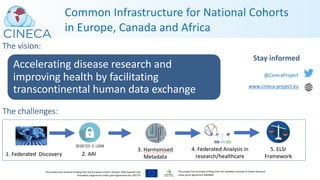
The challenges:
Stay informed
@CinecaProject
www.cineca-project.eu
Common Infrastructure for National Cohorts
in Europe, Canada and Africa
This project has received funding from the European Union’s Horizon 2020 research and
InnovaPon programme under grant agreement No. 825775
Accelerating disease research and
improving health by facilitating
transcontinental human data exchange
The vision:
This project has received funding from the Canadian Institute of Health Research
under grant agreement #404896
Today’s presenter
Katherine Johnston is currently co-chair of the H3ABioNet Health InformaPcs
Work Package and H3Africa Phenotype HarmonisaPon Working Group, focused
on data harmonisaPon efforts and building Phenotype Standards in the African
context. She provides support to the H3Africa ConsorPum studies in phenotype
data collecPon, harmonisaPon, soware pla]orms and incorporaPon of
ontologies. With a long-standing desire to play a role in advances in genePc
research, Katherine moved from a posiPon as Head Clinical Data Manager at
AHRI, Durban and joined the ComputaPonal Biology Division at UCT, Cape Town
as an H3ABioNet Soware Developer. She completed an Honours degree in
Computer Science and Economics and started her career working in Electronic
Health Record systems development.
Discovering a passion for helping medical professionals in the field of patient care by building them useful
electronic tools she joined CAPRISA as a Clinical Data Manager in 2004 and worked with enjoyment in the
field of clinical data management for 13 years. During this time, she married and had three beautiful
children, the first of whom has Down Syndrome. As a result, she finds herself unexpectedly combining her
interest in genetics, health informatics and patient care with her love for her children, advocating for
inclusivity and research advancements in medical care, data collection standards and software development
to benefit all genetically diverse people in Africa.
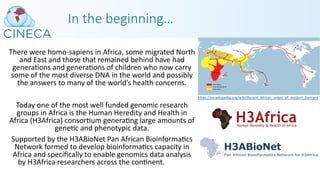
In the beginning…
There were homo-sapiens in Africa, some migrated North
and East and those that remained behind have had
generaPons and generaPons of children who now carry
some of the most diverse DNA in the world and possibly
the answers to many of the world’s health concerns.
Today one of the most well funded genomic research
groups in Africa is the Human Heredity and Health in
Africa (H3Africa) consorPum generaPng large amounts of
genePc and phenotypic data.
Supported by the H3ABioNet Pan African BioinformaPcs
Network formed to develop bioinformaPcs capacity in
Africa and specifically to enable genomics data analysis
by H3Africa researchers across the conPnent.
https://en.wikipedia.org/wiki/Recent_African_origin_of_modern_humans
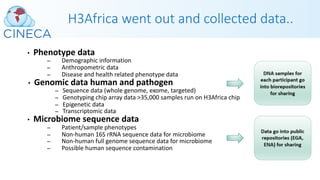
H3Africa went out and collected data..
• Phenotype data
– Demographic information
– Anthropometric data
– Disease and health related phenotype data
• Genomic data human and pathogen
– Sequence data (whole genome, exome, targeted)
– Genotyping chip array data >35,000 samples run on H3Africa chip
– Epigenetic data
– Transcriptomic data
• Microbiome sequence data
– Patient/sample phenotypes
– Non-human 16S rRNA sequence data for microbiome
– Non-human full genome sequence data for microbiome
– Possible human sequence contamination
…and discovered a little way into its journey a
need to harmonise Phenotype data
• To enable cross-project analyses
• H3Africa grantees encouraged, whenever possible, to use the PhenX
standardized phenotype measures
• Phenotype HarmonizaPon Working Group established
• PHWG worked on data standards and harmonizaPon:
• Developing core phenotypes to collect
• Created tools around core phenotypes
• RetrospecPve harmonizaPon of data
Both prospective and retrospective
data harmonisation had to be done.
• All first round funded projects had started data collection
• Two options
1. Decide what variables should be collected and how, then see
who has collected them
2. See what everyone has already collected and identify overlaps
• Where there were differences, these would have to be mapped to a
common variable later
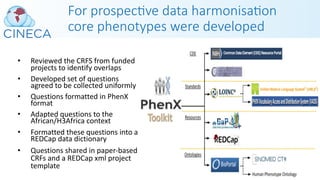
For prospec8ve data harmonisa8on
core phenotypes were developed
• Reviewed the CRFS from funded
projects to identify overlaps
• Developed set of questions
agreed to be collected uniformly
• Questions formatted in PhenX
format
• Adapted questions to the
African/H3Africa context
• Formatted these questions into a
REDCap data dictionary
• Questions shared in paper-based
CRFs and a REDCap xml project
template
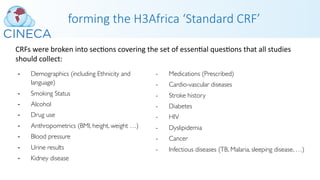
forming the H3Africa ‘Standard CRF’
- Demographics (including Ethnicity and
language)
- Smoking Status
- Alcohol
- Drug use
- Anthropometrics (BMI, height, weight …)
- Blood pressure
- Urine results
- Kidney disease
- Medications (Prescribed)
- Cardio-vascular diseases
- Stroke history
- Diabetes
- HIV
- Dyslipidemia
- Cancer
- Infectious diseases (TB, Malaria, sleeping disease, …)
CRFs were broken into secPons covering the set of essenPal quesPons that all studies
should collect:
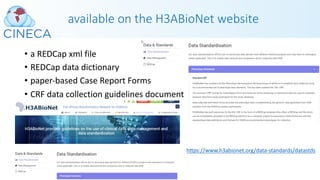
available on the H3ABioNet website
• a REDCap xml file
• REDCap data dictionary
• paper-based Case Report Forms
• CRF data collection guidelines document
hkps://www.h3abionet.org/data-standards/datastds
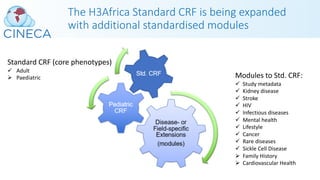
The H3Africa Standard CRF is being expanded
with additional standardised modules
Modules to Std. CRF:
ü Study metadata
ü Kidney disease
ü Stroke
ü HIV
ü Infectious diseases
ü Mental health
ü Lifestyle
ü Cancer
ü Rare diseases
ü Sickle Cell Disease
Ø Family History
Ø Cardiovascular Health
Standard CRF (core phenotypes)
ü Adult
Ø Paediatric
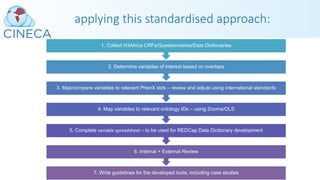
applying this standardised approach:
7. Write guidelines for the developed tools, including case studies
6. Internal + External Review
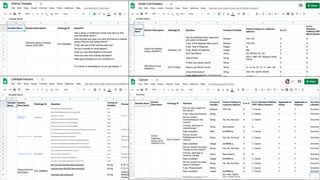
5. Complete variable spreadsheet – to be used for REDCap Data Dictionary development
4. Map variables to relevant ontology IDs – using Zooma/OLS
3. Map/compare variables to relevant PhenX stds – review and adjust using international standards
2. Determine variables of interest based on overlaps
1. Collect H3Africa CRFs/Questionnaires/Data Dictionaries
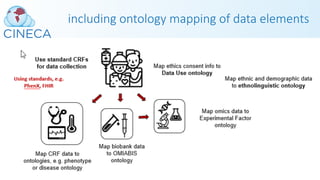
including ontology mapping of data elements
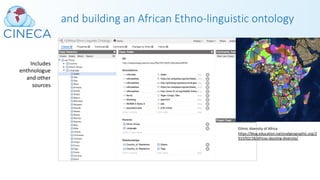
and building an African Ethno-linguistic ontology
Ethnic diversity of Africa
https://blog.education.nationalgeographic.org/2
015/02/18/africas-dazzling-diversity/
Includes
enthnologue
and other
sources
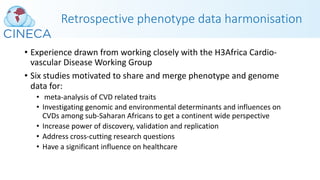
Retrospective phenotype data harmonisation
• Experience drawn from working closely with the H3Africa Cardio-
vascular Disease Working Group
• Six studies motivated to share and merge phenotype and genome
data for:
• meta-analysis of CVD related traits
• Investigating genomic and environmental determinants and influences on
CVDs among sub-Saharan Africans to get a continent wide perspective
• Increase power of discovery, validation and replication
• Address cross-cutting research questions
• Have a significant influence on healthcare
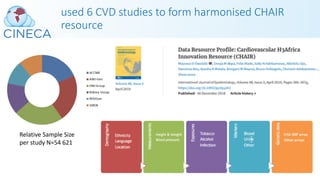
used 6 CVD studies to form harmonised CHAIR
resource
Relative Sample Size
per study N=54 621
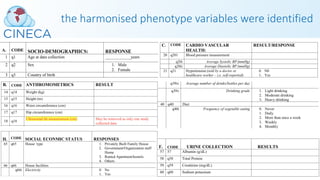
the harmonised phenotype variables were identified
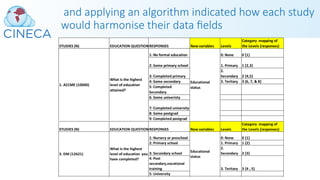
and applying an algorithm indicated how each study
would harmonise their data fields
STUDIES (N) EDUCATION QUESTIONSRESPONSES New variables Levels
Category mapping of
the Levels {responses}
1: No formal education 0: None 0 {1}
2: Some primary school 1. Primary 1 {2,3}
3: Completed primary
2.
Secondary 2 {4,5}
4: Some secondary 3. Teritary 3 (6, 7, & 8}
5: Completed
Secondary
6: Some univeristy
7: Completed university
8: Some postgrad
9: Completed postgrad
1: No formal education, 0: None 0 {0}
2. Primary 1. Primary 1 {2}
3. Secondary
2.
Secondary 2 {3}
4. Tertiary 3. Teritary 3 {4}
Highest level of
education?
What is the highest
level of education
attained?
Educational
status
Educational
status
1. ACCME (10000)
2. Awi-GEN (12, 000)
STUDIES (N) EDUCATION QUESTIONSRESPONSES New variables Levels
Category mapping of
the Levels {responses}
1: Nursery or preschool 0: None 0 {1}
2: Primary school 1. Primary 1 {2}
3: Secondary school
2.
Secondary 2 {3}
4: Post
secondary,vocational
training 3. Teritary 3 {4 , 5}
5: University
Educational
status
3. DM (12621)
What is the highest
level of education you
have completed?
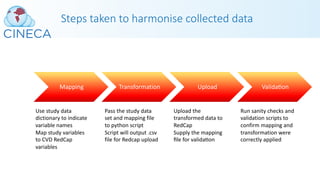
Steps taken to harmonise collected data
Mapping Transformation Upload ValidaPon
Use study data
dictionary to indicate
variable names
Map study variables
to CVD RedCap
variables
Pass the study data
set and mapping file
to python script
Script will output .csv
file for Redcap upload
Upload the
transformed data to
RedCap
Supply the mapping
file for validaPon
Run sanity checks and
validation scripts to
confirm mapping and
transformation were
correctly applied
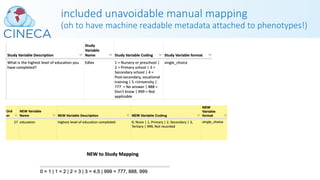
included unavoidable manual mapping
(oh to have machine readable metadata attached to phenotypes!)
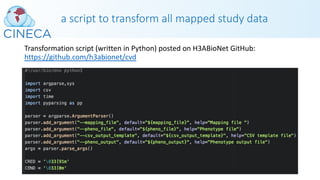
a script to transform all mapped study data
Transformation script (written in Python) posted on H3ABioNet GitHub:
https://github.com/h3abionet/cvd
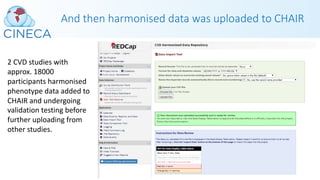
And then harmonised data was uploaded to CHAIR
2 CVD studies with
approx. 18000
participants harmonised
phenotype data added to
CHAIR and undergoing
validation testing before
further uploading from
other studies.
Many challenges were met…
With the retrospecPve data harmonisaPon:
• Did parPcipant consent forms cover meta-analysis? What DUO codes applied?
• Could fragmented IRBs and insPtuPons in different countries agree on harmonised efforts?
• Where would curated and harmonised data reside?
• IRB approval for harmonisaPon database had to be obtained.
• Diverse or lacking data governance policies in different African countries created uncertainty.
• Tribal poliPcs and minority populaPons had concerns about data sharing and access that minimised data that was
allowed to be harmonised.
• Who could send or ship samples out a country – was it permiked?
• Different data pla]orms and hetrogeneity of phenotype data meant each study had to be manually mapped to
harmonised variables.
• Studies were slow to completely clean and analyse data ready for meta-analysis
• Visibility of some data were a concern e.g. site – some minority populaPons were concerned about idenPficaPon and
potenPal risks.
• Determining whether or not to include longitudinal data and how
• RetrospecPve coding of ethnicity/tribe and language needed to be done
• Calculated variables had to be done at a study level – the generic script could not accommodate different scenarios from
different studies to where mulPple fields informed a single harmonised data element.
Many…
With the prospective data harmonisation (recommending harmonised data collection
variables and building of data standards):
• Motivation for studies to implement standards for data collection is low when they are focused on getting a study off the
ground
• Benefits are not immediately apparent
• Obtaining study CRF templates and identifying what data studies actually collect can take a long time
• Use of different data collection platforms, infrastructure and environments in multiple African countries mean applying a
single standard is difficult
• The diversity in Africa made formatting and methods of data collection difficult to agree on and apply – different cultures,
languages and governing structures affect how clinical data is collected in Africa
• A number of pre-defined phenotype data standards already in existence did not align with availability of data in African
countries and the formatting of participant questions e.g. Asking environmental exposure question to someone in a rural
area of Africa what temperature they set their washing machine to when washing clothes is nonsensical when they are
very unlikely to have electricity let alone a washing machine.
• It is difficult to assess how successful a standard is until applied, data has been collected and a meta-analysis across
multiple standard users are applied…this takes time and often results in version changes to standards over extended time
Lessons were learnt and best practices in phenotype
harmonisation are beginning to take shape
1. Make sure your clinical data managers and database developers are aware of the FAIR data principles and
current phenotype data standards available.
2. Communicate and get involved in other efforts building phenotype standards such as GA4GH ClinPheno
workstream; PhenX toolkit; FHIR / HL7; etc.
3. Acknowledgement of funder requirements and knowing what standards to apply in database development and
CRF design before a study starts is important including
4. Provide data collection recommendations along with data dictionaries
5. Data must be completely clean prior to harmonisation
6. Familiarity with consent and data access policies important
7. Consulting with elders / leaders in the location of research is important to respecting rights of populations
8. Including and expanding on collection of machine readable metadata important
9. Address any misconceptions about data upfront
10. Implement FAIR data practices whenever possible
11. Keep abreast of study status and implement a feedback process for studying using data collection standards.
Acknowledgements
Prof. Nicola Mulder; Alia Bankhala; Prof Michele Ramsay; Onoja Akpa ; Lyndon Zass;
Mamana Mbiyavanga; Tinashe Chikowore; Vicky Nembaware; Nicola Tiffin; Jeff
Strewing.
H3ABioNet Std CRF project team; Joint Phenotype Harmonisation Project team;
H3Africa Phenotype Harmonisation WG; H3Africa CVD WG; H3ABioNet staff at UCT
H3ABioNet central node.
Some African sayings…
Cross the river
in a crowd
and the
c r o c o d i l e
will not eat you.
~ African proverb
A single bracelet does not jingle.
~ Congolese proverb
If you want to go quickly,
go alone.
If you want to go far, go together.
~ African proverb
A united family eats from the same plate. ~ Baganda proverb
Questions?
Title: H3ABioNet Experiences in Phenotype Data HarmonisaPon and
Standards Development
Presenter: Katherine Johnston, UCT
Please write your questions in the questions
window of the GoToWebinar application
Next CINECA webinar
Title: Ethical, legal and societal issues in international data sharing
Presenter: Éloïse Gennet and Melanie Goisauf
Date/Time: Friday 24th January 2020, 13:30 CET
Registration and details: https://www.cineca-project.eu/webinars

CINECA webinar slides: H3ABioNet Experiences in Phenotype Data Harmonisation and Standards Development

  • 1.
    This project hasreceived funding from the European Union’s Horizon 2020 research and Innovation programme under grant agreement No. 825775 H3ABioNet Experiences in Phenotype Data Harmonisa8on and Standards Development Presenter: Katherine Johnston, UCT Host: Vera Matser (EMBL-EBI)
  • 2.
    This webinar isbeing recorded
  • 3.
    Audience Q&A Session Pleasewrite your questions in the questions window of the GoToWebinar application
  • 4.
    The challenges: Stay informed @CinecaProject www.cineca-project.eu CommonInfrastructure for National Cohorts in Europe, Canada and Africa This project has received funding from the European Union’s Horizon 2020 research and InnovaPon programme under grant agreement No. 825775 Accelerating disease research and improving health by facilitating transcontinental human data exchange The vision: This project has received funding from the Canadian Institute of Health Research under grant agreement #404896
  • 5.
    Today’s presenter Katherine Johnstonis currently co-chair of the H3ABioNet Health InformaPcs Work Package and H3Africa Phenotype HarmonisaPon Working Group, focused on data harmonisaPon efforts and building Phenotype Standards in the African context. She provides support to the H3Africa ConsorPum studies in phenotype data collecPon, harmonisaPon, soware pla]orms and incorporaPon of ontologies. With a long-standing desire to play a role in advances in genePc research, Katherine moved from a posiPon as Head Clinical Data Manager at AHRI, Durban and joined the ComputaPonal Biology Division at UCT, Cape Town as an H3ABioNet Soware Developer. She completed an Honours degree in Computer Science and Economics and started her career working in Electronic Health Record systems development. Discovering a passion for helping medical professionals in the field of patient care by building them useful electronic tools she joined CAPRISA as a Clinical Data Manager in 2004 and worked with enjoyment in the field of clinical data management for 13 years. During this time, she married and had three beautiful children, the first of whom has Down Syndrome. As a result, she finds herself unexpectedly combining her interest in genetics, health informatics and patient care with her love for her children, advocating for inclusivity and research advancements in medical care, data collection standards and software development to benefit all genetically diverse people in Africa.
  • 6.
    In the beginning… Therewere homo-sapiens in Africa, some migrated North and East and those that remained behind have had generaPons and generaPons of children who now carry some of the most diverse DNA in the world and possibly the answers to many of the world’s health concerns. Today one of the most well funded genomic research groups in Africa is the Human Heredity and Health in Africa (H3Africa) consorPum generaPng large amounts of genePc and phenotypic data. Supported by the H3ABioNet Pan African BioinformaPcs Network formed to develop bioinformaPcs capacity in Africa and specifically to enable genomics data analysis by H3Africa researchers across the conPnent. https://en.wikipedia.org/wiki/Recent_African_origin_of_modern_humans
  • 7.
    H3Africa went outand collected data.. • Phenotype data – Demographic information – Anthropometric data – Disease and health related phenotype data • Genomic data human and pathogen – Sequence data (whole genome, exome, targeted) – Genotyping chip array data >35,000 samples run on H3Africa chip – Epigenetic data – Transcriptomic data • Microbiome sequence data – Patient/sample phenotypes – Non-human 16S rRNA sequence data for microbiome – Non-human full genome sequence data for microbiome – Possible human sequence contamination
  • 8.
    …and discovered alittle way into its journey a need to harmonise Phenotype data • To enable cross-project analyses • H3Africa grantees encouraged, whenever possible, to use the PhenX standardized phenotype measures • Phenotype HarmonizaPon Working Group established • PHWG worked on data standards and harmonizaPon: • Developing core phenotypes to collect • Created tools around core phenotypes • RetrospecPve harmonizaPon of data
  • 9.
    Both prospective andretrospective data harmonisation had to be done. • All first round funded projects had started data collection • Two options 1. Decide what variables should be collected and how, then see who has collected them 2. See what everyone has already collected and identify overlaps • Where there were differences, these would have to be mapped to a common variable later
  • 10.
    For prospec8ve dataharmonisa8on core phenotypes were developed • Reviewed the CRFS from funded projects to identify overlaps • Developed set of questions agreed to be collected uniformly • Questions formatted in PhenX format • Adapted questions to the African/H3Africa context • Formatted these questions into a REDCap data dictionary • Questions shared in paper-based CRFs and a REDCap xml project template
  • 11.
    forming the H3Africa‘Standard CRF’ - Demographics (including Ethnicity and language) - Smoking Status - Alcohol - Drug use - Anthropometrics (BMI, height, weight …) - Blood pressure - Urine results - Kidney disease - Medications (Prescribed) - Cardio-vascular diseases - Stroke history - Diabetes - HIV - Dyslipidemia - Cancer - Infectious diseases (TB, Malaria, sleeping disease, …) CRFs were broken into secPons covering the set of essenPal quesPons that all studies should collect:
  • 12.
    available on theH3ABioNet website • a REDCap xml file • REDCap data dictionary • paper-based Case Report Forms • CRF data collection guidelines document hkps://www.h3abionet.org/data-standards/datastds
  • 13.
    The H3Africa StandardCRF is being expanded with additional standardised modules Modules to Std. CRF: ü Study metadata ü Kidney disease ü Stroke ü HIV ü Infectious diseases ü Mental health ü Lifestyle ü Cancer ü Rare diseases ü Sickle Cell Disease Ø Family History Ø Cardiovascular Health Standard CRF (core phenotypes) ü Adult Ø Paediatric
  • 14.
    applying this standardisedapproach: 7. Write guidelines for the developed tools, including case studies 6. Internal + External Review 5. Complete variable spreadsheet – to be used for REDCap Data Dictionary development 4. Map variables to relevant ontology IDs – using Zooma/OLS 3. Map/compare variables to relevant PhenX stds – review and adjust using international standards 2. Determine variables of interest based on overlaps 1. Collect H3Africa CRFs/Questionnaires/Data Dictionaries
  • 16.
  • 17.
    and building anAfrican Ethno-linguistic ontology Ethnic diversity of Africa https://blog.education.nationalgeographic.org/2 015/02/18/africas-dazzling-diversity/ Includes enthnologue and other sources
  • 18.
    Retrospective phenotype dataharmonisation • Experience drawn from working closely with the H3Africa Cardio- vascular Disease Working Group • Six studies motivated to share and merge phenotype and genome data for: • meta-analysis of CVD related traits • Investigating genomic and environmental determinants and influences on CVDs among sub-Saharan Africans to get a continent wide perspective • Increase power of discovery, validation and replication • Address cross-cutting research questions • Have a significant influence on healthcare
  • 19.
    used 6 CVDstudies to form harmonised CHAIR resource Relative Sample Size per study N=54 621
  • 20.
    the harmonised phenotypevariables were identified
  • 21.
    and applying analgorithm indicated how each study would harmonise their data fields STUDIES (N) EDUCATION QUESTIONSRESPONSES New variables Levels Category mapping of the Levels {responses} 1: No formal education 0: None 0 {1} 2: Some primary school 1. Primary 1 {2,3} 3: Completed primary 2. Secondary 2 {4,5} 4: Some secondary 3. Teritary 3 (6, 7, & 8} 5: Completed Secondary 6: Some univeristy 7: Completed university 8: Some postgrad 9: Completed postgrad 1: No formal education, 0: None 0 {0} 2. Primary 1. Primary 1 {2} 3. Secondary 2. Secondary 2 {3} 4. Tertiary 3. Teritary 3 {4} Highest level of education? What is the highest level of education attained? Educational status Educational status 1. ACCME (10000) 2. Awi-GEN (12, 000) STUDIES (N) EDUCATION QUESTIONSRESPONSES New variables Levels Category mapping of the Levels {responses} 1: Nursery or preschool 0: None 0 {1} 2: Primary school 1. Primary 1 {2} 3: Secondary school 2. Secondary 2 {3} 4: Post secondary,vocational training 3. Teritary 3 {4 , 5} 5: University Educational status 3. DM (12621) What is the highest level of education you have completed?
  • 22.
    Steps taken toharmonise collected data Mapping Transformation Upload ValidaPon Use study data dictionary to indicate variable names Map study variables to CVD RedCap variables Pass the study data set and mapping file to python script Script will output .csv file for Redcap upload Upload the transformed data to RedCap Supply the mapping file for validaPon Run sanity checks and validation scripts to confirm mapping and transformation were correctly applied
  • 23.
    included unavoidable manualmapping (oh to have machine readable metadata attached to phenotypes!)
  • 24.
    a script totransform all mapped study data Transformation script (written in Python) posted on H3ABioNet GitHub: https://github.com/h3abionet/cvd
  • 25.
    And then harmoniseddata was uploaded to CHAIR 2 CVD studies with approx. 18000 participants harmonised phenotype data added to CHAIR and undergoing validation testing before further uploading from other studies.
  • 26.
    Many challenges weremet… With the retrospecPve data harmonisaPon: • Did parPcipant consent forms cover meta-analysis? What DUO codes applied? • Could fragmented IRBs and insPtuPons in different countries agree on harmonised efforts? • Where would curated and harmonised data reside? • IRB approval for harmonisaPon database had to be obtained. • Diverse or lacking data governance policies in different African countries created uncertainty. • Tribal poliPcs and minority populaPons had concerns about data sharing and access that minimised data that was allowed to be harmonised. • Who could send or ship samples out a country – was it permiked? • Different data pla]orms and hetrogeneity of phenotype data meant each study had to be manually mapped to harmonised variables. • Studies were slow to completely clean and analyse data ready for meta-analysis • Visibility of some data were a concern e.g. site – some minority populaPons were concerned about idenPficaPon and potenPal risks. • Determining whether or not to include longitudinal data and how • RetrospecPve coding of ethnicity/tribe and language needed to be done • Calculated variables had to be done at a study level – the generic script could not accommodate different scenarios from different studies to where mulPple fields informed a single harmonised data element.
  • 27.
    Many… With the prospectivedata harmonisation (recommending harmonised data collection variables and building of data standards): • Motivation for studies to implement standards for data collection is low when they are focused on getting a study off the ground • Benefits are not immediately apparent • Obtaining study CRF templates and identifying what data studies actually collect can take a long time • Use of different data collection platforms, infrastructure and environments in multiple African countries mean applying a single standard is difficult • The diversity in Africa made formatting and methods of data collection difficult to agree on and apply – different cultures, languages and governing structures affect how clinical data is collected in Africa • A number of pre-defined phenotype data standards already in existence did not align with availability of data in African countries and the formatting of participant questions e.g. Asking environmental exposure question to someone in a rural area of Africa what temperature they set their washing machine to when washing clothes is nonsensical when they are very unlikely to have electricity let alone a washing machine. • It is difficult to assess how successful a standard is until applied, data has been collected and a meta-analysis across multiple standard users are applied…this takes time and often results in version changes to standards over extended time
  • 28.
    Lessons were learntand best practices in phenotype harmonisation are beginning to take shape 1. Make sure your clinical data managers and database developers are aware of the FAIR data principles and current phenotype data standards available. 2. Communicate and get involved in other efforts building phenotype standards such as GA4GH ClinPheno workstream; PhenX toolkit; FHIR / HL7; etc. 3. Acknowledgement of funder requirements and knowing what standards to apply in database development and CRF design before a study starts is important including 4. Provide data collection recommendations along with data dictionaries 5. Data must be completely clean prior to harmonisation 6. Familiarity with consent and data access policies important 7. Consulting with elders / leaders in the location of research is important to respecting rights of populations 8. Including and expanding on collection of machine readable metadata important 9. Address any misconceptions about data upfront 10. Implement FAIR data practices whenever possible 11. Keep abreast of study status and implement a feedback process for studying using data collection standards.
  • 29.
    Acknowledgements Prof. Nicola Mulder;Alia Bankhala; Prof Michele Ramsay; Onoja Akpa ; Lyndon Zass; Mamana Mbiyavanga; Tinashe Chikowore; Vicky Nembaware; Nicola Tiffin; Jeff Strewing. H3ABioNet Std CRF project team; Joint Phenotype Harmonisation Project team; H3Africa Phenotype Harmonisation WG; H3Africa CVD WG; H3ABioNet staff at UCT H3ABioNet central node.
  • 30.
    Some African sayings… Crossthe river in a crowd and the c r o c o d i l e will not eat you. ~ African proverb A single bracelet does not jingle. ~ Congolese proverb If you want to go quickly, go alone. If you want to go far, go together. ~ African proverb A united family eats from the same plate. ~ Baganda proverb
  • 31.
    Questions? Title: H3ABioNet Experiencesin Phenotype Data HarmonisaPon and Standards Development Presenter: Katherine Johnston, UCT Please write your questions in the questions window of the GoToWebinar application
  • 32.
    Next CINECA webinar Title:Ethical, legal and societal issues in international data sharing Presenter: Éloïse Gennet and Melanie Goisauf Date/Time: Friday 24th January 2020, 13:30 CET Registration and details: https://www.cineca-project.eu/webinars