COT LESSON PLAN
SCHOOLMARIGONDON ELEMENTARY
SCHOOL
GRADE/ SECTION V
TEACHER CARICRIS O. MARATA SUBJECT SCIENCE 5
DATE/TIME January 20, 2022 (11:00- 12:00) QUARTER 2nd
LEARNING COMPETENCIES Identify the reproductive parts in a flowering plants S5LT-IIf-6
(all highlighted with green colors belong to #7)
INTEGRATION
OBJECTIVES: Identify the reproductive parts in a flowering plant
Draw and label the parts of the reproductive organs of the
flower
Discuss the importance of flowers to plants
The teacher applies
in the lesson
planning objectives
in order to meet the
curriculum
requirement based
on the curriculum
guide.
CONTENT:
Reproductive Parts in Flowering Plants
LEARNING RESOURCES Sci-Bytes Worktext in Science 5pp.175-176, Cyber Science Worktext
in Science and Technology 5 pp.119- 12; powerpoint presentation,
downloaded images, (ICT integration found in the review, chalk,
eraser, flashcards, activity cards, worksheets, illustrations, interactive
TV, laptop
LRMDS – Project EASE Biology pp.11-14
http;/leavingbio.net/thestructureandfunctionsofflowers
PROCEDURES: 5 E's APPROACH
A. Reviewing the previous
Lesson (Through power
point presentation)
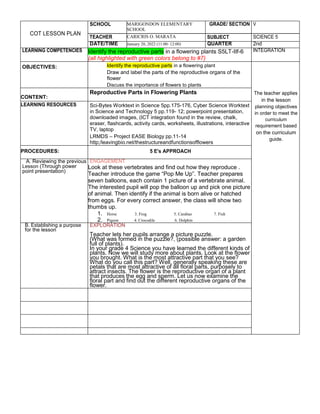
ENGAGEMENT
Look at these vertebrates and find out how they reproduce .
Teacher introduce the game “Pop Me Up”. Teacher prepares
seven balloons, each contain 1 picture of a vertebrate animal.
The interested pupil will pop the balloon up and pick one picture
of animal. Then identify if the animal is born alive or hatched
from eggs. For every correct answer, the class will show two
thumbs up.
1. Horse 3. Frog 5. Carabao 7. Fish
2. Pigeon 4. Crocodile 6. Dolphin
B. Establishing a purpose
for the lesson
EXPLORATION
Teacher lets her pupils arrange a picture puzzle.
(What was formed in the puzzle?, (possible answer: a garden
full of plants).
In your grade 4 Science you have learned the different kinds of
plants. Now we will study more about plants. Look at the flower
you brought. What is the most attractive part that you see?
What do you call this part? Well, generally speaking these are
petals that are most attractive of all floral parts, purposely to
attract insects. The flower is the reproductive organ of a plant
that produces the egg and sperm. Let us now examine the
floral part and find out the different reproductive organs of the
flower.
2.
The teacher
manages learner
behavior
constructivelyby
applyi ng positive
and non violent
disciplineto ensure
learning- focused
environment.
B. Establishing a purpose
for the |esson
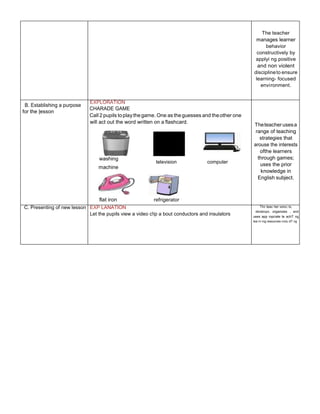
EXPLORATION
CHARADE GAME
Call 2 pupils toplaythegame. One as theguesses and theother one
will act out the word written on a flashcard.
washing
television computer
machine
flat iron refrigerator
Theteacherusesa
range of teaching
strategies that
arouse the interests
ofthe learners
through games;
uses the prior
knowledge in
English subject.
C. Presenting of new lesson EXP LANATION
Let the pupils view a video c!ip a bout conductors and insulators
The teac her seiec ts,
deveiops, organizes , and
uses app ropriate te achT ng
lea rn ing resources inclu dT ng
3.
D. Discussing newconcepts
and practicing new skills
ELABORATION
Questions about the video presentation
1. What is the video a|I about?
2. What is a conductor?
3. What is an insulator?
4. What are the metals made of?
5. Why do you think the materials made of metal is hot?
6. Why do you think the materials made of plastic is not hot?
7. Why are some materials are good conductors of heat and electricity?
8. How does the electrons move in conductors? Insulators?
The teacher uses a
range of teaching
strategies that
enhance learner
achievement in
literacy and
numeracy skills.
E. Developing Mastery Learn more about the characteristics of good conductor of heat and
electricity by arranging the jumbled letters in each sentence.
1. Metals are good conductor of electricity because of its {Tehraml
Conucdvitiy)
2. Electrons flow easily through (Concudtors)
3. It is a commonly used metal in electrical wires because of its high
conductivity. (Ceppor)
4-5. Our body is also a good conductor of electricity because of the
presence of (Wetar and Minarel)
The teacher uses
differentiated,
developmentally
appropriate
lea rning
experiences to
address learners'
needs, strengths
and interests.
F. Finding practical
applications of concepts
Group Activity
The teacher
manages classroom
structure to engage
learners in group
hands- on
activities basedon
their interests and
capabilities.
The teacher aslo
uses the prior
knowledge in
MAPE H subject.
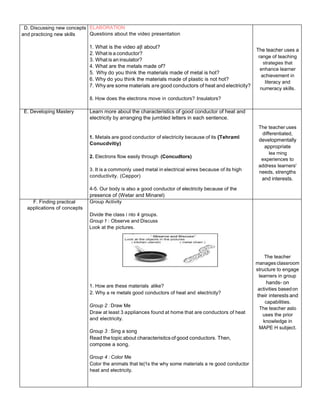
Divide the class i nto 4 groups.
Group 1 : Observe and Discuss
Look at the pictures.
1. How are these materials alike?
2. Why a re metals good conductors of heat and electricity?
Group 2 : Draw Me
Draw at least 3 appliances found at home that are conductors of heat
and electricity.
Group 3 : Sing a song
Read the topic about characterisitcs of good conductors. Then,
compose a song.
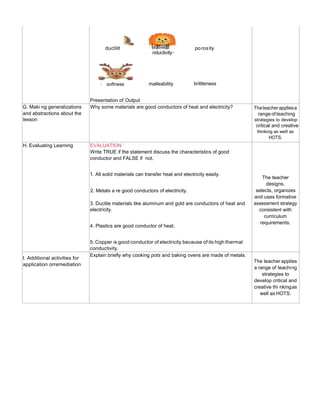
Group 4 : Color Me
Color the animals that te|1s the why some materials a re good conductor
heat and electricity.
4.
ductilit
“ t ermal"
porosity
. nductivity•
,I softness , malleability brittleness
Presentation of Output
G. Maki ng generalizations
and abstractions about the
Why some materials are good conductors of heat and electricity? Theteacherappliesa
range ofteaching
lesson strategies to develop
critical and creative
thinking as weII as
HOTS.
H. Evaluating Learning EVALUATION
Write TRUE if the statement discuss the characteristics of good
conductor and FALSE if not.
The teacher
designs,
selects, organizes
and uses formative
assessment strategy
consistent with
curriculum
requirements.
1. All solid materials can transfer heat and electricity easily.
2. Metals a re good conductors of electricity.
3. Ductile materials like aluminum and gold are conductors of heat and
electricity.
4. Plastics are good conductor of heat.
5. Copper is good conductor of electricity because of its high thermal
conductivity.
I. Additional activities for
application orremediation
Explain briefly why cooking pots and baking ovens are made of metals.
The teacher applies
a range of teaching
strategies to
develop critical and
creative thi nkingas
well as HOTS.