July 2019 | Issue 25 | Pagewww.vidyapitha.in 1
A Monthly E-Magazine from the Bhaktivedanta Vidyapitha with Illuminating Perspectives on the Srimad-Bhagavatam
July 2019 | Issue 25
Dedicated to His Divine Grace
A. C. Bhaktivedänta Swämi Prabhupäda,
Founder-Äcärya of the International Society
for Krishna Consciousness
Who is More Favored by Krsna? 2
Who is Worthy of Giving Shelter? 3
Devotion to Guru 6
Verse of the Month 7
Quiz Corner 7
Bhägavata Praväha 8
Analogy Arena 9
Pari-praçna 10
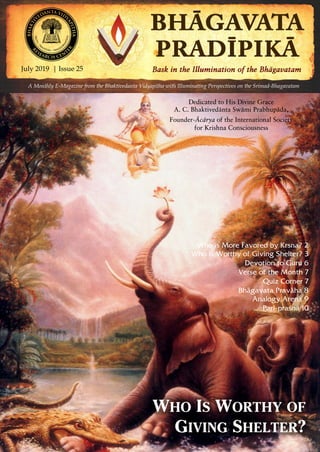
WHO IS WORTHY OF
GIVING SHELTER?
July 2019 | Issue 25 | Pagewww.vidyapitha.in 2
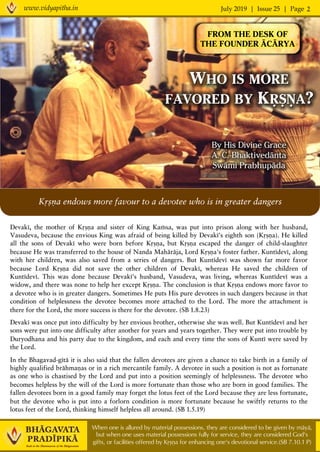
Kåñëa endows more favour to a devotee who is in greater dangers
Devaké, the mother of Kåñëa and sister of King Kaàsa, was put into prison along with her husband,
Vasudeva, because the envious King was afraid of being killed by Devaké's eighth son (Kåñëa). He killed
all the sons of Devaké who were born before Kåñëa, but Kåñëa escaped the danger of child-slaughter
because He was transferred to the house of Nanda Mahäräja, Lord Kåñëa's foster father. Kuntédevé, along
with her children, was also saved from a series of dangers. But Kuntédevé was shown far more favor
because Lord Kåñëa did not save the other children of Devaké, whereas He saved the children of
Kuntédevé. This was done because Devaké's husband, Vasudeva, was living, whereas Kuntédevé was a
widow, and there was none to help her except Kåñëa. The conclusion is that Kåñëa endows more favor to
a devotee who is in greater dangers. Sometimes He puts His pure devotees in such dangers because in that
condition of helplessness the devotee becomes more attached to the Lord. The more the attachment is
there for the Lord, the more success is there for the devotee. (SB 1.8.23)
Devaké was once put into difficulty by her envious brother, otherwise she was well. But Kuntédevé and her
sons were put into one difficulty after another for years and years together. They were put into trouble by
Duryodhana and his party due to the kingdom, and each and every time the sons of Kunté were saved by
the Lord.
In the Bhagavad-gétä it is also said that the fallen devotees are given a chance to take birth in a family of
highly qualified brähmaëas or in a rich mercantile family. A devotee in such a position is not as fortunate
as one who is chastised by the Lord and put into a position seemingly of helplessness. The devotee who
becomes helpless by the will of the Lord is more fortunate than those who are born in good families. The
fallen devotees born in a good family may forget the lotus feet of the Lord because they are less fortunate,
but the devotee who is put into a forlorn condition is more fortunate because he swiftly returns to the
lotus feet of the Lord, thinking himself helpless all around. (SB 1.5.19)
WHO IS MORE
FAVORED BY KÅÑËA?
FROM THE DESK OF
THE FOUNDER ÄCÄRYA
By His Divine Grace
A. C. Bhaktivedänta
Swämi Prabhupäda
When one is allured by material possessions, they are considered to be given by mäyä,
but when one uses material possessions fully for service, they are considered God's
gifts, or facilities offered by Kåñëa for enhancing one's devotional service.(SB 7.10.1 P)
July 2019 | Issue 25 | Pagewww.vidyapitha.in 3
Only by penance can one appreciate the beauty and opulence of the Lord, and
when one is acquainted with that beauty and opulence, he is no longer attracted
by any other. (SB 3.9.1 P)
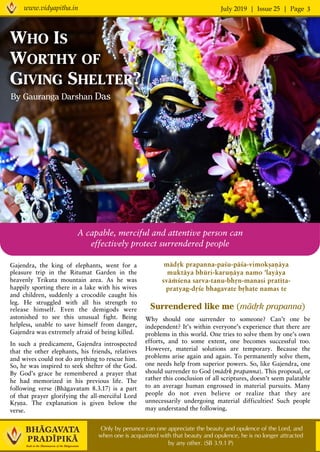
Gajendra, the king of elephants, went for a
pleasure trip in the Ritumat Garden in the
heavenly Trikuta mountain area. As he was
happily sporting there in a lake with his wives
and children, suddenly a crocodile caught his
leg. He struggled with all his strength to
release himself. Even the demigods were
astonished to see this unusual fight. Being
helpless, unable to save himself from danger,
Gajendra was extremely afraid of being killed.
In such a predicament, Gajendra introspected
that the other elephants, his friends, relatives
and wives could not do anything to rescue him.
So, he was inspired to seek shelter of the God.
By God’s grace he remembered a prayer that
he had memorized in his previous life. The
following verse (Bhägavatam 8.3.17) is a part
of that prayer glorifying the all-merciful Lord
Kåñëa. The explanation is given below the
verse.
By Gauranga Darshan Das
WHO IS
WORTHY OF
GIVING SHELTER?
Surrendered like me (mädåk prapanna)
Why should one surrender to someone? Can’t one be
independent? It’s within everyone’s experience that there are
problems in this world. One tries to solve them by one’s own
efforts, and to some extent, one becomes successful too.
However, material solutions are temporary. Because the
problems arise again and again. To permanently solve them,
one needs help from superior powers. So, like Gajendra, one
should surrender to God (mädåk prapanna). This proposal, or
rather this conclusion of all scriptures, doesn’t seem palatable
to an average human engrossed in material pursuits. Many
people do not even believe or realize that they are
unnecessarily undergoing material difficulties! Such people
may understand the following.
A capable, merciful and attentive person can
effectively protect surrendered people
mädåk prapanna-paçu-päça-vimokñaëäya
muktäya bhüri-karuëäya namo 'layäya
sväàçena sarva-tanu-bhån-manasi pratéta-
pratyag-dåçe bhagavate båhate namas te
July 2019 | Issue 25 | Pagewww.vidyapitha.in 4
As long as one remains in the bodily concept of life, he may act according to the
duties of social convention, but if one is elevated to the spiritual platform, he must
simply serve the Supreme Lord; that is the real execution of sva-dharma. (SB 3.28.2 P)
Unlimitedly Merciful
(bhüri-karuëäya)	
One who has million dollars certainly has the
capacity to help a poor person who is in need of
ten dollars. But unless that rich man has the
willingness to help, he wouldn’t help the poor
man. That basis of such willingness is one’s
merciful attitude. God is not only supremely
capable, but unlimitedly merciful too (bhüri-
karuëäya). This combination of God’s mercy
and capacity makes our surrender fruitful and
the most effective means to drive away all
miseries. But are ‘capacity’ and ‘mercy’
sufficient? 	
Attentive to the Devotees
(namo alayäya)	
One may be capable and merciful, but unless
one is ‘attentive’ to the needs or difficulties of
others, one cannot help them. Being omnipotent
and omniscient, God is always aware of our
problems. His awareness is due to His attentive-
ness. When we offer prayers, He attentively	
Entangled Animals (paçu-päça)
Gajendra was an animal (paçu). Çréla Prabhupäda says that
everyone who identifies oneself with the material body can
be called as paçu. Just as Gajendra was caught by
crocodile, every conditioned soul is entangled by the noose
(päça) of mäya or the illusory energy of God. Mäya
constitutes three material modes that bind a bewildered
soul in the cycle of repeated birth and death. Unlike an
animal, a human being is provided with a higher
intelligence to come out of it by seeking shelter of God.
Seeking Deliverance (vimokñaëäya)	
Surrendering to God, one seeks liberation from material
bondage (vimokñaëäya). To the degree we are eager for
deliverance, to that degree He reciprocates mercifully. Of
course, a pure devotee only wants to render unalloyed
service to God, without expecting anything in return,
including liberation. However, circumstantially, a devotee
may ask some favor from the Lord for self-preservation,
so that one may continue to serve Him without
obstructions. So, one who desires deliverance from
miseries or obstacles in life should fervently seek help
from God. But why only God, why not someone else?
	
Only the Liberated can Liberate
(muktäya)	
One should seek help from a capable person. One who
had fallen in a deep blind well can be pulled out only by
one who is outside the well. One who is drowning in an
ocean cannot be saved by another person who is also
drowning. When none of his strong elephant associates
were capable of saving Gajendra, he sought help from
God. Only God can liberate an entangled person because
God is never entangled, i.e., ever-liberated (muktäya).
Most people in this world are entangled by mäya to a
smaller or greater degree. And those who are not are so
only due to the mercy of God who reciprocated with their
desire to get disentangled. Of course, the Lord’s eternal
associates are also never entangled. Therefore, only the
omnipotent God and His pure devotees have the capability
to liberate a person bound by material miseries. But is
‘capability’ the only criterion? 	
Only the omnipotent God and His pure
devotees have the capability to liberate a
person bound by material miseries.
July 2019 | Issue 25 | Pagewww.vidyapitha.in 5
The duty of saintly persons is to take up seriously the cause of sanätana-dharma and
try to re-establish it for the benefit of the entire human society. (SB 8.14.4 P)
listens to us. Being our well-wisher, He aims and endeavors
to deliver us from material life, even before we pray. He is
never lazy in regard to our deliverance. Someone might ask,
“How can God be so attentive to our needs? He stays so
far from us in His spiritual abode!”
Stays Right in the Heart
(sva-aàçena sarva tanu-bhån manasi)	
God is not only capable, merciful, attentive to protect us,
but he is also very close to us. Although God eternally stays
in His spiritual kingdom, He also expands Himself as the
Supersoul or Paramätma (sva-aàçena) in the hearts of all
embodied beings (sarva tanu-bhån manasi). Even if the
living entity commits abominable actions and becomes an
insect or worm in stool, the Lord doesn’t ignore him or her.
He stays right within their hearts giving them knowledge,
remembrance and forgetfulness. 	
Directly Observes (pratéta pratyak-dåçe)	
Staying within the hearts of all, the Lord directly and
attentively observes the desires, needs and difficulties of
everyone and mercifully solves the problems of those who
surrender unto Him. 	
The unlimited Lord Kåñëa
(bhagavate båhate namaste)	
And that God (bhagavate) is none other than Lord Kåñëa
who is unlimited and the greatest (båhate), and is the source
of all incarnations. He is capable, merciful, attentive,
observant, and closest well-wisher of all of us. So, Gajendra
sought shelter of the Supreme Lord Kåñëa, the merciful
deliverer of all. 	
Hearing the helpless appeal of Gajendra, the Lord hastily
came on the back of His bird carrier Garuòa, and killed the
crocodile with His disc weapon and saved Gajendra. Lord
Kåñëa is always ready to save us from any difficulty at any
time. But are we ready enough to seek His protection like
Gajendra? Gajendra was exclusively dependent on the
Lord, having no other source of protection. Seeking
inspiration from Gajendra, let us humbly express our
dependence on Kåñëa. Everyone is caught by the crocodile
of eternal time and may die at any moment. The best
course, therefore, is to seek shelter of Kåñëa, and be saved
from the struggle for existence. To reach this
understanding is the ultimate goal of life.
July 2019 | Issue 25 | Pagewww.vidyapitha.in 6
Disposition of Disciple
There are many instances in
scriptures about people who
have perfected their lives by
their sincere devotion to their
gurus. These examples teach us
as to what is the nature and
mood of a disciple. How does a
disciple think of his spiritual
master? One such example is
that of Prahläda Mahäräja. He
was such a dear devotee of the
Lord that by the strength of his
devotional service, the Supreme
Lord appeared as Nåsiàha-
deva to protect him. The Lord
offered any benediction
desirable to him. Prahläda
however refused to accept any
such offerings, and filled with
gratitude, he could only
remember his guru, Närada
Muni. Prahläda said, “I have
been fallen in the hole of
saàsära due to the worldly
association. My guru Närada
Muni accepted me as his own
possession.
Liberation is never inaction, but service without human mistakes. (SB 2.2.1 P)
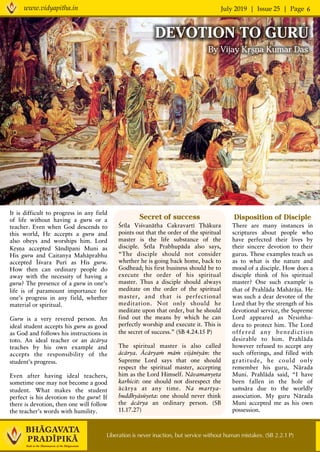
It is difficult to progress in any field
of life without having a guru or a
teacher. Even when God descends to
this world, He accepts a guru and
also obeys and worships him. Lord
Kåñëa accepted Sändépani Muni as
His guru and Caitanya Mahäprabhu
accepted Éçvara Puré as His guru.
How then can ordinary people do
away with the necessity of having a
guru? The presence of a guru in one’s
life is of paramount importance for
one’s progress in any field, whether
material or spiritual.
Guru is a very revered person. An
ideal student accepts his guru as good
as God and follows his instructions in
toto. An ideal teacher or an äcärya
teaches by his own example and
accepts the responsibility of the
student’s progress.
Even after having ideal teachers,
sometime one may not become a good
student. What makes the student
perfect is his devotion to the guru! If
there is devotion, then one will follow
the teacher’s words with humility.
DEVOTION TO GURU
By Vijay Kåñëa Kumar Das
Secret of success
Çréla Viçvanätha Cakravarté Öhäkura
points out that the order of the spiritual
master is the life substance of the
disciple. Çréla Prabhupäda also says,
“The disciple should not consider
whether he is going back home, back to
Godhead; his first business should be to
execute the order of his spiritual
master. Thus a disciple should always
meditate on the order of the spiritual
master, and that is perfectional
meditation. Not only should he
meditate upon that order, but he should
find out the means by which he can
perfectly worship and execute it. This is
the secret of success.” (SB 4.24.15 P)
The spiritual master is also called
äcärya. Äcäryaà mäà vijänéyän: the
Supreme Lord says that one should
respect the spiritual master, accepting
him as the Lord Himself. Nävamanyeta
karhicit: one should not disrespect the
äcärya at any time. Na martya-
buddhyäsüyeta: one should never think
the äcärya an ordinary person. (SB
11.17.27)
July 2019 | Issue 25 | Pagewww.vidyapitha.in 7
Happiness in the world depends proportionately on the maintenance of the religious principles,
individually or collectively. (SB 1.16.25 P)
Guru’s Pleasure and
Displeasure
Only by pleasing guru can one please
Kåñëa and when guru is dissatisfied,
one cannot advance properly on the
path of spiritual realization. Just like
scriptures give instances of disciples
who have achieved success by serving
their gurus, they also give examples of
those who have lost everything by
displeasing their gurus.
Once upon a time, Indra was sitting
along with his wife on his throne in the
assembly of demigods. Being the king
of the heavens, he was being served
royally. Intoxicated by wealth, he did
not rise from his seat and neglected to
welcome his guru Båhaspati .
Displeased, Båhaspati immediately left
the place. This offense caused Indra to
lose all his opulence. On the other
hand, the demons worshiped their guru
Çukräcärya with devotion and acquired
the strength to conquer the demigods.
Thus the demigods lost to the demons.
QUIZ CORNER
gurur na sa syät sva-jano na sa syät
pitä na sa syäj janané na sä syät
daivaà na tat syän na patiç ca sa syän
na mocayed yaù samupeta-måtyum
One who cannot deliver his dependents
from the path of repeated birth and
death should never become a spiritual
master, a relative, a father, a husband, a
mother or a worshipable demigod.
(5.5.18 – Lord Åñabhadeva's Teachings
to His Sons)
VERSE OF THE MONTH
Responsibility of a leader
Mail your answer to pradipika@vidyapitha.in with
“July Quiz Corner” in the subject. The answer along with
the your name will be published in the next issue
What are the five nescience that Lord Brahmä
created?
1.	Self-decep,on	
2.	The	sense	of	death	
3.	Anger	a9er	frustra,on		
4.	Sense	of	false	ownership		
5.	Illusory	bodily	concep,on	
Winners: Pranjal, Pritam De
What are the ten topics of Bhägavatam?
“Let this jéva be mine!” By force, he
has taken me by the hand, brought
me near to him and had me serve
him! Only by his mercy, I have
now become Your devotee. How
can I give up service to my guru,
your servant?” (7.9.28)
Thus, refusing to accept any
benediction by the Lord, Prahläda
only desired to engage in the service
of his guru Närada Muni. He did
not even propose to be engaged
directly in the service of the Lord.
Çréla Prabhupäda remarks that one
should serve the spiritual master
first. One cannot bypass the
spiritual master and desire to serve
the Supreme Lord directly.
A devotee and disciple never give up
his sädhana or spiritual practices.
On the path of bhakti, even when
sädhana yields the result, devotees
such as Prahläda who have attained
the Lord never give up serving their
spiritual masters.
The guru or an äcärya is not an
ordinary person and should not be
disrespected at any time. Familiarity
sometimes breeds contempt, and so the
scriptures warns us to be very careful
in dealings with the äcärya. Serving the
guru with devotion attracts the mercy
of Kåñëa, whereas displeasing him
causes great disaster.
July 2019 | Issue 25 | Pagewww.vidyapitha.in 8
We are all one with Lord, just as the gold ornaments are one in quality with the
stock gold, but the individual gold ornament is never equal in quantity with the stock
gold. (SB 2.3.16 P)
Being pardoned by Lord Çiva and with permission of Brahmä, Dakña again began the sacrifice in which Lord
Viñëu arrives and gives him good counsel. (4.7)
Lord Çiva Revives Dakña’s life
Everyone approved the benedictions given by
Lord Çiva and all proceeded towards the
sacrificial arena. Dakña’s body was joined to the
head of a goat. Adapting to his new body, Dakña
saw Lord Çiva and became purified of his hatred
towards him. Dakña wanted to offer prayers to
Lord Çiva but he couldn’t, as his heart was heavy
with the emotions of remorse for the ill-fated
death of his daughter, Saté. Pacifying his mind
with great endeavor, he began to praise Lord
Çiva sincerely. Acknowledging his mistake, he
could see Çiva’s punishment as a favor which
saved him from going to hell and in great
humility, he expressed his inability to satisfy
Lord Çiva through his words.
Lord Viñëu in Dakña’s Sacrifice
After being pardoned by Lord Çiva and with
permission of Brahmä, Dakña again began the
sacrifice in which Lord Viñëu appeared on
Garuòa, illuminating all directions. He possessed
eight hands holding conch, wheel, club, lotus,
arrow, bow, shield and sword, which were
decorated with golden ornaments. As soon as
Lord Viñëu was visible, various demigods, sages
and mystics present at the sacrificial arena
offered respects and with awe and veneration,
folding their hands, they offered prayers.
Lord Viñëu instructs Dakña
To assure that Dakña be careful of such offense again,
Supreme Lord counselled him for his welfare, by describing
Lord Çiva’s real position. “I am the original Supreme Person,
but for creation, maintenance and destruction, I act through
mäyä and take different names – for creation I am Lord
Brahma, for maintenance I am Lord Visnu and for
annihilation I am Lord Çiva. Therefore, there is no difference
between Brahmä, Çiva and Myself. Such difference is only
perceived by people who are ignorant. One who sees non-
difference between the three of us, achieves peace.”
Dakña completes the Sacrifice
Dakña first worshipped Viñëu, then separately worshipped
Brahmä and Çiva. The devatas gave blessings to Dakṣa, and
departed for their abodes.
Saté was reborn as Pärvaté in the womb of Menaka, wife of
Himalaya. She again chose Lord Çiva as her beloved husband.
Maitreya concludes this pastime by saying, “Anyone who
hears or narrates this pastime with devotion destroys all sin.”
Lineage of Adharma
Having completed the description of the descendants of the
daughters of Manu, Maitreya briefly describes the lineage of
adharma (irreligion) hearing which one will attain piety and
washes off one’s sinful contaminations. Resuming his
description of descendants of the sons of Manu, he first
describes Uttänapada in which most pious king, Dhruva
Mahäräja took birth. To be Continued…
BHĀGAVATA
PRAVĀHA
The Flow of Çrémad-Bhägavatam
Dakña Completes the Sacrifice
Srémad-Bhägavatam, Canto 4 Chapters 7]
July 2019 | Issue 25 | Pagewww.vidyapitha.in 9
Spiritual salvation and liberation from material bondage must be worked out with
great caution, otherwise a little discrepancy will cause one to fall down again into
material existence. (SB 5.8.7 P)
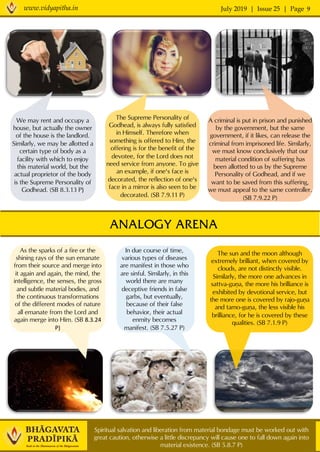
ANALOGY ARENA
As the sparks of a fire or the
shining rays of the sun emanate
from their source and merge into
it again and again, the mind, the
intelligence, the senses, the gross
and subtle material bodies, and
the continuous transformations
of the different modes of nature
all emanate from the Lord and
again merge into Him. (SB 8.3.24	
P)	
In due course of time,
various types of diseases
are manifest in those who
are sinful. Similarly, in this
world there are many
deceptive friends in false
garbs, but eventually,
because of their false
behavior, their actual
enmity becomes
manifest. (SB 7.5.27 P)
We may rent and occupy a
house, but actually the owner
of the house is the landlord.
Similarly, we may be allotted a
certain type of body as a
facility with which to enjoy
this material world, but the
actual proprietor of the body
is the Supreme Personality of
Godhead. (SB 8.3.13 P)
A criminal is put in prison and punished
by the government, but the same
government, if it likes, can release the
criminal from imprisoned life. Similarly,
we must know conclusively that our
material condition of suffering has
been allotted to us by the Supreme
Personality of Godhead, and if we
want to be saved from this suffering,
we must appeal to the same controller.
(SB 7.9.22 P)
The sun and the moon although
extremely brilliant, when covered by
clouds, are not distinctly visible.
Similarly, the more one advances in
sattva-guëa, the more his brilliance is
exhibited by devotional service, but
the more one is covered by rajo-guëa
and tamo-guëa, the less visible his
brilliance, for he is covered by these
qualities. (SB 7.1.9 P)
The Supreme Personality of
Godhead, is always fully satisfied
in Himself. Therefore when
something is offered to Him, the
offering is for the benefit of the
devotee, for the Lord does not
need service from anyone. To give
an example, if one's face is
decorated, the reflection of one's
face in a mirror is also seen to be
decorated. (SB 7.9.11 P)
July 2019 | Issue 25 | Pagewww.vidyapitha.in 10
As stated in the çästras, when one disrespects a respectable superior, one loses his
longevity and the results of his pious activities, and in this way one is degraded.
(SB 6.7.22 P)
PARI-PRAÇNA
Question: Who can give protection from all
kinds of fears?
Answer: For absolute protection from all sorts
of fear, as well as for all our needs of life, we
must take shelter of the lotus feet of the Lord,
not only in this planet but also in all the upper,
lower and heavenly planets. This absolute
dependence on the lotus feet of the Lord is
called pure devotional service,
No one should have any kind of doubt in this
matter, nor should one be inclined to seek the
help of any other demigods, because all of
them are dependent on Him only. Everyone,
except the Lord Himself, is dependent on the
mercy of the Lord; even the all-pervading
Supersoul is also dependent on the supreme
aspect of Bhagavän, the Personality of
Godhead. (SB 2.6.7 P)
Mail us at pradipika@vidyapitha.in your
questions on Çrémad-Bhägavatam. Answers to
shortlisted questions shall be published in the
next issue of Bhägavata Pradépikä.
Question: How much gratification do the senses
require?
Answer: One should satisfy the senses only
insomuch as required for self-preservation, and not
for sense gratification. Because the body is made of
senses, which also require a certain amount of
satisfaction, there are regulative directions for
satisfaction of such senses. But the senses are not
meant for unrestricted enjoyment. (SB 1.2.10 P)
Any living creature who wants real benefit in life
must act according to the direction of the Vedic
literature. The conditioned souls who have come to
this material world for material sense gratification
are regulated by the injunctions of the Vedic
literature.
Sense gratification is just like salt. One cannot take
too much or too little, but one must take some salt
in order to make one's foodstuff palatable. Those
conditioned souls who have come to this material
world should utilize their senses according to the
direction of the Vedic literature, otherwise they will
be put into a more miserable condition of life. No
human being or demigod can enact laws like those
of the Vedic literature because the Vedic
regulations are prescribed by the Supreme Lord. (SB
3.15.8 P)
July 2019 | Issue 25 | Pagewww.vidyapitha.in 11
Register for our
Online Course
PUBLISHED BY
Bhaktivedänta Vidyäpéöha Research Center, ISKCON
Govardhan Eco Village (GEV), Galtare, Hamrapur (P.O),
Wada (Taluka), Palghar (District), Maharashtra, India,
421303.
To subscribe, please visit our website www.vidyapitha.in.
For any comments or feedbacks mail us at
pradipika@vidyapitha.in
The Çrémad-Bhägavatam images, verses and quotes from the books
of His Divine Grace A. C. Bhaktivedanta Swami Prabhupäda are
copyright of The Bhaktivedanta Book Trust. Other images are
copyright of their respective artists / photographers/ websites.
NOMENCLATURE
SB: Çrémad-Bhägavatam
CC: Çré Caitanya-caritämåta
BG: Bhagavad-gétä
BS: Brahma-saàhitä
1.1.1: Canto 1, Chapter 1, Verse 1
1.1.1 P: From Çréla Prabhupäda’s
purport to SB 1.1.1 (If it is beyond
Canto 10 Chapter 13, it is from the
purport of Çréla Prabhupäda’s disciples)
1.1.1 V: From Çréla Viçvanätha
Cakravarti Öhäkura’s commentary on
SB 1.1.1.
hEp://www.vidyapitha.in/sign-up-for-bhak,-vedanta-vidyapitha-courses/	
The devotees and the Lord are interlinked, and they cannot be separated.
Therefore talks about them are all kåñëa-kathä, or topics of the Lord.
(SB 1.7.12 P)
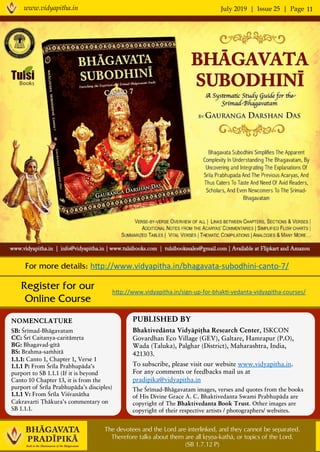
For more details: hEp://www.vidyapitha.in/bhagavata-subodhini-canto-7/

Bhagavata Pradipika#25

  • 1.
    July 2019 |Issue 25 | Pagewww.vidyapitha.in 1 A Monthly E-Magazine from the Bhaktivedanta Vidyapitha with Illuminating Perspectives on the Srimad-Bhagavatam July 2019 | Issue 25 Dedicated to His Divine Grace A. C. Bhaktivedänta Swämi Prabhupäda, Founder-Äcärya of the International Society for Krishna Consciousness Who is More Favored by Krsna? 2 Who is Worthy of Giving Shelter? 3 Devotion to Guru 6 Verse of the Month 7 Quiz Corner 7 Bhägavata Praväha 8 Analogy Arena 9 Pari-praçna 10 WHO IS WORTHY OF GIVING SHELTER?
  • 2.
    July 2019 |Issue 25 | Pagewww.vidyapitha.in 2 Kåñëa endows more favour to a devotee who is in greater dangers Devaké, the mother of Kåñëa and sister of King Kaàsa, was put into prison along with her husband, Vasudeva, because the envious King was afraid of being killed by Devaké's eighth son (Kåñëa). He killed all the sons of Devaké who were born before Kåñëa, but Kåñëa escaped the danger of child-slaughter because He was transferred to the house of Nanda Mahäräja, Lord Kåñëa's foster father. Kuntédevé, along with her children, was also saved from a series of dangers. But Kuntédevé was shown far more favor because Lord Kåñëa did not save the other children of Devaké, whereas He saved the children of Kuntédevé. This was done because Devaké's husband, Vasudeva, was living, whereas Kuntédevé was a widow, and there was none to help her except Kåñëa. The conclusion is that Kåñëa endows more favor to a devotee who is in greater dangers. Sometimes He puts His pure devotees in such dangers because in that condition of helplessness the devotee becomes more attached to the Lord. The more the attachment is there for the Lord, the more success is there for the devotee. (SB 1.8.23) Devaké was once put into difficulty by her envious brother, otherwise she was well. But Kuntédevé and her sons were put into one difficulty after another for years and years together. They were put into trouble by Duryodhana and his party due to the kingdom, and each and every time the sons of Kunté were saved by the Lord. In the Bhagavad-gétä it is also said that the fallen devotees are given a chance to take birth in a family of highly qualified brähmaëas or in a rich mercantile family. A devotee in such a position is not as fortunate as one who is chastised by the Lord and put into a position seemingly of helplessness. The devotee who becomes helpless by the will of the Lord is more fortunate than those who are born in good families. The fallen devotees born in a good family may forget the lotus feet of the Lord because they are less fortunate, but the devotee who is put into a forlorn condition is more fortunate because he swiftly returns to the lotus feet of the Lord, thinking himself helpless all around. (SB 1.5.19) WHO IS MORE FAVORED BY KÅÑËA? FROM THE DESK OF THE FOUNDER ÄCÄRYA By His Divine Grace A. C. Bhaktivedänta Swämi Prabhupäda When one is allured by material possessions, they are considered to be given by mäyä, but when one uses material possessions fully for service, they are considered God's gifts, or facilities offered by Kåñëa for enhancing one's devotional service.(SB 7.10.1 P)
  • 3.
    July 2019 |Issue 25 | Pagewww.vidyapitha.in 3 Only by penance can one appreciate the beauty and opulence of the Lord, and when one is acquainted with that beauty and opulence, he is no longer attracted by any other. (SB 3.9.1 P) Gajendra, the king of elephants, went for a pleasure trip in the Ritumat Garden in the heavenly Trikuta mountain area. As he was happily sporting there in a lake with his wives and children, suddenly a crocodile caught his leg. He struggled with all his strength to release himself. Even the demigods were astonished to see this unusual fight. Being helpless, unable to save himself from danger, Gajendra was extremely afraid of being killed. In such a predicament, Gajendra introspected that the other elephants, his friends, relatives and wives could not do anything to rescue him. So, he was inspired to seek shelter of the God. By God’s grace he remembered a prayer that he had memorized in his previous life. The following verse (Bhägavatam 8.3.17) is a part of that prayer glorifying the all-merciful Lord Kåñëa. The explanation is given below the verse. By Gauranga Darshan Das WHO IS WORTHY OF GIVING SHELTER? Surrendered like me (mädåk prapanna) Why should one surrender to someone? Can’t one be independent? It’s within everyone’s experience that there are problems in this world. One tries to solve them by one’s own efforts, and to some extent, one becomes successful too. However, material solutions are temporary. Because the problems arise again and again. To permanently solve them, one needs help from superior powers. So, like Gajendra, one should surrender to God (mädåk prapanna). This proposal, or rather this conclusion of all scriptures, doesn’t seem palatable to an average human engrossed in material pursuits. Many people do not even believe or realize that they are unnecessarily undergoing material difficulties! Such people may understand the following. A capable, merciful and attentive person can effectively protect surrendered people mädåk prapanna-paçu-päça-vimokñaëäya muktäya bhüri-karuëäya namo 'layäya sväàçena sarva-tanu-bhån-manasi pratéta- pratyag-dåçe bhagavate båhate namas te
  • 4.
    July 2019 |Issue 25 | Pagewww.vidyapitha.in 4 As long as one remains in the bodily concept of life, he may act according to the duties of social convention, but if one is elevated to the spiritual platform, he must simply serve the Supreme Lord; that is the real execution of sva-dharma. (SB 3.28.2 P) Unlimitedly Merciful (bhüri-karuëäya) One who has million dollars certainly has the capacity to help a poor person who is in need of ten dollars. But unless that rich man has the willingness to help, he wouldn’t help the poor man. That basis of such willingness is one’s merciful attitude. God is not only supremely capable, but unlimitedly merciful too (bhüri- karuëäya). This combination of God’s mercy and capacity makes our surrender fruitful and the most effective means to drive away all miseries. But are ‘capacity’ and ‘mercy’ sufficient? Attentive to the Devotees (namo alayäya) One may be capable and merciful, but unless one is ‘attentive’ to the needs or difficulties of others, one cannot help them. Being omnipotent and omniscient, God is always aware of our problems. His awareness is due to His attentive- ness. When we offer prayers, He attentively Entangled Animals (paçu-päça) Gajendra was an animal (paçu). Çréla Prabhupäda says that everyone who identifies oneself with the material body can be called as paçu. Just as Gajendra was caught by crocodile, every conditioned soul is entangled by the noose (päça) of mäya or the illusory energy of God. Mäya constitutes three material modes that bind a bewildered soul in the cycle of repeated birth and death. Unlike an animal, a human being is provided with a higher intelligence to come out of it by seeking shelter of God. Seeking Deliverance (vimokñaëäya) Surrendering to God, one seeks liberation from material bondage (vimokñaëäya). To the degree we are eager for deliverance, to that degree He reciprocates mercifully. Of course, a pure devotee only wants to render unalloyed service to God, without expecting anything in return, including liberation. However, circumstantially, a devotee may ask some favor from the Lord for self-preservation, so that one may continue to serve Him without obstructions. So, one who desires deliverance from miseries or obstacles in life should fervently seek help from God. But why only God, why not someone else? Only the Liberated can Liberate (muktäya) One should seek help from a capable person. One who had fallen in a deep blind well can be pulled out only by one who is outside the well. One who is drowning in an ocean cannot be saved by another person who is also drowning. When none of his strong elephant associates were capable of saving Gajendra, he sought help from God. Only God can liberate an entangled person because God is never entangled, i.e., ever-liberated (muktäya). Most people in this world are entangled by mäya to a smaller or greater degree. And those who are not are so only due to the mercy of God who reciprocated with their desire to get disentangled. Of course, the Lord’s eternal associates are also never entangled. Therefore, only the omnipotent God and His pure devotees have the capability to liberate a person bound by material miseries. But is ‘capability’ the only criterion? Only the omnipotent God and His pure devotees have the capability to liberate a person bound by material miseries.
  • 5.
    July 2019 |Issue 25 | Pagewww.vidyapitha.in 5 The duty of saintly persons is to take up seriously the cause of sanätana-dharma and try to re-establish it for the benefit of the entire human society. (SB 8.14.4 P) listens to us. Being our well-wisher, He aims and endeavors to deliver us from material life, even before we pray. He is never lazy in regard to our deliverance. Someone might ask, “How can God be so attentive to our needs? He stays so far from us in His spiritual abode!” Stays Right in the Heart (sva-aàçena sarva tanu-bhån manasi) God is not only capable, merciful, attentive to protect us, but he is also very close to us. Although God eternally stays in His spiritual kingdom, He also expands Himself as the Supersoul or Paramätma (sva-aàçena) in the hearts of all embodied beings (sarva tanu-bhån manasi). Even if the living entity commits abominable actions and becomes an insect or worm in stool, the Lord doesn’t ignore him or her. He stays right within their hearts giving them knowledge, remembrance and forgetfulness. Directly Observes (pratéta pratyak-dåçe) Staying within the hearts of all, the Lord directly and attentively observes the desires, needs and difficulties of everyone and mercifully solves the problems of those who surrender unto Him. The unlimited Lord Kåñëa (bhagavate båhate namaste) And that God (bhagavate) is none other than Lord Kåñëa who is unlimited and the greatest (båhate), and is the source of all incarnations. He is capable, merciful, attentive, observant, and closest well-wisher of all of us. So, Gajendra sought shelter of the Supreme Lord Kåñëa, the merciful deliverer of all. Hearing the helpless appeal of Gajendra, the Lord hastily came on the back of His bird carrier Garuòa, and killed the crocodile with His disc weapon and saved Gajendra. Lord Kåñëa is always ready to save us from any difficulty at any time. But are we ready enough to seek His protection like Gajendra? Gajendra was exclusively dependent on the Lord, having no other source of protection. Seeking inspiration from Gajendra, let us humbly express our dependence on Kåñëa. Everyone is caught by the crocodile of eternal time and may die at any moment. The best course, therefore, is to seek shelter of Kåñëa, and be saved from the struggle for existence. To reach this understanding is the ultimate goal of life.
  • 6.
    July 2019 |Issue 25 | Pagewww.vidyapitha.in 6 Disposition of Disciple There are many instances in scriptures about people who have perfected their lives by their sincere devotion to their gurus. These examples teach us as to what is the nature and mood of a disciple. How does a disciple think of his spiritual master? One such example is that of Prahläda Mahäräja. He was such a dear devotee of the Lord that by the strength of his devotional service, the Supreme Lord appeared as Nåsiàha- deva to protect him. The Lord offered any benediction desirable to him. Prahläda however refused to accept any such offerings, and filled with gratitude, he could only remember his guru, Närada Muni. Prahläda said, “I have been fallen in the hole of saàsära due to the worldly association. My guru Närada Muni accepted me as his own possession. Liberation is never inaction, but service without human mistakes. (SB 2.2.1 P) It is difficult to progress in any field of life without having a guru or a teacher. Even when God descends to this world, He accepts a guru and also obeys and worships him. Lord Kåñëa accepted Sändépani Muni as His guru and Caitanya Mahäprabhu accepted Éçvara Puré as His guru. How then can ordinary people do away with the necessity of having a guru? The presence of a guru in one’s life is of paramount importance for one’s progress in any field, whether material or spiritual. Guru is a very revered person. An ideal student accepts his guru as good as God and follows his instructions in toto. An ideal teacher or an äcärya teaches by his own example and accepts the responsibility of the student’s progress. Even after having ideal teachers, sometime one may not become a good student. What makes the student perfect is his devotion to the guru! If there is devotion, then one will follow the teacher’s words with humility. DEVOTION TO GURU By Vijay Kåñëa Kumar Das Secret of success Çréla Viçvanätha Cakravarté Öhäkura points out that the order of the spiritual master is the life substance of the disciple. Çréla Prabhupäda also says, “The disciple should not consider whether he is going back home, back to Godhead; his first business should be to execute the order of his spiritual master. Thus a disciple should always meditate on the order of the spiritual master, and that is perfectional meditation. Not only should he meditate upon that order, but he should find out the means by which he can perfectly worship and execute it. This is the secret of success.” (SB 4.24.15 P) The spiritual master is also called äcärya. Äcäryaà mäà vijänéyän: the Supreme Lord says that one should respect the spiritual master, accepting him as the Lord Himself. Nävamanyeta karhicit: one should not disrespect the äcärya at any time. Na martya- buddhyäsüyeta: one should never think the äcärya an ordinary person. (SB 11.17.27)
  • 7.
    July 2019 |Issue 25 | Pagewww.vidyapitha.in 7 Happiness in the world depends proportionately on the maintenance of the religious principles, individually or collectively. (SB 1.16.25 P) Guru’s Pleasure and Displeasure Only by pleasing guru can one please Kåñëa and when guru is dissatisfied, one cannot advance properly on the path of spiritual realization. Just like scriptures give instances of disciples who have achieved success by serving their gurus, they also give examples of those who have lost everything by displeasing their gurus. Once upon a time, Indra was sitting along with his wife on his throne in the assembly of demigods. Being the king of the heavens, he was being served royally. Intoxicated by wealth, he did not rise from his seat and neglected to welcome his guru Båhaspati . Displeased, Båhaspati immediately left the place. This offense caused Indra to lose all his opulence. On the other hand, the demons worshiped their guru Çukräcärya with devotion and acquired the strength to conquer the demigods. Thus the demigods lost to the demons. QUIZ CORNER gurur na sa syät sva-jano na sa syät pitä na sa syäj janané na sä syät daivaà na tat syän na patiç ca sa syän na mocayed yaù samupeta-måtyum One who cannot deliver his dependents from the path of repeated birth and death should never become a spiritual master, a relative, a father, a husband, a mother or a worshipable demigod. (5.5.18 – Lord Åñabhadeva's Teachings to His Sons) VERSE OF THE MONTH Responsibility of a leader Mail your answer to pradipika@vidyapitha.in with “July Quiz Corner” in the subject. The answer along with the your name will be published in the next issue What are the five nescience that Lord Brahmä created? 1. Self-decep,on 2. The sense of death 3. Anger a9er frustra,on 4. Sense of false ownership 5. Illusory bodily concep,on Winners: Pranjal, Pritam De What are the ten topics of Bhägavatam? “Let this jéva be mine!” By force, he has taken me by the hand, brought me near to him and had me serve him! Only by his mercy, I have now become Your devotee. How can I give up service to my guru, your servant?” (7.9.28) Thus, refusing to accept any benediction by the Lord, Prahläda only desired to engage in the service of his guru Närada Muni. He did not even propose to be engaged directly in the service of the Lord. Çréla Prabhupäda remarks that one should serve the spiritual master first. One cannot bypass the spiritual master and desire to serve the Supreme Lord directly. A devotee and disciple never give up his sädhana or spiritual practices. On the path of bhakti, even when sädhana yields the result, devotees such as Prahläda who have attained the Lord never give up serving their spiritual masters. The guru or an äcärya is not an ordinary person and should not be disrespected at any time. Familiarity sometimes breeds contempt, and so the scriptures warns us to be very careful in dealings with the äcärya. Serving the guru with devotion attracts the mercy of Kåñëa, whereas displeasing him causes great disaster.
  • 8.
    July 2019 |Issue 25 | Pagewww.vidyapitha.in 8 We are all one with Lord, just as the gold ornaments are one in quality with the stock gold, but the individual gold ornament is never equal in quantity with the stock gold. (SB 2.3.16 P) Being pardoned by Lord Çiva and with permission of Brahmä, Dakña again began the sacrifice in which Lord Viñëu arrives and gives him good counsel. (4.7) Lord Çiva Revives Dakña’s life Everyone approved the benedictions given by Lord Çiva and all proceeded towards the sacrificial arena. Dakña’s body was joined to the head of a goat. Adapting to his new body, Dakña saw Lord Çiva and became purified of his hatred towards him. Dakña wanted to offer prayers to Lord Çiva but he couldn’t, as his heart was heavy with the emotions of remorse for the ill-fated death of his daughter, Saté. Pacifying his mind with great endeavor, he began to praise Lord Çiva sincerely. Acknowledging his mistake, he could see Çiva’s punishment as a favor which saved him from going to hell and in great humility, he expressed his inability to satisfy Lord Çiva through his words. Lord Viñëu in Dakña’s Sacrifice After being pardoned by Lord Çiva and with permission of Brahmä, Dakña again began the sacrifice in which Lord Viñëu appeared on Garuòa, illuminating all directions. He possessed eight hands holding conch, wheel, club, lotus, arrow, bow, shield and sword, which were decorated with golden ornaments. As soon as Lord Viñëu was visible, various demigods, sages and mystics present at the sacrificial arena offered respects and with awe and veneration, folding their hands, they offered prayers. Lord Viñëu instructs Dakña To assure that Dakña be careful of such offense again, Supreme Lord counselled him for his welfare, by describing Lord Çiva’s real position. “I am the original Supreme Person, but for creation, maintenance and destruction, I act through mäyä and take different names – for creation I am Lord Brahma, for maintenance I am Lord Visnu and for annihilation I am Lord Çiva. Therefore, there is no difference between Brahmä, Çiva and Myself. Such difference is only perceived by people who are ignorant. One who sees non- difference between the three of us, achieves peace.” Dakña completes the Sacrifice Dakña first worshipped Viñëu, then separately worshipped Brahmä and Çiva. The devatas gave blessings to Dakṣa, and departed for their abodes. Saté was reborn as Pärvaté in the womb of Menaka, wife of Himalaya. She again chose Lord Çiva as her beloved husband. Maitreya concludes this pastime by saying, “Anyone who hears or narrates this pastime with devotion destroys all sin.” Lineage of Adharma Having completed the description of the descendants of the daughters of Manu, Maitreya briefly describes the lineage of adharma (irreligion) hearing which one will attain piety and washes off one’s sinful contaminations. Resuming his description of descendants of the sons of Manu, he first describes Uttänapada in which most pious king, Dhruva Mahäräja took birth. To be Continued… BHĀGAVATA PRAVĀHA The Flow of Çrémad-Bhägavatam Dakña Completes the Sacrifice Srémad-Bhägavatam, Canto 4 Chapters 7]
  • 9.
    July 2019 |Issue 25 | Pagewww.vidyapitha.in 9 Spiritual salvation and liberation from material bondage must be worked out with great caution, otherwise a little discrepancy will cause one to fall down again into material existence. (SB 5.8.7 P) ANALOGY ARENA As the sparks of a fire or the shining rays of the sun emanate from their source and merge into it again and again, the mind, the intelligence, the senses, the gross and subtle material bodies, and the continuous transformations of the different modes of nature all emanate from the Lord and again merge into Him. (SB 8.3.24 P) In due course of time, various types of diseases are manifest in those who are sinful. Similarly, in this world there are many deceptive friends in false garbs, but eventually, because of their false behavior, their actual enmity becomes manifest. (SB 7.5.27 P) We may rent and occupy a house, but actually the owner of the house is the landlord. Similarly, we may be allotted a certain type of body as a facility with which to enjoy this material world, but the actual proprietor of the body is the Supreme Personality of Godhead. (SB 8.3.13 P) A criminal is put in prison and punished by the government, but the same government, if it likes, can release the criminal from imprisoned life. Similarly, we must know conclusively that our material condition of suffering has been allotted to us by the Supreme Personality of Godhead, and if we want to be saved from this suffering, we must appeal to the same controller. (SB 7.9.22 P) The sun and the moon although extremely brilliant, when covered by clouds, are not distinctly visible. Similarly, the more one advances in sattva-guëa, the more his brilliance is exhibited by devotional service, but the more one is covered by rajo-guëa and tamo-guëa, the less visible his brilliance, for he is covered by these qualities. (SB 7.1.9 P) The Supreme Personality of Godhead, is always fully satisfied in Himself. Therefore when something is offered to Him, the offering is for the benefit of the devotee, for the Lord does not need service from anyone. To give an example, if one's face is decorated, the reflection of one's face in a mirror is also seen to be decorated. (SB 7.9.11 P)
  • 10.
    July 2019 |Issue 25 | Pagewww.vidyapitha.in 10 As stated in the çästras, when one disrespects a respectable superior, one loses his longevity and the results of his pious activities, and in this way one is degraded. (SB 6.7.22 P) PARI-PRAÇNA Question: Who can give protection from all kinds of fears? Answer: For absolute protection from all sorts of fear, as well as for all our needs of life, we must take shelter of the lotus feet of the Lord, not only in this planet but also in all the upper, lower and heavenly planets. This absolute dependence on the lotus feet of the Lord is called pure devotional service, No one should have any kind of doubt in this matter, nor should one be inclined to seek the help of any other demigods, because all of them are dependent on Him only. Everyone, except the Lord Himself, is dependent on the mercy of the Lord; even the all-pervading Supersoul is also dependent on the supreme aspect of Bhagavän, the Personality of Godhead. (SB 2.6.7 P) Mail us at pradipika@vidyapitha.in your questions on Çrémad-Bhägavatam. Answers to shortlisted questions shall be published in the next issue of Bhägavata Pradépikä. Question: How much gratification do the senses require? Answer: One should satisfy the senses only insomuch as required for self-preservation, and not for sense gratification. Because the body is made of senses, which also require a certain amount of satisfaction, there are regulative directions for satisfaction of such senses. But the senses are not meant for unrestricted enjoyment. (SB 1.2.10 P) Any living creature who wants real benefit in life must act according to the direction of the Vedic literature. The conditioned souls who have come to this material world for material sense gratification are regulated by the injunctions of the Vedic literature. Sense gratification is just like salt. One cannot take too much or too little, but one must take some salt in order to make one's foodstuff palatable. Those conditioned souls who have come to this material world should utilize their senses according to the direction of the Vedic literature, otherwise they will be put into a more miserable condition of life. No human being or demigod can enact laws like those of the Vedic literature because the Vedic regulations are prescribed by the Supreme Lord. (SB 3.15.8 P)
  • 11.
    July 2019 |Issue 25 | Pagewww.vidyapitha.in 11 Register for our Online Course PUBLISHED BY Bhaktivedänta Vidyäpéöha Research Center, ISKCON Govardhan Eco Village (GEV), Galtare, Hamrapur (P.O), Wada (Taluka), Palghar (District), Maharashtra, India, 421303. To subscribe, please visit our website www.vidyapitha.in. For any comments or feedbacks mail us at pradipika@vidyapitha.in The Çrémad-Bhägavatam images, verses and quotes from the books of His Divine Grace A. C. Bhaktivedanta Swami Prabhupäda are copyright of The Bhaktivedanta Book Trust. Other images are copyright of their respective artists / photographers/ websites. NOMENCLATURE SB: Çrémad-Bhägavatam CC: Çré Caitanya-caritämåta BG: Bhagavad-gétä BS: Brahma-saàhitä 1.1.1: Canto 1, Chapter 1, Verse 1 1.1.1 P: From Çréla Prabhupäda’s purport to SB 1.1.1 (If it is beyond Canto 10 Chapter 13, it is from the purport of Çréla Prabhupäda’s disciples) 1.1.1 V: From Çréla Viçvanätha Cakravarti Öhäkura’s commentary on SB 1.1.1. hEp://www.vidyapitha.in/sign-up-for-bhak,-vedanta-vidyapitha-courses/ The devotees and the Lord are interlinked, and they cannot be separated. Therefore talks about them are all kåñëa-kathä, or topics of the Lord. (SB 1.7.12 P) For more details: hEp://www.vidyapitha.in/bhagavata-subodhini-canto-7/