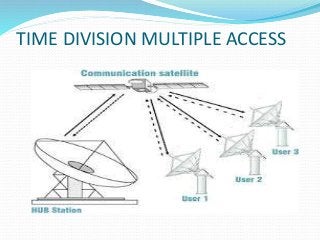
TIME DIVISION MULTIPLE ACCESS
TDMA
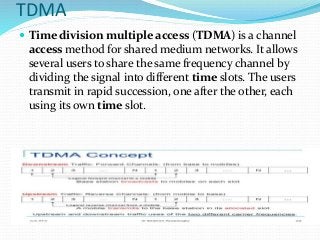
 Time division multiple access (TDMA) is a channel
access method for shared medium networks. It allows
several users to share the same frequency channel by
dividing the signal into different time slots. The users
transmit in rapid succession, one after the other, each
using its own time slot.
 The allocated ratio spectrum for the system is divided
into time slots
 In each slot user can transmit or receive
A user occupies a cyclically repeating solts
A channel is logically defined as a particular time slot
that repeats within the period
 Tdma systems buffers the data untill it turns (time
slot) comes to transmit
 this is called buffer-and burst method
Leaky bucket
 Requires digital modulation
OPERATION
 The operation of TDMA requires an outlink control to all the remote sites
which contains some control information. This outlink carrier also had a frame
structure that provides accurate timing information for all the remote
sites. The teleport hub equipment computer tells each VSAT site what
particular time slot to use in the TDMA frame and this time plan information is
broadcast to all sites periodically. The burst time plan may be fixed, so as to
allocate each site a particular proportion of the total TDMA frame time or is
may be dynamic, whereby the time slot allocated is adjusted in response to the
traffic needs of each site.
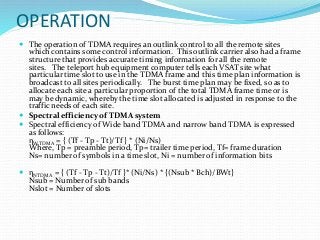
 Spectral efficiency of TDMA system
 Spectral efficiency of Wide band TDMA and narrow band TDMA is expressed
as follows:
ηWTDMA = { (Tf - Tp - Tt)/Tf } * (Ni/Ns)
Where, Tp = preamble period, Tp= trailer time period, Tf= frame duration
Ns= number of symbols in a time slot, Ni = number of information bits
 ηNTDMA = { (Tf - Tp - Tt)/Tf }* (Ni/Ns) * {(Nsub * Bch)/BWt}
Nsub = Number of sub bands
Nslot = Number of slots
TDMA Frame
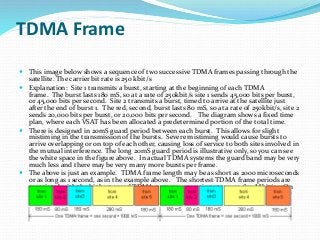
 This image below shows a sequence of two successive TDMA frames passing through the
satellite. The carrier bit rate is 250 kbit/s
 Explanation: Site 1 transmits a burst, starting at the beginning of each TDMA
frame. The burst lasts 180 mS, so at a rate of 250kbit/s site 1 sends 45,000 bits per burst,
or 45,000 bits per second. Site 2 transmits a burst, timed to arrive at the satellite just
after the end of burst 1. The red, second, burst lasts 80 mS, so at a rate of 250kbit/s, site 2
sends 20,000 bits per burst, or 20,000 bits per second. The diagram shows a fixed time
plan, where each VSAT has been allocated a predetermined portion of the total time.
 There is designed in 20mS guard period between each burst. This allows for slight
mistiming in the transmission of the bursts. Severe mistiming would cause bursts to
arrive overlapping or on top of each other, causing loss of service to both sites involved in
the mutual interference. The long 20mS guard period is illustrative only, so you can see
the white space in the figure above. In actual TDMA systems the guard band may be very
much less and there may be very many more bursts per frame.
 The above is just an example. TDMA frame length may be as short as 2000 microseconds
or as long as 1 second, as in the example above. The shortest TDMA frame periods are
associated with the highest speed TDMA systems, operating at say 120.832 Mbit/s. On
low speed 250kbit/s VSAT return links, with perhaps 2 to 50 sites sharing, and used for
internet browsing and emails, the TDMA frame period is typically 500mS.
TDMA burst time plan
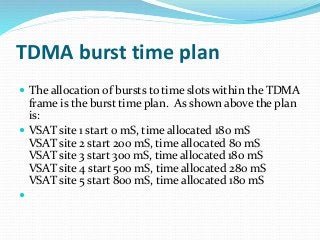
 The allocation of bursts to time slots within the TDMA
frame is the burst time plan. As shown above the plan
is:
 VSAT site 1 start 0 mS, time allocated 180 mS
VSAT site 2 start 200 mS, time allocated 80 mS
VSAT site 3 start 300 mS, time allocated 180 mS
VSAT site 4 start 500 mS, time allocated 280 mS
VSAT site 5 start 800 mS, time allocated 180 mS

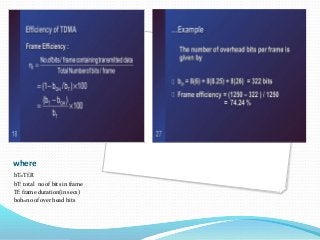
where
bT=Tf.R
bT: total no of bits in frame
Tf: frame duration(in secs)
boh=no of over head bits
PROS AND CONS
ADVANTAGES DISADVANTAGES
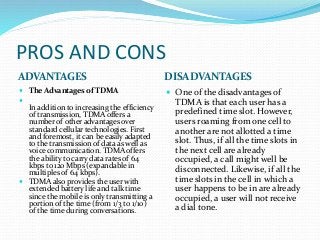
 The Advantages of TDMA

In addition to increasing the efficiency
of transmission, TDMA offers a
number of other advantages over
standard cellular technologies. First
and foremost, it can be easily adapted
to the transmission of data as well as
voice communication. TDMA offers
the ability to carry data rates of 64
kbps to 120 Mbps (expandable in
multiples of 64 kbps).
 TDMA also provides the user with
extended battery life and talk time
since the mobile is only transmitting a
portion of the time (from 1/3 to 1/10)
of the time during conversations.
 One of the disadvantages of
TDMA is that each user has a
predefined time slot. However,
users roaming from one cell to
another are not allotted a time
slot. Thus, if all the time slots in
the next cell are already
occupied, a call might well be
disconnected. Likewise, if all the
time slots in the cell in which a
user happens to be in are already
occupied, a user will not receive
a dial tone.
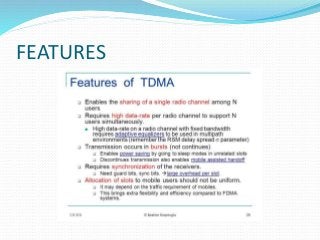
FEATURES
THANK YOU
H.BHAVANI

Time division multiple access

  • 1.
  • 2.
    TDMA  Time divisionmultiple access (TDMA) is a channel access method for shared medium networks. It allows several users to share the same frequency channel by dividing the signal into different time slots. The users transmit in rapid succession, one after the other, each using its own time slot.
  • 3.
     The allocatedratio spectrum for the system is divided into time slots  In each slot user can transmit or receive A user occupies a cyclically repeating solts A channel is logically defined as a particular time slot that repeats within the period  Tdma systems buffers the data untill it turns (time slot) comes to transmit  this is called buffer-and burst method Leaky bucket  Requires digital modulation
  • 4.
    OPERATION  The operationof TDMA requires an outlink control to all the remote sites which contains some control information. This outlink carrier also had a frame structure that provides accurate timing information for all the remote sites. The teleport hub equipment computer tells each VSAT site what particular time slot to use in the TDMA frame and this time plan information is broadcast to all sites periodically. The burst time plan may be fixed, so as to allocate each site a particular proportion of the total TDMA frame time or is may be dynamic, whereby the time slot allocated is adjusted in response to the traffic needs of each site.  Spectral efficiency of TDMA system  Spectral efficiency of Wide band TDMA and narrow band TDMA is expressed as follows: ηWTDMA = { (Tf - Tp - Tt)/Tf } * (Ni/Ns) Where, Tp = preamble period, Tp= trailer time period, Tf= frame duration Ns= number of symbols in a time slot, Ni = number of information bits  ηNTDMA = { (Tf - Tp - Tt)/Tf }* (Ni/Ns) * {(Nsub * Bch)/BWt} Nsub = Number of sub bands Nslot = Number of slots
  • 5.
    TDMA Frame  Thisimage below shows a sequence of two successive TDMA frames passing through the satellite. The carrier bit rate is 250 kbit/s  Explanation: Site 1 transmits a burst, starting at the beginning of each TDMA frame. The burst lasts 180 mS, so at a rate of 250kbit/s site 1 sends 45,000 bits per burst, or 45,000 bits per second. Site 2 transmits a burst, timed to arrive at the satellite just after the end of burst 1. The red, second, burst lasts 80 mS, so at a rate of 250kbit/s, site 2 sends 20,000 bits per burst, or 20,000 bits per second. The diagram shows a fixed time plan, where each VSAT has been allocated a predetermined portion of the total time.  There is designed in 20mS guard period between each burst. This allows for slight mistiming in the transmission of the bursts. Severe mistiming would cause bursts to arrive overlapping or on top of each other, causing loss of service to both sites involved in the mutual interference. The long 20mS guard period is illustrative only, so you can see the white space in the figure above. In actual TDMA systems the guard band may be very much less and there may be very many more bursts per frame.  The above is just an example. TDMA frame length may be as short as 2000 microseconds or as long as 1 second, as in the example above. The shortest TDMA frame periods are associated with the highest speed TDMA systems, operating at say 120.832 Mbit/s. On low speed 250kbit/s VSAT return links, with perhaps 2 to 50 sites sharing, and used for internet browsing and emails, the TDMA frame period is typically 500mS.
  • 6.
    TDMA burst timeplan  The allocation of bursts to time slots within the TDMA frame is the burst time plan. As shown above the plan is:  VSAT site 1 start 0 mS, time allocated 180 mS VSAT site 2 start 200 mS, time allocated 80 mS VSAT site 3 start 300 mS, time allocated 180 mS VSAT site 4 start 500 mS, time allocated 280 mS VSAT site 5 start 800 mS, time allocated 180 mS 
  • 7.
    where bT=Tf.R bT: total noof bits in frame Tf: frame duration(in secs) boh=no of over head bits
  • 8.
    PROS AND CONS ADVANTAGESDISADVANTAGES  The Advantages of TDMA  In addition to increasing the efficiency of transmission, TDMA offers a number of other advantages over standard cellular technologies. First and foremost, it can be easily adapted to the transmission of data as well as voice communication. TDMA offers the ability to carry data rates of 64 kbps to 120 Mbps (expandable in multiples of 64 kbps).  TDMA also provides the user with extended battery life and talk time since the mobile is only transmitting a portion of the time (from 1/3 to 1/10) of the time during conversations.  One of the disadvantages of TDMA is that each user has a predefined time slot. However, users roaming from one cell to another are not allotted a time slot. Thus, if all the time slots in the next cell are already occupied, a call might well be disconnected. Likewise, if all the time slots in the cell in which a user happens to be in are already occupied, a user will not receive a dial tone.
  • 9.
  • 10.