
PRICE WARS: HOW DO OUR
CUSTOMERS CHANGE AND WHAT
NEW COMPETITIVE ENVIRONMENT
DO WE DEVELOP?
Arūnas Vizickas, founder and shareholder of Pricer.lt
1. What is the real price war?
The company that has announced “war” by low prices, i.e. that makes the prices of goods and
services lower than those of competitors in order to force competitors to go bankrupt. In many
countries such “price war” is prohibited however it is very difficult to prove it. Economists say that
it is rarely applied in practice.
Companies that take such competitive measures must be financially strong to be able to operate
at a loss for a sufficiently long period of time. Thereby ousting competitors from the market they
must be sure that competitors will not come back to the market when the prices start growing. As
one of the ways to avoid this is to acquire premises or equipment or attract employees from weak
competitors.
Already well-established businesses often resolve to disrupt new competitors this way.
Finnacially strong companies, market newcomers also apply a similar mode but not necessarily
wishing to ruin market old-timers. Their goal is to conquer market share as soon as possible, later
the prices prices will gradually begin to increase.
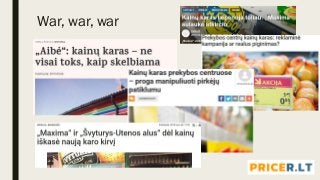
War, war, war
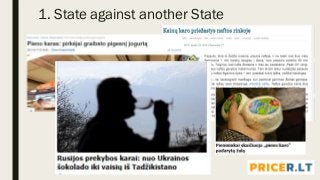
1. State against another State
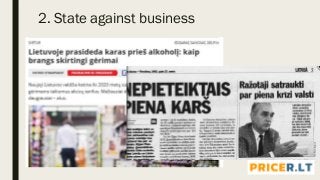
2. State against business
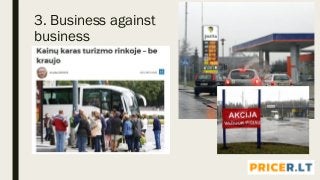
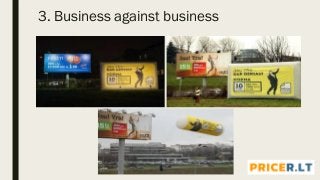
3. Business against
business
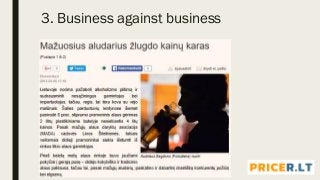
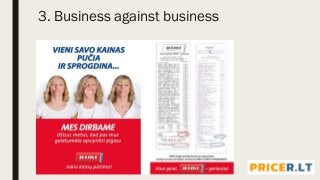
3. Business against business
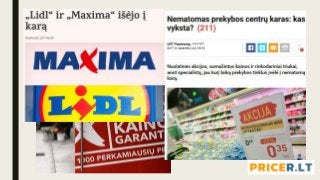
Maxima/Lidl
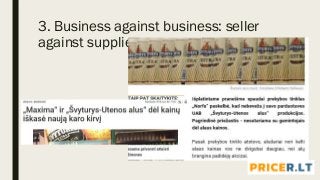
3. Business against business: seller
against supplier
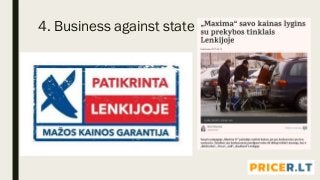
4. Business against state
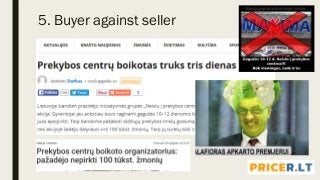
5. Buyer against seller
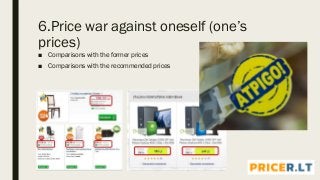
6.Price war against oneself (one’s
prices)
■ Comparisons with the former prices
■ Comparisons with the recommended prices
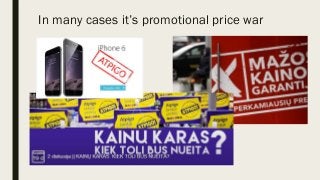
In many cases it’s promotional price war
We are having old price wars, most
frequently promotional...
Have we assessed the changed situation
and new opportunities?
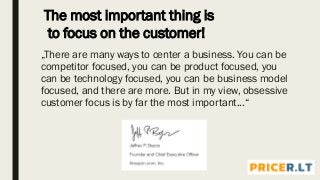
„There are many ways to center a business. You can be
competitor focused, you can be product focused, you
can be technology focused, you can be business model
focused, and there are more. But in my view, obsessive
customer focus is by far the most important...“
The most important thing is
to focus on the customer!
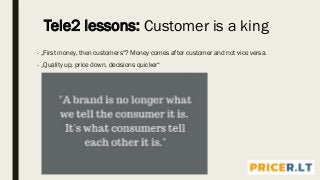
- „First money, then customers“? Money comes after customer and not vice versa.
- „Quality up, price down, decisions quicker“
Tele2 lessons: Customer is a king
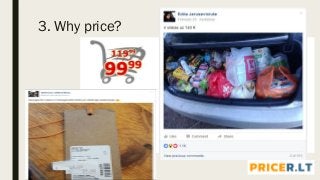
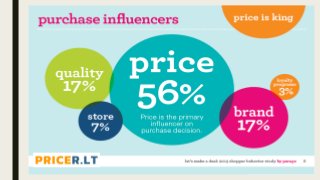
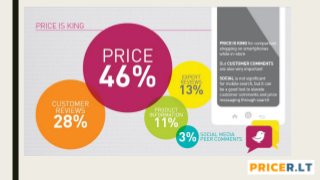
3. Why price?
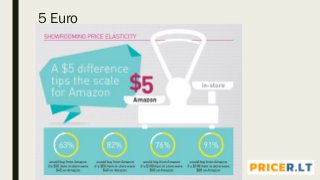
5 Euro
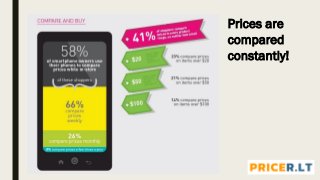
Prices are
compared
constantly!
New technologies
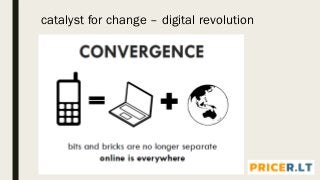
catalyst for change – digital revolution
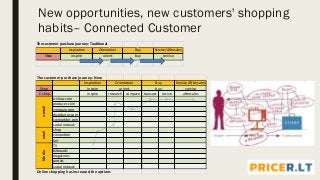
New opportunities, new customers' shopping
habits– Connected Customer
The customer purchase journey: Traditional
Inspiration Service/Aftersales
Shop inspire servisebuy
BuyOrientation
orient
The customer purchase journey: New
Inspiration Service/Aftersales
Shop inspire servise
E-shop inspire research compare transact recive aftersales
e-shop.com
producer.com
compare.com
distributor.com
competitor.com
social netwok
shop
competitor
fair
TV
bilboards
magazines
portals
social netwok
Online shopping has increased the options
e-retailretailMedia
Buy
buy
Orientation
orient
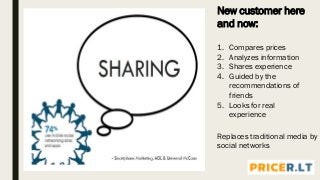
New customer here
and now:
1. Compares prices
2. Analyzes information
3. Shares experience
4. Guided by the
recommendations of
friends
5. Looks for real
experience
Replaces traditional media by
social networks
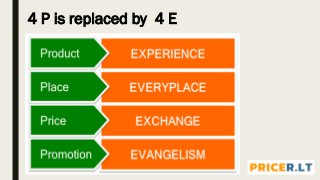
4 P is replaced by 4 E
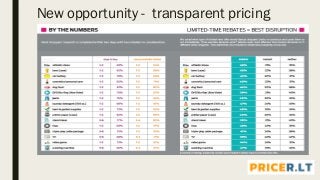
New opportunity - transparent pricing
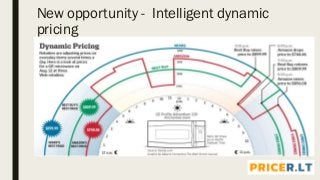
New opportunity - Intelligent dynamic
pricing
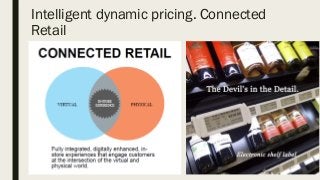
Intelligent dynamic pricing. Connected
Retail
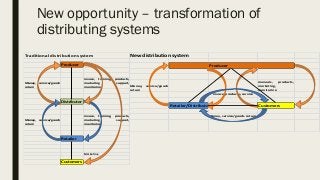
New distribution system
Producer
Money, service/goods
return
manuals, products,
marketing,
monitoring
invoce, products, service
Retailer/Distributor Customers
Money, service/goods return
Traditional distribution system
Producer
Money, service/goods
return
invoce, training, products,
marketing support,
monitoring
Distributor
Money, service/goods
return
invoce, training, products,
marketing support,
monitoring
Retailer
Marketing
Customers
New opportunity – transformation of
distributing systems
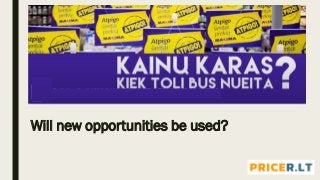
Will new opportunities be used?

Pricer.lt at "Food retail innovations" conference 2017

  • 1.
    PRICE WARS: HOWDO OUR CUSTOMERS CHANGE AND WHAT NEW COMPETITIVE ENVIRONMENT DO WE DEVELOP? Arūnas Vizickas, founder and shareholder of Pricer.lt
  • 3.
    1. What isthe real price war? The company that has announced “war” by low prices, i.e. that makes the prices of goods and services lower than those of competitors in order to force competitors to go bankrupt. In many countries such “price war” is prohibited however it is very difficult to prove it. Economists say that it is rarely applied in practice. Companies that take such competitive measures must be financially strong to be able to operate at a loss for a sufficiently long period of time. Thereby ousting competitors from the market they must be sure that competitors will not come back to the market when the prices start growing. As one of the ways to avoid this is to acquire premises or equipment or attract employees from weak competitors. Already well-established businesses often resolve to disrupt new competitors this way. Finnacially strong companies, market newcomers also apply a similar mode but not necessarily wishing to ruin market old-timers. Their goal is to conquer market share as soon as possible, later the prices prices will gradually begin to increase.
  • 4.
  • 5.
    1. State againstanother State
  • 6.
  • 7.
  • 8.
  • 9.
  • 10.
  • 11.
  • 12.
    3. Business againstbusiness: seller against supplier
  • 13.
  • 14.
  • 15.
    6.Price war againstoneself (one’s prices) ■ Comparisons with the former prices ■ Comparisons with the recommended prices
  • 16.
    In many casesit’s promotional price war
  • 17.
    We are havingold price wars, most frequently promotional... Have we assessed the changed situation and new opportunities?
  • 18.
    „There are manyways to center a business. You can be competitor focused, you can be product focused, you can be technology focused, you can be business model focused, and there are more. But in my view, obsessive customer focus is by far the most important...“ The most important thing is to focus on the customer!
  • 19.
    - „First money,then customers“? Money comes after customer and not vice versa. - „Quality up, price down, decisions quicker“ Tele2 lessons: Customer is a king
  • 20.
  • 23.
  • 24.
  • 25.
  • 26.
    catalyst for change– digital revolution
  • 27.
    New opportunities, newcustomers' shopping habits– Connected Customer The customer purchase journey: Traditional Inspiration Service/Aftersales Shop inspire servisebuy BuyOrientation orient The customer purchase journey: New Inspiration Service/Aftersales Shop inspire servise E-shop inspire research compare transact recive aftersales e-shop.com producer.com compare.com distributor.com competitor.com social netwok shop competitor fair TV bilboards magazines portals social netwok Online shopping has increased the options e-retailretailMedia Buy buy Orientation orient
  • 28.
    New customer here andnow: 1. Compares prices 2. Analyzes information 3. Shares experience 4. Guided by the recommendations of friends 5. Looks for real experience Replaces traditional media by social networks
  • 29.
    4 P isreplaced by 4 E
  • 30.
    New opportunity -transparent pricing
  • 31.
    New opportunity -Intelligent dynamic pricing
  • 32.
  • 34.
    New distribution system Producer Money,service/goods return manuals, products, marketing, monitoring invoce, products, service Retailer/Distributor Customers Money, service/goods return Traditional distribution system Producer Money, service/goods return invoce, training, products, marketing support, monitoring Distributor Money, service/goods return invoce, training, products, marketing support, monitoring Retailer Marketing Customers New opportunity – transformation of distributing systems
  • 35.