The Five Product Levels model provides a way to show the different levels of need customers have for a product. These needs range from core needs to psychological needs. At each product level, more customer value is added.
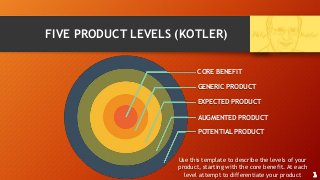
FIVE PRODUCT LEVELS(KOTLER)
CORE BENEFIT
GENERIC PRODUCT
EXPECTED PRODUCT
AUGMENTED PRODUCT
POTENTIAL PRODUCT
Use this template to describe the levels of your
product, starting with the core benefit. At each
level attempt to differentiate your product 1
3.
Product Levels History& Importance
(Kotler)
• The Five Product Levels model was developed by Philip Kotler in the 1960s. The
renowned economist presented that a product can be more than just a tangible
entity and can be identified in five levels.
• For Kotler, the definition of a product goes way beyond being a physical object or
a service. He defines a product as anything that can meet a need or a want. This
means that even a retail store or a customer service representative is considered a
product.
• The Five Product Levels model provides a way to show the different levels of need
customers have for a product. These needs range from core needs to psychological
needs. At each product level, more customer value is added.
2
4.
Product Levels Considerations
•The model considers that products are a means to an end to meet the various needs
of customers.
• Customers will choose a product based on their perceived value of it
(Actual value has to meet or exceed expectations).
3
5.
Product Levels ModelBasis
V A L U E
01
CUSTOMER NEED
V A L U E
02
CUSTOMER WANT
V A L U E
03
CUSTOMER DEMAND
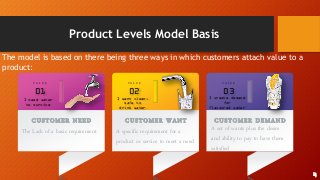
The Lack of a basic requirement
The model is based on there being three ways in which customers attach value to a
product:
A set of wants plus the desire
and ability to pay to have them
satisfied
A specific requirement for a
product or service to meet a need
I create demand
for
flavoured water
I want clean,
safe to
drink water
I need water
to survive
4
6.
Product Levels (Kotler)
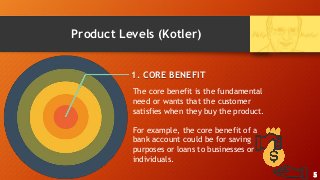
1.CORE BENEFIT
The core benefit is the fundamental
need or wants that the customer
satisfies when they buy the product.
For example, the core benefit of a
bank account could be for saving
purposes or loans to businesses or
individuals.
5
7.
Product Levels (Kotler)
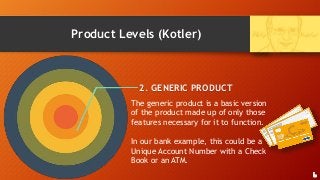
2.GENERIC PRODUCT
The generic product is a basic version
of the product made up of only those
features necessary for it to function.
In our bank example, this could be a
Unique Account Number with a Check
Book or an ATM.
6
8.
Product Levels (Kotler)
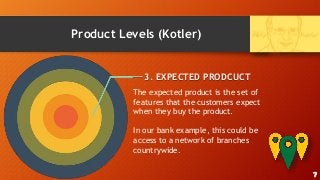
3.EXPECTED PRODCUCT
The expected product is the set of
features that the customers expect
when they buy the product.
In our bank example, this could be
access to a network of branches
countrywide.
7
9.
Product Levels (Kotler)
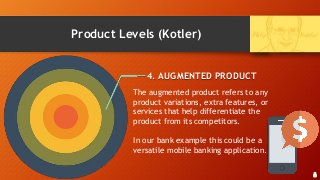
4.AUGMENTED PRODUCT
The augmented product refers to any
product variations, extra features, or
services that help differentiate the
product from its competitors.
In our bank example this could be a
versatile mobile banking application.
8
10.
Product Levels (Kotler)
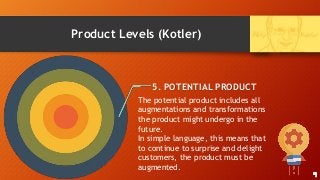
5.POTENTIAL PRODUCT
The potential product includes all
augmentations and transformations
the product might undergo in the
future.
In simple language, this means that
to continue to surprise and delight
customers, the product must be
augmented.
9
11.
Summary
• The FiveProduct Levels model provides a way to show the different levels of
need that customers have for a product.
• It can be useful in helping organizations understand their customers. From there,
they can structure themselves to best serve those needs and wants. In this way,
they can differentiate themselves from their competitors.
10