[insights]
10 Essential Tips for Business Cost
Reduction Programs
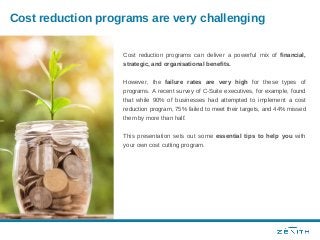
Cost reduction programs can deliver a powerful mix of financial,
strategic, and organisational benefits.
However, the failure rates are very high for these types of
programs. A recent survey of C-Suite executives, for example, found
that while 90% of businesses had attempted to implement a cost
reduction program, 75% failed to meet their targets, and 44% missed
them by more than half.
This presentation sets out some essential tips to help you with
your own cost cutting program.
Cost reduction programs are very challenging
Existential threats (you need to cut your costs to stay in
business)
Competitive threats (e.g. a low cost entrant is taking market
share)
Need to fund investment in new growth opportunities
Cost reduction is hard - it means changing the way people do
things. It might mean cutting back on staff
Your management team and staff need a good reason to come
on this journey - a Burning Platform.
Burning platforms can take a number of forms e.g.
Communicate your burning platform clearly at the outset. Help
your team to understand the need for change
Create a burning platform1
Setting an overall financial target for the cost cutting program can
help to reinforce the burning platform (e.g. "we've got to cut our
costs by 20% to stay competitive")
A target also defines the expectation for the program from the
outset. If your teams know what they are aiming for, it will help
focus them on ways to achieve the target.
However, an arbitrary and unrealistic target will cause people to
dis-engage with the process.
A good target should therefore be a stretch, but feasible for the
business to achieve. Conduct a high level assessment of your
cost structure and benchmark key cost categories.
By investing a small amount of time up-front, you can set a
challenging target that sets the foundation for a successful cost
reduction program.
Set a target2
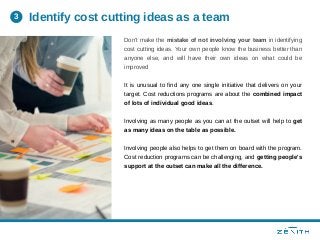
Don't make the mistake of not involving your team in identifying
cost cutting ideas. Your own people know the business better than
anyone else, and will have their own ideas on what could be
improved
It is unusual to find any one single initiative that delivers on your
target. Cost reductions programs are about the combined impact
of lots of individual good ideas.
Involving as many people as you can at the outset will help to get
as many ideas on the table as possible.
Involving people also helps to get them on board with the program.
Cost reduction programs can be challenging, and getting people's
support at the outset can make all the difference.
Identify cost cutting ideas as a team3
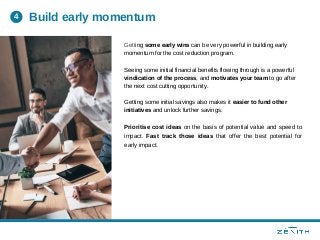
Getting some early wins can be very powerful in building early
momentum for the cost reduction program.
Seeing some initial financial benefits flowing through is a powerful
vindication of the process, and motivates your team to go after
the next cost cutting opportunity.
Getting some initial savings also makes it easier to fund other
initiatives and unlock further savings.
Prioritise cost ideas on the basis of potential value and speed to
impact. Fast track those ideas that offer the best potential for
early impact.
Build early momentum4
One of the main causes of failure for cost cutting programs is the
failure to follow through from the initial idea generation to a
clear execution plan.
Developing a clear project plan for each cost initiative is a critical
step in building the necessary accountability for the cost
reduction program.
By clearly setting out the key milestones and timing for the delivery
of benefits, it forces everyone in the team to think carefully
about the practicalities of the idea.
It also surfaces any issues with access to resources at the start of
the process, ensuring that any necessary trade-offs are made and
the program is set up for success.
Develop a clear project plan5
It is important to estimate the potential financial benefit of each
cost initiative, as well as the expected timing for the delivery of
these benefits.
By estimating the likely savings from each individual cost initiative,
you can assess whether you are on track to hit the overall
targets for the program.
Having targets for each initiative also helps with the tracking of
the program. They allow you to compare the actual level of
savings with what was expected, helping to identify shortfalls early
on in the process before they compound into a major problem over
time
Forecast the expected cost savings6
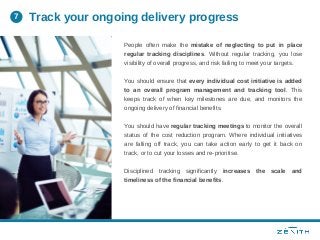
People often make the mistake of neglecting to put in place
regular tracking disciplines. Without regular tracking, you lose
visibility of overall progress, and risk failing to meet your targets.
You should ensure that every individual cost initiative is added
to an overall program management and tracking tool. This
keeps track of when key milestones are due, and monitors the
ongoing delivery of financial benefits.
You should have regular tracking meetings to monitor the overall
status of the cost reduction program. Where individual initiatives
are falling off track, you can take action early to get it back on
track, or to cut your losses and re-prioritise.
Disciplined tracking significantly increases the scale and
timeliness of the financial benefits.
Track your ongoing delivery progress7
Not everything goes to plan. Not every cost reduction idea turns
out to be realistic in practice. Critical operational issues side-track
key resources that were needed for cost initiatives.
The key to a successful cost reduction program is how well you
respond to these unanticipated eventualities
Program management and tracking processes provide early
visibility when an unforeseen circumstance is impacting on the
overall program.
You need to be flexible and ready to adapt the program to
changes in circumstances to maintain alignment with the overall
objectives.
Refine and adapt as you go along8
Cost reduction programs don't exactly have a reputation for being a
fun and rewarding thing to be associated with. They can be
intense, the stakes can be high.
At the same time, for a cost reduction program to be successful,
you need everyone on board. It is a collective process, from the
initial generation of ideas, to the work to drive home the individual
savings associated with each cost initiative.
Calling out early wins can help to build momentum for the broader
program. Celebrating success recognises the hard work your
team puts in to make it a success.
Each celebration is an important step along the transformation
journey, marking key milestones in the delivery of the program.
Celebrate success9
In many ways, cost reduction programs are similar to major
business transformation programs. They involve multiple
functions and changes to the way things are done.
Being good at cost reduction, and business transformation more
broadly, is a good capability for a business to have.
You should therefore review your cost reduction program, both
to work out what is working well, as well as to identify where you as
an organisation need to focus further.
This will ensure you are in a good position for the next complex
transformation you need to undertake.
Learn and improve for next time10
Download the full report
Click to go to download page
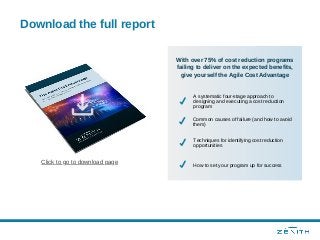
With over 75% of cost reduction programs
failing to deliver on the expected benefits,
give yourself the Agile Cost Advantage
A systematic four-stage approach to
designing and executing a cost reduction
program
Common causes of failure (and how to avoid
them)
Techniques for identifying cost reduction
opportunities
How to set your program up for success
Stay Connected
Zenith Strategy Associates is a
strategic consultancy, serving
companies, private equity funds and
their portfolio companies.
www.zenithstrategy.com
Follow us on Linkedin
or Facebook for
regular updates and
insights

10 essential tips for business cost reduction programs

  • 1.
    [insights] 10 Essential Tipsfor Business Cost Reduction Programs
  • 2.
    Cost reduction programscan deliver a powerful mix of financial, strategic, and organisational benefits. However, the failure rates are very high for these types of programs. A recent survey of C-Suite executives, for example, found that while 90% of businesses had attempted to implement a cost reduction program, 75% failed to meet their targets, and 44% missed them by more than half. This presentation sets out some essential tips to help you with your own cost cutting program. Cost reduction programs are very challenging
  • 3.
    Existential threats (youneed to cut your costs to stay in business) Competitive threats (e.g. a low cost entrant is taking market share) Need to fund investment in new growth opportunities Cost reduction is hard - it means changing the way people do things. It might mean cutting back on staff Your management team and staff need a good reason to come on this journey - a Burning Platform. Burning platforms can take a number of forms e.g. Communicate your burning platform clearly at the outset. Help your team to understand the need for change Create a burning platform1
  • 4.
    Setting an overallfinancial target for the cost cutting program can help to reinforce the burning platform (e.g. "we've got to cut our costs by 20% to stay competitive") A target also defines the expectation for the program from the outset. If your teams know what they are aiming for, it will help focus them on ways to achieve the target. However, an arbitrary and unrealistic target will cause people to dis-engage with the process. A good target should therefore be a stretch, but feasible for the business to achieve. Conduct a high level assessment of your cost structure and benchmark key cost categories. By investing a small amount of time up-front, you can set a challenging target that sets the foundation for a successful cost reduction program. Set a target2
  • 5.
    Don't make themistake of not involving your team in identifying cost cutting ideas. Your own people know the business better than anyone else, and will have their own ideas on what could be improved It is unusual to find any one single initiative that delivers on your target. Cost reductions programs are about the combined impact of lots of individual good ideas. Involving as many people as you can at the outset will help to get as many ideas on the table as possible. Involving people also helps to get them on board with the program. Cost reduction programs can be challenging, and getting people's support at the outset can make all the difference. Identify cost cutting ideas as a team3
  • 6.
    Getting some earlywins can be very powerful in building early momentum for the cost reduction program. Seeing some initial financial benefits flowing through is a powerful vindication of the process, and motivates your team to go after the next cost cutting opportunity. Getting some initial savings also makes it easier to fund other initiatives and unlock further savings. Prioritise cost ideas on the basis of potential value and speed to impact. Fast track those ideas that offer the best potential for early impact. Build early momentum4
  • 7.
    One of themain causes of failure for cost cutting programs is the failure to follow through from the initial idea generation to a clear execution plan. Developing a clear project plan for each cost initiative is a critical step in building the necessary accountability for the cost reduction program. By clearly setting out the key milestones and timing for the delivery of benefits, it forces everyone in the team to think carefully about the practicalities of the idea. It also surfaces any issues with access to resources at the start of the process, ensuring that any necessary trade-offs are made and the program is set up for success. Develop a clear project plan5
  • 8.
    It is importantto estimate the potential financial benefit of each cost initiative, as well as the expected timing for the delivery of these benefits. By estimating the likely savings from each individual cost initiative, you can assess whether you are on track to hit the overall targets for the program. Having targets for each initiative also helps with the tracking of the program. They allow you to compare the actual level of savings with what was expected, helping to identify shortfalls early on in the process before they compound into a major problem over time Forecast the expected cost savings6
  • 9.
    People often makethe mistake of neglecting to put in place regular tracking disciplines. Without regular tracking, you lose visibility of overall progress, and risk failing to meet your targets. You should ensure that every individual cost initiative is added to an overall program management and tracking tool. This keeps track of when key milestones are due, and monitors the ongoing delivery of financial benefits. You should have regular tracking meetings to monitor the overall status of the cost reduction program. Where individual initiatives are falling off track, you can take action early to get it back on track, or to cut your losses and re-prioritise. Disciplined tracking significantly increases the scale and timeliness of the financial benefits. Track your ongoing delivery progress7
  • 10.
    Not everything goesto plan. Not every cost reduction idea turns out to be realistic in practice. Critical operational issues side-track key resources that were needed for cost initiatives. The key to a successful cost reduction program is how well you respond to these unanticipated eventualities Program management and tracking processes provide early visibility when an unforeseen circumstance is impacting on the overall program. You need to be flexible and ready to adapt the program to changes in circumstances to maintain alignment with the overall objectives. Refine and adapt as you go along8
  • 11.
    Cost reduction programsdon't exactly have a reputation for being a fun and rewarding thing to be associated with. They can be intense, the stakes can be high. At the same time, for a cost reduction program to be successful, you need everyone on board. It is a collective process, from the initial generation of ideas, to the work to drive home the individual savings associated with each cost initiative. Calling out early wins can help to build momentum for the broader program. Celebrating success recognises the hard work your team puts in to make it a success. Each celebration is an important step along the transformation journey, marking key milestones in the delivery of the program. Celebrate success9
  • 12.
    In many ways,cost reduction programs are similar to major business transformation programs. They involve multiple functions and changes to the way things are done. Being good at cost reduction, and business transformation more broadly, is a good capability for a business to have. You should therefore review your cost reduction program, both to work out what is working well, as well as to identify where you as an organisation need to focus further. This will ensure you are in a good position for the next complex transformation you need to undertake. Learn and improve for next time10
  • 13.
    Download the fullreport Click to go to download page With over 75% of cost reduction programs failing to deliver on the expected benefits, give yourself the Agile Cost Advantage A systematic four-stage approach to designing and executing a cost reduction program Common causes of failure (and how to avoid them) Techniques for identifying cost reduction opportunities How to set your program up for success
  • 14.
    Stay Connected Zenith StrategyAssociates is a strategic consultancy, serving companies, private equity funds and their portfolio companies. www.zenithstrategy.com Follow us on Linkedin or Facebook for regular updates and insights