Alfred Griffioen
MSc, CSAP, FC
Presentation for ASAP
16 April 2014
Financial valuation
of alliances and
partnerships
Alfred Griffioen
•  Specialist in business partnerships and
alliances
•  Track record in marketing, business
development and strategy consulting
•  Author of 2 books about alliances and
competitive advantage and 1 about
strategy
•  Certified Strategic Alliance Professional
•  Founding partner of Alliance experts
Alliance experts:
an international network of partnership specialists
Collabora'on	
  strategy	
  	
  
&	
  Market	
  research	
  
Interna'onal	
  
matchmaking	
  
Nego'a'ons	
  &	
  
Partnering	
  agreements	
  
Benchmarks	
  	
  
&	
  Training	
  	
  
Agenda
1.  Introduction
2.  Traditional company valuation
3.  Information alliances
4.  Three ways to valuate a partnership
5.  Roles in alliance management and their impact on value
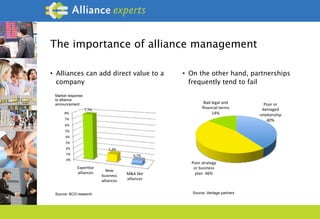
The importance of alliance management
•  Alliances can add direct value to a
company
•  On the other hand, partnerships
frequently tend to fail
Poor$or$
damaged$
rela+onship$
40%$
Poor$strategy$
or$business$
plan$$46%$
Bad$legal$and$
financial$terms$
14%$
0%#
1%#
2%#
3%#
4%#
5%#
6%#
7%#
8%#
Exper1se#
alliances#
New#
business#
alliances#
M&A#like#
alliances#
7.7%#
1.3%#
0.7%#
Market response
to alliance
announcement
Source: BCG research Source: Vantage partners
Why financial metrics are important
•  Practically every company is
driven by return on investment
•  This makes the CFO in most
cases the second-in-command
•  If you can’t show what the added
value is of an alliance, why
should a company invest in it?
www.allianceexperts.com	
   6	
  
Agenda
1.  Introduction
2.  Traditional company valuation
3.  Information alliances
4.  Three ways to valuate a partnership
5.  Roles in alliance management and their impact on value
Traditional company valuation
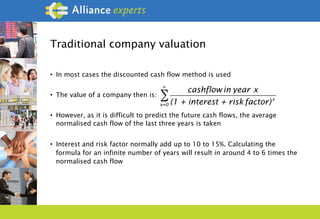
•  In most cases the discounted cash flow method is used
•  The value of a company then is:
•  However, as it is difficult to predict the future cash flows, the average
normalised cash flow of the last three years is taken
•  Interest and risk factor normally add up to 10 to 15%. Calculating the
formula for an infinite number of years will result in around 4 to 6 times the
normalised cash flow
cashflow in year x
(1 + interest + risk factor)x
x=0
∞
∑
Results from the past do not give any
guarantee for the future
•  What happened to Nokia, Ahold, Enron or Microsoft?
•  In three years time, more than half of the critical staff will have changed jobs
•  New technologies make older business models obsolete
Like Darwin said: the companies that can adept best to changing market
circumstances, will be the companies that survive
www.allianceexperts.com	
   9	
  
Agenda
1.  Introduction
2.  Traditional company valuation
3.  Information alliances
4.  Three ways to valuate a partnership
5.  Roles in alliance management and their impact on value
The value chain relies heavily on information
•  The value chain is not linear any more but has shortcuts, twists and bends
•  Value chains and related production costs are heavily impacted by product
design and the application of the right production technologies
•  Information about (end) customer needs is dissipated through the chain very
slowly
www.allianceexperts.com	
   11	
  
Creating exclusive partnerships sets an
incentive on information sharing
•  Information sharing takes time of key
employees
•  Traditional sales or purchasing behaviour
is mainly filtering of information
•  Only with a joint goal and the right
contractual setting companies start to
share about customer needs, leads and
experiences.
www.allianceexperts.com	
   12	
  
Carefully create your alliance portfolio
www.allianceexperts.com	
   13	
  
Direct	
  
value	
  
and	
  	
  
cash	
  flow	
  
big	


small	


small	
   big	
  
Contribu'on	
  to	
  the	
  company	
  mission	
  
and	
  innova'on	
  
Core	
  
ac'vi'es	
  
Oppor-­‐	
  
tunis'c	
  
Innova'on	
  
porKolio	
  
extension	
  
Agenda
1.  Introduction
2.  Traditional company valuation
3.  Information alliances
4.  Three ways to valuate a partnership
5.  Roles in alliance management and their impact on value
According to IFRS-11
•  The core principle of IFRS 11 is that a party to a joint arrangement
determines the type of joint arrangement in which it is involved by assessing
its rights and obligations and accounts for those rights and obligations in
accordance with that type of joint arrangement. [IFRS 11:1-2]
•  Two types: joint operations or joint venture
•  Procedure:
–  Check for ‘Control’
–  Check for ‘Joint Control’
–  Check for ‘Significant Influence’
•  Outcome can range from (partial) consolidation to classification as just
‘a financial instrument’
www.allianceexperts.com	
   15	
  
The cost savings methodology
•  Partnerships save on investments and
operational costs
•  Examples:
–  Choosing for a franchise concept
over opening own outlets
–  Sharing investments for
instruments that are hardly used
–  Joint product development
•  Cost savings can easily be calculated
and should only be corrected for
income sharing
www.allianceexperts.com	
   16	
  
The discounted cash flow method (revisited)
•  The value of an enterprise is:
•  The value of an alliance is:
•  But typically:
–  The duration of the alliance can be limited
–  The initial investment is much lower
–  The risk factor is higher
–  Your share will be between 30 and 70% of the profits
your share ×
cashflow in year x
(1 + interest + risk factor)x
x=0
n
∑
cashflow in year x
(1 + interest + risk factor)x
x=0
∞
∑
Investments for market entry through a
partnership will be lower
•  Your distribution partner will already have the economy of scale in his
sales force or logistic network
•  Your partner (if selected properly) has a known brand name and credibility,
which allows the partnership to ask a premium price
•  Your investment will mainly be in small adaptions to the product (e.g.
translations) and product support
The risk factor is higher
•  Shared ownership means less flexibility in decision making: this is a risk in
itself for quick adaption to market conditions
•  Having a shareholder’s agreement or other collaboration agreement also
means restrictions in divestments or changes in strategy
•  There always is the risk of opportunistic behavior of the partner
On the other hand:
•  Especially in less developed countries or countries you’re not familiar with,
working with a service provider or agent also brings risks.
You will have to share your profits
www.allianceexperts.com	
   20	
  
There are three ways to enhance your share in
the alliance
•  To make your offering more attractive
–  Better adjusted to the new market
–  Partly do your own branding and advertisement
•  To become more attractive as a partner yourself
–  Improving the ease to work with you
–  Profiling yourself in a more attractive way
•  To take the initiative in partnering
–  This also enhances the chance of ending up with the best partner
Game theory shows that it’s favourable to
involve other companies one by one
A
B
C
A
B
C
First A and B, then C A, B and C simultaneously
1
2
3
Agenda
1.  Introduction
2.  Traditional company valuation
3.  Information alliances
4.  Three ways to valuate a partnership
5.  Roles in alliance management and their impact on value
Roles in alliance management
Hinterhuber (2002) distinguishes four types of network orchestrator roles:
•  Architect:
–  Defines the objectives of the network
–  Decides who becomes a member of the network
•  Judge
–  Defines and maintains performance standards
•  Developer
–  Creates new concepts and intellectual assets
•  Leader
–  Motivates partner firms and creates network identity
www.allianceexperts.com	
   24	
  
Each role has a specific influence on value
www.allianceexperts.com	
   25	
  
Architect	
   Developer	
   Judge	
   Leader	
  
Has	
  influence	
  on	
  	
  
the	
  split	
  of	
  shares	
  
Influences	
  the	
  life	
  	
  
span	
  of	
  the	
  network	
  
Influences	
  the	
  
investments	
   Reduces	
  risks	
  in	
  
the	
  collabora'on	
  
your share ×
cashflow in year x
(1 + interest + risk factor)x
x=0
n
∑
Conclusions
•  We need to rethink how we valuate companies, the real value moves from
assets to exclusive collaborations
•  Choose your collaborations carefully and balance your involvement
•  The architect role is the most strategic one, but also other roles need to be
taken care of
•  Proper alliance management increases both the pie and your share of it!
Questions or comments: alfred.griffioen@allianceexperts.com
www.allianceexperts.com	
   26	
  

Financial valuation of alliances and partnership

  • 1.
    Alfred Griffioen MSc, CSAP,FC Presentation for ASAP 16 April 2014 Financial valuation of alliances and partnerships
  • 2.
    Alfred Griffioen •  Specialistin business partnerships and alliances •  Track record in marketing, business development and strategy consulting •  Author of 2 books about alliances and competitive advantage and 1 about strategy •  Certified Strategic Alliance Professional •  Founding partner of Alliance experts
  • 3.
    Alliance experts: an internationalnetwork of partnership specialists Collabora'on  strategy     &  Market  research   Interna'onal   matchmaking   Nego'a'ons  &   Partnering  agreements   Benchmarks     &  Training    
  • 4.
    Agenda 1.  Introduction 2.  Traditionalcompany valuation 3.  Information alliances 4.  Three ways to valuate a partnership 5.  Roles in alliance management and their impact on value
  • 5.
    The importance ofalliance management •  Alliances can add direct value to a company •  On the other hand, partnerships frequently tend to fail Poor$or$ damaged$ rela+onship$ 40%$ Poor$strategy$ or$business$ plan$$46%$ Bad$legal$and$ financial$terms$ 14%$ 0%# 1%# 2%# 3%# 4%# 5%# 6%# 7%# 8%# Exper1se# alliances# New# business# alliances# M&A#like# alliances# 7.7%# 1.3%# 0.7%# Market response to alliance announcement Source: BCG research Source: Vantage partners
  • 6.
    Why financial metricsare important •  Practically every company is driven by return on investment •  This makes the CFO in most cases the second-in-command •  If you can’t show what the added value is of an alliance, why should a company invest in it? www.allianceexperts.com   6  
  • 7.
    Agenda 1.  Introduction 2.  Traditionalcompany valuation 3.  Information alliances 4.  Three ways to valuate a partnership 5.  Roles in alliance management and their impact on value
  • 8.
    Traditional company valuation • In most cases the discounted cash flow method is used •  The value of a company then is: •  However, as it is difficult to predict the future cash flows, the average normalised cash flow of the last three years is taken •  Interest and risk factor normally add up to 10 to 15%. Calculating the formula for an infinite number of years will result in around 4 to 6 times the normalised cash flow cashflow in year x (1 + interest + risk factor)x x=0 ∞ ∑
  • 9.
    Results from thepast do not give any guarantee for the future •  What happened to Nokia, Ahold, Enron or Microsoft? •  In three years time, more than half of the critical staff will have changed jobs •  New technologies make older business models obsolete Like Darwin said: the companies that can adept best to changing market circumstances, will be the companies that survive www.allianceexperts.com   9  
  • 10.
    Agenda 1.  Introduction 2.  Traditionalcompany valuation 3.  Information alliances 4.  Three ways to valuate a partnership 5.  Roles in alliance management and their impact on value
  • 11.
    The value chainrelies heavily on information •  The value chain is not linear any more but has shortcuts, twists and bends •  Value chains and related production costs are heavily impacted by product design and the application of the right production technologies •  Information about (end) customer needs is dissipated through the chain very slowly www.allianceexperts.com   11  
  • 12.
    Creating exclusive partnershipssets an incentive on information sharing •  Information sharing takes time of key employees •  Traditional sales or purchasing behaviour is mainly filtering of information •  Only with a joint goal and the right contractual setting companies start to share about customer needs, leads and experiences. www.allianceexperts.com   12  
  • 13.
    Carefully create youralliance portfolio www.allianceexperts.com   13   Direct   value   and     cash  flow   big               small               small   big   Contribu'on  to  the  company  mission   and  innova'on   Core   ac'vi'es   Oppor-­‐   tunis'c   Innova'on   porKolio   extension  
  • 14.
    Agenda 1.  Introduction 2.  Traditionalcompany valuation 3.  Information alliances 4.  Three ways to valuate a partnership 5.  Roles in alliance management and their impact on value
  • 15.
    According to IFRS-11 • The core principle of IFRS 11 is that a party to a joint arrangement determines the type of joint arrangement in which it is involved by assessing its rights and obligations and accounts for those rights and obligations in accordance with that type of joint arrangement. [IFRS 11:1-2] •  Two types: joint operations or joint venture •  Procedure: –  Check for ‘Control’ –  Check for ‘Joint Control’ –  Check for ‘Significant Influence’ •  Outcome can range from (partial) consolidation to classification as just ‘a financial instrument’ www.allianceexperts.com   15  
  • 16.
    The cost savingsmethodology •  Partnerships save on investments and operational costs •  Examples: –  Choosing for a franchise concept over opening own outlets –  Sharing investments for instruments that are hardly used –  Joint product development •  Cost savings can easily be calculated and should only be corrected for income sharing www.allianceexperts.com   16  
  • 17.
    The discounted cashflow method (revisited) •  The value of an enterprise is: •  The value of an alliance is: •  But typically: –  The duration of the alliance can be limited –  The initial investment is much lower –  The risk factor is higher –  Your share will be between 30 and 70% of the profits your share × cashflow in year x (1 + interest + risk factor)x x=0 n ∑ cashflow in year x (1 + interest + risk factor)x x=0 ∞ ∑
  • 18.
    Investments for marketentry through a partnership will be lower •  Your distribution partner will already have the economy of scale in his sales force or logistic network •  Your partner (if selected properly) has a known brand name and credibility, which allows the partnership to ask a premium price •  Your investment will mainly be in small adaptions to the product (e.g. translations) and product support
  • 19.
    The risk factoris higher •  Shared ownership means less flexibility in decision making: this is a risk in itself for quick adaption to market conditions •  Having a shareholder’s agreement or other collaboration agreement also means restrictions in divestments or changes in strategy •  There always is the risk of opportunistic behavior of the partner On the other hand: •  Especially in less developed countries or countries you’re not familiar with, working with a service provider or agent also brings risks.
  • 20.
    You will haveto share your profits www.allianceexperts.com   20  
  • 21.
    There are threeways to enhance your share in the alliance •  To make your offering more attractive –  Better adjusted to the new market –  Partly do your own branding and advertisement •  To become more attractive as a partner yourself –  Improving the ease to work with you –  Profiling yourself in a more attractive way •  To take the initiative in partnering –  This also enhances the chance of ending up with the best partner
  • 22.
    Game theory showsthat it’s favourable to involve other companies one by one A B C A B C First A and B, then C A, B and C simultaneously 1 2 3
  • 23.
    Agenda 1.  Introduction 2.  Traditionalcompany valuation 3.  Information alliances 4.  Three ways to valuate a partnership 5.  Roles in alliance management and their impact on value
  • 24.
    Roles in alliancemanagement Hinterhuber (2002) distinguishes four types of network orchestrator roles: •  Architect: –  Defines the objectives of the network –  Decides who becomes a member of the network •  Judge –  Defines and maintains performance standards •  Developer –  Creates new concepts and intellectual assets •  Leader –  Motivates partner firms and creates network identity www.allianceexperts.com   24  
  • 25.
    Each role hasa specific influence on value www.allianceexperts.com   25   Architect   Developer   Judge   Leader   Has  influence  on     the  split  of  shares   Influences  the  life     span  of  the  network   Influences  the   investments   Reduces  risks  in   the  collabora'on   your share × cashflow in year x (1 + interest + risk factor)x x=0 n ∑
  • 26.
    Conclusions •  We needto rethink how we valuate companies, the real value moves from assets to exclusive collaborations •  Choose your collaborations carefully and balance your involvement •  The architect role is the most strategic one, but also other roles need to be taken care of •  Proper alliance management increases both the pie and your share of it! Questions or comments: alfred.griffioen@allianceexperts.com www.allianceexperts.com   26