Bridging the Gap
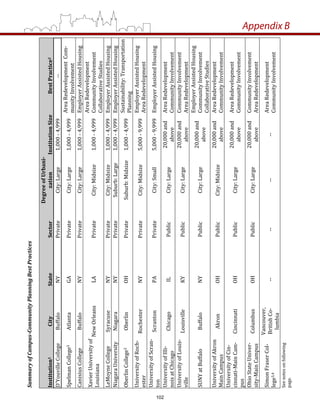
Community Collaboration Between D’youville College and the West Side of Buffalo
BRIDGING THE GAP 
Community Collaboration Between D’Youville College and the West Side of Buffalo 
James Bragg    
Alexis Soto Colorado 
Dattatreya Das 
Sadie Geisler 
Michael Grimble 
Rachel Heckl  
Rebecca Hoffman 
Creighton Randall 
Paul Ray 
Joelle Ruettiman 
Annie Stinson 
Mary Walls 
 
Instructor: Daniel B. Hess                                                                      
Department of Urban and Regional Planning 
Graduate Studio—Workshop, Master of Urban Planning Program 
December 2008 
Acknowledgments
Our studio would like to warmly acknowledge the following individuals for their time and consideration in 
assisting us in our efforts.   Without their kind assistance this studio would not be possible. 
Community, Education & Religious Leaders 
 
Father James Fee, Holy Angels Church  
Father David Gallivan, Holy Cross Catholic Church 
Principal Baines, Public School #3  
Principal Young, Grover Cleveland High School  
Principal Preston, DaVinci High School  
 
Darlie Al‐Haqq, Heart of the City Neighborhoods  
Stephanie Simeon, Heart of the City Neighborhoods  
Aaron Bartley, People United for Sustainable Housing 
(PUSH) 
Chris Brown, Kleinhans Community Association  
Lucy Candalario, West Side Community Services 
Linda Chiarenza, Neighbor Works 
Ellen O. Conley, Canisus  College 
David Ellerbrock, University Heights Collaborative  
Harvey Garrett, West Side Community Collaborative 
Anthony Armstrong, Local Initiative Support        
Corporation, LISC  
Andy Goldstein, Lower West Side Partnership 
Lourdes Iglesias, Hispanics United of Buffalo (HUB) 
Nanette Dorrios, Hispanics United of Buffalo (HUB) 
Zoe Lavatelli, Grassroots Gardens of Buffalo 
Ed Marshner, West Side Community Collaborative 
Jim Messina, Fargo Estate Neighborhood Association  
Diane Picard, Massachusetts Avenue Project (MAP) 
Matthew Ryan, Allentown Association 
Miguilla Schaus, Fargo 300 Block Club  
Kathleen Sheldon, Santa Maria Towers  
Tim Tielman, Campaign for Buffalo History, Architecture & 
Culture 
Jerry Turcotte, MicroBiz Buffalo  
Cynthia Van Ness, Preservation Coalition of Erie County  
Charles Banas, New Millenium Group  
Robin Vilardo, Connecticut Street Association  
Pam Kefi, International Institute  
Christopher Kelly, Karpeles' Manuscript Museum 
Stephanie Maleninko, WNY Service Learning Coalition  
Alex Bitterman, Rochester Institute of Technology 
Ron Reinas, Peace Bridge Authority 
D’Youville College 
 
Sister Denise Roche 
Kenneth Rogers 
Don Keller 
Molly Flynn 
Jan Mahle 
April Rockwood 
Olga Karman 
Sam Savarino 
D’Youville College Community Advisory Board 
Board of Trustees 
 
University at Buffalo 
 
Daniel B. Hess 
G. William Page 
Robert Shibley  
Beth Tauke 
Ferdinand Lewis 
Brian Carter 
Jajean Rose‐Burney 
 
Cannon Design 
 
Bill Greeley 
Kelly Hayes‐McAlonie 
 
Government and Elected leaders 
 
Council Member David Rivera, Niagara District 
Kirk Laubenstein, Legislative Assistant, 
Niagara District 
John Fell, Office of Strategic  Planning 
Peter Merlo, Office of Strategic Planning 


demand for on street parking, which was formerly a 
major community issue, D’Youville College must 
acknowledge the adverse economic, environmental, 
and social consequences of continued surface lot 
expansion.  Although housing values have been 
increasing, many residents fear the destruction of 
housing stock for convenient off‐street parking may 
reduce adjacent property values which, accordingly, 
will result in diminished incentives for neighborhood 
investment.  In addition, the effect of paved parking 
lots is a reduction in permeable surface area.  This 
loss of permeable surface area creates an increase in 
runoff and consequent increases in water pollution of 
both Lake Erie and the Niagara River.  The physical 
barrier created by these fenced lots is viewed 
differently by campus and community; physically 
isolating the campus from the neighborhood and 
taking away “eyes on the street,” while 
simultaneously increasing the sense of safety for 
students who commute to campus.  
Tensions between some residents and D’Youville 
College have increased in the absence of a clear and 
transparent land acquisition plan.  While residents 
and community leaders embrace the presence of 
D’Youville College in the neighborhood, many have 
expressed concern with D’Youville College’s 
expansion policies.  From the perspective of some 
homeowners, the conversion of D’Youville College‐
owned former residential parcels to parking lots 
contributes to neighborhood destabilization.   
To determine the strengths and weaknesses of 
D’Youville College within its existing collaborations, a 
survey was conducted to gauge college‐community 
interaction.  This survey focused only on community 
based organizations (CBOs) possessing formal or 
informal relationships with D’Youville College.  
Seventeen CBOs were identified as formal partners 
by the College.  These 17 CBOs were provided a 
survey that measured perceptions of interaction with 
D’Youville College.  The results of this survey 
revealed many CBOs perceive D’Youville College 
shares a “common goal and direction” and is 
As an intimate catholic college on Buffalo’s West 
Side, D’Youville College shares a rich history with 
the neighborhood and has a proud tradition of 
service to the community. D’Youville is one of 15 
colleges and universities in the Buffalo‐Niagara 
region that together enroll nearly 100,000 students 
annually.  What distinguishes D’Youville College 
from its regional peers is its location as a waterfront 
urban institution in a dynamic, diverse and densely 
populated neighborhood.  A symbiotic relationship 
between  D’Youville College and its West Side 
community has existed for over 100 years; students, 
faculty, and staff have historically exhibited a strong 
ethic of volunteerism and applied service.  The 
community has always valued D’Youville College as 
a vital presence and service provider in the 
neighborhood. However, recent physical expansion  
on the part of D’Youville College has strained 
relations despite continued community service 
emanating from D’Youville College. 
In recent years, D’Youville College has increased 
enrollment, expanded curricula and established 
additional degree programs including doctoral 
education.  Between 1998 and 2007, the school  
increased enrollment by a staggering 60 percent 
from 1,900 to 3,020 students, and was initially 
unable to accommodate parking on and around the 
campus.  Physical growth of the D’Youville College 
campus has followed this programmatic growth, 
and while new capital construction has lagged 
slightly, the supply of parking now outpaces growth 
in enrollment.   
Unlike peer institutions in the region, residential 
properties surround D’Youville College on all sides 
of its campus.  Consequently, the college has taken 
advantage of what limited land acquisition 
opportunities exist, and a series of housing 
demolitions for the purpose of parking lot 
expansion have negatively impacted property 
owners and neighborhood residents.   
While the creation of parking lots has reduced the 
Executive Summary
residential interests in promoting and preserving 
this area as a great place to work, shop and live.  This 
neighborhood association could organize events to 
celebrate the diversity of the multicultural 
community.  D’Youville College should serve as a 
facilitator to unite the diverse groups to form this 
neighborhood association, possibly utilizing the 
National Trust for Historic Preservation’s Main Street 
Four‐Point approach to community‐driven 
commercial revitalization.   
Moreover, D’Youville College should declare a 
moratorium on the acquisition and subsequent 
demolition of residential properties.  As a gesture of 
good faith, D’Youville College should collaborate with 
community organizations such as Heart of the City to 
stabilize property values through preservation of the 
current housing stock.  D’Youville College should also 
consider joint development of the construction of a 
parking structure and strive to convert some surface 
parking lots into green space to provide an inviting 
transition from the campus to the neighborhood and 
provide the campus with a sense of place. 
 
“accessible” to the organization.  However, there 
was near consensus among these CBOs that 
D’Youville College lacks consistency in 
communication.   
Precedent studies indicate that successful town‐
gown practices involve collaboration of universities 
with their surrounding communities.  Currently, 
there is a shift among urban institutions of higher 
learning across the country to work with their host 
communities as partners.  Collaboration between 
universities and neighbors encourages integration 
through (i.) the seamless transition between 
campus and the neighborhood, (ii.) the sharing of 
resources and (iii.) through the establishment of 
social connections.   
The primary recommendation from this study is 
D’Youville College should establish a Community 
Partnership Center (CPC) based on the Community 
Outreach Partnership Center model, an initiative of 
the US Department of Housing and Urban 
Development.  This program provides a framework 
to assist colleges and universities in developing 
neighborhood partnerships to revitalize distressed 
communities.  
A D’Youville College CPC would be responsible for 
coordinating service learning, oversee government 
and community relations and promote community 
resources.  This CPC would be responsible for 
facilitating communication between CBOs and 
neighborhood residents, and would serve as the hub 
for volunteer and curriculum‐based service 
opportunities.  It is recommended that D’Youville 
College establish a physical location for this CPC on 
Connecticut Street as a gesture of the institution’s 
support for revitalization of the commercial 
corridor.  Furthermore, D’Youville College should 
attempt to focus future institutional investment on 
infill development and adaptive reuse of structures 
on Connecticut Street.  
In addition, a 501(c)(3) nonprofit neighborhood 
association should be formed to unite business and 
Como un intimo colegio católico en el West Side de 
Buffalo, Colegio D’Youville tiene orgullo en su 
tradición de servicio a la comunidad y comparte una 
historia rica con el vecindario.  D’Youville es uno de 
los 15 colegios y universidades en la región de 
Buffalo‐Niágara que agrupa casi 100,000 
estudiantes anualmente.  Lo que distingue Colegio 
D’Youville de sus contrapartes de la región es su 
localización en una área con un frente marítimo, 
densamente poblada,y una comunidad diversa. Una 
relación simbiótica entre el Colegio D’Youville y 
West Side de Buffalo ha existido por mas de 100 
años; estudiantes, facultad, y personal 
administrativo historicamente a excedido un fuerte 
voluntarismo. La comunidad ha valorado la 
presencia de Colegio D’Youville  por ser un vital 
proveedor de servicios.  Sin embargo; la reciente 
expansión física de parte del Colegio ha afectado 
relaciones a pesar que Colegio D’Youville sigue 
proveyendo servicios comunitarios.     
 
En reciente años, Colegio D’Youville ha aumentado 
la matricula, expandido su currículo, y establece 
programas adicionales incluyendo programas 
doctorales. Desde 1998 a 2007, el Colegio ha 
aumentado su matrícula en 60% de 1,900 a 3,020 
estudiantes y inicialmente no fue capaz en 
acomodar la demanda por estacionamiento dentro y 
alrededores del campus. El crecimiento físico del 
campus D’Youville fue seguido por expansión y 
construcción del área de estacionamientos que ha 
sobrepasado el número de estudiantes.   
A diferencia de sus contraparte regionales, Colegio 
de D’Youville esta rodeado por propiedades 
residenciales.  Consiguientemente, el Colegio ha 
tomado cualquier oportunidad para adquirir 
propiedades, y conducido unas series de 
demoliciones de residencias con el propósito de 
expandir los lotes de estacionamientos. Esta  
expansión ha afectado negativamente los dueños de 
propiedades y vecinos.   
 
Aunque la creación de nuevos estacionamientos ha 
reducido la demanda de estacionamientos  en la 
calle que en el pasado era una queja de la 
comunidad, el Colegio D’Youville tiene que reconoce 
los efectos negativo en la economía, ambiente, y en 
la fabrica social de la comunidad.   Aunque los 
precios de residencias ha crecido, mucho residentes 
expresa miedo que la demolición de residencias  
para crea lotes de estacionamiento este bajando los 
precio de las propiedades adyacentes y este 
reduciendo los incentivos de inversión en la 
comunidad.  En adición, los estacionamientos 
reduce el área permeable disponible en el West 
Side.  La perdida de área permeable aumenta la 
escorrentía de agua causando la contaminación del 
Lago de Erie y Río de Niagara.  Las cercas de esto 
lotes de estacionamientos aísla la comunidad de 
D’Youville provocando la eliminación del efecto de 
“los ojos en la calle” sin embargo al mismo tiempo 
ha aumentado el sentido de seguridad para los 
estudiantes que conmutar al campus.   
Las tensiones entre los residente y el Colegio 
D’Youville ha aumentado por la ausencia de un plan 
transparente para la expansión del campus. Aunque 
algunos residentes y lideres comunitarios agradece 
la presencia de D’Youville en la comunidad, otros 
cuestiona la política de expansión física del Colegio. 
Desde la perspectiva de los dueños de residencias, la 
demolición de residencias para  crear lotes de 
estacionamientos desestabiliza la comunidad.        
Para determinar la fuerzas y las debilidades de 
Colegio D’Youville con sus  asociaciones existente, 
se condujo una encuesta para medir la interacción  
entre colegio‐comunidad.  Esta encuesta se enfoco 
en organizaciones comunitarias que tenía relación 
formal o informal con D’Youville.  Diecisiete 
organizaciones comunitarias fueron identificadas 
para medir la percepción de la relación con el 
Colegio. El resultado revelo que muchas 
organizaciones comunitarias comparte un objetivo, 
dirección, y accesibilidad con el Colegio. Pero el 
consenso es que Colegio D’Youville  falla en 
mantener comunicación constantes con las 
organizaciones. 
 
 El estudio de casos previos de otra universidades y 
colegios enseña que la mejor practica es 
colaboración entres instituciones educativa y 
comunidades. Actualmente, la tendencia es que 
universidades y colegios trabajen conjuntamente 
con las comunidades. Colaboración entre vecinos y 
instituciones educativas tiene los beneficios de: (I.) 
de motivar una transacción suave entre el campus y 
la comunidad, (II.) compartí recursos y (III.) 
mantener las conexiones sociales. 
Resumen Ejecutivo


La mas importante colaboración de este estudio es 
que D’Youville debía establece un Centro de Ayuda 
Comunitaria (CAC) basado en el modelo de  creado 
por el “US Department of Housing and Urban 
Development (HUD)”.  El modelo de HUD provee 
asistencia a colegios y universidades  para que la 
institución educativa ayude a revitalizar 
comunidades en angustia. 
 
El Colegio de D’Youville’s CAC va supervisar la 
coordinación de servicios educativos, relaciones 
comunitarias y gubernamentales.  El CAC va ser 
responsable de mantener comunicaciones con los 
vecinos y organizaciones comunitarias.  Esto 
ayudaría a D’Youville mejorar su trabajo voluntario 
que realiza en la comunidad. Es  recomendado que 
el CAC y otro futura expansión física de D’Youville 
sea localizado en la Calle de Connecticut para 
ayudar revitalizar esa área.     
  
En adición, una asociación comunitaria 501(c) (3) 
sin fines de lucros debe ser creada para unir 
negocios y residentes para promover y motivar una 
gran área para trabajar, vivir, y compra.  Esta  
asociación comunitaria puede organizar actividades 
como mercado internacional a aire abierto para 
mercadea la diversidad  cultural de la comunidad.  
El Colegio de D’Youville debe servir como un 
facilitador para unir diversos grupos para formar 
esta asociación comunitaria usando el enfoque 
Cuatro Punto de “National Trust for  Historic 
Preservation’s  Main Street” para revitalización 
comercial dirigida por la comunidad.    
 
Además, D’Youville debe declarar un moratoria en 
la adquisición y demolición  de residencias como un 
gesto de buena fe hacia la comunidad.  El Colegio 
debe colaborar con la organización “Heart of the 
City” para estabilizar y preserva la disponibilidad de 
residencias. El Colegio de D’Youville debe 
considerar un desarrollo junto de un 
estacionamiento multi‐pisos para así convertir los 
lotes estacionamientos en áreas verde.  Las áreas 
verdes ayudan a una transición menos abrupta 
entre campus‐comunidad y provee de un ambiente 
de un campus universitario. 
 
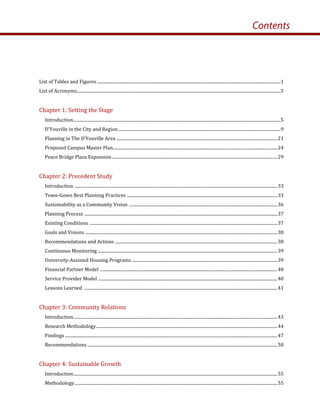
List of Tables and Figures ............................................................................................................................................................................1 
List of Acronyms...............................................................................................................................................................................................3 
 
Chapter 1: Setting the Stage 
Introduction..................................................................................................................................................................................................5 
D’Youville in the City and Region........................................................................................................................................................9 
Planning in The D’Youville Area .......................................................................................................................................................21 
Proposed Campus Master Plan..........................................................................................................................................................24 
Peace Bridge Plaza Expansion...........................................................................................................................................................29 
 
Chapter 2: Precedent Study 
Introduction ..............................................................................................................................................................................................33 
Town‐Gown Best Planning Practices .............................................................................................................................................33 
Sustainability as a Community Vision ...........................................................................................................................................36 
Planning Process .....................................................................................................................................................................................37 
Existing Conditions ................................................................................................................................................................................37 
Goals and Visions ....................................................................................................................................................................................38 
Recommendations and Actions ........................................................................................................................................................38 
Continuous Monitoring ........................................................................................................................................................................39 
University‐Assisted Housing Programs ........................................................................................................................................39 
Financial Partner Model ......................................................................................................................................................................40 
Service Provider Model ........................................................................................................................................................................40 
Lessons Learned  .....................................................................................................................................................................................41 
 
Chapter 3: Community Relations 
Introduction...............................................................................................................................................................................................43 
Research Methodology..........................................................................................................................................................................44 
Findings .......................................................................................................................................................................................................47 
Recommendations ..................................................................................................................................................................................50 
 
Chapter 4: Sustainable Growth 
Introduction...............................................................................................................................................................................................55 
Methodology..............................................................................................................................................................................................55 
Contents
Urban Context...........................................................................................................................................................................................55 
Transportation and Parking...............................................................................................................................................................57 
The Argument for Alternative Travel Modes..............................................................................................................................59 
Committing to Sustainability .............................................................................................................................................................61 
Recommendations..................................................................................................................................................................................61 
 
Chapter 5: Investment 
     Introduction...............................................................................................................................................................................................73 
Methodology..............................................................................................................................................................................................73 
Commercial Corridors...........................................................................................................................................................................73 
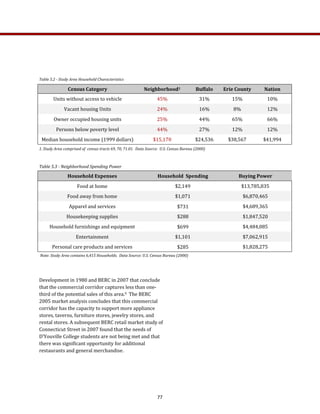
Consumer Spending Power.................................................................................................................................................................76 
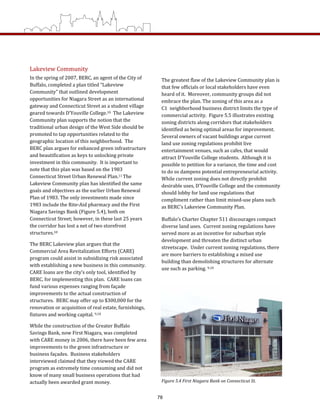
Lakeview Community............................................................................................................................................................................78 
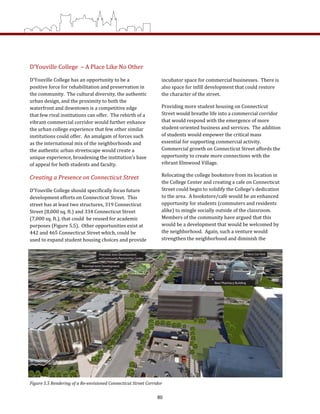
D’Youville College ‐ A Place like No Other....................................................................................................................................80 
 
Chapter 6: Synthesis 
Introduction...............................................................................................................................................................................................85 
Community Partnership Center........................................................................................................................................................85 
Community Advisory Board: An Evolution..................................................................................................................................86 
Development of 501(c)(3) ..................................................................................................................................................................88 
Focus Expansion on Connecticut Street........................................................................................................................................88 
Joint Development ..................................................................................................................................................................................88 
Moratorium on Residential Property Acquisition....................................................................................................................89 
 
Appendix 
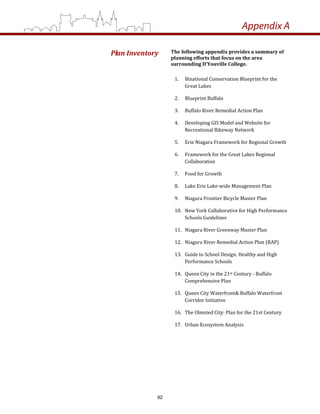
Plan Inventory..........................................................................................................................................................................................92 
Summary of Campus‐Community Best Practices................................................................................................................... 102 
Summary of University Assisted Housing Programs............................................................................................................ 104 
Real Estate Trends in the Neighborhood................................................................................................................................... 105 
Opportunities for Expansion along Connecticut Street....................................................................................................... 106 
Connecticut Street Anchors............................................................................................................................................................. 107 
 
 
Chapter 1: Setting the Stage 
 
Figure 1.1 ‐ D’Youville College and the Westside of Buffalo.   
Figure 1.2  ‐ Koessler Administration Buildings.   
Figure 1.3 ‐ D’Youville College Regional Sphere of Influence.   
Figure 1.4 ‐ 2008 D’Youville College Student Addresses.   
Figure 1.5 ‐ 2008 D’Youville College Student Addresses in WNY and Ontario.   
Figure 1.6 ‐  Distribution of D’Youville Students Within 200 miles of Campus.   
Figure 1.7 ‐ 20 Minute Commuter‐shed and 2008 Student Addresses.   
Figure 1.8 ‐ 1/4 Mile Pedestrian‐shed.   
Figure 1.9 ‐ D’Youville Neighborhood Partnerships.    
Figure 1.10 ‐ Neighborhood Study Area.   
Figure 1.11 ‐ Neighborhood Demographics.    
Figure 1.12 ‐ Primary Language Spoke at Home.   
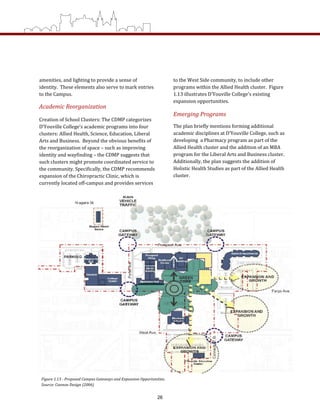
Figure 1.13 ‐ Proposed Campus Gateways and Expansion Opportunities. 
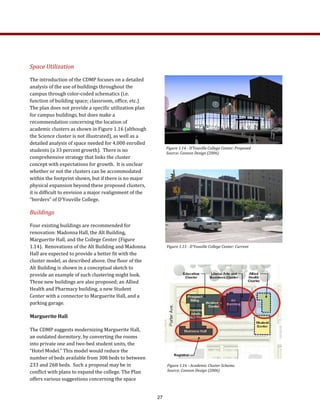
Figure 1.14 ‐ D’Youville College Center—Current.          
Figure 1.15 ‐ D’Youville College Center—Proposed.  
Figure 1.16 ‐ Academic Cluster Scheme.   
Figure 1.17 ‐ Proposed redesign of Fargo Avenue. 
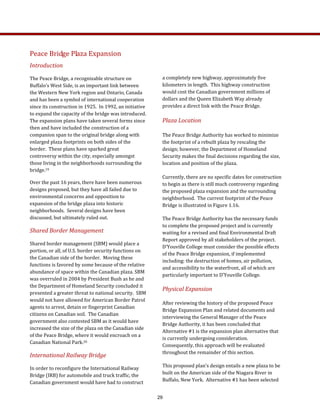
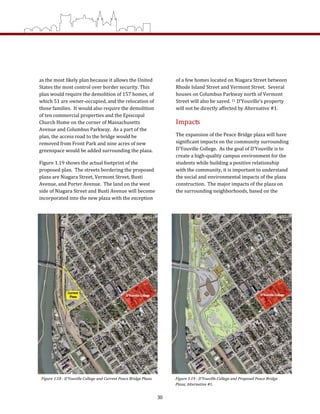
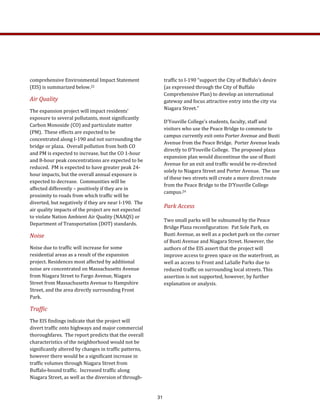
Figure 1.18 ‐ D’Youville College and Current Peace Bridge Plaza. 
Figure 1.19 ‐ D’Youville College and Proposed Peace Bridge Plaza, Alternative #1. 
 
Table 1.1 ‐  Percentage of Degrees Awarded by All Institutions in WNY by Degree.  
Table 1.2 ‐ Degrees Awarded by Degree Level. 
Table 1.3 ‐ Change in Sq.Ft. Real Estate Prices Within Study Area. 
Table 1.4 ‐ Plan Inventory Analysis. 
 
Chapter 2: Precedent Analysis 
 
Table 2.1 ‐ Advantages and Disadvantages of Employer Assisted Housing (EAH) Programs by Stakeholder.  
Table 2.2 ‐ EAH Models Motivated by Community Revitalization. 
 
Chapter 3: Community Relations 
 
Figure 3.1 ‐ The Seven Phases of Planned Changed. 
 
Table 3.1 ‐ Community Partners Assessment Survey Results. 
 
Chapter 4: Sustainable Growth 
 
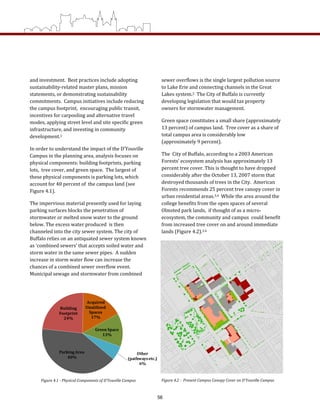
Figure 4.1 ‐ Physical Components of D’Youville Campus. 
Figure 4.2 ‐ Campus Tree Canopy Cover on D’Youville Campus Grounds. 
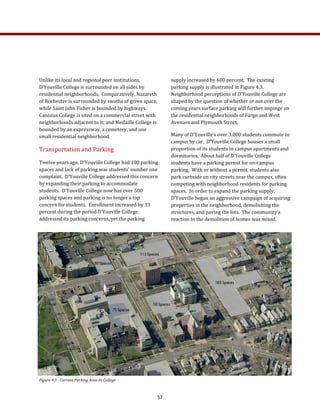
Figure 4.3 ‐ Current Parking Area At College. 
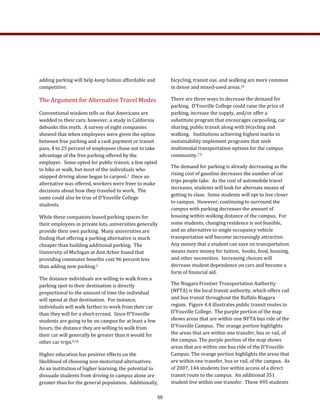
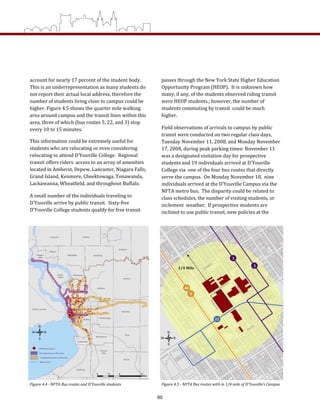
Figure 4.4 ‐ NFTA Bus routes and D’Youville students. 
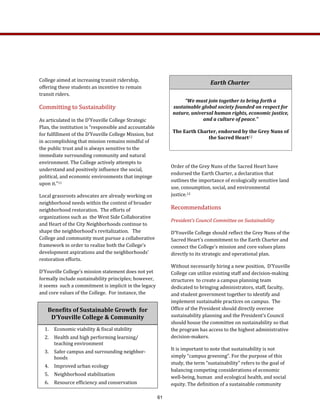
Figure 4.5 ‐ NFTA Bus routes with in 1/4 mile of D’Youville’s Campus. 
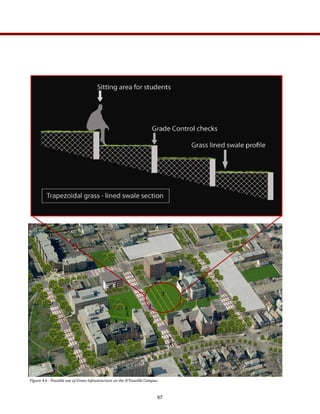
Figure 4.6 ‐ Possible use of Green Infrastructure on The D’Youville Campus. 
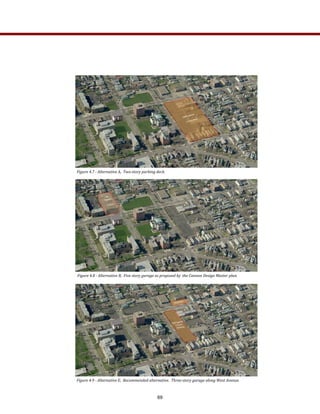
Figure 4.7 ‐ Alternative A, Two‐story parking deck. 
Figure 4.8 ‐ Alternative B, Five story garage as proposed by the Cannon Design Master Plan. 
Figure 4.9 ‐ Alternative E, Recommended alternative.  Three‐story garage along West Avenue. 
 
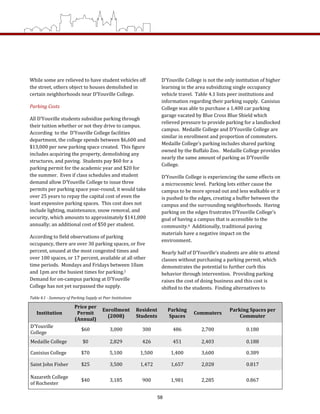
Table 4.1 ‐ Summary of Parking Supply at Peer Institutions. 
List of Tables and Figures
1
Chapter 5: Investment 
 
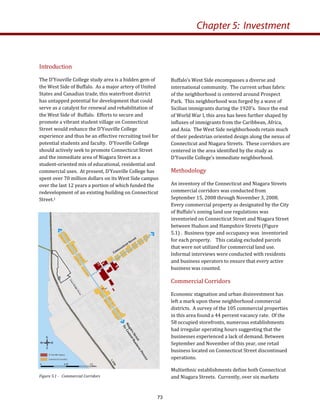
Figure 5.1 ‐ Commercial Corridor. 
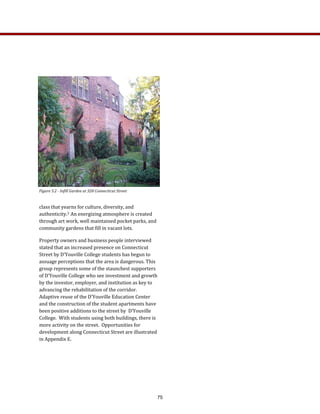
Figure 5.2 ‐ Infill Garden at 328 Connecticut Street.   
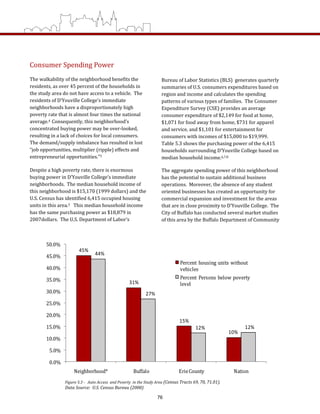
Figure 5.3 ‐ Auto Access  and Poverty  in the Neighborhood Study Area.   
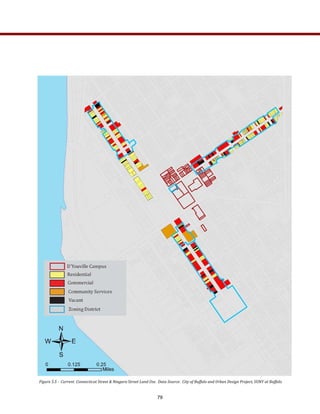
Figure 5.4 ‐  Current  Connecticut Street & Niagara Street Zoning.   
 
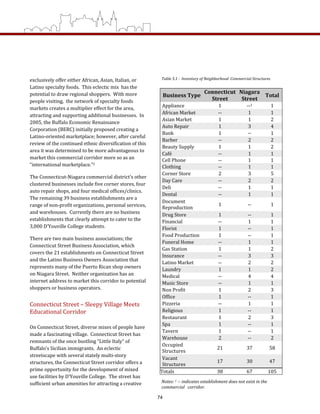
Table 5.1 ‐ Inventory of Neighborhood  Commercial Structures. 
Table 5.2 ‐ Neighborhood Household Characteristics.  
Table 5.3 ‐ Neighborhood Spending Power.  
Table 5.4 ‐  Suggested Special  Zoning Uses. 
Table 5.5 ‐  Prohibited Overlay Uses. 
 
Chapter 6: Synthesis 
 
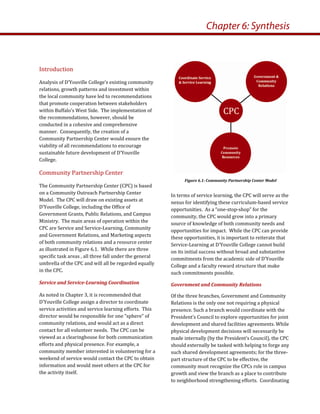
Figure 6.1 ‐ Community Partnership Center Model. 
2
List of Acronyms
ACRONYMS 
 
ADA     Americans with Disabilities Act  
ASR    Action Science Research 
BERC    Buffalo Economic Renaissance Corporation 
CAB    Community Advisory Board 
CAN     Community Needs Assessment 
CARE    Community Area Revitalization Efforts 
CBO    Community Based Organization 
CDMP     Cannon Design Master Plan 
CO    Carbon Monoxide  
CSO    Combined Sewer Overflow 
DOT    Department of Transportation  
EAH    Employer Assisted Housing  
EIS    Environmental Impact Statement  
EPA    Environmental Protection Agency 
FAST    Family Advocates Skills Team 
GIS    Geographic Information Systems 
GLRC    Great Lakes Regional Collaboration 
HANDS    Housing and Neighborhood Strategies      
IPEDS    Integrated Post‐Secondary Education Data System 
IRB    International Railway Bridge  
LID    Low Impact Development 
NAAQS    Nation Ambient Air Quality Standards 
NCES    National Center for Education Statistics 
NFTA    Niagara Frontier Transit Authority 
NY‐CHP   New York Collaborative for High Performance Schools 
NYS HEOP  New York State Higher Education Opportunity Program 
OSU    Ohio State University                                                                         
PM     Particulate Matter 
NYSED    New York State Department of Education  
NYSERDA   New York State Energy Research and Development Authority 
RAP    Remedial Action Plan 
RIT    Rochester Institute of Technology 
SBM    Shared Border Management 
SUNY    State University of New York 
TDM    Transportation Demand Management 
UCP    University‐Community Partnership 
3
4
Introduction 
D’Youville College, a small Catholic heritage college 
located in the heart of Buffalo’s West Side, has 
expanded steadily in the last several years.  To help 
meet demand for institutional and physical growth, 
D’Youville College commissioned Cannon Design to 
develop a Master Plan for the campus in 2006.   
Through recent expansion efforts and following 
completion of the Master Plan, D’Youville College 
has recognized the need to enhance its relationship 
with its diverse neighbors.  Consequently, the 
President and Board of Trustees of D’Youville 
College approached the Department of Urban 
Planning at the University at Buffalo, which assigned 
a graduate planning studio to assess the 
neighborhood impacts of D’Youville College and 
develop a plan to strengthen community 
interaction. 
Through initial conversations, the studio identified 
existing barriers to a strong campus and community 
relationship.  Specifically, the studio recognizes that 
D’Youville College’s autonomous property 
acquisition and demolition strategy is creating 
stress on community members and grassroots 
organizations that are striving to revitalize Buffalo’s 
West Side neighborhoods.  Additionally, a lack of 
community inclusion in decision making has 
discouraged ongoing neighborhood stabilization 
efforts. The analysis provides an in depth account of 
these community perceptions and makes 
recommendations for addressing them. 
D’Youville College’s urban location and wealth of 
assets surrounding the campus are nearly 
impossible to replicate.  Located in the midst of a 
multicultural neighborhood, the campus has 
convenient access to the waterfront via Porter 
Avenue.  Olmsted‐designed parks and green spaces 
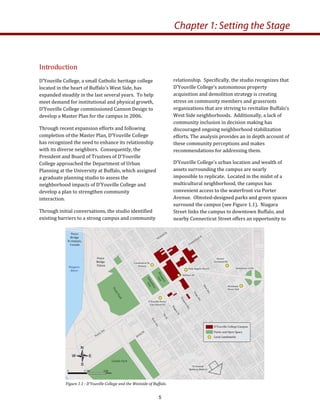
surround the campus (see Figure 1.1).  Niagara 
Street links the campus to downtown Buffalo, and 
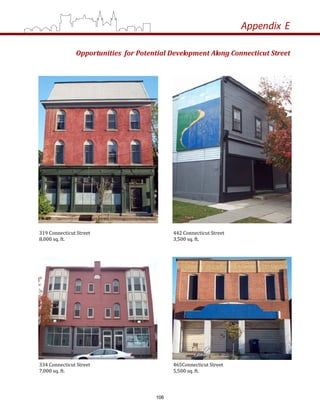
nearby Connecticut Street offers an opportunity to 
Chapter 1: Setting the Stage
Figure 1.1 ­ D’Youville College and the Westside of Buffalo.  
5
create a mixed‐use district.   
The studio provides a sustainable model to guide 
D’Youville College’s future investment that will 
build on these assets and empower the local 
community and economy.  D’Youville College is in a 
unique position to create educational corridors 
surrounding the campus that will blur the division 
between campus and community and serve to 
enhance the prestige of D’Youville College. 
The work of the studio considers how D’Youville 
College occupies space in a dense urban setting and 
how the college decision makers interact with the 
surrounding community.  Recommendations are 
provided to guide the future growth of D’Youville 
College as it strives to become a university while 
preserving and improving the surrounding 
neighborhoods.     
College History 
In October 1857, the Oblates of Mary Immaculate 
invited the Grey Nuns to the West Side of Buffalo, 
citing a need for women of service to complement 
the work of the priests in the community, and five 
nuns answered the call.  D’Youville College evolved 
from a mission to educate elementary school 
children on the West Side.  Holy Angels Academy 
was established the same year the Grey Nuns 
arrived and taught 26 children in a private home.  In 
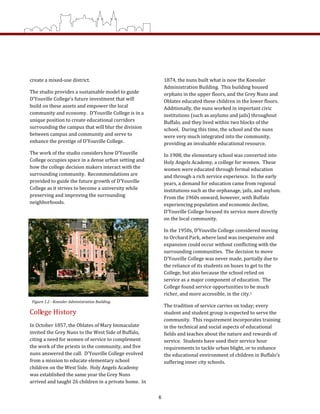
1874, the nuns built what is now the Koessler 
Administration Building.  This building housed 
orphans in the upper floors, and the Grey Nuns and 
Oblates educated these children in the lower floors.  
Additionally, the nuns worked in important civic 
institutions (such as asylums and jails) throughout 
Buffalo, and they lived within two blocks of the 
school.  During this time, the school and the nuns 
were very much integrated into the community, 
providing an invaluable educational resource. 
In 1908, the elementary school was converted into 
Holy Angels Academy, a college for women.  These 
women were educated through formal education 
and through a rich service experience.  In the early 
years, a demand for education came from regional 
institutions such as the orphanage, jails, and asylum.  
From the 1960s onward, however, with Buffalo 
experiencing population and economic decline, 
D’Youville College focused its service more directly 
on the local community.  
In the 1950s, D’Youville College considered moving 
to Orchard Park, where land was inexpensive and 
expansion could occur without conflicting with the 
surrounding communities.  The decision to move 
D’Youville College was never made, partially due to 
the reliance of its students on buses to get to the 
College, but also because the school relied on 
service as a major component of education.  The 
College found service opportunities to be much 
richer, and more accessible, in the city.1 
The tradition of service carries on today; every 
student and student group is expected to serve the 
community.  This requirement incorporates training 
in the technical and social aspects of educational 
fields and teaches about the nature and rewards of 
service.  Students have used their service hour 
requirements to tackle urban blight, or to enhance 
the educational environment of children in Buffalo’s 
suffering inner city schools. 
Figure 1.2 ­ Koessler Administration Building.  
6
Community Service 
The year 2008 marked the centennial of D’Youville 
College’s charter by New York State as a college.  In 
celebration, the college committed to 10,000 hours 
of community service in 2008 through the “100 to 
the second power” campaign.  Participants in this 
campaign had logged over 10,800 hours of service 
with 6 weeks left in the year. In addition, D’Youville 
College was placed on the President’s Higher 
Education Community Service Honor Roll for 2007, 
a designation given to only a handful of institutions 
nationwide in recognition of effective service 
programs.  Campus Ministry plans to continue the 
success of these centennial efforts through ongoing 
programs such as “Give 100,” in which individuals 
pledge to complete 100 hours of service over the 
course of a year.1   
At present, community service at D’Youville College 
is coordinated through Campus Ministry.  Although 
not officially part of the College administration, 
Campus Ministry is closely aligned with D’Youville 
College’s mission and is located on campus.  The 
ministry directly coordinates service opportunities 
at the College; an online “databank” of volunteers’ 
service activities and a listing of current volunteer 
opportunities are maintained by staff.  Campus 
Ministry staff often teach classes that feature service 
components, and while the ministry has focused on 
service activities it has also taken an active role in 
Service‐Learning initiatives.   
Service‐Learning 
Service‐Learning is a relatively new practice in 
higher education.  There are essentially three 
components: course work related to service, a 
service requirement, and reflection on the 
experience. Service‐Learning requires a significant 
academic commitment on the part of the institution, 
particularly when it comes to encouraging faculty 
participation, because it is somewhat time‐
intensive.  The process is well suited to institutions 
that concentrate on the holistic development of 
their students.  D’Youville College recognizes this, as 
evidenced by its mission statement: “At [D’Youville 
College], there are four foundation stones in an 
effective learning environment: academic 
preparation, practical experience, a consistent value 
structure, and a concern for the betterment of the 
community.”  Service‐Learning essentially bridges 
these “foundation stones.”1 
In most cases, Service‐Learning comes in the form of 
a credit bearing class and is required for graduation.  
A typical course has a minimum service‐hour 
component.  While D’Youville College does not have 
a Service –Learning requirement for graduation (as 
do some peer institutions, such as Daemen College), 
it runs first‐year orientation classes that emphasize 
service and feature hands‐on participation in at 
least one service project.  
In the context of neighborhood partnerships, 
Service‐Learning is considered more effective than 
traditional community service because it allows 
both a student and a CBO to form a relationship. A 
student receives a deeper understanding of the 
purpose of a CBO, and a CBO receives a more 
intensive, and in many cases more effective, 
commitment from a college or university.  The 
theme of the Service‐Learning may be aligned with a 
student’s academic focus, thereby encouraging a 
higher level student engagement that may progress 
into future involvement beyond the course. 
Service‐Learning at D’Youville College is currently 
coordinated by April Rockwood, a faculty member 
D’Youville College (Mission)
“honors its Catholic heritage...by providing 
academic, social, spiritual, and professional 
development in programs that emphasize 
leadership and service.” 
7
D’Youville College’s Role
D’Youville College has an opportunity to 
redefine its role within the community from a 
service provider to a partner 
in the occupational therapy department.  Professor 
Rockwood’s duties as program coordinator replace 
the equivalent of a 3‐credit hour course in her 
teaching commitments.  She is assisted by the 
recently formed Service Learning Work Group, 
which consists of a mix of faculty and 
administrators. 
D’Youville College strives to produce high‐caliber 
professionals and instill in those professionals the 
importance of using their training to serve those in 
need.  D’Youville College has recently expanded its 
programs, adding programs such as physical 
therapy and pharmaceutical sciences, both of which 
are modern extensions of D’Youville College’s 
original mission to serve others.  D’Youville College 
has a tradition of redefining the ways in which its 
mission of education and service is realized, in 
order to remain relevant to new technologies, 
knowledge and societal change.  D’Youville College’s 
commitment to such a mission, however, is not 
always translated through the institution’s actions.   
As D’Youville College continues to grow, tensions 
with the community have increased for reasons 
independent of D’Youville College’s commitment to 
service.  As discussed in Chapter 3, physical changes 
that D’Youville College has perceived as necessary 
for its growth and prosperity have been viewed by 
some members of the community as a disruption of 
the fabric of the community.  Specifically, residents 
have voiced resentment over demolition of viable 
housing stock, although some of this tension comes 
from differing views on the viability of those houses.  
Academia has changed its approach to community 
interaction as well, both locally and nationally.  
Spurred by new programs through the U.S. 
Department of Housing and Urban Development, 
many colleges and universities have developed 
community partnership centers.  Locally, this model 
has been adopted by many institutions, D’Youville 
College included, through the Western New York 
Service Learning Coalition (WNYSLC).  Examples of 
this model are presented in Chapter 3. 
With these local and national changes taking place, 
D’Youville College has an opportunity to redefine its 
role within the community from a service provider to 
a partner.  Recent developments in community 
service, Service‐Learning, and educational outreach 
at D’Youville College suggest that the timing is right 
for just such a shift. 
8
D’Youville in the City and Region 
As a result of the dynamic relationship between 
campus and community, many post‐secondary 
institutions throughout the United States have 
forged community partnerships, recognizing that 
collaboration induces both campus and community 
strength.  In distressed urban regions, an evaluation 
of neighborhood diversity, assets and opportunities 
for collaboration have provided those areas with a 
lens through which to identify venues for 
institutional, neighborhood, and regional growth.  
Buffalo’s West Side has experienced decline, 
disinvestment, and the start of a comeback due to a 
variety of factors.  As a result, assessment of the 
extent of D’Youville College’s reach in the city and 
the region will provide guidance in identifying 
opportunities for both the institution and the region 
as a whole.   
To facilitate the analysis, it is first necessary to 
identify a study area.  A preliminary evaluation of 
the data, however, reveals that D’Youville College 
has an extensive reach within the region that varies 
depending on the context of analysis.  Consequently, 
it is evident that utilizing stringent boundaries 
would most likely result in a loss of information that 
may be critical to understanding D’Youville College 
within the scope of the region.  Therefore, the best 
manner in which to identify D’Youville College is to 
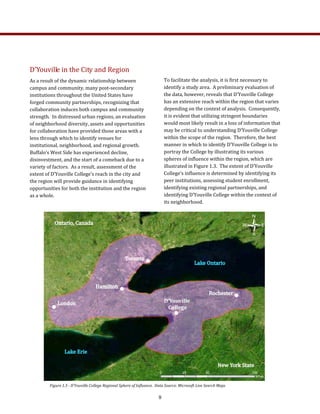
portray the College by illustrating its various 
spheres of influence within the region, which are 
illustrated in Figure 1.3.  The extent of D’Youville 
College’s influence is determined by identifying its 
peer institutions, assessing student enrollment, 
identifying existing regional partnerships, and 
identifying D’Youville College within the context of 
its neighborhood. 
Figure 1.3 ­ D’Youville College Regional Sphere of Influence.  Data Source: Microsoft Live Search Maps 
9
College to compete for top students and to establish 
additional doctoral programs.  Since 1998, the 
college has experienced a staggering 60 percent 
growth, increasing enrollment from approximately 
1,900 students to about 3,020 in 2007.  D’Youville’s 
niche academic areas are closely aligned with 
degrees awarded within the Erie‐Niagara region, 
granting a majority of degrees in health science, 
education, and business management programs at 
the undergraduate and graduate levels.  To maintain 
such a pace of growth, it is increasingly important 
for the college to distinguish itself from its regional 
peers.     
As part of the Better by Degrees Survey conducted 
on behalf of the Western New York Consortium for 
Higher Education, D’Youville College identified 
secondary institutions that it considers chief 
competitors for attracting students.3  In conjunction 
with the colleges and universities identified by 
D’Youville College, additional institutions within 
Western New York were also identified by this 
studio that are comparable in size and academic 
programs.  The majority of D’Youville College’s 
peers are located within the Erie‐Niagara region.  In 
Western New York, D’Youville College’s peers 
include: Daemen College, Medaille College, SUNY 
Buffalo, Niagara University, Hilbert College, and 
Canisius College.  Outside of the area, D’Youville 
College’s peers include Nazareth College and Saint 
John Fisher College, both located in Rochester, New 
York. 
In relation to its peers, D’Youville College grants the 
largest share of degrees in health professions and 
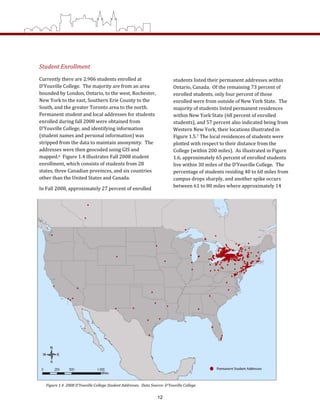
related clinical sciences.  Table 1.2 summarizes the 
degrees granted in the field as a share of total 
degrees awarded for each institution.   
Bachelor degrees granted in business related fields, 
the second most dominant field of study at 
D’Youville College, are within the top three most 
awarded fields at D’Youville College’s peer 
institutions.  Compared with the other nine 
Peer Institutions 
Within Erie and Niagara counties, D’Youville College 
is one of 15 institutions of higher education that 
together enroll more than 90,000 students annually.  
Data on total enrollment and degrees granted are 
accessed from the Integrated Post‐Secondary Data 
System (IPEDS) for the 2005‐2006 academic year 
for all school identification codes (Unit ID) within 
Erie and Niagara counties.2    Within the area, 49 
percent of all bachelor’s degrees awarded are in 
business/management, the social sciences 
(including psychology and history), and education.  
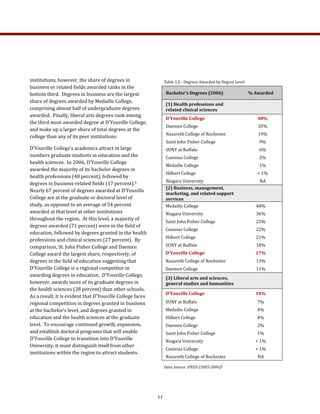
The majority of masters degrees are awarded in 
education, business and management, and the 
health sciences, respectively.  Regionally, 75 percent 
of first‐professional and doctoral degrees are 
awarded in health, law, and the biological and 
physical sciences.  Table 1.1 summarizes the most 
popular degrees awarded by all institutions within 
Western New York.3  
In 2006, D’Youville College awarded approximately 
five percent of all degrees granted within Western 
New York and is now striving to become the sixth 
university in Erie and Niagara counties.  In order to 
accomplish this goal, it is necessary for D’Youville 
Table 1.1 ­  Percentage of Degrees Awarded by All Institutions in 
WNY by Degree.3  
Data Source: IPEDS (2005­2006) 2,4 
Undergraduate Degree  % Awarded 
Business / Management  18% 
Social Science / Psychology / History  17% 
Education  14% 
Total:  49% 
Master's Degree    
Education  53% 
Business / Management  11% 
Health  7% 
Total:  71% 
Doctoral / Professional Degree    
Health  42% 
Law  25% 
Biology / Physical Science  8% 
Total:  75% 
10
institutions, however, the share of degrees in 
business or related fields awarded ranks in the 
bottom third.  Degrees in business are the largest 
share of degrees awarded by Medaille College, 
comprising almost half of undergraduate degrees 
awarded.  Finally, liberal arts degrees rank among 
the third most awarded degree at D’Youville College, 
and make up a larger share of total degrees at the 
college than any of its peer institutions.  
D’Youville College’s academics attract in large 
numbers graduate students in education and the 
health sciences.  In 2006, D’Youville College 
awarded the majority of its bachelor degrees in 
health professions (48 percent), followed by 
degrees in business‐related fields (17 percent).5  
Nearly 67 percent of degrees awarded at D’Youville 
College are at the graduate or doctoral level of 
study, as opposed to an average of 54 percent 
awarded at that level at other institutions 
throughout the region.  At this level, a majority of 
degrees awarded (71 percent) were in the field of 
education, followed by degrees granted in the health 
professions and clinical sciences (27 percent).  By 
comparison, St. John Fisher College and Daemen 
College award the largest share, respectively, of 
degrees in the field of education suggesting that 
D’Youville College is a regional competitor in 
awarding degrees in education.  D’Youville College, 
however, awards more of its graduate degrees in 
the health sciences (28 percent) than other schools.  
As a result, it is evident that D’Youville College faces 
regional competition in degrees granted in business 
at the bachelor’s level, and degrees granted in 
education and the health sciences at the graduate 
level.  To encourage continued growth, expansion, 
and establish doctoral programs that will enable 
D’Youville College to transition into D’Youville 
University, it must distinguish itself from other 
institutions within the region to attract students. 
Table 1.2 ‐ Degrees Awarded by Degree Level 
Data Source: IPEDS (2005­2006)2  
Bachelor's Degrees (2006)  % Awarded 
(1) Health professions and 
related clinical sciences 
  
D'Youville College  48% 
Daemen College  35% 
Nazareth College of Rochester  19% 
Saint John Fisher College  9% 
SUNY at Buffalo  6% 
Canisius College  2% 
Medaille College  1% 
Hilbert College  < 1% 
Niagara University  NA 
(2) Business, management, 
marketing, and related support 
services 
  
Medaille College  48% 
Niagara University  36% 
Saint John Fisher College  25% 
Canisius College  22% 
Hilbert College  21% 
SUNY at Buffalo  18% 
D'Youville College  17% 
Nazareth College of Rochester  13% 
Daemen College  11% 
(3) Liberal arts and sciences, 
general studies and humanities 
  
D'Youville College  14% 
SUNY at Buffalo  7% 
Medaille College  4% 
Hilbert College  4% 
Daemen College  2% 
Saint John Fisher College  1% 
Niagara University  < 1% 
Canisius College  < 1% 
Nazareth College of Rochester  NA 
11
Student Enrollment 
Currently there are 2,906 students enrolled at 
D’Youville College.  The majority are from an area 
bounded by London, Ontario, to the west, Rochester, 
New York to the east, Southern Erie County to the 
South, and the greater Toronto area to the north.  
Permanent student and local addresses for students 
enrolled during fall 2008 were obtained from 
D’Youville College, and identifying information 
(student names and personal information) was 
stripped from the data to maintain anonymity.  The 
addresses were then geocoded using GIS and 
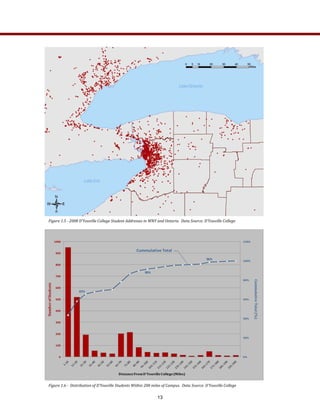
mapped.6  Figure 1.4 illustrates Fall 2008 student 
enrollment, which consists of students from 28 
states, three Canadian provinces, and six countries 
other than the United States and Canada.  
In Fall 2008, approximately 27 percent of enrolled 
Figure 1.4  2008 D’Youville College Student Addresses.  Data Source: D’Youville College 
students listed their permanent addresses within 
Ontario, Canada.  Of the remaining 73 percent of 
enrolled students, only four percent of those 
enrolled were from outside of New York State.  The 
majority of students listed permanent residences 
within New York State (68 percent of enrolled 
students), and 57 percent also indicated being from 
Western New York, their locations illustrated in 
Figure 1.5.7 The local residences of students were 
plotted with respect to their distance from the 
College (within 200 miles).  As illustrated in Figure 
1.6, approximately 65 percent of enrolled students 
live within 30 miles of the D’Youville College.  The 
percentage of students residing 40 to 60 miles from 
campus drops sharply, and another spike occurs 
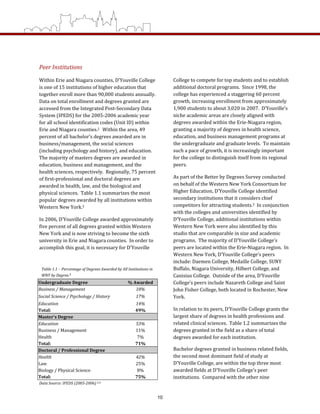
between 61 to 80 miles where approximately 14 
12
Figure 1.5 ­ 2008 D’Youville College Student Addresses in WNY and Ontario.  Data Source: D’Youville College 
0%
20%
40%
60%
80%
100%
120%
0
100
200
300
400
500
600
700
800
900
1000
Number of Students
Distance From D'Youville College (Miles)
90%
96%
65%
Cummulative Total
Cummulative Total (%)
Figure 1.6 ­  Distribution of D’Youville Students Within 200 miles of Campus.  Data Source: D’Youville College 
13
percent of all students list their local residences, 
indicating that a large portion of students most 
likely commute from Canada to D’Youville Collegem, 
or reside in the US without student visas.   In 
summary, a total of 95 percent of students enrolled 
during the fall 2008 semester reside in either 
Ontario or the Western New York region (see Figure 
1.6), illustrating that D’Youville truly is a regional 
college. 
Commuter­Shed 
According to the 2000 Census, the average commute 
time within Erie County was approximately 20 
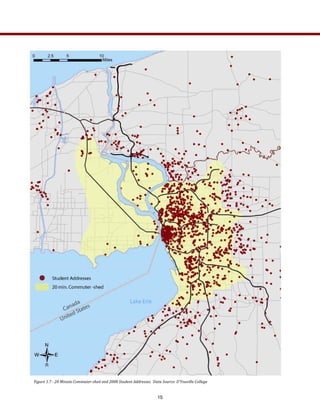
minutes.  Based on this information, a 20 minute 
driving buffer is mapped around the campus (see 
Figure 1.7).  The commuter‐shed is bounded to the 
east by Transit Road, to the North by North 
Tonawanda, and on the south by Orchard Park.  
Neglecting wait times that may be incurred by 
international travel, the buffer extends 
approximately ten miles across the Canadian 
border.  Approximately 1,146 students listed local 
addresses within the 20 minute commuter‐shed, 
which provides a conservative estimate that about 
39 percent of enrolled students have a commute of 
20 minutes or less, with the exception of those 
commuting from Canada.  Local addresses may not 
reflect actual residents within the area due to 
students’ reporting permanent addresses as their 
local address.    
14
Figure 1.7 ­ 20 Minute Commuter­shed and 2008 Student Addresses.  Data Source: D’Youville College 
15
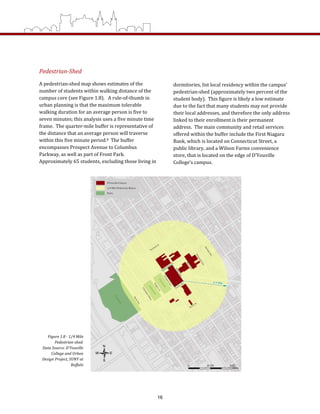
Figure 1.8 ­ 1/4 Mile 
Pedestrian­shed.   
Data Source: D’Youville 
College and Urban 
Design Project, SUNY at 
Buffalo 
Pedestrian­Shed 
A pedestrian‐shed map shows estimates of the 
number of students within walking distance of the 
campus core (see Figure 1.8).   A rule‐of‐thumb in 
urban planning is that the maximum tolerable 
walking duration for an average person is five to 
seven minutes; this analysis uses a five minute time 
frame.  The quarter‐mile buffer is representative of 
the distance that an average person will traverse 
within this five minute period.8  The buffer 
encompasses Prospect Avenue to Columbus 
Parkway, as well as part of Front Park.  
Approximately 65 students, excluding those living in 
dormitories, list local residency within the campus’ 
pedestrian‐shed (approximately two percent of the 
student body).  This figure is likely a low estimate 
due to the fact that many students may not provide 
their local addresses, and therefore the only address 
linked to their enrollment is their permanent 
address.  The main community and retail services 
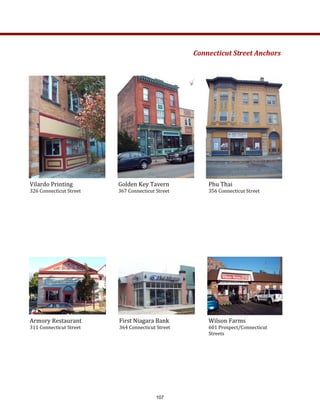
offered within the buffer include the First Niagara 
Bank, which is located on Connecticut Street, a 
public library, and a Wilson Farms convenience 
store, that is located on the edge of D’Youville 
College’s campus. 
16
 
D’Youville College’s Partnerships 
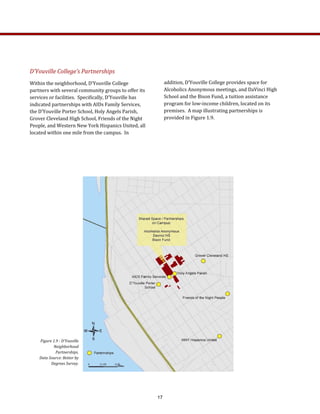
Within the neighborhood, D’Youville College 
partners with several community groups to offer its 
services or facilities.  Specifically, D’Youville has 
indicated partnerships with AIDs Family Services, 
the D’Youville Porter School, Holy Angels Parish, 
Grover Cleveland High School, Friends of the Night 
People, and Western New York Hispanics United, all 
located within one mile from the campus.  In 
Figure 1.9 ­ D’Youville 
Neighborhood 
Partnerships.    
Data Source: Better by 
Degrees Survey.  
addition, D’Youville College provides space for 
Alcoholics Anonymous meetings, and DaVinci High 
School and the Bison Fund, a tuition assistance 
program for low‐income children, located on its 
premises.  A map illustrating partnerships is 
provided in Figure 1.9. 
17
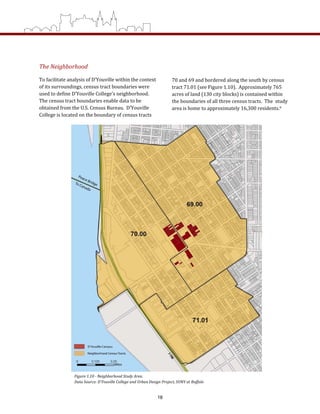
The Neighborhood 
To facilitate analysis of D’Youville within the context 
of its surroundings, census tract boundaries were 
used to define D’Youville College’s neighborhood.  
The census tract boundaries enable data to be 
obtained from the U.S. Census Bureau.  D’Youville 
College is located on the boundary of census tracts 
Figure 1.10 ­ Neighborhood Study Area.   
Data Source: D’Youville College and Urban Design Project, SUNY at Buffalo 
70 and 69 and bordered along the south by census 
tract 71.01 (see Figure 1.10).  Approximately 765 
acres of land (130 city blocks) is contained within 
the boundaries of all three census tracts.  The  study 
area is home to approximately 16,300 residents.9 
18
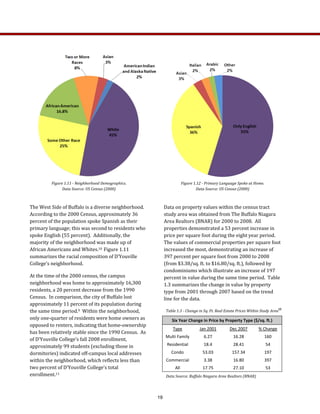
Table 1.3 ­ Change in Sq. Ft. Real Estate Prices Within Study Area
12
 
Data Source: Buffalo Niagara Area Realtors (BNAR) 
Six Year Change in Price by Property Type ($/sq. ft.)  
Type  Jan 2001  Dec 2007   % Change 
Multi Family  6.27  16.28  160 
Residential  18.4  28.41  54 
Condo   53.03  157.34  197 
Commercial  3.38  16.80  397 
All  17.75  27.10  53 
Data on property values within the census tract 
study area was obtained from The Buffalo Niagara 
Area Realtors (BNAR) for 2000 to 2008.  All 
properties demonstrated a 53 percent increase in 
price per square foot during the eight year period.  
The values of commercial properties per square foot 
increased the most, demonstrating an increase of 
397 percent per square foot from 2000 to 2008 
(from $3.38/sq. ft. to $16.80/sq. ft.), followed by 
condominiums which illustrate an increase of 197 
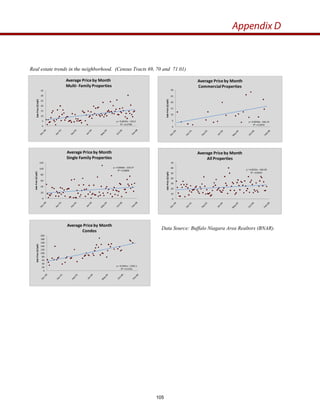
percent in value during the same time period.  Table 
1.3 summarizes the change in value by property 
type from 2001 through 2007 based on the trend 
line for the data.   
The West Side of Buffalo is a diverse neighborhood.  
According to the 2000 Census, approximately 36 
percent of the population spoke Spanish as their 
primary language; this was second to residents who 
spoke English (55 percent).  Additionally, the 
majority of the neighborhood was made up of 
African Americans and Whites.10  Figure 1.11 
summarizes the racial composition of D’Youville 
College’s neighborhood.   
At the time of the 2000 census, the campus 
neighborhood was home to approximately 16,300 
residents, a 20 percent decrease from the 1990 
Census.  In comparison, the city of Buffalo lost 
approximately 11 percent of its population during 
the same time period.9  Within the neighborhood, 
only one‐quarter of residents were home owners as 
opposed to renters, indicating that home‐ownership 
has been relatively stable since the 1990 Census.  As 
of D’Youville College’s fall 2008 enrollment, 
approximately 99 students (excluding those in 
dormitories) indicated off‐campus local addresses 
within the neighborhood, which reflects less than 
two percent of D’Youville College’s total 
enrollment.11   
Figure 1.12 ­ Primary Language Spoke at Home.   
Data Source: US Census (2000) 
Figure 1.11 ­ Neighborhood Demographics.    
Data Source: US Census (2000) 
19
The data indicates that property values have been 
increasing within the neighborhood since 2000.  It is 
important to note, however, that prices were not 
adjusted for inflation.  The increase in property 
values is therefore higher than it would be if values 
were adjusted for inflation for the eight year time 
period.  
Viewing D’Youville College at various geographic 
levels provides understanding as to its influence 
within the City of Buffalo and the bi‐national region.  
It is evident that D’Youville College influences an 
area beyond its own backyard, as evidenced by the 
students that it attracts and the partnerships that it 
has formed.  In conjunction with D’Youville College’s 
growth, the neighborhood is also beginning to 
revive, as indicated by rising property values.  
Consequently, it is important that actions taken by 
the College with respect to its growth complement 
the actions that have been taken by CBOs 
throughout the community.  In order to better 
understand how these efforts can simultaneously 
occur, local planning efforts and best practices from 
other institutions similar to D’Youville College were 
considered, and are discussed further in the next 
chapter. 


20
Planning in the D’Youville Area 
Introduction  
There are a plethora of planning efforts and 
initiatives focusing on the neighborhoods 
surrounding the D’Youville College campus.  Some 
of these plans directly or indirectly affect the 
college, and its future expansion plans.  Local, 
regional, and state level plans provide 
recommendations ranging from improving food 
access to the remediation of the area’s natural 
resources.  Many of the plans have implications for 
D’Youville College’s growth.   Examining the goals, 
principles, implementation, and common issues 
within these various plans informs the process and 
helps to produce a framework for prudent decision 
making. This analysis began with a search for all 
plans that addressed any part of the present campus 
or the surrounding neighborhoods.  In total, 17 
plans were found from various organizations that 
have the potential to affect the future growth of 
D’Youville College.13  
The analysis of the plans’ content was a two‐fold 
process. First, plans that will have a significant 
impact on the study area were separated from the 
rest.  These plans were then categorized by their 
geographic focus, content focus and type of 
recommendations.  This method was chosen in 
order to better understand the concerns currently 
being addressed on and around the campus as well 
as which concerns merit more attention.  The 
second process involved examining the plans for 
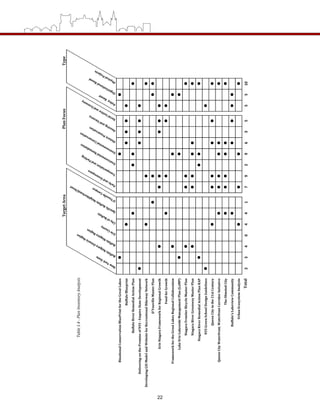
common themes.  An inventory of ongoing planning 
efforts in the D’Youville College area are provided in 
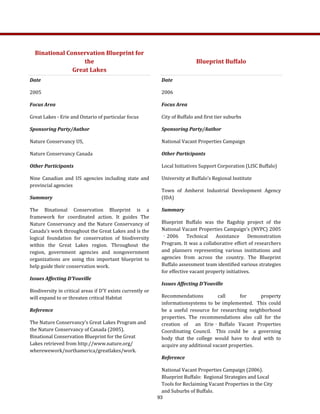
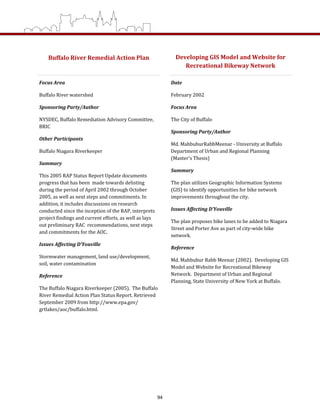
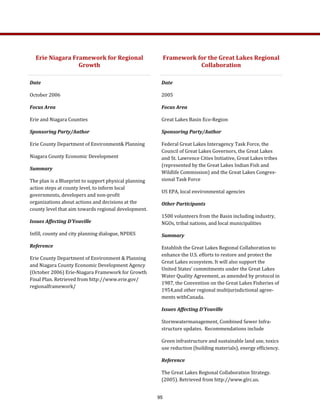
Appendix A.   
Findings 
As part of this process, brief overviews of each plan 
were created, and the analysis are summarized in 
Table 1.4.   
Built Environment 
Many of the plans propose specific projects that 
would significantly alter the built environment 
around the campus.  A great deal of attention is 
given to the parks surrounding D’Youville College.   
In particular, the Olmsted Parks System Plan 
proposes that Porter Avenue be converted into a 
parkway to create a better link to the waterfront.  
This project includes redesigning the bridge, which 
passes over Interstate‐190, tree plantings, and 
enlarging pedestrian walkways.14 
Many projects are proposed for the park grounds as 
well, including restoring the ‘X’ pathway pattern 
within Prospect Park.  It is also recommended that 
the Niagara Branch Library, which is currently within 
Prospect Park be relocated.   
Finally, pedestrian safety is addressed in the plans. 
Traffic calming measures are proposed along Niagara 
Street and a safer connection between the two sides 
of Prospect Park is recommended.  Inclusive design 
features enable universal access for all residents. 
Community and Social Implications 
While it can be argued that all plans attempt to 
address social concerns, the three issues that were 
persistent throughout these documents were 
mobility, integration and recreation.  Poor mobility is 
a significant issue for many residents living in the 
study area due to low automobile ownership.  
Improved access to the waterfront, food, goods and 
public transportation are cited several times in the 
various plans as needed improvements.   
The study area has an ethnically diverse community 
and providing interaction between cultures is highly 
desired.  Interaction is especially encouraged along 
commercial corridors such as Connecticut Street and 
Niagara Street.      
Recreation was also a prevalent theme.  The study 
area’s many parks and cultural venues make it a 
unique section of the city and provide strong 
elements for leveraging regeneration.   The area’s 
parks seem to be the common link between mobility, 
recreation and integration.  The parks surrounding 
D’Youville College show great potential to improve 
the lives of the area residents and their historic 
nature and pedestrian bike pathways make them 
valued assets in the community.   
21
Target AreaPlan FocusType
New York State Buffalo Naigara Ontario Region
Buffalo Niagara Region
Erie County 
City of Buffalo  Specific Buffalo Neighborhood/Asset 
D'Youville Campus
Parks and Greenspace
Transportation and Parking
Environmental Remediation
Environmental Conservation
Historic Preservation
Housing and Vacancy
Social Justice and Economy
Policy  Based
Organizational Based
Physical Projects
Binational Conservation BluePrint for the Great Lakes
Buffalo Blueprint
Buffalo River Remedial Action Plan
Delivering on the Promise of NYS ­ Empire State Development
Developing GIS Model and Website for Recreational Bikeway Network
D'Youville Master Plan
Erie Niagara Framework for Regional Growth
Food for Growth
Framework for the Great Lakes Regional Collaboration
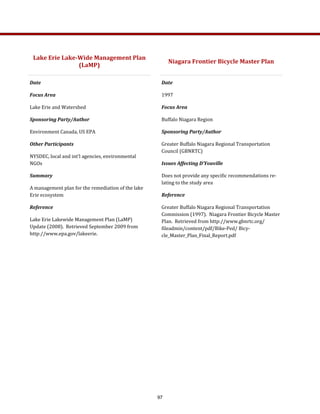
Lake Erie Lakewide Management Plan (LaMP)
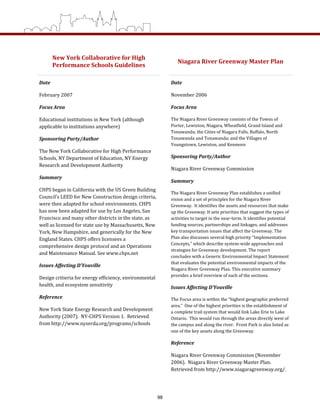
Niagara Frontier Bicycle Master Plan
Niagara River Greenway Master Plan
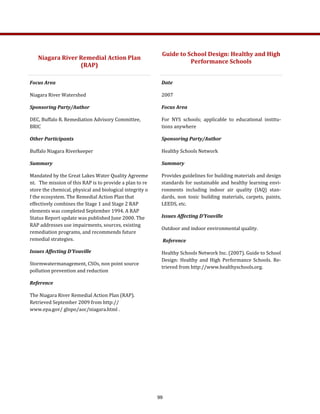
Niagara River Remedial Action Plan RAP
NYS Green School Design Guidelines
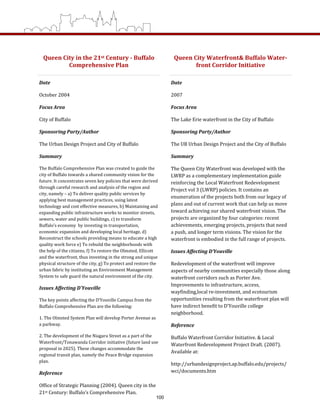
Queen City in the 21st Century 
Queen City Waterfront, Waterfront Corridor Initiative
The Olmsted City
Buffalo's Lakeview Community
Urban Ecosystem Analysis
Total234044179296355510
Table 1.4 ­ Plan Inventory Analysis 
22
and can be designated “high performance” based on 
their final cumulative score.  The NY‐CHPs scorecard 
and criterion include planning standards set by the 
United States Environmental Protection Agency 
(EPA) and the New York Energy Research and 
Development Authority (NYSERDA). 
Synthesis 
Examination of the existing plans presents the case 
for several key considerations in this planning 
process.  First, park system integration plans should 
be a key consideration in planning for D’Youville 
College’s future expansion.  Second, D’Youville should 
collaborate with neighborhood groups and the City of 
Buffalo to plan for social justice and housing 
redevelopment in the neighborhoods surrounding 
D’Youville College, which seem to be lacking in 
existing plans.  Third, since several plans deal with 
strategies to improve or protect environmental 
conditions in the area, D’Youville College should 
consider adopting the principles and strategies 
articulated in existing plans. 
As an institution of higher learning, D’Youville 
College has a unique opportunity to become a model 
for a more integrated and community‐minded 
institution.  Acknowledging the broader framework 
of community, environmental, and physical plans will 
create a campus that is a reflection of the school’s 
heritage and core values of innovation and 
resourcefulness. 
Environmental Implications 
Many of the existing plans focusing on the Buffalo‐ 
Niagara Region deal with environmental protection 
and ecological restoration, focusing on the 
watersheds of Lake Erie, Lake Ontario, the Buffalo 
River and the Niagara River.  Many of the 
recommendations require implementation at the 
municipal and local levels. Several New York State 
agencies and organizations have articulated 
environmental standards for institutions that aim to 
address ecological and environmental issues raised 
in river, lake, and watershed plans.  
Green Infrastructure and Low Impact Development 
(LID) are advocated for in many plans.  Non‐point 
source pollution and stormwater management are 
primary concerns identified in the Great Lakes 
Regional Collaboration (GLRC) Strategy and in both 
Buffalo and Niagara River Remedial Action Plans 
(RAPs).15  Green infrastructure and LID strategies 
such as green roofs, downspout disconnect projects, 
vegetated swales and filtration, permeable 
pavement, and biorention aim to curtail sewer 
overflow events by reducing the runoff flowing into 
the combined sewer system.16 
In an effort to identify ecological value within the 
Buffalo Niagara Region, an ecosystem analysis was 
conducted in 2003 to create an inventory of “green 
data” for the region.  Recommendations from this 
study include benchmarks for tree cover.17  The 
goals include a 40 percent overall coverage with 25 
percent located in urban residential areas, which 
includes D’Youville College and surrounding 
communities.  
The New York State Department of Education 
(NYSED) also addresses environmental issues along 
with the New York Collaborative for High 
Performance schools (NY‐CHPs).  Together, they 
have developed resources for school buildings 
including energy efficiency standards, stormwater 
best management practices, ecologically sensitive 
site planning methods, and recommended 
sustainable building materials. Schools that 
implement NY‐CHP measures accumulate points 
23
Proposed Campus Master Plan  
Introduction 
In 2006, D’Youville College hired Cannon Design to 
create a campus master plan, the content of which is 
reviewed in this section.18  The Cannon Design Master 
Plan (CDMP) was analyzed in three stages.  First, 
content relating to campus‐community relations was 
identified.  Second, a comparison between relevant 
information and the plan’s status, received from 
D’Youville College’s campus planner, was conducted to 
determine the extent to which the CDMP has been 
accepted and implemented. Finally, the document was 
evaluated for gaps related to the objectives of the 
studio. The analysis of the CDMP is divided into four 
broad topic areas: pathways, parking, and green space; 
borders, edges and interaction; academic 
reorganization; and buildings. 
Pathways, Parking, and Green Space 
One of the goals of the CDMP is to create a pedestrian‐
focused campus by eliminating cars and parking areas.  
The Master Plan suggests that this approach will 
encourage alternate forms of transportation, such as 
biking and walking. 
Student Street 
The CDMP recommends paved student walkways to 
link buildings.  These walkways would unify the 
campus, which is currently divided by city streets.  
Cannon Design suggests a central “Student Street” to 
connect all of the buildings on campus.  The student 
street would have both an indoor and outdoor 
component.  The outdoor component would run on 
the east sidewalk of Prospect Avenue from the Student 
Apartments to Marguerite Hall, from the Campus 
Center to Madonna Hall via the west crosswalk 
crossing Porter Avenue, from the rear of the Koessler 
Building to the Academic Center, and from the 
Academic Center to the Montante Library.  
A walkway would be created between Parking Lot A 
and the adjacent lot.  Additionally, pavers would be 
used to visually separate the proposed loading dock 
behind the Koessler Administration Building from 
pedestrian and vehicle areas.  However, in the CDMP 
illustrations, the loading dock is identical to a 
student walkway. Conceptual drawings for an 
enclosed pedestrian bridge across Porter Avenue 
are included in the CDMP although incompatible 
floor elevations make the project too expensive to 
be undertaken in the short term.     
Identity 
The D’Youville Collegecampus is located on a main 
street, yet lacks a sense of identity.  A visitor 
crossing the intersection of Porter Avenue and 
Niagara Street may be unaware that they have 
entered a campus environment.  In order to define 
the campus, the CDMP proposes standardized seat 
walls throughout the campus and gateway walls at 
the corners and entry points of the campus.  The 
plan also recommends enhancing the identity of 
the campus by unifying all furnishings, lighting, 
and plantings to create a sense of place.  
Additionally, the plan suggests using landscaping 
to frame buildings and define the campus 
boundaries.  
Parking  
D’Youville College is a landlocked, commuter 
campus.  As such, it can be a struggle to provide 
adequate parking for students and faculty who 
commute to campus on a daily basis.  Currently, the 
campus is surrounded by an abundance of surface 
parking lots, which contribute to the campus’ sense 
of isolation within its neighborhood.  
Cannon Design recommends a single five‐story 
parking garage to accommodate 490 new parking 
spaces, which provides the most parking with the 
smallest footprint, as the ideal solution. The plan 
proposes to accomplish this by transforming the 
current Campus Community Center to the site for 
the parking garage. Although this would address 
D’Youville College’s parking concerns, locating the 
parking garage at the site of the campus center 
would likely face community opposition.  
24
elements of inclusive design from the master plan 
has the potential to generate community resistance. 
The CDMP identifies gateways to the D’Youville 
College campus.  The gateway locations are Fargo 
and Porter Avenues, Porter and Prospect Avenues, 
Prospect Avenue and Connecticut Street and 
Connecticut Street and West Avenue.  CDMP 
strengths include several suggestions for identifying 
college gateways through the utilization of 
identifying walls, banners, pedestrian furniture and 
landscape.  These recommendations encourage 
interaction between the college and the community.  
There are, however, several recommendations that 
access points of buildings be turned inward to face 
away from the community, which would isolate the 
community from the campus.  
The D’Youville College Center on the corner of  
Porter Avenue and Fargo Avenue is an important 
element of the Porter/Fargo Avenue college 
gateway.  Currently the college center has an 
inconspicuous entryway, which is difficult to access.  
The CDMP recommends creating a ground‐floor 
entry to entice students in from the street and 
create a welcoming sense of activity at street level.  
A glass enclosure around the front stairs and 
outside arcade area provides an opportunity to 
create a new campus attraction and promote 
economic development and branding.  This could 
additionally serve to enhance community 
integration.  The Master Plan recognizes the 
D’Youville College Center as an essential element for 
enhanced integration of the college and community.  
Wayfinding   
Wayfinding and branding are two integral elements 
in establishing strong identities for colleges or 
communities.  Little attention is paid to wayfinding 
and branding in the plan.  The inclusion of elements 
such as banners and pavers or cobblestone would 
outline pedestrian areas and become unifying 
elements for college and community.  The CDMP 
mentions the importance of consistent furnishings, 
Additionally, traffic patterns on Porter Avenue make 
crossing unsafe.  Instead, consideration should be 
given to locating a parking garage closer to student 
apartments, which would provide a visual buffer on 
the west side of the garage.  Furthermore, placing 
the garage behind the student apartments would 
leave the parcel facing Connecticut Street open for 
future development.   
Borders, Gateways and Interaction 
The spatial interaction between colleges and 
surrounding communities begins with the borders, 
edges, and gateways of a campus.  Access is a 
leading physical factor for successful college and 
community  integration.  
The Master Plan states goals for connecting the 
campus to the surrounding community, which 
include: 
1.  Develop a Campus Master Plan that enhances 
the character of the built environment; 
2.  Establish continuity in amenities and create 
gateways to re‐knit the campus; 
3.  Establish new centers of student activity; 
4.  Improve public awareness and access to the 
campus through a strengthened identity. 
For urban campuses like D’Youville College, 
community integration presents challenges.  Urban 
campuses by their nature are landlocked.   
Landlocked colleges and universities have greater 
potential for successful community relationships if 
sections within campus master plans are devoted to 
the research and development of community and 
neighborhood relations.   Within the Master Plan 
little attention is paid to community integration and 
there is limited discussion as to how campus 
planning will impact the surrounding community 
economically, socially or aesthetically.  Given the 
population density of the neighborhood and spatial 
constraints of the built environment, omitting 
25
amenities, and lighting to provide a sense of 
identity.  These elements also serve to mark entries 
to the Campus.   
Academic Reorganization 
Creation of School Clusters: The CDMP categorizes 
D’Youville College’s academic programs into four 
clusters: Allied Health, Science, Education, Liberal 
Arts and Business.  Beyond the obvious benefits of 
the reorganization of space – such as improving 
identity and wayfinding – the CDMP suggests that 
such clusters might promote coordinated service to 
the community. Specifically, the CDMP recommends 
expansion of the Chiropractic Clinic, which is 
currently located off‐campus and provides services 
to the West Side community, to include other 
programs within the Allied Health cluster.  Figure 
1.13 illustrates D’Youville College’s existing 
expansion opportunities.   
Emerging Programs 
The plan briefly mentions forming additional 
academic disciplines at D’Youville College, such as 
developing  a Pharmacy program as part of the 
Allied Health cluster and the addition of an MBA 
program for the Liberal Arts and Business cluster.  
Additionally, the plan suggests the addition of 
Holistic Health Studies as part of the Allied Health 
cluster.   
Figure 1.13 ­ Proposed Campus Gateways and Expansion Opportunities. 
Source: Cannon Design (2006) 
26
Space Utilization 
The introduction of the CDMP focuses on a detailed 
analysis of the use of buildings throughout the 
campus through color‐coded schematics (i.e. 
function of building space; classroom, office, etc.)  
The plan does not provide a specific utilization plan 
for campus buildings, but does make a 
recommendation concerning the location of 
academic clusters as shown in Figure 1.16 (although 
the Science cluster is not illustrated), as well as a 
detailed analysis of space needed for 4,000 enrolled 
students (a 33 percent growth).  There is no 
comprehensive strategy that links the cluster 
concept with expectations for growth.  It is unclear 
whether or not the clusters can be accommodated 
within the footprint shown, but if there is no major 
physical expansion beyond these proposed clusters, 
it is difficult to envision a major realignment of the 
“borders” of D’Youville College.  
Buildings 
Four existing buildings are recommended for 
renovation: Madonna Hall, the Alt Building, 
Marguerite Hall, and the College Center (Figure 
1.14).  Renovations of the Alt Building and Madonna 
Hall are expected to provide a better fit with the 
cluster model, as described above. One floor of the 
Alt Building is shown in a conceptual sketch to 
provide an example of such clustering might look. 
Three new buildings are also proposed; an Allied 
Health and Pharmacy building, a new Student 
Center with a connector to Marguerite Hall, and a 
parking garage. 
Marguerite Hall   
The CDMP suggests modernizing Marguerite Hall, 
an outdated dormitory, by converting the rooms 
into private one and two‐bed student units, the 
“Hotel Model.” This model would reduce the 
number of beds available from 308 beds to between 
233 and 268 beds.  Such a proposal may be in 
conflict with plans to expand the college. The Plan 
offers various suggestions concerning the space 
Figure 1.15 ­ D’Youville College Center: Current   
     
Figure 1.14 ­ D’Youville College Center: Proposed 
Source: Cannon Design (2006)                                                                                                            
Figure 1.16 ­ Academic Cluster Scheme.   
Source: Cannon Design (2006) 
27
between Marguerite Hall and the existing College 
Center, proposing green space on one page and a 
ground‐level enclosed connector on another.  
Additionally, the plan recommends rehabilitating 
the exterior of the College Center but suggests 
eventually demolishing the building. 
New Pharmacy Building 
The CDMP includes the Wilson Farms site at the 
corner of Connecticut and Prospect as a site for an 
“Allied Health and Pharmacy” building under its 
short term recommendations. This suggestion for 
expansion at the forefront of the plan suggests that 
no barriers were foreseen to acquiring this 
property.  To date, however, the Wilson Farms store 
has not agreed to offers for acquisition and 
redevelopment from D’Youville College. The “Allied 
Health and Pharmacy” complex has not officially 
been built, although the Academic Building 
currently under construction east of the Wilson 
Farms site will include space for the Pharmacy 
School.   
Other Renovations 
Renovating the Alt Building is suggested based on 
criticism that the building is “corridor intense” and 
therefore not conducive to learning.  Renovating 
Madonna Hall is justified due to a need for the 
building to become “more conference focused.”  
Missing Elements and Shortcomings  
The most conspicuous weaknesses of the plan 
include the lack of community and environmental 
considerations.  For example, the plan discusses 
paving, but there is no mention of using recycled 
materials or managing runoff.  Additionally, 
although pedestrian and bicycle planning are 
admirable, the plan makes no recommendations 
that address the climate of this region or the reality 
that 90 percent of the current student population 
commutes to campus.  Instead, focus should be 
placed on ways to increase carpooling and to 
encourage transit use among faculty and students.  
There are also weaknesses in some of the 
recommendations.  The student street does not 
connect to the parking lots or from the library to the 
student apartments.  The cul‐de‐sac does not benefit 
the campus as much as it could, and therefore will 
not create a campus center in which students can 
congregate.  The only benefit it provides is safe 
passage from the academic building to the library, 
which could be achieved through other means such 
as the addition of a crosswalk.  The bridges between 
buildings should be discouraged because they 
separate students from the neighborhood.   
The recommendations presented, particularly those 
related to physical expansion, are general and do 
not mention timelines for implementation or 
estimated costs, with the exception of Americans 
with Disabilities Act (ADA) improvements.  
Furthermore, the CDMP does not discuss funding 
sources despite the significant investment required 
for building construction and renovation.  In 
conclusion, the recommendations from the CDMP 
should be reconsidered with the community at the 
forefront of every decision.  D’Youville College and 
the neighborhood should establish a symbiotic 
relationship, as they cannot thrive independent of 
each other. 
28
a completely new highway, approximately five 
kilometers in length.  This highway construction 
would cost the Canadian government millions of 
dollars and the Queen Elizabeth Way already 
provides a direct link with the Peace Bridge. 
Plaza Location   
The Peace Bridge Authority has worked to minimize 
the footprint of a rebuilt plaza by rescaling the 
design; however, the Department of Homeland 
Security makes the final decisions regarding the size, 
location and position of the plaza. 
Currently, there are no specific dates for construction 
to begin as there is still much controversy regarding 
the proposed plaza expansion and the surrounding 
neighborhood.  The current footprint of the Peace 
Bridge is illustrated in Figure 1.16.   
The Peace Bridge Authority has the necessary funds 
to complete the proposed project and is currently 
waiting for a revised and final Environmental Draft 
Report approved by all stakeholders of the project.  
D’Youville College must consider the possible effects 
of the Peace Bridge expansion, if implemented 
including: the destruction of homes, air pollution, 
and accessibility to the waterfront, all of which are 
particularly important to D’Youville College. 
Physical Expansion 
After reviewing the history of the proposed Peace 
Bridge Expansion Plan and related documents and 
interviewing the General Manager of the Peace 
Bridge Authority, it has been concluded that 
Alternative #1 is the expansion plan alternative that 
is currently undergoing consideration.  
Consequently, this approach will be evaluated 
throughout the remainder of this section. 
This proposed plan’s design entails a new plaza to be 
built on the American side of the Niagara River in 
Buffalo, New York.  Alternative #1 has been selected 
Peace Bridge Plaza Expansion 
Introduction 
The Peace Bridge, a recognizable structure on 
Buffalo’s West Side, is an important link between 
the Western New York region and Ontario, Canada 
and has been a symbol of international cooperation 
since its construction in 1925.  In 1992, an initiative 
to expand the capacity of the bridge was introduced.  
The expansion plans have taken several forms since 
then and have included the construction of a 
companion span to the original bridge along with 
enlarged plaza footprints on both sides of the 
border.  These plans have sparked great 
controversy within the city, especially amongst 
those living in the neighborhoods surrounding the 
bridge.19 
Over the past 16 years, there have been numerous 
designs proposed, but they have all failed due to 
environmental concerns and opposition to 
expansion of the bridge plaza into historic 
neighborhoods.  Several designs have been 
discussed, but ultimately ruled out.   
Shared Border Management  
Shared border management (SBM) would place a 
portion, or all, of U.S. border security functions on 
the Canadian side of the border.  Moving these 
functions is favored by some because of the relative 
abundance of space within the Canadian plaza. SBM 
was overruled in 2004 by President Bush as he and 
the Department of Homeland Security concluded it 
presented a greater threat to national security.  SBM 
would not have allowed for American Border Patrol 
agents to arrest, detain or fingerprint Canadian 
citizens on Canadian soil.  The Canadian 
government also contested SBM as it would have 
increased the size of the plaza on the Canadian side 
of the Peace Bridge, where it would encroach on a 
Canadian National Park.20   
International Railway Bridge  
In order to reconfigure the International Railway 
Bridge (IRB) for automobile and truck traffic, the 
Canadian government would have had to construct 
29
as the most likely plan because it allows the United 
States the most control over border security. This 
plan would require the demolition of 157 homes, of 
which 51 are owner‐occupied, and the relocation of 
those families.  It would also require the demolition 
of ten commercial properties and the Episcopal 
Church Home on the corner of Massachusetts 
Avenue and Columbus Parkway.  As a part of the 
plan, the access road to the bridge would be 
removed from Front Park and nine acres of new 
greenspace would be added surrounding the plaza. 
Figure 1.19 shows the actual footprint of the 
proposed plan.  The streets bordering the proposed 
plaza are Niagara Street, Vermont Street, Busti 
Avenue, and Porter Avenue.  The land on the west 
side of Niagara Street and Busti Avenue will become 
incorporated into the new plaza with the exception 
of a few homes located on Niagara Street between 
Rhode Island Street and Vermont Street.  Several 
houses on Columbus Parkway north of Vermont 
Street will also be saved. 21 D’Youville’s property 
will not be directly affected by Alternative #1. 
Impacts 
The expansion of the Peace Bridge plaza will have 
significant impacts on the community surrounding 
D’Youville College.  As the goal of D’Youville is to 
create a high‐quality campus environment for the 
students while building a positive relationship 
with the community, it is important to understand 
the social and environmental impacts of the plaza 
construction.  The major impacts of the plaza on 
the surrounding neighborhoods, based on the 
Figure 1.18 ­ D’Youville College and Current Peace Bridge Plaza.  Figure 1.19 ­ D’Youville College and Proposed Peace Bridge 
Plaza, Alternative #1. 
30
traffic to I‐190 “support the City of Buffalo’s desire 
(as expressed through the City of Buffalo 
Comprehensive Plan) to develop an international 
gateway and focus attractive entry into the city via 
Niagara Street.”   
D’Youville College’s students, faculty, staff and 
visitors who use the Peace Bridge to commute to 
campus currently exit onto Porter Avenue and Busti 
Avenue from the Peace Bridge.  Porter Avenue leads 
directly to D’Youville College.  The proposed plaza 
expansion plan would discontinue the use of Busti 
Avenue for an exit and traffic would be re‐directed 
solely to Niagara Street and Porter Avenue.  The use 
of these two streets will create a more direct route 
from the Peace Bridge to the D’Youville College 
campus.24 
Park Access 
Two small parks will be subsumed by the Peace 
Bridge Plaza reconfiguration:  Pat Sole Park, on 
Busti Avenue, as well as a pocket park on the corner 
of Busti Avenue and Niagara Street. However, the 
authors of the EIS assert that the project will 
improve access to green space on the waterfront, as 
well as access to Front and LaSalle Parks due to 
reduced traffic on surrounding local streets. This 
assertion is not supported, however, by further 
explanation or analysis. 
comprehensive Environmental Impact Statement 
(EIS) is summarized below.22  
Air Quality  
The expansion project will impact residents’ 
exposure to several pollutants, most significantly 
Carbon Monoxide (CO) and particulate matter 
(PM).  These effects are expected to be 
concentrated along I‐190 and not surrounding the 
bridge or plaza.  Overall pollution from both CO 
and PM is expected to increase, but the CO 1‐hour 
and 8‐hour peak concentrations are expected to be 
reduced.  PM is expected to have greater peak 24‐
hour impacts, but the overall annual exposure is 
expected to decrease.  Communities will be 
affected differently – positively if they are in 
proximity to roads from which traffic will be 
diverted, but negatively if they are near I‐190.  The 
air quality impacts of the project are not expected 
to violate Nation Ambient Air Quality (NAAQS) or 
Department of Transportation (DOT) standards.  
Noise 
Noise due to traffic will increase for some 
residential areas as a result of the expansion 
project. Residences most affected by additional 
noise are concentrated on Massachusetts Avenue 
from Niagara Street to Fargo Avenue, Niagara 
Street from Massachusetts Avenue to Hampshire 
Street, and the area directly surrounding Front 
Park. 
Traffic 
The EIS findings indicate that the project will 
divert traffic onto highways and major commercial 
thoroughfares.  The report predicts that the overall 
characteristics of the neighborhood would not be 
significantly altered by changes in traffic patterns, 
however there would be a significant increase in 
traffic volumes through Niagara Street from 
Buffalo‐bound traffic.  Increased traffic along 
Niagara Street, as well as the diversion of through‐
31
Chapter 1 Endnotes 
 
1.  Sister Denise Roche, President of D’Youville College.  Personal Interview, October 22 2008.   
2.  U.S. Department of Education. (2008). National Center for Education Statistics. Retrieved September 2008, 
from Integrated Post­Secondary Education Data System: http://nces.ed.gov/ipedspas/. 
3.  Percentage of degrees granted refers to degrees granted at the bachelor, masters, doctoral, or first professional 
level of study, only.  Degrees granted for D’Youville College were calculated as a percent composition of Erie 
and Niagara counties, only. 
4.  Data for the 2005­2006 academic year was released by the National Center for Education Statistics in 2007. 
5.  Degrees awarded in business are classified by the IPEDS as business, management, marketing, and related sup­
port services.  
6.  Geocoding is a process of finding geographic coordinates to enable mapping associated with information such 
as street addresses or zip codes. 
7.  Western New York consists of the following eight counties: Erie, Niagara, Orleans, Genesee, Wyoming, Chautau­
qua, Cattaraugus, and Allegany.  
8.  Watson, D., Plattus, A., & Shibley, R. G. (2003). Time­Saver Standards for Urban Design. New York: McGraw­Hill.  
9.  U.S. Census 2000. Summary File 3.  
10.  The 1990 Census included Hispanic ­as part of the racial demographic and removed it from consideration in the 
2000 Census due to it referring to ethnicity rather than race. 
11.  Local addresses may not reflect actual residents within the area due to under­reporting of actual local ad­
dresses. 
12.  All real estate price figures represent trend line values.  Further information can be found in Appendix D. 
13.  Appendix A contains a brief summary of each plan that was considered in this study. 
14.  Buffalo Olmsted Parks Conservancy (2008).  The Olmsted City. The Buffalo Olmsted Parks System: Plan for the 
21st Century. 
15.  Buffalo RAP 2005 Update section 4.1.5. http://www.epa.gov/grtlakes/aoc/buffalo.html#Beneficial_and Niag­
ara River RAP “Stormwater Management” section http://www.epa.gov/glnpo/aoc/niagara.html . 
16.  Green Cities, Great Lakes: Using Green Infrastructure to Reduce Combined Sewer Overflows. (2008). Ecojustice
(formerly Sierra Legal).  http://www.ecojustice.ca/publications/reports/the­green­infrastructure­report.  
17.  Urban Ecosystem Analysis: Buffalo and Lackwanna. (2003). Retrieved from http://www.americanforests.org/
downloads/rea/AF_Buffalo.pdf.  
18.  Cannon Design (2006). D’Youville College Master Plan2006. Grand Island, NY. 
19.  The Peace Bridge Authority. (n.d.). Project History. Retrieved October 2008, from Peace Bridge Expansion Pro­
ject: http://www.peacebridgex.com/history.aspx 
20.  The Peace Bridge Authority. (n.d.). Key Issues. Retrieved October 2008, from The Peace Bridge Expansion Pro­
ject: http://www.peacebridgex.com/issues/default.aspx 
21.  The Peace Bridge Authority. (n.d.). The Peace Bridge Expansion. Retrieved October 2008, from Project News: 
http://www.peacebridgex.com/news.aspx 
22.  U.S. Department of Transportation. (2007).  Peace Bridge Expansion Project: Draft Environmental Impact 
Statement. 


32
residential community.  Often, while they were 
acknowledged for their contributions through 
research, the level of their community engagement 
remained minimal.  The stress of institutional 
expansion within urban settings, however, began to 
create the awareness of the need for collaboration.  It 
was found that areas in which institutions 
collaborated with the community fared better than 
those that remained isolated from their 
surroundings.1,3  As a result, many colleges and 
universities located in urban areas began to view 
their communities as partners rather than clients.  
The collaboration of universities with their 
communities to encourage integration has happened 
in three manners that inherently overlap: through 
physical redefinition, through the encouragement of 
shared resources, and through social connections.  
Additionally, sustainability provides a framework for 
collaboration and growth which is increasingly being 
embraced by institutions throughout the country.  
The physical connectivity of a college campus to its 
surroundings proves to be an important factor in 
fostering town and gown relationships.  Hard campus 
edges, poorly defined gateways, and building designs 
that emphasize the interior of campus while 
neglecting the exterior not only deter from a sense of 
place, but enforce a sense of isolation from the 
campus.  Such was the case with the original design 
of the University of Cincinnati.  Plagued by the 
consequences of rapid suburbanization in the 1960’s 
and the construction of an interstate highway 
through one of the area’s prime neighborhoods, the 
University of Cincinnati and the surrounding 
community experienced several decades of rapid 
decline.   
Introduction 
In the past several years, there has been a shift in 
the role of urban institutions within their 
surrounding communities.  Universities were 
formerly perceived  to function independently of the 
communities in which they resided, due to lack of 
collaboration with the community.  Consequently, 
communities often viewed universities as 
competitors for resources.  More recently, however, 
research suggests that forging partnerships 
between institutions of higher education and their 
surrounding communities has proven to be 
mutually beneficial.1   Following the development of 
the CDMP in 2006, the college began to embrace the 
need to plan within the context of the surrounding 
community. 
The first task was to determine the effective 
practices other urban institutions have embraced to 
facilitate town‐gown relationships.  Institutional 
data was accessed from the National Center for 
Educational Statistics (NCES) and narrowed down 
to D’Youville College’s peer institutions.2  
Specifically, national universities were sorted to 4‐
year institutions located in large urban settings that 
had a student population within 10 percent of 
D’Youville College’s 2006 reported student 
population (approximately 3,018 students).  
Additionally, celebrated practices of larger urban 
institutions were taken into account based on 
whether or not their practices were likewise 
applicable to the urban issues that D’Youville 
College currently faces.  Based on findings from this 
preliminary research, town‐gown best planning 
practices were divided into four subcategories that 
will be discussed in further detail: town‐gown 
planning practices, campus sustainability as a 
community vision, the planning process and 
university assisted housing programs.  
Town‐Gown Best Planning Practices 
The role of universities within their surrounding 
communities has constantly evolved.  Traditionally, 
such institutions were viewed separately from the 
Town­Gown Planning 
The stress of college and university expansion 
within urban settings has heightened awareness 
of the need for collaboration.  Research suggests 
that neighborhoods where college and 
community collaboration occurs fare better 
than those that remain isolated. 
Chapter 2: Precedent Study
33
affect change in the built environment.  The 
University of Louisville, for example, partnered with 
several local businesses and community 
organizations to revitalize residences within the 
Russell neighborhood.  The partnership helped 
residents and developers with the planning, code 
compliance and regulatory approval, and design for 
energy efficient housing.  Additionally, the program 
advised residents who desired to make 
improvements to existing structures, thus 
encouraging preservation and investment in 
property.  The partnership also equipped 
neighborhood groups to become developers and 
contractors, and from these efforts emerged the 
Russell Neighborhood Development Plan.  The plan 
provided a detailed, comprehensive analysis of 
neighborhood needs and, although it was not fully 
realized, it enabled the creation of a vision for the 
revitalization.6  
Although the negative effects of the emphasis on 
place‐based policies have been widely studied, it has 
also been argued that such are necessary to create a 
sense of place and defensible spaces.  Additionally, 
however, the need to socially fuse campus and 
community together has been recognized.  Although 
mixed‐use developments and shared facilities enable 
this blending, non‐physical collaborations through 
University‐Community Partnerships (UCPs) have 
proven to be equally beneficial.  A growing body of 
literature exists describing established  UCPs that 
have met their original goals.7 Additionally, efforts 
have been made to disseminate information 
concerning the initiatives that institutions have 
made, especially within the context of distressed 
urban settings. As previously discussed, some studies 
have indicated that UCPs have proven to be mutually 
beneficial, but do not necessarily ensure that such 
will be the case.  For these partnerships to work, 
both the primary goals and expectations of the 
planning effort must be articulated and 
communicated between the institutions and 
stakeholders.1 
The University of Illinois at Chicago undertook a 
By the 1990s, the University of Cincinnati realized 
the need to address both its decreasing enrollment 
and the community’s concerns of low home 
ownership, high unemployment, housing vacancies, 
and neighborhood crime.  Utilized primarily as a 
commuter campus, large surface parking lots had 
been constructed around the edges of campus, 
hindering the permeability between the campus and 
its surroundings.  Additionally, piecemeal 
development resulted in a campus edge that was 
non‐porous and characterized by inconsistent 
architecture.1   
 In keeping with the University’s objectives to 
connect more effectively with the surrounding 
community, the University of Cincinnati spent the 
past ten years reconciling its built environment, 
adopting measures to increase permeability 
surrounding the campus, and eliminating the 
surface parking that acted as a barrier to campus.  
Additionally, the University made improvements to 
the campus boundary by demolishing outdated 
residence towers that had created hard edges.  
These measures alone created a sense of expansion 
into its surroundings without feeling invasive.  
Furthermore, the University located several student 
amenities within the urban fabric surrounding the 
campus, such as the Calhoun Street marketplace and 
University Village, which unite the university’s 
students with the community.1    
Likewise, Rochester Institute of Technology (RIT) 
and Ohio State University (OSU) have undertaken 
efforts to redefine their campus edges.  RIT’s Park 
Point project is a mixed‐use, village‐like 
development that has amenities for both campus 
and community.  The High Street Project at OSU is 
also intended to create a mixed‐use edge 
surrounding the campus with lofts, retail, 
restaurants, and entertainment space meant to 
promote interaction between campus and 
community.3,5 
In some instances, academic institutions have 
partnered directly with neighborhoods in order to 
34
HANDS project.  The FAST team consists of social 
work interns, early childhood specialists, and nursing 
students who collaborate to assign a case manager to 
serve as a point of contact for over 400 families in the 
Russell neighborhood.  The effort was dedicated in 
contacting families and meeting with them at their 
convenience and at their homes to provide health, 
education, and socioeconomic services.8  
The Russell neighborhood was also characterized by 
a high unemployment rate.  To address this, job and 
leadership training opportunities were developed 
through the HANDS program.  An eight‐week course 
was administered in computer training, designed to 
equip residents with basic computer skills.  
Additionally, a mentoring program was established 
in conjunction with job training to link participants 
to job opportunities and provide needed skills to 
ensure workplace success.  The program aspired to 
have residents view themselves as leaders of the 
revitalization initiative. 
Other UCP’s that have proven effective in fostering 
town‐gown relationships include the University of 
Cincinnati’s Uptown Consortium, which seeks to 
address five core areas of university and community 
development with community input : public safety, 
transportation, housing, economic development, and 
neighborhood services.  Additionally, the consortium 
has sought to incorporate the community as wholly 
as possible to thwart the feeling of institutional 
dominance and neighborhood inferiority throughout 
the planning and design process.1   
Similarly, the University of Akron has developed 
effective partnerships with community institutions, 
such as Habitat for Humanity, to rehabilitate housing 
surrounding campus.  Not only has this revived 
portions of the city surrounding the university, it has 
also assisted low‐income families with rehabilitation 
efforts and emphasized the importance of investing 
in property.  A summary of national town‐gown best 
planning practices is provided in Appendix B.   
 
participatory planning process utilizing technology 
to disseminate local knowledge in a way that proved 
to be useful during the redevelopment of the Pilsen 
neighborhood, a predominantly minority district.  In 
a phased process, the University encouraged public 
participation in conjunction with technological 
resources to map residents’ perceptions about 
various features of their own neighborhood.  The 
next several phases included visualizing and 
simulating such visions for the residents.  The 
process not only encouraged effective 
communication between the residents and the 
institution, but also redressed the feelings of 
mistrust by residents of large institutions that had 
pervaded the community for several decades.8 
Likewise, the University of Louisville established a 
Housing and Neighborhood Strategies (HANDS) 
program.  Funded by the U.S. Department of 
Education Urban Community Service Grant, the 
program was a partnership between business, 
government, schools, and community‐based 
organizations.  The intent of the program was to 
attract middle‐income families back into the Russell 
neighborhood, which, like many other urban 
neighborhoods, had experienced several decades of 
neglect following flight from the city.  The 
partnership aimed to jump‐start redevelopment and 
plan for its continuance beyond the life of the grant.6 
The program has several components including: 
family services, education, job training, and 
leadership training.  The family services portion of 
the outreach manifested itself through the 
formation of the Family Advocate Skills Team 
(FAST), which acts under the umbrella of the 
Technology and Local Knowledge 
The University of Illinois used technology to 
communicate local knowledge to the university 
during redevelopment of the Pilsen 
Neighborhood. 
35
campuses, iterate the social, economic, and 
environmental dimensions of sustainability, and 
outline initiatives and recommendations for all 
education.  These recommendations are based on the 
core themes of lifelong learning within formal and 
informal educational settings, interdisciplinary 
approaches, partnerships between educational 
institutions and the broader community, and 
multicultural perspectives.14 
These movements emphasize the role of institutions 
of higher education as critical drivers for 
sustainability, positively impacting the economic, 
environmental, and social viability of their 
immediate communities and regions.  Presently, 
institutions of higher learning continue their 
advancement towards addressing some of the most 
critical energy and resource challenges.  At least 250 
campuses have coordinators, offices, or directors of 
sustainability and more than 25 percent of all higher 
education institutions will have institution‐wide 
sustainability programs by the end of the decade.15  
According to the 2008 College Sustainability report 
card,16  the proportion of institutions committed to 
carbon emissions reductions increased from 14 to 50 
percent in one year.17  Of critical importance to these 
efforts is the policy, programs, and practices that 
acknowledge a clear connection between 
environmental outcomes and vast economic 
dividends to the institution and its surrounding 
community and region.17  Moreover, even smaller, 
Sustainability as a Community Vision 
As collaboration between universities and 
communities  becomes increasingly more common, 
focus is being placed on the utilization of 
sustainability as a framework for advancing shared 
goals.  Since the 1960s, many colleges and 
universities have taken steps to reduce negative 
environmental impacts on campus.  Such “campus 
greening” strategies have led to waste reduction, 
increased recycling, toxics‐use reduction, energy 
conservation and enhanced natural spaces.9  Over 
the last decade, sustainability and sustainable 
development has emerged as a significant focus 
within college curricula and as a goal of campus and 
community initiatives.  In 1990, higher education 
institutions took the first step towards defining and 
promoting sustainability with the creation of the 
Tailloires Declaration (Appendix A).  Hosted by the 
Tufts University European Center, during a 
conference held in Taillores, France, leaders of 
higher education institutions discussed the role of 
universities in shaping a sustainable future.  The 
Declaration establishes a 10 point voluntary action 
plan for building a sustainable university.10  As of 
2001, over 280 university presidents and 
chancellors in over 40 countries have signed on, 
including 73 US institutions. Following the Taillores 
Conference, sustainability in higher education 
remains a significant focus in the U.S. culminating in 
documents such as the Yale University Blueprint for 
a Green Campus (1994),11 the Essex Report (1995),12 
and the Education for Sustainability: An Agenda for 
Action (1996).13 These documents serve to clarify 
the direction of the sustainability movement on 
Goals for Sustainability Planning 
“Efforts to promote a sustainable environment 
should be directed to all campus constituents 
and to the community beyond.” 
 
~ Spelman Presentation at  Sustainable 
Colleges Conference, 2008 
 
Taillores Declaration 
“Universities educate most of the people who 
develop and manage society’s institutions. For 
this reason, universities bear profound 
responsibilities to increase the awareness, 
knowledge, technologies, and tools to create an 
environmentally sustainable future.” 
 
~ Report and Declaration of the Presidents’ 
Conference (1990). University Leaders for a 
Sustainable Future 
36
Planning Process 
Many of the best campus and community planning 
practices studied occur in the context of larger, de‐
industrialized cities, which provide a basis for 
comparison to D’Youville College.  Consequently, the 
impetus behind most of the planning efforts was the 
disinvestment of property, due to declining 
populations, and the consequent deterioration of 
conditions surrounding campus communities. To 
jump‐start the process of campus and community 
regeneration, many institutions developed 
community partnerships to focus planning efforts in 
two core areas: physical revitalization and the 
strengthening of community ties.  The campus‐
community planning process typically begins with an 
assessment of current conditions, an articulation of 
goals and visions, transferring goals into 
recommendations and action, and finally creating a 
mechanism for continuous monitoring.  
Existing Conditions 
In the case of the University of Cincinnati, 
revitalization began first within the campus.  World 
renowned architects were recruited to physically 
redefine the campus buildings and establish 
recognition locally, regionally, and nationally.  
Following a bold campus redefinition, the University 
articulated several physical goals for community 
redevelopment including recycling and 
rehabilitation, as well as assessing and improving 
connectivity.   
modestly endowed colleges are making strides to 
improve their campus quality through sustainability 
strategies; of colleges with similar enrollment to 
D’Youville College, 19 of 33 (58 percent) 
significantly improved their overall sustainability 
scores in one year. 
Oberlin College recently achieved a top grade for 
sustainability according to the 2008 College 
Sustainability Report Card.16   With an enrollment of 
2,857 students as of 2008, the college achieved 
excellence in planning and implementation of 
sustainable practices across sectors including 
transportation, climate change and energy issues, 
administration, food and recycling, green building, 
student involvement, endowment transparency, 
shareholder engagement, and investment priorities.  
The College made considerable progress in each 
graded sector but transportation contributed most 
significantly to Oberlin College’s high sustainability 
score.16 
Spelman College, situated five minutes  from 
downtown Atlanta, Georgia, recently undertook a 
strategic planning process for campus 
sustainability.  Spelman College, which has a student 
enrollment between 1,000 and 5,000 students,2 
convened a "sustainability focus group" in 2007 
comprised of faculty, students, and staff to begin 
identifying goals and objectives related to campus 
sustainability.  The overall goal for Spelman’s 
sustainability planning focused on enhancing the 
students' learning environment by addressing the 
physical, social, environmental, and community 
dimensions of the college campus experience: "to 
expand and improve the physical campus, 
technology infrastructure and residential programs 
in order to facilitate a seamless living and learning 
environment with (a) increased focus on 
environmental responsibility, b) increased student 
engagement and student‐faculty interactions, and c) 
increased student achievement and overall 
satisfaction with the collegiate experience."17  
Campus Transition 
“The impetus that inspired this transition…was 
the realization that improving the quality of life 
in and for the communities neighboring the 
university was part of the social obligations of 
the university as a good citizen and a good 
neighbor” 
 
­  Community Interactions and Collaborations 
Peer Institutional Study, 2006  
 
37
1.  To become a model for University‐community 
relations; 
2.  To be a place of pride through the maintenance, 
conservation, and enhancement of buildings; 
3.  To be culturally and socio‐economically diverse; 
4.  To become a neighborhood of choice; 
5.  To become a leader and partner to encourage 
retail and housing; and 
6.  To be actively engaged with community leaders 
and agencies.  
Recommendations and Actions 
Following the identification of its values, universities 
translated each goal into a set of recommendations 
and actions, which stemmed from opportunities 
identified by the university.  The University of Akron, 
OSU, and the University of Cincinnati realized the 
symbiotic relationship between university and 
community, and therefore the need to create an 
environment to attract and engage people not only to 
campus but to the surrounding community as well.  
Aside from the physical redefinition of their 
campuses, incentives were put in place to increase 
homeownership.  Additionally, opportunities for 
partnerships were identified based on the dual need 
for student preparation within specific disciplines of 
study and the communities’ need for those skill sets 
within local schools, businesses, and agencies.5 
The University quickly realized that capitalizing on 
existing housing stock would be less invasive to the 
community than engaging in mass demolition and 
restructuring.  As a result, the University of 
Cincinnati made it a primary goal to assess existing 
real estate, housing types, and retail and 
commercial spaces prior to redevelopment.  
Specifically, housing types, housing sizes, and 
occupancy type within the area were assessed.  
Furthermore, the University undertook an in‐depth 
analysis of retail establishments within the area 
surrounding the campus, including an assessment of 
the geographic reach of such establishments.  
Additionally, the effort determined important needs 
of the off‐campus community, which included 
demand for a recreational space.  The University 
agreed to provide a recreational facility for the 
community in exchange for a parcel of land it 
desired to acquire for expansion. 
Similarly, the University of Akron assessed existing 
conditions surrounding the University by 
conducting a community resident needs 
assessment.  To determine residents’ needs, surveys 
were issued, public meetings held, and market 
studies conducted.  Additionally, the University of 
Akron mapped both community assets and existing 
businesses using Geographic Information Systems 
(GIS). 
Goals and Visions 
After establishing the Campus Partners for 
Community Urban Redevelopment, OSU initiated its 
own campus rehabilitation by first articulating the 
University’s core values for the process.  The values 
articulated were long‐term goals toward which 
campus actions should ultimately be directed.  The 
values not only encompassed the physical 
revitalization of the campus and surrounding 
community, but its social redefinition as well.  The 
University divided its values for the neighborhood 
into the following six categories:5 
Ohio State University ~ Vision 
“The University District shall become a high 
quality ‘city­within­a­city,’ characterized by 
diverse, enriched, safe, livable, and 
commercially viable neighborhoods with 
community features and programs connected by 
a district­wide framework of transportation, 
open space, amenities, and human services.” 
~University Neighborhoods Revitalization Plan 
Concept Document, 2005 
38
University‐Assisted Housing Programs 
Many urban universities have found it increasingly 
difficult to attract and retain faculty and students due 
to urban decline surrounding college campuses.2  
Consequently, many institutions are engaging in 
partnerships to encourage development in their 
communities.  Motivated to recruit, retain, revitalize, 
and/or develop positive community relations, 
several universities have adopted Employer Assisted 
Housing (EAH) programs, which provide incentives 
for employees to purchase homes in targeted 
communities.  Such programs have proven to be 
beneficial to universities, employees, and the 
surrounding communities, the costs and benefits of 
which are summarized in Table 2.1.      
There are four conventional EAH models that 
employers may adopt, depending on their motivation 
for implementing such a program: the financial 
partner model, the service provider model, the 
connector/facilitator model, and the developer 
model.   
Continuous Monitoring 
 In conjunction with assessing current conditions, 
articulating goals, and translating goals into actions, 
each of the universities studied developed 
community partnerships.  The partnerships not only 
enabled dialogue between a university and its 
community, but created a feedback mechanism for 
the redevelopment process.  The University of 
Cincinnati created the Uptown Consortium, which 
consisted of the five largest employers within the 
University’s region.  Similarly, the University of 
Akron created the University Park Alliance, a 
cooperation between the University of Akron, the 
City of Akron, Summa Health System, and the 
University Park Neighborhood Association.  The 
organization brought together important 
stakeholders to develop a comprehensive 
community‐based planning process.  Additionally, 
the Alliance created a means for checks and 
balances of each action undertaken.5  
Advantages of EAHs 
Employer 
 
• Effective Recruitment Tool 
• Employee Retention and Loyalty 
• Reduced Costs Associated with 
Turnover 
• Positive Press Releases 
• Creation of Goodwill to the Community 
• Community Revitalization 
• Encourage Investment in Existing 
Housing Stock 
Employee 
 
• Facilitates Homeownership 
• Enhanced Quality of Life due to 
Homeownership 
• Job Satisfaction 
• Employer Loyalty 
• Reduction in Commute times 
• Equity Appreciation 
Community 
 
• Increased Neighborhood Stability 
•  Increased Sense of Community 
• Higher degree of Community 
Involvement 
• Increased Business for Local 
Businesses 
• Increased Tax Base 
• Less Studentification 
Disadvantages of EAHs 
Employer 
 
• Forgiven Loan Principal 
• Program Administration Costs 
Employee 
 
• Locked into Homeownership for 
Period of Time 
• Termination of Employment with 
University makes Prorated Loan 
Payable Immediately 
Community 
 
• Possible Perception of University 
Dominance in Neighborhood 
 
Table 2.1 ­ Advantages and Disadvantages of Employer Assisted Housing (EAH) Programs by Stakeholder  
39
Financial Partner Model 
Universities will often adopt the financial partner 
model in conjunction with a lender or a partner to 
reduce the risk of taking on loans themselves.  As a 
financial partner, the University provides financial 
support to employees who choose to participate.  
The support can take on many different forms: low 
interest loans, cash towards down payment, or 
reduced transaction costs (i.e. closing costs, 
mortgage fees).  Some Universities also offer 
employer matched savings programs, sometimes at 
ratios greater than one.18 
In Western New York, the University at Buffalo has 
established an employer assisted housing program 
that allows employees to finance up to 120 percent 
of the cost of a house if they purchase within the 
University Heights area.  To date, approximately 21 
employees participate in the program.  Likewise, 
Canisius College has undertaken a program that 
provides forgivable loans to defray closing costs or 
assist with down payments.  The loans issued are 
forgiven after 5‐years as long as the employee 
remains employed by the college and continues 
homeownership.  
Efforts have also been made outside of Western 
New York to encourage faculty investment in 
neighborhoods surrounding universities.  The 
University of Rochester has initiated the 3+3+3 
program in partnership with the City of Rochester 
and local banks.  The program provides up to 
$9,000 towards the purchase of a new home in 
Sectors 4 and 6 of the city, forgivable after 5‐year 
occupancy and employment with the University.  
Since its inception in March 2008, the program 
already has 14 faculty buyers and has had 
approximately 147 additional inquiries.19  
Service Provider Model 
The service provider model is a passive form of 
University homeownership support.  Niagara 
University has adopted this model, which does not 
include the dedication of University funds in order 
EAH Near Canisius College 
“We believe our EAH program will not only fa­
cilitate home ownership but also develop 
greater employee loyalty to the college and 
commitment to the city of Buffalo.” 
 
~  Rev. Vincent M. Cook, President 
Canisius College News and Events, 2002 
 
 
Institution  Model 
U. of Cincinnati  Financial Partner 
LeMoyne College  Financial Partner 
Ohio State University  Financial Partner 
Canisius College  Financial Partner  
U. at Buffalo  Financial Partner  
U. of Rochester  Financial Partner 
U. of Scranton 
Financial Partner, 
Connector/Facilitator 
Niagara U.  Service Provider 
Table 2.2 ­ EAH Models Motivated by Community Revitalization 
After evaluating over 24 case studies, it is apparent 
that institutions whose primary goal is community 
revitalization most often adopt the financial partner 
model, followed by the service provider model.  
Table 2.2 outlines the models adopted by 
institutions motivated by community revitalization 
that are located in similar urban settings to 
D’Youville College.18  
40
Xavier University has been able to position itself as a 
major player in tackling city problems, such as 
poverty and racial tensions, while supporting 
dedicated community based initiatives.  The 
University’s mission statement indicates that its 
“ultimate purpose…is the promotion of a more just 
and humane society,” and has therefore dedicated 
itself to the preparation of its students through 
academics and service.20  
To engage in effective partnerships and foster 
positive community relationships, urban academic 
institutions must commit to their communities and 
demonstrate a willingness to reach out and rally 
disparate groups toward a common goal.  The 
University of Louisville summarizes the key to 
effective partnerships using the concept of the ten 
P’s: planning, partnership, perseverance, 
perspiration, passion, professionalism, politeness, 
prophet, people skills, and profit.  The ability to 
commit sufficient time, energy, and desire to see a 
project through to its end while maintaining a sense 
of purpose is at the core of an effective partnership.  
Furthermore, conveying courtesy to partnering 
organizations by responding to communications, 
meeting deadlines, and using effective people skills 
demonstrate mutual respect and promote the 
trustworthiness of the partnership.  Finally, 
conveying the profitability of the venture increases 
the likelihood of attracting capital in support of the 
initiative.6 
The lessons outlined above from other universities’ 
efforts to strengthen their communities convey that 
planned campus expansion must seek collaboration 
with the surrounding community.  Additionally, it is 
necessary for the campus to complement its 
surrounding community and to obtain an 
understanding of its existing assets prior to 
expansion.  Finally, emphasis should also be placed 
on integrating a campus with its neighboring 
community to establish a connectivity to encourage 
stronger community relations.  A summary of the 
evaluated best practices is provided in the Appendix. 
to increase homeownership.  In this type of model, 
the main contributions from the institution include 
the provision of homeownership education services, 
often in collaboration with pre‐established 
programs.  This model is typically directed towards 
the recruitment and retention of faculty, but may 
also strengthen community relations if done in 
cooperation with other businesses.  Because the 
model does not include the dedication of funds from 
the institution, often times this is easier to 
implement than a program that requires the 
university to provide funding support.  Additionally, 
homeownership services can be extended to benefit 
the off‐campus community.  A summary of the case 
studies evaluated in both the financial partner 
model and service provider models are provided in 
Appendix C.  
Lessons Learned 
There is a growing body of literature examining the 
effectiveness of UCPs established throughout the 
United States.  Important lessons have been learned 
through each endeavor to advance university and 
community relations, via formal or informal 
evaluations.  Some of the main obstacles faced 
throughout the process include coping with 
competing interests within neighborhoods, and 
identifying a uniting thread.  In the case of the 
University of Louisville, the common interest 
became evident in the neighborhood’s housing 
problem.  The team that established the HANDS 
project encouraged residents to own homes while 
enabling entrepreneurs to still make a profit.6   
Occasionally, a lack of organized leadership within a 
community inhibits the partnering of institutions.  
For example, Xavier University, a historically black 
Catholic University located in New Orleans, found it 
challenging to form community partnerships until 
the 1990s.  Xavier University officials have since 
learned to evolve beyond reactive service to the 
community and have become proactive in tackling 
urban challenges that its neighborhood faces.  
41
Chapter 2 Endnotes  
 
1.  Romanos, M., Edelman, D., & Arefi, M. (2006). Community Interactions and Collaborations Peer Institutional 
Study. Cincinnati: University of Cincinnati. 
2.  U.S. Department of Education . (2008). National Center for Education Statistics. Retrieved September 2008, 
from Integrated Post­Secondary Education Data System: http://nces.ed.gov/ipedspas/ 
3.  Perry, D., & Wiewel, W. (2005). The University as Urban Developer: Case Studies and Analysis. M.E. Sharpe. 
4.  Park Point at RIT. (2008). Retrieved September 20, 2008, from Park Point at RIT: http://
www.parkpointrit.com. 
5.  Ohio State University Campus Partners. (2005). University Neighborhoods Revitalization Plan Concept Docu­
ment. Retrieved September 25, 2008, from Campus Partners: Ohio State University: http://
campuspartners.osu.edu 
6.  Gilderbloom, J., & Mullins, R. (2005). Promise and Betrayal. Albany: State University of New York Press. 
7.  Gelmon, S., Holland, B., Driscoll, A., Spring, A., & Kerrigan, S. (2001). Assessing Service Learning and Civic En­
gagement: Principles and Techniques. . Providence, RI: Campus Compact.  Silka, L. (2005). Scholarship in Ac­
tion: Applied Research and Community Change. Washington D.C.: Department of Housing and Urban Develop­
ment, Office of Policy Development and Research.  Vidal, A., Nye, N., Walker, C., Manjarrez, C., & Romanik, C. 
(2002). Lessons from the Community Outreach Partnership Center Program. Washington D.C.: The Urban In­
stitute. 
8.  Al­Kodmany, K. (1999, June). Using Visualization Techniques for Enhancing Public Participation in Planning 
and Design: Process, Implementation, and Evaluation. Landscape and Urban Planning , pp. 37­45. 
9.  Smith, April and the Student Environmental Action Coalition (1993), Campus Ecology: A Guide to Assessing 
Environmental Quality and Creating Strategies for Change, Living Planet Press, Los Angeles CA 
10.  ULSF, Talloires Declaration (1990), available at http://ulsf.org/talloires_declaration.html. Retrieved October 
2008 
11.  Blueprint for a Green Campus: The Campus Earth Summit Initiatives for Higher Education, (1995)  A Project of 
theHeinz Family Foundation  
12.  Second Nature & ULSF, Workshop on the Principles of Sustainability in Higher Education, Essex Report (1995) 
13.  PCSD, Education for Sustainability: An Agenda for Action (1996). 
14.  Calder, W & Clugston, RM. (2003). Progress Towards Sustainability in Higher Education. Environmental Law 
Institute. Washington, D.C. Retrieved October 2008 http://www.eli.org 
15.   Calhoun, T. &. (2005). We rise to play a greater part: students, faculty, staff converge in search of leadership 
from the top. Ann Arbor: Society for College and University Planning (SCUP). 
16.  College Sustainability Report Card (2008).  www.greenreportcard.org 
17.  Harnisch, T. 2008 The State College Role in Advancing Environmental Sustainability 
18.  Hoereth, J. K., Packnett, D., & Perry, D. C. (2007). University Employer­Assisted Housing: Models of University­
Community Partnerships. Retrieved September 25, 2008, from Lincoln Institute. 
19.  Dickman, S. (2008, March 28). University of Rochester News. Retrieved September 12, 2008, from New Incen­
tive for University Employees to Buy a City Home : http://www.rochester.edu/news/show.php?id=3133 
20.  Maurrasse, D. J. (2001). Beyond the Campus: How Colleges and Universities. London: Routeledge. 


42
Introduction  
An evaluation of the communication between  
D’Youville College, its neighbors, and community 
partners is an important first step towards a 
strengthened campus‐community fabric. This 
chapter examines both formal and informal 
relationships to determine areas for improvement. 
Effective methods employed at peer institutions are 
drawn upon to recommend community relations 
strategies for D’Youville College. 
In the last decade, some residents of adjacent 
neighborhoods have viewed D’Youville College’s 
physical expansion process as an encroachment on 
the fabric of the community.  More recently, 
D’Youville College’s effort to interact with CBOs and 
neighborhood residents has been met with distrust 
from some due to D’Youville College’s expansion 
strategy. 
As the previous chapter suggests, universities and 
their surrounding communities have historically 
struggled to cooperatively address urban problems.  
The expansion of urban colleges can often challenge 
neighborhood stability on the same streets that 
these institutions work to strengthen in other ways.  
As a result, community relationships are strained by 
the proposed expansion of a college despite often 
valiant efforts towards community service.   
A growing number of examples exist for innovative 
university‐community partnerships, as 21st century 
academic institutions strive to shed “ivory tower” 
stereotypes and become strong and integrated 
community partners. Examples such as Xavier 
University and the University of Cincinnati guide 
both the work of this chapter and Chapter Six.   
In transforming community relations, an array of 
scholarly research, reinforced by practice, points to 
a series of  key action steps for the leadership 
structure at D’Youville College.  
A careful examination of perspectives of several key 
stakeholders at D’Youville College and within the 
Chapter 3: Community Relations
Vision Statement 
D’Youville College will become a model for 
community outreach and development that 
respects the community and ensures 
neighborhood stabilization. 
survey of a wider group of community entities, 
which investigates perceptions of the College. 
Building on the findings of this analysis and the 
community assets identified throughout this 
project, a series of recommendations are presented 
as a means to repair and strengthen community 
relations.  
D’Youville Leadership in the Community  
To make the most of partnership opportunities in 
the community, D’Youville College should be 
perceived by the community as an entity that can 
be trusted and is capable of and committed to 
bringing about significant change.  D’Youville 
College’s goals for change in the community must 
both reflect and derive from the goals of the 
community itself.  Consequently, D’Youville College 
must show its commitment to the community 
through its own actions.  The most important 
entities in D’Youville College’s endeavor to build 
trusting, meaningful relationships with members 
and groups in the community are the President and 
the Board of Trustees. 
The President 
The President has a great responsibility to uphold 
the mission of D’Youville College.  Words spoken by 
the President, whether in meetings or speeches, 
are perceived to convey the intent of the entire 
college.  When the President acts, it implies the 
support of the entire College.  Willingness to 
provide potential or existing partners with direct 
access to central leadership at D’Youville College 
indicates the intent to act on what is 
communicated. 
43
Community Advisory Board 
The Community Advisory Board (CAB) was formed in 
2008 following discussions between the Niagara 
District Councilmember and D’Youville College.  The 
CABs main purpose is to provide a discussion forum 
to advise D’Youville College as it attempts to make 
the physical changes necessary to accommodate its 
visions.  The CAB meets quarterly and includes 
chosen members of the community, including block 
club leaders and the Niagara District councilmember.  
The President of D’Youville College does not preside 
over the CAB but has been present at meetings thus 
far and has taken an active role. The President views 
the CAB as an opportunity for D’Youville College to 
assume a leadership role towards neighborhood 
collaboration.2    
Discussions since the establishment of the CAB have 
centered on acute land use concerns, which include a 
proposed street closing of Fargo Avenue to 
accommodate a cul­de­sac and property acquisition 
and the demolition of specific structures.  These 
issues tend to dominate meeting agendas and 
prevent discussion of other areas in which D’Youville 
relates to the community. 
Research Methodology 
Participants  
This study was conducted in the neighborhoods 
surrounding D’Youville College and includes an 
analysis of stakeholders’ perceptions of the 
D’Youville College expansion plan as well as the 
strength of existing partnerships.  D’Youville College 
exemplifies a traditional model of an academic 
institution in which it acts primarily as a service 
provider to its “client,” the community.  D’Youville 
The President, therefore, has the responsibility to 
build community trust and respect for D’Youville 
College by supporting words with action.  The 
President should avoid making promises, or 
perceived promises, that will not be fulfilled or that 
do not have the support of D’Youville College.  An 
unfulfilled promise or contradictory action will 
undermine trust and make it increasingly difficult to 
collaborate with the community.1   
The President should look to the city government, 
CBOs and businesses to assess the community’s 
needs and to continually define the role of 
D’Youville College in the community.  The President 
should also look to these entities for meaningful 
partnership opportunities. Therefore, the President 
should not only be receptive to, but must actively 
pursue, opportunities to hear community input. The 
President’s presence at the Community Advisory 
Board’s meetings, for example, is extremely 
important to provide the forum with a direct link to 
D’Youville College leadership.1 
The President should also act to unite D’Youville 
College under its mission.  The current President 
has faced complex urban problems that require 
interdisciplinary approaches and effective 
communication and collaboration between 
departments. The President should also call on the 
Board of Trustees to work toward policy and fiscal 
changes that support the mission.1  
The Board of Trustees 
The Board of Trustees shapes institutional policies 
to support the values and priorities of the 
institution.  It is the Board’s responsibility to help 
D’Youville College achieve its goals while protecting 
its fiscal health.2   The Board is given the difficult 
task of dedicating funds towards the betterment of 
the community without compromising the principal 
mission of the institution: advancement of 
education and knowledge. Trustees must also 
govern within a framework that ensures each 
program works efficiently toward a common, 
overarching goal.   
The Urban Mission 
Developing an urban mission, in conjunction 
with the community and supported by the 
administrative and academic leadership of 
D'Youville College, will help D'Youville College 
articulate its partnership and service priorities 
to the Board of Trustees. 
44
preparation for college.  D'Youville College 
initiated the grant, which expired in 2007.   
2.  The YEP Program provides and aids with 
academic tutoring, wellness, cultural activities 
and career development guidance to at risk fifth 
and sixth graders in an attempt to maintain a 
guided path to college. 
3.  The Upward Bound program is a specific 
partnership between D'Youville College and 
Grover Cleveland High School.  D'Youville 
College provides college access programs to 
local students who are at risk of being denied an 
opportunity to develop the skills required for 
successful college placement.   
Design 
The research design implemented in this section of 
the project is the Action Science Research Model 
(ASR).  An ASR is a way of changing social systems by 
studying the way they function.  It is an informal, 
interpretative and experimental model of inquiry in 
which all individuals involved are aware of the 
inquiry and are contributing partners.  An ASR is 
designed to help organizations understand various 
aspects of their existing state of affairs in a social 
setting, and to develop decisions concerning changes 
to be made. The goal is to help organizations 
overcome problems in relations.4   
The key themes of an ASR are based on the concept 
that individuals can improve the dynamics of the 
College and the surrounding neighborhood are 
seemingly distinct entities with minimal interaction 
beyond community service oriented college 
programs.  D’Youville College indicates that several 
CBOs have expressed concern with D’Youville 
College’s physical expansion, as it appears to have 
led to a perception of D’Youville College as a 
contributor to neighborhood destabilization. 
This study focuses on two groups who have pre‐
established relationships with D’Youville College.  
The first group consists of highly visible CBOs that 
have informal partnerships with D’Youville College 
(Group I).  The CBOs are actively engaged in 
community revitalization efforts and are 
categorized in context of their relationship with 
D’Youville College.  
The second group consists of organizations with 
formal partnerships with D’Youville College that 
have been in place for an extended period of time 
(Group II), as identified by the “Better by Degrees 
Survey.”3  Group II participants are characterized by 
community and educational outreach programs in 
cooperation with D’Youville College.  The focus of 
the agreements is to meet community demand for 
an educated and trained work force.   
The “Better by Degrees” survey findings indentified 
three community‐based programs funded from 
grants that assisted with the establishment of three 
key community based programs: The Gear ‐Up 
Program (Gaining Early Awareness and Readiness 
for Undergraduate Programs), Youth Empowerment 
Program (YEP), and the Upward Bound Program.  
D’Youville College uses these programs in 
community outreach efforts to emphasize helping 
at‐risk community children remain on a structured 
and mentored path towards college.  The three 
programs are described further below. 
1.  The Gear‐Up Program provides a number of 
essential services to the community targeting 
sixth and seventh grade students to work with 
the students through high school in 
Group I Participants 
Highly Visible Community Based Organizations  
Group II Participants 
Organizations with Formal Partnerships with 
D’Youville College  
45
group and organizational mechanics by examining 
the underlying processes that guide their decision‐
making.  Five themes below are the basis for ASR: 
1.  Problem identification and planning. 
2.  Collaboration to resolve a problem identified 
through the ASR process. 
3.  Education and reeducation of group members 
through reforming organizational cultures as a 
result of change in social organizations. 
4.  Democratic participation and action through a 
strong commitment of democratic action in 
improving group behavior and effectiveness. 
5.  Theory building and practical applications. 
An ASR design incorporates seven phases to initiate 
change within a group or organization. The model 
begins with the recognition that a problem exists 
within a group. Next, all of the necessary data are 
collected for analysis.  An analysis uncovers where 
gaps in group dynamics occur.  This creates an 
opportunity for collaborative planning from all 
members to diminish or lessen the gaps. The phases 
of this model were formed based on the idea that 
group members can improve interpersonal and 
organizational effectiveness by examining 
underlying motivations that drive their interactions. 
This collective evaluation process is key to 
successful and sustainable change. The seven 
phases are outlined in Figure 3.1. 
The second research design method implemented is 
a Community Needs Assessment (CNA), a method of 
ranking institutional effectiveness.  The University 
of Cincinnati developed a model to rank colleges 
across the United States by performance utilizing a 
letter grade.5  Specifically, the University of 
Cincinnati assessed institutional performance 
across a variety of community collaboration 
activities including: the generation of knowledge, 
collaborative studies, community involvement, and 
area redevelopment.   
Figure 3.1 ­ The Seven Phases of Planned Changed 
Phase 1:  A need for a change is identified for a 
current situation falling short of an ideal state. 
Phase 3: A diagnosis is made from the data. 
Phase 2:  Data from the current situation are 
collected. The data come from different sources 
Phase 4: A plan is made to change the current 
situation and move toward the ideal state. 
Phase 5: The plan is converted into an actual 
change effort: The “actions” of the actions re‐
Phase 6: The actions are evaluated and assessed 
to determine if the change efforts are working. 
Phase 7: The best parts of the action are 
institutionalized. Need for additional change is 
46
Findings 
Group I — Key Players in the West Side 
Interviews with D’Youville College staff show that 
the CBOs are discouraged by their perception of 
D’Youville College’s lack of earnest commitment 
to neighborhood stabilization.  Several Group I 
interviewees perceive D’Youville College as a 
possible threat to neighborhood stability, which 
directly opposes the visions and goals of these 
CBOs. As important neighborhood stakeholders, 
the CBOs are essential to understanding 
community relationships. The interviews 
conducted with Group I reveal similar perceptions 
of D’Youville College.  Eight out of ten Group I 
interviewees view D’Youville College as an entity 
separate from the surrounding neighborhoods 
and that D’Youville College acts in accordance 
with its own, independent agenda.  Furthermore, 
there is a general level of mistrust and 
apprehensiveness regarding D’Youville Colleges’ 
intentions.   
The findings of these initial interviews reveal a 
communication process between community 
organizations that appears to be initiated through 
D'Youville College, often to address its own 
agenda.  Currently, there is not a mechanism in 
place for CBOs to contact D’Youville College, other 
than Service Learning or the Community Advisory 
Board.  These measures, however, do not 
guarantee reciprocal communications.  
Perspectives of key players in the West Side are 
identified below.   
D’Youville College  
D’Youville College aspires to become a university 
in order to compete for domestic, Canadian and 
overseas students.  D’Youville College is also 
striving to be competitive with comparable 
schools, as discussed in Chapter One.  D’Youville 
College requires one additional non‐clinical 
doctorate degree in order to qualify for University 
status in the state of New York, and is currently 
establishing a clinical Doctor of Pharmacy 
program.  D’Youville College would like to 
increase enrollment to support the research and 
Research Instruments 
Administrative members of Group I CBOs were 
interviewed to understand the relationship 
between the CBOs and D’Youville College. For 
Group II, a variation of the CNA model was used to 
determine the perceptions of the community 
surrounding the D’Youville College and to enable 
comparisons across partnerships.   This approach 
has three steps: (1) collection of data, (2) analysis 
and interpretation of the data, and (3) 
communication of the research findings.   
Data was collected through a survey, which was 
issued to each formal partnership identified by 
D’Youville.  The survey included ten questions 
that were devised as a measure of the perceived 
interactions that exist between D’Youville College 
and established partners.  Broad‐based inquiries 
were made to gauge partnership perceptions from 
the concept of a shared community vision to more 
specific inquires relating to the adequacy of 
shared communications.  A Likert Scale was used 
to measure responses on a scale from one to five: 
one indicating the “least effective” rating, and five 
indicating the “most effective” rating.  Following 
the first set of questions, the partner was asked to 
weigh the indicators by their individual 
importance to the overall partnership.  Assessing 
partnerships with a variety of community service 
objectives enables evaluation of D’Youville 
College’s performance across many areas of 
community outreach.  Gathering the information 
through the surveys constitutes the first phase of 
the ASR Model.   
47
from these assets by their discomfort with and lack 
of integration into the surrounding community.  
D’Youville College also desires a more unified 
campus, both physically and among various academic 
departments.  This requires balancing D’Youville 
College’s desire to integrate into the community with 
its desire to create an insulated sense of home and 
place.  D’Youville College needs to encourage 
students to become more involved with D’Youville 
College outside of their respective departments to 
enhance student life and interaction with the 
community.    It also will require changes to the built 
environment which, if not handled with sensitivity to 
the community, can be seen as D’Youville College’s 
imposition on the community or as a disconnect with 
the community. 
An example of a possible change to the built 
environment is the proposed cul­de­sac on Fargo 
Avenue, which runs through the campus.  The road 
carries fast‐moving traffic, and separates two blocks 
that comprise the main body of D’Youville College’s 
campus.  In an attempt to create a physically unified 
campus, D’Youville College leadership proposed 
building a cul­de­sac on Fargo Avenue, discontinuing 
through‐traffic.  Members of the community were 
extremely vocal in opposition, resulting in expensive 
delays and a project that may go over budget.  
D’Youville College is looking for a solution that will 
suit the needs of D’Youville College while not 
creating controversy in the community.2  
Holy Angels Catholic Church 
Holy Angels Catholic Church is adjacent to the 
campus on Fargo and Porter Avenues.  The 
priesthood of the Oblates of Mary Immaculate 
founded the West Side Parish and recruited the 
Sisters of Charity of Quebec (Grey Nuns) from 
Canada shortly thereafter, offering them land to 
begin their work and a parish from which to operate. 
This common origin has fostered an “intimate 
relationship” between the Church and D’Youville 
College.  The close relationship continues today in 
technology base of an eminent university, however 
does not want to become so large that classes will 
be oversized or difficult to access.  Students will still 
be able to develop quality relationships with faculty, 
and the student population will not overwhelm 
service opportunities in the community. 
A further increase in student population will cause a 
strain on the community as long as students 
continue to rely on cars to get to and from campus.  
Increasing parking accommodation on campus 
within recent years has been accomplished through 
the purchase and demolition of homes in the area.  
The community has responded to this piecemeal 
strategy in a variety of ways: some feel that 
D’Youville College has, overall, removed dangerous 
or unsightly properties from the area, while others 
feel that D’Youville College is destabilizing the 
community and is diminishing opportunities for the 
community to revitalize itself.   Part of the task of 
the D’Youville College Community Advisory Board is 
to evaluate properties in the area and decide which 
should truly be demolished, and which are unsightly 
but can be rehabilitated into student housing or 
other campus or neighborhood uses. 
The leadership of D’Youville College envisions the 
College maturing into a University that is not only 
recognized for its academic reputation, but for the 
quality of its physical and social environment.  This 
section summarizes some of the ways the college 
President, who is responsible for driving the vision 
and direction of the institution, envisions these 
goals. 
D’Youville College could be part of a vital culture 
and education corridor, drawing on and enhancing 
existing educational facilities in the area, such as the 
Buffalo and Erie County Public Library’s Niagara 
Branch, the Buffalo Philharmonic Orchestra and 
Kleinhans Music Hall, Da Vinci High School, Karpeles 
Manuscript Museum, Connecticut Street Armory, 
and other attractions.  These are assets to both the 
community at large and to the students of D’Youville 
College, but currently students are often isolated 
48
acquisition can be best resolved through the 
continued work of the D’Youville College Advisory 
Board.7   
City of Buffalo 
The City of Buffalo temporarily halted plans for 
reconstruction of Fargo Avenue into a cul­de­sac 
following neighborhood opposition.  Since the 
project is already funded at a fixed amount, there is 
concern that revised plans will exceed the budget, as 
construction costs increase with inflation.  The City is 
open, however, to discussion of ways to move 
forward with the project.  The City has not taken a 
firm stance on either this issue or that of the housing 
demolition and seems to be deferring those decisions 
to the Councilmember, but there is no guarantee that 
this will be the case into the future. 
The Peace Bridge Authority 
The Peace Bridge Authority has a positive 
relationship with D’Youville College and has hosted 
several public forums at the campus.  The President 
of D’Youville College has previously served on the 
Public Consensus Review Panel for the proposed 
Peace Bridge Expansion Project.  D’Youville College 
has taken a neutral position towards the project, yet 
senior staff members do not seem convinced that 
expansion is a foregone conclusion.  D’Youville 
College has made inquiries into purchasing the 
Episcopal Church Home on Columbus Parkway, a 
large vacant complex that would be demolished if the 
project moved forward.  
Survey Results 
Group II’s survey results demonstrate a wide range 
of strengths and weaknesses that exist within 
D'Youville College’s partnerships.  The scores are a 
cumulative result of distributed print surveys that 
were completed and returned for the purpose of our 
study.   Of the 17 surveys distributed, 13 were 
completed, a response rate of 76 percent. Table 3.1 
summarizes common  responses.   
terms of shared physical space as the Church uses 
D’Youville College’s Student Center to host social 
events, while D’Youville College holds 
commencement in the Holy Angels chapel.6  
In 2008, new leadership was established in the 
Parish.  The new leadership has quickly come to 
appreciate the complex dynamics that exist between 
D’Youville College and the neighborhood, and this 
understanding has been made possible due to the 
Church’s inclusion in the newly formed advisory 
board.  Members of the church hold mixed feelings 
regarding both the cul­de­sac and land acquisition; 
however, Holy Angels Catholic Church is 
enthusiastic about the Community Advisory Board 
and looks forward to further collaboration with 
D’Youville College. Holy Angels’ is a shrinking 
parish, with current membership one‐third of its 
peak in the 1950s; the church is increasingly 
interested in sharing resources with the 
neighborhood and with D’Youville College in 
particular.6   
Niagara District Councilmember 
In August of 2008, the Niagara District 
Councilmember assisted D’Youville College in 
forming the Community Advisory Board and 
selected its members with input from the D’Youville 
College Office of the President.  Thus far, the 
councilmember and the D’Youville College President 
have been in attendance at the advisory meetings 
and have served as co‐conveners.   
The councilmember offers unique perspective in 
these meetings because of the responsibility to the 
welfare of entire community.  The Councilmember’s 
office has expressed concern that D’Youville College 
has not clearly stated its expansion plans; while this 
office understands the threat to D’Youville College 
from potential land speculation, it is hoped that a 
visual representation of D’Youville College’s growth 
needs can soon be provided, with a reasonable 
degree of uncertainty.  The office remains optimistic 
that the two issues of the cul­de­sac and housing 
49
The survey results reveal partnership perceptions 
of the strengths and weaknesses exhibited by 
D'Youville.  Of the 13 partnerships, 80 percent agree 
that D'Youville College shares a “common goal and 
direction for the partnership” with the organization.  
Also, 69 percent of respondents feel that D’Youville 
College is “accessible.” Additionally, 54 percent feel 
that D'Youville College is both “dedicated to 
involvement with the community” and easily 
identifiable as a community partner.  
The remaining questions addressed perceptions of 
D’Youville’s communication and outreach.  Only 15 
percent of Group II respondents feel that they are 
“kept informed regarding D’Youville events”, or that 
they are directly kept informed by D’Youville 
College.  Although D'Youville College seems to be a 
dedicated community partner, there is a lack of 
consistency when it comes to communication with 
community organizations.  One organization 
indicated that it would like to be contacted for more 
than collaborative grant applications, while another 
was not even aware that D'Youville College had 
discontinued its partnership.  
The overall responses from the 13 organizations 
indicate that five perceive D’Youville College to be 
performing well across all indicators for the 
collaboration.  Many of the remaining organizations 
perceive D’Youville College to be strong in some 
areas, and weak and others.  Finally, a handful 
indicate that D’Youville College needs improvement 
Table 3.1 ­ Community Partners Assessment Survey Results 
Strengths:   Approval Rating 
Do you feel that you and D'Youville share a common goal/direction with the partnership?  80% 
Do you percieve D'Youville as being accessible to you?  62% 
Do you feel there is dedication to involvment with the community?  54% 
Are you able to identify D'Youville as a community partner?  54% 
Areas for Improvement:   Approval Rating 
Are D'Youville's Programs are well advertised?  15% 
Are you kept informed regarding D'Youville events?  15% 
Are you contacted by D'Youville when necessary?  31% 
Is the information you receive from the college helpful?  31% 
in every area of the collaboration.  
Improved communication and implementation of 
the ASR Method can help to strengthen community 
partnerships. 
Recommendations  
Commitment to an Urban Mission 
Urban regeneration is intricate, and if revitalization 
initiatives are not sufficiently comprehensive, they 
will not succeed in solving urban problems, but 
instead provide temporary relief to those directly 
impacted.  Programs should focus on creating 
consistent and sustained relationships in the 
community to support these initiatives.1   In order to 
comprehensively address problems of the West 
Side, D’Youville College must work to understand 
the neighborhoods and their concerns.  D’Youville 
College must also determine how these concerns 
will impact itself, and how both parties would 
benefit from an active partnership in developing 
and meeting the neighborhood’s goals.  These 
concerns cannot be identified or addressed properly 
without learning from the community, and 
D’Youville College should avoid focusing solely on 
providing service to the neighborhoods. 
D’Youville College must identify problems and 
opportunities in the community that can be 
addressed through partnerships.  Such a shift in 
service paradigm, from one of only reactive or 
50
vision, and it must partner with D’Youville College to 
enhance the progress of both its own and D’Youville 
College’s goals.  The mission, therefore, should 
identify the aspects of the community’s vision that it 
can be most effective in enhancing.  It must also 
identify what aspects of this vision are most 
beneficial to its own growth.  D’Youville College must 
demonstrate that it acknowledges the community as 
a major contributor to its success.  The community 
should be a partner with, and not a client of, 
D’Youville College. 
Expansion of the Community Advisory Board 
The CAB is an important first step towards 
facilitating the exchange of information between 
D’Youville College and the community, and to 
community rebuilding.  Although it is important for 
D’Youville College to have a designated group of 
community members to guide its physical expansion 
decisions, the CAB can function as a conduit for 
development of the college’s urban mission as 
described above.  This may be best accomplished 
through the formation of a series of “working 
groups” that cover a broader scope of campus‐
community relations.   This expansion is best 
facilitated by a shift towards “neutral ground.” 
The CAB should make a practice of either meeting in 
a neutral location (i.e. not on campus) or rotating 
meeting locations around the neighborhood.  
Additionally, a change of name from D’Youville 
Community Advisory Board to a label that denotes 
collaboration is a small adjustment that would 
indicate a shift in the D’Youville College’s perception 
of the community.  Similarly, the “Board” itself could 
be renamed “Steering Committee” to indicate 
interaction with the newly formed “working groups.”  
If this Board is to provide community leadership, it is 
important that it represent the diversity of the 
neighborhood, particularly in terms of ethnicity, 
religion, and age.  Additions to the CAB could come 
from non‐Catholic religious institutions, continuing 
care facilities, and cultural organizations.   
student‐centered service to one that also includes a 
significant component of progressive and strategic 
action against urban problems, requires a shift in 
attitudes toward the community and D’Youville 
College’s purpose therein.  It also requires shifts in 
policies regarding D’Youville College’s programs 
and partnerships.  Leadership, most specifically the 
President and the Board of Trustees, must 
spearhead these changes, acting as ambassadors for 
D’Youville College by uniting the college community 
around a common mission and mobilizing the 
resources needed to meet D’Youville College’s 
goals.1   
Uniting D’Youville College around a mission is 
imperative to ensure that the whole is equal to or 
greater than the sum of its parts.  Opportunities can 
be lost, or actions can be duplicated or 
contradictory without a uniting mission emanating 
from central leadership.  By endorsing a college‐
wide urban mission, the President and Board can 
redress the inherent lack of cohesion or even 
competition between departments. 
The urban mission supports but is secondary to 
D’Youville College’s mission.  It is particularly 
important for a Catholic service‐oriented college, 
such as D’Youville College, to define the relationship 
between the development of its students through 
service and the implementation of its urban 
mission.  The urban mission is also subsidiary to the 
community vision.  The community must articulate 
to D’Youville College its own vision for the 
neighborhood that addresses the potential of each 
of its parts as well as its whole, and should guide 
D’Youville College’s actions.  Once the community 
has a vision around which its many disparate parts 
can unite, the community can commission 
D’Youville College to help work towards these ends. 
It is important that D’Youville College and the 
community recognize that D’Youville College is not 
“fixing” the community.  The community must be 
committed to its own revitalization and to its own 
51
Relationship with the Community: Client to Partner 
In order to build solid, trusting relationships with 
the community, D’Youville College should begin to 
nurture a new view of the community, from the 
President and Board to faculty and students.  Many 
programs at D’Youville College focus on clients who 
receive benefits from the actions of D’Youville 
College or students but do not give anything in 
return, with the exception of educational 
opportunities.  D’Youville College has many 
opportunities to foster a self‐sufficient community, 
and should begin to treat the community as a 
partner. 
Visibility 
For D’Youville College to be an equal participant in 
the community, visibility within the neighborhood 
needs to be enhanced.  Visibility, as discussed here, 
is not necessarily street visibility through branding 
and way finding, but rather through being an active 
participant in the community.  D’Youville College is 
a neighborhood asset that can become a gateway for 
the neighborhood through utilizing its resources 
and educational specializations.  This in turn will 
promote its relations with the West Side as well as 
help to create a stronger neighborhood. 
The D’Youville College West  
The University at Buffalo introduced the “UB 
Neighbor” to South Campus neighborhood residents 
in an effort to better community and university 
relations.7    The publication, which is produced four 
times a year, offers the residents of the University 
District Neighborhood insight into events on and 
around the campus.  The publication also includes 
information on the University at Buffalo’s goal to 
help to improve the neighborhood through clinics, 
lectures and meetings. 
A similar quarterly publication would allow 
D’Youville College to increase its role in the 
community.  A publication provided to the 
neighborhood surrounding the college can include 
neighborhood happenings and improvements 
occurring in the area as well as information 
regarding D’Youville College’s satellite health clinics 
and opportunities offered by D’Youville College for 
the public. 
In a neighborhood that consists of a high percentage 
of refugees and immigrants, D’Youville College must 
be knowledgeable about its neighbors and address 
the need for a bilingual publication, including 
English and Spanish.  Further analysis is necessary 
to determine the areas of the neighborhood that 
primarily speak English, Spanish, or other 
languages.  However, a publication including at least 
English and Spanish would unify and increase a 
sense of community. 
Neighborhood Information Share 
A perceived problem with D’Youville College’s 
relationship with the community is a lack of 
information gathering from the community by 
D’Youville College.  CBOs express concern that there 
are events happening on the campus that they were 
unaware of until after the event.  The neighborhood 
share would be a clearly visible link on D’Youville 
College’s current website and allow community 
members to place information on the site through a 
link on the page or e‐mail contact.  Additionally, the 
neighborhood share would be advertised through 
D’Youville College’s neighborhood publication, in 
the college’s informational pamphlets, and in CAB 
meetings, where suggestions, improvements or 
concerns from the community members can be 
voiced.  The neighborhood share would include 
information on events held on campus and 
throughout the neighborhood, as well as contact 
information for community resources and centers in 
the neighborhood.  For individuals without Internet 
access, a neighborhood information share center 
bulletin board could be located at the Niagara 
Branch Library, including event posters, newsletters 
and a calendar. 
International Market 
The neighborhood surrounding D’Youville College is 
diverse, consisting of large immigrant and refugee 
52
populations.  An International Market, held on each 
Saturday from the early summer to late fall on the 
lawn of D’Youville College, would showcase the 
worldly offerings found in the neighborhood 
surrounding D’Youville College.  The Market would 
consist of vendors that would be approved by 
D’Youville College to maintain a manageable 
number of quality vendors.  The vendors would 
offer various international food items and clothing 
pieces, available throughout the Western New York 
Region.   Through the office of Multicultural Affairs, 
D’Youville College can work to promote cultural 
diversity and knowledge while giving students the 
opportunity to become more involved.  D’Youville 
College can offer its current parking lots to provide 
parking for market participants and vendors, and 
hold the event in the green space at Prospect Park. 
Entertainment Series 
D’Youville College should consider offering a free 
entertainment series during the week.   The free 
entertainment series would allow for a diverse 
crowd to see various live entertainers, therefore 
increasing the overall support for D’Youville 
College.  Additionally, D’Youville College can offer its 
current parking lots to provide free parking for 
guests. 
Enhancement 
The enhancement of D’Youville College’s current 
services and programs would allow for more 
comprehensive and participatory programs that 
would benefit both D’Youville College and the 
surrounding community. 
Community Rental Space 
D’Youville College currently allows community 
groups to use its conference rooms to hold 
neighborhood meetings.  Discussion with various 
CBOs, however, indicates that many groups are 
unaware of such services.  Through marketing and 
discussion at Advisory Boards, D’Youville College 
could rent the space within its campus to CBOs in 
need of a professional meeting place.  The calendar 
of events and availability of rooms should be 
available at the neighborhood information share 
locations described above. 
Lecture Series 
D’Youville College could implement a lecture series 
to be held for the community.  The lectures would 
be held on D’Youville College’s campus and would 
feature guest speakers relevant to D’Youville 
College’s educational programs, including clinical 
health and health care administration.  D’Youville 
College would publicize the events through local 
media and through its neighborhood information 
share.  The lecture series would be open to the 
general public and D’Youville College would provide 
parking for attendees. 
Satellite Locations 
D’Youville College currently has a Chiropractic 
Health Center, located at 2900 Main Street in 
Buffalo.  While the success of the clinic is 
undeniable, D’Youville College can increase its 
footprint within the boundaries of its own 
neighborhood, if it is determined that such a need 
exists.  Clinics can include D’Youville College’s 
specialization degrees, including a second 
chiropractic clinic; a tax resource center supported 
by its accounting students; and a tutoring center for 
youth in the neighborhood.  The clinics would offer 
free or discounted services to interested residents 
of the neighborhood while allowing students to gain 
practical experience.  The offices would be housed 
in established community centers, on D’Youville 
College’s campus, or in vacant and salvageable 
neighborhood buildings.   
53
Chapter 3 Endnotes 
 
1.  Gilderbloom, J.I. & Mullins, R. (2005.)  Promise and Betrayal: Universities and the Battle for Sustainable Urban 
Neighborhoods. Albany NY: State University of New York Press. 
2.  Sister Denise Roche, D’Youville College President.  Personal Interview, October 22 2008. 
3.  D'Youville. (2008, February 21). Better by Degrees Survey. (o. b. The Regional Institute, Interviewer 
4.  McNabb, D. (2002). Research Methods in Administrative and Nonprofit Management. Quantitative and Qualita­
tive Approaches., M.E.Sharpre, Armonk, New York. 
5.  Romanos, M., Edelman, D., & Arefi, M. (2006). Community Interactions and Collaborations Peer Institutional 
Study. Cincinnati: University of Cincinnati. 
6.  Father James Fee.  Personal Interview. October 30 2008. 
7.  Councilmember David Rivera and Staff.  Personal Interviews.  September 10 2008 and October 14 2008 
8.  University at Buffalo (2008). UB Neighbor: News for the South Campus Neighborhood. Retrieved from http://
www.buffalo.edu/community/impact_neighbors.html 
 
54
Introduction 
D’Youville College has a unique opportunity to 
embody and foster sustainability on and around 
campus.  As the college aspires to university status, 
increase its student body, and physically expand the 
campus, the processes by which the College and 
community design these physical transformations 
are as important as the transformations themselves.  
The college and community must jointly steward 
their shared resources and take on the role of co‐
designers, seeking continuous environmental, 
social, and economic improvements as 
neighborhood transitions occur.  
D’Youville College is uniquely situated to benefit 
from a collaborative community sustainability 
planning process that can not only achieve a high‐
performance environment for students, faculty, and 
staff but advance  towards a thriving urban 
community for generations to come. 
Despite the negative connotations associated with 
being land‐locked, D’Youville College is positioned 
strategically in comparison to other colleges and 
universities in the city and region. For instance, 
D’Youville College sits less than a mile from Lake 
Erie, part of the largest interconnected freshwater 
ecosystem in the world.  
As an urban college campus intimately intertwined 
in the fabric of historic West Side neighborhoods, 
D’Youville campus expansion will undeniably 
change the character of the local residential 
neighborhoods, the local business community, and 
the wider community.  To what degree will the 
College’s plans coincide with concurrent planning 
processes, for example the potential Peace Bridge 
expansion?   
Methodology & Data Sources 
Canadian and U.S. college and university community 
and sustainability plans at academic institutions 
were reviewed in order to develop specific criteria 
and priorities applicable to D’Youville College.   
Additionally, benchmarks such as the College 
Sustainability Report Card, campus footprint 
analyses, and existing literature on sustainability in 
higher education were reviewed.  
Background information on parking is gathered 
from D’Youville College Facilities Department, the 
Cannon Design Master Plan, the Watts Engineering 
Traffic and Parking Impact Study, and the City of 
Buffalo Engineering Department.  Background 
information includes not only the current 
neighborhood parking conditions but reactions to 
previous proposals or actions taken to alleviate the 
parking problem.  Information regarding the 
physical campus design, number of parking spaces 
and other quantitative data for this section came 
from field observations, the Cannon Design Master 
Plan, the Traffic and Parking Impact Study, and 
D’Youville College.   
The natural environment of the study area is 
inventoried to understand the characteristics of the 
natural environment on and around campus as a 
basis for identifying significant ecological features 
that may be impacted by development.  
Urban Context  
Institutions in urban settings face, like their 
surrounding communities, environmental, social, 
and economic stressors.  D’Youville College and the 
West Side neighborhood face the stressors of 
disinvestment, the environmental and health 
impacts of commuter activity across the Peace 
Bridge, neighborhood fragmentation, and 
commercial vacancies.  The confluence of these 
stressors along with scarce urban land resources 
undoubtedly shape both D’Youville College’s and the 
neighborhoods’ future options for growth.    
Institutions facing similar urban challenges have 
addressed these stressors through campus 
community efforts focused on sustainable growth 
Chapter 4: Sustainable Growth
55
sewer overflows is the single largest pollution source 
to Lake Erie and connecting channels in the Great 
Lakes system.2  The City of Buffalo is currently 
developing legislation that would tax property 
owners for stormwater management.  
Green space constitutes a small share (approximately 
13 percent) of campus land.  Tree cover as a share of 
total campus area is considerably low 
(approximately 9 percent).   
The  City of Buffalo, according to a 2003 American 
Forests’ ecosystem analysis has approximately 13 
percent tree cover. This is thought to have dropped 
considerably after the October 13, 2007 storm that 
destroyed thousands of trees in the City.  American 
Forests recommends 25 percent tree canopy cover in 
urban residential areas.3,4  While the area around the 
college benefits from the open spaces of several 
Olmsted park lands,  if thought of as a micro‐
ecosystem, the community and campus  could benefit 
from increased tree cover on and around immediate 
lands (Figure 4.2).3,4 
and investment.  Best practices include adopting 
sustainability‐related master plans, mission 
statements, or demonstrating sustainability 
commitments.  Campus initiatives include reducing 
the campus footprint,  encouraging public transit, 
incentives for carpooling and alternative travel 
modes, applying street level and site specific green 
infrastructure, and investing in community 
development.1 
In order to understand the impact of the D’Youville 
Campus in the planning area, analysis focuses on 
physical components: building footprints, parking 
lots,  tree cover, and green space.  The largest of 
these physical components is parking lots, which 
account for 40 percent of  the campus land (see 
Figure 4.1). 
The impervious material presently used for laying 
parking surfaces blocks the penetration of 
stormwater or melted snow water to the ground 
below. The excess water produced  is then 
channeled into the city sewer system. The city of 
Buffalo relies on an antiquated sewer system known 
as ‘combined sewers’ that accepts soiled water and 
storm water in the same sewer pipes.  A sudden 
increase in storm water flow can increase the 
chances of a combined sewer overflow event.  
Municipal sewage and stormwater from combined 
Figure 4.2 ­  Present Campus Canopy Cover on D’Youville Campus Figure 4.1 ­ Physical Components of D’Youville Campus 
Parking Area
40%
Building 
Footprint
24%
Acquired 
Unutilized 
Spaces
17%
Green Space
13%
Other 
(pathways etc.)
6%
56
Unlike its local and regional peer institutions, 
D’Youville College is surrounded on all sides by 
residential neighborhoods.  Comparatively, Nazareth 
of Rochester is surrounded by swaths of green space, 
while Saint John Fisher is bounded by highways.   
Canisius College is sited on a commercial street with 
neighborhoods adjacent to it; and Medaille College is 
bounded by an expressway, a cemetery, and one 
small residential neighborhood.    
Transportation and Parking 
Twelve years ago, D’Youville College had 100 parking 
spaces and lack of parking was students’ number one 
complaint.  D’Youville College addressed this concern 
by expanding their parking to accommodate 
students.  D’Youville College now has over 500 
parking spaces and parking is no longer a top 
concern for students.  Enrollment increased by 33 
percent during the period D’Youville College 
addressed its parking concerns, yet the parking 
supply increased by 600 percent.  The existing 
parking supply is illustrated in Figure 4.3.  
Neighborhood perceptions of D’Youville College are 
shaped by the question of whether or not over the 
coming years surface parking will further impinge on 
the residential neighborhoods of Fargo and West 
Avenues and Plymouth Street. 
Many of D’Youville’s over 3,000 students commute to 
campus by car.  D’Youville College houses a small 
proportion of its students in campus apartments and 
dormitories.  About half of D’Youville College 
students have a parking permit for on‐campus 
parking.  With or without a permit, students also 
park curbside on city streets near the campus, often 
competing with neighborhood residents for parking 
spaces.  In order to expand the parking supply, 
D’Youville began an aggressive campaign of acquiring 
properties in the neighborhood, demolishing the 
structures, and paving the lots.  The community’s 
reaction to the demolition of homes was mixed.  
Figure 4.3 ­ Current Parking Area At College 
57
D’Youville College is not the only institution of higher 
learning in the area subsidizing single occupancy 
vehicle travel.  Table 4.1 lists peer institutions and 
information regarding their parking supply.  Canisius 
College was able to purchase a 1,400 car parking 
garage vacated by Blue Cross Blue Shield which 
relieved pressure to provide parking for a landlocked 
campus.  Medaille College and D’Youville College are 
similar in enrollment and proportion of commuters. 
Medaille College’s parking includes shared parking 
owned by the Buffalo Zoo.   Medaille College provides 
nearly the same amount of parking as D’Youville 
College.   
D’Youville College is experiencing the same effects on 
a microcosmic level.  Parking lots either cause the 
campus to be more spread out and less walkable or it 
is pushed to the edges, creating a buffer between the 
campus and the surrounding neighborhoods.  Having 
parking on the edges frustrates D’Youville College’s 
goal of having a campus that is accessible to the 
community.6  Additionally, traditional paving 
materials have a negative impact on the 
environment. 
Nearly half of D’Youville’s students are able to attend 
classes without purchasing a parking permit, which 
demonstrates the potential to further curb this 
behavior through intervention.  Providing parking 
raises the cost of doing business and this cost is 
shifted to the students.  Finding alternatives to 
While some are relieved to have student vehicles off 
the street, others object to houses demolished in 
certain neighborhoods near D’Youville College. 
Parking Costs 
All D’Youville students subsidize parking through 
their tuition whether or not they drive to campus.  
According  to the  D’Youville College facilities 
department, the college spends between $6,600 and 
$13,000 per new parking space created.  This figure 
includes acquiring the property, demolishing any 
structures, and paving.  Students pay $60 for a 
parking permit for the academic year and $20 for 
the summer.  Even if class schedules and student 
demand allow D’Youville College to issue three 
permits per parking space year‐round, it would take 
over 25 years to repay the capital cost of even the 
least expensive parking spaces.  This cost does not 
include lighting, maintenance, snow removal, and 
security, which amounts to approximately $141,000 
annually; an additional cost of $50 per student.   
According to field observations of parking 
occupancy, there are over 30 parking spaces, or five 
percent, unused at the most congested times and 
over 100 spaces, or 17 percent, available at all other 
time periods.  Mondays and Fridays between 10am 
and 1pm are the busiest times for parking.5  
Demand for on‐campus parking at D’Youville 
College has not yet surpassed the supply. 
Institution 
Price per 
Permit 
(Annual) 
Enrollment 
(2008) 
Resident 
Students 
Parking 
Spaces 
Commuters 
Parking Spaces per 
Commuter 
D'Youville 
College 
$60   3,000  300  486  2,700  0.180 
Medaille College  $0   2,829  426  451  2,403  0.188 
Canisius College  $70   5,100  1,500  1,400  3,600  0.389 
Saint John Fisher  $25   3,500  1,472  1,657  2,028  0.817 
Nazareth College 
of Rochester 
$40   3,185  900  1,981  2,285  0.867 
Table 4.1 ­ Summary of Parking Supply at Peer Institutions 
58
adding parking will help keep tuition affordable and 
competitive.   
The Argument for Alternative Travel Modes 
Conventional wisdom tells us that Americans are 
wedded to their cars; however, a study in California 
debunks this myth.  A survey of eight companies 
showed that when employees were given the option 
between free parking and a cash payment or transit 
pass, 4 to 25 percent of employees chose not to take 
advantage of the free parking offered by the 
employer.  Some opted for public transit, a few opted 
to bike or walk, but most of the individuals who 
stopped driving alone began to carpool.7  Once an 
alternative was offered, workers were freer to make 
decisions about how they traveled to work.  The 
same could also be true of D’Youville College 
students.  
While these companies leased parking spaces for 
their employees in private lots, universities generally 
provide their own parking.  Many universities are 
finding that offering a parking alternative is much 
cheaper than building additional parking.  The 
University of Michigan at Ann Arbor found that 
providing commuter benefits cost 96 percent less 
than adding new parking.8  
The distance individuals are willing to walk from a 
parking spot to their destination is directly 
proportional to the amount of time the individual 
will spend at that destination.  For instance, 
individuals will walk farther to work from their car 
than they will for a short errand.  Since D’Youville 
students are going to be on campus for at least a few 
hours, the distance they are willing to walk from 
their car will generally be greater than it would for 
other car trips.9,10  
Higher education has positive effects on the 
likelihood of choosing non‐motorized alternatives.  
As an institution of higher learning, the potential to 
dissuade students from driving to campus alone are 
greater than for the general population.  Additionally, 
bicycling, transit use, and walking are more common 
in dense and mixed‐used areas.10 
There are three ways to decrease the demand for 
parking.  D’Youville College could raise the price of 
parking, increase the supply, and/or offer a 
substitute program that encourages carpooling, car 
sharing, public transit along with bicycling and 
walking.   Institutions achieving highest marks in 
sustainability implement programs that seek 
multimodal transportation options for the campus 
community.7,9  
The demand for parking is already decreasing as the 
rising cost of gasoline decreases the number of car 
trips people take.  As the cost of automobile travel 
increases, students will look for alternate means of 
getting to class.  Some students will opt to live closer 
to campus.  However, continuing to surround the 
campus with parking decreases the amount of 
housing within walking distance of the campus.  For 
some students, changing residence is not feasible, 
and an alternative to single occupancy vehicle 
transportation will become increasingly attractive.  
Any money that a student can save on transportation 
means more money for tuition,  books, food, housing, 
and other necessities.  Increasing choices will 
decrease student dependence on cars and become a 
form of financial aid.     
The Niagara Frontier Transportation Authority 
(NFTA) is the local transit authority, which offers rail 
and bus transit throughout the Buffalo Niagara 
region.  Figure 4.4 illustrates public transit routes to 
D’Youville College.  The purple portion of the map 
shows areas that are within one NFTA bus ride of the 
D’Youville Campus.  The orange portion highlights 
the areas that are within one transfer, bus or rail, of 
the campus. The purple portion of the map shows 
areas that are within one bus ride of the D’Youville 
Campus. The orange portion highlights the areas that 
are within one transfer, bus or rail, of the campus.  As 
of 2007, 144 students live within access of a direct 
transit route to the campus.  An additional 351 
student live within one transfer.  These 495 students 
59
Figure 4.4 ­ NFTA Bus routes and D’Youville students  Figure 4.5 ­ NFTA Bus routes with in 1/4 mile of D’Youville’s Campus 
account for nearly 17 percent of the student body.   
This is an underrepresentation as many students do 
not report their actual local address, therefore the 
number of students living close to campus could be 
higher. Figure 4.5 shows the quarter mile walking 
area around campus and the transit lines within this 
area, three of which (bus routes 5, 22, and 3) stop 
every 10 to 15 minutes. 
This information could be extremely useful for 
students who are relocating or even considering 
relocating to attend D’Youville College.  Regional 
transit offers riders  access to an array of amenities 
located in Amherst, Depew, Lancaster, Niagara Falls, 
Grand Island, Kenmore, Cheektowaga, Tonawanda, 
Lackawanna, Wheatfield, and throughout Buffalo. 
A small number of the individuals traveling to 
D’Youville arrive by public transit.  Sixty‐five 
D’Youville College students qualify for free transit 
passes through the New York State Higher Education 
Opportunity Program (HEOP).  It is unknown how 
many, if any, of the students observed riding transit 
were HEOP students.; however, the number of 
students commuting by transit  could be much 
higher.     
Field observations of arrivals to campus by public 
transit were conducted on two regular class days, 
Tuesday November 11, 2008, and Monday November 
17, 2008, during peak parking times: November 11 
was a designated visitation day for prospective 
students and 19 individuals arrived at D’Youville 
College via  one of the four bus routes that directly 
serve the campus.  On Monday November 18,  nine 
individuals arrived at the D’Youville Campus via the 
NFTA metro bus.  The disparity could be related to 
class schedules, the number of visiting students, or 
inclement  weather.  If prospective students are 
inclined to use public transit, new policies at the 
60
Order of the Grey Nuns of the Sacred Heart have 
endorsed the Earth Charter, a declaration that 
outlines the importance of ecologically sensitive land 
use, consumption, social, and environmental 
justice.12  
Recommendations 
President’s Council Committee on Sustainability 
D’Youville College should reflect the Grey Nuns of the 
Sacred Heart’s commitment to the Earth Charter and 
connect the College’s mission and core values plans 
directly to its strategic and operational plan.   
Without necessarily hiring a new position,  D’Youville 
College can utilize existing staff and decision‐making 
structures  to create a campus planning team 
dedicated to bringing administrators, staff, faculty, 
and student government together to identify and 
implement sustainable practices on campus.  The 
Office of the President should directly oversee   
sustainability planning and the President’s Council 
should house the committee on sustainability so that 
the program has access to the highest administrative 
decision‐makers. 
It is important to note that sustainability is not 
simply “campus greening”. For the purpose of this 
study, the term “sustainability” refers to the goal of 
balancing competing considerations of economic 
well‐being, human  and ecological health, and social 
equity. The definition of a sustainable community 
Earth Charter  
  
“We must join together to bring forth a 
sustainable global society founded on respect for 
nature, universal human rights, economic justice, 
and a culture of peace.” 
  
The Earth Charter, endorsed by the Grey Nuns of 
the Sacred Heart12 
 
Benefits of Sustainable Growth  for  
D’Youville College & Community 
 
1.  Economic viability & fiscal stability 
2.  Health and high performing learning/
teaching environment 
3.  Safer campus and surrounding neighbor‐
hoods 
4.  Improved urban ecology 
5.  Neighborhood stabilization 
6.  Resource efficiency and conservation 
College aimed at increasing transit ridership, 
offering these students an incentive to remain 
transit riders. 
Committing to Sustainability 
As articulated in the D’Youville College Strategic 
Plan, the institution is “responsible and accountable 
for fulfillment of the D’Youville College Mission, but 
in accomplishing that mission remains mindful of 
the public trust and is always sensitive to the 
immediate surrounding community and natural 
environment. The College actively attempts to 
understand and positively influence the social, 
political, and economic environments that impinge 
upon it.”11   
Local grassroots advocates are already working on 
neighborhood needs within the context of broader 
neighborhood restoration.  The efforts of 
organizations such as  the West Side Collaborative 
and Heart of the City Neighborhoods continue to 
shape the neighborhood’s revitalization.   The 
College and community must pursue a collaborative 
framework in order to realize both the College’s 
development aspirations and the neighborhoods’ 
restoration efforts. 
D’Youville College’s mission statement does not yet 
formally include sustainability principles; however, 
it seems  such a commitment is implicit in the legacy 
and core values of the College.  For instance, the 
61
depends heavily upon the unique local circumstances 
derived from community history, economy, culture, 
and landscape features.12   Therefore, specific 
benchmarks must be defined through intensive 
collaboration with the community.   
Criteria for guiding campus‐community sustainable 
practices draw on urban design and planning 
principles and sustainability best practices that 
directly relate to the campus‐community 
relationship.   The goal is to develop a tailored 
framework to facilitate a joint visioning process for 
both the College and the community. Additional 
criteria for campus‐community sustainability were 
developed with consideration for D’Youville College’s 
strategic plan, expectations for growth, current size 
and endowment, existing physical conditions, 
community health, local cultural context, and 
socioeconomic conditions.  The proposed goals are 
to: 
1.  Value and build on existing neighborhood 
assets  such  as  housing  stock,  commercial 
spaces  and  rich  and  diverse  cultural 
heritage. 
2.  Protect and restore the urban environment 
especially in terms of water resource 
management 
3.  Co‐design campus expansion with the 
community for connectivity, continuity, 
equity, health, environmental justice and 
ecological integrity. 
4.  Capitalize on the opportunities of the 
waterfront city and bi‐national region. 
5.  Develop in  a community centered and 
place‐based fashion. 
6.  Promote equitable opportunities to 
participate in decision making processes 
and implementation with local residential 
communities through candor, respect, and 
peace in dialogue and planning, . 
7.  Redefine and advance economic viability 
through employing economic multipliers, 
fostering equity partnerships and campus 
community commercial support systems. 
8.  Empower local entrepreneurs, local 
workforce, and local buying power. 
Transportation Demand Management Proposals 
To operationally define the above principles 
D’Youville should pursue the following sustainable 
practices: 
Carpooling 
Carpool or rideshare programs are a major 
component driving the success of campus 
sustainability plans for many colleges reviewed in 
this study.  Locally, Daemen College began offering 
preferred parking to carpoolers in November 2008.  
A security guard enforces the regulation.  Daemen 
College is working to further expand its carpool 
parking.   
D’Youville College can aid students and employees 
interested in carpooling by registering as an 
employer with GoodGoingWNY.  GoodGoingWNY 
was created by the Greater Buffalo‐Niagara Regional 
Transportation Council to provide travelers with 
information about alternative transportation 
options.  In addition to mapping transit, bicycle, and 
pedestrian routes, GoodGoingWNY provides a 
carpool matching service for its users.  Individuals 
register with the site, enter their carpool 
preferences as well as their origin, destination, and 
travel times.  Users are then directed to a list of 
potential carpool partners.  Contacting carpool 
matches is optional.  
Employers may register with GoodGoingWNY and 
access additional features.  As a registered 
employer, the designated representative can 
monitor those who sign up for the carpool program.  
The employer representative can track which 
62
all the hassle and expense of car 
ownership.  Students would be able to access a car on 
demand, allowing them to run errands.  Students that 
got to campus by bus or carpool would have access to 
a vehicle while on campus. Membership can be as 
little as $5 per month, plus low hourly rate and 
mileage charge based on actual usage.  Buffalo 
CarShare will launch in Spring 2009 in select areas of 
the city, including nearby D'Youville College.  
Non­motorized transportation 
Buffalo Blue Bicycle is a non‐profit bicycle lending 
program.  For a $25 donation or six hours of 
volunteer time, individuals can become members for 
the eight‐month season.  Members have access to a 
fleet of blue bicycles stationed at hubs throughout 
the region and can use the bicycles for a few hours or 
check them out for up to two days.  Currently, Buffalo 
State College and all three University at Buffalo 
campuses have Buffalo Blue Bicycle hubs. 
Megabus 
Megabus Bus Company offers bus service between 
Buffalo and Toronto.  The unique thing about 
Megabus is the price structure.  Bus tickets start at $1 
and increase as the bus fills and as the travel date 
approaches.  D’Youville students, knowing their class 
schedules, would be able to purchase tickets far in 
advance and save hundreds of dollars on travel over 
the course of a single semester.  Megabus offers five 
trips in a day in each direction between Toronto and 
Buffalo and serves the downtown bus station. 
Encourage Bicycling and Walking 
For the cost of purchasing and installing a bicycle 
rack and $30 for a sign, D’Youville College could 
establish a Buffalo Blue Bicycle hub on its campus.  
D’Youville College would be listed on the Buffalo Blue 
Bicycle website and possibly other locations.  Buffalo 
Blue Bicycle would provide students who live on 
campus greater access to non‐motorized 
transportation.  Additionally, any D’Youville College 
employees have registered with the site; download 
daily, weekly, or monthly reports; and monitor 
emissions reductions.  
GoodGoingWNY’s carpool network includes not only 
the Buffalo‐Niagara region but also Rochester and 
Southern Ontario.  D’Youville College students are 
already mobilizing to carpool.6 Providing preferred 
parking spaces for carpoolers and assisting students 
in finding carpool partners would help build this 
momentum.  D’Youville College could convert its 
most convenient parking lot into carpool‐only 
parking.  D’Youville College already has enough 
security personnel and cameras to monitor the 
preferred parking.  On days when a commute 
partner is ill, students could simply park in another 
lot. 
D’Youville College could launch its relationship with 
GoodGoingWNY through a promotional campaign 
and incentives.  For instance, every student or 
faculty member who registers with GoodGoingWNY 
could be entered in a raffle.  The bigger the prize, 
the more students will be enticed to enroll in the 
program.  Even those who normally would not 
consider carpooling may change their mind after 
seeing the number of potential carpool partners 
available. 
To generate excitement, D’Youville College could 
use the employer features to calculate the money its 
commuters have saved as well as the amount of 
emissions that have been saved and publish the 
numbers every month.  The benefits to the 
environment will increase school pride and bolster 
D’Youville College’s image in the community and 
among prospective students.  
Car Sharing 
Students who opt out of owning a car or having one 
campus can have their automobile needs met 
through Buffalo CarShare.13  Buffalo CarShare is a 
non‐profit organization that allows members 
convenient access to short‐term rental cars without 
63
student could use the bicycles to get downtown, 
travel to the Elmwood Village, or take advantage of 
the waterfront bike path.  The hub would be an 
added amenity that would appeal to prospective 
students. 
Any Buffalo Blue Bicycle member would know that 
they could pick up or drop off a bike at the D’Youville 
campus.  A bicycle hub would also facilitate 
interaction between the community and D’Youville 
College by giving residents a reason to come to the 
campus.  Individuals who might not otherwise find 
themselves in the neighborhood would also be 
exposed to the campus, the neighborhood, and the 
commercial districts adjacent to the college.   
Currently, the closest Buffalo Blue Bicycle hub is at 
Main Street and Tupper, Street 1.3 miles from the 
D’Youville College campus.  Individuals would either 
have to drive or make a one‐hour round‐trip on foot 
to pick up and drop off the bicycle.  A bicycle hub 
would be a welcome asset in the neighborhood. 
D’Youville could reduce parking demand by 
encouraging students to live within walking distance 
of the College.  Developing a brochure to highlight the 
neighborhood assets and providing tours to 
prospective students and faculty would be an 
inexpensive way to save the college resources for 
parking by convincing students to live close enough 
to walk to campus. 
A surplus of housing in the neighborhoods 
surrounding D’Youville College results in 
comparatively low rents that are attractive to 
students.  Higher occupancy rates in the 
neighborhoods would strengthen the community and 
increase the demand for retail on Connecticut and 
Niagara Streets.  With an economically vibrant 
neighborhood setting, D’Youville College would 
attract even more students. 
Public Transportation 
D’Youville College could promote public transit use 
by raising awareness about the routes that run 
adjacent to the campus and by offering incentives 
for transit riders.  For instance, D’Youville students 
who purchase monthly NFTA passes could turn in 
their passes at the end of the month to be entered in 
a raffle.   
D’Youville College should survey its students to 
determine what sort of interest exists in an 
Unlimited Access transit pass program.14  Demand 
for public transportation is increasing.  In the past 
year, NFTA saw a 23 percent increase in transit 
ridership.  In the fall of 2008, NFTA added 22 trips 
to the #5 bus line, more than for any other line.  If a 
significant number of students support it, D’Youville 
could reopen negotiations with the NFTA.  Any 
increase in transit service that D’Youville College 
could negotiate would also benefit the community.   
D’Youville College would have participated in 
NFTA’s Unlimited Access program if Canadian 
students were exempt.6  If NFTA had agreed, the 
program would have cost approximately $100,000 
annually.  These same funds could provide 378 
students with six pre‐paid monthly passes or 
provide 757 students with a 50 percent discount on 
transit passes.  Alternatively, the same funds could 
be used by D’Youville provide a one time subsidy for 
its students to purchase a monthly pass for $5 to 
encourage students to try transit for one month.  If 
demand for passes surpassed these numbers, 
D’Youville College should reopen its dialogue with 
NFTA because student demand would warrant the 
cost.   
D’Youville College could also coordinate class 
schedules with Megabus bus schedules in order to 
better serve commuters from the Toronto area.  
Current Megabus schedules have buses arriving in 
downtown Buffalo at 10:00am and 12:30pm.  
Additional buses arrive in the evening which may be 
useful to students who arrive the previous night for 
D’Youville College’s two‐day programs.  Buses leave 
64
downtown Buffalo at 3:30pm, 5:45pm and 8:45pm.  
The travel time in each direction is 2.5 hours.  In 
addition to being less expensive than driving, riding a 
bus as opposed to driving allows students to read or 
do other school work and use their commute time 
productively.  While the trip from the Megabus 
terminal to campus could be made easily on transit, 
D’Youville may wish to implement a shuttle with 
pick‐up and drop‐off times that coordinate with 
Megabus arrivals and departures. 
Encouraging bus travel would reduce the number of 
cars driving through the neighborhood.  Decreasing 
traffic in the neighborhood would not only relieve 
parking congestion on the streets, it would mean less 
harmful emissions in air and safer conditions for 
pedestrians and cyclists.   
Shared Parking Agreements 
Finally, by utilizing existing neighborhood parking 
surfaces, D’Youville College could increase its parking 
supply.  While a parking structure is part of 
D’Youville’s long‐term plan, shared parking 
agreements could be a relatively inexpensive way of 
meeting student demand in the near future.  Parking 
is fairly abundant for most of the week and so adding 
a significant number of D’Youville owned parking 
spots is not only unnecessary, but the cost far 
outweighs the benefit.  D’Youville only needs 
additional parking at certain times.  Shared parking 
agreements for certain days and times may be easier 
to establish than more comprehensive parking 
solutions.  
While negotiating with Kleinhans Music Hall in the 
past has  been difficult due to Kleinhans’ irregular 
schedule, an agreement could perhaps be reached for 
when D’Youville’s parking demand is the greatest: 
Mondays and Fridays during the day.  The Buffalo 
Philharmonic Orchestra has no events planned on 
Mondays during the spring 2009 semester and only 
three Fridays with daytime concerts.  Since 
D’Youville College experienced a parking surplus 
even at peak times as of January 2008, the amount of 
supplementary parking D’Youville College students 
would use on a Friday may not create a conflict with 
Kleinhans patrons.  Instead of monetary payment to 
Kleinhans, a reciprocal parking agreement might be 
possible as Kleinhans has its greatest parking 
demands on weekend evenings when D’Youville 
parking lots are under‐utilized.  Parking for 
Kleinhans events is in such short supply that patrons 
park illegally on neighborhood streets and walk for 
blocks to reach the concert hall. 
Design for Watershed Management 
As a waterfront campus, D’Youville College draws 
benefit from its physical proximity to Lake Erie and 
the Buffalo‐Niagara River.  Moreover,  the freshwater 
system provides drinking water to Buffalo and 
millions of people in the region.  The College, 
alongside all residents, has a stewardship role in 
protecting this vital resource.   Many cost effective 
and cost saving techniques can be applied in physical 
planning to being to mitigate land uses that pollute 
water resources while simultaneously enhancing and 
integrating various land uses and pathways. 
Green Infrastructure 
Engineered green infrastructure techniques mimic 
natural ecosystem services such as air and water 
filtration and flood control.  D’Youville College can 
better integrate the campus and surrounding 
neighborhood and restore important urban 
ecological services by addressing the ‘hard campus 
edge’ with vegetative buffers, swales, and increased 
tree canopy. Studies of urban ecosystems show that 
even small targeted increases in tree canopy can 
have important effects. These efforts save thousands 
of dollars in stormwater management and filters 
thousands of pounds of pollutants annually.4  This 
strategy could allow D’Youville College to positively 
impact the community on a new and innovative level. 
Figure 4.5 shows a graded swale replacing parking in 
the core of the campus. The terraced green space 
leads to street level and offers a natural expanse  
65
amidst buildings in which campus and community 
members can gather, study, relax, and converse. 
Green roofs can also act as an alternative storm 
water management system. Green roofs consist of a 
series of layered surfaces like growing mediums, 
drainage surfaces and roofing membrane that allow 
special plants to be grown on building roof tops.   
Apart from the added aesthetic quality, the growing 
surfaces absorb rain water that would otherwise be 
lost.   Green roofs now exist in over a dozen cities as 
active community spaces functioning dually as 
community spaces and restorative ecological 
microenvironments.  As a symbol for community 
partnership and a space where collaborative  work 
takes place, the Community Partnership Center 
(discussed in the following chapter) could be the 
future site of the first community green roof in the 
West Side of Buffalo.  Similar in concept to vest 
pocket parks, the community green roof adds 
respite space for users as well as enhances  the 
environmental quality and aesthetics of the 
neighborhood streetscape. 
Pedestrian Intensive Zones 
The D’Youville College campus spans six city blocks. 
This creates a fragmented campus divided by city 
streets.  Redesigning Connecticut Street between 
Prospect and West Avenues as pedestrian intensive 
can help create a more vibrant campus environment 
with more pedestrian amenities.   A pedestrian 
intensive zone would restrict the types of vehicles 
allowed at specific times, limit speed, and include 
special texturing on the road surface to alert 
motorists to drive slowly.  Both Prospect and 
Columbus Parks are assets to the campus and 
neighborhood.  Using pedestrian zones to ‘stitch’ 
together the neighborhoods to D’Youville College 
campus, and the campus  to the parks, can ease 
access to parks for all. 
Parking Alternatives 
Use of sustainable methods for constructing parking 
can mitigate the ill‐effects of asphalt parking 
surfaces.  The proposed City of Buffalo property tax 
for stormwater runoff could be reduced by on‐site 
stormwater management.  By using porous parking 
surfaces, approximately 90 percent of stormwater 
can percolate into the ground surface3. This reduces 
the need for a traditional storm water management 
system resulting in reduced operating costs in the 
long term. In colder climates like Buffalo, this can 
also reduce salt and sand used to melt snow as 
melting snow water can run through the surface.  
Parking Deck 
After analysis of potential benefits from 
Transportation Demand Management (TDM) 
strategies including assumptions for enrollment 
growth, it has been determined that an additional 
146 spaces will be needed for expanded enrollment 
to 4000 students, and that aggressive TDM policies 
can be expected to relieve this demand by 40 to 65 
parking spaces.  D’Youville College has several 
options for accommodating this parking expansion.  
It can choose to continue the strategy of piecemeal 
property acquisition, which this would require the 
acquisition and demolition of 5 to 7 additional 
houses at an estimated cost of $400,000 to $600,000 
or it can choose to construct a parking structure to 
accommodate parking demand.  
The construction of a parking structure is 
recommended for the following reasons: 
1.  Eliminates perceptions of ad hoc property 
acquisition 
2.  Affirms goal of increasing green space on 
campus, particularly at the campus core 
3.  Will lead to removal of surface parking 
along Connecticut Street, reducing 
barriers between the campus and 
community 
4.  Allows for joint development 
opportunities along Connecticut Street 
66
Figure 4.6 ­ Possible use of Green Infrastructure on the D’Youville Campus. 
67
C.  Parking with first floor retail on 
Connecticut Street would be a desirable 
option in terms of shared parking but is 
by far the most expensive option per 
space added (Figure not shown). 
D.  A three‐story structure as an alternative 
to large footprint of the two‐story 
structure originally suggested. This option 
is less expensive and requires less 
property acquisition than the two story 
structure, but possibilities for shared 
parking are less likely (Figure not shown). 
E.  A three‐story structure facing West and 
Connecticut Streets.  This is the suggested 
alternative because it is least expensive, 
has the greatest potential for shared 
parking, and has minimal visual impact on 
the neighborhood. 
F.  The Ted’s Hot Dogs site, located on Porter 
Avenue, is the least expensive option since 
the site is currently vacant. Because of the 
location, visual impact is a non‐factor, but 
the distance from the College raises 
concerns related to safety and feasibility 
of use (students might actually  park on 
streets closer to campus). These concerns 
could be resolved with a circulator 
(shuttle) bus at an estimated cost of 
$100,000 per year (Figure not shown). 
It is important to note that the analysis and 
discussion focuses on the capital costs 
associated with expanding the parking supply.  
Operating costs associated with expanded 
parking, which can be significant, will also 
need to be considered.  
Criteria examined in evaluating scenarios were: 
1.  Total cost 
2.  Cost per new space 
3.  Structures required for demolition 
4.  Walking distance 
5.  Negative visual impact 
6.  Potential for shared parking 
7.  Retail Space (measured in gross square 
feet) made available 
Six Parking alternatives were considered for 
analysis, and are discussed in detail in the following 
section.  Cost, capacity, and other details for these 
alternatives are presented in Table 4.2.  Three of the 
alternatives are shown in Figures 4.7, 4.8, and 4.9. 
A.  A two‐story parking deck was suggested 
as an option for consideration by 
D’Youville administrators.6 This deck 
would be constructed in the block 
bounded by West Avenue, York Street, 
Connecticut Street and Plymouth Avenue 
but would require major property 
assembly to prepare the site. The deck 
would be fully exposed to all four streets 
and is the most physically imposing 
option. A two story deck is also the 
second most expensive option in terms 
of cost per space added. 
B.  A five‐story deck proposed in the Cannon 
Design Master Plan is a reasonable 
option in terms of total cost, cost per 
space, and land assembly required (see 
Table 4.2). However, this option is out of 
context with the adjacent properties 
(including D’Youville’s Student 
Apartments) and is not a desirable 
location for shared parking for 
Connecticut Street retail. 
68
Figure 4.7 ­ Alternative A,  Two­story parking deck. 
Figure 4.8 ­ Alternative B,  Five story garage as proposed by  the Cannon Design Master plan. 
Figure 4.9 ­ Alternative E,  Recommended alternative.  Three­story garage along West Avenue. 
69
Capital Cost 
Cost per 
New Space 
Structures 
Required 
for Demo 
Walking    
Distance (ft) 
Visual  
Impact 
Potential for 
Shared Park‐
ing 
GSF Retail 
Available Alternatives 
A.  2 Story 
Parking 
Structure 
$13,450,630   $25,475   20  720  High  Low  62,884  
 
B.  Cannon 
Design 
Proposal 
$8,440,333   $21,698   1  550  High  Low  61,127  
 
C.  Parking 
with First 
Floor Retail 
$6,877,130   $37,580   3  620  Medium  High  79,461  
 
D.  Parking Be‐
hind Con‐
necticut St. 
$11,431,297   $25,014   5  730  Medium  Low  79,461  
 
E.  Parking at 
Connecticut 
and West 
$7,929,102   $17,388   0  640  Low  Medium  62,884  
 
F.  Ted's Hot 
Dogs Site 
$8,685,017   $17,652   2  2,250  None  Unknown  0 
Peace Bridge Expansion 
A potential expansion of the Peace Bridge may lead 
to significant transformation in the immediate 
D’Youville College planning area.  The potential 
expansion may further affect community health, the 
built and natural environment, transportation, 
economic development, and neighborhood 
livability.  D’Youville College has not taken a 
position on the Peace Bridge expansion, but this is 
not the same as remaining neutral.  D’Youville 
College has made inquiries into the purchase of the 
Episcopal Church Home on Columbus Parkway, 
although the Episcopal Church is not in a position to 
sell the property.  The Peace Bridge Authority has 
shown a favorable opinion of D’Youville College, 
which has hosted several public forums at the 
campus.  Sister Denise Roche served on the Public 
Consensus Review Panel which deliberated over 
bridge expansion. 
D’Youville College is likely to continue growing.  The 
new pharmacy school alone is expected to generate 
an additional 250 students.  In anticipation of its 
growth, D’Youville College can take institutional 
measures to adopt sustainable growth measures to 
benefit the surrounding community.  


Table 4.2 ­ Analysis of Parking Alternatives. 
70
Chapter 4 Endnotes 
 
1.  Indicators. (2008). The College Sustainability Report Card. Retrieved from http://ww.greenreportcard.org.   
2.  Ecojustice (Formerly Sierra League). (2008). Green Cities, Great Lakes:Using Green Infrastructure to Re­
duce Combined Sewer Overflows. Retrieved from http://www.ecojustice.ca/publications/reports/the­
green­infrastructure­report. 
3.  American Forests (2008).  Setting Urban Tree Canopy Goals.  Retrieved September 2008 from  http://
www.americanforests.org/resources/urbanforests/treedeficit.php. 
4.  Urban Ecosystem Analysis Buffalo Lackawanna Area. (2003, June). American Forest & USFSDA.  
5.  D’Youville College Facilities.  Personal Interview, October 2008. 
6.  Don Keller, Personal Interview.  October 9, 2008. 
7.  Shoup, D. (2005).  The high cost of free parking. Chicago: American Planning Association. 
8.  June, A. W. (2006).  Give & take.  Chronicle of Higher Education, 52(38), A30. 
9.  Jakle, J. A., & Sculle, K. A.,  (2004).  Lots of parking: Land use in a car culture.  Charlottesville: University of 
Virginia Press. 
10.  Plaut, P. O. (2005).  Non­motorized commuting in the US.  Transportation Part D, 10(5), 347­ 356. 
11.  Cannon Design (2006). D’Youville College Master Plan2006. Grand Island, NY. 
12.  The Earth Charter. (2000) www.earthcharterinaction.org/2000/10/the_earth_charter.html 
13.  Buffalo Car Share. A Non­Profit Initiative of Green Options Buffalo.  Obtained  November 2008 from http://
buffalocarshare.org/index.php. 
14.  Hess, D., Brown, J., Shoup, D. (2004).  Waiting for the Bus. Journal of Public Transportation. Vol. 7, No. 4. 
          
71
72
Introduction 
The D’Youville College study area is a hidden gem of 
the West Side of Buffalo.  As a major artery of United 
States and Canadian trade, this waterfront district 
has untapped potential for development that could 
serve as a catalyst for renewal and rehabilitation of 
the West Side of  Buffalo.  Efforts to secure and 
promote a vibrant student village on Connecticut 
Street would enhance the D’Youville College 
experience and thus be an effective recruiting tool for 
potential students and faculty.  D’Youville College 
should actively seek to promote Connecticut Street 
and the immediate area of Niagara Street as a 
student‐oriented mix of educational, residential and 
commercial uses.  At present, D’Youville College has 
spent over 70 million dollars on its West Side campus 
over the last 12 years a portion of which funded the 
redevelopment of an existing building on Connecticut 
Street.1 
Buffalo’s West Side encompasses a diverse and 
international community.  The current urban fabric 
of the neighborhood is centered around Prospect 
Park.  This neighborhood was forged by a wave of 
Sicilian immigrants during the 1920’s.  Since the end 
of World War I, this area has been further shaped by 
influxes of immigrants from the Caribbean, Africa, 
and Asia.  The West Side neighborhoods retain much 
of their pedestrian oriented design along the nexus of 
Connecticut and Niagara Streets.  These corridors are 
centered in the area identified by the study as 
D’Youville College’s immediate neighborhood. 
Methodology 
An inventory of the Connecticut and Niagara Streets 
commercial corridors was conducted from 
September 15, 2008 through November 3, 2008.  
Every commercial property as designated by the City 
of Buffalo’s zoning land use regulations was 
inventoried on Connecticut Street and Niagara Street 
between Hudson and Hampshire Streets (Figure 
5.1) .  Business type and occupancy was  inventoried 
for each property.    This catalog excluded parcels 
that were not utilized for commercial land use.  
Informal interviews were conducted with residents 
and business operators to ensure that every active 
business was counted.  
Commercial Corridors 
Economic stagnation and urban disinvestment has 
left a mark upon these neighborhood commercial 
districts.  A survey of the 105 commercial properties 
in this area found a 44 percent vacancy rate.  Of the 
58 occupied storefronts, numerous establishments 
had irregular operating hours suggesting that the 
businesses experienced a lack of demand. Between 
September and November of this year, one retail 
business located on Connecticut Street discontinued 
operations.   
Multiethnic establishments define both Connecticut 
and Niagara Streets.  Currently, over six markets 
Chapter 5: Investment
Figure 5.1 ­   Commercial Corridors 
73
exclusively offer either African, Asian, Italian, or 
Latino specialty foods.  This eclectic mix  has the 
potential to draw regional shoppers.  With more 
people visiting,  the network of specialty foods 
markets creates a multiplier effect for the area, 
attracting and supporting additional businesses.  In 
2005, the Buffalo Economic Renaissance 
Corporation (BERC) initially proposed creating a 
Latino‐oriented marketplace; however, after careful 
review of the continued ethnic diversification of this 
area it was determined to be more advantageous to 
market this commercial corridor more so as an 
“international marketplace.”2 
The Connecticut‐Niagara commercial district’s other  
clustered businesses include five corner stores, four 
auto repair shops, and four medical offices/clinics.  
The remaining 39 business establishments are a 
range of non‐profit organizations, personal services, 
and warehouses.  Currently there are no business 
establishments that clearly attempt to cater to the  
3,000 D’Youville College students.
There are two main business associations; the 
Connecticut Street Business Association, which 
covers the 21 establishments on Connecticut Street 
and the Latino Business Owners Association that 
represents many of the Puerto Rican shop owners 
on Niagara Street.  Neither organization has an 
internet address to market this corridor to potential 
shoppers or business operators. 
 
Connecticut Street – Sleepy Village Meets 
Educational Corridor 
 
On Connecticut Street, diverse mixes of people have 
made a fascinating village.  Connecticut Street has  
remnants of the once bustling “Little Italy” of 
Buffalo’s Sicilian immigrants.  An eclectic 
streetscape with several stately multi‐story 
structures, the Connecticut Street corridor offers a 
prime opportunity for the development of mixed 
use facilities by D’Youville College.  The street has 
sufficient urban amenities for attracting a creative 
   
Business Type 
Connecticut 
Street 
Niagara 
Street 
Total 
Appliance  1  ‐‐1  1 
African Market  ‐‐  1  1 
Asian Market  1  1  2 
Auto Repair  1  3  4 
Bank  1  ‐‐  1 
Barber  ‐‐  2  2 
Beauty Supply  1  1  2 
Café  ‐‐  1  1 
Cell Phone  ‐‐  1  1 
Clothing  ‐‐  1  1 
Corner Store  2  3  5 
Day Care  ‐‐  2  2 
Deli  ‐‐  1  1 
Dental   ‐‐  1  1 
Document         
Reproduction 
1  ‐‐  1 
Drug Store  1  ‐‐  1 
Financial  ‐‐  1  1 
Florist  1  ‐‐  1 
Food Production  1  ‐‐  1 
Funeral Home  ‐‐  1  1 
Gas Station   1  1  2 
Insurance  ‐‐  3  3 
Latino Market  ‐‐  2  2 
Laundry  1  1  2 
Medical  ‐‐  4  4 
Music Store  ‐‐  1  1 
Non Profit  1  2  3 
Office  1  ‐‐  1 
Pizzeria  ‐‐  1  1 
Religious  1  ‐‐  1 
Restaurant  1  2  3 
Spa  1  ‐‐  1 
Tavern  1  ‐‐  1 
Warehouse  2  ‐‐  2 
Occupied     
Structures 
21  37  58 
Vacant          
Structures  
17  30  47 
Totals  38  67  105 
 
Table 5.1 ­  Inventory of Neighborhood  Commercial Structures 
Notes: 1 ­­ indicates establishment does not exist in the 
commercial   corridor.  
74
class that yearns for culture, diversity, and 
authenticity.3  An energizing atmosphere is created 
through art work, well maintained pocket parks, and 
community gardens that fill in vacant lots. 
Property owners and business people interviewed 
stated that an increased presence on Connecticut 
Street by D’Youville College students has begun to 
assuage perceptions that the area is dangerous. This 
group represents some of the staunchest supporters 
of D’Youville College who see investment and growth 
by the investor, employer, and institution as key to 
advancing the rehabilitation of the corridor.  
Adaptive reuse of the D’Youville Education Center 
and the construction of the student apartments have 
been positive additions to the street by  D’Youville 
College.  With students using both buildings, there is 
more activity on the street.  Opportunities for 
development along Connecticut Street are illustrated  
in Appendix E.  
   
 
Figure 5.2 ­ Infill Garden at 328 Connecticut Street   
75
Bureau of Labor Statistics (BLS)  generates quarterly 
summaries of U.S. consumers expenditures based on 
region and income and calculates the spending 
patterns of various types of families.  The Consumer 
Expenditure Survey (CSE) provides an average 
consumer expenditure of $2,149 for food at home, 
$1,071 for food away from home, $731 for apparel 
and service, and $1,101 for entertainment for 
consumers with incomes of $15,000 to $19,999.  
Table 5.3 shows the purchasing power of the 6,415 
households surrounding D’Youville College based on 
median household income.6,7,8  
The aggregate spending power of this neighborhood 
has the potential to sustain additional business 
operations.  Moreover, the absence of any student 
oriented businesses has created an opportunity for 
commercial expansion and investment for the areas 
that are in close proximity to D’Youville College.  The 
City of Buffalo has conducted several market studies 
of this area by the Buffalo Department of Community 
Consumer Spending Power 
The walkability of the neighborhood benefits the 
residents, as over 45 percent of the households in 
the study area do not have access to a vehicle.  The 
residents of D’Youville College’s immediate 
neighborhoods have a disproportionately high 
poverty rate that is almost four times the national 
average.4  Consequently, this neighborhood’s 
concentrated buying power may be over‐looked, 
resulting in a lack of choices for local consumers.  
The demand/supply imbalance has resulted in lost 
“job opportunities, multiplier (ripple) effects and 
entrepreneurial opportunities.”5   
Despite a high poverty rate, there is enormous 
buying power in D’Youville College’s immediate 
neighborhoods.  The median household income of 
this neighborhood is $15,170 (1999 dollars) and the 
U.S. Census has identified 6,415 occupied housing 
units in this area.5   This median household income 
has the same purchasing power as $18,879 in 
2007dollars.  The U.S. Department of Labor’s 
Figure 5.3 ­   Auto Access  and Poverty  in the Study Area (Census Tracts 69, 70, 71.01).   
Data Source:  U.S. Census Bureau (2000) 
45%
31%
15%
10%
44%
27%
12% 12%
0.0%
5.0%
10.0%
15.0%
20.0%
25.0%
30.0%
35.0%
40.0%
45.0%
50.0%
Neighborhood* Buffalo Erie County Nation 
Percent  housing units without 
vehicles  
Percent  Persons below poverty 
level
76
Development in 1980 and BERC in 2007 that conclude 
that the commercial corridor captures less than one‐
third of the potential sales of this area.9  The BERC 
2005 market analysis concludes that this commercial 
corridor has the capacity to support more appliance 
stores, taverns, furniture stores, jewelry stores, and 
rental stores. A subsequent BERC retail market study of 
Connecticut Street in 2007 found that the needs of 
D’Youville College students are not being met and that 
there was significant opportunity for additional 
restaurants and general merchandise. 
Census Category   Neighborhood1  Buffalo  Erie County  Nation  
Units without access to vehicle   45%  31%  15%  10% 
Vacant housing Units  24%  16%  8%  12% 
Owner occupied housing units  25%  44%  65%  66% 
Persons below poverty level  44%  27%  12%  12% 
Median household income (1999 dollars)  $15,170  $24,536  $38,567  $41,994 
Table 5.2 ­ Study Area Household Characteristics  
1. Study Area comprised of  census tracts 69, 70, 71.01.  Data Source:  U.S. Census Bureau (2000) 
Household Expenses  Household  Spending  Buying Power 
Food at home   $2,149   $13,785,835  
Food away from home   $1,071   $6,870,465  
Apparel and services   $731   $4,689,365  
Housekeeping supplies   $288   $1,847,520  
Household furnishings and equipment  $699   $4,484,085  
Entertainment  $1,101   $7,062,915  
Personal care products and services   $285   $1,828,275  
Table 5.3 ­ Neighborhood Spending Power  
 Note: Study Area contains 6,415 Households.  Data Source: U.S. Census Bureau (2000) 
77
Lakeview Community  
In the spring of 2007, BERC, an agent of the City of 
Buffalo, completed a plan titled “Lakeview 
Community” that outlined development 
opportunities for Niagara Street as an international 
gateway and Connecticut Street as a student village 
geared towards D’Youville College.10  The Lakeview 
Community plan supports the notion that the 
traditional urban design of the West Side should be 
promoted to tap opportunities related to the 
geographic location of this neighborhood.  The 
BERC plan argues for enhanced green infrastructure 
and beautification as keys to unlocking private 
investment in this community.  It is important to 
note that this plan was based on the 1983 
Connecticut Street Urban Renewal Plan.11 The 
Lakeview Community plan has identified the same 
goals and objectives as the earlier Urban Renewal 
Plan of 1983. The only investments made since 
1983 include the Rite‐Aid pharmacy and the First 
Niagara Savings Bank (Figure 5.4), both on 
Connecticut Street; however, in these last 25 years 
the corridor has lost a net of two storefront 
structures.10  
The BERC Lakeview plan argues that the 
Commercial Area Revitalization Efforts (CARE) 
program could assist in subsidizing risk associated 
with establishing a new business in this community.  
CARE loans are the city’s only tool, identified by 
BERC, for implementing this plan.  CARE loans can 
fund various expenses ranging from façade 
improvements to the actual construction of 
structures.  BERC may offer up to $300,000 for the 
renovation or acquisition of real estate, furnishings, 
fixtures and working capital. 9,10  
While the construction of the Greater Buffalo 
Savings Bank, now First Niagara, was completed 
with CARE money in 2006, there have been few area 
improvements to the green infrastructure or 
business façades.  Business stakeholders 
interviewed claimed that they viewed the CARE 
program as extremely time consuming and did not 
know of many small business operations that had 
actually been awarded grant money.   
The greatest flaw of the Lakeview Community plan is 
that few officials or local stakeholders have even 
heard of it.  Moreover, community groups did not 
embrace the plan. The zoning of this area as a 
C1  neighborhood business district limits the type of 
commercial activity.  Figure 5.5 illustrates existing 
zoning districts along corridors that stakeholders 
identified as being optimal areas for improvement.  
Several owners of vacant buildings argue current 
land use zoning regulations prohibit live 
entertainment venues, such as cafes, that would 
attract D’Youville College students.  Although it is 
possible to petition for a variance, the time and cost 
to do so dampens potential entrepreneurial activity.  
While current zoning does not directly prohibit 
desirable uses, D’Youville College and the community 
should lobby for land use regulations that 
compliment rather than limit mixed‐use plans such 
as BERC’s Lakeview Community Plan.   
Buffalo’s Charter Chapter 511 discourages compact 
diverse land uses.  Current zoning regulations have 
served more as an incentive for suburban style 
development and threaten the distinct urban 
streetscape.  Under current zoning regulations, there 
are more barriers to establishing a mixed use 
building than demolishing structures for alternate 
use such as parking. 9,10 
Figure 5.4 First Niagara Bank on Connecticut St.  
78
Figure 5.5 ­  Current  Connecticut Street & Niagara Street Land Use.  Data Source:  City of Buffalo and Urban Design Project, SUNY at Buffalo 
79
D’Youville College  – A Place Like No Other 
D’Youville College has an opportunity to be a 
positive force for rehabilitation and preservation in 
the community.  The cultural diversity, the authentic 
urban design, and the proximity to both the 
waterfront and downtown is a competitive edge 
that few rival institutions can offer.  The rebirth of a 
vibrant commercial corridor would further enhance 
the urban college experience that few other similar 
institutions could offer.  An amalgam of forces such 
as the international mix of the neighborhoods and 
the authentic urban streetscape would create a 
unique experience, broadening the institution’s base 
of appeal for both students and faculty.   
Creating a Presence on Connecticut Street 
D’Youville College should specifically focus future 
development efforts on Connecticut Street.  This 
street has at least two structures, 319 Connecticut 
Street (8,000 sq. ft.) and 334 Connecticut Street
(7,000 sq. ft.), that could  be reused for academic 
purposes (Figure 5.5).  Other opportunities exist at 
442 and 465 Connecticut Street which, could be 
used to expand student housing choices and provide 
incubator space for commercial businesses.  There is 
also space for infill development that could restore 
the character of the street.   
Providing more student housing on Connecticut 
Street would breathe life into a commercial corridor 
that would respond with the emergence of more 
student‐oriented business and services.  The addition 
of students would empower the critical mass 
essential for supporting commercial activity.  
Commercial growth on Connecticut Street affords the 
opportunity to create more connections with the 
vibrant Elmwood Village. 
Relocating the college bookstore from its location in 
the College Center and creating a cafe on Connecticut 
Street could begin to solidify the College’s dedication 
to the area.  A bookstore/café would be an enhanced 
opportunity for students (commuters and residents 
alike) to mingle socially outside of the classroom.  
Members of the community have argued that this 
would be a development that would be welcomed by 
the neighborhood.  Again, such a venture would 
strengthen the neighborhood and diminish the 
Figure 5.5 Rendering of a Re­envisioned Connecticut Street Corridor 
80
perception of constant crime along Connecticut 
Street  – a perception that may limit the appeal of 
D’Youville College to prospective students and 
faculty.  In addition, with its large share of commuter 
students, D’Youville College should explore the 
possibility of creating a day care facility as an 
essential service to faculty, staff and students but to 
also further cement the college’s presence on 
Connecticut Street. 
Strong Partnerships Equal Vibrant 
Communities 
D’Youville College should be a leader that organizes 
an association that is similar to either the Elmwood 
Village or Allentown Associations.  The Connecticut‐
Niagara Commercial corridor in D’Youville College’s 
neighborhood needs a proactive force that unites and 
promotes the neighborhood.  There is a symbiotic 
relationship between great neighborhoods and great 
commercial districts; an association would work to 
ensure that neither residential nor commercial 
interests were ignored.  For too long residents and 
the college alike have waited for another entity such 
as city government to change the course of this 
commercial corridor; however, there must be 
recognition that only a collaborative effort between 
the community and the college will be able to lure 
investment and economic development into 
D’Youville College’s neighborhood.  Economic 
development is not a matter of chance‐ collaboration 
is needed to make things happen.  
The organization of a Prospect Park Association 
should follow the National Trust for Historic 
Preservation four point revitalization plan that has 
been successfully followed in cities and towns 
nationwide.12  The National Trust Main Street 
Program is designed specifically for revitalizing 
traditional commercial districts that suffer from 
disinvestment or stagnation.  The Main Street 
program is an attempt to bring together public‐
private interests to work together to establish an 
agenda for economic privatization.  This National 
Trust Main Street Program would strengthen the 
current Connecticut Street Businesses Association 
by uniting both business and community 
organizations.  
Connecticut Street exemplifies a traditional 
commercial district that would benefit from the 
formation of an association outlined in the Main 
Street program.  Connecticut Street suffers from a 
high storefront vacancy rate but still retains anchor 
establishments such as Mineo & Sapio, First 
Niagara Bank, the Armory Restaurant, the Golden 
Key Tavern, Vilardo Printing, Phu Thai and Wilson 
Farms; all are establishments that still draw 
clientele from the surrounding area as well as the 
city and region.  The Main Street program would 
aim to make current business establishments 
stronger and to take incremental steps towards 
growing the base of commercial activity on this 
street.  Most importantly, this commercial corridor 
is still surrounded by a densely populated 
neighborhood.   
The National Trust’s four point plan is based on (1) 
organization, (2) promotion, (3) design and (4) 
economic restructuring.  Organization is essential 
to get all stakeholders to build consensus and work 
towards the same goal.  Promotion is vital to create 
a positive image that this neighborhood is a great 
place to live, work and shop.  Design is critical to 
have a welcoming environment to promote 
pedestrian amenities.  Economic restructuring is 
the most crucial of the Trust’s four points, as it 
endeavors to diversify the economic base in 
addition to sharpening the competiveness of 
existing businesses.12  
An active association could ensure that there is 
collaboration to enact plans and quickly mitigate 
disputes.  Building upon the success of the Garden 
Walk, Allentown Arts Festival and the Elmwood 
Village Arts Festival a Prospect Park Association 
could collaborate with the organizers of other 
81
festivals or organize and sponsor festivals that are 
unique to the area.   
If a Citizens Advisory Board evolves into a recognized 
501(c)(3) non‐profit, it would enable the community 
to compete for state and federal grant assistance.  
More autonomous control of community grant 
money might be more efficient and effective in 
identifying areas that would be best served.  
Connecticut Street and Niagara Street need 
aggressive marketing to lure (especially potential 
Canadian) business investments in this area to 
showcase the geographical and cultural advantages 
in this area.   
New Land Use Regulations 
Traditional Euclidian zoning has, regrettably, been a 
de facto substitute for long term planning in this 
neighborhood.  A consensus seems to exist between 
government and business interests that the current 
zoning codes are outdated.  In interviews, both 
government and business leaders argue that zoning 
in Buffalo is not only antiquated but the rigid 
regulations have created a sanitizing effect which has 
diminished the traditional urban synergy of the city’s 
neighborhoods.  The fading of the traditional 
pedestrian oriented mixed‐use neighborhood has 
resulted in suburban, automobile centric 
development.  Present zoning regulations do nothing 
to preserve or protect the current streetscape; 
regulations reduce the financial viability and thus 
result in disinvestment.   
82
Chapter 5 Endnotes 
 
1.  Sister Denise Roche, D’Youville College President.  Personal Interview, October 22, 2008. 
2.  Buffalo’s Lakeview Community:  The Niagara Street – Connecticut Street Neighborhood:  International Gate­
way – Student Village.  Peter J. Smith & Company, Inc.  May 2007.  p. 6. 
3.  Florida, R. (2004).  The Rise of the Creative Class.  New York, NY. Basic Books.  
4.  U.S. Census Bureau.  2000 Summary File 3 – Buffalo Census Blocks 69, 70, 70.1. 
5.  Pothukuchi, K.  (2005). Attracting Supermarkets to Inner­City Neighborhoods:  Economic Development Outside 
the Box.  Economic Development Quarterly. DOI 10.1177/0891242404273517.  p. 232.  
6.  Bureau of Labor Statistics Consumer Price Calculator.  Retrieved on December 9, 2008 from <http://
data.bls.gov/cgi­bin/cpicalc.pl>. 
7.  US Bureau of Labor Statistics Handbook of Methods.  Chapter 16:  Consumer Expenditures and Income.  (2007).  
Retrieved on December 9, 2008 from < http://www.bls.gov/opub/hom/homch16_a.htm> 
8.  Bureau of Labor Statistics Table 2.  Income before taxes:  Average annual expenditures and characteristics, 
Consumer Expenditure Survey, 2007.  Retrieved on December 9, 2008 from < ftp://ftp.bls.gov/pub/
special.requests/ce/standard/2007/income.txt>.  
9.  Buffalo Economic Renaissance Corporation (BERC) Community Area Revitalization Effort (CARE) Program 
Manual.  (2005).  p. 11.  Retrieved on December 9, 2008 from < http://www.berc.org/pdf/CAREmanual.pdf.  
10.  Buffalo’s Lakeview Community:  the Niagara Street – Connecticut Street Neighborhood:  International Gateway 
– Student Village.  Peter J. Smith & Company, Inc.  May 2007. 
11.  Connecticut Street Urban Renewal Plan.  July, 1983.  C.C.P. No. 181. 
12.  National Trust Main Street Center.  Retrieved on October 31, 2008 from http://www.mainstreet.org/ 
 
83
84
In terms of service learning, the CPC will serve as the 
nexus for identifying these curriculum‐based service 
opportunities.  As a “one‐stop‐shop” for the 
community, the CPC would grow into a primary 
source of knowledge of both community needs and 
opportunities for impact.  While the CPC can provide 
these opportunities, it is important to reiterate that 
Service‐Learning at D’Youville College cannot build 
on its initial success without broad and substantive 
commitments from the academic side of D’Youville 
College and a faculty reward structure that make 
such commitments possible. 
Government and Community Relations  
Of the three branches, Government and Community 
Relations is the only one not requiring a physical 
presence. Such a branch would coordinate with the 
President’s Council to explore opportunities for joint 
development and shared facilities agreements. While 
physical development decisions will necessarily be 
made internally (by the President’s Council), the CPC 
should externally be tasked with helping to forge any 
such shared development agreements; for the three‐
part structure of the CPC to be effective, the 
community must recognize the CPCs role in campus 
growth and view the branch as a place to contribute 
to neighborhood strengthening efforts.  Coordinating 
Introduction 
Analysis of D’Youville College’s existing community 
relations, growth patterns and investment within 
the local community have led to recommendations 
that promote cooperation between stakeholders 
within Buffalo’s West Side.  The implementation of 
the recommendations, however, should be 
conducted in a cohesive and comprehensive 
manner.  Consequently, the creation of a  
Community Partnership Center would ensure the 
viability of all recommendations to encourage 
sustainable future development of D’Youville 
College. 
Community Partnership Center 
The Community Partnership Center (CPC) is based 
on a Community Outreach Partnership Center 
Model.  The CPC will draw on existing assets at 
D’Youville College, including the Office of 
Government Grants, Public Relations, and Campus 
Ministry.  The main areas of operation within the 
CPC are Service and Service‐Learning, Community 
and Government Relations, and Marketing aspects 
of both community relations and a resource center 
as illustrated in Figure 6.1.  While there are three 
specific task areas , all three fall under the general 
umbrella of the CPC and will all be regarded equally 
in the CPC.   
Service and Service­Learning Coordination 
As noted in Chapter 3, it is recommended that 
D’Youville College assign a director to coordinate 
service activities and service learning efforts.  This 
director would be responsible for one “sphere” of 
community relations, and would act as a direct 
contact for all volunteer needs.  The CPC can be 
viewed as a clearinghouse for both communication 
efforts and physical presence. For example, a 
community member interested in volunteering for a 
weekend of service would contact the CPC to obtain 
information and would meet others at the CPC for 
the activity itself.   
Chapter 6: Synthesis
Figure 6.1: Community Partnership Center Model 
specific modifications, the current Community 
Advisory Board can become a more comprehensive 
and productive tool that will create a stronger, more 
viable and aware group including: changing the 
Board’s name, the addition of a steering committee, 
and development of task groups.    
Change of Name  
The Board’s name should be changed from D’Youville 
Community Advisory Board to a label that both 
denotes collaboration and focuses on the community, 
not D’Youville College, as the subject.  This is a small 
adjustment that would symbolize a shift in D’Youville 
College’s perception of the community.  In addition, 
current board members should refer to themselves 
as a  “Steering Committee” to indicate interaction 
with a broader base of stakeholders. 
Suggestions for Additions to Steering Committee  
Guidelines should be established and regulated for 
the Steering Committee: 
1.  Steering Committee should consist of a 
certain number of participants who could 
come from religious institutions of all faiths, 
continuing care facilities, cultural 
organizations and should also include 
members that do not have direct relations 
with D’Youville College but represent 
important community concerns; 
2.  Steering Committee should be comprised of 
a Chair‐Elect, Chair, and Advisory Chair who 
have specific tasks and duties; 
3.  Decisions made in or regarding the Steering 
Committee should be determined by 
majority vote; 
4.  A regimented method of determining who 
will replace members who are unable to 
fulfill their term should be in place based on 
who will best help the Steering Committee; 
and  
this external participation will mean the branch 
might:  
1.  Provide staff support for the Community 
Advisory Board; 
2.  Apply for government and private grants 
and obtain community support for these 
grants; 
3.  Serve as liaison to all government offices; 
and 
4.  Attend meetings of community‐based 
organization and relevant public forums. 
Promoting Community Resources  
This branch would serve as the information hub for 
the CPC and would manage D’Youville College’s 
physical presence and web presence with respect to 
community relations. Running the center itself 
would require coordination of space needs that 
D’Youville currently offers, such as free meeting 
space for community groups.  The branch could also 
organize community events hosted by D’Youville 
College, such as the Neighborhood Bazaar 
recommended in Chapter 3.  Cataloguing and 
promoting the CPCs activities could be done by this 
branch, including the recommended quarterly 
community publication and online Information 
Share. 
Possible funding sources for the CPC include the 
Western New York Service Learning Coalition, the 
New York Campus Compact, the City of Buffalo and 
local and national foundations. 
Community Advisory Board: An Evolution  
The establishment of the Community Advisory 
Board (CAB) could provide a major step towards 
improved information sharing and collaborative 
planning between D’Youville College and 
community leaders, and may further serve to 
rebuild trust between D’Youville College and 
estranged segments of the community.  With three 
86
develop English as a second language (ESL) 
programs. 
5.  Transportation – to focus on development 
of parking facilities, access to transit 
service, alternative transportation, and to 
address parking concerns. 
6.  Health and Safety – to focus on clinics 
drawing from health‐related departments, 
as well as the broader concerns of residents 
young and old; and to address crime 
concerns.  
The task groups will work both independently and as 
one entity to create neighborhood stabilization and 
revitalization.  The categories suggested above are 
merely suggestions, and should be rearranged 
refined by those involved.  Success of the task groups 
is, of course, dependent on the level of interest and 
involvement, and this should be considered while 
forming task groups. While the content of individual 
task groups should be freely determined, the 
following issues should be addressed by both the 
task groups and the Steering Committee:  
1.  Formation of a neighborhood association 
that will operate under nonprofit 501(c)3 
status, referred to in Chapter Five and 
below; 
2.  Review of forthcoming Property 
Acquisition Plan put forth by D’Youville 
College;  
3.  Consideration of opportunities for joint 
development and shared facilities; 
4.  Transportation demand management 
strategies; and 
5.  Methods for introducing green 
infrastructure as a best management 
practice for air and water quality 
considerations. 
5.  Upon completion of a term, Steering 
Committee members should be eligible to 
submit a nomination form for 
consideration for an additional term as a 
member. 
Development of Task Groups  
As an extension of the Steering Committee, task 
groups will offer broad‐based and collaborative 
opportunities for D’Youville College and the 
surrounding community to focus on specific issues 
that are pertinent to the success and stability of the 
neighborhood.  The proposed working groups 
include: 
1.  Residential ­ to focus on housing issues, 
including care and maintenance of vacant 
properties; citing and reporting housing 
violations with the City of Buffalo; 
administering proper purchasing 
techniques and usage of available housing 
stock; and work closely with housing CBOs 
in neighborhood. 
2.  Business – to focus on creating and 
maintaining a business association; 
bringing business to the Connecticut Street 
and Niagara Street corridors; and helping 
to modify its zoning. 
3.  Sustainability – to focus on local 
environmental issues such as community 
green space, local air quality, water 
quality, home weatherization, and the 
crosscutting issue of environmental 
literacy.  
4.  Education – to focus on partnerships and 
mentoring programs in the community 
through D'Youville College's education 
program resources; utilize current and 
future grants and community partnerships 
to develop after‐school programs; and 
87
following reasons: 
1.  Current surface parking on either side of 
the street is owned by D’Youville and can 
be utilized for building space if parking is 
accommodated elsewhere; 
2.  The setting provides an opportunity to mix 
academic, residential, retail and office 
space. This will enhance walkability and 
help to soften the edges between campus 
and community; 
3.  Development of student‐oriented uses 
along Connecticut Street can catalyze the 
rebirth of this commercial corridor; and  
4.  Revitalization of this commercial corridor 
is a priority issue for a broad range of 
neighborhood stakeholders. For D’Youville 
College, the corridor holds the most 
promising opportunities for joint 
development. 
Joint Development 
D’Youville College, like most higher education 
institutions, must satisfy a demand for expanded and 
modernized facilities while operating in a restricted 
capital funding environment. Sharing the costs of 
both constructing and maintaining new facilities can 
help to maximize the impact of capital investments.  
In terms of external impacts, joint development 
provides opportunities to balance the College’s urban 
mission and affirm its role as a stabilizing force in the 
neighborhood. Development of shared facilities will 
also help to blur campus edges and enhance the 
“open doors” image of the College.  Joint 
development opportunities include: 
1.  Constructing a parking structure along 
Connecticut Street; 
2.  Sharing recreational facilities with the City 
of Buffalo in LaSalle Park; 
Development of 501(c)3 
As discussed in Chapter Five, the establishment of a 
nonprofit 501 (c)3 neighborhood association will 
help the community become eligible for state and 
federal grant assistance.  Currently, grants are 
applied for and received by nonprofits.  Instead of 
utilizing various local nonprofits that have specific 
areas of focus, a nonprofit for the community will 
allow for the West Side to grow as a whole.   
An example of a successful 501 (c)3 is Xavier 
University’s Xavier Triangle Neighborhood 
Development Corporation (XTNDC).   
The XTNDC is an organization that receives support 
from the University and is comprised of specific 
working groups intended to serve as an extension of 
the University’s commitment to community 
partnerships.  The organization does not have any 
direct decision‐making power regarding the 
University’s overall community agenda.  D’Youville 
College would follow the premise of the XNTDC, 
while also allowing for: 
1.  More control of community grant money that 
might be more efficient and effective in 
identifying areas that would best served; 
2.  Beautification efforts; 
3.  Development and incentives to operate 
business in the Niagara and Connecticut 
Street corridors; and 
4.     A  stronger basis for businesses’ to relocate, 
attracting businesses locally, regionally, or 
internationally by capitalizing on its 
proximity to the Peace Bridge and Canada. 
Focus Expansion on Connecticut Street 
Given the modest long‐term growth needs of 
D’Youville College, roughly 200,000 GSF, a number 
of alternative growth scenarios exist (as evaluated 
in Chapter Five).  Mixed‐use development along 
Connecticut Street in an eastward direction is 
recommended as the preferred alternative for the 
88
1.  Offset costs of parking structure – 
construction of a parking structure can be 
expedited through alternative financing 
strategies, as described in Chapter 5, 
ranging from bond assistance to shared 
parking agreements and joint funding 
agreements to city ownership of said 
garage. 
2.  Set the stage for joint development – 
Potential partners from both public and 
private sectors may currently be uncertain 
about joint development on the edges of 
D’Youville College due to negative impacts 
such actions would have on their own public 
relations.  A moratorium would clear this 
barrier. 
3.  Help to stabilize property values – 
Perceptions of piecemeal property 
acquisition tend to have a negative influence 
on adjacent property values (need citation). 
A public declaration that D’Youville College 
has “drawn a line in the sand” will help to 
neutralize D’Youville’s impact on property 
values. 
4. Encourage reinvestment in the 
neighborhood – Homeowners that have no 
reason to fear depreciation of property 
values are more likely to invest in property 
upkeep and improvement .
The CPCs  responsibilities include all of the 
recommendations provided within, which fall 
under the scope of coordinating service and 
service learning,  government and community 
relations, and promoting community resources.  
Implementing the CPC would enable D’Youville 
College to translate its mission to meet the 
needs of residents on the lower West Side in 
Buffalo, New York.  
3.  Developing mixed use (retail/office/
apartments) on north side of Connecticut 
Street; 
4.  Establishing active uses, such as the 
International Bazaar, in Prospect and 
Columbus Parks. 
Additionally, building a physical home for the 
Community Partnership Center could itself be an 
opportunity for joint development. As the College 
pursues outside funding sources to develop the 
Center’s core staff and programs, it should seek to 
fund its physical development with a range of 
partners, since there will be many diverse users of 
such a facility. 
Moratorium on Residential Property 
Acquisition 
D’Youville College has the opportunity to grow 
programmatically and provide adequate space for 
parking and recreation without further acquisitions 
of residential property. By choosing to construct a 
parking garage and direct future expansion along 
either the Connecticut Street or Porter Avenue 
corridors, D’Youville College will be in a position to 
declare a self‐imposed moratorium on residential 
property acquisition.  While this would necessarily 
be a good‐faith agreement (not a legally binding 
document), such a measure would have a major 
positive impact on D’Youville College’s community 
relations – no single action would do more to 
restore the community standing of D’Youville 
College. 
If adopted, this moratorium should be widely 
publicized in coordination with community leaders. 
A public consensus that the neighborhood has “a 
fresh attitude toward property acquisition” can 
have the following positive impacts for D’Youville 
College: 
89
90
Appendix
91
Appendix A
The following appendix provides a summary of 
planning efforts that focus on the area 
surrounding D’Youville College.  
 
1.  Binational Conservation Blueprint for the 
Great Lakes 
2.  Blueprint Buffalo 
3.  Buffalo River Remedial Action Plan  
4.  Developing GIS Model and Website for 
Recreational Bikeway Network  
5.  Erie Niagara Framework for Regional Growth  
6.  Framework for the Great Lakes Regional 
Collaboration  
7.  Food for Growth 
8.  Lake Erie Lake‐wide Management Plan 
9.  Niagara Frontier Bicycle Master Plan 
10.  New York Collaborative for High Performance 
Schools Guidelines 
11.  Niagara River Greenway Master Plan  
12.  Niagara River Remedial Action Plan (RAP)  
13.  Guide to School Design: Healthy and High 
Performance Schools  
14.  Queen City in the 21st Century ‐ Buffalo 
Comprehensive Plan  
15.  Queen City Waterfront& Buffalo Waterfront 
Corridor Initiative  
16.  The Olmsted City: Plan for the 21st Century 
17.  Urban Ecosystem Analysis  
 
 
Plan Inventory 
92
Date 
2005 
Focus Area 
Great Lakes ‐ Erie and Ontario of particular focus 
Sponsoring Party/Author 
Nature Conservancy US,  
Nature Conservancy Canada 
Other Participants 
Nine  Canadian  and  US  agencies  including  state  and 
provincial agencies 
Summary 
The  Binational  Conservation  Blueprint  is  a 
framework  for  coordinated  action.  It  guides  The 
Nature Conservancy and the Nature Conservancy of 
Canada’s work throughout the Great Lakes and is the 
logical  foundation  for  conservation  of  biodiversity 
within  the  Great  Lakes  region.  Throughout  the 
region,  government  agencies  and  nongovernment 
organizations  are  using  this  important  blueprint  to 
help guide their conservation work. 
Issues Affecting D’Youville 
Biodiversity in critical areas if D'Y exists currently or 
will expand to or threaten critical Habitat 
Reference 
The Nature Conservancy’s Great Lakes Program and 
the Nature Conservancy of Canada (2005).  
Binational Conservation Blueprint for the Great 
Lakes retrieved from http://www.nature.org/ 
wherewework/northamerica/greatlakes/work. 
 
 
Date 
2006 
Focus Area 
City of Buffalo and first tier suburbs 
Sponsoring Party/Author 
National Vacant Properties Campaign 
Other Participants 
Local Initiatives Support Corporation (LISC Buffalo) 
University at Buffalo’s Regional Institute 
Town  of  Amherst  Industrial  Development  Agency 
(IDA) 
Summary 
Blueprint  Buffalo  was  the  flagship  project  of  the 
National Vacant Properties Campaign’s (NVPC) 2005
‐2006  Technical  Assistance  Demonstration 
Program. It was a collaborative effort of researchers 
and  planners  representing  various  institutions  and 
agencies  from  across  the  country.  The  Blueprint 
Buffalo assessment team identified various strategies 
for effective vacant property initiatives. 
Issues Affecting D’Youville 
Recommendations  call  for  property 
informationsystems  to  be  implemented.    This  could 
be  a  useful  resource  for  researching  neighborhood 
properties.  The  recommendations  also  call  for  the 
creation  of    an  Erie‐Buffalo  Vacant  Properties 
Coordinating  Council.    This  could  be    a  governing 
body  that  the  college  would  have  to  deal  with  to 
acquire any additional vacant properties. 
Reference 
National Vacant Properties Campaign (2006).  
Blueprint Buffalo:  Regional Strategies and Local 
Tools for Reclaiming Vacant Properties in the City 
and Suburbs of Buffalo. 
Binational Conservation Blueprint for 
the  
Great Lakes 
Blueprint Buffalo 
93
Focus Area 
Buffalo River watershed 
Sponsoring Party/Author 
NYSDEC, Buffalo Remediation Advisory Committee, 
BRIC 
Other Participants 
Buffalo Niagara Riverkeeper 
Summary 
This 2005 RAP Status Report Update documents 
progress that has been  made towards delisting 
during the period of April 2002 through October  
2005, as well as next steps and commitments. In 
addition, it includes discussions on research 
conducted since the inception of the RAP, interprets 
project findings and current efforts, as well as lays 
out preliminary RAC  recommendations, next steps 
and commitments for the AOC. 
Issues Affecting D’Youville 
Stormwater management, land use/development, 
soil, water contamination 
Reference 
The Buffalo Niagara Riverkeeper (2005).  The Buffalo 
River Remedial Action Plan Status Report. Retrieved 
September 2009 from http://www.epa.gov/
grtlakes/aoc/buffalo.html. 
 
Buffalo River Remedial Action Plan 
 
Developing GIS Model and Website for 
Recreational Bikeway Network 
Date 
February 2002 
Focus Area 
The City of Buffalo 
Sponsoring Party/Author 
Md. MahbuburRabbMeenar ‐ University at Buffalo 
Department of Urban and Regional Planning 
(Master's Thesis) 
Summary 
The plan utilizes Geographic Information Systems 
(GIS) to identify opportunities for bike network 
improvements throughout the city. 
Issues Affecting D’Youville 
The plan proposes bike lanes to be added to Niagara 
Street and Porter Ave as part of city‐wide bike 
network. 
Reference 
Md. Mahbubur Rabb Meenar (2002).  Developing GIS 
Model and Website for Recreational Bikeway 
Network.  Department of Urban and Regional 
Planning, State University of New York at Buffalo. 
 
 
94
Date 
October 2006 
Focus Area 
Erie and Niagara Counties 
Sponsoring Party/Author 
Erie County Department of Environment& Planning 
Niagara County Economic Development  
Summary 
The plan is a Blueprint to support physical planning 
action steps at county level, to inform local 
governments, developers and non‐profit 
organizations about actions and decisions at the 
county level that aim towards regional development. 
Issues Affecting D’Youville 
Infill, county and city planning dialogue, NPDES 
Reference 
Erie County Department of Environment & Planning 
and Niagara County Economic Development Agency 
(October 2006) Erie‐Niagara Framework for Growth 
Final Plan. Retrieved from http://www.erie.gov/ 
regionalframework/ 
 
Erie Niagara Framework for Regional 
Growth 
Framework for the Great Lakes Regional 
Collaboration 
Date 
2005 
Focus Area 
Great Lakes Basin Eco‐Region 
Sponsoring Party/Author 
Federal Great Lakes Interagency Task Force, the 
Council of Great Lakes Governors, the Great Lakes 
and St. Lawrence Cities Initiative, Great Lakes tribes 
(represented by the Great Lakes Indian Fish and 
Wildlife Commission) and the Great Lakes Congres‐
sional Task Force  
US EPA, local environmental agencies 
Other Participants 
1500 volunteers from the Basin including industry, 
NGOs, tribal nations, and local municipalities 
Summary 
Establish the Great Lakes Regional Collaboration to 
enhance the U.S. efforts to restore and protect the 
Great Lakes ecosystem. It will also support the 
United States’ commitments under the Great Lakes 
Water Quality Agreement, as amended by protocol in 
1987, the Convention on the Great Lakes Fisheries of 
1954,and other regional multijurisdictional agree‐
ments withCanada. 
Issues Affecting D’Youville 
Stormwatermanagement, Combined Sewer Infra‐
structure updates.  Recommendations include 
Green infrastructure and sustainable land use, toxics 
use reduction (building materials), energy efficiency. 
Reference 
The Great Lakes Regional Collaboration Strategy. 
(2005). Retrieved from http://www.glrc.us. 
95
Food for Growth 
Date 
Fall 2003 
Focus Area 
Census Tracts 69, 66.01 and 67.01 (bounded by 
Richmond Avenue  to the east, Porter Avenue to the 
south, Fargo Avenue to the southwest, New 
Hampshire street to the northwest and West Ferry 
street to the north 
Sponsoring Party/Author 
Massachusetts Avenue Project 
Other Participants 
University at Buffalo, Department of Urban and 
Regional Planning 
Summary 
This report presents recommendations based on an 
assessment of food security in the West Side and a 
comprehensive analysis of the opportunities and 
shortcomings in the local food system. This plan is 
also an example of how planning can be used to 
improve food security within an urban 
neighborhood.  
Issues Affecting D’Youville 
The target area includes the eastern half of the 
campus.  It identifies the lack of adequate quality 
food available to residents in the area.  The food 
prices were also found to be higherthan the rest of 
the city and items tended to be closer to their marked 
expirations date.   It wasalso found that residents 
without personal vehicles have a hard time accessing 
supermarket dueto their locations and the locations 
of public transportation stops.  Most of 
therecommendations are aimed at greater 
cooperation between local growers, 
communitygardens, local organizations and the City 
of Buffalo and Erie County.  There are few 
recommendations that, if implemented, could affect 
the land use and transportation around the campus. 
1. Niagara Frontier Transportation Authority should 
make food store and supermarket locations a 
primary consideration when planning bus routes and 
stops.  They should also consider collaborating with 
major supermarkets to provide shuttles for 
residents.  
2. [The City of Buffalo should] facilitate adaptive 
reuse and historic preservation of buildings along 
possible business oriented streets, such as 
Connecticut, to allow them to be developed as 
restaurants, and small‐scale food businesses.   
3. [The City of Buffalo should] modify land use policy 
to allow land trusts that would protect viable urban 
community gardens.  
4. [The City of Buffalo should] recognize community 
gardens as a permissible use in all zoning categories. 
The abundance of vacant land that could be used as 
network of community gardens was listed as a key 
strength of the planning area. 
Reference 
The Massachusetts Avenue Project. (2003). Food For 
Growth: A Community Food System Plan for Buffalo’s 
West Side. 
 
96
Date 
Focus Area 
Lake Erie and Watershed 
Sponsoring Party/Author 
Environment Canada, US EPA 
Other Participants 
NYSDEC, local and int'l agencies, environmental 
NGOs 
Summary 
A management plan for the remediation of the lake 
Erie ecosystem 
Reference 
Lake Erie Lakewide Management Plan (LaMP) 
Update (2008).  Retrieved September 2009 from 
http://www.epa.gov/lakeerie. 
 
Date 
1997  
Focus Area 
Buffalo Niagara Region 
Sponsoring Party/Author 
Greater Buffalo Niagara Regional Transportation 
Council (GBNRTC) 
Issues Affecting D’Youville 
Does not provide any specific recommendations re‐
lating to the study area 
Reference 
Greater Buffalo Niagara Regional Transportation 
Commission (1997).  Niagara Frontier Bicycle Master 
Plan.  Retrieved from http://www.gbnrtc.org/
fileadmin/content/pdf/Bike‐Ped/ Bicy‐
cle_Master_Plan_Final_Report.pdf 
Lake Erie Lake­Wide Management Plan 
(LaMP) 
Niagara Frontier Bicycle Master Plan  
97
New York Collaborative for High 
Performance Schools Guidelines 
Date 
February 2007 
Focus Area 
Educational institutions in New York (although 
applicable to institutions anywhere) 
Sponsoring Party/Author 
The New York Collaborative for High Performance 
Schools, NY Department of Education, NY Energy 
Research and Development Authority 
Summary 
CHPS began in California with the US Green Building 
Council’s LEED for New Construction design criteria, 
were then adapted for school environments. CHPS 
has now been adapted for use by Los Angeles, San 
Francisco and many other districts in the state, as 
well as licensed for state use by Massachusetts, New 
York, New Hampshire, and generically for the New 
England States. CHPS offers licensees a 
comprehensive design protocol and an Operations 
and Maintenance Manual. See www.chps.net 
Issues Affecting D’Youville 
Design critieria for energy efficiency, environmental 
health, and ecosystem sensitivity 
Reference 
New York State Energy Research and Development 
Authority (2007).  NY‐CHPS Version 1.  Retrieved 
from http://www.nyserda.org/programs/schools 
Date 
November 2006 
Focus Area 
The Niagara River Greenway consists of the Towns of 
Porter, Lewiston, Niagara, Wheatfield, Grand Island and 
Tonawanda; the Cities of Niagara Falls, Buffalo, North 
Tonawanda and Tonawanda; and the Villages of 
Youngstown, Lewiston, and Kenmore 
Sponsoring Party/Author 
Niagara River Greenway Commission 
Summary 
The Niagara River Greenway Plan establishes a unified 
vision and a set of principles for the Niagara River 
Greenway.  It identifies the assets and resources that make 
up the Greenway. It sets priorities that suggest the types of 
activities to target in the near‐term. It identifies potential 
funding sources, partnerships and linkages, and addresses 
key transportation issues that affect the Greenway. The 
Plan also discusses several high priority “Implementation 
Concepts,” which describe system‐wide approaches and 
strategies for Greenway development. The report 
concludes with a Generic Environmental Impact Statement 
that evaluates the potential environmental impacts of the 
Niagara River Greenway Plan. This executive summary 
provides a brief overview of each of the sections. 
Issues Affecting D’Youville 
The Focus area is within the “highest geographic preferred 
area.”  One of the highest priorities is the establishment of 
a complete trail system that would link Lake Erie to Lake 
Ontario.  This would run through the areas directly west of 
the campus and along the river.  Front Park is also listed as 
one of the key assets along the Greenway. 
Reference 
Niagara River Greenway Commission (November 
2006).  Niagara River Greenway Master Plan.  
Retrieved from http://www.niagaragreenway.org/. 
 
Niagara River Greenway Master Plan 
98
Focus Area 
Niagara River Watershed 
Sponsoring Party/Author 
DEC, Buffalo R. Remediation Advisory Committee, 
BRIC 
Other Participants 
Buffalo Niagara Riverkeeper 
Summary 
Mandated by the Great Lakes Water Quality Agreeme
nt.   The mission of this RAP is to provide a plan to re
store the chemical, physical and biological integrity o
f the ecosystem. The Remedial Action Plan that 
effectively combines the Stage 1 and Stage 2 RAP 
elements was completed September 1994. A RAP 
Status Report update was published June 2000. The 
RAP addresses use impairments, sources, existing 
remediation programs, and recommends future 
remedial strategies. 
Issues Affecting D’Youville 
Stormwatermanagement, CSOs, non point source 
pollution prevention and reduction 
Reference 
The Niagara River Remedial Action Plan (RAP).   
Retrieved September 2009 from http://
www.epa.gov/ glnpo/aoc/niagara.html . 
 
Date 
2007 
Focus Area 
For  NYS  schools;  applicable  to  educational  institu‐
tions anywhere 
Sponsoring Party/Author 
Healthy Schools Network 
Summary 
Provides guidelines for building materials and design 
standards for sustainable and healthy learning envi‐
ronments  including  indoor  air  quality  (IAQ)  stan‐
dards,  non  toxic  building  materials,  carpets,  paints, 
LEEDS, etc. 
Issues Affecting D’Youville 
Outdoor and indoor environmental quality. 
 Reference 
Healthy Schools Network Inc. (2007). Guide to School 
Design:  Healthy  and  High  Performance  Schools.  Re‐
trieved from http://www.healthyschools.org. 
 
Niagara River Remedial Action Plan 
(RAP) 
Guide to School Design: Healthy and High 
Performance Schools 
 
99
Queen City in the 21st Century ­ Buffalo 
Comprehensive Plan 
Date 
October 2004 
Focus Area 
City of Buffalo 
Sponsoring Party/Author 
The Urban Design Project and City of Buffalo 
Summary 
The Buffalo Comprehensive Plan was created to guide the 
city of Buffalo towards a shared community vision for the 
future. It concentrates seven key policies that were derived 
through careful research and analysis of the region and 
city, namely – a) To deliver quality public services by 
applying best management practices, using latest 
technology and cost effective measures, b) Maintaining and 
expanding public infrastructure works to monitor streets, 
sewers, water and public buildings, c) to transform 
Buffalo’s economy  by investing in transportation, 
economic expansion and developing local heritage, d) 
Reconstruct the schools providing means to educate a high 
quality work force e) To rebuild the neighborhoods with 
the help of the citizens, f) To restore the Olmsted, Ellicott 
and the waterfront, thus investing in the strong and unique 
physical structure of the city, g) To protect and restore the 
urban fabric by instituting an Environment Management 
System to safe guard the natural environment of the city. 
Issues Affecting D’Youville 
The key points affecting the D’Youville Campus from the 
Buffalo Comprehensive Plan are the following: 
1. The Olmsted System Plan will develop Porter Avenue as 
a parkway. 
2. The development of the Niagara Street as a part of the 
Waterfront/Tonawanda Corridor initiative (future land use 
proposal in 2025). These changes accommodate the 
regional transit plan, namely the Peace Bridge expansion 
plan. 
Reference 
Office of Strategic Planning (2004). Queen city in the 
21st Century: Buffalo’s Comprehensive Plan. 
Date 
2007 
Focus Area 
The Lake Erie waterfront in the City of Buffalo 
Sponsoring Party/Author 
The UB Urban Design Project and the City of Buffalo 
Summary 
The Queen City Waterfront was developed with the 
LWRP as a complementary implementation guide 
reinforcing the Local Waterfront Redevelopment 
Project vol 3 (LWRP) policies. It contains an 
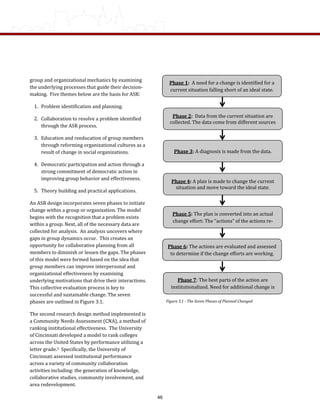
enumeration of the projects both from our legacy of 
plans and out of current work that can help us move 
toward achieving our shared waterfront vision. The 
projects are organized by four categories: recent 
achievements, emerging projects, projects that need 
a push, and longer term visions. The vision for the 
waterfront is embodied in the full range of projects. 
Issues Affecting D’Youville 
Redevelopment of the waterfront will improve 
aspects of nearby communities especially those along 
waterfront corridors such as Porter Ave. 
Improvements to infrastructure, access, 
wayfinding,local re‐investment, and ecotourism 
opportunities resulting from the waterfront plan will 
have indirect benefit to D’Youville college 
neighborhood. 
Reference 
Buffalo Waterfront Corridor Initiative. & Local 
Waterfront Redevelopment Project Draft. (2007).  
Available at:  
http://urbandesignproject.ap.buffalo.edu/projects/
wci/documents.htm 
 
Queen City Waterfront& Buffalo Water­
front Corridor Initiative 
100
Date 
2008 
Focus Area 
Buffalo's Olmstead Park System includes six major Parks, 
multiple parkways, circles and small spaces. The six major 
parks are 1) Delaware Park, 2) Riverside Park, 3) Front 
Park 4) MLK Park, 5) Cezanovia Park, 6) South Park 
Sponsoring Party/Author 
Buffalo Olmstead Parks Conservancy 
Other Participants 
University at Buffalo, Department of Urban and Regional 
Planning, City of Buffalo, County of Erie 
Summary 
The guiding principles for restoration and management 
are:  Protect, rehabilitate and "Brand" the system as a 
unique and historic landscape; Promote safe, diverse and 
sustainable use of the parks ; Expand the system to connect 
the parks throughout the city and the Niagara River 
Greenway; Involve local community partners to foster 
meaningful participation and help in development of the 
adjacent neighborhoods 
Issues Affecting D’Youville 
Parkways:  Redesign the bridge over the thruway with 
plantings and enlarged pedestrian walkways; Connect to 
shoreline trail along The Bank, an Olmsted designed circle 
adjacent to the Front Park, and Busti Avenue; Use Porter 
Avenue to connect to Symphony Circle, Front Park and 
LaSalle Park.  
Prospect Park : Consider renaming both sections of the 
park with the historic "Prospect park" name; Restore the X 
pathway pattern; Phase out Niagara Branch Library 
according to Erie County's library consolidation plan; 
Restore the park shelter building as a functioning park 
building; Provide traffic calming measures along Niagara 
Street to reconnect the two sides of the park. 
Reference 
Buffalo Olmsted Parks Conservancy (2008).  The Olmsted 
City. The Buffalo Olmsted Parks System: Plan for the 21st 
Century. 
Date 
2003 
Focus Area 
Cities of Buffalo and Lackawanna 
Sponsoring Party/Author 
US Forest Service, Dept. of Agriculture 
Other Participants 
USDA  Forest  Service  NE,  City  of  Buffalo,  Buff/
Lackawanna Urban Renewal Communities 
Summary 
The  Buffalo  Lackawanna  Urban  Ecosystem  Analysis 
is part of a larger effort in the Erie Niagara region to 
understand the value of the natural environment as 
“green infrastructure” and for communities to work 
together  on  regional  planning  issues.  One  major 
product  of  this  study  is  a  digital  map  of  the  area’s 
landcover,  a  “green  data  layer”,  which  allows  local 
communities  to  integrate  the  green  infrastructure 
into their planning. The green data layer shows that 
trees are a vital and valuable part of the infrastruc‐
ture in the Buffalo Lackawanna region.   
Issues Affecting D’Youville 
25% canopy layer for urban residential areas; green 
infrastructure valuation 
Reference 
Urban Ecosystem Analysis: Buffalo and Lackwanna. 
(2003). Retrieved from http://
www.americanforests.org/downloads/rea/
AF_Buffalo.pdf 
The Olmsted City: Plan for The 21st 
Century 
Urban Ecosystem Analysis 
 
 
101
Appendix BSummary of Campus­Community Planning Best Practices  
Institution1 City State  Sector 
Degree of Urbani­
zation Institution Size Best Practice2 
D'Youville College Buffalo NY Private City: Large 1,000 ‐ 4,999 ‐‐ 
Spelman College3 Atlanta GA Private City: Large 1,000 ‐ 4,999 
Area Redevelopment  Com‐
munity Involvement 
Canisius College Buffalo NY Private City: Large 1,000 ‐ 4,999 Employer Assisted Housing 
Xavier University of 
Louisiana 
New Orleans LA Private City: Midsize 1,000 ‐ 4,999 
Area Redevelopment 
Community Involvement 
Collaborative Studies 
LeMoyne College Syracuse NY Private City: Midsize 1,000 ‐ 4,999 Employer Assisted Housing 
Niagara University Niagara NY Private Suburb: Large 1,000 ‐ 4,999 Employer Assisted Housing 
Oberlin College3 Oberlin OH Private Suburb: Midsize 1,000 ‐ 4,999 
Sustainability: Transportation 
Planning 
University of Roch‐
ester 
Rochester NY Private City: Midsize 5,000 ‐ 9,999 
Employer Assisted Housing 
Area Redevelopment 
University of Scran‐
ton 
Scranton PA Private City: Small 5,000 ‐ 9,999 Employer Assisted Housing 
University of Illi‐
nois at Chicago 
Chicago IL Public City: Large 
20,000 and 
above 
Area Redevelopment 
Community Involvement 
University of Louis‐
ville 
Louisville KY Public City: Large 
20,000 and 
above 
Community Involvement 
Area Redevelopment 
SUNY at Buffalo Buffalo NY Public City: Large 
20,000 and 
above 
Employer Assisted Housing 
Community Involvement 
Collaborative Studies 
University of Akron 
Main Campus 
Akron OH Public City: Midsize 
20,000 and 
above 
Area Redevelopment 
Community Involvement 
University of Cin‐
cinnati‐Main Cam‐
pus 
Cincinnati OH Public City: Large 
20,000 and 
above 
Area Redevelopment 
Community Involvement 
Ohio State Univer‐
sity‐Main Campus 
Columbus OH Public City: Large 
20,000 and 
above 
Community Involvement 
Area Redevelopment 
Simon Fraser Col‐
lege3,4 
Vancouver, 
British Co‐
lumbia 
‐‐ ‐‐ ‐‐ ‐‐ 
Area Redevelopment   
Community Involvement 
See notes on following 
page. 
 
102
Appendix B Notes:   
1 Data was accessed through the Integrated Post‐Secondary Education Data System (IPEDS). 
2 Area Redevelopment Refers to efforts initiated by the campus for the purposes of revitalization, community enhancement,   
and/or campus expansion efforts.  Institutions act as partners in investment through this role. 
Community Involvement refers to initiatives intended to directly benefit the community.  Institutions generally serve as ser‐
vice or service providers in this role. 
Collaborative Studies indicates studies performed by the institution for educational or research purposes that also have a 
benefit to the community at large.   
This role could indicate service learning, or the institution's role as a community resource. 
3 College/University actively engaged in campus sustainability planning which by its nature has indirect community benefit 
where sustainability is lens through which institutions view  community involvement and outreach initiatives. 
4 College/ University is located outside of the continental United States. Consequently, institutional data could not be obtained 
from the IPEDS. 
103
Appendix C
Summary of University Assisted Housing Programs
UniversityYear EstablishedLenders / PartnersGeographic Reach# SalesDesired OutcomesNotes
Western New York
Canisius College2002
M&T Mortgage Corporation and 
Hunt Real Estate Corporation
Six Neighborhoods:
Delaware Council District
Masten Council District
Portion of North Council District
Parkside District
Hamlin Park District
Portion of Linwood‐Oxford District
12
Recruitment
Retention
Revitalization
Cited in Fannie Mae's publication about Employer Assisted 
Housing.  
The program provides 5 percent or $5,000 (whichever is 
less) for eligible areas, and 10 percent or $7,000 (whichever 
is less) for target areas.
Niagara UniversityUnknown
Center City, Inc.; City of Niagara 
Falls; St. Mary's Hospital; Memorial 
Hospital; Public Schools; and many 
local lenders
Faculty, Staff, possibly outside 
community members.
NA1
Recruitment
RetentionProvides home buyer educational services.
SUNY University at BuffaloUnknown
University Heights, outside South 
Campus
21Revitalization
Extended Reach
University of Rochester2008
City of Rochester; Advantage 
Federal Credit Union; and 
Canandaigua National Bank & 
Trust
Sector 4 (West Side)
Sector 6 (East Side)
14 buyers, 
147 inquiries
Revitalization
Known as the 3+3+3 program, the University partners with 
two other banks to provide up to $9,000 in loan assistance.
LeMoyne CollegeUnknown
Syracuse Neighborhood Initiative, 
Key Bank, Fleet Bank, and M&T 
Bank
Roughly 781 acres, boundaries 
include: Erie Boulevard to the north, 
East Genesee Street to the south, 
Croly Street to the west and the city 
line to the east.
Unknown
Recruitment
Retention
Revitalization
A 2001 survey conducted by Human Resource Management 
indicated that only 9 percent of employers in the United 
States offer an EAH.
Ohio State University1998
City of Columbus; Fannie Mae; 
Campus Partners; and Northside 
Community Development 
Corporation
Two Districts:
District A: Weinland Park 
neighborhood, and Central portion 
University District
District B: University District north 
Norwich Avenue, and Dennison 
Place neighborhood
74
Recruitment
Retention
Revitalization
University of CincinnatiUnknown
The Home Ownership Center of 
Greater Cincinnati, Inc.
Seven Neighborhoods:
Mt. Auburn 
Avondale
Clifton
Corryville
Clifton Heights
University Heights and 
Fairview Heights
Unknown
Recruitment
Retention
Revitalization
The program provides up to $2,500 for assistance with down 
payment.
University of ScrantonUnknown
Fannie Mae and Neighborhood 
Housing of Scranton
Eligible area is bounded on the east 
and west by Ash Street and Ridge 
Row and on the north and south by 
Jefferson Avenue and Nay Aug Park
UnknownRevitalization
St. Louis UniversityUnknownFannie Mae
West of Jefferson Avenue, south of 
Natural Bridge and east of 
Vandeventer to Delmar. 
South of Delmar, east of Pendleton, 
north of Olive, east of Boyle, north 
of Laclede, west of Sarah, north of 
Lindell, west of Compton. 
From Compton north of Dr. Martin 
Luther King Drive to Jefferson.
Unknown
Recruitment
Retention
Revitalization
St. Louis has expanded its program to make it available for 
Professional Students as well as faculty and staff.
Notes:
104
Appendix D
y = 0.0035x ‐ 120.2
R² = 0.2798
0
5
10
15
20
25
30
35
Sale Price ($/sqft)
Average Price by Month
Multi‐ Family Properties
y = 0.0068x ‐ 230.37
R² = 0.0809
0
20
40
60
80
100
120
Sale Price ($/sqft)
Average Price by Month
Single Family Properties
y = 0.0361x ‐ 1265.1
R² = 0.5761
0
20
40
60
80
100
120
140
160
180
200
Sale Price ($/sqft)
Average Price by Month
Condos
y = 0.0046x ‐ 166.14
R² = 0.2652
0
5
10
15
20
25
30
Sale Price ($/sqft)
Average Price by Month
Commercial Properties
y = 0.0032x ‐ 100.28
R² = 0.0655
0
10
20
30
40
50
60
70
Sale Price ($/sqft)
Average Price by Month
All Properties
Real estate trends in the neighborhood. (Census Tracts 69, 70 and 71.01)
Data Source: Buffalo Niagara Area Realtors (BNAR).
105
319 Connecticut Street     
8,000 sq. ft.
334 Connecticut Street 
7,000 sq. ft.
442 Connecticut Street   
3,500 sq. ft.
465Connecticut Street 
5,500 sq. ft. 
Appendix E
Opportunities  for Potential Development Along Connecticut Street  
106
Vilardo Printing  
326 Connecticut Street  
Golden Key Tavern  
367 Connecticut Street  
Phu Thai  
356 Connecticut Street 
Armory Restaurant   
311 Connecticut Street 
First Niagara Bank 
364 Connecticut Street  
Connecticut Street Anchors  
Wilson Farms 
601 Prospect/Connecticut 
Streets 
107
108

Bridging the Gap: Community Collaboration Between D’youville College and the West Side of Buffalo