Area: Rock magnetism
RemanentMagnetisation in Rocks
Ayush Chakrawarti
E-mail: ayushchakrawarti@gmail.com
Department of Geophysics
Banaras Hindu University, Varanasi, U.P.
Summary:
Rock magnetism is the study of the magnetic properties of rocks. Rock can be magnetized by
geomagnetic and external origin magnetic field. Orientation of domain and poles in rock depend upon
direction of geomagnetic field and very less affected by external magnetic field. Orientation of domain
frozen in rock, it is called magnetization of rock. Magnetisation in rock is directly depending upon
magnetic field. NRM is signature of presence of iron as an accessory mineral in rock and study of NRM
helps us understand geophysical properties of earth.
Introduction:
The magnetization that may be measured in rock specimens in absence of any external field is
called natural remanent magnetization (NRM). All rocks carry a NRM, which is often rather weak and
requires specific instrument to be measured. The NRM in rocks is due to the presence, usually as
accessory components, of magnetic minerals (the most common is magnetite, hematite and other iron
oxides).
When any rock exposed in a magnetic field then dipole (in paramagnetic and diamagnetic
material) or domain (in ferromagnetic, ferrimagnetic and antiferromagnetic material) of material
elongated in direction of external magnetic field and material is magnetized. In case of ferromagnetic
material, magnetic field is remanent after removing of external field this is called remanence of
magnetization. In the same way Rock is magnetized in the presence of earth’s magnetic field. However,
the Earth's field is not large, and this kind of remanence would be weak and easily overwritten by later
fields. A central part of rock magnetism is the study of magnetic remanence, both as natural remanent
magnetization (NRM) in rocks obtained from the field and remanence induced in the laboratory. Below
are listed the important natural remanences and some artificially induced kinds.
Thermoremanent magnetization (TRM)
Chemical (or crystallization) remanent magnetization (CRM)
Depositional remanent magnetization (DRM)
Isothermal remanent magnetization (IRM)
Other remanent magnetization
The NRM of a rock is generally the resultant of various magnetizations components acquired at
various times during its geologic history. Each rock acquire a NRM during the processes giving rise to its
formation; This NRM component is called the “primary” magnetization. The processes by which rocks
are magnetized are different for the diverse main rock types: igneous rocks, formed by consolidation of
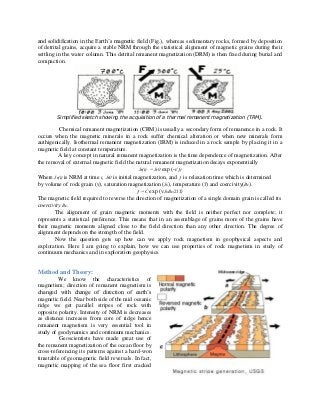
magma, acquire a stable NRM, which is called thermal remanent magnetization (TRM), during cooling
2.
and solidification inthe Earth’s magnetic field (Fig.), whereas sedimentary rocks, formed by deposition
of detrital grains, acquire a stable NRM through the statistical alignment of magnetic grains during their
settling in the water column. This detrital remanent magnetization (DRM) is then fixed during burial and
compaction.
Simplified sketch showing the acquisition of a thermal remanent magnetization (TRM).
Chemical remanent magnetization (CRM) is usually a secondary form of remanence in a rock. It
occurs when the magnetic minerals in a rock suffer chemical alteration or when new minerals form
authigenically. Isothermal remanent magnetization (IRM) is induced in a rock sample by placing it in a
magnetic field at constant temperature.
A key concept in natural remanent magnetization is the time dependence of magnetization. After
the removal of external magnetic field the natural remanent magnetization decays exponentially
Jr(t) = Jr0 exp (-t/ƒ)
Where Jr(t) is NRM at time t, Jr0 is initial magnetization, and ƒ is relaxation time which is determined
by volume of rock grain (v), saturation magnetization (Js), temperature (T) and coercivity(Bc).
ƒ = C exp (vJsBc/21T)
The magnetic field required to reverse the direction of magnetization of a single domain grain is called its
coercivity Bc.
The alignment of grain magnetic moments with the field is neither perfect nor complete; it
represents a statistical preference. This means that in an assemblage of grains more of the grains have
their magnetic moments aligned close to the field direction than any other direction. The degree of
alignment depends on the strength of the field.
Now the question gets up how can we apply rock magnetism in geophysical aspects and
exploration. Here I am going to explain, how we can use properties of rock magnetism in study of
continuum mechanics and in exploration geophysics.
Method and Theory:
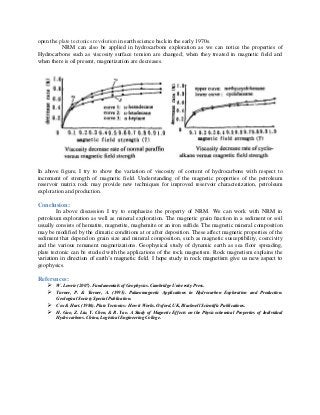
We know the characteristics of
magnetism; direction of remanent magnetism is
changed with change of direction of earth’s
magnetic field. Near both side of the mid oceanic
ridge we get parallel stripes of rock with
opposite polarity. Intensity of NRM is decreases
as distance increases from core of ridge hence
remanent magnetism is very essential tool in
study of geodynamics and continuum mechanics.
Geoscientists have made great use of
the remanent magnetization of the ocean floor by
cross-referencing its patterns against a hard-won
timetable of geomagnetic field reversals. In fact,
magnetic mapping of the sea floor first cracked
3.
open the platetectonics revolution in earth science back in the early 1970s.
NRM can also be applied in hydrocarbons exploration as we can notice the properties of
Hydrocarbons such as viscosity surface tension are changed; when they treated in magnetic field and
when there is oil present, magnetization are decreases.
In above figure, I try to show the variation of viscosity of content of hydrocarbons with respect to
increment of strength of magnetic field. Understanding of the magnetic properties of the petroleum
reservoir matrix rock may provide new techniques for improved reservoir characterization, petroleum
exploration and production.
Conclusion:
In above discussion I try to emphasize the property of NRM. We can work with NRM in
petroleum exploration as well as mineral exploration. The magnetic grain fraction in a sediment or soil
usually consists of hematite, magnetite, maghemite or an iron sulfide. The magnetic mineral composition
may be modified by the climatic conditions at or after deposition. These affect magnetic properties of the
sediment that depend on grain size and mineral composition, such as magnetic susceptibility, coercivity
and the various remanent magnetizations. Geophysical study of dynamic earth as sea floor spreading,
plate tectonic can be studied with the applications of the rock magnetism. Rock magnetism explains the
variation in direction of earth’s magnetic field. I hope study in rock magnetism give us new aspect to
geophysics.
References:
W. Lowrie (2007). Fundamentals of Geophysics. Cambridge University Press.
Turner, P. & Turner, A. (1995). Palaeomagnetic Applications in Hydrocarbon Exploration and Production.
Geological Society Special Publication.
Cox & Hart. (1986). Plate Tectonics: How it Works. Oxford, UK, Blackwell Scientific Publications.
H. Guo, Z. Liu, Y. Chen, & R. Yao. A Study of Magnetic Effects on the Physicochemical Properties of Individual
Hydrocarbons. China, Logistical Engineering College.