Do i Need a Cost System - Cloud-Based Costing with the Product Coster
It’s hard to know whether it’s the right time to invest in a cost system, but there are some indicators that deeper cost insights can provide the roadmap to increased profitability and business stability.
Do i Need a Cost System - Cloud-Based Costing with the Product Coster
1.
Do you needa (new) cost system?
From the moment your business opened its doors, there was some
method in place to calculate the cost to make the products you sell.
It was probably as simple as tabulating the receipts of materials
purchased to make it and then subtracting the money spent paying
people to build it.
But over time, as your product offerings grew, your manufacturing
processes became more complex, and your share of the market
increased - the process of calculating those product costs and
communicating the results got more complicated, too. It’s hard to
know whether it’s the right time to invest in a cost system, but there
are some indicators that deeper cost insights can provide the
roadmap to increased profitability and business stability.
2.
A few symptomsof a poor costing process
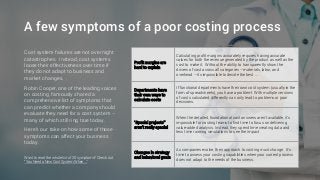
Cost system failures are not overnight
catastrophes. Instead, cost systems
loose their effectiveness over time if
they do not adapt to business and
market changes.
Robin Cooper, one of the leading voices
on costing, famously shared a
comprehensive list of symptoms that
can predict whether a company should
evaluate they need for a cost system –
many of which still ring true today.
Here’s our take on how some of those
symptoms can affect your business
today.
Want to read the whole list of 20 symptoms? Check out
“You Need a New Cost System When…”.
Profit margins are
hard to explain
Calculating profit margins accurately requires having accurate
values for both the revenue generated by the product as well as the
cost to make it. Without the ability to transparently show the
drivers of cost across all categories – materials, labor, and
overhead – its impossible to decide the best …
Departments have
their own ways to
calculate costs
If functional departments have their own cost system (usually in the
form of spreadsheets), you have a problem! With multiple versions
of costs calculated differently can only lead to problems or poor
decisions.
“Special projects”
aren’t really special
When the detailed, foundational cost answers aren’t available, it’s
impossible for costing teams to find time to focus on delivering
value-added analysis. Instead, they spend time creating data and
less time running simulations to see the impact
Changes in strategy
and behavioral goals
As companies evolve, their approach to costing must change. It’s
time to assess your costing capabilities when your current process
does not adapt to the needs of the business.
3.
So how doI know if the Product Coster is the
right cost system for us?
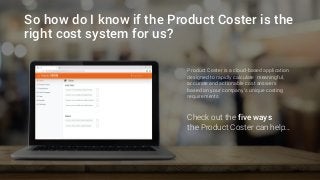
Product Coster is a cloud-based application
designed to rapidly calculate meaningful,
accurate and actionable cost answers
based on your company’s unique costing
requirements.
Check out the five ways
the Product Coster can help…
4.
You’re struggling toaccurately calculate
detailed product costs in a meaningful way.
Define your own attributes
Centralized, rules-based logic
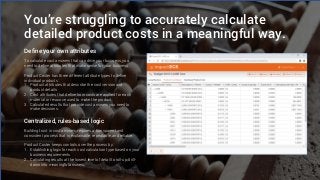
To calculate cost answers that can drive your business, you
need to define attributes that make sense for your business.
Product Coster has three different attribute types to define
individual products:
1. Product attributes that describe the cost version and
product details
2. Cost attributes that define how costs are applied for each
material or resource used to make the product
3. Calculated results that provide cost answers you need to
make decisions.
Building trust in cost answers requires a transparent and
consistent process that is explainable, repeatable, and reliable.
Product Coster keeps controls over the process by:
1. Establishing logic for each cost calculation type based on your
business requirements.
2. Calculating results at the lowest level of detail to roll-up/drill-
down into meaningful answers.
5.
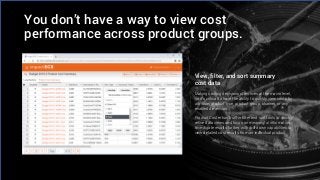
You don’t havea way to view cost
performance across product groups.
View, filter, and sort summary
cost data
Making costing decisions often lives at the macro level,
so it’s critical to have the ability to quickly view costs by
attribute, product type, product group, channel, or any
enabled dimension.
Product Coster has built-in filter and sort tools to quickly
refine data views and focus on meaningful information.
Investigate results further with drill-down capabilities to
view detailed cost results from an individual product.
6.
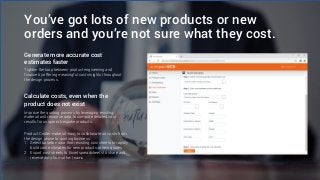
You’ve got lotsof new products or new
orders and you’re not sure what they cost.
Generate more accurate cost
estimates faster
Tighten the loop between product engineering and
finance by offering meaningful cost insights throughout
the design process.
Calculate costs, even when the
product does not exist
Improve the quoting process by leveraging existing
material and resource data to compute detailed cost
results for unique or bespoke products.
Product Coster makes it easy to collaborate on costs from
the design phase to quoting business:
1. Select baseline data from existing cost sheets to rapidly
build cost estimates for new products or new quotes
2. Export cost sheets to Excel spreadsheets to share and
receive data from other teams
7.
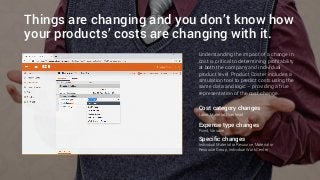
Things are changingand you don’t know how
your products’ costs are changing with it.
Cost category changes
Labor, Material, Overhead
Expense type changes
Fixed, Variable
Specific changes
Individual Material or Resource, Material or
Resource Group, Individual Work Center
Understanding the impact of a change in
cost is critical to determining profitability
at both the company and individual
product level. Product Coster includes a
simulation tool to predict costs using the
same data and logic – providing a true
representation of the cost change.
8.
You need away to collect, connect and
maintain relevant cost data.
Data
Some companies have data everywhere, others are just starting on the
data journey. The Product Coster uses a core set of information about the
materials, resources, processes, and business requirements to generate
cost sheets, run simulations, create estimates and share results.
Typical Product Coster Data sets: Cost Center, Budget Hours, General
Ledger Spending, Machine Efficiencies, Labor Rates, Overhead Spending
Rates, Material Master Data, BOM Data
Technology
Undergoing a digital transformation? By leveraging cloud-based solutions,
you can expand the reach of relevant cost information to empower and
inspire decisions that add value.
1. Eliminate spreadsheets from cost analysis process
2. Integrate with existing ERP, financial and data systems



![[Infographic] 4 Problems with Using Excel for Analytics](https://cdn.slidesharecdn.com/ss_thumbnails/infographic4problemsexcel3csoftware-160618205402-thumbnail.jpg?width=640&height=640&fit=bounds)


