Sweet Potato
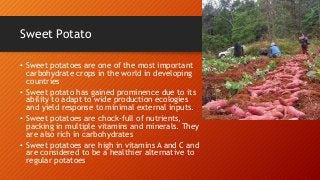
• Sweetpotatoes are one of the most important
carbohydrate crops in the world in developing
countries
• Sweet potato has gained prominence due to its
ability to adapt to wide production ecologies
and yield response to minimal external inputs.
• Sweet potatoes are chock-full of nutrients,
packing in multiple vitamins and minerals. They
are also rich in carbohydrates
• Sweet potatoes are high in vitamins A and C and
are considered to be a healthier alternative to
regular potatoes
3.
Sweet Potato Producers
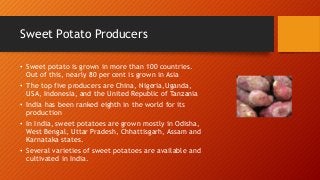
•Sweet potato is grown in more than 100 countries.
Out of this, nearly 80 per cent is grown in Asia
• The top five producers are China, Nigeria,Uganda,
USA, Indonesia, and the United Republic of Tanzania
• India has been ranked eighth in the world for its
production
• In India, sweet potatoes are grown mostly in Odisha,
West Bengal, Uttar Pradesh, Chhattisgarh, Assam and
Karnataka states.
• Several varieties of sweet potatoes are available and
cultivated in India.
4.
Sweet Potato Importers
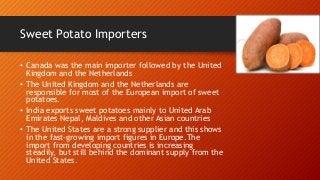
•Canada was the main importer followed by the United
Kingdom and the Netherlands
• The United Kingdom and the Netherlands are
responsible for most of the European import of sweet
potatoes.
• India exports sweet potatoes mainly to United Arab
Emirates Nepal, Maldives and other Asian countries
• The United States are a strong supplier and this shows
in the fast-growing import figures in Europe.The
import from developing countries is increasing
steadily, but still behind the dominant supply from the
United States.
5.
About Buyers
• Supermarketsfacilitate the marketing of
sweet potatoes with cooking suggestions and
recipes. Popular dishes include sweet potato
fries, soup, mashed potato and even toast.
• Exporters from the United States have a
major share of the supply to Europe. They
have invested in varieties, quality storage
and logistical processes, and are able to
export throughout the year.
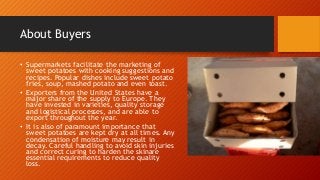
• It is also of paramount importance that
sweet potatoes are kept dry at all times. Any
condensation of moisture may result in
decay. Careful handling to avoid skin injuries
and correct curing to harden the skinare
essential requirements to reduce quality
loss.
6.
Minimise pesticides Levels(MRL)
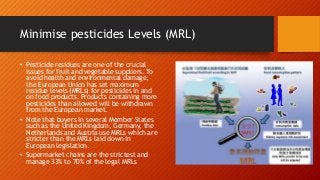
• Pesticide residues are one of the crucial
issues for fruit and vegetable suppliers. To
avoid health and environmental damage,
the European Union has set maximum
residue levels (MRLs) for pesticides in and
on food products. Products containing more
pesticides than allowed will be withdrawn
from the European market.
• Note that buyers in several Member States
such as the United Kingdom, Germany, the
Netherlands and Austria use MRLs which are
stricter than the MRLs laid down in
European legislation.
• Supermarket chains are the strictest and
manage 33% to 70% of the legal MRLs
7.
DATA BASE -World Trade Information
• Primary Information Services offer World Trade
Information data bases on Sweet Potato
• Data includes production & market information
covering presentations on Global Scenario
• Questions & Feed back on this presentation are
Welcome
• mailto:primaryinfo@gmail.com