The Lean Startup#leanstartupTechStars EditionEric Ries (@ericries)http://StartupLessonsLearned.blogspot.com
Most Startups Fail
Most Startups Fail
Most Startups Fail
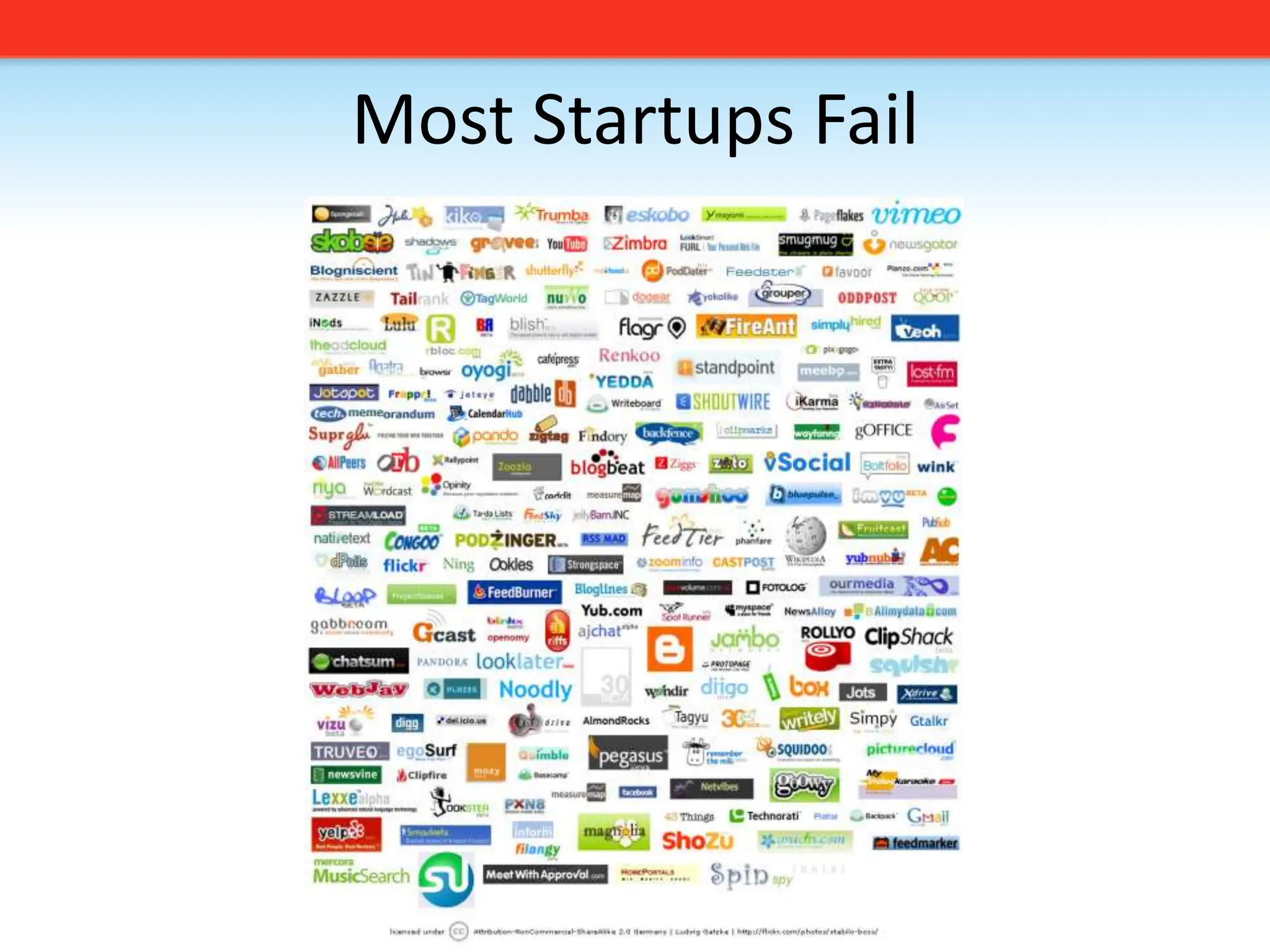
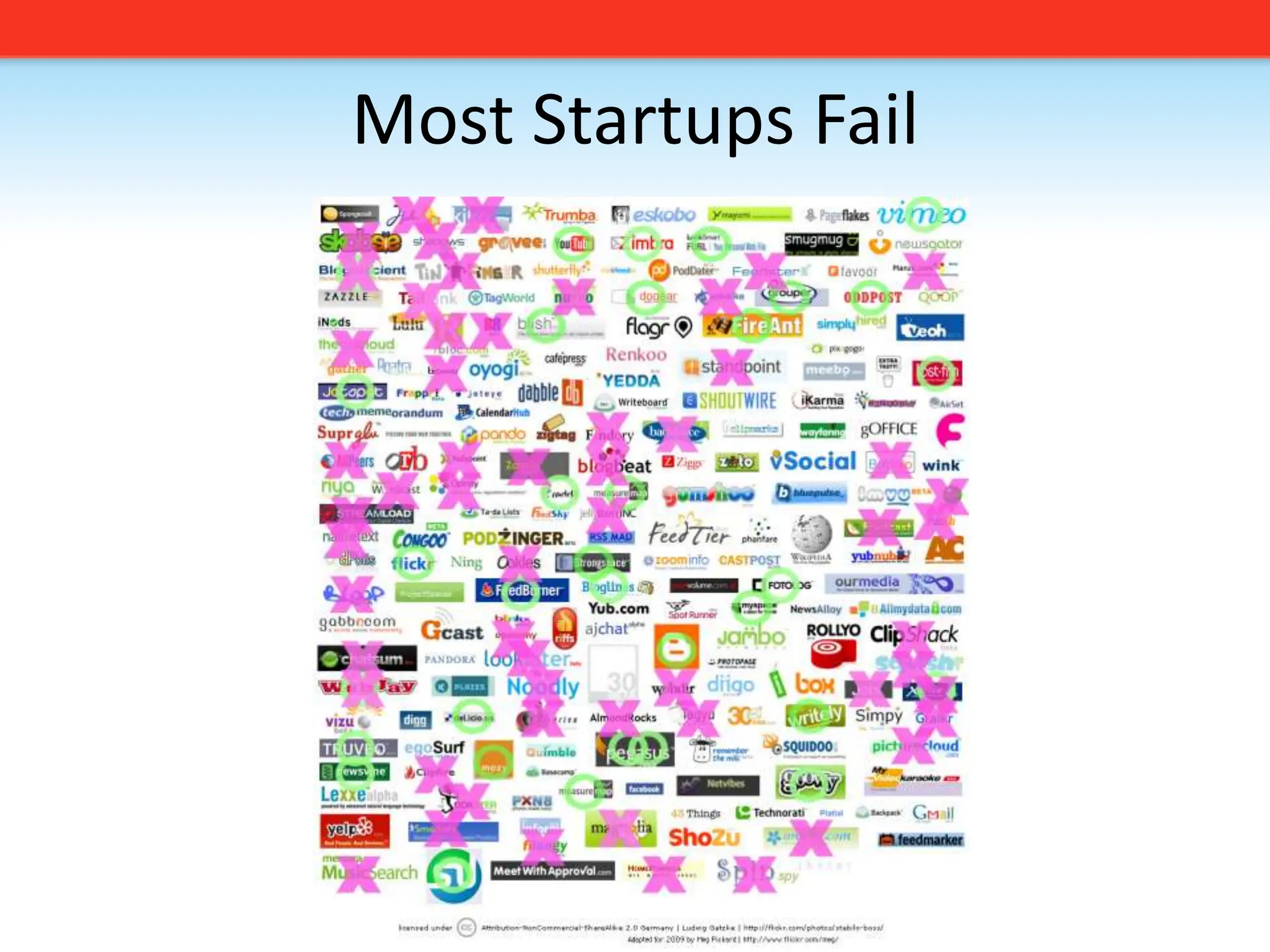
Most Startups FailBut it doesn’t have to be that way. We can do better. This talk is about how.
What is a startup?A startup is a human institution designed to deliver a new product or service under conditions of extreme uncertainty. Nothing to do with size of company, sector of the economy, or industry
Product / Market Fit“Do whatever is required to get to product/market fit. Including:changing out people,rewriting your product,moving into a different market,telling customers no when you don’t want to,telling customers yes when you don’t want to,raising that fourth round of highly dilutive venture capital—whatever is required.”— Marc Andreessenhttp://blog.pmarca.com/2007/06/the-pmarca-gu-2.html
The PivotWhat do successful startups have in common?They started out as digital cash for PDAs, but evolved into online payments for eBay.They started building BASIC interpreters, but evolved into the world's largest operating systems monopoly.They were shocked to discover their online games company was actually a photo-sharing site.Pivot: change directions but stay grounded in what we’ve learned.http://startuplessonslearned.blogspot.com/2009/06/pivot-dont-jump-to-new-vision.html
Speed Winsif we can reduce the time between major iterationswe can increase our odds of success
A Tale of Two Startups
Startup #1
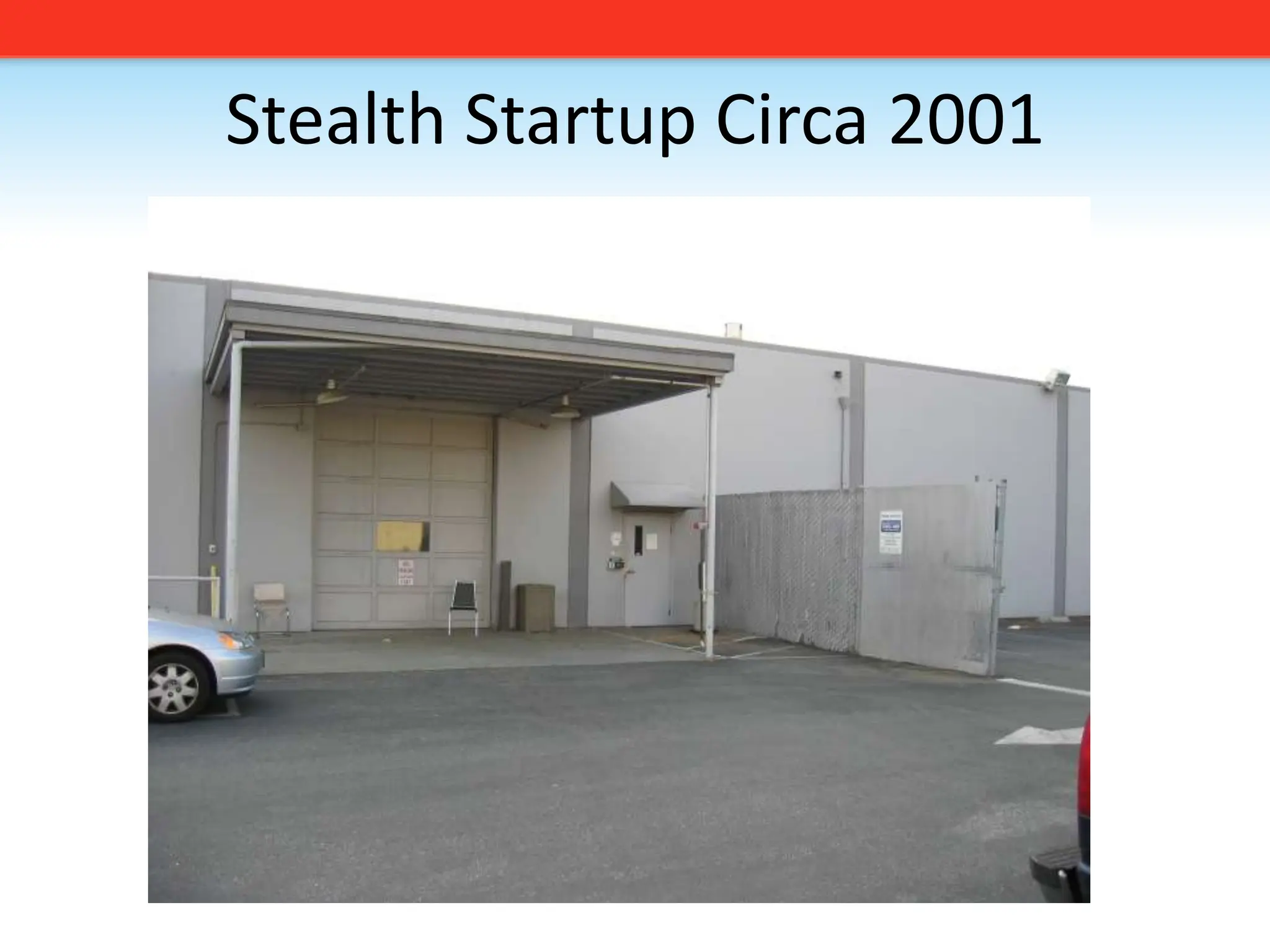
Stealth Startup Circa 2001
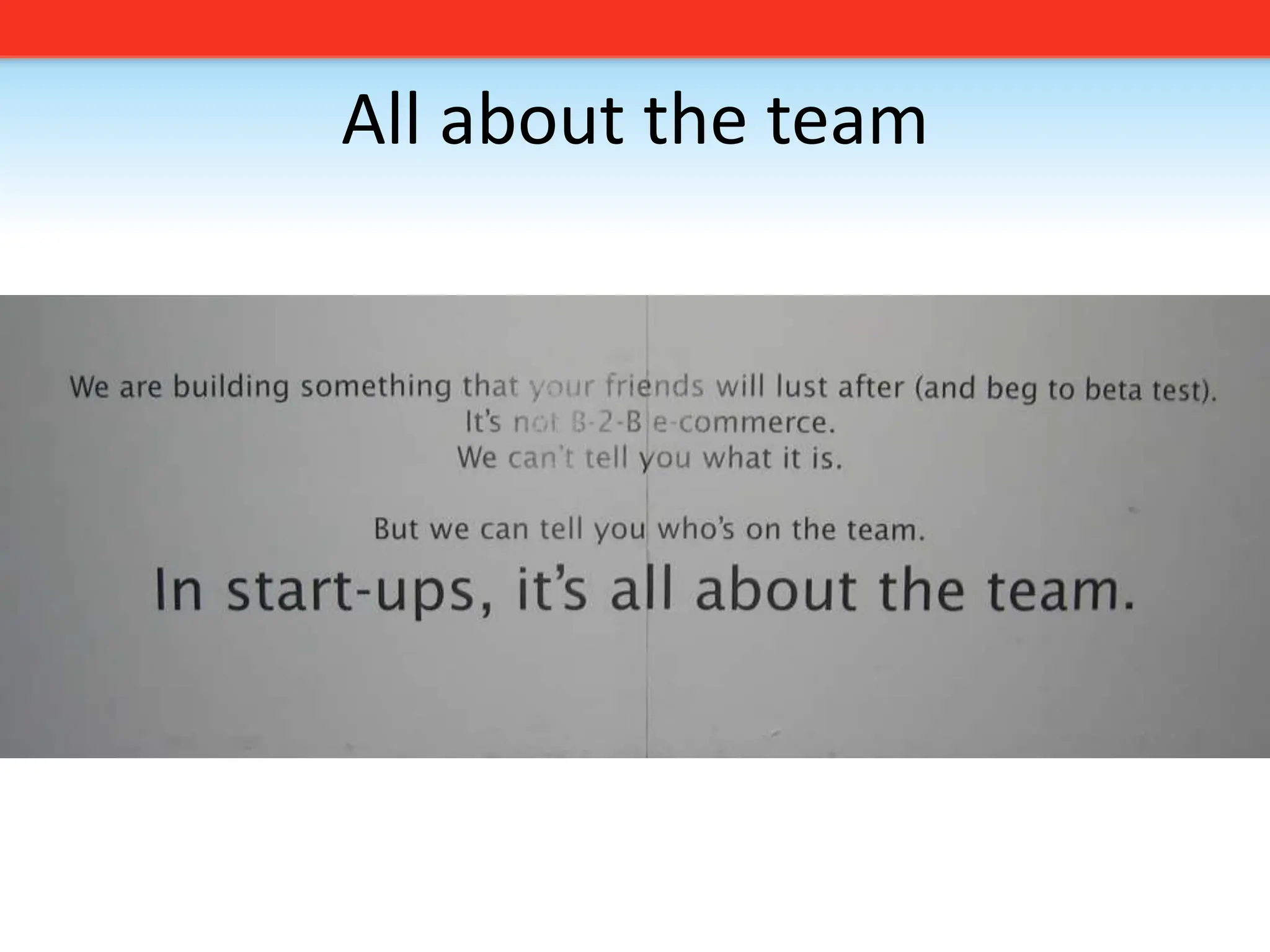
All about the team
A good plan?Start a company with a compelling long-term vision. Raise plenty of capital.Hire the absolute best and the brightest.Hire an experienced management team with tons of startup experience.Focus on quality. Build a world-class technology platform.Build buzz in the press and blogosphere.
Achieving FailureCompany failed utterly, $40MM and five years of pain.Crippled by “shadow beliefs” that destroyed the effort of all those smart people.
Shadow Belief #1We know what customers want.
Shadow Belief #2We can accurately predict the future.
Shadow Belief #3Advancing the plan is progress.
A good plan?Start a company with a compelling long-term vision. Raise plenty of capital.Hire the absolute best and the brightest.Hire an experienced management team with tons of startup experience.Focus on quality. Build a world-class technology platform.Build buzz in the press and blogosphere.
Startup #2
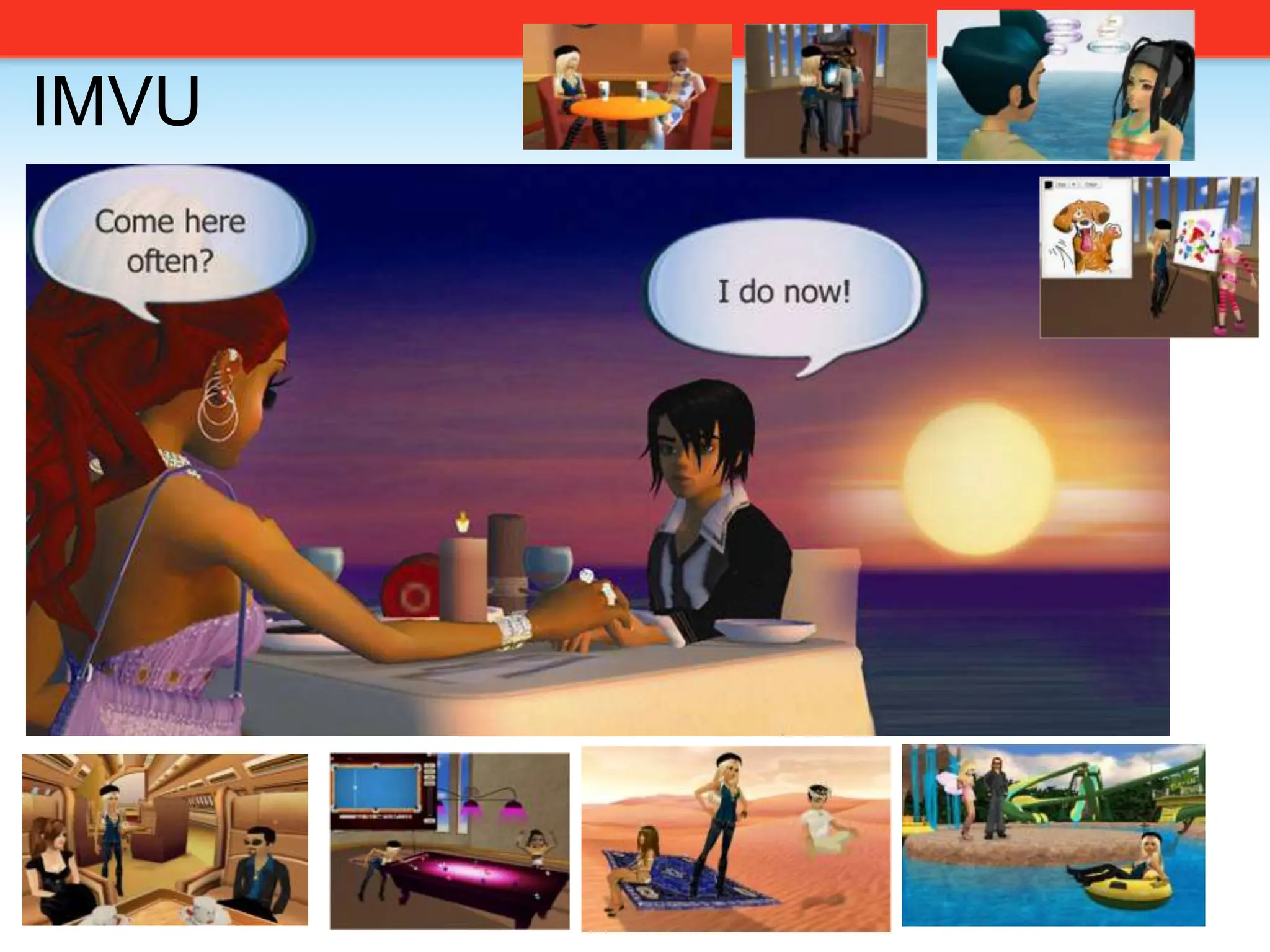
IMVU 
IMVU 
New planShipped in six months – a horribly buggy beta productCharged from day oneShipped multiple times a day (by 2008, on average 50 times a day)No PR, no launchResults: 2007 revenues of $10MM
Lean Startups Go FasterCommodity technology stack, highly leveraged (free/open source, user-generated content, SEM).Customer development – find out what customers want before you build it. Agile (lean) product development – but tuned to the startup condition.
Commodity technology stackLeverage = for each ounce of effort you invest in your product, you take advantage of the efforts of thousands or millions of others.It’s easy to see how high-leverage technology is driving costs down.More important is its impact on speed.Time to bring a new product to market is falling rapidly.
Customer DevelopmentContinuous cycle of customer interaction
Rapid hypothesis testing about market, pricing, customers, …
Extreme low cost, low burn, tight focus
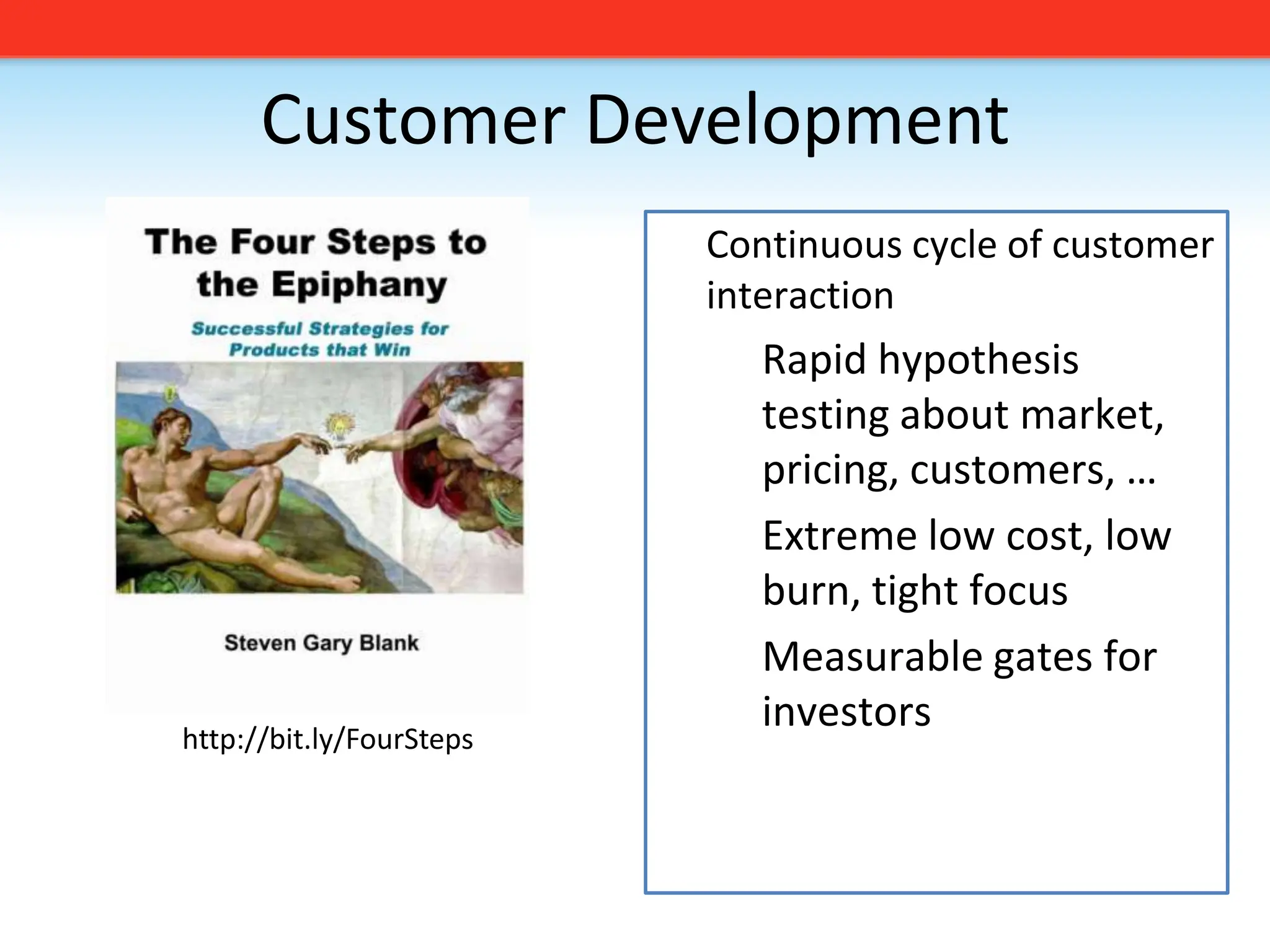
Measurable gates for investorshttp://bit.ly/FourSteps
Agile Product Development(A tale of two startups, revisited)Principles drawn from Lean Manufacturing and Toyota Production System
These examples are drawn from software startups, but increasingly:
All products require software
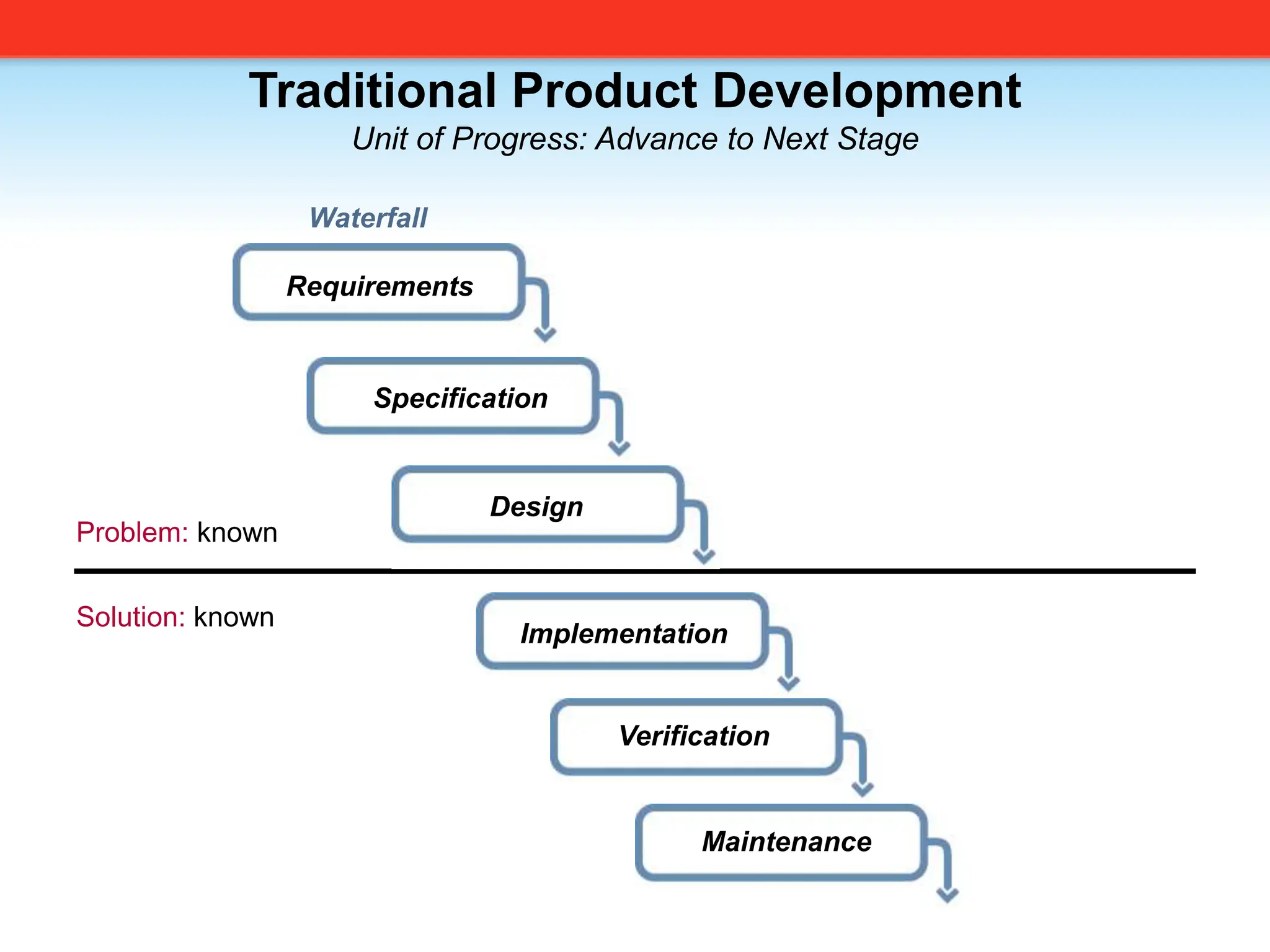
All companies are operating in a startup-like environment of extreme uncertaintyTraditional Product DevelopmentUnit of Progress: Advance to Next StageWaterfallRequirementsSpecificationDesignProblem: knownSolution: knownImplementationVerificationMaintenance
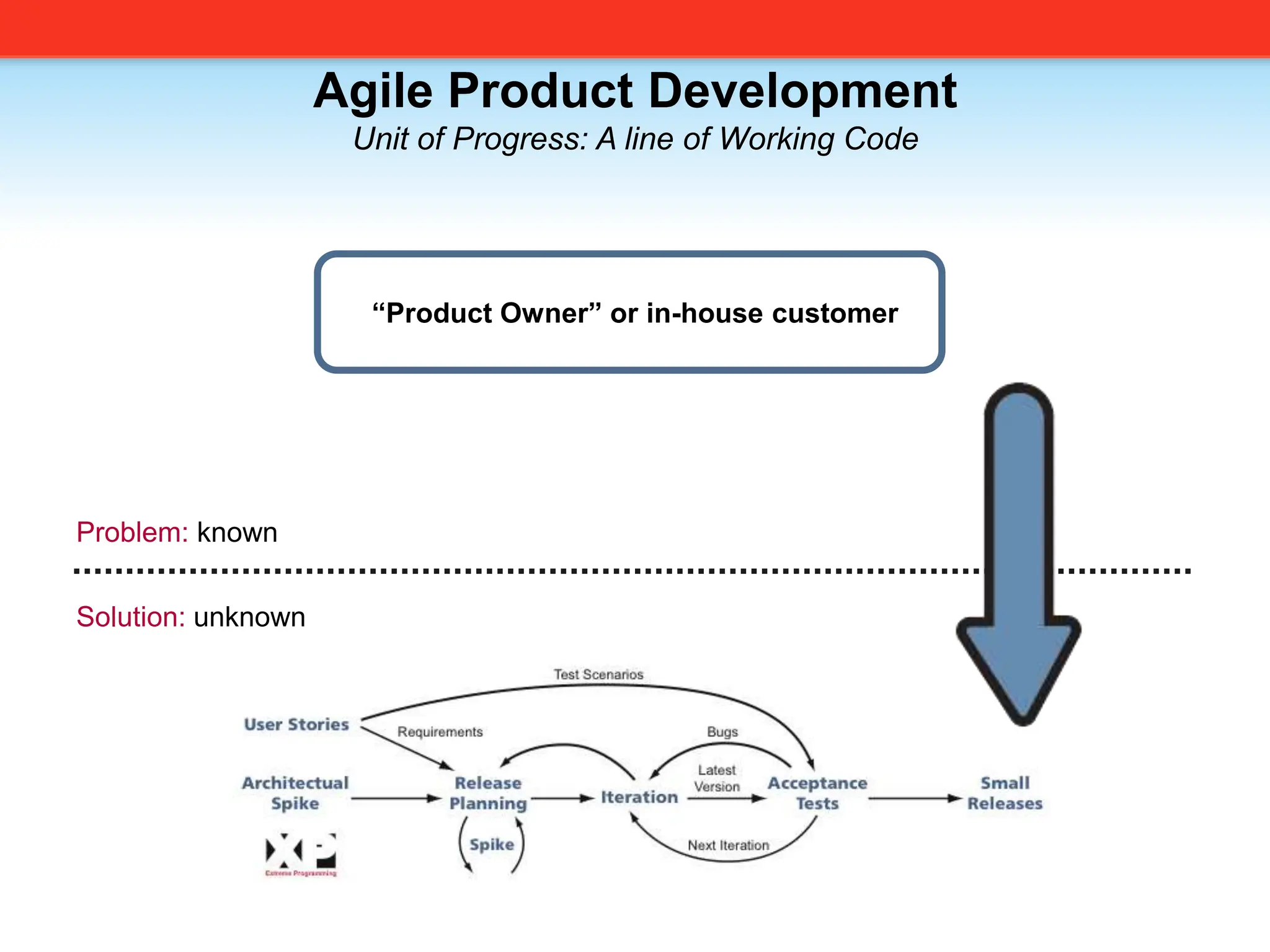
Agile Product DevelopmentUnit of Progress: A line of Working Code“Product Owner” or in-house customerProblem: knownSolution: unknown
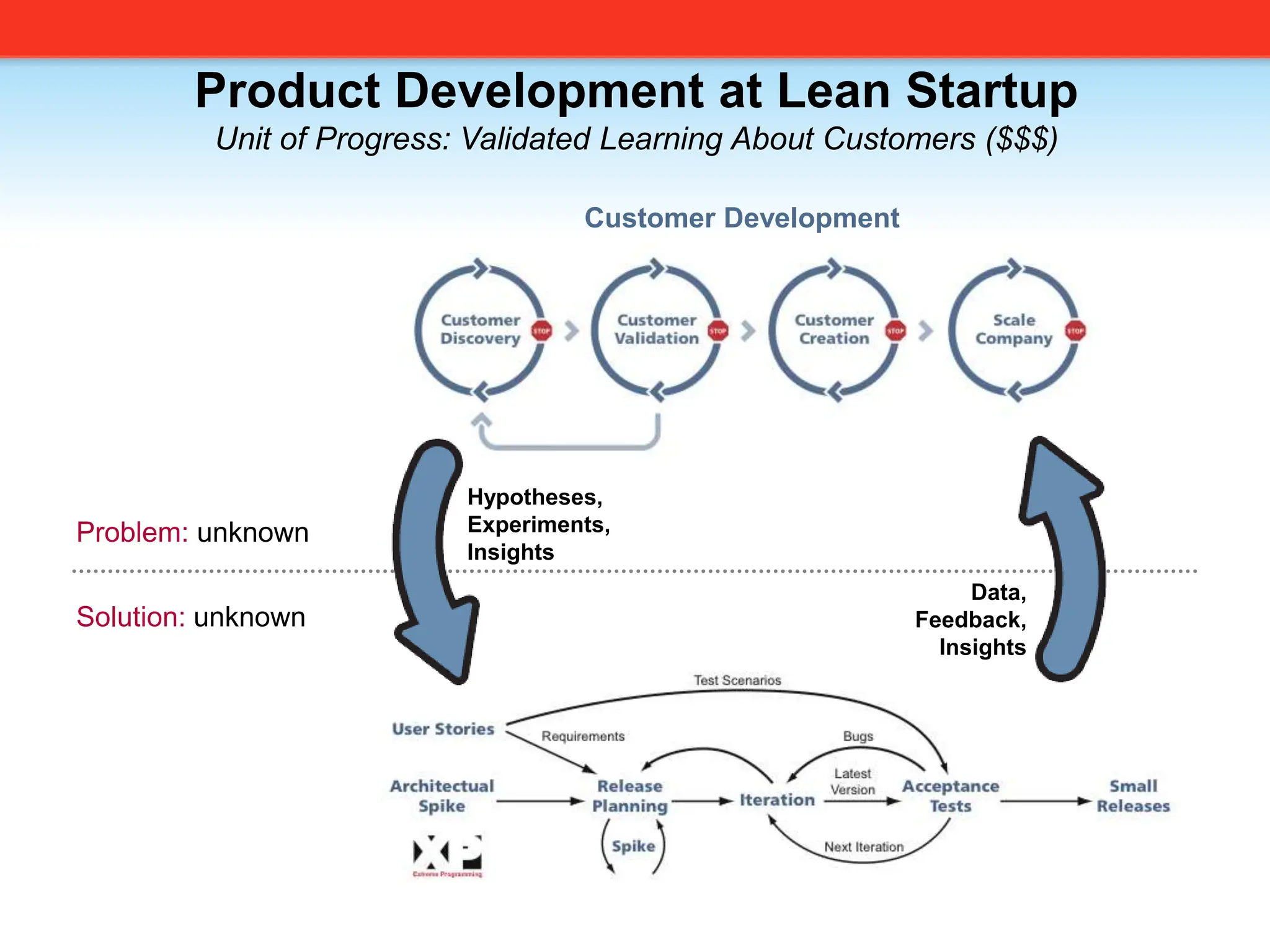
Product Development at Lean StartupUnit of Progress: Validated Learning About Customers ($$$)Customer DevelopmentHypotheses,Experiments,InsightsProblem: unknownData,Feedback,InsightsSolution: unknown
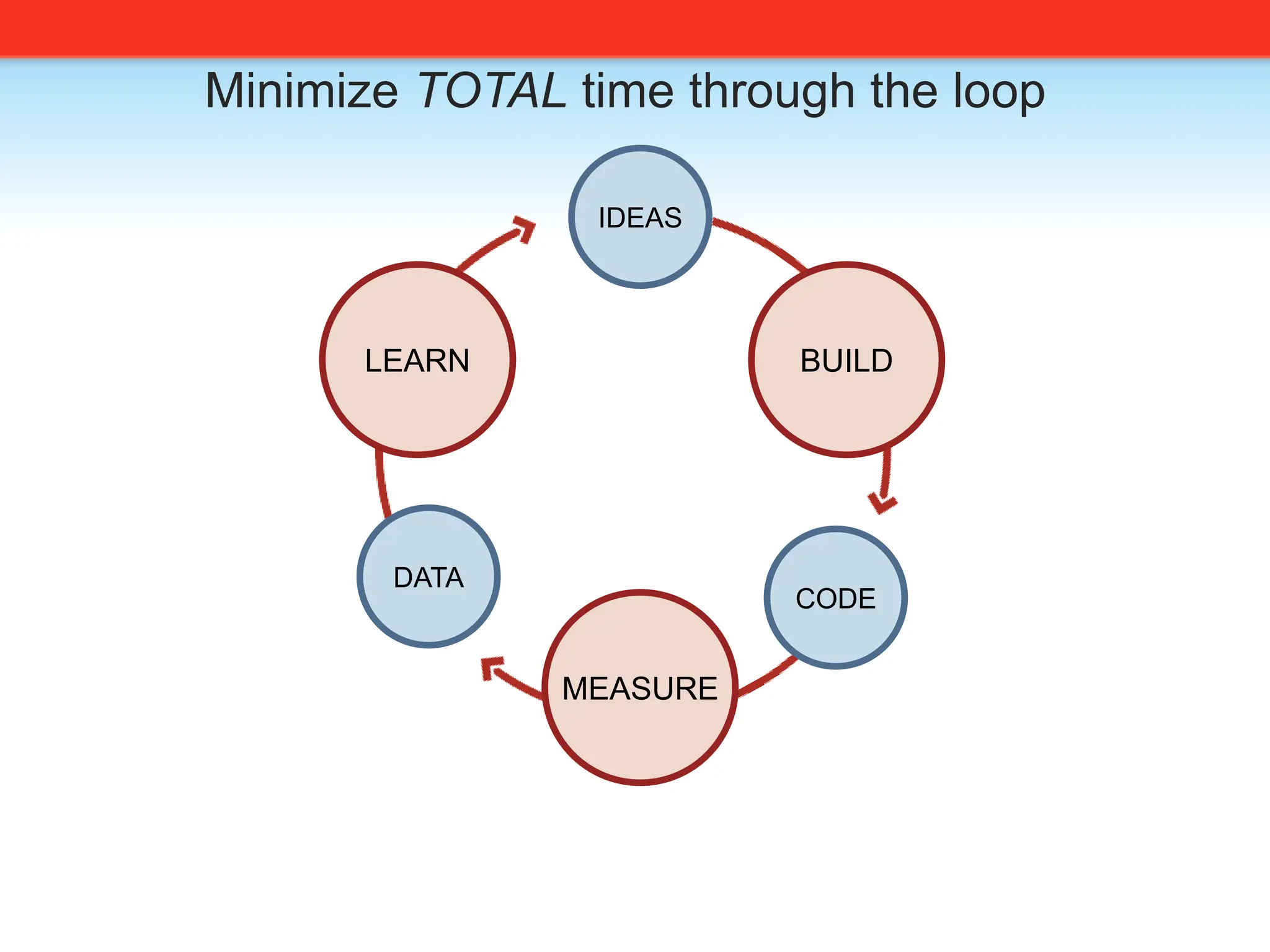
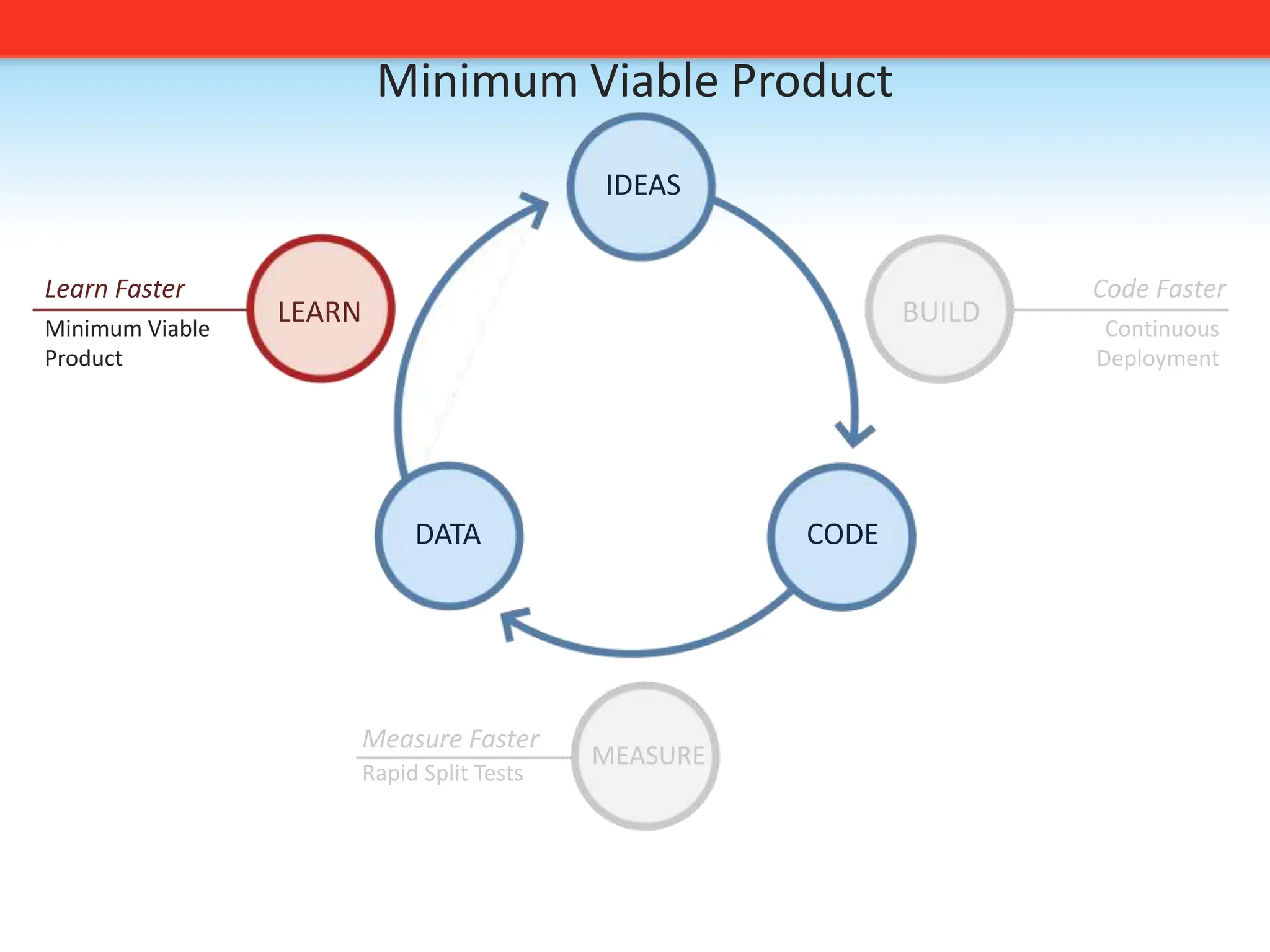
Minimize TOTAL time through the loopIDEASLEARNBUILDDATACODEMEASURE
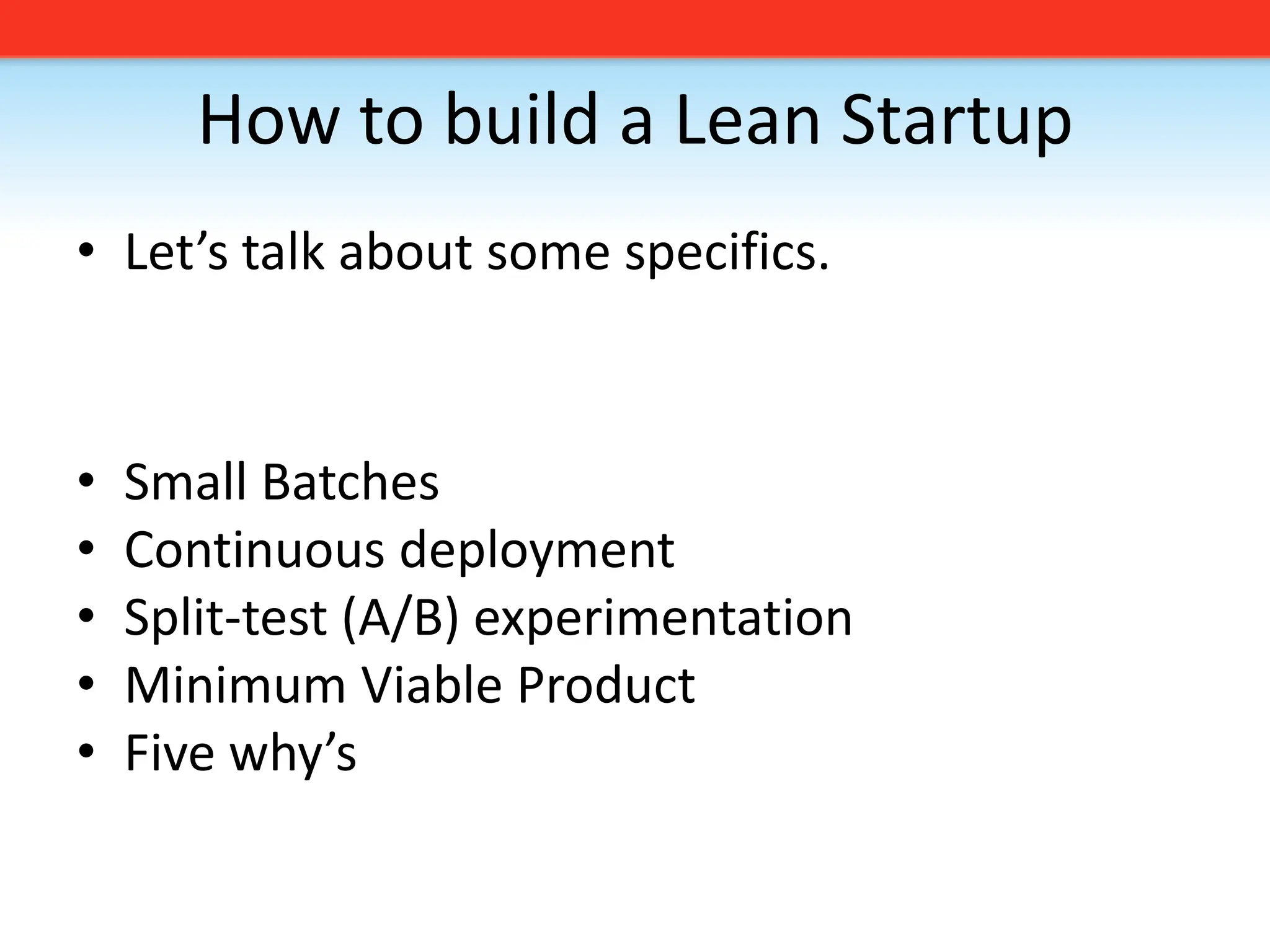
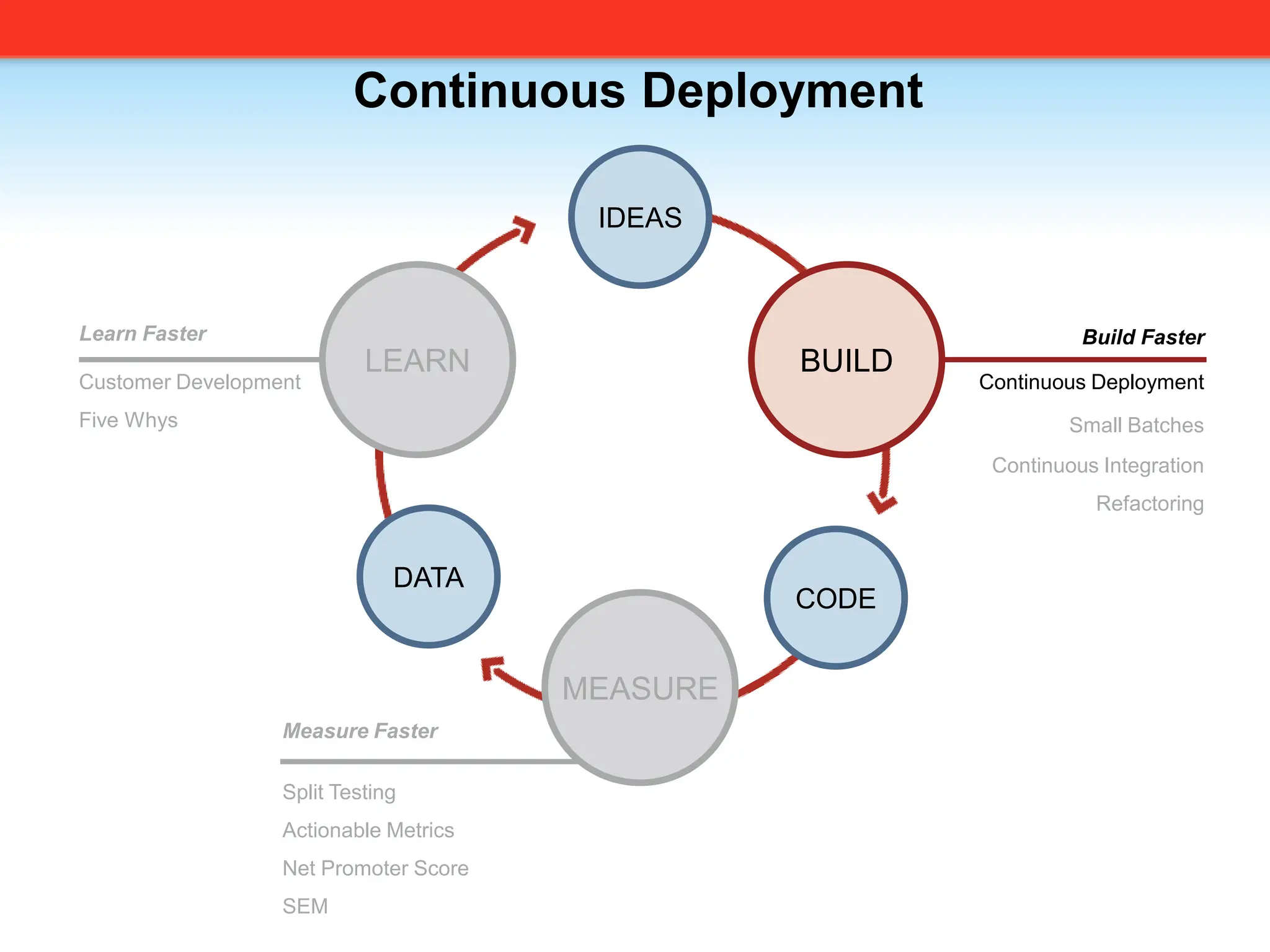
How to build a Lean StartupLet’s talk about some specifics. Small BatchesContinuous deploymentSplit-test (A/B) experimentationMinimum Viable ProductFive why’s
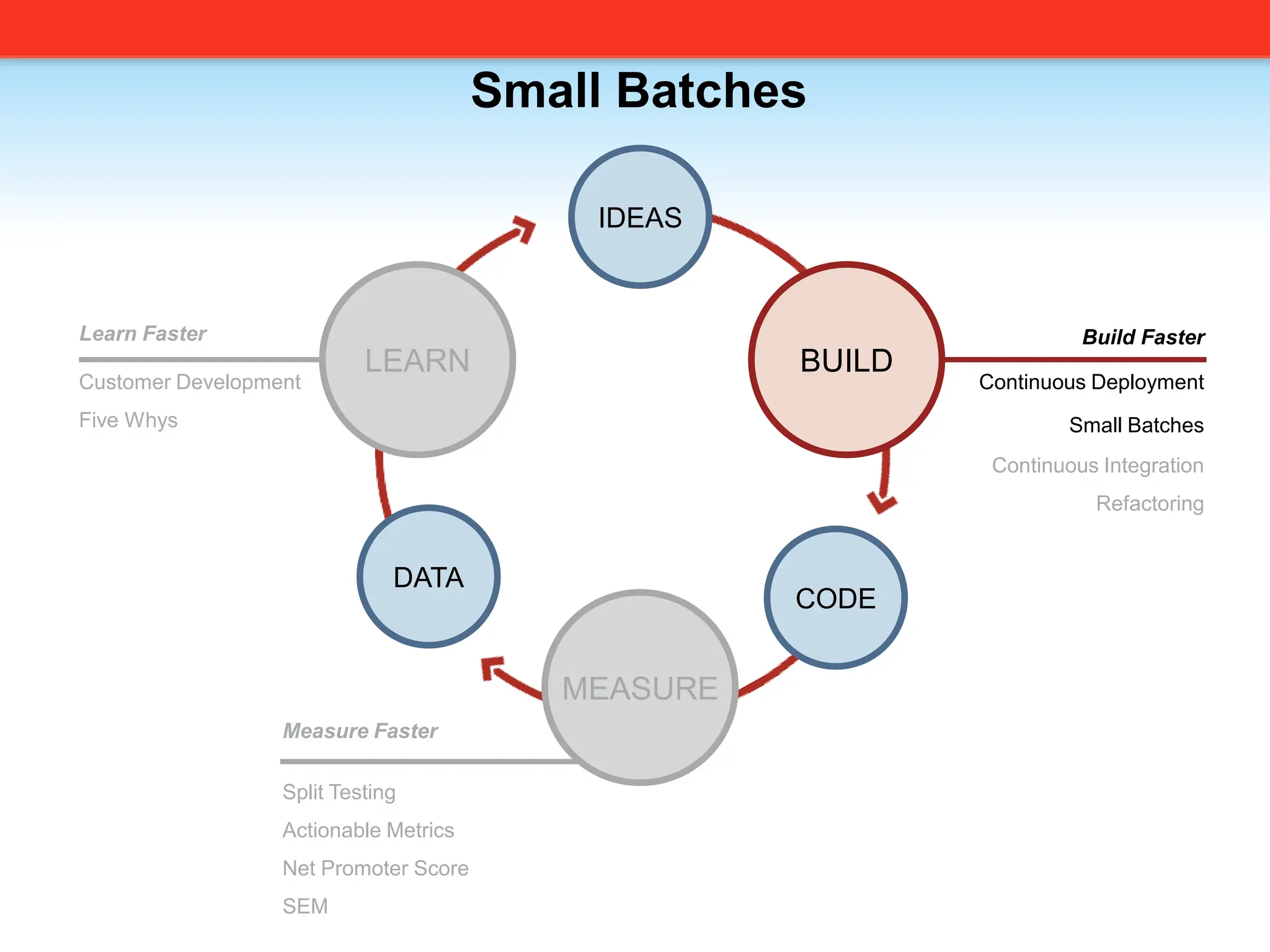
Small BatchesIDEASLEARNBUILDLearn FasterCustomer DevelopmentFive WhysBuild FasterContinuous DeploymentSmall BatchesContinuous IntegrationRefactoringDATACODEMEASUREMeasure FasterSplit TestingActionable MetricsNet Promoter ScoreSEM
Benefits of Small BatchesFaster feedbackProblems are instantly localizedReduce riskReduce overhead
Continuous DeploymentIDEASLEARNBUILDLearn FasterCustomer DevelopmentFive WhysBuild FasterContinuous DeploymentSmall BatchesContinuous IntegrationRefactoringDATACODEMEASUREMeasure FasterSplit TestingActionable MetricsNet Promoter ScoreSEM
Continuous DeploymentDeploy new software quickly
At IMVU time from check-in to production = 20 minutes
Tell a good change from a bad change (quickly)
Revert a bad change quickly
And “shut down the line”
Work in small batches
At IMVU, a large batch = 3 days worth of work
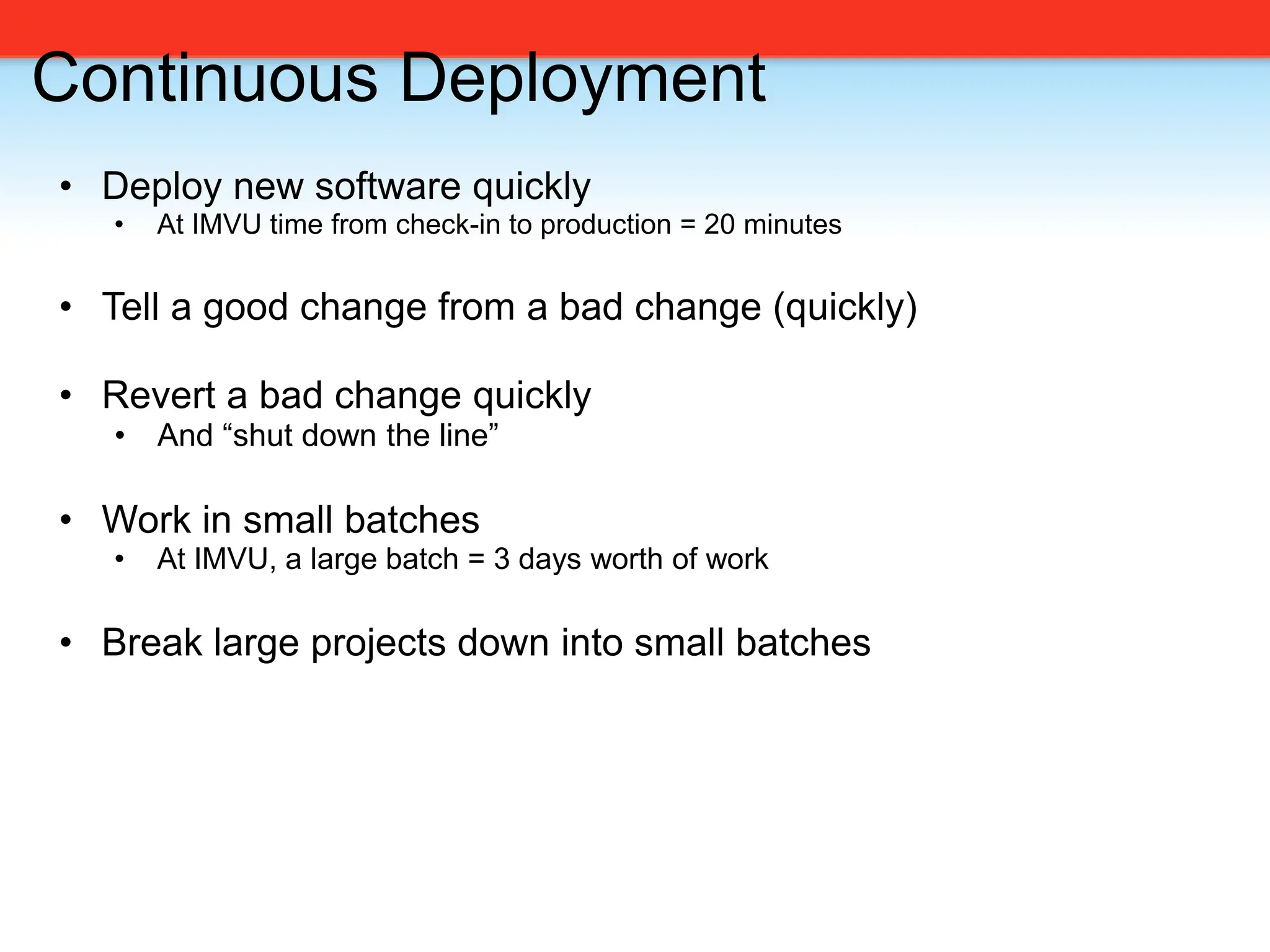
Break large projects down into small batchesCluster Immune SystemWhat it looks like to ship one piece of code to production:Run tests locally (SimpleTest, Selenium)
Everyone has a complete sandbox
Continuous Integration Server (BuildBot)
All tests must pass or “shut down the line”
Automatic feedback if the team is going too fast
Incremental deploy
Monitor cluster and business metrics in real-time

2009 08 19 The Lean Startup TechStars Edition

  • 1.
    The Lean Startup#leanstartupTechStarsEditionEric Ries (@ericries)http://StartupLessonsLearned.blogspot.com
  • 2.
  • 3.
  • 4.
  • 5.
    Most Startups FailButit doesn’t have to be that way. We can do better. This talk is about how.
  • 6.
    What is astartup?A startup is a human institution designed to deliver a new product or service under conditions of extreme uncertainty. Nothing to do with size of company, sector of the economy, or industry
  • 7.
    Product / MarketFit“Do whatever is required to get to product/market fit. Including:changing out people,rewriting your product,moving into a different market,telling customers no when you don’t want to,telling customers yes when you don’t want to,raising that fourth round of highly dilutive venture capital—whatever is required.”— Marc Andreessenhttp://blog.pmarca.com/2007/06/the-pmarca-gu-2.html
  • 8.
    The PivotWhat dosuccessful startups have in common?They started out as digital cash for PDAs, but evolved into online payments for eBay.They started building BASIC interpreters, but evolved into the world's largest operating systems monopoly.They were shocked to discover their online games company was actually a photo-sharing site.Pivot: change directions but stay grounded in what we’ve learned.http://startuplessonslearned.blogspot.com/2009/06/pivot-dont-jump-to-new-vision.html
  • 9.
    Speed Winsif wecan reduce the time between major iterationswe can increase our odds of success
  • 10.
    A Tale ofTwo Startups
  • 11.
  • 12.
  • 13.
  • 14.
    A good plan?Starta company with a compelling long-term vision. Raise plenty of capital.Hire the absolute best and the brightest.Hire an experienced management team with tons of startup experience.Focus on quality. Build a world-class technology platform.Build buzz in the press and blogosphere.
  • 15.
    Achieving FailureCompany failedutterly, $40MM and five years of pain.Crippled by “shadow beliefs” that destroyed the effort of all those smart people.
  • 16.
    Shadow Belief #1Weknow what customers want.
  • 17.
    Shadow Belief #2Wecan accurately predict the future.
  • 18.
    Shadow Belief #3Advancingthe plan is progress.
  • 19.
    A good plan?Starta company with a compelling long-term vision. Raise plenty of capital.Hire the absolute best and the brightest.Hire an experienced management team with tons of startup experience.Focus on quality. Build a world-class technology platform.Build buzz in the press and blogosphere.
  • 20.
  • 21.
  • 22.
  • 23.
    New planShipped insix months – a horribly buggy beta productCharged from day oneShipped multiple times a day (by 2008, on average 50 times a day)No PR, no launchResults: 2007 revenues of $10MM
  • 24.
    Lean Startups GoFasterCommodity technology stack, highly leveraged (free/open source, user-generated content, SEM).Customer development – find out what customers want before you build it. Agile (lean) product development – but tuned to the startup condition.
  • 25.
    Commodity technology stackLeverage= for each ounce of effort you invest in your product, you take advantage of the efforts of thousands or millions of others.It’s easy to see how high-leverage technology is driving costs down.More important is its impact on speed.Time to bring a new product to market is falling rapidly.
  • 26.
  • 27.
    Rapid hypothesis testingabout market, pricing, customers, …
  • 28.
    Extreme low cost,low burn, tight focus
  • 29.
    Measurable gates forinvestorshttp://bit.ly/FourSteps
  • 30.
    Agile Product Development(Atale of two startups, revisited)Principles drawn from Lean Manufacturing and Toyota Production System
  • 31.
    These examples aredrawn from software startups, but increasingly:
  • 32.
  • 33.
    All companies areoperating in a startup-like environment of extreme uncertaintyTraditional Product DevelopmentUnit of Progress: Advance to Next StageWaterfallRequirementsSpecificationDesignProblem: knownSolution: knownImplementationVerificationMaintenance
  • 34.
    Agile Product DevelopmentUnitof Progress: A line of Working Code“Product Owner” or in-house customerProblem: knownSolution: unknown
  • 35.
    Product Development atLean StartupUnit of Progress: Validated Learning About Customers ($$$)Customer DevelopmentHypotheses,Experiments,InsightsProblem: unknownData,Feedback,InsightsSolution: unknown
  • 36.
    Minimize TOTAL timethrough the loopIDEASLEARNBUILDDATACODEMEASURE
  • 37.
    How to builda Lean StartupLet’s talk about some specifics. Small BatchesContinuous deploymentSplit-test (A/B) experimentationMinimum Viable ProductFive why’s
  • 38.
    Small BatchesIDEASLEARNBUILDLearn FasterCustomerDevelopmentFive WhysBuild FasterContinuous DeploymentSmall BatchesContinuous IntegrationRefactoringDATACODEMEASUREMeasure FasterSplit TestingActionable MetricsNet Promoter ScoreSEM
  • 39.
    Benefits of SmallBatchesFaster feedbackProblems are instantly localizedReduce riskReduce overhead
  • 40.
    Continuous DeploymentIDEASLEARNBUILDLearn FasterCustomerDevelopmentFive WhysBuild FasterContinuous DeploymentSmall BatchesContinuous IntegrationRefactoringDATACODEMEASUREMeasure FasterSplit TestingActionable MetricsNet Promoter ScoreSEM
  • 41.
  • 42.
    At IMVU timefrom check-in to production = 20 minutes
  • 43.
    Tell a goodchange from a bad change (quickly)
  • 44.
    Revert a badchange quickly
  • 45.
    And “shut downthe line”
  • 46.
  • 47.
    At IMVU, alarge batch = 3 days worth of work
  • 48.
    Break large projectsdown into small batchesCluster Immune SystemWhat it looks like to ship one piece of code to production:Run tests locally (SimpleTest, Selenium)
  • 49.
    Everyone has acomplete sandbox
  • 50.
  • 51.
    All tests mustpass or “shut down the line”
  • 52.
    Automatic feedback ifthe team is going too fast
  • 53.
  • 54.
    Monitor cluster andbusiness metrics in real-time
  • 55.
    Reject changes thatmove metrics out-of-bounds
  • 56.
    Alerting & Predictivemonitoring (Nagios)
  • 57.
    Monitor all metricsthat stakeholders care about
  • 58.
    If any metricgoes out-of-bounds, wake somebody up
  • 59.
    Use historical trendsto predict acceptable boundsWhen customers see a failure:Fix the problem for customers
  • 60.
    Improve your defensesat each levelRapid Split TestsIDEASCode FasterLearn FasterBUILDLEARNContinuousDeploymentFive Whys RootCause AnalysisCODEDATAMeasure FasterMEASURERapid Split Tests
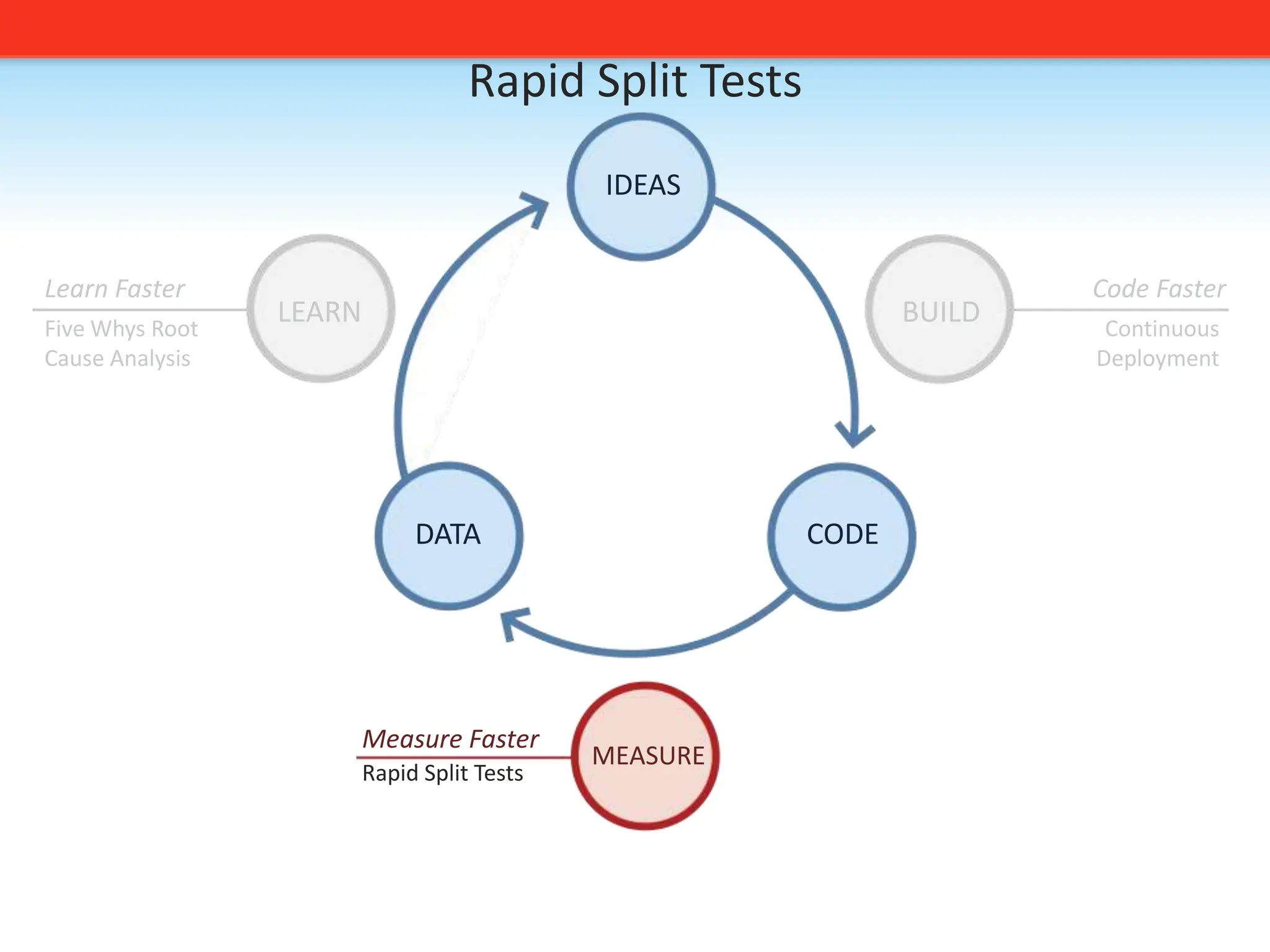
  • 61.
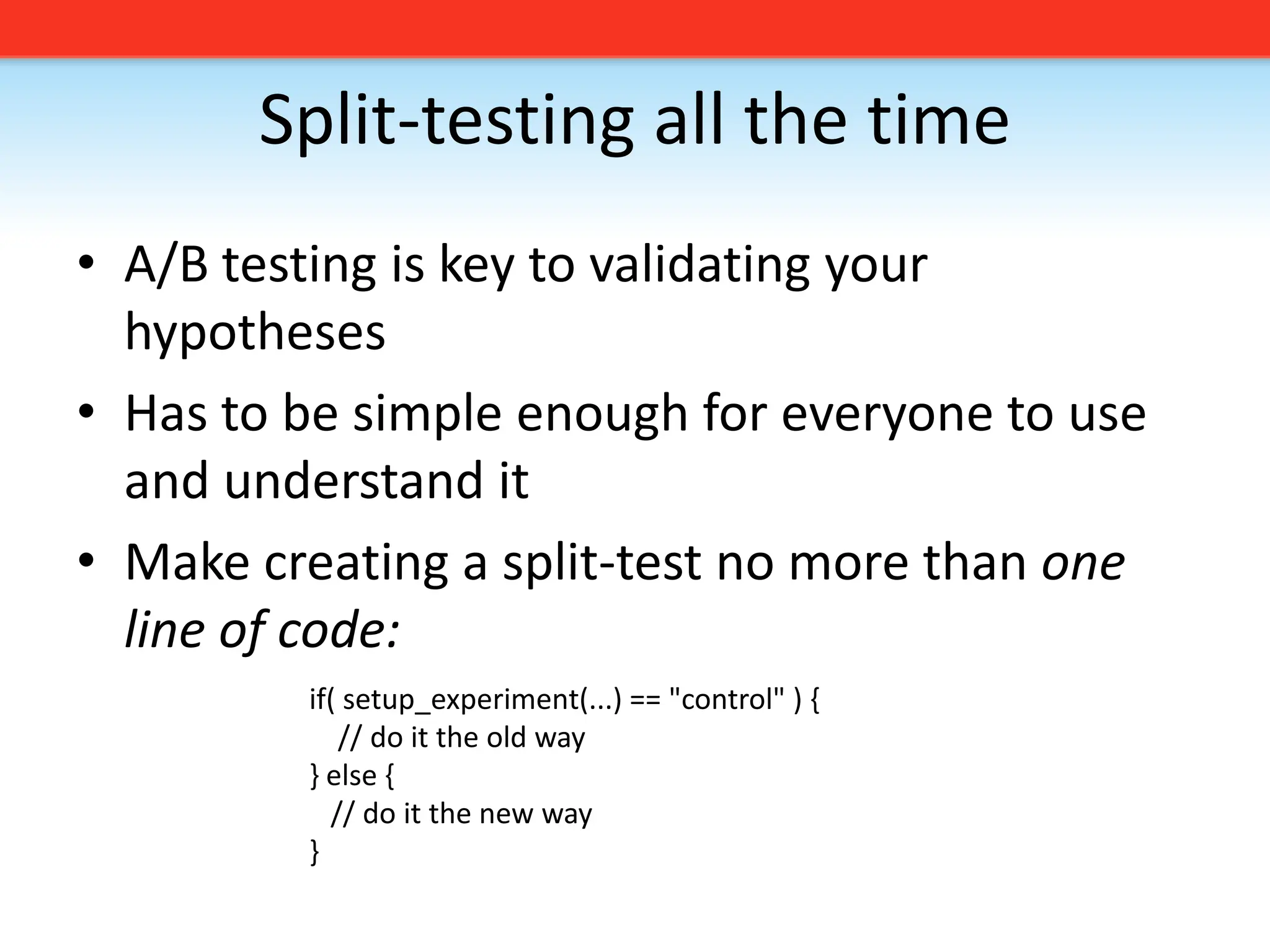
    Split-testing all thetimeA/B testing is key to validating your hypothesesHas to be simple enough for everyone to use and understand itMake creating a split-test no more than one line of code:if( setup_experiment(...) == "control" ) { // do it the old way} else { // do it the new way}
  • 62.
    The AAA’s ofMetricsActionableAccessibleAuditable
  • 63.
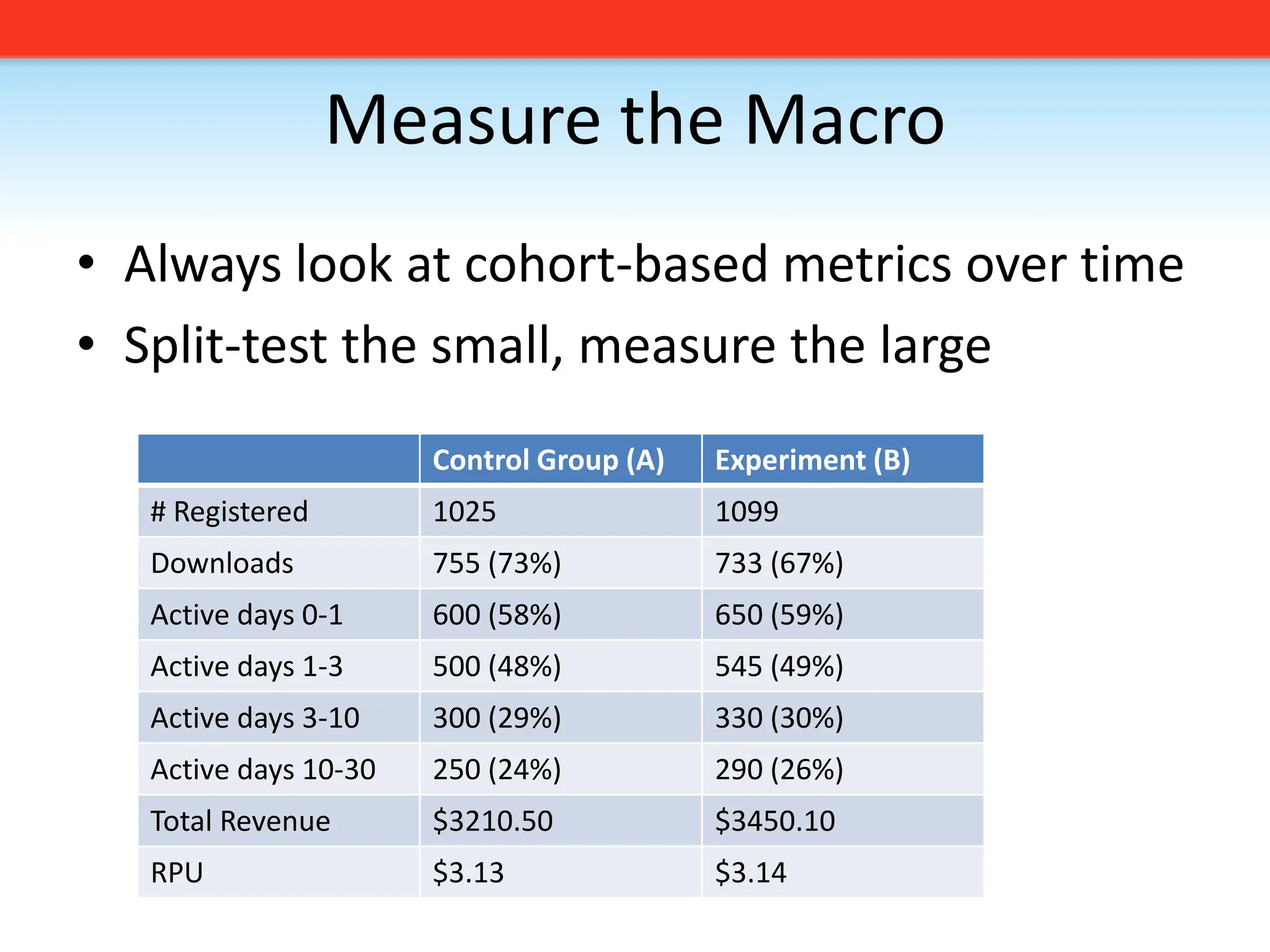
    Measure the MacroAlwayslook at cohort-based metrics over timeSplit-test the small, measure the large
  • 64.
    Minimum Viable ProductIDEASCodeFasterLearn FasterBUILDLEARNContinuousDeploymentMinimum Viable ProductCODEDATAMeasure FasterMEASURERapid Split Tests
  • 65.
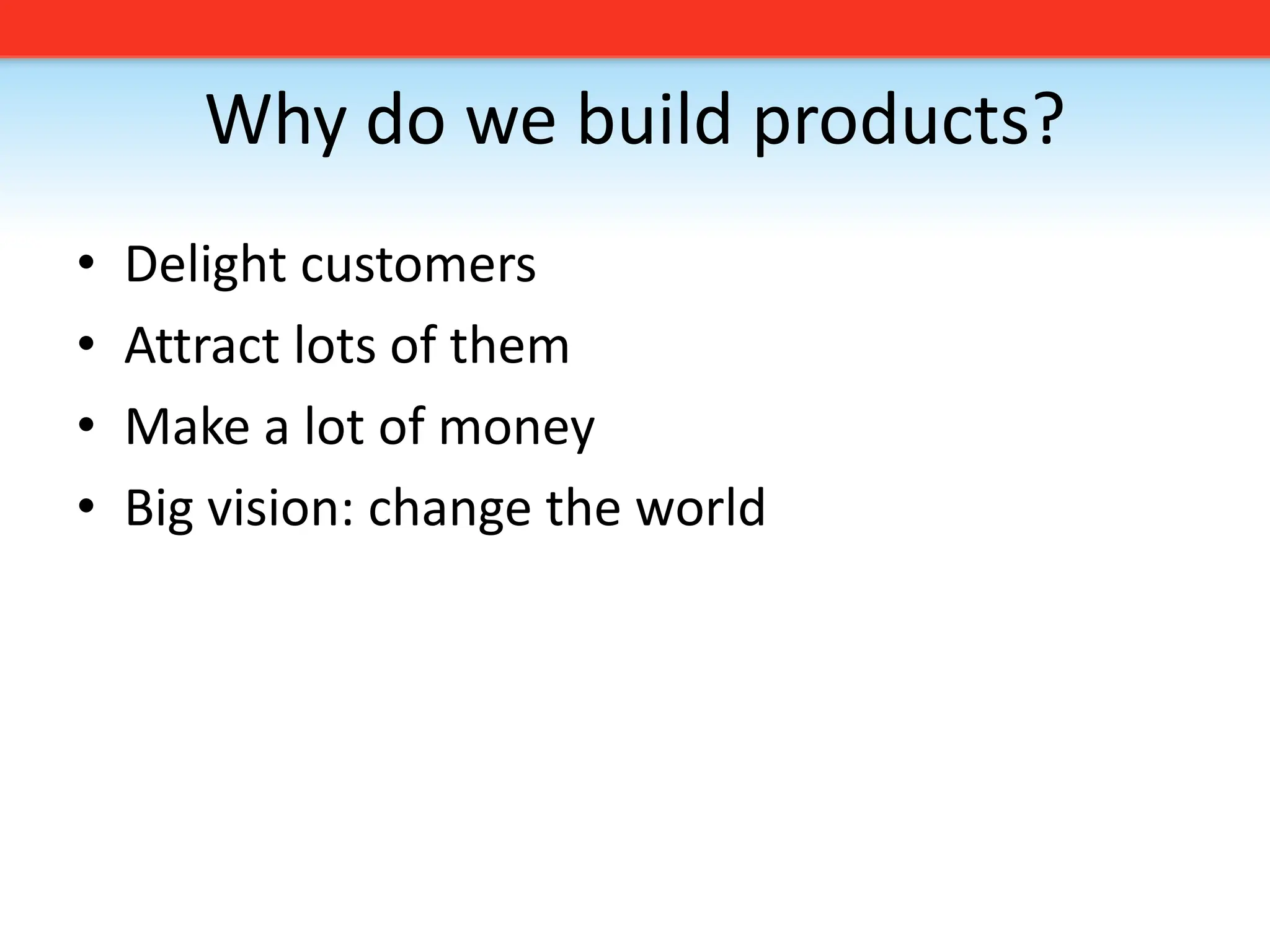
    Why do webuild products?Delight customersAttract lots of themMake a lot of moneyBig vision: change the world
  • 66.
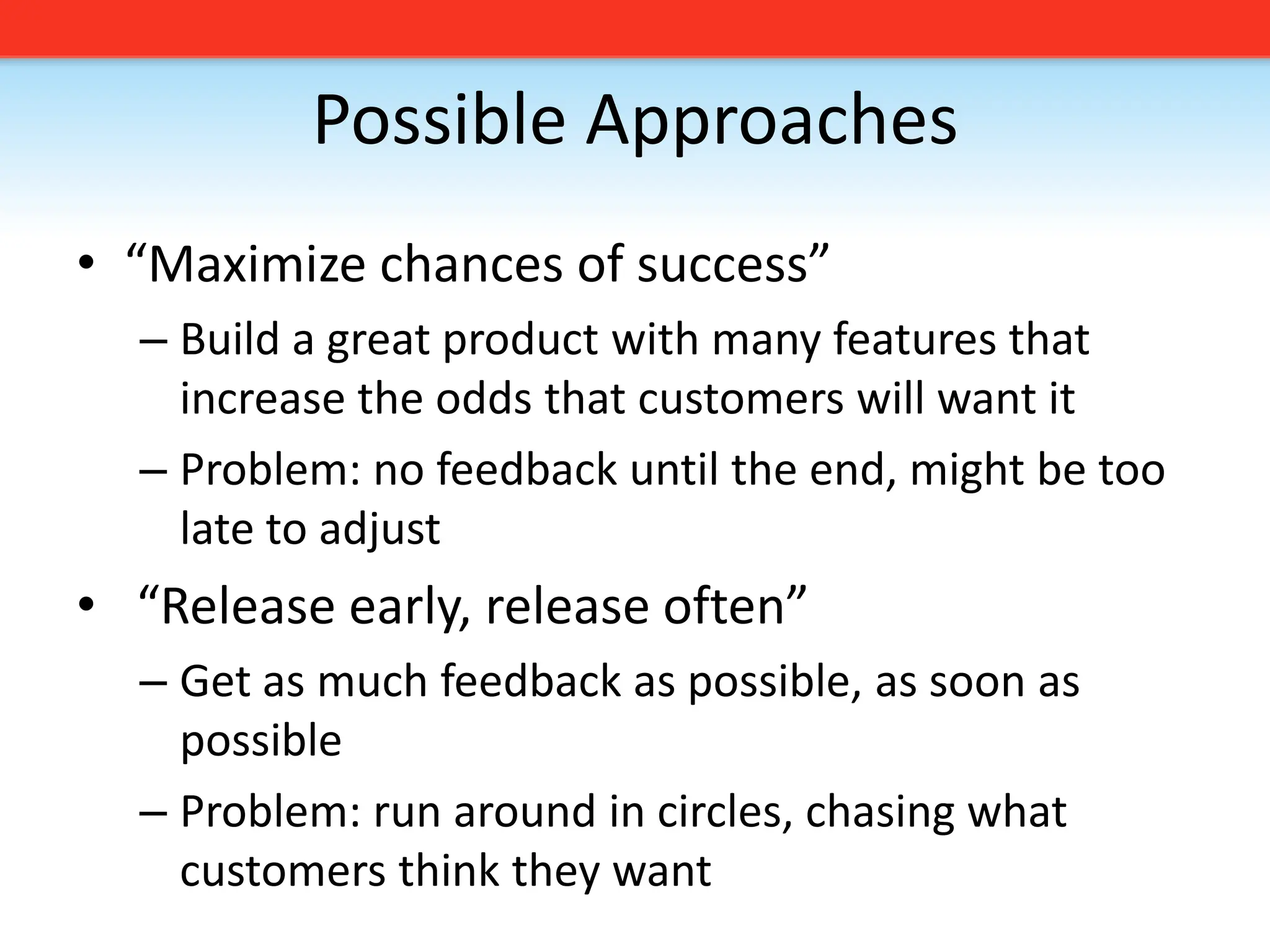
    Possible Approaches“Maximize chancesof success”Build a great product with many features that increase the odds that customers will want itProblem: no feedback until the end, might be too late to adjust “Release early, release often”Get as much feedback as possible, as soon as possibleProblem: run around in circles, chasing what customers think they want
  • 67.
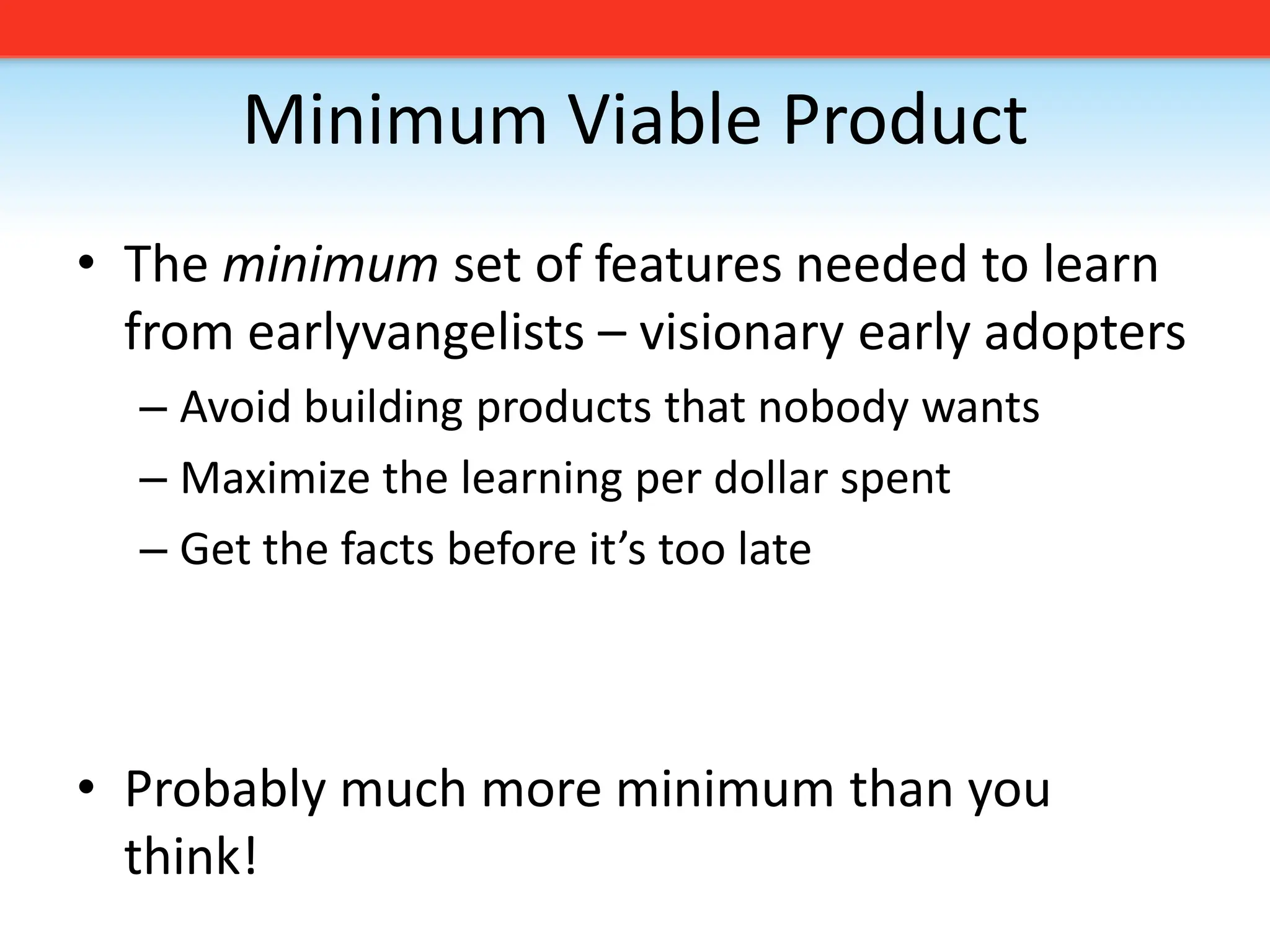
    Minimum Viable ProductTheminimum set of features needed to learn from earlyvangelists – visionary early adoptersAvoid building products that nobody wantsMaximize the learning per dollar spentGet the facts before it’s too lateProbably much more minimum than you think!
  • 68.
    Minimum Viable ProductVisionarycustomers can “fill in the gaps” on missing features, if the product solves a real problemAllows us to achieve a big vision in small increments without going in circlesRequires a commitment to iteration
  • 69.
    ExamplesBuilding IMVU insix months2004 “Kerry vs. Bush avatar debate”
  • 70.
    TechniquesSmoke testing withlanding pages, AdWordsSEM on five dollars a dayIn-product split testingPaper prototypesCustomer discovery/validationRemoving features (“cut and paste”)
  • 71.
    FearsFalse negative: “customerswould have liked the full product, but the MVP sucks, so we abandoned the vision”Visionary complex: “but customers don’t know what they want!”Too busy to learn: “it would be faster to just build it right, all this measuring distracts from delighting customers”
  • 72.
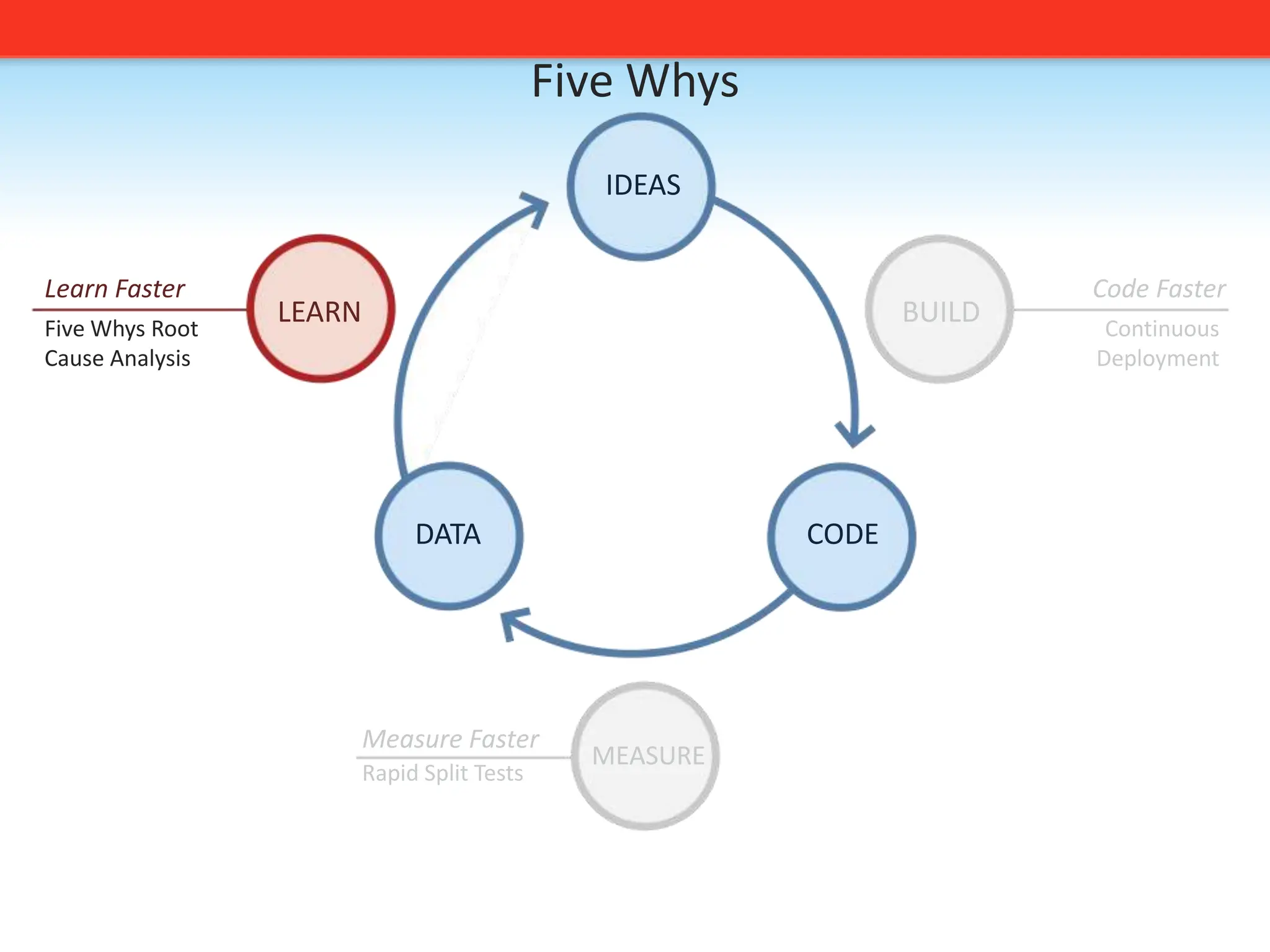
    Five WhysIDEASCode FasterLearnFasterBUILDLEARNContinuousDeploymentFive Whys RootCause AnalysisCODEDATAMeasure FasterMEASURERapid Split Tests
  • 73.
    Five Whys RootCause AnalysisA technique for continuous improvement of company process.
  • 74.
    Ask “why” fivetimes when something unexpected happens.
  • 75.
    Make proportional investmentsin prevention at all five levels of the hierarchy.
  • 76.
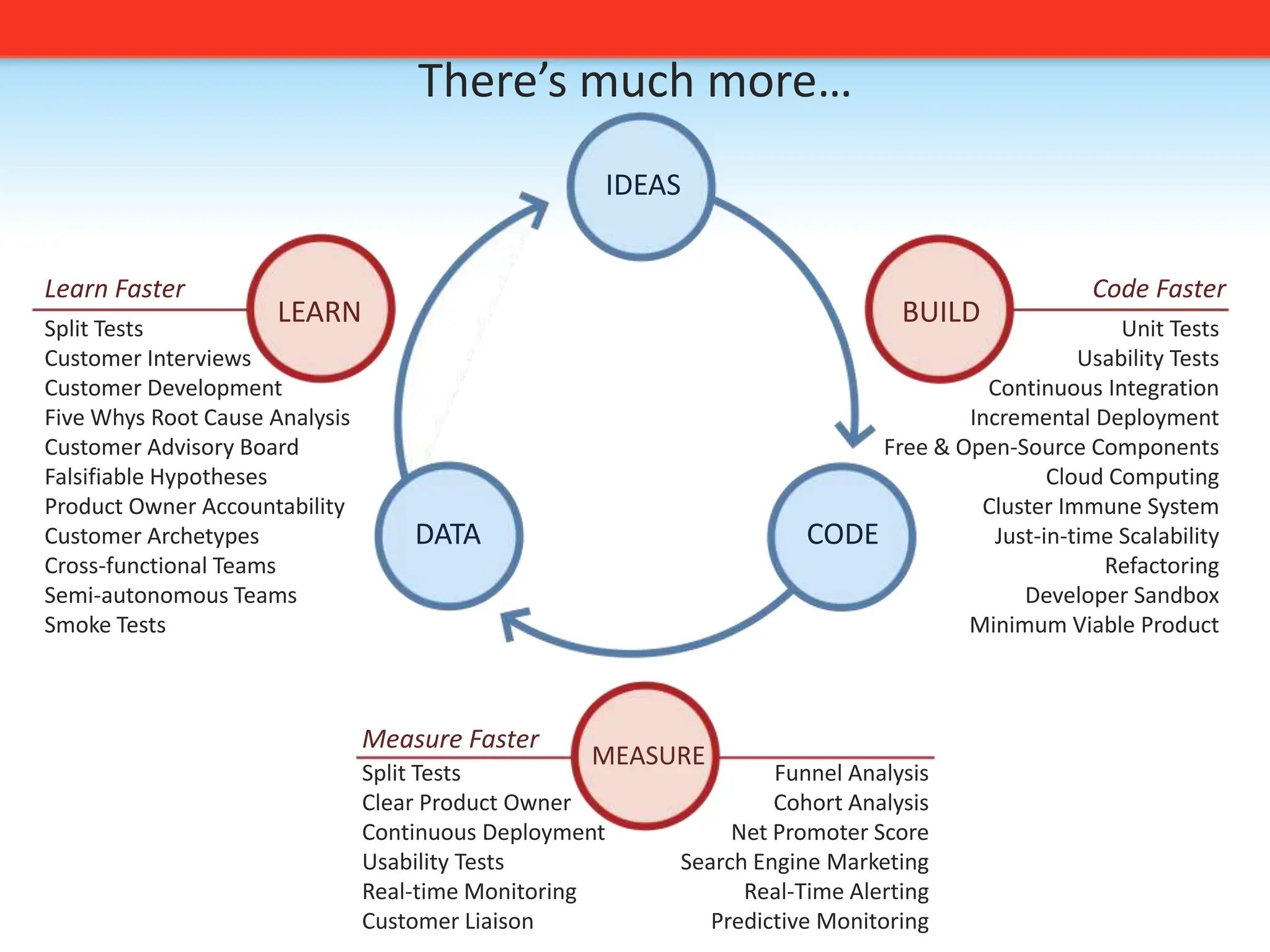
    Behind every supposedtechnical problem is usually a human problem. Fix the cause, not just the symptom.There’s much more…IDEASCode FasterLearn FasterBUILDLEARNUnit TestsUsability TestsContinuous IntegrationIncremental DeploymentFree & Open-Source ComponentsCloud ComputingCluster Immune SystemJust-in-time ScalabilityRefactoringDeveloper SandboxMinimum Viable ProductSplit TestsCustomer InterviewsCustomer DevelopmentFive Whys Root Cause AnalysisCustomer Advisory BoardFalsifiable HypothesesProduct Owner AccountabilityCustomer ArchetypesCross-functional TeamsSemi-autonomous TeamsSmoke TestsCODEDATAMeasure FasterMEASURESplit TestsClear Product OwnerContinuous DeploymentUsability TestsReal-time MonitoringCustomer LiaisonFunnel AnalysisCohort AnalysisNet Promoter ScoreSearch Engine MarketingReal-Time AlertingPredictive Monitoring
  • 77.
    Get Started TodayYouare ready to do this, no matter who you arewhat job you havewhat stage of company you’re inGet started now, today.
  • 78.
  • 79.
  • 80.
    Getting in touch(#leanstartup)
  • 81.
  • 82.
  • 83.
  • 84.
  • 85.

Editor's Notes

  • #9 The premise of the lean startup is simple: if we can reduce the time between these major iterations, we can increase the odds of success.
  • #18 Even though some aspects of the product were eventually vindicated as good ones, the underlying architecture suffered from hard-to-change assumptions. After years of engineering effort, changing these assumptions was incredibly hard. Without conscious process design, product development teams turn lines of code written into momentum in a certain direction. Even a great architecture becomes inflexible. This is why agility is such a prized quality in product development.
  • #20 Do our actions live up to our ideals?
  • #22 After our crushing failure, the founders of my next company decided to question every single assumption for how a startup should be built. Failure gave us the courage to try some radical things.
  • #23 After our crushing failure, the founders of my next company decided to question every single assumption for how a startup should be built. Failure gave us the courage to try some radical things.
  • #25 Based on that experience, and the experience of the other startups I have worked for, I now strongly believe there is a better way to create startups. I’ve called this vision the Lean Startup. It combines three key trends.
  • #28 Let’s look at those changes schematically.
  • #38 Run tests locally:-- Sandbox includes as much of production as humanly possible (db, memcached, Solr, Apache).-- Write tests in every language. We use 8 different test frameworks for different environs. Otherwise you get fear and brittle.-- Example kind of problem is that AJAX updater for site header. Seemingly innocuous change would break shopping experience.CIT/BuildBot:-- Simply don’t push with red tests. Even if the site is in trouble. Example Christmas site outage with memcache sampling.-- Give an idea of the scale. 20 machine cluster, runs 10000 tests and 100,000’s of thousand of assertions on every change.Incremental deploy:-- Catch performance bugs and gaps in test coverageSlow query in free tags. This started to drive database load higher on one MySQL instance due to contention and data size. Detected and rolled back before it affected users and before the database was hosed due to high load.Changed transaction commit logic in foundation of the system. This passed all tests but caused registrations to fail in production due to subtle difference between sandbox and production. System detected drop in business metric in 1 minute and reverted the changeAlerting and Predictive MonitoringExample: Second tier ISP to block our outbound emailExample: Rooms list performance time bombExample: Registration quality, second tier payment methods, invite mail success rates by serviceStory: Anything that can go wrong will, so just catch it then fast.
  • #53 Webcast: May 1Workshop: May 29Fliers up frontDiscussion in web2open