
Field Edge Habitat Effect on Soybean Insect Predators
•
1 like•336 views

This study examined the effect of different field edge habitats on predatory insect populations in soybean fields. Researchers sampled 18 soybean fields with either wooded ("complex") or grassy ("simple") edge habitats every 2-3 weeks from June to August. They found that multicolored Asian lady beetle populations increased over 100% from simple edge habitats to field interiors, but decreased 60% from complex edges to interiors. Lacewing populations were not affected by edge type and were highest on edges regardless of type, decreasing 70% into fields. All predatory insect species reached maximum numbers in late August.
Recommended

Recommended
More Related Content
More from nacaa
More from nacaa (20)
Recently uploaded
Recently uploaded (20)
Field Edge Habitat Effect on Soybean Insect Predators
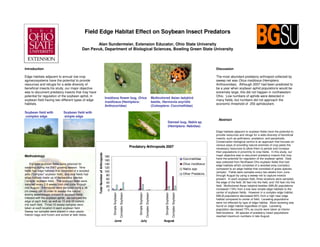
- 1. Field Edge Habitat Effect on Soybean Insect Predators Alan Sundermeier, Extension Educator, Ohio State University Dan Pavuk, Department of Biological Sciences, Bowling Green State University Introduction Discussion Edge habitats adjacent to annual row crop The most abundant predatory arthropod collected by agroecosystems have the potential to provide sweep net was Orius insidiosus (Hemiptera: resources and refugia for a wide diversity of Anthocoridae). Although 2007 had been predicted to beneficial insects.his study, our major objective be a year when soybean aphid populations would be was to document predatory insects that may have extremely large, this did not happen in northwestern potential for regulation of the soybean aphid, in Ohio. Low numbers of aphids were detected in Insidious flower bug, Orius Multicolored Asian ladybird soybean field having two different types of edge many fields, but numbers did not approach the insidiosus (Hemiptera: beetle, Harmonia axyridis habitats. economic threshold of 250 aphids/plant. Anthocoridae) (Coleoptera: Coccinellidae) Soybean field with Soybean field with complex edge simple edge Abstract Damsel bug, Nabis sp. (Hemiptera: Nabidae) Edge habitats adjacent to soybean fields have the potential to provide resources and refuge for a wide diversity of beneficial insects, such as pollinators, predators, and parasitoids. Conservation biological control is an approach that focuses on various ways of providing natural enemies of crop pests the Predatory Arthropods 2007 necessary resources to allow them to persist and increase their populations in proximity to crop fields. In this study, our Total Number of Arthropods Methodology 180 major objective was to document predatory insects that may Coccinellidae have the potential for regulation of the soybean aphid. Data 160 was collected from Northwest Oho soybean fields that had Eighteen soybean fields were selected for 140 Orius insidiosus edge habitats which consisted of a wooded area (complex) sampling during the 2007 growing season. Nine 120 Nabis spp compared to an edge habitat that consisted of grass species fields had edge habitats that consisted of a wooded 100 (simple). Fields were samples every two weeks from June area (“complex” soybean field), and nine fields had 80 Other Predators through August by using a sweep net to capture insects edge habitats made up of herbaceous species 60 present. In each soybean field, three locations were sampled, (“simple” soybean field). The soybean fields were the edge of the field, 50 feet into the field, and 150 feet into the 40 sampled every 2-3 weeks from mid-June through field. Multicolored Asian ladybird beetles (MALB) populations mid-August. Arthropods were sampled using a 38 20 0 increased 116% from a low near simple edge habitats to the cm sweep net. In order to assess the natural center of soybean fields. However in a complex edge habitat, Simple Soybean Complex Soybean Simple Soybean Complex Soybean Simple Soybean Complex Soybean enemy assemblages present in soybean fields MALB populations decreased 60% from a high near edge infested with the soybean aphid, we sampled the habitat compared to center of field. Lacewing populations edge of each field, as well as 15 and 45 meters were not effected by type of edge habitat. More lacewing was into each field. Three-10 sweep samples were found on edge habitat regardless of type. Lacewing taken at each location in each soybean field. population decreased 70% as counts were taken at interior Sweep net samples were placed in clear plastic field locations. All species of predatory insect populations freezer bags and frozen and sorted at later dates. reached maximum numbers in late August. June July August