Twitter: @matthiasnoback
Matthias Noback
A Series of Fortunate Events
What are events, really?
Things that happen
They trigger actions
Just now...
Attendees arrived,
triggered me to turn on microphone,
which triggered you to stop talking,
which triggered me to start talking
Events in software
Events model what happened in a system
Other parts of the system
can respond to what happened
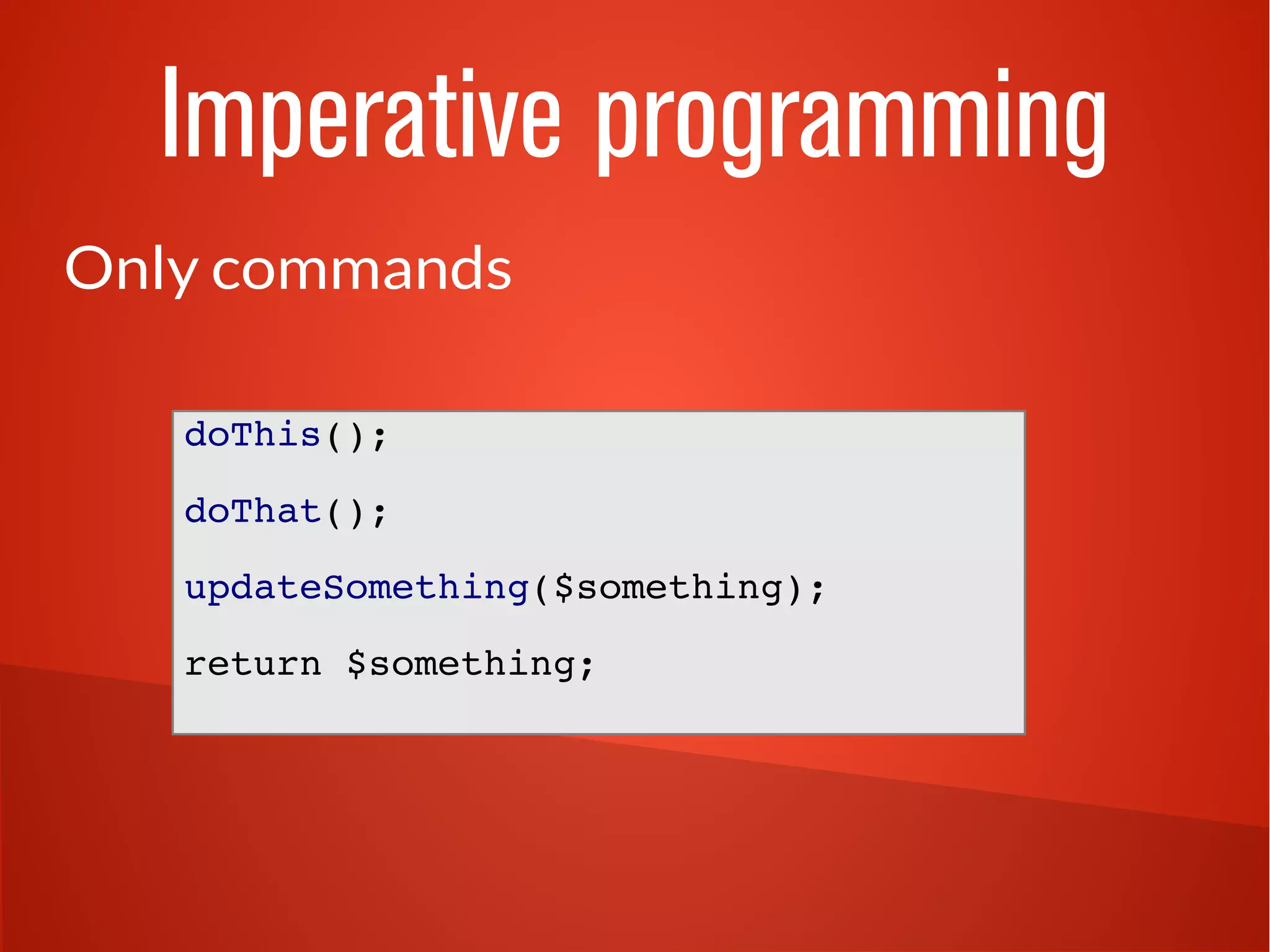
Imperative programming
Only commands
doThis();
doThat();
updateSomething($something);
return $something;
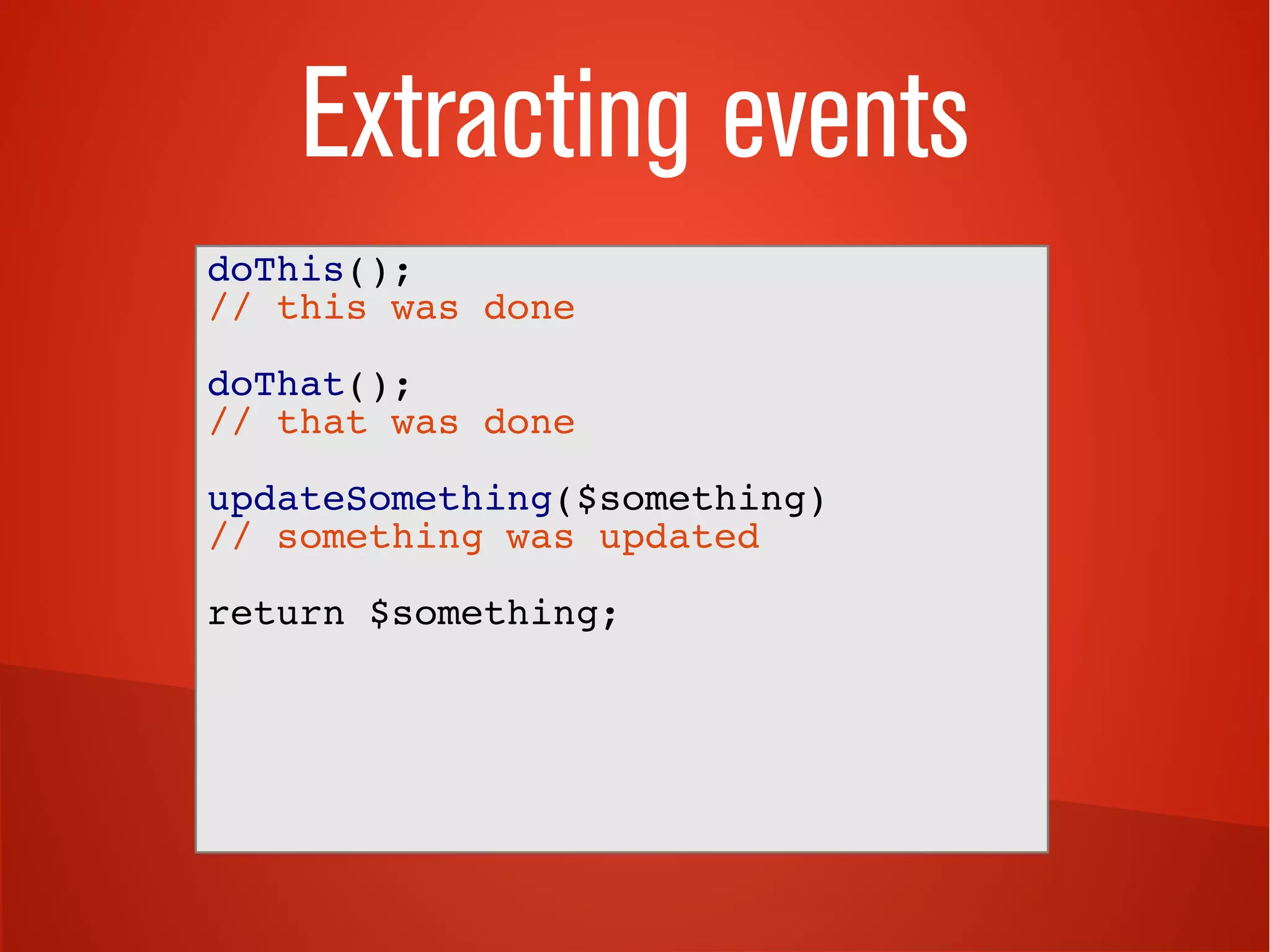
Extracting events
doThis();
// this was done
doThat();
// that was done
updateSomething($something)
// something was updated
return $something;
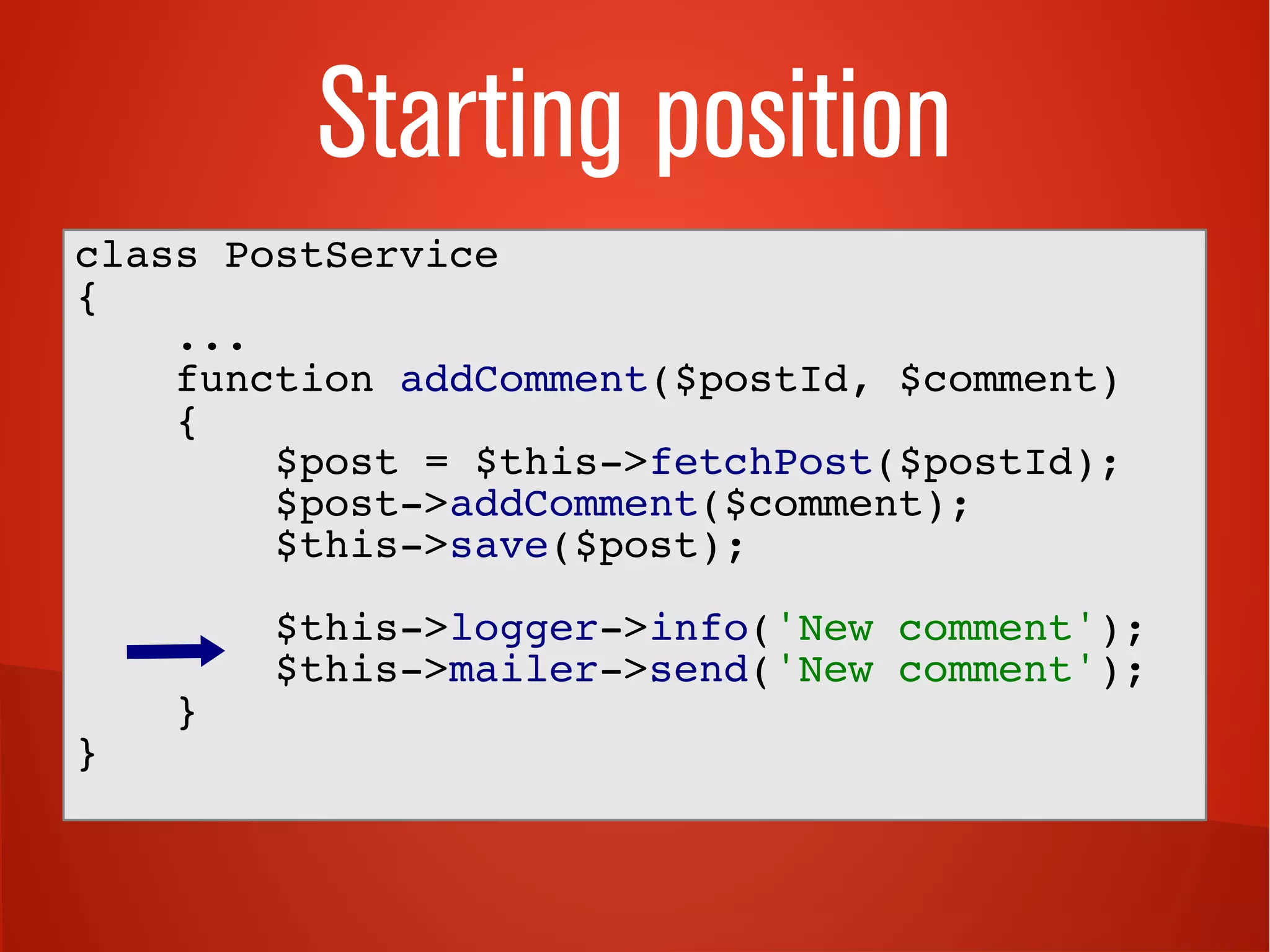
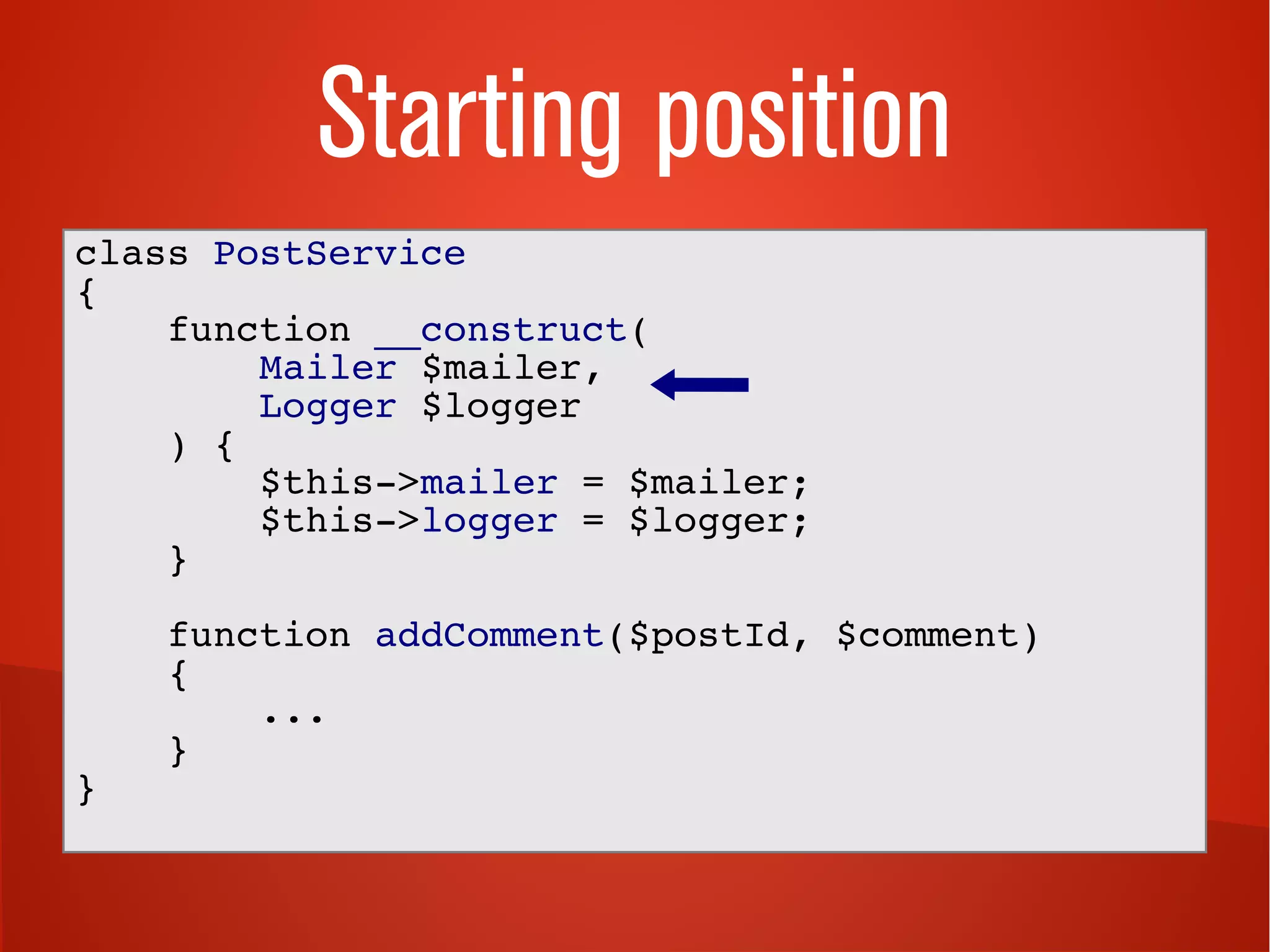
Starting position
class PostService
{
...
function addComment($postId, $comment)
{
$post = $this->fetchPost($postId);
$post->addComment($comment);
$this->save($post);
$this->logger->info('New comment');
$this->mailer->send('New comment');
}
}
Starting position
class PostService
{
function __construct(
Mailer $mailer,
Logger $logger
) {
$this->mailer = $mailer;
$this->logger = $logger;
}
function addComment($postId, $comment)
{
...
}
}
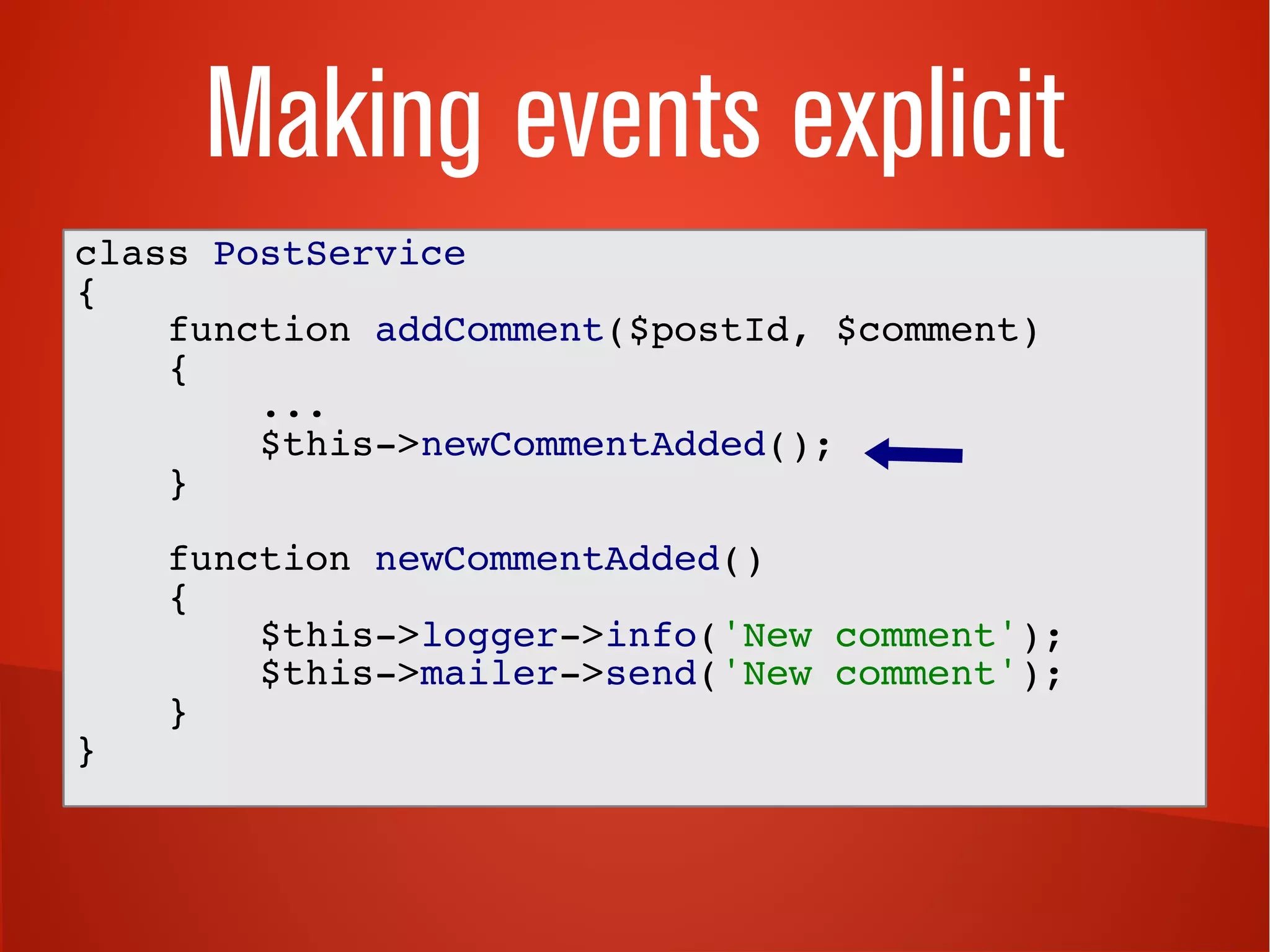
Making events explicit
class PostService
{
function addComment($postId, $comment)
{
...
$this->newCommentAdded();
}
function newCommentAdded()
{
$this->logger->info('New comment');
$this->mailer->send('New comment');
}
}
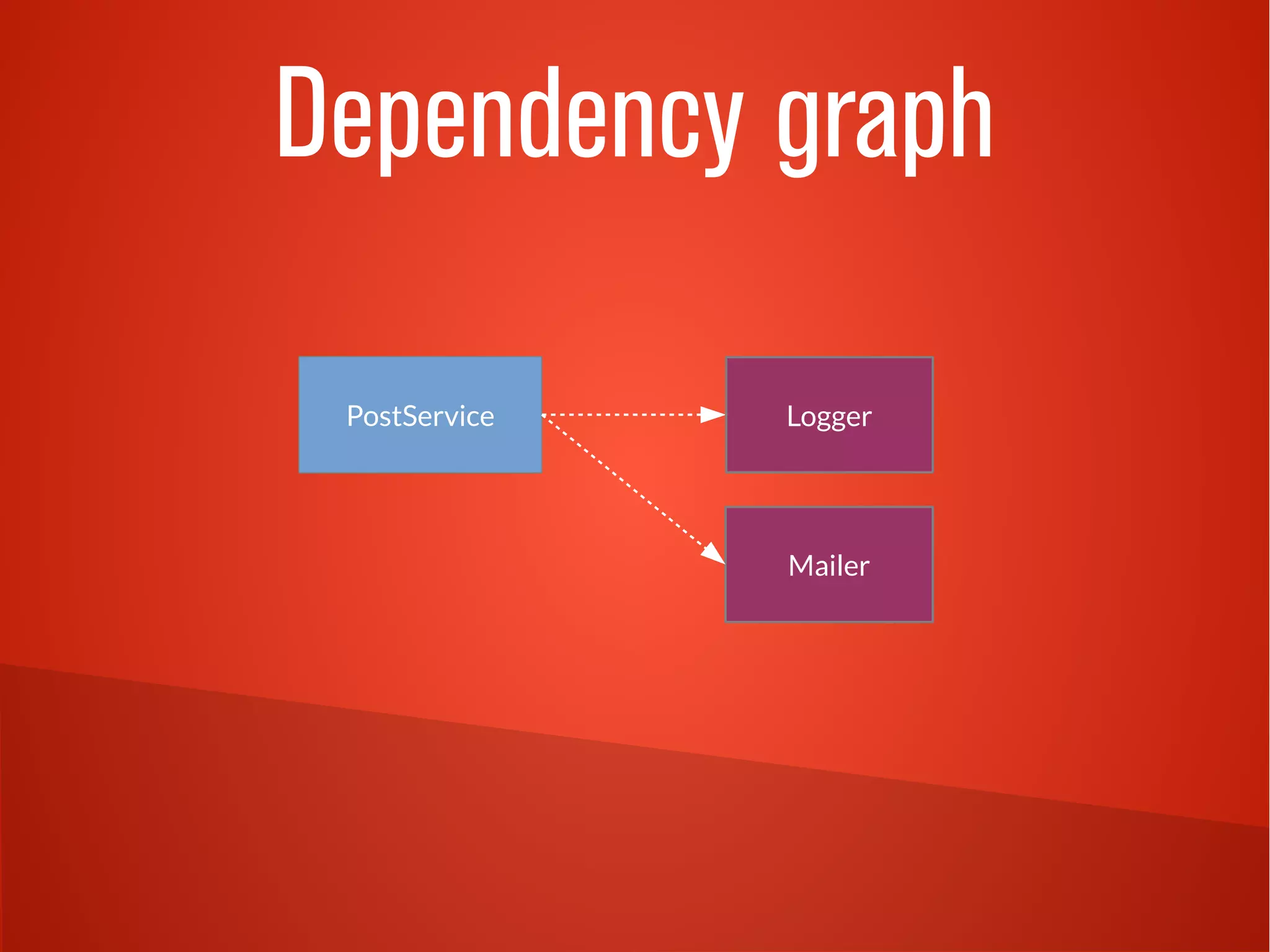
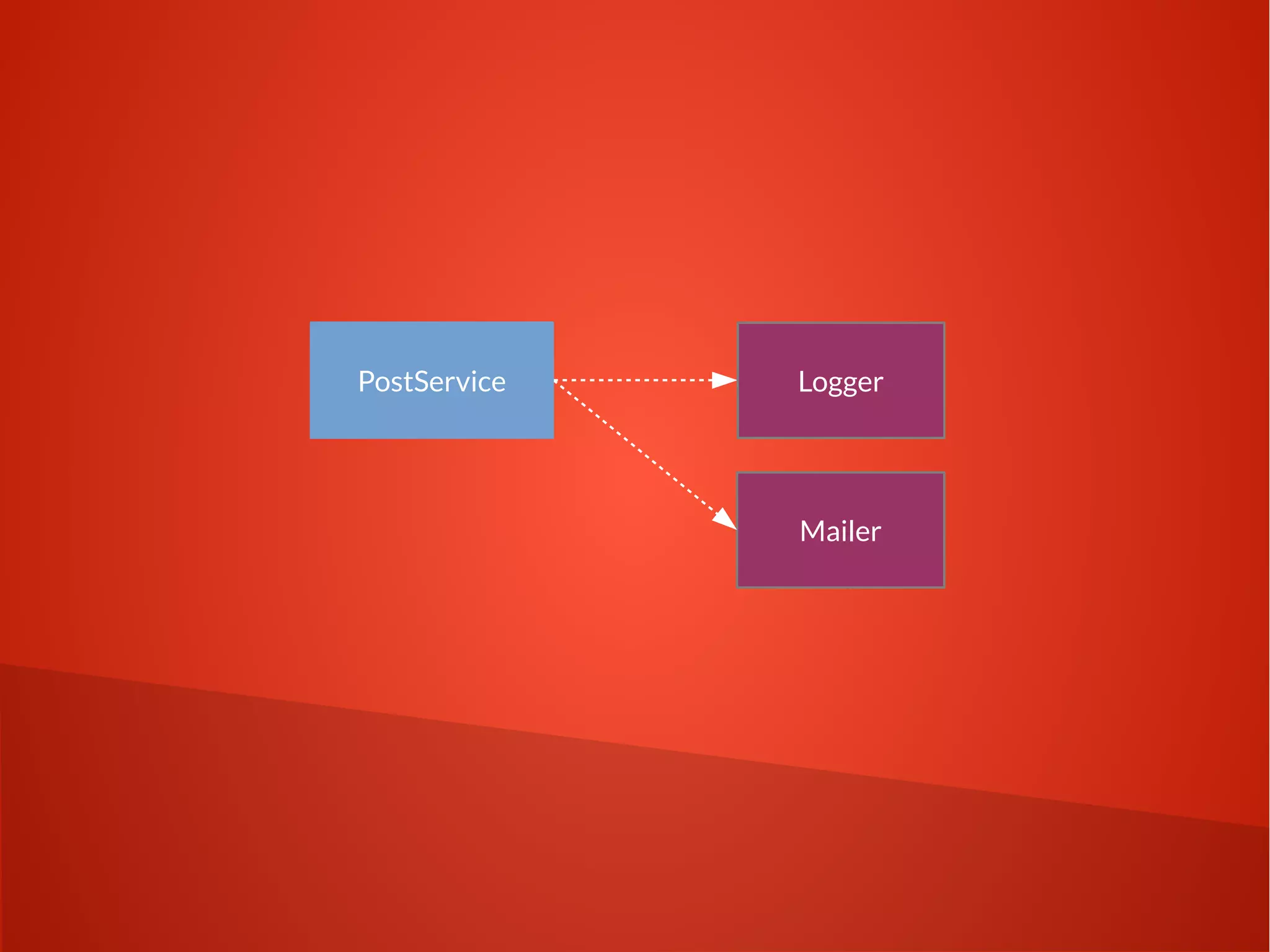
Dependency graph
PostServicePostService
Mailer
Logger
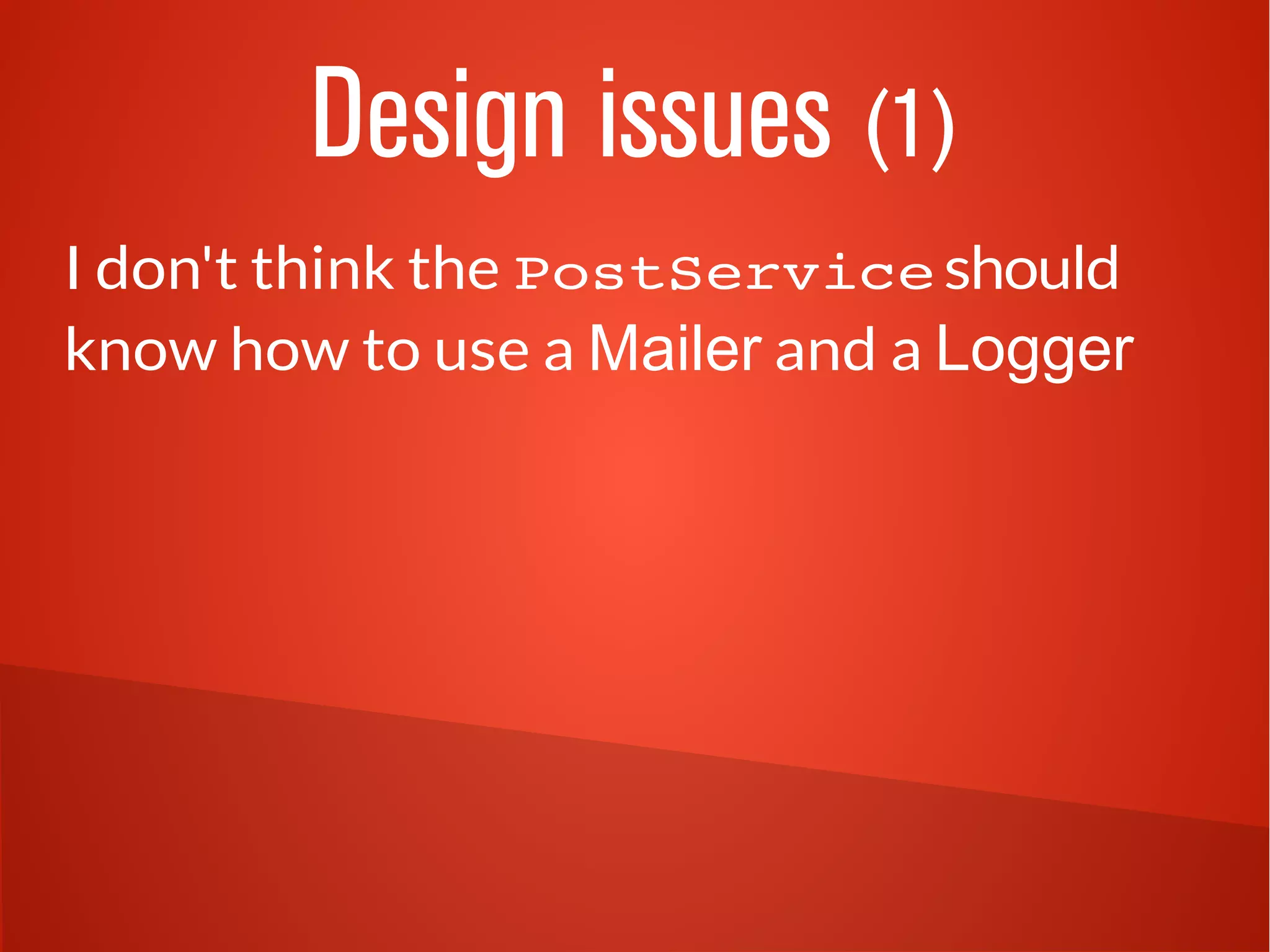
Design issues (1)
I don't think the PostService should
know how to use a Mailer and a Logger
Design issues (2)
I want to change the behavior of
PostService without modifying the
class itself
Fix the problems
By introducing events!
(later)
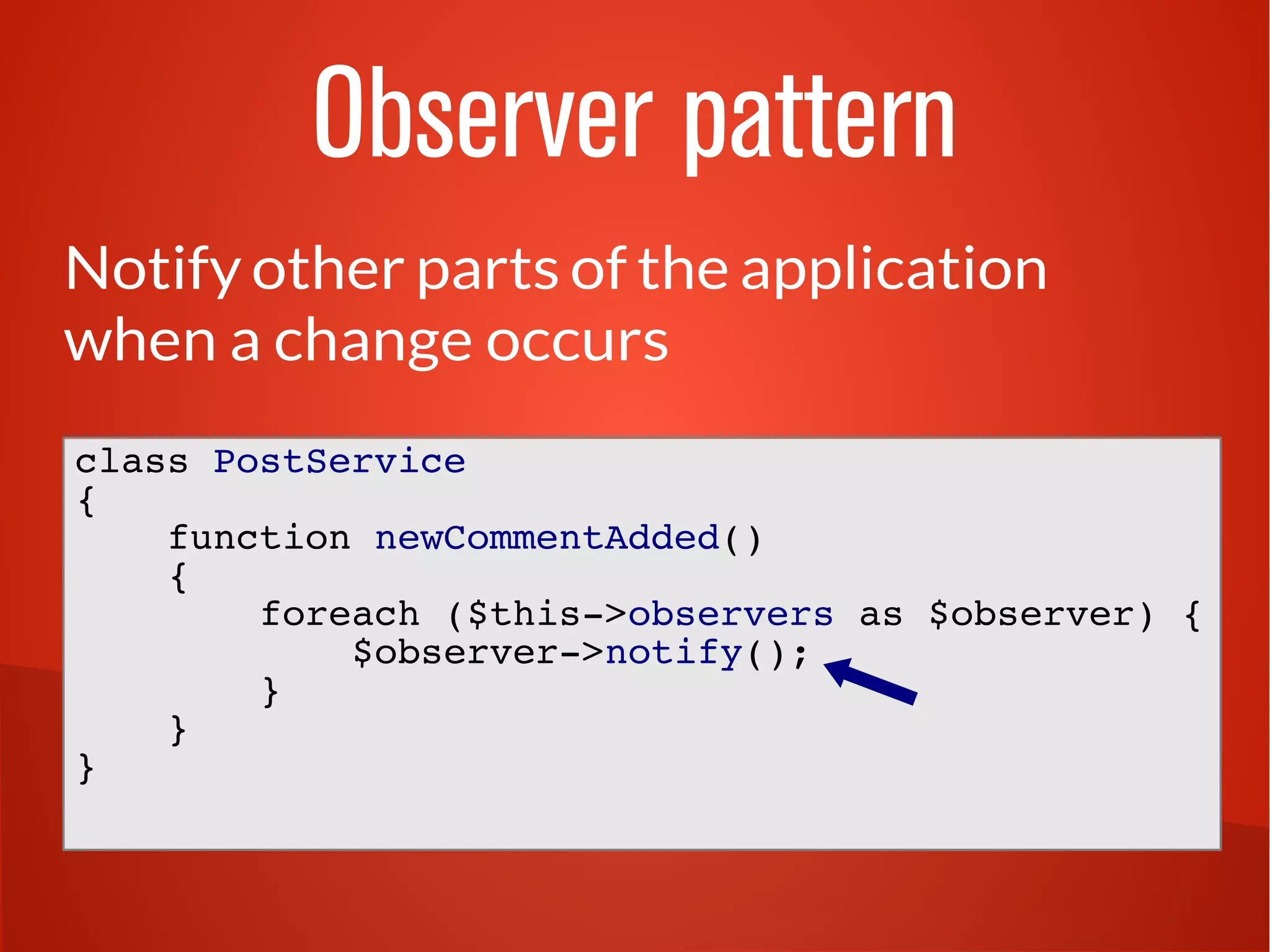
Observer pattern
Notify other parts of the application
when a change occurs
class PostService
{
function newCommentAdded()
{
foreach ($this->observers as $observer) {
$observer->notify();
}
}
}
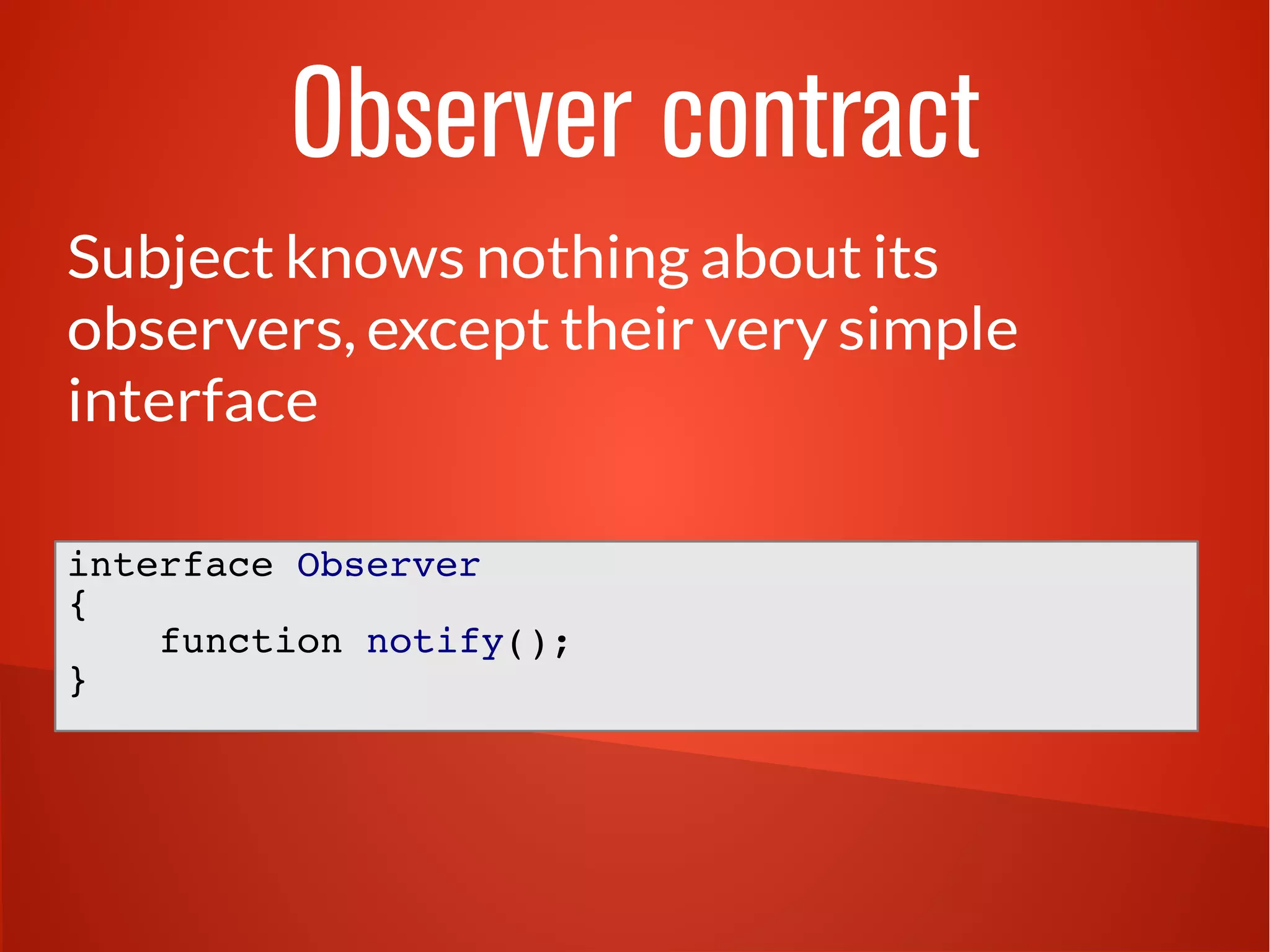
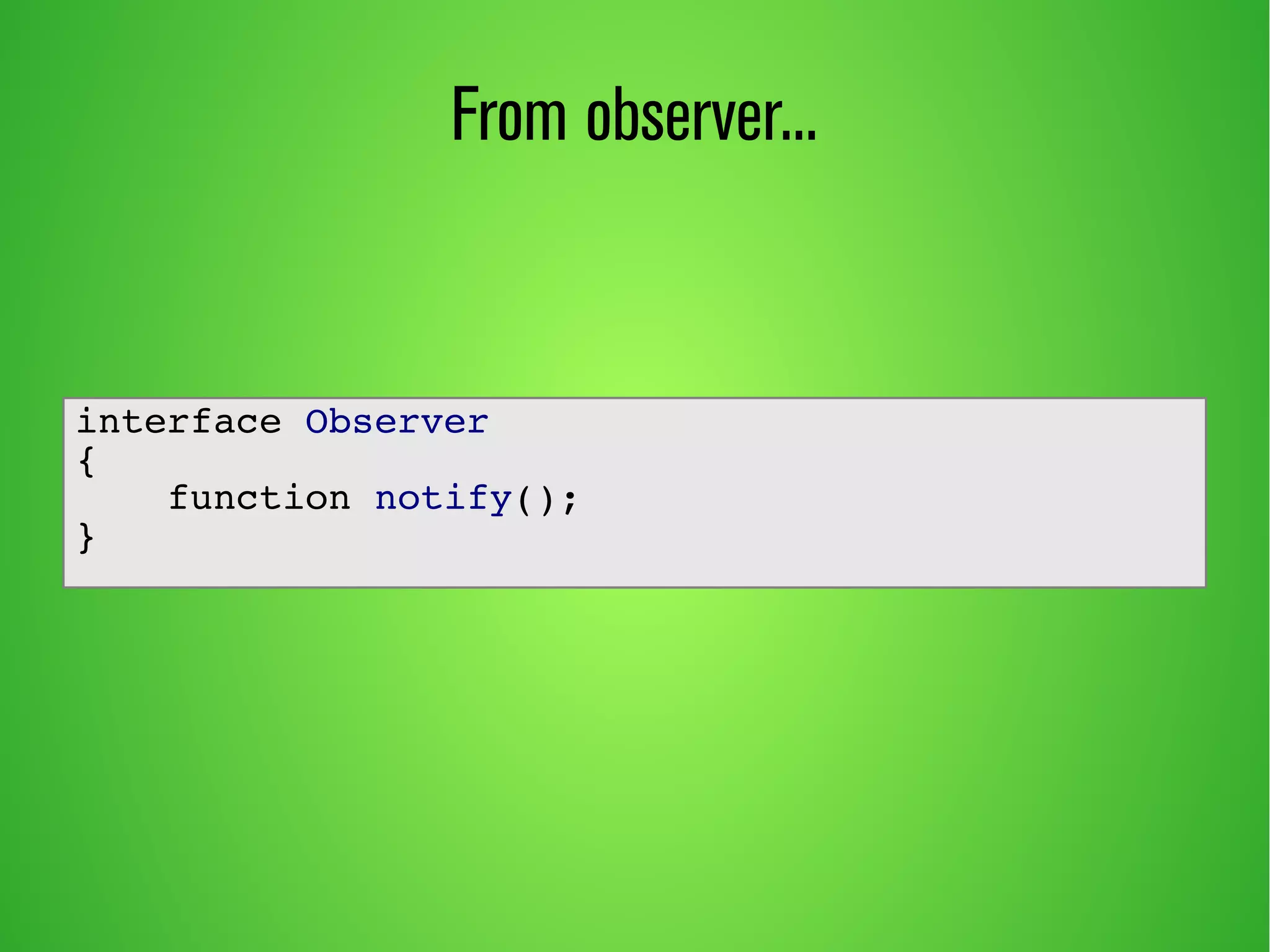
Observer contract
interface Observer
{
function notify();
}
Subject knows nothing about its
observers, except their very simple
interface
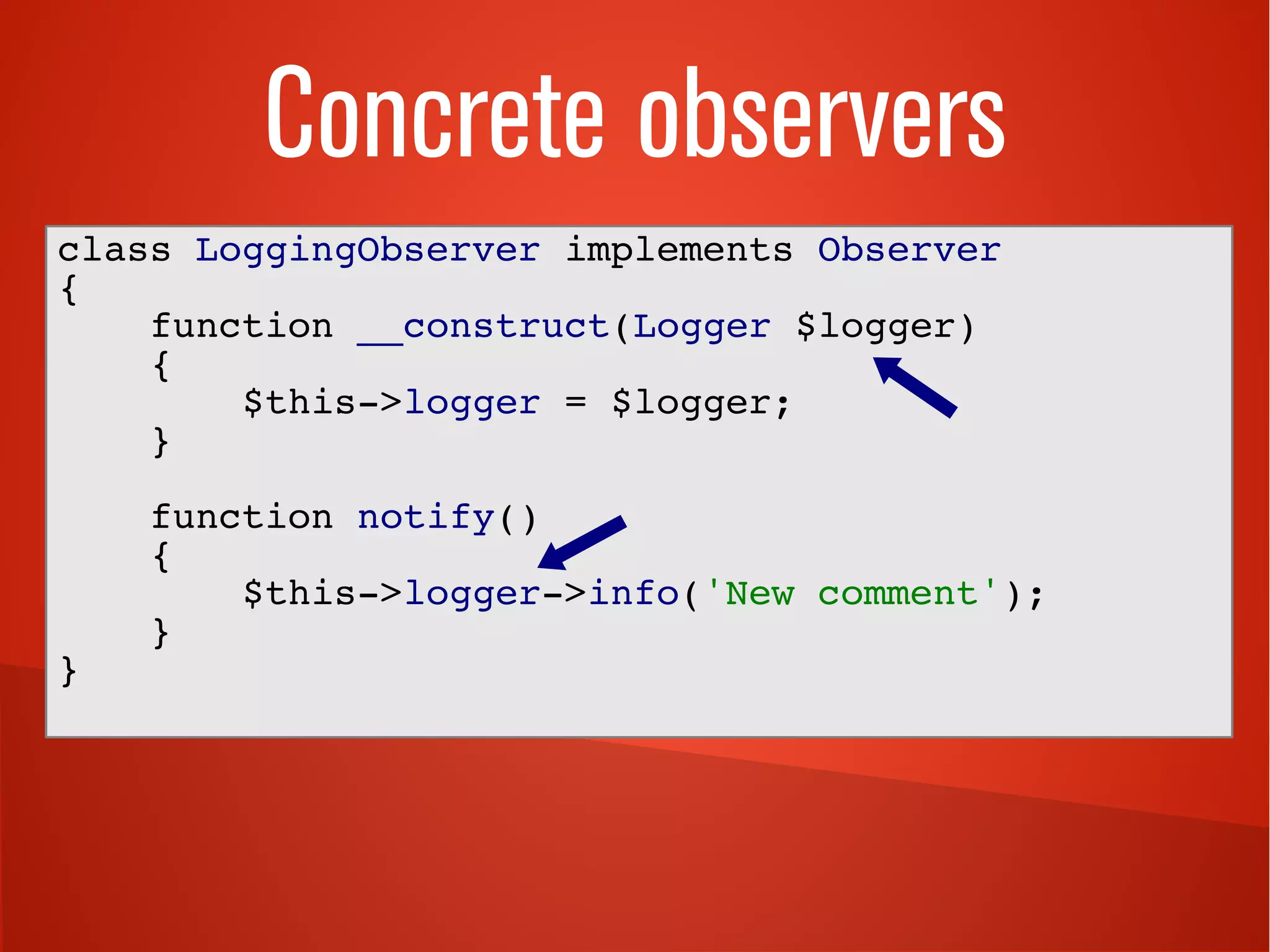
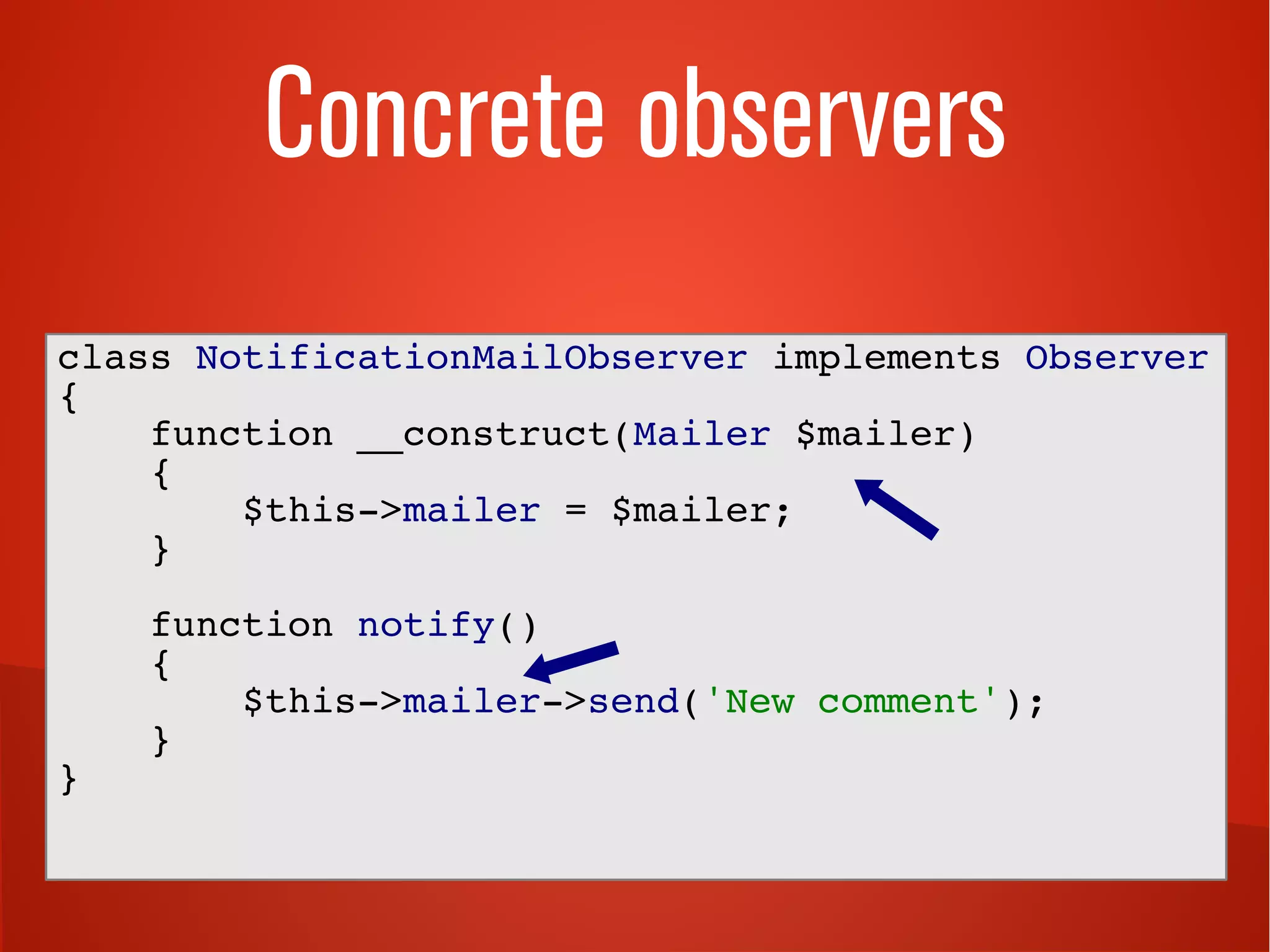
Concrete observers
class LoggingObserver implements Observer
{
function __construct(Logger $logger)
{
$this->logger = $logger;
}
function notify()
{
$this->logger->info('New comment');
}
}
Concrete observers
class NotificationMailObserver implements Observer
{
function __construct(Mailer $mailer)
{
$this->mailer = $mailer;
}
function notify()
{
$this->mailer->send('New comment');
}
}
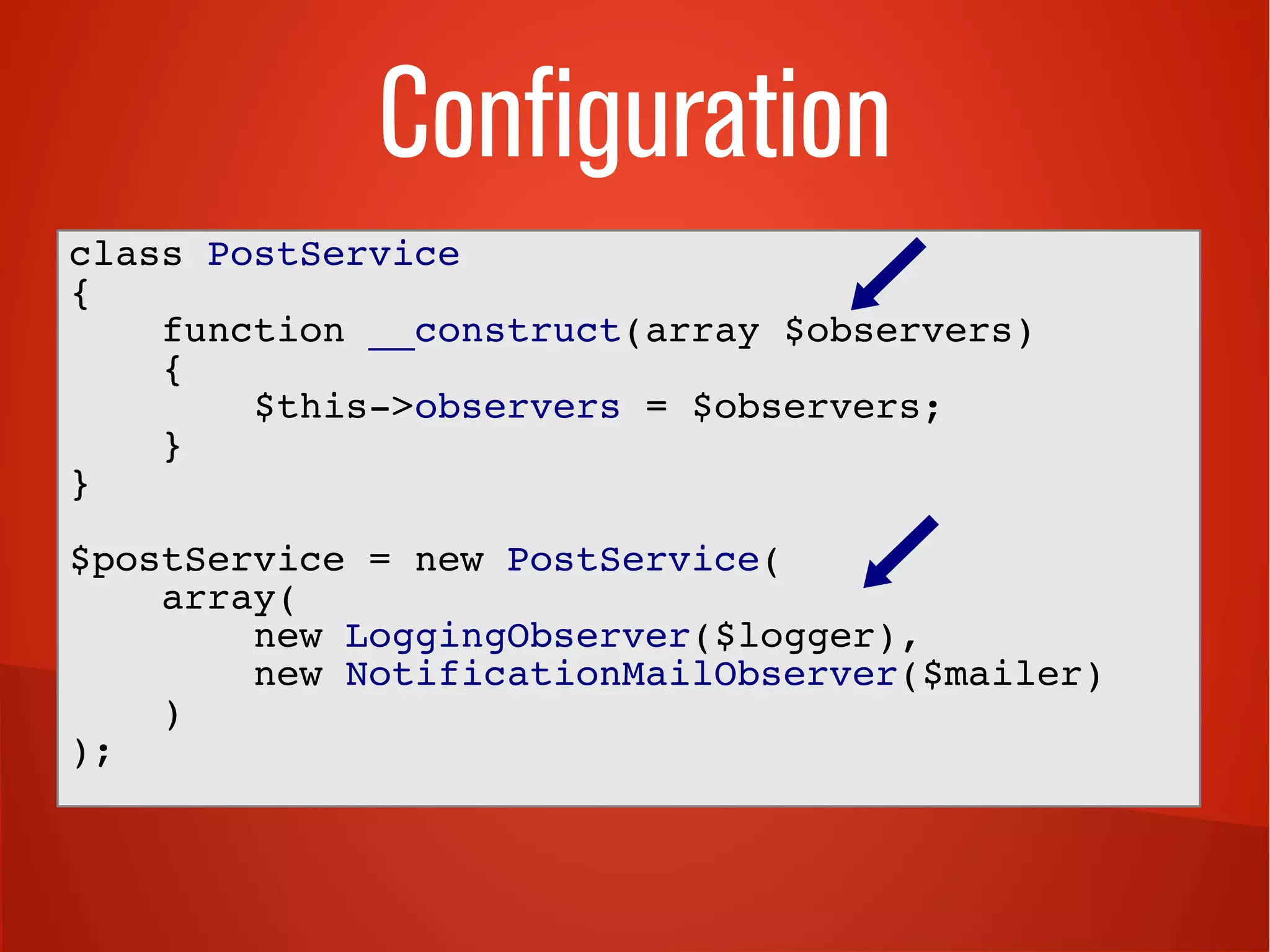
Configuration
class PostService
{
function __construct(array $observers)
{
$this->observers = $observers;
}
}
$postService = new PostService(
array(
new LoggingObserver($logger),
new NotificationMailObserver($mailer)
)
);
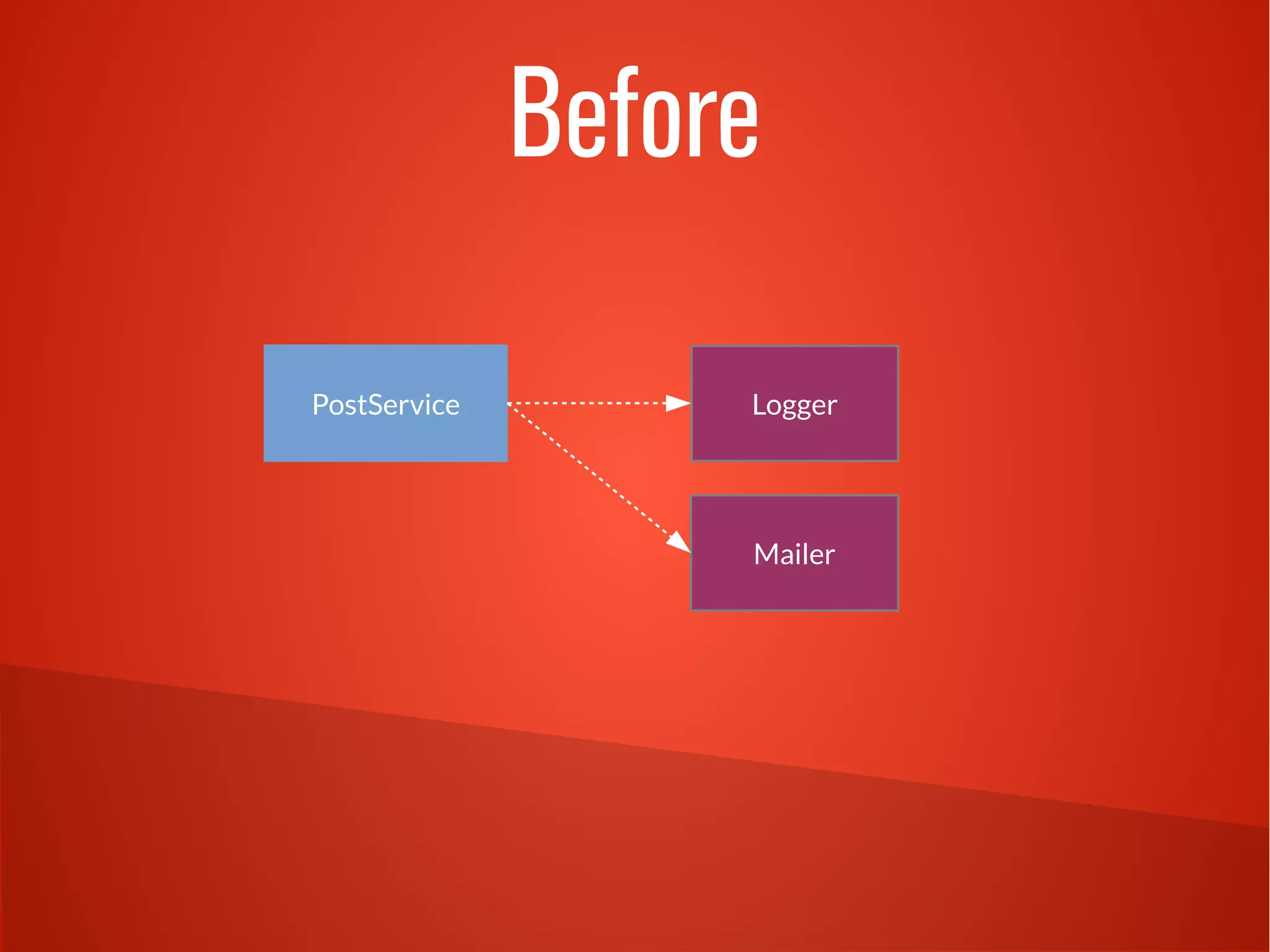
Before
PostServicePostService
Mailer
Logger
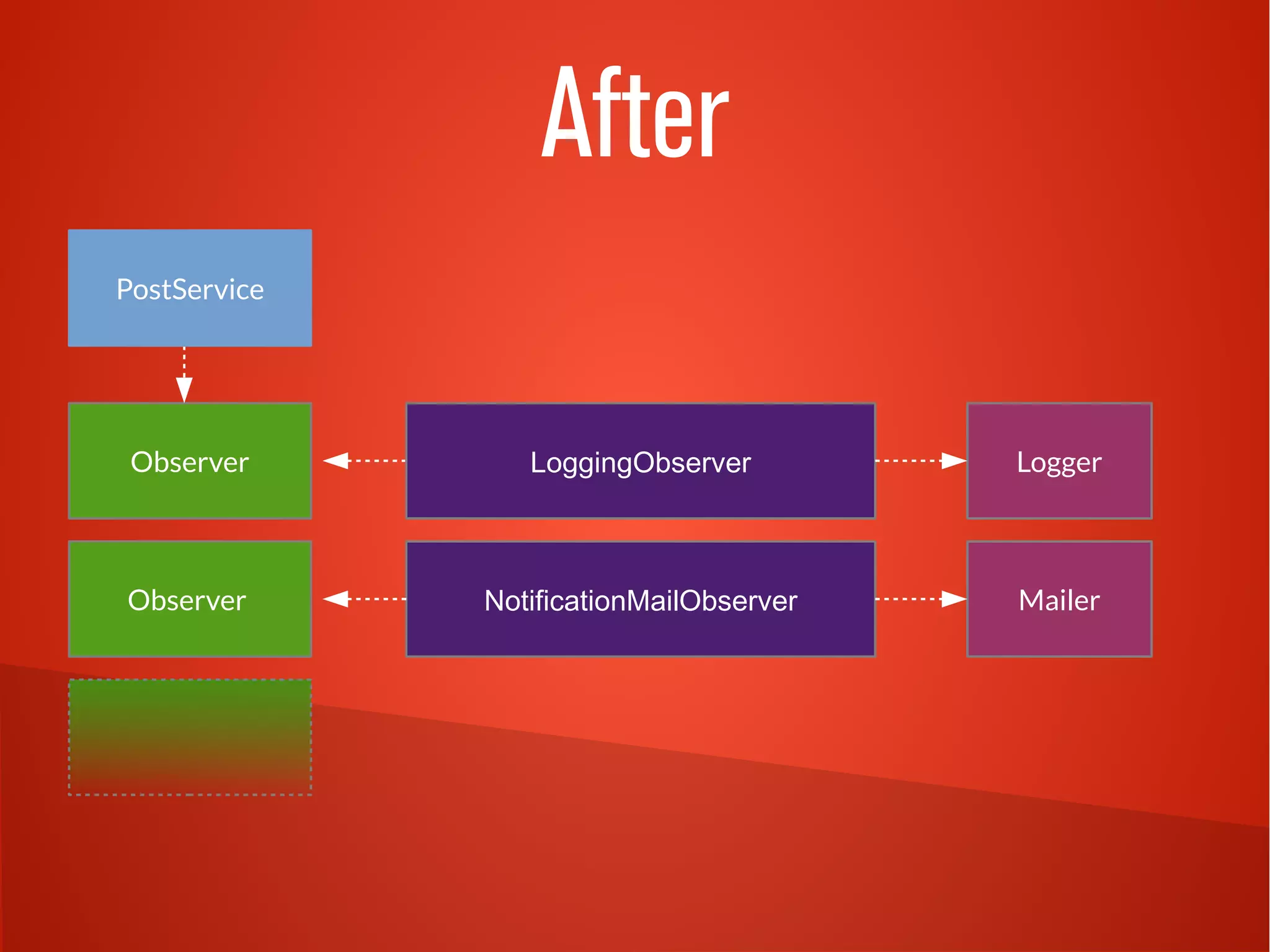
After
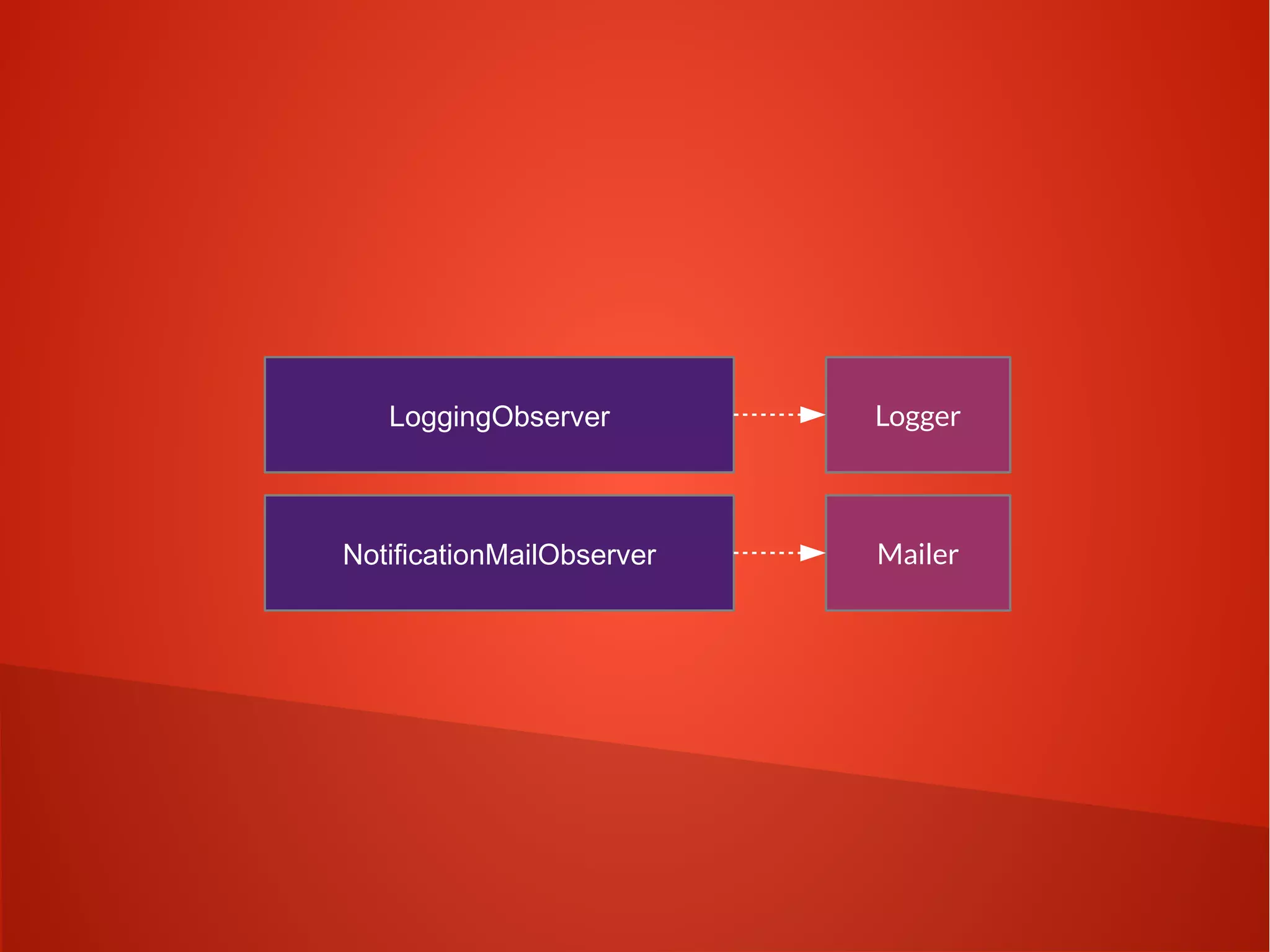
NotificationMailObserver
Observer
Observer
LoggingObserver
Mailer
Logger
PostService
Design Principles Party
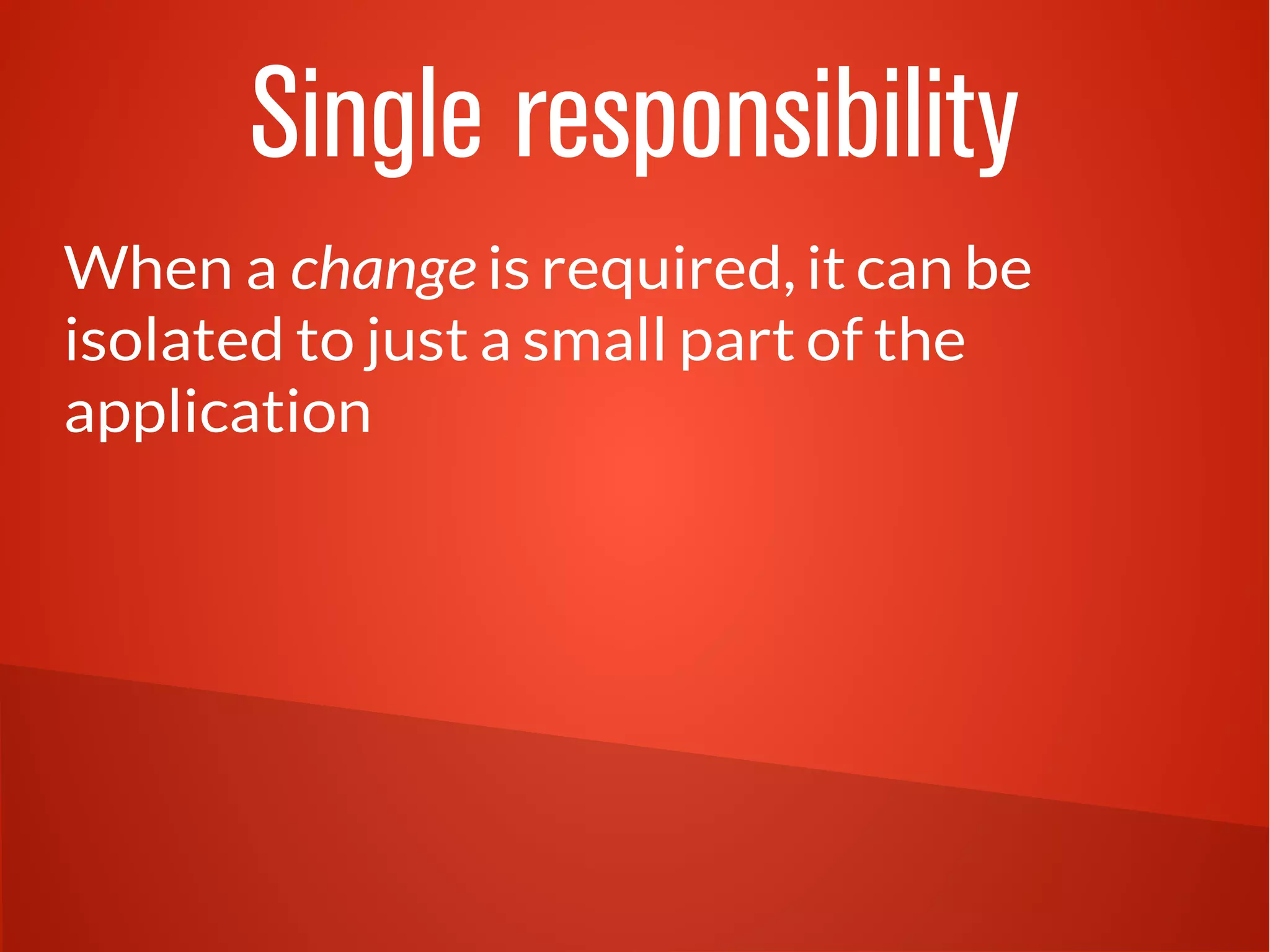
Single responsibility
Each class has one small,
well-defined responsibility
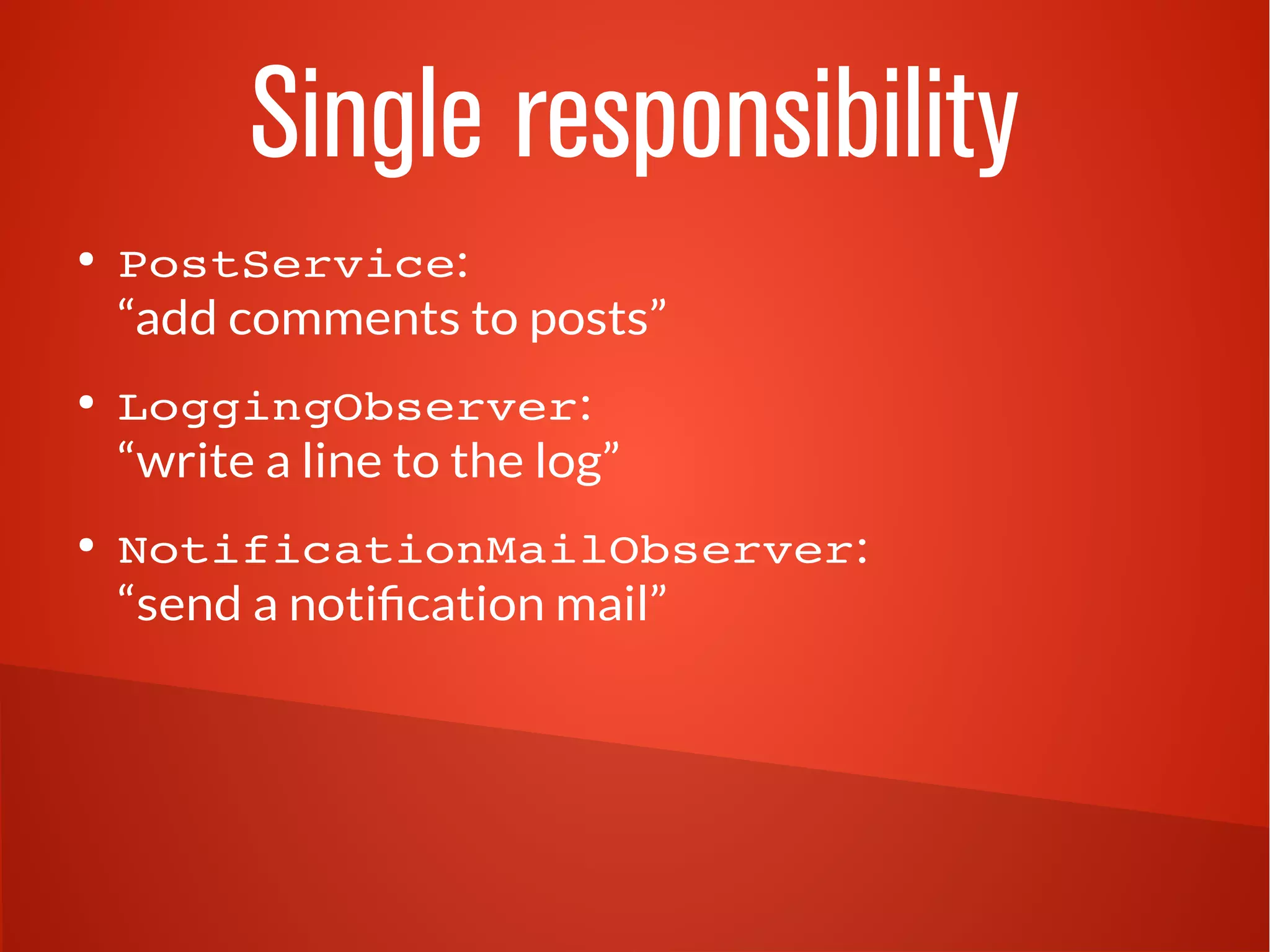
Single responsibility
● PostService:
“add comments to posts”
● LoggingObserver:
“write a line to the log”
● NotificationMailObserver:
“send a notification mail”
Single responsibility
When a change is required, it can be
isolated to just a small part of the
application
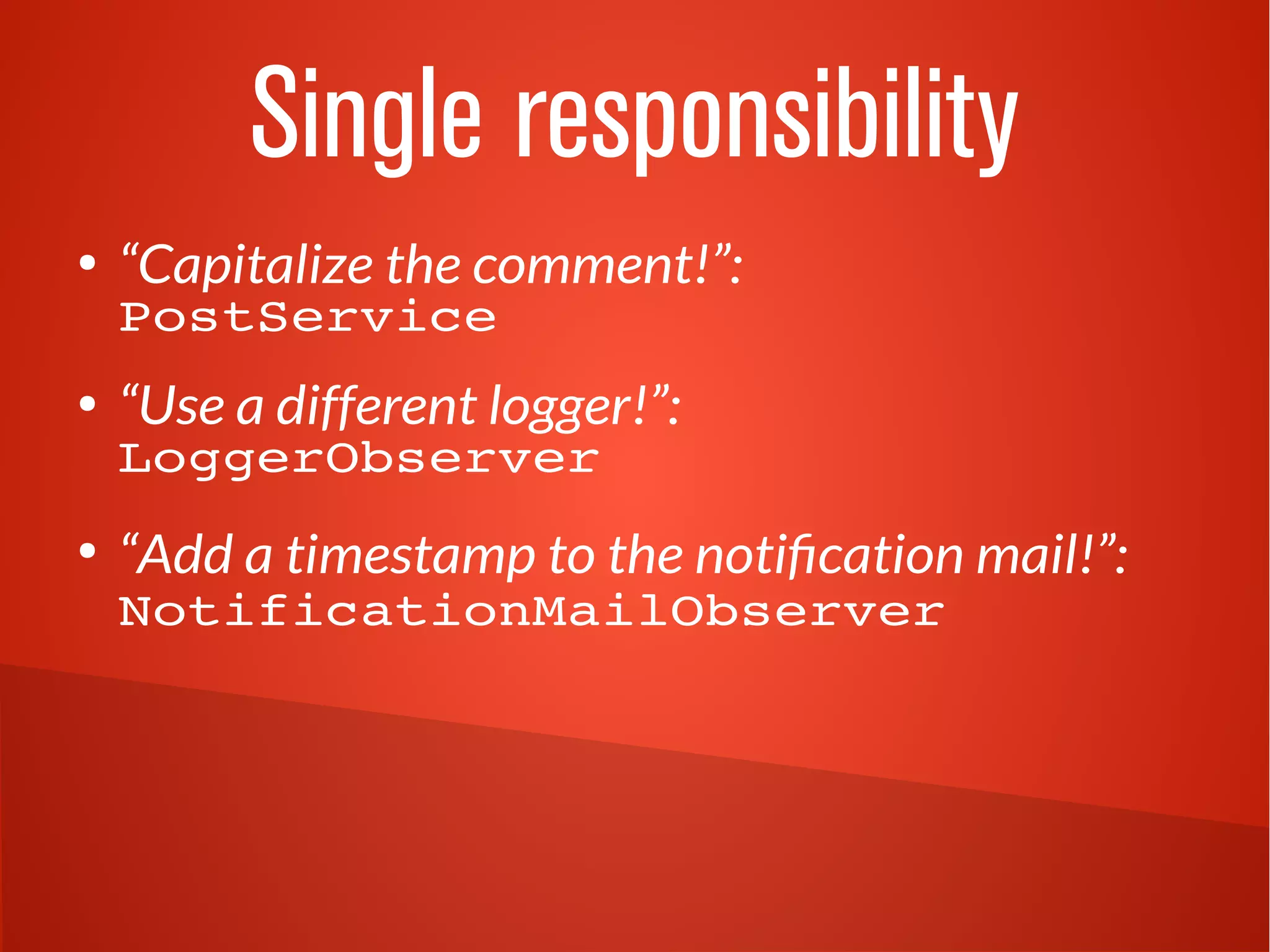
Single responsibility
●
“Capitalize the comment!”:
PostService
●
“Use a different logger!”:
LoggerObserver
●
“Add a timestamp to the notification mail!”:
NotificationMailObserver
Dependency inversion
Depend on abstractions,noton
concretions
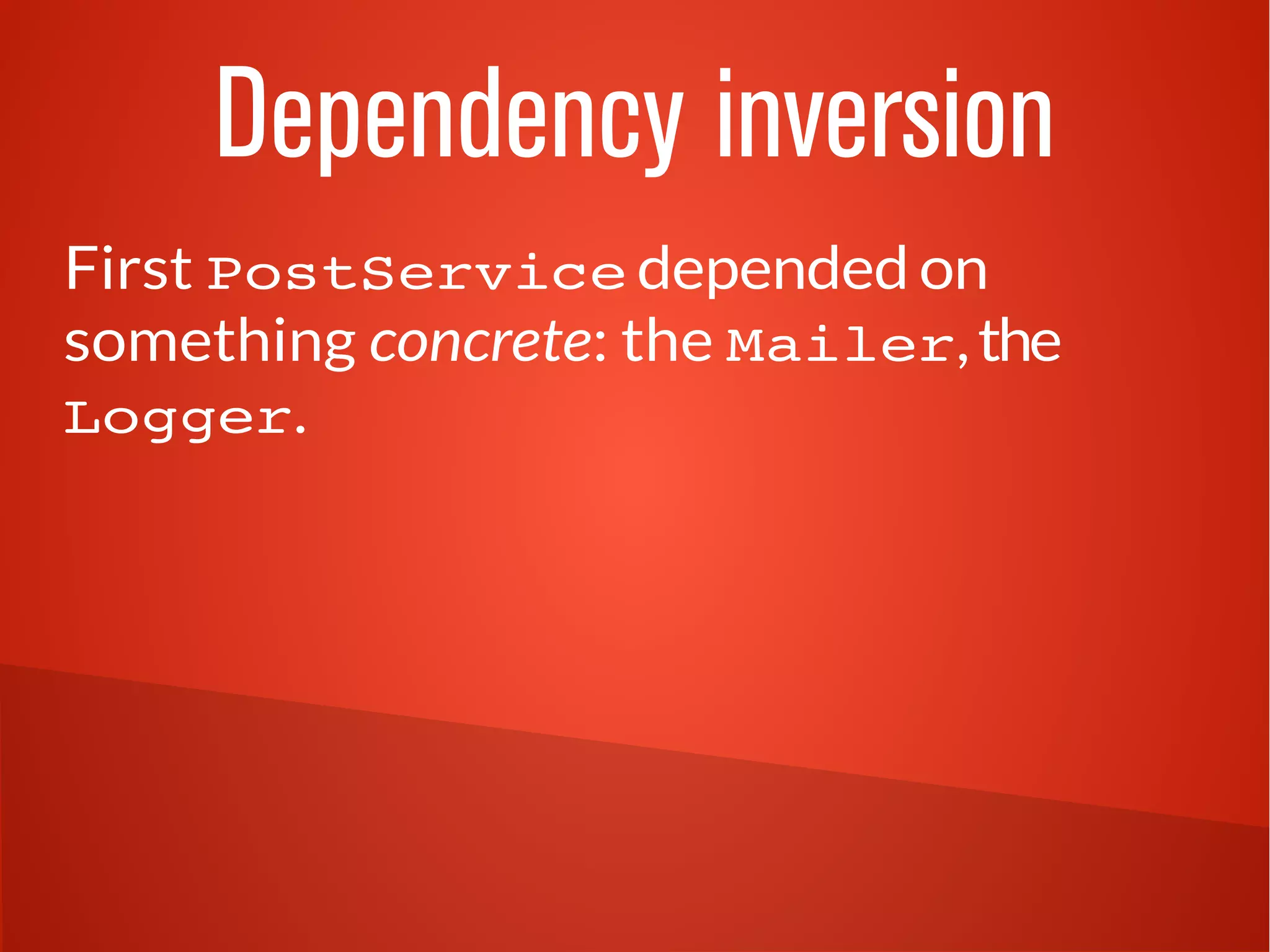
Dependency inversion
First PostService depended on
something concrete: the Mailer,the
Logger.
Mailer
LoggerPostService
Dependency inversion
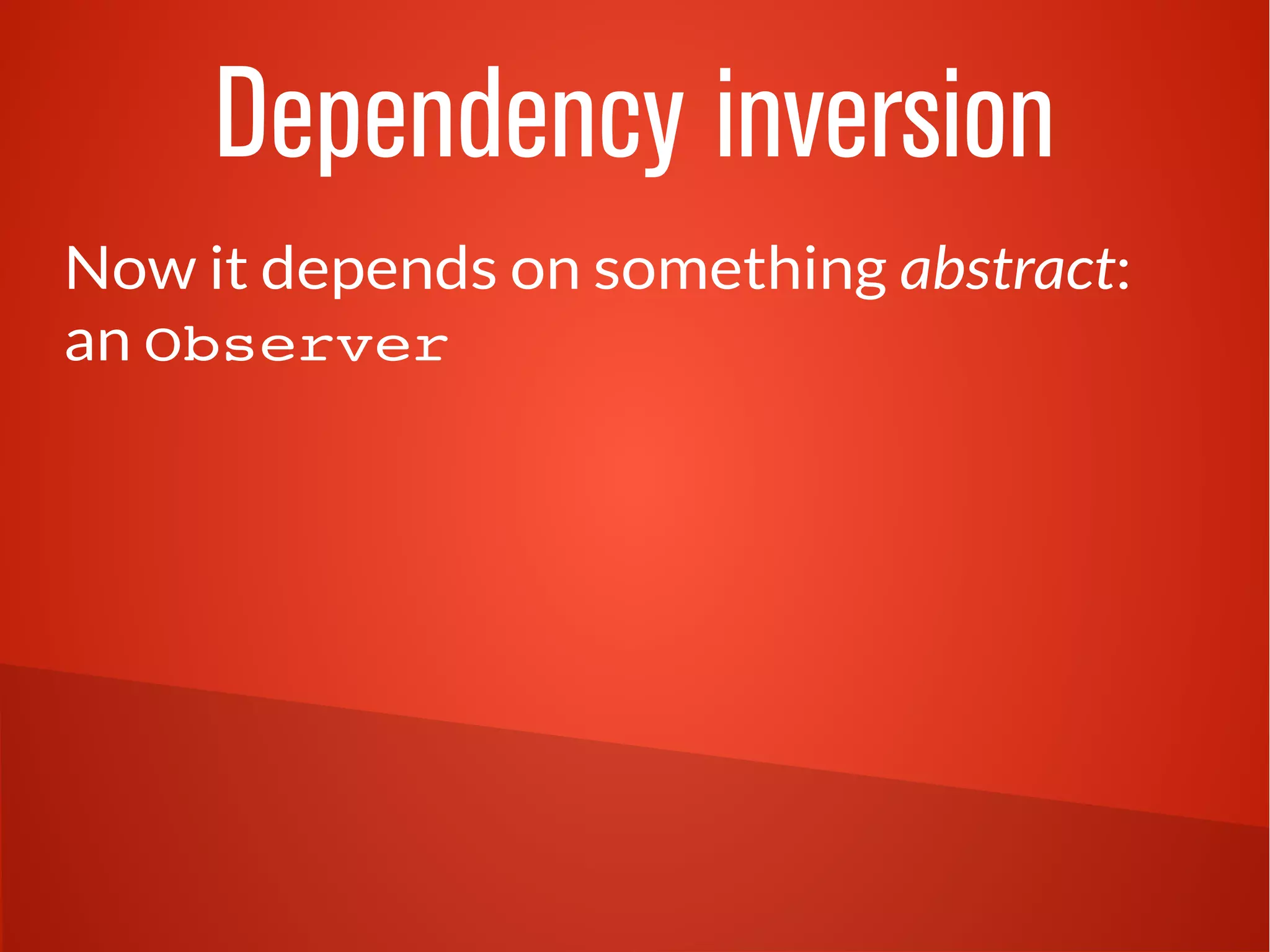
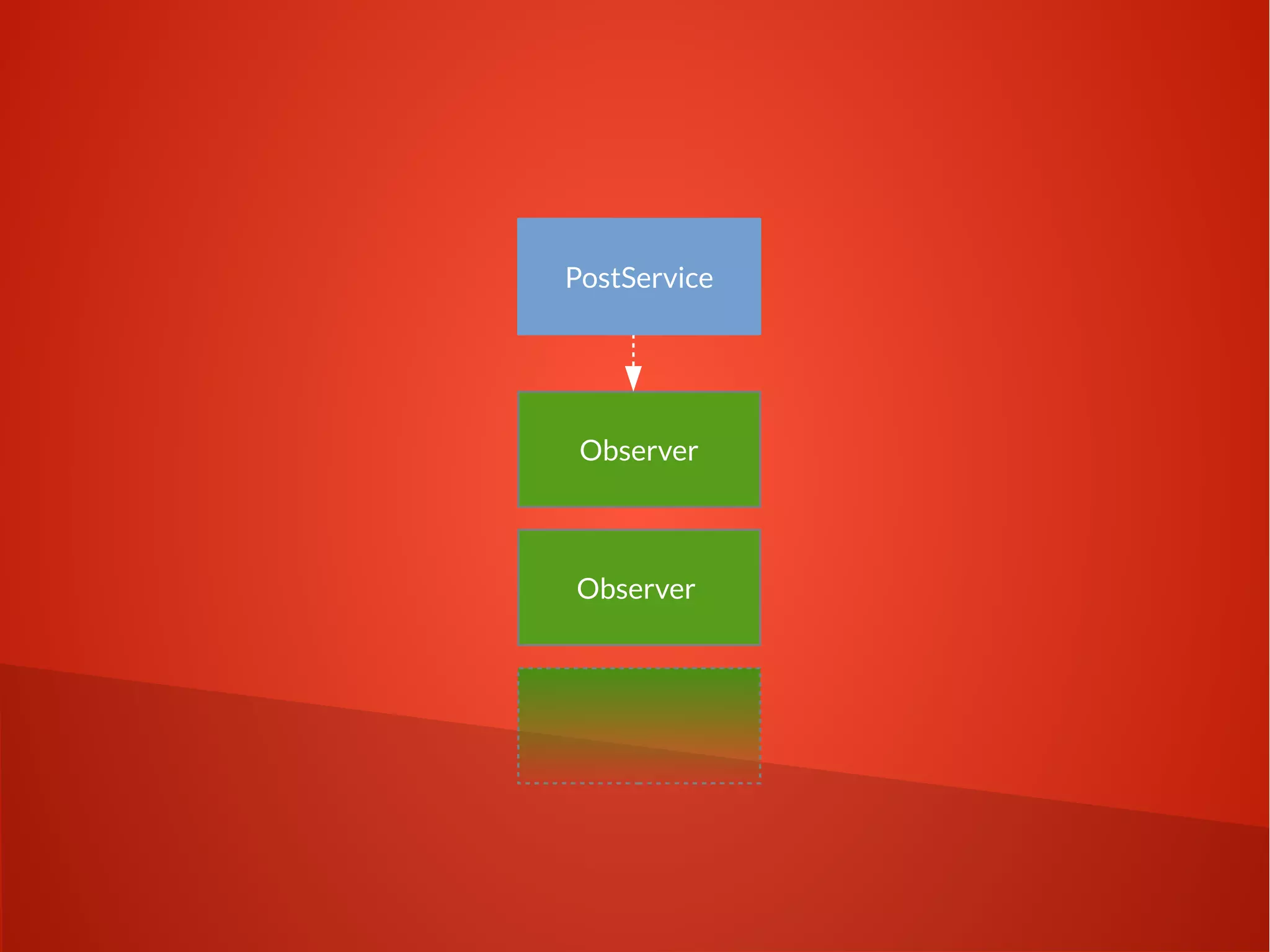
Now it depends on something abstract:
an Observer
Observer
Observer
PostService
Dependency inversion
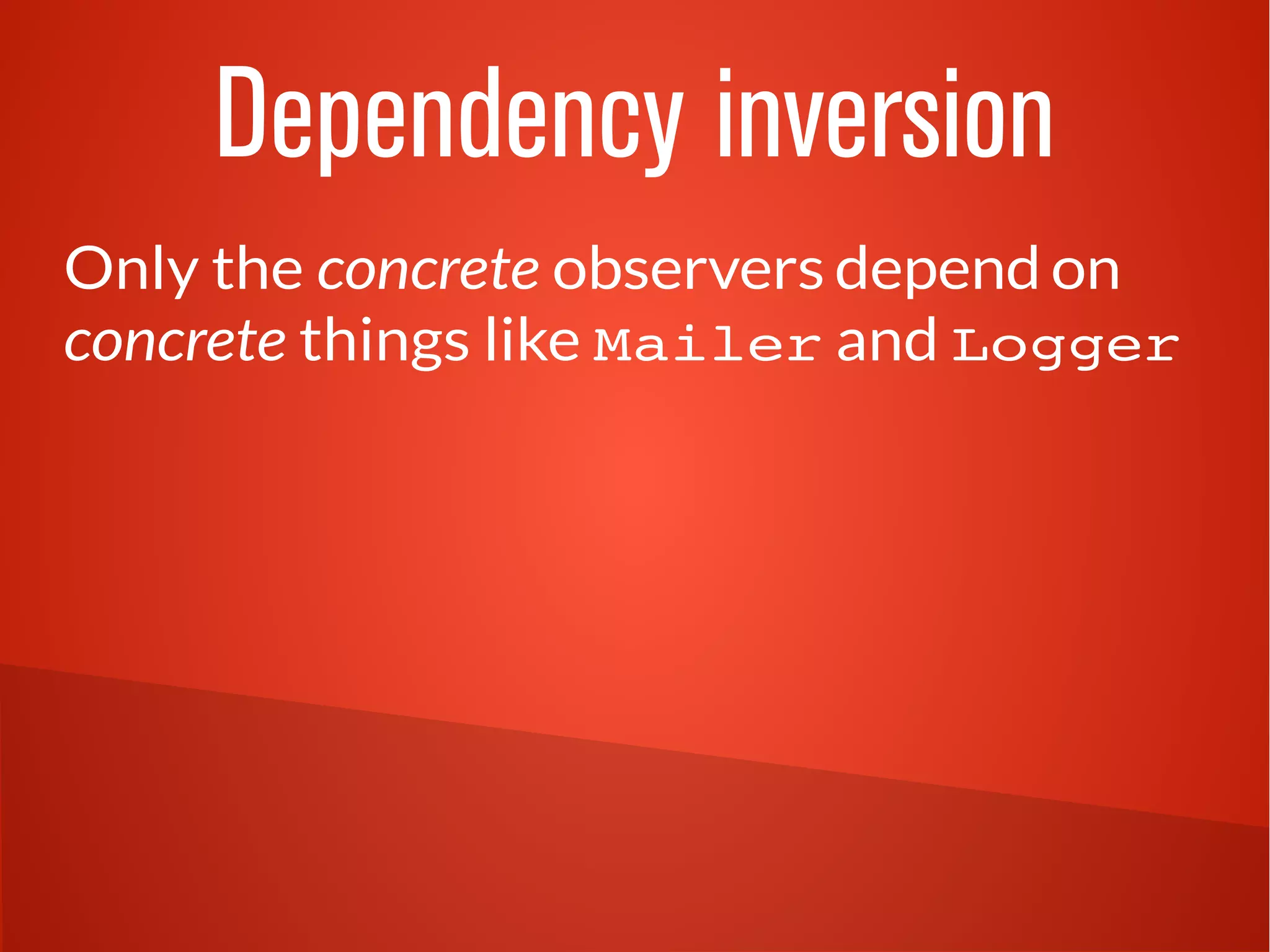
Only the concrete observers depend on
concrete things like Mailer and Logger
NotificationMailObserver
LoggingObserver
Mailer
Logger
Open/closed
A class should be open for extension and
closed for modification
Open/closed
You don't need to modify the class to
change its behavior
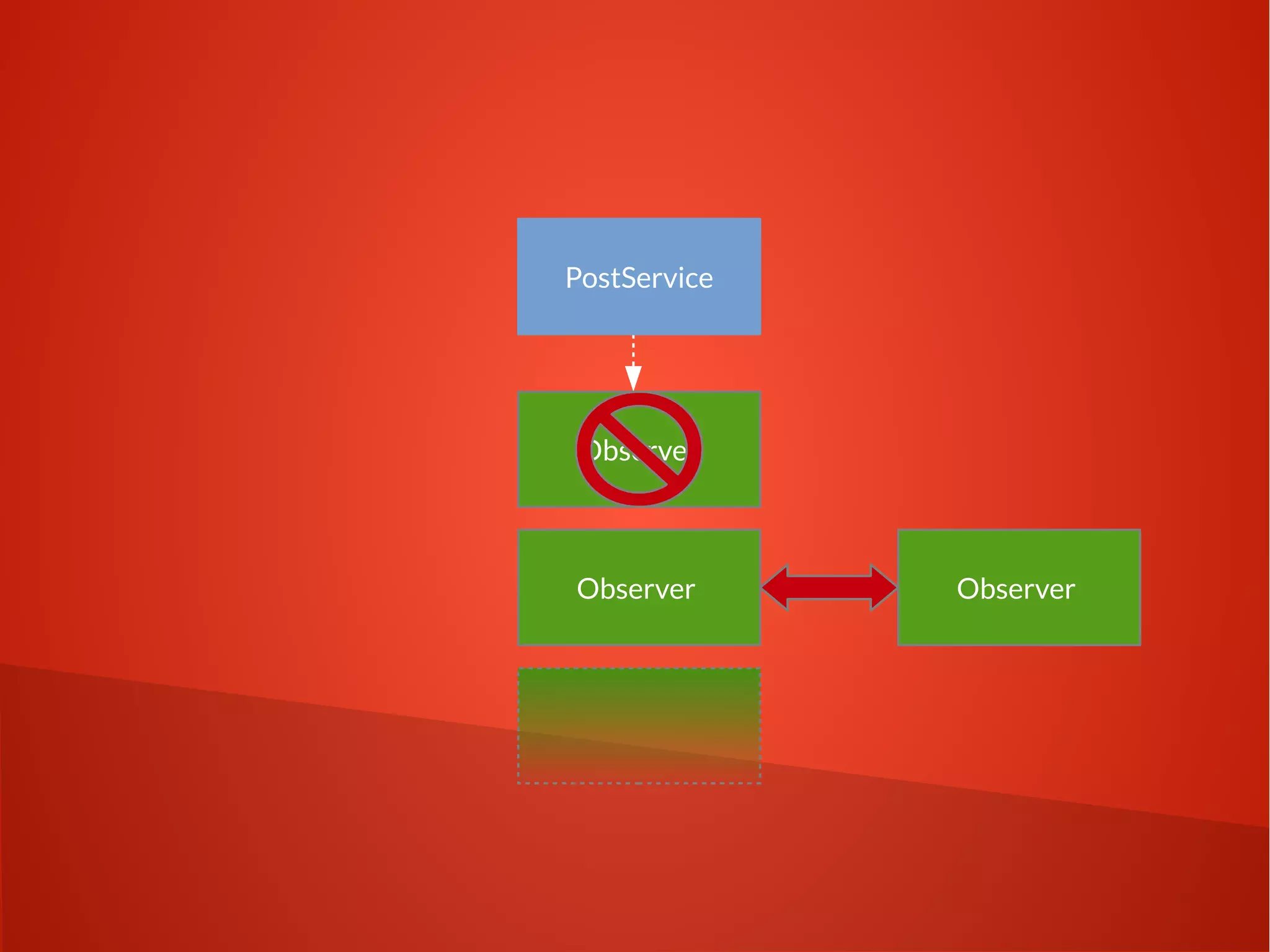
Observer
Observer Observer
PostService
Open/closed
We made it closed for modification,
open for extension
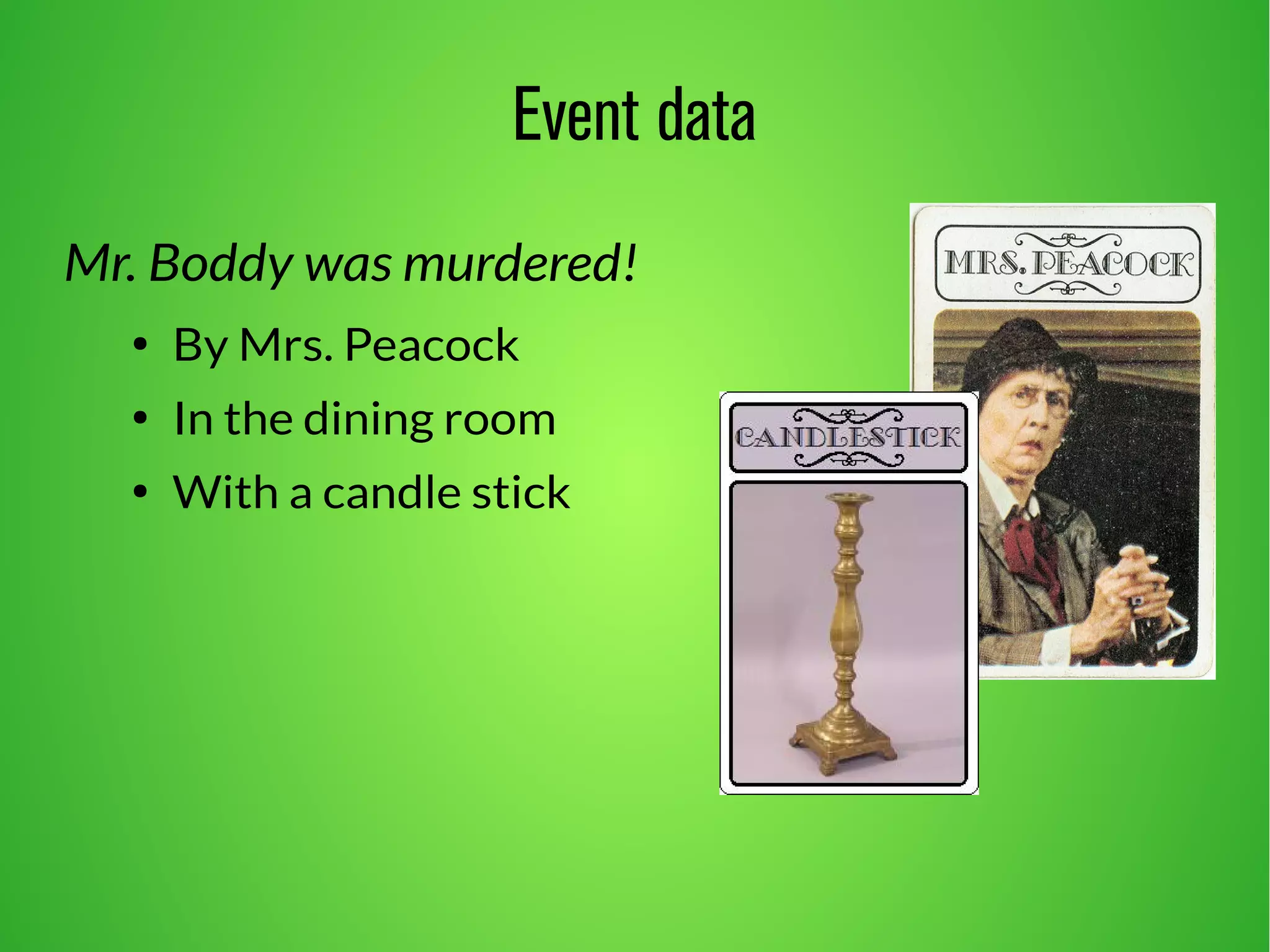
Event data
Mr. Boddy was murdered!
● By Mrs. Peacock
● In the dining room
● With a candle stick
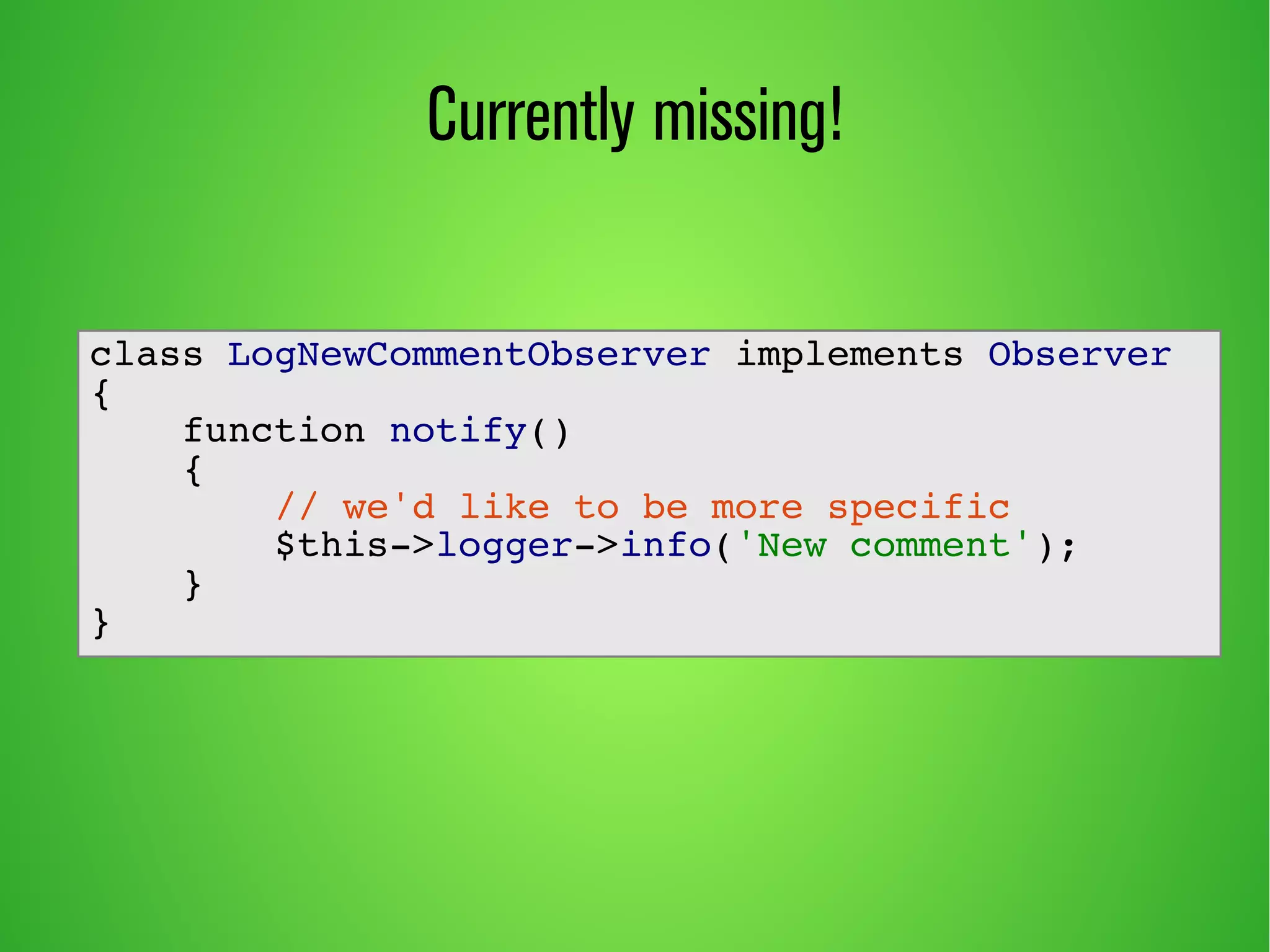
Currently missing!
class LogNewCommentObserver implements Observer
{
function notify()
{
// we'd like to be more specific
$this->logger->info('New comment');
}
}
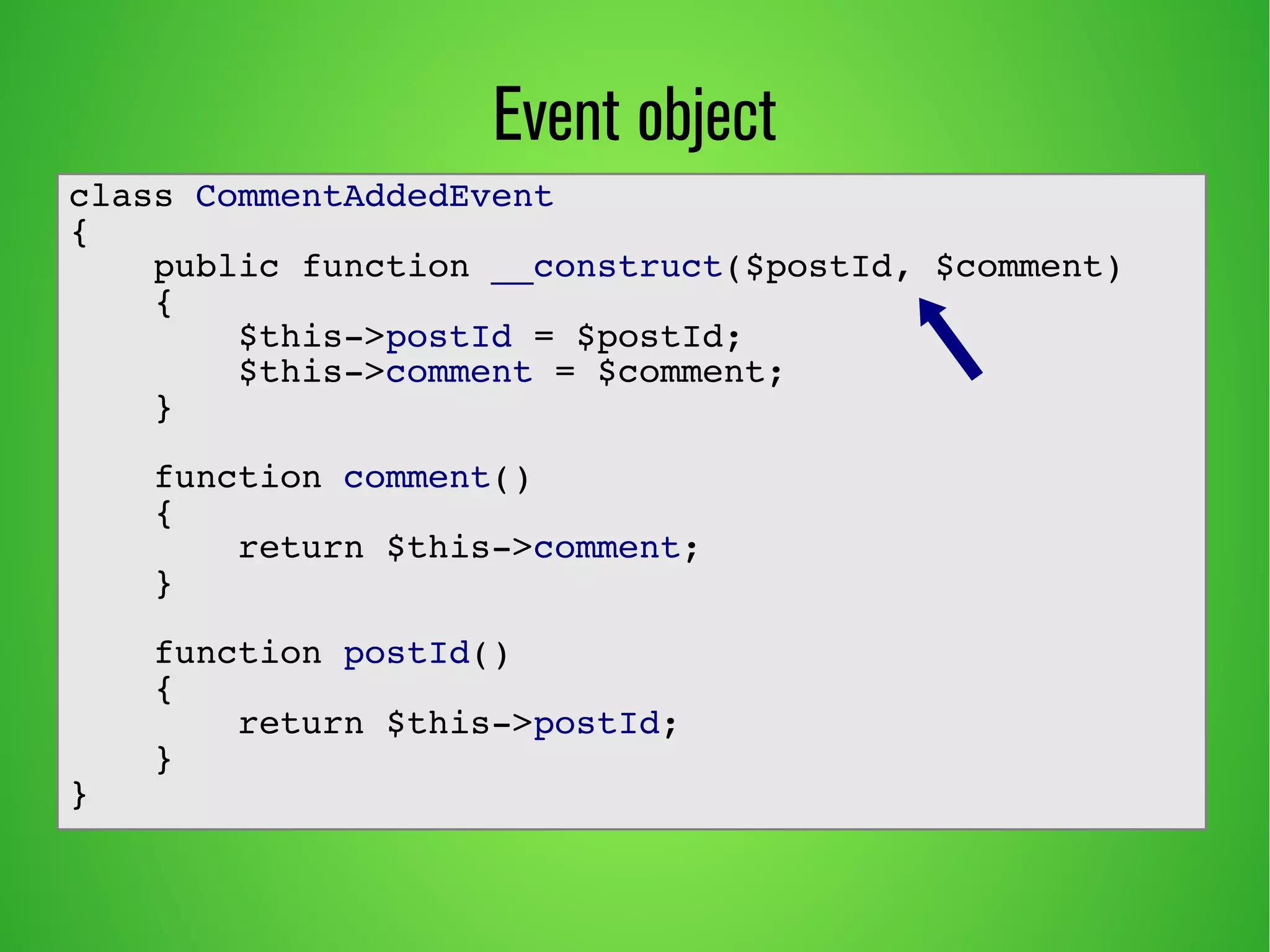
Event object
class CommentAddedEvent
{
public function __construct($postId, $comment)
{
$this->postId = $postId;
$this->comment = $comment;
}
function comment()
{
return $this->comment;
}
function postId()
{
return $this->postId;
}
}
Event object
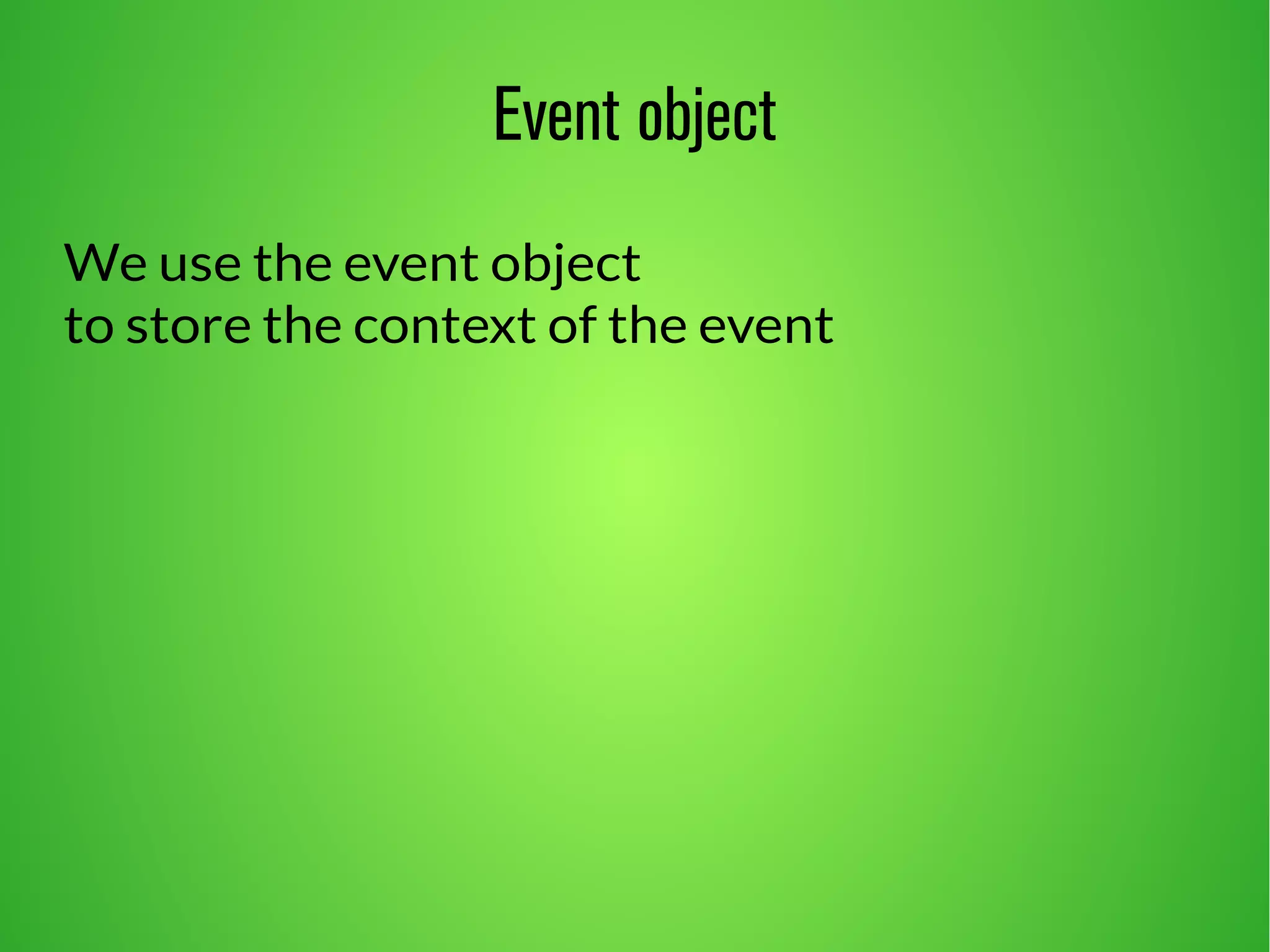
We use the event object
to store the context of the event
From observer...
interface Observer
{
function notify();
}
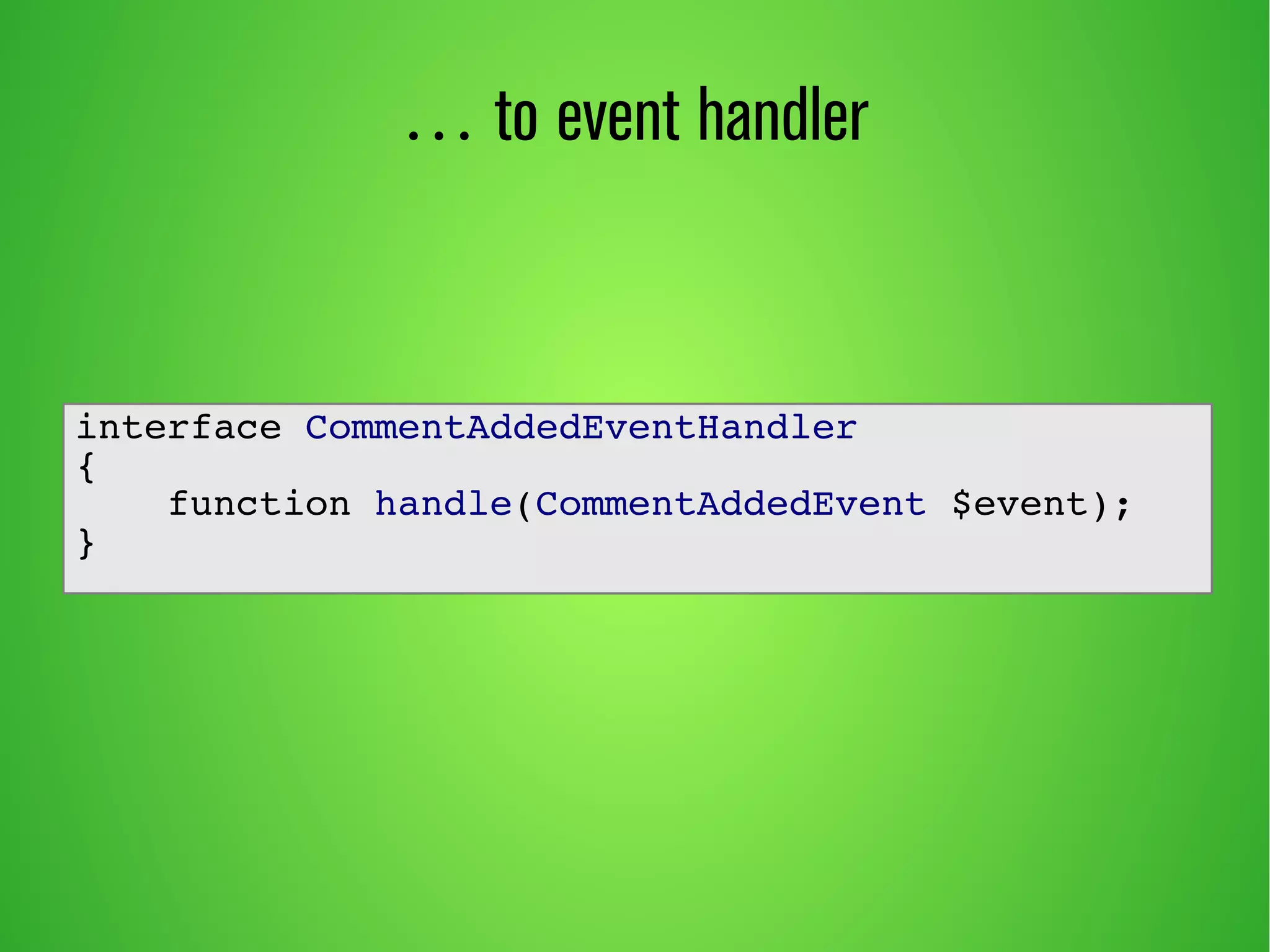
… to event handler
interface CommentAddedEventHandler
{
function handle(CommentAddedEvent $event);
}
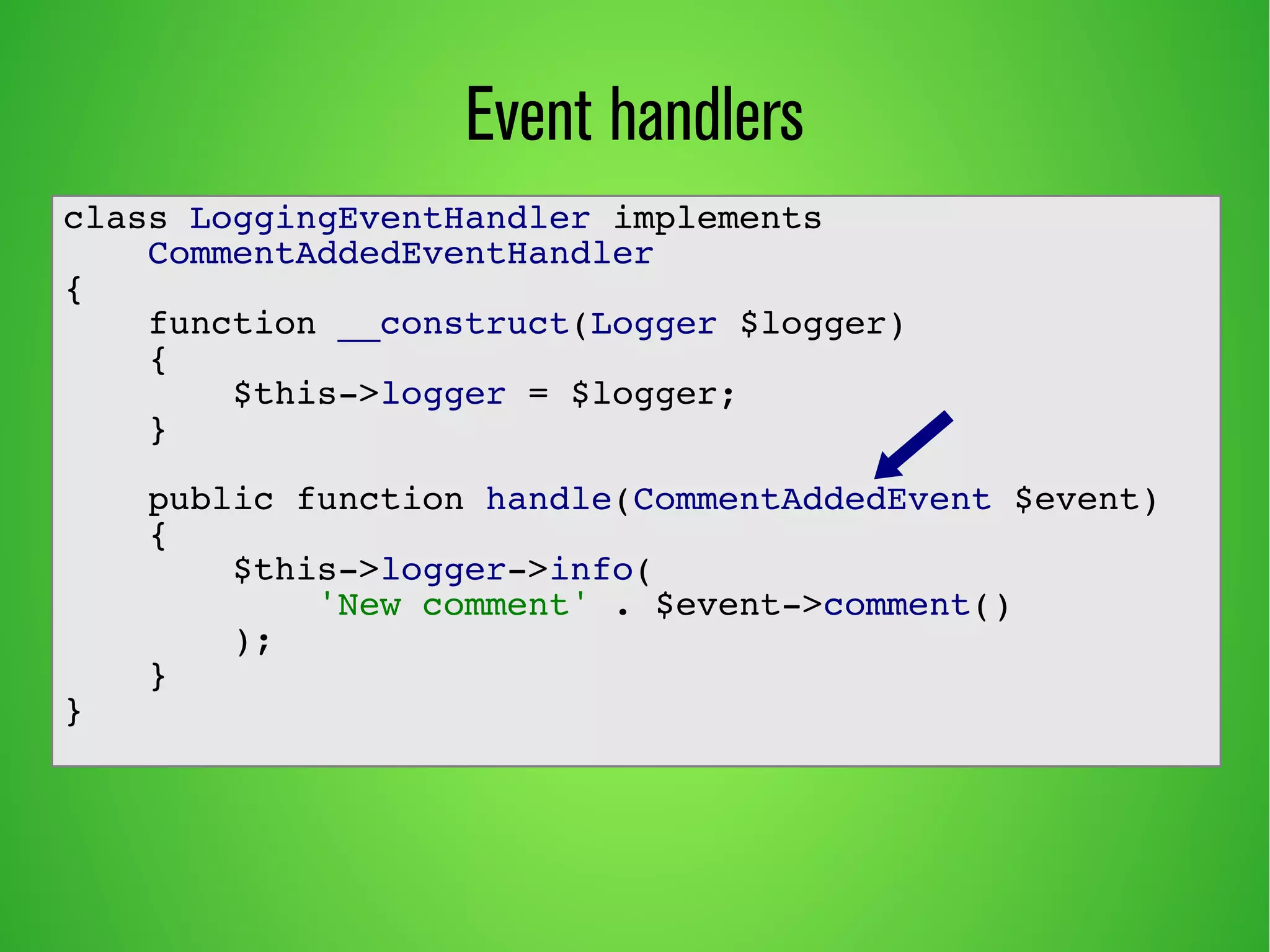
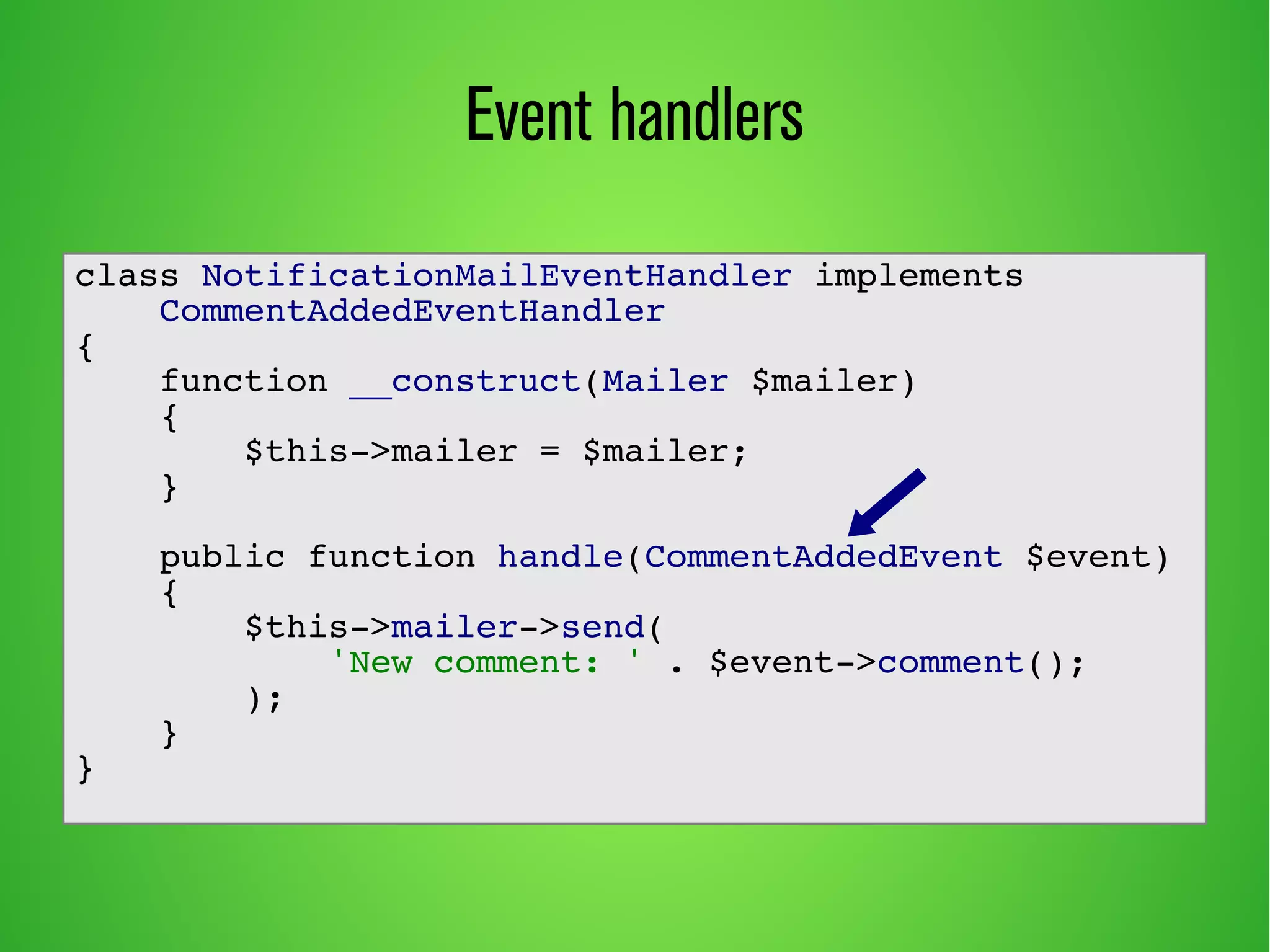
Event handlers
class LoggingEventHandler implements
CommentAddedEventHandler
{
function __construct(Logger $logger)
{
$this->logger = $logger;
}
public function handle(CommentAddedEvent $event)
{
$this->logger->info(
'New comment' . $event->comment()
);
}
}
Event handlers
class NotificationMailEventHandler implements
CommentAddedEventHandler
{
function __construct(Mailer $mailer)
{
$this->mailer = $mailer;
}
public function handle(CommentAddedEvent $event)
{
$this->mailer->send(
'New comment: ' . $event->comment();
);
}
}
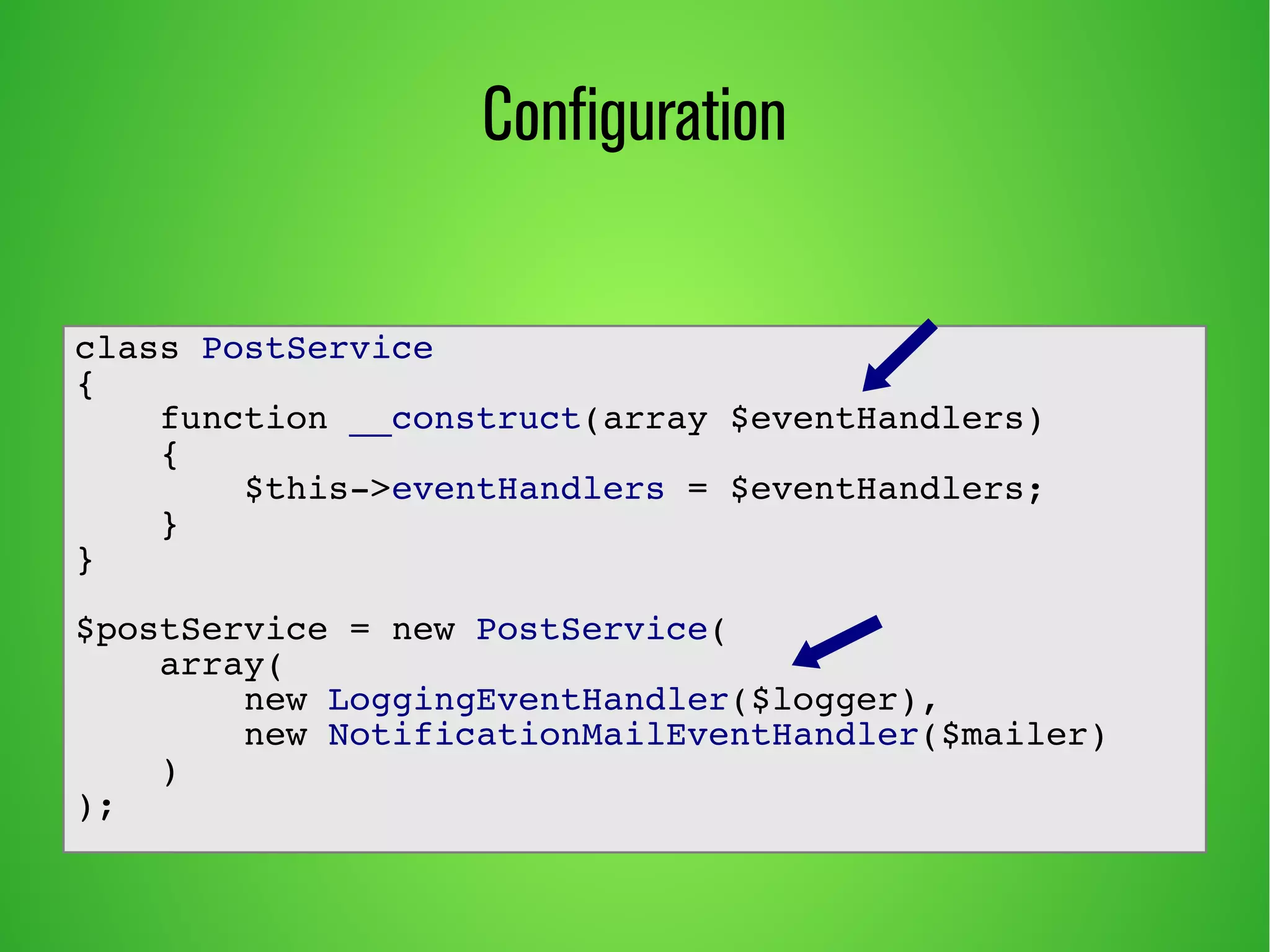
Configuration
class PostService
{
function __construct(array $eventHandlers)
{
$this->eventHandlers = $eventHandlers;
}
}
$postService = new PostService(
array(
new LoggingEventHandler($logger),
new NotificationMailEventHandler($mailer)
)
);
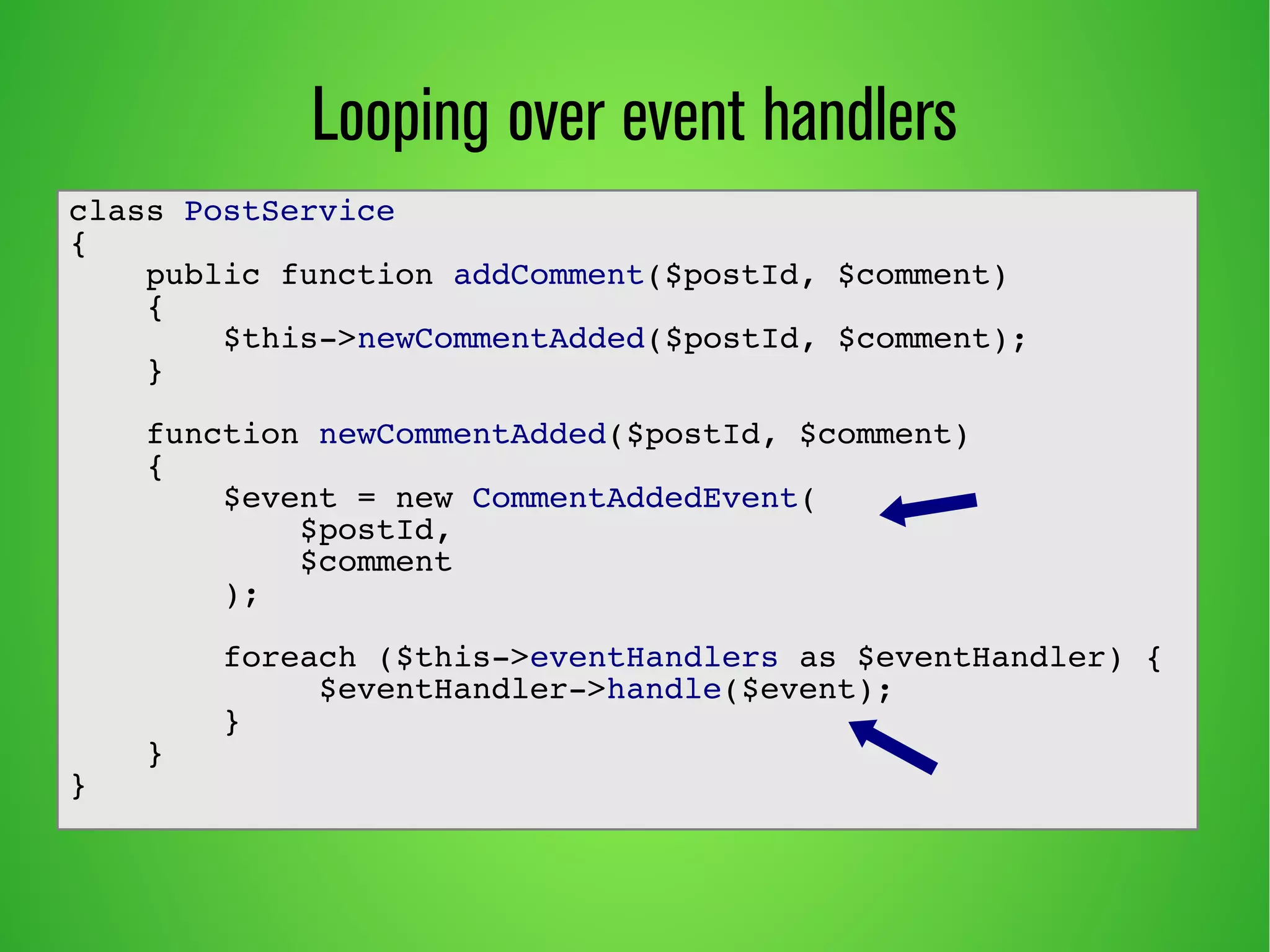
Looping over event handlers
class PostService
{
public function addComment($postId, $comment)
{
$this->newCommentAdded($postId, $comment);
}
function newCommentAdded($postId, $comment)
{
$event = new CommentAddedEvent(
$postId,
$comment
);
foreach ($this->eventHandlers as $eventHandler) {
$eventHandler->handle($event);
}
}
}
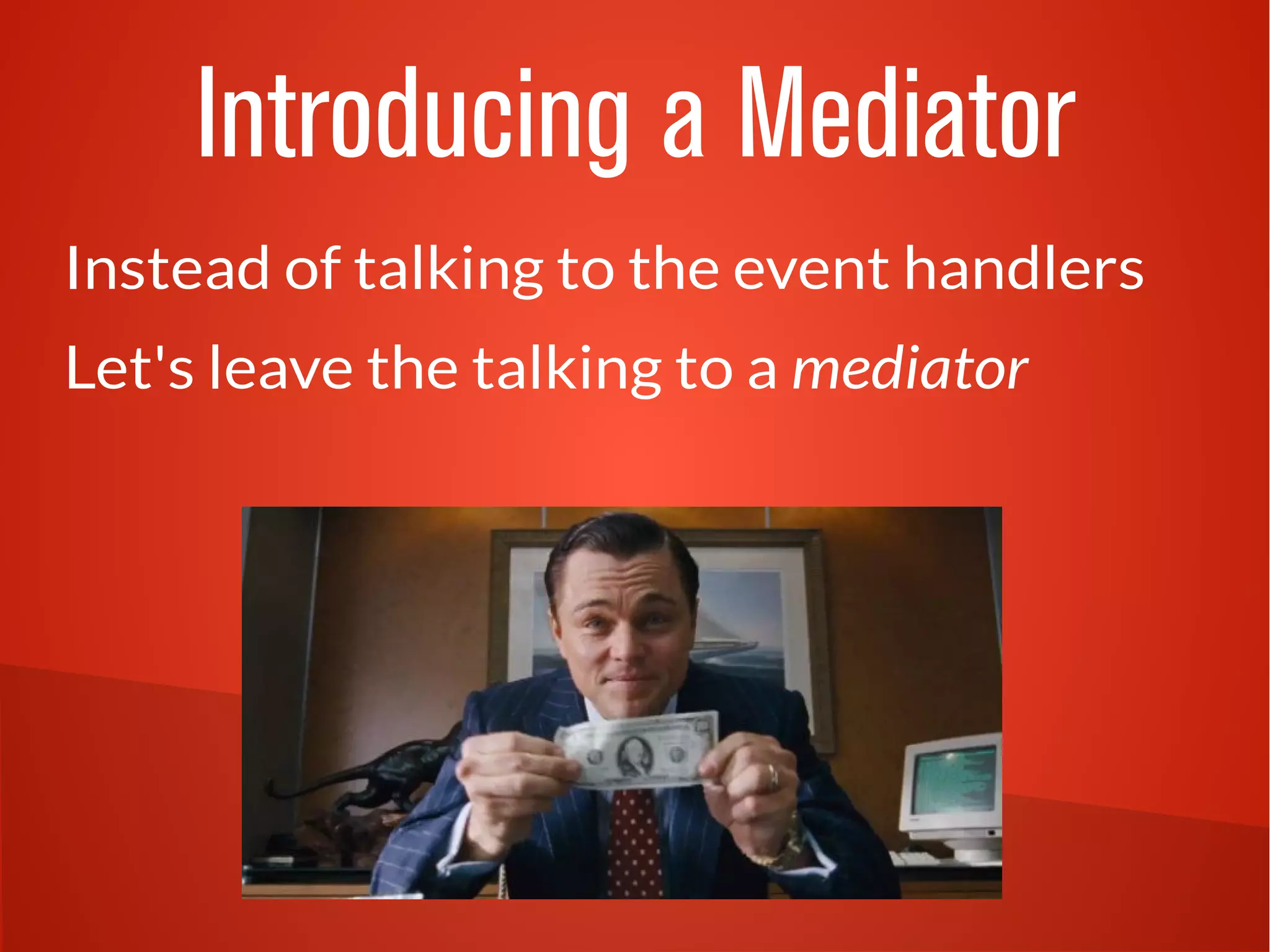
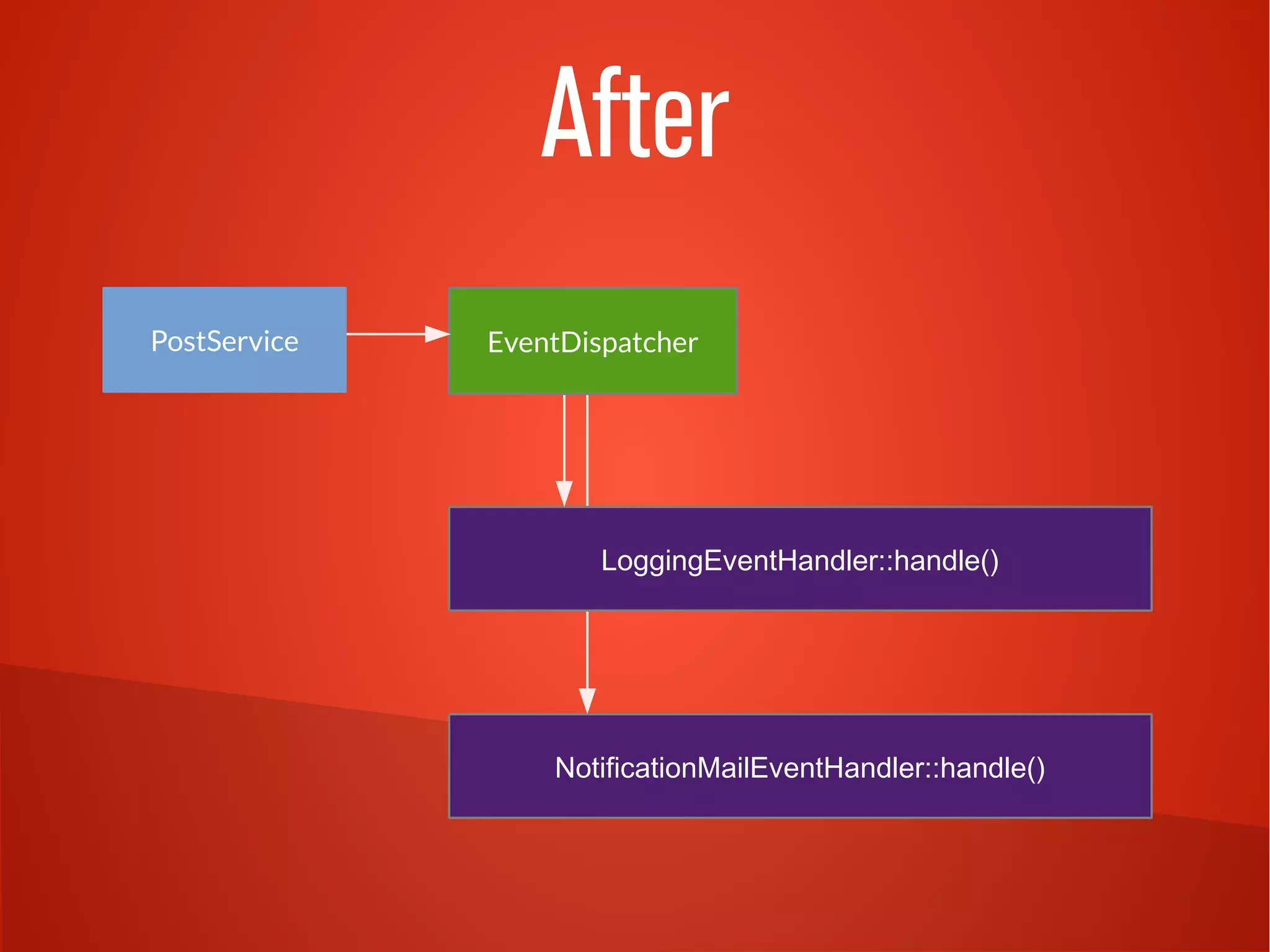
Introducing a Mediator
Instead of talking to the event handlers
Let's leave the talking to a mediator
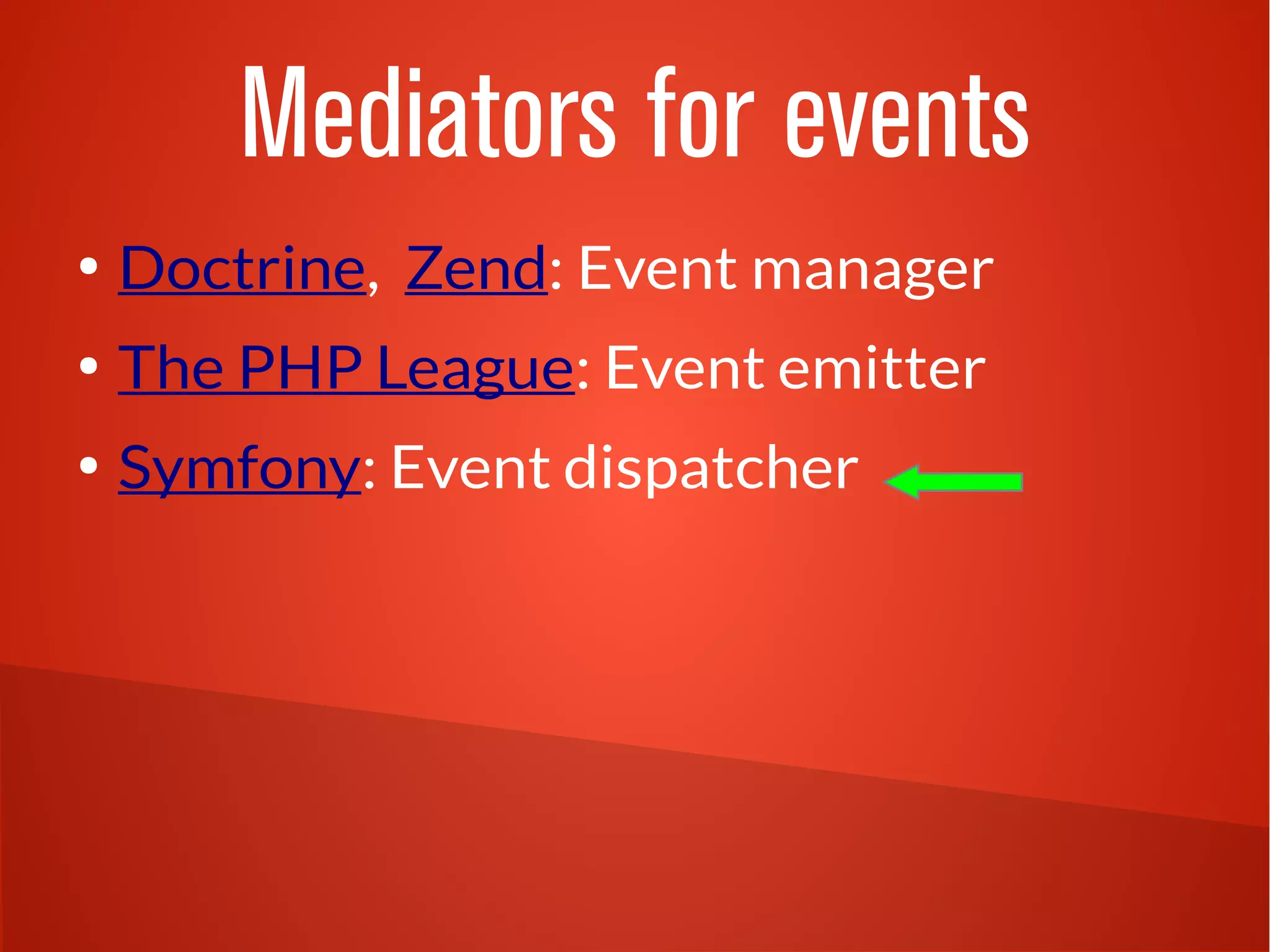
Mediators for events
●
Doctrine, Zend: Event manager
●
The PHP League: Event emitter
●
Symfony: Event dispatcher
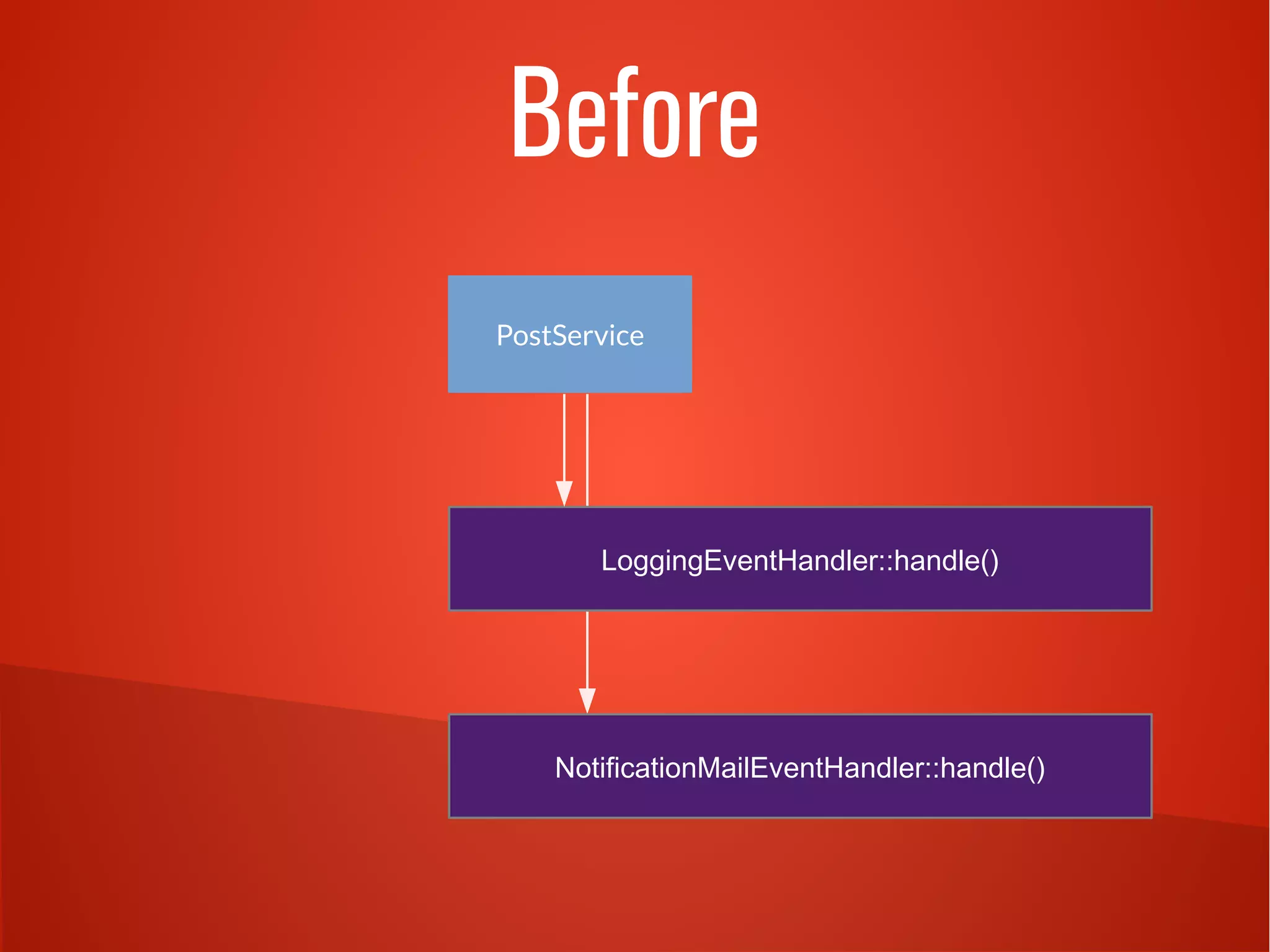
Before
LoggingEventHandler::handle()
NotificationMailEventHandler::handle()
PostService
After
LoggingEventHandler::handle()
NotificationMailEventHandler::handle()
EventDispatcherPostService
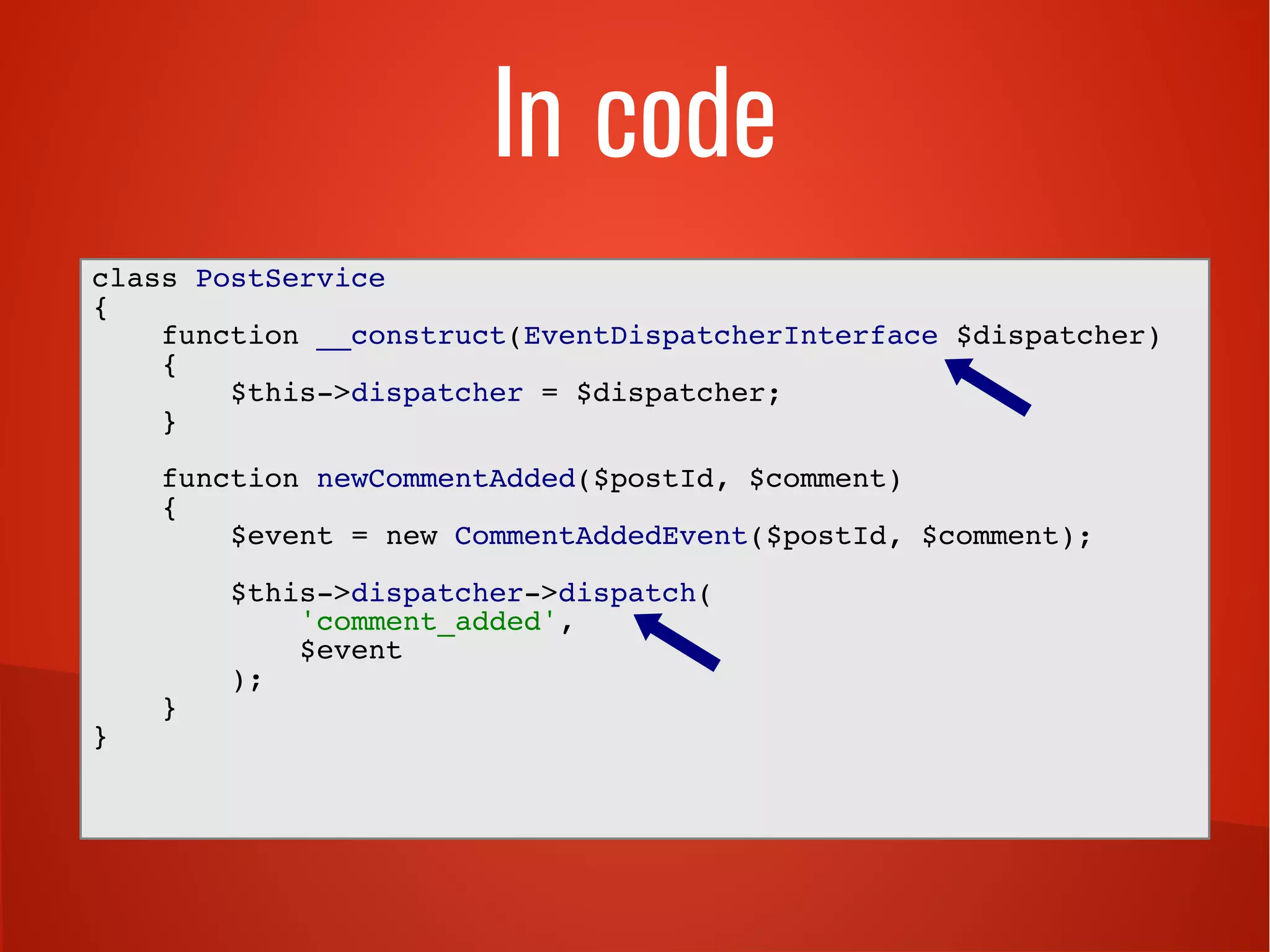
In code
class PostService
{
function __construct(EventDispatcherInterface $dispatcher)
{
$this->dispatcher = $dispatcher;
}
function newCommentAdded($postId, $comment)
{
$event = new CommentAddedEvent($postId, $comment);
$this->dispatcher->dispatch(
'comment_added',
$event
);
}
}
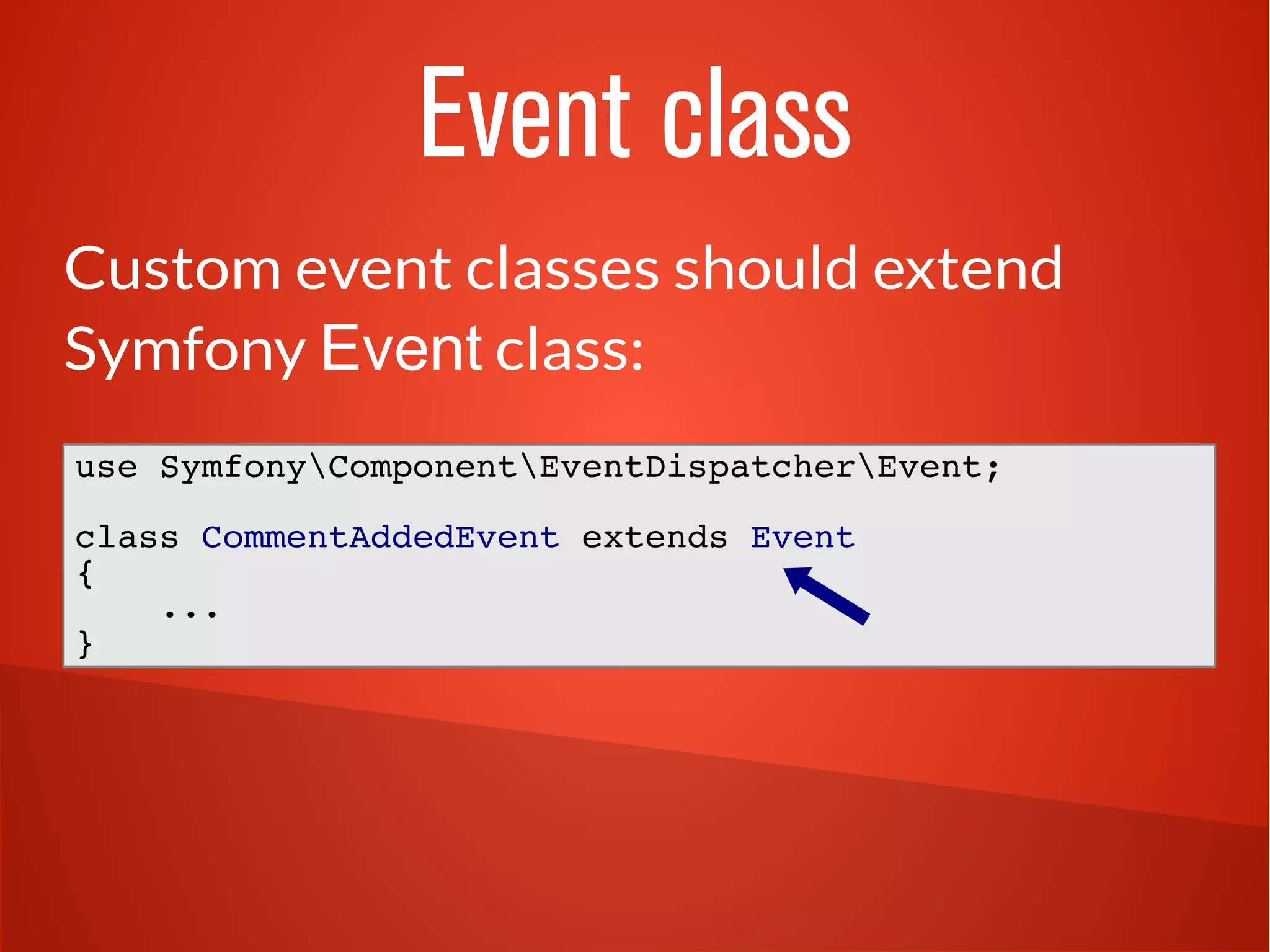
Event class
use SymfonyComponentEventDispatcherEvent;
class CommentAddedEvent extends Event
{
...
}
Custom event classes should extend
Symfony Event class:
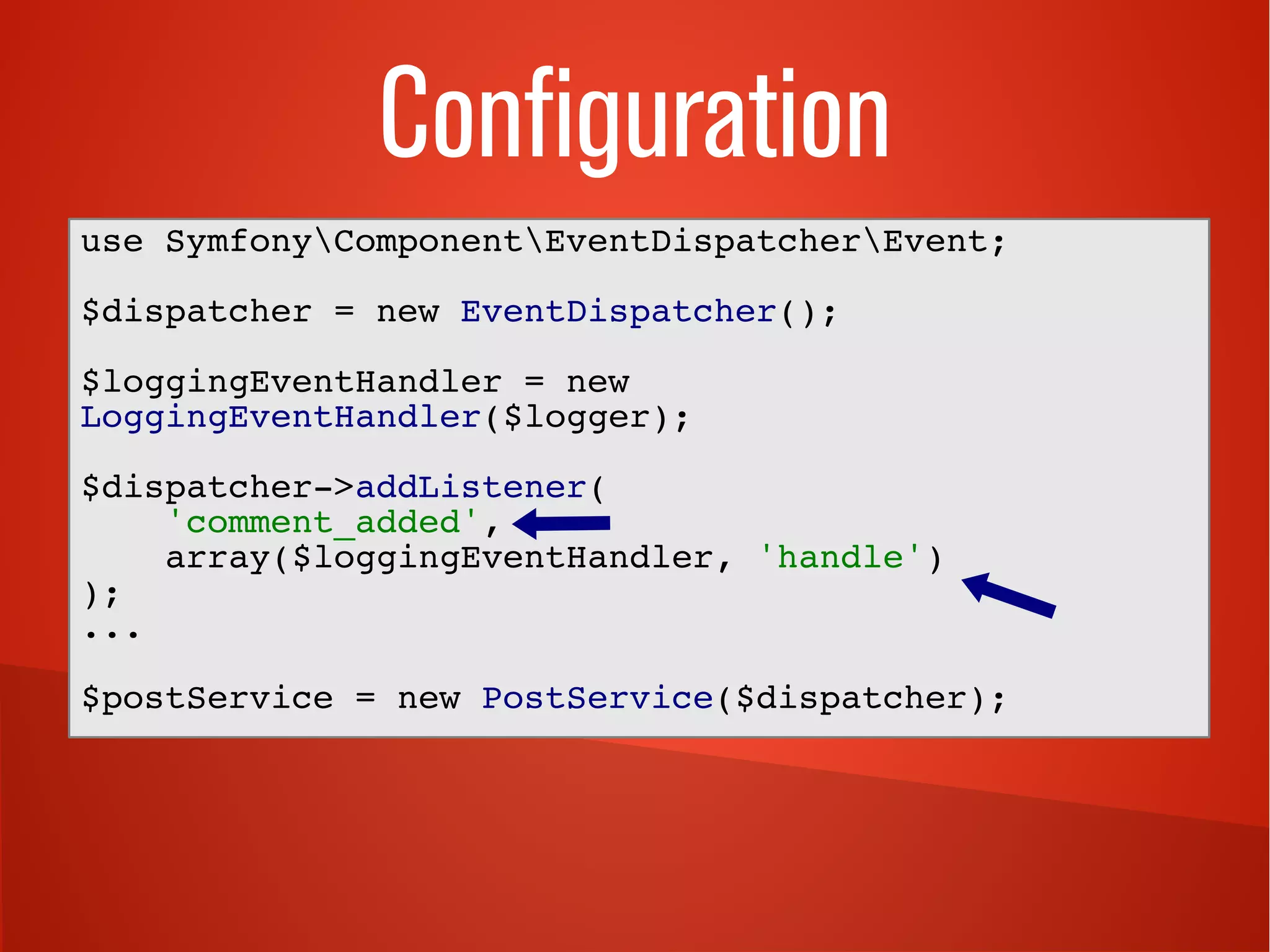
Configuration
use SymfonyComponentEventDispatcherEvent;
$dispatcher = new EventDispatcher();
$loggingEventHandler = new
LoggingEventHandler($logger);
$dispatcher->addListener(
'comment_added',
array($loggingEventHandler, 'handle')
);
...
$postService = new PostService($dispatcher);
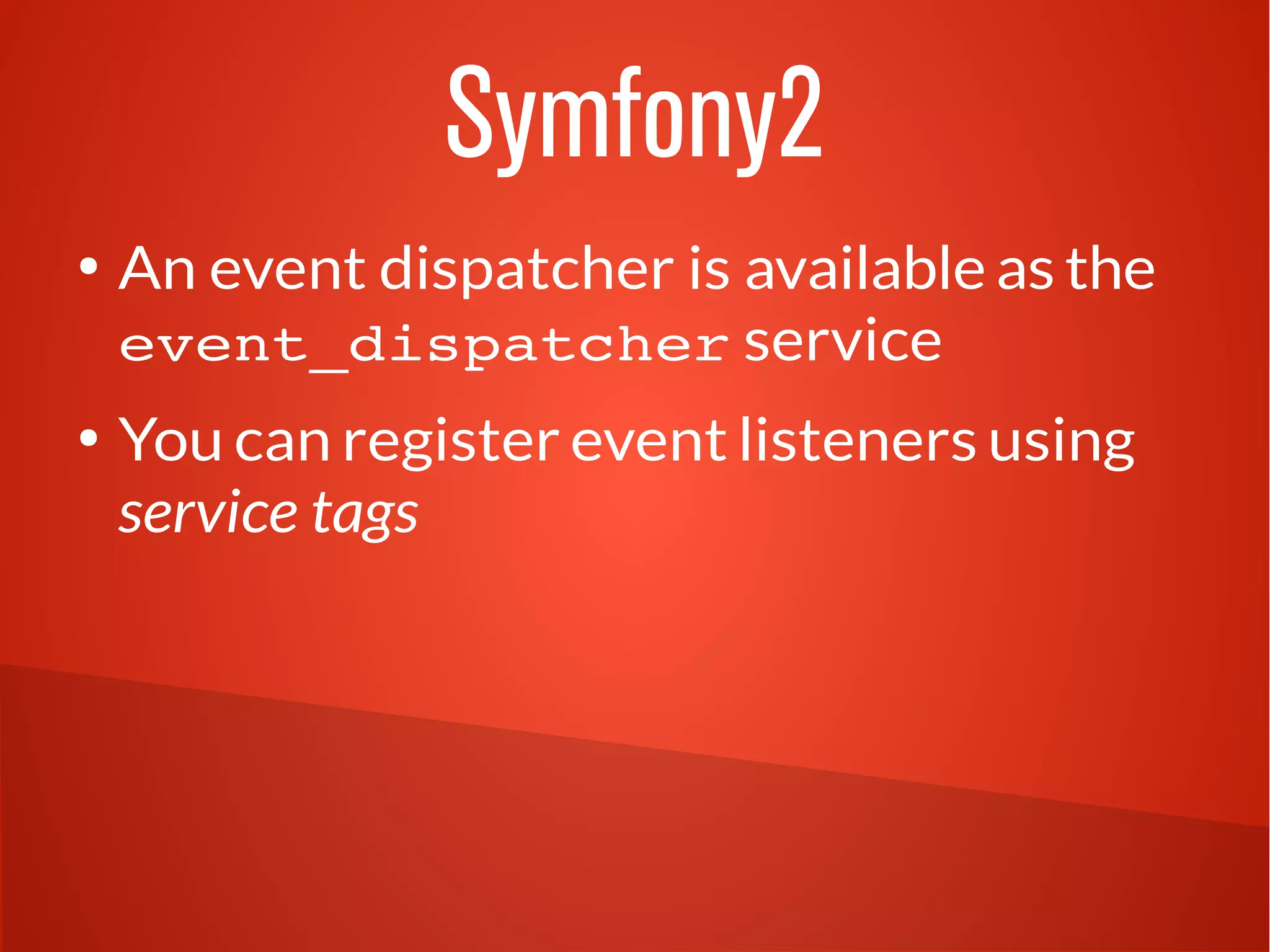
Symfony2
●
An event dispatcher is available as the
event_dispatcher service
●
You can register event listeners using
service tags
Inject the event dispatcher
# services.yml
services:
post_service:
class: PostService
arguments: [@event_dispatcher]
Register your listeners
# services.yml
services:
...
logging_event_handler:
class: LoggingEventHandler
arguments: [@logger]
tags:
- {
name: kernel.event_listener
event: comment_added
method: handle
}
Events and application flow
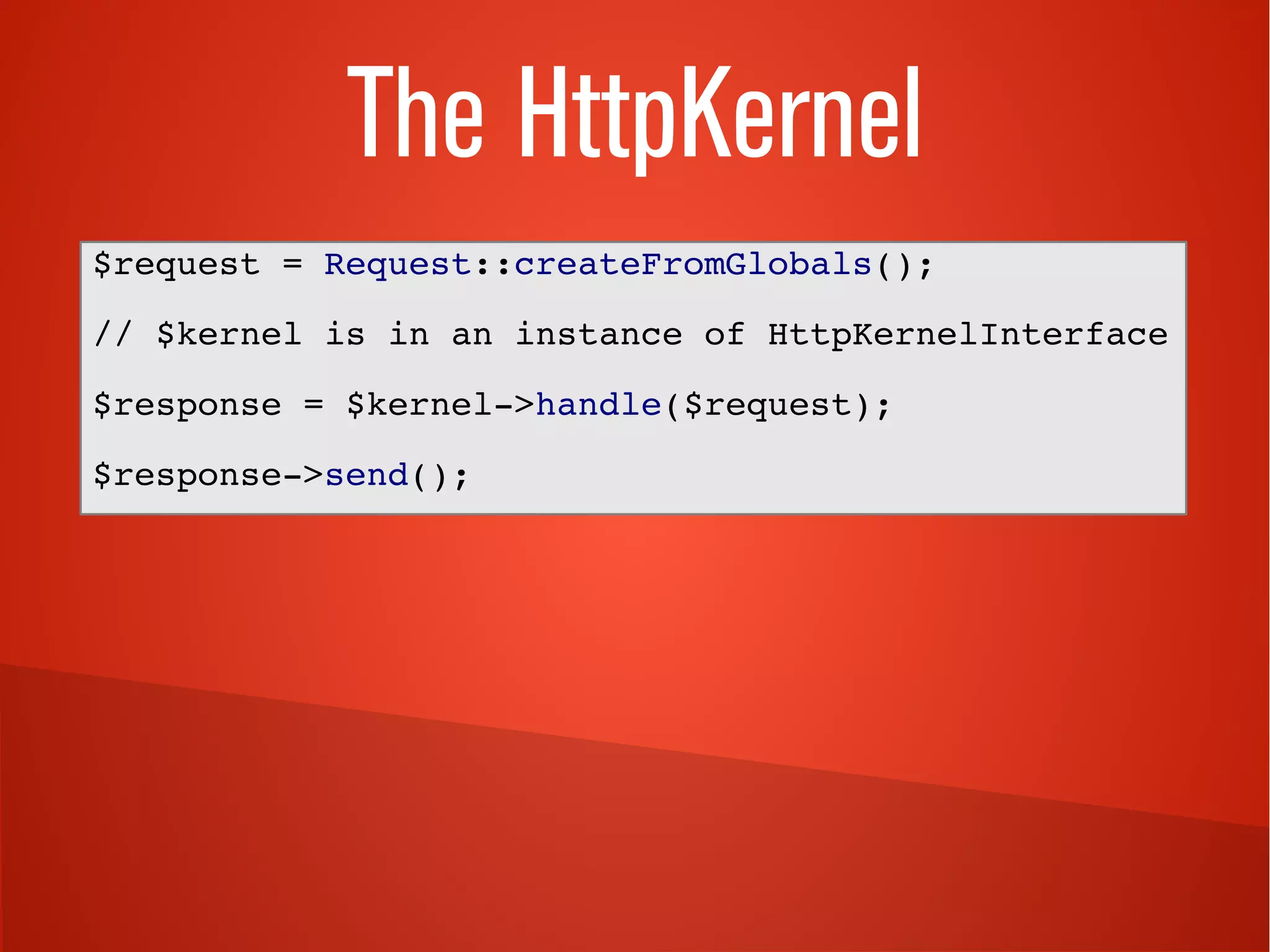
Symfony2 uses events to generate
response for any given HTTP request
The HttpKernel
$request = Request::createFromGlobals();
// $kernel is in an instance of HttpKernelInterface
$response = $kernel->handle($request);
$response->send();
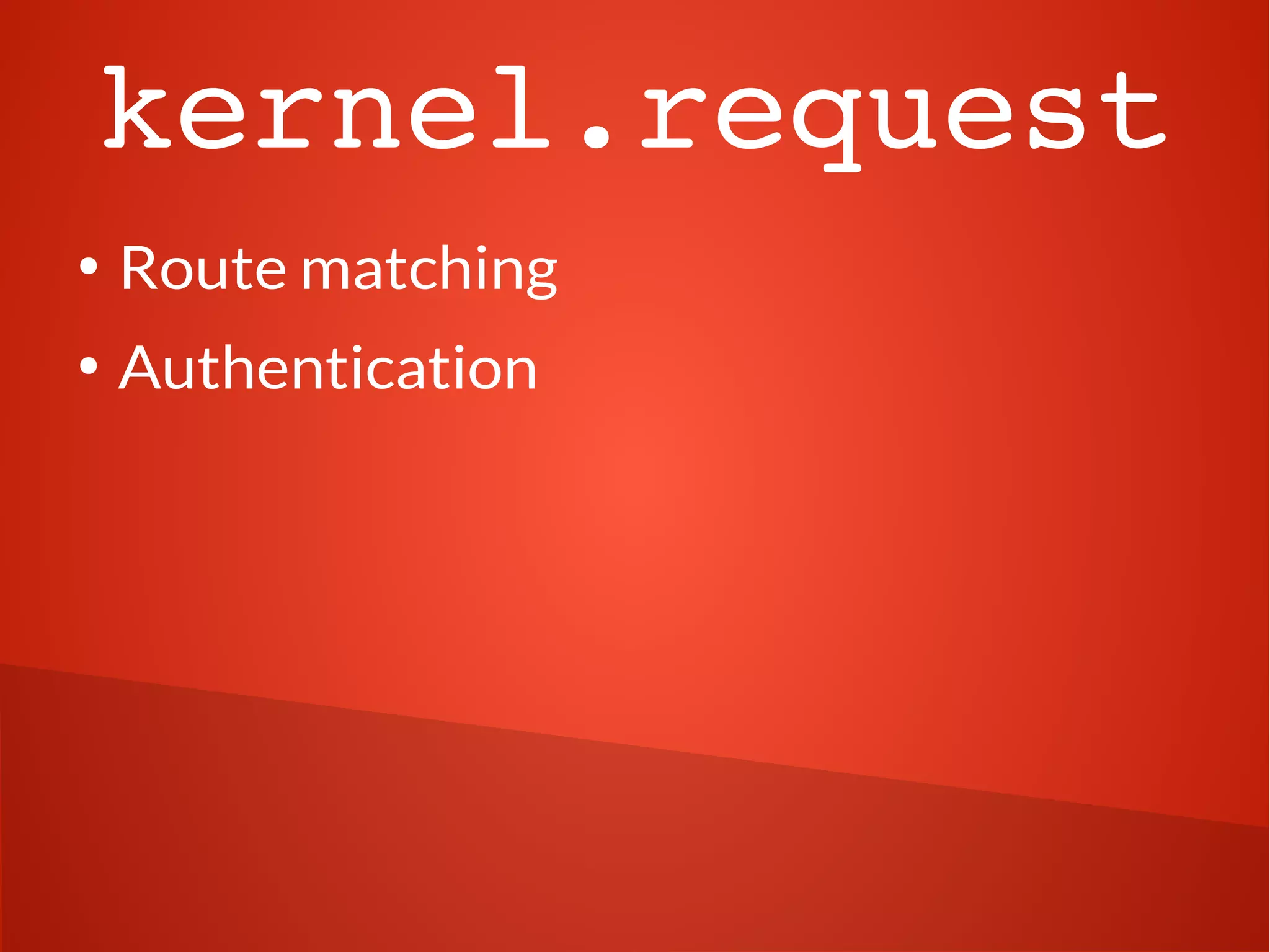
Kernel events
kernel.request
●
Route matching
●
Authentication
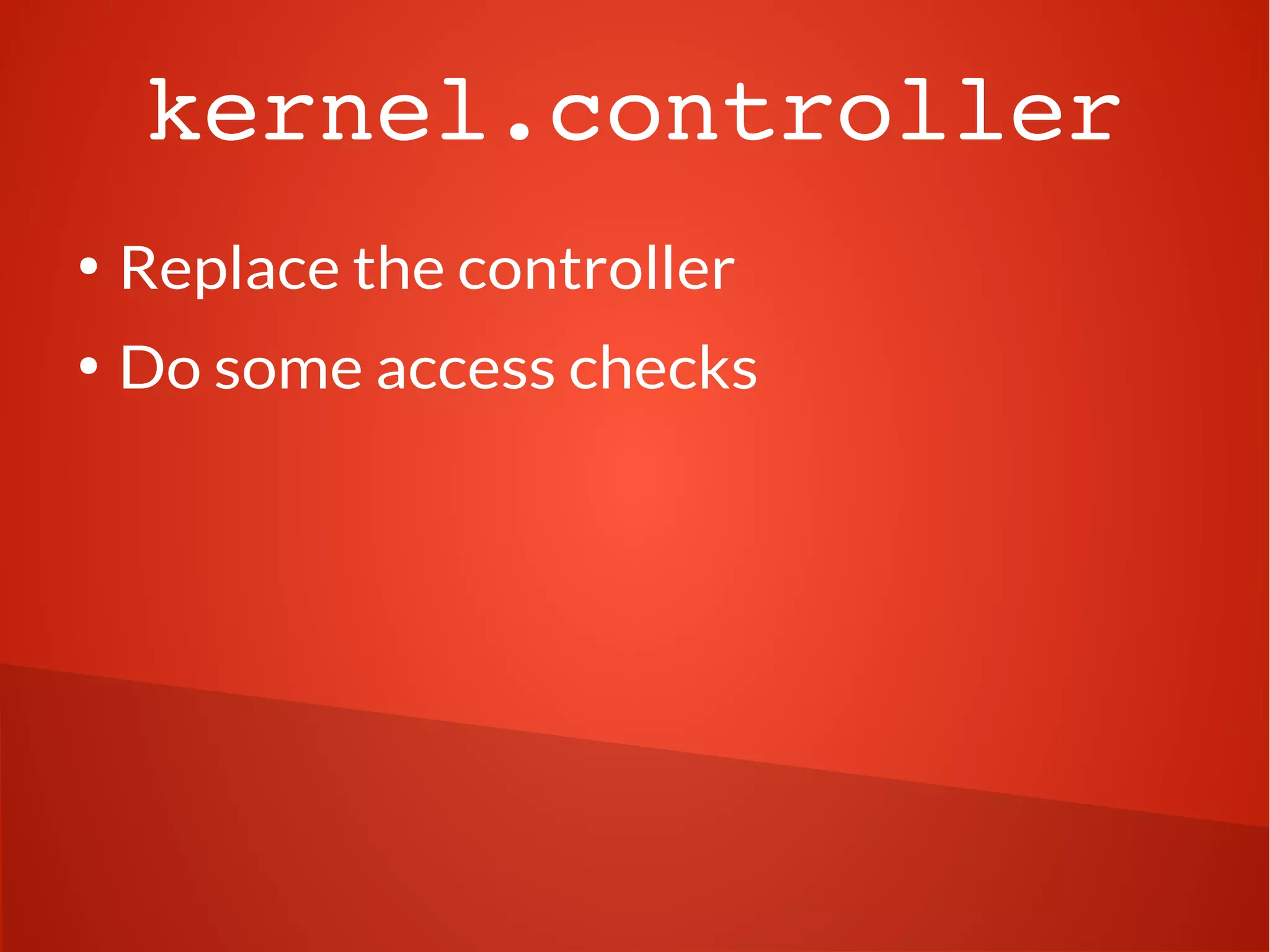
kernel.controller
●
Replace the controller
●
Do some access checks
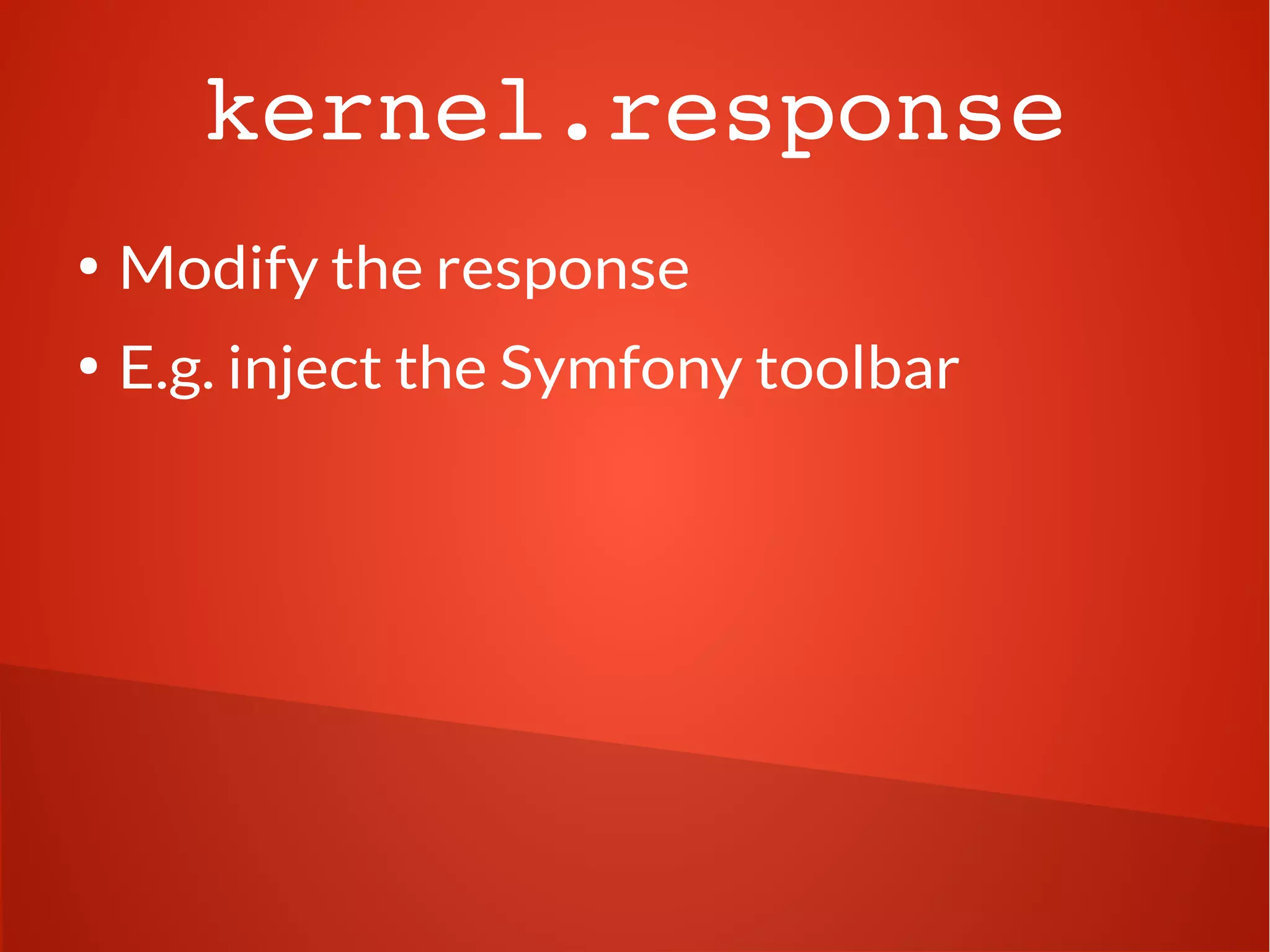
kernel.response
●
Modify the response
●
E.g. inject the Symfony toolbar
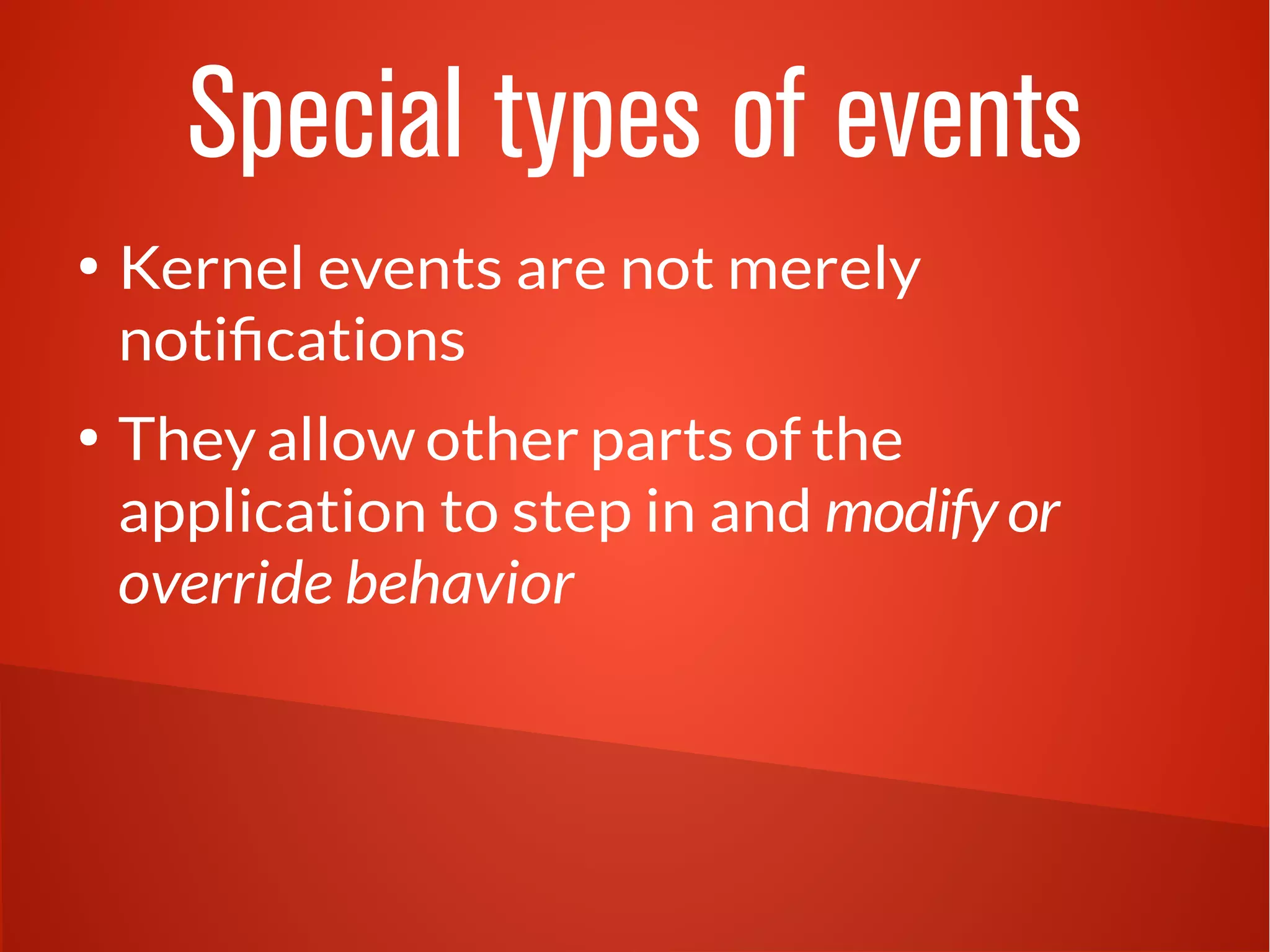
Special types of events
●
Kernel events are not merely
notifications
●
They allow other parts of the
application to step in and modify or
override behavior
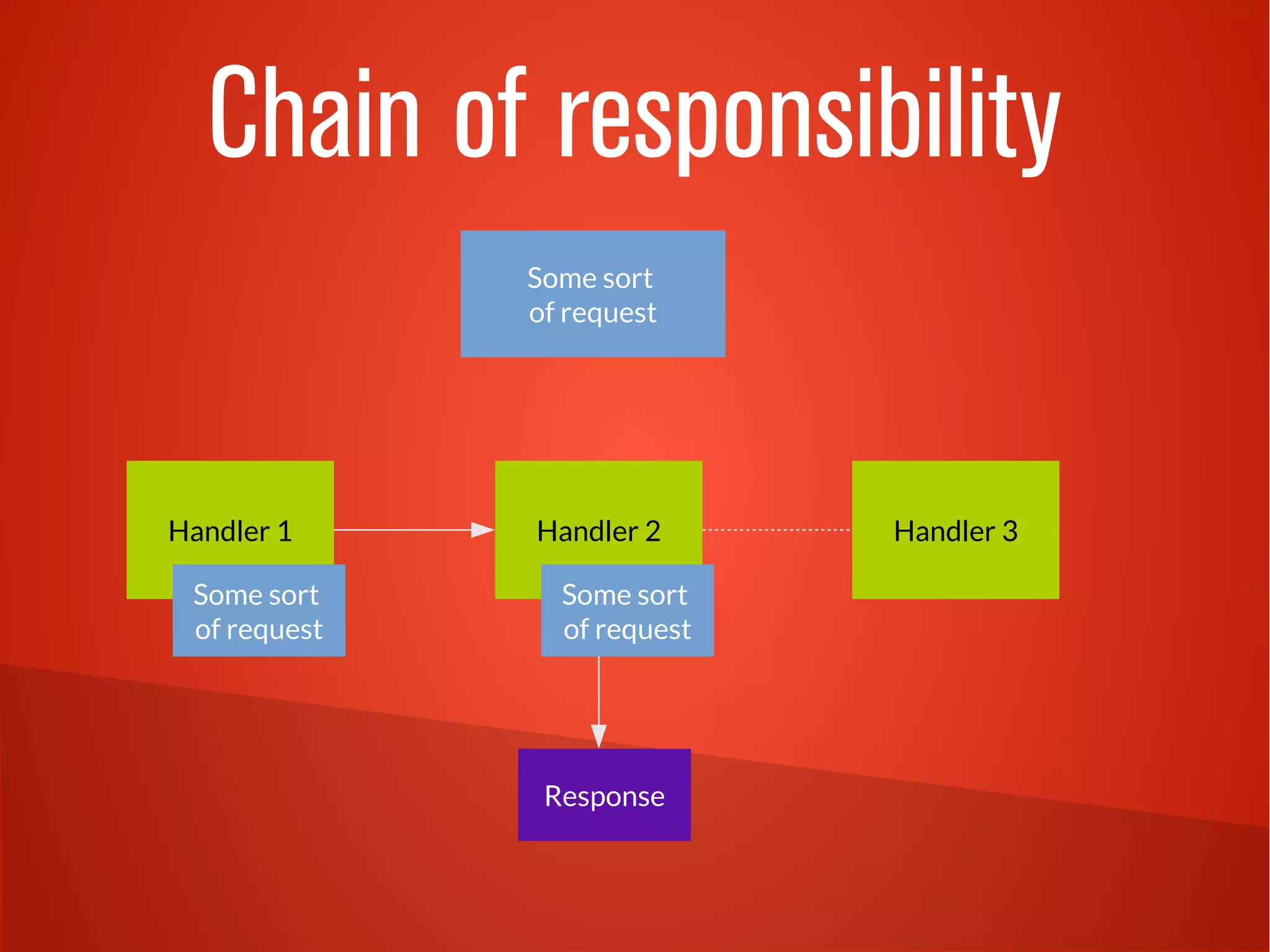
Chain of responsibility
Handler 3Handler 1 Handler 2
Some sort
of request
Some sort
of request
Response
Some sort
of request
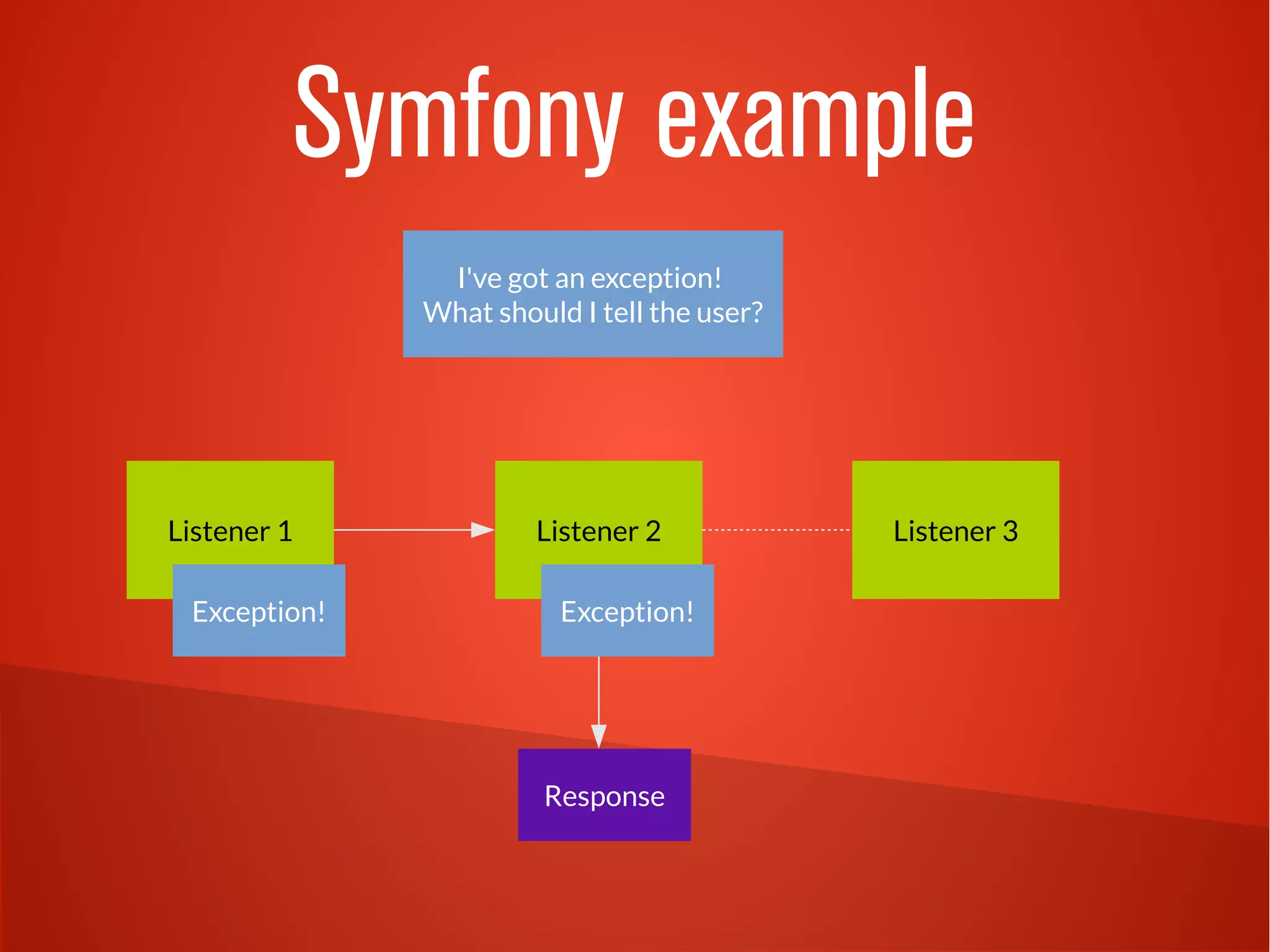
Symfony example
Listener 3Listener 1 Listener 2
Exception! Exception!
Response
I've got an exception!
What should I tell the user?
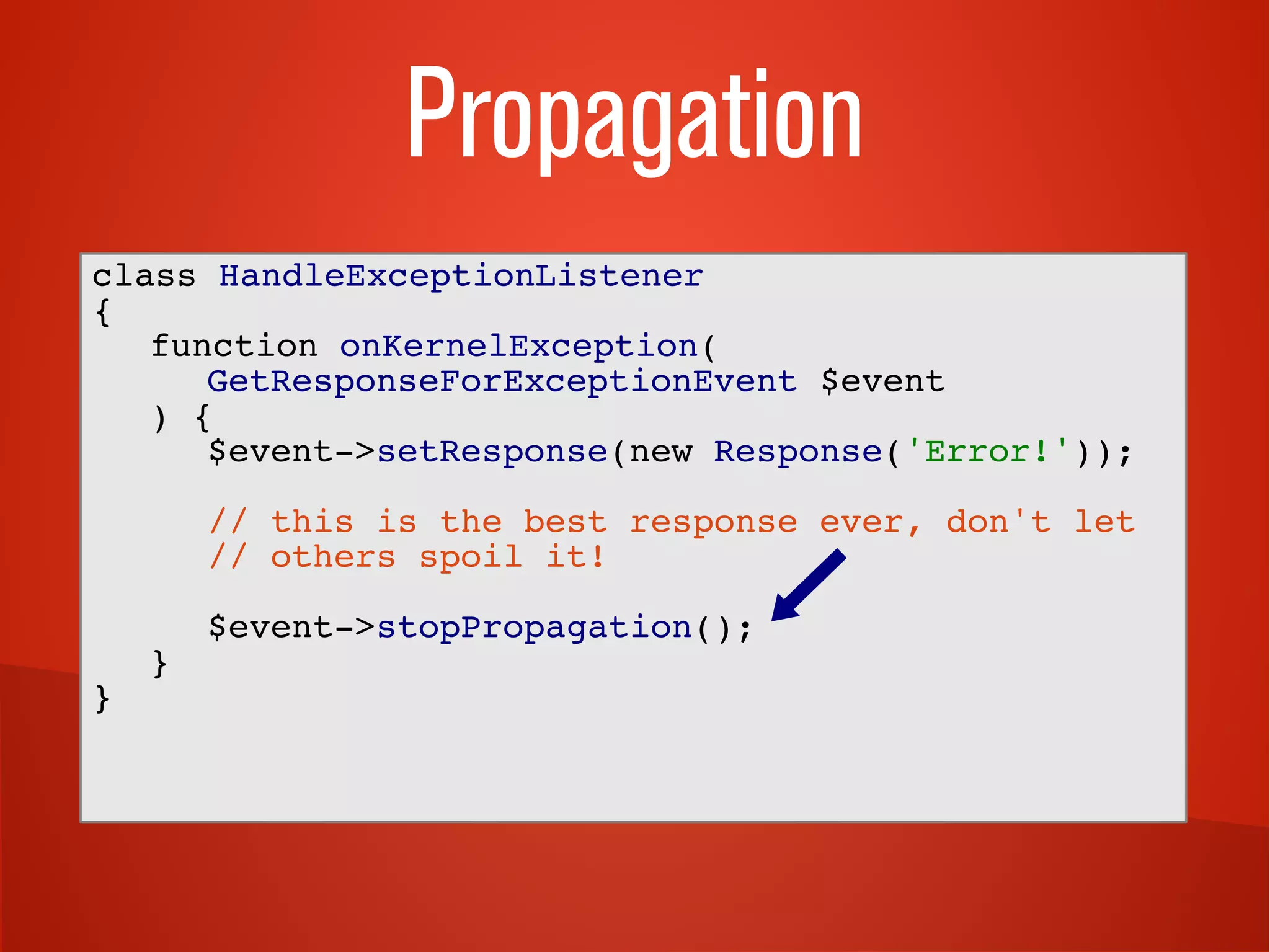
Propagation
class HandleExceptionListener
{
function onKernelException(
GetResponseForExceptionEvent $event
) {
$event->setResponse(new Response('Error!'));
// this is the best response ever, don't let
// others spoil it!
$event->stopPropagation();
}
}
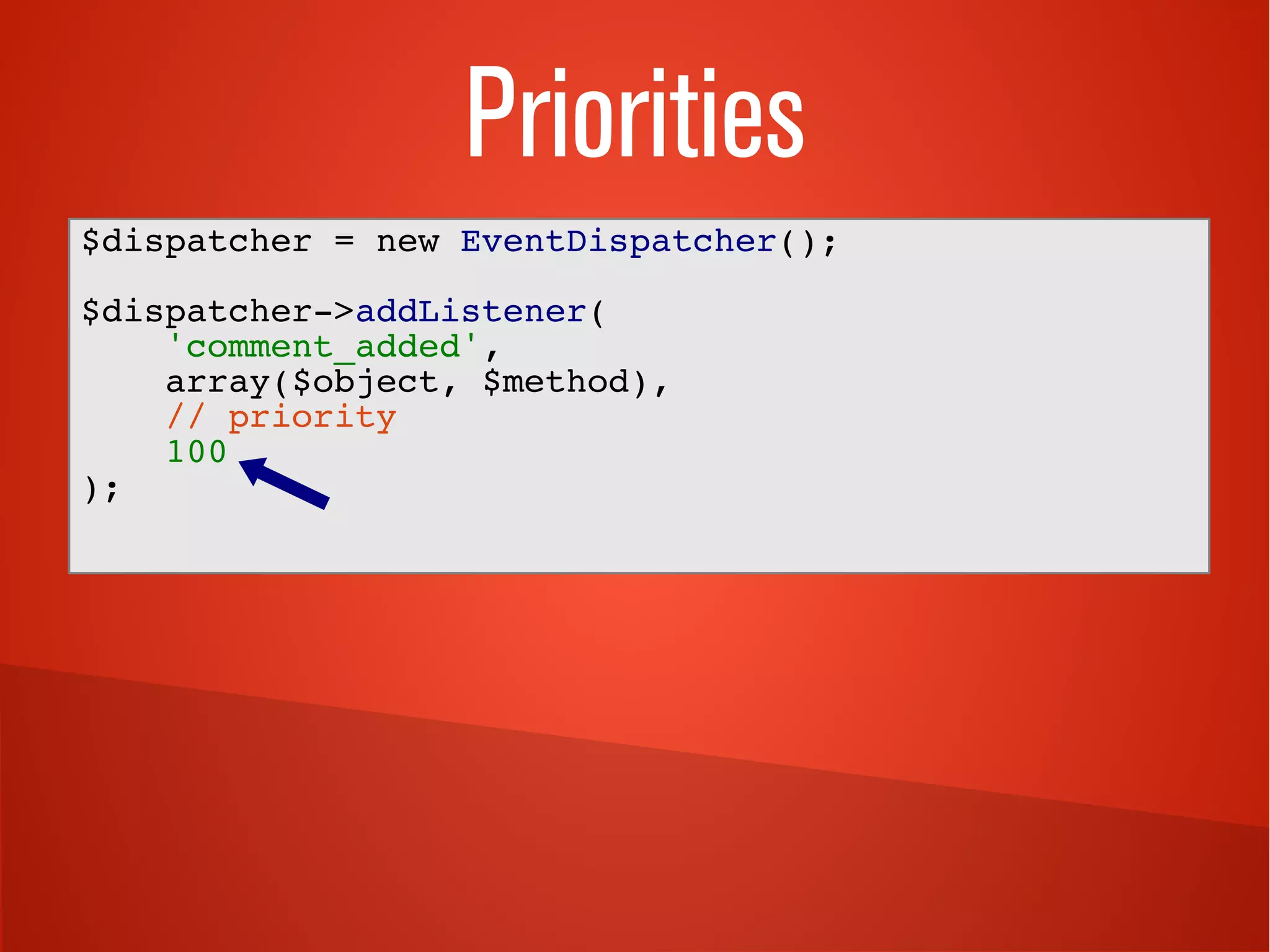
Priorities
$dispatcher = new EventDispatcher();
$dispatcher->addListener(
'comment_added',
array($object, $method),
// priority
100
);
Concerns
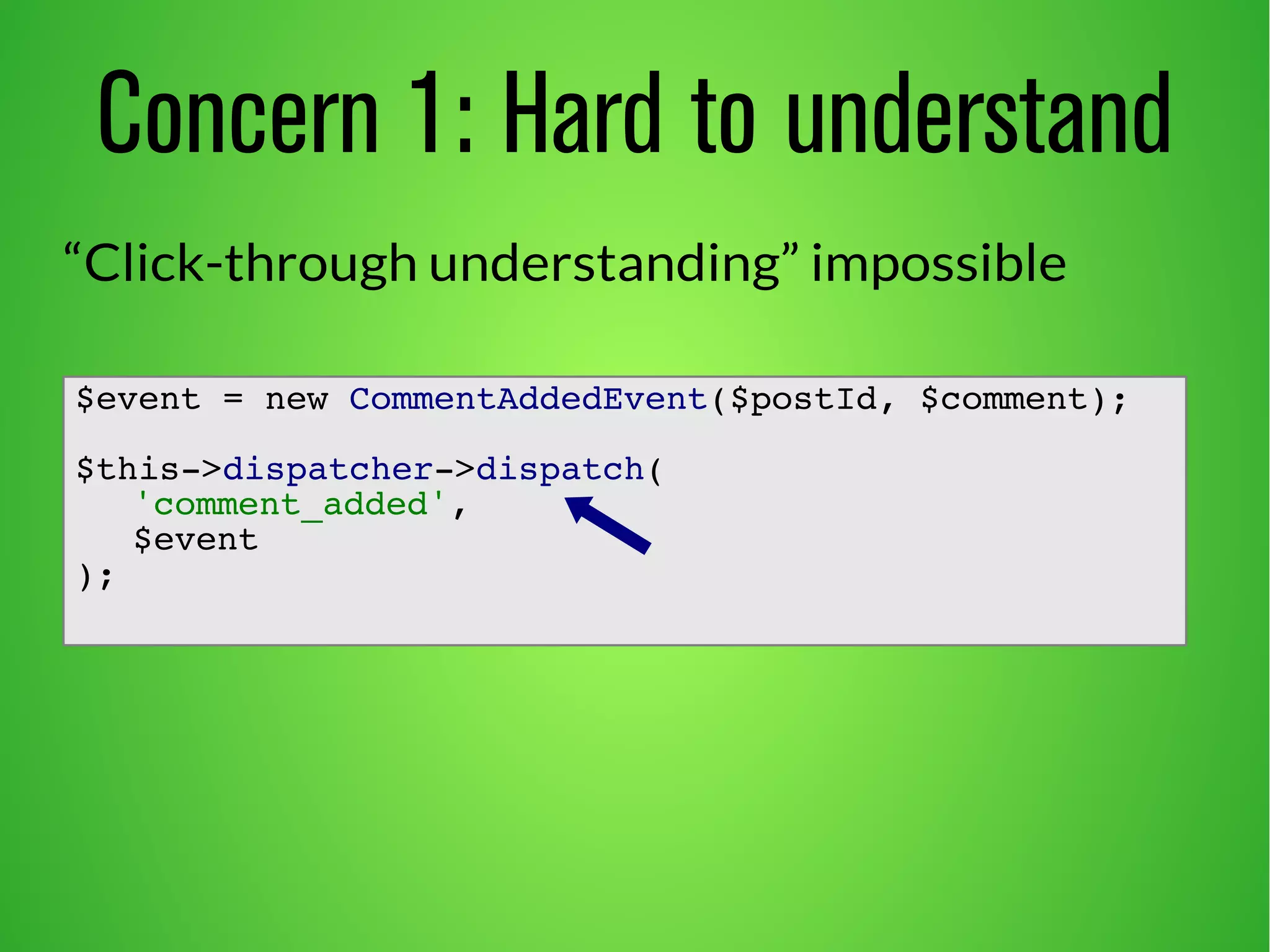
Concern 1: Hard to understand
“Click-through understanding” impossible
$event = new CommentAddedEvent($postId, $comment);
$this->dispatcher->dispatch(
'comment_added',
$event
);
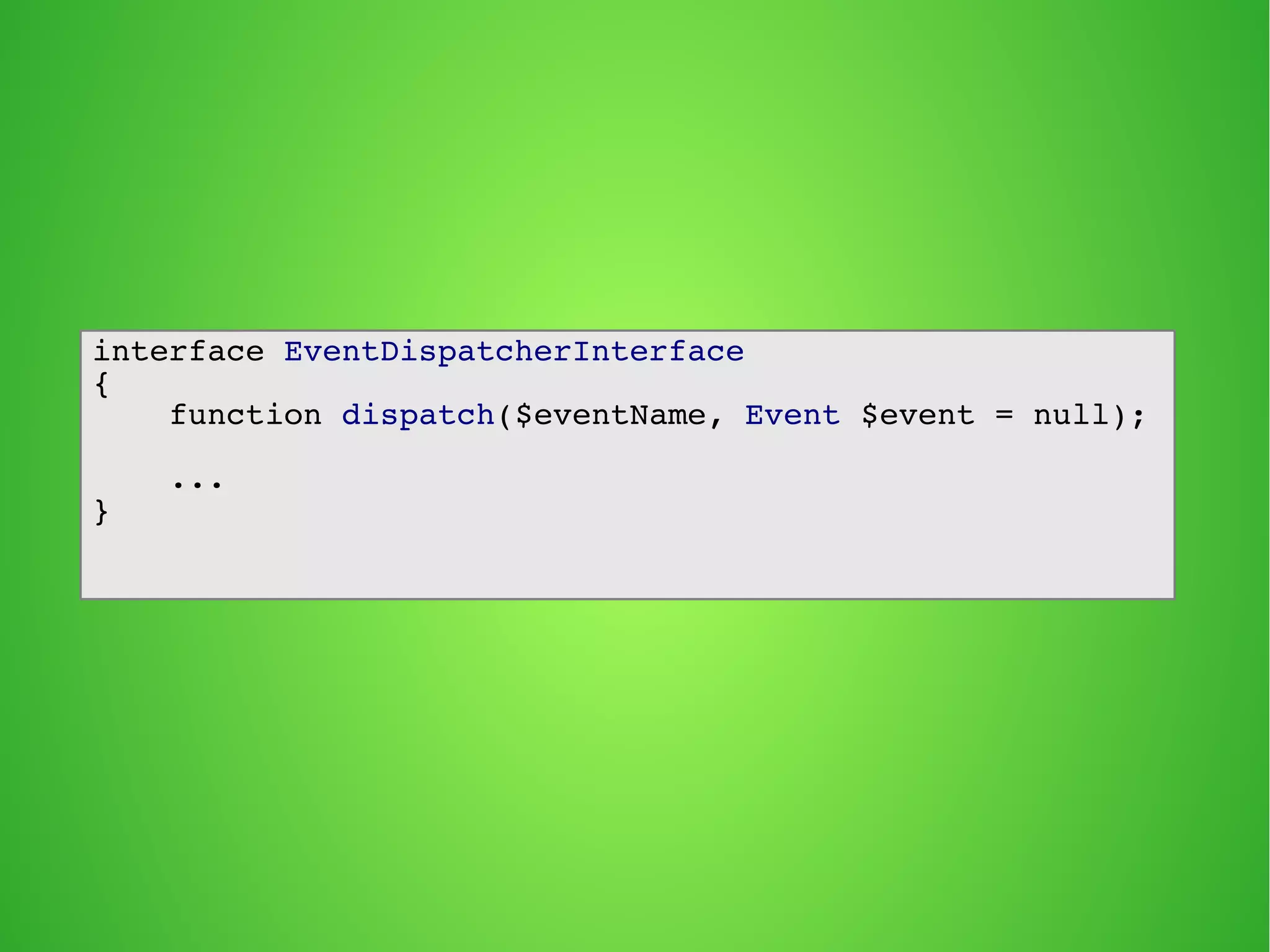
interface EventDispatcherInterface
{
function dispatch($eventName, Event $event = null);
...
}
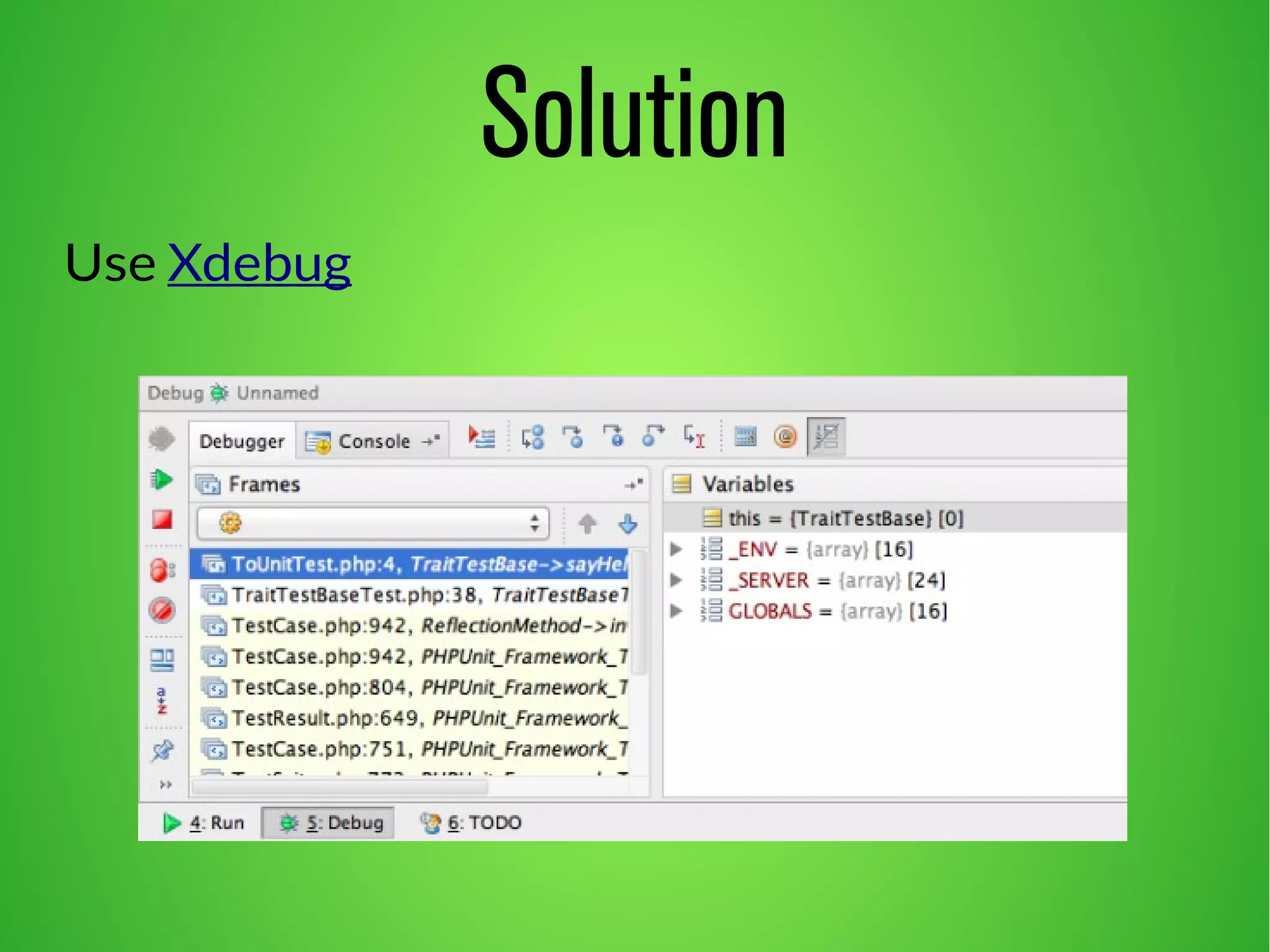
Solution
Use Xdebug
Concern 2: Out-of-domain concepts
●
“Comment”
●
“PostId”
●
“Add comment to post”
●
“Dispatcher” (?!)
We did a good thing
We fixed coupling issues
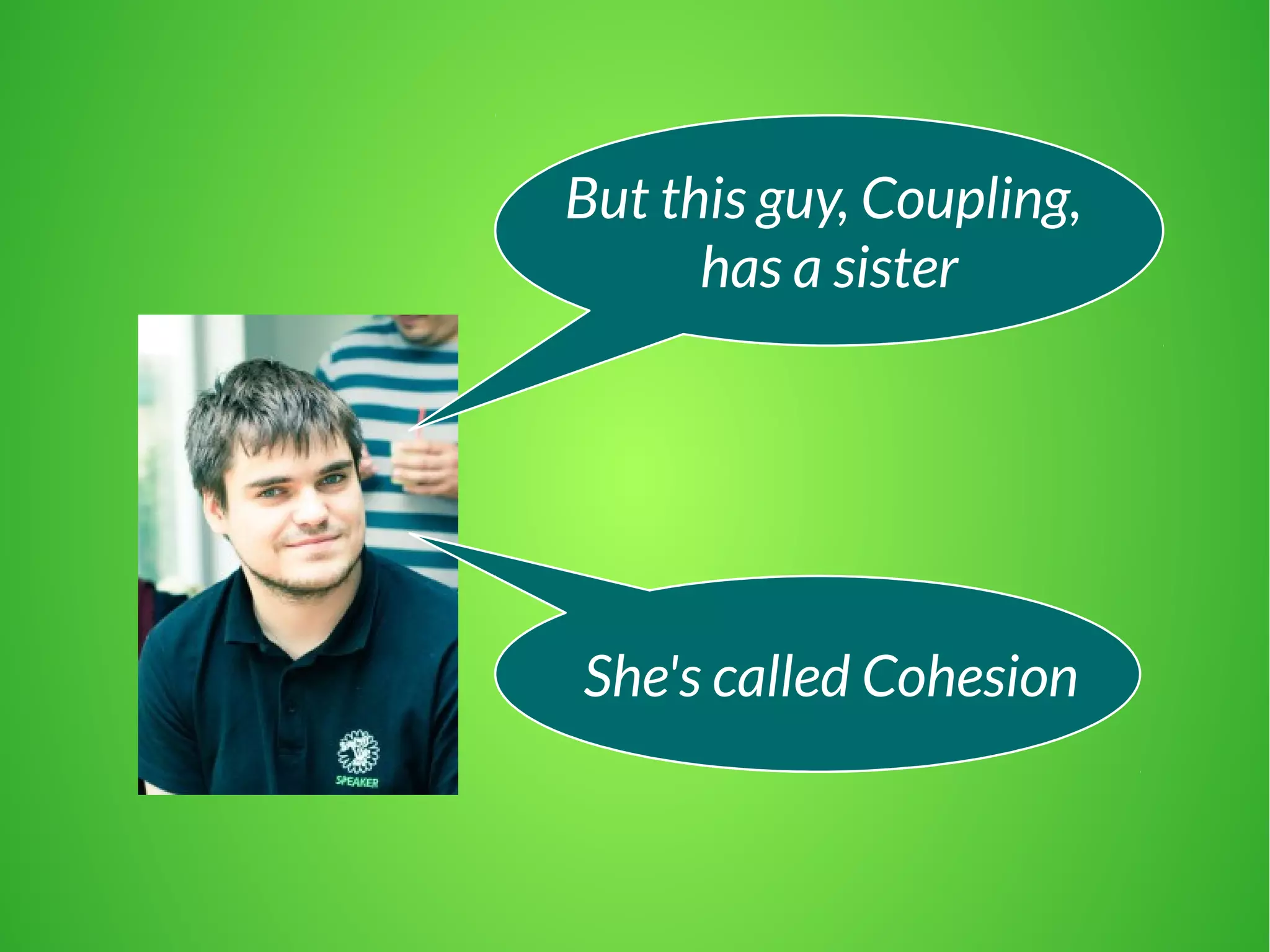
She's called Cohesion
But this guy, Coupling,
has a sister
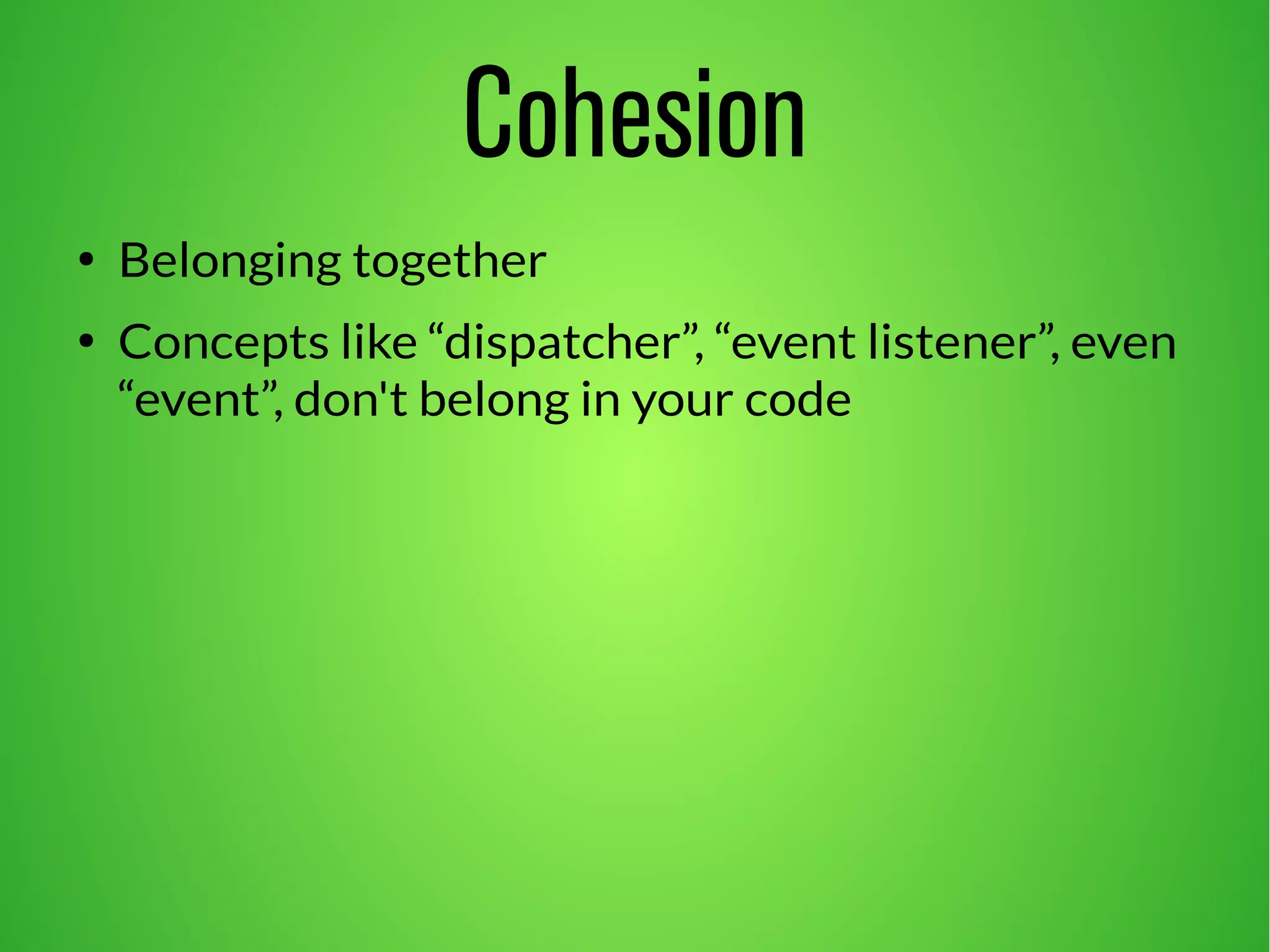
Cohesion
● Belonging together
● Concepts like “dispatcher”, “event listener”, even
“event”, don't belong in your code
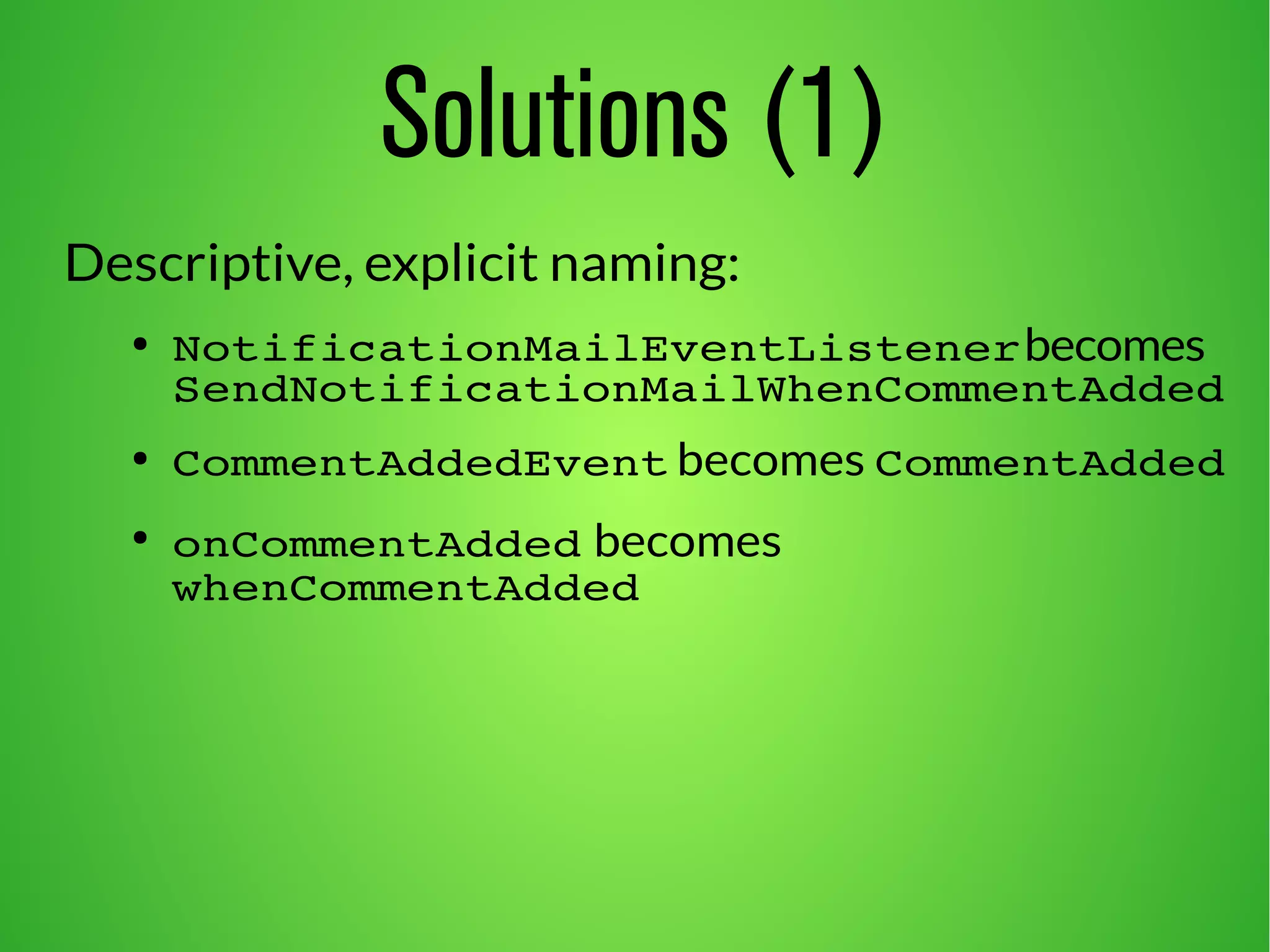
Solutions (1)
Descriptive, explicit naming:
● NotificationMailEventListenerbecomes
SendNotificationMailWhenCommentAdded
● CommentAddedEvent becomes CommentAdded
●
onCommentAdded becomes
whenCommentAdded
Solutions (1)
This also hides implementation details!
Solutions (2)
Use an event dispatcher for things
that are not naturally cohesive anyway
Solutions (2)
Use something else
when an event dispatcher causes low cohesion
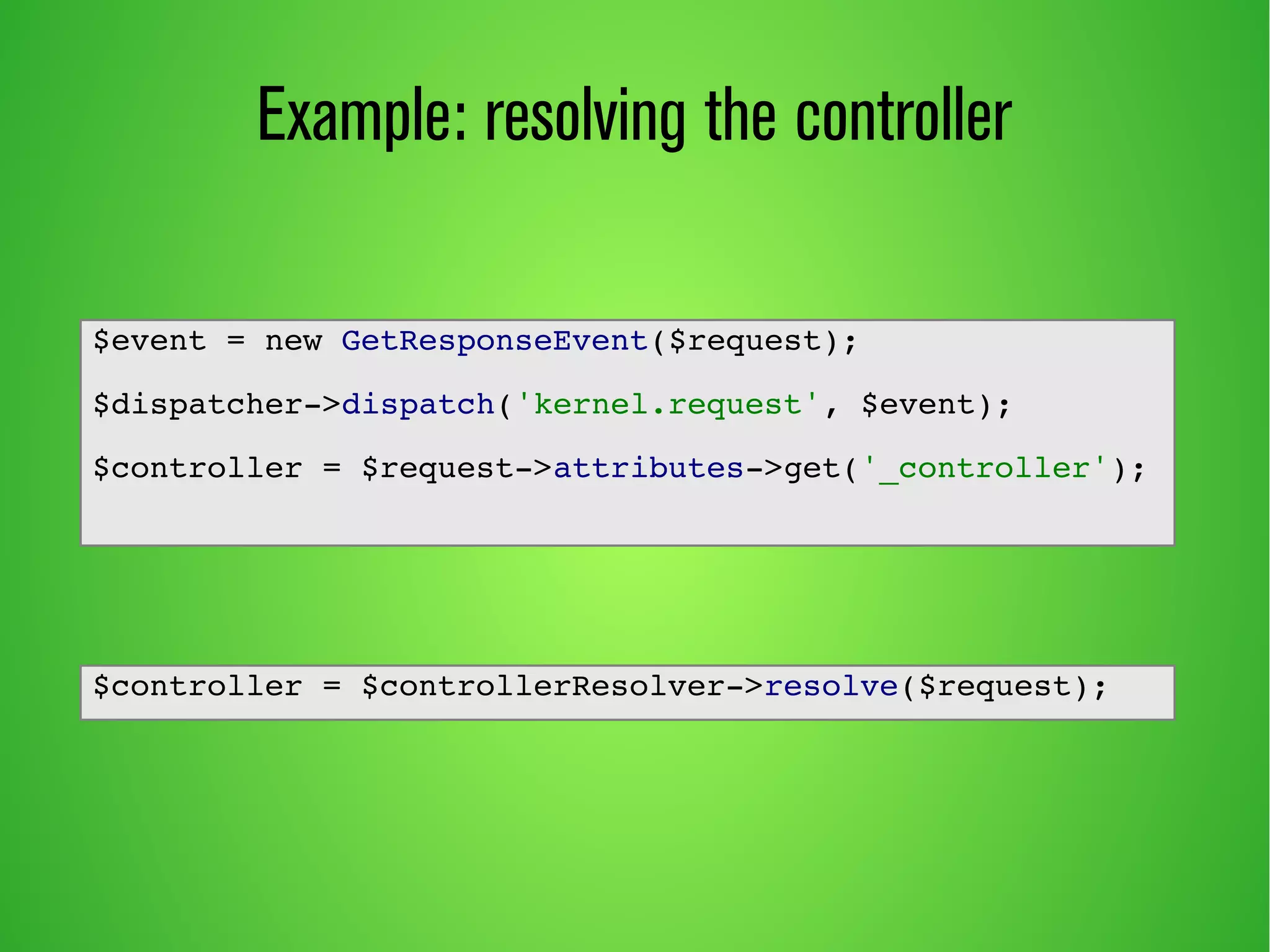
Example: resolving the controller
$event = new GetResponseEvent($request);
$dispatcher->dispatch('kernel.request', $event);
$controller = $request->attributes->get('_controller');
$controller = $controllerResolver->resolve($request);
Concern 3: Loss of control
●
You rely on event listeners to do some really
important work
●
How do you know if they are in place
and do their job?
Solution
●
“Won't fix”
●
You have to learn to live with it
It's good
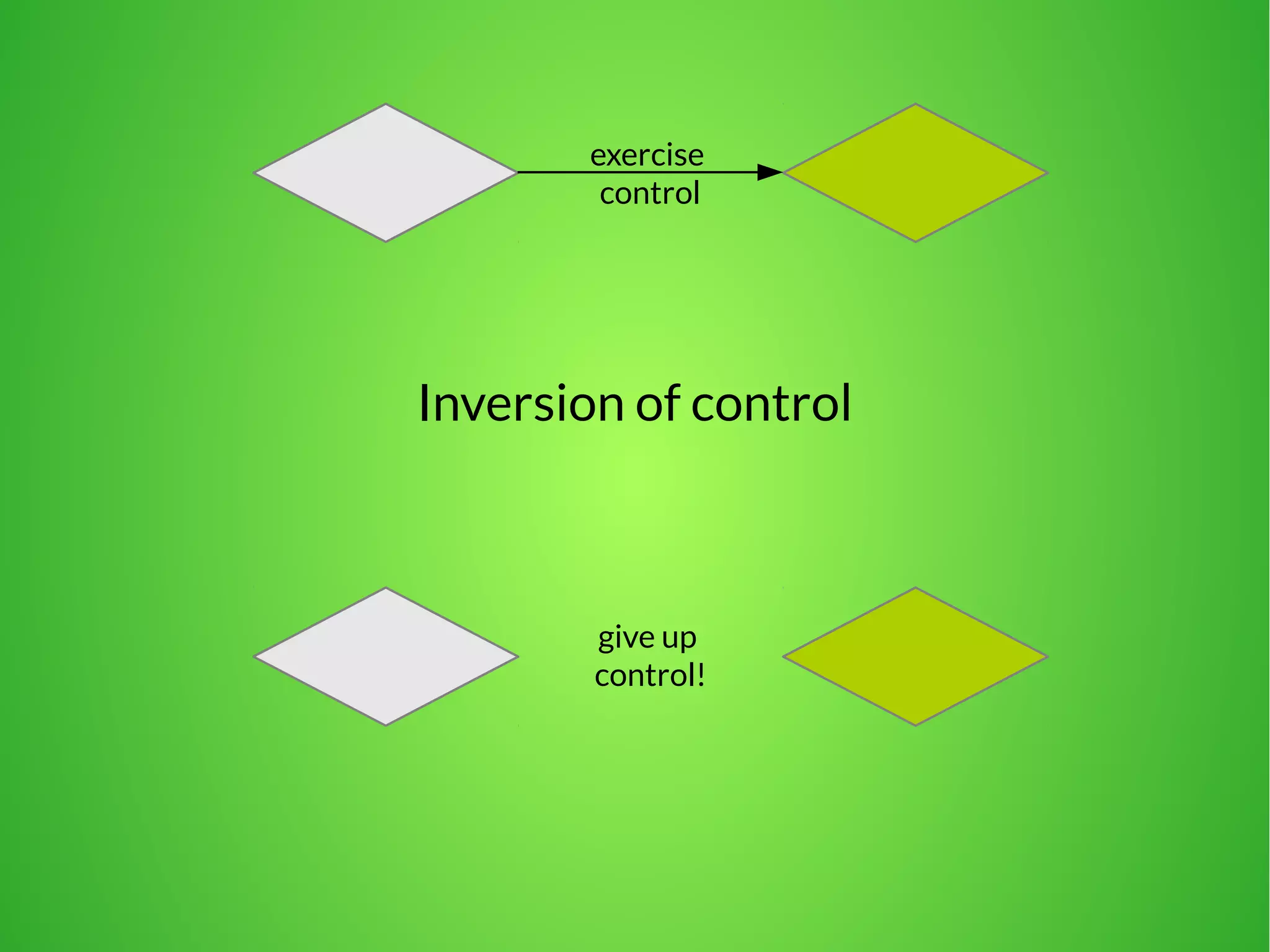
Inversion of control
exercise
control
give up
control!
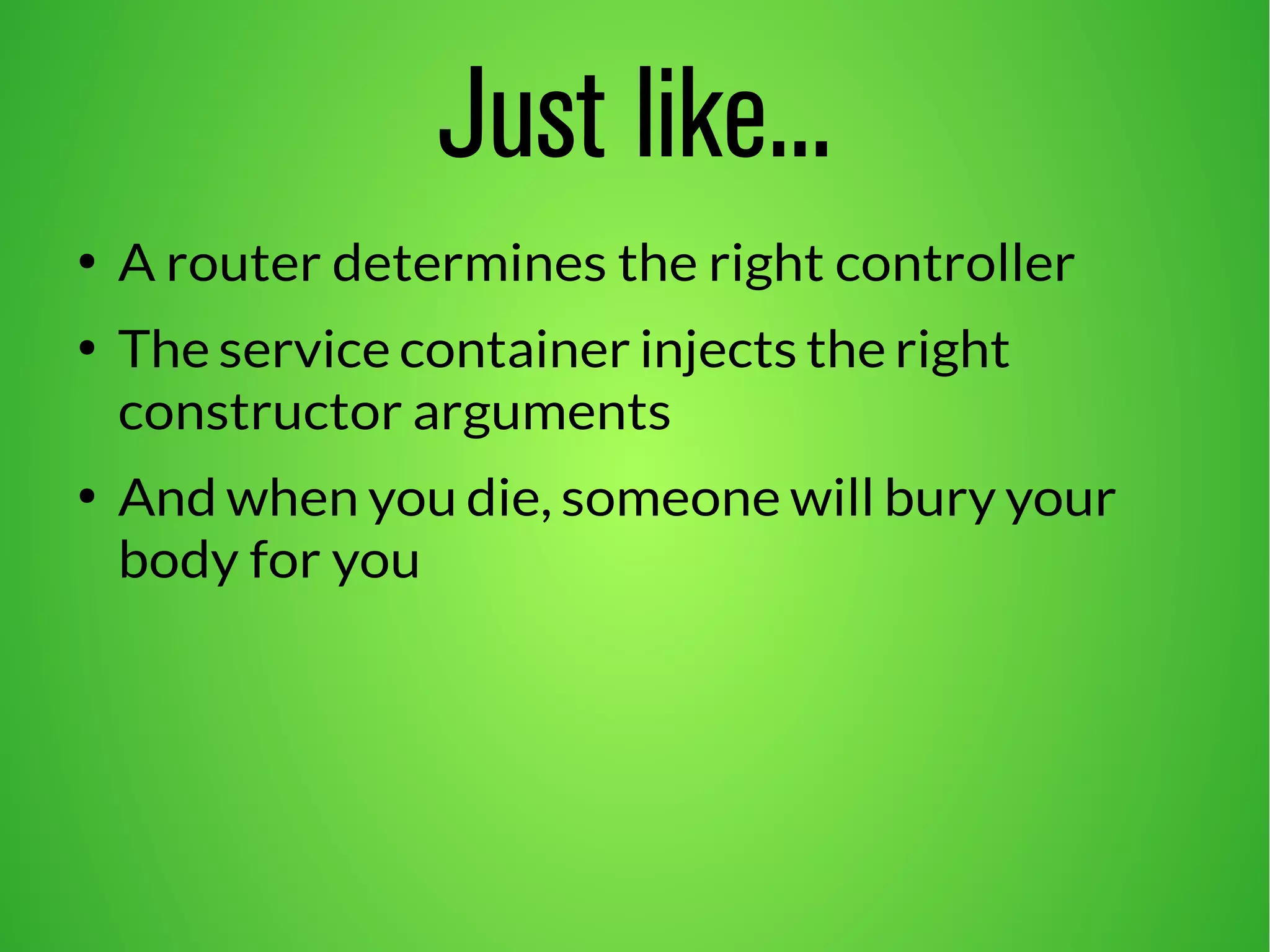
Just like...
●
A router determines the right controller
●
The service container injects the right
constructor arguments
●
And when you die, someone will bury your
body for you
I admit, inversion of control can be scary
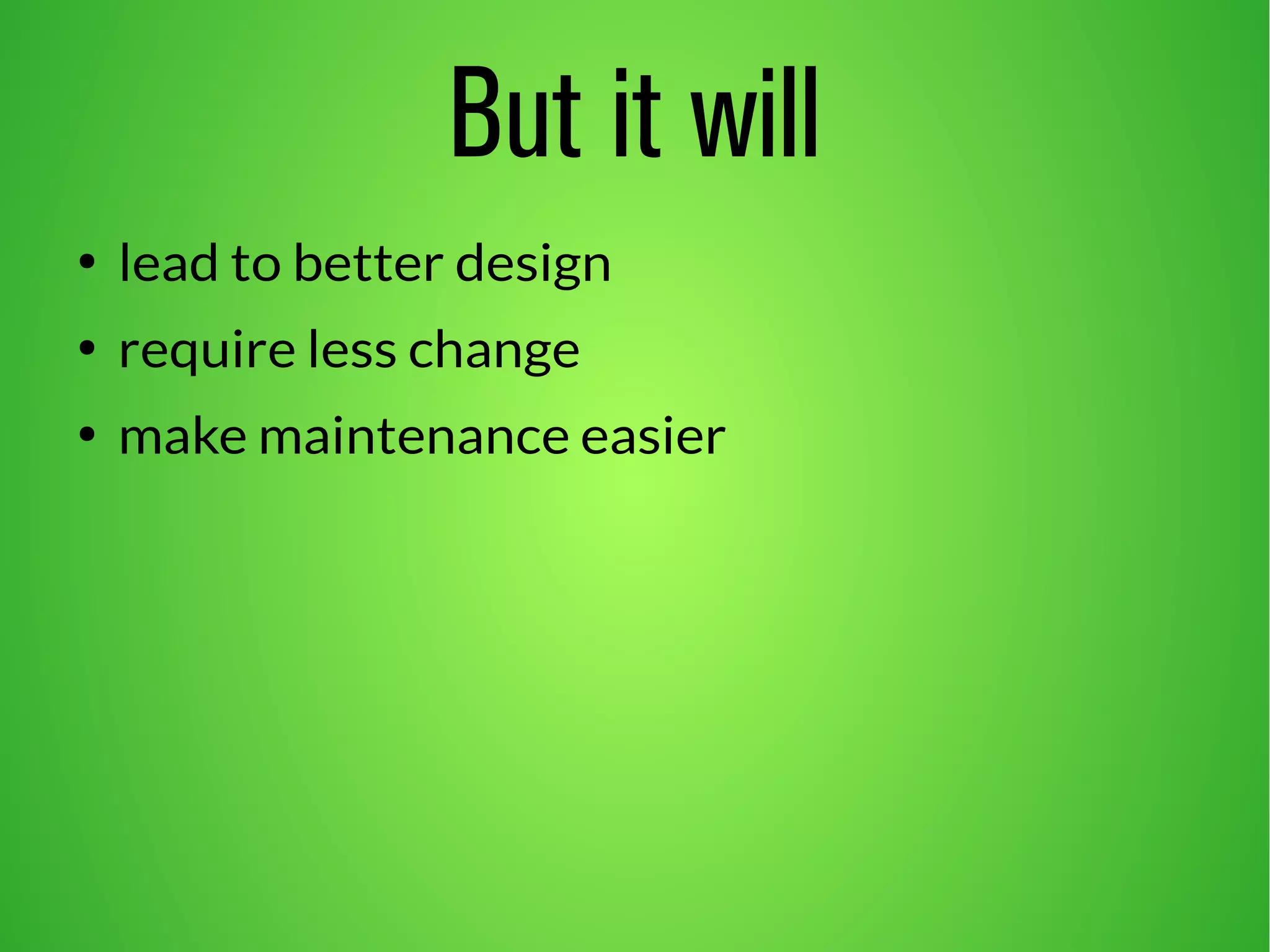
But it will
●
lead to better design
●
require less change
●
make maintenance easier
PresentationFinished
AskQuestionsWhenPresentationFinished
SayThankYouWhenNoMoreQuestions
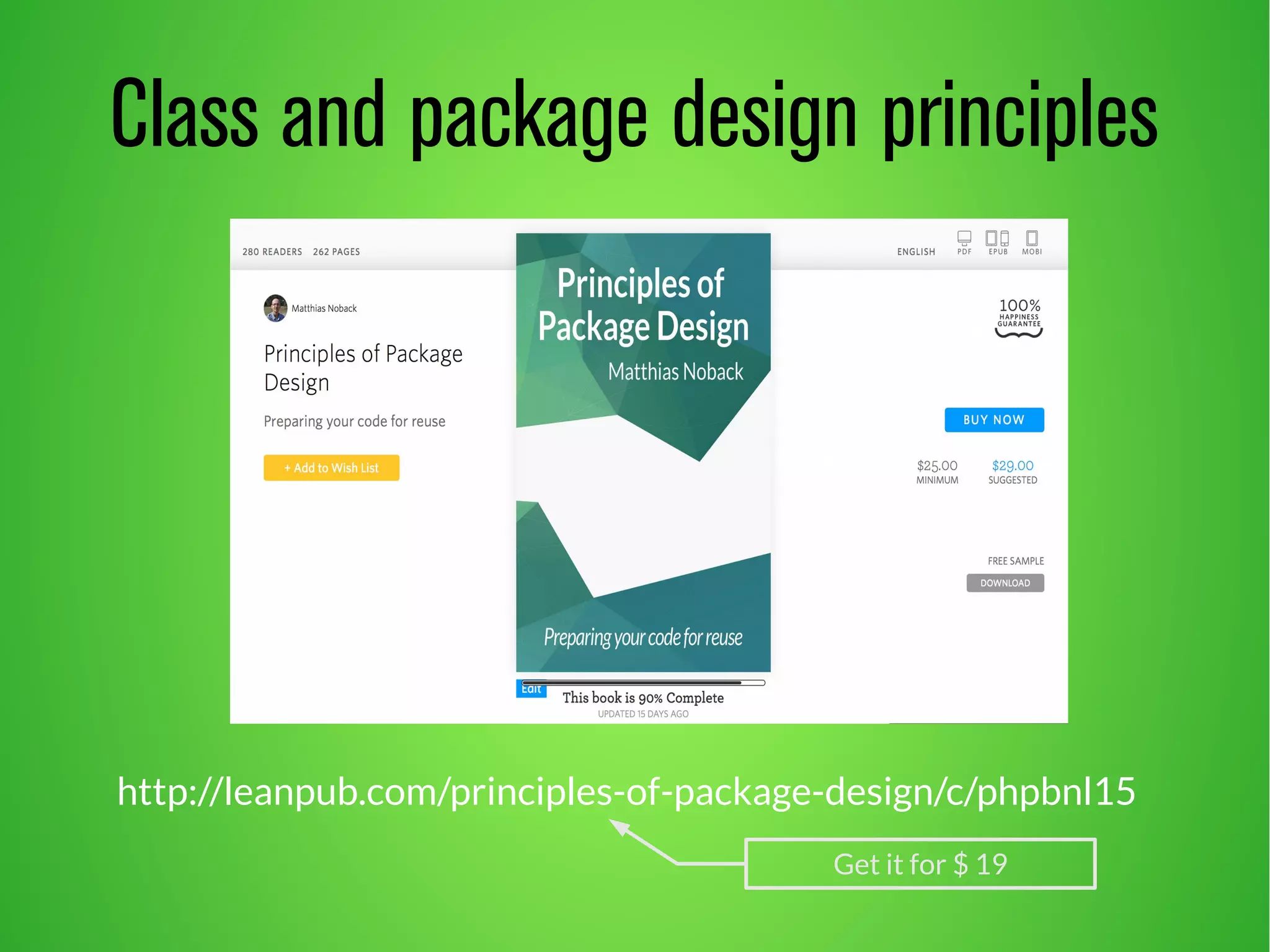
Class and package design principles
http://leanpub.com/principles-of-package-design/c/phpbnl15
Get it for $ 19
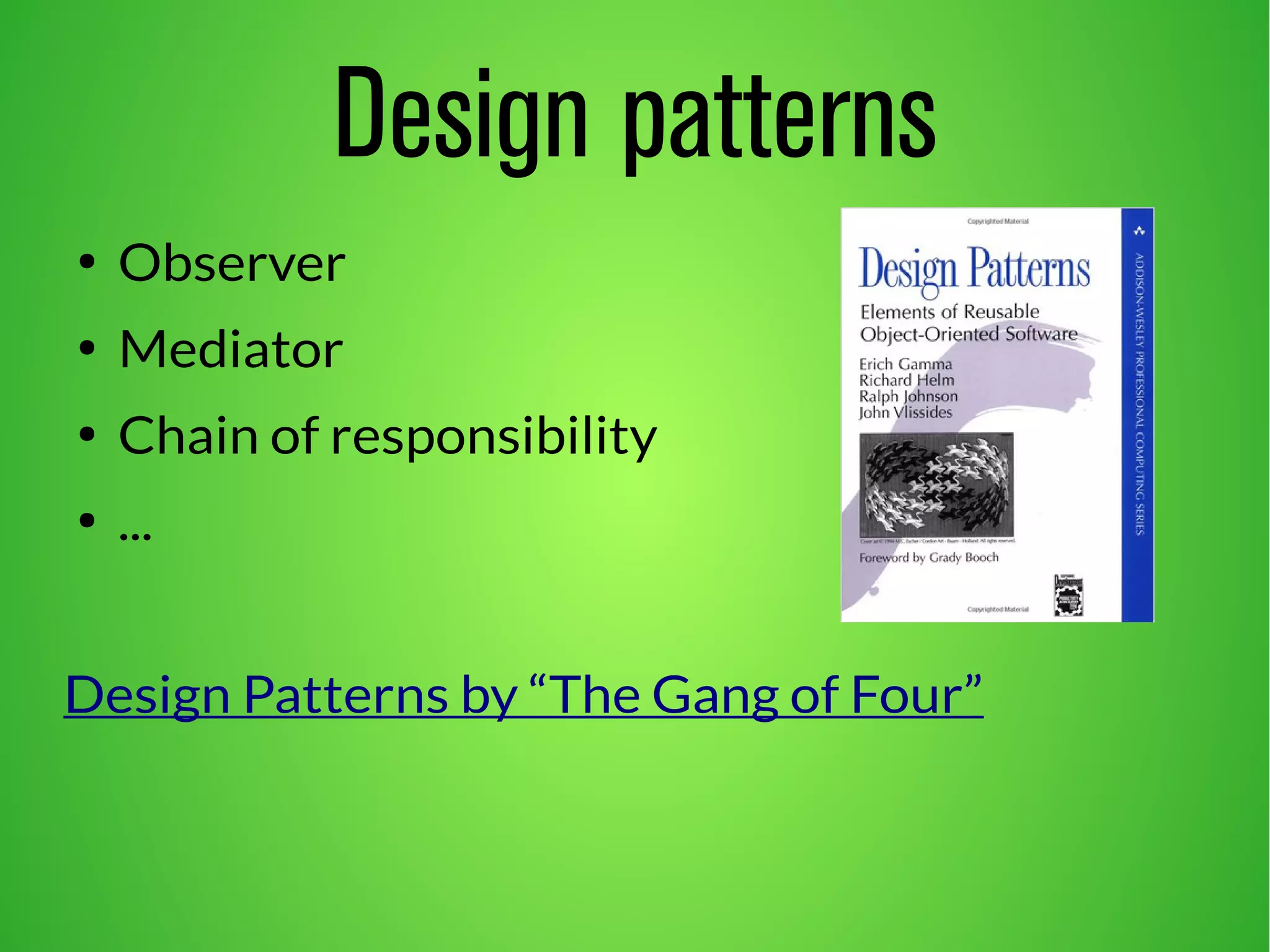
Design patterns
●
Observer
●
Mediator
●
Chain of responsibility
●
...
Design Patterns by “The Gang of Four”
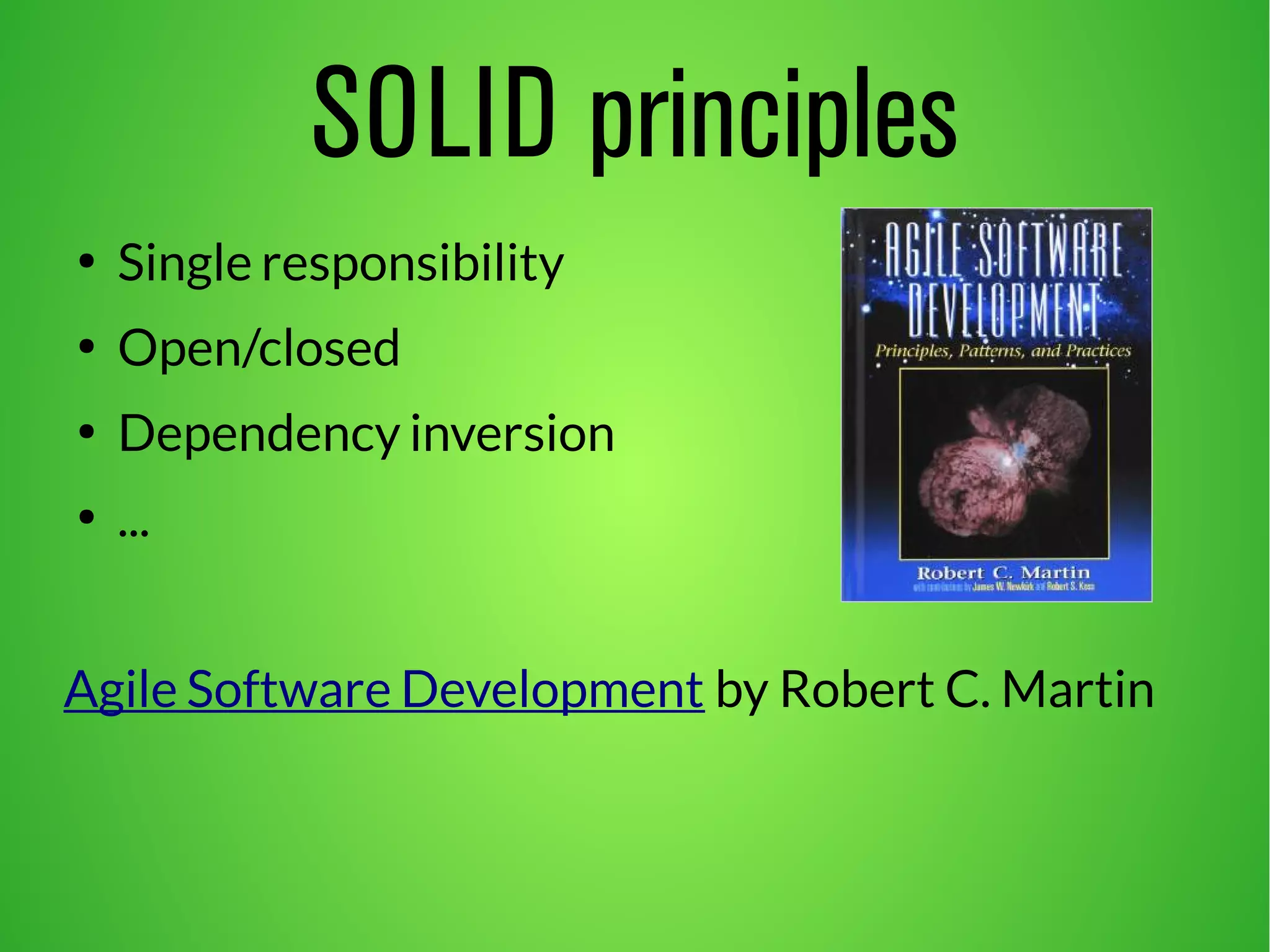
SOLID principles
●
Single responsibility
●
Open/closed
●
Dependency inversion
●
...
Agile Software Development by Robert C. Martin
Images
●
www.ohiseered.com/2011_11_01_archive.html
●
Mrs. Peacock, Candlestick:
www.cluecult.com
●
Leonardo DiCaprio:
screenrant.com/leonardo-dicaprio-defends-wolf-wall-street-controversy/
●
Book covers:
Amazon
●
Party:
todesignoffsite.com/events-2/to-do-closing-party-with-love-design/
●
Russell Crowe:
malinaelena.wordpress.com/2014/04/18/top-8-filme-cu-russell-crowe/
Twitter: @matthiasnoback
joind.in/13120
What did you think?

A Series of Fortunate Events - PHP Benelux Conference 2015