Lari Hotari @lhotari
Pivotal Software, Inc.
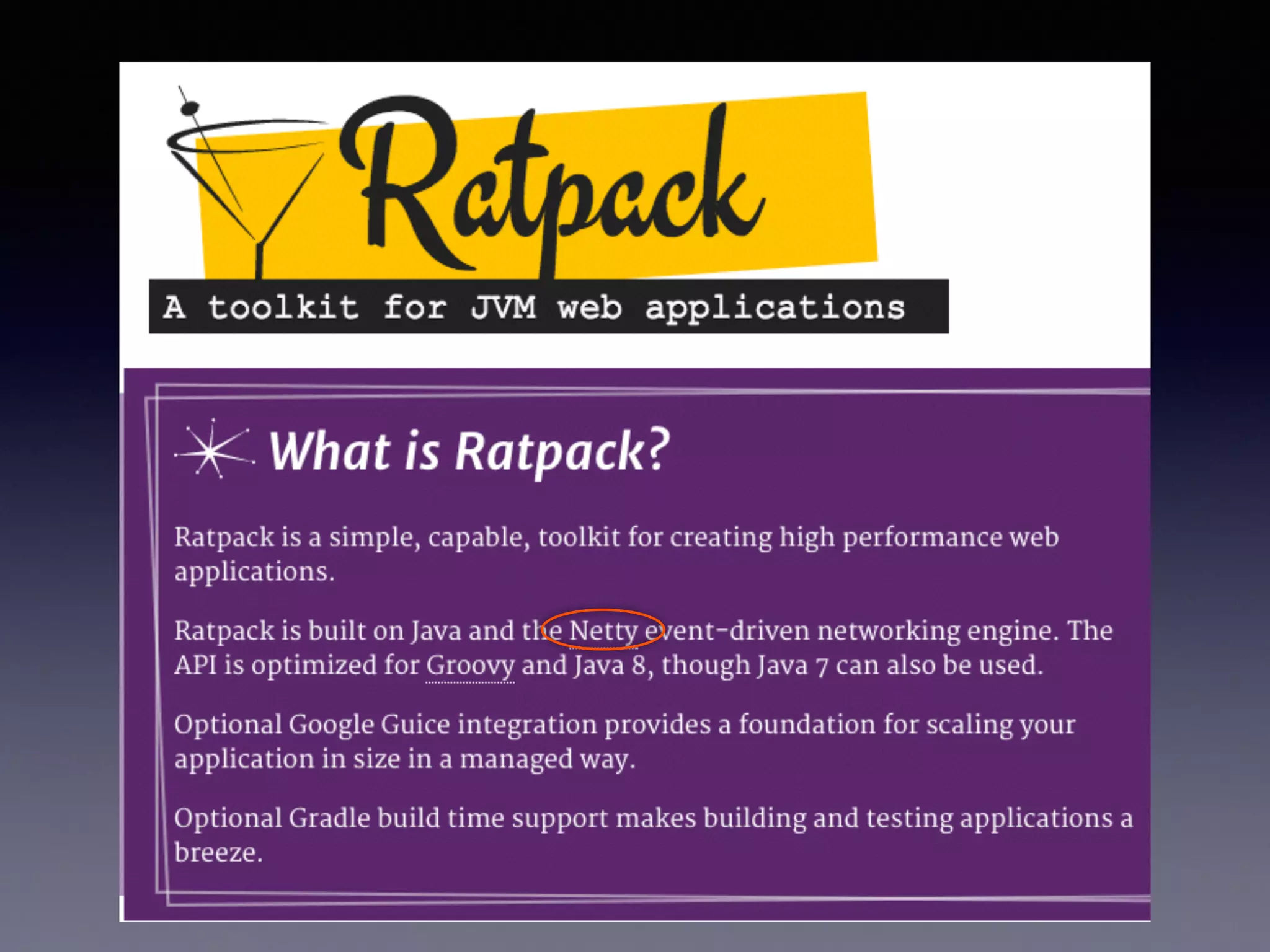
Ratpack and
Grails 3
Agenda
• Grails 3 and Ratpack
• Why async?
• Modularity and micro service architectures
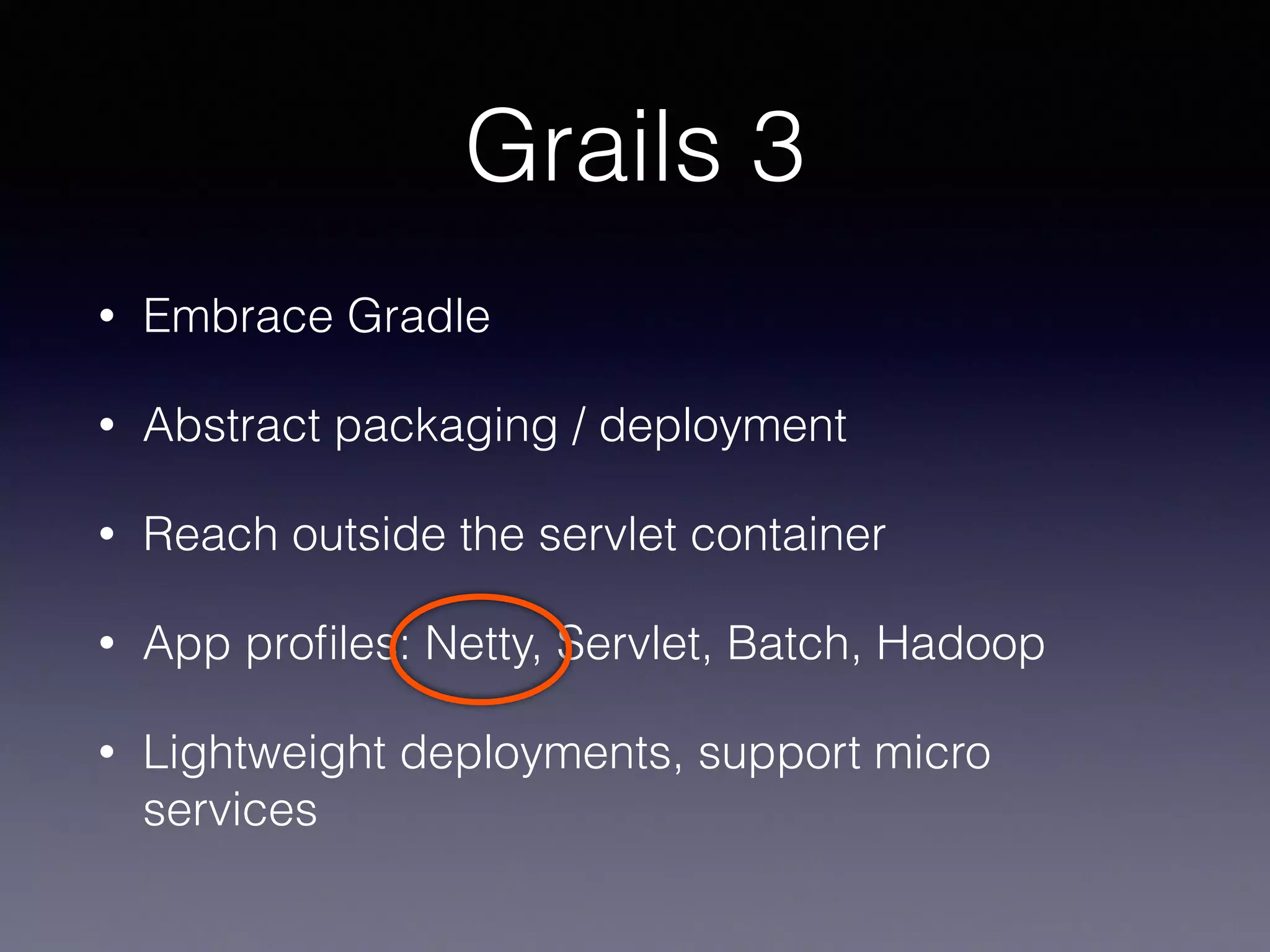
• Embrace Gradle
• Abstract packaging / deployment
• Reach outside the servlet container
• App profiles: Netty, Servlet, Batch, Hadoop
• Lightweight deployments, support micro
services
Grails 3
Why Netty / Ratpack?
Why async?
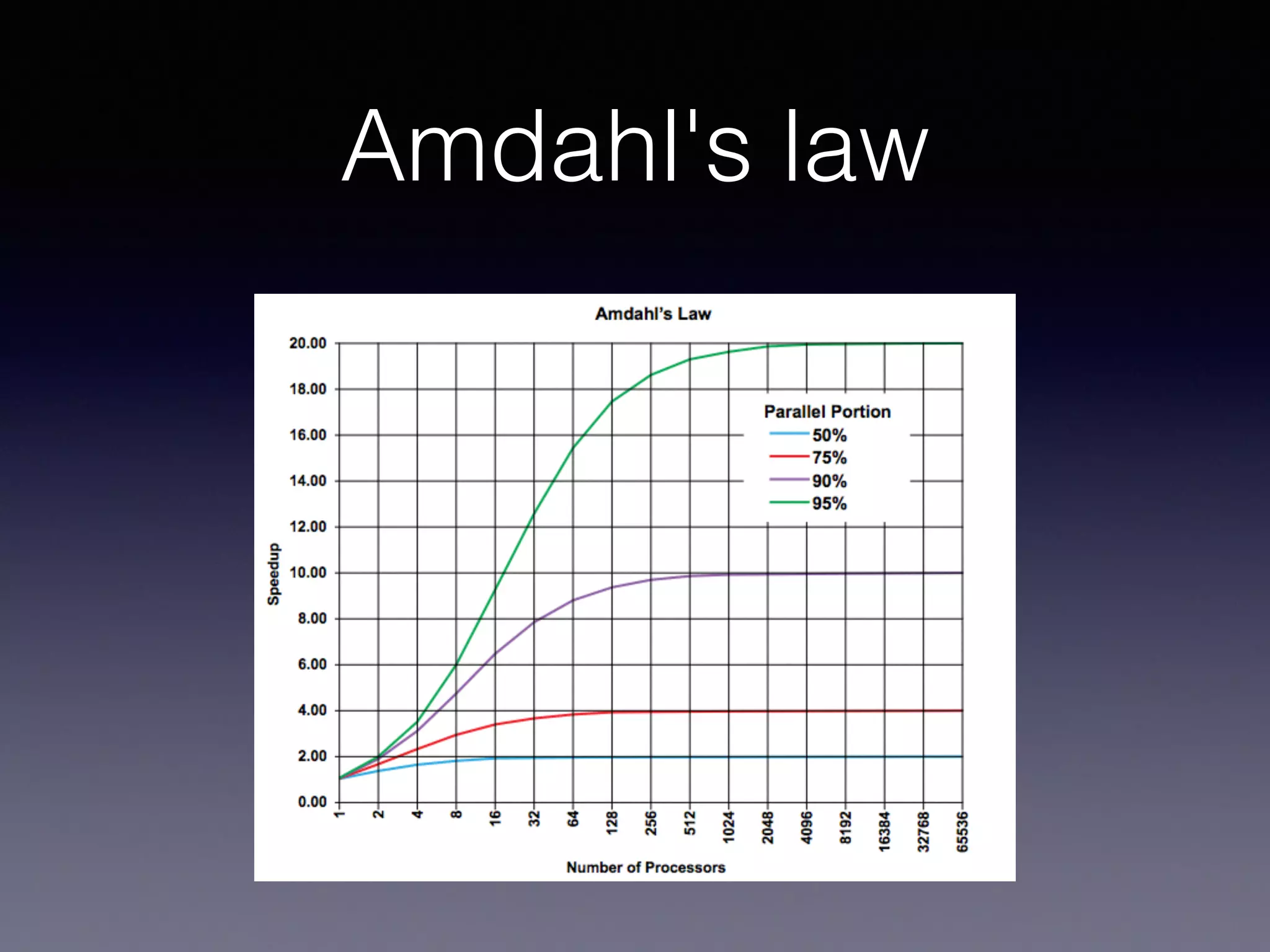
Amdahl's law
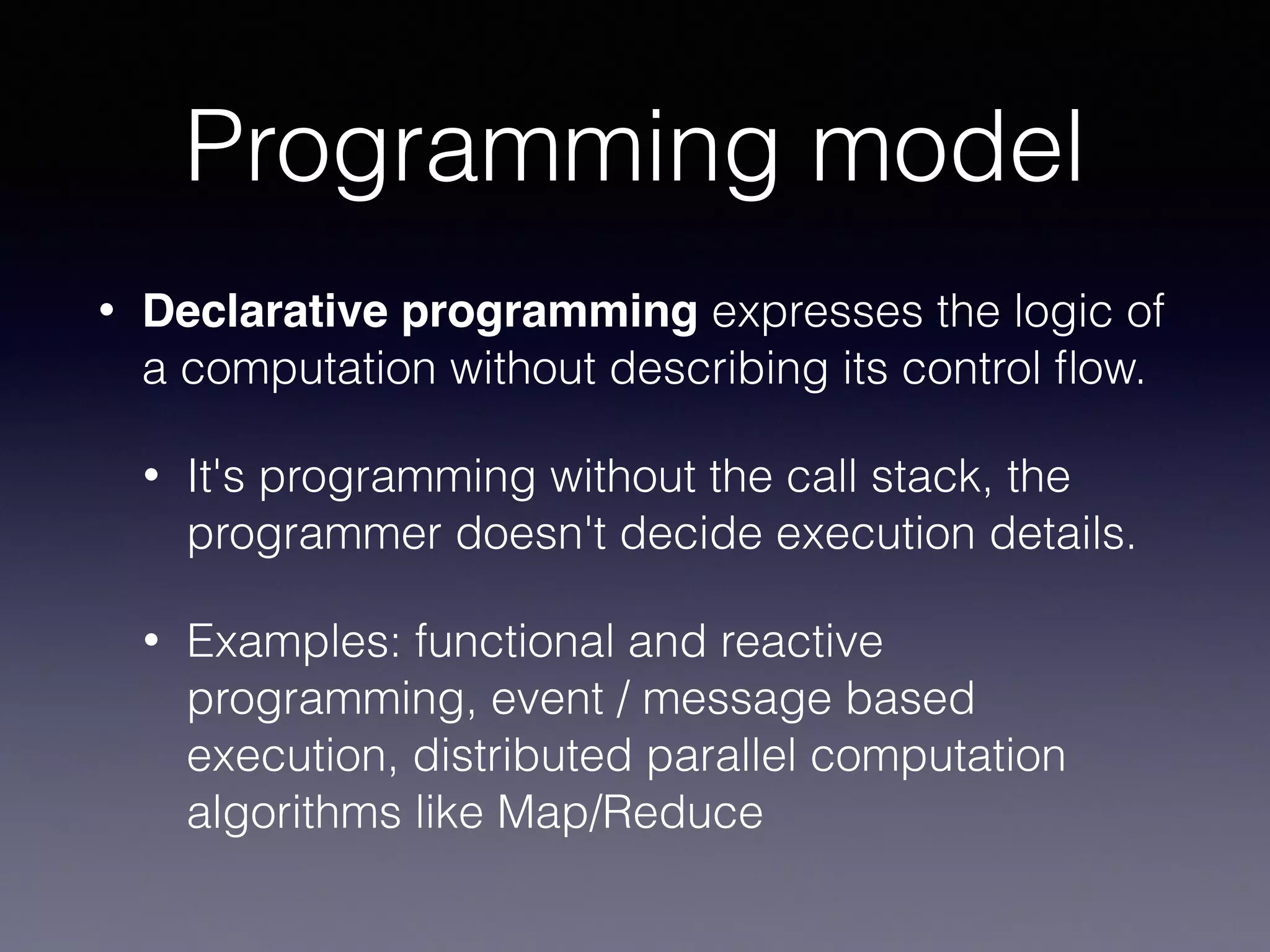
Programming model
• Declarative programming expresses the logic of
a computation without describing its control flow.
• It's programming without the call stack, the
programmer doesn't decide execution details.
• Examples: functional and reactive
programming, event / message based
execution, distributed parallel computation
algorithms like Map/Reduce
15 import ratpack.rx.RxRatpack
16 import ratpack.session.SessionModule
17 import ratpack.session.store.MapSessionsModule
18 import ratpack.session.store.SessionStorage
19
20 import static ratpack.groovy.Groovy.groovyTemplate
21 import static ratpack.groovy.Groovy.ratpack
22 import static ratpack.jackson.Jackson.json
23 import static ratpack.pac4j.internal.SessionConstants.USER_PROFILE
24
25 ratpack {
26 bindings {
27 bind DatabaseHealthCheck
28 add new CodaHaleMetricsModule().jvmMetrics().jmx().websocket().
29 healthChecks()
30 add new HikariModule([URL: "jdbc:h2:mem:dev;INIT=CREATE SCHEMA IF NOT
31 EXISTS DEV"], "org.h2.jdbcx.JdbcDataSource")
32 add new SqlModule()
33 add new JacksonModule()
34 add new BookModule()
35 add new RemoteControlModule()
36 add new SessionModule()
37 add new MapSessionsModule(10, 5)
38 add new Pac4jModule<>(new FormClient("/login", new
39 SimpleTestUsernamePasswordAuthenticator()), new
40 AuthPathAuthorizer())
41
42 init { BookService bookService ->
43 RxRatpack.initialize()
44 HystrixRatpack.initialize()
45 bookService.createTable()
46 }
47 }
48
49 handlers { BookService bookService ->
50
51 get {
52 bookService.all().toList().subscribe { List<Book> books ->
53 SessionStorage sessionStorage = request.get(SessionStorage)
54 UserProfile profile = sessionStorage.get(USER_PROFILE)
55 def username = profile?.getAttribute("username")
56
57 render groovyTemplate("listing.html",
58 username: username ?: "",
59 title: "Books",
60 books: books,
61 msg: request.queryParams.msg ?: "")
62 }
63 }
64
65 handler("create") {
66 byMethod {
67 get {
68 render groovyTemplate("create.html", title: "Create Book")
69 }
70 post {
71 Form form = parse(Form)
72 bookService.insert(
73 form.isbn,
74 form.get("quantity").asType(Long),
75 form.get("price").asType(BigDecimal)
76 ).single().subscribe { String isbn ->
77 redirect "/?msg=Book+$isbn+created"
78 }
79 }
80 }
81 }
82
83 handler("update/:isbn") {
84 def isbn = pathTokens["isbn"]
85
86 bookService.find(isbn).single().subscribe { Book book ->
87 if (book == null) {
88 clientError(404)
89 } else {
90 byMethod {
91 get {
92 render groovyTemplate("update.html", title:
93 "Update Book", book: book)
94 }
95 post {
96 Form form = parse(Form)
97 bookService.update(
98 isbn,
99 form.get("quantity").asType(Long),
100 form.get("price").asType(BigDecimal)
101 ) subscribe {
102 redirect "/?msg=Book+$isbn+updated"
103 }
104 }
105 }
106 }
107 }
108 }
109
110 post("delete/:isbn") {
111 def isbn = pathTokens["isbn"]
112 bookService.delete(isbn).subscribe {
113 redirect "/?msg=Book+$isbn+deleted"
114 }
115 }
116
117 prefix("api") {
118 get("books") {
119 bookService.all().toList().subscribe { List<Book> books ->
120 render json(books)
121 }
122 }
123
124 handler("book/:isbn?", registry.get(BookRestEndpoint))
81 }
82
83 handler("update/:isbn") {
84 def isbn = pathTokens["isbn"]
85
86 bookService.find(isbn).single().subscribe { Book book ->
87 if (book == null) {
88 clientError(404)
89 } else {
90 byMethod {
91 get {
92 render groovyTemplate("update.html", title:
93 "Update Book", book: book)
94 }
95 post {
96 Form form = parse(Form)
97 bookService.update(
98 isbn,
99 form.get("quantity").asType(Long),
100 form.get("price").asType(BigDecimal)
101 ) subscribe {
102 redirect "/?msg=Book+$isbn+updated"
103 }
104 }
105 }
106 }
107 }
108 }
109
110 post("delete/:isbn") {
111 def isbn = pathTokens["isbn"]
112 bookService.delete(isbn).subscribe {
113 redirect "/?msg=Book+$isbn+deleted"
source: https://github.com/ratpack/example-books/blob/master/src/ratpack/Ratpack.groovy
Ratpack application
consists of
functional handler
chains
Ratpack applications
• Ratpacks comes with Guice for dependency injection
• Guice modules are also used as the plugin system for
Ratpack
• Examples of Ratpack module contributions:
• Integrations to RxJava and Reactor. Can be used for
async composition and preventing "callback hell".
• Integration to Netflix Hystrix for adding error resilience
functionality . f.e., Circuit-breaker pattern impl.
Demo
Ratpack and Grails (GORM) used together
• https://github.com/lhotari/ratpack-gorm-example
• Spring Boot embedded in Ratpack, running
GORM
Modularity
• logical partitioning of the "software design"
• allows complex software to be manageable for
the purpose of implementation and maintenance
Coupling and Cohesion
• Coupling and cohesion are measures for
describing how easy it will be to change the
behaviour of some element in a system
• Modules are coupled if a change in one forces a
change in a the other
• A module's cohesion is a measure of whether it's
responsibilities form a meaningful unit
source: GOOS book
• Low coupling between modules ⟹ easier to
change
• High cohesion within module ⟹ single
responsibility
Microservice definition
by James Lewis
• Each application only does one thing
• Small enough to fit in your head
• Small enough that you can throw them away
• Embedded web container
• Packaged as a single executable jar
• Use HTTP and HATEOAS to decouple services
• Each app exposes metrics about itself
–Arnon Rotem-Gal-Oz, Practical SOA
“Nanoservice is an Anti-pattern where a
service is too fine grained. Nanoservice is a
service whose overhead (communications,
maintenance etc.) out-weights its utility.”
Polygot persistence
• Common principle is that each service owns it's data -
there is no shared database across multiple services.
• If this principle is followed, it usually means switching
to Hexagonal architecture, where persistence is an
integration and not part of the core.
• "Start with the events and behaviour instead of the
database."
• Data consistency models in distributed systems
Brooks: "No silver bullet"
• Essential complexity
• complexity that you cannot escape
• Accidental complexity
• we could be adding complexity by bad design
- Google's "Solve for X"
“You don't spend your time
being bothered that you can't
teleport from here to Japan,
because there's a part of you
that thinks it's impossible. !
Moonshot thinking is choosing
to be bothered by that.”
Modular monoliths
• Modular monoliths are composed of loosely coupled
modules of single responsibility
• Enabling the 3rd way (after monoliths and
microservices) for building applications on the JVM
across different libraries and frameworks
• Modules can be turned into true micro services when
needed - instead of introducing accidental complexity
to projects that don't really require micro services in
the beginning, but could benefit of them later
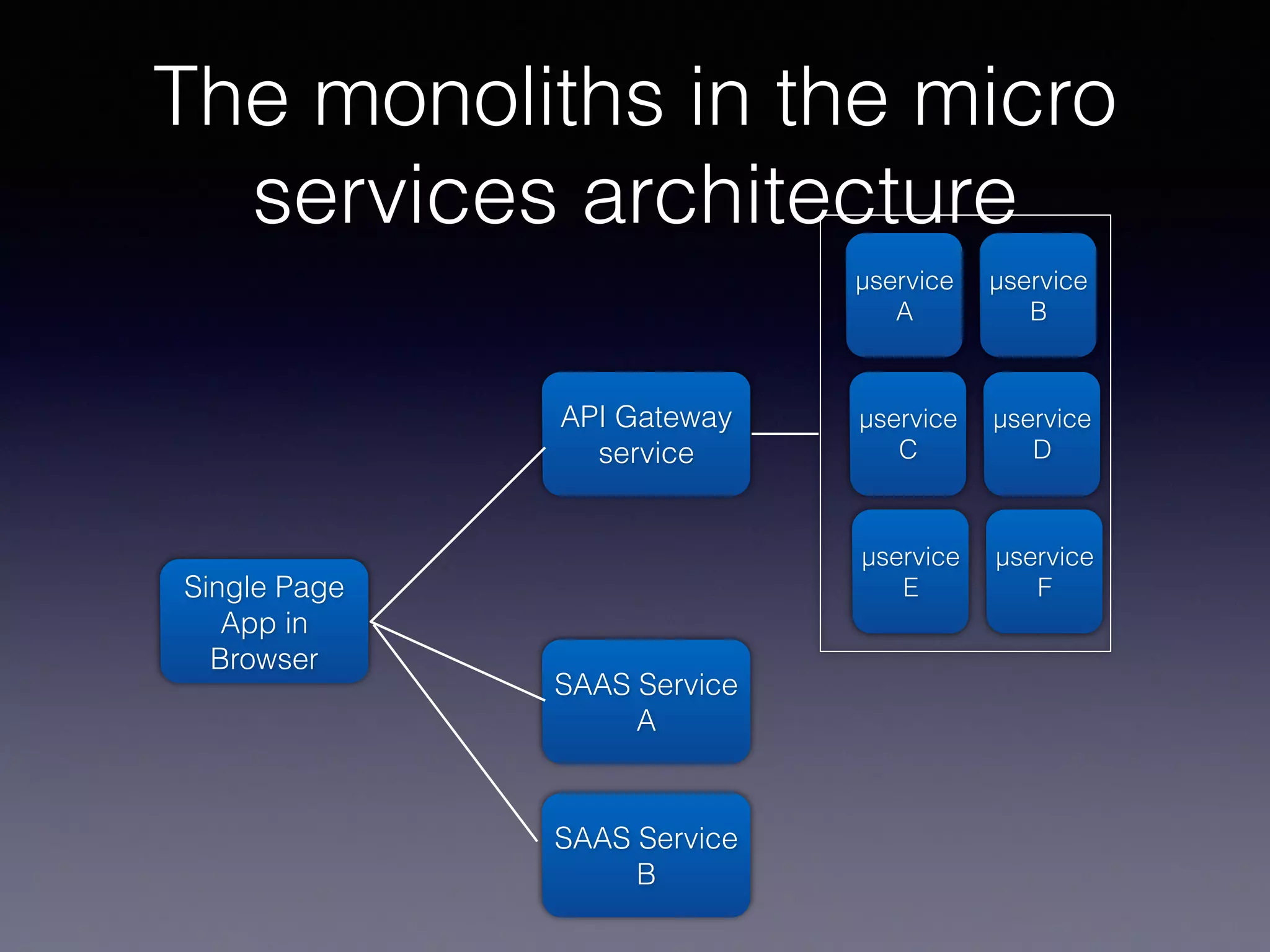
The monoliths in the micro
services architecture
Single Page
App in
Browser
API Gateway
service
µservice
A
SAAS Service
A
SAAS Service
B
µservice
B
µservice
C
µservice
D
µservice
E
µservice
F
"If you built it..."
 pretotyping.org
“Make sure you are building the
right it before you build it right."
!
"Fail fast ... and Often"
Lari Hotari @lhotari
Pivotal Software, Inc.
Thank you!

Ratpack and Grails 3

  • 1.
    Lari Hotari @lhotari PivotalSoftware, Inc. Ratpack and Grails 3
  • 2.
    Agenda • Grails 3and Ratpack • Why async? • Modularity and micro service architectures
  • 3.
    • Embrace Gradle •Abstract packaging / deployment • Reach outside the servlet container • App profiles: Netty, Servlet, Batch, Hadoop • Lightweight deployments, support micro services Grails 3
  • 5.
    Why Netty /Ratpack? Why async?
  • 6.
  • 7.
    Programming model • Declarativeprogramming expresses the logic of a computation without describing its control flow. • It's programming without the call stack, the programmer doesn't decide execution details. • Examples: functional and reactive programming, event / message based execution, distributed parallel computation algorithms like Map/Reduce
  • 8.
    15 import ratpack.rx.RxRatpack 16import ratpack.session.SessionModule 17 import ratpack.session.store.MapSessionsModule 18 import ratpack.session.store.SessionStorage 19 20 import static ratpack.groovy.Groovy.groovyTemplate 21 import static ratpack.groovy.Groovy.ratpack 22 import static ratpack.jackson.Jackson.json 23 import static ratpack.pac4j.internal.SessionConstants.USER_PROFILE 24 25 ratpack { 26 bindings { 27 bind DatabaseHealthCheck 28 add new CodaHaleMetricsModule().jvmMetrics().jmx().websocket(). 29 healthChecks() 30 add new HikariModule([URL: "jdbc:h2:mem:dev;INIT=CREATE SCHEMA IF NOT 31 EXISTS DEV"], "org.h2.jdbcx.JdbcDataSource") 32 add new SqlModule() 33 add new JacksonModule() 34 add new BookModule() 35 add new RemoteControlModule() 36 add new SessionModule() 37 add new MapSessionsModule(10, 5) 38 add new Pac4jModule<>(new FormClient("/login", new 39 SimpleTestUsernamePasswordAuthenticator()), new 40 AuthPathAuthorizer()) 41 42 init { BookService bookService -> 43 RxRatpack.initialize() 44 HystrixRatpack.initialize() 45 bookService.createTable() 46 } 47 } 48 49 handlers { BookService bookService -> 50 51 get { 52 bookService.all().toList().subscribe { List<Book> books -> 53 SessionStorage sessionStorage = request.get(SessionStorage) 54 UserProfile profile = sessionStorage.get(USER_PROFILE) 55 def username = profile?.getAttribute("username") 56 57 render groovyTemplate("listing.html", 58 username: username ?: "", 59 title: "Books", 60 books: books, 61 msg: request.queryParams.msg ?: "") 62 } 63 } 64 65 handler("create") { 66 byMethod { 67 get { 68 render groovyTemplate("create.html", title: "Create Book") 69 } 70 post { 71 Form form = parse(Form) 72 bookService.insert( 73 form.isbn, 74 form.get("quantity").asType(Long), 75 form.get("price").asType(BigDecimal) 76 ).single().subscribe { String isbn -> 77 redirect "/?msg=Book+$isbn+created" 78 } 79 } 80 } 81 } 82 83 handler("update/:isbn") { 84 def isbn = pathTokens["isbn"] 85 86 bookService.find(isbn).single().subscribe { Book book -> 87 if (book == null) { 88 clientError(404) 89 } else { 90 byMethod { 91 get { 92 render groovyTemplate("update.html", title: 93 "Update Book", book: book) 94 } 95 post { 96 Form form = parse(Form) 97 bookService.update( 98 isbn, 99 form.get("quantity").asType(Long), 100 form.get("price").asType(BigDecimal) 101 ) subscribe { 102 redirect "/?msg=Book+$isbn+updated" 103 } 104 } 105 } 106 } 107 } 108 } 109 110 post("delete/:isbn") { 111 def isbn = pathTokens["isbn"] 112 bookService.delete(isbn).subscribe { 113 redirect "/?msg=Book+$isbn+deleted" 114 } 115 } 116 117 prefix("api") { 118 get("books") { 119 bookService.all().toList().subscribe { List<Book> books -> 120 render json(books) 121 } 122 } 123 124 handler("book/:isbn?", registry.get(BookRestEndpoint)) 81 } 82 83 handler("update/:isbn") { 84 def isbn = pathTokens["isbn"] 85 86 bookService.find(isbn).single().subscribe { Book book -> 87 if (book == null) { 88 clientError(404) 89 } else { 90 byMethod { 91 get { 92 render groovyTemplate("update.html", title: 93 "Update Book", book: book) 94 } 95 post { 96 Form form = parse(Form) 97 bookService.update( 98 isbn, 99 form.get("quantity").asType(Long), 100 form.get("price").asType(BigDecimal) 101 ) subscribe { 102 redirect "/?msg=Book+$isbn+updated" 103 } 104 } 105 } 106 } 107 } 108 } 109 110 post("delete/:isbn") { 111 def isbn = pathTokens["isbn"] 112 bookService.delete(isbn).subscribe { 113 redirect "/?msg=Book+$isbn+deleted" source: https://github.com/ratpack/example-books/blob/master/src/ratpack/Ratpack.groovy Ratpack application consists of functional handler chains
  • 9.
    Ratpack applications • Ratpackscomes with Guice for dependency injection • Guice modules are also used as the plugin system for Ratpack • Examples of Ratpack module contributions: • Integrations to RxJava and Reactor. Can be used for async composition and preventing "callback hell". • Integration to Netflix Hystrix for adding error resilience functionality . f.e., Circuit-breaker pattern impl.
  • 10.
    Demo Ratpack and Grails(GORM) used together • https://github.com/lhotari/ratpack-gorm-example • Spring Boot embedded in Ratpack, running GORM
  • 12.
    Modularity • logical partitioningof the "software design" • allows complex software to be manageable for the purpose of implementation and maintenance
  • 13.
    Coupling and Cohesion •Coupling and cohesion are measures for describing how easy it will be to change the behaviour of some element in a system • Modules are coupled if a change in one forces a change in a the other • A module's cohesion is a measure of whether it's responsibilities form a meaningful unit source: GOOS book
  • 14.
    • Low couplingbetween modules ⟹ easier to change • High cohesion within module ⟹ single responsibility
  • 15.
    Microservice definition by JamesLewis • Each application only does one thing • Small enough to fit in your head • Small enough that you can throw them away • Embedded web container • Packaged as a single executable jar • Use HTTP and HATEOAS to decouple services • Each app exposes metrics about itself
  • 16.
    –Arnon Rotem-Gal-Oz, PracticalSOA “Nanoservice is an Anti-pattern where a service is too fine grained. Nanoservice is a service whose overhead (communications, maintenance etc.) out-weights its utility.”
  • 17.
    Polygot persistence • Commonprinciple is that each service owns it's data - there is no shared database across multiple services. • If this principle is followed, it usually means switching to Hexagonal architecture, where persistence is an integration and not part of the core. • "Start with the events and behaviour instead of the database." • Data consistency models in distributed systems
  • 18.
    Brooks: "No silverbullet" • Essential complexity • complexity that you cannot escape • Accidental complexity • we could be adding complexity by bad design
  • 19.
    - Google's "Solvefor X" “You don't spend your time being bothered that you can't teleport from here to Japan, because there's a part of you that thinks it's impossible. ! Moonshot thinking is choosing to be bothered by that.”
  • 20.
    Modular monoliths • Modularmonoliths are composed of loosely coupled modules of single responsibility • Enabling the 3rd way (after monoliths and microservices) for building applications on the JVM across different libraries and frameworks • Modules can be turned into true micro services when needed - instead of introducing accidental complexity to projects that don't really require micro services in the beginning, but could benefit of them later
  • 21.
    The monoliths inthe micro services architecture Single Page App in Browser API Gateway service µservice A SAAS Service A SAAS Service B µservice B µservice C µservice D µservice E µservice F
  • 22.
  • 23.
     pretotyping.org “Make sure youare building the right it before you build it right." ! "Fail fast ... and Often"
  • 24.
    Lari Hotari @lhotari PivotalSoftware, Inc. Thank you!