I was dismayed to learn form an Australian professor of literature that hardly anyone in Australia today has heard of, much less remember, Dorothy Cottrell. How Australians have allowed a national treasure like Dorothy to pass into oblivion is beyond belief.
You may wonder why I, a Cuban-born naturalized American on the other side of the Globe, feel so strongly about preserving Dorothy’s legacy. Well, one reason is intellectual: I consider Dorothy a first-rater writer. The other reason is emotional, spiritual: As a person Dorothy Cottrell made deep impression on me during my formative years.
She and her husband were neighbors of ours when they resided in Homestead, Florida, in the 1950’s. Though I was only 13 at the time—and had no clue of Dorothy’s literary reputation—I have many vivid and fond memories of her. Though wheelchair-bound since childhood, she was an accomplished, painter, gardener and sailor, and one of the most cheerful, optimistic persons I’ve ever known. Her husband Walter, or Mac, as we called him (his middle name being Mackenzie) was our Boy Scout Master
Sometimes the Troop would meet in the living room of their house, and though by now in declining health, Dorothy would literally come alive on hearing the rambling accounts of our camping experiences, and, in turn, regale us with stories of her and Mac’s trips to exotic places. It was at one of these Troop meeting that she taught us the iconic “Waltzing Matilda.” (In those days, before the advent of a TV set in every home, story telling and singing were was a popular form of entertainment) We American kids, of course, had no idea what a swagman or a billabong was, not ever seen a coolabah tree, but we learned the song, anyway, and henceforth included in our campfire repertoire. In addition to her other talents, Dorothy had a fine, robust singing voice.
It appears to me that the low esteem of Dorothy among academics in Australia, as is the case here in America with comparable authors, is that she was too sanguine, too self-reliant, and too successful commercially. Unlike the Silvia Plaths and Virginia Woolfs so revered in university literature departments (no disrgard of the works intended), Dorothy had no emotional issues to trumpet or social axes to grind, though as a life-long polio victim she certainly had good reason to be bitter.
As regard her womanhood, I can’t understand how modern-day feminists haven’t given Dorothy her due. True, Dorothy was no a militant in the spectacular manner of an Emmeline Pankhurst, but by dint of the example she set—a handicapped woman who became a best-selling author throughout the English-speaking world-- her inspiration to individual women of grit and talent was no less significant.
Nor can I understand why some Australian cinema producer hasn’t considered doing a film on Dorothy’s life. I can’t imagine a richer, more interesting, more uplifting love story than hers and Mac’s. Perhaps you saw or heard of the prize-winning film (2002) on the life of the Mexican artist Frida Kahlo. To be sure, the film is a classic, but, objectively speaking, the life story and artistic gifts of your Dorothy Cottrell are far more engaging than Frida Kahlo’s. Had Frida not been married to the renowned Mexican muralists Diego Rivera and connected with the Russian exile Leon Trotsky, chances are that no one would have ever heard of Frida. Dorothy Cottrell, by contrast, achieved all she did without any outside help.
Should anyone in Australia be interested in more late-life biographical anecdotes of Dorothy Cottrell—her relationship with Mac, their moving into the local “haunted” house, her workroom, her garden, her hand-pulley elevator, her visitors, etc—please do not hesitate to email me. The reintroduction of Dorothy Cottrell to her native land is long overdue.
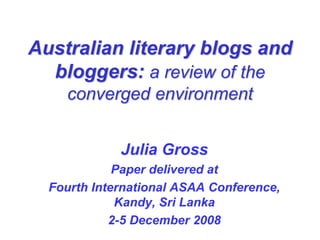
Australian literary blogs and bloggers - Presentation Transcript
Australian literary blogs and
bloggers: a review of the
converged environment
Julia Gross
Paper delivered at
Fourth International ASAA Conference,
Kandy, Sri Lanka
2-5 December 2008
The Association of Australasian
Studies in Asia (ASAA)
Paper delivered at the Fourth International
ASAA Conference, Kandy, Sri Lanka,
December 2008.
Conference theme: Australasia - Asia: Change,
Conflict and Convergence
http://www.asaa.net.au/default.htm
1 comments
Comments 1 - 1 of 1 previous next Post a comment