The Test Optional DecisionWhy, What, and How
I Really Do Know What You’re Thinking
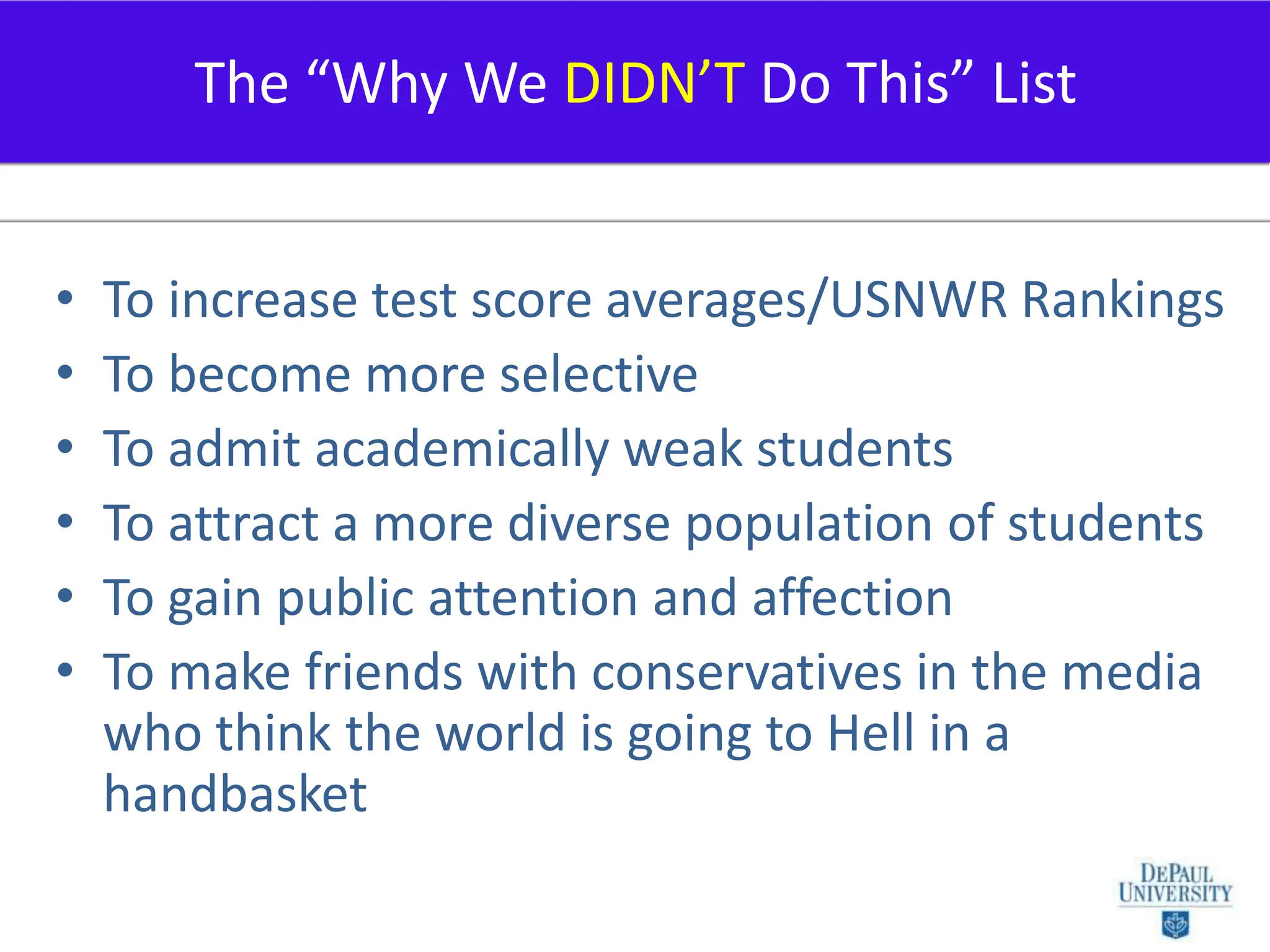
To increase test score averages/USNWR RankingsTo become more selectiveTo admit academically weak studentsTo attract a more diverse population of studentsTo gain public attention and affectionTo make friends with conservatives in the media who think the world is going to Hell in a handbasketThe “Why We DIDN’T Do This” List
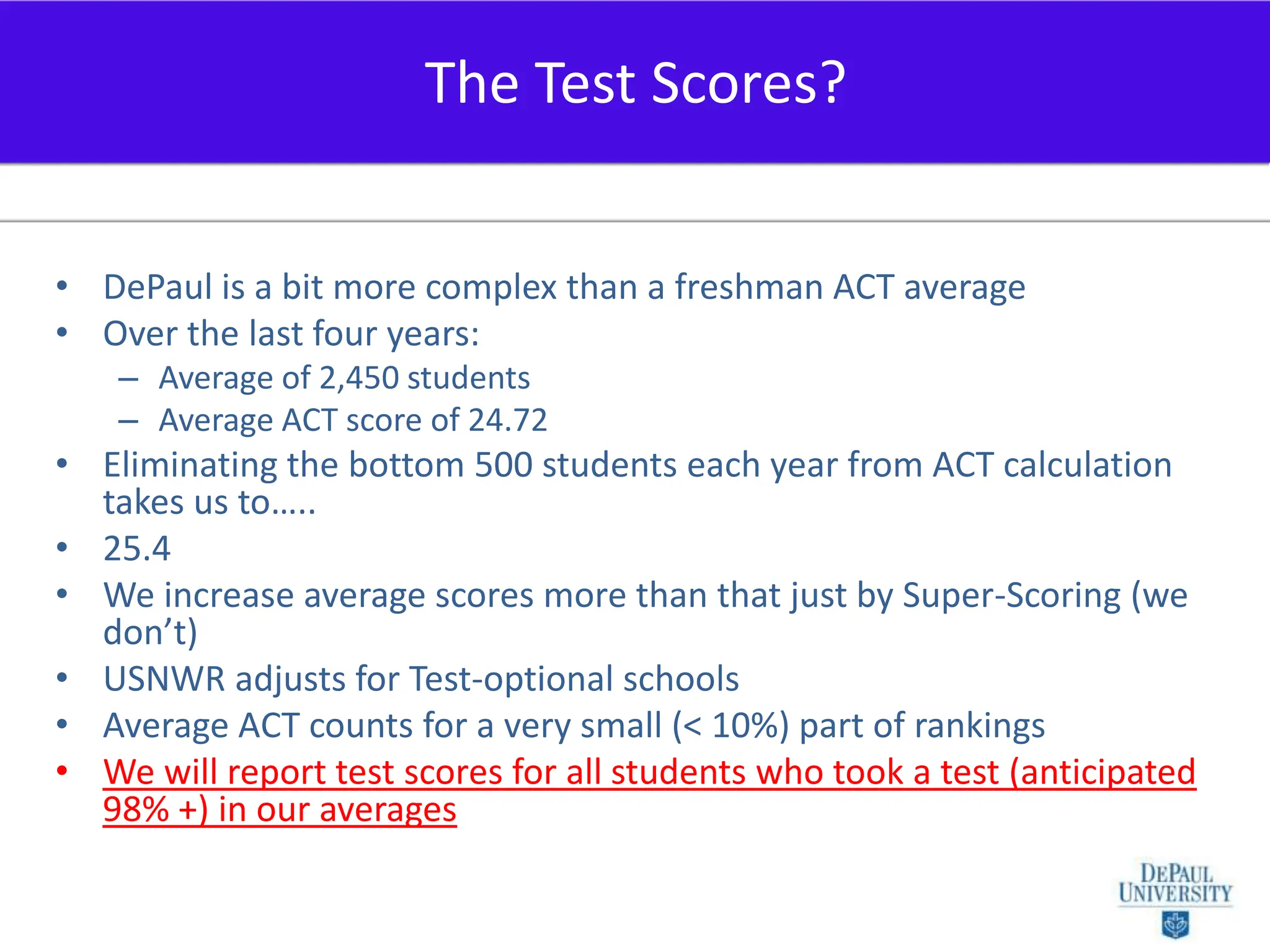
DePaul is a bit more complex than a freshman ACT averageOver the last four years:Average of 2,450 studentsAverage ACT score of 24.72Eliminating the bottom 500 students each year from ACT calculation takes us to…..25.4We increase average scores more than that just by Super-Scoring (we don’t)USNWR adjusts for Test-optional schoolsAverage ACT counts for a very small (< 10%) part of rankingsWe will report test scores for all students who took a test (anticipated 98% +) in our averagesThe Test Scores?
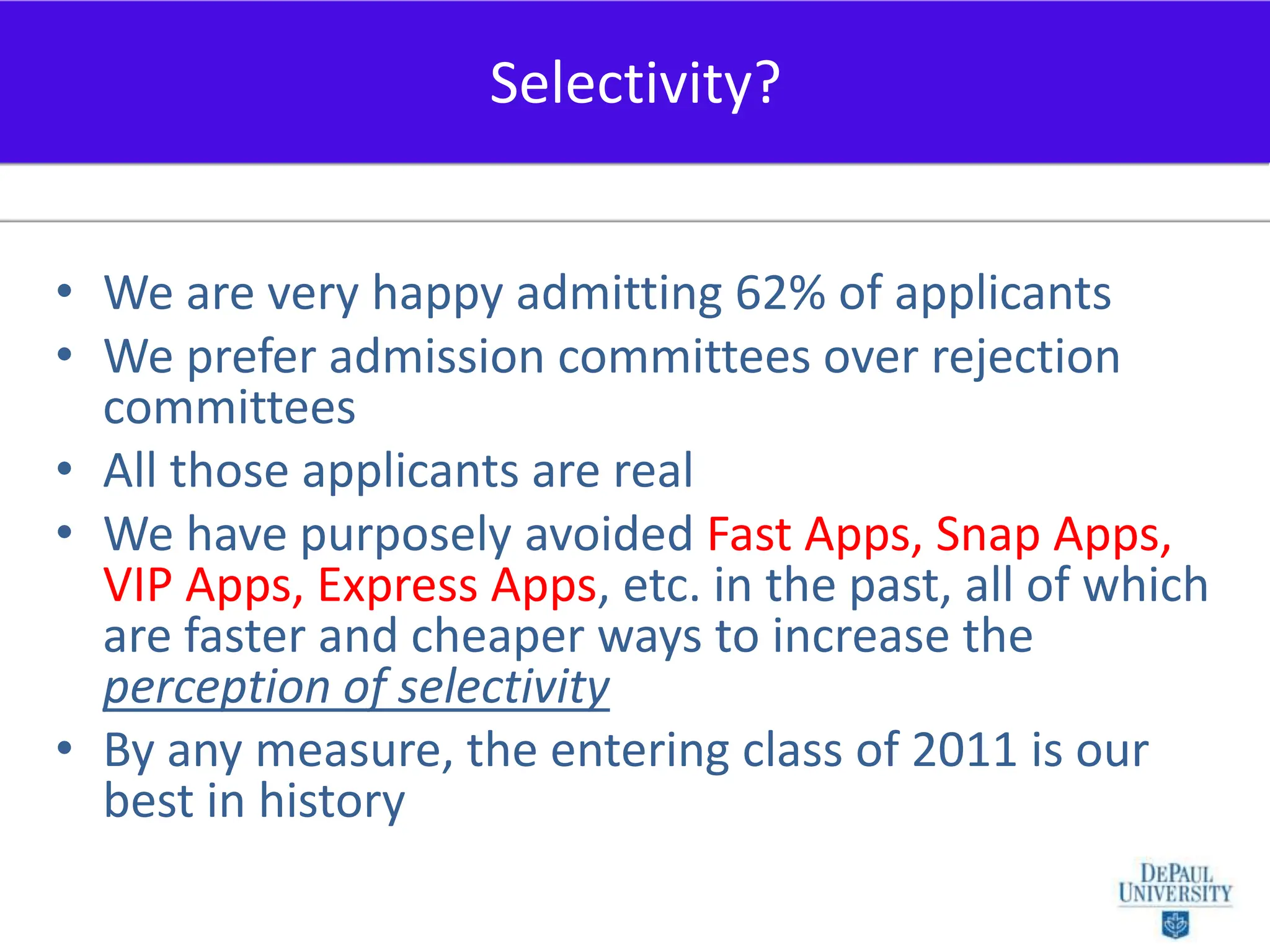
We are very happy admitting 62% of applicantsWe prefer admission committees over rejection committeesAll those applicants are realWe have purposely avoided Fast Apps, Snap Apps, VIP Apps, Express Apps, etc. in the past, all of which are faster and cheaper ways to increase the perception of selectivityBy any measure, the entering class of 2011 is our best in historySelectivity?
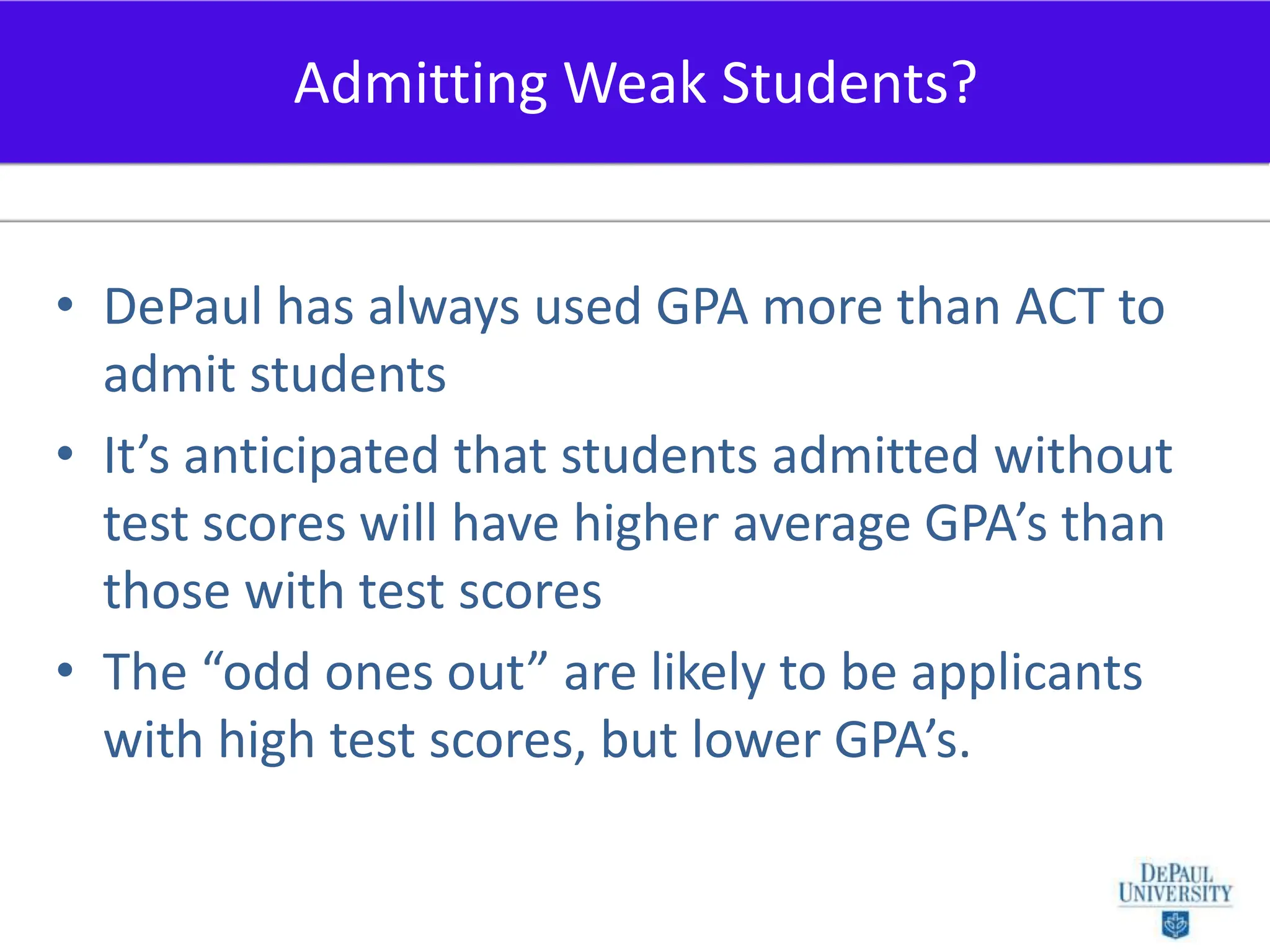
DePaul has always used GPA more than ACT to admit studentsIt’s anticipated that students admitted without test scores will have higher average GPA’s than those with test scoresThe “odd ones out” are likely to be applicants with high test scores, but lower GPA’s.Admitting Weak Students?
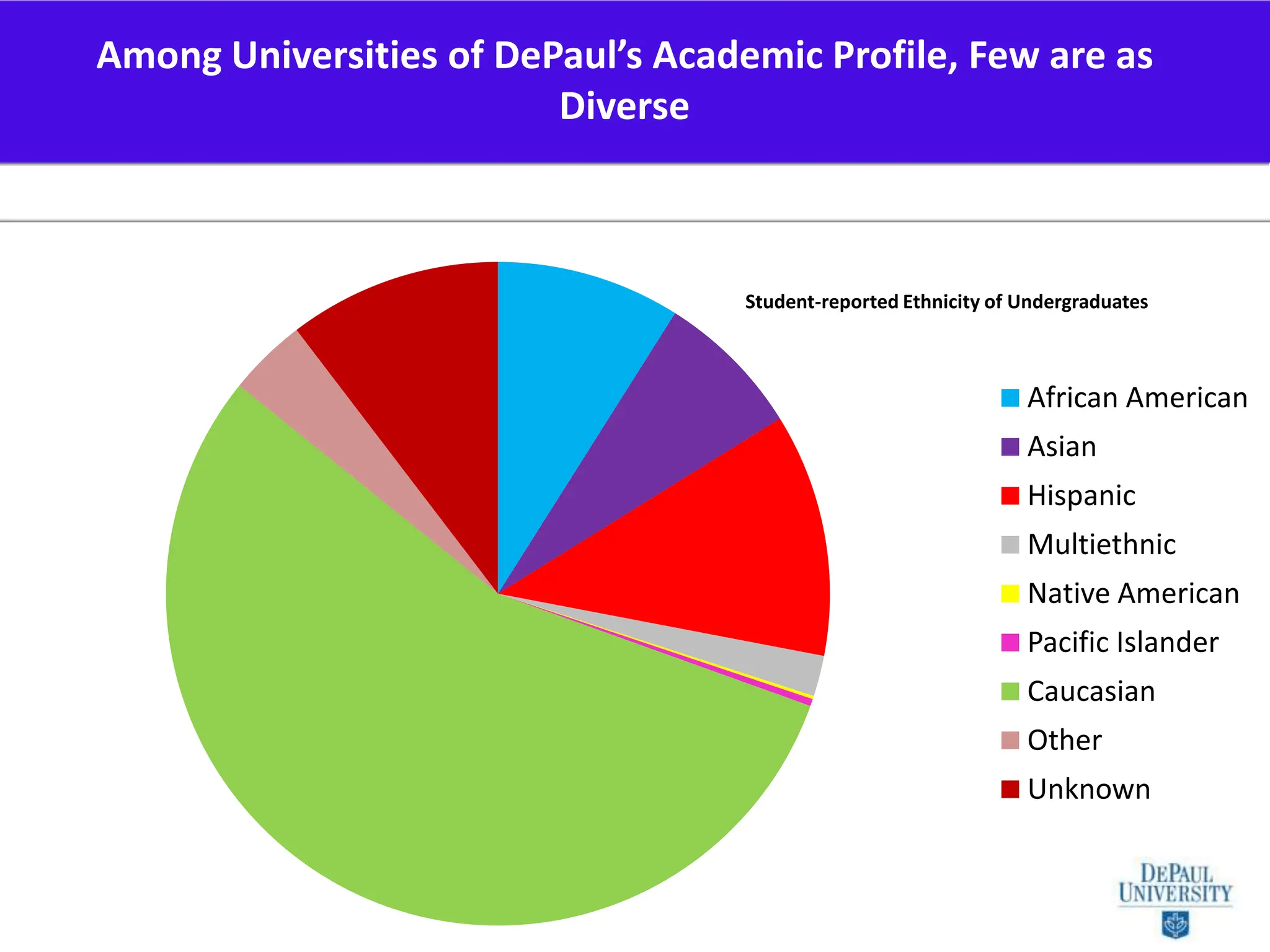
Of institutions with higher academic profiles than DePaul, only a few are more ethnically diverse Of institutions more diverse, few share the profile of DePaulOur diversity is a function of who we are as an institution, not a function of artificial processesWhen adding socio-economic diversity, DePaul is distinctive, sharing the spotlight with less than 20 similar institutionsMore Diversity?
Among Universities of DePaul’s Academic Profile, Few are as Diverse
Our announcement was purposely given only to the Chronicle to ensure it played out professionally firstHardly mentioned in Tribune, Sun Times, Inside Higher Ed, etc. until seven months laterTo Gain More Public Attention and Affection?
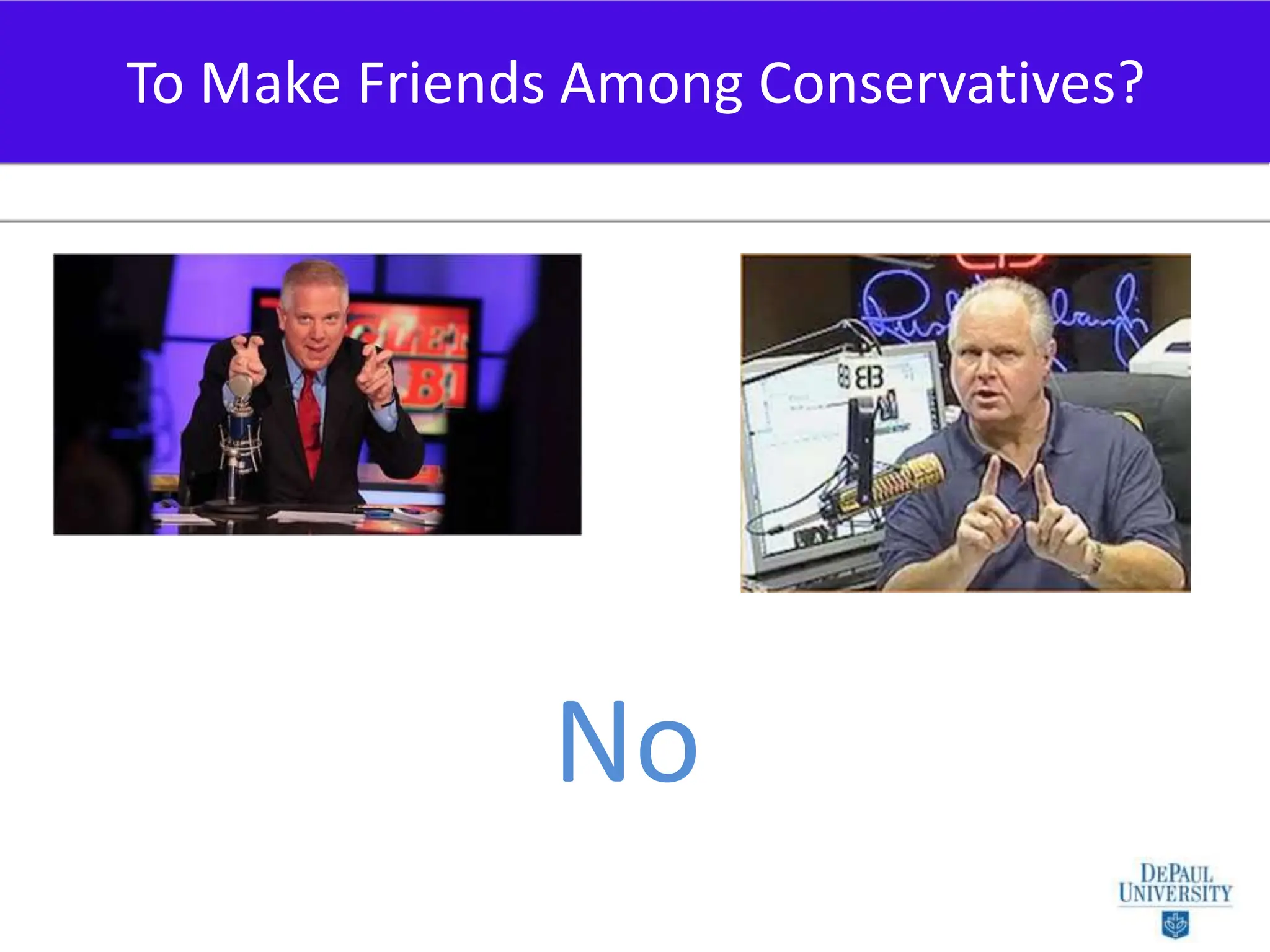
To Make Friends Among Conservatives?No
Test OptionalWhy We DID Do It
We have known for a LONG time that the single best predictor of college GPA is HS GPAYES, even from one HS to the nextNo study has ever refuted thisACT and SAT DO predict college GPA…but covariance with HS GPA tends to eliminate incremental valueACT and SAT are not intelligence testsOther factors have been shown to predict academic success ** better than ACT or SATOnly Academic Success predicts graduationIn All Seriousness…* Combination of 2.5 GPA and48 quarter credits earned in first year
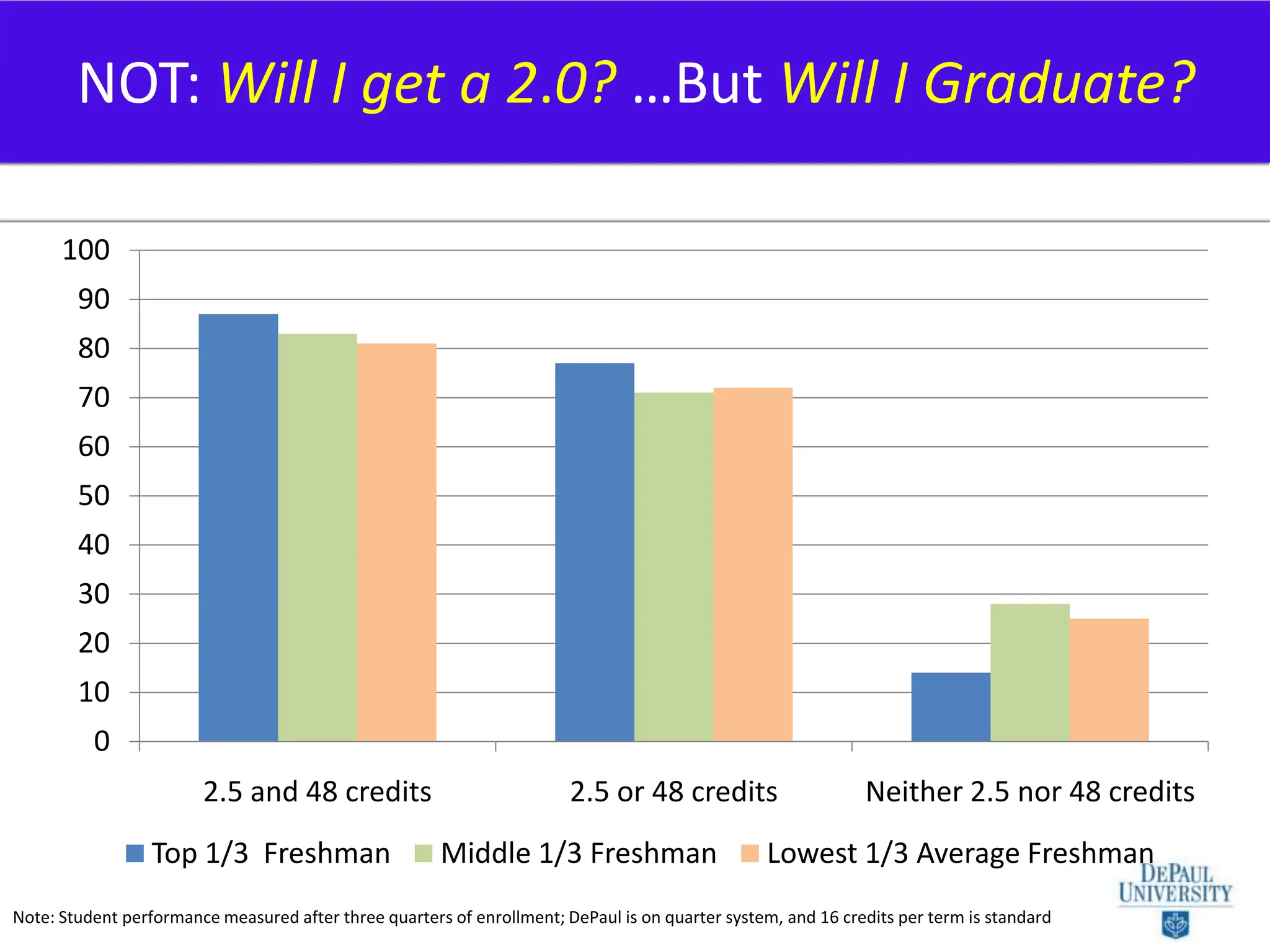
NOT: Will I get a 2.0? …But Will I Graduate?Note: Student performance measured after three quarters of enrollment; DePaul is on quarter system, and 16 credits per term is standard
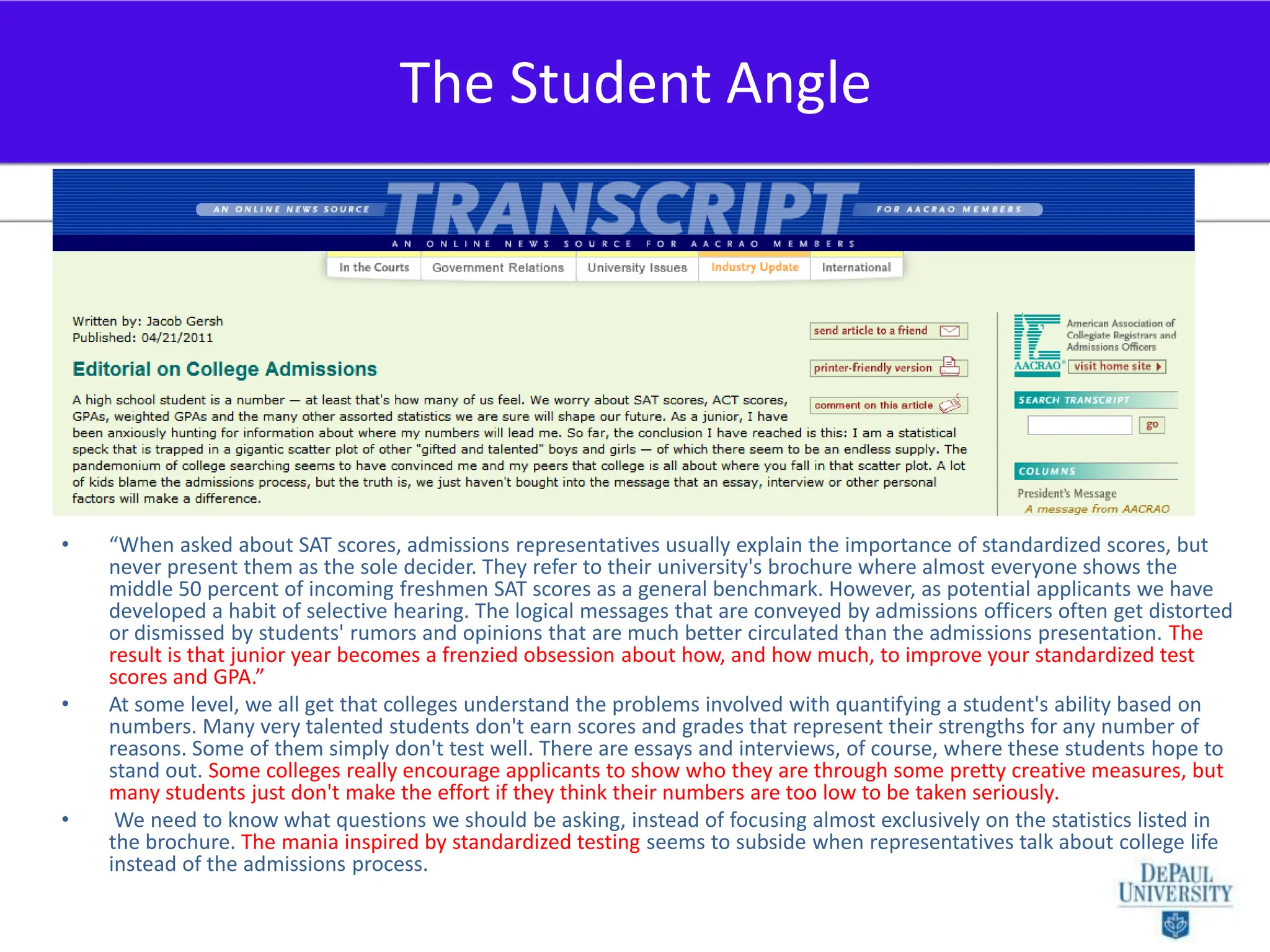
“When asked about SAT scores, admissions representatives usually explain the importance of standardized scores, but never present them as the sole decider. They refer to their university's brochure where almost everyone shows the middle 50 percent of incoming freshmen SAT scores as a general benchmark. However, as potential applicants we have developed a habit of selective hearing. The logical messages that are conveyed by admissions officers often get distorted or dismissed by students' rumors and opinions that are much better circulated than the admissions presentation. The result is that junior year becomes a frenzied obsession about how, and how much, to improve your standardized test scores and GPA.”At some level, we all get that colleges understand the problems involved with quantifying a student's ability based on numbers. Many very talented students don't earn scores and grades that represent their strengths for any number of reasons. Some of them simply don't test well. There are essays and interviews, of course, where these students hope to stand out. Some colleges really encourage applicants to show who they are through some pretty creative measures, but many students just don't make the effort if they think their numbers are too low to be taken seriously. We need to know what questions we should be asking, instead of focusing almost exclusively on the statistics listed in the brochure. The mania inspired by standardized testing seems to subside when representatives talk about college life instead of the admissions process.The Student Angle
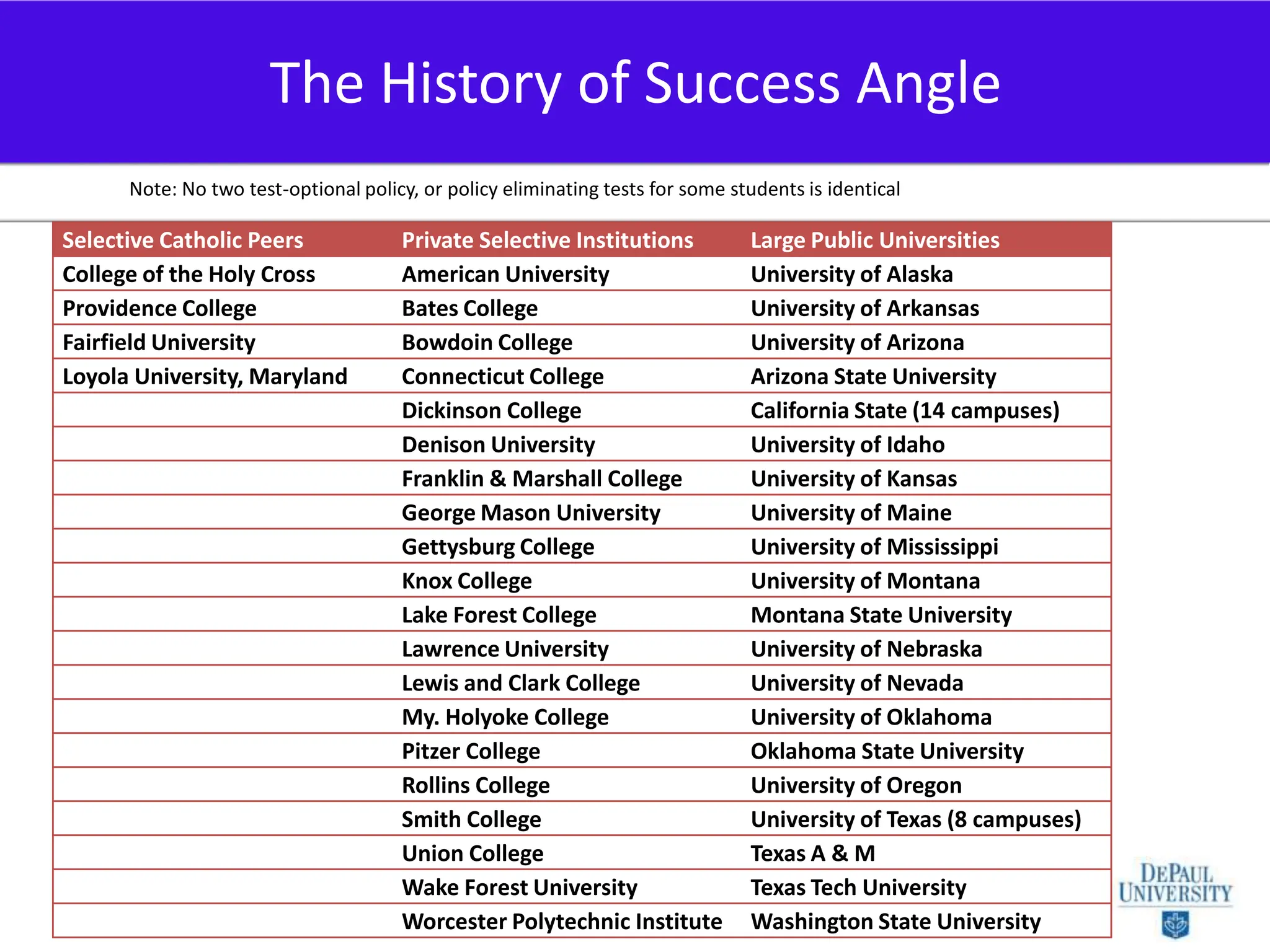
The History of Success AngleNote: No two test-optional policy, or policy eliminating tests for some students is identical
The Fairness and Access Angle
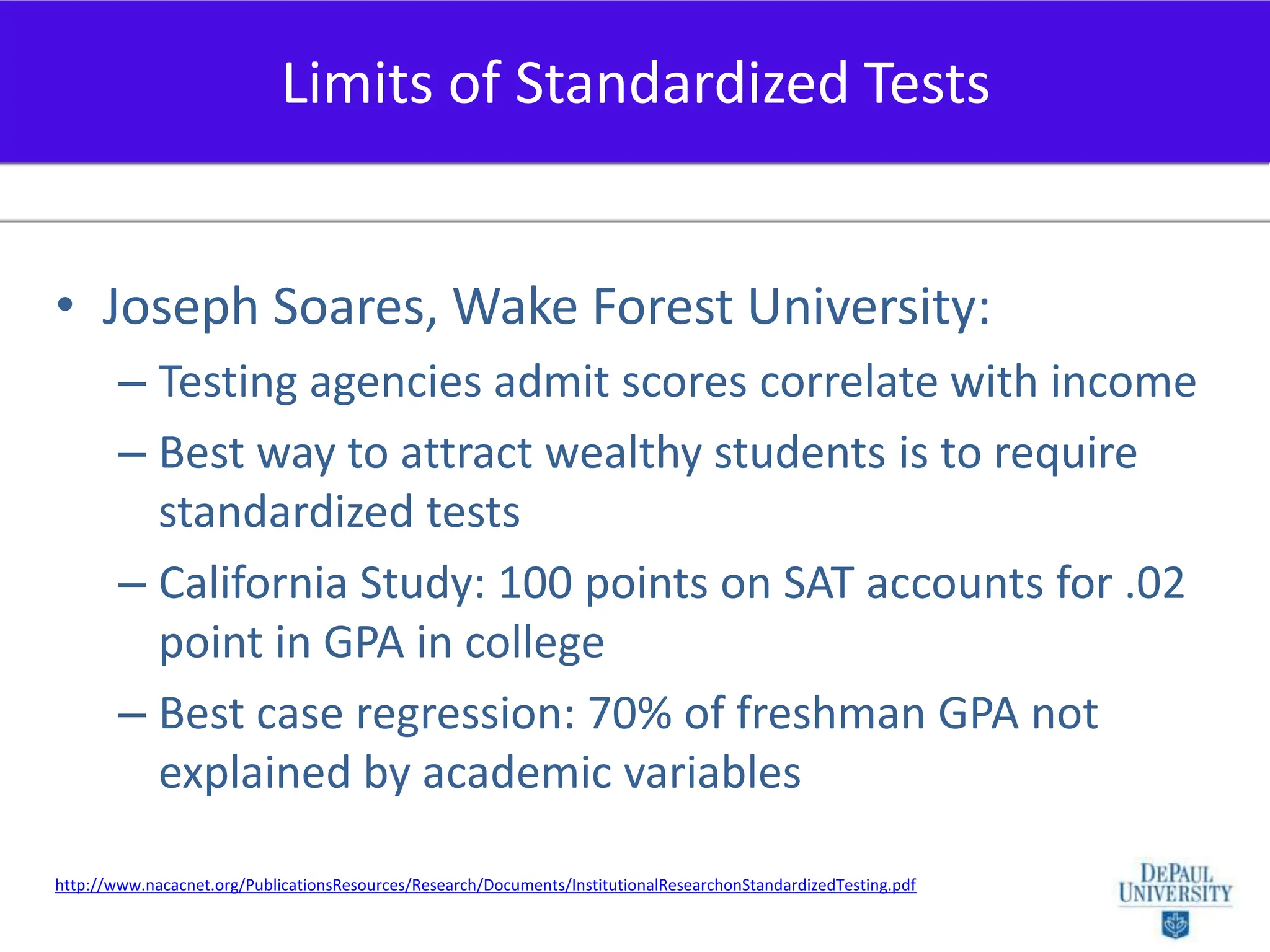
Joseph Soares, Wake Forest University:Testing agencies admit scores correlate with incomeBest way to attract wealthy students is to require standardized testsCalifornia Study: 100 points on SAT accounts for .02 point in GPA in collegeBest case regression: 70% of freshman GPA not explained by academic variablesLimits of Standardized Testshttp://www.nacacnet.org/PublicationsResources/Research/Documents/InstitutionalResearchonStandardizedTesting.pdf
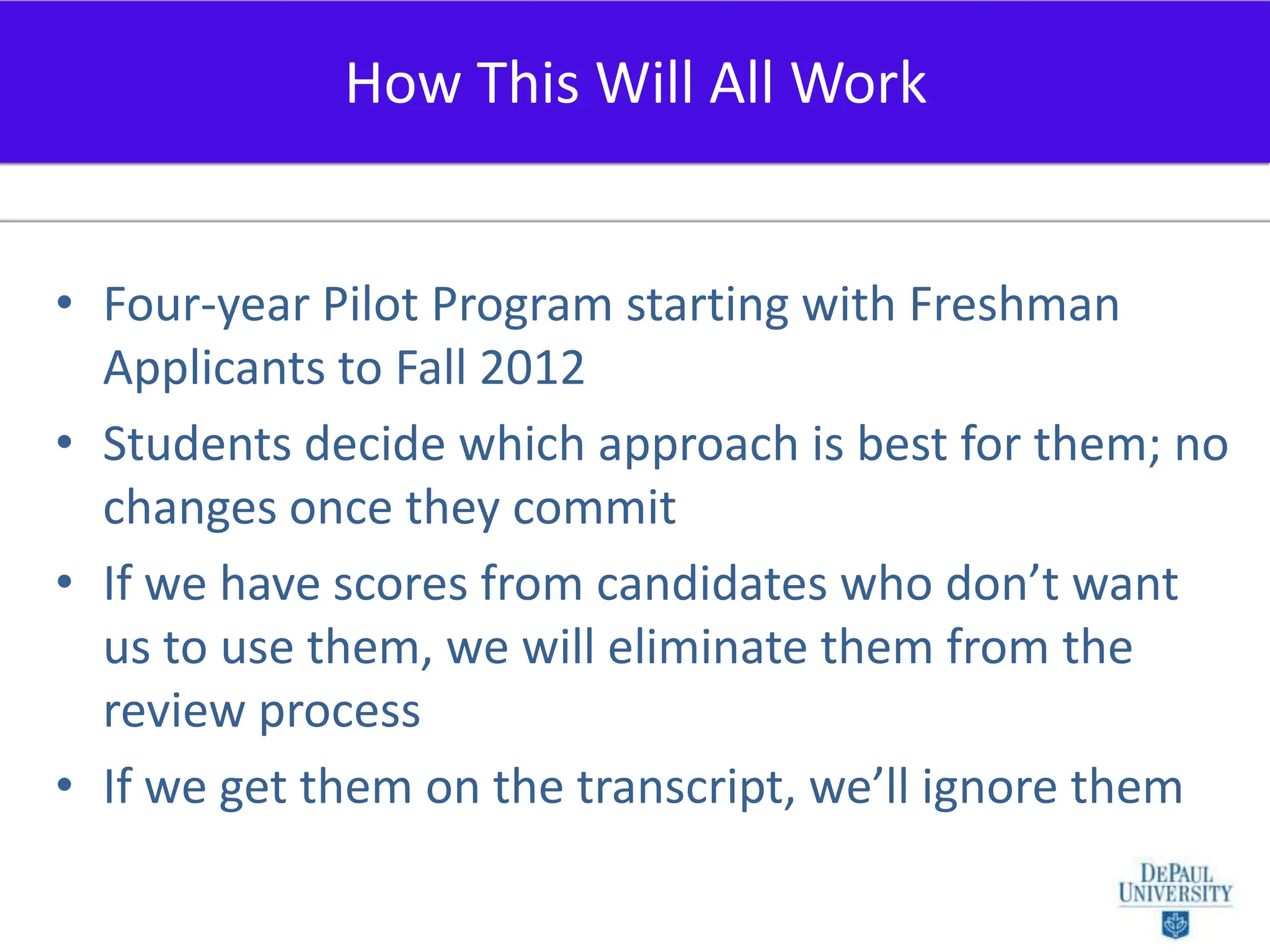
Four-year Pilot Program starting with Freshman Applicants to Fall 2012Students decide which approach is best for them; no changes once they commitIf we have scores from candidates who don’t want us to use them, we will eliminate them from the review processIf we get them on the transcript, we’ll ignore themHow This Will All Work
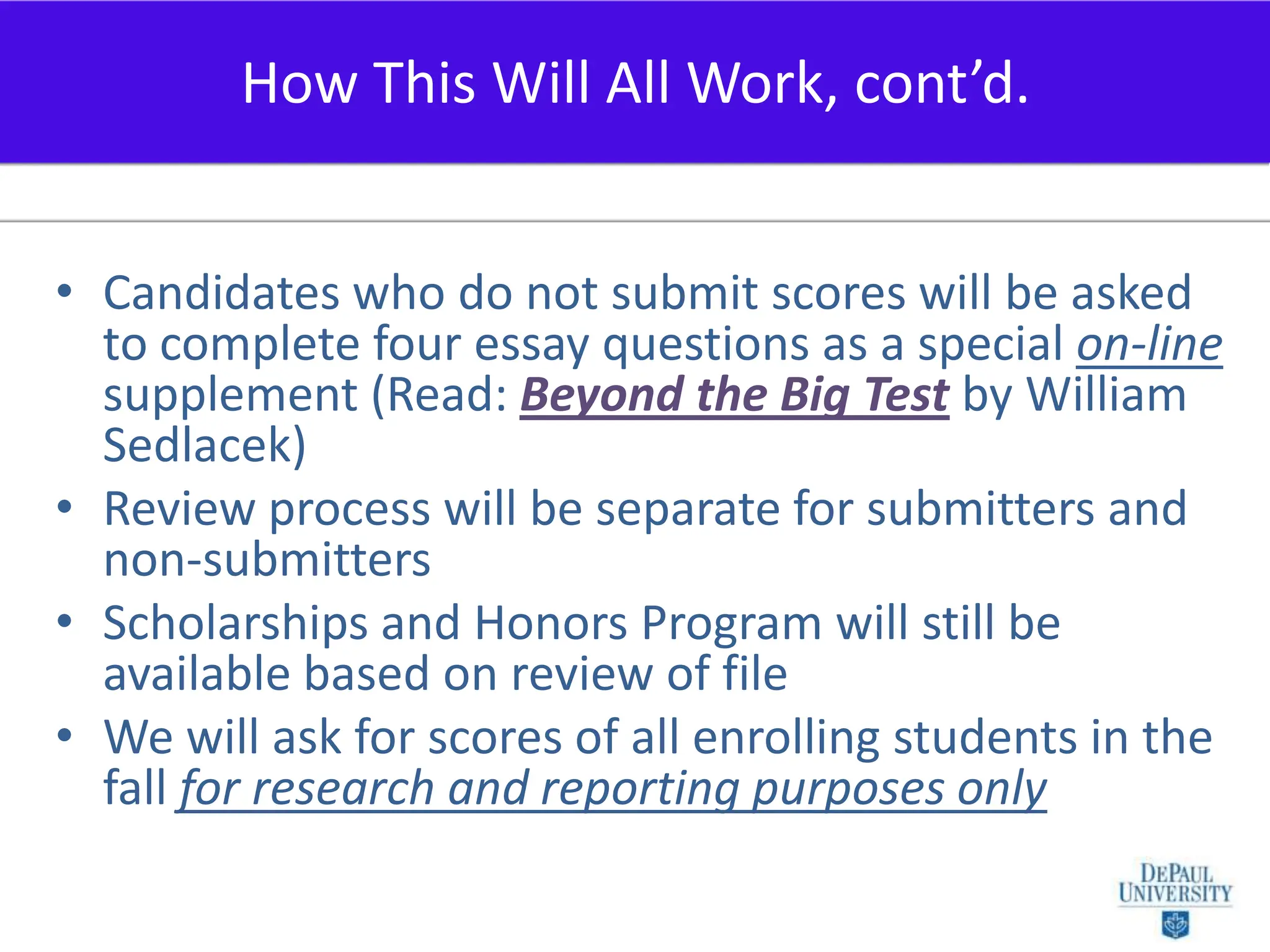
Candidates who do not submit scores will be asked to complete four essay questions as a special on-line supplement (Read: Beyond the Big Test by William Sedlacek)Review process will be separate for submitters and non-submittersScholarships and Honors Program will still be available based on review of fileWe will ask for scores of all enrolling students in the fall for research and reporting purposes onlyHow This Will All Work, cont’d.
We will work with Faculty to review the Pilot Program results yearlyWe anticipate full implementation by 2016However, we reserve the right to change or revert prior to the start of any application cycleWe’re happy to answer questions at any timeHow This Will All Work, cont’d.

http://bit.ly/dputestRead All About ItCounselors:http://bit.ly/dpuoptionalStudents:http://bit.ly/readthispleaseEveryone:

DePaul University Test Optional Decision

  • 1.
    The Test OptionalDecisionWhy, What, and How
  • 2.
    I Really DoKnow What You’re Thinking
  • 3.
    To increase testscore averages/USNWR RankingsTo become more selectiveTo admit academically weak studentsTo attract a more diverse population of studentsTo gain public attention and affectionTo make friends with conservatives in the media who think the world is going to Hell in a handbasketThe “Why We DIDN’T Do This” List
  • 4.
    DePaul is abit more complex than a freshman ACT averageOver the last four years:Average of 2,450 studentsAverage ACT score of 24.72Eliminating the bottom 500 students each year from ACT calculation takes us to…..25.4We increase average scores more than that just by Super-Scoring (we don’t)USNWR adjusts for Test-optional schoolsAverage ACT counts for a very small (< 10%) part of rankingsWe will report test scores for all students who took a test (anticipated 98% +) in our averagesThe Test Scores?
  • 5.
    We are veryhappy admitting 62% of applicantsWe prefer admission committees over rejection committeesAll those applicants are realWe have purposely avoided Fast Apps, Snap Apps, VIP Apps, Express Apps, etc. in the past, all of which are faster and cheaper ways to increase the perception of selectivityBy any measure, the entering class of 2011 is our best in historySelectivity?
  • 6.
    DePaul has alwaysused GPA more than ACT to admit studentsIt’s anticipated that students admitted without test scores will have higher average GPA’s than those with test scoresThe “odd ones out” are likely to be applicants with high test scores, but lower GPA’s.Admitting Weak Students?
  • 7.
    Of institutions withhigher academic profiles than DePaul, only a few are more ethnically diverse Of institutions more diverse, few share the profile of DePaulOur diversity is a function of who we are as an institution, not a function of artificial processesWhen adding socio-economic diversity, DePaul is distinctive, sharing the spotlight with less than 20 similar institutionsMore Diversity?
  • 8.
    Among Universities ofDePaul’s Academic Profile, Few are as Diverse
  • 9.
    Our announcement waspurposely given only to the Chronicle to ensure it played out professionally firstHardly mentioned in Tribune, Sun Times, Inside Higher Ed, etc. until seven months laterTo Gain More Public Attention and Affection?
  • 10.
    To Make FriendsAmong Conservatives?No
  • 11.
  • 12.
    We have knownfor a LONG time that the single best predictor of college GPA is HS GPAYES, even from one HS to the nextNo study has ever refuted thisACT and SAT DO predict college GPA…but covariance with HS GPA tends to eliminate incremental valueACT and SAT are not intelligence testsOther factors have been shown to predict academic success ** better than ACT or SATOnly Academic Success predicts graduationIn All Seriousness…* Combination of 2.5 GPA and48 quarter credits earned in first year
  • 13.
    NOT: Will Iget a 2.0? …But Will I Graduate?Note: Student performance measured after three quarters of enrollment; DePaul is on quarter system, and 16 credits per term is standard
  • 14.
    “When asked aboutSAT scores, admissions representatives usually explain the importance of standardized scores, but never present them as the sole decider. They refer to their university's brochure where almost everyone shows the middle 50 percent of incoming freshmen SAT scores as a general benchmark. However, as potential applicants we have developed a habit of selective hearing. The logical messages that are conveyed by admissions officers often get distorted or dismissed by students' rumors and opinions that are much better circulated than the admissions presentation. The result is that junior year becomes a frenzied obsession about how, and how much, to improve your standardized test scores and GPA.”At some level, we all get that colleges understand the problems involved with quantifying a student's ability based on numbers. Many very talented students don't earn scores and grades that represent their strengths for any number of reasons. Some of them simply don't test well. There are essays and interviews, of course, where these students hope to stand out. Some colleges really encourage applicants to show who they are through some pretty creative measures, but many students just don't make the effort if they think their numbers are too low to be taken seriously. We need to know what questions we should be asking, instead of focusing almost exclusively on the statistics listed in the brochure. The mania inspired by standardized testing seems to subside when representatives talk about college life instead of the admissions process.The Student Angle
  • 15.
    The History ofSuccess AngleNote: No two test-optional policy, or policy eliminating tests for some students is identical
  • 16.
    The Fairness andAccess Angle
  • 17.
    Joseph Soares, WakeForest University:Testing agencies admit scores correlate with incomeBest way to attract wealthy students is to require standardized testsCalifornia Study: 100 points on SAT accounts for .02 point in GPA in collegeBest case regression: 70% of freshman GPA not explained by academic variablesLimits of Standardized Testshttp://www.nacacnet.org/PublicationsResources/Research/Documents/InstitutionalResearchonStandardizedTesting.pdf
  • 18.
    Four-year Pilot Programstarting with Freshman Applicants to Fall 2012Students decide which approach is best for them; no changes once they commitIf we have scores from candidates who don’t want us to use them, we will eliminate them from the review processIf we get them on the transcript, we’ll ignore themHow This Will All Work
  • 19.
    Candidates who donot submit scores will be asked to complete four essay questions as a special on-line supplement (Read: Beyond the Big Test by William Sedlacek)Review process will be separate for submitters and non-submittersScholarships and Honors Program will still be available based on review of fileWe will ask for scores of all enrolling students in the fall for research and reporting purposes onlyHow This Will All Work, cont’d.
  • 20.
    We will workwith Faculty to review the Pilot Program results yearlyWe anticipate full implementation by 2016However, we reserve the right to change or revert prior to the start of any application cycleWe’re happy to answer questions at any timeHow This Will All Work, cont’d.

  • 21.
    http://bit.ly/dputestRead All AboutItCounselors:http://bit.ly/dpuoptionalStudents:http://bit.ly/readthispleaseEveryone: