
Web of jobs

As many as 55-60% of the Internet users in India are seeking jobs on the net. And given that Internet penetration will only increase, Indicus predicts online job seekers will grow three-four folds during the next decade, to reach 100 million by 2020 Internet penetration in India has been slow and mainly an urban phenomenon. Various estimates place this figure between 50 and 55 million. Interestingly, a very significant proportion of the Internet users are job seekers. Research by Juxt Consult indicates that as many as 65% have visited job sites. All of them may not be active job seekers, but clearly a lot of them are. The three-four leading job sites and the size of their resume databases (as indicated on their sites) indicate that there are between 15 and 22 million active jobseekers on each of these sites. Even if one assumes that a large proportion of these are present on all the leading databases, one can realistically assume a figure of 28 to 30 million active job seekers, which is abut 55-60% of all the people on the net at present. Driven by high economic growth, availability of multiple devices for Internet access and better Internet infrastructure, the Internet population in India is expected to grow five-six folds during the next ten years. The future will, of course, see many different users, including fun, entertainment and transaction. However, we also expect active job search to remain a mainstay of the Internet in India. Driven by increased penetration, growth in economic centres, and large numbers from the younger age group (who are currently not job seekers), we expect the population of active online job seekers to grow three-four folds during the next decade to reach 100 million by 2020. There are various reasons why the job seekers are largely getting on the net. The whole ecosystem of the Internet makes job search, applications, getting alerts, etc, so much easier, that most active job seekers find it more efficient to be on the net. However, since job availability and the physical interviews continue to be concentrated around the economic growth centres, active job seekers from small towns and villages tend to either migrate to the growth centres or be off the net. What are the job seekers on the net like? Indicus conducted a research to find out the profile of jobseekers in India, which, in turn, is a profile of a substantial chunk of the Internet population in India. Our research has been conducted over the past one year through various surveys over the net. We present here some of the characteristics of the job seekers on the net. We already know that the active job seekers on the net are about 28-30 million. Apart from a very small percentage, they are mainly urban. In fact, ten cities account for as many as 71% of the job seekers on the net. The five metros—Delhi, Chennai, Mumbai, Bangalore and Kolkata (not counting their satellites)—account for 48% of the online job seekers. Pune and Hyderabad individually account for more job seekers than Kolkata and Chennai, respectively, and online job seekers in Ahmedabad are only slightly below Kolkata in number. The national capital region (Delhi, Gurgaon, Noida, Greater Noida, Faridabad and Ghaziabad) accounts for as many as 19% of the online jobseekers, making it the largest cluster of online job seekers. Gurgaon, despite being small in terms of population, has a particularly high concentration of job seekers. Fifty cities account for almost 90% of the jobseekers, and the top 20 cities account for nearly 81%. This, more than anything else, is a clear indication of the skewed distribution of online jobseekers. There are several reasons behind this, the key ones being economic opportunities and Internet penetration. Women The gender difference probably reflects the workplace gender difference (in the kind of organisations that online jobseekers work). As many as 23% of the online job seekers are women. However, the proportion of women among the onl

Recommended
More Related Content
More from Indicus Analytics Private Limited
More from Indicus Analytics Private Limited (20)
Recently uploaded
Recently uploaded (20)
Web of jobs
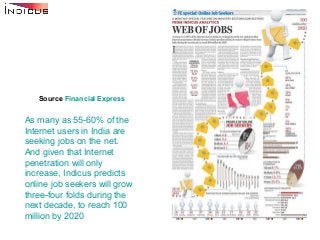
- 1. Source Financial Express As many as 55-60% of the Internet users in India are seeking jobs on the net. And given that Internet penetration will only increase, Indicus predicts online job seekers will grow three-four folds during the next decade, to reach 100 million by 2020
- 2. Internet penetration in India has been slow and mainly an urban phenomenon. Various estimates place this figure between 50 and 55 million. Interestingly, a very significant proportion of the Internet users are job seekers. Research by Juxt Consult indicates that as many as 65% have visited job sites. All of them may not be active job seekers, but clearly a lot of them are. The three-four leading job sites and the size of their resume databases (as indicated on their sites) indicate that there are between 15 and 22 million active jobseekers on each of these sites. Even if one assumes that a large proportion of these are present on all the leading databases, one can realistically assume a figure of 28 to 30 million active job seekers, which is abut 55-60% of all the people on the net at present. Driven by high economic growth, availability of multiple devices for Internet access and better Internet infrastructure, the Internet population in India is expected to grow five-six folds during the next ten years. The future will, of course, see many different users, including fun, entertainment and transaction. However, we also expect active job search to remain a mainstay of the Internet in India. Driven by increased penetration, growth in economic centres, and large numbers from the younger age group (who are currently not job seekers), we expect the population of active online job seekers to grow three-four folds during the next decade to reach 100 million by 2020.
- 3. There are various reasons why the job seekers are largely getting on the net. The whole ecosystem of the Internet makes job search, applications, getting alerts, etc, so much easier, that most active job seekers find it more efficient to be on the net. However, since job availability and the physical interviews continue to be concentrated around the economic growth centres, active job seekers from small towns and villages tend to either migrate to the growth centres or be off the net. What are the job seekers on the net like? Indicus conducted a research to find out the profile of jobseekers in India, which, in turn, is a profile of a substantial chunk of the Internet population in India. Our research has been conducted over the past one year through various surveys over the net. We present here some of the characteristics of the job seekers on the net. We already know that the active job seekers on the net are about 28-30 million. Apart from a very small percentage, they are mainly urban. In fact, ten cities account for as many as 71% of the job seekers on the net. The five metros—Delhi, Chennai, Mumbai, Bangalore and Kolkata (not counting their satellites)—account for 48% of the online job seekers. Pune and Hyderabad individually account for more job seekers than Kolkata and Chennai, respectively, and online job seekers in Ahmedabad are only slightly below Kolkata in number. The national capital region (Delhi, Gurgaon, Noida, Greater Noida, Faridabad and Ghaziabad) accounts for as many as 19% of the online jobseekers, making it the largest cluster of online job seekers. Gurgaon, despite being small in terms of population, has a particularly high concentration of job seekers.
- 4. Fifty cities account for almost 90% of the jobseekers, and the top 20 cities account for nearly 81%. This, more than anything else, is a clear indication of the skewed distribution of online jobseekers. There are several reasons behind this, the key ones being economic opportunities and Internet penetration. Women The gender difference probably reflects the workplace gender difference (in the kind of organisations that online jobseekers work). As many as 23% of the online job seekers are women. However, the proportion of women among the online job seekers varies greatly across cities. In Mumbai, Pune, Hyderabad, Bangalore, Chennai and Pune, the proportion of women is significantly higher than the all-India average, whereas in Delhi and Ahmedabad, it is well below the all-India average. Interestingly, the proportion of women is higher in larger cities as compared to smaller cities in the same region. Age distribution As many as 97% of the job seekers are between the age of 20 and 45 years. In fact, two age groups (25-35 and 20-24) account for 88% of the job seekers, and these age groups are likely to remain active job seekers even in 2020. The age profile indicates that given the rise of Internet penetration and the fast growth in the economy, the number of active job seekers is likely to grow at a fast clip right through the coming decade. It is also evident that as the years pass by and people age, the proportions of the higher age groups will increase significantly.
- 5. Just like the age profile, the distribution by years of work experience is heavily skewed towards job seekers with less experience. More than half the job seekers have two years of experience or less and a further 24% have experience of six years or less. Only 4.5% of the active online jobseekers have more than 15 years of experience. Again, we would expect that by 2020, the chart would be considerably different and even the 15 year-plus segment will have a considerably higher share. Industry Our research indicates that online jobseekers are now representing virtually all the major industries. The IT sector, as expected, is the leading sector. However, as many as 78% of the job seekers are from other sectors. BFSI, engineering and manufacturing, education and training, ITES, healthcare, core sector (oil, gas, power, construction, etc) and telecom are the leading sectors represented by online job seekers. In the years to come, we would expect the share of IT and BFSI to shrink somewhat and the share of most other sectors grow. However, IT should continue to be the leading sector.
- 6. Hierarchy It is evident that most online job seekers are young and are likely to be in the lower rungs of corporate hierarchy. In fact, top management accounts for just about 1% of the job seekers, and senior management accounts for another 5.4%. About 30% are very fresh and another 30% are at junior management level. Educational qualifications Engineers, MBAs and commerce graduates dominate the online jobseekers space. Interestingly, non- graduates/non-diploma (12 th pass) account for 4% of the job seekers. In conclusion The online job space has grown tremendously during the past ten years. It is set to continue to grow at a fast pace during the next decade too. Whereas, younger jobseekers will continue to be the dominant force, the representation of higher age brackets is set to grow significantly. Further, already most industry sectors are being well represented in the online job space, and this movement will continue. We also expect that as the economy keeps expanding rapidly and Internet penetration increases, the share of smaller cities in the online jobseekers’ space will expand rapidly.
- 7. Hierarchy It is evident that most online job seekers are young and are likely to be in the lower rungs of corporate hierarchy. In fact, top management accounts for just about 1% of the job seekers, and senior management accounts for another 5.4%. About 30% are very fresh and another 30% are at junior management level. Educational qualifications Engineers, MBAs and commerce graduates dominate the online jobseekers space. Interestingly, non- graduates/non-diploma (12 th pass) account for 4% of the job seekers. In conclusion The online job space has grown tremendously during the past ten years. It is set to continue to grow at a fast pace during the next decade too. Whereas, younger jobseekers will continue to be the dominant force, the representation of higher age brackets is set to grow significantly. Further, already most industry sectors are being well represented in the online job space, and this movement will continue. We also expect that as the economy keeps expanding rapidly and Internet penetration increases, the share of smaller cities in the online jobseekers’ space will expand rapidly.