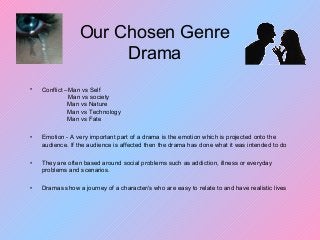
Our Chosen Genre
Drama
•Conflict –Man vs Self
Man vs society
Man vs Nature
Man vs Technology
Man vs Fate
• Emotion - A very important part of a drama is the emotion which is projected onto the
audience. If the audience is affected then the drama has done what it was intended to do
• They are often based around social problems such as addiction, illness or everyday
problems and scenarios.
• Dramas show a journey of a character/s who are easy to relate to and have realistic lives
3.
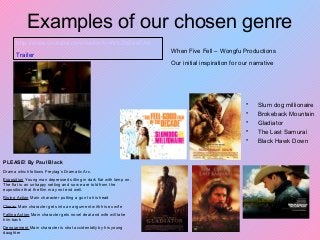
Examples of ourchosen genre
• Slum dog millionaire
• Brokeback Mountain
• Gladiator
• The Last Samurai
• Black Hawk Down
When Five Fell – Wongfu Productions
Our initial inspiration for our narrative
http://www.youtube.com/watch?v=N5-ZhZea7AA
Trailer
PLEASE! By Paul Black
Drama which follows Freytag’s Dramatic Arc.
Exposition Young man depressed sitting in dark flat with lamp on.
The flat is an unhappy setting and so we are told from the
exposition that the film may not end well.
Rising Action Main character putting a gun to his head
Climax Main character gets into an argument with his ex wife
Falling Action Main character gets novel deal and wife will take
him back
Denouement Main character is shot accidentally by his young
daughter
4.
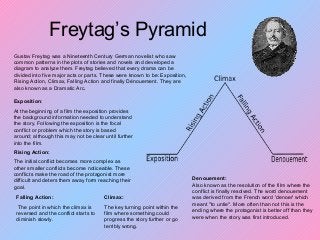
Freytag’s Pyramid
Gustav Freytagwas a Nineteenth Century German novelist who saw
common patterns in the plots of stories and novels and developed a
diagram to analyze them. Freytag believed that every drama can be
divided into five major acts or parts. These were known to be: Exposition,
Rising Action, Climax, Falling Action and finally Dénouement. They are
also known as a Dramatic Arc.
Exposition:
At the beginning of a film the exposition provides
the background information needed to understand
the story. Following the exposition is the focal
conflict or problem which the story is based
around; although this may not be clear until further
into the film.
Rising Action:
The initial conflict becomes more complex as
other smaller conflicts become noticeable. These
conflicts make the road of the protagonist more
difficult and deters them away form reaching their
goal.
Climax:
The key turning point within the
film where something could
progress the story further or go
terribly wrong.
Falling Action:
The point in which the climax is
reversed and the conflict starts to
diminish slowly.
Denouement:
Also known as the resolution of the film where the
conflict is finally resolved. The word denouement
was derived from the French word 'denoer' which
meant "to untie". More often than not this is the
ending where the protagonist is better off than they
were when the story was first introduced.
5.
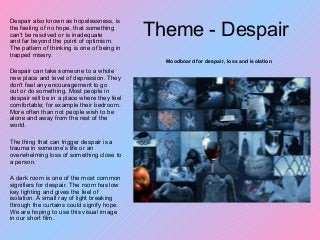
Theme - Despair
Despairalso known as hopelessness, is
the feeling of no hope, that something
can't be resolved or is inadequate
and far beyond the point of optimism.
The pattern of thinking is one of being in
trapped misery.
Despair can take someone to a whole
new place and level of depression. They
don't feel any encouragement to go
out or do something. Most people in
despair will be in a place where they feel
comfortable; for example their bedroom.
More often than not people wish to be
alone and away from the rest of the
world.
The thing that can trigger despair is a
trauma in someone’s life or an
overwhelming loss of something close to
a person.
A dark room is one of the most common
signifiers for despair. The room has low
key lighting and gives the feel of
isolation. A small ray of light breaking
through the curtains could signify hope.
We are hoping to use this visual image
in our short film.
Moodboard for despair, loss and isolation
6.
Narrative
Originally about agirl who has fallen into despair due to the loss
of her best friend. The story will be told through flashbacks and
voice overs as the young girl picks up objects which were
important to her and connected her to her best friend.
Although the story is based on the same principal of despair and
losing someone we decided the young girl will lose her sister
instead of her best friend. Our questionnaire told us that most
people have siblings which they are close to and they would be
more affected by their death.
7.
The point wewanted to pull out from our film was that through the
difficult times, things always will get better, we learn how to move on
and pick ourselves up.
8.
Target Audience
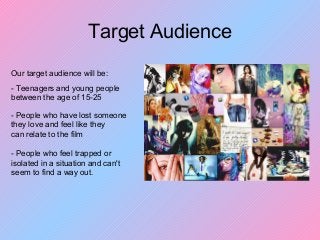
Our targetaudience will be:
- Teenagers and young people
between the age of 15-25
- People who have lost someone
they love and feel like they
can relate to the film
- People who feel trapped or
isolated in a situation and can't
seem to find a way out.
9.
Questionnaire
We created aquestionnaire and distributed it to young men and women around our school
to help us. We decided not to restrict our questionnaire to just women because we wanted
to see what the men's choices would be and whether we should use two men who are
bothers rather than two women who are sisters.
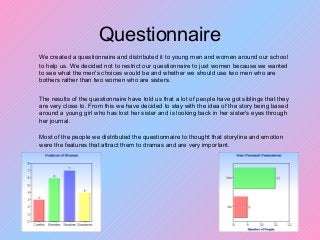
The results of the questionnaire have told us that a lot of people have got siblings that they
are very close to. From this we have decided to stay with the idea of the story being based
around a young girl who has lost her sister and is looking back in her sister's eyes through
her journal.
Most of the people we distributed the questionnaire to thought that storyline and emotion
were the features that attract them to dramas and are very important.
Location
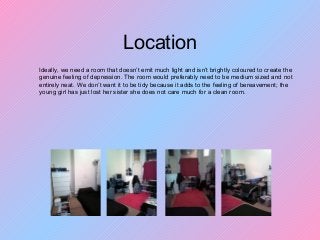
Ideally, we needa room that doesn’t emit much light and isn’t brightly coloured to create the
genuine feeling of depression. The room would preferably need to be medium sized and not
entirely neat. We don’t want it to be tidy because it adds to the feeling of bereavement; the
young girl has just lost her sister she does not care much for a clean room.
12.
Script
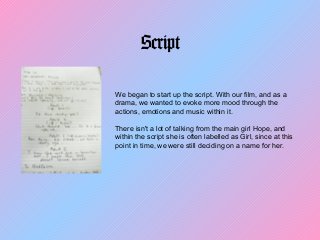
We began tostart up the script. With our film, and as a
drama, we wanted to evoke more mood through the
actions, emotions and music within it.
There isn't a lot of talking from the main girl Hope, and
within the script she is often labelled as Girl, since at this
point in time, we were still deciding on a name for her.
13.
Animatics
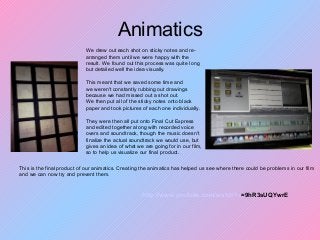
We drew outeach shot on sticky notes and re-
arranged them until we were happy with the
result. We found out this process was quite long
but detailed well the idea visually.
This meant that we saved some time and
we weren't constantly rubbing out drawings
because we had missed out a shot out.
We then put all of the sticky notes onto black
paper and took pictures of each one individually.
They were then all put onto Final Cut Express
and edited together along with recorded voice
overs and soundtrack, though the music doesn't
finalize the actual soundtrack we would use, but
gives an idea of what we are going for in our film,
so to help us visualize our final product.
http://www.youtube.com/watch?v=9hR3sUQYwrE
This is the final product of our animatics. Creating the animatics has helped us see where there could be problems in our film
and we can now try and prevent them.
14.
Props
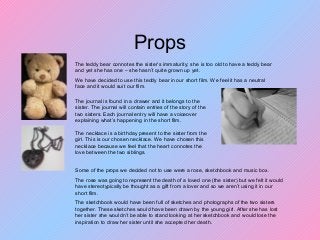
The necklace isa birthday present to the sister from the
girl. This is our chosen necklace. We have chosen this
necklace because we feel that the heart connotes the
love between the two siblings.
The teddy bear connotes the sister’s immaturity; she is too old to have a teddy bear
and yet she has one – she hasn’t quite grown up yet.
We have decided to use this teddy bear in our short film. We feel it has a neutral
face and it would suit our film.
The journal is found in a drawer and it belongs to the
sister. The journal will contain entries of the story of the
two sisters. Each journal entry will have a voiceover
explaining what’s happening in the short film.
Some of the props we decided not to use were a rose, sketchbook and music box.
The rose was going to represent the death of a loved one (the sister) but we felt it would
have stereotypically be thought as a gift from a lover and so we aren’t using it in our
short film.
The sketchbook would have been full of sketches and photographs of the two sisters
together. These sketches would have been drawn by the young girl. After she has lost
her sister she wouldn’t be able to stand looking at her sketchbook and would lose the
inspiration to draw her sister until she accepted her death.
15.
Casting
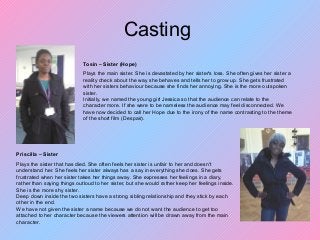
Tosin – Sister(Hope)
Plays the main sister. She is devastated by her sister's loss. She often gives her sister a
reality check about the way she behaves and tells her to grow up. She gets frustrated
with her sisters behaviour because she finds her annoying. She is the more outspoken
sister.
Initially, we named the young girl Jessica so that the audience can relate to the
character more. If she were to be nameless the audience may feel disconnected. We
have now decided to call her Hope due to the irony of the name contrasting to the theme
of the short film (Despair).
Priscilla – Sister
Plays the sister that has died. She often feels her sister is unfair to her and doesn't
understand her. She feels her sister always has a say in everything she does. She gets
frustrated when her sister takes her things away. She expresses her feelings in a diary,
rather than saying things outloud to her sister, but she would rather keep her feelings inside.
She is the more shy sister.
Deep down inside the two sisters have a strong sibling relationship and they stick by each
other in the end.
We have not given the sister a name because we do not want the audience to get too
attached to her character because the viewers attention will be drawn away from the main
character.



![Presentation2[1]](https://cdn.slidesharecdn.com/ss_thumbnails/presentation21-110218072235-phpapp02-thumbnail.jpg?width=640&height=640&fit=bounds)


