OF MALMÖ
                          MAPPING SUSTAINABILITY IN THE MALMÖ DNA


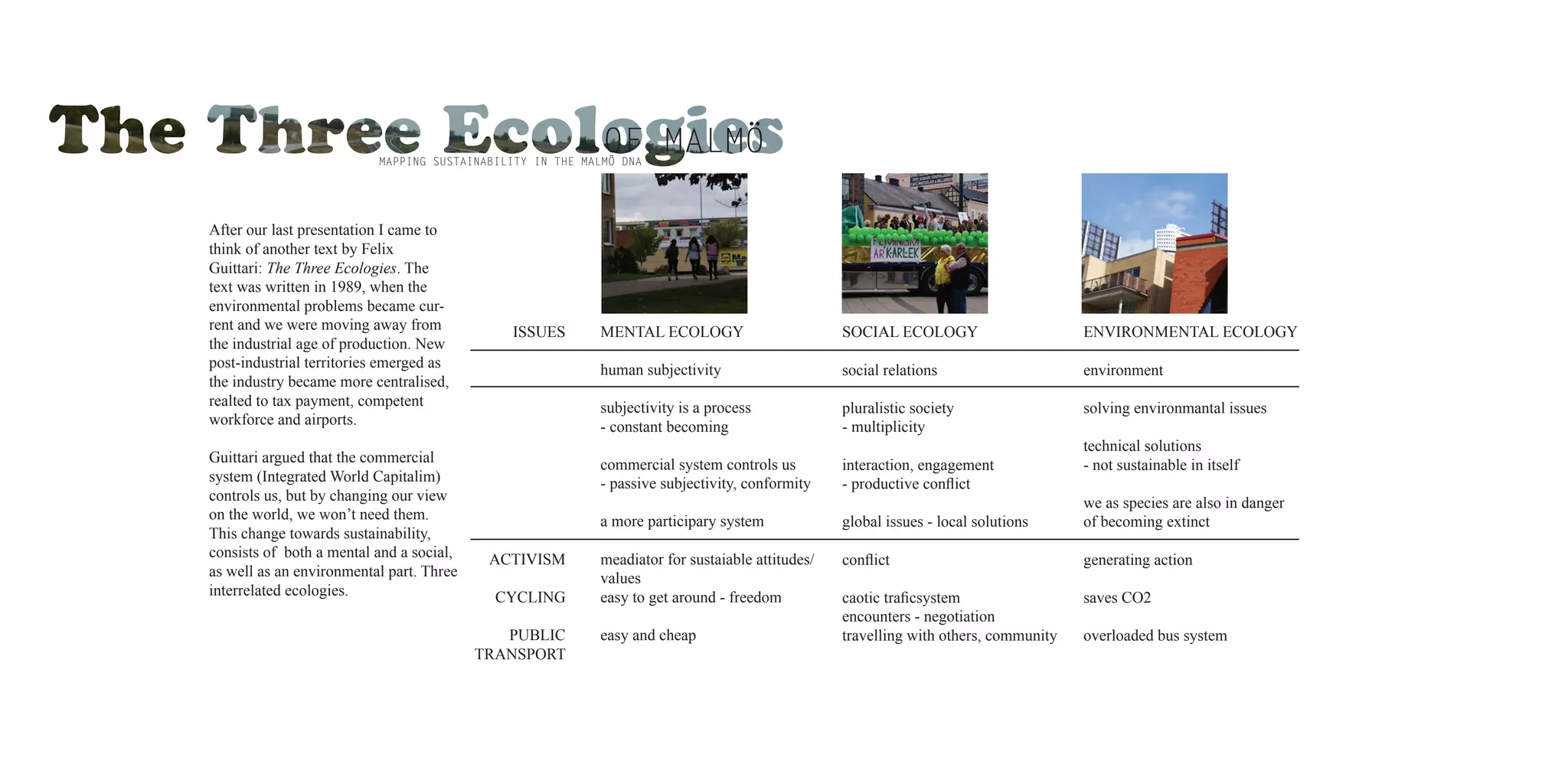
After our last presentation I came to
think of another text by Felix
Guittari: The Three Ecologies. The
text was written in 1989, when the
environmental problems became cur-
rent and we were moving away from            ISSUES       MENTAL ECOLOGY                        SOCIAL ECOLOGY                      ENVIRONMENTAL ECOLOGY
the industrial age of production. New
post-industrial territories emerged as                    human subjectivity                    social relations                    environment
the industry became more centralised,
realted to tax payment, competent                         subjectivity is a process             pluralistic society                 solving environmantal issues
workforce and airports.                                   - constant becoming                   - multiplicity
                                                                                                                                    technical solutions
Guittari argued that the commercial                       commercial system controls us         interaction, engagement             - not sustainable in itself
system (Integrated World Capitalim)                       - passive subjectivity, conformity    - productive conflict
controls us, but by changing our view                                                                                               we as species are also in danger
on the world, we won’t need them.                         a more participary system             global issues - local solutions     of becoming extinct
This change towards sustainability,
consists of both a mental and a social,    ACTIVISM       meadiator for sustaiable attitudes/   conflict                            generating action
as well as an environmental part. Three                   values
interrelated ecologies.                     CYCLING       easy to get around - freedom          caotic traficsystem                 saves CO2
                                                                                                encounters - negotiation
                                             PUBLIC       easy and cheap                        travelling with others, community   overloaded bus system
                                          TRANSPORT
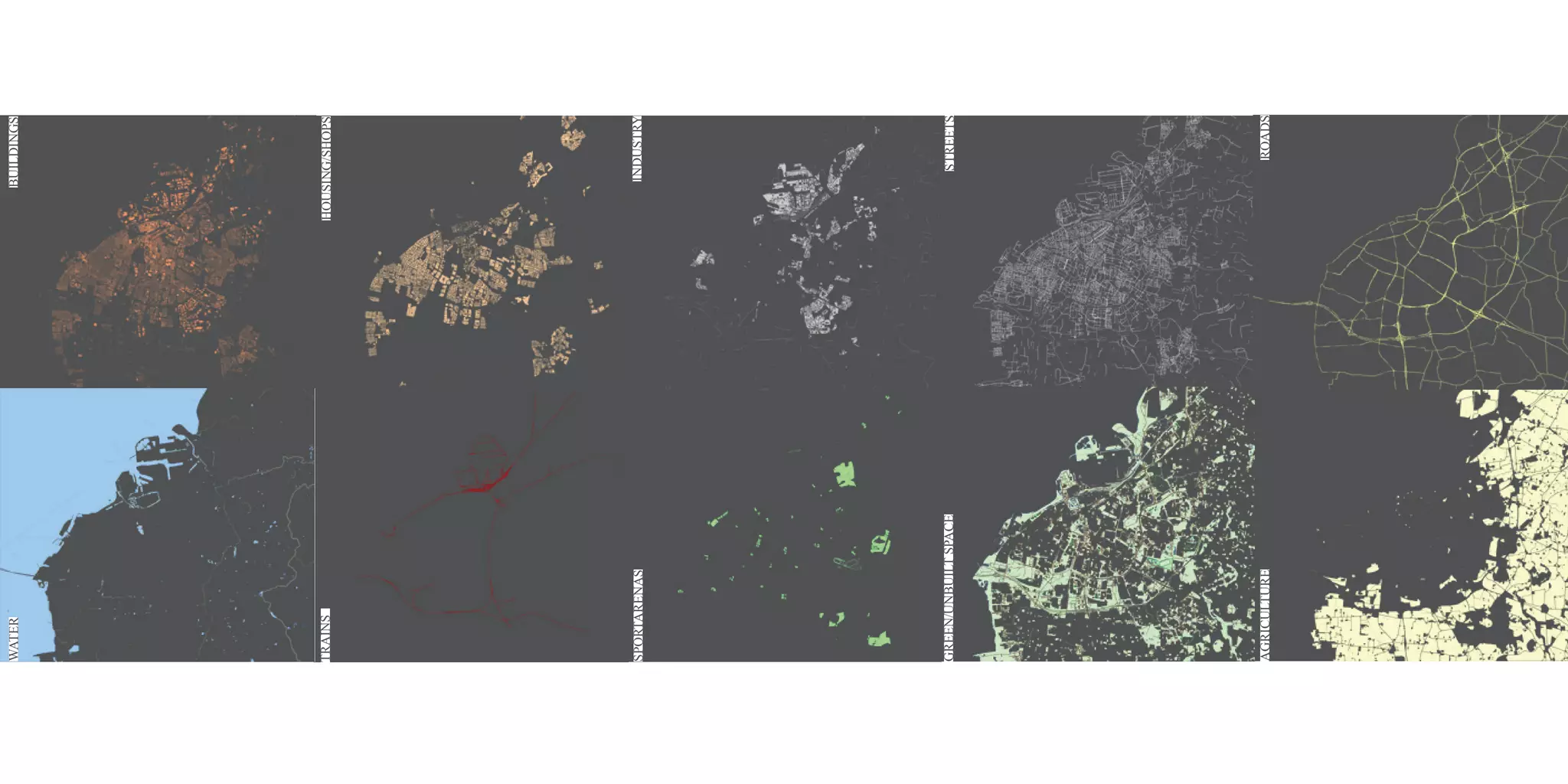
WATER                     BUILDINGS


TRAINS                HOUSING/SHOPS


SPORTARENAS               INDUSTRY


GREEN/UNBUILT SPACE         STREETS


AGRICULTURE                  ROADS
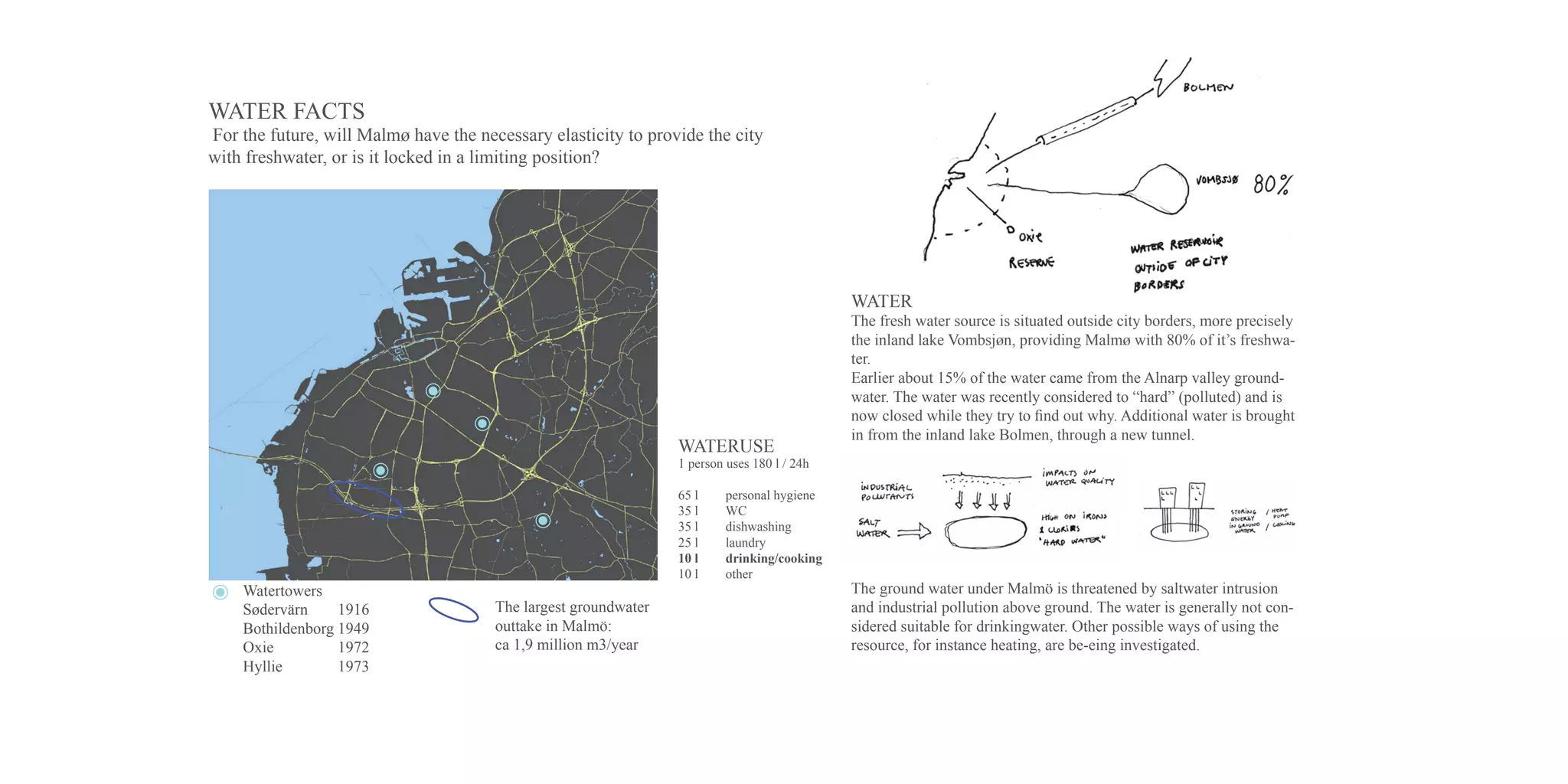
WATER FACTS
For the future, will Malmø have the necessary elasticity to provide the city
with freshwater, or is it locked in a limiting position?


                                                                                             WATER
                                                                                             The fresh water source is situated outside city borders, more precisely
                                                                                             the inland lake Vombsjøn, providing Malmø with 80% of it’s freshwa-
                                                                                             ter.
                                                                                             Earlier about 15% of the water came from the Alnarp valley ground-
                                                                                             water. The water was recently considered to “hard” (polluted) and is
                                                                                             now closed while they try to find out why. Additional water is brought
                                                                                             in from the inland lake Bolmen, through a new tunnel.
                                                                 WATERUSE
                                                                 1 person uses 180 l / 24h

                                                                 65 l     personal hygiene
                                                                 35 l     WC
                                                                 35 l     dishwashing
                                                                 25 l     laundry
                                                                 10 l     drinking/cooking
                                                                 10 l     other
    Watertowers                                                                              The ground water under Malmö is threatened by saltwater intrusion
    Sødervärn     1916                 The largest groundwater                               and industrial pollution above ground. The water is generally not con-
    Bothildenborg 1949                 outtake in Malmö:                                     sidered suitable for drinkingwater. Other possible ways of using the
    Oxie          1972                 ca 1,9 million m3/year                                resource, for instance heating, are be-eing investigated.
    Hyllie        1973
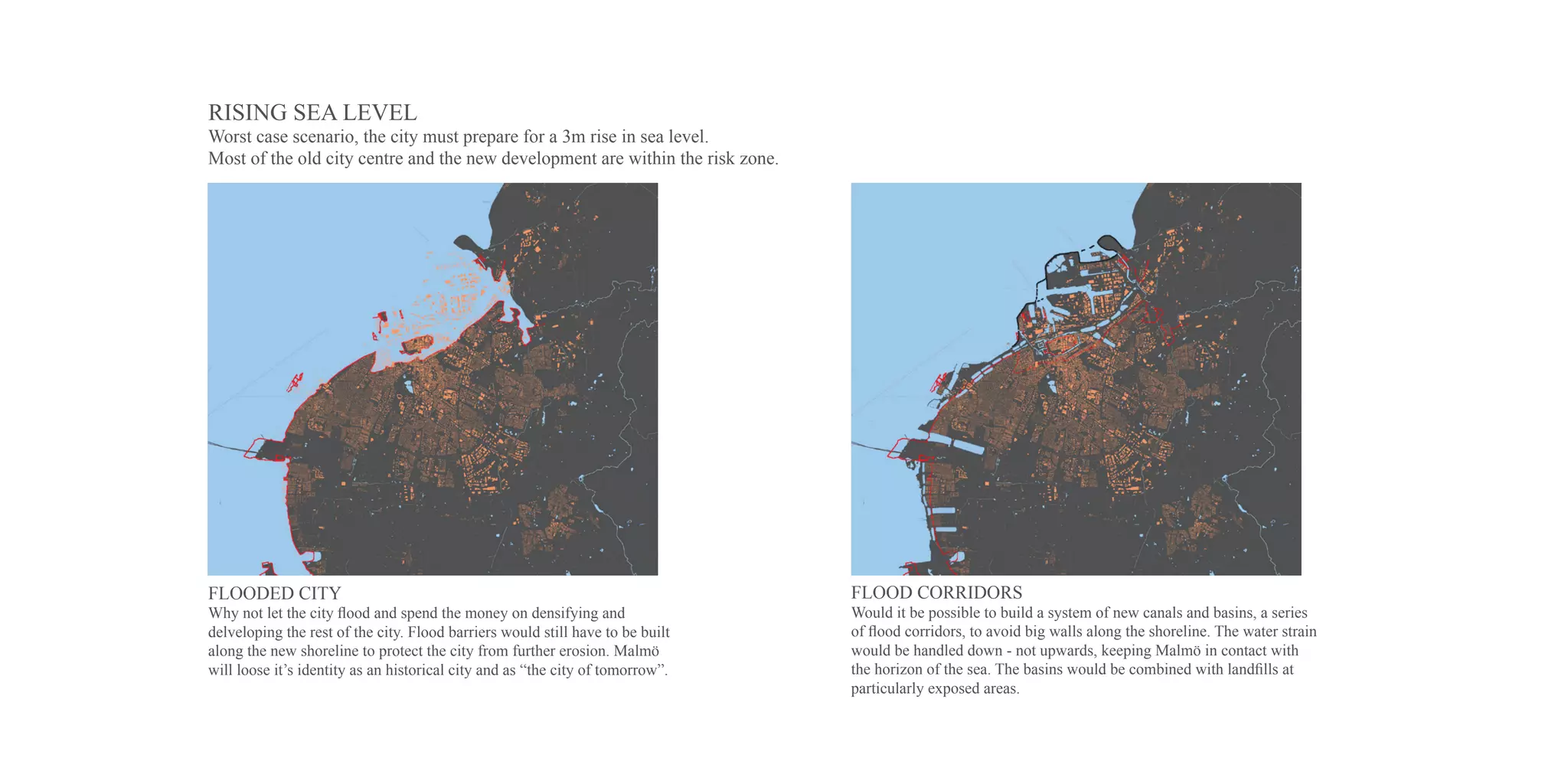
RISING SEA LEVEL
Worst case scenario, the city must prepare for a 3m rise in sea level.
Most of the old city centre and the new development are within the risk zone.


FLOODED CITY                                                                    FLOOD CORRIDORS
Why not let the city flood and spend the money on densifying and                Would it be possible to build a system of new canals and basins, a series
delveloping the rest of the city. Flood barriers would still have to be built   of flood corridors, to avoid big walls along the shoreline. The water strain
along the new shoreline to protect the city from further erosion. Malmö         would be handled down - not upwards, keeping Malmö in contact with
will loose it’s identity as an historical city and as “the city of tomorrow”.   the horizon of the sea. The basins would be combined with landfills at
                                                                                particularly exposed areas.
TRANSPORTATION


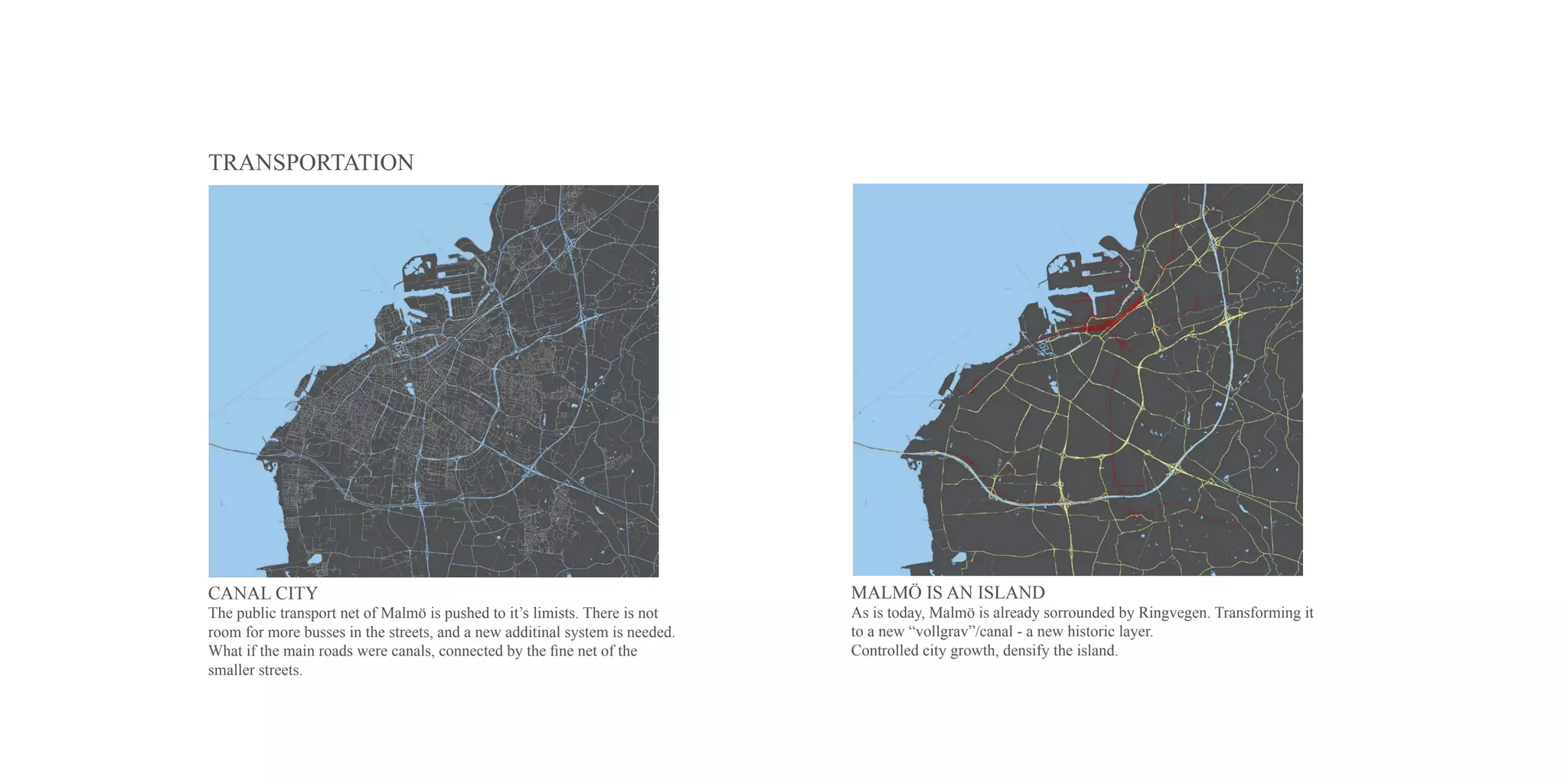
CANAL CITY                                                                   MALMÖ IS AN ISLAND
The public transport net of Malmö is pushed to it’s limists. There is not    As is today, Malmö is already sorrounded by Ringvegen. Transforming it
room for more busses in the streets, and a new additinal system is needed.   to a new “vollgrav”/canal - a new historic layer.
What if the main roads were canals, connected by the fine net of the         Controlled city growth, densify the island.
smaller streets.
LANDUSE
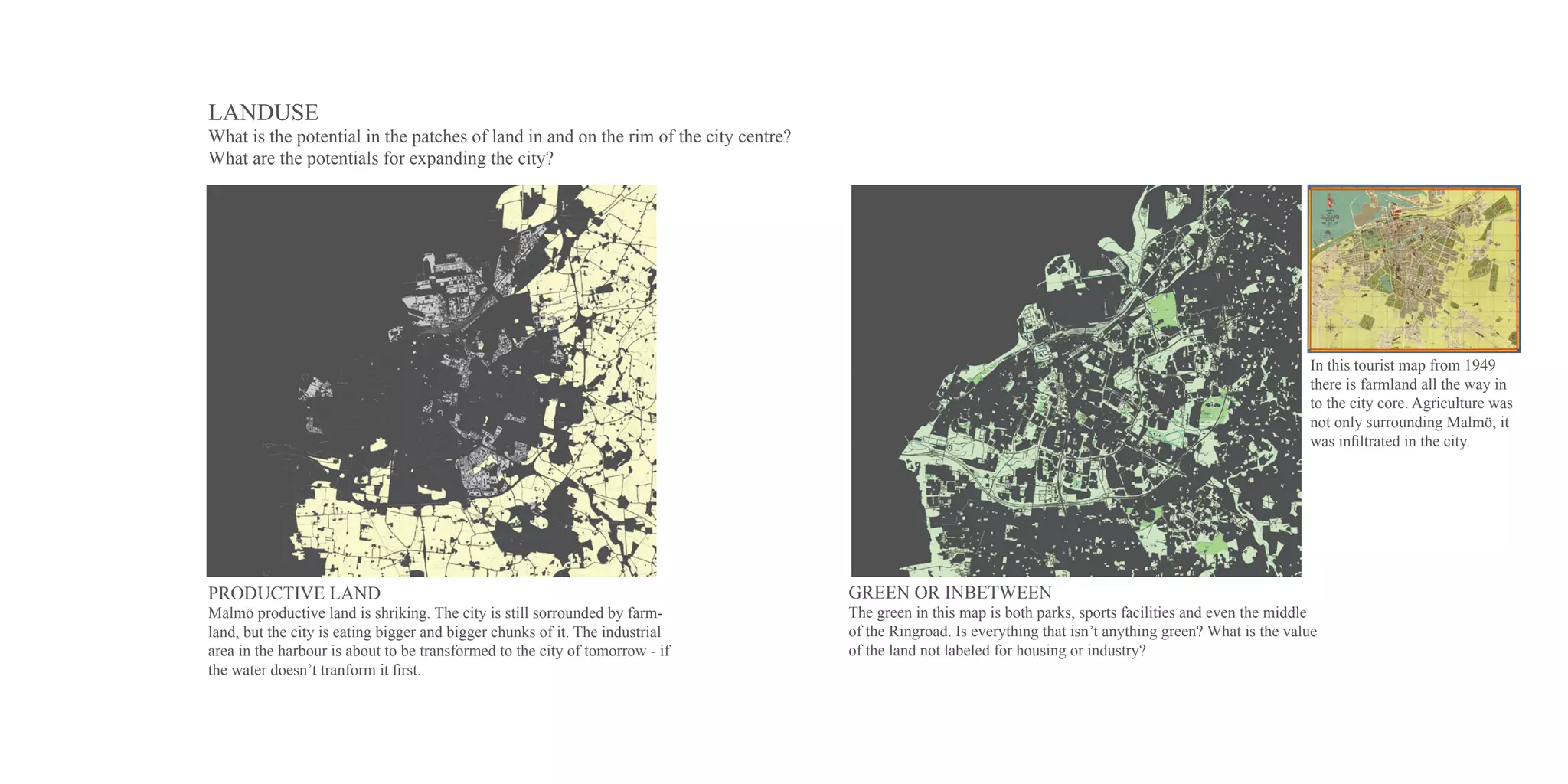
What is the potential in the patches of land in and on the rim of the city centre?
What are the potentials for expanding the city?


                                                                                                                                                              In this tourist map from 1949
                                                                                                                                                              there is farmland all the way in
                                                                                                                                                              to the city core. Agriculture was
                                                                                                                                                              not only surrounding Malmö, it
                                                                                                                                                              was infiltrated in the city.


PRODUCTIVE LAND                                                                      GREEN OR INBETWEEN
Malmö productive land is shriking. The city is still sorrounded by farm-             The green in this map is both parks, sports facilities and even the middle
land, but the city is eating bigger and bigger chunks of it. The industrial          of the Ringroad. Is everything that isn’t anything green? What is the value
area in the harbour is about to be transformed to the city of tomorrow - if          of the land not labeled for housing or industry?
the water doesn’t tranform it first.
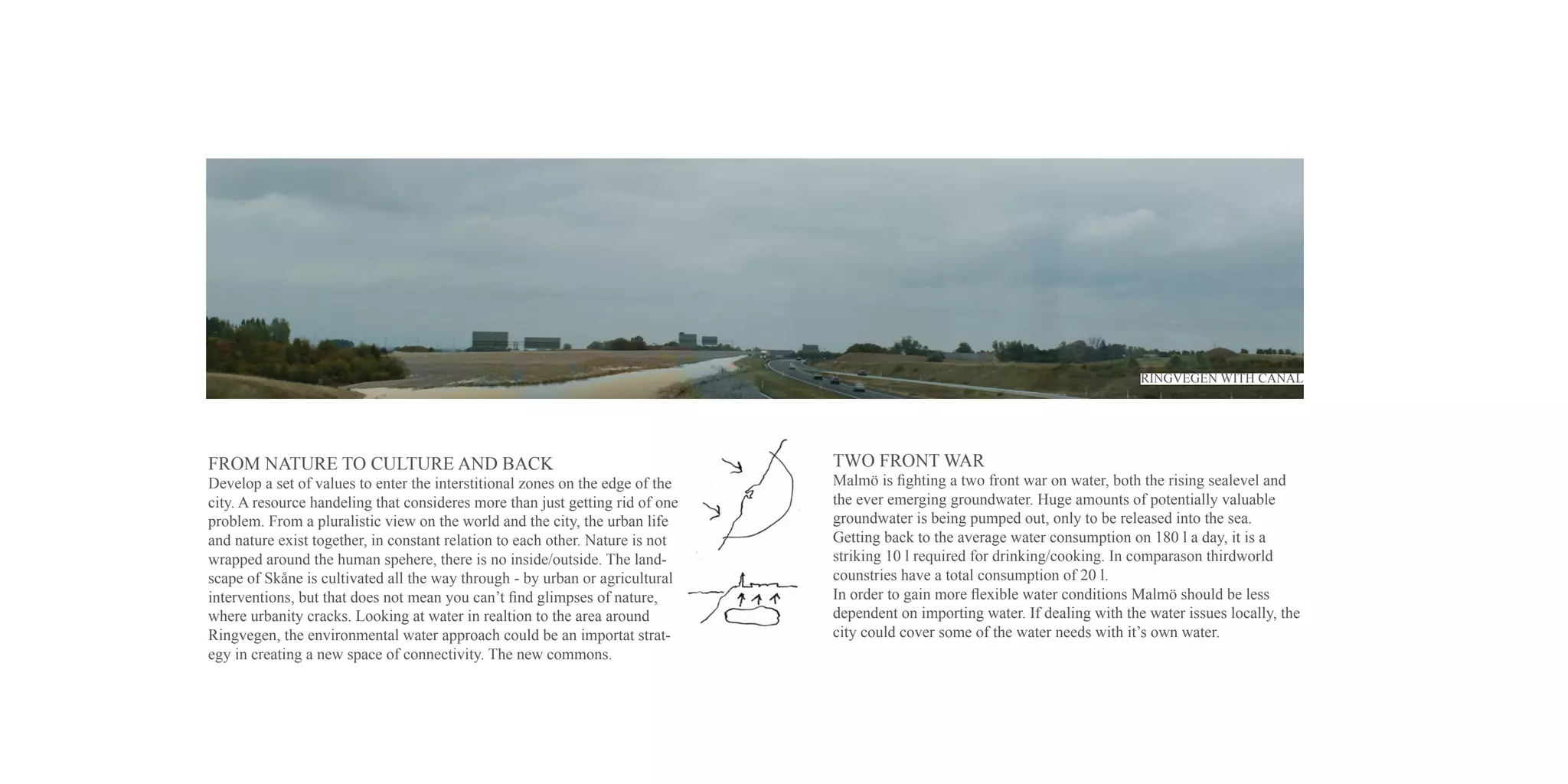
RINGVEGEN WITH CANAL


FROM NATURE TO CULTURE AND BACK                                                TWO FRONT WAR
Develop a set of values to enter the interstitional zones on the edge of the   Malmö is fighting a two front war on water, both the rising sealevel and
city. A resource handeling that consideres more than just getting rid of one   the ever emerging groundwater. Huge amounts of potentially valuable
problem. From a pluralistic view on the world and the city, the urban life     groundwater is being pumped out, only to be released into the sea.
and nature exist together, in constant relation to each other. Nature is not   Getting back to the average water consumption on 180 l a day, it is a
wrapped around the human spehere, there is no inside/outside. The land-        striking 10 l required for drinking/cooking. In comparason thirdworld
scape of Skåne is cultivated all the way through - by urban or agricultural    counstries have a total consumption of 20 l.
interventions, but that does not mean you can’t find glimpses of nature,       In order to gain more flexible water conditions Malmö should be less
where urbanity cracks. Looking at water in realtion to the area around         dependent on importing water. If dealing with the water issues locally, the
Ringvegen, the environmental water approach could be an importat strat-        city could cover some of the water needs with it’s own water.
egy in creating a new space of connectivity. The new commons.

Oppgave 3 elasticity

  • 1.
    OF MALMÖ MAPPING SUSTAINABILITY IN THE MALMÖ DNA After our last presentation I came to think of another text by Felix Guittari: The Three Ecologies. The text was written in 1989, when the environmental problems became cur- rent and we were moving away from ISSUES MENTAL ECOLOGY SOCIAL ECOLOGY ENVIRONMENTAL ECOLOGY the industrial age of production. New post-industrial territories emerged as human subjectivity social relations environment the industry became more centralised, realted to tax payment, competent subjectivity is a process pluralistic society solving environmantal issues workforce and airports. - constant becoming - multiplicity technical solutions Guittari argued that the commercial commercial system controls us interaction, engagement - not sustainable in itself system (Integrated World Capitalim) - passive subjectivity, conformity - productive conflict controls us, but by changing our view we as species are also in danger on the world, we won’t need them. a more participary system global issues - local solutions of becoming extinct This change towards sustainability, consists of both a mental and a social, ACTIVISM meadiator for sustaiable attitudes/ conflict generating action as well as an environmental part. Three values interrelated ecologies. CYCLING easy to get around - freedom caotic traficsystem saves CO2 encounters - negotiation PUBLIC easy and cheap travelling with others, community overloaded bus system TRANSPORT
  • 2.
    WATER BUILDINGS TRAINS HOUSING/SHOPS SPORTARENAS INDUSTRY GREEN/UNBUILT SPACE STREETS AGRICULTURE ROADS
  • 3.
    WATER FACTS For thefuture, will Malmø have the necessary elasticity to provide the city with freshwater, or is it locked in a limiting position? WATER The fresh water source is situated outside city borders, more precisely the inland lake Vombsjøn, providing Malmø with 80% of it’s freshwa- ter. Earlier about 15% of the water came from the Alnarp valley ground- water. The water was recently considered to “hard” (polluted) and is now closed while they try to find out why. Additional water is brought in from the inland lake Bolmen, through a new tunnel. WATERUSE 1 person uses 180 l / 24h 65 l personal hygiene 35 l WC 35 l dishwashing 25 l laundry 10 l drinking/cooking 10 l other Watertowers The ground water under Malmö is threatened by saltwater intrusion Sødervärn 1916 The largest groundwater and industrial pollution above ground. The water is generally not con- Bothildenborg 1949 outtake in Malmö: sidered suitable for drinkingwater. Other possible ways of using the Oxie 1972 ca 1,9 million m3/year resource, for instance heating, are be-eing investigated. Hyllie 1973
  • 4.
    RISING SEA LEVEL Worstcase scenario, the city must prepare for a 3m rise in sea level. Most of the old city centre and the new development are within the risk zone. FLOODED CITY FLOOD CORRIDORS Why not let the city flood and spend the money on densifying and Would it be possible to build a system of new canals and basins, a series delveloping the rest of the city. Flood barriers would still have to be built of flood corridors, to avoid big walls along the shoreline. The water strain along the new shoreline to protect the city from further erosion. Malmö would be handled down - not upwards, keeping Malmö in contact with will loose it’s identity as an historical city and as “the city of tomorrow”. the horizon of the sea. The basins would be combined with landfills at particularly exposed areas.
  • 5.
    TRANSPORTATION CANAL CITY MALMÖ IS AN ISLAND The public transport net of Malmö is pushed to it’s limists. There is not As is today, Malmö is already sorrounded by Ringvegen. Transforming it room for more busses in the streets, and a new additinal system is needed. to a new “vollgrav”/canal - a new historic layer. What if the main roads were canals, connected by the fine net of the Controlled city growth, densify the island. smaller streets.
  • 6.
    LANDUSE What is thepotential in the patches of land in and on the rim of the city centre? What are the potentials for expanding the city? In this tourist map from 1949 there is farmland all the way in to the city core. Agriculture was not only surrounding Malmö, it was infiltrated in the city. PRODUCTIVE LAND GREEN OR INBETWEEN Malmö productive land is shriking. The city is still sorrounded by farm- The green in this map is both parks, sports facilities and even the middle land, but the city is eating bigger and bigger chunks of it. The industrial of the Ringroad. Is everything that isn’t anything green? What is the value area in the harbour is about to be transformed to the city of tomorrow - if of the land not labeled for housing or industry? the water doesn’t tranform it first.
  • 7.
    RINGVEGEN WITH CANAL FROMNATURE TO CULTURE AND BACK TWO FRONT WAR Develop a set of values to enter the interstitional zones on the edge of the Malmö is fighting a two front war on water, both the rising sealevel and city. A resource handeling that consideres more than just getting rid of one the ever emerging groundwater. Huge amounts of potentially valuable problem. From a pluralistic view on the world and the city, the urban life groundwater is being pumped out, only to be released into the sea. and nature exist together, in constant relation to each other. Nature is not Getting back to the average water consumption on 180 l a day, it is a wrapped around the human spehere, there is no inside/outside. The land- striking 10 l required for drinking/cooking. In comparason thirdworld scape of Skåne is cultivated all the way through - by urban or agricultural counstries have a total consumption of 20 l. interventions, but that does not mean you can’t find glimpses of nature, In order to gain more flexible water conditions Malmö should be less where urbanity cracks. Looking at water in realtion to the area around dependent on importing water. If dealing with the water issues locally, the Ringvegen, the environmental water approach could be an importat strat- city could cover some of the water needs with it’s own water. egy in creating a new space of connectivity. The new commons.